
Judge, 1931-03-28 · page 24 of 36
Judge — March 28, 1931 — page 24: what you’re looking at
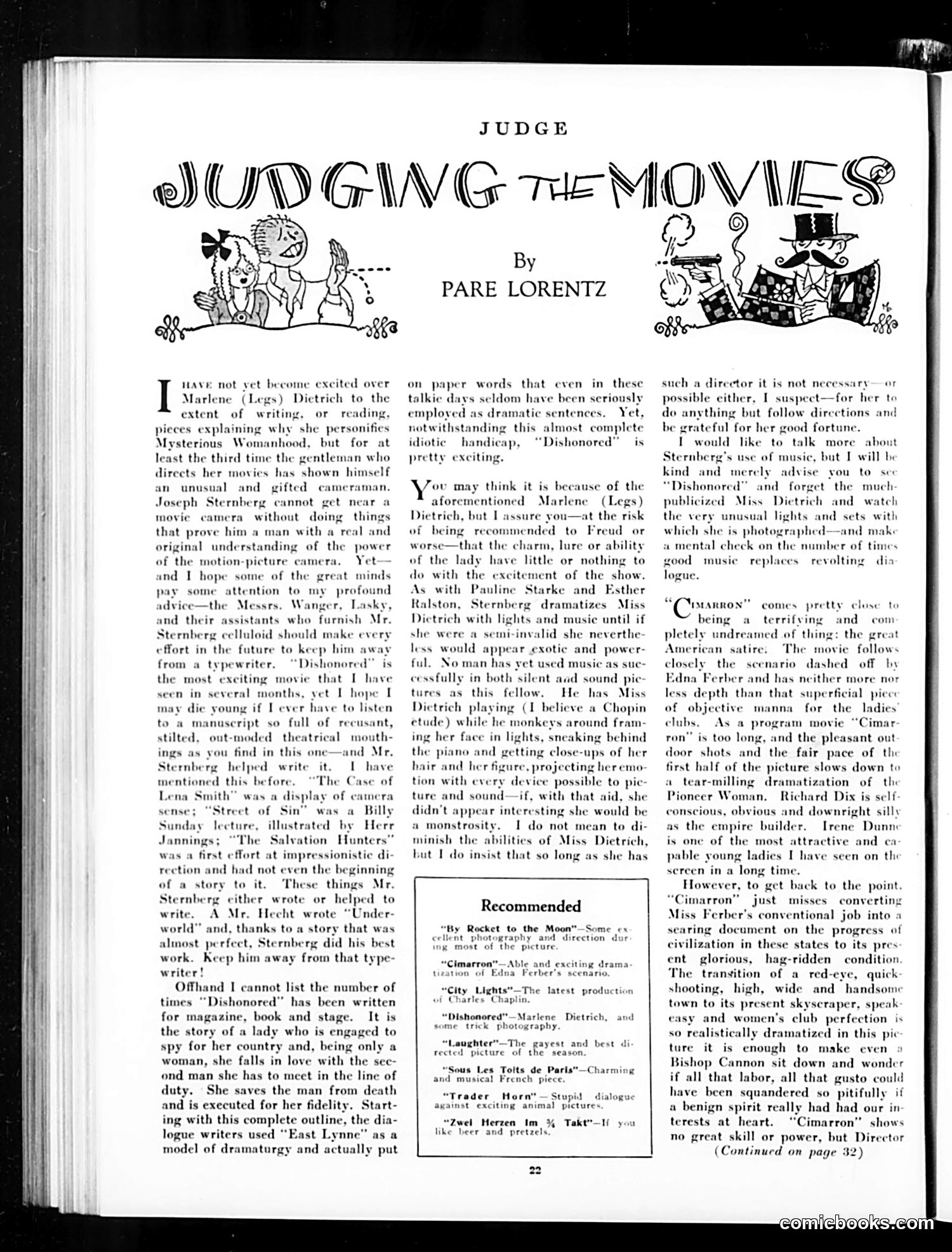
A restored page from Judge, 1931-03-28. Page through the whole issue in the reader above.
📄 Transcribed text from this page (OCR, searchable)
Machine-transcribed from the original scan — historical spelling and the odd misread are preserved.
HAVE not vet become excited over Marlene (Legs) Dietrich to the extent of writing, or reading, pieces explaining why she personifies Mysterious Womanhood, but for at least the third time the gentleman who directs her movies has shown himself an unusual and gifted cameraman. Joseph Sternberg cannot get near a movie without doing things at prove him a man with a real and ginal understanding of the of the motion-picture camera. Yet ind I hope some of the great minds pay some attention to my profound udvice—the Messrs. W. Lasky, and their assistants who furnish Mr. Sternberg celluloid should m: effort in the future to keep him away from a typewriter. camera power rer, p every *‘Dishonored” is that I seen in several months, yet I hope I the most exciting movie have may die young if I ever have to listen full of wled theatrical to a manuscript so stilted, out-r ings as you find in this one Stern helped mentioned this before. “The Lena Smith” was a display of camera ; “Street of Sin” 1 Billy lecture, illustrated by Herr ‘The Salvation i was a first effort at impressionistic di rection and had not even the beginning of a story to it. These things Mr. Sternberg cither wrote or helped to write. A Mr. Hecht wrote “Under- world” and, thanks to a story that was almost perfect, Sternberg did his best work. Keep him away from that type- writer! Offhand I cannot list the number of times “Dishonored” has been written for magazine, book and stage. It is the story of a lady who is engaged to spy for her country and, being only a woman, she falls in love with the sec- ond man she has to meet in the line of duty. She saves the man from dea and is executed for her fidelity. Start- ing with this complete outline, the dia- logue writers used “East Lynne” as a model of dramaturgy and actually put recusant, mouth- and Mr. write it. IL have Case of sen was Sunday Jannings; JUDGE JIUVDGWG r=MOVILS By PARE LORENTZ on paper words that even in. these talkie days seldom have be employed as dramatic sent notwithstandin idiotic pretty exciti n seriously Yet, this almost complete licap, ‘“Dishonored” is neces. ay think it is because of the aforementioned Marlene (Legs) Dietrich, but I assure you—at the risk of being recommended to Freud or worse—that the charm, lure or ability of the lady have little or nothing to with the excitement of the show. As with Pauline Starke and Esther Ralston, Sternberg dramatizes Miss Dietrich with lights and music until if she were a semi-invalid she neverthe less would appear exotic and power- ful. No man has yet used music as suc- cessfully in both silent aad sound pic tures as this fellow. He has Miss Dietrich playing (1 believe a Chopin etude) while he monkeys around fram- ing her face in lights, sneaking behind the piano and getting close-ups of her hair and her figure, projecting her emo tion with every device possible to pic- ture and sound—if, with that aid, she didn’t appear interesting she would be a monstrosity. I do not mean to di- minish the abilities of Miss Dietrich, but I do insist that so long as she has r Recommended “By Rocket to the Moon”—Some ex t tography and direction dur the picture and exciting dr. “Cimarron” —Able tion 0 Ferber's scenar tie Ed “City Lights” latest production oi Charles Ch ‘Dishonored”—Marlene Dietrich, and me trick photography The gayest best di of the season “Sous Les Toits de Paris"—Charming and musical French piece Trader Horn™— Stupid st exciting animal pictur logue “Zwel Herzen Im % Takt™—Ii you Hk rand pretzels. [Se ree 2? Ye such a director it is not necessary— or possible either, I suspect—for her to do anything but follow directions and be grateful for her good fortune. I would like to talk Sternberg’s use of mus kind and merely “Dishonored” more advise you to and forget the much publicized Miss Dietrich and watch the very unusual lights and sets with nd make a mental check on the number of times good music logue. “( “iatarnon” which she is photographed- replaces revolting dia comes pretty close to being and pletely undreamed of thing: the great American satire. The movie follows closely the dashed off by Edna Ferber and has neither more nor less depth than that superficial pice: of objective ma clubs, terrifying com scenario As a prog ron” is too long, and the pleasant out door shots and the fair pace of th first half of the picture slows down to a tear-milling dramatization of | the Pioneer Woman. Richard Dix is self conscious, obvious and downright silly as the empire builder. Irene Dunn: of the most attractive and ca » seen on the sereen in a long time. ver, to get rk to the point, just misses convertin, ber's conventional job into a ring document on the progress of civilization in these states to its pres ent glorious, hag-ridden condition The transition of a red-eye, quick shooting, high, wide and handsome town to its present skyscraper, spe. and women’s club perfection is so realistically dram 1 in this pic ture it is enough to make even Bishop Cannon sit down and wonder if all that labor, all that gusto could have been squandered so pitifully if a benign spirit really had had our in terests at heart. Cimarron” shows no great skill or power, but Director (Continued on page 32)