
Judge, 1931-03-28 · page 18 of 36
Judge — March 28, 1931 — page 18: what you’re looking at
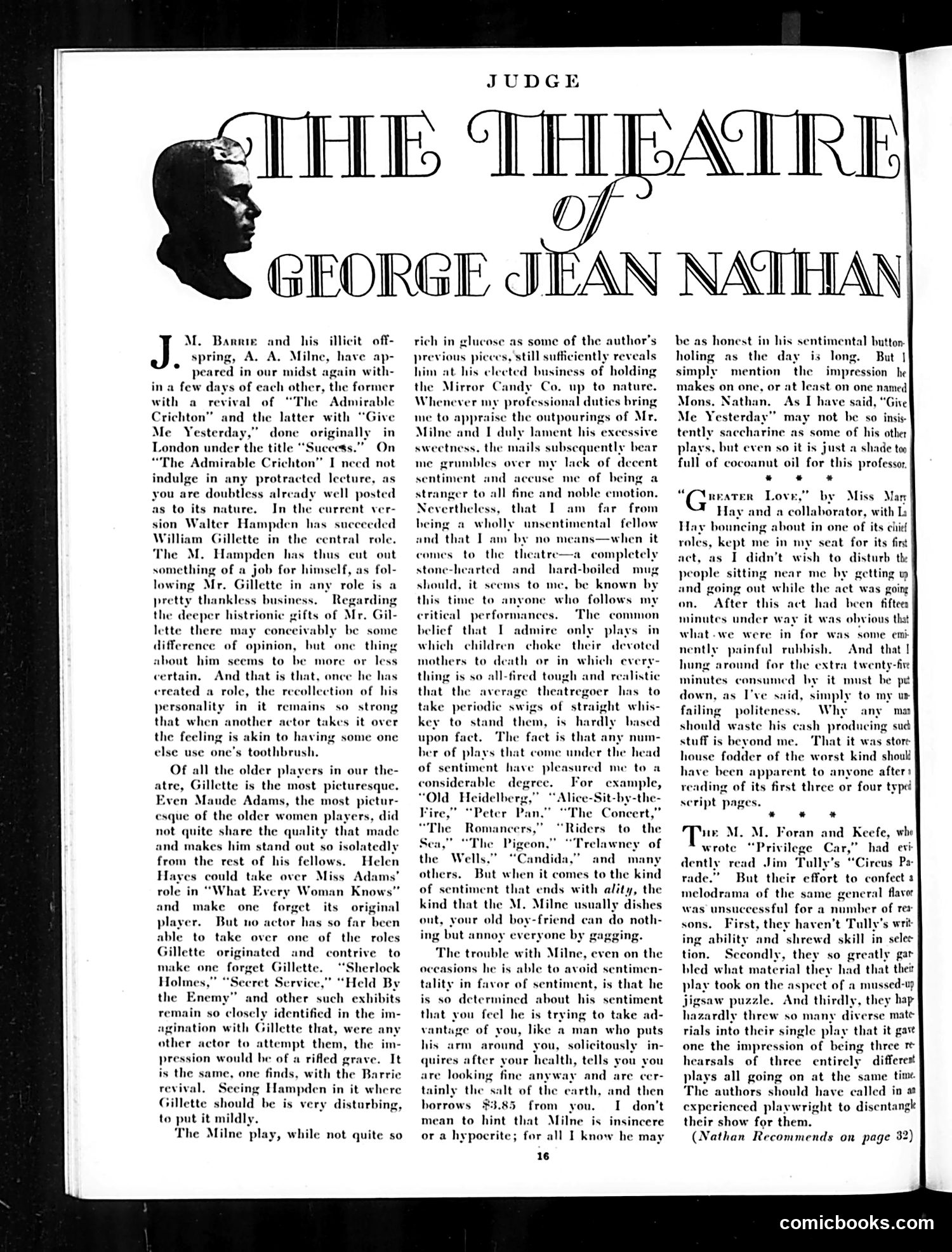
A restored page from Judge, 1931-03-28. Page through the whole issue in the reader above.
📄 Transcribed text from this page (OCR, searchable)
Machine-transcribed from the original scan — historical spelling and the odd misread are preserved.
JUDGE O GEORGE J M. Barre and his illicit off- spring, A. A. Milne, have ap- ° peared in our midst again with- ina few ¢ other, the former with a re of “The Admi Crichton” and the latter with * Me Yesterday,” done origin London under the title “Success “The Admirable Crichton” I need not indulge in any protracted lecture, as you are doubtless already well posted as to its nature. In the current ver- sion Walter Hampden has succeeded William Gillette in the central role. The M. Hampden has thus cut out something of a job for himself, as fol- lowing Mr. Gillette in any role is a pretty thankless business. Regarding the deeper histrionic gifts of Mr. Gil- lette there may conceivably be some difference of opinion, but one thing about: hi cer And that is that, once he has created a role, the recollection of his personality in it remains so that wh another actor takes it over the feeling is akin to having some one else use one’s toothbrush, seems to be more or less strong Of all the older players in our the- atre, Gillette is the most picturesque. Even Maude Adams, the most pictur- esque of the older women players, did not quite share the quality that made and makes him stand out so isolatedly from the rest of his fellows. Helen Hayes could take over Miss Adams’ role in “What Every Woman Knows and make one forget its original pl: But no actor has so far been able to take over one of the roles Gillette originated and contrive to make one forget Gillette. “Sherlock Holmes,” “Secret Serv Held By the Enemy” and other such exhibits remain so closely identified in the im- F n with Gillette that, were other actor to attempt them, the pression would be of a rifled grave. It is the same, one finds, with the Barrie revival. Seeing Hampden in it where Gillette should be is very disturbing, to put it mildly. The Milne play, while not quite so rich in glucose as some of the author’s previous picces, still sufficiently reve him at his elected business of holding the Mirror Candy Co. up to nature. Whenever my professional duties bring me to appraise the outpourings of Mr, Milne and I duly lament his excessive sweetness, the mails subsequently bear me grumbles over my lack of decent sentiment and accuse me of being a stranger to all fine and noble emotion, Nevertheless, that I am far from being a wholly unsentimental fellow and that Tam’ by no means—when it comes to the theatre—a_ completely stone-hearted and hard-boiled mug should, it seems to me, be known by this time to anyone who follows my 1 performances. ft which children mothers to dea thing is so all that the take periodic swigs of key to stand them, is hardly based upon fact. The fact is that any num- her of plays that come under the head of sentiment have pleasured me to a considerable degree. “Old Heidelbe ore,” “Peter Pa Romancers,” The common only their mire choke verage straight whis- For example, “Alice-Sit-by-the- “The Concert,” “Riders to the The Pigeon.” “Trelawney of the Wells.” “Candid and = many others. But when it comes to the kind of sentiment that ends with ality, the kind that the M. Milne usually dishes out, your old boy-friend can do noth- ing but annoy everyone by gagging. The trouble with Milne, even on the oceasions he is able to avoid sentimen- ality in favor of sentiment, is that he is so determined about his sentiment that you feel he is trying to take ad- vantage of you, like a man who puts his arm around you, solicitously in- quires after your health, tells you you are looking fine anyway and are cer- tainly the salt of the earth, and then borrows $3.85 from you. I don't mean to hint that Milne is insincere or a hypocrite; for all I know he may 16 AIRE NATHAN be as honest in his sentimental button- holing as the day is long. But | simply mention the impression he on one, or at least on one named Mons. Nathan. As I have said, “Gi Me Yesterday” may not be so insi tently saccharine as some of his other plays, but even so it is just a shade too full of cocoanut oil for this professor, * # “Grater Love,” by Miss Marr Hay and a collaborator, with Ls Hay bouncing about in one of its chi roles, kept me in my seat for its fint act, as I didn’t wish to disturb the people sitting near me by getting » and going out while the act was going on, After this act had been fiftees minutes under way it was obvious thst what .w in for was some emi nently painful rubbish. And that | hung around for the extra twenty-five minutes consumed by it must be pe down, as I’ve said, simply to my ur failing politeness. Why any ma should waste his cash producing sud stuff is bevond me. That it was store house fodder of the worst kind shoul! have been apparent to anyone afters reading of its first three or four typed script pages. “ *# * TT M. wrote were Foran and Keefe, whe aime Car,” had evi dently read Jim Tully's ireus Pa- rade.” But their effort to confect melodrama of the same general flaver was unsuccessful for a number of ret sons. First, they haven't Tully's writ ing ability and shrewd skill in selec tion. Sccondly, they so greatly gar Wed what material they had that their play took on the aspect of a mussed-up igsaw puzzle. And thirdly, they hap hazardly threw so many diverse mate rials into their single play that it gave one the impression of being three hearsals of three entirely differest plays all going on at the same time The authors should have called in experienced playwright to disentangk their show for them. (Nathan Recommends on page 32) comicbooks.com