
Judge, 1931-03-28 · page 15 of 36
Judge — March 28, 1931 — page 15: what you’re looking at
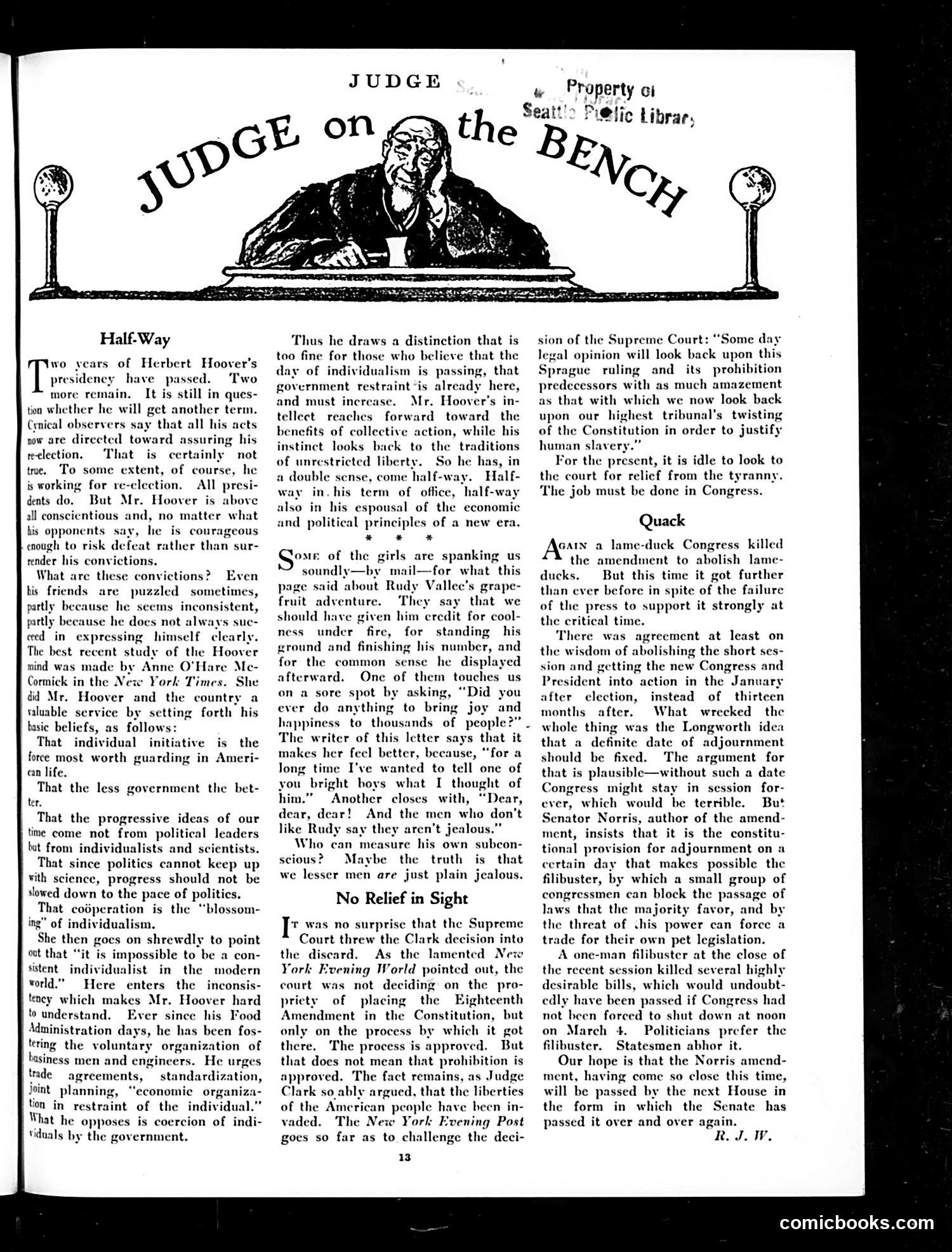
A restored page from Judge, 1931-03-28. Page through the whole issue in the reader above.
📄 Transcribed text from this page (OCR, searchable)
Machine-transcribed from the original scan — historical spelling and the odd misread are preserved.
Half-Way wo years of Herbert Hoover's presidency have passed. Two more remain. It is still in ques- tion whether he will get another term. Cmnical observers say that all his acts sow are directed toward assuring his reelection, That is certainly not tee. To some extent, of course, he is working for re-election. All presi- dents do. But Mr. Hoover is above all conscientious and, no matter what his opponents say, he is courageous enough to risk defeat rather than sur- render his convictions, What are these convictions? Even tis friends are puzzled sometimes, partly because he seems inconsistent, partly because he does not always suc- ced in expressing himself clearly. The best recent study of the Hoover nind was made by Anne O'Hare Me- Cormick in the New York Times. She did Mr. Hoover and the country a saluable service by setting forth his basic beliefs, as follow That individual ii tive is the force most worth guarding in Ameri- an life. That the less government the bet- ter, That the progressive ideas of our time come not from political leaders tat from individualists and scientists. That since politics cannot keep up vith science, progress should not be slowed down to the pace of politics. That codperation is the * ing” of individualism. She then goes on shrewdly to point out that “it is impossible to be a con- sistent individualist in the modern world.” Here enters the inconsis- tency which makes Mr. Hoover hard to understand. Ever since his Food Administration days, he has been fos- tering the voluntary organization of tusiness men and engineers. He urges trade agreements, ndardization, Joint planning, “economic organiza- tion in restraint of the individual. What he opposes is coercion of indi- ‘duals by the government. blossom- Thus he draws a distinction that is too fine for those who believe that the day of individualism is passing, that government restraint “is already here, and must increase. Mr. Hoover's in- tellect reaches forward toward the benefits of collective action, while his instinct looks back to the t of unrestricted liber! So he a double sense, come half-way. Half- way in.his term of office, half-way also in his espousal of the economic and political principles of a new era. * * # Some of the girls are spanking us soundly—by mail—for what this. page said about Rudy Vallee’s grape- fruit adventure. They say that we should have given him credit for cool- ness under fire, for standing his ground and finishing his number, and for the common sense he displayed afterward. One of them touches us on a sore spot by asking, “Did you ever do anything to bring joy and happiness to thousands of people?” - The writer of this letter says that it makes her feel better, because, “for a long time I’ve wanted to tell one of you bright boys what I thought of him.” Another closes with, “Dear, dear, dear! And the men who don’t like Rudy say they aren't jealous.” Who can measure his own subcon- scious? Maybe the truth is that we lesser men are just plain jealous. No Relief in Sight T was no surprise that the Supreme Court threw the Clark decision into the discard. As the lamented New York Evening World pointed out, the court was not deciding on the pro- priety of placing the Eighteenth Amendment in the Constitution, but only on the process by which it got there. The process is approved. But that does not mean that prohibition is approved. The fact remains, as Judge Clark so ably argued, that the liberties of the American people have been in- vaded. The New York Evening Post goes so far as to challenge the deci- 13 @lic Librar, sion of the Supreme Court: “Some day legal opinion will look back upon this. Sprague ruling and its prohibition predecessors with as much amazement as that with which we now look back upon our highest tribunal's twisting of the Constitution in order to justify human slavery.” For the present, it is idle to look to the court for relief from the tyranny. The job must be done in Congress. Quack Aor a lame-duck Congress killed the amendment to abolish lame- ducks. But this time it got further than ever before in spite of the failure of the press to support it strongly at the critical time. recment at least on the wisdom of bolishing the short ses- sion and getting the new Congress and President into action in the January after election, instead of thirteen months after. What wrecked the whole thing was the Longworth idea that a definite date of adjournment should be fixed. The argument for that is plausible—without such a date Congress might stay in session for- ever, which would be terrible. But Senator Norris, author of the amend- ment, insists that it is the constitu- tional provision for adjournment on a certain day that makes possible the filibuster, by which a small group of congressmen can block the passage of laws that the majority favor, and by the threat of .his power can force a trade for their own pet legislation. A one-man filibuster at the close of the recent session killed several highly desirable bills, which would undoubt- edly have been passed if Congress had not been forced to shut down at noon on March Politicians prefer the filibuster. Statesmen abhor i Our hope is that the Norris amend- ment, having come so close this time, will be passed by the next House in the form in which the Senate has passed it over and over again. R.J.W. comicbooks.com