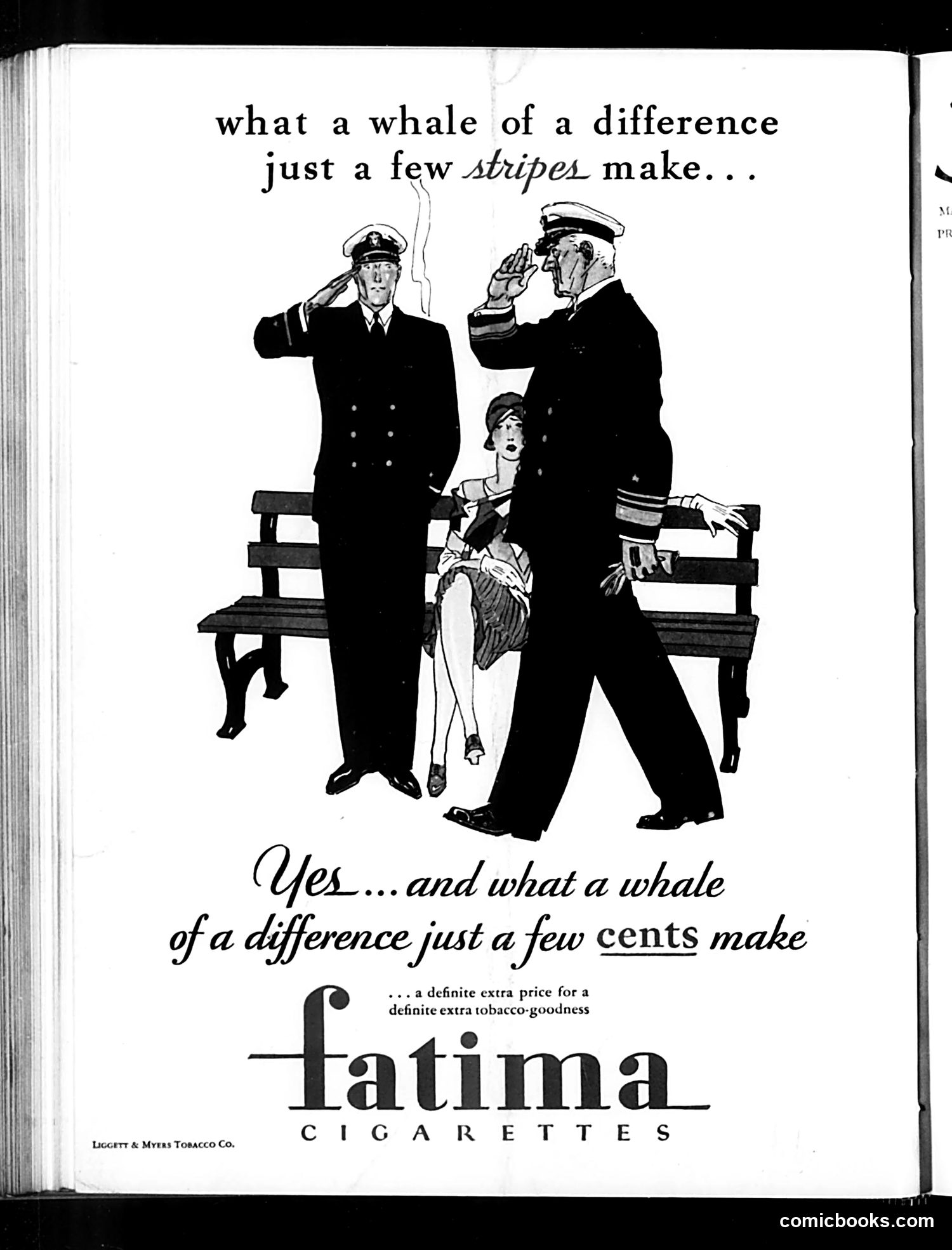
A complete issue · 36 pages · 1929
Judge — March 9, 1929
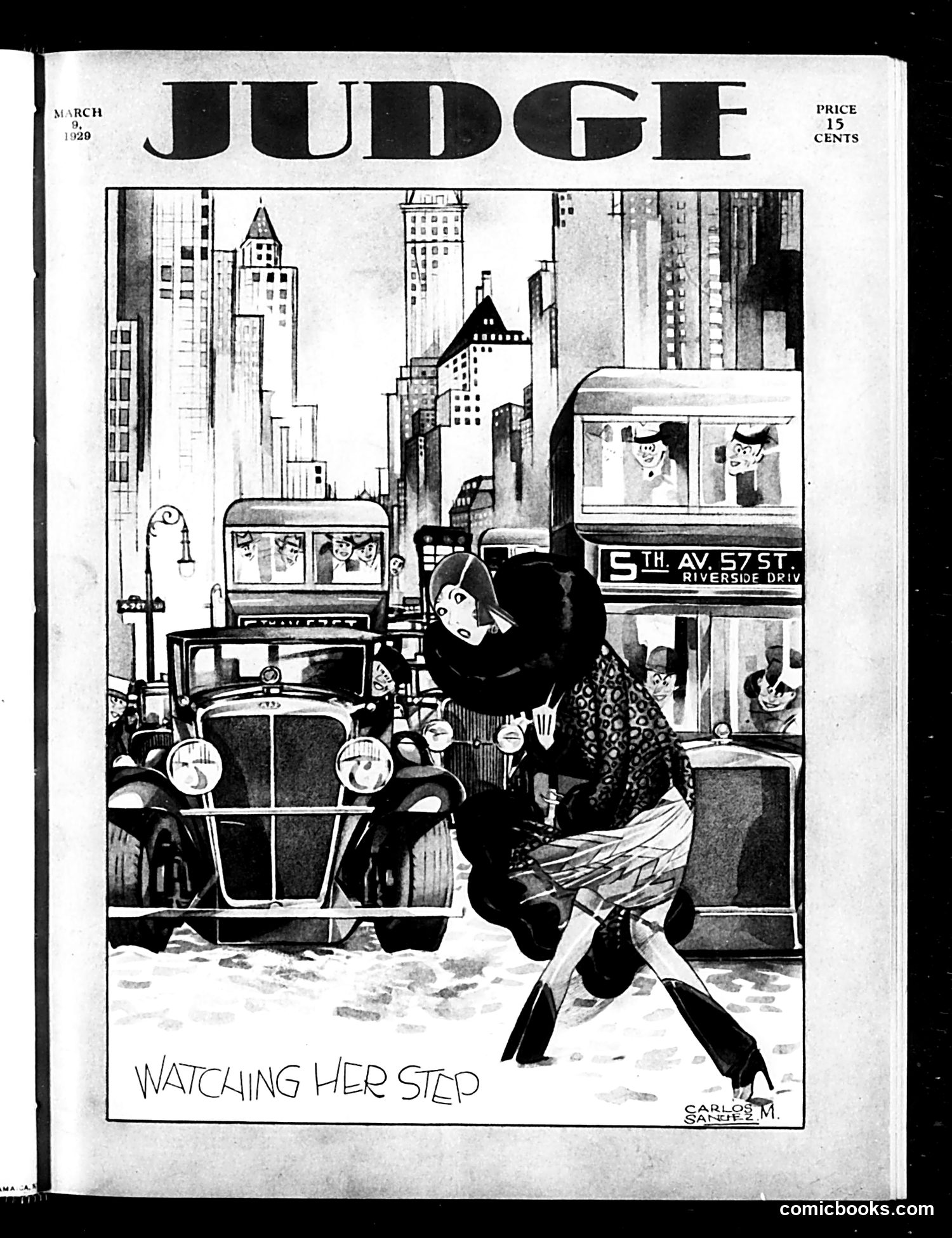
This satirical cartoon, titled "Watching Her Step," depicts a fashionably dressed woman crossing a busy urban street amid automobiles and pedestrians. The image appears to satirize 1920s urban life and changing social dynamics. The woman's prominent positioning and the title suggest commentary on female independence and social behavior during the Jazz Age. Her careful navigation of the street—both literally and figuratively—may reference concerns about women's newfound freedom, including driving, employment, and social mobility. The busy cityscape emphasizes modernity and urban culture. The cartoon likely mocks contemporary anxieties about women's liberation and their "stepping" into public spaces traditionally dominated by men, presenting this as a humorous navigation challenge requiring careful attention.
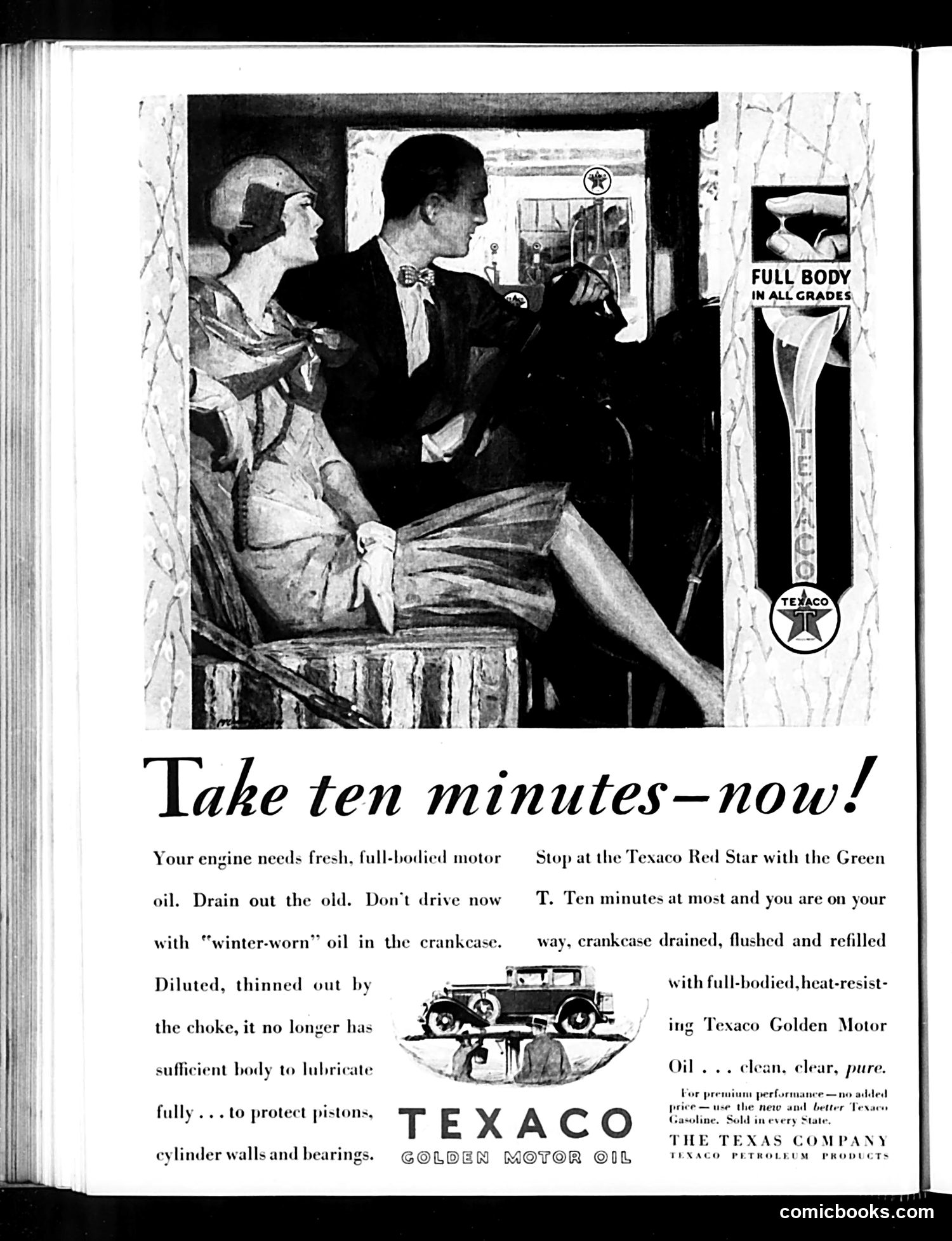
This page is primarily a **Texaco motor oil advertisement**, not political satire. The image shows a domestic scene: a woman and man in what appears to be a car interior, with the tagline "Take ten minutes—now!" The ad's appeal is practical rather than satirical: it promotes stopping at Texaco stations to drain old "winter-worn" oil and replace it with fresh "full-bodied" Texaco Golden Motor Oil. The pitch emphasizes that this ten-minute service will properly lubricate engines and protect pistons and cylinders. The woman's presence suggests the ad targets general motorists (not just mechanics), reflecting 1920s-30s advertising that increasingly marketed car maintenance to middle-class families. There is no discernible political commentary or satire on this page—it is straightforward automotive marketing.
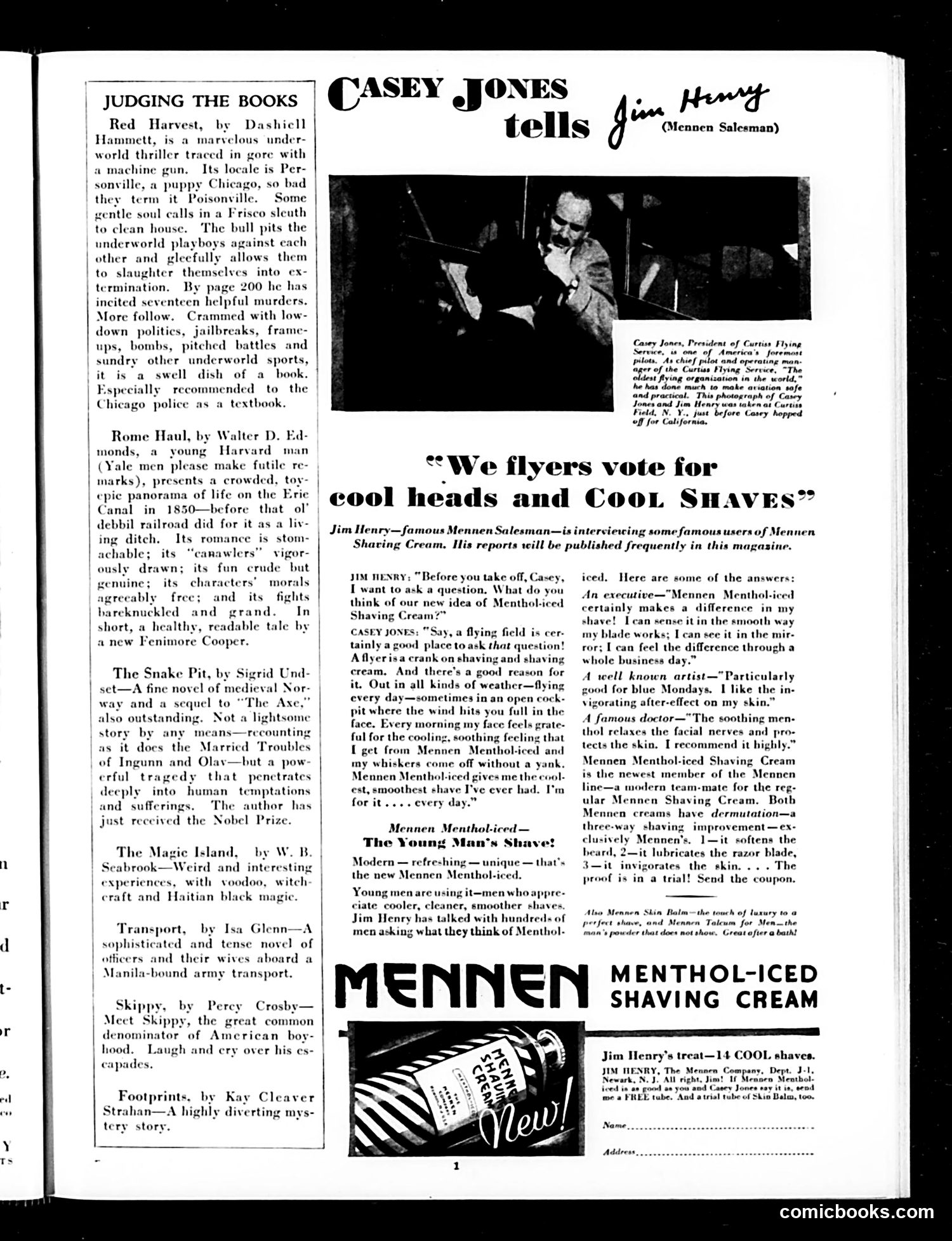
This page is primarily **advertising disguised as editorial content** rather than political satire. The main feature is a sponsored article where Casey Jones (identified as "President of Casper Flying Service") endorses Mennen Mentholated Shaving Cream. The layout mimics a celebrity interview format popular in Judge magazine, with Jones discussing the product's cooling properties for aviators. The sidebar "Judging the Books" reviews fiction titles like *Red Harvest* and *Rome Haul*. The satirical element is minimal—the humor lies in the absurdist quote "We flyers vote for cool heads and cool shaves," playing on aviation terminology. The entire piece functions as paid promotional content rather than genuine satire or political commentary.
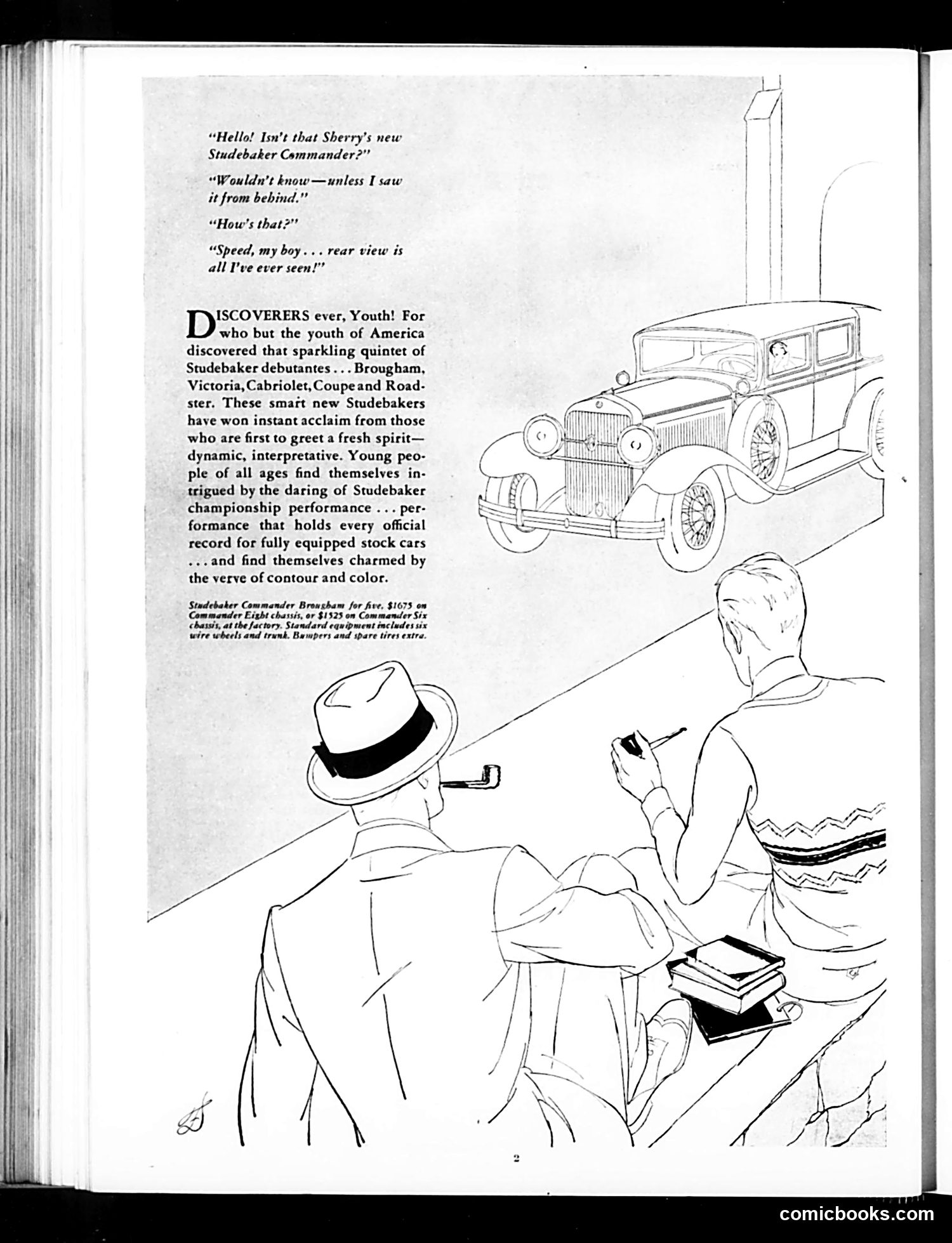
This page is primarily **automobile advertising**, not political satire. It promotes the Studebaker Commander, a luxury car model, targeting young buyers. The ad emphasizes the vehicle's performance record and aesthetic appeal ("verve of contour and color"). The dialogue at top presents a casual scene where someone spots what appears to be a new Studebaker model, remarking on its distinctive rear view. The illustration shows two figures observing the car—one in a hat and suit, another seated with notebooks, suggesting they may be automotive enthusiasts, journalists, or potential buyers evaluating the vehicle. The content is essentially a **branded advertisement** capitalizing on youth culture and automotive enthusiasm rather than containing political commentary or satire.
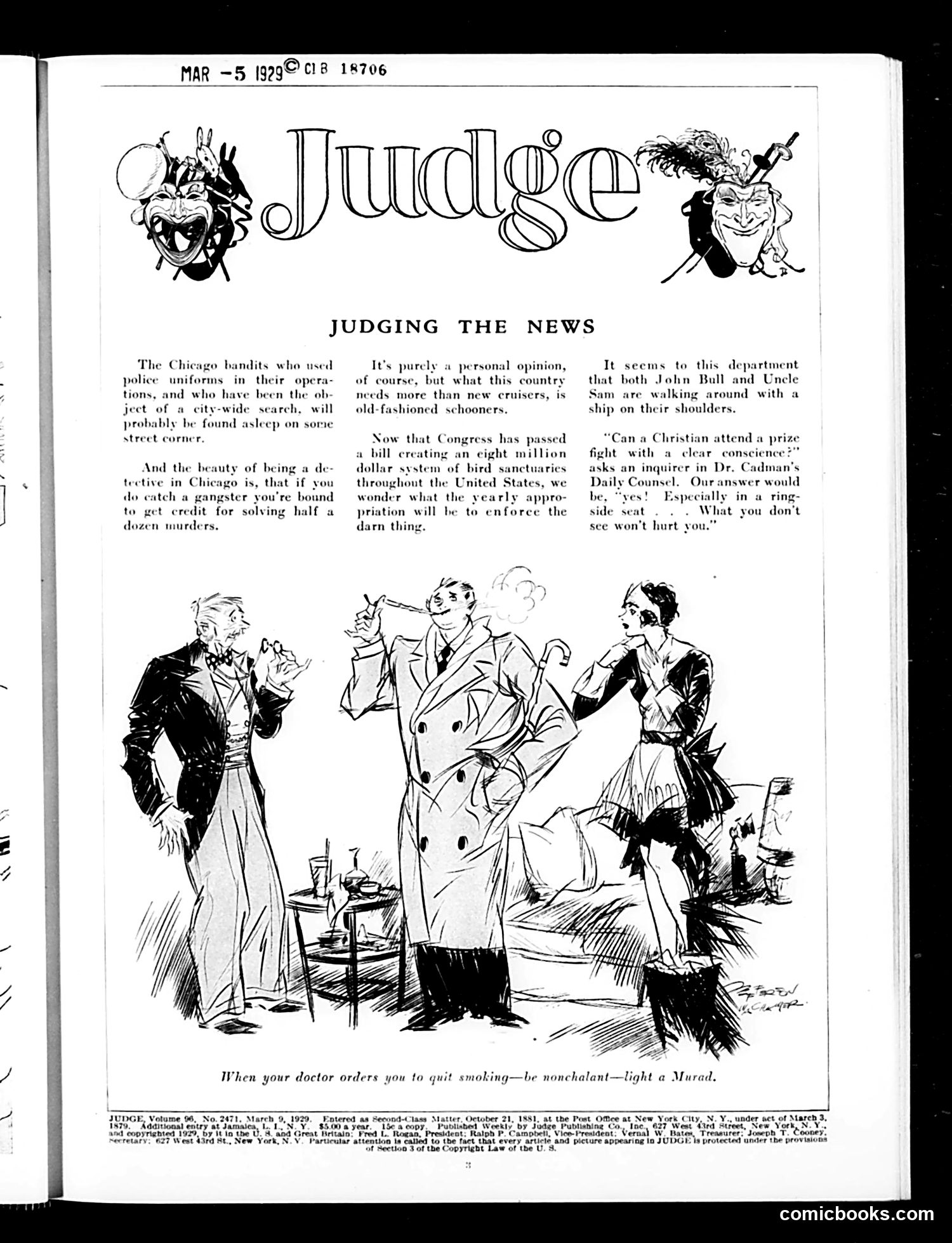
This page's main cartoon satirizes a social contradiction of the era. A doctor orders a patient to quit smoking, which the patient dismisses as overly restrictive ("light a Murad"—referencing a cigarette brand). The humor plays on the disconnect between medical advice and public behavior, particularly the popularity of cigarettes despite growing health concerns. The three text sections above comment on 1920s news: Chicago's detective work, Congress's bird sanctuary bill, and a Christian's moral dilemma about attending prize fights. The overall tone mocks inconsistency—people ignoring experts or wrestling with conflicting values. This reflects the Jazz Age's tension between modernization, commercialism, and traditional morality, with Judge's satirists treating these contradictions as comedy.
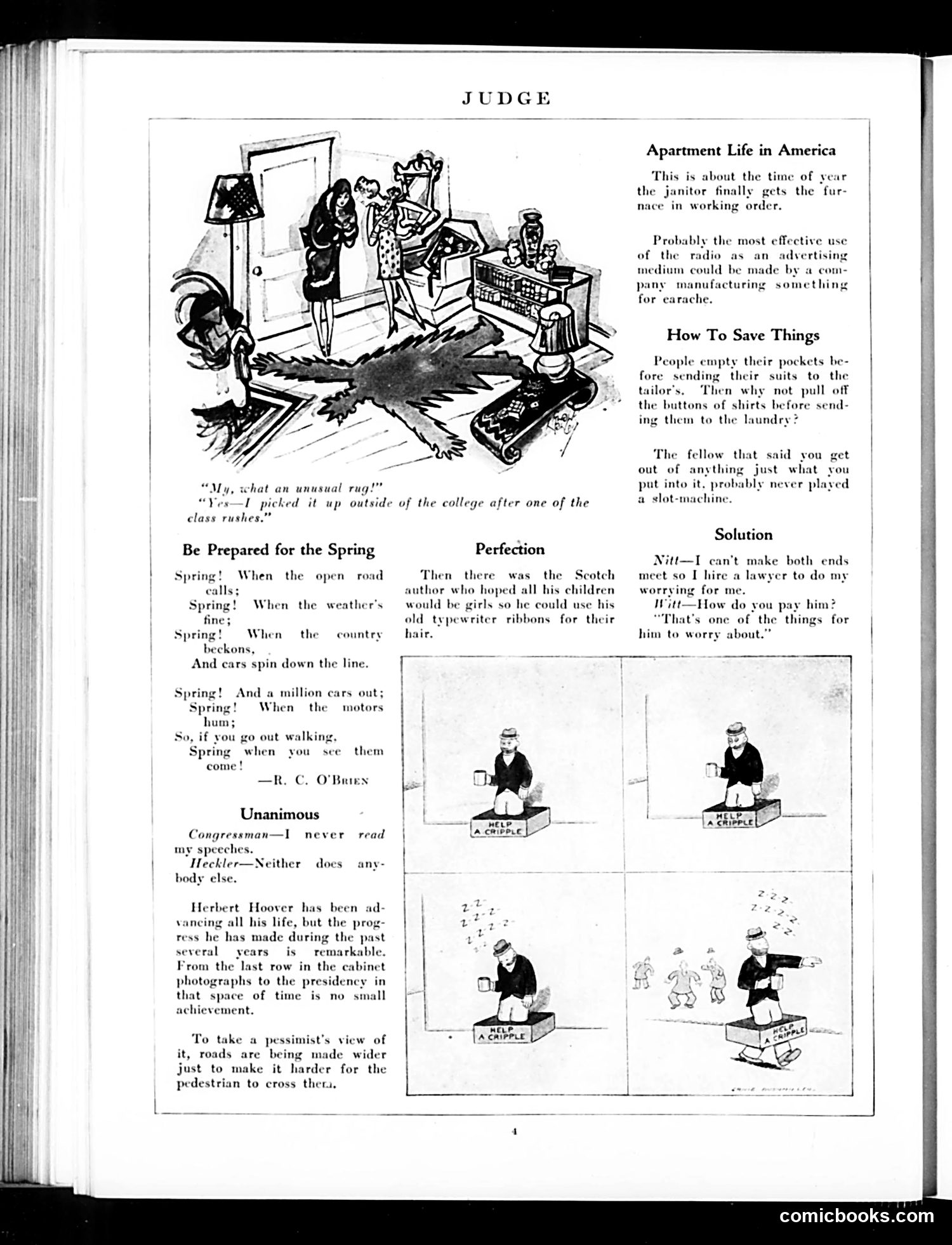
This page contains several satirical pieces about 1920s American life: **"Apartment Life in America"** (top cartoon): Shows a janitor dealing with apartment furnace maintenance—a seasonal necessity when residents need heat. The satire mocks both apartment dwellers' incompetence and janitors' essential but underappreciated role. **"Be Prepared for the Spring"** (poem): R.C. O'Brien's verse humorously warns of spring's arrival—open roads, warm weather, and increased automobile traffic—encouraging pedestrians to be cautious. **The bottom cartoon strip** appears to show a man with a cradle demonstrating childcare or domestic duties, suggesting satire about household management or parenting responsibilities. The page reflects 1920s urban concerns: apartment living complexities, seasonal transitions, and evolving domestic roles.
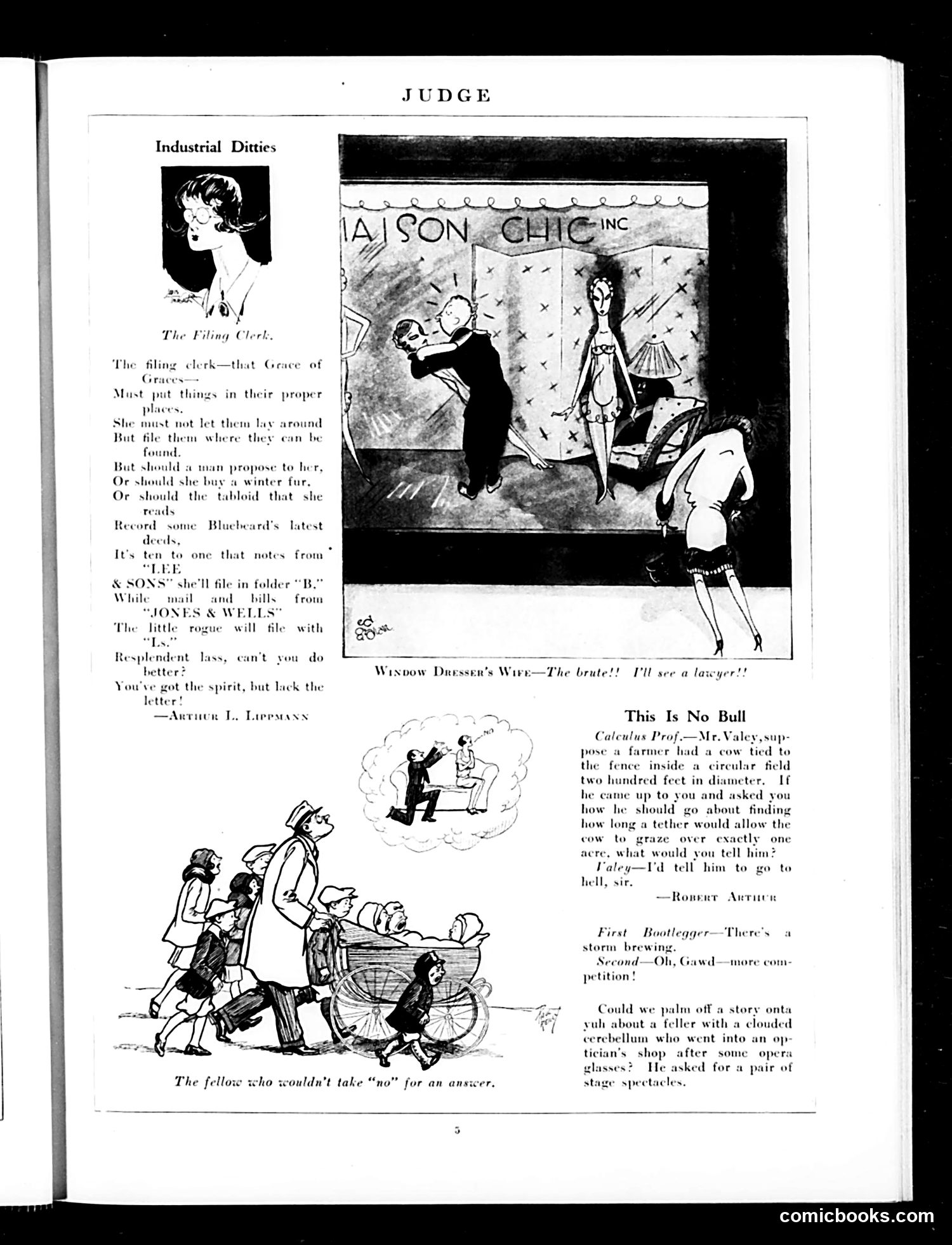
This page contains two unrelated items: **"Industrial Ditties: The Filing Clerk"** (left) presents stereotypical workplace advice for female office workers—maintaining proper filing, not socializing, rejecting romantic advances or gifts. The tone is satirical, mocking rigid workplace hierarchies and paternalistic attitudes toward women in clerical positions. **"Maison Chic" advertisement** (top right) shows a fashion store scene with a well-dressed woman confronting what appears to be a window dresser or employee, with the caption "The brute!! I'll see a lawyer!!" This likely satirizes fashion industry drama or disputes over designs/displays. **"This Is No Bull"** (bottom) contains brief humorous anecdotes, including a calculus problem joke. The cartoon shows travelers refusing to answer a man's question, captioned "The fellow who wouldn't take 'no' for an answer."
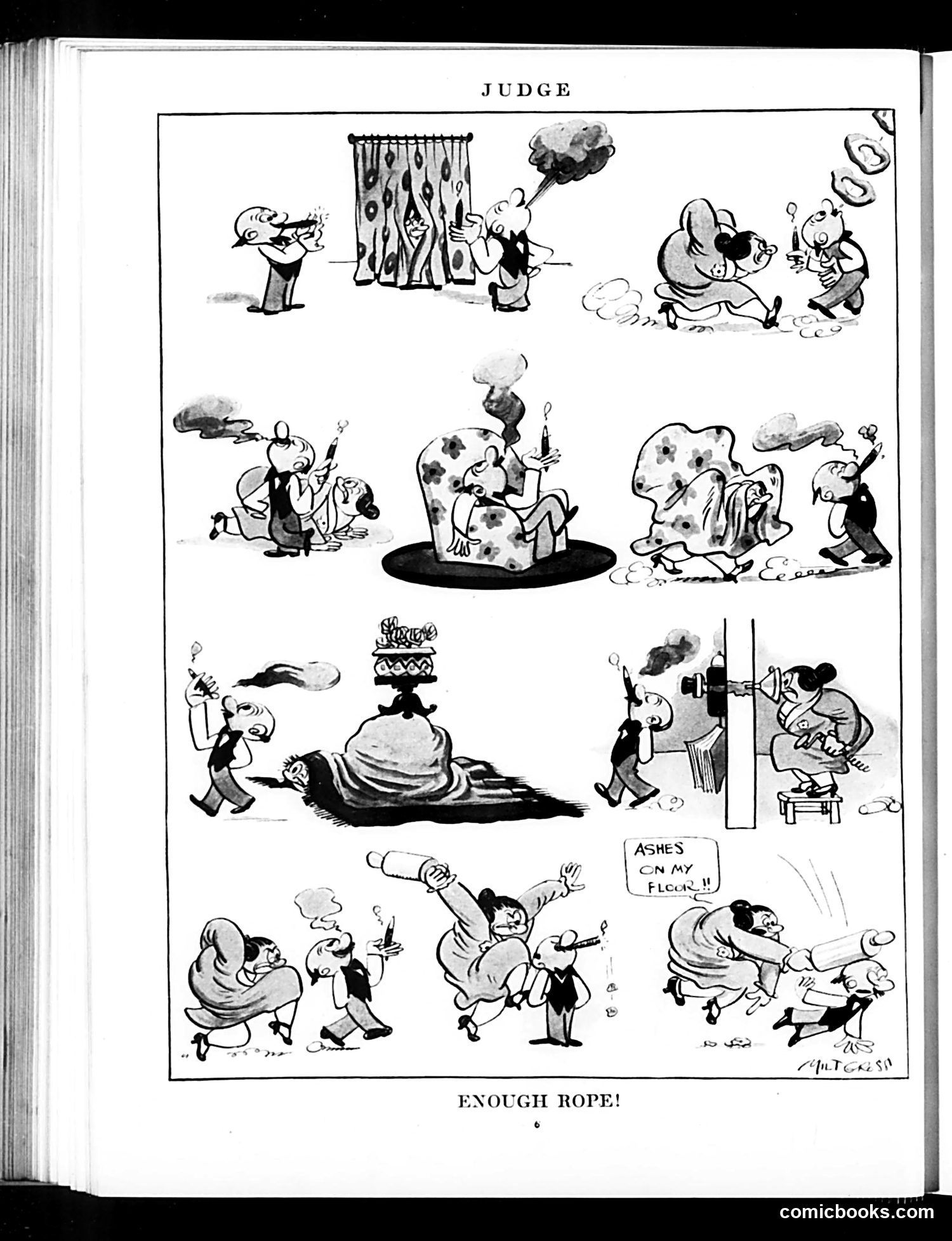
This Judge magazine cartoon satirizes judicial corruption or leniency toward wealthy defendants. The sequential panels depict various figures—likely representing judges, lawyers, and wealthy defendants—engaged in chaotic scenes of destruction and misconduct. The title "Enough Rope!" references the proverb about giving someone enough rope to hang themselves. The cartoon suggests that corrupt or ineffectual judges are enabling wrongdoing by powerful figures. One panel shows "Ashes on my floor!"—indicating property damage or negligence going unpunished. The exaggerated, caricatured figures and anarchic scenes emphasize how the judicial system appears to tolerate or ignore serious misconduct by the wealthy and connected, while ordinary citizens suffer consequences. The satire critiques the apparent double standard in American justice during this era.
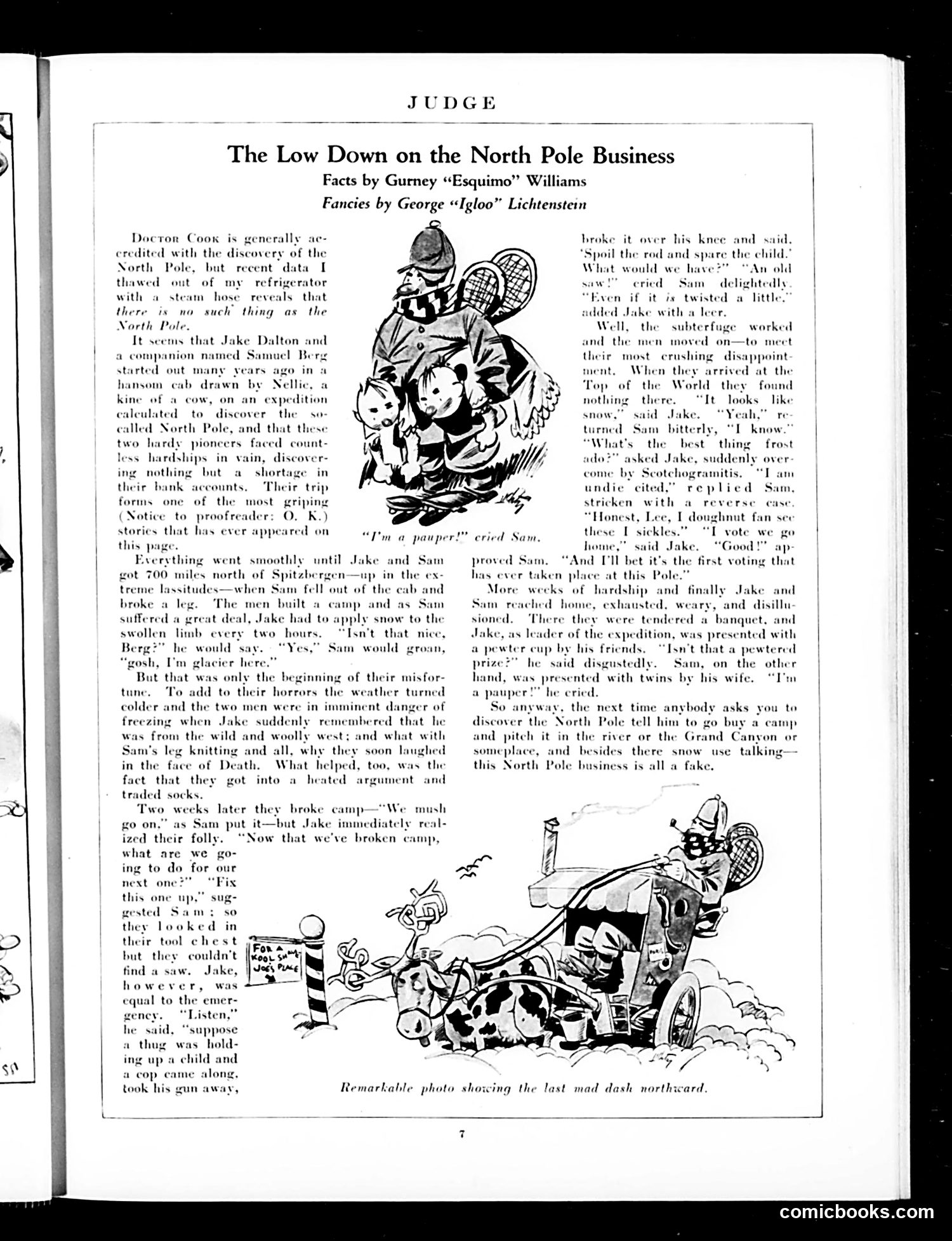
This is a humorous debunking of Arctic exploration claims. The article satirizes the era's celebrated polar discoveries—likely referencing real explorers like Peary and Cook who claimed North Pole discovery around 1909, sparking controversy about who actually reached it first. The joke: Two ordinary men, Jake Dalton and Samuel Berg, supposedly discovered "nothing" at the North Pole decades earlier, yet received no credit. Their absurd journey—traveling by cow-drawn cab, surviving via socks-trading and bad puns—mocks the hardship narratives of actual polar expeditions. The satire targets the public's credulity about exploration claims and the glorification of polar discovery. By presenting an obviously fake, ridiculous expedition as equally valid, Judge suggests the "real" polar discoveries were equally dubious or meaningless. The punchline: it's all a commercial fake. The bylines ("Esquimo" Williams, "Igloo" Lichtenstein) are obvious pseudonyms, emphasizing the satire's tongue-in-cheek tone.
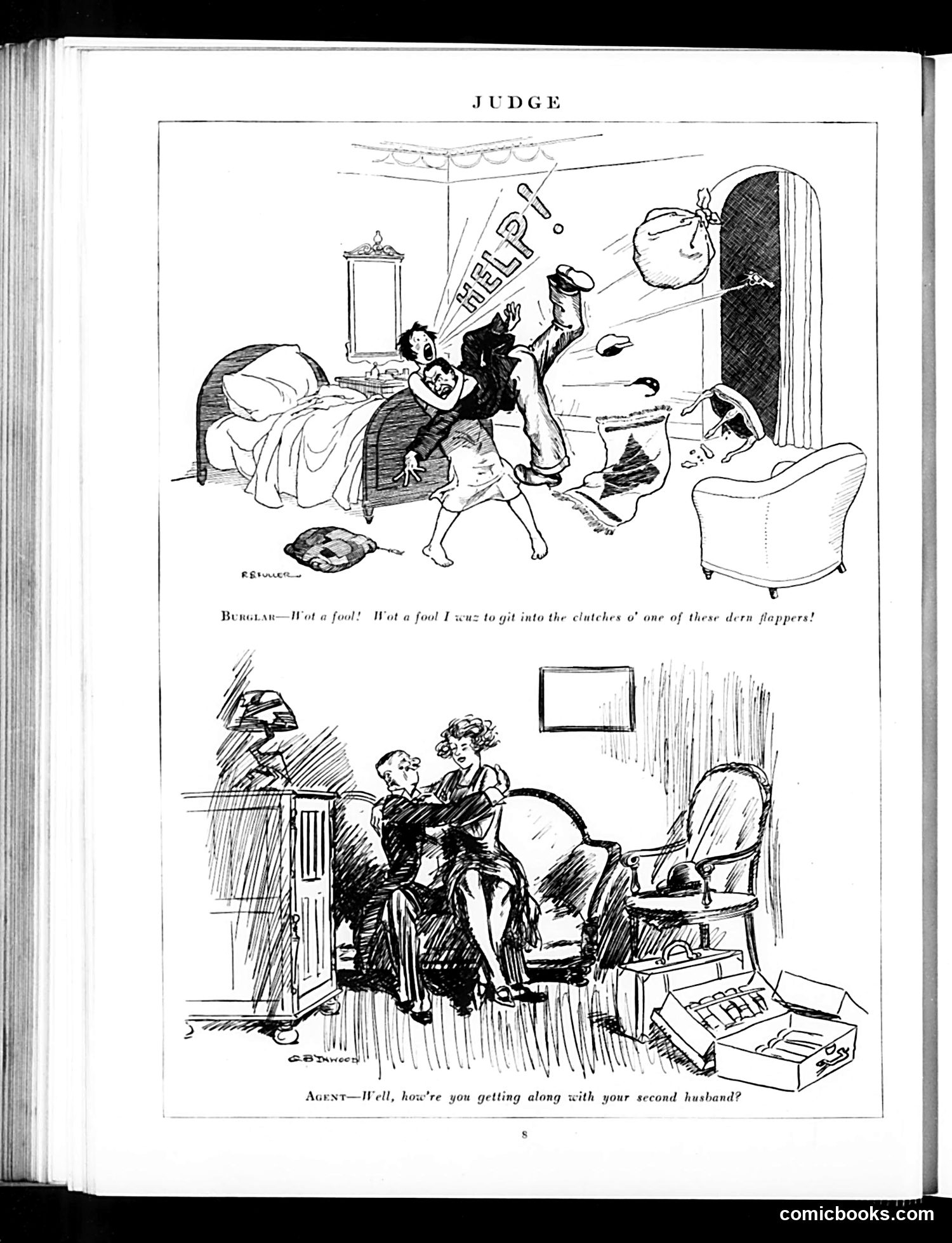
This page contains two satirical cartoons mocking women's behavior and marriage. **Top cartoon:** A burglar interrupts a bedroom scene, calling for help as a woman attacks him with a club. The burglar's complaint uses working-class dialect ("Wot a fool!"), suggesting he's the sympathetic figure—victimized by an aggressive woman. The satire targets "flappers" (young, modern women of the 1920s), portraying them as violent and uncontrollable. **Bottom cartoon:** An insurance agent asks a woman how she's "getting along with your second husband," implying women rapidly cycle through marriages. This ridicules women's marital instability. Both cartoons reflect period anxieties about changing women's roles in the 1920s, satirizing female independence and modern behavior as chaotic and threatening to traditional male authority. The humor depends on viewing women's agency negatively.
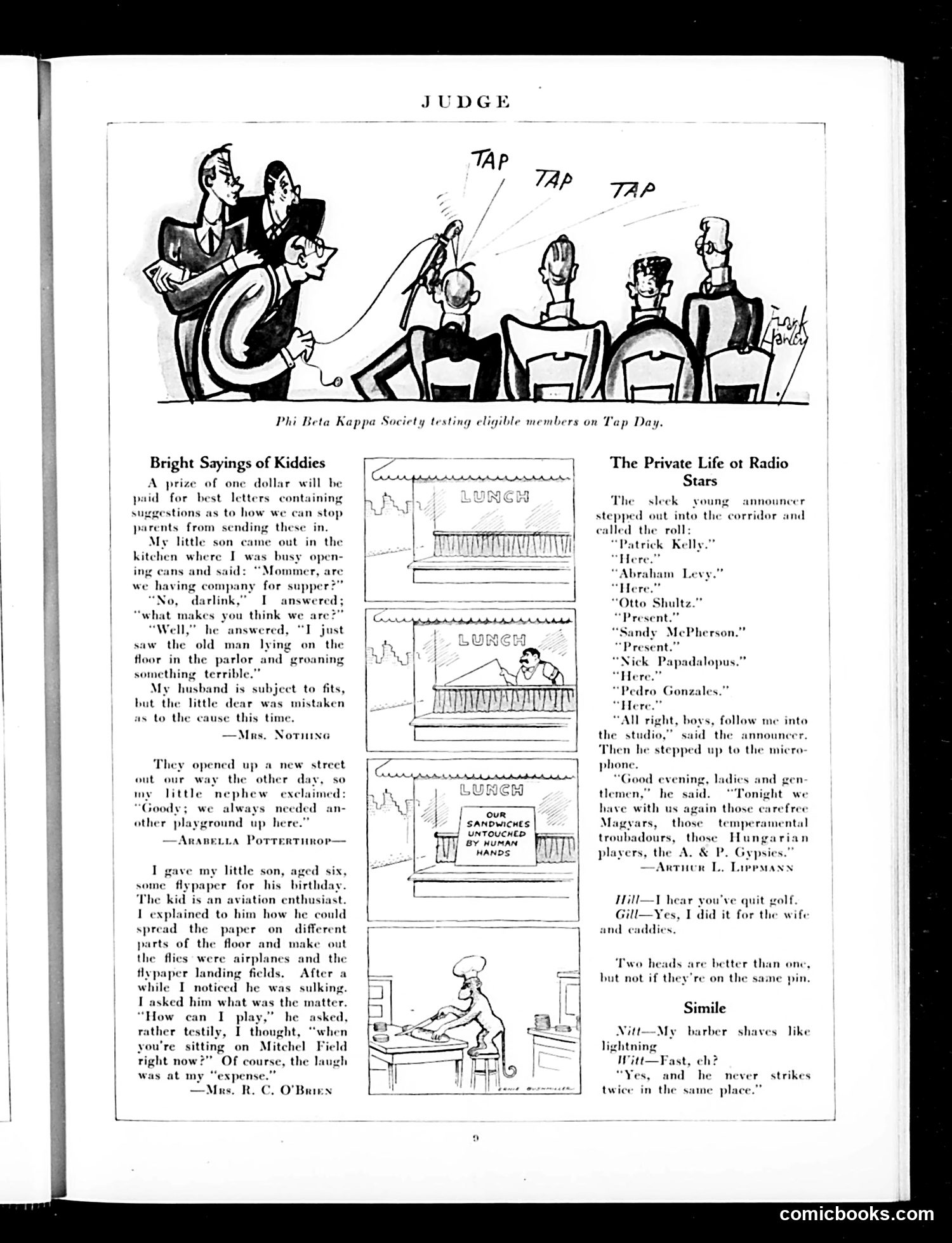
**Main Cartoon (Top):** Depicts Phi Beta Kappa Society's "Tap Day"—the ceremonial selection of new members. The honored society members sit facing initiators who tap them with a gavel while saying "TAP." This was a real collegiate tradition where elite academic societies would invite new members through this ritualistic process. The cartoon satirizes the pretentious formality of academic elitism. **"Bright Sayings of Kiddies":** A humor column featuring amusing childish misunderstandings and malapropisms—a popular magazine format of the era. Examples include a child mistaking his father's medical episode for evidence of guests coming, and another misinterpreting Aviation Day explanations. **"Private Life of Radio Stars":** A satirical piece mocking radio announcers' theatrical pretense. An announcer dramatically calls the roll of performers (with ethnic names like "Magyars" and "Hungarian players"), then uses grandiose language on-air despite the mundane backstage reality. The page reflects 1920s-30s popular culture concerns about elitism, radio's growing influence, and entertainment industry artifice.
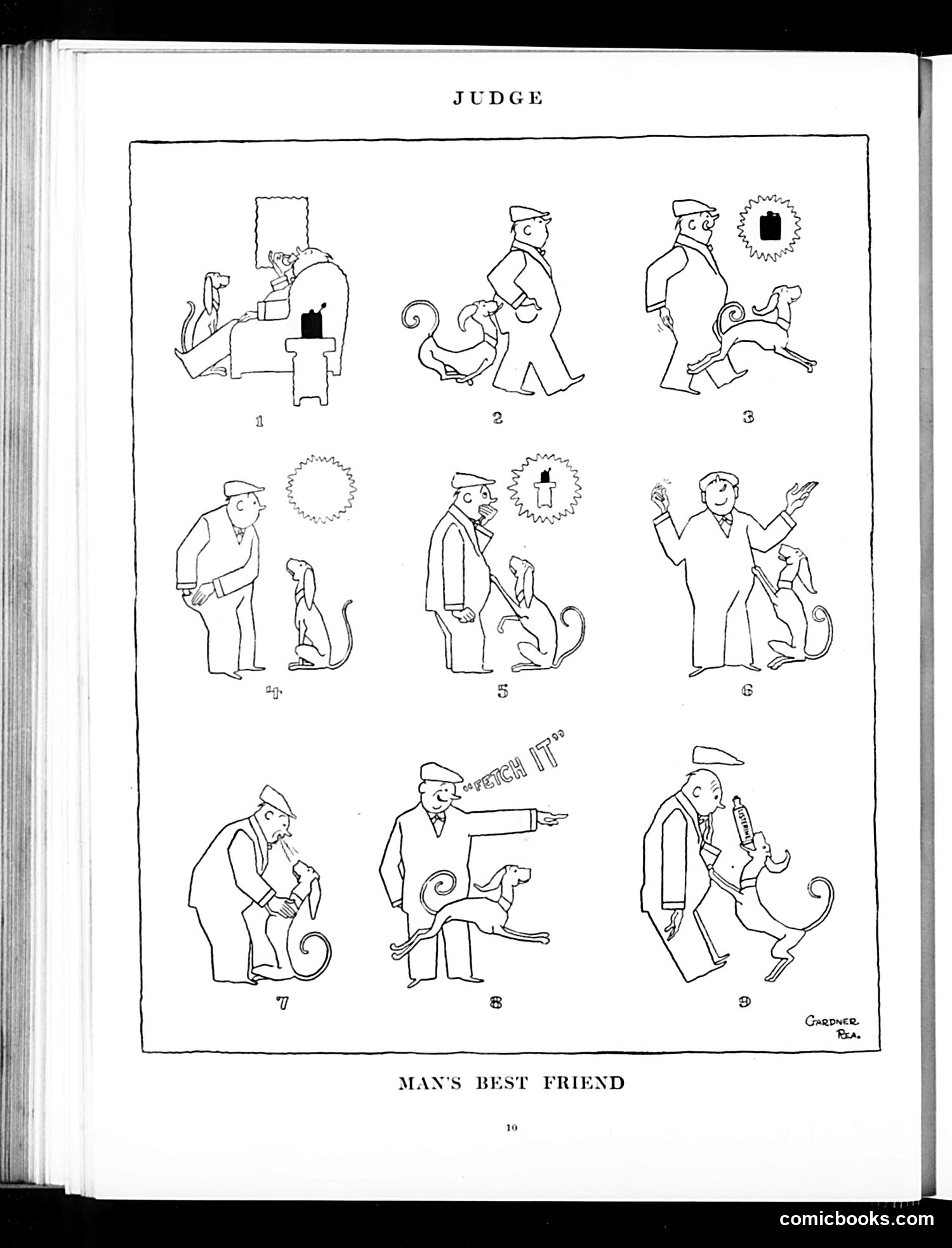
This page presents nine cartoon panels depicting a judge and a dog in various scenarios. The title "Man's Best Friend" plays on the common phrase about dogs while satirizing judicial authority. The panels show the judge in different situations with the dog—some panels depict the judge seemingly favorable toward the dog, while others show conflict or punishment (indicated by the black squares, likely representing struck blows or corrections). Panel 8 includes text reading "Scratch it!" suggesting the dog is being instructed to scratch or mark something. The satire appears to mock judicial inconsistency or the arbitrary nature of a judge's decisions—showing favoritism shifting unpredictably. The dog serves as a metaphor for subjects under judicial authority, whose treatment depends on the judge's whims rather than consistent application of law. Artist signature: "Gardner Rea" (bottom right)
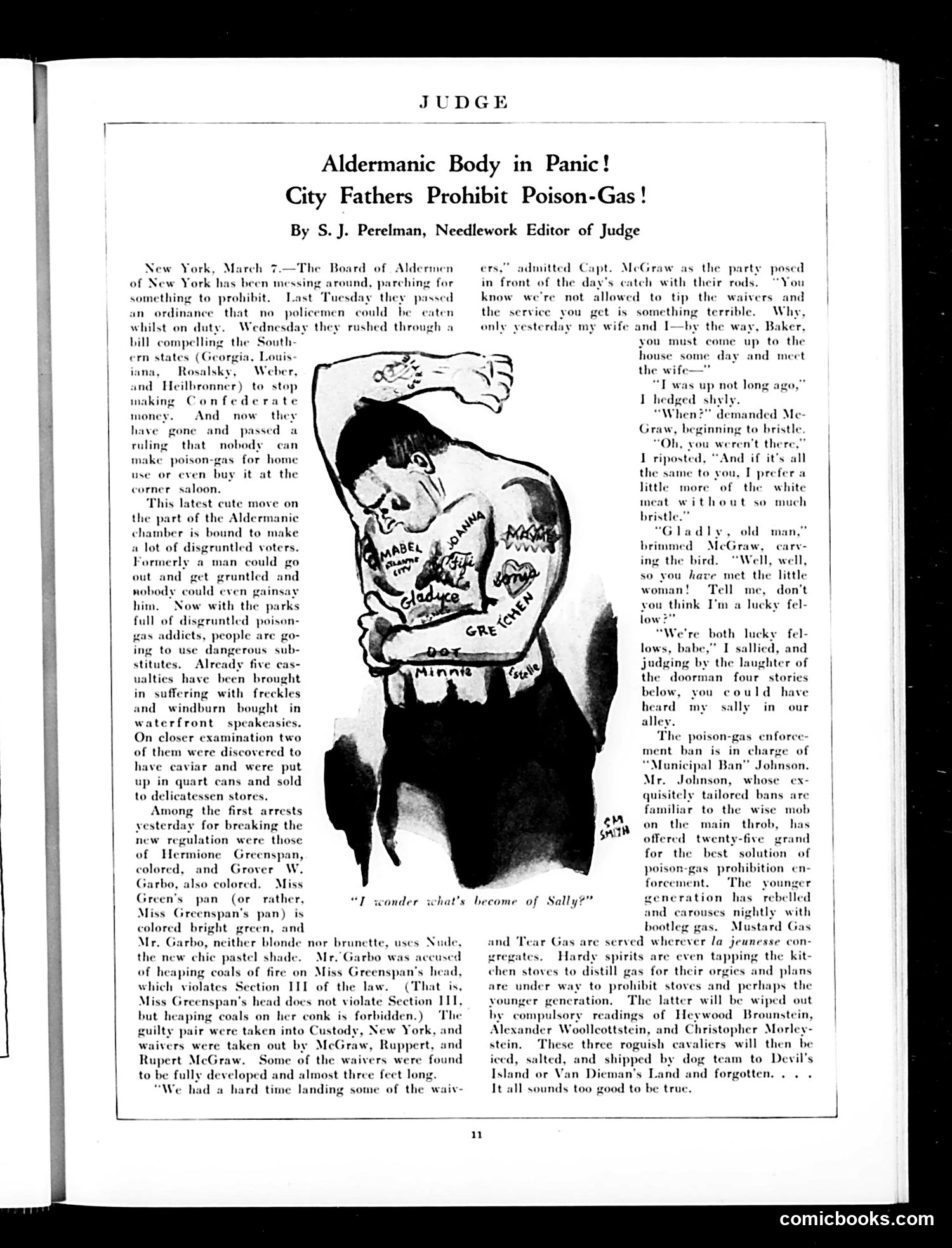
This is a satirical piece by S.J. Perelman mocking New York City's Board of Aldermen for passing frivolous prohibition ordinances. The central joke is absurdist: the aldermen supposedly ban poison-gas manufacture for home use, presented as yet another in a series of ridiculous regulations (including prohibiting eating policemen and forcing Southern states to stop making Confederate money). The cartoon depicts an anthropomorphized "Aldermanic Body"—literally a stomach labeled with various proper names (Rosalsky, Weber, etc.)—suggesting these officials are self-serving and gluttonous. The satirical point criticizes government overreach and the Prohibition era's enforcement contradictions. While poison-gas bans are presented as absurd, the piece suggests actual bootleg substances (mustard gas, tear gas) are being consumed illegally anyway, paralleling alcohol prohibition's failure. The mention of "Municipal Ban Johnson" appears to reference real Prohibition enforcement. Perelman uses deadpan humor and elaborate tangents (the caviar anecdote, the awkward dinner conversation) characteristic of his comedic style, making fun of bureaucratic incompetence and the gap between official rules and actual behavior.
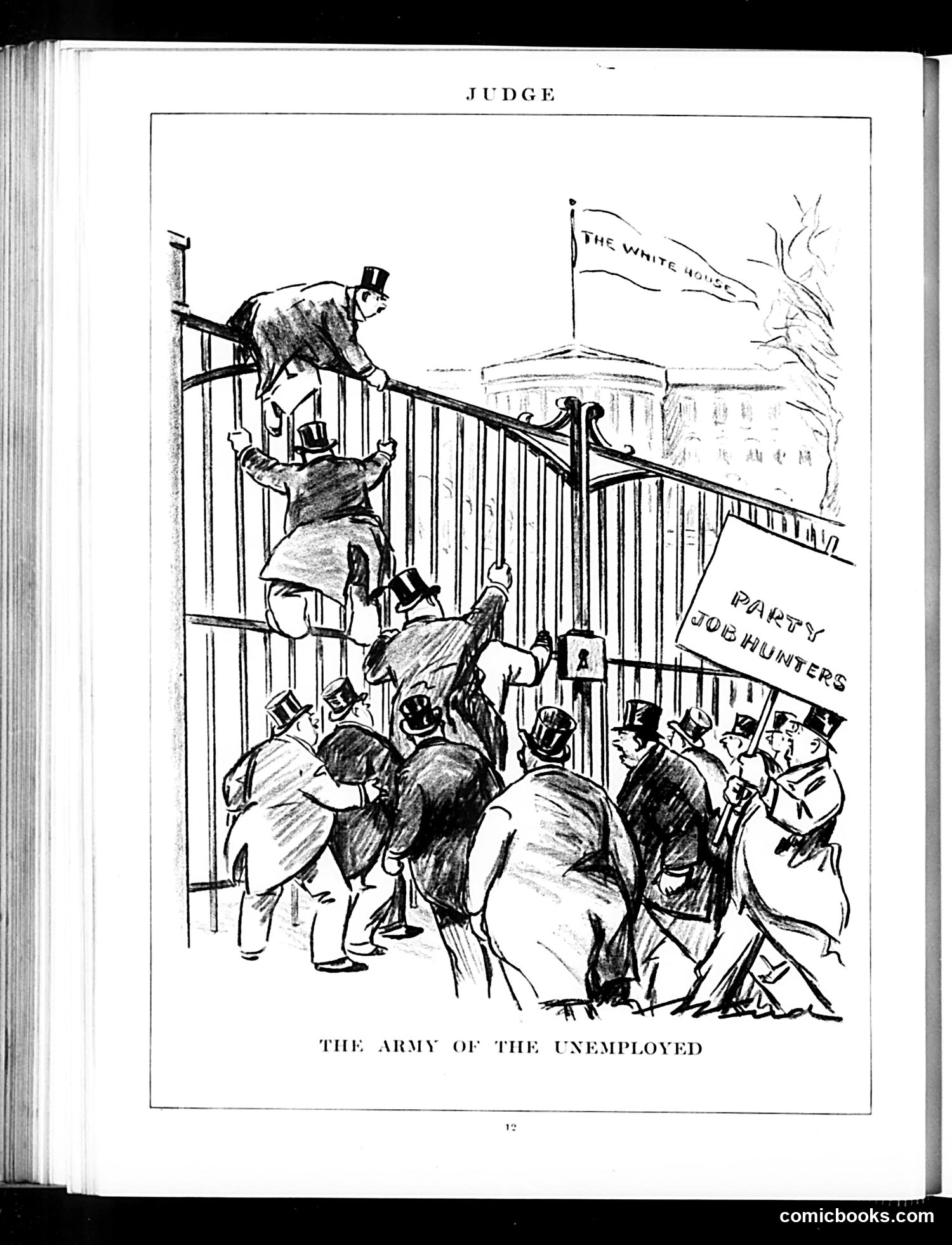
This political cartoon from *Judge* magazine satirizes unemployment and economic hardship through a stark visual metaphor. A massive crowd of unemployed workers—depicted as an "army"—scales the gates of what appears to be the White House (identifiable by its distinctive architecture and "The White House" flag). Two well-dressed figures stand atop the gate, apparently representing political or economic leadership, seemingly indifferent or overwhelmed by the crisis below. The "Party Job Hunters" sign suggests commentary on political patronage and the failure of the ruling party to address mass joblessness. The cartoon critiques both the severity of unemployment and the government's inadequate response, depicting desperate workers as a threatening force that leadership cannot ignore or control.
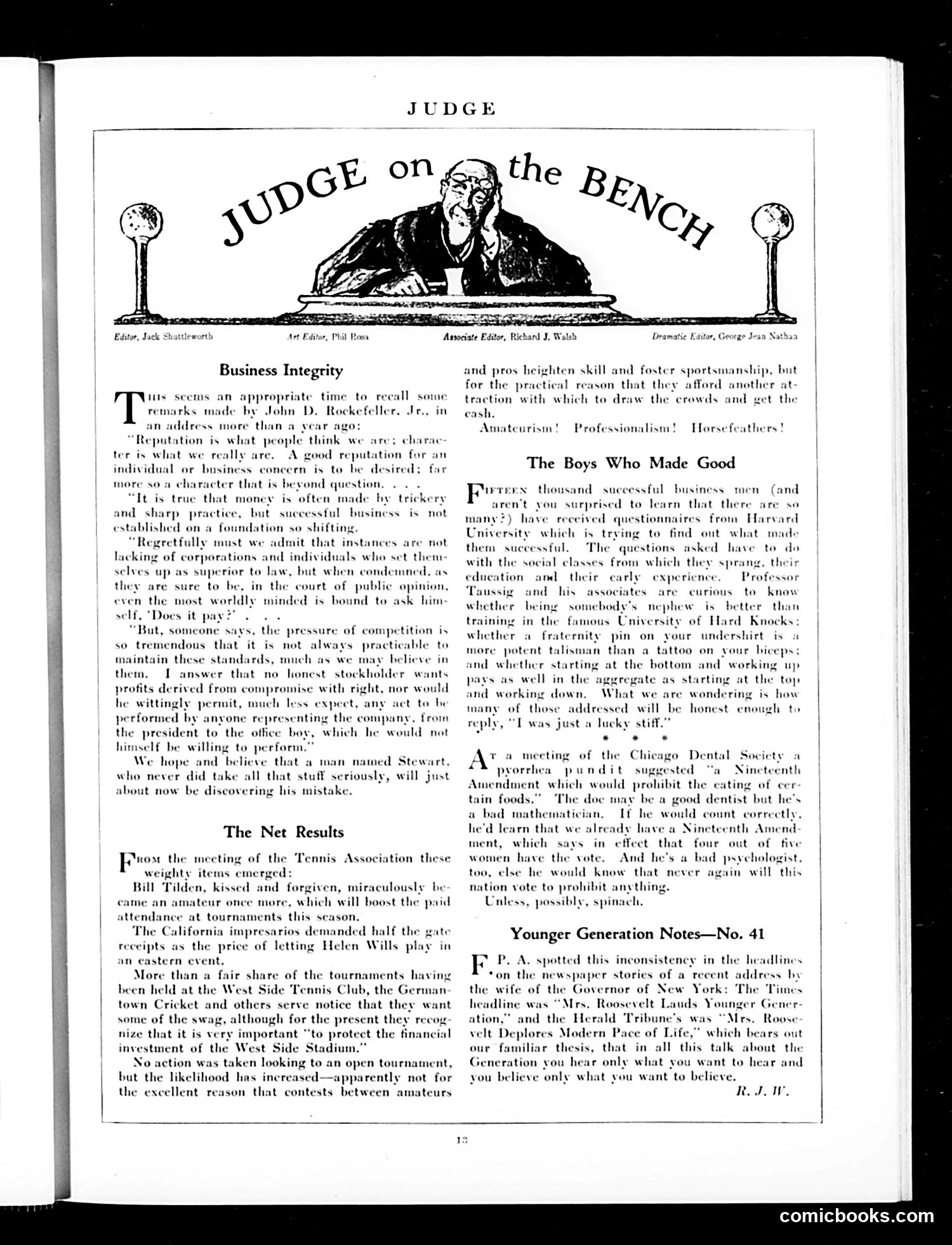
This page from *Judge* magazine contains three satirical pieces on business ethics, amateur athletics, and higher education—all touchstones of Progressive Era reform debate. **"Business Integrity"** quotes John D. Rockefeller Jr.'s moralizing about corporate character, then sarcastically suggests a man named "Stewart" will "discover his mistake" about ignoring such principles. This likely references a contemporary business scandal, though the specific identity isn't clear from the text alone. **"The Net Results"** mocks the contradiction between amateur athletics' stated ideals and commercial reality. Bill Tilden, the famous tennis player, is mentioned being "kissed and forgiven" as an amateur again—suggesting reinstated status after some violation. The piece ridicules the pretense that amateur tournaments aren't primarily about profit. **"The Boys Who Made Good"** satirizes Harvard University's survey of successful alumni, questioning whether inherited privilege (fraternity pins, social class) or merit ("University of Hard Knocks") explains success—a dig at elite institutions' self-justifying mythology. The tone is cynical throughout: all three pieces expose gaps between stated ideals and actual motivations in American institutions.
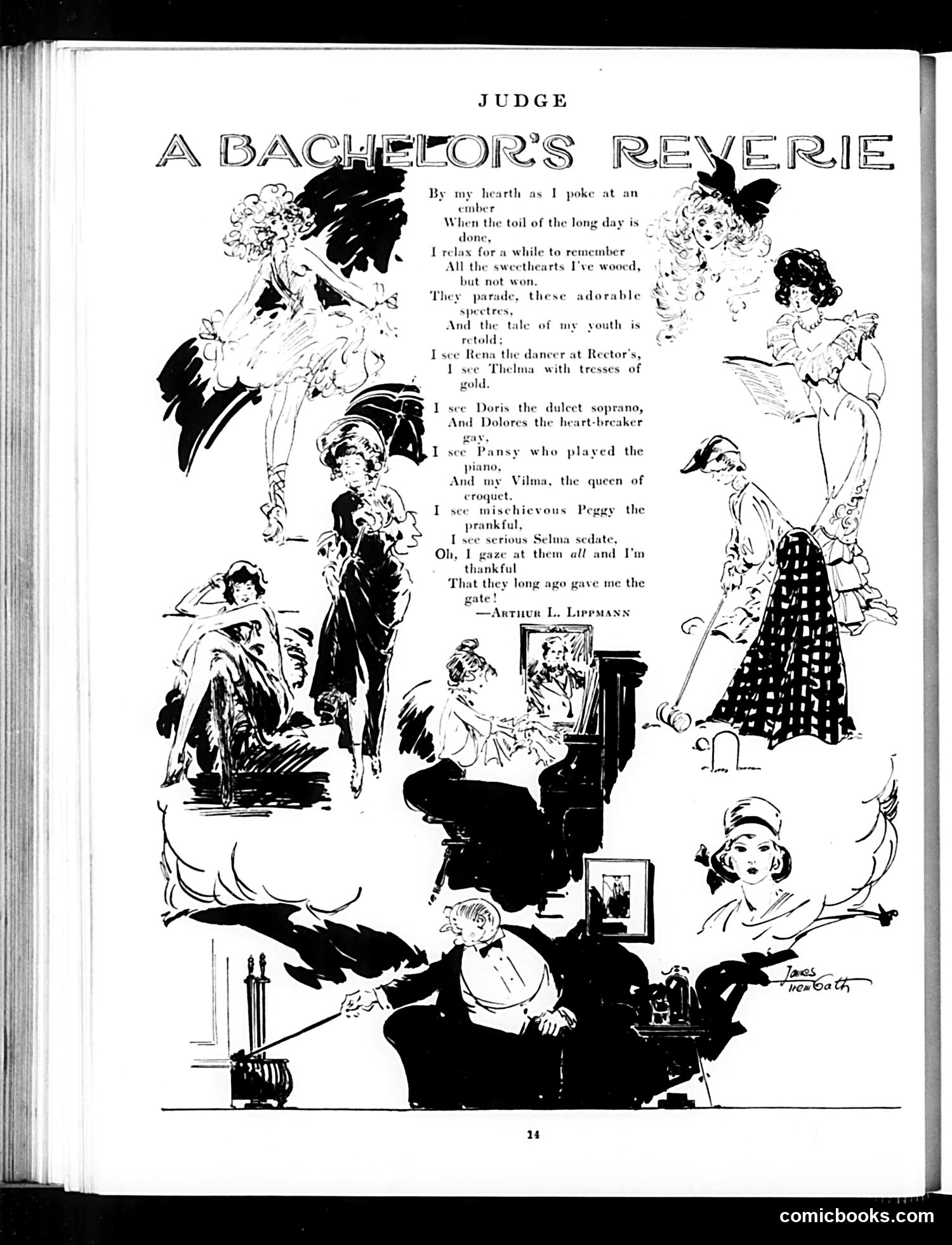
This is a humorous poem illustrated with period artwork depicting a bachelor nostalgically reminiscing about past romantic rejections. The speaker reflects by his fireplace on all the women who rejected him—dancers, singers, society girls with names like Rena, Thelma, Doris, and Vilma. The joke is the poem's twist ending: he's actually *grateful* they rejected him ("gave me the gate"), suggesting bachelorhood suits him better than any of those romantic entanglements would have. The illustrations show various stylized female figures and a man lounging contentedly, visualizing these remembered women. This reflects early 20th-century *Judge* magazine humor: gentle satire about modern dating, marriage anxiety, and bachelor life—themes that appealed to young male readers navigating social expectations around courtship and commitment.
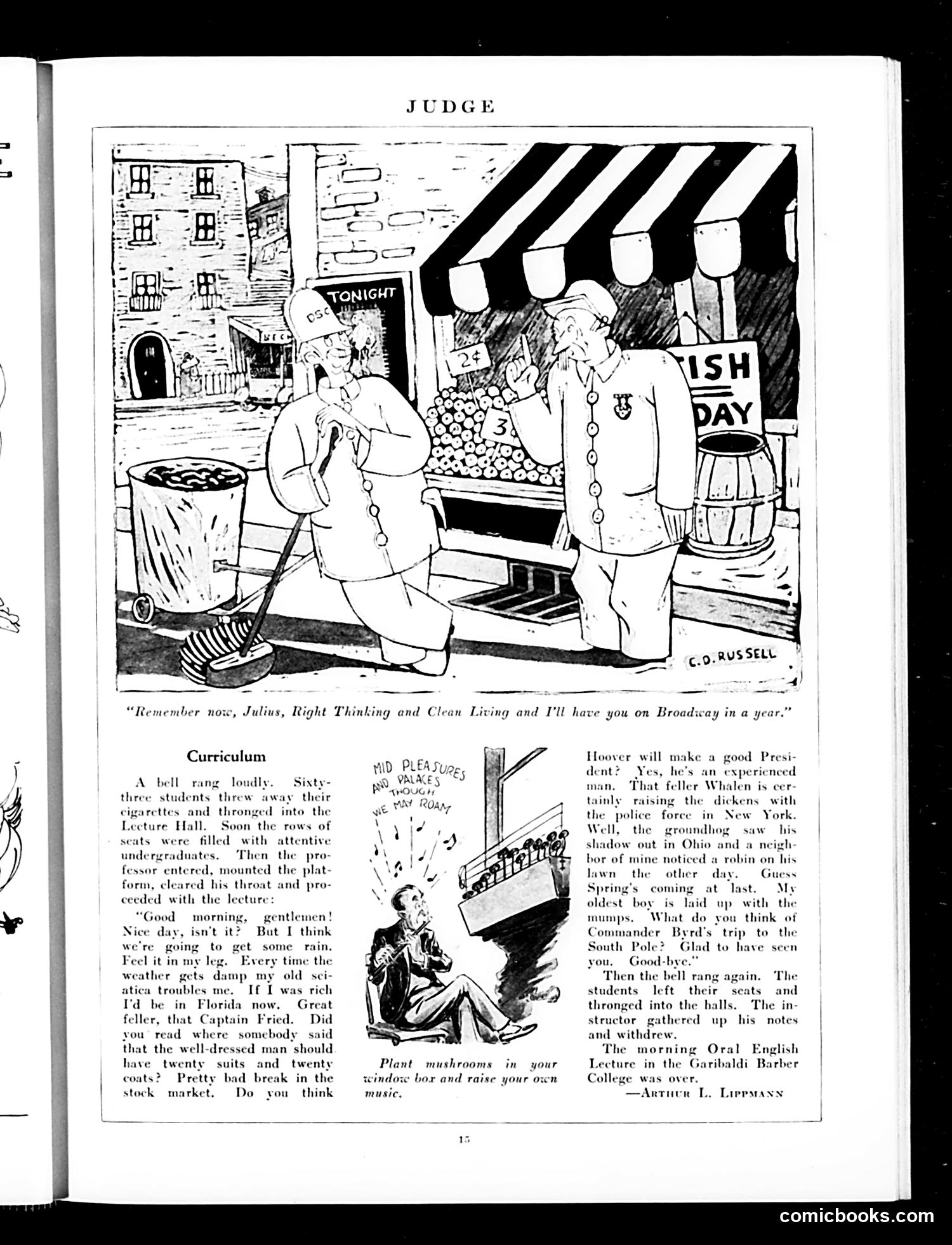
This satirical piece mocks the superficiality of a college lecture on oral English. The cartoon depicts a professor at "Garibaldi Barber College" delivering a rambling lecture filled with disconnected small talk—gossip about Hoover (likely Herbert Hoover, president 1929-1933), mentions of Captain Fried, Commander Byrd's South Pole expedition, stock market troubles, and personal complaints about his sciatic nerve. The satire's point: the "curriculum" consists of meaningless chitchat rather than actual instruction. Students are shown smoking cigarettes before class, suggesting low academic standards. By setting this at a "Barber College" rather than a prestigious university, the author emphasizes the pretentiousness of calling such rambling discourse an "Oral English Lecture." The joke targets both educators who waste students' time with off-topic monologues and institutions that dress up trivial instruction in respectable-sounding titles. The rigid bell schedule frames legitimate learning being replaced by idle conversation.
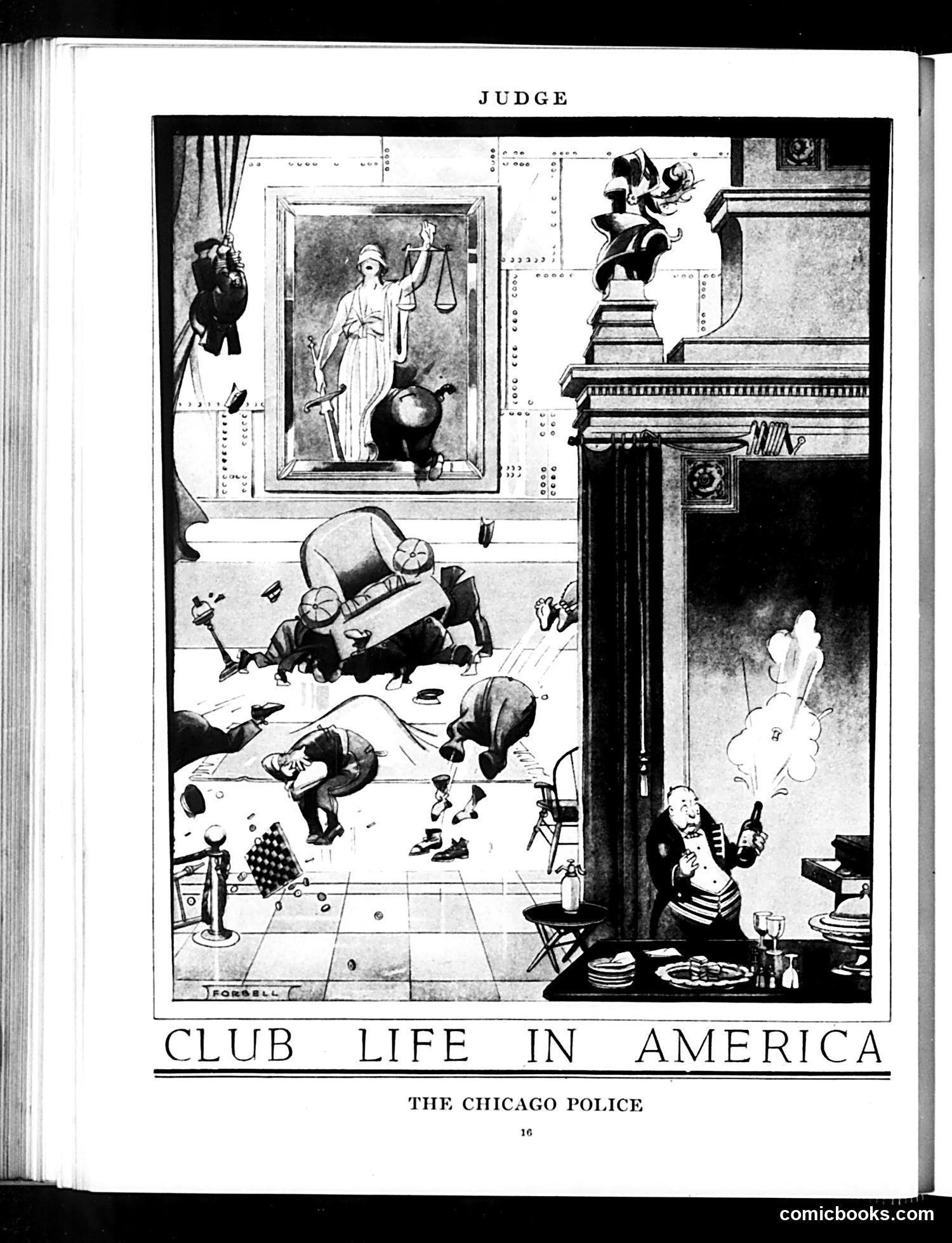
This satirical cartoon from *Judge* magazine critiques Chicago police corruption during Prohibition era. The central image depicts Lady Justice presiding over a courtroom where police officers are literally fighting and brawling on the floor—overturning furniture and creating chaos. The satire points to the Chicago Police Department's notorious corruption and violence, particularly their involvement in bootlegging operations and organized crime during Prohibition (1920-1933). Rather than maintaining order, the officers are shown as lawless themselves, destroying the very justice system they're supposed to protect. The contrast between the idealized statue of Justice above and the violent mayhem below underscores the gap between the law's noble intentions and Chicago's brutal police reality—a well-documented problem of that era.
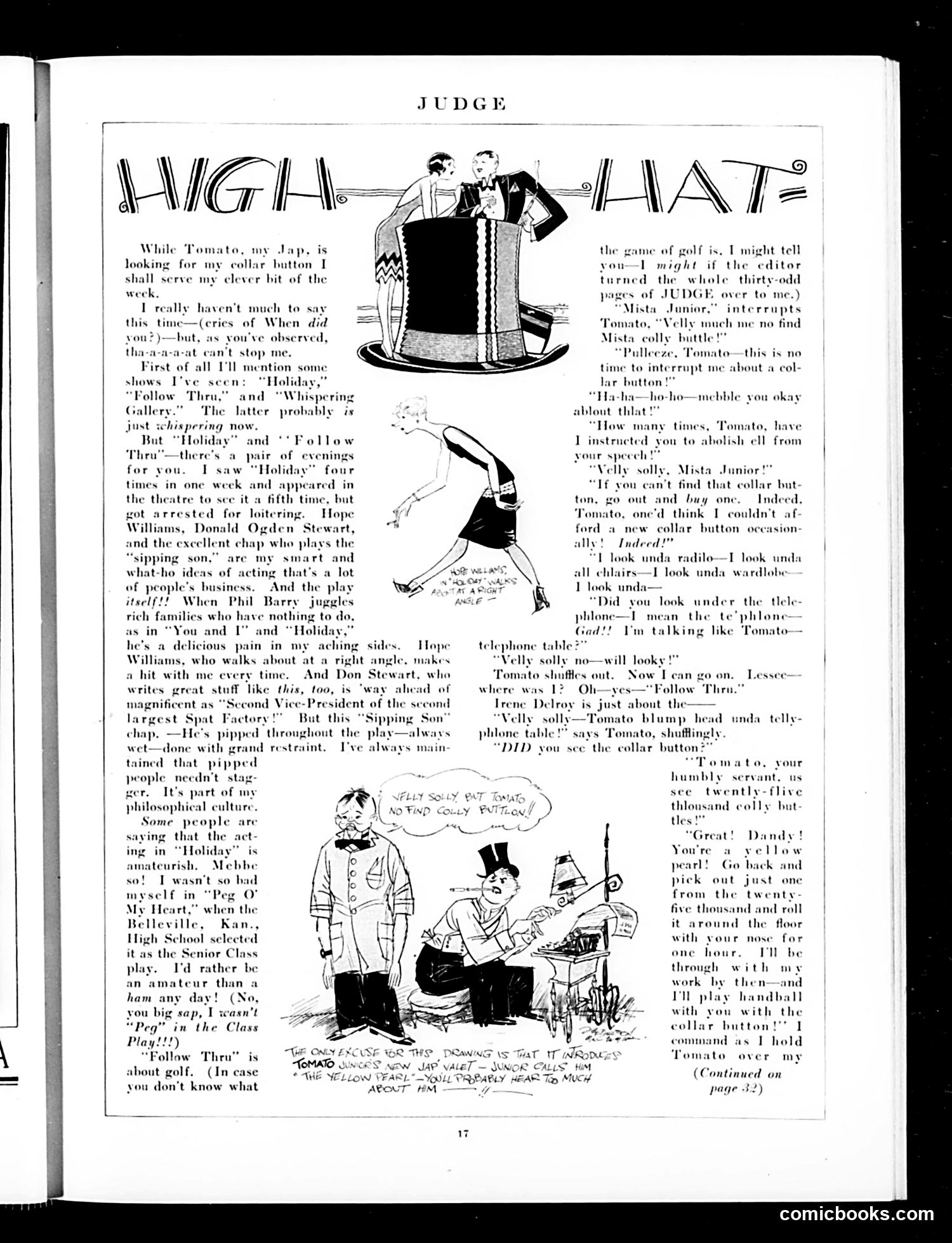
This is a humorous essay-comic by Judge magazine's editor, presenting theatrical and social commentary disguised as a conversation with his Japanese servant "Tomato." The piece satirizes Broadway plays of the era—specifically "Holiday," "Follow Thru," and "Whispering Gallery"—praising their quality while mocking theater-goers who loiter outside hoping to see stars. He references playwright Phil Barry and actors like Donald Ogden Stewart and Hope Williams. The extended dialogue with Tomato (depicted in period racist caricature with exaggerated dialect) serves as a comedic device: while the editor discusses golf and theater, Tomato repeatedly interrupts about a missing collar button, eventually finding it under the telephone table. The servant's malapropisms and the editor's escalating mock-threats to play handball using the button are meant for slapstick humor. The satire targets pretentious theater culture and social attitudes of the 1920s leisure class, though it relies heavily on offensive ethnic stereotyping typical of the period.
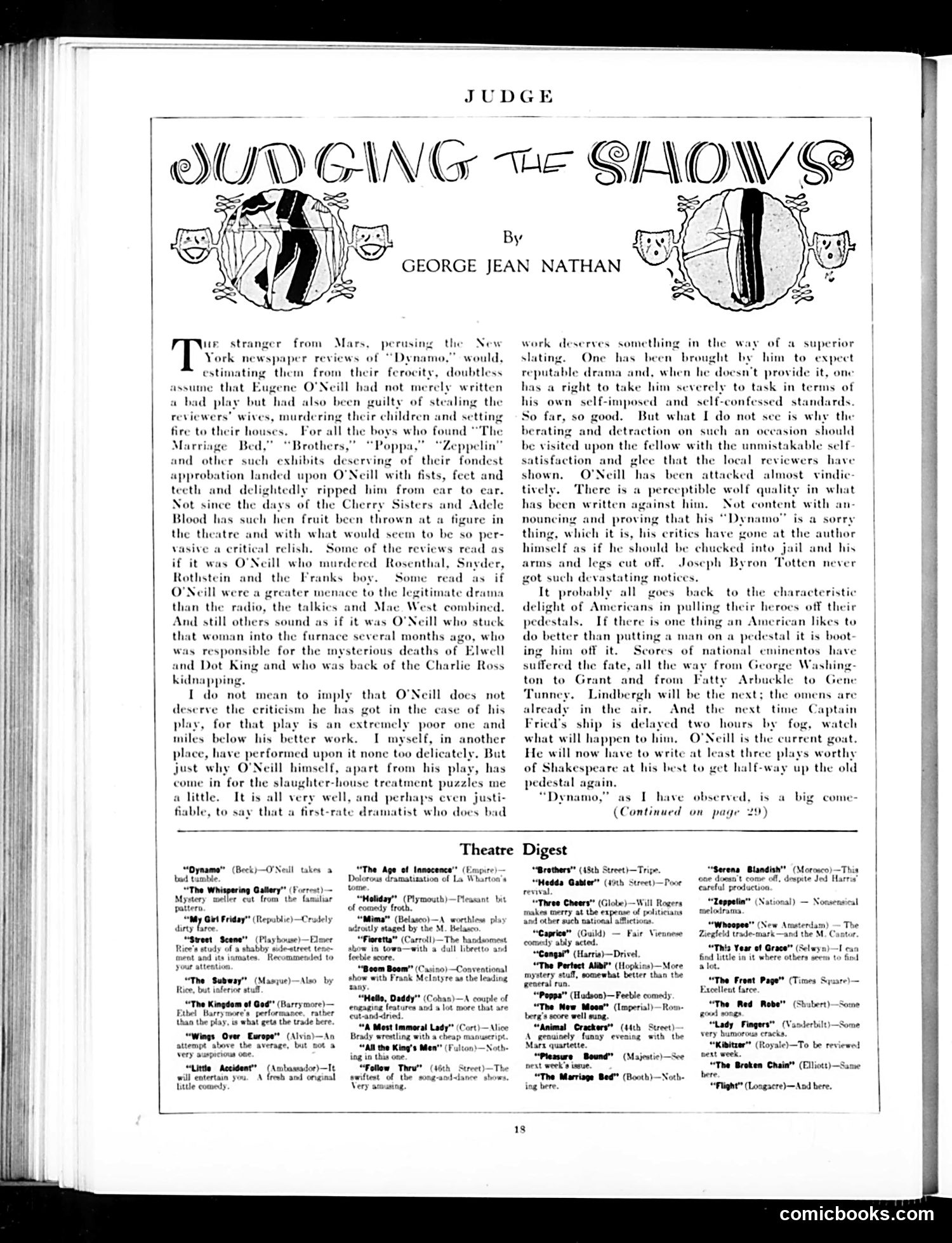
This is a theater criticism piece by prominent drama critic George Jean Nathan, reviewing the hostile critical reception of playwright Eugene O'Neill's play "Dynamo." Nathan's point: O'Neill's new play is genuinely poor and deserves negative reviews. However, he finds the *ferocity* of the critical attacks excessive and personally vindictive toward O'Neill himself—reviewers seem gleeful in tearing down not just the work but the man. Nathan traces this to an American cultural tendency to delight in toppling celebrated figures from pedestals. He references famous cases (Lindbergh, Gene Tunney, Ruth) where the public turned on previous heroes. O'Neill is the current "goat"—scapegoat absorbing disproportionate criticism. The satire critiques critics' unprofessionalism: attacking the artist personally rather than judging the art fairly, driven by schadenfreude rather than honest assessment.
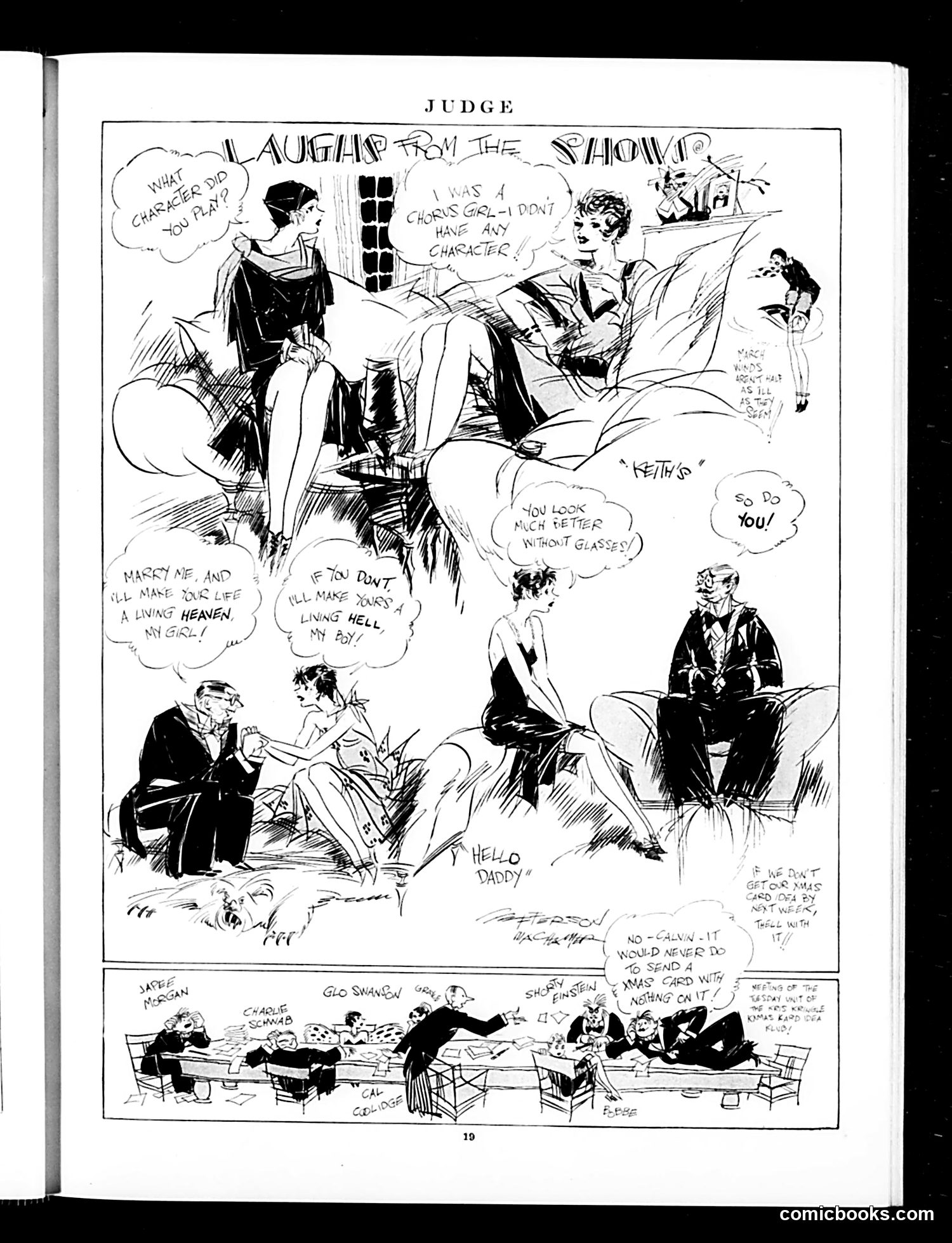
This Judge page satirizes theatrical performers and show business personalities through a series of vignettes. The top panel depicts backstage interactions with various entertainers making theatrical declarations—one character promises to "make your life a living heaven," another threatens "living hell," and there are references to chorus girls lacking character. The bottom panel shows what appears to be a judge or panel reviewing performers, with labeled figures including names like "Jake Began," "Glo Swanson," and others—likely actual entertainers of Judge magazine's era (early 20th century). The satire targets the exaggerated personalities and grandiose promises of show business, the artificiality of theatrical performers, and the gap between their public personas and reality. The recurring joke is that performers are all ego and bombast with little actual substance or character beneath the surface.
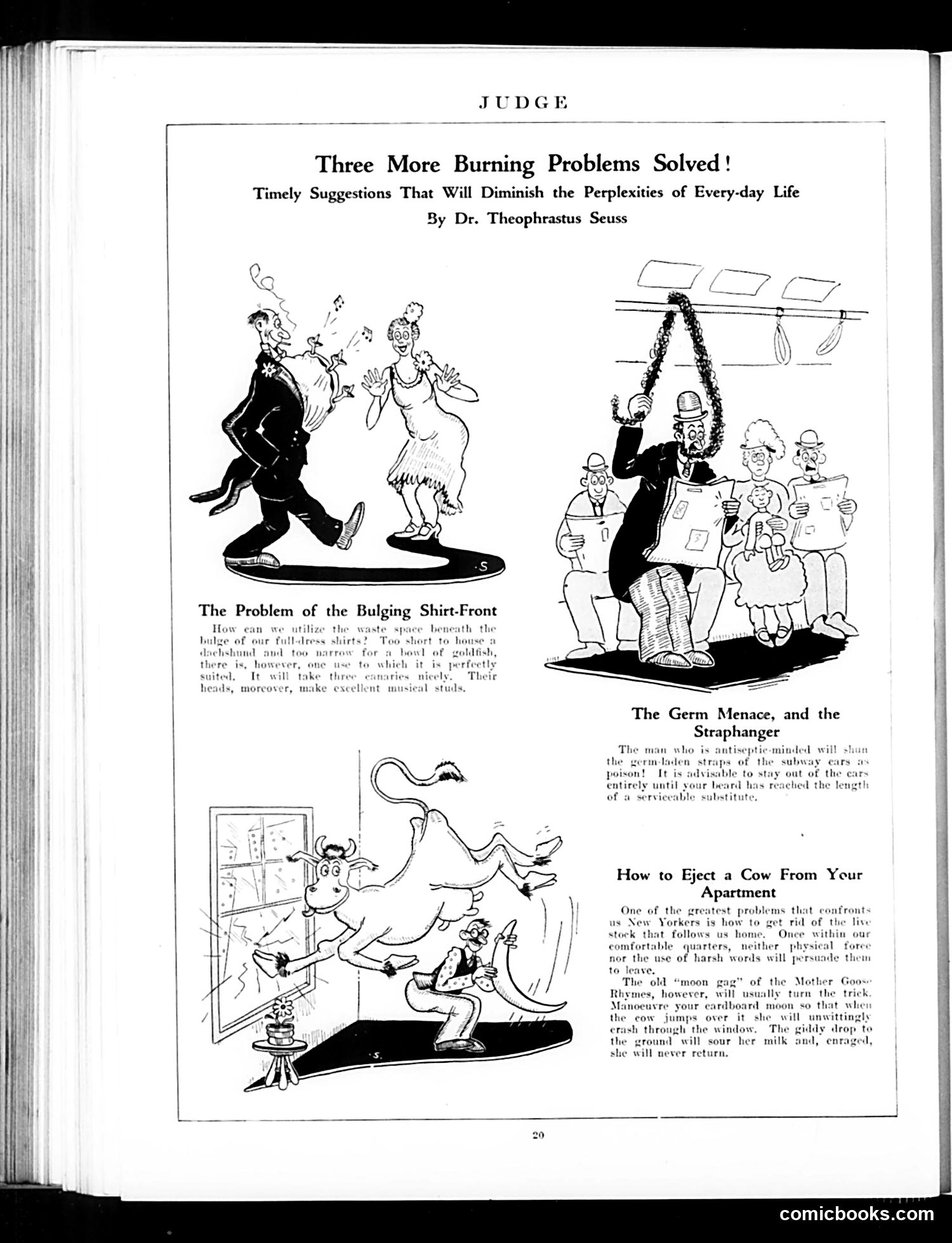
This is a humorous advice column by "Dr. Theophrastus Seuss" (the pen name of Dr. Seuss) offering absurd "solutions" to everyday problems through exaggerated illustrations. **The three problems satirized:** 1. **Bulging Shirt-Front**: Uses three canaries as living shirt studs—poking fun at fashion concerns and impracticality. 2. **The Germ Menace/Straphanger**: Mocks germaphobia by suggesting subway riders avoid touching contaminated surfaces until their beards grow long enough to serve as a "serviceable substitute" barrier—satirizing both excessive hygiene anxiety and absurd solutions. 3. **Eject a Cow From Your Apartment**: References the nursery rhyme "Hey Diddle Diddle" (the cow jumping over the moon), suggesting using that rhyme to trick a cow into jumping out the window—absurdist humor playing on literal interpretation of children's verses. The column's humor relies on taking mundane modern anxieties (hygiene, crowding, urban living) and proposing deliberately ridiculous solutions, typical of Judge magazine's satirical style.
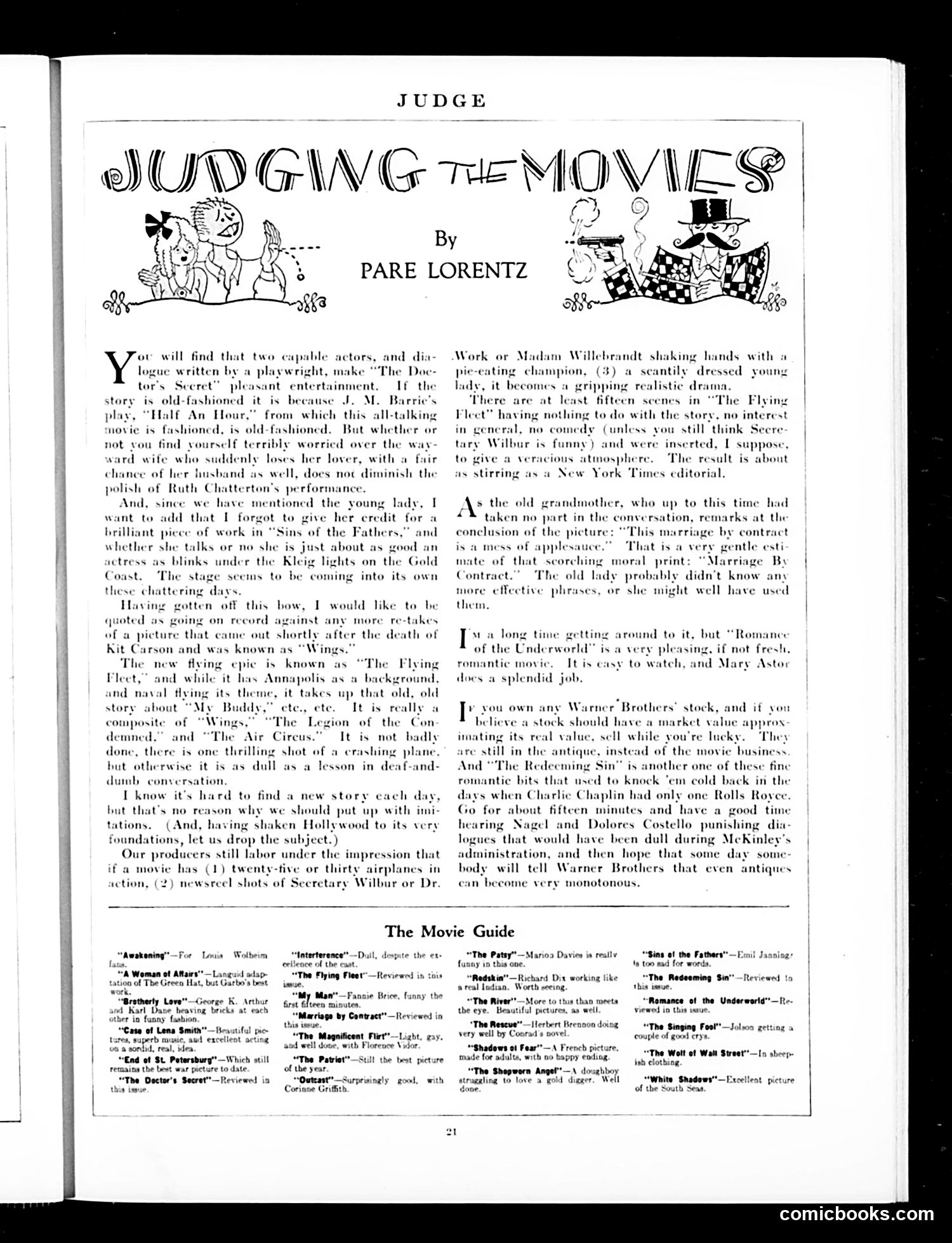
This is a film criticism column reviewing contemporary motion pictures. Lorentz critiques several 1920s movies, emphasizing how producers rely on spectacle over substance. He sarcastically notes that studios believe success requires "(1) twenty-five or thirty airplanes in action, (2) newsreel shots of Secretary Wilbur or Dr. [Madam Willebrandt]"—referencing actual government officials inserted for publicity value. His main complaint: repetitive, derivative plots. He mocks the aviation film "The Flying Fleet" as recycling old stories ("Wings," "The Legion of the Condemned"), calling it "as dull as a lesson in deaf-and-dumb conversation." He praises Ruth Chatterton's acting despite weak material. The satire targets Hollywood's assumption that audiences will watch anything if padded with expensive set pieces and newsworthy cameos. Lorentz advocates for original storytelling over manufactured spectacle—a recurring tension in early sound cinema.
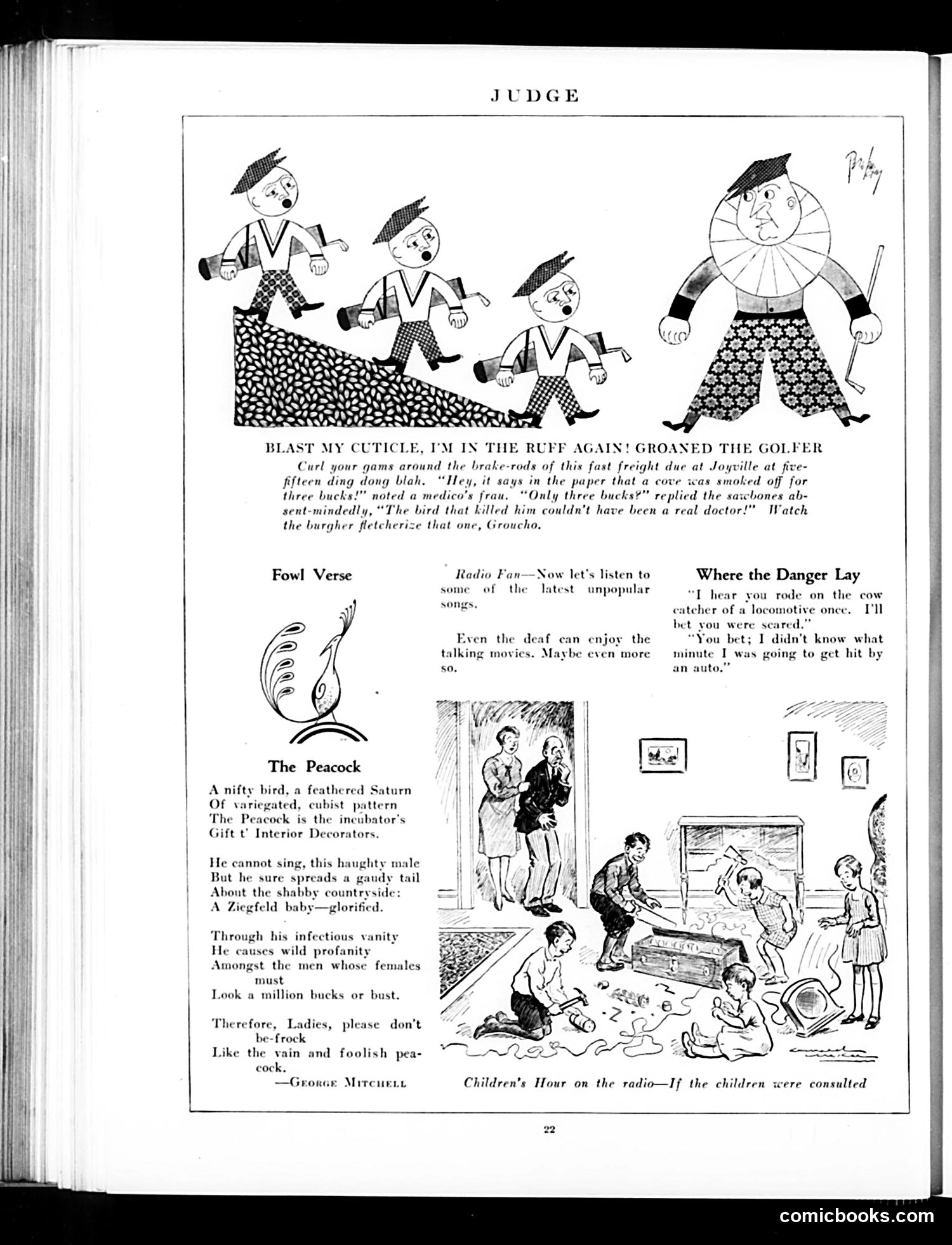
This page contains three satirical pieces typical of 1920s-30s Judge magazine humor: **"The Peacock" (verse by George Mitchell):** A moralistic poem mocking vain men who spend lavishly on their appearance and girlfriends' wardrobes. The "peacock" metaphor compares such men to the bird's showy vanity, warning women not to emulate this foolish behavior. References "Ziegfeld baby" (Florenz Ziegfeld's glamorous chorus girls), suggesting masculine vanity mimics theatrical excess. **Top cartoon:** A slapstick joke about railroad workers and medical incompetence—a hobo's death leads to dark humor about whether the doctor who treated him was legitimate. **"Where the Danger Lay":** A brief exchange satirizing urban automobile dangers versus perceived rural hazards. A man who worked with locomotives claims cars were more dangerous because he couldn't predict when he'd be hit. **"Radio Fan":** A short jab at unpopular radio content and talking movies' appeal even to deaf audiences—satire on emerging mass media quality. The overall tone reflects Judge's characteristic cocktail of social commentary, snobbish mockery of working classes, and vaudeville-style wordplay.
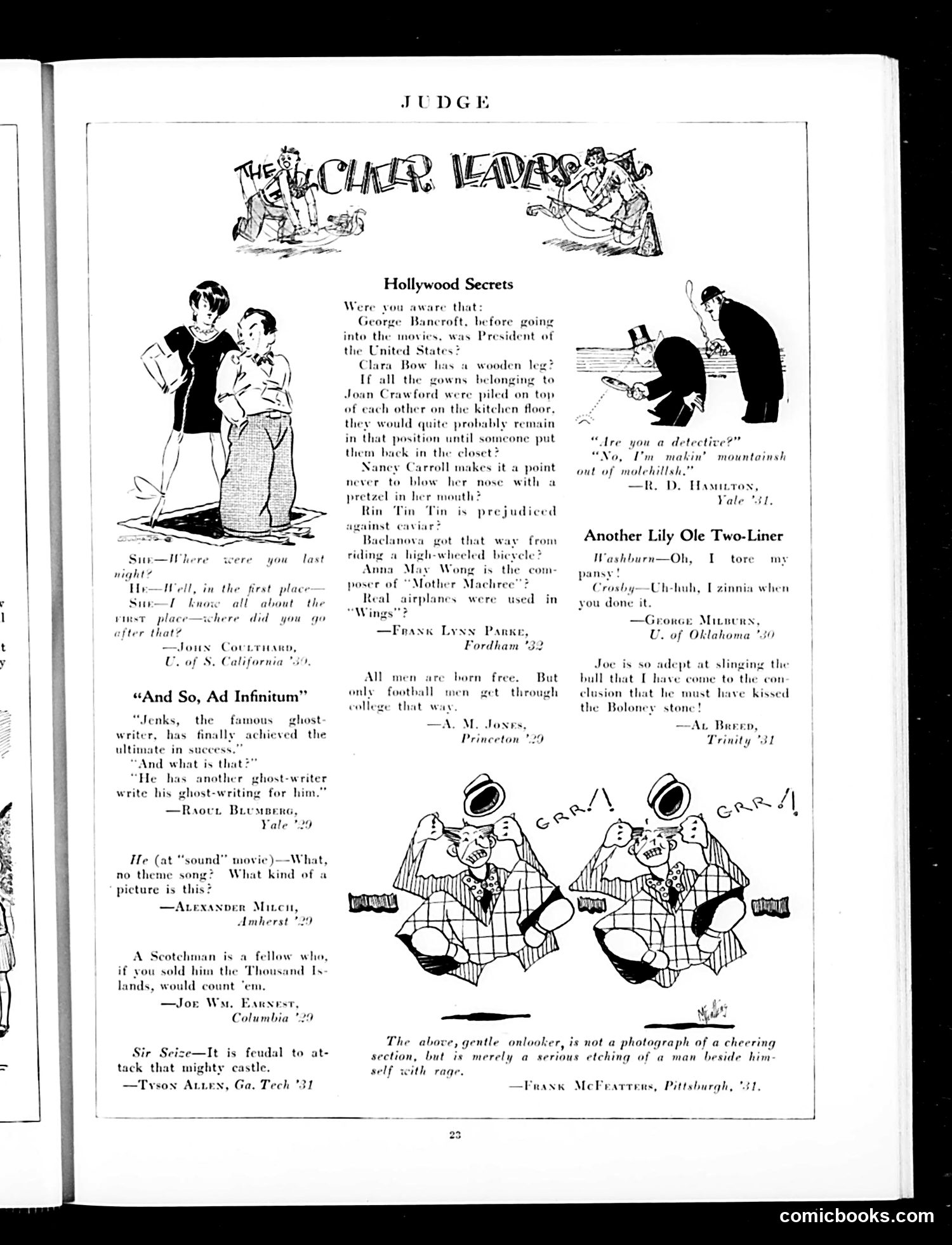
This page from *Judge* magazine contains humorous observations about 1920s Hollywood celebrities and contains student-written jokes submitted from various colleges. The **"Hollywood Secrets"** section presents trivia and rumors about silent film stars like George Bancroft, Clara Bow, Joan Crawford, Nancy Carroll, Rin Tin Tin, and Anna May Wong—offering gossipy, often absurd "facts" to amuse readers familiar with these celebrities. The main **cartoon** (bottom center) shows two identical figures in plaid suits angrily gesticulating at each other with "GRRR-A!" sound effects. The caption explains this depicts "a man beside himself with rage"—a visual pun on the expression "beside oneself." The surrounding **student jokes** from colleges like Yale, Princeton, and Columbia use wordplay and logical absurdities typical of 1920s college humor. The satire targets celebrity gossip culture and demonstrates how magazines relied on recognizable entertainment figures to engage readers, while also showcasing contemporary college wit.
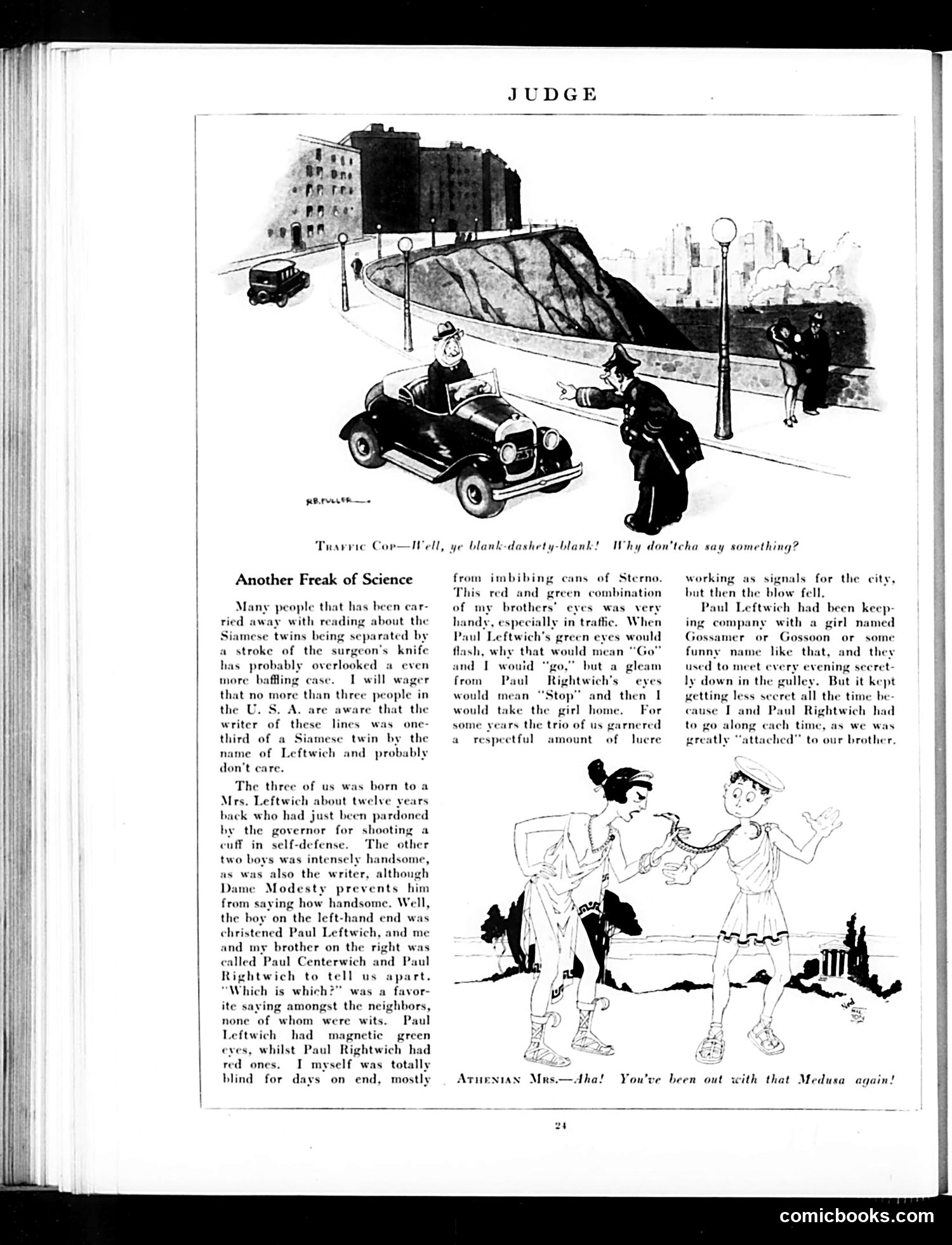
This page contains two separate pieces of satirical humor typical of Judge magazine's style: **"Another Freak of Science"** is a tall tale about Siamese triplets named Paul Leftwich, Paul Centerwich, and Paul Rightwich. The narrator, one of the pauls, describes how their different eye colors (green, red, and blind) made them useful as traffic signals for the city. The satire mocks pseudo-scientific curiosity about medical oddities (referencing real Siamese twin cases that fascinated the public) by presenting an absurdly implausible scenario. The humor derives from the ridiculous premise and the narrator's deadpan delivery about such an outlandish situation. **The cartoon above** shows a traffic cop berating a driver, illustrating the conflict mentioned in the story's punchline about signaling systems failing. The lower cartoon depicts two women, with one (labeled "Athenian Mrs.") accusing the other of consorting with "that Medusa"—a classical mythology reference used as casual social mockery about appearance or reputation. Both pieces reflect early 20th-century American humor: absurdist storytelling mixed with genteel social commentary.
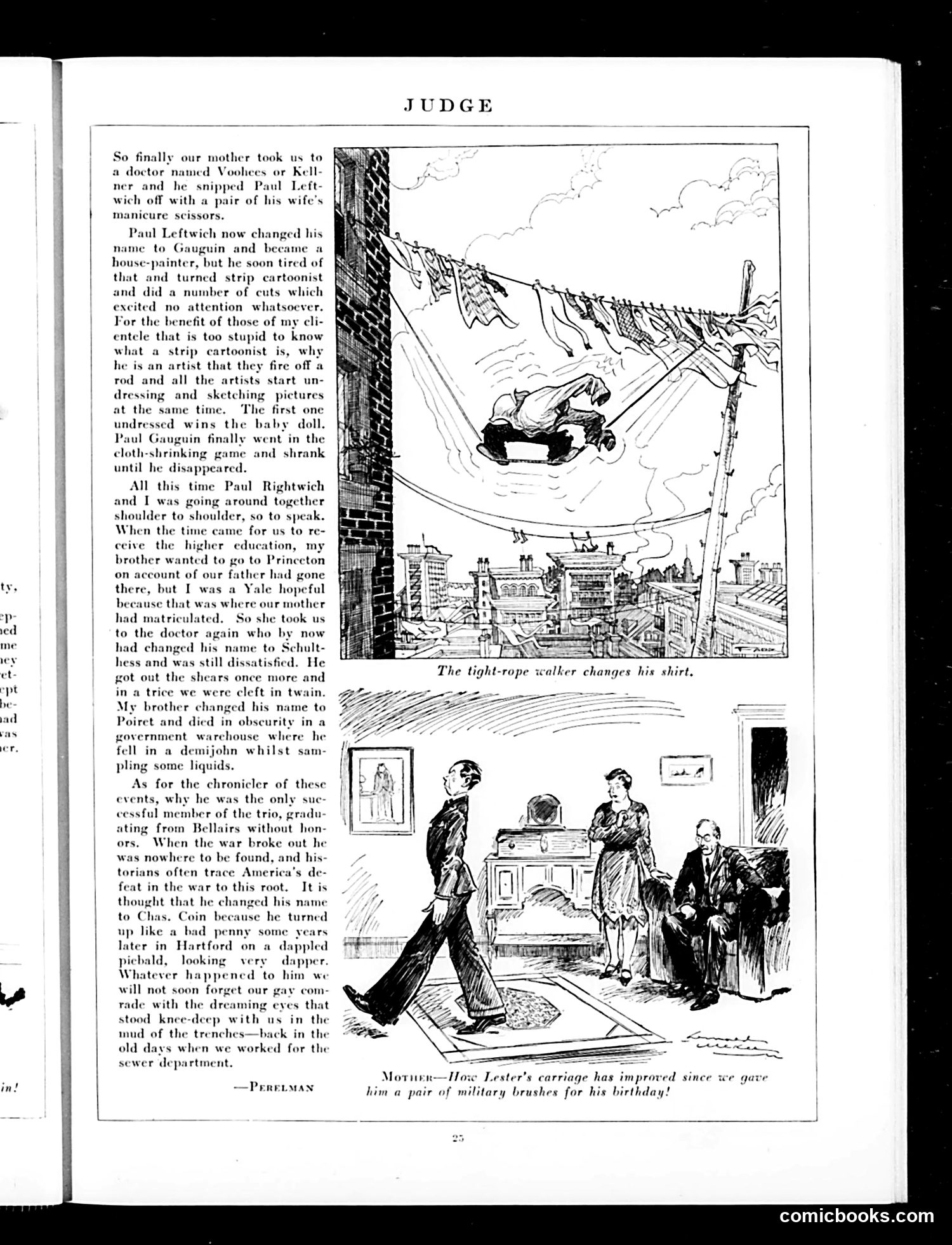
This satirical piece uses absurdist humor to mock several early-20th-century American concerns: artistic pretension, class aspirations, and wartime patriotism. The main narrative is a rambling monologue about twins—Paul Leftwich and Paul Rightwich—separated by their mother's doctor at birth (via comically inappropriate scissors). Each subsequent "Paul" adopts a new identity and fails spectacularly: house-painter, strip cartoonist, Gauguin imitator, fashion designer (Poiret), and failed soldier. The joke targets bohemian artists, aspiring social climbers, and those who claim war service. The final cartoon caption mocks parental gift-giving—suggesting military brushes ("military" being used ironically) improved someone's carriage/deportment, a dig at superficial social improvement. The humor relies on exaggeration and non-sequiturs typical of Judge's satirical style, poking fun at pretense and self-reinvention in American society.
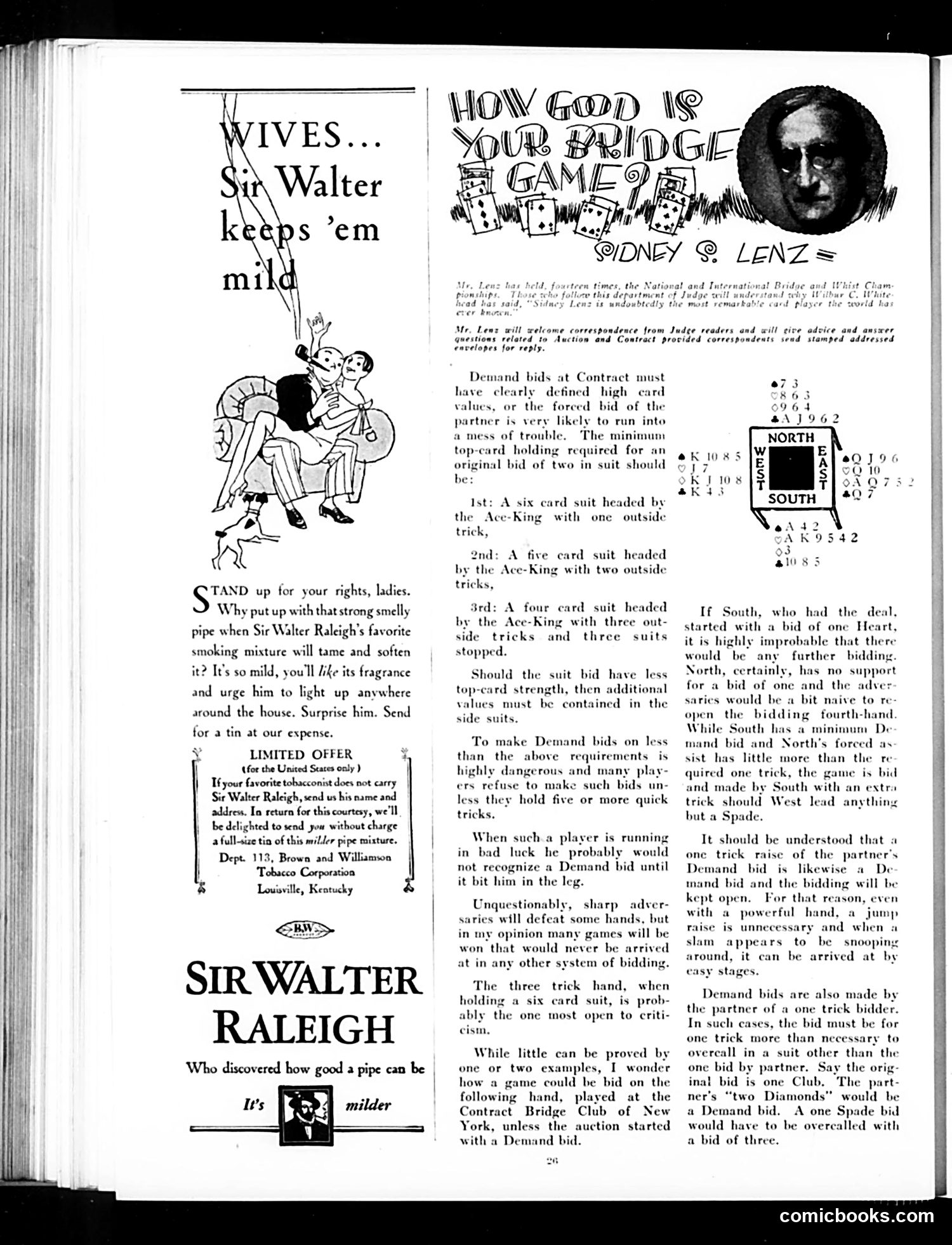
This page combines two distinct types of content: **Left Side - Advertisement:** A Sir Walter Raleigh tobacco ad targets wives, using humor to suggest they buy their husbands a milder pipe tobacco. The joke implies wives suffer from their husbands' strong-smelling pipes and should "surprise" them with this gentler alternative. It's a patronizing appeal to female consumers framed as marital peacekeeping. **Right Side - Bridge Column:** The bulk of the page features "How Good Is Your Bridge Game?" by Sidney Lenz, a bridge instruction column with card hands and bidding strategy. This appears to be a regular educational feature teaching "Demand bids" in contract bridge. **Overall Context:** Judge magazine mixed satirical cartoons with advertisements and instructional columns. The tobacco ad reflects period gender stereotypes (wives managing husbands' habits), while the bridge column represents the magazine's broader appeal to educated readers interested in games and strategy.
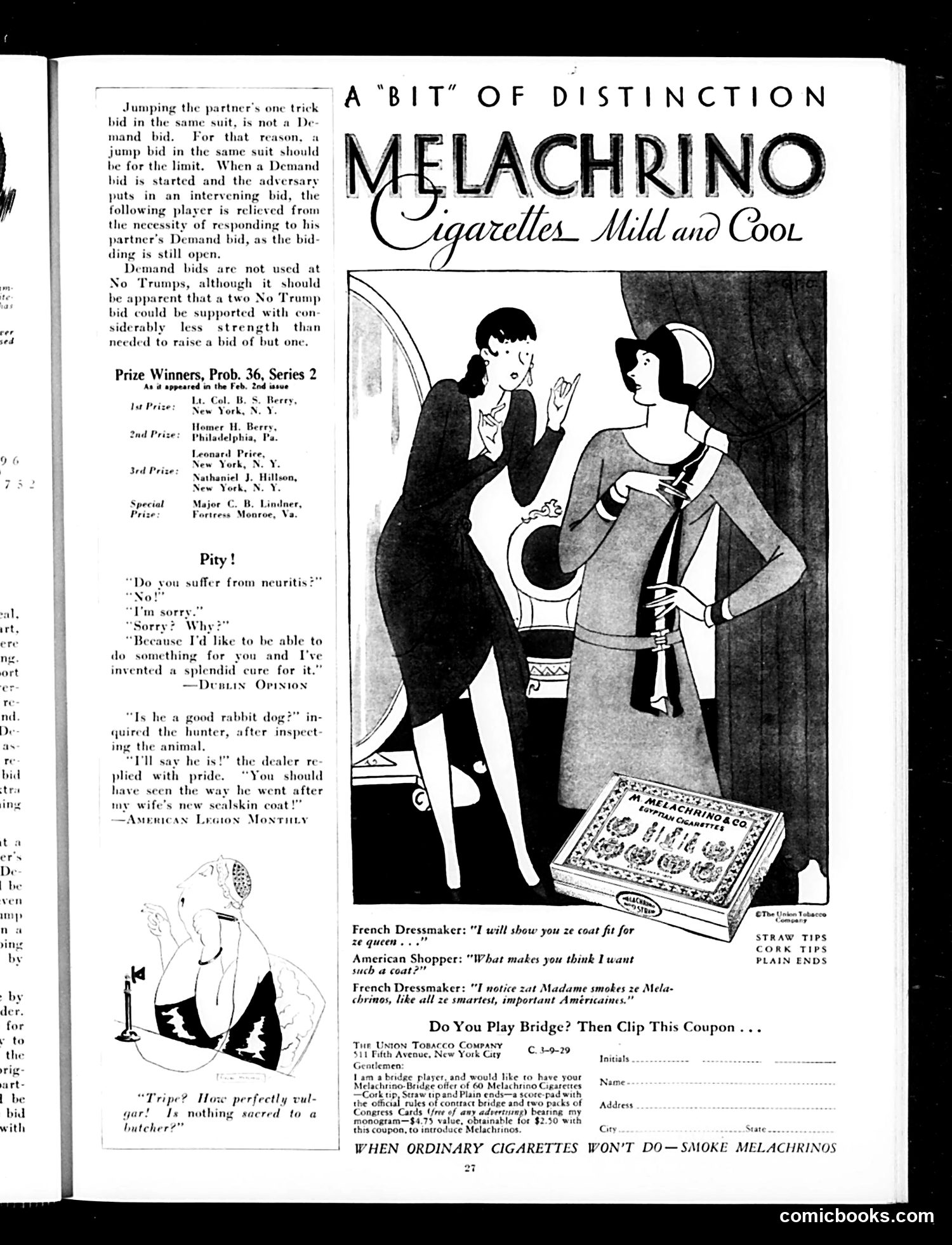
This page is primarily **advertising for Melachrino cigarettes**, with minimal editorial content. The main illustration depicts two fashionable women—a French dressmaker and an American shopper—in an elegant interior. The dressmaker assumes the shopper wants a queen-like coat because she smokes Melachrinos, implying the brand signals sophistication and high status among "the smartest, important Américaines." The surrounding jokes and bridge puzzle are filler content. Small cartoons include one where a doctor regrets being unable to cure a patient's neuritis, and another (likely a joke about infidelity) referencing a man chasing his wife's "new sealskin"—probably a mink coat. The coupon offers bridge supplies as an incentive to try Melachrino's different tip styles (cork, straw, plain). **The satire/marketing angle**: Melachrinos were positioned as a luxury cigarette for elegant, cosmopolitan consumers, particularly women—a relatively forward-thinking marketing approach for this era.
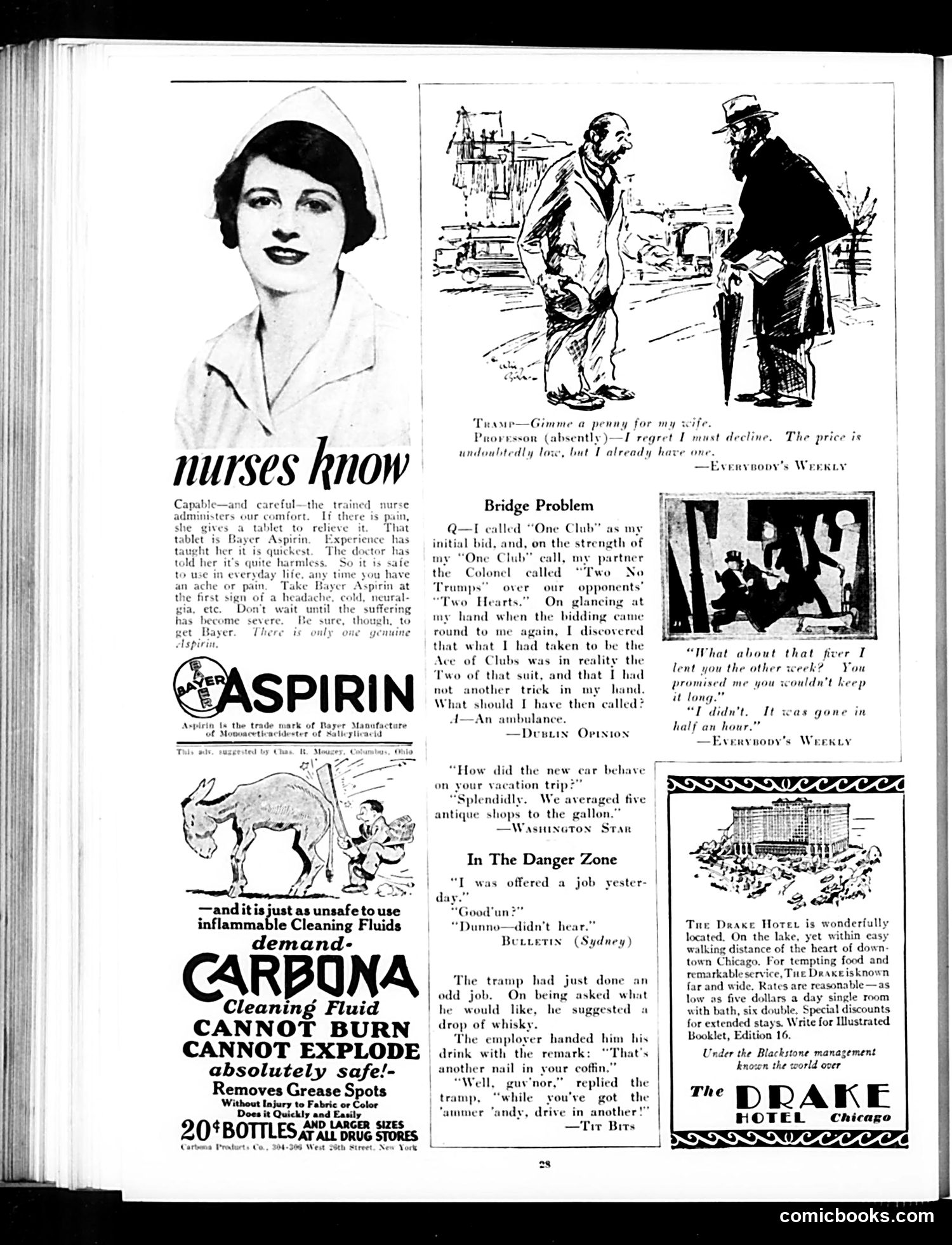
This page combines advertisements with humorous jokes typical of early-20th-century American magazines. **Main Content:** The page features brief comedic vignettes mocking social situations. A "Bridge Problem" joke plays on the anxiety of card games—a man realizes mid-bidding he's misread his cards, and the advice is darkly comic: "call an ambulance." Another joke involves a tramp negotiating wages; when offered whisky instead of money, he quips the drink is "another nail in your coffin," suggesting working-class desperation masked by dark humor. **Advertisements:** Bayer Aspirin and Carbona cleaning fluid dominate, emphasizing safety—Aspirin for everyday use, Carbona promising it "cannot explode." The Drake Hotel ad promotes Chicago luxury accommodations. **Context for Modern Readers:** The humor reflects pre-1930s attitudes toward class, employment, and everyday anxieties. References to "antique shops to the gallon" mock automotive efficiency; the tramp jokes assume readers find working-class struggle amusing. The overall tone is cynical yet mainstream entertainment.
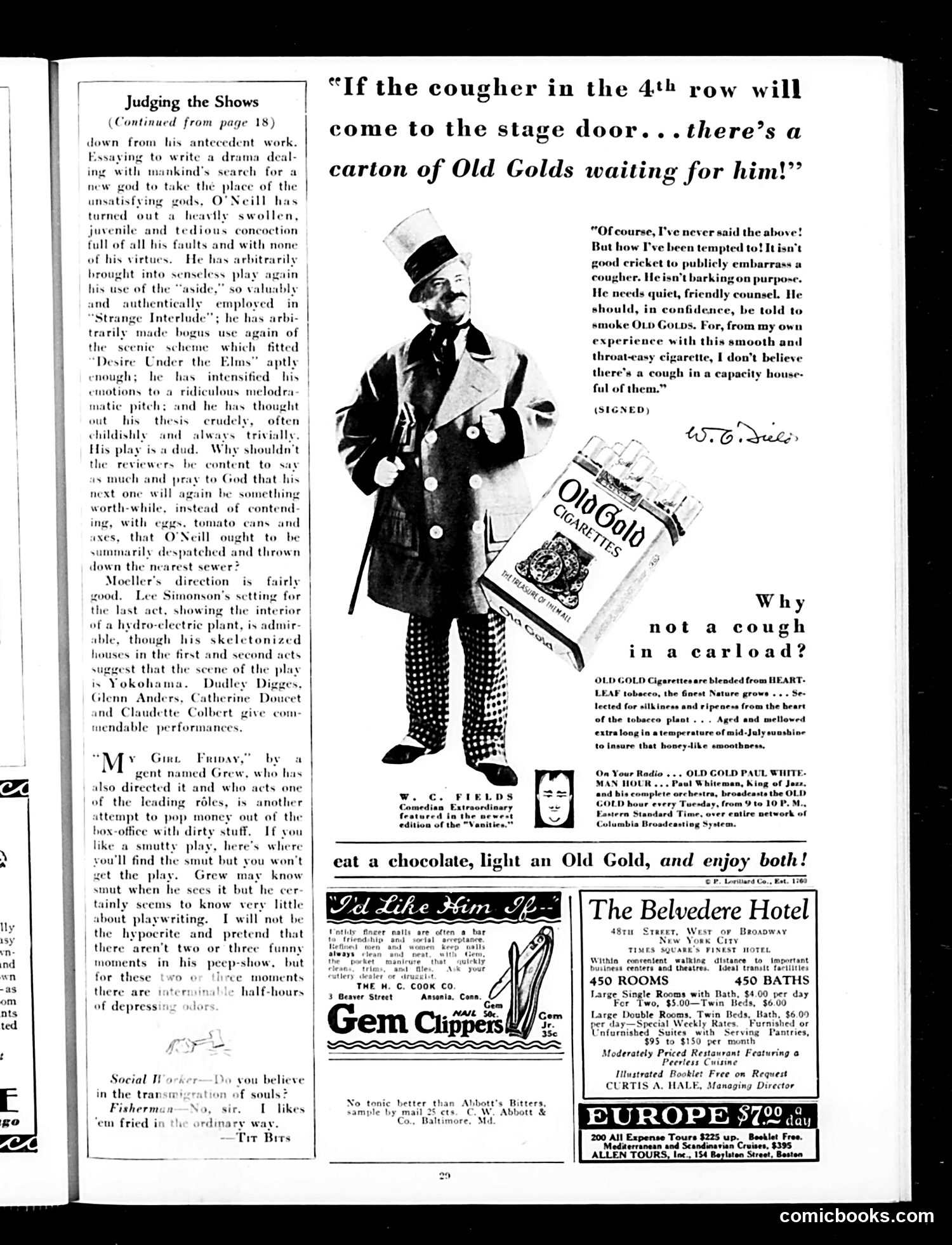
This page combines theater criticism with cigarette advertising. The main critique discusses Eugene O'Neill's play "Dynamo," calling it a "dud" despite O'Neill's reputation. The critic argues O'Neill relied too heavily on theatrical gimmicks ("the aside," melodrama) rather than developing his themes clearly. The dominant visual is a **cigarette advertisement** for Old Gold cigarettes. The illustrated figure (labeled W.C. Fields, a famous comedian) holds an Old Gold pack and a theatrical program, creating the joke: "If the cougher in the 4th row will come to the stage door...there's a carton of Old Golds waiting for him!" The satire is darkly humorous—suggesting a bad play causes coughing fits in the audience, but the solution is cigarettes (which would obviously cause coughing). Fields supposedly endorses Old Gold as so smooth it prevents coughs during theater attendance. The advertisement is vintage 1920s-30s marketing: before health warnings, cigarettes were openly promoted as healthful. The humor relies on the audience recognizing both Fields' celebrity and the absurdity of the pitch.
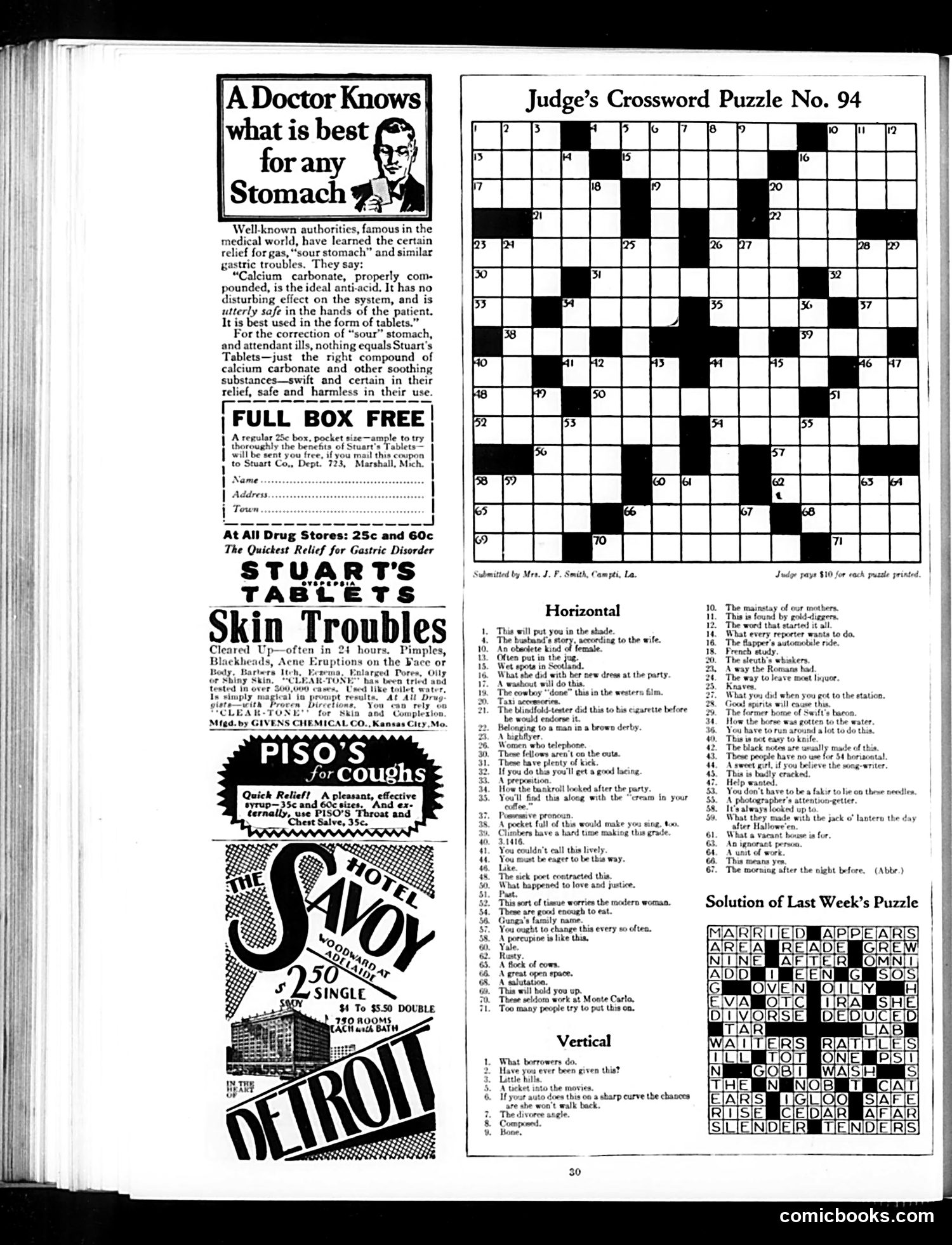
This page is primarily **advertising and puzzles**, not political satire. The dominant content includes: **Advertisements:** - Stuart's Tablets for stomach/digestive ailments (calcium carbonate remedy) - Piso's cough syrup and throat salve - Hotel Savoy in Detroit **Main Content:** Judge's Crossword Puzzle No. 94, a standard word puzzle with horizontal and vertical clues typical of 1920s-era magazines. The clues reference contemporary culture—flappers ("The flapper's automobile ride"), cowboys, and period slang—but contain no apparent political commentary. **Historical Context:** This reflects the magazine's evolution toward mainstream entertainment content, including advertisements for patent medicines (common before modern FDA regulations) and commercial puzzles, rather than the satirical cartoons the publication was historically known for. The page demonstrates how Judge magazine, founded as political satire, had broadened into general humor and entertainment by this era.
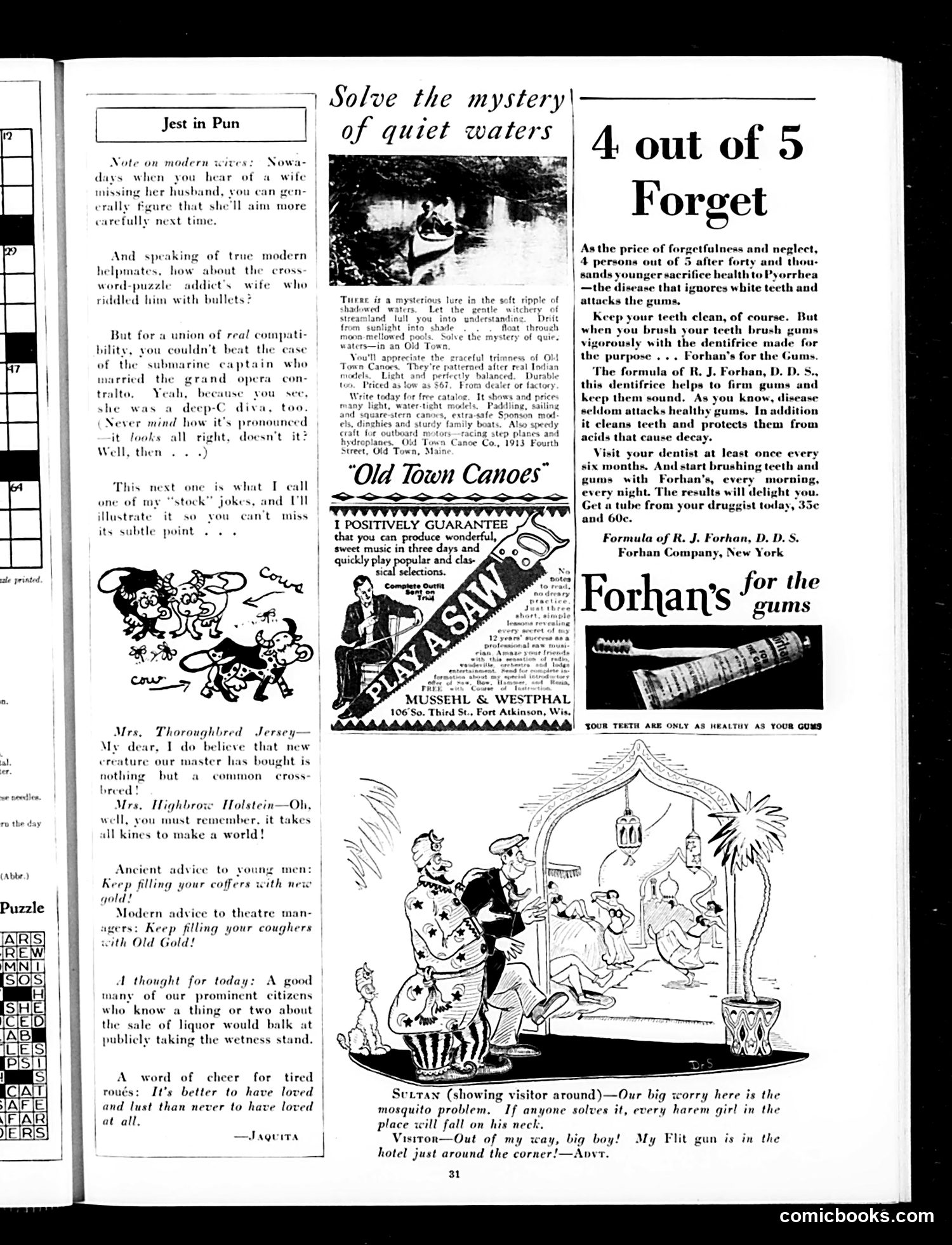
This page from Judge magazine (appears to be 1920s-1930s era) contains mostly **humorous quips and advertisements** rather than political cartoons. The "Jest in Pun" section offers light domestic humor: jokes about wives (one riddles her husband with bullets—a dark reference to modern marriage tensions), a submarine captain marrying an opera singer (pun on "deep C"), and a crossbred dog. These reflect contemporary anxieties about modern marriages and changing gender roles. The advertisements dominate: **Forhan's toothpaste** promotes gum health (pyorrhea was a serious concern then), **Old Town Canoes**, a **piano instruction guarantee**, and **Flit insecticide**. The cartoon illustration shows a **sultan hosting visitors**, joking about mosquitoes being such a problem that solving it would make harem girls grateful. This reflects early-20th-century stereotypes about exotic "Oriental" settings and casual attitudes toward insect control before modern pesticides. Overall, the page reflects contemporary consumer culture, domestic comedy, and period attitudes toward hygiene and colonialism.
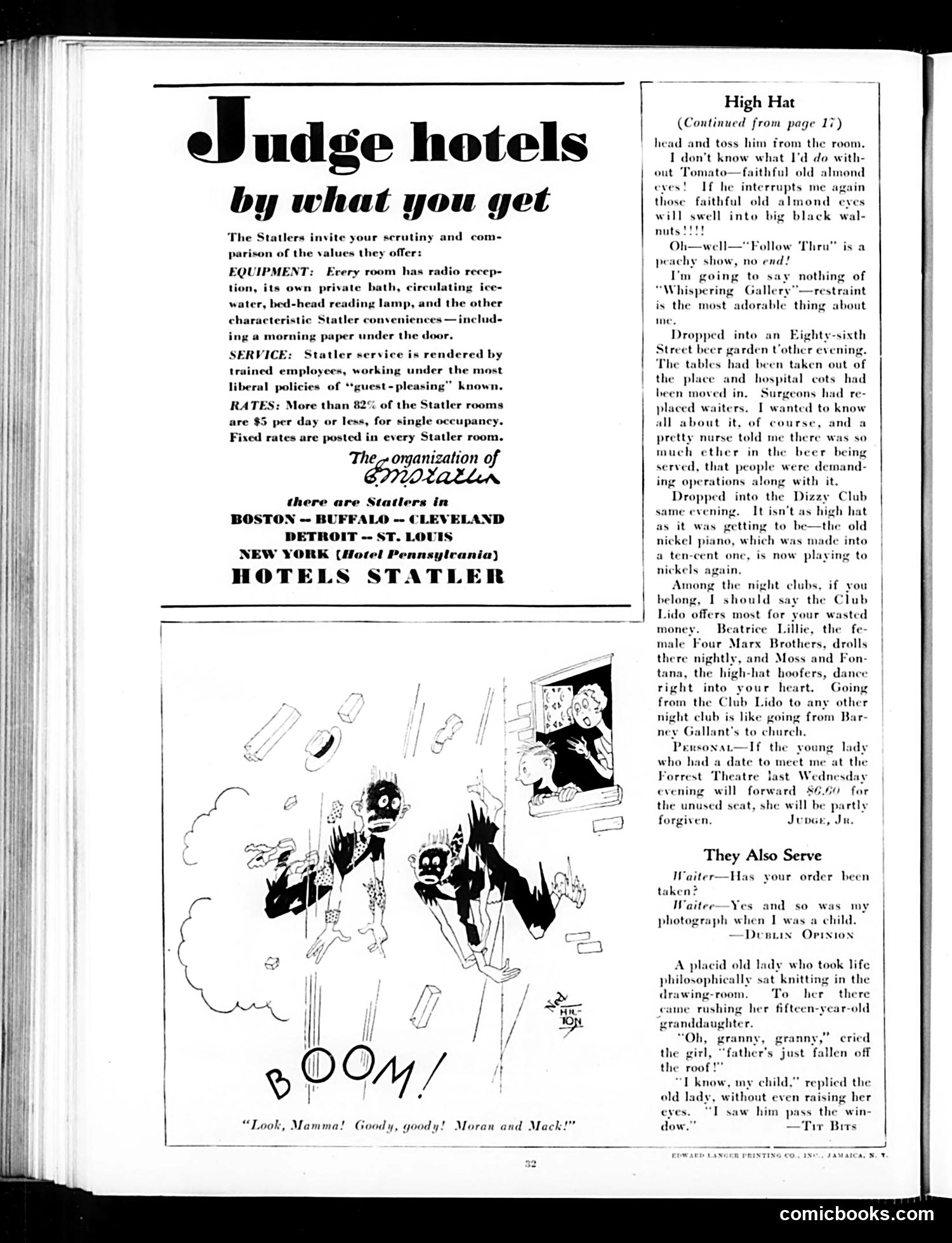
This page combines a Statler Hotels advertisement with humorous social commentary typical of Judge magazine's satirical style. **The Main Cartoon:** The illustration labeled "BOOM!" depicts figures (appearing to be comedians or entertainers named Moran and Mack, referenced in the caption) being explosively ejected from a room—likely a visual gag about rowdy nightclub behavior or hotel management removing disruptive guests. **The "High Hat" Column:** This is a society/entertainment gossip section mocking the pretensions of New York's nightlife scene. The author satirizes: - Speakeasy culture (the "beer garden" with hospital cots suggests Prohibition-era establishments) - High-hat nightclub snobbery (Club Lido, Club Dizzy) - Performers like Beatrice Lillie and the Marx Brothers - The affectation of wealthy patrons wasting money at exclusive venues **The Satire's Point:** Judge ridicules both the shallow vanity of nightclub society and the artificial class distinctions of establishments claiming superiority while merely serving alcohol illegally during Prohibition. The page reflects 1920s American culture: Prohibition, vaudeville entertainment, and Jazz Age nightlife pretension.
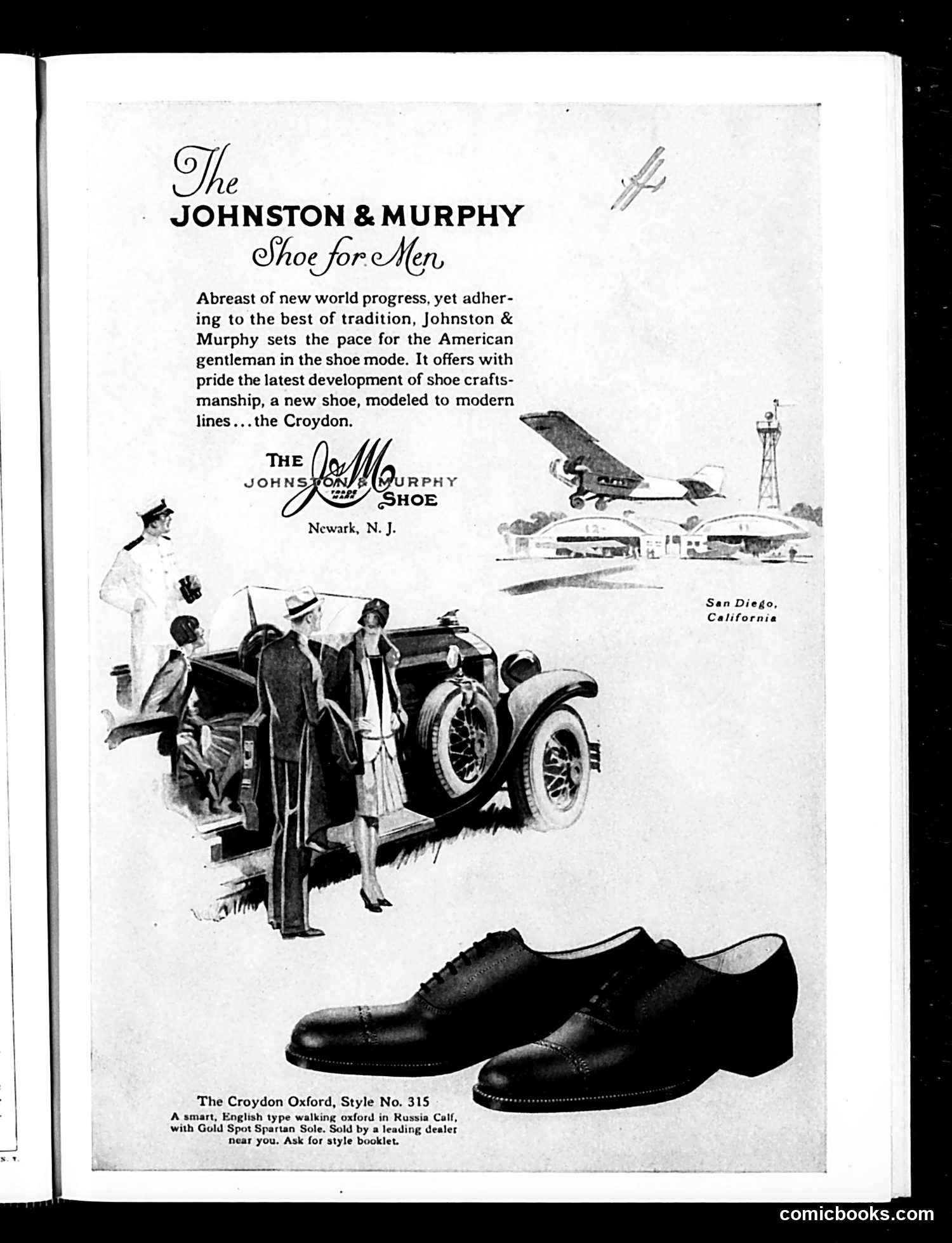
This is primarily **a commercial advertisement**, not political satire. It promotes Johnston & Murphy's "Croydon" oxford shoe for men, positioned as combining modern progress with traditional craftsmanship. The page uses aspirational imagery typical of 1920s-1930s advertising: well-dressed men and women near an automobile, and an airplane at San Diego (representing cutting-edge technology and sophistication). These visual references suggest the shoe appeals to upwardly mobile, progressive gentlemen. The text emphasizes the shoe's "modern lines" while maintaining "tradition," marketing it to the American gentleman as a status symbol aligned with contemporary leisure and travel culture. No satire or political commentary is evident—this is straightforward product promotion in *Judge* magazine's advertising section.