
Judge, 1929-03-09 · page 20 of 36
Judge — March 9, 1929 — page 20: what you’re looking at
What you’re looking at
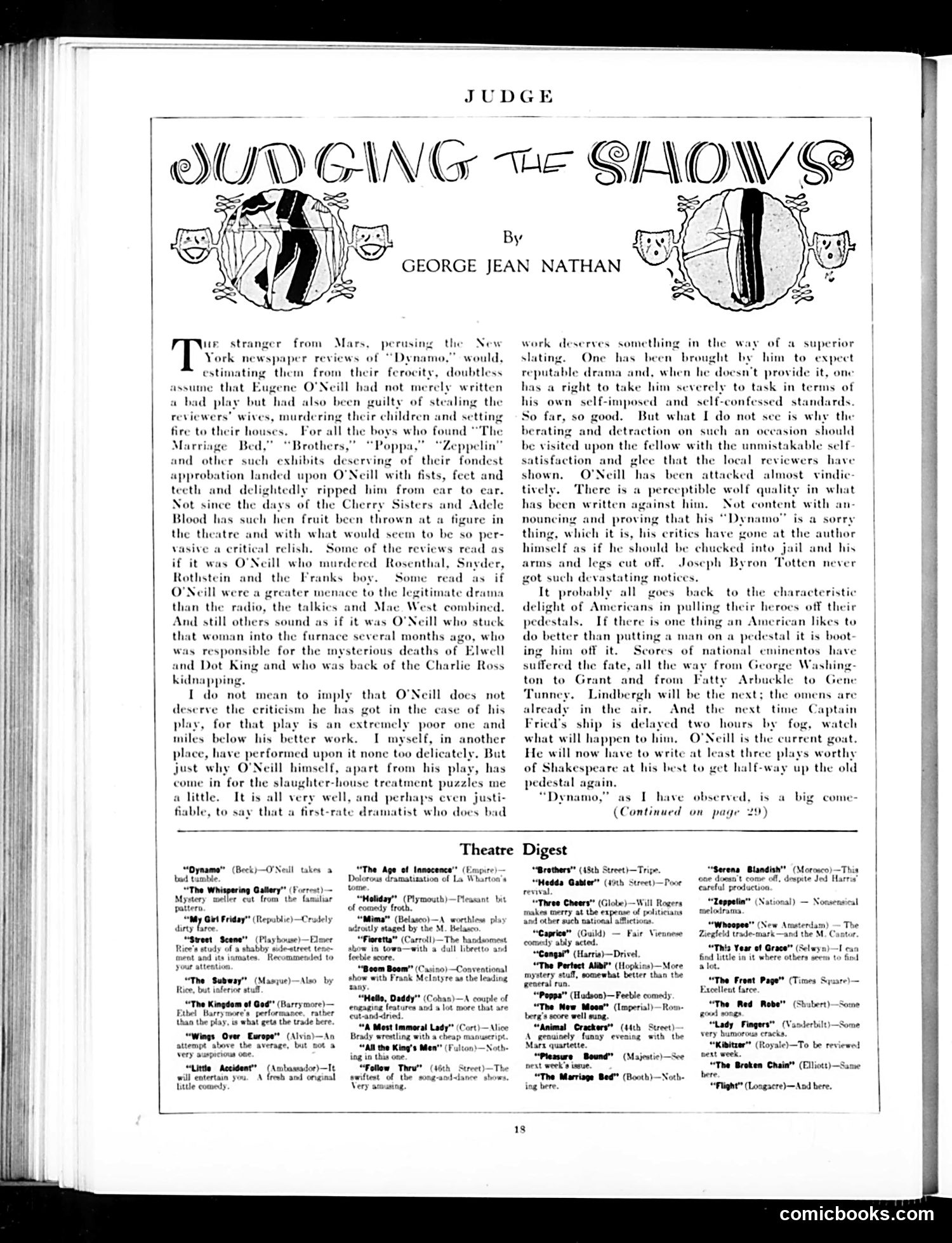
This is a theater criticism piece by prominent drama critic George Jean Nathan, reviewing the hostile critical reception of playwright Eugene O'Neill's play "Dynamo." Nathan's point: O'Neill's new play is genuinely poor and deserves negative reviews. However, he finds the *ferocity* of the critical attacks excessive and personally vindictive toward O'Neill himself—reviewers seem gleeful in tearing down not just the work but the man. Nathan traces this to an American cultural tendency to delight in toppling celebrated figures from pedestals. He references famous cases (Lindbergh, Gene Tunney, Ruth) where the public turned on previous heroes. O'Neill is the current "goat"—scapegoat absorbing disproportionate criticism. The satire critiques critics' unprofessionalism: attacking the artist personally rather than judging the art fairly, driven by schadenfreude rather than honest assessment.
📄 Transcribed text from this page (OCR, searchable)
Machine-transcribed from the original scan — historical spelling and the odd misread are preserved.
from Mars, perusing the New York newspaper reviews of “Dynamo,” would, estimating them from their ferocity, doubtless assume that Eugene O'Neill had not merely written a bad play but had also been guilty of stealing the their children and settin, ses. For all the boys who found “Th “Brothers,” “Poppa,” “Zeppelin” and other such exhibits deserving of their fondest approbation landed upon O'Neill with fists, fect and vd delightedly ripped him from ear to ear. t since the days of the Cherry Sisters and Ad Blood has such hen fruit been thrown at a figure i the theatre and with what would seem to be so per- vasive a critical relish. Some of the reviews read as if it was O'Neill who murdered Rosenthal, Snyder, Rothstein and the Franks boy. Some read as if O'Neill were a greater menace to the legitimate drama than the radio, the talkies and Mac, West combined. And still others sound as if it was O'Neill who stuck that woman into the furnace several months a who was responsible for the mysterious deaths of Elwell and Dot King and who was back of the Charlie Ross kidnapping. I do not mean to imply that O'Neill does not deserve the criticism he has got in the case of his play, for that play is an extremely poor one and miles below his better work. I myself, in another place, have performed upon it none too delicately, But just why O'Neill himself, apart from his play, has come in for the slaughter-house treatment puzzles me a little. It is all very well, and perhaps even justi- fiable, to say that a first-rate dramatist who does bad reviewers’ wives, murderin Marriage Bed, JUDGE By Aree) Te GEORGE JEAN NATHAN Cie x HE GAOWSG work deserves something in the way of a superior slating. One has been brought by him to expect reputable drat doesn’t provide it, one has a right to take him severely to task in terms of his own self-imposed and self-confessed standards. So far, so good. But w I do not se the berating and detraction on such an oceasion should be visited upon the fellow with the unmistakable self satisfaction and glee that the reviewers have shown, O'Neill has been at almost) vindic tively. There is a perceptible wolf quality in what has been written against him. Not content with an- nouncing and proving that his “Dynamo” is a sorry thing, which it is, his critics have gone at the author himself as if he should be chucked into jail and his arms and legs cut off. Joseph Byron Totten never at such devastating notices, It probably all goes back to the characteristic delight of Americans in pulli pedestals. If there is one thin, do better than putti ing him off it. suffered the fat ton to Grant and from 3 to Gene Tunney. Lindbergh will be the next; the omens are already in the air. And the next time Captain ied’s ship is delayed two hours by fog, watch will happen to him, O'Neill is the current goat. He will now have to write at least three plays worthy of Shakes) this best to get half-way up the old pedestal again. “Dyn aand, when their heroes off their an Amer mo,” as I have observed, is a big come- (Continued on page 29) Theatre “Dyname” (Beck) —O'Nell kes a “The Age of Innecence’? (Emp Dolorous dramatization of La Wha tome. “Holiday” (Plymouth)—Pteasant bit of comedy froth. rt Friday” (Repablie)—Craely “Mima (Belasco) —A. worthlew pls any farce. adroitly staged by the M. Belasco. “Street Scene” The handsomest libretto and (Masque)—Also by of stuf. “The Kingdom of Ged" (Barry more)— Ethel Barrymore's performance. rather than the play, is what geta the trade bere. “Wings Over Europe (Alvi engaging features and a lot more that are eut-and-dried. “Ah Mest Immoral Lady” (Cort)—Alice —An Brady wrestling with a cheap manuscript. peated - “All the King’s Men” (Fu very @ ing in this one “Little Accident” (Ambawador)—It “Fellow Thru (4th St will entertain you. A fresh and orginal ewiftest of the song-and-dance sho Little comedy Very atmasing. Digest ethers” (48th Street}—Trige. “Serena Blandish” (Morosco)—T! * (49th Street)——Pooe 088 donan’t come off, dewpite Jed Har dda Gabler” (42th Street) —Poor Cor man t come « revival “Three Cheers” (Globe) —Will Rogers makes merry at the expense of p and other such national affictions ‘Cesrlea” (Guild) — Fair Viennewe comedy ably acted. : “This Year of Grace” (Sel wy “*Congat” (Harris)—Drive find litthe in it where others seem to find “The Pertect Alibi* (Hopkins)—More a lot. mystery stuff, somewhat better than the general run. Jeppelin” (National) — No melodrama. Whoopee" (New Amsterdam) — The feld trade-mark —and the M. Cantor “The Front Page” (Times Syuate)— “Poppa” (Hudeon)—Peeble comedy, __‘Pxcelleutfarew ; “The New Moon” (Imperial) —Rom- “The Red Robe” (Shubert) —Some berg’s score well sung. good songs. Fe ; “Animal Crackers” (44th Street) : (Vanderbilt) A genuinely funay evening with the very bumorous craci Marx quartette. “Kibituer’ * (Roy “Pleasure Bound” (Majestic)—See ext week. next week's rue, “The Marriage Bed” (Booth)—Noth- bere. ing bere. “Flight” (Longacre)—And bere. —To be revie “The Broken Chain” (Elliott) —Same | | : | | comicbooks.com