
A complete issue · 36 pages · 1929
Judge — March 2, 1929
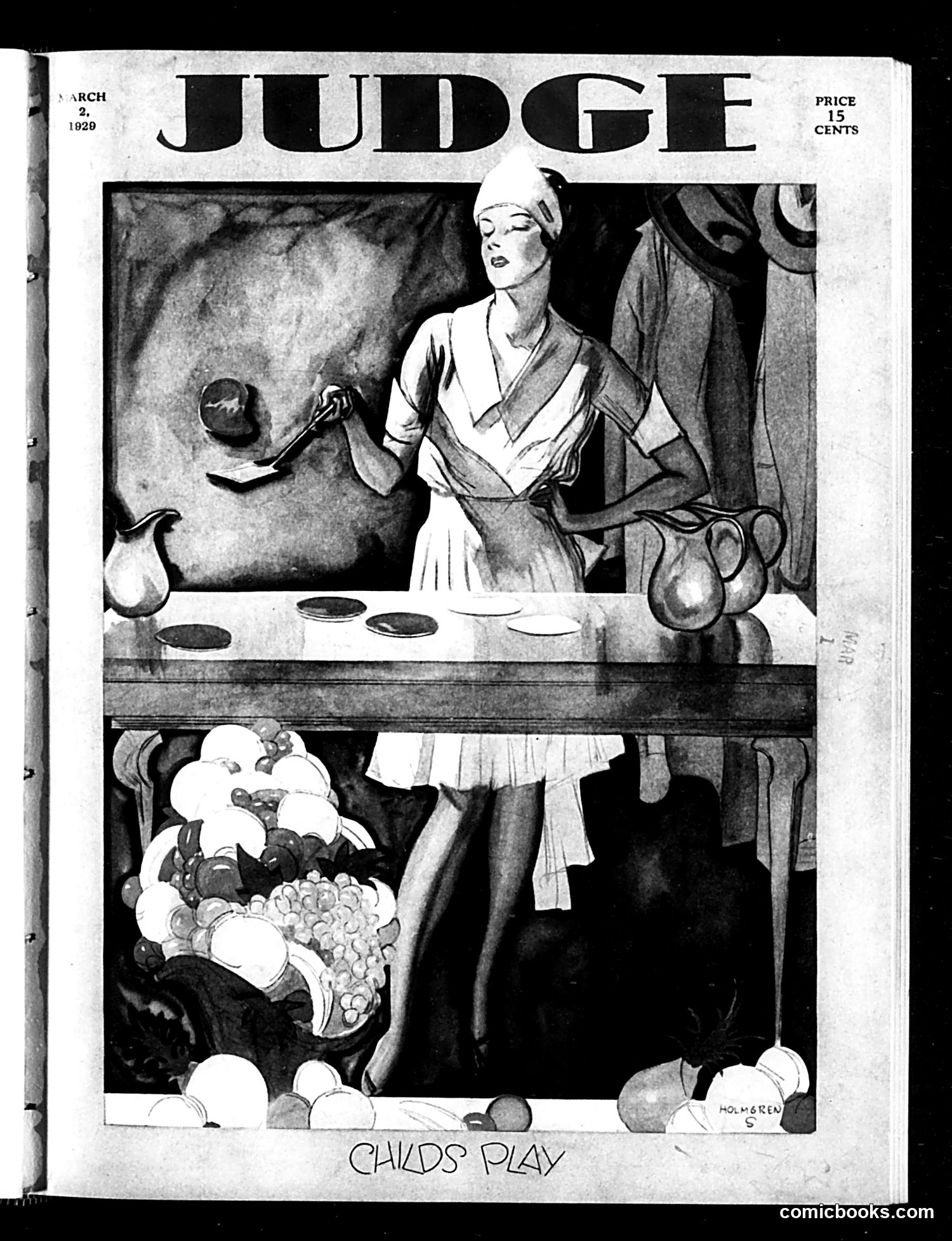
This cover illustrates a domestic scene titled "Child's Play," depicting a woman in 1920s attire (headwrap, short dress) at a kitchen counter. The upper panel shows her appearing to juggle or toss items, while the lower panel displays abundant produce and eggs—suggesting food preparation or household management. The satire likely comments on women's domestic labor in the Jazz Age, when modern "efficiency" was promoted as a solution to housework. The abundance of fresh produce and eggs may reference either the prosperity of the era or, given the date (just months before the 1929 stock market crash), perhaps ironic commentary on assumed plenty. The work appears to critique how "child's play" romanticizes what was actually demanding domestic labor.
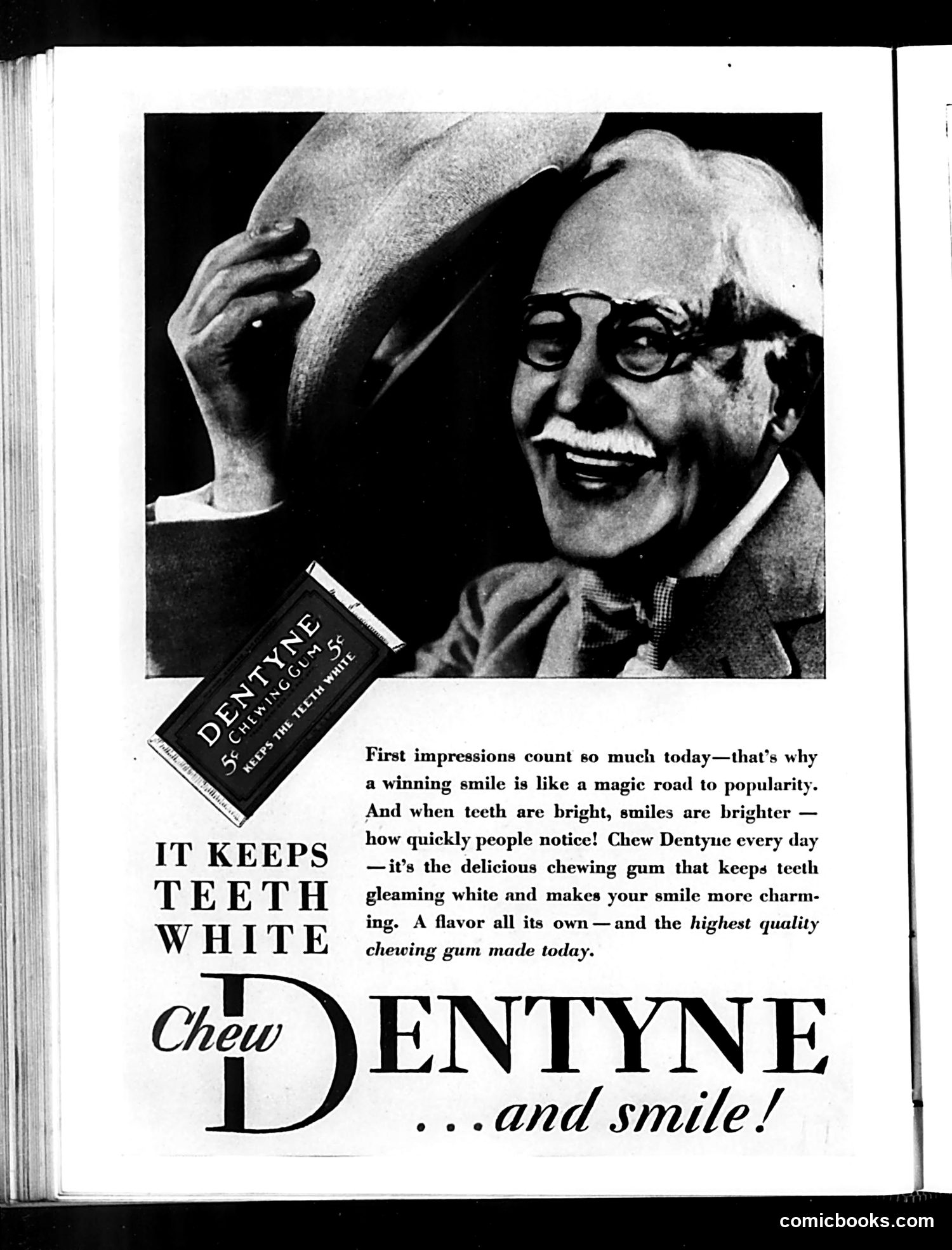
This page is primarily **advertising, not satire or political content**. It's a Dentyne chewing gum advertisement from an era when Judge magazine included such ads. The ad features an older man wearing glasses in a cheerful pose, promoting chewing gum's teeth-whitening properties. The accompanying text emphasizes "first impressions" and social popularity through bright smiles—typical mid-20th century advertising rhetoric linking personal grooming to success and charm. No political figures or satirical commentary appear here. The image is simply a promotional piece using an avuncular, trustworthy-looking man as a spokesperson. The "magic road to popularity" reference reflects common advertising tropes of the period that connected consumer products to social acceptance.
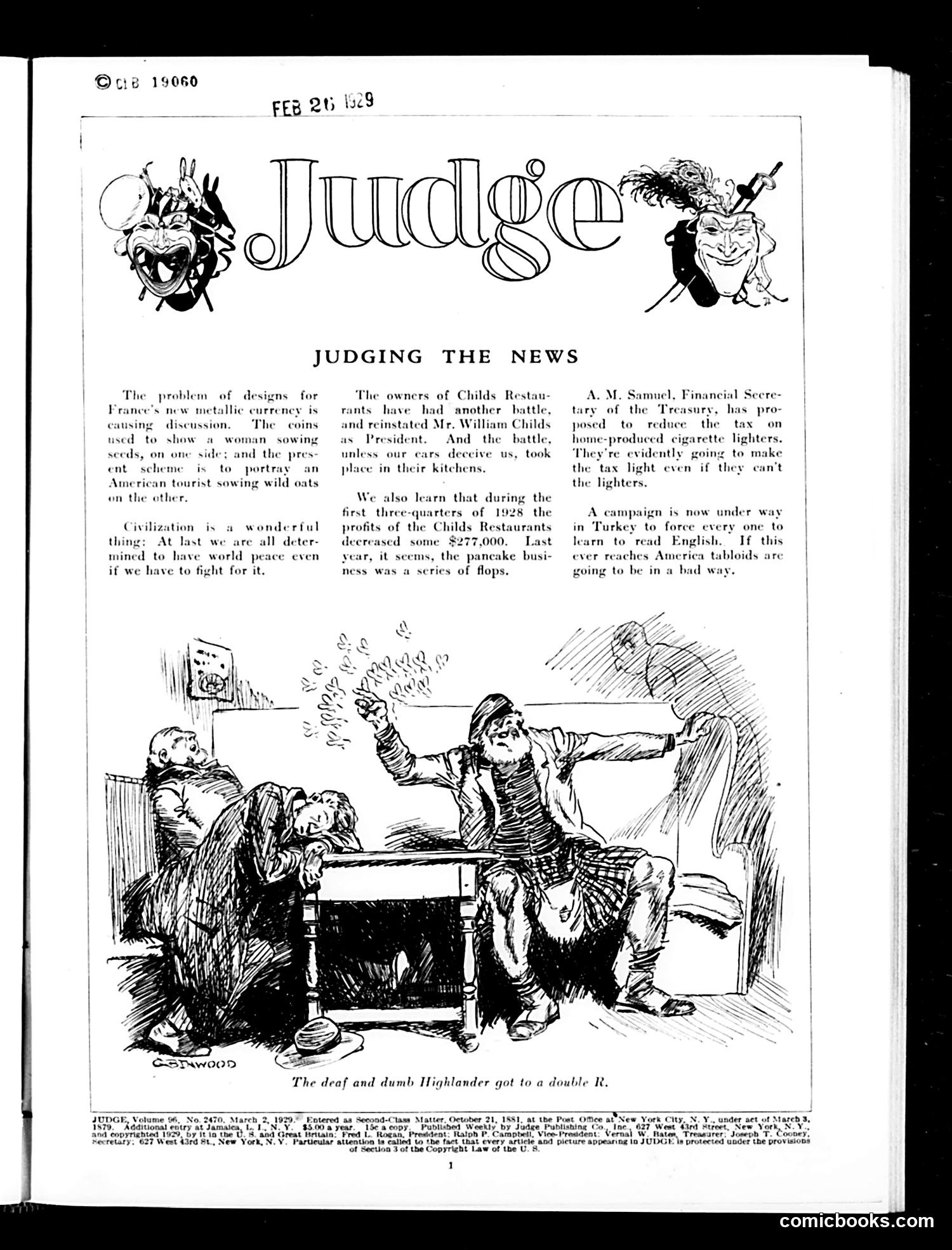
This page satirizes contemporary 1929 news events: **Top stories critiqued:** - Design controversy involving Frosted foods (details unclear) - Childs Restaurants financial troubles: profits dropped $257,000 in 1928; management reinstated William Childs as President despite ongoing business failures - Tax reduction proposals by Financial Secretary A.M. Samuel opposing cigarette lighter taxes - Turkey literacy campaign promoting English-language education **The cartoon** depicts characters engaged in wordplay or miscommunication—likely satirizing the "deaf and dumb Highlander" getting a "double R" (visual pun unclear without fuller context). This mocks either political incompetence or social absurdity related to the era's news. The satire reflects Judge's typical approach: lampooning failed business ventures, government inefficiency, and contemporary social initiatives through exaggeration and visual humor.
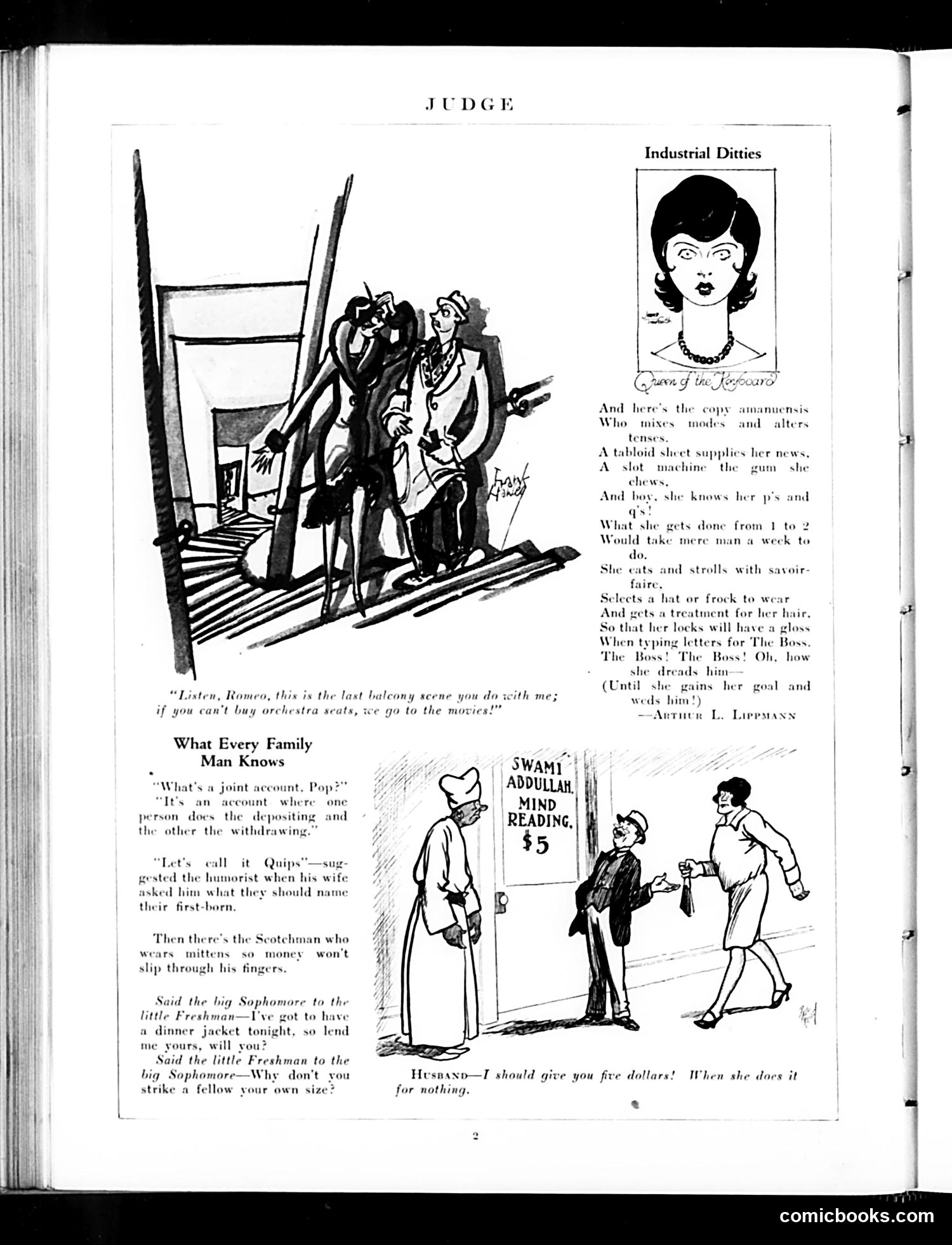
This page contains three distinct pieces of humor: 1. **Top cartoon**: Shows two men in what appears to be a theater balcony collapsing. The caption jokes about "orchestra seats" and going to "the movies" instead—likely satirizing early cinema's growing popularity over live theater. 2. **"Industrial Duties"**: A poem mocking a female office worker (the "copy amanuensis") who edits copy, reads tabloids, chews gum, and types letters while daydreaming of marriage and wealth. This satirizes women entering the workforce and stereotypes about their work habits and ambitions. 3. **"What Every Family Man Knows"**: Humorous anecdotes about marriage finances and domestic life, including a joke about a Scotsman wearing mittens to prevent spending money. The bottom cartoon depicts a fortune teller ("Swami Abdullah") charging five dollars for a "mind reading" while a skeptical couple watches—commentary on popular spiritualism scams of the era.
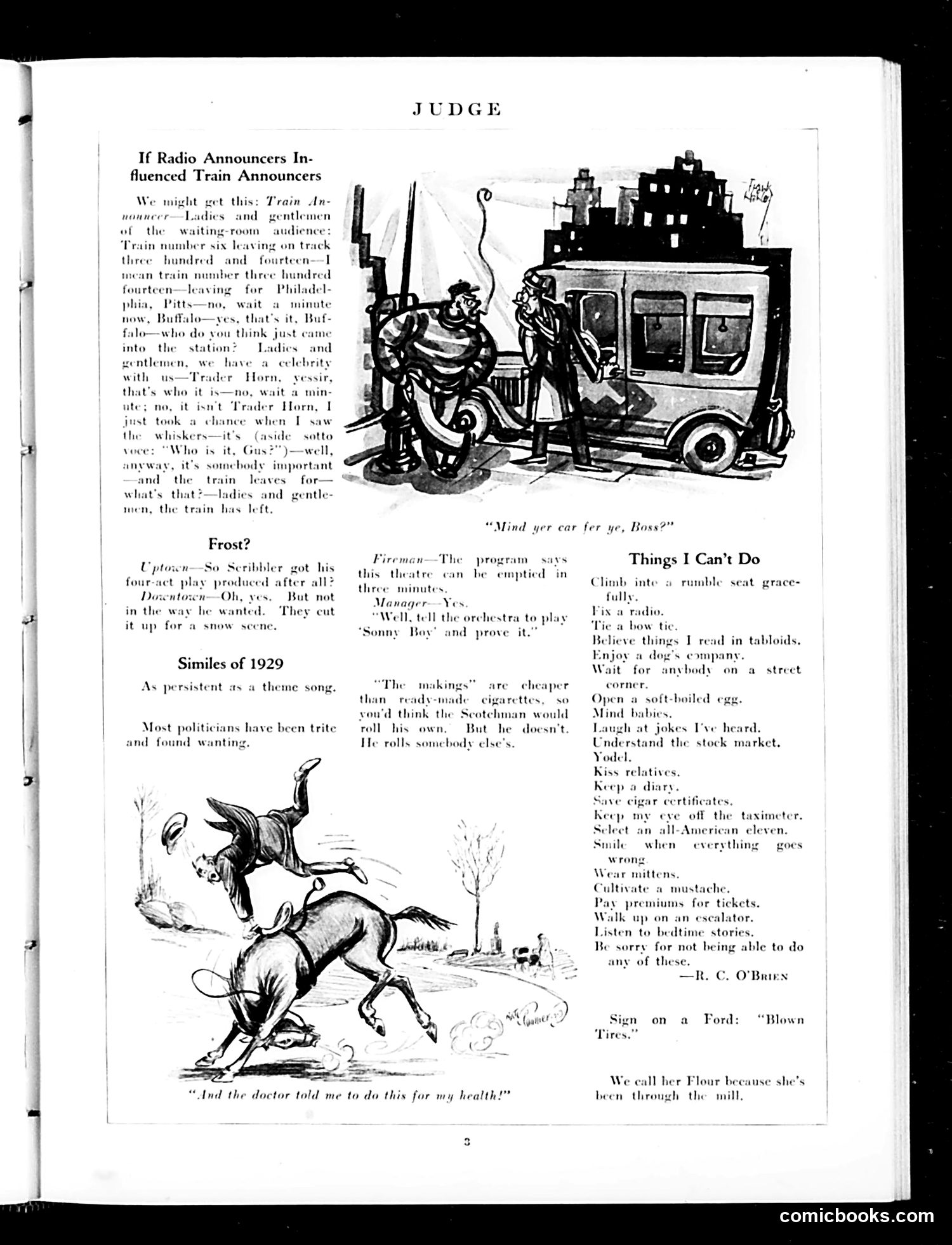
This page contains several humor pieces typical of Judge's 1920s content: **"If Radio Announcers Influenced Train Announcers"** mocks how radio personalities' theatrical delivery style might sound absurd if applied to mundane train station announcements. The cartoon shows exaggerated reaction from passengers to an overly dramatic "train departure" announcement. **"Frost?"** is a brief joke about theatrical productions, possibly referencing a playwright or performer named Frost. **"Similes of 1929"** presents a cartoon showing a donkey bucking with the caption "And the doctor told me to do this for my health!" — satirizing health fads popular in the 1920s-30s by depicting an absurd "health" activity. **"Things I Can't Do"** is a humorous list of life's frustrations, written by R.C. O'Brien. The page reflects 1920s American leisure culture and emerging mass media satire.
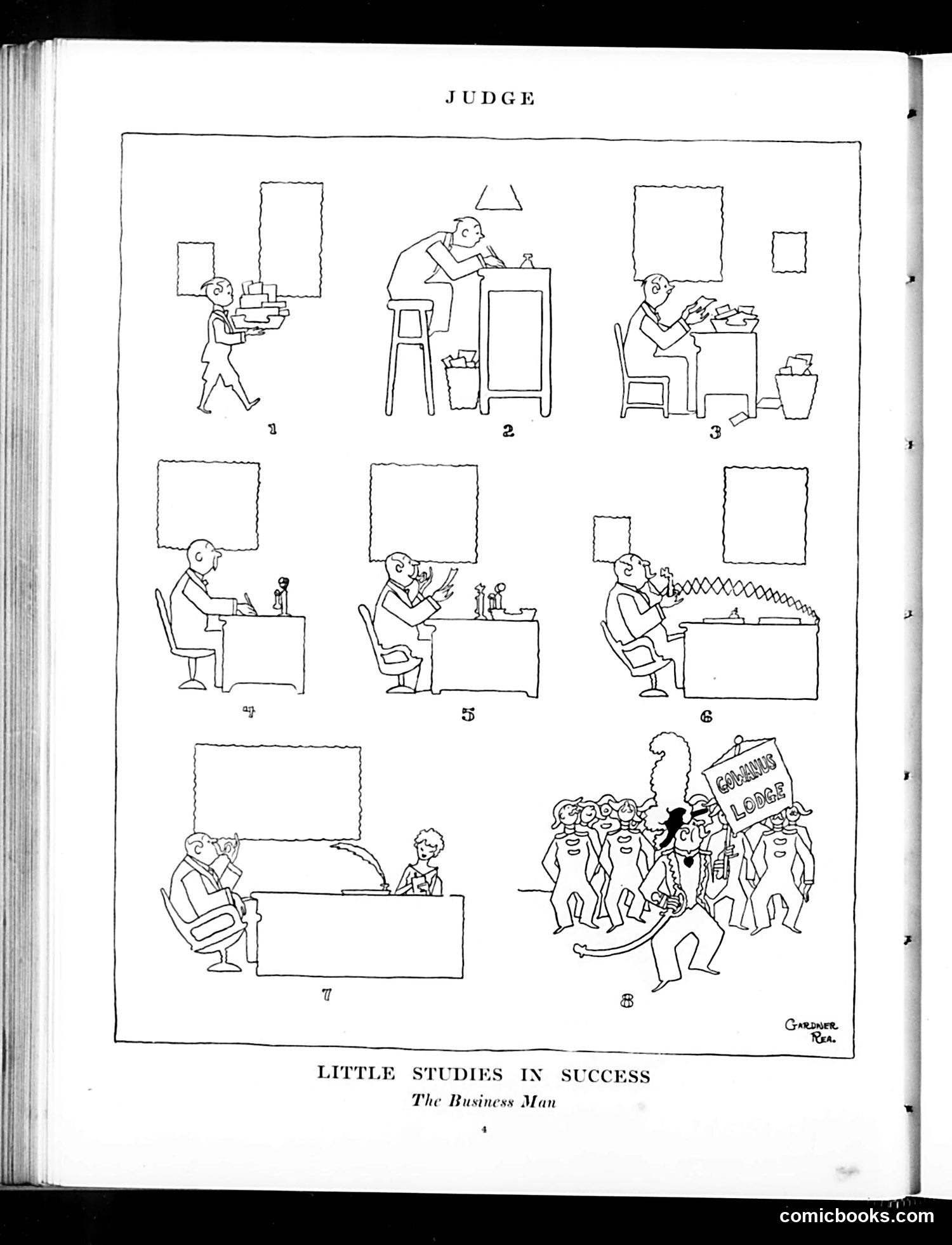
This satirical comic strip mocks the ambitious American businessman through eight sequential panels. The progression shows a man's rise from humble beginnings (panel 1: carrying dishes) through increasingly dishonest tactics—desk work involving questionable schemes (panels 4-6), manipulating chess pieces (suggesting strategic deception), and culminating in panel 8 where he leads a parade of admiring followers under a banner reading "Colossal Success." The satire suggests that business success in this era required moral compromise and manipulation rather than honest work. The chess imagery implies calculated, game-like scheming. By showing the "successful" businessman as a leader of blind followers, the cartoonist critiques both the corrupted individual and society's uncritical admiration for wealth-accumulation regardless of its methods.
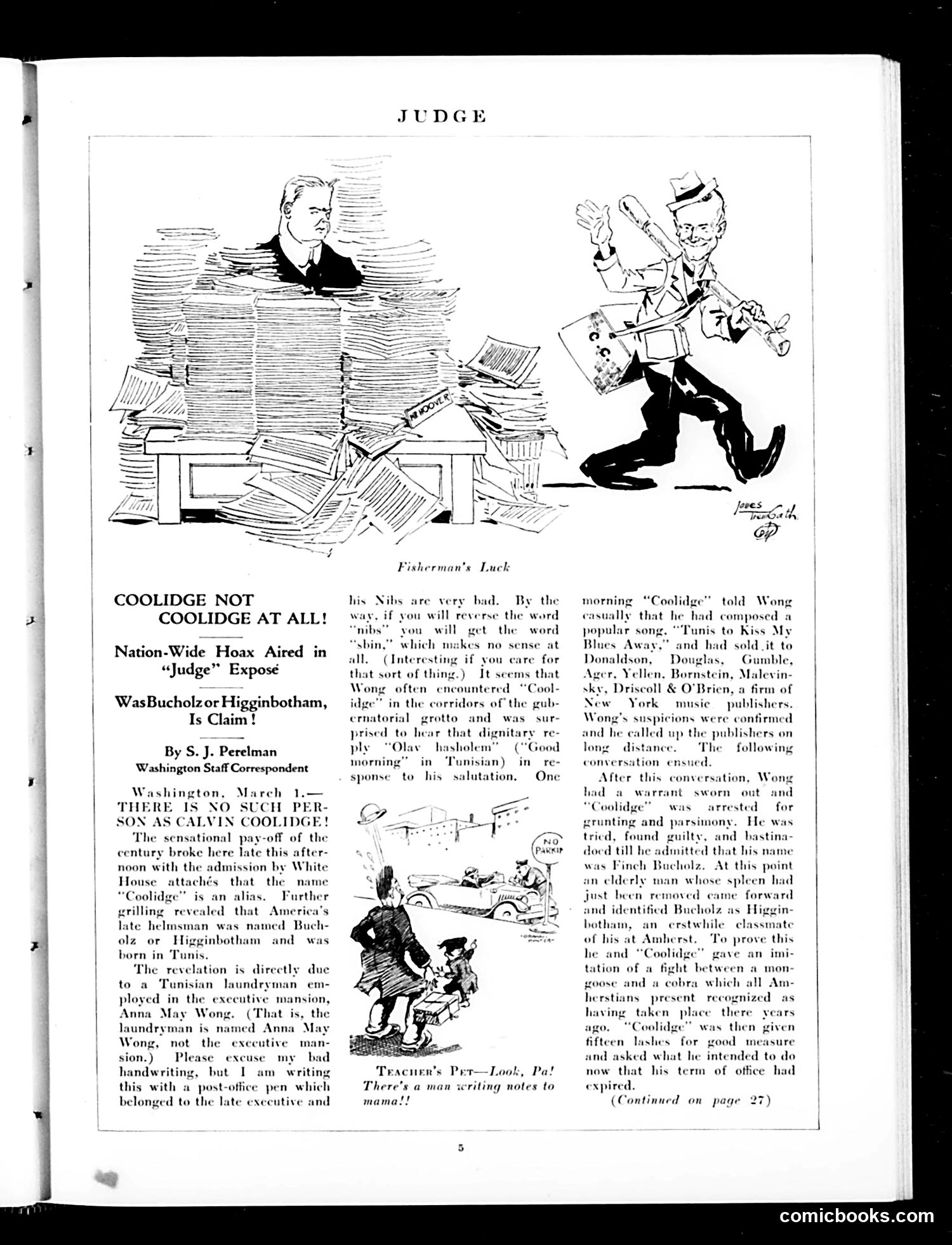
This page satirizes **Calvin Coolidge's** presidency through the headline "Coolidge Not Coolidge At All!" The main cartoon depicts a judge buried under paperwork, while a caricatured figure (likely representing a political operative or aide) jugggles papers and tools—suggesting administrative chaos. The accompanying article by S.I. Percleman reveals that "Coolidge" is allegedly an alias for someone named **Finch Bucholz** (or Higginbotham), supposedly born in Tunisia. The piece claims a Tunisian laundrywoman named **Anna May Wong** actually ran the executive office, not Coolidge himself. This appears to be political mockery of Coolidge's quiet, hands-off governing style—suggesting he wasn't truly in control of his own administration. The absurdist premise (fake identity, foreign origins) amplifies the satire about presidential ineffectiveness.
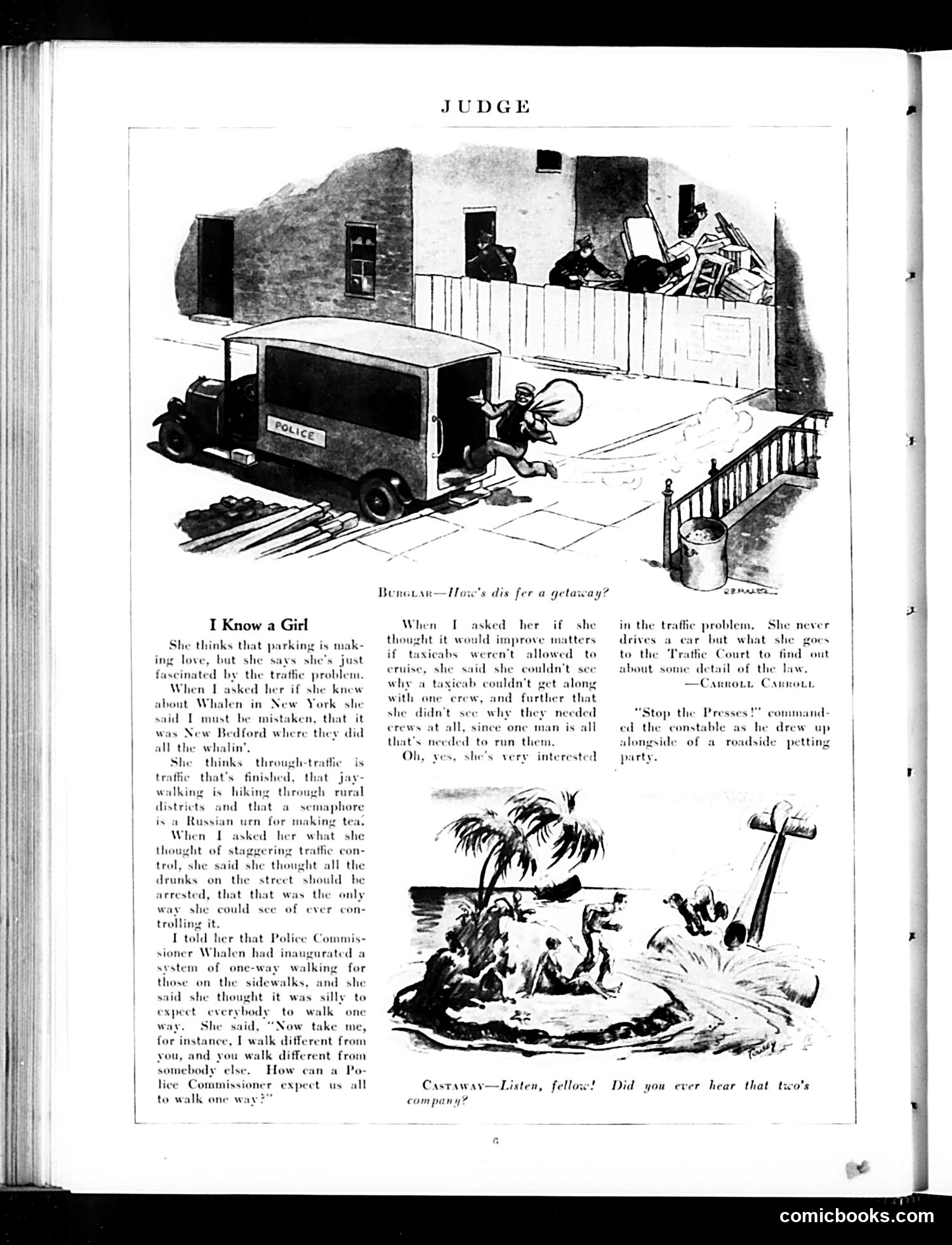
This page contains two satirical cartoons and an anecdotal text piece critiquing early 20th-century urban life. **Top cartoon ("Burglar—How's dis for a getaway?"):** Shows a police van that's broken down while a burglar escapes on a bicycle, satirizing police incompetence and inadequate resources. **Text piece ("I Know a Girl"):** Mocks a woman's casual attitude toward traffic problems in New York, suggesting she thinks parking restrictions are merely inconvenient rather than serious civic issues. It lampoons her indifference to urban infrastructure challenges. **Bottom cartoon ("Castaway—Listen, fellow! Did you ever hear that two's company?"):** Depicts shipwrecked castaways, likely satirizing isolation or unwanted companionship on deserted islands—a common comic trope of the era. The overall theme critiques modern urban society's inefficiencies and public attitudes toward civic order.
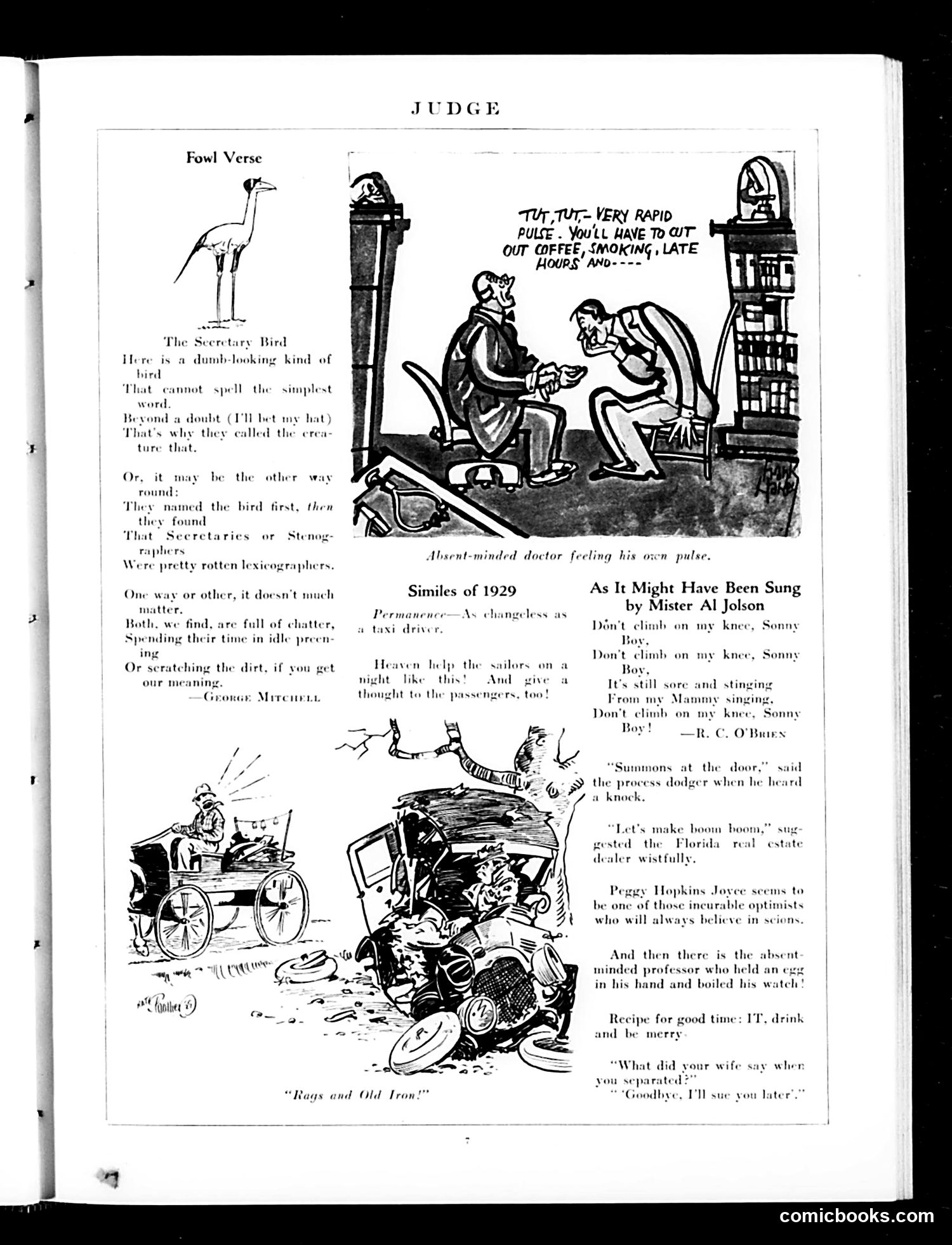
This 1929 Judge page combines humor pieces targeting 1920s social anxieties. The "Secretary Bird" is a pun linking incompetent office workers—stenographers and secretaries—to a real bird species, satirizing widespread complaints about clerical staff's poor spelling and literacy. The main cartoon shows an "absent-minded doctor" with a racing pulse, advised to quit coffee, smoking, and late hours. This reflects 1920s medical anxiety and the newly fashionable concept of doctors diagnosing based on lifestyle rather than illness itself. "Similes of 1929" parodies Al Jolson's popular song "Sonny Boy," while scattered jokes mock period figures: an optimistic Florida real estate dealer (referencing the 1920s land boom), a process server dodging summons, and an absentminded professor. The humor targets work culture inefficiency, medical fads, and economic speculation typical of the pre-Depression era.
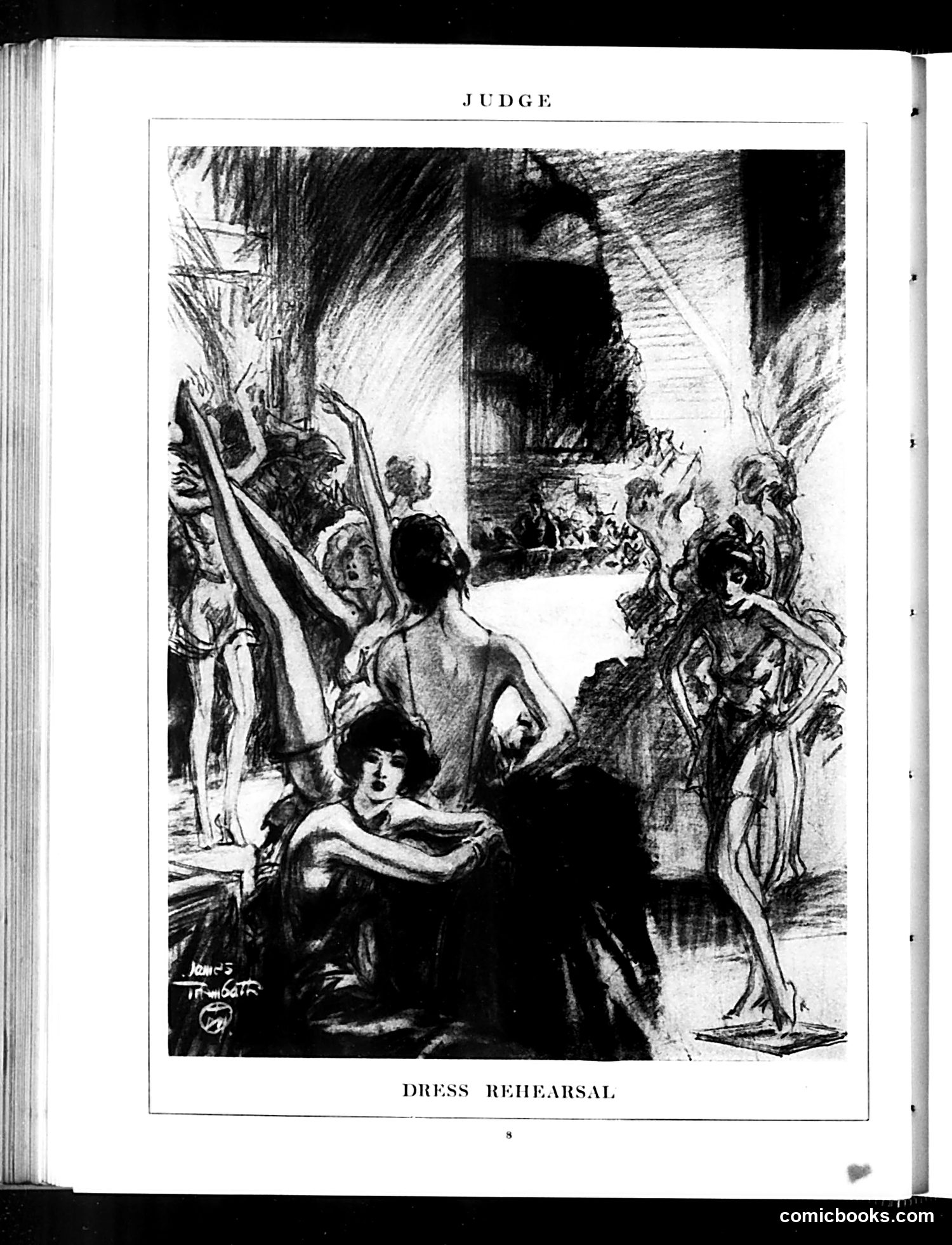
This appears to be a theatrical satire illustration from *Judge* magazine. The image depicts what seems to be a dramatic courtroom or legal proceeding, with a central female figure in dark clothing positioned prominently in the foreground while various other figures—appearing to be judges, lawyers, or court officials—surround her in the background. The title "Dress Rehearsal" suggests this is mocking a staged or performative legal proceeding rather than genuine justice. The theatrical composition, with dramatic lighting and gesturing figures, emphasizes the artificiality of the scene. However, without clearer OCR text or additional context about the publication date, I cannot definitively identify the specific legal case, individuals, or social issue being satirized. The image appears to critique either judicial theater or the dramatic presentation of a particular trial, but specifics remain unclear.
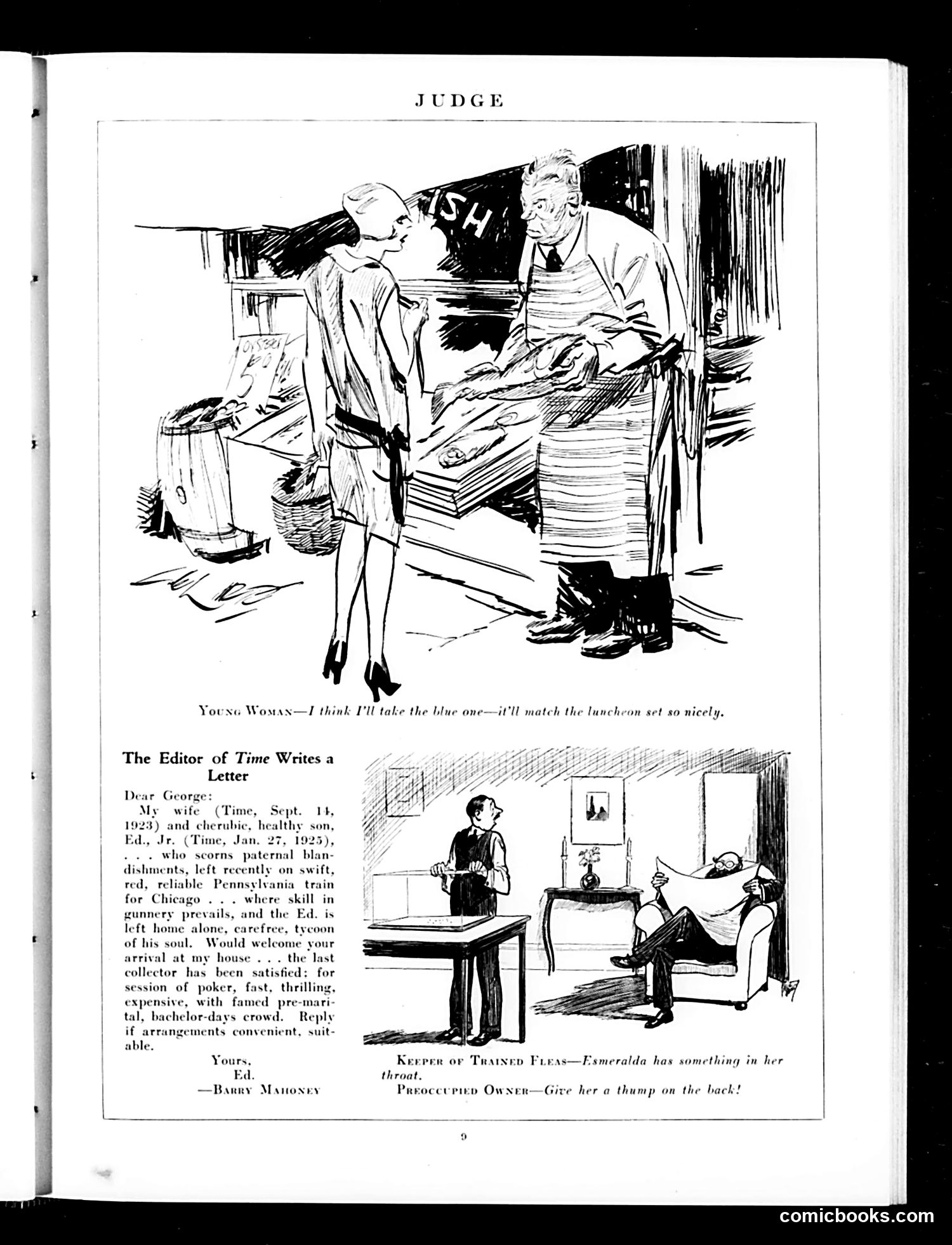
**Top Cartoon**: A young woman in 1920s fashion consults a judge about purchasing a blue dinner set. The joke plays on the legal term "blue laws" (regulations restricting certain activities)—she's making a pun, asking the judge about acquiring something "blue," expecting legal guidance on what appears to be a domestic shopping matter. **Bottom Section**: Contains two elements: 1. **Letter from Time Magazine's Editor**: A humorous letter supposedly from Time magazine's editor inviting a friend named George for a poker game, mentioning his wife and child (with joking references to Time's publication dates). This satirizes Time's celebrity and the editor's social invitation. 2. **Bottom Cartoon**: Depicts someone presenting a trained flea to its owner, with a joke about the flea having "something in her throat" requiring "a thump on the back"—a crude visual pun about fleas and physical punishment. All content reflects early 1920s sensibilities and upper-class social life depicted in Judge's satirical humor.
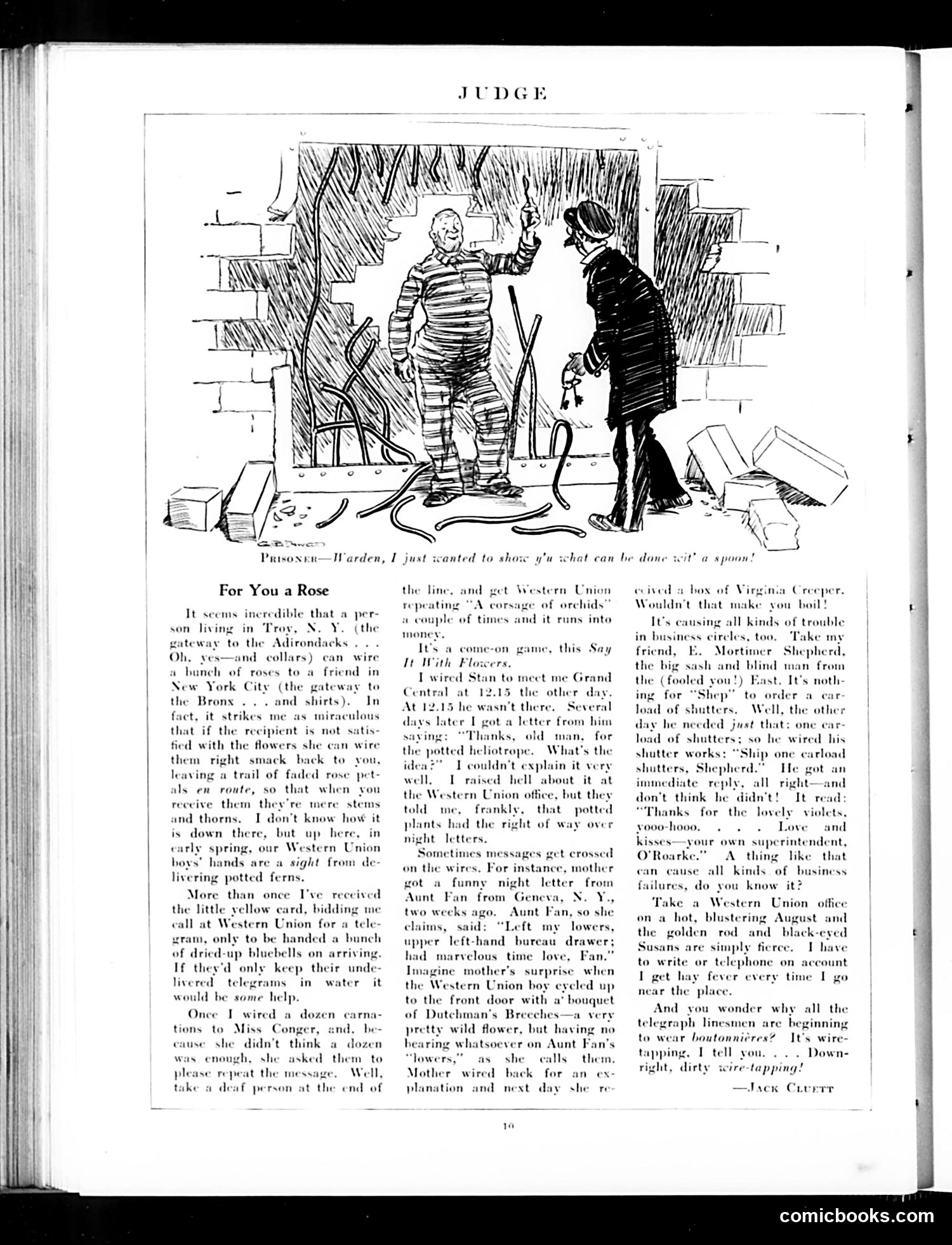
This page features a humorous essay by Jack Clefft titled "For You a Rose," satirizing the Western Union telegram and flower delivery system. The cartoon at top depicts a prisoner in striped clothing wired flowers by mistake—a visual joke supporting the essay's theme: Western Union frequently delivers the wrong items or garbled messages. Clefft's satire targets the absurdity of long-distance communication failures in early 20th-century America. He catalogs mishaps: flowers arriving as dried stems, potted plants mysteriously substituted for telegrams, crossed wires delivering love notes with bouquets of random wildflowers instead of intended recipients' names. The essay culminates in complaints about hay fever from flowers cluttering Western Union offices and accusations that telegraph linesmen steal flowers ("wire-tapping"). The humor relies on the era's genuine frustrations with telegraph service reliability before modern telecommunications—a system readers would recognize as simultaneously miraculous and maddeningly unreliable.
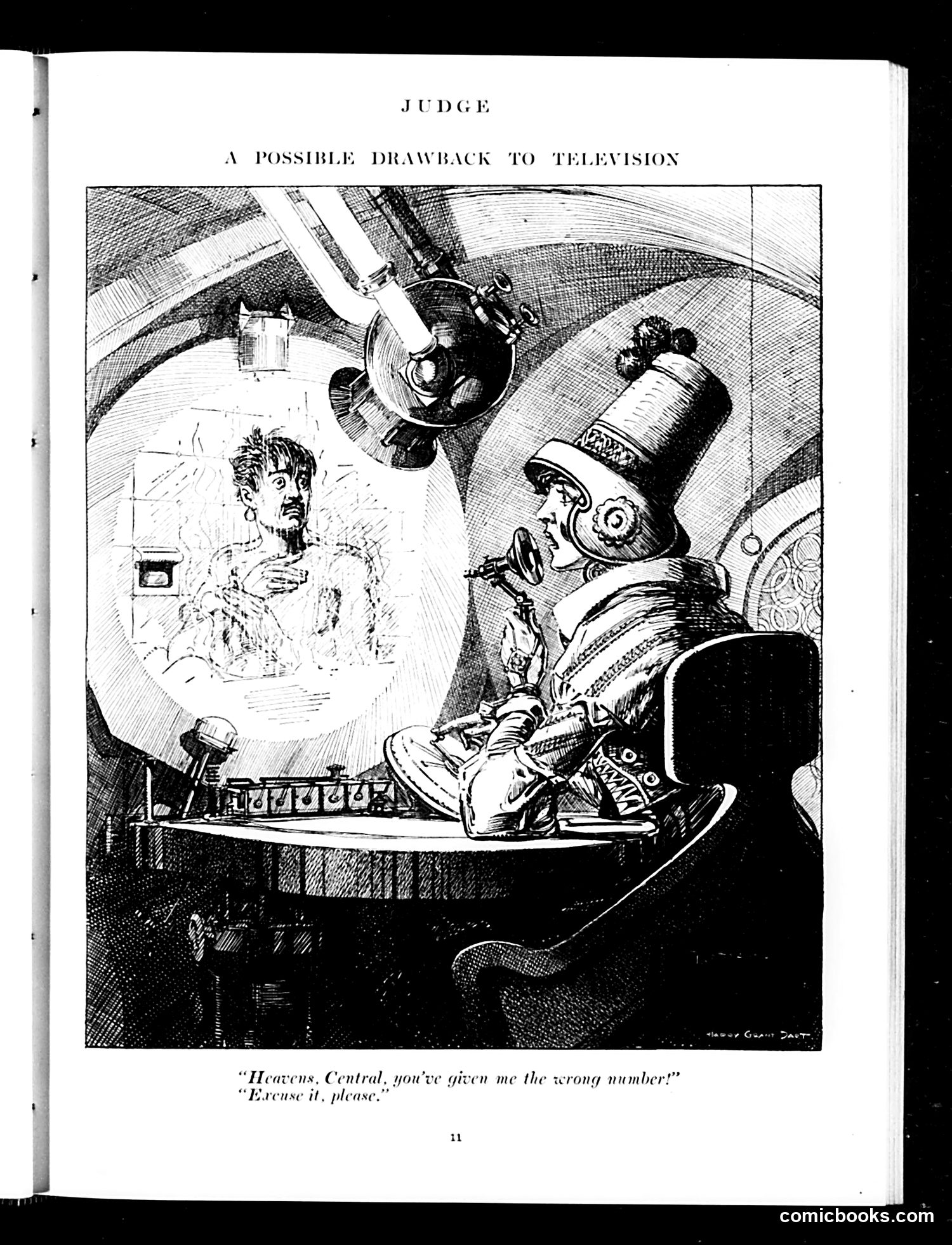
This cartoon satirizes early television technology as a drawback compared to traditional communication. A fantastically dressed operator (likely representing a telephone "Central" switchboard operator) sits before a massive, ornate television apparatus. The dramatic perspective emphasizes the bulky, complicated nature of the device. The joke: the operator complains to "Central" (the telephone exchange) about receiving the "wrong number"—a traditional telephone error—suggesting that even with this futuristic technology, fundamental communication problems persist. The satire mocks television as an overly elaborate solution that fails to improve upon existing systems, or that introduces new complications despite technological advancement. The title "A Possible Drawback to Television" confirms this is critical commentary on early TV's impracticality, likely from the 1920s-1930s when television was experimental and not yet domesticated.
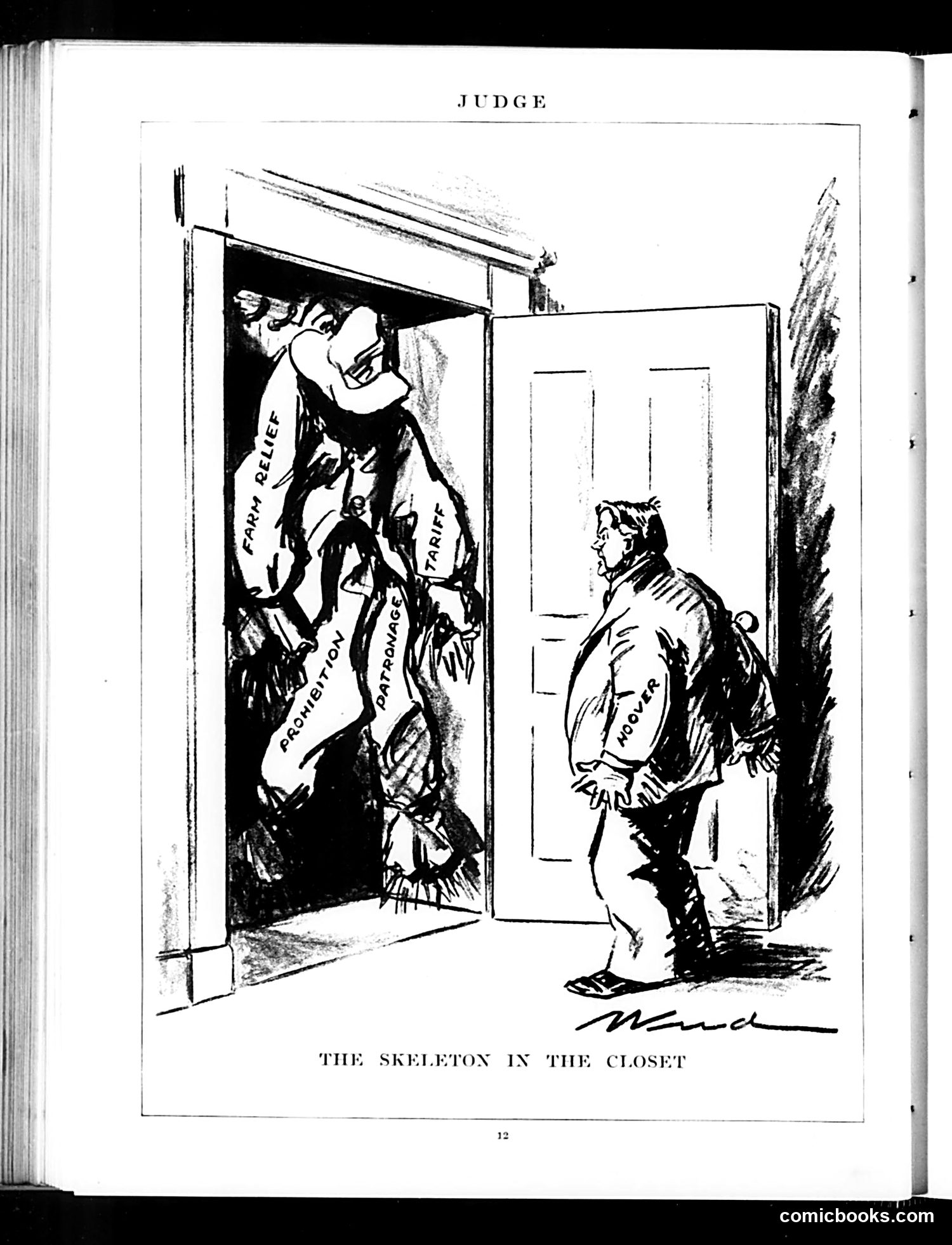
This cartoon illustrates the idiom "skeleton in the closet"—a family secret or hidden shame. A man labeled "MORALS" opens a closet door to discover grotesque figures inside bearing labels: "FIRM BELIEF," "PROHIBITIONS," "ORTHODOXY," and "PATRIOTISM." The satire suggests that rigid adherence to conventional morality, religious orthodoxy, and patriotic conformity—when examined closely—reveal underlying hypocrisy or ugliness. The "skeleton" represents what these supposedly virtuous principles actually conceal or produce. Judge magazine frequently mocked social hypocrisy and pretense. This cartoon critiques how people maintain outward respectability while harboring contradictions, or how strict moral frameworks mask darker realities. The specific era is unclear from visible text, but the style suggests early-to-mid 20th century.
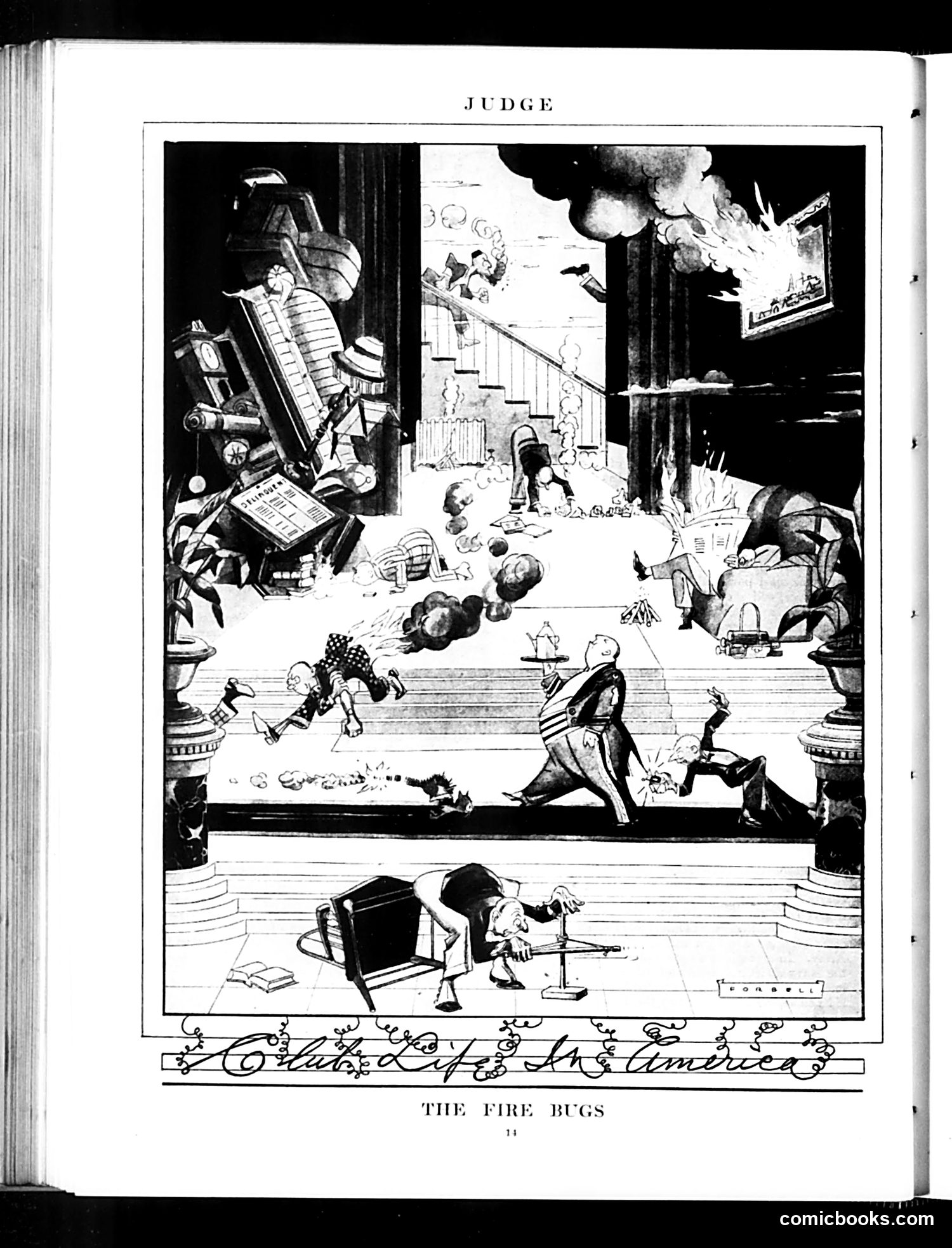
This satirical cartoon depicts a chaotic courtroom scene titled "The Fire Bugs." The image shows a judge presiding over what appears to be a trial involving multiple small, bug-like figures engaged in destructive behavior—setting fires and causing mayhem inside the courthouse itself. The satire likely critiques either arsonists/fire-setters operating in the courts' jurisdiction, or metaphorically, dishonest legal practitioners ("fire bugs") destroying justice from within. The irony is that the defendants are committing their crimes *during* their trial, right under the judge's nose, suggesting incompetence in law enforcement or the judicial system's inability to control criminal behavior even in its own domain. The crude, insect-like depiction of the perpetrators emphasizes their contemptibility. Without clearer historical context, the specific incident referenced remains unclear.
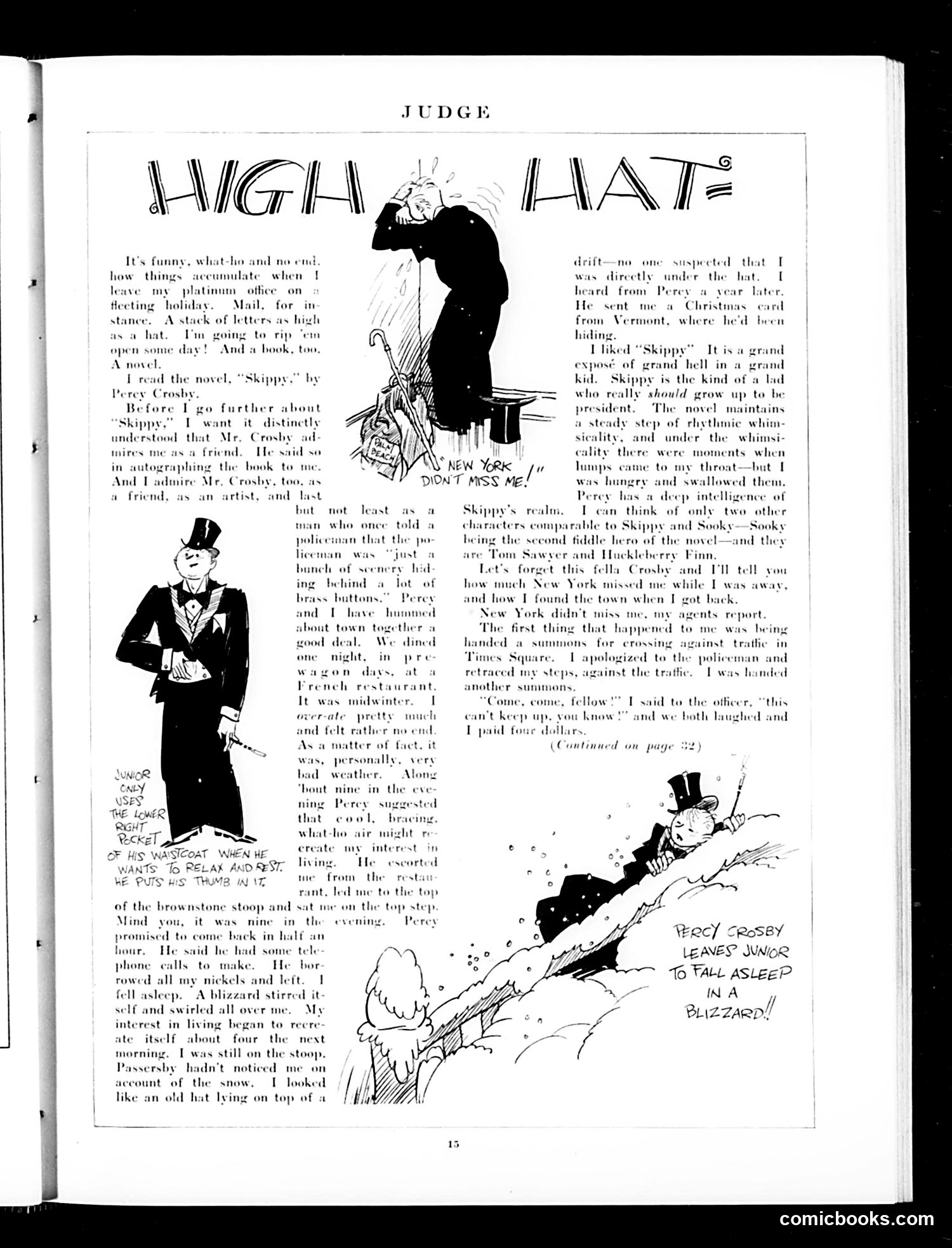
This is a book review of Percy Crosby's novel *Skippy*, written in a humorous, conversational style. The author recounts how Crosby—a friend and artist—left him sitting on a brownstone stoop during a blizzard while claiming to make phone calls, essentially abandoning him overnight in freezing conditions. The satire works on two levels: it's both a genuine (if wry) endorsement of the *Skippy* novel as a worthy successor to classic American literature (comparing the protagonist favorably to Tom Sawyer and Huckleberry Finn), and a playful roast of Crosby's inconsiderate behavior. The illustrations show a well-dressed gentleman in formal attire—likely Crosby himself—and a figure tumbling through snow. The review concludes with ironic anecdotes about New York City's indifference and bureaucratic annoyances upon the author's return, maintaining the magazine's satirical tone throughout.
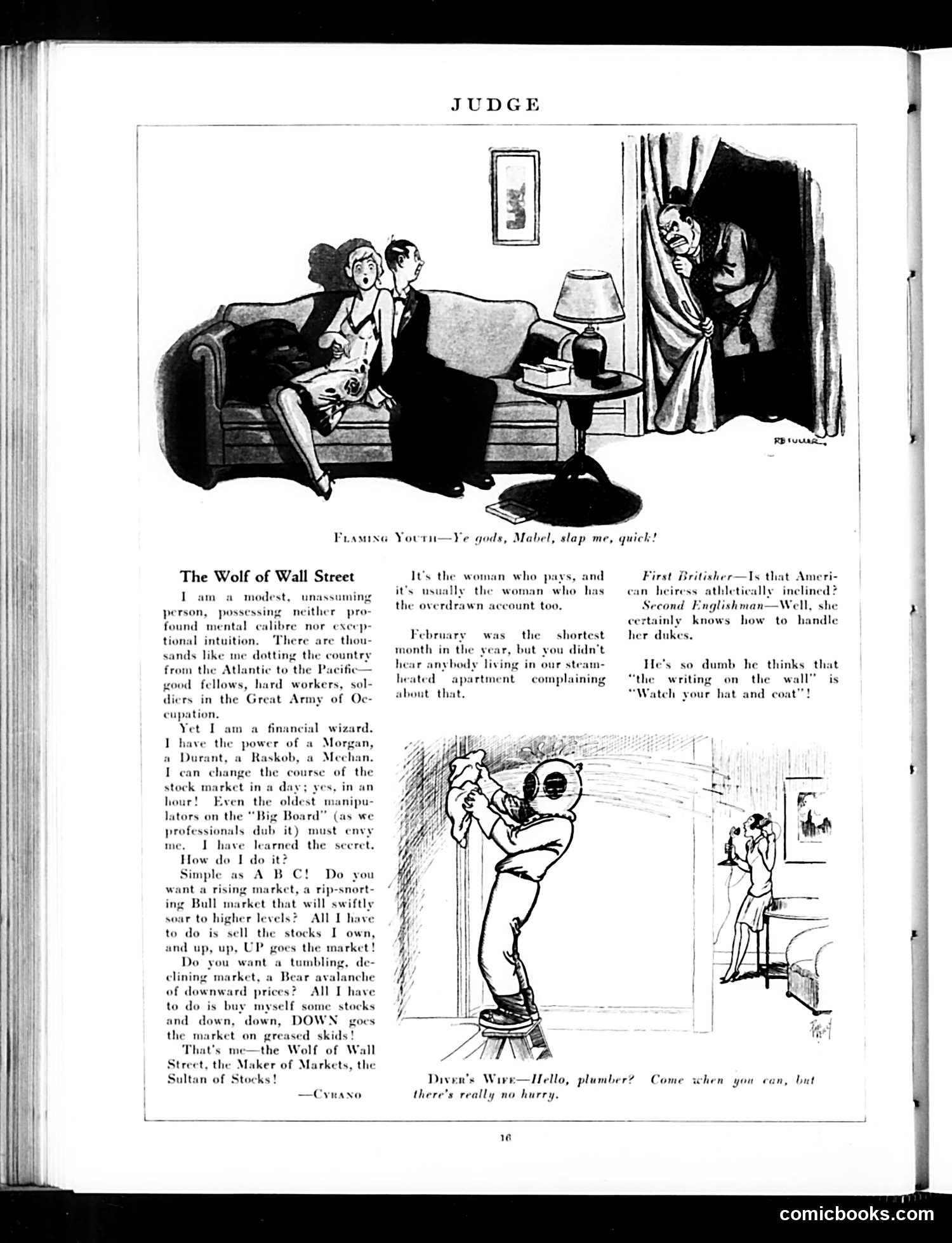
This page satirizes 1920s stock market manipulation and financial hubris. The main article, narrated by an unnamed Wall Street operator, mocks the era's "financial wizards" who claimed to control markets. The narrator boasts he can trigger bull or bear markets simply by buying or selling his own stocks—a transparent admission of market manipulation that exposes how little actual skill these operators possessed. The satire targets figures like J.P. Morgan, William Durant, and James Raskob (real financiers mentioned by name), suggesting their legendary market power was equally illusory. By attributing such godlike abilities to an "average" person, the piece ridicules the inflated reputations of Wall Street elite during the speculative 1920s boom. The accompanying comics offer lighter social humor about gender dynamics and class differences, typical Judge fare. The page likely dates to the pre-1929 Crash era, when such market manipulation anxieties were prominent.
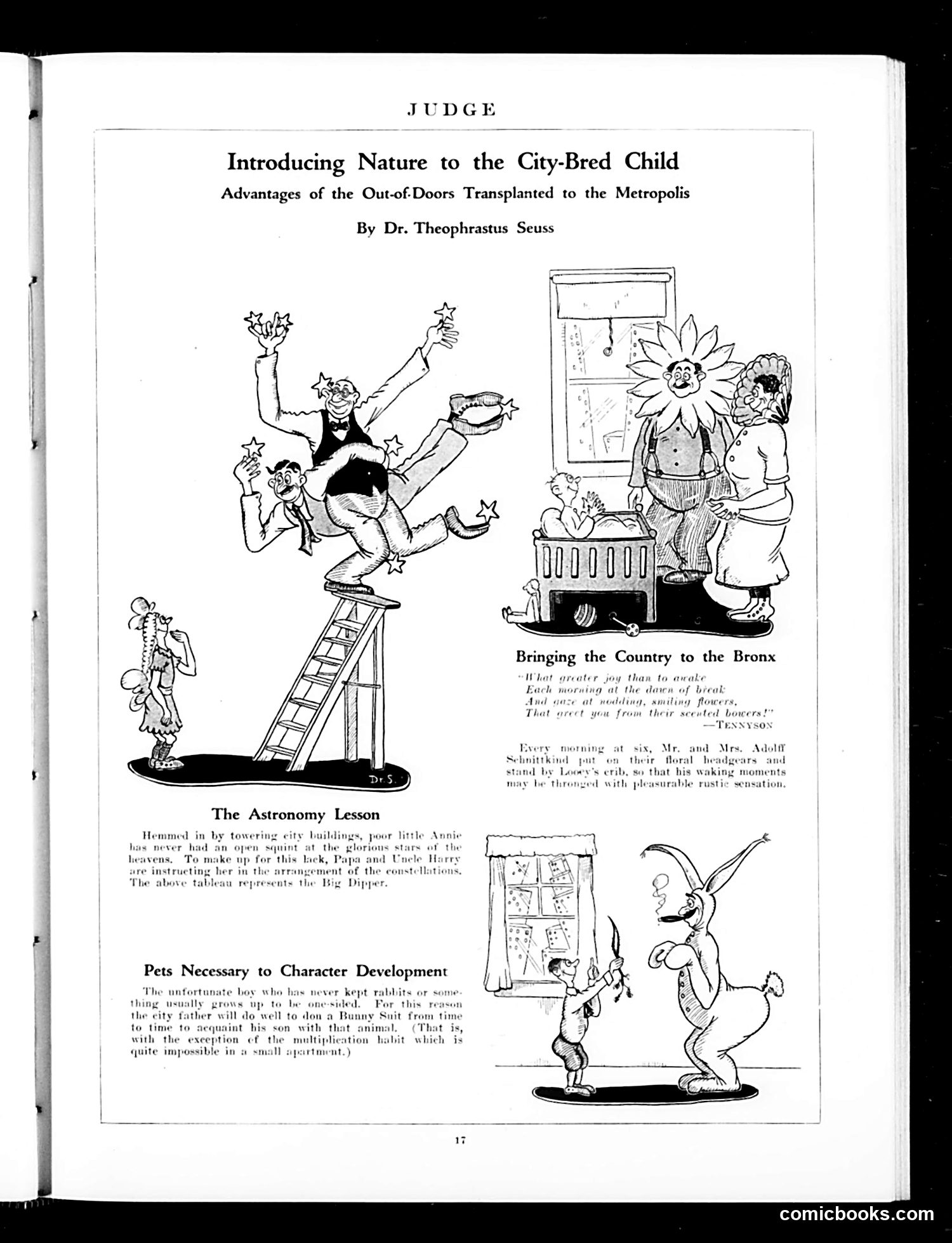
This 1920s-era satirical piece mocks wealthy urban parents attempting to give their city children "nature experiences." **The joke:** Well-to-do New Yorkers, unable to provide genuine outdoor education, resort to absurd substitutes—a father dressed in a bunny suit to simulate pet ownership, artificial window-box gardening with giant papier-mâché flowers, and pointing out constellations from rooftops. **Key targets:** - The pretentiousness of city elites trying to compensate for urban deprivation - The absurdity of artificial "nature" in the metropolis - Parental performativity masquerading as character-building "Dr. Theophrastus Seuss" (the author byline) appears to be a pseudonym, possibly satirizing both pseudo-scientific parenting advice and Seuss-like whimsy. The cartoons illustrate three scenarios showing how divorced from authentic nature city children—and their parents—have become.
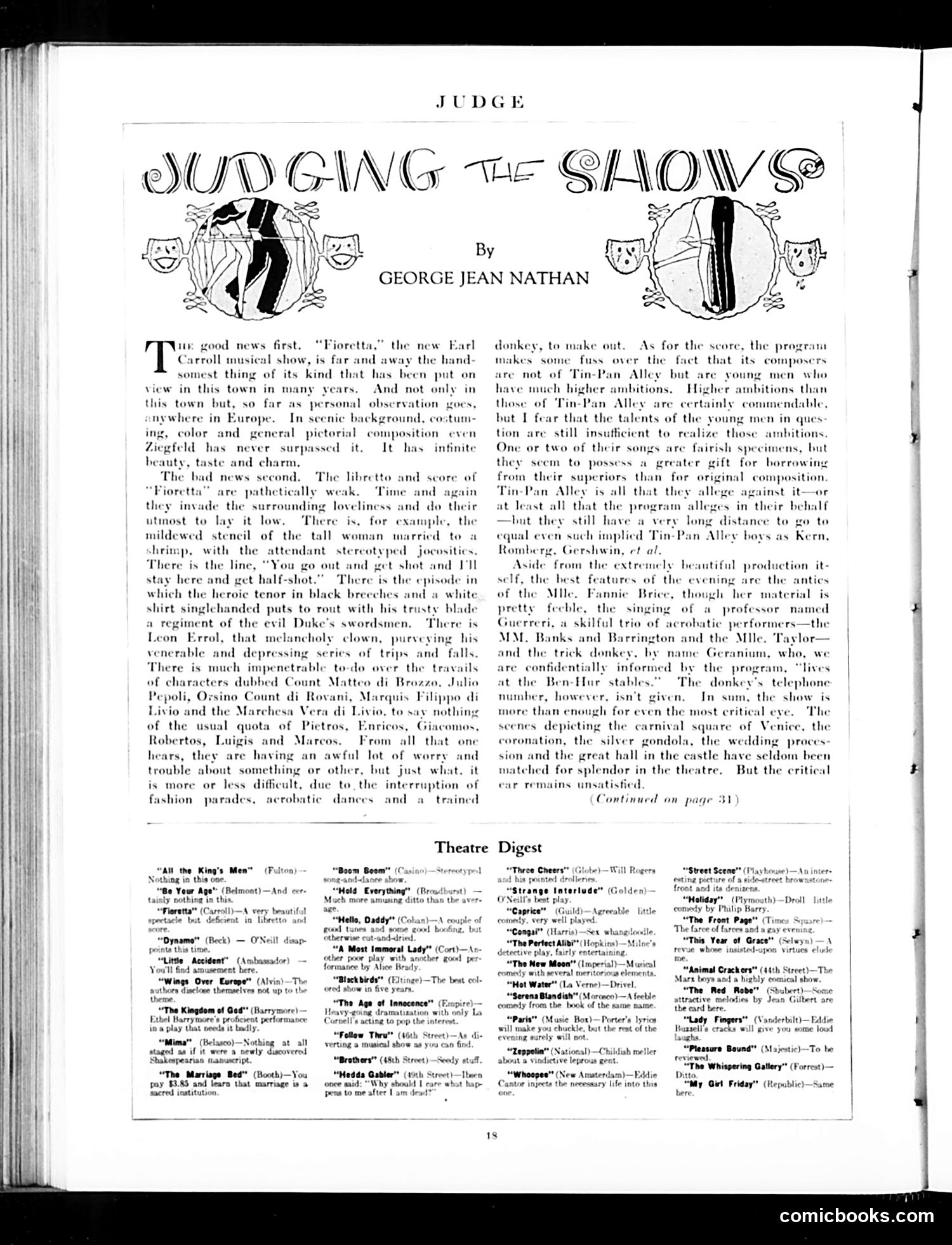
This is a theatrical review column, not a political cartoon. Nathan critiques Earl Carroll's new musical "Fioretta," praising its spectacular visual production design (rivaling Florenz Ziegfeld's famous work) while harshly condemning its weak script and score. Nathan identifies specific problems: tired comedic tropes (the "tall woman married to a shrimp"), clichéd plots, and reliance on physical comedy from performer Leon Errol. He notes the young composers, though ambitiously attempting serious work beyond "Tin-Pan Alley" standards, lack sufficient talent and resort to borrowing from superior composers like Kern and Gershwin. The review highlights performance strengths: Fannie Brice, acrobats Banks and Barrington, performer Taylor, and a trained donkey named Geranium. Nathan concludes the beautiful Venetian carnival scenery cannot overcome the production's fundamental artistic shortcomings. The "Theatre Digest" section below lists other contemporary Broadway shows with brief one-line reviews.
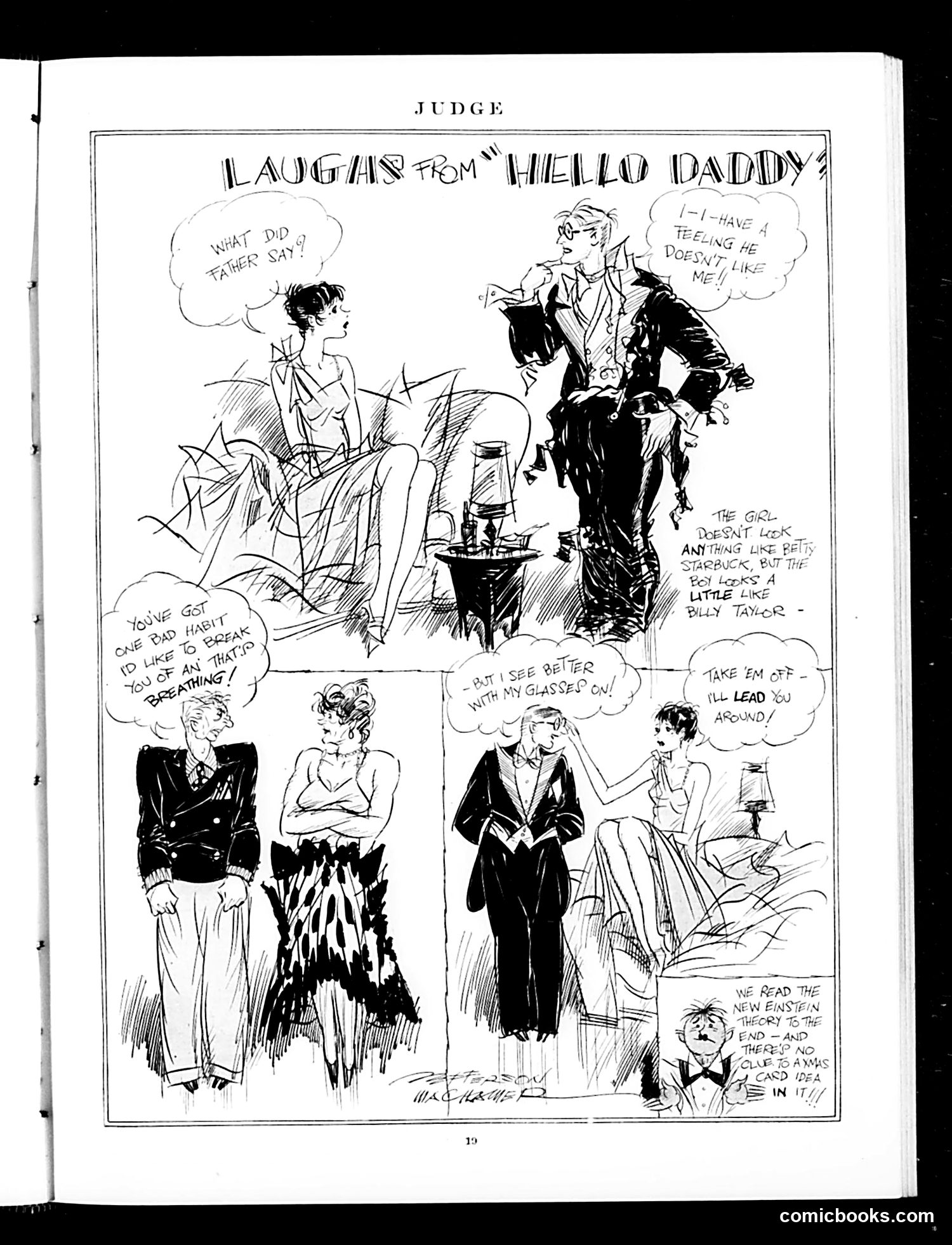
This satirical cartoon from *Judge* magazine mocks the popular play or film "Hello, Daddy!" through dialogue between a father figure and various women. The humor targets upper-class dating conventions and paternal disapproval. The strip shows a father questioning what a suitor said ("What did father say?"), while a young woman deflects his concern. A reference to "Billy Taylor" and someone looking "a little like" him suggests commentary on contemporary celebrities or scandals. The final panel shows a man reading Einstein's theory, seemingly escaping marital chaos—satirizing how intellectual pursuits serve as male refuge from domestic complications. The overall joke plays on generational conflict over romance and courtship standards among the wealthy, typical of 1920s-30s *Judge* humor.
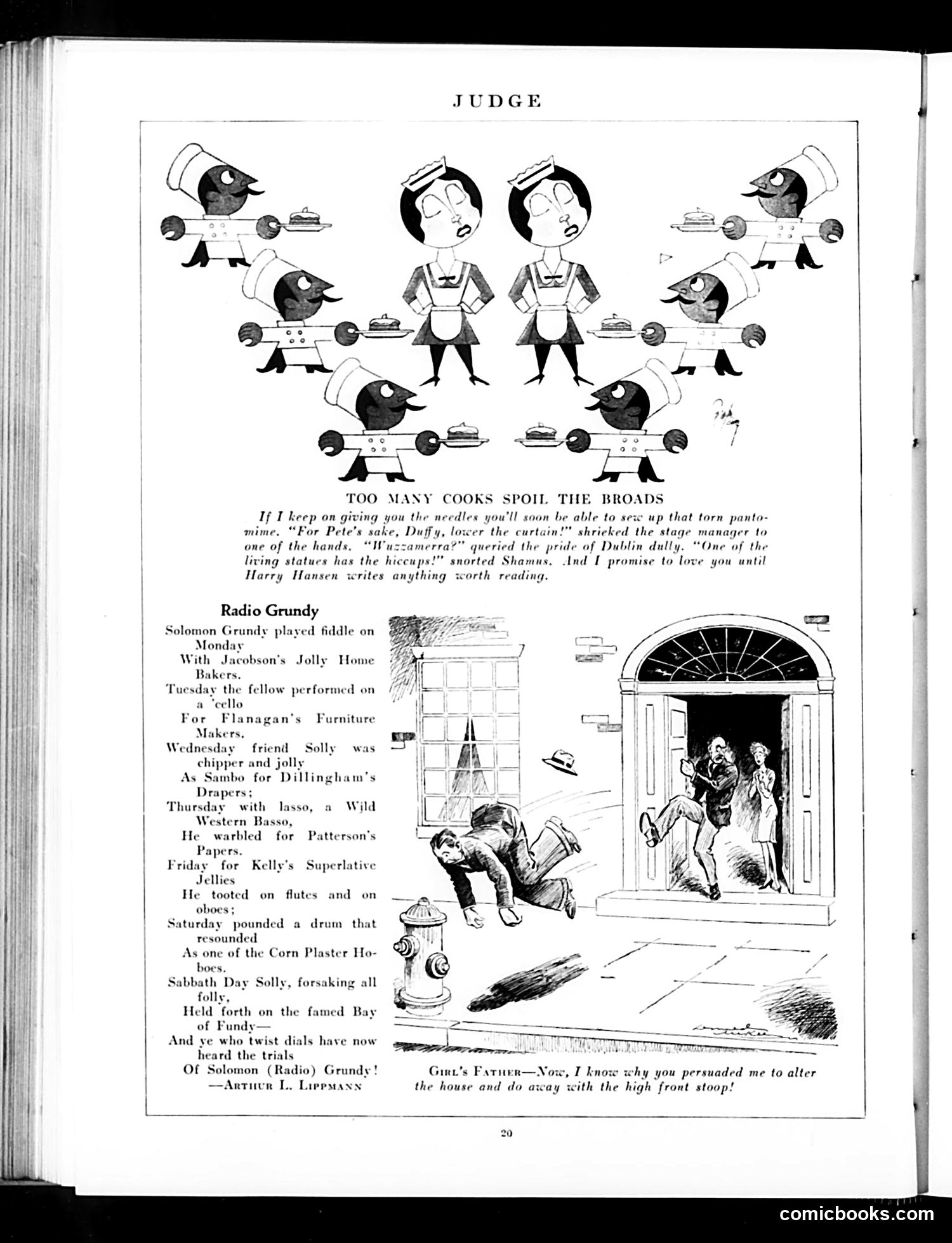
**Top Cartoon ("Too Many Cooks Spoil the Broads"):** This is a theatrical satire showing two identical female performers surrounded by male judges or critics holding scales. The caption references a backstage dispute over a pantomime production—someone criticizes another's sewing ("torn pantomime"), with characters named Duffy, Pete, and references to Dublin. The joke appears to be about theatrical chaos caused by too many people offering opinions or "judging" the production, playing on the proverb "too many cooks spoil the broth." **Bottom Section ("Radio Grundy"):** A humorous poem by Arthur L. Lippmann mocking the ubiquity of radio advertising in the 1920s-30s. It parodies the nursery rhyme "Solomon Grundy" by showing a performer named Solly appearing on radio every day for different sponsors (bakeries, furniture makers, jelly companies, corn plaster remedies). The satire criticizes how radio stars endlessly promoted commercial products, with the speaker humorously tracking these advertisements across the week.
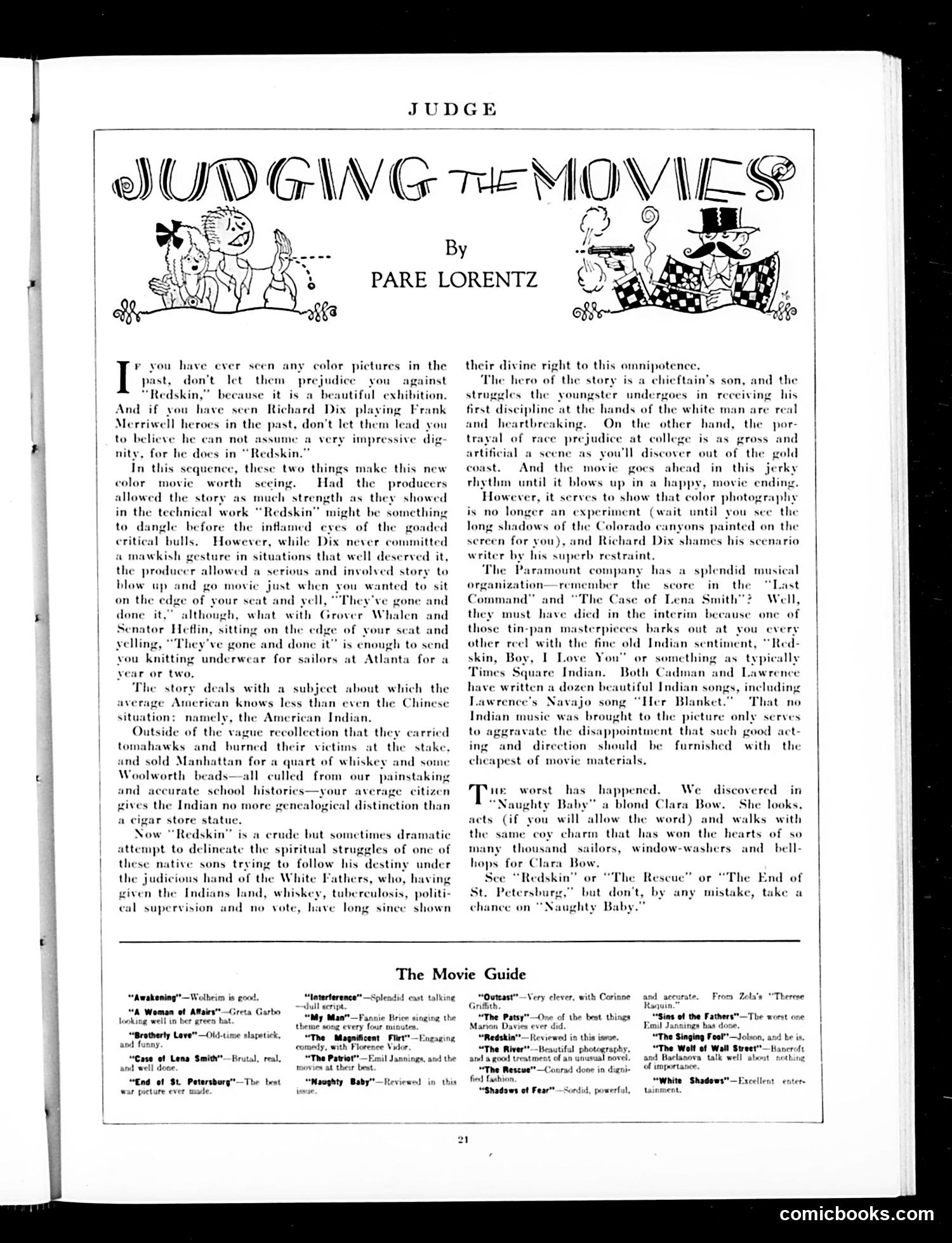
This is a film review by Pare Lorentz critiquing the Paramount picture "Redskin," starring Richard Dix. The satire targets both the film itself and broader American ignorance about Native Americans. **The Setup:** Lorentz mocks audiences' shallow knowledge of Indians—reduced to stereotypes (tomahawks, Manhattan's sale for whiskey, "cigar store statue"). The film attempts to dramatize a Native American youth's spiritual struggle under White Father guidance, dealing with racial prejudice at college. **The Critique:** While praising Dix's restrained acting and color cinematography as technical achievements, Lorentz savages the execution: the plot becomes "jerky" melodrama with a fake happy ending. Worse, the musical score—supposedly from Paramount's acclaimed composers—degrades into "tin-pan" sentimentality ("Redskin, Boy, I Love You"), cheapening genuine Indian material. **The Punch:** By reviewing this alongside dismissing Clara Bow in "Naughty Baby," Lorentz suggests Hollywood's formula entertainment prioritizes spectacle over substance.
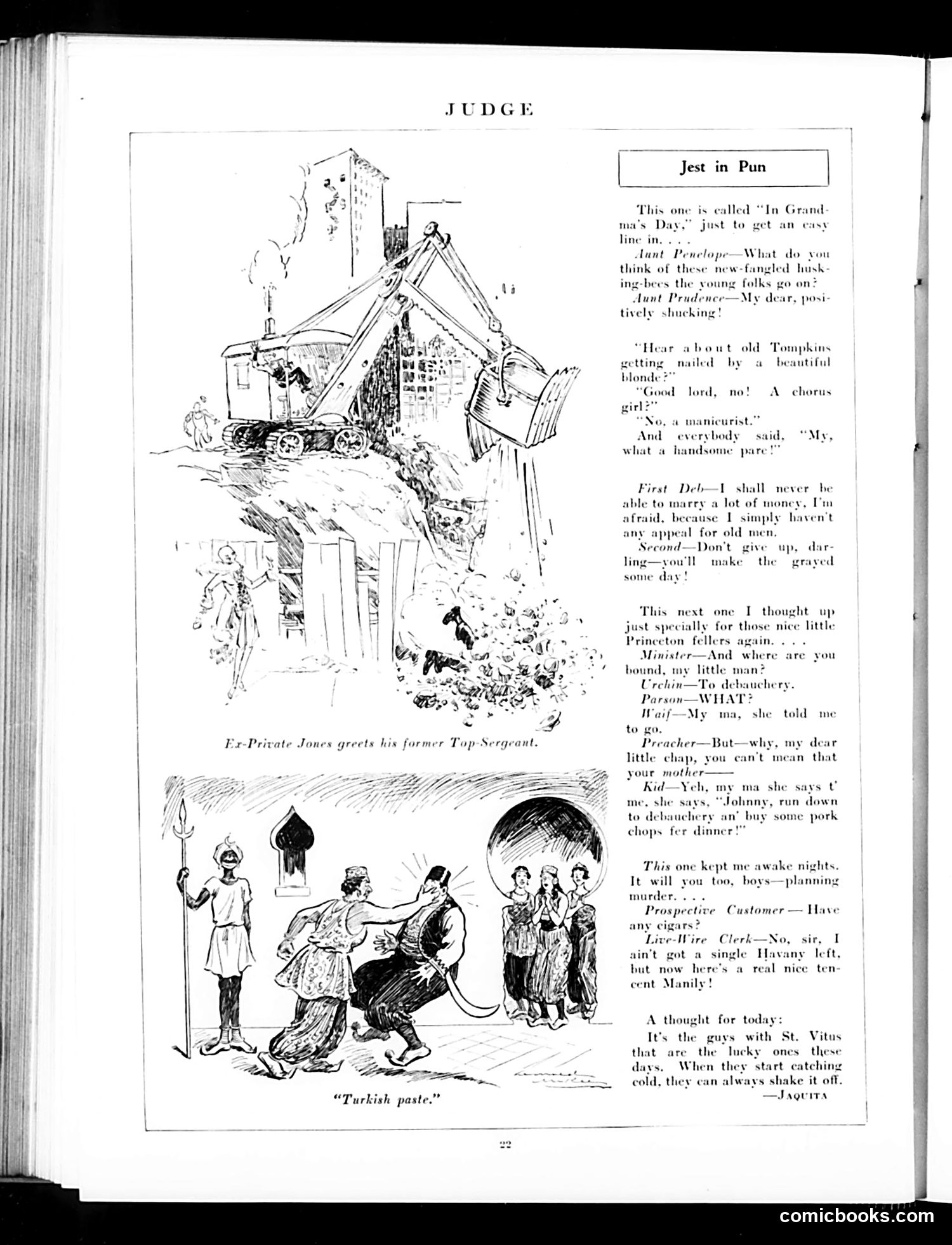
This page from *Judge* magazine contains satirical humor pieces typical of early 20th-century American comedy. **"In Grandma's Day"** contrasts old and new social customs—older aunts disapprove of modern young people's "tangled" dating behaviors at husking bees (social gatherings), finding them scandalous compared to their era. **"Turkish Paste"** (bottom cartoon) depicts a domestic scene where a man appears to be in an awkward or compromising situation, likely playing on period anxieties about infidelity or impropriety. The right column contains brief joke exchanges: a debutante jokes about lacking appeal to wealthy older men; a preacher is scandalized when a street child reveals his mother sent him to "debauchery" (actually mispronounced—she said "delicatessen"); a clerk jokes about cheap cigars versus premium Havanas. The final "thought for today" references St. Vitus (a disease causing involuntary movement), making a dark joke about catching colds being "lucky" compared to serious illness—gallows humor typical of the period.
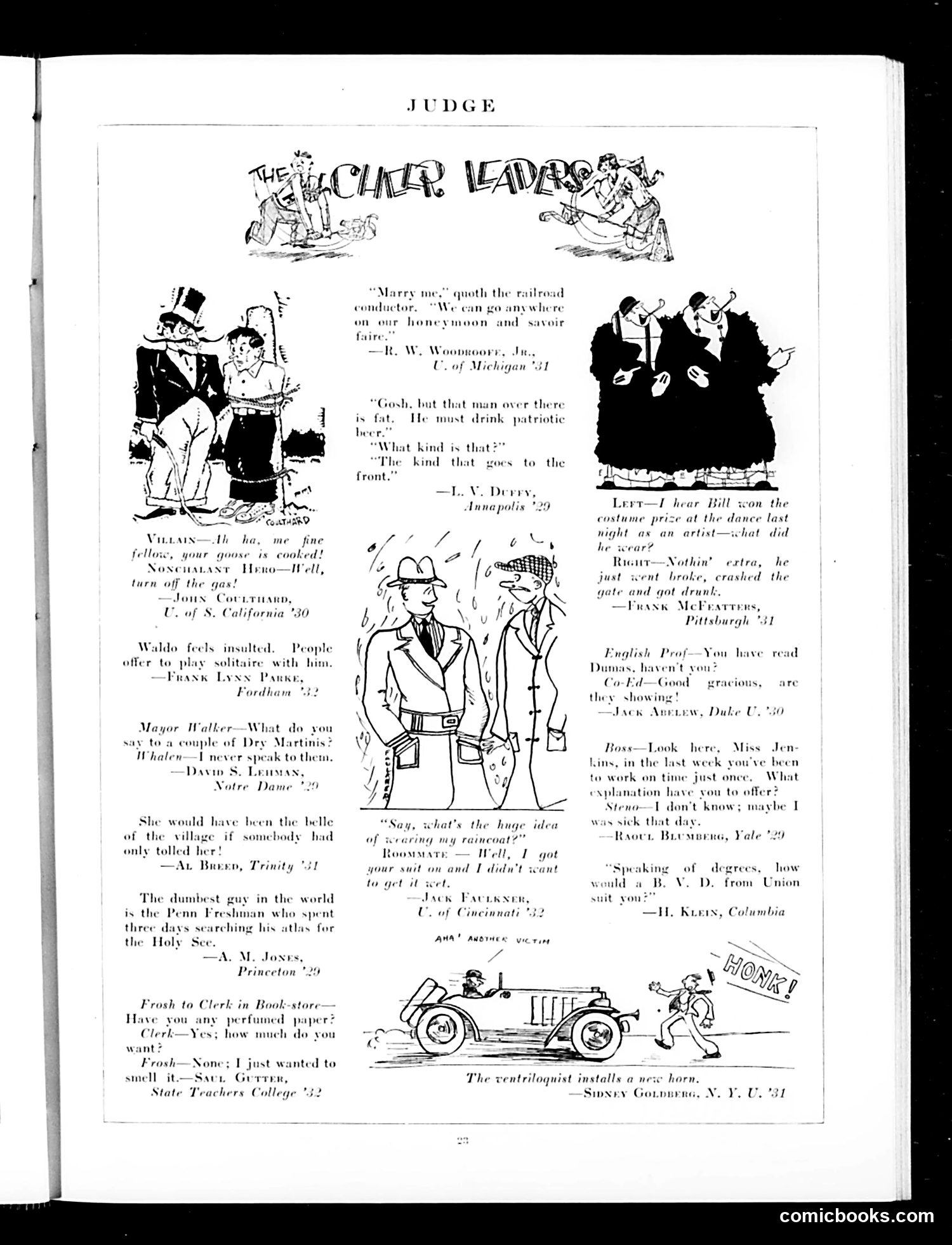
This page from Judge magazine collects student-submitted humor jokes and cartoons, likely from the early 1930s (based on college class years '29-'32). The content reflects period college life and social attitudes: **Notable jokes:** - References to Prohibition ("patriotic beer," dry martinis) — the 18th Amendment was in effect 1920-1933 - Gender dynamics (the "costume prize" joke about a man getting drunk and crashing events) - Class stereotypes (Penn freshmen portrayed as stupid, searching an atlas for "Holy See") - Office workplace humor (secretary chronically late) **The cartoons** feature slapstick scenarios: a man accused of stealing a raincoat, a ventriloquist installing a car horn, various romantic/social embarrassments. **The satire** is gentle, focused on relatable college and young-adult misadventures rather than political commentary. The humor targets personal foibles, romantic confusion, and authority figures (bosses, professors, mayors) in ways recognizable to Judge's educated, presumably college-attending audience. This represents mainstream American humor of the Depression-era leisure class.
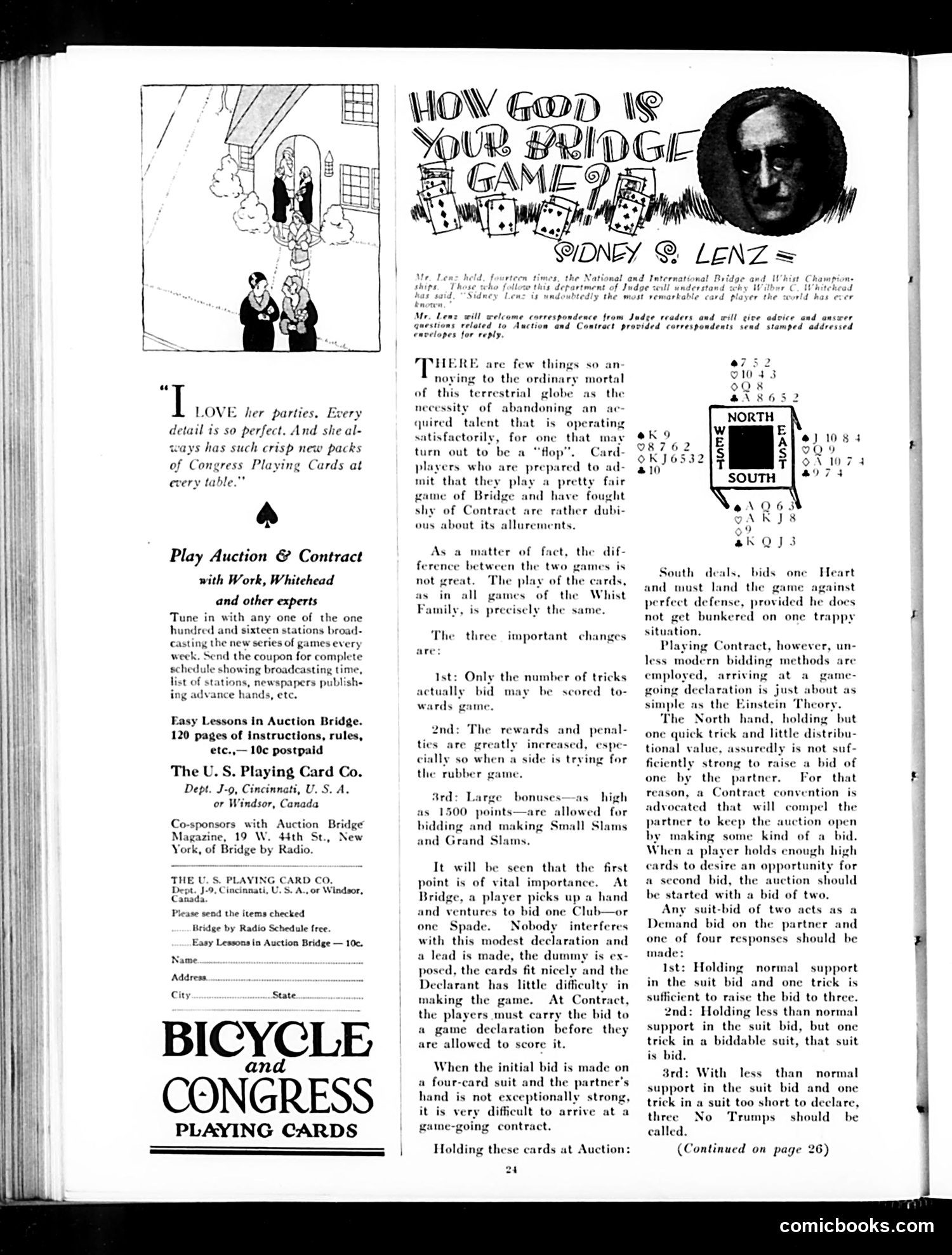
This page is primarily **advertising and instructional content** rather than political satire. The main elements are: **The Cartoon (top left):** A small illustration showing a woman entertaining guests, accompanying a quote praising her party hosting skills. **The Main Content:** Sidney Lenz (identified in the portrait) explains differences between Auction Bridge and Contract Bridge—two card games popular in the 1920s-30s. This represents a genuine cultural moment: Contract Bridge was the newer, more complex variant gaining popularity. **The Satire (implicit):** The page gently mocks Bridge players' snobbery about the "new" game. The quote about perfect party details and the Einstein Theory comparison humorously suggest Bridge players took their hobby quite seriously. **The Advertising:** U.S. Playing Card Company promotes instruction booklets and radio broadcasts about Bridge, reflecting how commercial media promoted the game's spread. This reflects early 20th-century leisure culture and the commercialization of middle-class entertainment rather than political commentary.
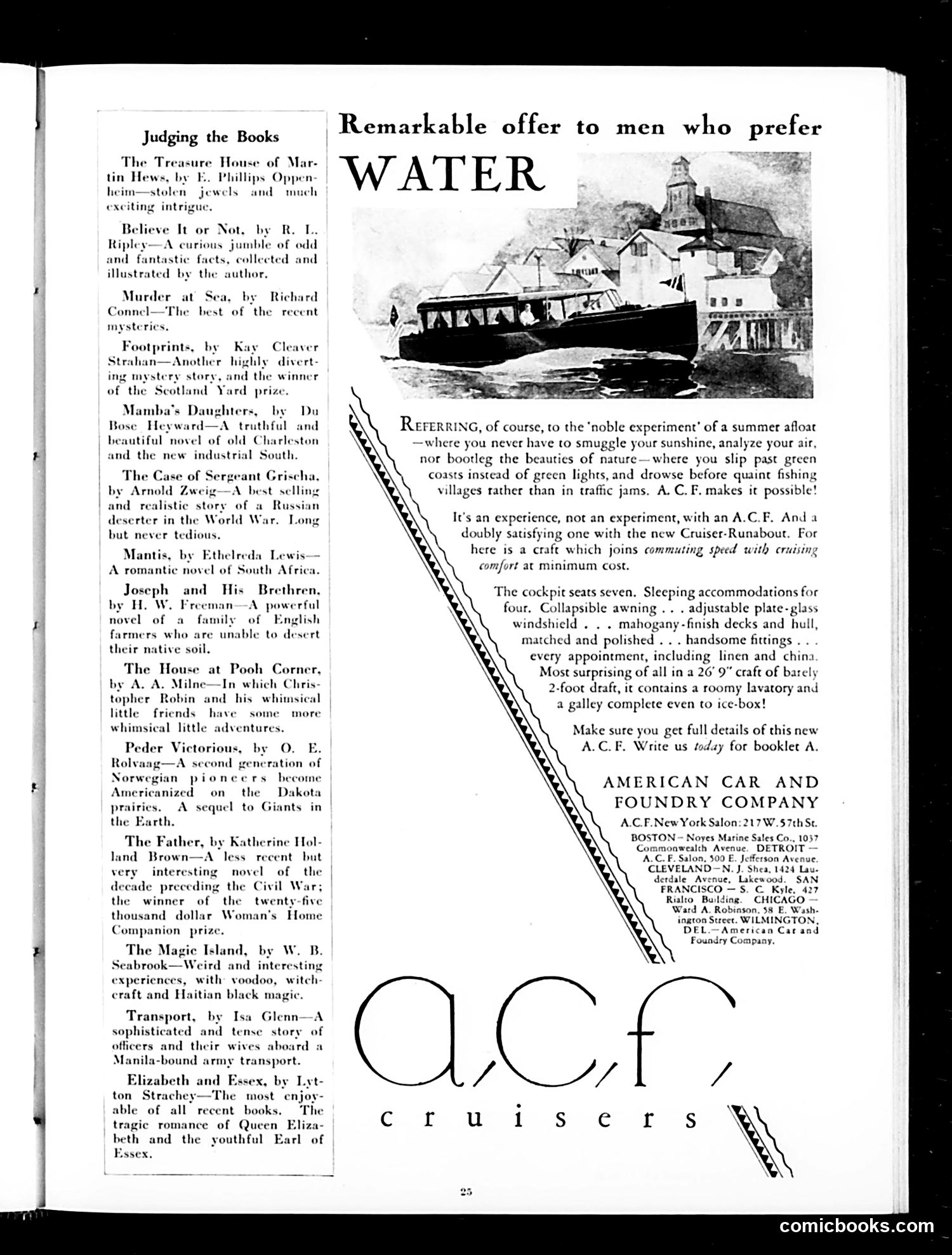
This page combines book reviews with a advertisement for recreational boats, reflecting 1920s-30s leisure culture. **"Judging the Books"** section reviews contemporary novels, including works by Ripley ("Believe It or Not"), Lytton Strachey's "Elizabeth and Essex," and A.A. Milne's "The House at Pooh Corner"—establishing Judge's literary coverage. **The main content** is an advertisement for American Car and Foundry Company's "Cruiser-Runabout" motorboat. The ad's headline "Remarkable offer to men who prefer WATER" cleverly implies escape from Prohibition-era restrictions. The phrase "noble experiment" (Prohibition's euphemism) combined with references to avoiding "smuggle your sunshine" and "bootleg the beauties of nature" suggest this boat offers legal leisure alternatives during the dry era. The boat itself—26'9" with luxury appointments (mahogany, galley, ice-box)—targets wealthy buyers seeking recreational escape. This represents the affluent leisure lifestyle Judge's readership aspired to during the prosperous 1920s-30s.
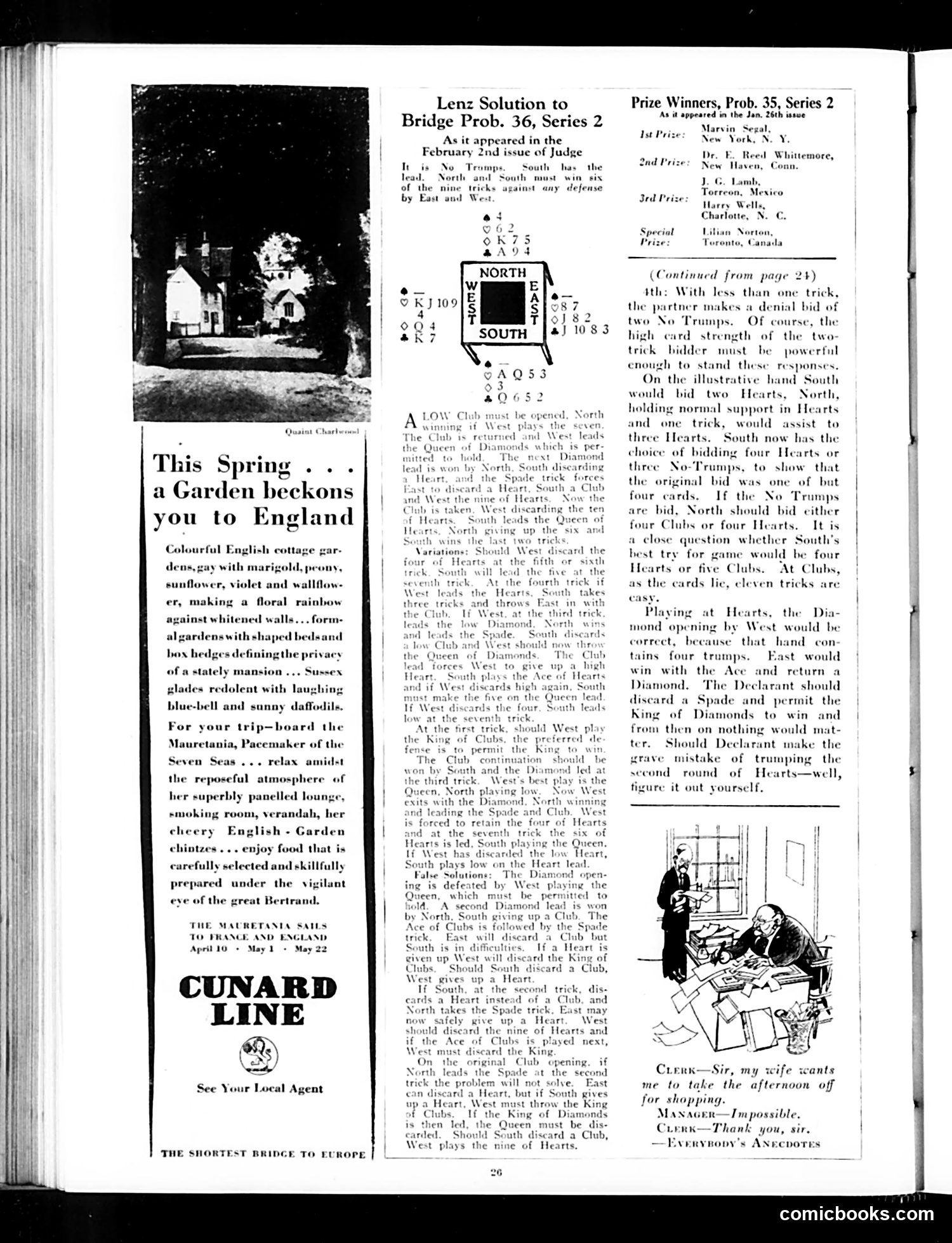
This page combines bridge game instruction with period advertising and a brief comic exchange. **The Bridge Content:** The bulk of the page discusses solutions to bridge problems from Judge's regular bridge puzzle column—a popular feature in 1920s magazines. The detailed card-play analysis would appeal to serious bridge enthusiasts among Judge's readers. **The Cunard Advertisement:** A full-page ad promotes luxury ocean travel to England via the Mauretania, emphasizing English gardens and refined shipboard amenities. This targets affluent readers. **The Comic:** A tiny cartoon at bottom shows a clerk asking his manager for an afternoon off so his wife can go shopping. The manager refuses ("Impossible"), and the clerk thanks him anyway—a joke about workplace hierarchy and the clerk's sarcastic acceptance of authority. The humor relies on the absurdity of thanking someone for denying your request. This appears to be a standard 1920s Judge issue mixing serious content (bridge) with advertisements and light humor.
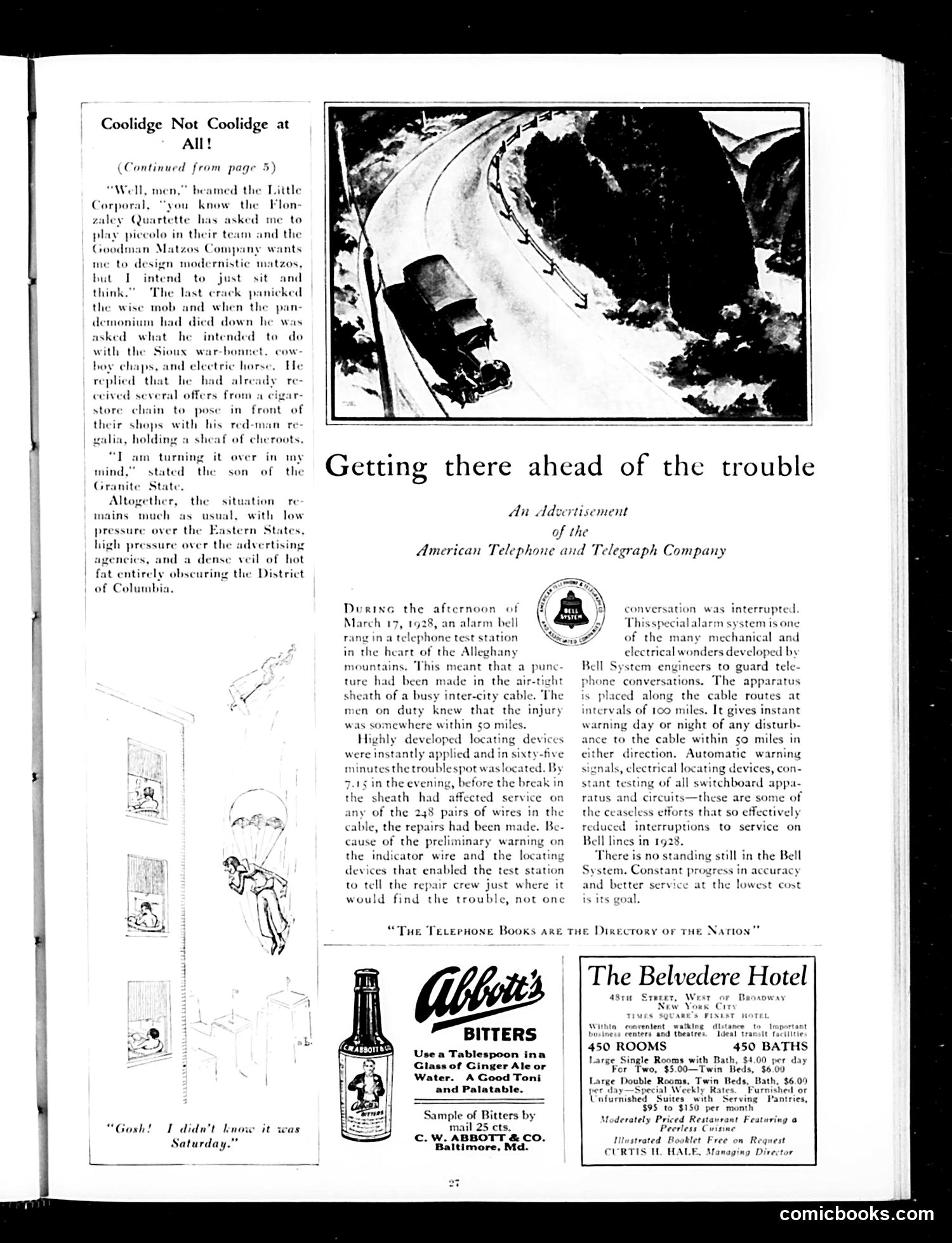
This page mixes a satirical story with period advertisements. The main content is "Coolidge Not Coolidge at All!"—a continuation piece mocking President Calvin Coolidge's famous taciturn reputation. The satire imagines Coolidge secretly accepting various commercial endorsements (a baseball team, a matzo company, a Native American headdress/tobacco chain), contradicting his carefully cultivated image of quiet restraint and above commercialism. The joke targets the gap between his public persona and potential private ambitions. The cartoons on the left appear to illustrate the absurd scenarios described in the text, though details are unclear in reproduction. The page's dominant feature is a full Bell Telephone System advertisement celebrating their cable-repair warning system—placed strategically during the 1928 business boom, emphasizing technological reliability and constant service improvement. Period advertisements for Abbott's Bitters and the Belvedere Hotel round out the page, typical of Judge's revenue model.
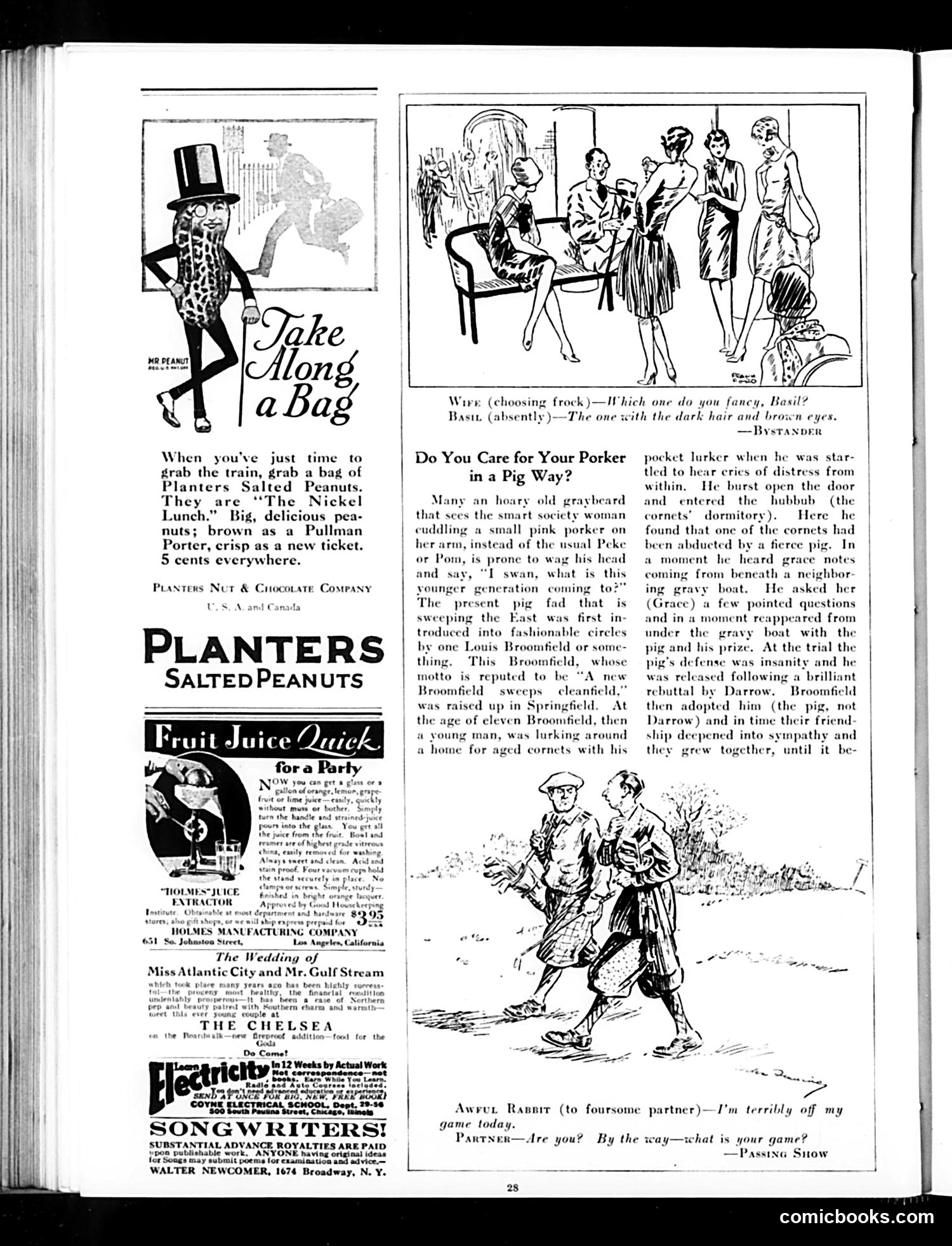
This page is primarily **advertising content** with two short comic captions. The main illustrated cartoon depicts a society woman choosing a dress while a man (Basil) distractedly selects based on physical appearance rather than fashion—a mild joke about male superficiality. Below is a satirical story about the "pig fad" sweeping high society. It traces this trend to Louis Broomfield, who allegedly rescued a pig from a girls' dormitory and adopted it. The story is absurdist humor mocking fashionable society's tendency to adopt eccentric trends—in this case, wealthy women carrying small pigs as pet accessories instead of traditional lap dogs (Pekingese or Pomeranians). The final caption features two golfers: one complains about poor performance; the other dryly asks what game he actually plays—a joke about incompetence. The page is dominated by period advertisements for Planters peanuts, juice extractors, and songwriting opportunities, typical of 1920s magazine layout.
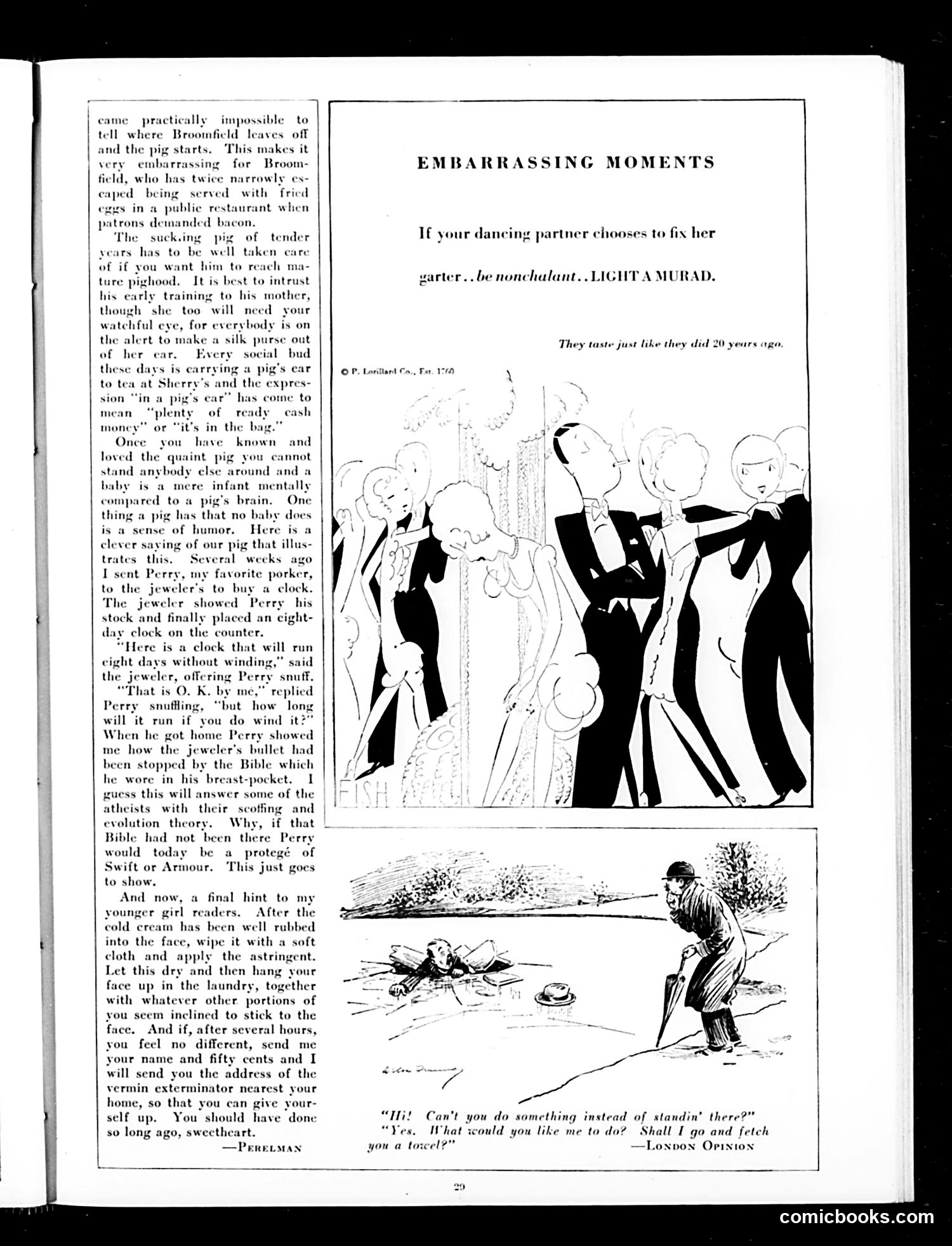
This page contains two separate humorous pieces satirizing early 20th-century social etiquette and courtship customs. **Top cartoon**: Shows men dancing with women at what appears to be a formal social event. The caption advises men whose dance partners adjust their garters to remain "nonchalant" and smoke a Murad cigarette. The joke mocks the awkwardness of such intimate moments in polite society—the cigarette advertisement serves as absurdist "solution" to social embarrassment. **Bottom cartoon**: A comedic exchange between a lazy man lying on the ground and a woman standing nearby. When she asks if he'll do something useful instead of lying there, he offers to fetch her a towel—a deliberately unhelpful, absurd response. The "London Opinion" credit suggests this is reprinted from a British publication. Both pieces satirize male incompetence and indifference in social/romantic contexts, a common Judge magazine theme mocking masculine behavior and courtship rituals.
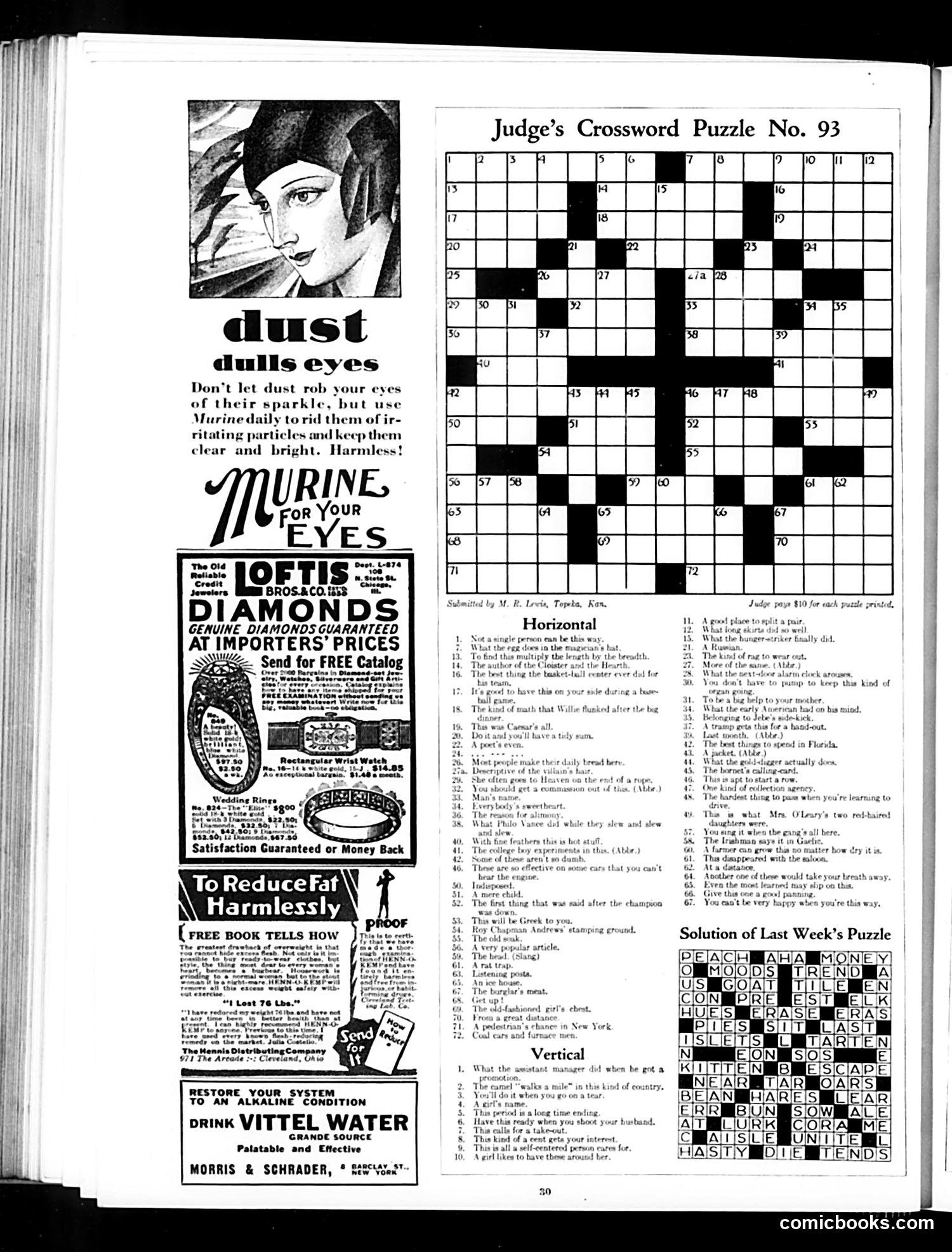
This page is primarily **advertising**, not political satire. It features vintage early-20th-century product advertisements typical of Judge magazine's commercial content. The main elements include: - **"Dust Dulls Eyes"**: A Murine eyedrop advertisement warning that dust irritates eyes, with an illustration of a woman's face - **Loftis jewelry ad**: Promoting diamonds and watches with "satisfaction guaranteed" messaging - **Weight-loss book**: "To Reduce Fat Harmlessly" offering a free instructional booklet - **Vittel Water**: A mineral water advertisement claiming alkaline health benefits - **Crossword puzzle**: The magazine's typical puzzle feature The advertisements reflect period concerns (eye irritation from urban dust, weight management, "alkaline" wellness fads) and sales tactics (free catalogs, money-back guarantees, health claims). There is **no visible political cartoon or satire** on this page—it's standard commercial magazine filler from the era.
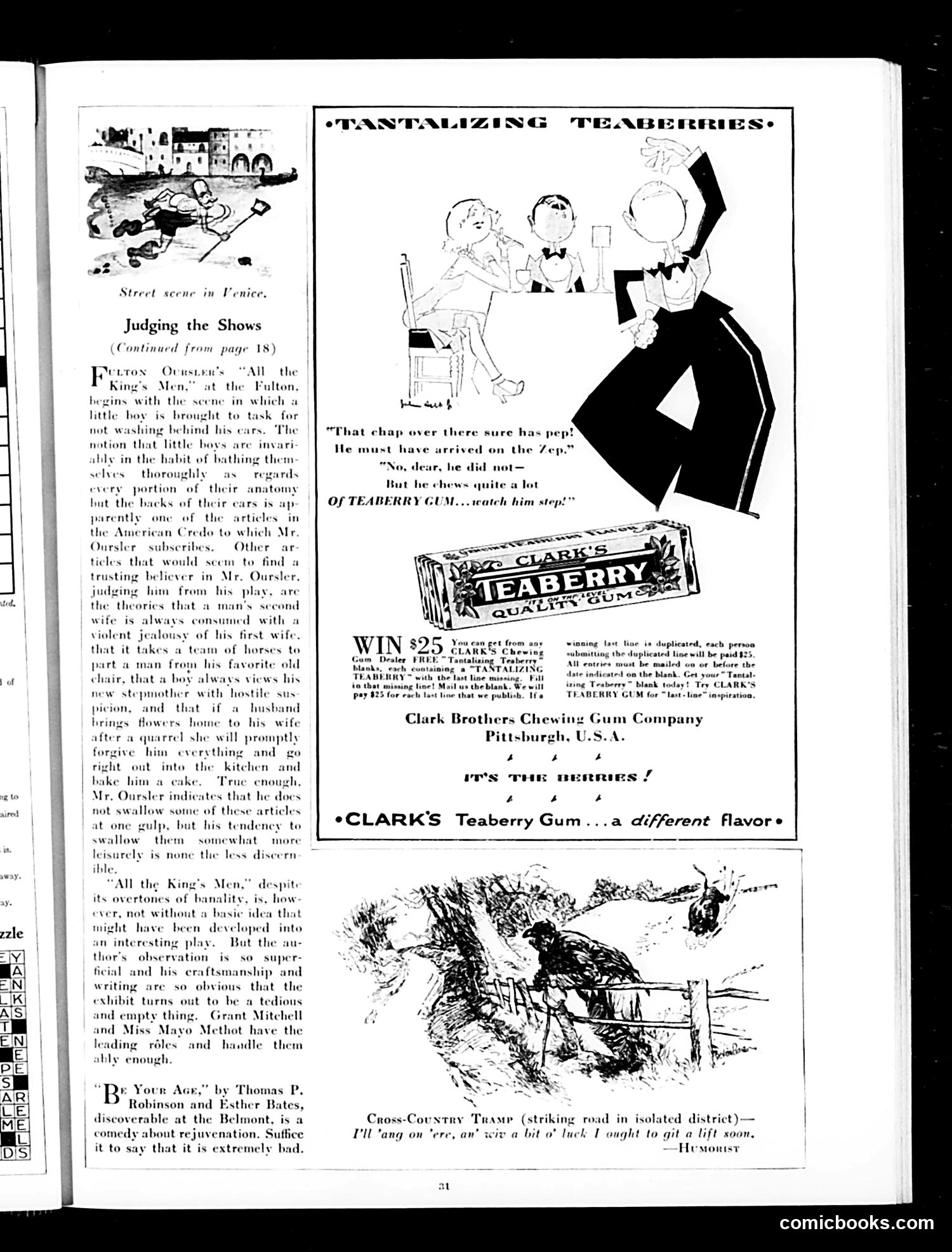
This page contains theater reviews and advertising rather than political cartoons. The main cartoon titled "Tantalizing Teaberries" is an advertisement for Clark's Teaberry Gum, depicting a man in formal wear enthusiastically chewing gum, with dialogue suggesting someone arrived "on the Zep" (zeppelin, implying foreign origin) and "chews quite a lot." The bulk of the page reviews theatrical productions: Fulton Oursler's "All the King's Men" (critiqued for promoting clichéd American beliefs about family behavior) and "Be Your Age" (dismissed as an extremely poor comedy about rejuvenation). A bottom illustration labeled "Cross-Country Tramp" shows a rural hitchhiker, captioned with working-class British dialect. The page reflects 1920s entertainment culture and advertising practices—mixing serious theater criticism with product placement ads using humor and social commentary to sell consumer goods.
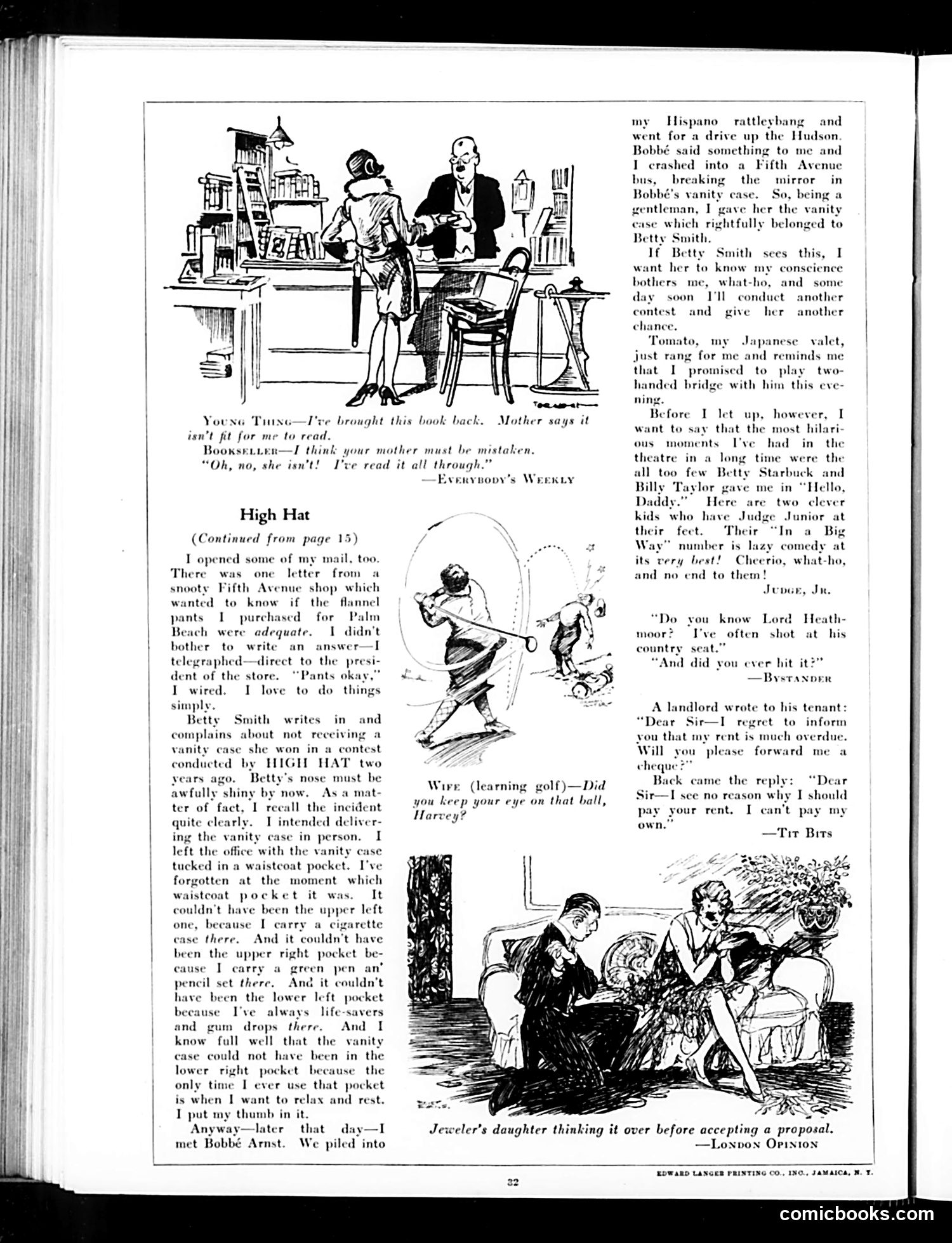
This is a continuation of a serialized humor piece mocking wealthy, self-absorbed Manhattan elites. The unnamed narrator embodies the "High Hat" type—someone obsessed with appearing sophisticated and effortlessly superior. **Main satire:** The narrator boasts about casual displays of wealth (telegraphing store presidents about flannel pants, owning a Hispano-Suiza car, employing a Japanese valet) while revealing his actual vapidity. His elaborate excuse for why a vanity case couldn't fit in any pocket of his waistcoat—because each pocket already holds cigarettes, pens, life-savers, or serves as a resting place for his thumb—is absurd self-parody. **The joke:** He accidentally gave away Betty Smith's contest prize to another woman (Bobbé Arnst), exposing his carelessness beneath the veneer of gentlemanly nonchalance. The side-panel jokes about golf, landlord-tenant disputes, and a jeweler's daughter are typical period humor—unrelated to the main narrative.
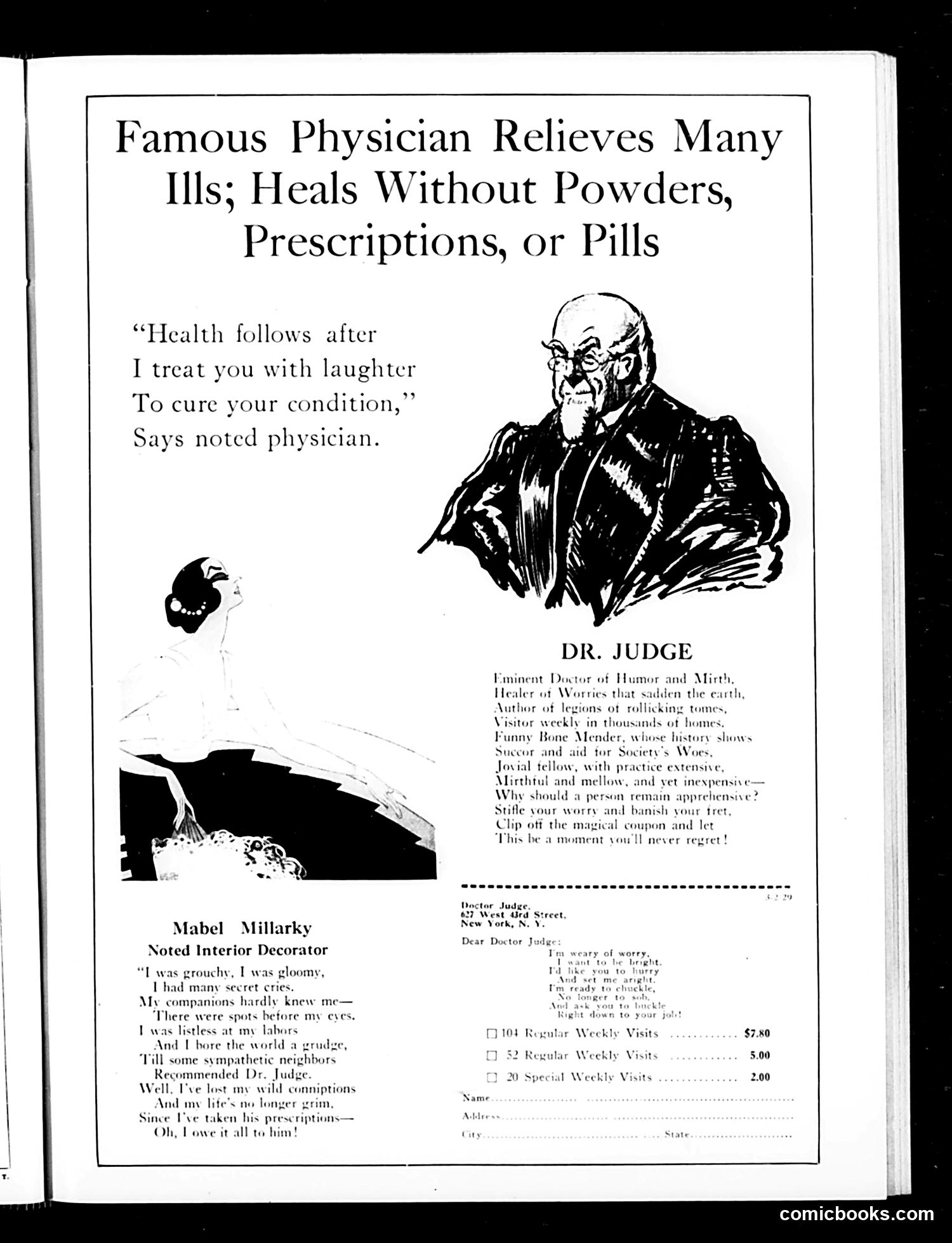
This page advertises **Judge magazine itself** disguised as medical promotion. "Dr. Judge" is a personified mascot—the magazine's embodiment as a comedic "physician" who heals through humor rather than medicine. The satire targets **early 20th-century patent medicine advertising**, which made exaggerated health claims. By positioning humor/laughter as the cure, Judge mocks those dubious medical pitches while promoting its own product: entertaining content that allegedly relieves worry, gloominess, and anxiety. **Mabel Millarky** (shown as an interior decorator) provides testimonial—a common advertising trope. Her transformation from "grouchy" and "gloomy" after reading Judge suggests the magazine's therapeutic value. The coupon at bottom with pricing ($7.80 for 104 weekly visits) mimics actual patent medicine order forms. The joke is that Judge offers affordable "treatment"—weekly comic relief—as superior to powders and pills, inverting medical advertising's language to sell magazine subscriptions instead.
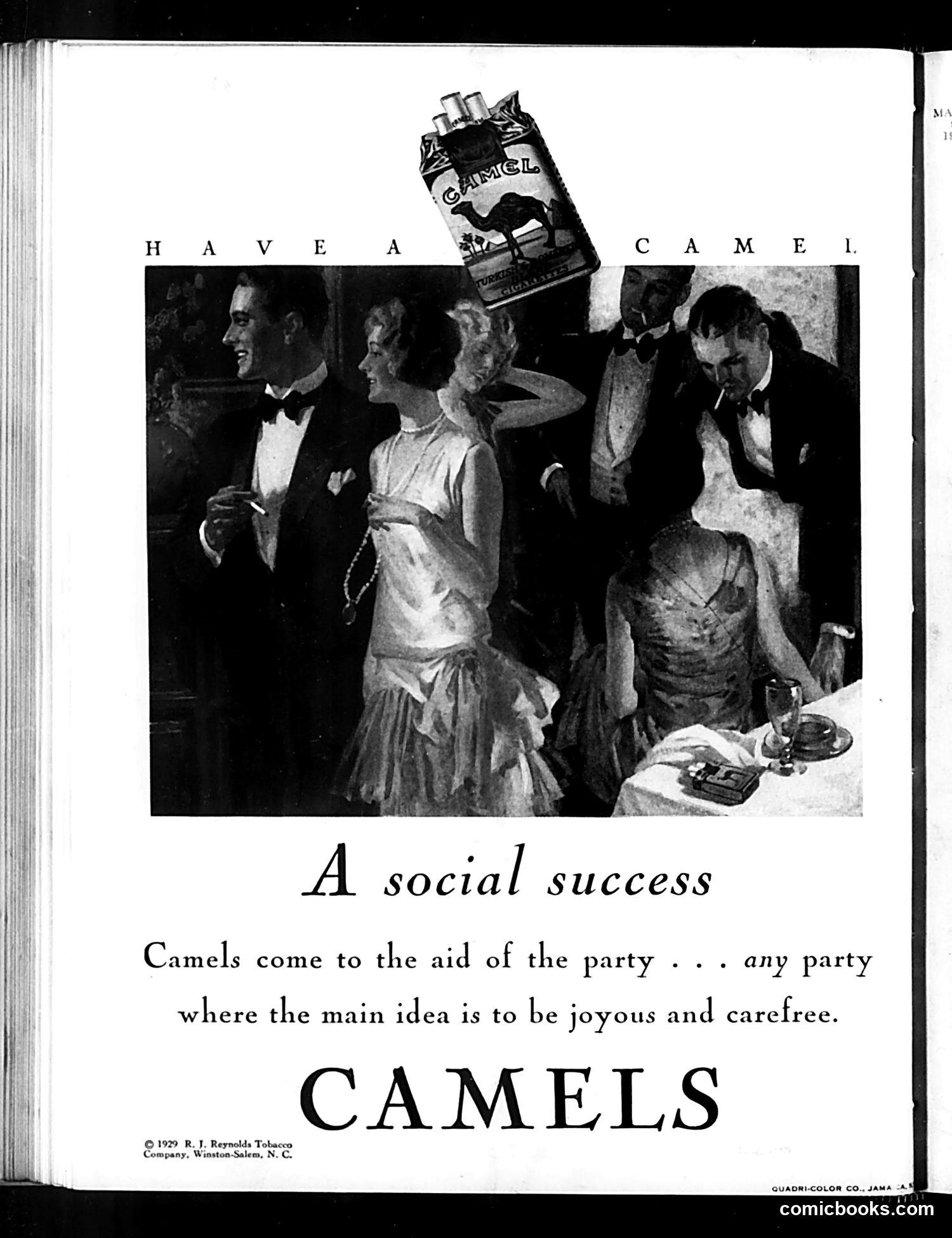
This is a **Camel cigarette advertisement**, not political satire. Dating to 1929, it depicts an elegant formal party scene with well-dressed men in tuxedos and women in evening gowns. The ad's tagline—"Camels come to the aid of the party...any party where the main idea is to be joyous and carefree"—positions cigarettes as social facilitators for sophistication and leisure. The humor is subtle: cigarettes allegedly enhance social gatherings by promoting relaxation and enjoyment. This reflects pre-health-warning advertising conventions that normalized smoking in polite company. The black-and-white photography and formal setting emphasize cigarettes as markers of class and refinement—a standard marketing approach for tobacco companies in this era.