
Judge, 1929-03-02 · page 15 of 36
Judge — March 2, 1929 — page 15: what you’re looking at
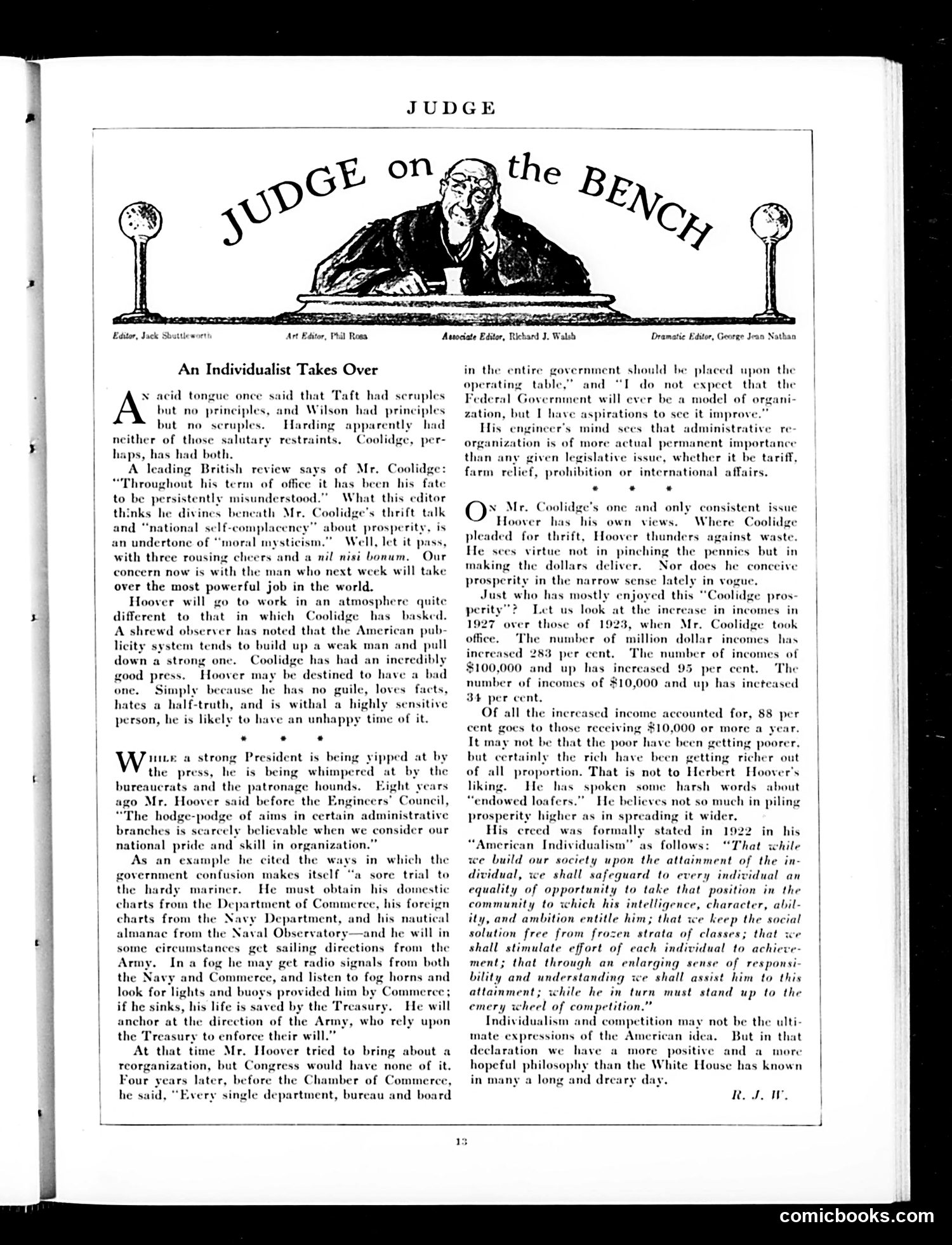
A restored page from Judge, 1929-03-02. Page through the whole issue in the reader above.
📄 Transcribed text from this page (OCR, searchable)
Machine-transcribed from the original scan — historical spelling and the odd misread are preserved.
a: Editar, Jack Shuttlewort Art Editor, Pil Ross, An Individualist Takes Over N acid tongue once said that Taft had scruples A but no principles, and Wilson had principles but no scruples. Harding apparently had neither of those salutary restraints, Coolidge, per- haps, has had both. A leading British review says of Mr. Coolidge: “Throughout his term of office it has been his fate to be persistently misunderstood.” What this editor thinks he divines beneath Mr. Coolidge’s thrift talk and “national self-complacency” about prosperity, is 1 undertone of “moral mysticism.” Well, let it pass, with three rousing cheers and a nil nisi bonum. Our concern now is with the man who next week will take over the most powerful job in the world. Hoover will go to work in an atmosphere quite different to that in which Coolidge has basked. A shrewd observer has noted that the American pub- licity system tends to build up a weak man and pull down a strong one. Coolidge has had an incredibly good press. Hoover may be destined to have a bad one. Simply because he has no guile, loves facts, hates a half-truth, and is withal a highly sensitive person, he is likely to have an unhappy time of it. * . . Wier a strong President is being yipped at by the press, he is being whimpered at by the bureaucrats and the patronage hounds. Eig ago Mr. Hoover said before the Engineers’ Council, “The hodge-podge of aims in certain administrative branches is scarcely believable when we consider our national pride and skill in org: As an example he cited the w government confusion makes itself the hardy mariner. He must obt charts from the Department of Commerce, his foreign charts from the Navy Department, and his naut almanac from the Naval Observatory—and he will in some circumstances get sailing directions from the Army. Ina fog he may get radio signals from both the Navy and Commerce, and listen to fog horns and look for lights and buoys provided him by Commerce; if he sinks, his life is saved by the Treasury. He will anchor at the direction of the Army, who rely upon the Treasury to enforce their will.” At that time Mr. reorgani Four y he said, in which the sore trial his domestic Hoover tried to bring about a ation, but Congress would have none of it. ars later, before the Chamber of Commerce, Every single department, bureau and board Dramatic Editor, George Jean Nathan ntire government should be placed upon the ating table,” and “I do not expect that the Federal Government will ever be a model of o zation, but I have o} spirations to see it improv His engineer's mind sees that administrative re ization is of more actual permanent importanc given legislative issue, whether it be tariff, ‘arm relief, prohibition or international affairs. . . * Ox, Me © "sone and only consistent issue Hoover has his own views. Where Coolidg: aded for thrift, Hoover thunders He sees virtue not in pinehi making the dollars deliver. Nor does he conceive prosperity in the narrow sense late! Just who has mostly enjoyed this re pros perity”? Let us look at the increase in incomes in 1927 r those of 1923, when Mr. Coolidge took The number of million dollar incomes has increased 283 per cent. The number of incomes of $100,000 and up has increased 95 per cent. T number of incomes of $10,000 and up has incteasec 34 per cent. Of all the ine d_ income accounted for, 88 per cent goes to those receiving $10,000 or more a year. not be that the poor have been getting poorer. ily the rich | inst waste. x the pennies but in y in vogue, “Coolic ov been getting richer out He has spoken some harsh words ab “endowed loafers.” it He believes not so much in piling prosperity higher as in spreading it wider. His creed formally stated in 1922 in his “American Individualism’ as follows: That while we build our society upon the attainment of the in- dividual, we shall safeguard to every individual an equality of opportunity to take that position in the community to which his intelligence, character, abil- ity, and ambition entitle him; that we keep the social solution free from frozen strata of classes; that shall stimulate effort of each individual to achieve ment; that through an enlarging sense of responsi bility and understanding we shall assist him to this attainment; while he in turn must stand up to the emery wheel of competition Individualism and compe mate expressions of the American idea. But in that declaration we have a more positive and a more hopeful philosophy than the White House has known in many a long and dreary da n may not be the ulti- RSW, comicbooks.com