
Judge, 1929-03-02 · page 23 of 36
Judge — March 2, 1929 — page 23: what you’re looking at
What you’re looking at
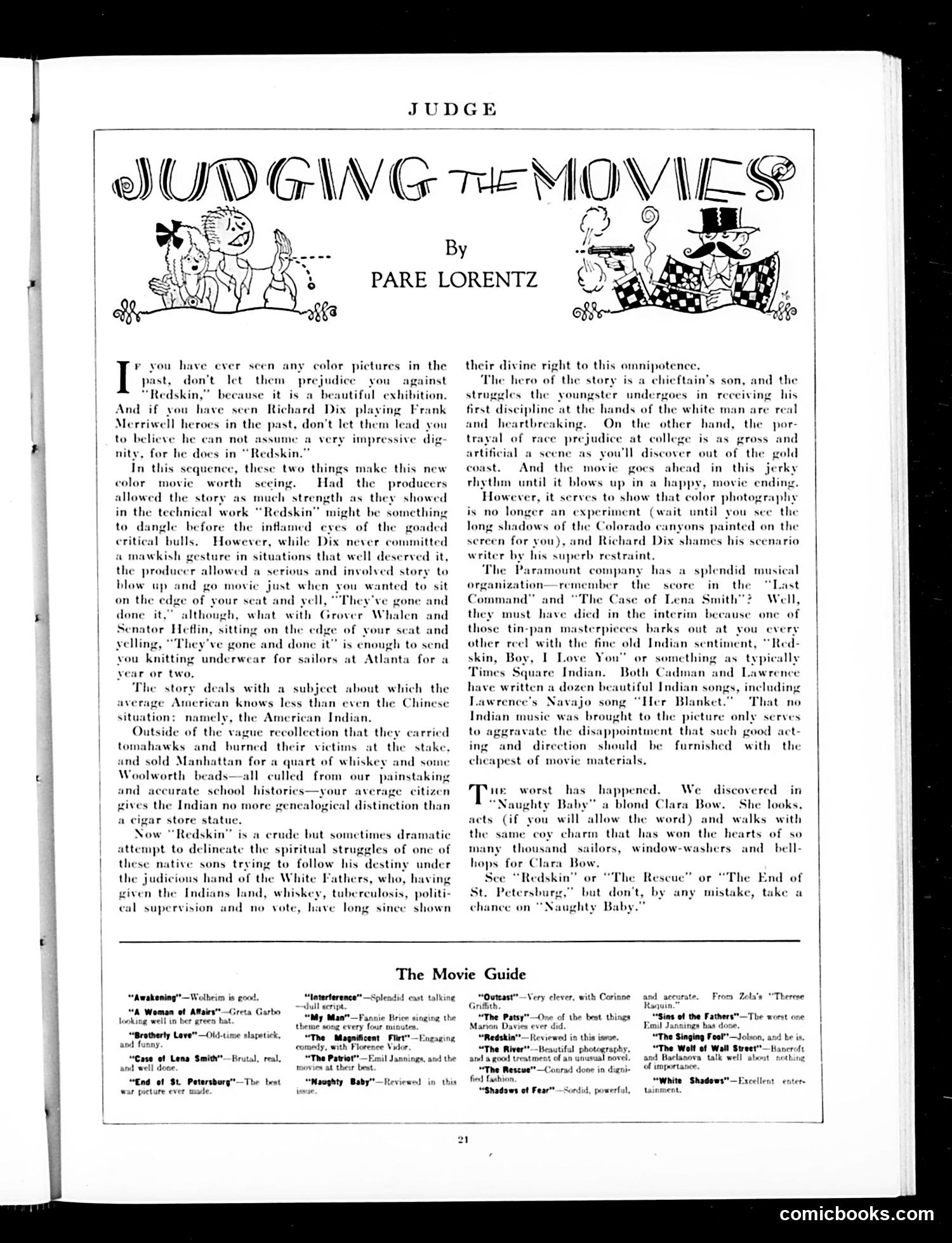
This is a film review by Pare Lorentz critiquing the Paramount picture "Redskin," starring Richard Dix. The satire targets both the film itself and broader American ignorance about Native Americans. **The Setup:** Lorentz mocks audiences' shallow knowledge of Indians—reduced to stereotypes (tomahawks, Manhattan's sale for whiskey, "cigar store statue"). The film attempts to dramatize a Native American youth's spiritual struggle under White Father guidance, dealing with racial prejudice at college. **The Critique:** While praising Dix's restrained acting and color cinematography as technical achievements, Lorentz savages the execution: the plot becomes "jerky" melodrama with a fake happy ending. Worse, the musical score—supposedly from Paramount's acclaimed composers—degrades into "tin-pan" sentimentality ("Redskin, Boy, I Love You"), cheapening genuine Indian material. **The Punch:** By reviewing this alongside dismissing Clara Bow in "Naughty Baby," Lorentz suggests Hollywood's formula entertainment prioritizes spectacle over substance.
📄 Transcribed text from this page (OCR, searchable)
Machine-transcribed from the original scan — historical spelling and the odd misread are preserved.
JUDGE ast, don’t let them prejudice you aga Redskin,” because it is a beautiful exhibition. And if you have scen Richard Dix playing Frank Merriwell heroes in the past, don't let them lead you to believe he can not nity, for he does in Redskin.’ In this sequen or movie I you have ever seen any color pictures in the assume a very impressive dig ec, these two things make this new worth seeing. Had the producers Nowed the story as much strength as they showed in the technical work “Redskin” might be something to dangle before the inflamed eyes of the goaded critical bulls. However, while Dix never committed a mawkish gesture in situations that well deserved it, the producer allowed a serious and involved story to blow up and go movie just when on the edge of your seat and yell, “They've gone and done it.” although, what with Gro Whalen and Senator Heflin, sitting on the edge of your seat and ou wanted to sit yelling, “They've gone and done it” is enough to send 1 knitting underwear for sailors at Atlanta for ar or two. The story deals with a subject about which the average American knows less than even the Chinese situation: namely, the American Indian. Outside of the vague recollection that they carried tomahawks and burned their victiins at the stake. and sold Manhattan for a quart of whiskey and some Woolworth beads—all culled from our and accurate school histories—your ave gives the Indian no more a cigar store statue. Now “Redskin” is a crude but sometimes dramatic attempt to delineate the spiritual struggles of one of these native sons trying to follow his destiny under the judicious hand of the White Fathers, who, having given the Indians land, whiskey, tuberculosis, politi- cal supervision and no vote, have long since shown OVIES The hero of the story is a struggles the youngster undergoes in receivin first discipline at the hands of the white man a and heartbreaking. On the other hand, the ul of race prejudice at college is as gross artificial a seene ¢ pull discover out of the gold coast. And the movie goes ahead in this jerky rhythm until it blows up in a happy, movie ending. However, it serves to show that color photography is no longer an experiment (wait until you see the long shadows of the Colorado sercen for you), and Richard Dix shames his scenario writer by his superb restraint. The Paramount company has a splendid musi anization—remember the score in’ the “Last | Command” and “The Case of Lena Smith” Well, they must have died in the interim beeause one of | those tin-pan masterpieces barks out at you every other reel with the fine old Indian sentiment, “Red- skin, Boy, I Love You" or something as typically Times Square Indian. Both Cs have written a dozen beautiful Indian songs, including Lawrence's Navajo song “Her Blanket.” ‘That 1 Indian music was brought to the picture only serves to aggravate the disappointment that such good act- and direction should be furnished with the cheapest of movie materials, nyons painted on the worst has happened. We discovered in ughty Baby” a blond Clara Bow. She looks. acts (if you will allow the word) and walks with the same coy charm that has won the hearts of so | many thousand sailors, window-washers and bell- hops for Clara Bow. See “Redskin” or “The Rescue” St. Petersburg,” but don’t, by chance on “Naughty Baby. or “The End of | mistake, taki The Movie Guide “toterterence” —<p! ull script. “My Man”—Fannie Brice singing the theme song every four min “The Magnificent Flirt” —Engaging commly, with Florence Vidor ase of Lena Smith” —Erutal, real, “The Patriot” —Emil Jannings, and the well dove. toovies at their best ersborg”—The best cast talking looking well in ber “<Brotherty Love” —Old-time slapetick, Reviewed in this “Outeast”—Very clever, with Corinne ot accurate. “Therese | bth. Ranui “The Patsy” —One of the best things “Sins of the Fathers”—The worst one d. Emil Jannings has done. “The Singing Feel” —Jolson, a: “The Wolt of Wall Sweet and Baclasova talk well of ismportance “white Shadews”—Excellent tainment. and a good tre “The Rescue fied faa of an unusual novel rad done in digni- comicbooks.com