
A complete issue · 36 pages · 1928
Judge — October 13, 1928
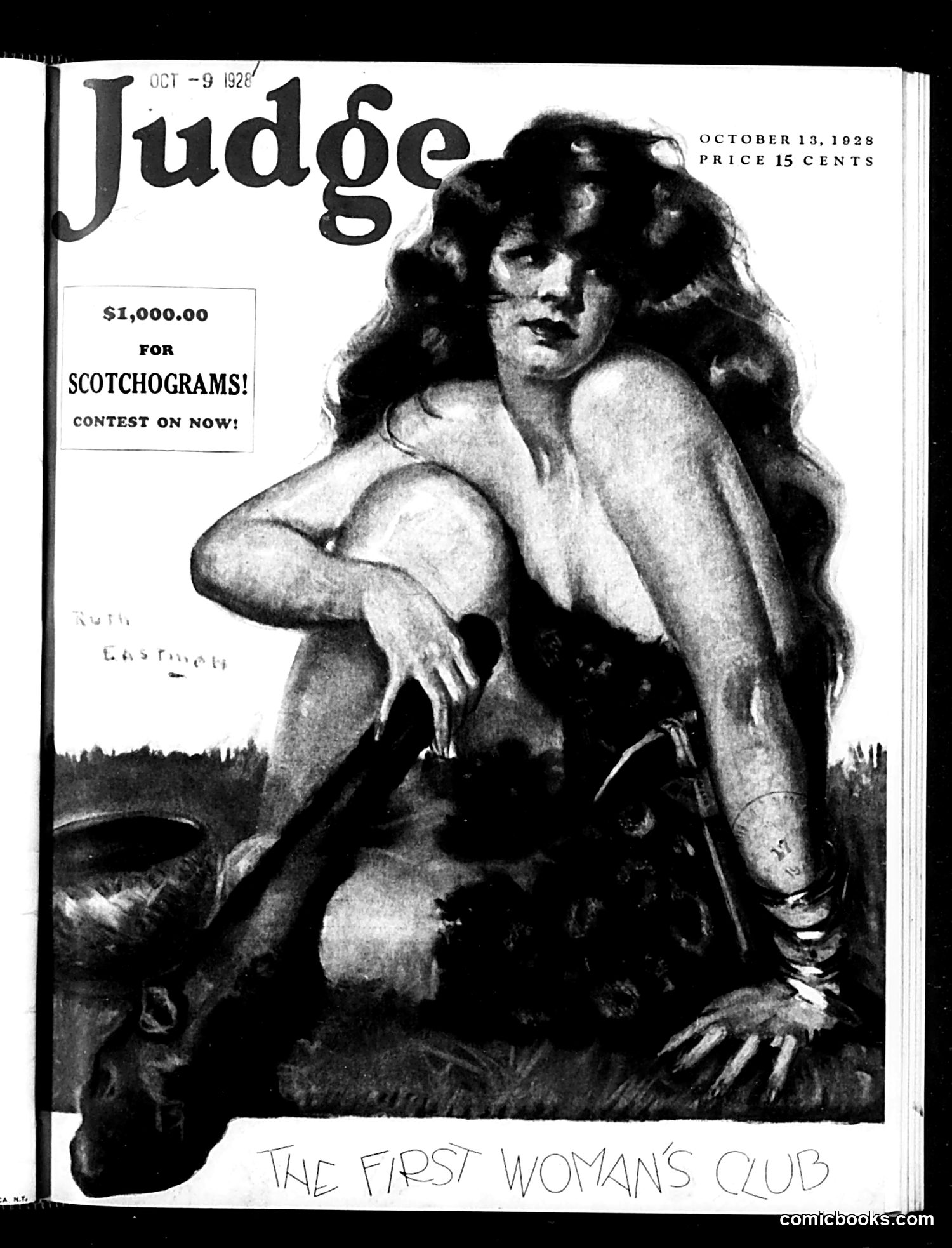
This page appears to be primarily an advertisement rather than political satire. It features a woman in 1920s attire (bobbed hair, minimal clothing) posed with what appears to be a rifle or hunting equipment in a landscape setting. The advertisement promotes a "$1,000.00 for SCOTCHOGRAMS! CONTEST ON NOW!" and is titled "THE FIRST WOMAN'S CLUB," likely a joke about women's changing social roles in the 1920s—a period of increased female independence (voting rights granted in 1920, looser fashion, more public presence). The "scotchogram" contest reference remains unclear without additional context, though it likely relates to a contemporary product or service advertised in Judge magazine.
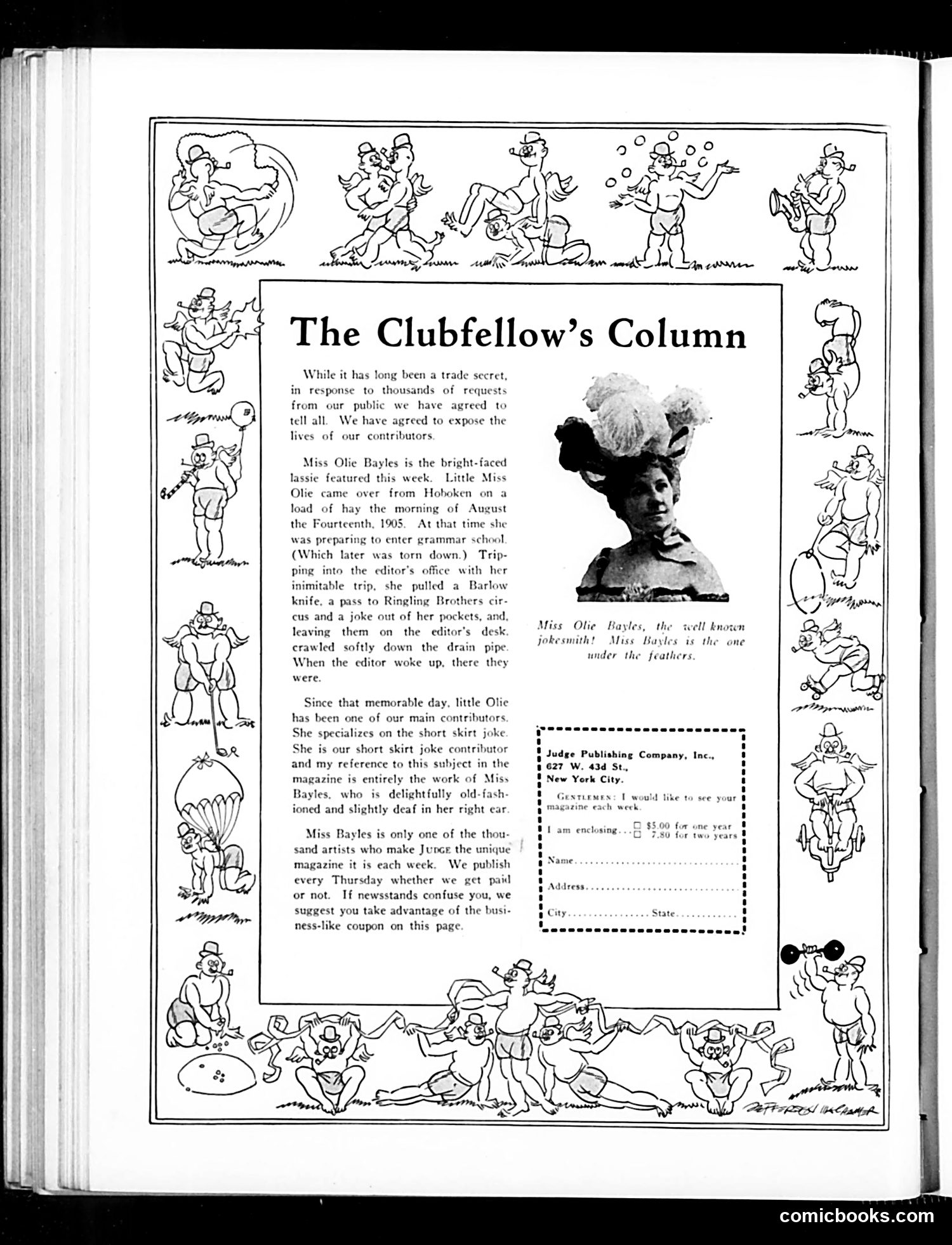
This page features a regular humor column by Miss Olie Bayles, a satirist specializing in short-skirt jokes. The column humorously traces how Bayles became a contributor: she arrived at the editor's office in 1905 carrying a Barlow knife, a Ringling Brothers circus pass, and joke materials, which she left scattered in the editor's desk and drain pipe. The surrounding decorative illustrations depict clubfellows (apparently young men and women) engaging in casual activities—juggling, playing instruments, cycling—representing the magazine's target audience of leisure-class readers. The page includes a subscription coupon for Judge's parent company, indicating this was a revenue-generating element of the publication. The humor relies on genteel satire about magazine operations and contributors.
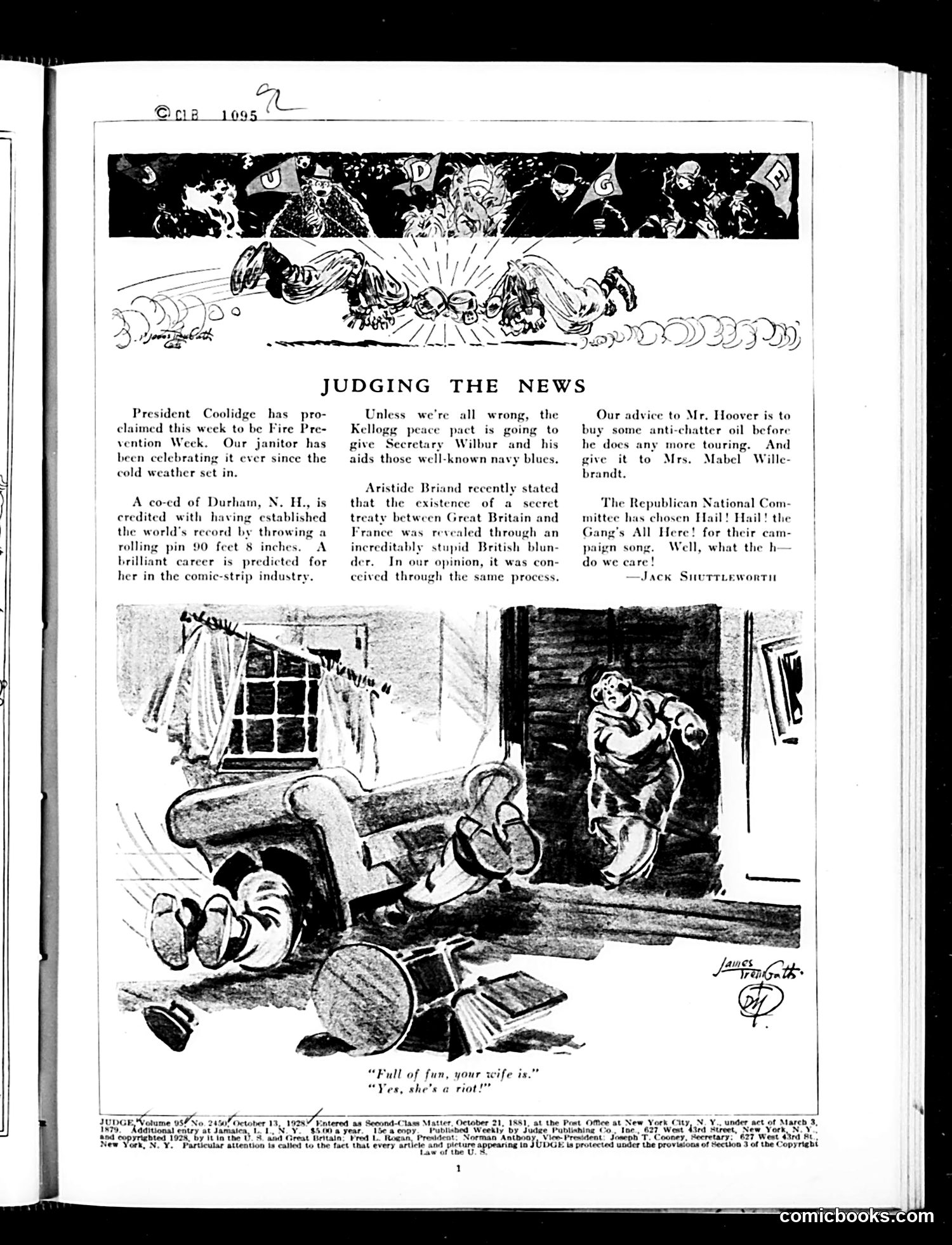
This satirical commentary page combines editorial commentary with a cartoon illustration. The text references President Coolidge proclaiming "Fire Prevention Week," a co-ed from Durham, N.H. setting a world record, and Aristide Briand's revelation of a secret treaty between Britain and France. The main cartoon depicts a domestic scene: a man lies on the floor surrounded by broken household items and furniture, while a woman stands nearby. The caption reads: "Full of fun, your wife is." "Yes, she's a riot!" The joke satirizes marital discord—what appears to be destruction or chaos is being euphemistically described as "fun." It's a commentary on domestic conflict treated as entertainment, typical of Judge's irreverent humor about American middle-class life.
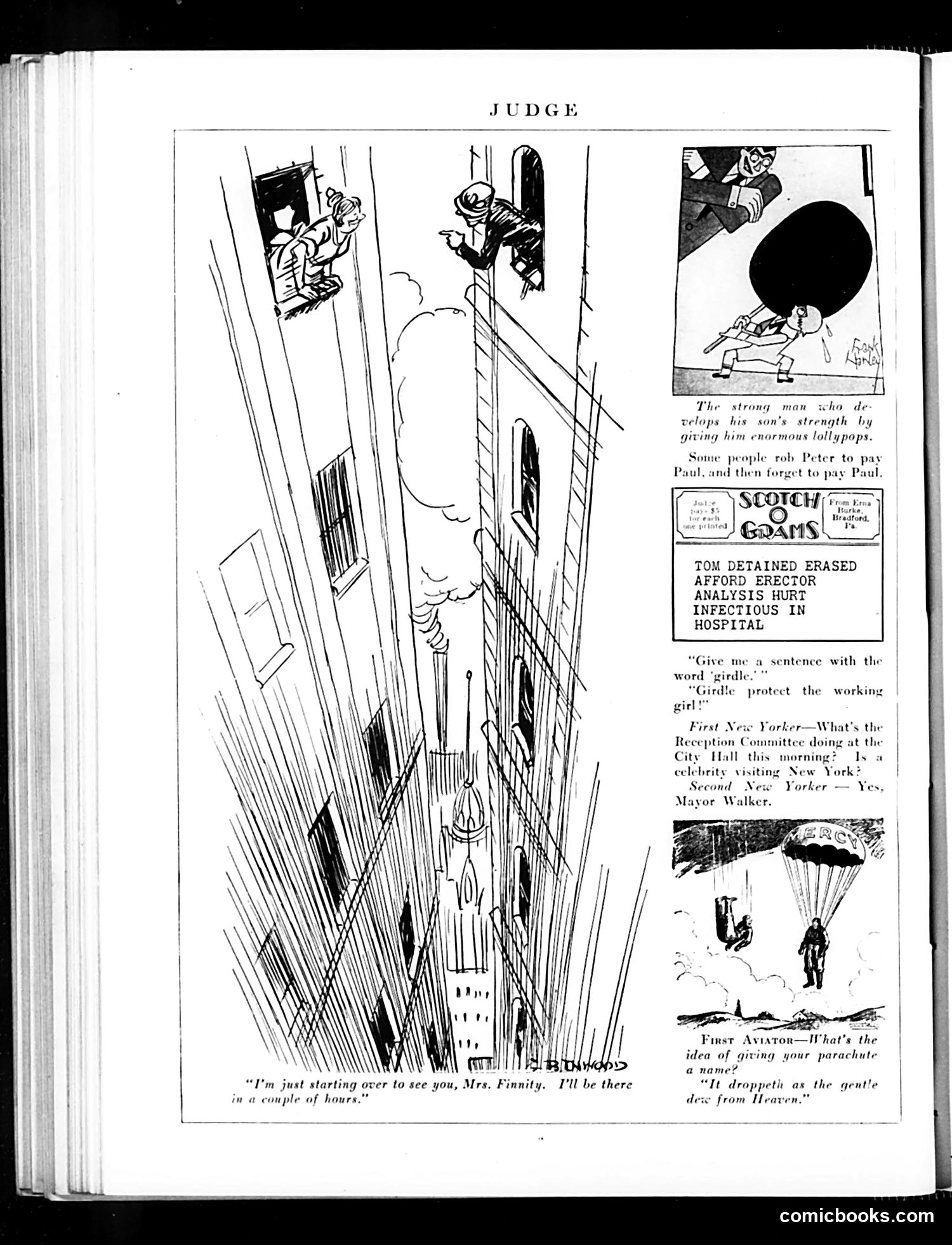
The main cartoon depicts a tall urban building with figures climbing on its exterior, illustrating the caption: "I'm just starting over to see you, Mrs. Finnity. I'll be there in a couple of hours." This appears to be satirizing the impracticality of New York City navigation or perhaps the dangers of urban climbing. The right side contains miscellaneous items: a "Scotch Oaks" advertisement, a hospital headline about "Tom Detained," a joke about using the word "girdle," and commentary on Mayor Walker and New York City Hall business. An aviator cartoon at bottom jokes about parachute naming ("It dropeth as the gentle dew from Heaven"). The page primarily mixes social satire with advertising and brief comedic observations typical of Judge's satirical format.
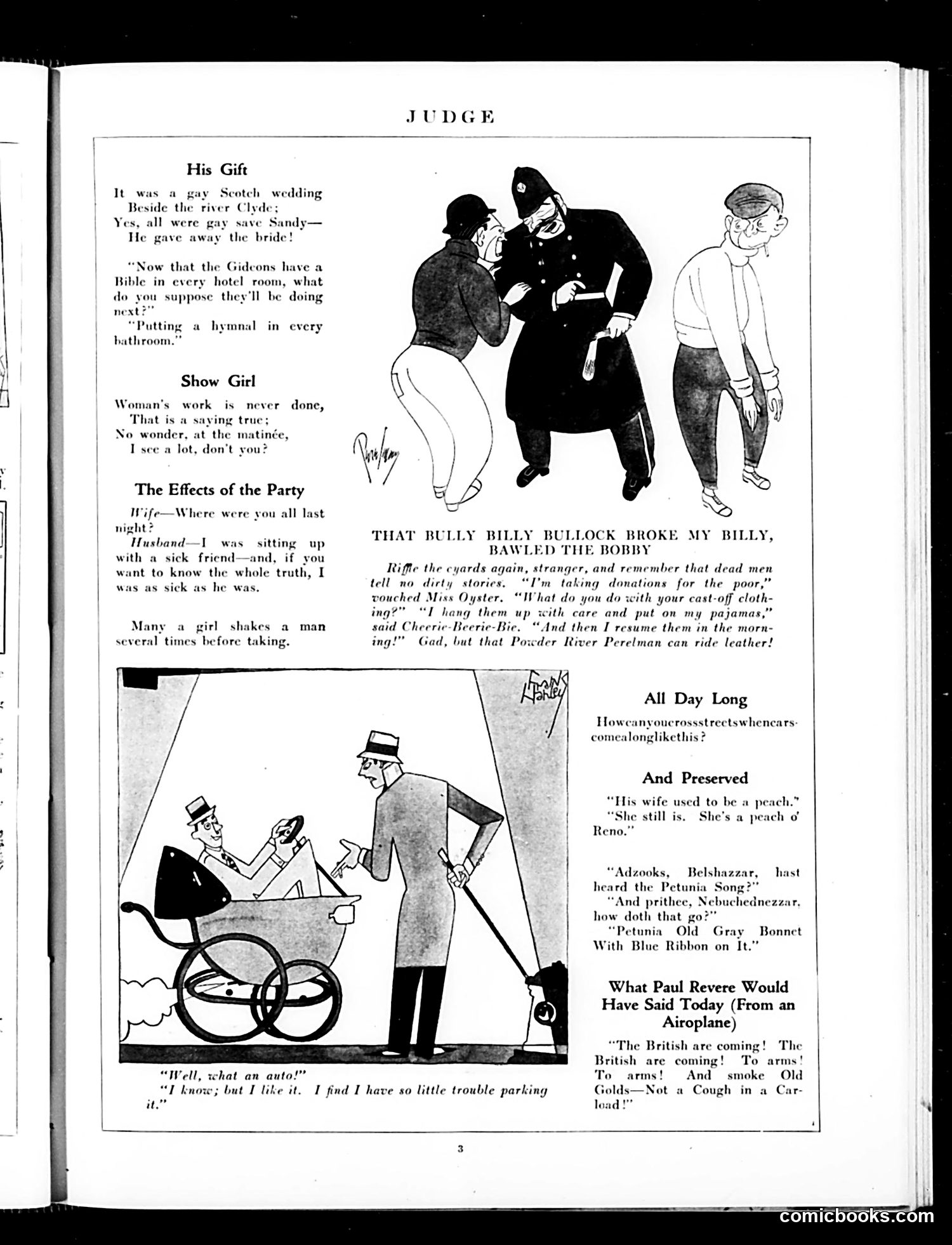
This page contains four separate humor sections satirizing 1920s social life: **"His Gift"** mocks the Gideon Bible hotel placement trend by suggesting the next logical step: hymn books in bathrooms. **"Show Girl"** jokes about women's endless domestic work. **"The Effects of the Party"** depicts a hungover husband making excuses to his wife about his sick evening—a common domestic comedy trope. **The main cartoon** shows two men admiring an automobile, with one saying parking it caused "so little trouble"—likely satirizing both early automobile enthusiasm and urban parking challenges. **"What Paul Revere Would Have Said Today"** updates the Revolutionary War figure's famous warning cry to modern concerns: British invasion replaced by "smoke Old Golds—Not a Cough in a Car-load" (appears to be advertising wordplay). The page reflects 1920s preoccupations: automobiles, advertising, marital dynamics, and consumer culture.
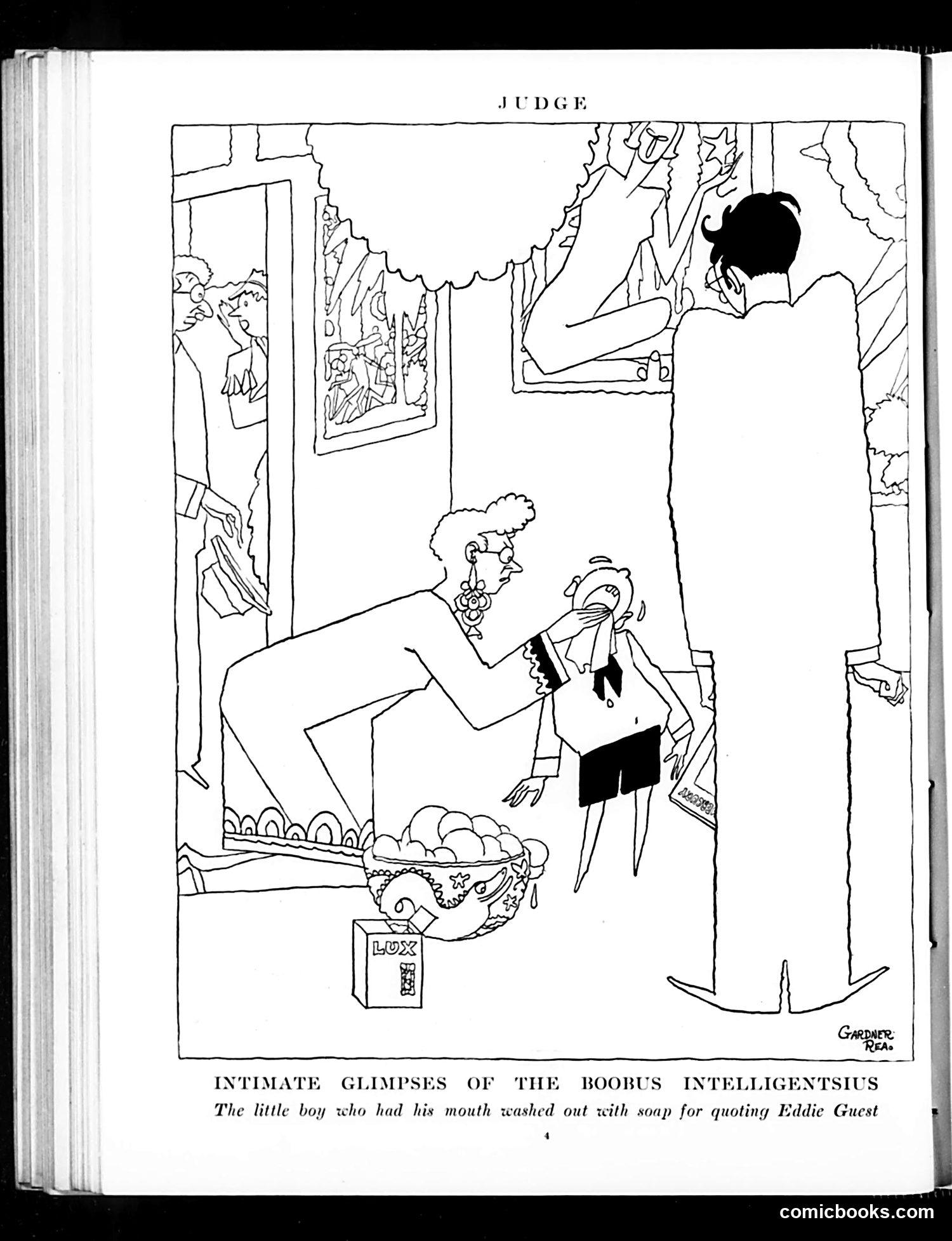
This cartoon, titled "Intimate Glimpses of the Boobus Intelligentsius," satirizes a wealthy woman and a young boy. The caption references "the little boy who had his mouth washed out with soap for quoting Eddie Guest." The satire likely targets upper-class hypocrisy: the elegantly dressed woman appears indifferent to the child's punishment, surrounded by luxury furnishings and artwork. Eddie Guest was a popular, sentimental poet of the early 20th century. The humor suggests the boy quoted Guest (considered lowbrow by elites) and was punished—while the woman's sophisticated surroundings mock the pretensions of "refined" society that would shame accessible poetry. The Latin-style title mockingly elevates this domestic scene to scholarly importance, reinforcing the satire of class-consciousness.
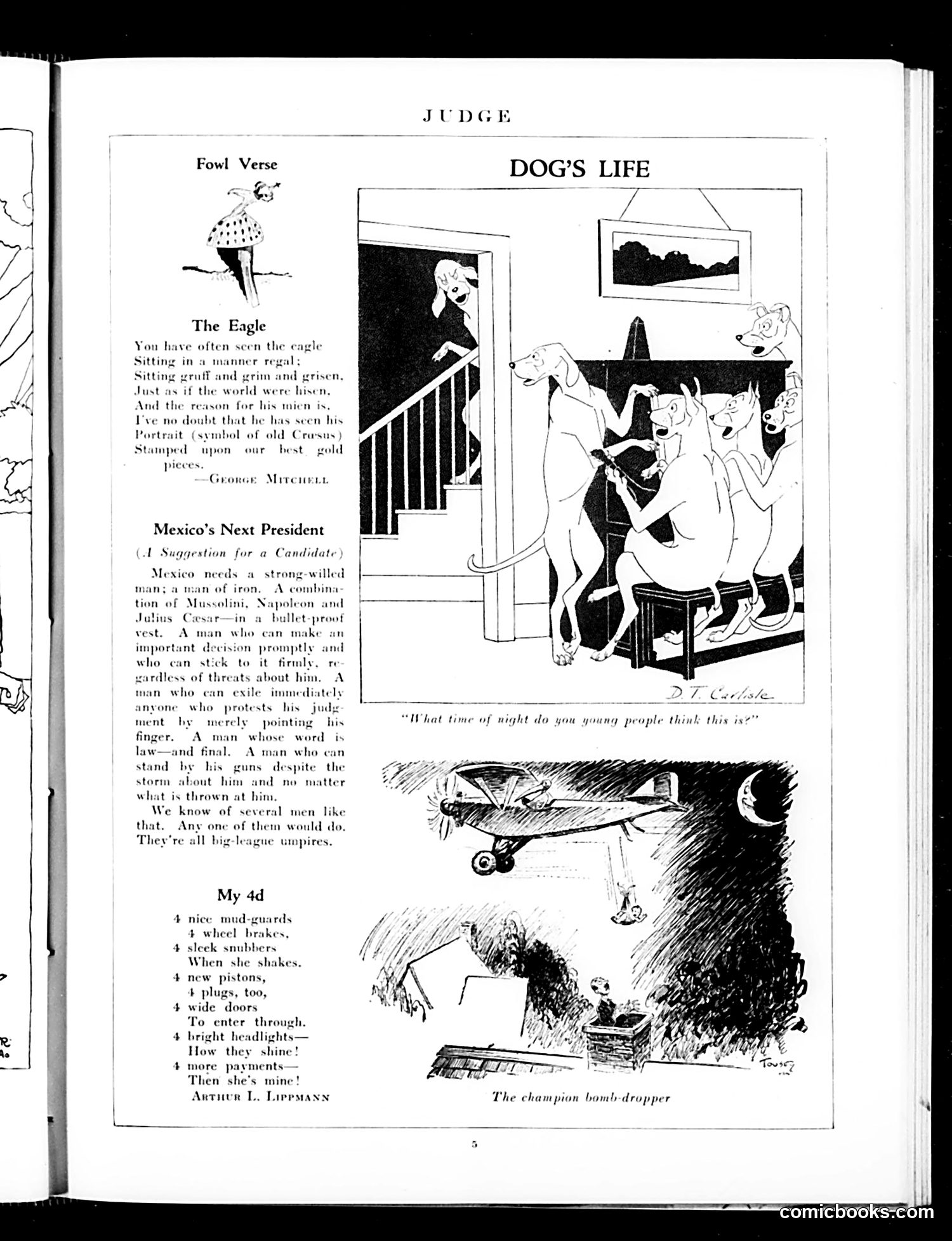
This page mixes unrelated content typical of early 20th-century Judge magazine. **"The Eagle"** reproduces a poem by George Mitchell about eagles as national symbols. **"Mexico's Next President"** is a serious proposal suggesting Mexico needs a strong, decisive leader—likely referencing Mexico's political instability during the Revolutionary period (1910s-1920s). It advocates for an authoritative figure who can maintain order. **"Dog's Life"** is a humorous cartoon showing dogs in a domestic scene, with the caption asking "What time of night do you young people think this is?"—poking fun at young people staying out late. **"My 4d"** is a riddle about a car ("4 nice mud guards...4 wheel brakes"), authored by Arthur L. Lippmann. **"The champion bomb-dropper"** shows a crude airplane joke, likely a WWI reference.
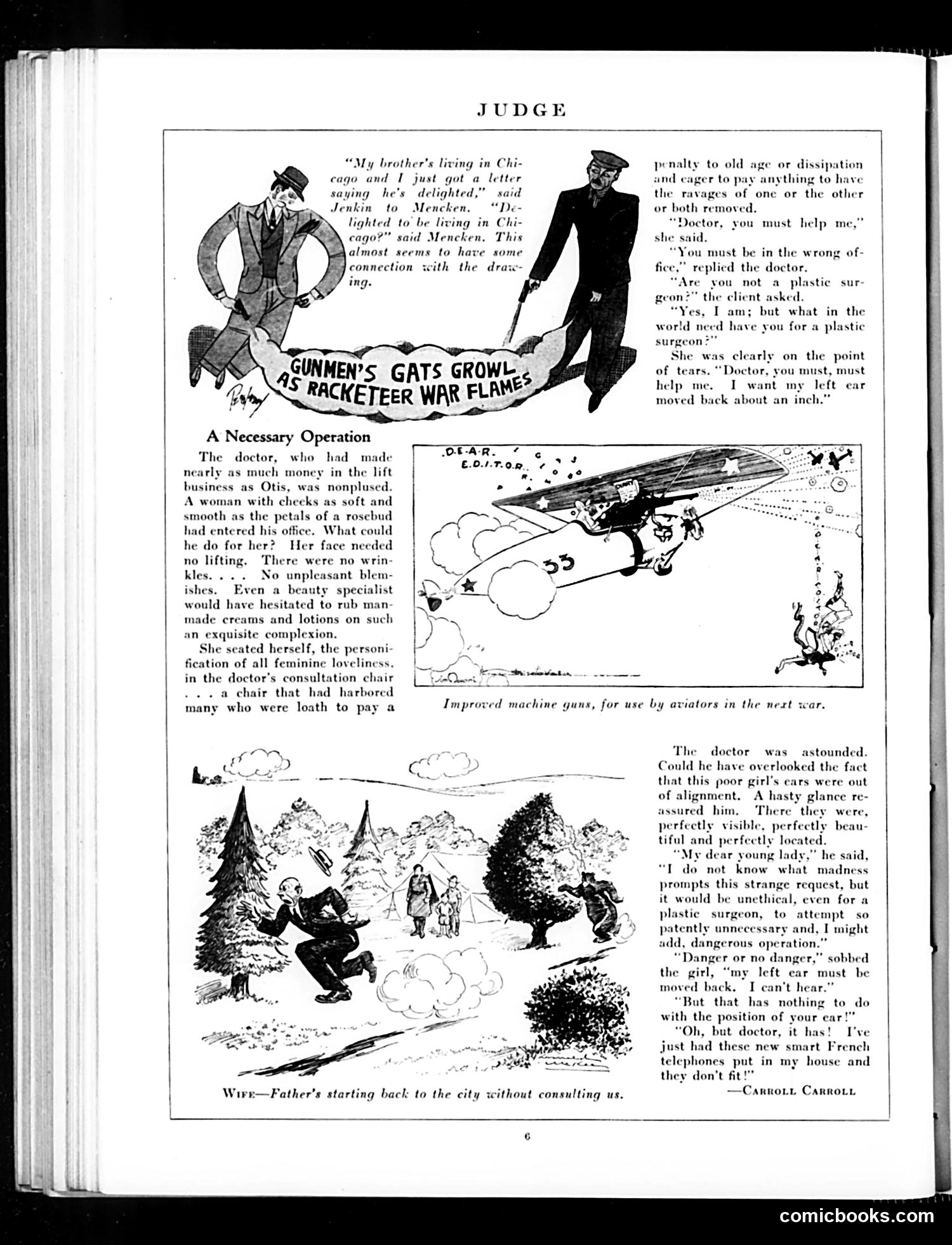
This satirical story by Carroll Carroll mocks the vanity culture and consumerism of the Jazz Age. A beautiful woman visits a plastic surgeon demanding he move her left ear back—not for aesthetic reasons, but because her new French telephone doesn't fit properly against it. The joke satirizes: 1. **Frivolous cosmetic surgery trends** among wealthy women of the era 2. **Consumer obsession**: the woman prioritizes fashionable imported technology over her body's natural state 3. **Class pretension**: "smart French telephones" signals snobbish status-seeking 4. **Absurdist humor**: the surgeon's ethical objections contrast with the woman's illogical vanity The cartoon's framing dialogues about Chicago and Mencken (the famous social critic) suggest broader commentary on American materialism and aspiration. The accompanying aerial illustration about "gunmen's gats" and "racketeer war" references Prohibition-era violence, creating ironic juxtaposition: society obsesses over fashion while violence erupts outside.
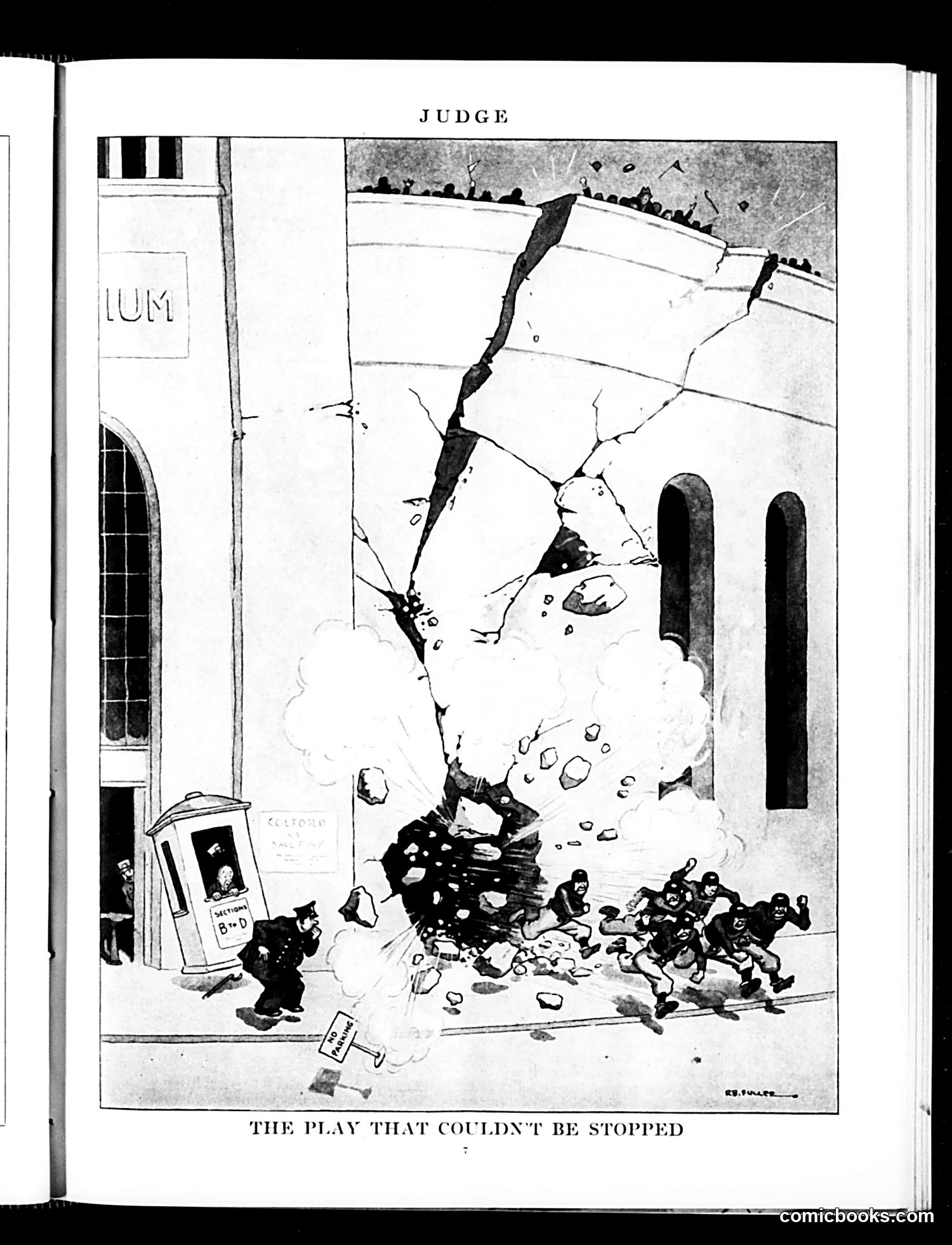
This Judge magazine cartoon satirizes theatrical censorship. A building labeled "LUM" (likely referring to a theater or licensing board) is being destroyed by an explosion, with debris and small figures fleeing the chaos below. The title suggests the cartoon criticizes attempts to censor or shut down a theatrical production. The catastrophic imagery implies that efforts to suppress the play have backfired spectacularly—the "play that couldn't be stopped" has metaphorically blown up the censoring authority itself. The small figures scrambling away likely represent theater officials or censors overwhelmed by forces beyond their control. This reflects early-20th-century debates over theatrical freedom and government/institutional attempts at moral censorship, which Judge magazine often mocked through satire.
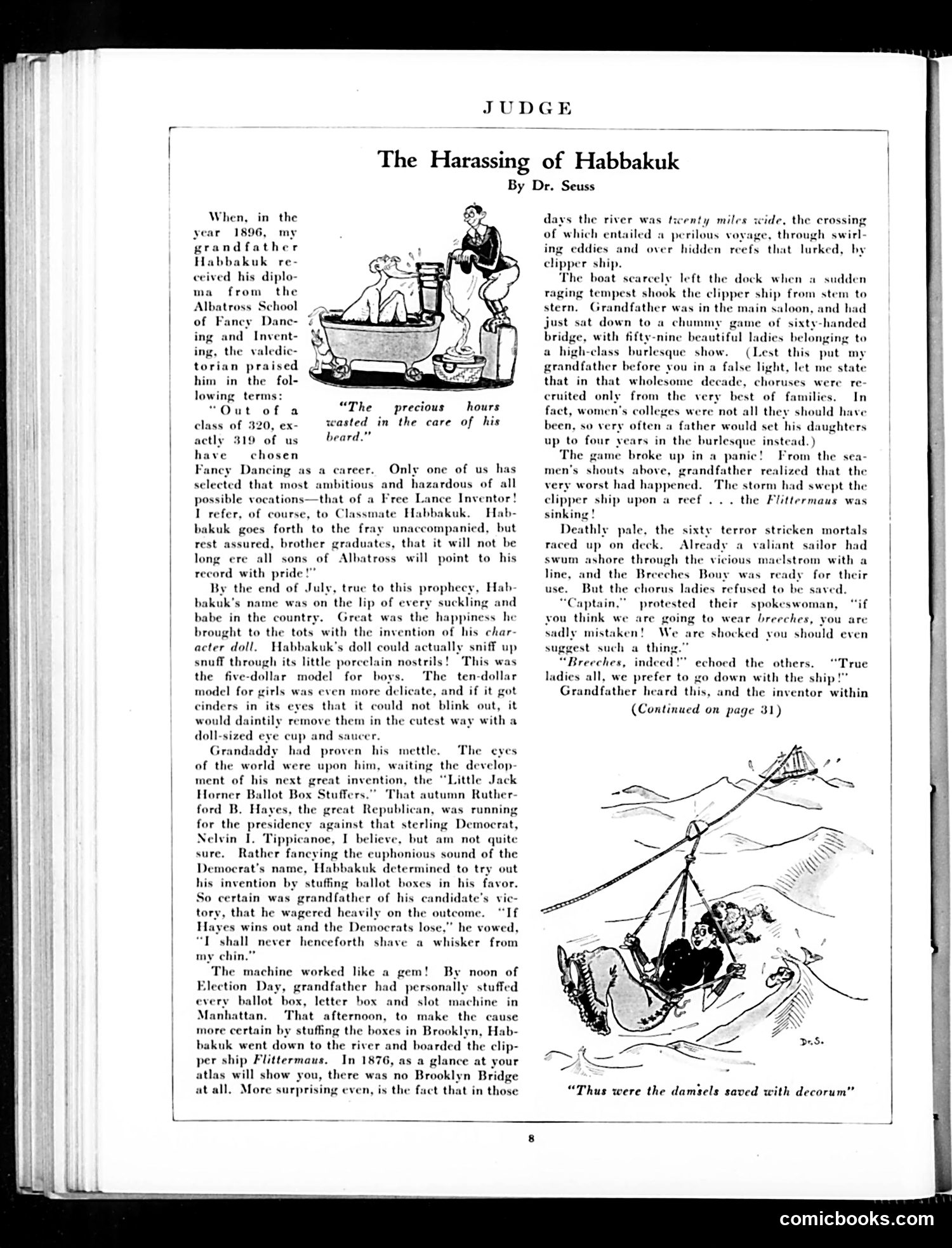
This is a tall tale satirizing both technological optimism and electoral corruption in the 1890s. The narrator's grandfather, Habbakuk, invents a "Ballot Box Stuffer" machine and uses it to rig the 1896 presidential election for Republican candidate (the text appears garbled, but references Rutherford B. Hayes, though that's from 1876). The satire operates on multiple levels: mocking the grandiose claims made about inventors' achievements, poking fun at flagrant ballot-box stuffing as an accepted practice, and using absurdist humor (a twenty-mile-wide river, a clipper ship to cross Manhattan) to lampoon the tall-tale tradition itself. The illustration shows the ship wrecking—suggesting consequences for Habbakuk's scheme—though the text promises continuation on page 31. This is characteristic Dr. Seuss satirical writing, predating his children's books.
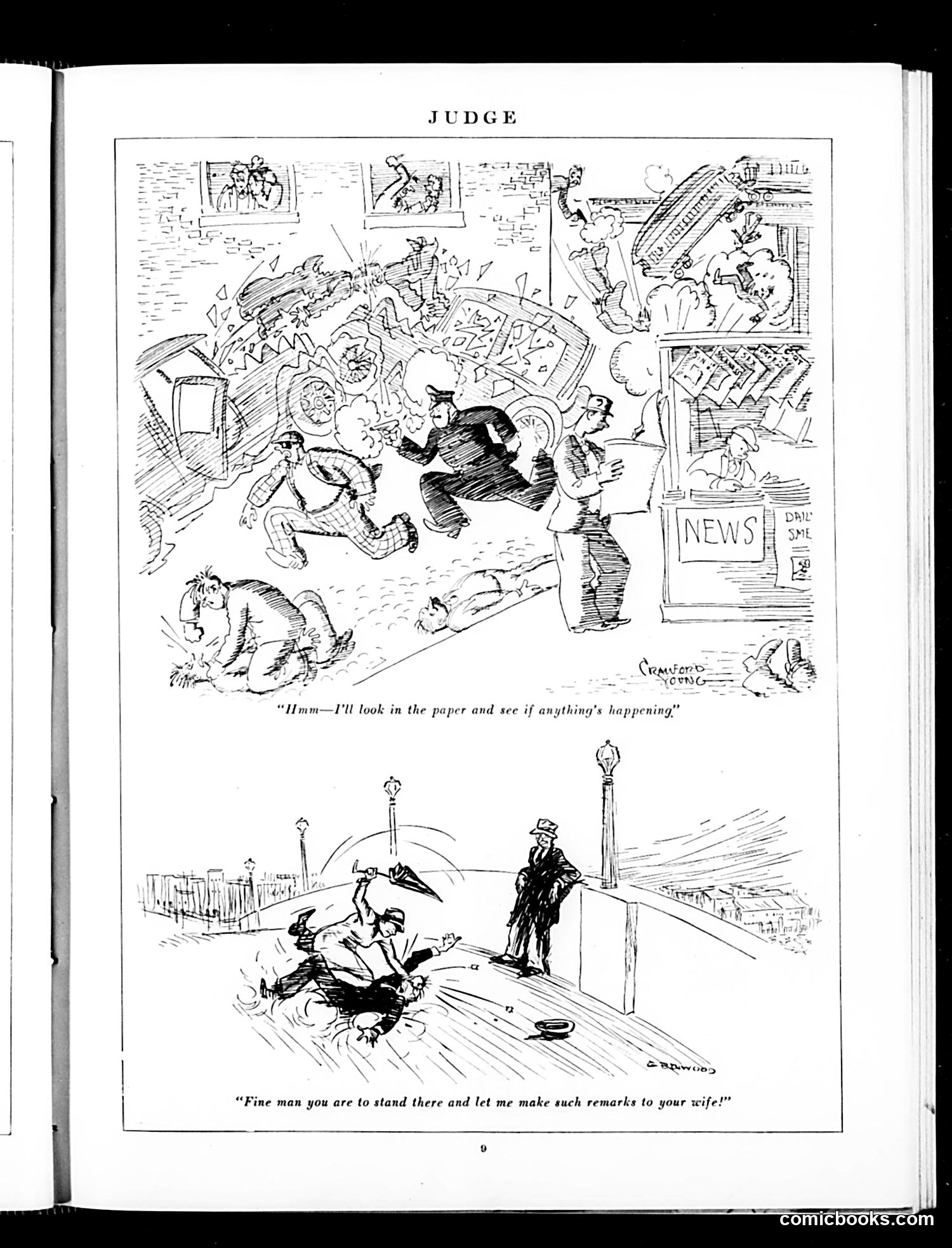
This page contains two cartoons satirizing the legal system and judicial authority. **Top cartoon**: Shows chaotic courtroom pandemonium with a judge presiding over absolute disorder—people fighting, papers flying, general mayhem. The caption reads: "Hmm—I'll look in the paper and see if anything's happening." The satire mocks judicial indifference: the judge is so disengaged he'd rather read the newspaper than notice the obvious chaos occurring in his own courtroom. **Bottom cartoon**: Depicts a judge apparently striking or hitting someone on a bridge or dock, with bystanders watching. The caption reads: "Fine man you are to stand there and let me make such remarks to your wife!" This satirizes judicial abuse of power and impropriety—a judge behaving unethically and violently while lecturing others about proper conduct. Both cartoons critique judicial incompetence and hypocrisy.
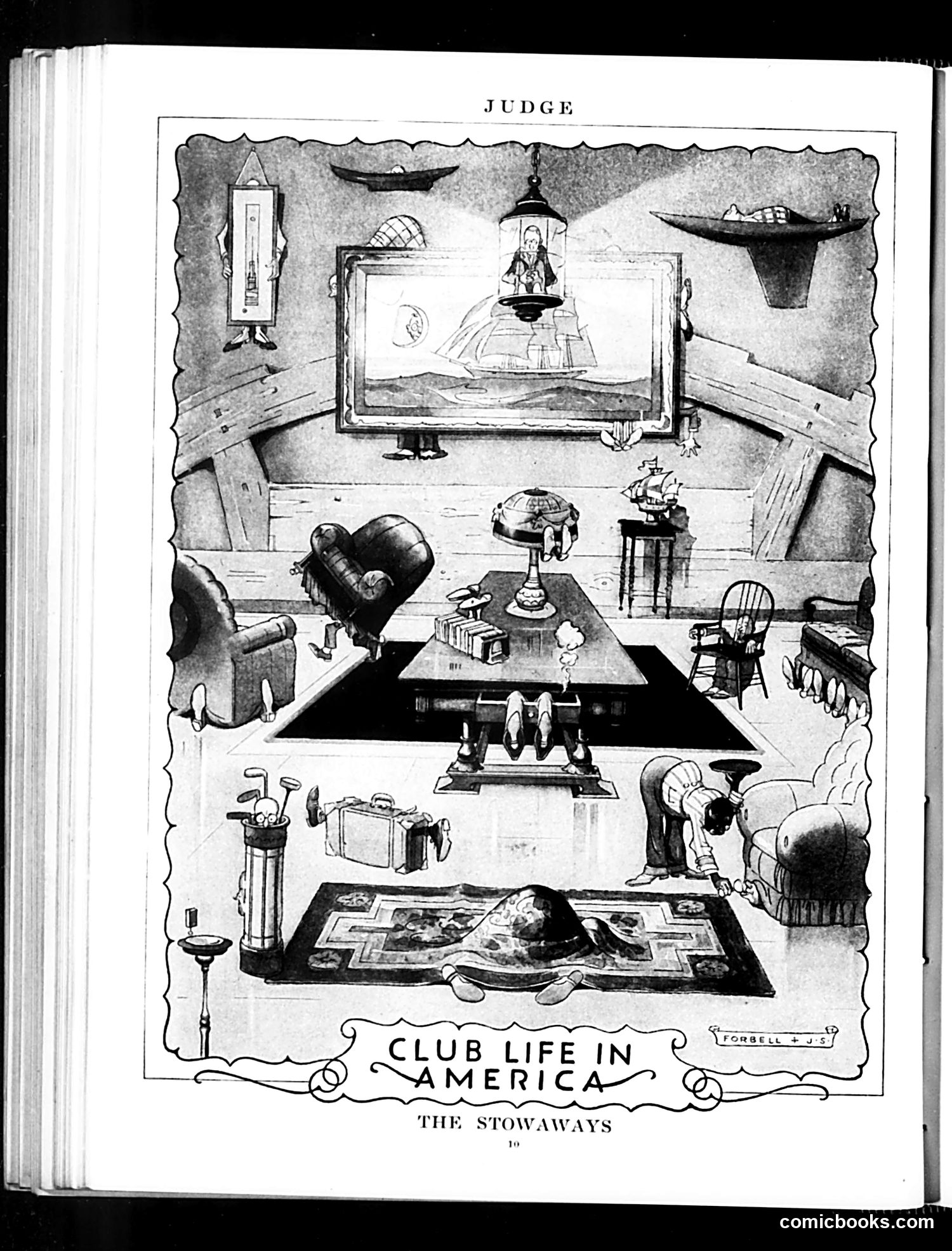
This satirical illustration depicts a wealthy gentleman's club interior populated by unwanted guests—literal stowaways hiding among the furnishings and recreational equipment. The joke appears to target how the ultra-rich leisure spaces are infiltrated by uninvited working-class or vagrant figures seeking shelter. The surreal composition shows various hidden figures emerging from golf bags, under rugs, behind chairs, and within club amenities, while a well-dressed man sits obliviously at a table. This likely satirizes either: - Growing class tensions and inequality in the Gilded Age - Concerns about unauthorized immigration or vagrants - Hypocrisy of exclusive clubs amid social problems The title suggests this represents American club culture being undermined by those outside its privileged circle. The specific historical context remains unclear without dating this issue.
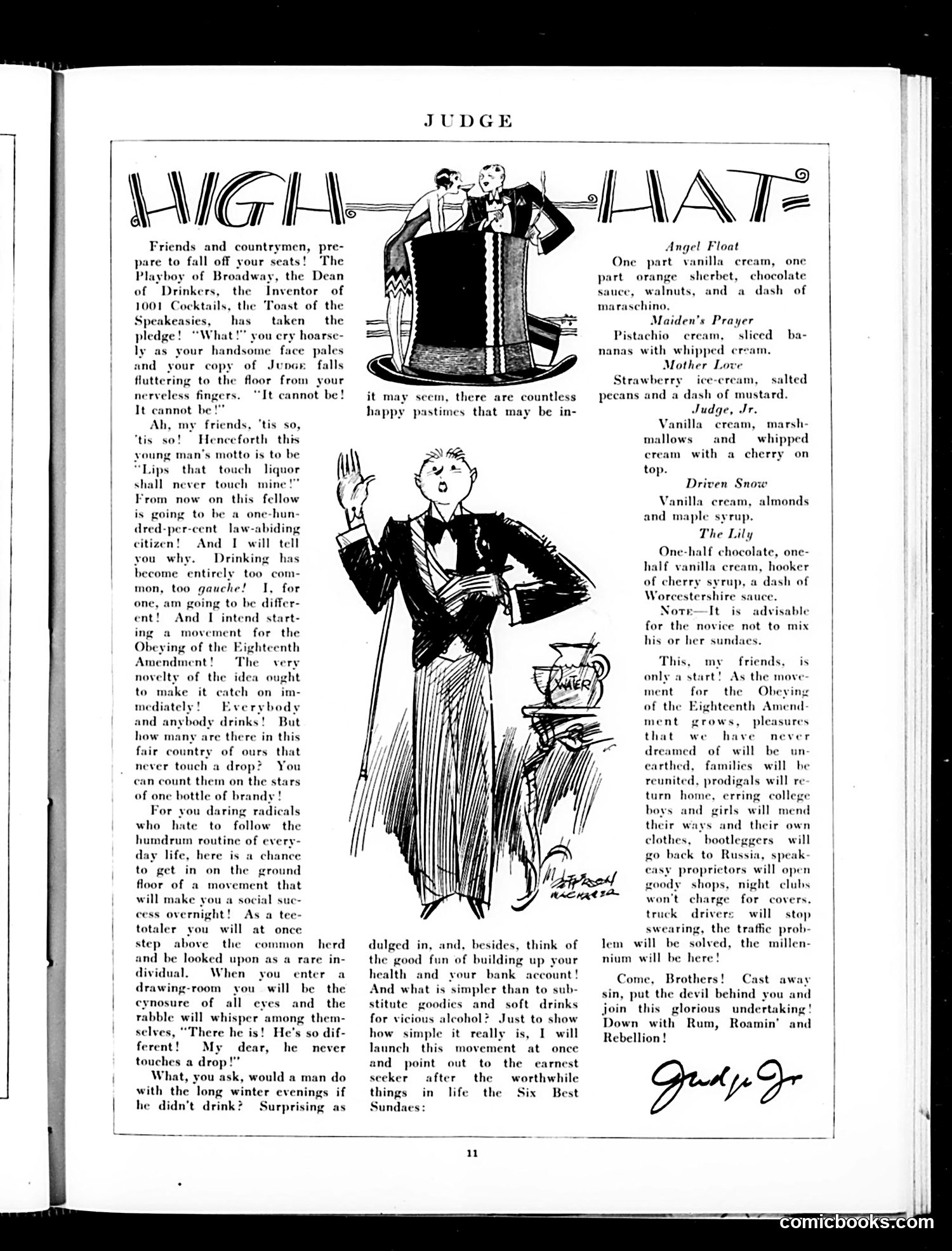
This is satire about Prohibition (the 18th Amendment banning alcohol, 1920-1933). A stereotypical Broadway socialite and heavy drinker—"the Playboy of Broadway, Dean of Drinkers"—announces he's taking the temperance pledge, claiming this will be a radical, countercultural act. The joke is the inversion: during Prohibition, *not* drinking was supposedly the law-abiding norm, yet the speaker treats sobriety as daringly unconventional. He mocks both Prohibition's earnestness and the era's drinking culture by proposing absurd ice cream sundae recipes (with mustard, Worcestershire sauce) as substitutes for cocktails, and predicting Prohibition will solve every social problem—bootleggers will vanish, college students will reform, traffic will clear. The satire targets the gap between Prohibition's lofty ideals and reality: speakeasies thrived, corruption flourished, and the law was widely flouted. By praising sobriety as rebellious, Judge mocks the movement's failure and hypocrisy.
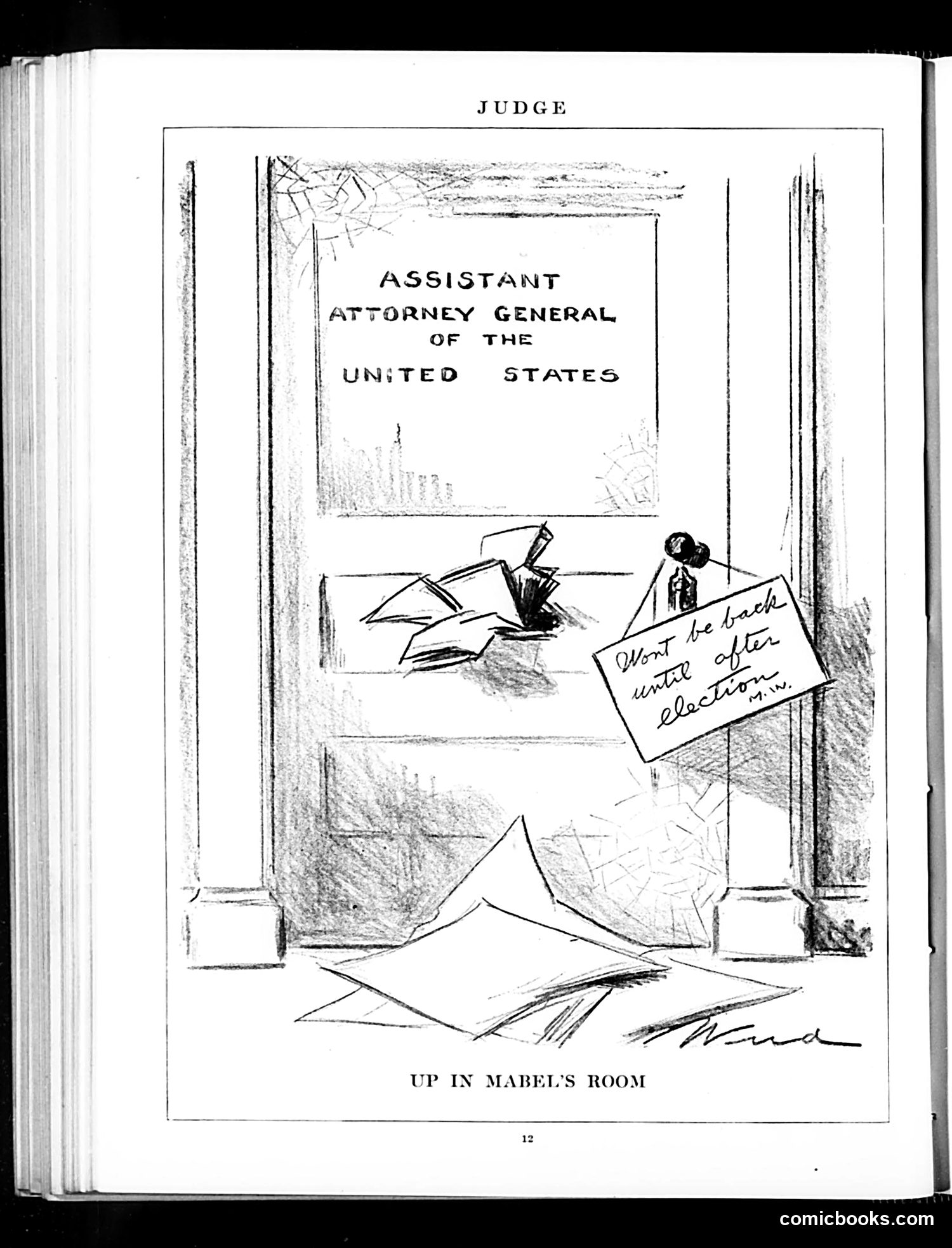
This cartoon satirizes the chaotic state of the Assistant Attorney General's office. The sketch shows papers scattered everywhere across the floor and desk, with a figure appearing overwhelmed by disarray. A note reads "Won't be back until after election," suggesting the official abandoned their duties during an election season. The title "Up in Mabel's Room" (likely referencing a popular play about romantic encounters) implies the official is shirking responsibilities for personal pursuits. The satire criticizes the office's dysfunction and the official's dereliction of duty—apparently choosing personal leisure over managing what should be an orderly, professional government department. The cartoon targets government incompetence and irresponsibility.
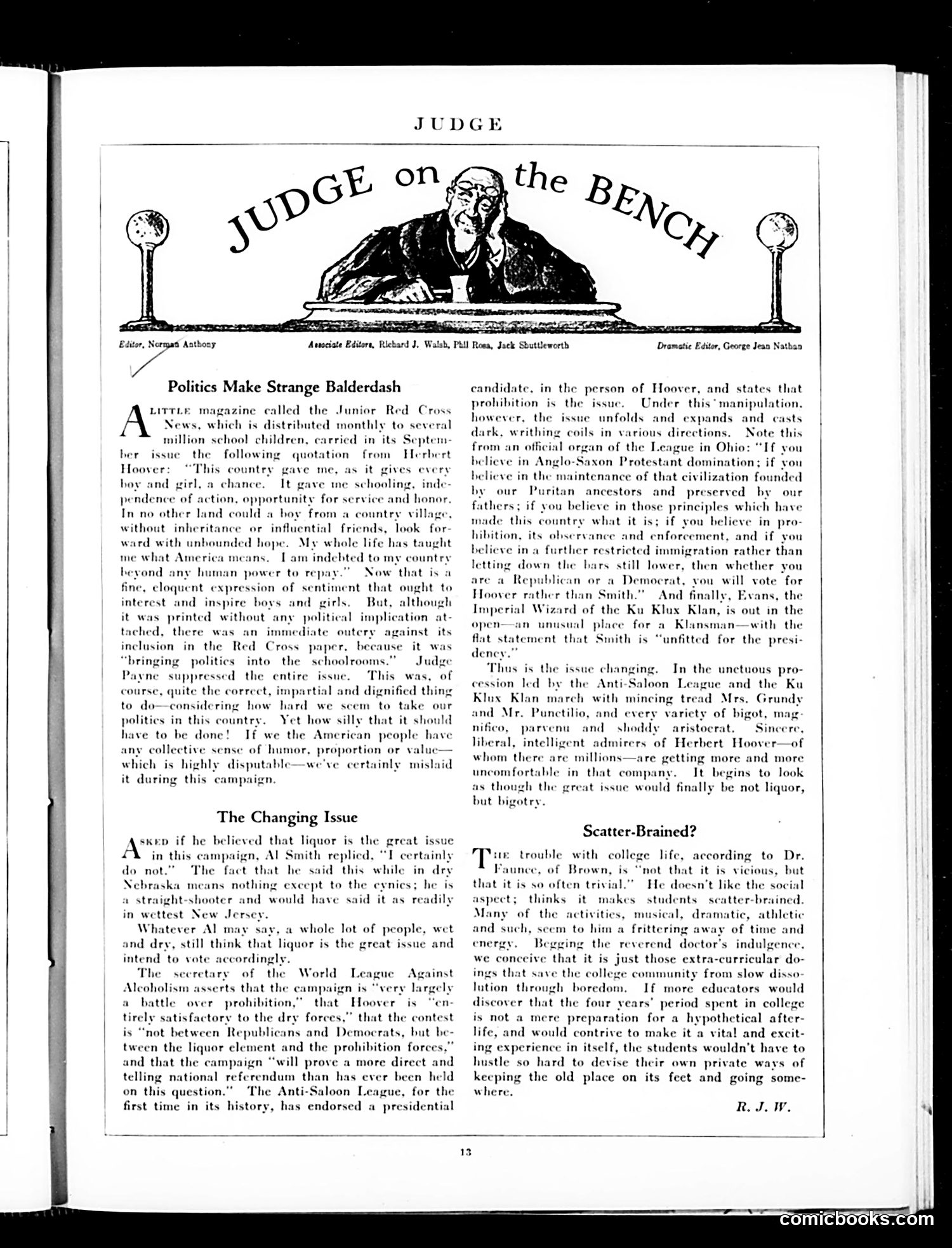
This is a political commentary from Judge magazine criticizing the 1928 presidential campaign. The page attacks how a seemingly neutral issue—Prohibition—became a vehicle for darker agendas. **The Main Satire:** Herbert Hoover's modest autobiography excerpt in the Junior Red Cross News sparked outrage from those opposed to his political message appearing in schools. Judge mocks this censorship while noting that whether liquor is truly the campaign's central issue, politicians are manipulating it. **The Broader Point:** Judge sarcastically illustrates how Prohibition's advocates—the Anti-Saloon League, the Ku Klux Klan, and various self-appointed moral guardians—have hijacked the issue. The satire shows these groups marching behind it like "Mrs. Grundy" (a stock figure for prudish moralism), using Prohibition as cover for religious bigotry and immigration restriction against candidate Al Smith. **Historical Context:** Smith was Catholic; Hoover was Protestant. Judge suggests Prohibition served as coded language for anti-Catholic, anti-immigrant sentiment during this election.
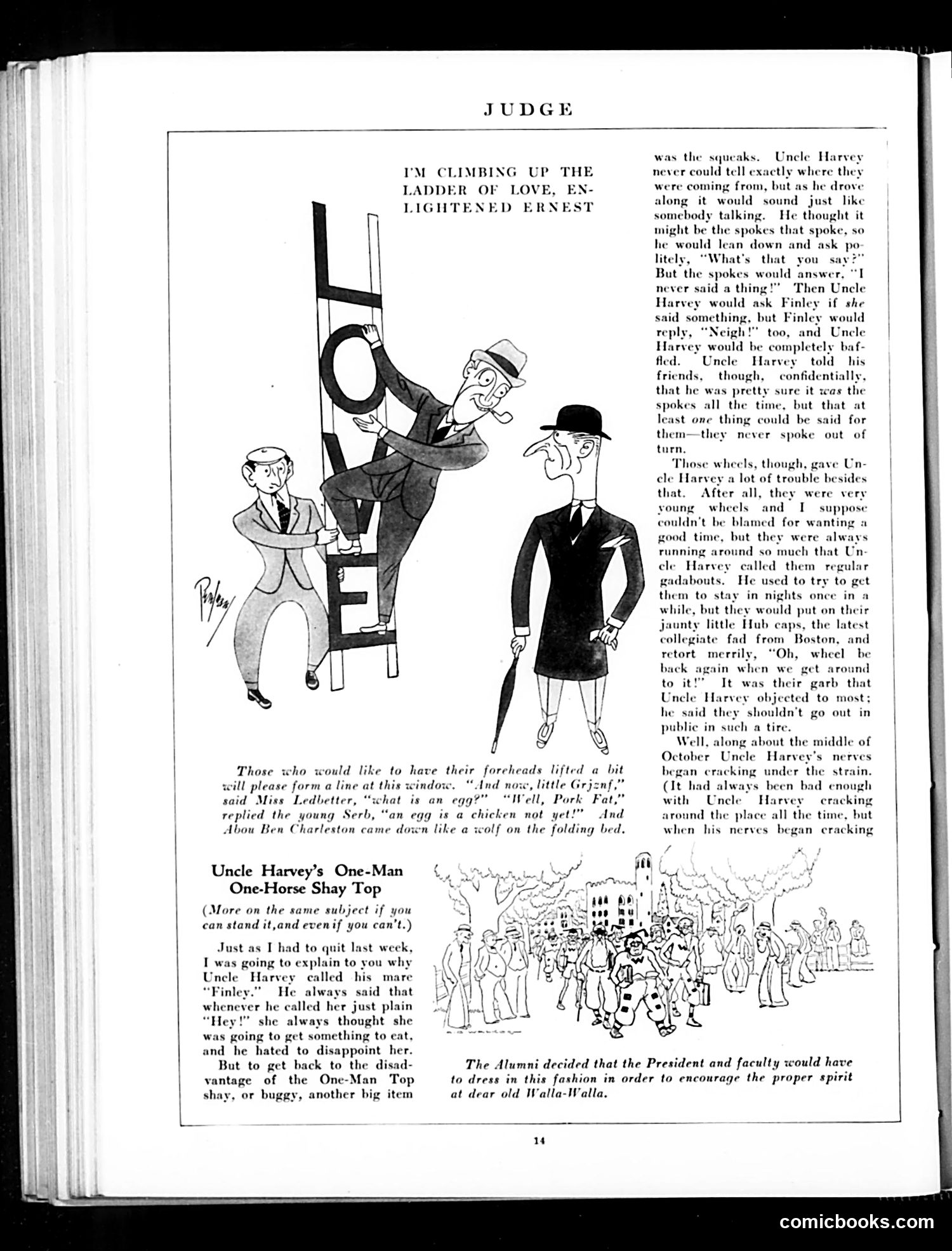
This page contains whimsical humor pieces rather than direct political satire. The main article, "Uncle Harvey's One-Man Horse Shay Top," is absurdist comedy personifying a vehicle's parts—wheels that "speak" through squeaking spokes, and gadabout wheels wearing fashionable "Hub caps" (a pun). The humor relies on treating mechanical objects as mischievous characters with personalities. The scattered jokes at bottom ("Those who would like to have their foreheads lifted...") appear to be unrelated one-liners common in Judge's format. The final illustration references Walla-Walla College's alumni requesting formal dress to encourage "proper spirit"—likely gentle satire of college fashion pretensions. Overall, this exemplifies Judge's early-20th-century style: pun-heavy, absurdist humor with light social commentary rather than biting political critique. The cartoons mock nothing serious—mainly everyday eccentricities and fashionable affectations.
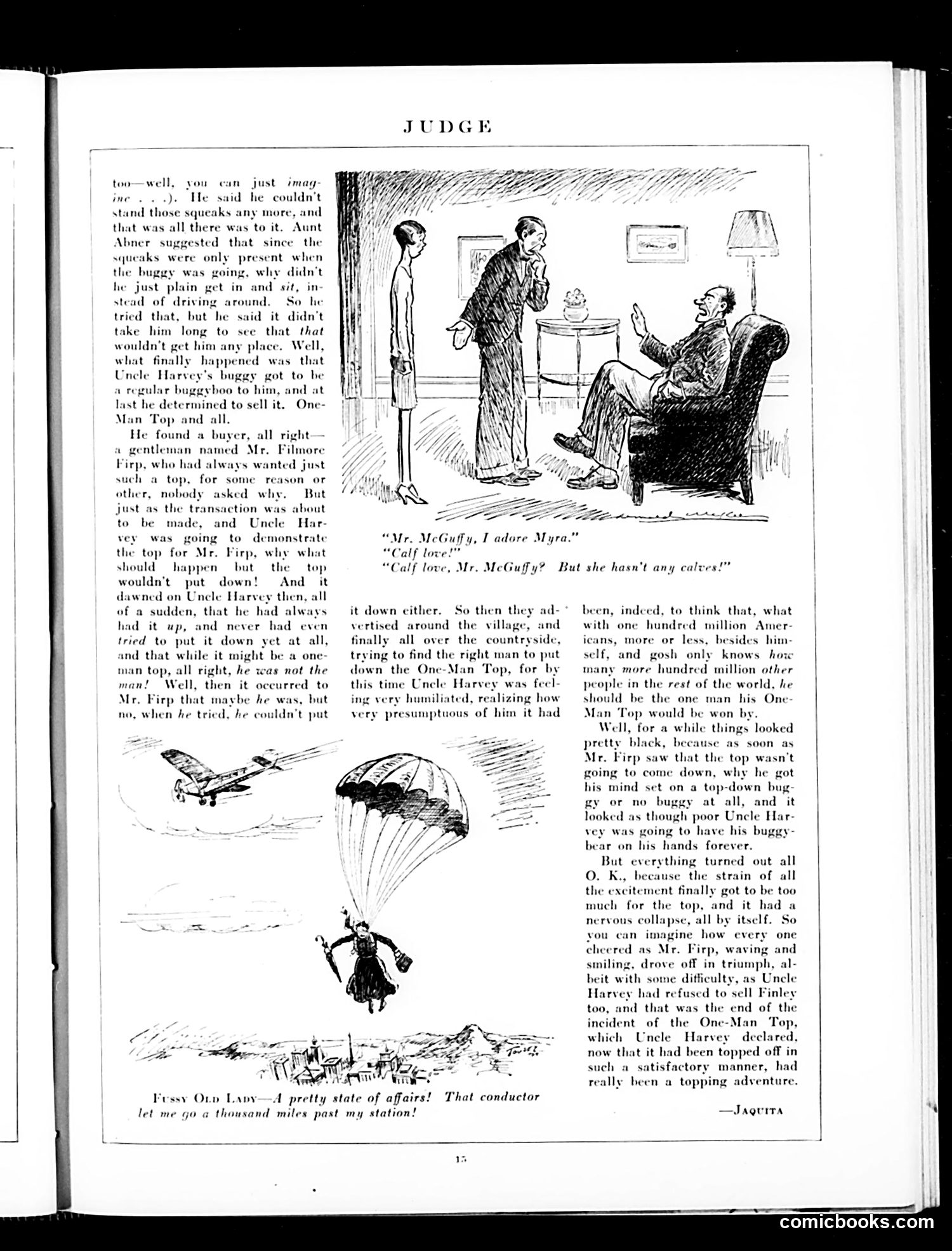
This page contains a humorous short story illustrated with cartoons about Uncle Harvey's problematic "One-Man Top" buggy. The narrative satirizes both product marketing and human pride. The main joke: Uncle Harvey purchases a buggy with a collapsible top advertised as requiring only one man to operate it. When he tries to demonstrate it to a buyer (Mr. Firp), the top won't lower. Neither man can operate it. They advertise across the countryside searching for "the right man"—the implication being that the product's claim is absurd. The top eventually fails mechanically ("nervous collapse"), solving the problem accidentally. The satire targets turn-of-the-century marketing hype and consumer gullibility. The "One-Man Top" is a pun-laden critique of exaggerated product claims. The secondary cartoon about "calf love" appears unrelated wordplay humor. The author is credited as "Jaquita."
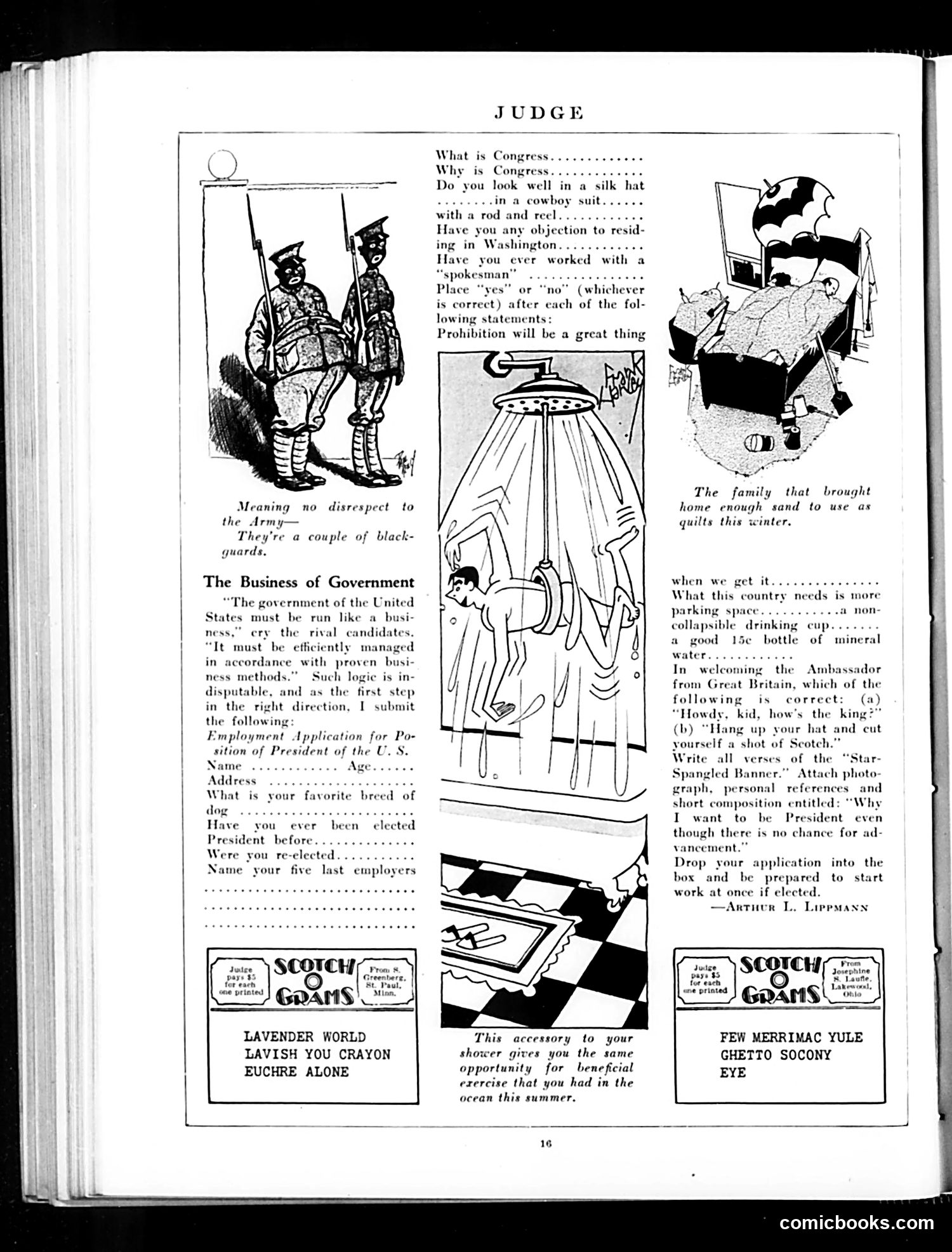
This page satirizes 1920s political rhetoric about running government "like a business." The central cartoon mocks presidential candidates who claim business efficiency principles should apply to the U.S. government. The joke: An "Employment Application for Position of President" reduces the presidency to absurd job-application questions—asking about favorite dog breeds, fishing skills, and whether applicants look good in silk hats or cowboy suits. Candidates must answer yes/no about "Prohibition will be a great thing" and other trivial matters. The satire targets: - **Empty campaign rhetoric** promising business-like efficiency without substance - **Shallow candidate qualifications** based on appearance and personality rather than competence - **Public distraction** with irrelevant details while serious governance is neglected The accompanying illustrations reinforce the mockery through absurdist humor. The page suggests that treating government as a business hiring process produces incompetent, image-focused leadership rather than effective administration.
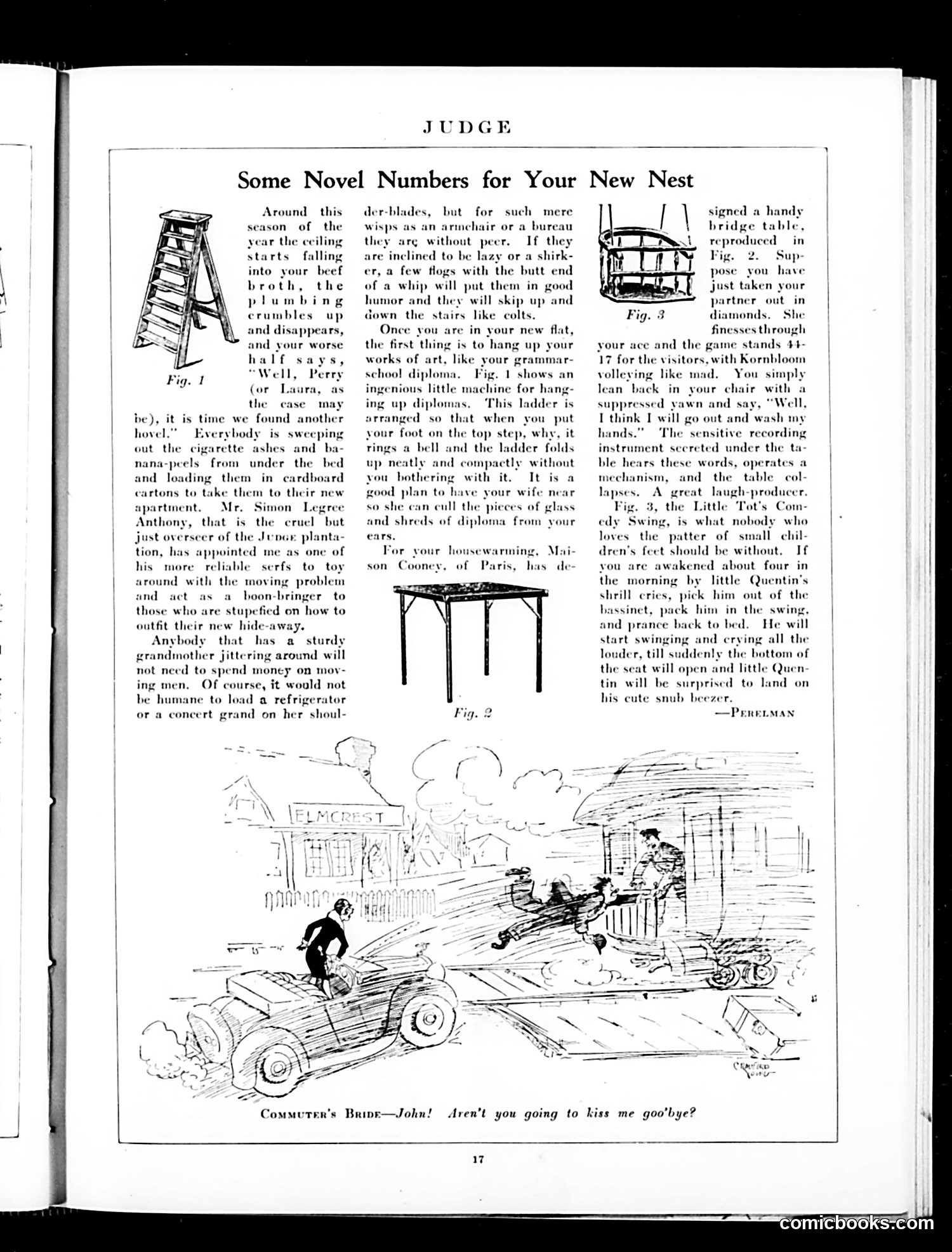
This is a humorous advice column disguised as product reviews. The author recommends absurd furniture and gadgets for newlyweds setting up apartments. **Main jokes:** 1. **Fig. 1** – A ladder with a bell mechanism that collapses when you step on the top rung, dropping you and your diploma. The dark humor: your wife will laugh while picking glass from your ears. 2. **Fig. 2** – A bridge table that mysteriously collapses during card games, humiliating the loser at bridge (a popular pastime). 3. **Fig. 3** – A baby swing with a trap door that deposits infants onto the floor—"solving" the problem of babies crying at 4 AM by literally dropping them. **The satire:** The column mocks both newfangled gadgets marketed to homemakers and the casual cruelty toward wives, children, and servants that upper-class households expected. The reference to "Simon Legree" (the villain from *Uncle Tom's Cabin*) darkly compares moving day exploitation to slavery. The cartoons below show chaotic automobile comedy unrelated to the text.
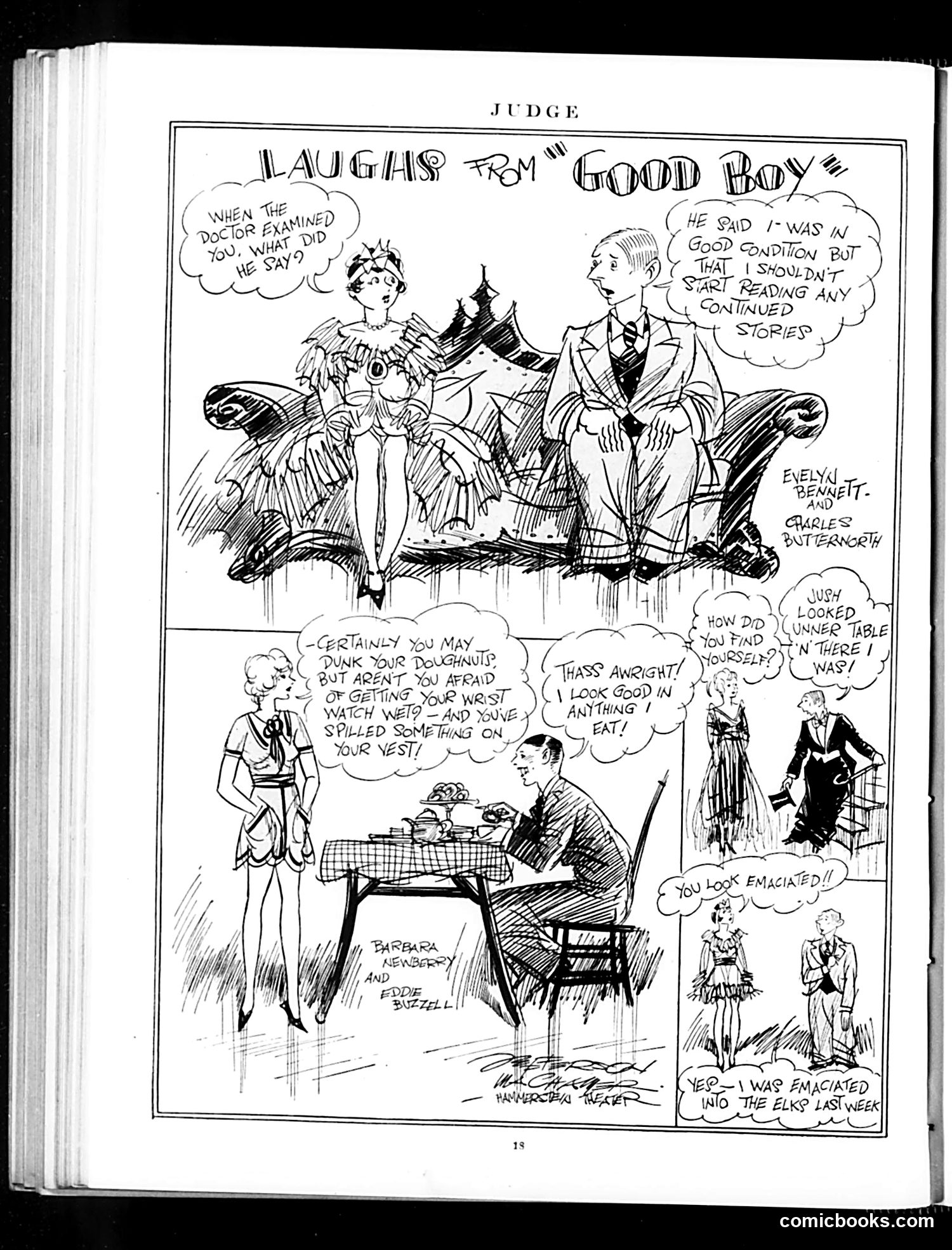
This cartoon satirizes the gap between appearance and reality in courtship or social situations. The top panel shows an elegantly dressed couple on a cloud (suggesting romance or idealization), with the man praising the woman's "good condition" while suggesting she avoid reading "continued stories" — implying concerns about her intellectual interests or attention span. The lower panels reveal the "reality": the woman is clumsy (spilling food on herself), appears desperate or unattractive in casual settings, and admits to being "emaciated" after a recent social outing. The cartoonist mocks how men present inflated praise during courtship while privately noting their date's actual flaws — her messiness, appearance, and social missteps. The satire targets the dishonesty of courtship rituals and the contrast between public flattery and private judgment in early 20th-century dating culture.
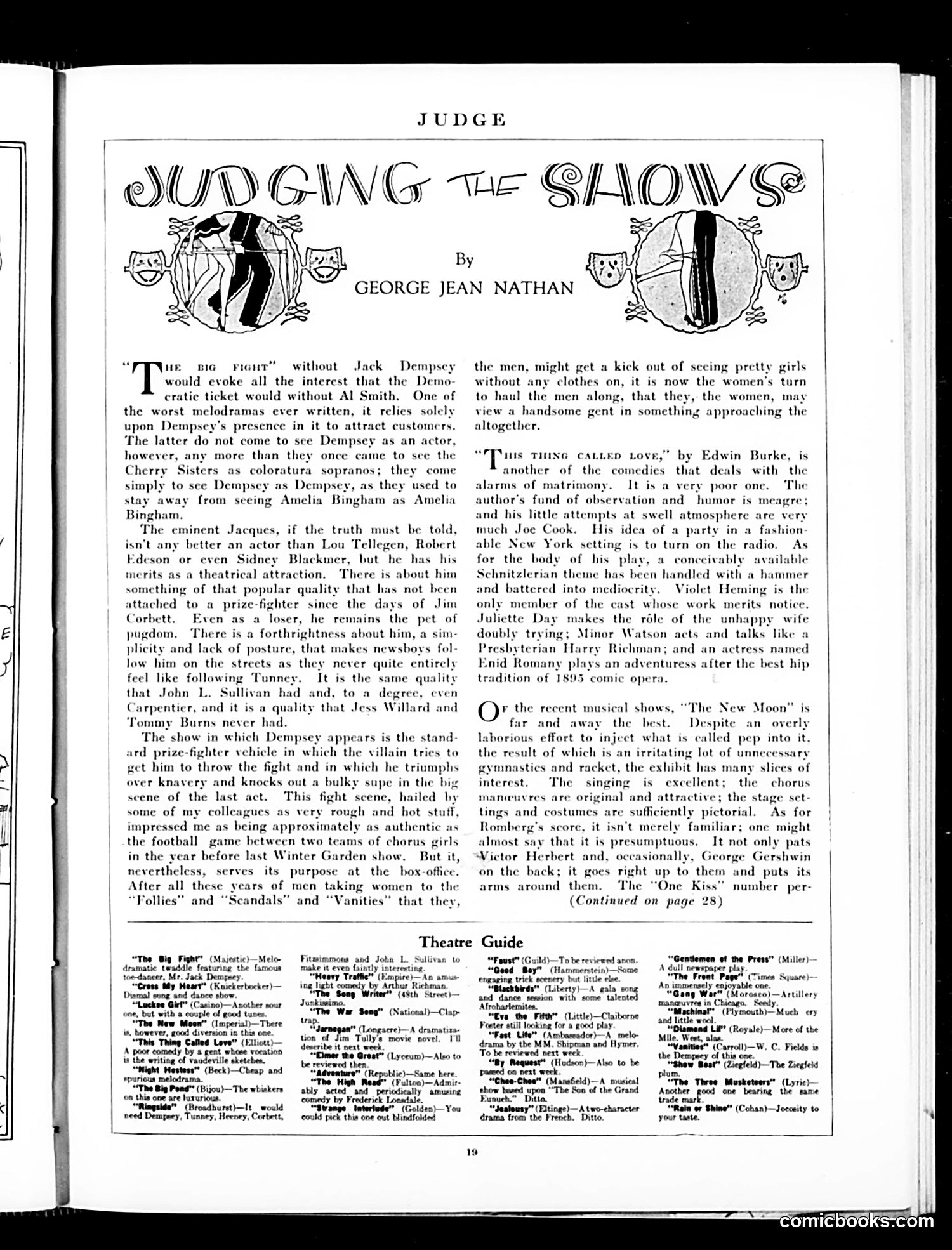
This is George Jean Nathan's theater review column titled "Judging the Shows." Nathan critiques several Broadway productions, focusing primarily on "The Big Fight," a melodrama starring boxer Jack Dempsey. **The Key Satire:** Nathan argues the play is dramatically terrible—relying entirely on Dempsey's celebrity to draw audiences, just as people attended freak shows to see curiosities rather than genuine performance. He compares Dempsey's drawing power to the notorious "Cherry Sisters" (vaudeville performers famous for being bad). **The Social Context:** Nathan contrasts Dempsey's authentic "forthrightness" with other boxers and actors, suggesting working-class appeal trumps theatrical quality. He also notes the gender reversal in theater attendance—women now accompanying men to see attractive male performers, mirroring how men previously dragged women to see chorus girls. **The Point:** Theater producers cynically exploit celebrity, not talent, to fill seats with inferior products.
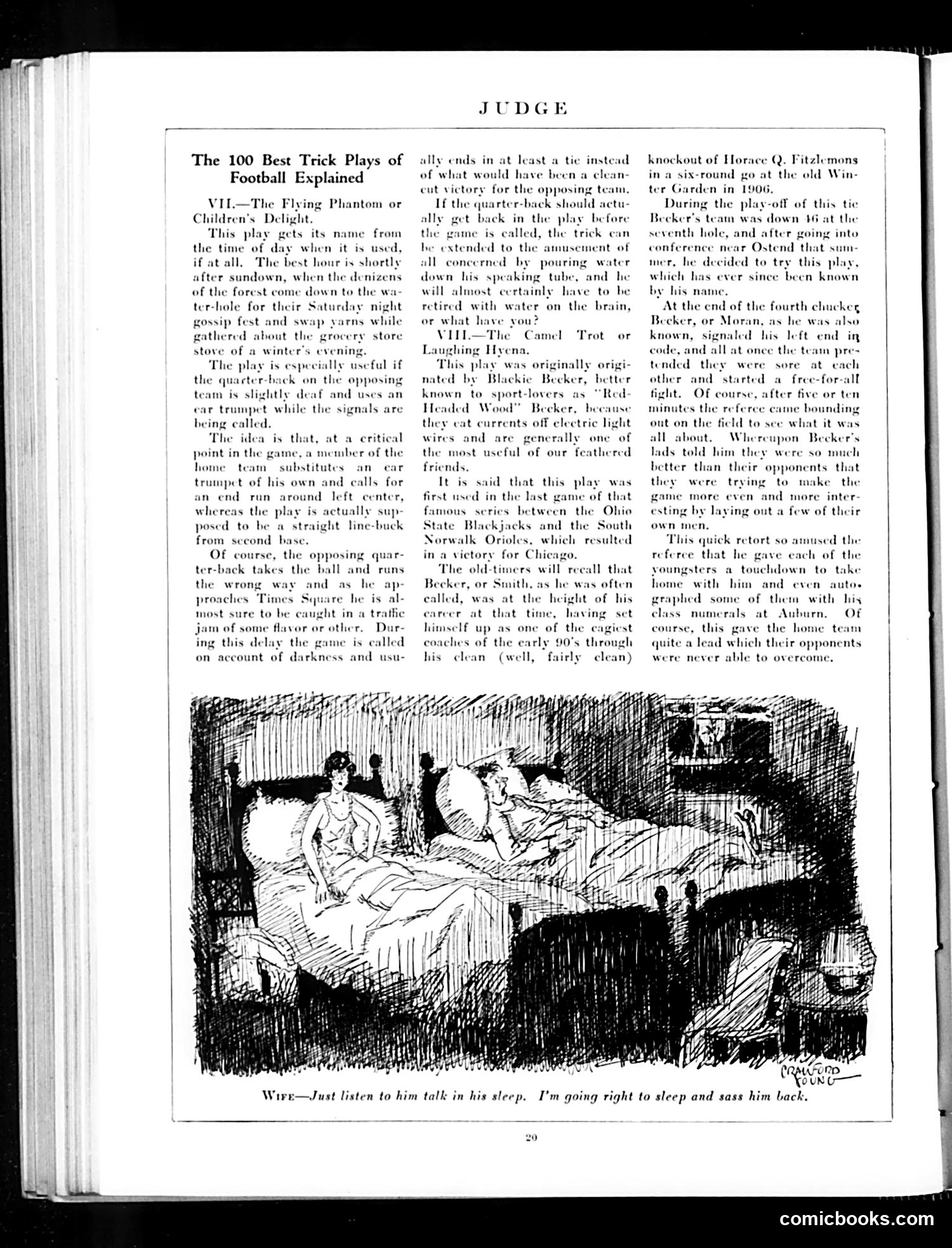
This page contains humorous fake "football trick plays" that are actually nonsensical absurdist jokes disguised as sports instruction. The "Flying Phantom" describes a quarterback substituting a real ear trumpet for the signal-calling device to confuse the opposing team—the joke being the elaborate, ridiculous setup for what amounts to simple deception. The "Camel Trot or Laughing Hyena" references fictional players and teams (Ohio State Blackjacks, South Norwalk Orioles) with intentionally muddled details. The punchline: when caught cheating, the players claim they were deliberately losing to make the game "more even," and the amused referee rewards them with touchdowns anyway—satirizing both football's rule-breaking and the absurdity of sportsmanship excuses. The cartoon below shows a wife about to "sass" her talking husband in his sleep—a marital humor joke common to the era. The satire mocks overly complicated football strategy and dubious sportsmanship.
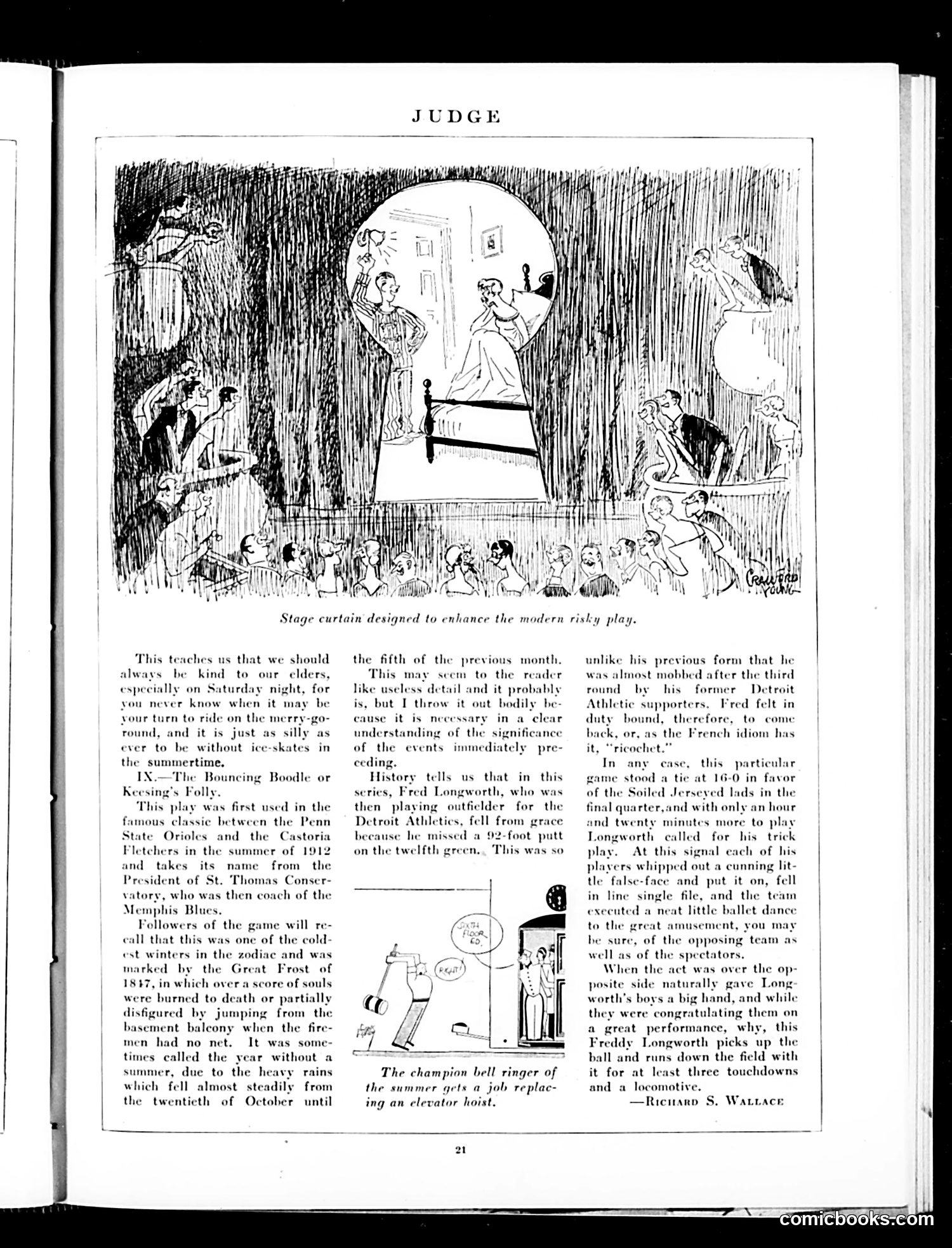
This page contains absurdist sports satire masquerading as serious sports history. The main cartoon depicts a theatrical stage set, satirizing modern "risky plays" in entertainment. The text mockingly describes nonsensical baseball/football incidents involving Fred Longworth of the Detroit Athletics. It fabricates ridiculous details—a 92-foot putt on a golf green (mixing sports), false references to "Penn State Orioles" and made-up teams, and a climactic story where players don on "false-faces" (masks) to deceive opponents, allowing Longworth to score multiple touchdowns and "a locomotive." The satire targets early 20th-century sports journalism's tendency toward overwrought storytelling and fabricated drama. By piling absurdities atop invented historical "facts," Judge mocks how contemporary sportswriters inflated trivial incidents into grand narratives. The deliberately incoherent plot—mixing sports, dates, and logic—exposes the genre's fundamental dishonesty for humorous effect.
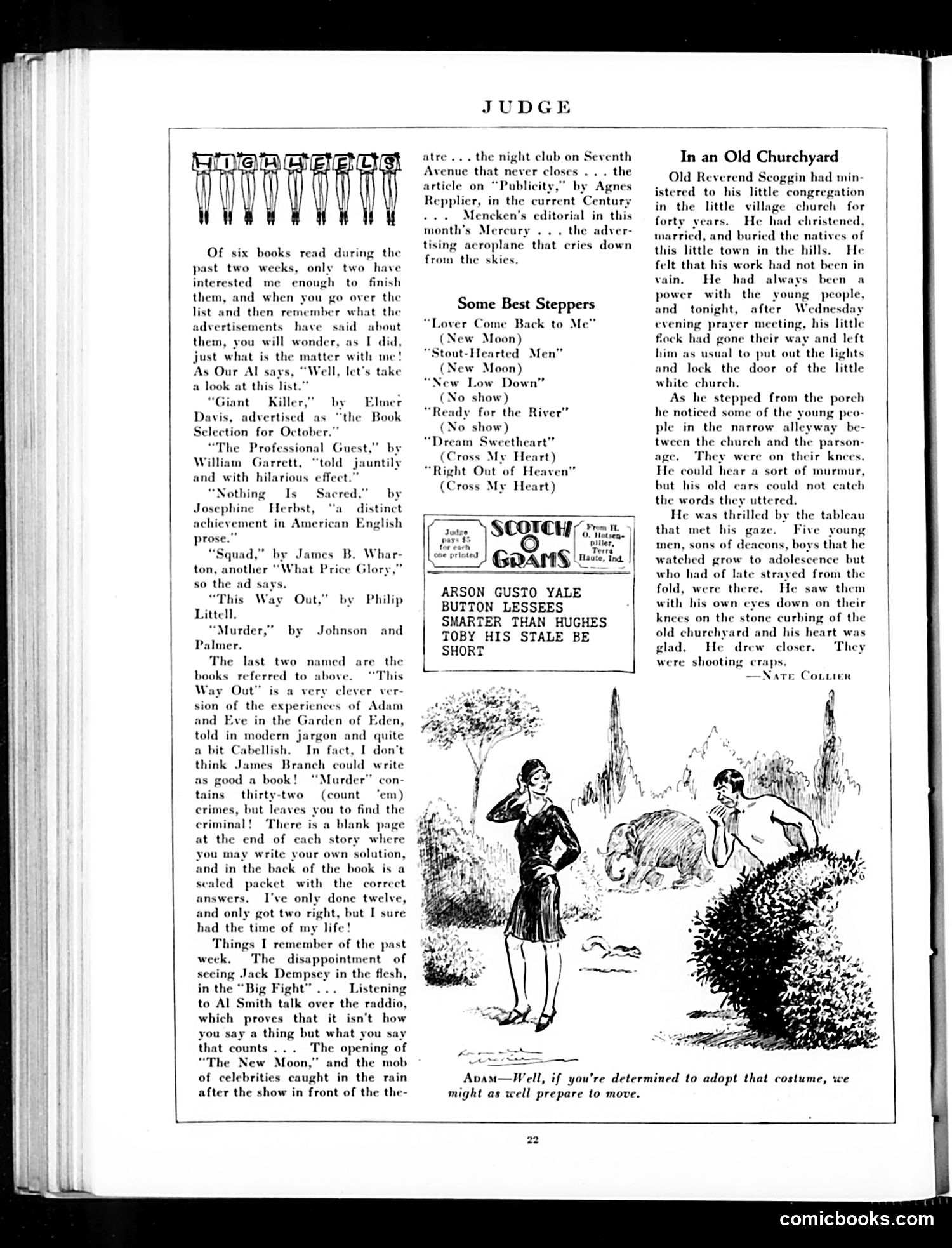
This page contains book reviews and two distinct pieces of content: **Book Review Section (left):** The author critiques six recently-read books, noting disappointment with most advertised titles. He praises two: "This Way Out" (a modern retelling of Adam and Eve in the Garden of Eden) and "Murder" (a mystery with 32 crimes where readers must identify the criminal, with sealed answers provided). **"In an Old Churchyard" (right):** A humorous short story by Nate Collier. An elderly reverend, Scoggin, discovers young men—including "sons of deacons" he'd watched grow up and who had "strayed from the fold"—kneeling in the churchyard at night. He's moved, believing they've returned to faith. The punchline: they're actually **shooting craps** (gambling with dice), not praying. The satire mocks both the reverend's naive optimism and the hypocrisy of ostensibly "good" families whose sons engage in vice. **Advertisement:** Scotch whisky ad (upper center).
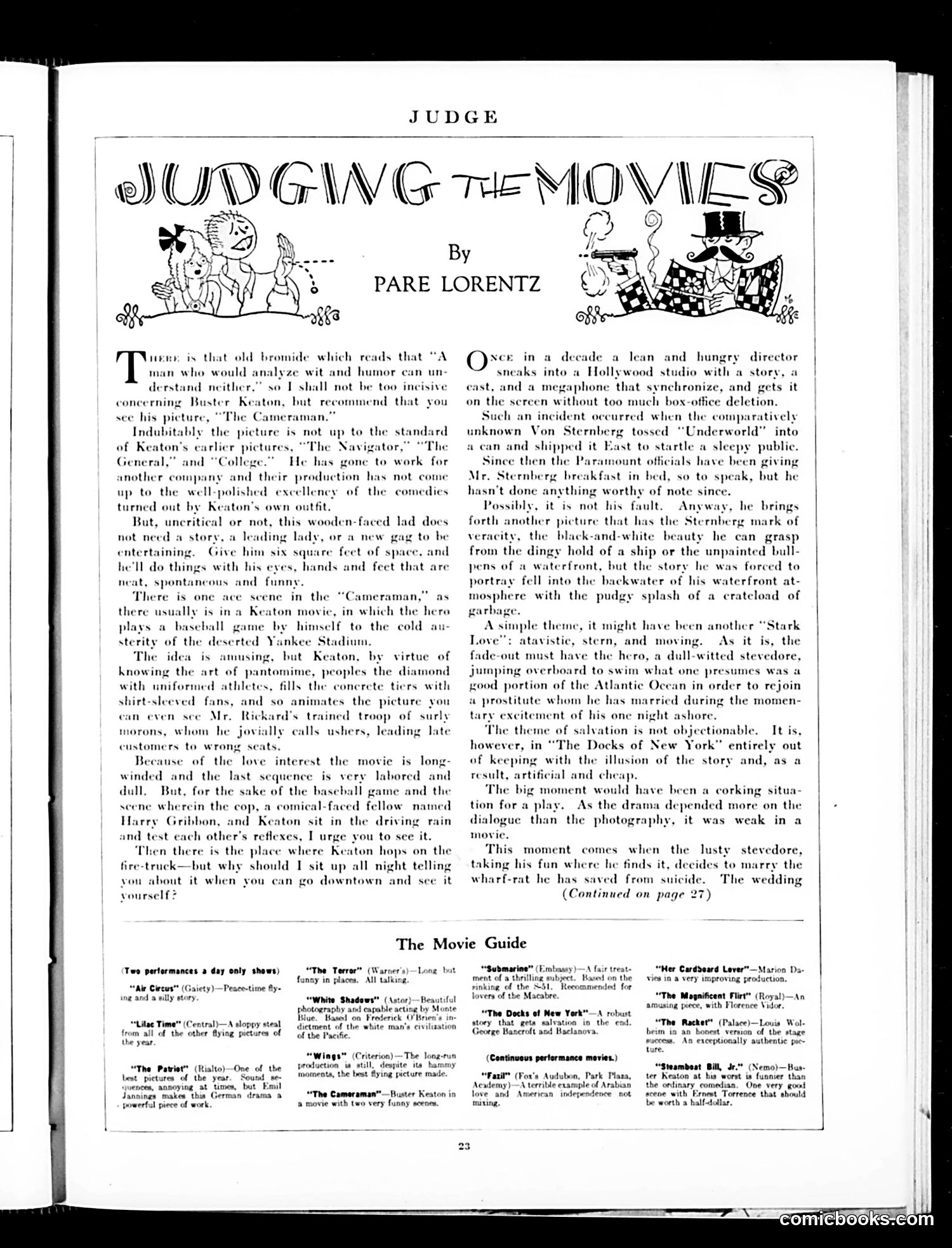
This is a film criticism column reviewing recent Hollywood releases. Lorentz evaluates Buster Keaton's *The Cameraman*, noting it's weaker than Keaton's earlier independent films (*The Navigator*, *The General*) because Keaton now works for another studio with less quality control. He praises Keaton's pantomime genius—his ability to animate empty scenes—but criticizes the added romantic subplot that makes the film "long-winded." Lorentz also dismisses director Josef von Sternberg's *The Docks of New York*, praising its visual beauty and gritty waterfront authenticity but faulting its contrived plot requiring a stevedore to marry a prostitute he rescued. He argues the melodramatic theme feels artificially tacked-on, and that such material works better on stage than in cinema. The column exemplifies 1920s film criticism's focus on cinematic technique versus theatrical conventions.
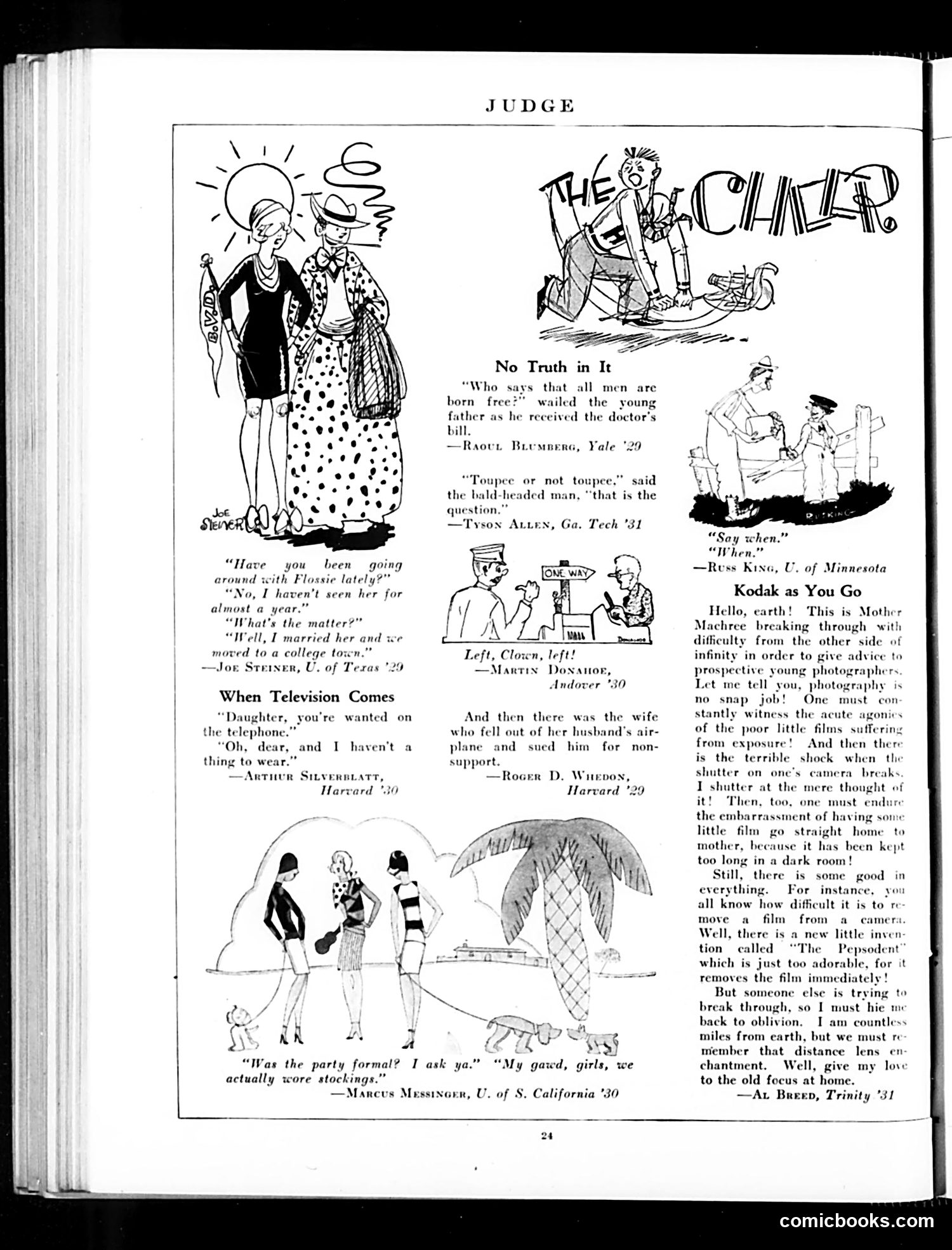
This page collects **humorous one-liners and cartoon jokes** from college students (noted by university attributions like Yale '29, Harvard '30), typical of Judge's format. The cartoons satirize **1920s-30s social conventions**: - **Top left**: Fashion and courtship—a woman in an enormous sun hat and another in a spotted dress, mocking exaggerated women's fashion trends - **"When Television Comes"**: Jokes about the emerging technology's social disruption - **"The Child" cartoon**: Depicts chaos, possibly mocking chaotic parenting or childhood behavior - **Bottom cartoon**: Women in a beach/swimming scene, with a joke about wearing stockings to a formal party—satirizing how younger women were abandoning modest dress codes, which scandalized older generations The **recurring theme** is generational conflict: college students joking about marriage, parents' expectations, fashion rules, and new technologies disrupting traditional life. The "Kodak as You Go" section parodies both amateur photography enthusiasm and pseudo-spiritual advice columns. These are **lighthearted college humor**, not sharp political satire—the page's appeal lay in relatability to educated young readers of the era.
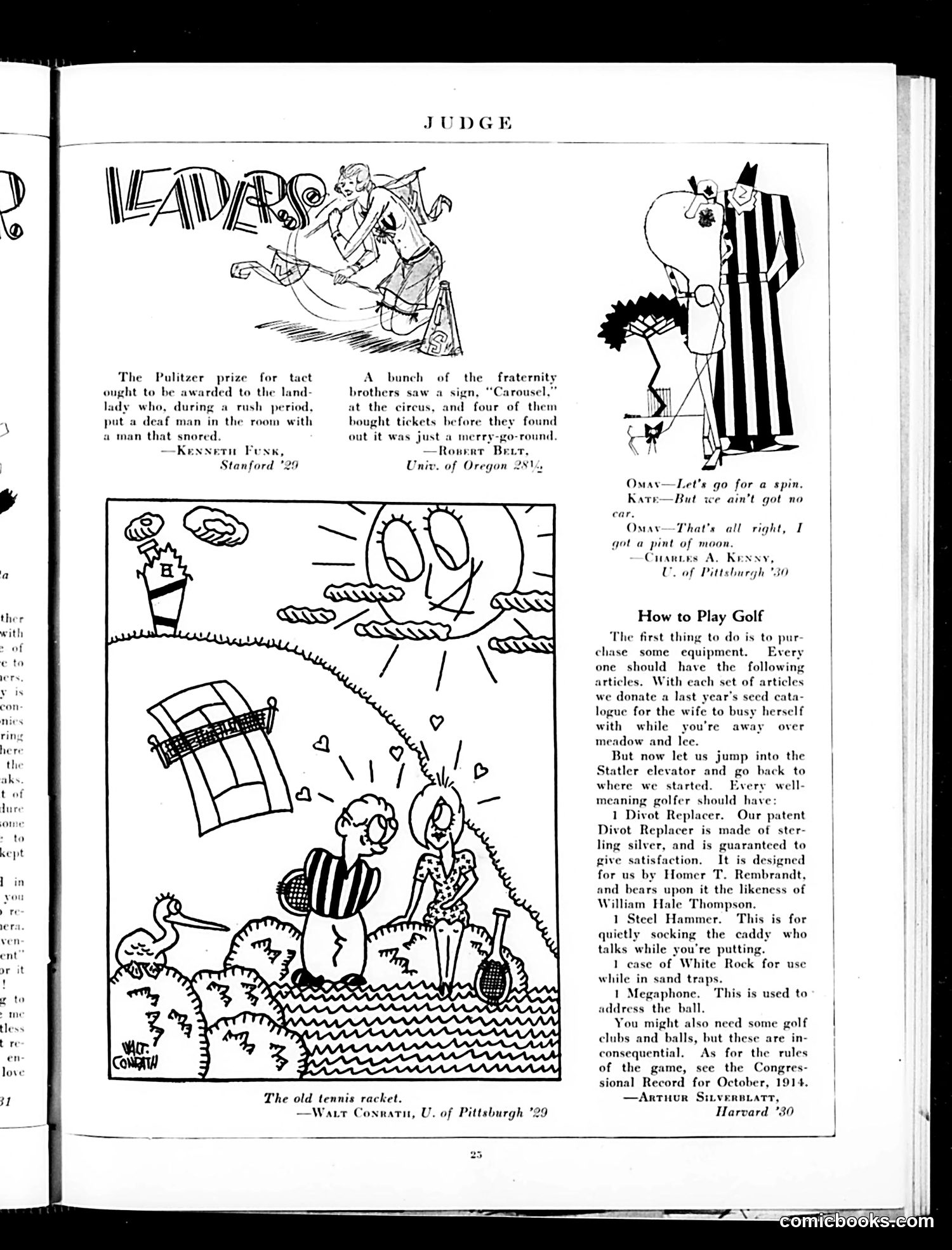
This page contains **humorous college submissions** typical of 1920s satirical magazines. The top cartoons are brief jokes from Stanford and University of Oregon students—one about an inconsiderate landlady, another about fraternity brothers fooled by a circus carousel. The main cartoon, "The old tennis racket" by Walt Conbath (U. of Pittsburgh '29), depicts a couple where the man proposes a car ride despite having no vehicle, offering instead "a pint of moon"—slang for **bootleg liquor during Prohibition**. The joke plays on how illegal alcohol became casual dating currency. The "How to Play Golf" piece is **satirical advice** mocking wealthy leisure culture. It includes absurd equipment like a divot replacer made of sterling silver and jokes about bribing caddies. The reference to "William Hale Thompson" (Chicago's notorious mayor) and suggesting readers consult the "Congressional Record for October, 1914" for golf rules adds political mockery. Overall, the page reflects **post-WWI college culture**, Prohibition-era drinking, and satirical jabs at American pretension and politics.
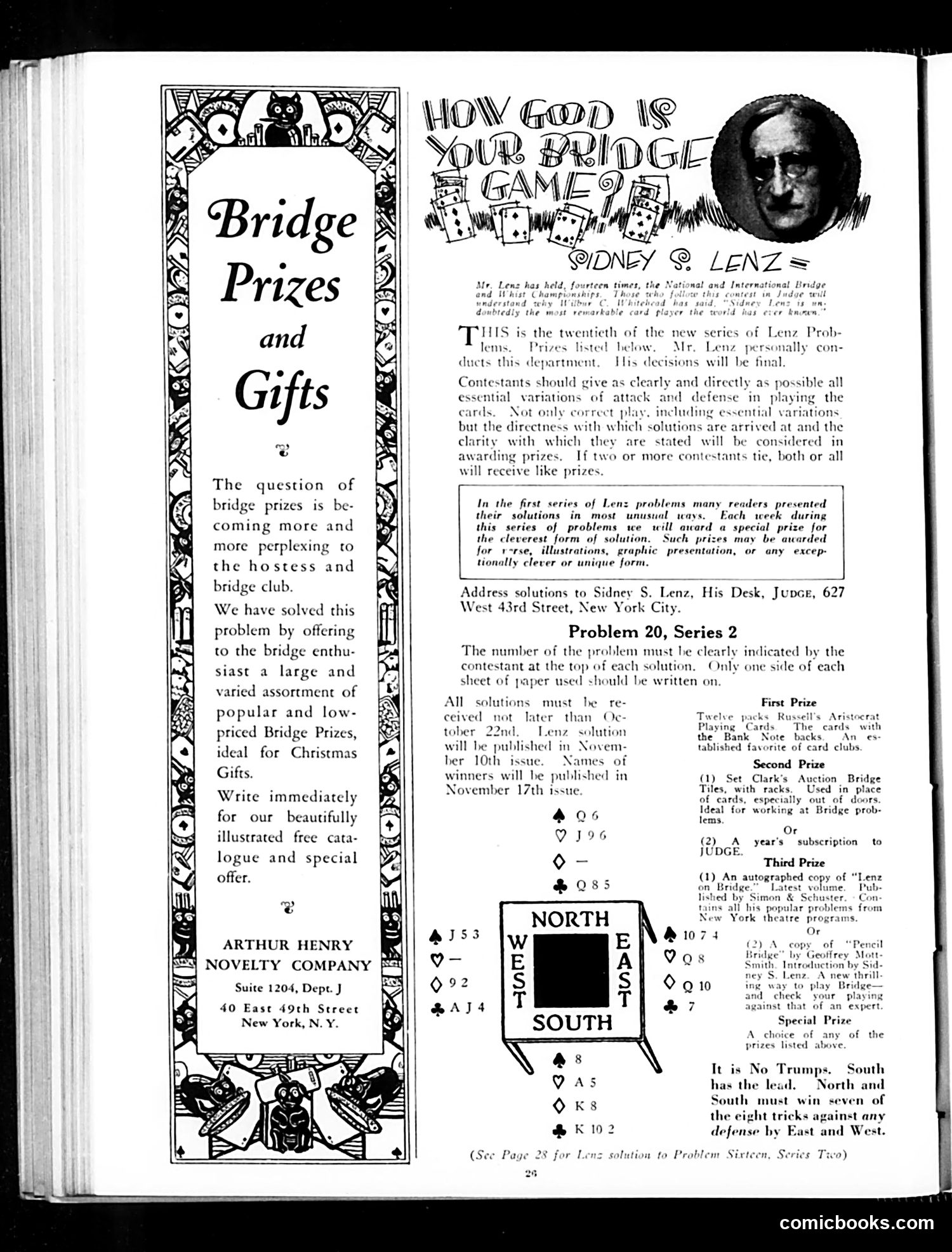
This page is primarily **instructional and promotional content**, not satire. It features: **Main Content:** A bridge card game problem (#20, Series 2) by Sidney S. Lenz, a renowned bridge expert. The puzzle shows a card hand layout and asks readers to solve how North-South can win seven tricks without trump cards. **The Satire/Joke:** The header "How Good Is Your Bridge Game?" with Lenz's portrait is tongue-in-cheek—presenting an impossibly difficult problem to readers, challenging their skills. **Context:** Bridge was enormously popular in 1920s America as a parlor game. Judge monetized this by running competitive puzzle series with prizes (cards, subscriptions, autographed books), encouraging reader participation. **Left Panel:** An advertisement from Arthur Henry Novelty Company selling affordable bridge prizes for hostesses and gift-givers, capitalizing on the game's social prominence. The page reflects bridge's cultural dominance in American leisure and entertainment during this era.
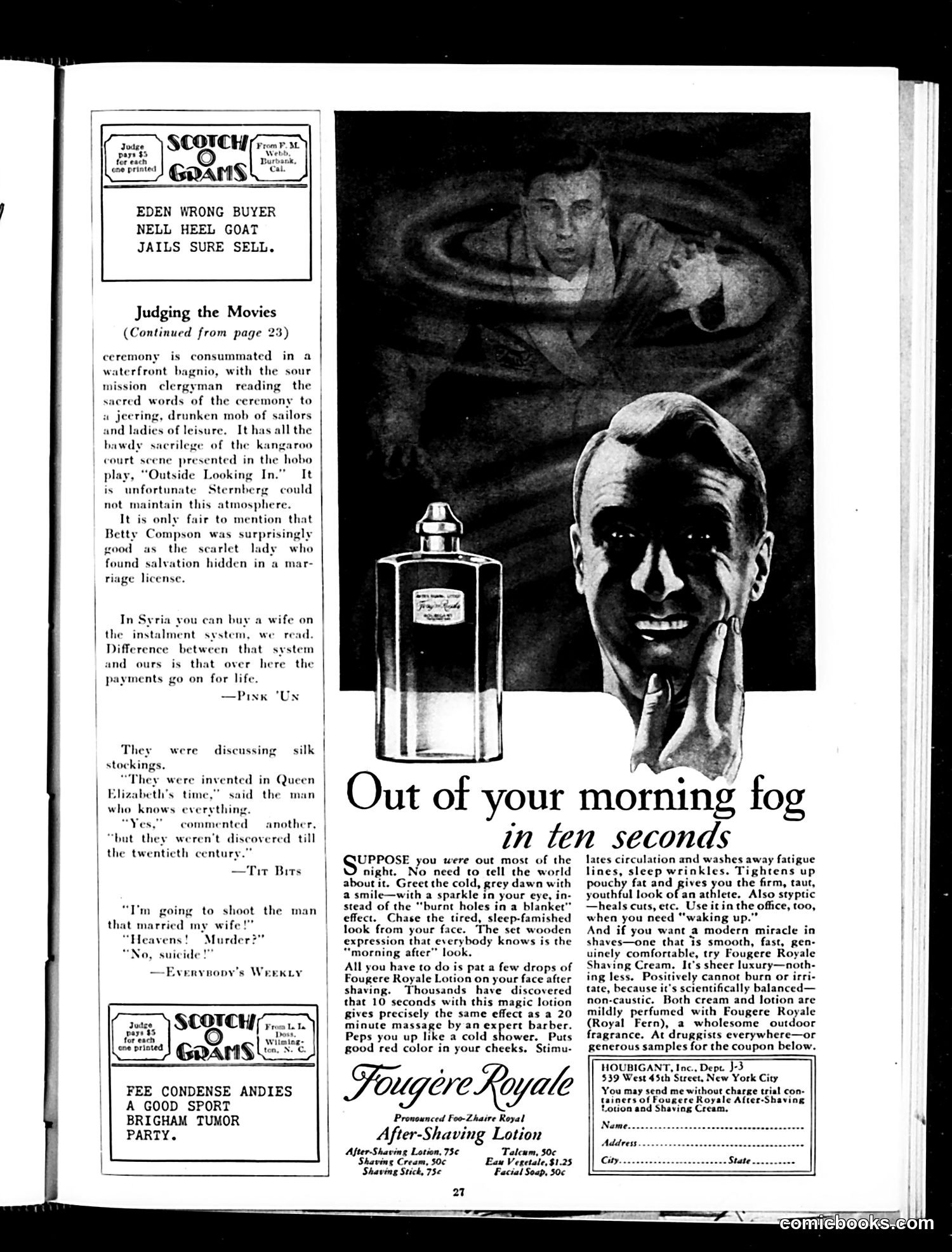
This page mixes satirical content with advertising. The top section contains brief jokes labeled with pseudonymous bylines (typical of Judge's humor format): - "Eden Wrong Buyer / Nell Heel Goat / Jails Sure Sell" appears to be wordplay, possibly mocking legal/marital situations - A joke about Syrian wife-purchasing critiques marriage as financial burden ("payments go on for life") - Brief quips about silk stockings and a shooting threat are typical period humor—often crude and punchy The dominant content is a **full-page advertisement for Fougere Royale shaving lotion**, featuring a distorted/grotesque facial image meant to humorously represent the "morning after" look—tired, worn appearance. The ad promises to erase signs of a night out within ten seconds. The "Judging the Movies" column discusses a film (likely from the silent era) with bawdy content, mentioning actress Betty Compson. **Context**: This reflects 1920s-30s Judge content—satirical jabs at marriage, social behavior, and product advertising seamlessly integrated into editorial pages.
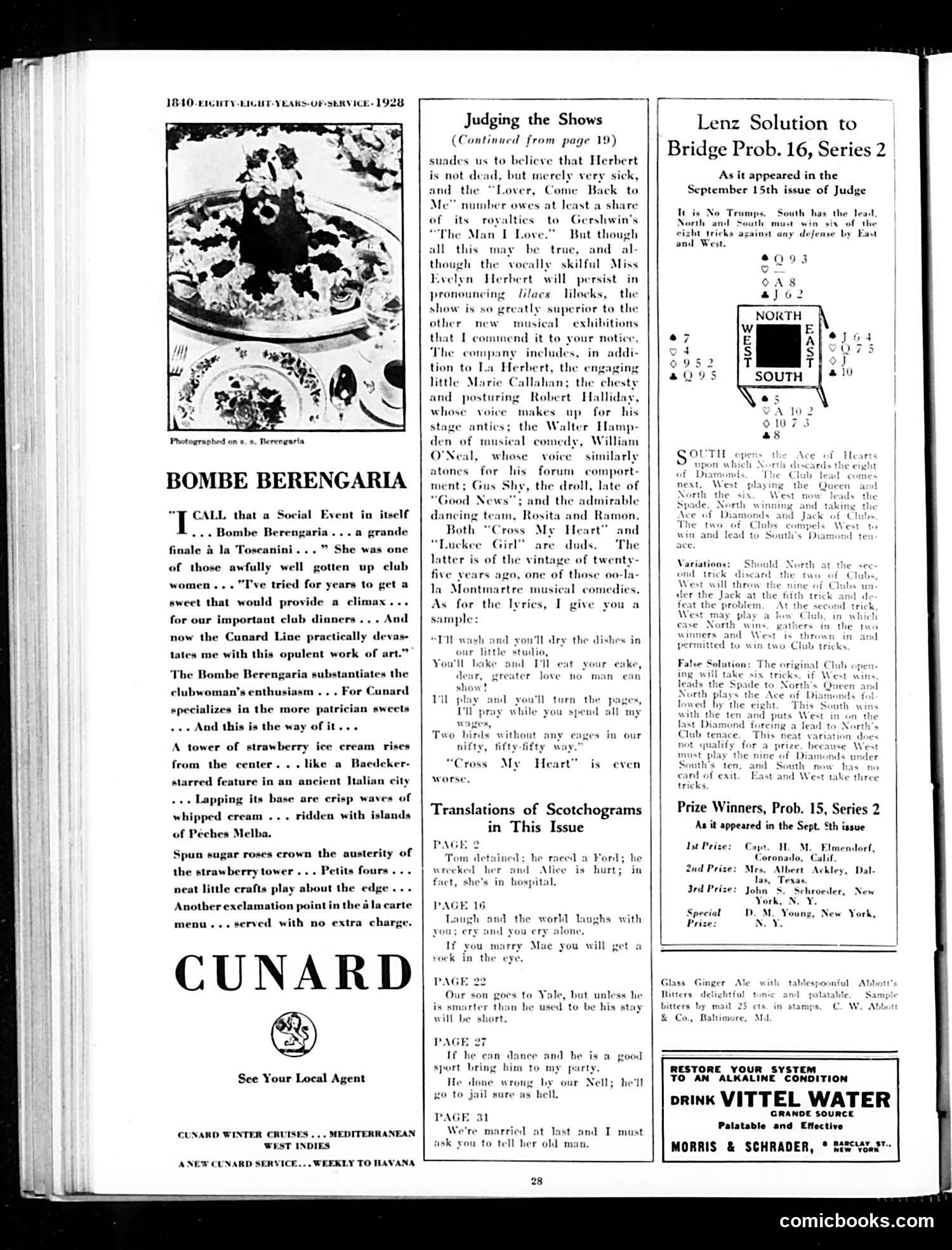
This page is primarily **advertising and instructional content** rather than political satire. The main feature is a **Cunard cruise line advertisement** for the "Bombe Berengaria" — an elaborate dessert served aboard their ships. The ad uses flowery, aspirational language targeting wealthy women ("clubwomen"), describing an ornate ice cream construction as a culinary triumph worthy of fine dining. The page also includes: - A theater review column discussing Broadway musicals, including critical commentary on performances by actors like Evelyn Herbert and Robert Halliday - "Scotchogram" translations (Scottish dialect humor) - A bridge puzzle solution - Prize announcements for previous bridge problems - A mineral water advertisement **There is no political cartoon visible.** The content reflects 1920s consumer culture targeting the wealthy leisure class through luxury travel and fine dining imagery. The tone is sophisticated and aspirational rather than satirical.
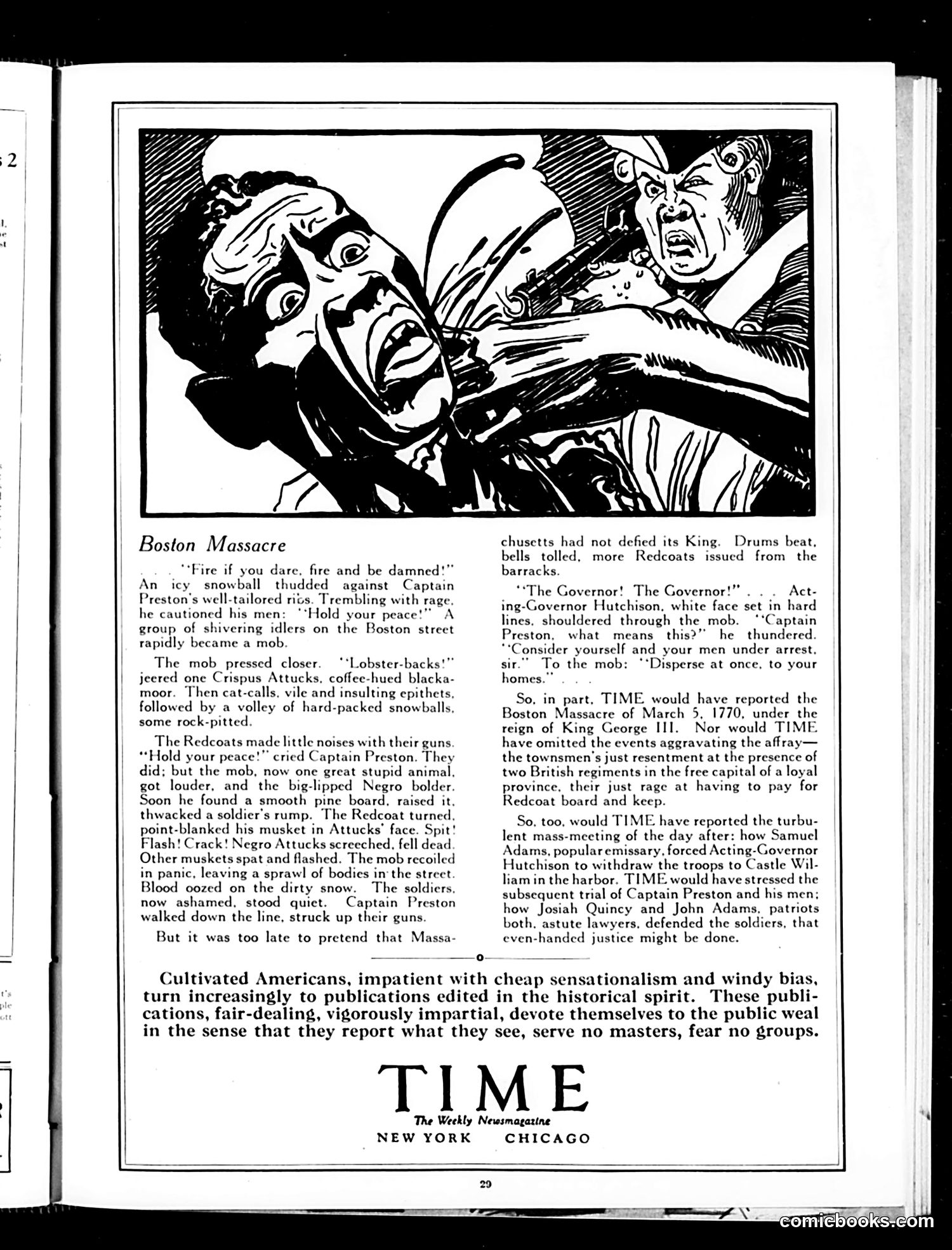
This is a TIME Magazine advertisement disguised as historical content. It retells the 1770 Boston Massacre—when British soldiers fired on a Boston mob, killing five colonists including Crispus Attucks—but frames TIME as the superior news source. The satire targets Judge's competitors: TIME claims to report history "fairly" and "impartially," unlike sensationalist rivals relying on "cheap sensationalism and windy bias." By contrasting how TIME *would have* covered the Massacre (contextualizing colonial resentment, mentioning Adams' leadership, emphasizing fair trial) against the inflammatory woodcut illustration above (which grotesquely caricatures Attucks with racist imagery), Judge implies TIME's competitors traffic in exactly such inflammatory, biased coverage. The ad positions TIME as the cultivated American's antidote to yellow journalism—ironic given the racist caricature adorning the very page making this pitch.
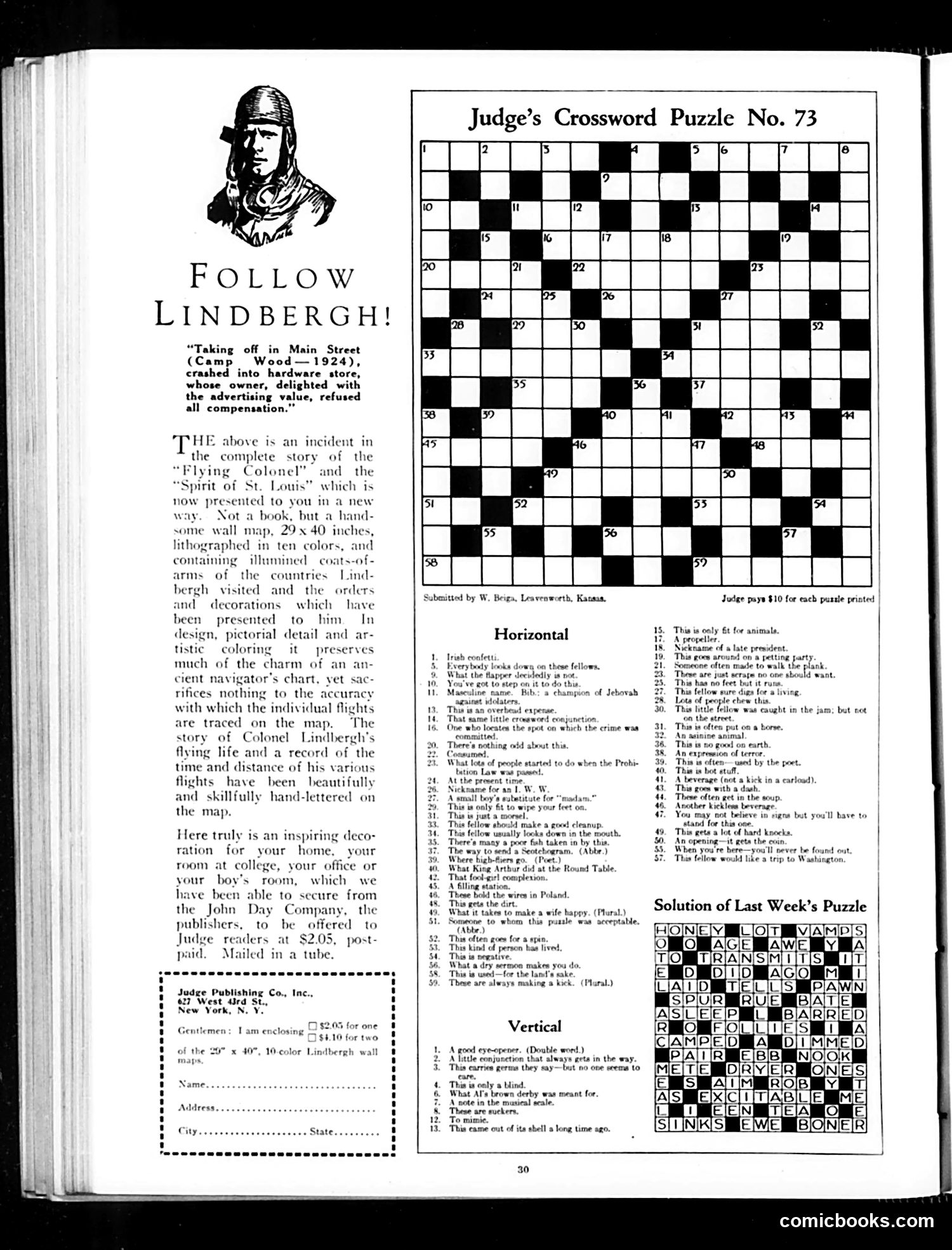
This page promotes a **Lindbergh wall map** as a decorative product, capitalizing on Charles Lindbergh's fame following his 1927 transatlantic flight. The opening anecdote—about Lindbergh crashing into a hardware store in 1924 and the owner refusing compensation—illustrates early public affection for the aviator, who was treated as a heroic figure. The map itself is described as a hand-lettered, ten-color lithograph showing Lindbergh's flight routes, the countries he visited, and decorations he received. It's marketed as inspirational home décor for living rooms, college dorms, and offices. The page includes an unrelated crossword puzzle (Puzzle No. 73). This is primarily **advertising content**, not satire—Judge magazine used such pages to promote commercial products to readers while maintaining editorial content elsewhere in the issue. The nostalgic tone reflects 1920s American hero-worship of Lindbergh before his later controversial public statements damaged his reputation.
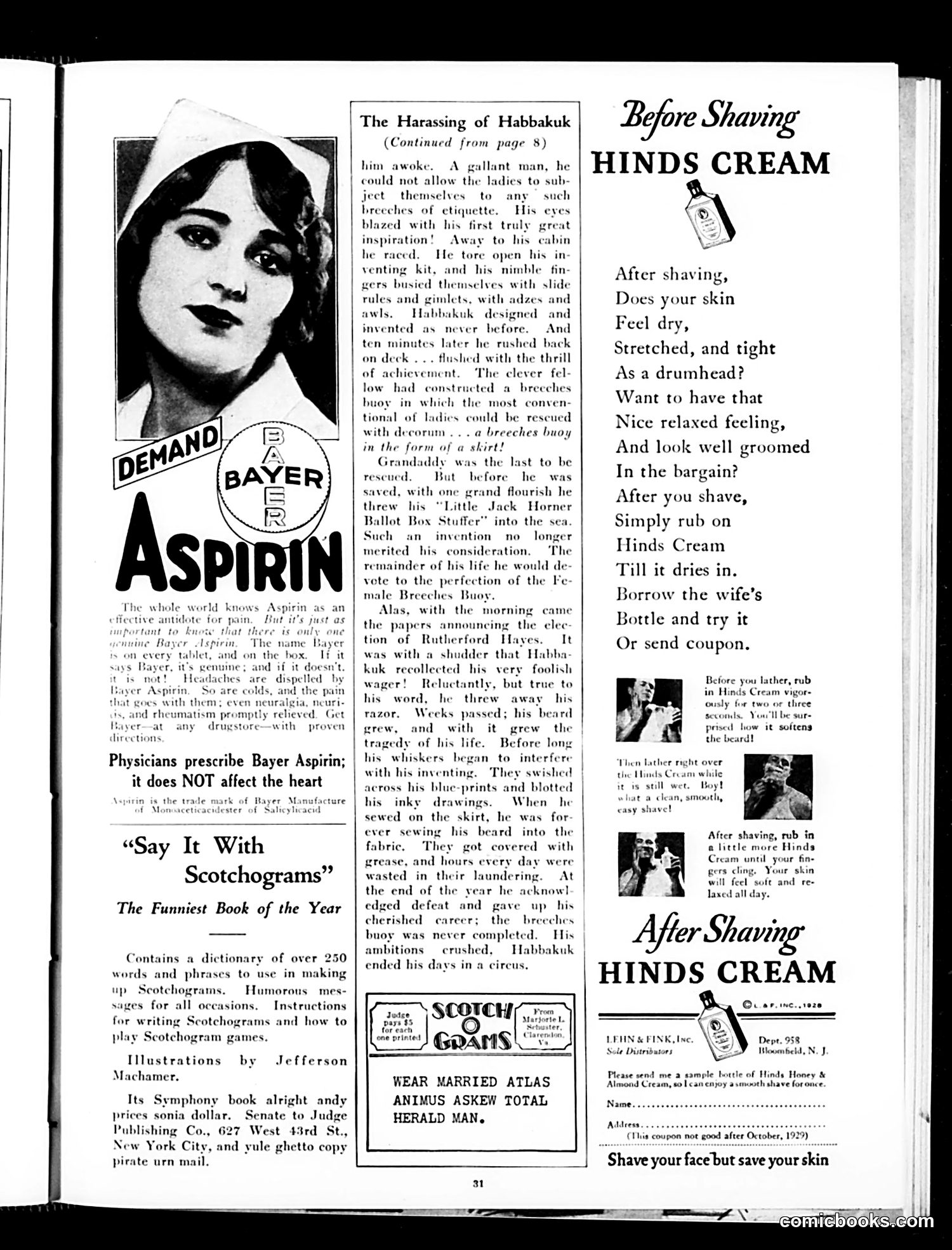
This page contains a serialized humorous story mocking 19th-century American politics and inventor culture. The protagonist, Habbakuk, makes a foolish bet involving the 1876 presidential election (Rutherford Hayes is explicitly named). Forced to stop shaving as penalty, his beard interferes with his work as an inventor, ultimately destroying his career and ambitions. The satire targets: - **Political gambling/wagers** among gentlemen over election outcomes - **The absurdity of masculine pride** (the beard becomes a symbol of masculine stubbornness) - **Overly-ingenious Victorian inventors** whose elaborate contraptions (like a "breeches buoy" fashioned as a skirt) distract from practical concerns The story ends with Habbakuk reduced to circus work—a commentary on how political folly and vanity lead to social degradation. The page also includes period advertisements for Bayer Aspirin and Hinds Cream shaving products, typical Judge content.
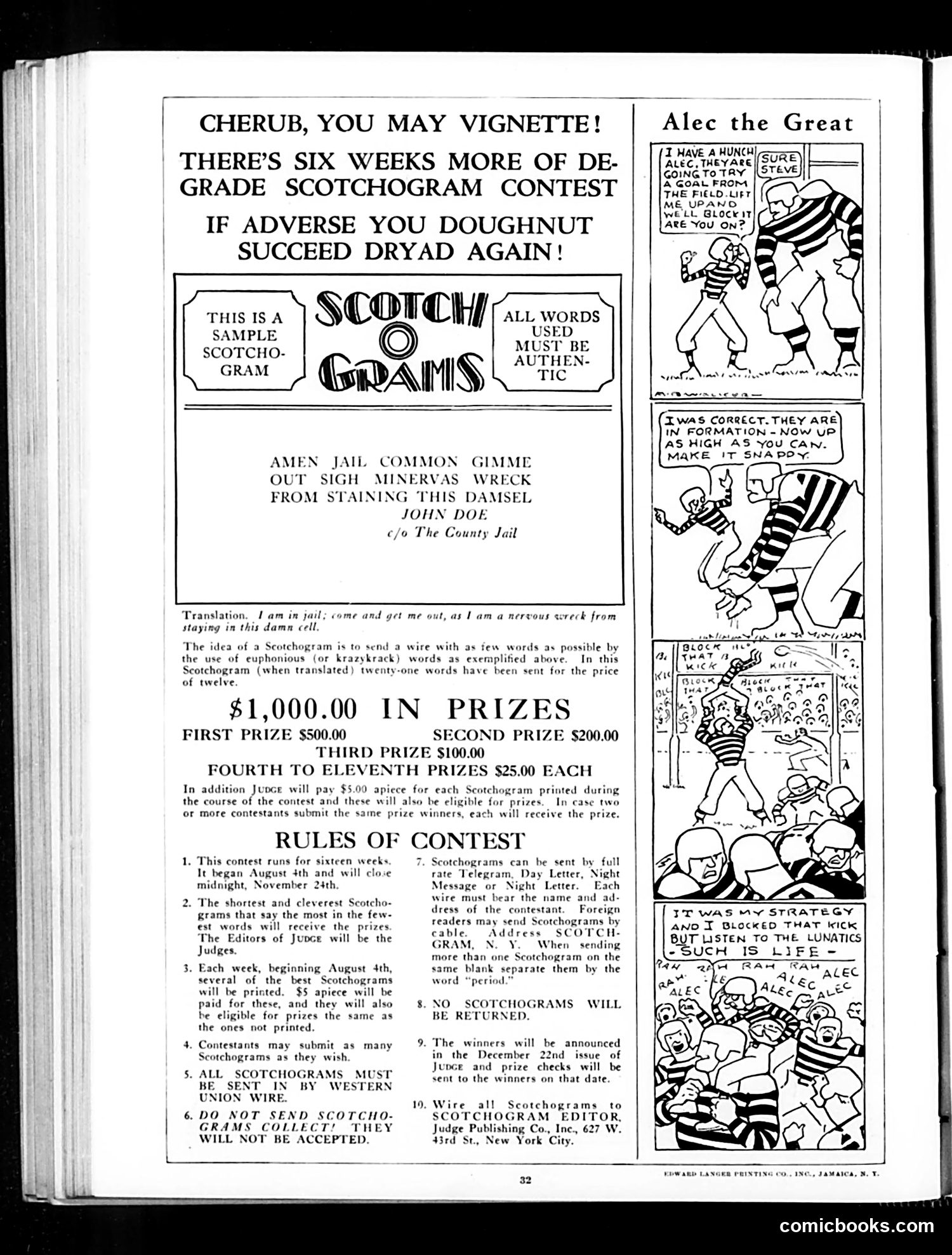
This page advertises Judge magazine's "Scotchogram" contest—a word game where contestants send telegrams using the fewest possible words by employing creative, phonetic wordplay. The sample shows "AMEN JAIL COMMON GIMME / OUT SIGH MINERVAS WRECK" translating to a prisoner's plea for bail. The right side features "Alec the Great," a football comic strip showing players discussing strategy. One character mentions blocking a kick while "lunatics" (likely fans or opposing players) react chaotically. The contest offered substantial prizes ($1,000 total, with first prize $500) and ran for sixteen weeks. It appealed to readers' cleverness and love of wordplay—popular entertainment during the Jazz Age. The Scotchogram itself was a cost-saving telegraph method, making the contest both entertaining and practically useful for readers.
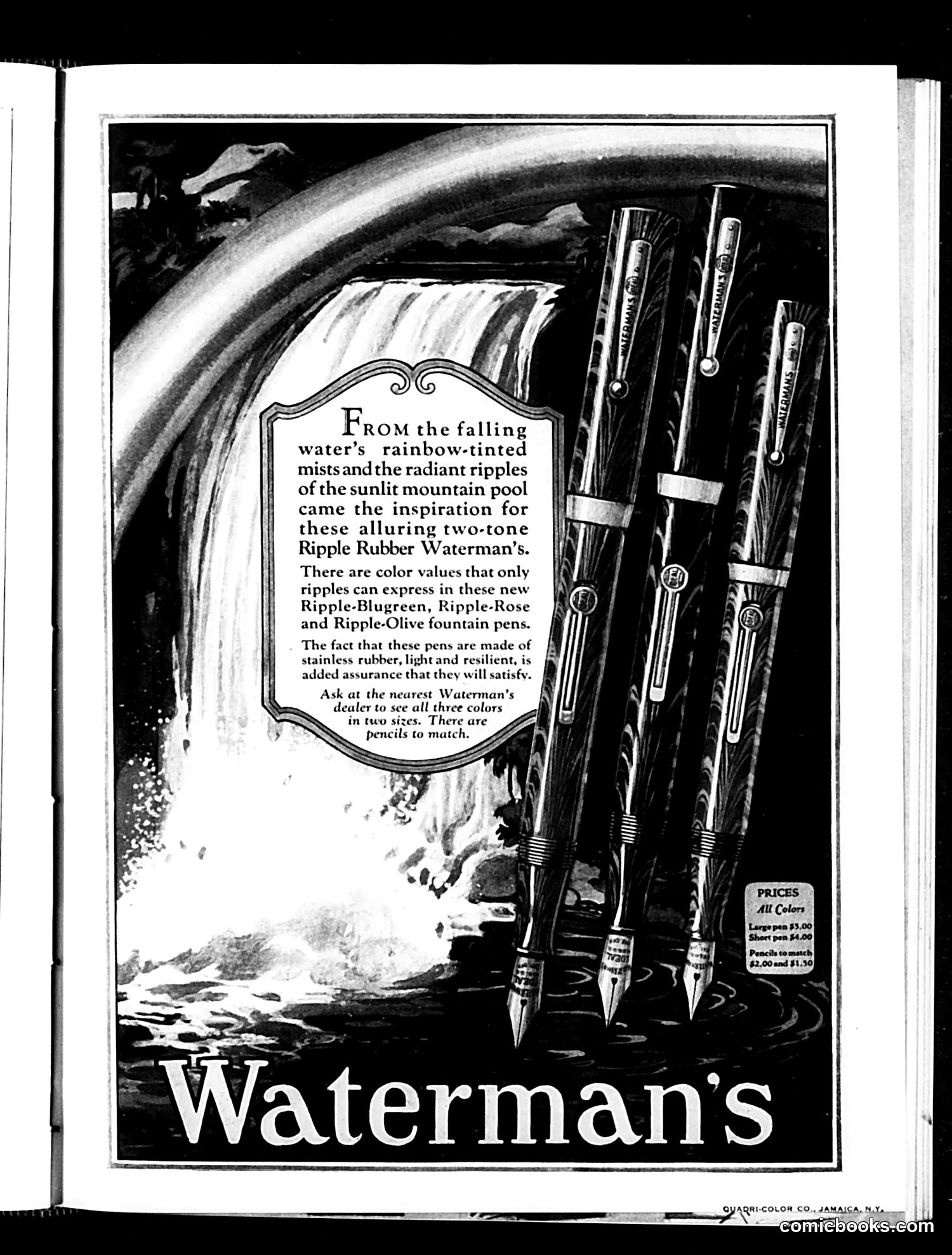
This page is **entirely an advertisement**, not a political cartoon. It promotes Waterman's fountain pens and matching pencils—specifically their "Ripple Rubber Waterman's" line in three two-tone color combinations: Ripple-Bluegreen, Ripple-Rose, and Ripple-Olive. The ad uses romantic imagery of a waterfall with rainbow mists to inspire the pen colors. It emphasizes that the pens are made of "stainless rubber, light and resilient." Pricing information appears in the corner box (large pens $3.00, short pens $2.00, with matching pencils available). This is typical early-20th-century advertising design—using poetic nature imagery to market luxury writing instruments. There is no satire or political content present.
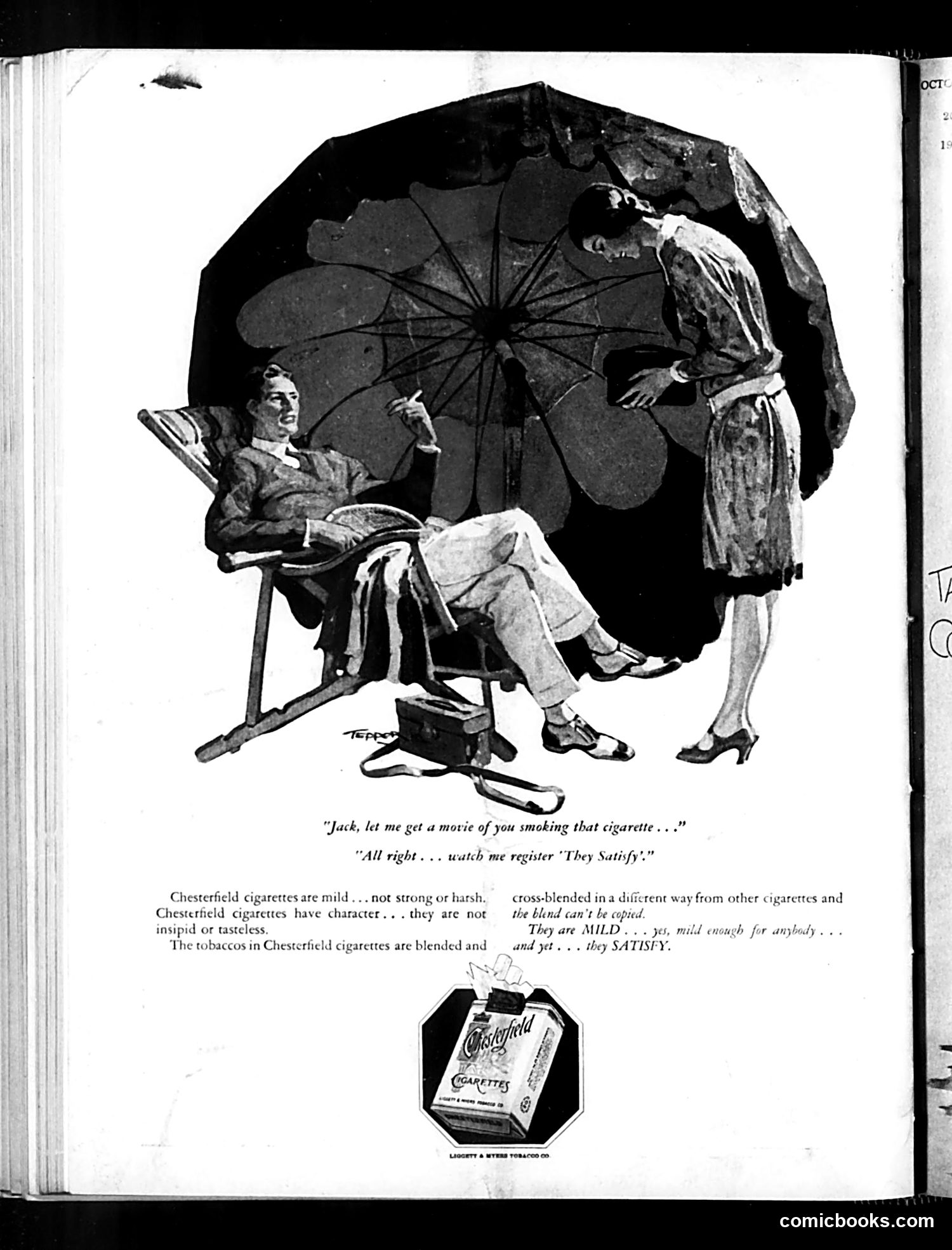
This is a **Chesterfield cigarette advertisement** disguised as editorial content in Judge magazine—a common advertising format of the era. The cartoon depicts two figures in 1920s-30s attire beneath a large umbrella. One seated man smokes while a woman (appearing to be a film director or photographer) records him, with dialogue suggesting they're creating promotional content. The visual joke plays on the phrase "They Satisfy"—Chesterfield's slogan—implying the cigarette's appeal is worth documenting. The accompanying text emphasizes Chesterfield's "mild" yet satisfying blend, distinguishing it from competitors by claiming a unique cross-blending process. **Historical context**: This reflects pre-regulation tobacco advertising that made health claims ("mild," "not harsh") now recognized as misleading. The sophisticated staging and entertainment references appealed to aspirational consumers, particularly targeting women—a significant market expansion for cigarette companies in this period.