
Judge, 1928-10-13 · page 15 of 36
Judge — October 13, 1928 — page 15: what you’re looking at
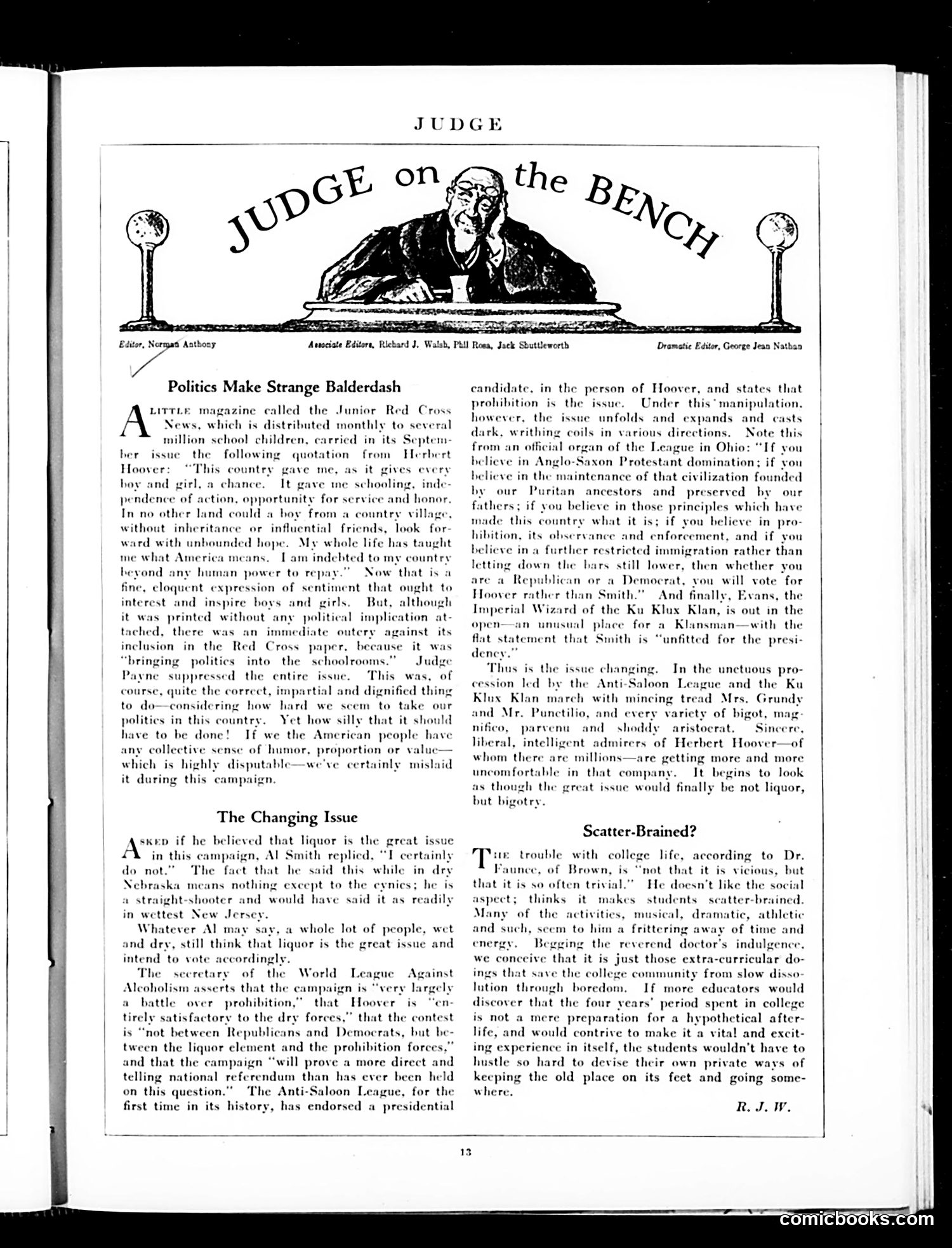
What you’re looking at
This is a political commentary from Judge magazine criticizing the 1928 presidential campaign. The page attacks how a seemingly neutral issue—Prohibition—became a vehicle for darker agendas. **The Main Satire:** Herbert Hoover's modest autobiography excerpt in the Junior Red Cross News sparked outrage from those opposed to his political message appearing in schools. Judge mocks this censorship while noting that whether liquor is truly the campaign's central issue, politicians are manipulating it. **The Broader Point:** Judge sarcastically illustrates how Prohibition's advocates—the Anti-Saloon League, the Ku Klux Klan, and various self-appointed moral guardians—have hijacked the issue. The satire shows these groups marching behind it like "Mrs. Grundy" (a stock figure for prudish moralism), using Prohibition as cover for religious bigotry and immigration restriction against candidate Al Smith. **Historical Context:** Smith was Catholic; Hoover was Protestant. Judge suggests Prohibition served as coded language for anti-Catholic, anti-immigrant sentiment during this election.
📄 Transcribed text from this page (OCR, searchable)
Machine-transcribed from the original scan — historical spelling and the odd misread are preserved.
JUDGE Editor, Normat Antbooy Politics Make Strange Balderdash LITTLE magazine called the Junior Red Cross News, which is distributed monthly to several million school children, carried in its Septem- her issue the following quotation Herbert “This country gave me, as it gives every from Hoover: boy and girl, a chance. It gave ne schooling, inde- pendence of action, opportunity for service and honor. In no other land could a boy from a country village, without influential friends, look for unded hoy My whole life has taug means. I indebted to my country Now that is fine, eloquent expression of sentiment that ought to interest and inspire boys and girls. But, altl it was printed without any political implies tached, there was an immediate outery against its inclusion in the Red Cross paper. because it “bringing politics into the schoolrooms.” Payne suppressed the entire issue course, quite the correct, impartial considerir inheritance or ward with unb me what Ameri beyond any human power to repay.” to do hard we seem to Yet how silly that it should If we the American people have any collective sense of humor, proportion or v which is highly disputable it during this ‘campaign. how politics in this country. have to be done! we've certainly mislaid The Changing Issue Ane if he believed that liquor is the great issue in this campaign, Al Smith replied, “I certainly do not.” The fact that he said this while in dry Nebraska means nothing except to the eynies; he is 1 straight-shooter and would have said it as readily in wettest New Jersey. Whatever Al may Say, a whole lot of people, wet and dry, still think that liquor is the gr intend to vote accordingly. The secretary of the Alcoholism asserts that the a battle over prohibition, tirely issue and World umpaign is r that Hoover is “en- tisfactory to the dry forces,” that the contest is “not between Republicans and Democrats, but be- tween the liquor element and the prohibition forces,” and that the campaign “will prove a more direct and telling national referendum than has ever been held on this question.” The Anti-Saloon League, for the first time in its history, has endorsed a presidential League very larg Ausociate Editors, Richard J, Walsh, PAU Rosa, Jack Sbuttleworth Dramatic Editor, George Jean Natbao candidate, in the person of Hoover, and s prohibition is the issue. tes that Under this’ manipulation. however, the issue unfolds and expands and. casts dark, writhing coils in various directions. Note this from an offic eague in Ohio: “If you xon Protestant domination; if you believe in the maintenance of that civilization founded by our Puritan ancestors and preserved by our fathers; if you believe in those principles which have made this country what it i believe in Anglo : if you believe in pro- hibition, ity observance and enforcement, and if you believe ina further restricted immigration rather than letting down the bars still lower, then whether you are a Republican or a Democrat, vou will vote for Hoover rather than Smith.” And finally, Evans, the Imperial Wizard of the Ku Klux Klan, is out in the open—an unusual place for a Klansman—with the flat statement that Smith is “unfitted for the presi- deney.”” Thus is the issue changing. In the unctuous pro- cession led by the Anti-Saloon League and the Ku Klux Klan march with mincing tread Mrs. Grundy and Mr. Punctilio, and every variety of bi nifico, parvenu and shoddy aristocrat. liberal, intelligent admirers of Herbert Hoover—of whom there are millions—are getting more and more uncomfortable in that company. It begins to look reat issue would finally be not liquor, mag incere, Scatter-Brained? with college life Brown, is trouble Faunce, of according to Dr. not that it is vicious, but that it is so often trivial.” He doesn’t like the social aspect; thinks it makes students seatte Many of the activities, musical, dram and such, seem to him a fritterin time and energy. Begging the reverend doctor's indulgence, we conceive that it is just those extra-curricular do- ings that save the college community from slow disso lution through borede If more educators would discover that the four years’ period spent in college is not a mere preparation for a hypothetical after- nd would contrive to make it a vital and excit- ing experience in itself, the students wouldn't have to hustle so hard to devise their own private ways of the old place on its feet and going some- rained. ic, athletic R.JLW.