
Judge, 1928-10-13 · page 22 of 36
Judge — October 13, 1928 — page 22: what you’re looking at
What you’re looking at
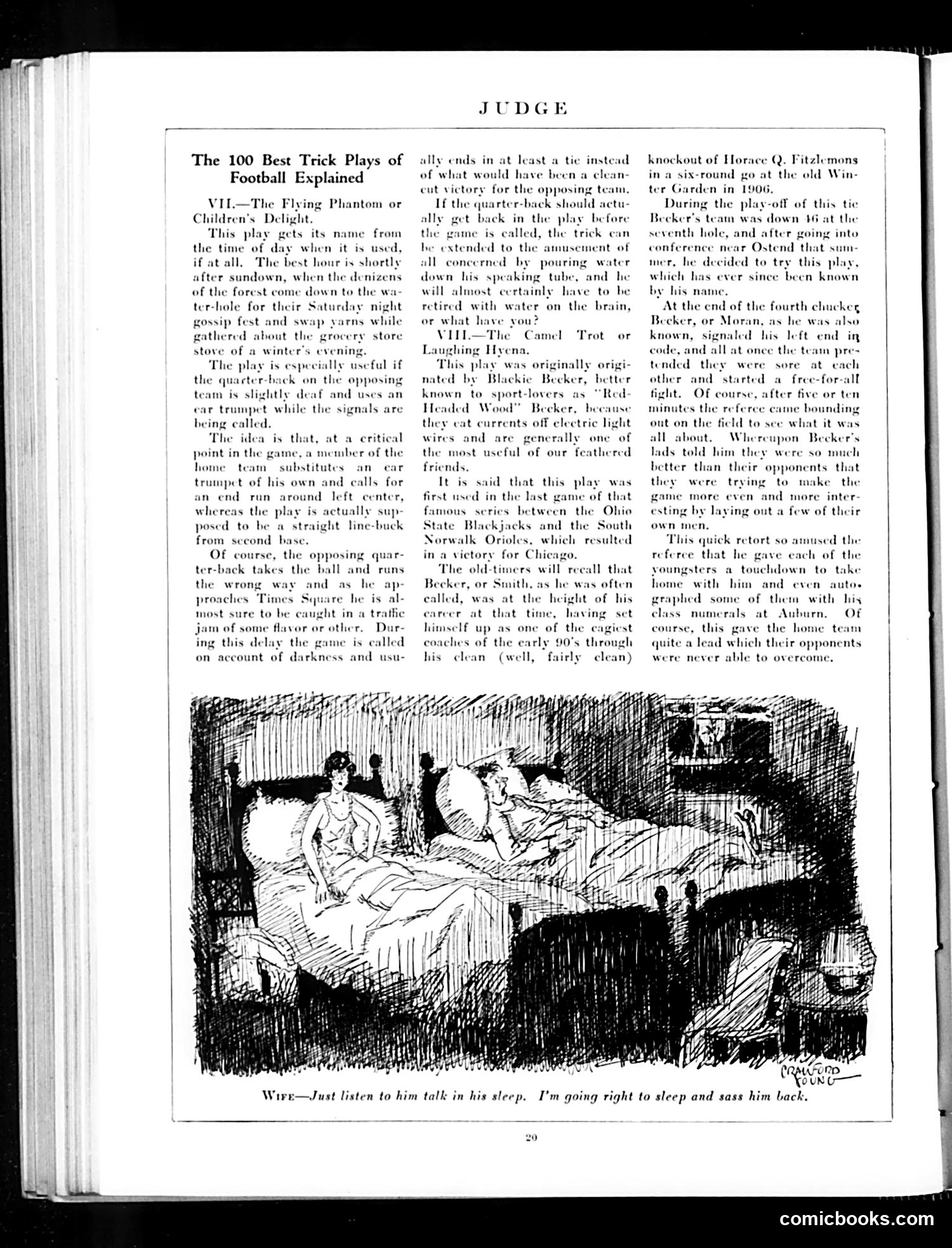
This page contains humorous fake "football trick plays" that are actually nonsensical absurdist jokes disguised as sports instruction. The "Flying Phantom" describes a quarterback substituting a real ear trumpet for the signal-calling device to confuse the opposing team—the joke being the elaborate, ridiculous setup for what amounts to simple deception. The "Camel Trot or Laughing Hyena" references fictional players and teams (Ohio State Blackjacks, South Norwalk Orioles) with intentionally muddled details. The punchline: when caught cheating, the players claim they were deliberately losing to make the game "more even," and the amused referee rewards them with touchdowns anyway—satirizing both football's rule-breaking and the absurdity of sportsmanship excuses. The cartoon below shows a wife about to "sass" her talking husband in his sleep—a marital humor joke common to the era. The satire mocks overly complicated football strategy and dubious sportsmanship.
📄 Transcribed text from this page (OCR, searchable)
Machine-transcribed from the original scan — historical spelling and the odd misread are preserved.
The 100 Best Trick Plays of Football Explained VIL—The Flying Phantom or Children’s Delight. This play gets its name from the time of day when it is used, ifatall. The best hour is shortly after sundown, when the nizens of the forest come down to the wa- ter-hole for their Saturday night gossip fest and swap yarns while gathered about the grocery store stove of a winter's evening, The play is especially useful if the quarter-back on the opposing team is slightly deaf and uses an ear trumpet while the signals are being called. The idea is that, at a critical point in the game, a member of the home team substitutes an ear trumpet of his own and calls for an end run around left center, whereas the play is actually sup- posed to be a straight line-buck from second base. Of course, the opposing quar- ter-back takes the ball and runs the wrong w proaches Times Square he is al- most sure to be caught in a trathe and as he ap jam of some flavor or other. Dur- ing this delay the game is called on account of darkness and usu- Wire—Just listen to him talk in his sleep. JUDGE ally ends in at least a tie instead of what would have been a clean- cut victory for the opposing team, If the quarter-back should actu- t back in the play before is called, the trick can he extended to the amusement of all concerned by pouring water down his speaking tube, and he will almost certainly have to be retired with water on the brain, or what h. you? VIILT—The Camel Trot or Laughing Hyena, This play was originally origi- nated by Blackie Becker, better known to sport-lovers as “Red Headed Wood" Beeker, because they cat currents off electric light wires and are generally one of the most useful of our feathered friends. It is said that this play was first used in the last game of that famous series between the Ohio State Blackjacks and the South Norwalk Orioles, which resulted in a victory for Chicago, The old-timers will reeall that Becker, or Smith, as he was often called, was at the height of his career at that time, having set himself up as one of the cagiest coaches of the early 90's through his clean (well, fairly clean) knockout of Horace Q. Fitzlemons ina six-round yo at the old Win- the play-off of this tic mwas down #6 at the seventh hole, and after ¢ into conference near Ostend that sum mer, he decided to try this play, which has ever since been known by his name. At the end of the fourth chuckes Becker, Moran, as he was also known, signaled his left end in nd allat once the team pres tended they were sore at each other and started a free-for-all tight. Of course, after five or ten minutes the referce came bounding out on the field to see what it was all about. Whereupon Becker's Jads told him they were so much better than their opponents that they were trying to make the game more even and more inter esting by laying out a few of their own men, code, 4 This quick retort so amused the referee that he gave each of the Youngsters a touchdown to take home with him and even autos graphed some of them with his class numerals at Auburn. Of course, this ve the home team quite a lead which their opponents were never able to overcome. I’m going right to sleep and sass him back. comicbooks.com