
Judge, 1928-10-13 · page 21 of 36
Judge — October 13, 1928 — page 21: what you’re looking at
What you’re looking at
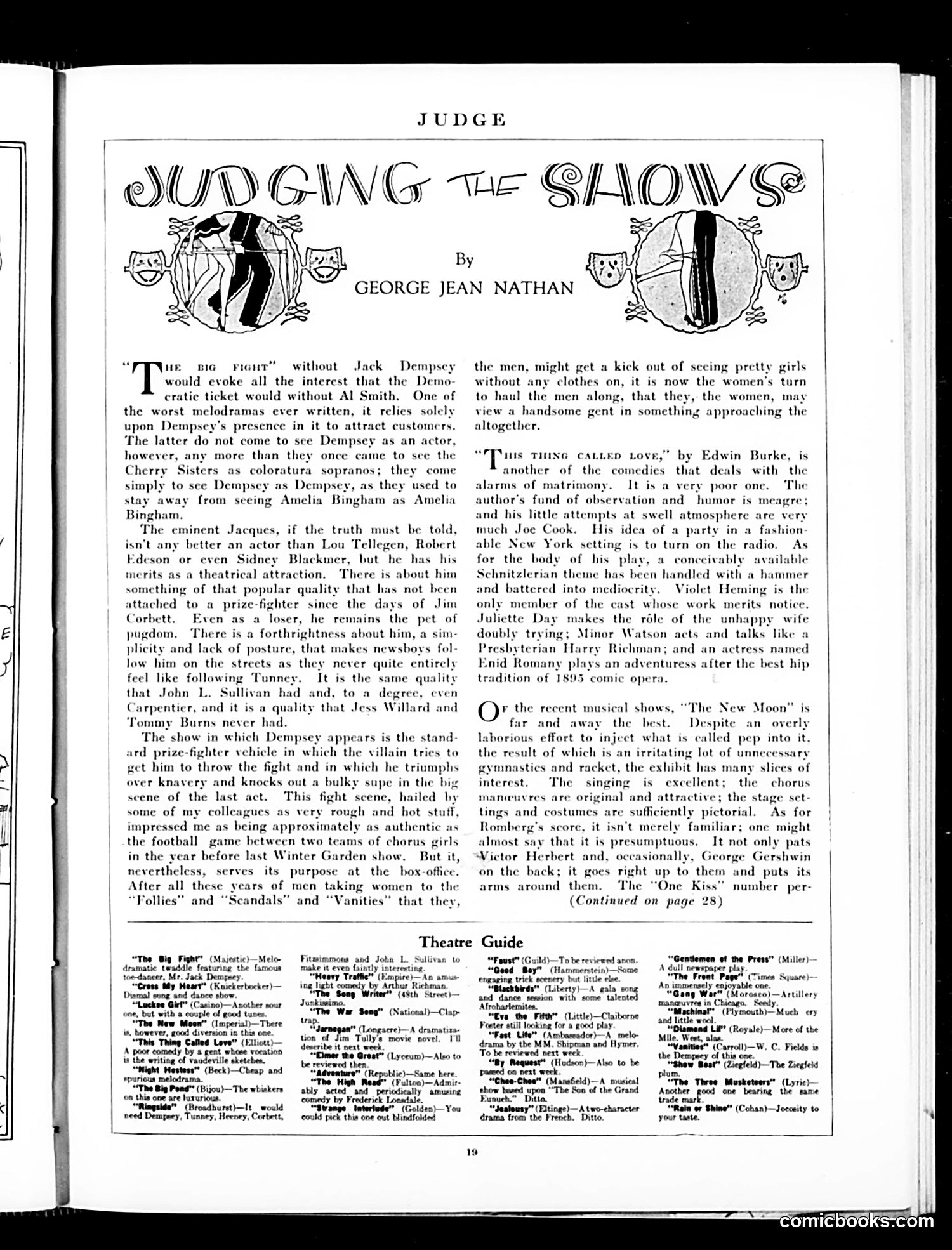
This is George Jean Nathan's theater review column titled "Judging the Shows." Nathan critiques several Broadway productions, focusing primarily on "The Big Fight," a melodrama starring boxer Jack Dempsey. **The Key Satire:** Nathan argues the play is dramatically terrible—relying entirely on Dempsey's celebrity to draw audiences, just as people attended freak shows to see curiosities rather than genuine performance. He compares Dempsey's drawing power to the notorious "Cherry Sisters" (vaudeville performers famous for being bad). **The Social Context:** Nathan contrasts Dempsey's authentic "forthrightness" with other boxers and actors, suggesting working-class appeal trumps theatrical quality. He also notes the gender reversal in theater attendance—women now accompanying men to see attractive male performers, mirroring how men previously dragged women to see chorus girls. **The Point:** Theater producers cynically exploit celebrity, not talent, to fill seats with inferior products.
📄 Transcribed text from this page (OCR, searchable)
Machine-transcribed from the original scan — historical spelling and the odd misread are preserved.
JUDGE MU) GA Nike HE SIAVONW Ge # tr pig Fleur” without Jack — Dempse. | would evoke all the interest that the Demo atic ticket would without Al Smith. One of the worst melodramas ever written, it relies solely upon Dempsey’s presence in it to attract customers, The latter do not come to sce Dempsey as an actor, however, any more than they once came to see the Cherry Sisters sopranos; they come simply to see Dempsey as Dempsey, as they used to stay away from seeing Amelia Bingham. The eminent Jacques, isn't any better an as coloratura Bingham as Amelia if the truth must be told, ctor than Lou Tellegen, Robert Edeson or even Sidney Blackmer, but he has his merits as a theatrical attraction. There is about him something of that popular quality that has not been attached to fighter since the days of Jim Corbett. a loser, he remains the pet of pugdom, ‘There is a forthrightness about him, a sim- plicity and lack of posture, that makes newsboys fol- low him on the streets as they never quite entirely feel like following Tunney. It is the same quality that John L. Sullivan had and, to a degree, even Carpentier, and it is a quality that Jess Willard and Tommy Burns never had. The show in which Dempsey appears is the stand ard prize-fighter vehicle in which the villain tries to get him to throw the fight and in which he triumphs over knavery and knocks out a bulky supe in the big scene of the last act. This fight 's iled by some of my as very rough and hot stuff, impressed me as being approximately as authentic as the football game between two teams of chorus girls in the year before last Winter Garden show. But it, nevertheless, serves its purpose at the box-office. After all these years of men taking women to the “Follies” and “Scandals” and “Vanities” that they, colles gues Theatre Sullivan to “The Big Fight” (Majestic)—Melo- dramatic twaddle featuring the famous toe-dancer, Mr. Jack Dempeey “Cross My Heart” (Knickerbocker)— Dismal song and dance show. ““Luckee Girf” (Casino)—Another sour Fitasimmons and Joba L. make it even faintly interesting. “Heavy Trathie” (Empire)—An ame ing, ett commend; Ard Richman. Seog, Writer” (sh Street) — Justice By GEORGE JEAN NATHAN the men, might get a kick out of seeing pretty girls without any clothes on, it is now the women's turn to haul the men along, that they, the view a handsome gent in something approaching the altogether. women, may HUIS THING CALLED LoV another of the comedies th alarms of matrimony. It is a author's fund of observation and humor is meagre; and his little attempts at swell atmosphere are very much Joe Cook. His idea of a party in a fashion- able New York setting is to turn on the radio. As for the body of his play, a conceivably available Schnitzlerian theme has b handled with a hammer and battered into mediocrity. Violet Heming is the Edwin Burke, is t deals with the y poor one. ‘The only member of the cast whose work merits notice. Juliette Day mukes the réle of the unhappy wife doubly trying; Minor Watson acts and talks like a Presbyterian Harry Richman; and an actress named Enid Romany plays an adventuress after the best hip tradition of 1895 comic opera. Or the recent musi shows, “The New Moon” is far and away the best. Despite an overly laborious effort to inject what is called pep into it. the result of which is an irritating le of unnecessary gymnastics and racket, the exhibit has many slices of interest. The singing is excellent; the chorus manauvres are original and attractive; the stage set- tings and costumes are sufficiently pictorial. As for Rombe it isn't merely almost say that it is presumptu Victor Herbert and, occasionally, George Gershwin on the back; it goes right up to them and puts its ns around them. The “One Kiss” number per- (Continued on page 28) score, amiliar; one might us. It not only pats Guide “Faust” (Guild)—To be reviewed anos. “Gentlemen of the Press (Miller) “Geos Bey” (Hammerstein)—Some lt pmers, play. Page” (Times Syuare) pensely enjoyable one. Gang War” {Morosse) Artillery engaging trick scenery but little elee. “Blackbirds” (Liberty) —A gala so and dance semion with some talent one, but with a couple of good tunes “The Mew Moon” (Imperial)—There however, good diversion in this ove. “This Thing Called Love" (Ellictt)— A poor comedy by a gent whose vocation is the writing tf Vaudeville sheschen, “Might Hostess” (Beck) —Cheap and ‘various melodrama “The Big Pend” (Bijou)—The whiskers 0 this one are lururious. “Ringside” (Brosdburst)—It would need Demprey, Tunney, Heeney, Corbett, “The War Seng” (National)—Clap- (Longacre)—A dramatiza- jim Tully's movie novel. I'll Aemcribe it next week “Elmer the Great” (Lyceum)—Also to be reviewed the Cee ie)—Same bere. “The High The High acd" (Fultoa)—Admir- ably acted and pericdically amusing comedy by Prederid Lonsdale. range (Goldes)—You coult pick “hin one ont Mindfokind Afroharlemites, “Eva the Fitth” (Little)—Claitorne Foster still looking for a good play. “Fast Life” (Ambaseador)—A_ melo- drama by the MM. Shipman and Hymer. To be reviewed next week “Chee-Chee” (Mansfield)—A musical thow based upon “The Son of the Grand Eunuch.” Ditto, “Jealousy” (Eltinge)—A two-character érama from the French. Ditto. mascruvres in Cl “Mechiaal™ (Plymouth) Much ery and litte wool. “Diamend Lit” (Royale)—More of the Mile. West, alas. “Vanities” (Carroll) —W. C. Fields i» the Dempsey of this one. oe Beat” (Ziegfeld) —The Ziegfeld jum. “The Three Musketeers” (Lyric) Another good one bearing the same trade mark. “Rain or Shine” (Cohan)—Jocosity to your taste. tt = - Lt cComicbooks-com