
A complete issue · 36 pages · 1928
Judge — March 17, 1928
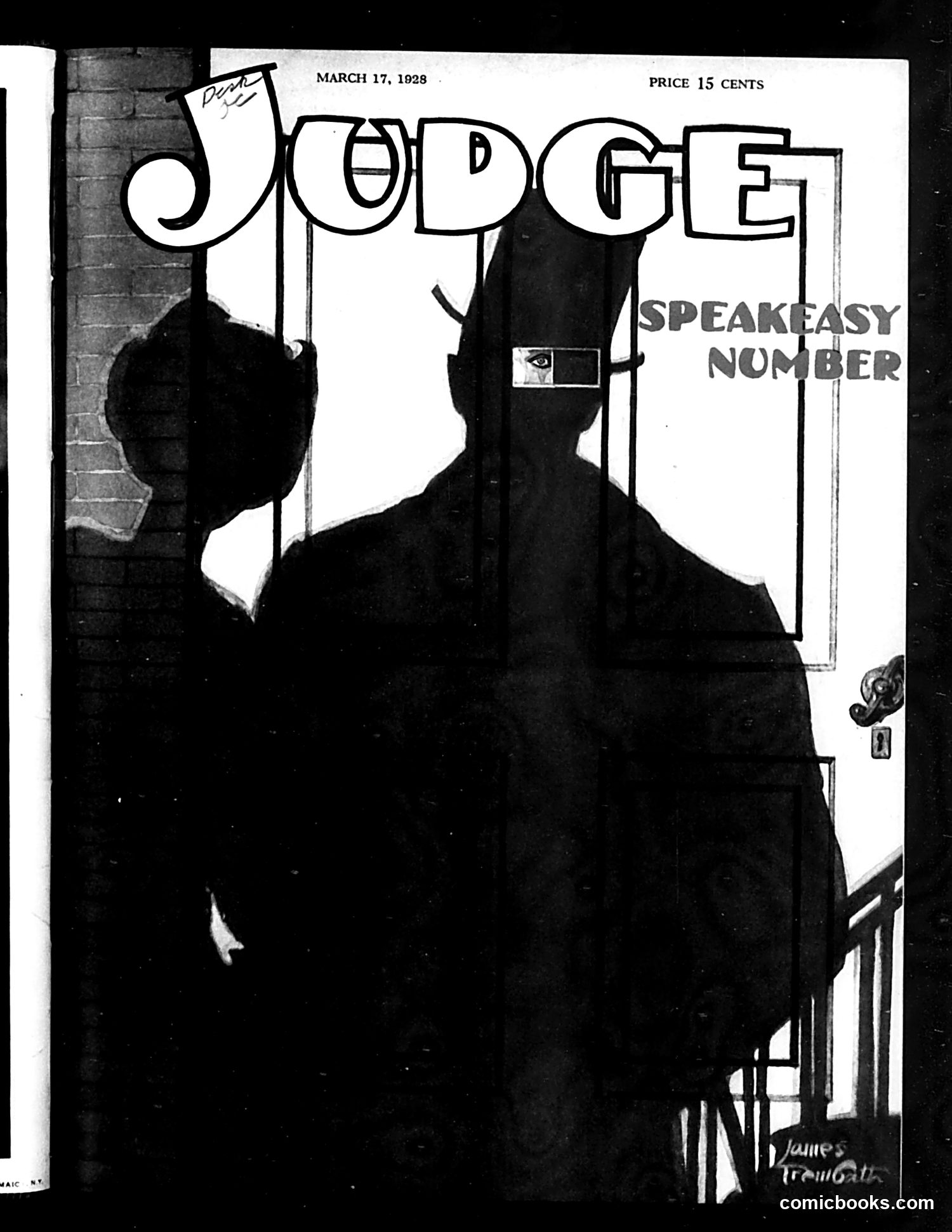
This is a "Speakeasy Number" cover from Judge, a satirical magazine published during Prohibition (1920-1933). The silhouetted figures appear to be entering or exiting a speakeasy—an illegal bar operating covertly during the alcohol ban. The satire targets the hypocrisy and widespread lawbreaking of Prohibition era. Speakeasies were ubiquitous despite federal law, attracting middle and upper-class patrons who wanted alcohol. By highlighting this as a special magazine "number," Judge mocks how normalized illegal drinking had become in American society. The shadowy figures suggest the secretive nature of speakeasy culture, while the sophisticated Art Deco "JUDGE" lettering emphasizes the establishment clientele patronizing these joints. The satire critiques both Prohibition's failure and society's casual disregard for it.
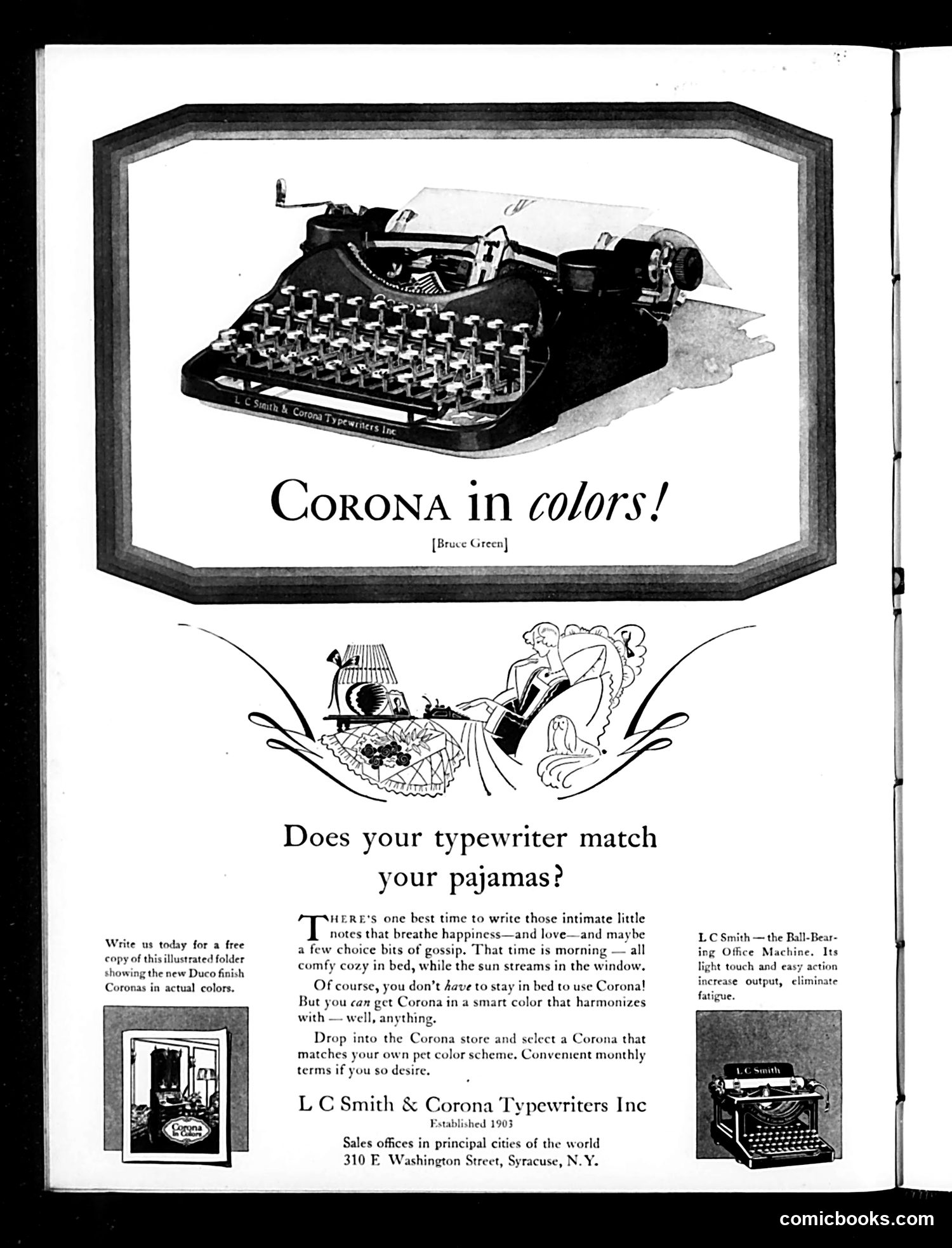
This page is primarily **advertising, not political satire**. It promotes Corona typewriters made by L.C. Smith & Corona Typewriters Inc. (established 1903, Syracuse, NY). The humor is commercial rather than political: the ad playfully asks "Does your typewriter match your pajamas?" — suggesting typewriters came in decorative colors that could coordinate with bedroom decor. The accompanying illustration shows a woman in bed writing intimate notes on a Corona. This reflects 1920s-30s marketing that positioned typewriters as stylish consumer goods for domestic use, particularly targeting women. The tagline "Corona in colors!" emphasizes color variety as a selling point. The cartoon contains **no political content** — it's a lifestyle advertisement appealing to leisure and romance.
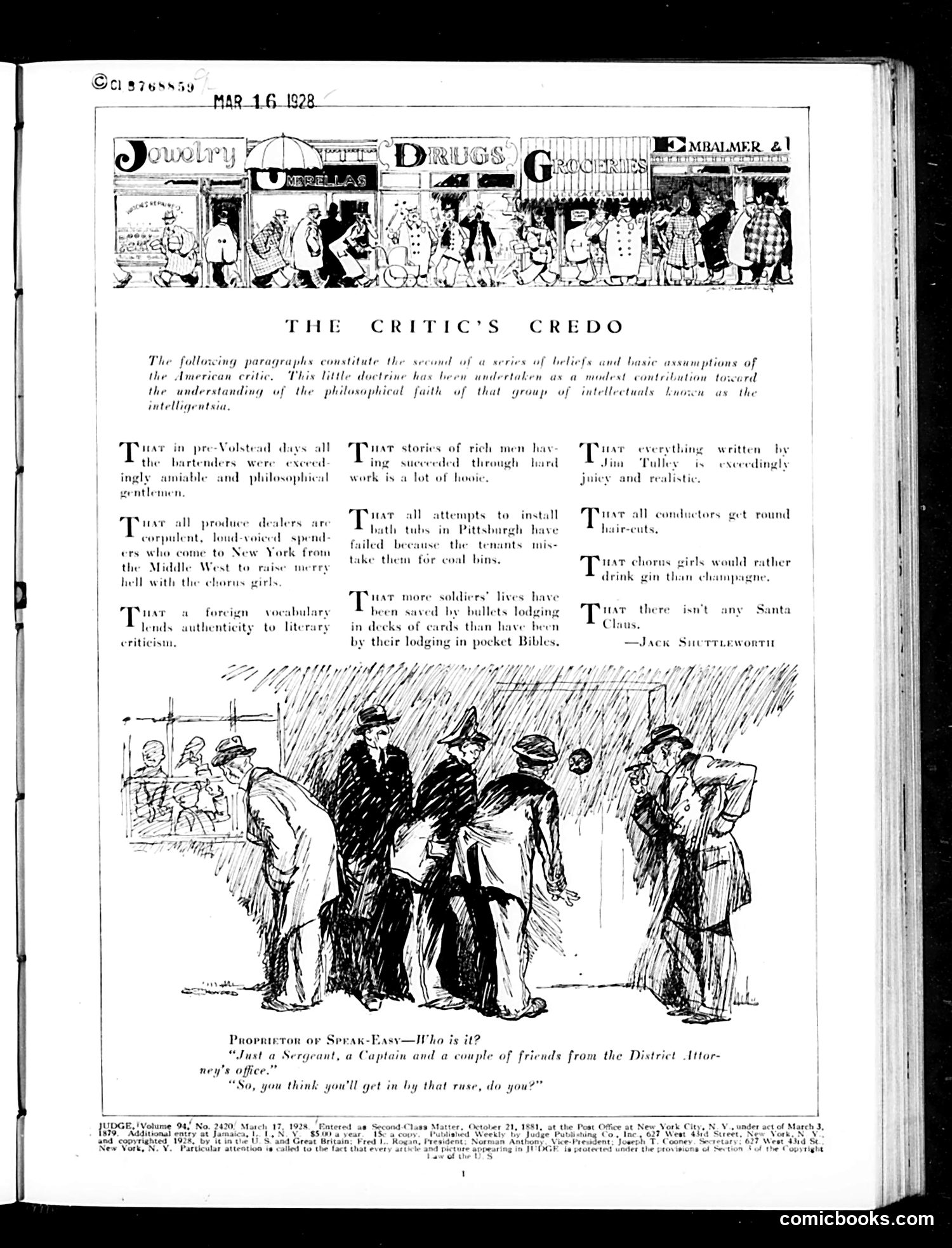
This page satirizes literary and social critics through a series of absurdist claims presented as established "facts." The humor targets pretentious intellectualism: critics claiming pre-Volstead "bartenders were philosophical," that stories by wealthy men are inherently worthless, that Jim Tully writes "juicily," and that bath-tub installations in Pittsburgh failed due to coal bins. The bottom cartoon depicts a "Proprietor of Speak-Easy" confronted by a sergeant and police captain in heavy rain, asking: "Who is it?" The caption references a "District Attorney's office," likely satirizing Prohibition-era corruption and police-politician relationships. The joke appears to be about the futility of trying to hide or deny illegal speakeasies when authorities openly visit them.
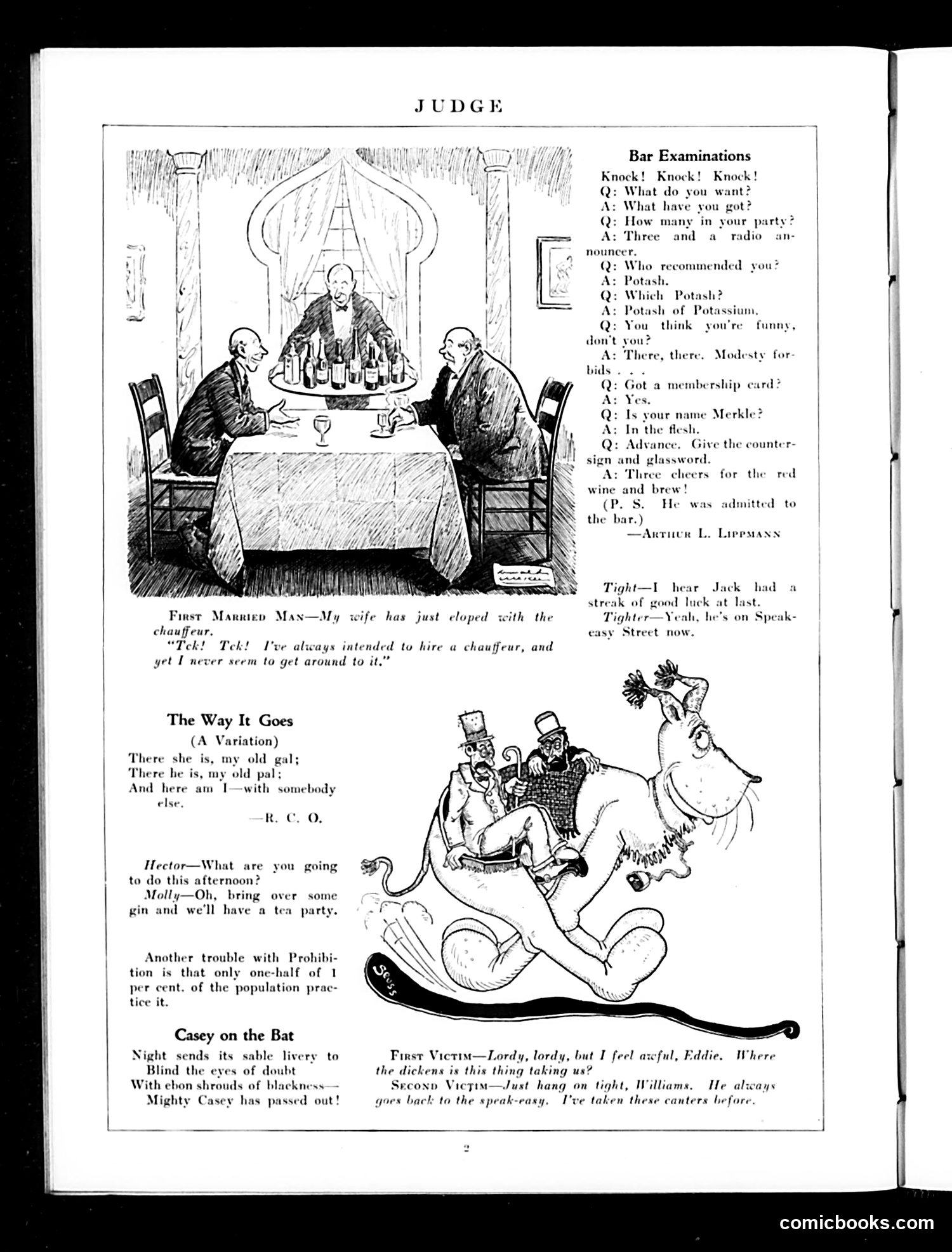
This page satirizes 1920s American social life during Prohibition (1920-1933). **"First Married Man"** cartoon mocks infidelity: a husband nervously excuses his wife's elopement with the chauffeur, claiming he always intended to hire one anyway—dark comedy about marital breakdown. **"Bar Examinations"** presents a mock test for speakeasy (illegal bar) membership, with questions about passwords and secret signals ("three cheers for red wine and brew"). This humorously exposes how Prohibition drove drinking underground into coded, membership-based establishments. **"Casey on the Bat"** references the famous baseball poem, suggesting Prohibition's impact on American pastimes. The overall theme criticizes Prohibition's unintended consequences: family dissolution, organized crime infrastructure (speakeasies), and cultural corruption—common Judge critiques of the era's "noble experiment."
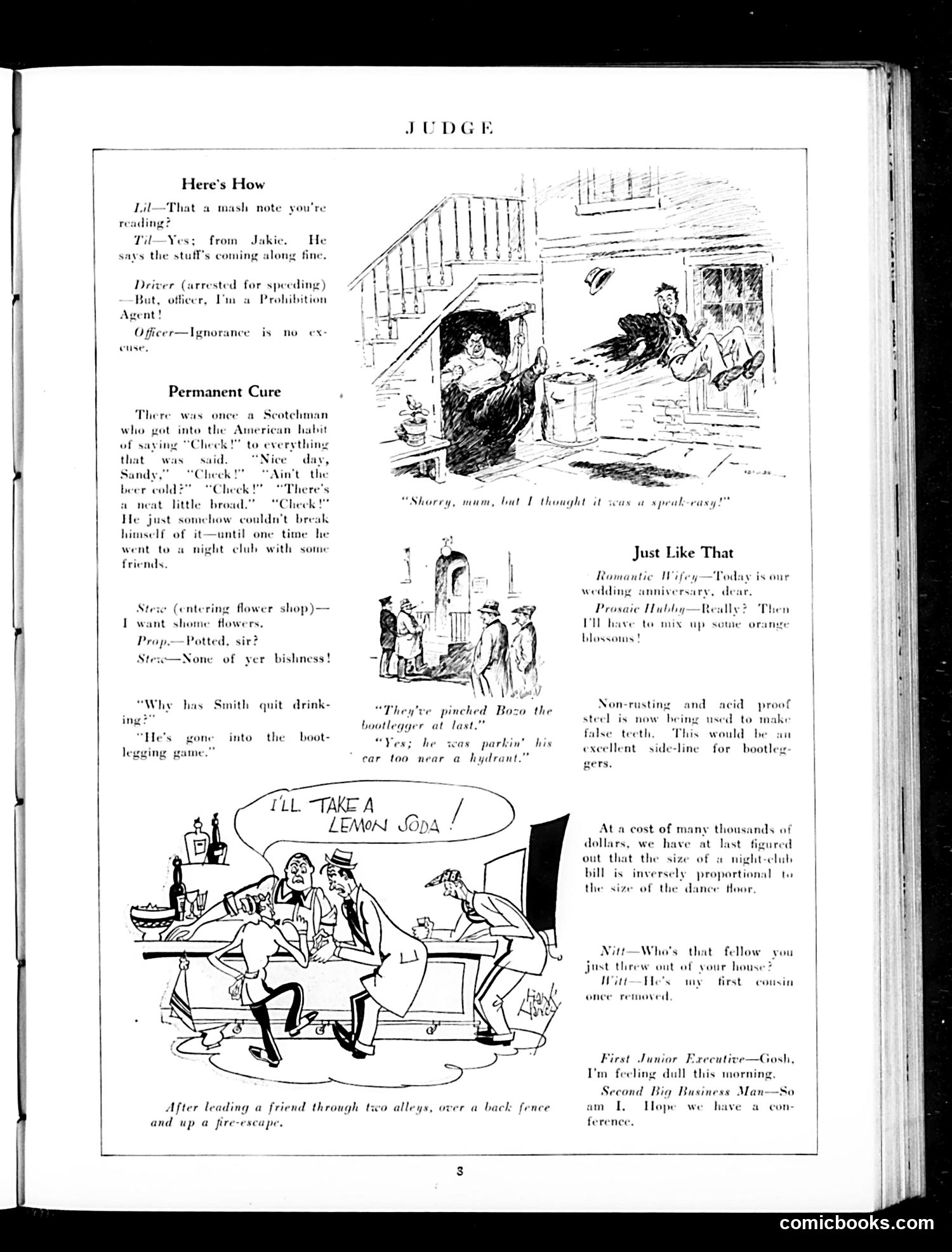
This page contains several brief humorous sketches typical of Judge's satirical format: **"Here's How"** mocks legal excuses—a speeding driver blames a Prohibition agent for distraction; an officer dismisses ignorance as no defense. **"Permanent Cure"** depicts a Scottish immigrant's malapropisms at a bar, playing on ethnic stereotypes common to the era. **"Just Like That"** satirizes a wife's demand for orange blossoms on their anniversary, with commentary on bootleggers and false teeth as odd business ventures. The large cartoon shows a prohibition-era speakeasy scene where someone demands "I'll take a lemon soda!"—clearly code for illegal alcohol. The caption references leading friends through alleys and over fences, depicting the era's secretive speakeasy culture. The humor relies on 1920s Prohibition-era references now historically dated.
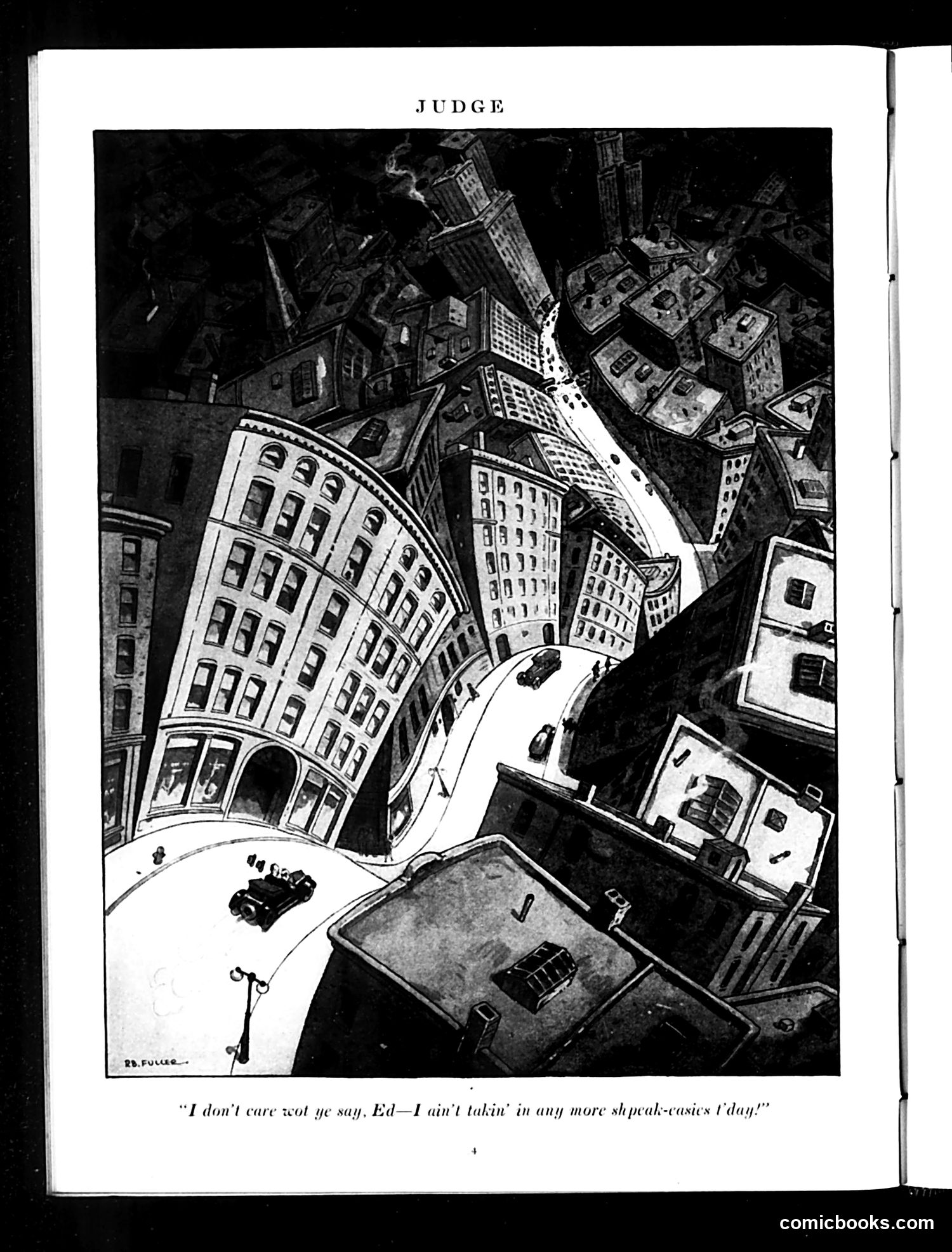
This aerial bird's-eye view cartoon depicts a crowded urban street scene with buildings, vehicles, and pedestrians crammed together. The caption reads: "I don't care 'sot ye say, Ed—I ain't takin' in any more speakeasies I day!" This references **Prohibition era** (1920s-1930s), when alcohol sales were illegal in America. The joke satirizes the proliferation of illegal bars ("speakeasies") in cities—so numerous that even the speaker claims exhaustion from visiting them. The aerial perspective emphasizes urban overcrowding and the scale of underground drinking establishments operating despite federal law. The humor derives from the absurdity of Prohibition's failure: rather than eliminating drinking, it created an epidemic of secret bars throughout American cities, making them practically impossible to avoid or patronize completely.
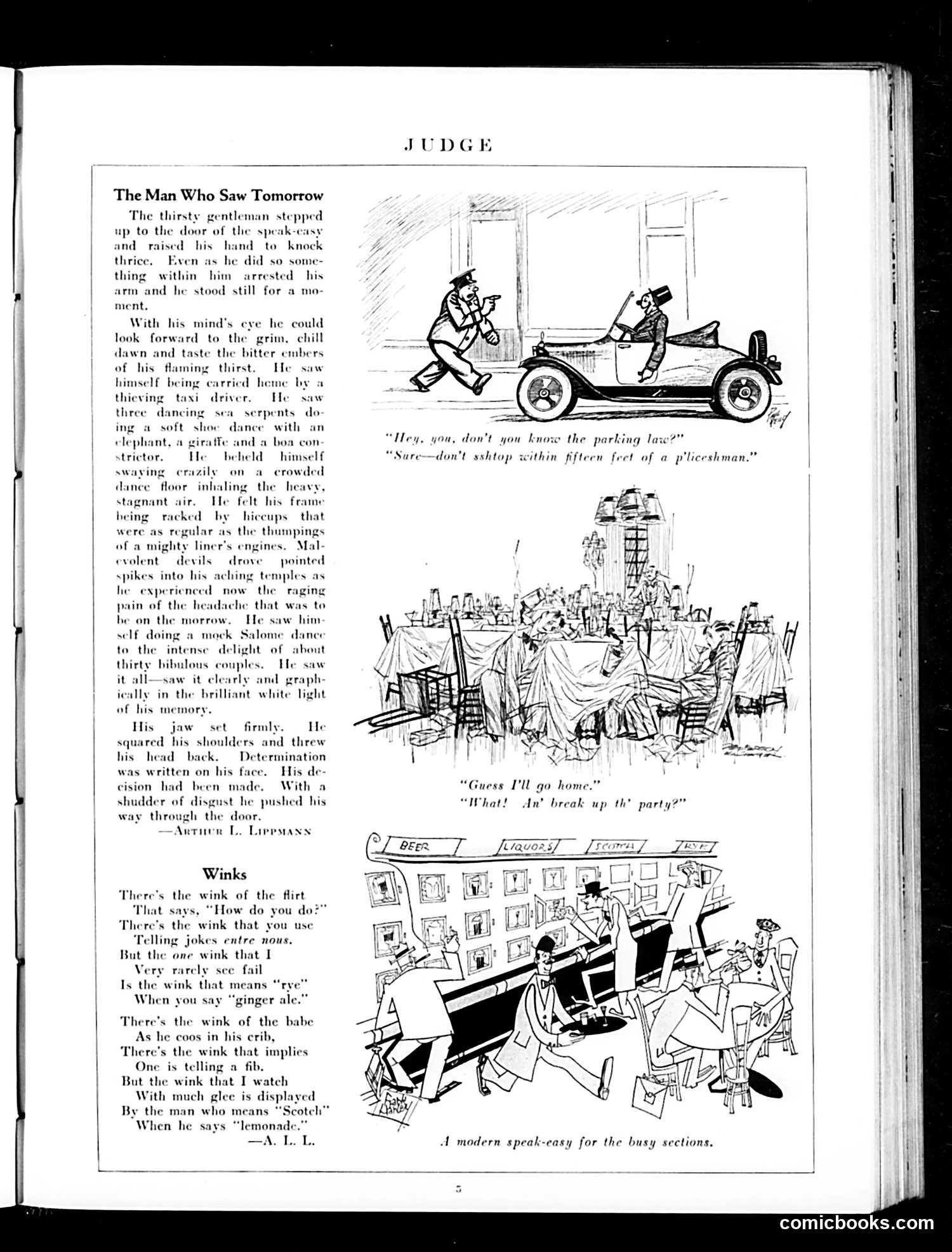
This page contains three distinct pieces: 1. **"The Man Who Saw Tomorrow"** (by Arthur L. Lippmann): A story about a man with apparent precognitive abilities who sees future disasters—a taxi crash, shipwrecked sailors, a crowded chaotic scene, and a wild party. The narrative explores his mental anguish from witnessing these visions. 2. **Top cartoon**: Shows someone warning about parking laws and a policeman, satirizing urban traffic regulations of the era. 3. **"Winks"** (by A.I.L.): A humorous poem cataloging different types of winks and their social meanings—flirtation, lies, the "ginger ale" wink (abstinence during Prohibition), and "lemonade." This clearly references Prohibition-era speakeasy culture. 4. **Bottom cartoon**: Depicts a crowded speakeasy during Prohibition, illustrating the "busy sections" mentioned in the caption.
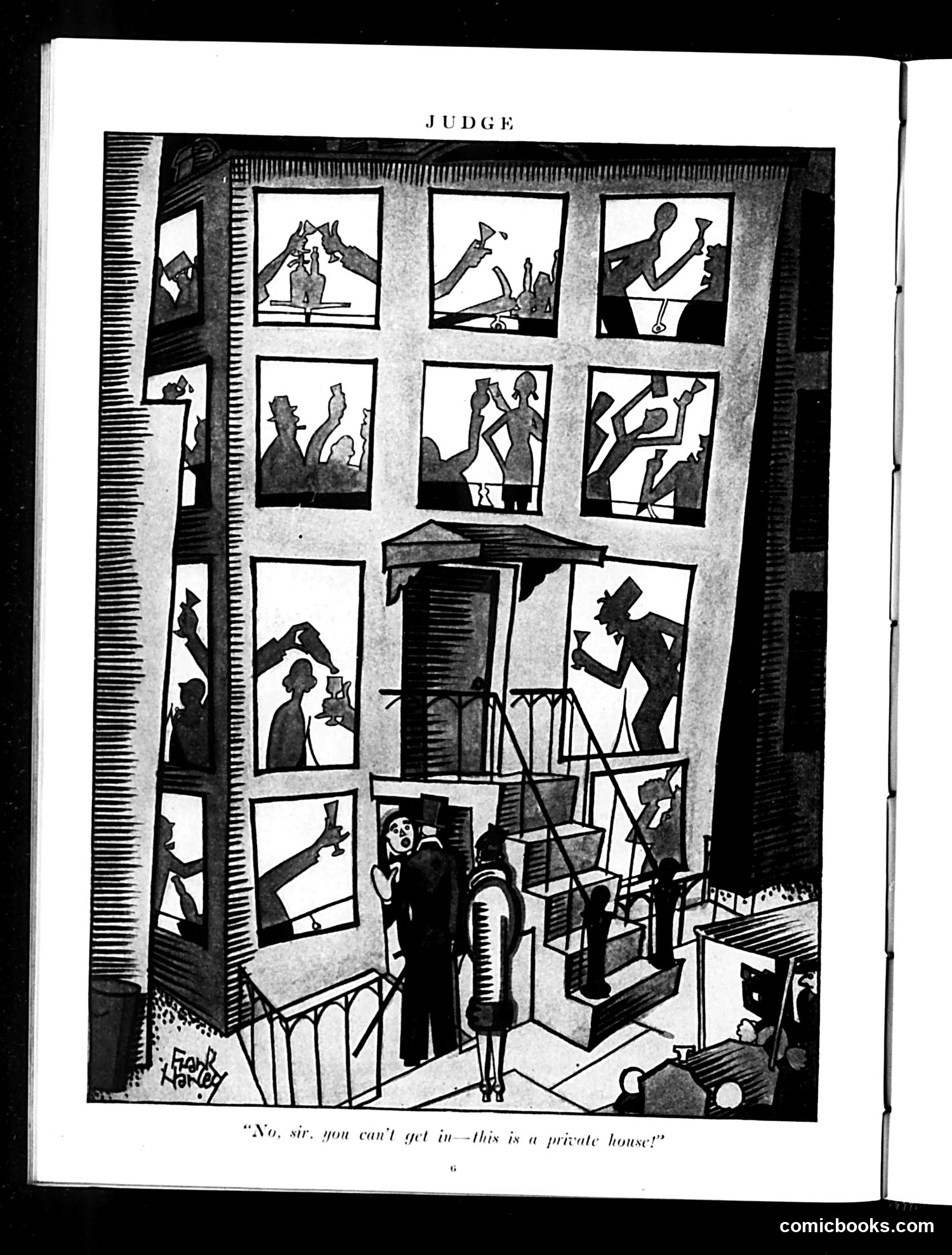
This single-panel cartoon depicts a tall apartment building with numerous windows showing various domestic scenes—couples arguing, people drinking, intimate moments, and general chaos. At street level, a man attempts to enter while a doorman blocks him with the caption: "No, sir, you can't get in—this is a private house!" The satire appears to target apartment living and lack of privacy in modern urban dwellings. Despite being theoretically "private" residences, the building's transparent windows expose residents' most intimate activities to public view. The joke suggests that calling these apartments "private" is absurd when everyone's business is visible to passersby—highlighting the irony of privacy claims in densely-packed city housing.
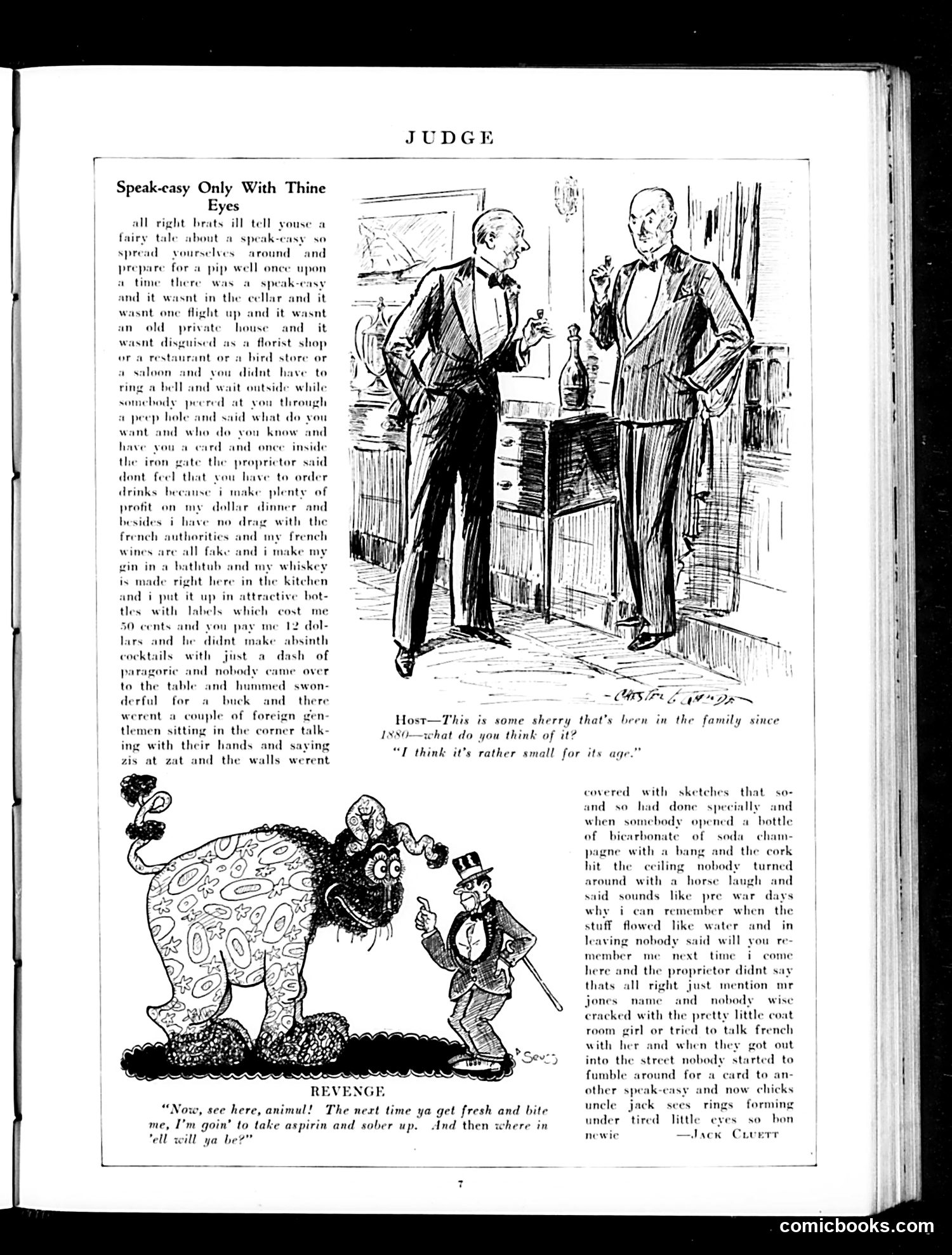
This page from *Judge* satirizes Prohibition-era speakeasy culture (1920s-1930s). The main article mocks the typical speakeasy experience through ironic contrast: it describes an imaginary speak-easy that *doesn't* have the usual suspicious entry procedures, watered-down alcohol, corrupt proprietors, or sketches covering the walls—in short, a place that operates openly and honestly, which is absurd because speakeasies by definition had to be secretive and deceptive. The satire criticizes both the establishments themselves (their low quality and profiteering) and the people who frequented them, who pretended not to notice obvious problems while engaging in elaborate social rituals. The two cartoons below are unrelated jokes: one about a man teaching an elephant manners, the other a dialogue about old sherry. The byline credits Jack Clertt.
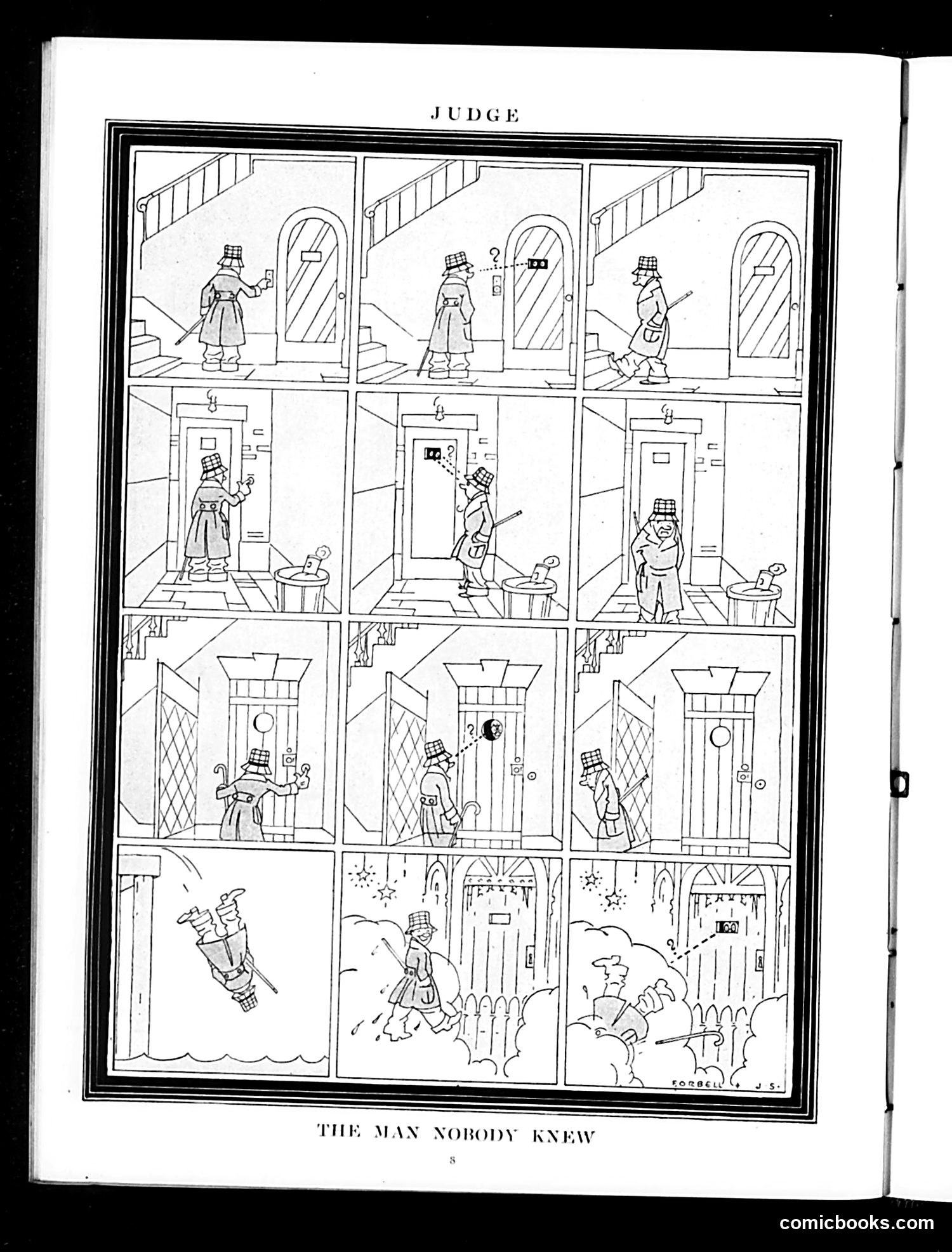
This is a sequential comic strip showing a character in a bowler hat repeatedly attempting to deliver or accomplish something, facing various obstacles and failures across multiple scenes. The strip progresses through interior spaces (hallways, rooms), exterior settings, and finally ends with the character apparently falling or being ejected into water. The title "The Man Nobody Knew" suggests this is satirizing someone obscure or unremarkable—likely a political figure or public personality of the Judge magazine era whose identity or significance was unclear to the public. The slapstick progression of failures and indignities appears to mock this figure's ineffectiveness or irrelevance. Without additional context about the specific publication date, the intended target remains unclear.
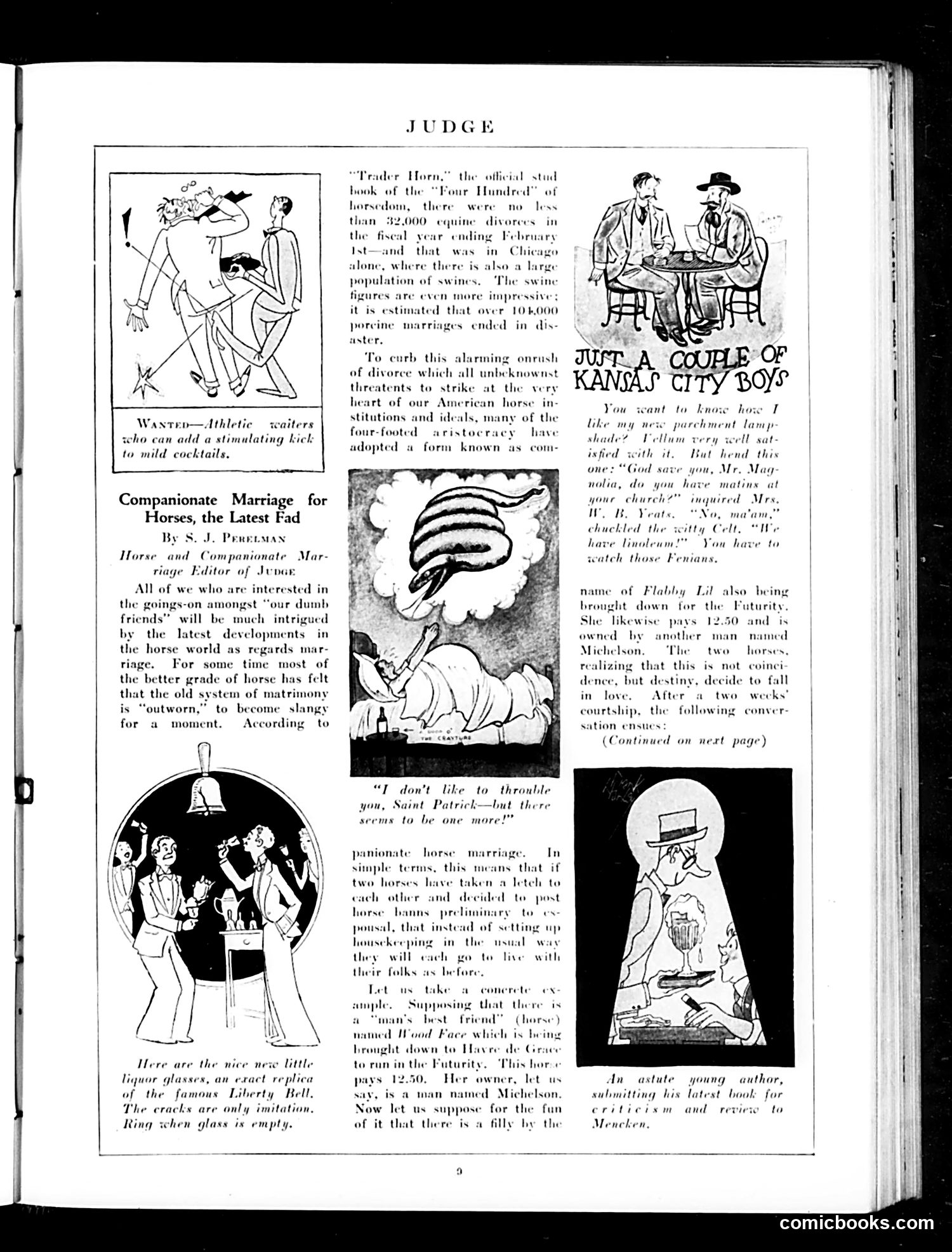
This page satirizes the 1920s "companionate marriage" trend—a progressive movement advocating couples live together without traditional legal marriage or formal household setup—by absurdly applying it to horses. **The satire:** The article mockingly treats horse breeding with the same social-reform language used in contemporary debates about human marriage. It references alarming divorce statistics (32,000 equine divorces in Chicago alone) and proposes horses adopt "companionate" arrangements where couples "live with their folks as before" rather than establishing joint households. **The joke's targets:** Upper-class horse owners ("Four Hundred" of horsedom), progressive social reformers, and perhaps H.L. Mencken (referenced in the sidebar illustration of "an astute young author"), who was a prominent cultural critic of the era. **Additional humor:** Side cartoons mock cocktail culture and Irish stereotypes (the Saint Patrick reference). The overall effect ridicules both progressive marriage reform and the pretentious concern devoted to horse-breeding among the wealthy.
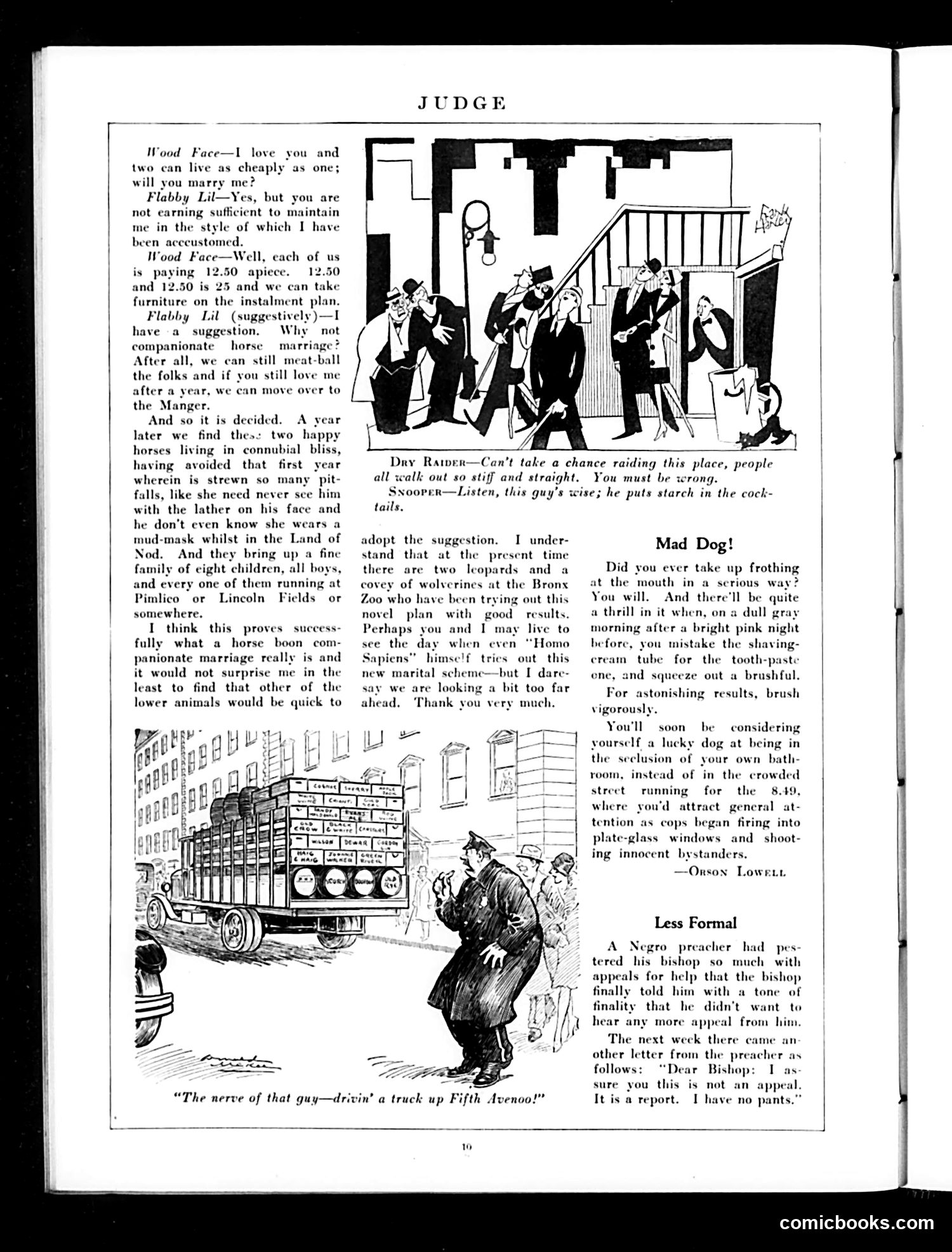
This page contains several satirical pieces typical of early 20th-century American humor: **"Companionate Horse Marriage"**: A dialogue between two horses discussing marriage economics satirizes the "companionate marriage" movement—a real 1920s trend advocating trial marriages or marriages based on companionship rather than permanence. The joke uses horses to mock the idea's absurdity, suggesting even animals could adopt it. **"Mad Dog" and "Less Formal"** are brief humorous anecdotes: the first jokes about mistaking shaving cream for toothpaste; the second tells a joke about a Black preacher cleverly requesting help by framing it as a "report" rather than an "appeal" to his bishop. The cartoons illustrate these pieces with period-appropriate drawings. The overall tone reflects Judge magazine's approach: gentle social satire targeting contemporary trends and racial stereotypes typical of that era's mainstream humor publications.
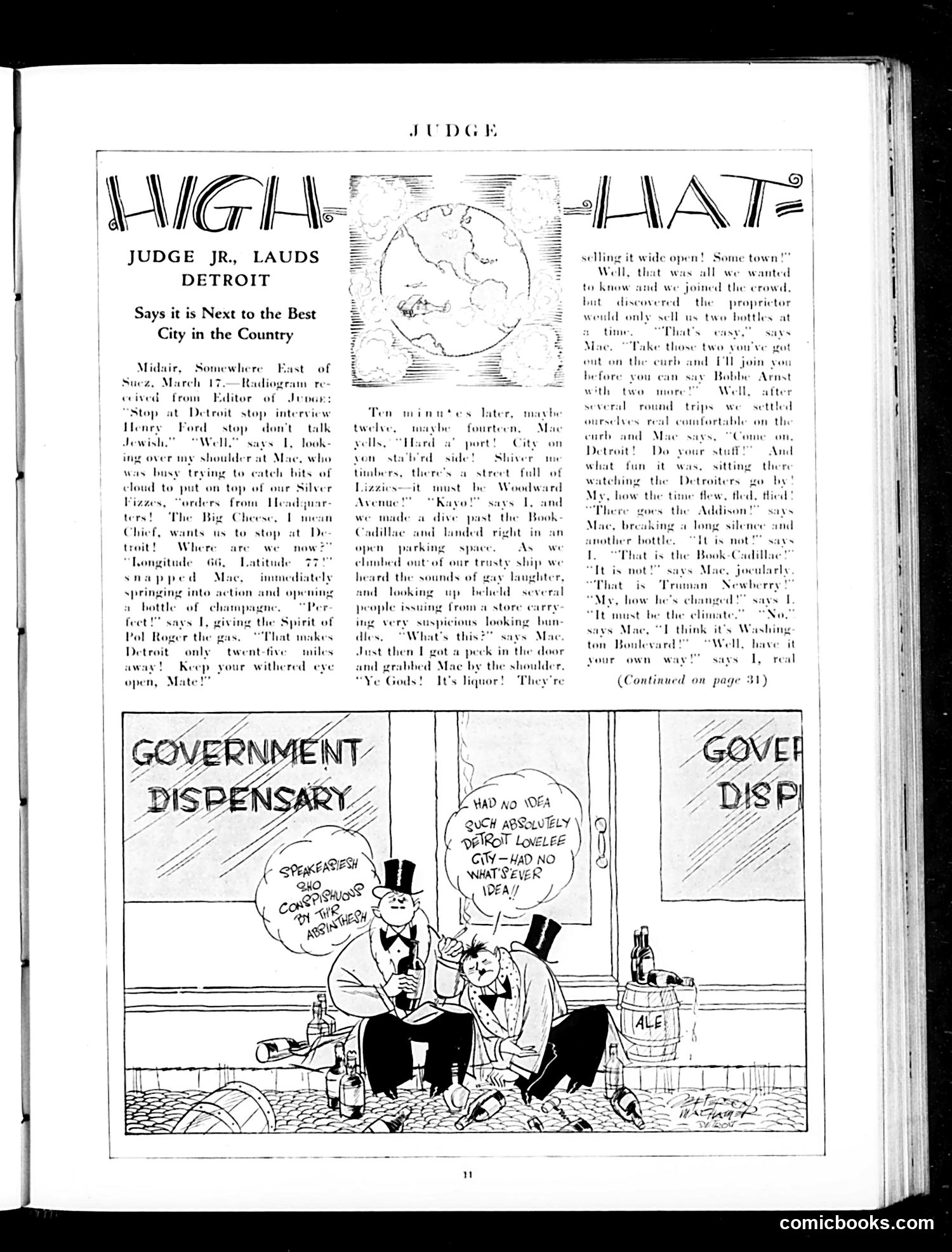
This page satirizes **Prohibition-era Detroit** through two pieces: ## Main Article ("High-Hat") A humorous first-person account of visiting Detroit by air. The narrator praises the city as "next to the best in the country" while depicting absurd scenes of casual liquor consumption despite Prohibition laws. References to "Silver Lizzies" (Ford Model Ts), Woodward Avenue, and landmarks like the Book-Cadillac Building establish the Detroit setting. The satire targets both Detroit's bootlegging culture and Prohibition's ineffectiveness—the protagonist easily purchases multiple bottles from street vendors with no legal consequence. ## Political Cartoon ("Government Dispensary") Shows two well-dressed figures at a "Government Dispensary" counter, discussing alcohol. One notes Detroit has "no idea" what it ever needed, while the other laments the city's complete lawlessness. The cartoon satirizes government hypocrisy: while officially banning alcohol sales, authorities appear complicit in widespread bootlegging. The barrels and bottles visible mock the contradiction between official policy and actual practice. **Overall point**: Detroit's rampant illegal liquor trade during Prohibition was so blatant and accepted that it became fodder for humorous criticism.
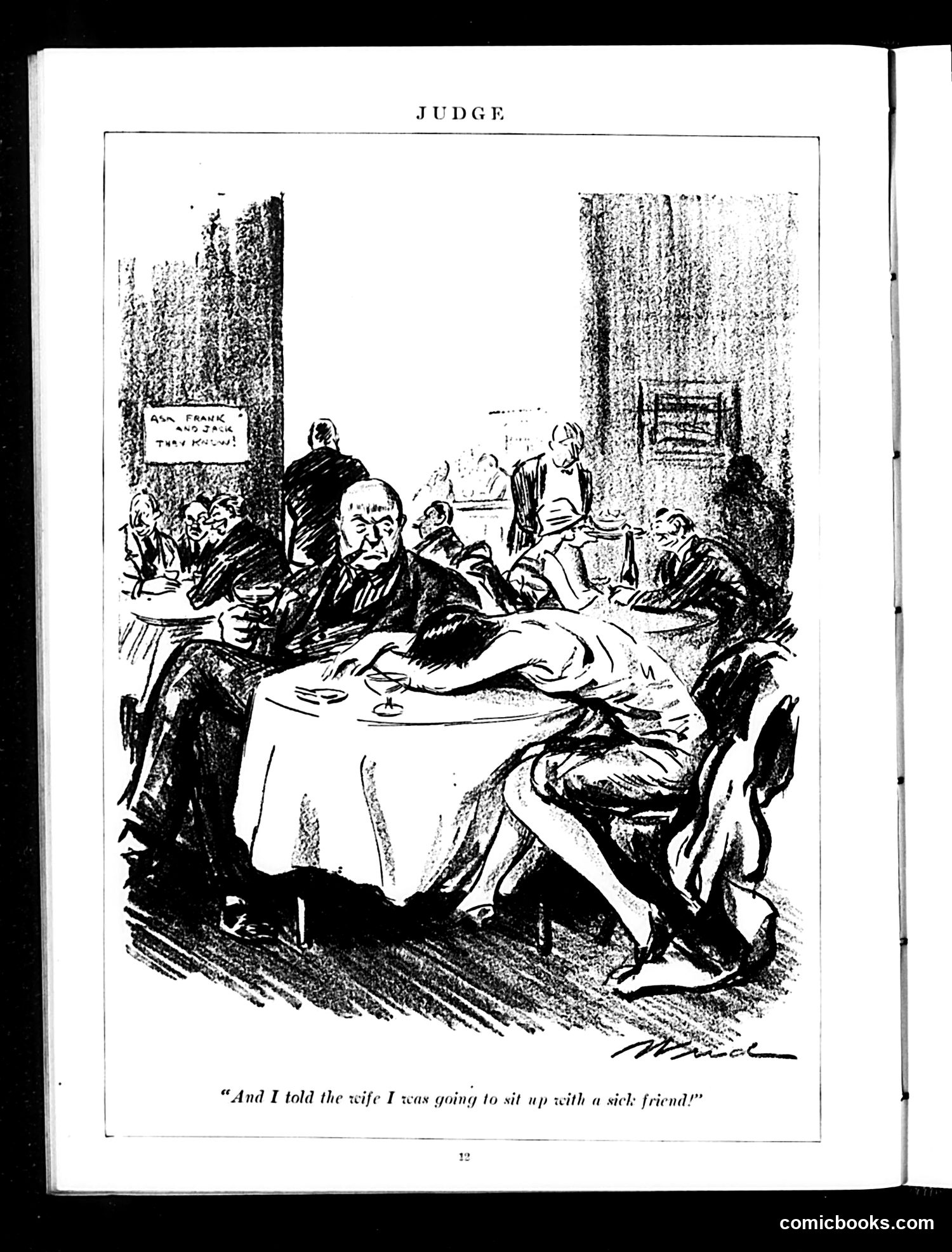
This single-panel cartoon depicts a domestic scene where a man sits at a dinner table with several other guests, apparently caught in a lie. The caption—"And I told the wife I was going to sit up with a sick friend!"—reveals the joke: he's actually dining out socially rather than attending to a supposedly ill companion. The satire targets male deception and infidelity of the era. The well-dressed gentleman's excuse about caring for a sick friend is exposed as pretext for enjoying entertainment and dining with others. This reflects Judge magazine's frequent mockery of bourgeois hypocrisy, particularly men's duplicity toward their wives. The illustration style and clothing suggest early 20th-century America, when such satirical commentary on marital discord was popular magazine humor.
This page contains two satirical articles critiquing American economic and social policies of the Prohibition era. **"The Gracious Speak-easy"** defends illegal bars as superior to pre-Prohibition saloons. The author argues speak-easies have brought "quiet and grace" to drinking by excluding "objectionable drunks" and "political heelers." The satire is tongue-in-cheek—acknowledging the "furtiveness" of sneaking through hidden doors feels "silly" yet necessary. Notably, Judge here endorses Prohibition-era lawbreaking as socially preferable, suggesting the magazine's irreverent stance toward federal alcohol bans. **"Profitless Prosperity"** warns that America's post-war economic boom masks structural problems. Citing banker Paul Mazur, it argues factories produce efficiently but distributors cannot move goods—consumers can afford only 65% of potential output. Unemployment rises despite prosperity. The solution isn't returning to slow production but improving distribution infrastructure and reducing waste. Both pieces reflect 1920s anxieties: Prohibition enforcement, economic inequality despite apparent prosperity, and industrial inefficiency.
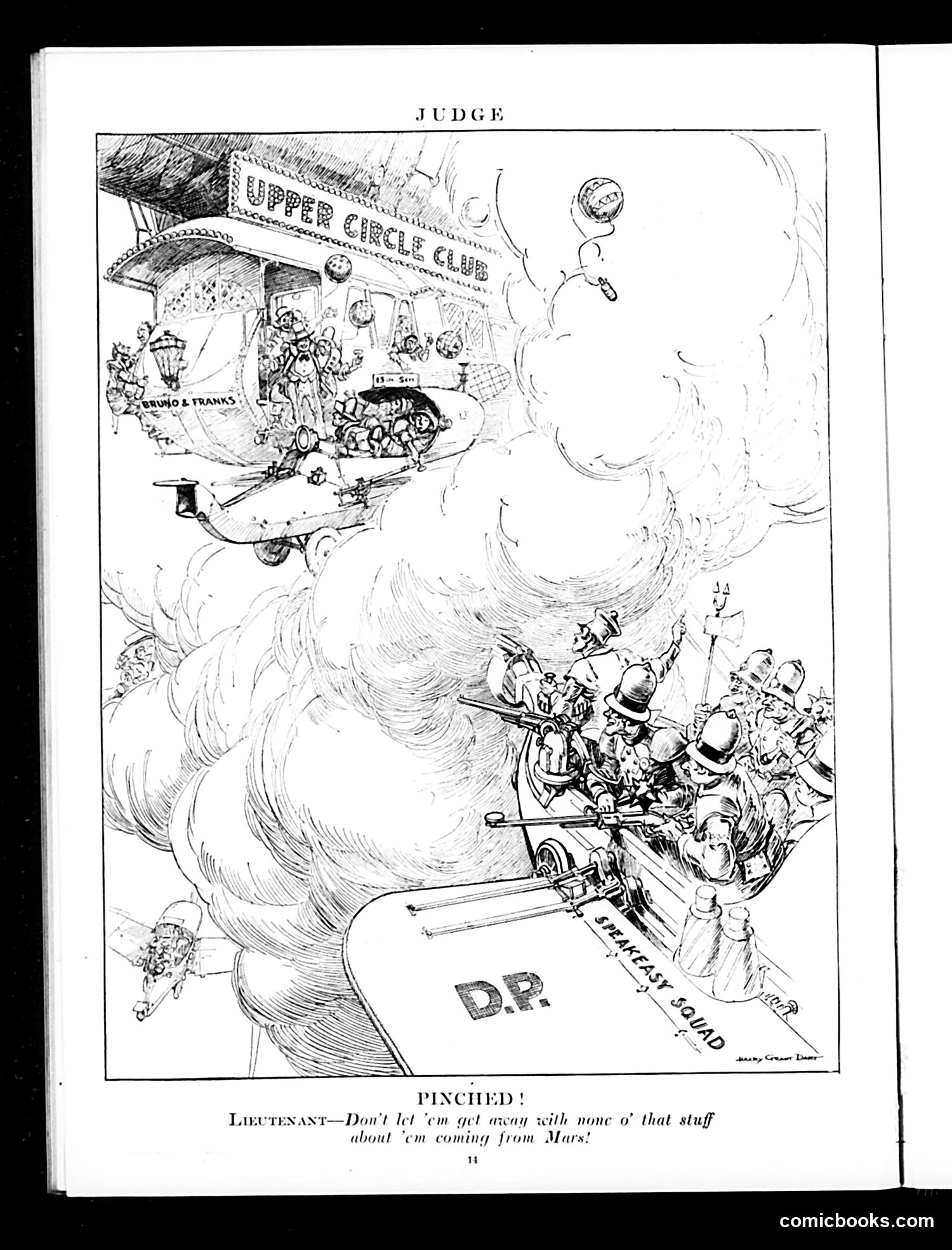
This political cartoon depicts a dramatic scene titled "Pinched!" where a police lieutenant warns against allowing something unspecified "from Mars." The upper left shows the "Upper Circle Club" (a gentlemen's establishment) in what appears to be a flying vessel. Below, a large tornado or whirlwind labeled "D.R." (possibly referring to a political figure or concept—unclear from context) engulfs uniformed police and officials on the ground. The cartoon appears to satirize either: - Concerns about foreign interference or exotic threats - Police/authority figures struggling to maintain control against chaotic forces - A topical scandal or controversy involving exclusive clubs and corrupt authority Without additional context about Judge magazine's publication date and contemporary events, the specific political targets remain unclear, though the "Mars" reference suggests mockery of sensationalized or absurd claims.
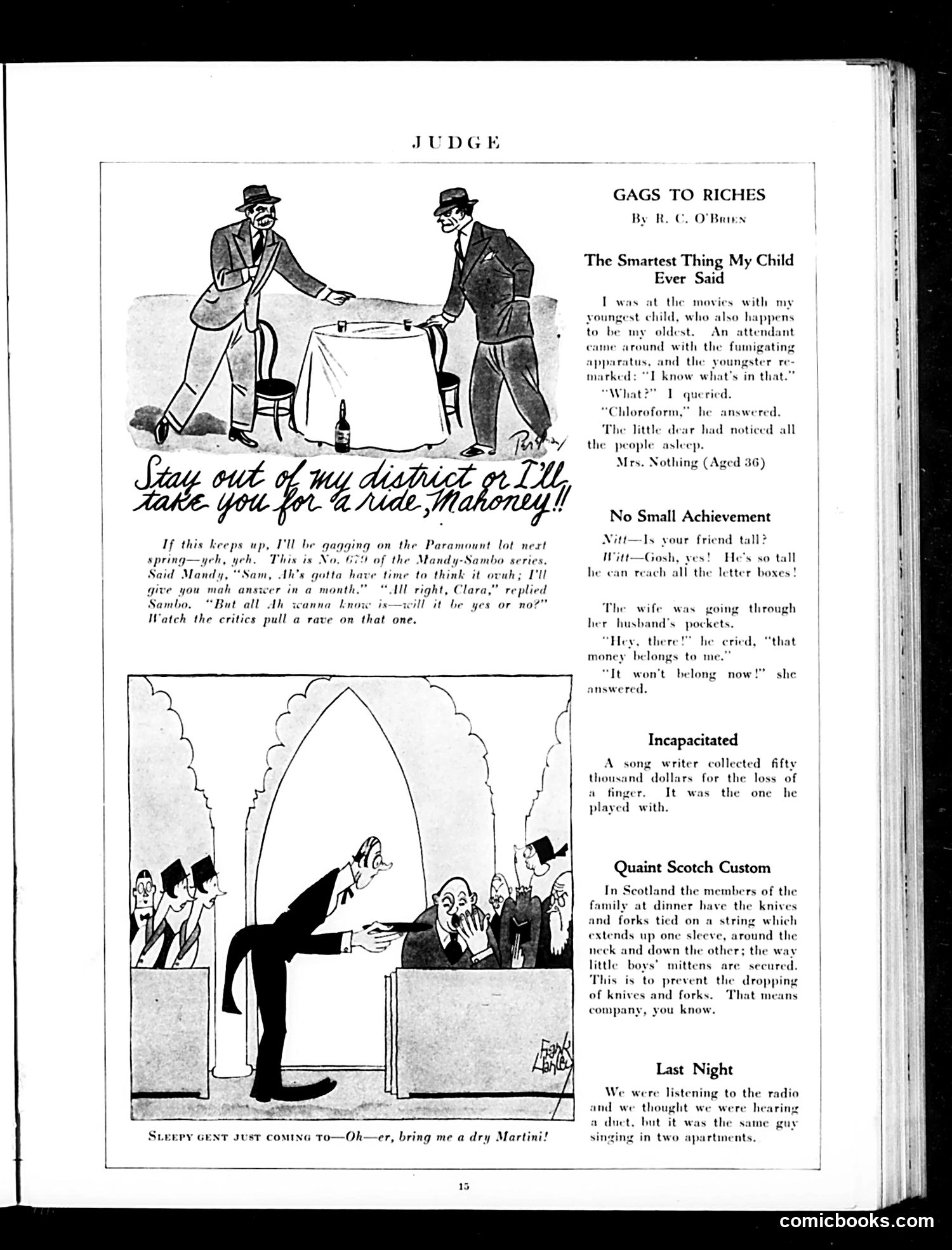
This page from *Judge* magazine contains several short humorous pieces ("gags") typical of early 20th-century American humor: **Top cartoon**: Two men in suits threaten each other over a card table, with one saying he'll take the other "for a rude, Mahoney!" The caption jokes this is part of a recurring "Mandy-Sambo series"—racist stereotyped characters common to that era. **Other pieces** include: - A child's joke about chloroform at movie theaters (referencing fumigation/pest control as "knocking people out") - Marital humor about wives stealing husbands' money - A Scottish cultural joke about tying cutlery to sleeves at dinner - A radio joke about hearing the same singer in two apartments The humor is mild, domestic, and relies on period-specific references (Paramount studios, radio broadcasts). The racist "Mandy-Sambo" reference reflects *Judge*'s unfortunate editorial choices of that era. Overall, this represents mainstream American magazine humor from roughly the 1920s-30s.
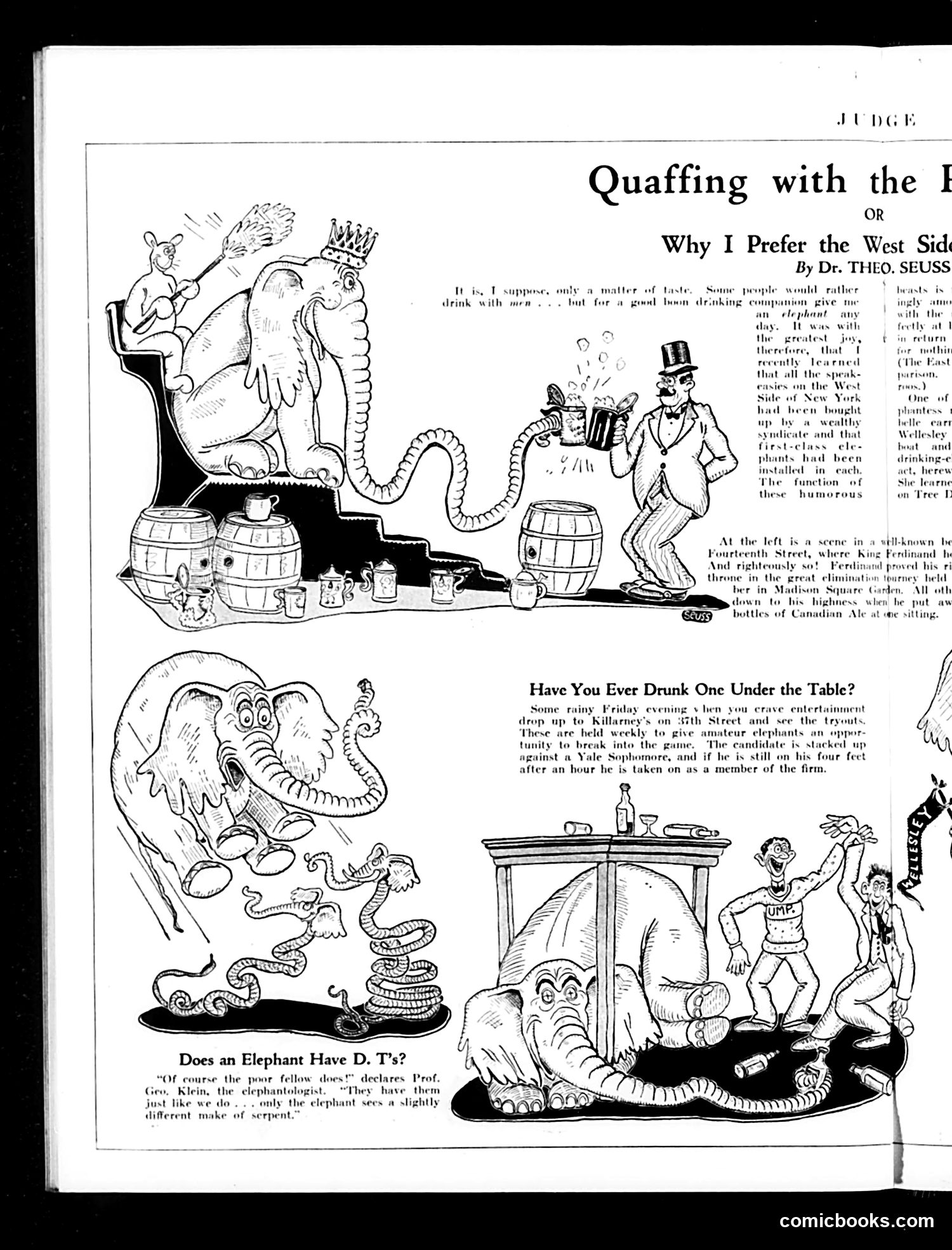
This page features early work by Dr. Seuss (Theodor Geisel) in Judge magazine, using elephants as satirical vehicles for Prohibition-era humor. **"Quaffing with the Elephant"** depicts wealthy New Yorkers drinking illegally with an elephant at speakeasies on the West Side, mocking the absurdity of Prohibition enforcement and the underground drinking culture it spawned. **"Have You Ever Drunk One Under the Table?"** references Yale fraternity hazing rituals involving amateur "elephant" initiations—satirizing upper-class collegiate excess and dangerous drinking competitions. **"Does an Elephant Have D.T.'s?"** plays on "delirium tremens" (alcohol withdrawal hallucinations), with a professor joking that elephants would see serpents instead of pink elephants—mocking both pseudoscientific commentary and the cultural cliché of alcohol-induced visions. The cartoons satirize Prohibition's failure, elite hypocrisy regarding drinking laws, and dangerous drinking culture among the wealthy and collegiate classes.
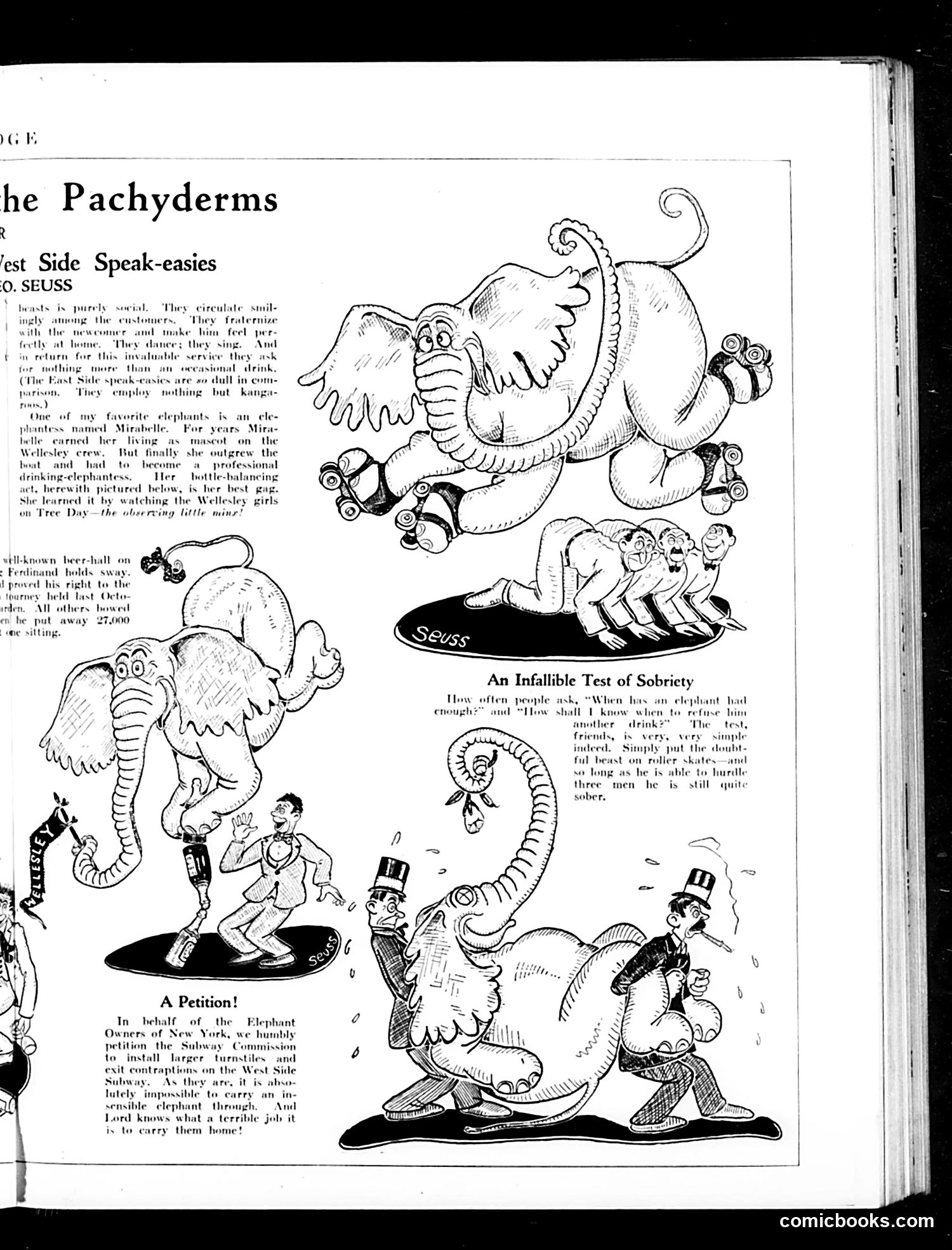
This page by Dr. Seuss satirizes Prohibition-era New York City speakeasies (illegal bars) operating on the West Side, using elephants as stand-ins for intoxicated patrons. The cartoons depict elephants in various states of inebriation—rolling on roller skates, being carried by men in top hats, and generally behaving uncontrollably. The humor plays on the elephant as a symbol of both weight/bulk and uncontrollable behavior when drunk. "A Petition!" mocks subway officials' concerns about transporting these drunken "pachyderms," arguing it's impossible to move such unwieldy creatures through turnstiles while intoxicated—a commentary on the chaos and absurdity of Prohibition enforcement and speakeasy culture. The text jokes about determining when an elephant has had enough to drink, satirizing how openly speakeasies flouted alcohol restrictions. The overall message critiques the failure of Prohibition and the rampant illegal drinking in Manhattan.
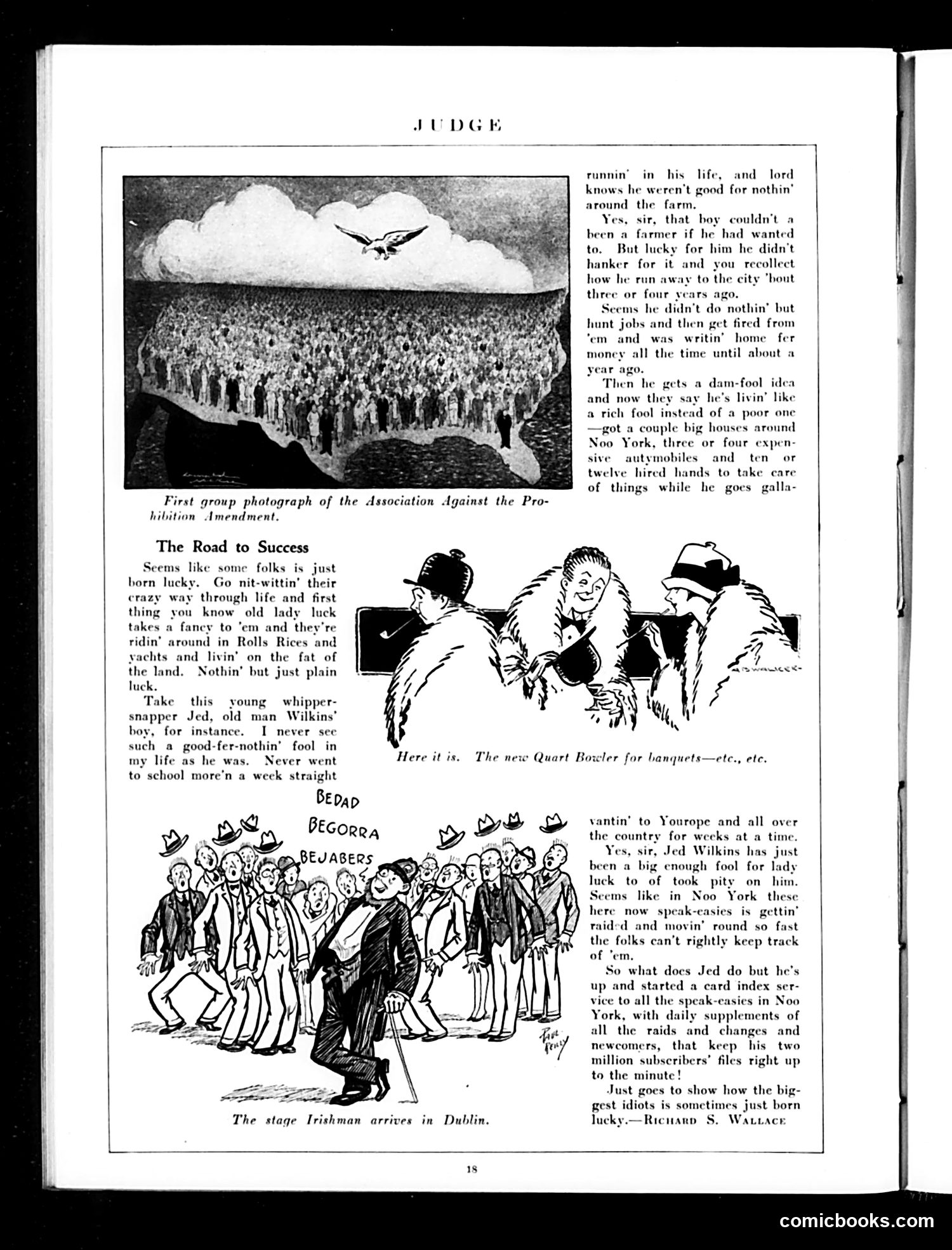
This page satirizes American wealth and luck through the story of Jed Wilkins, a farm boy who failed at everything conventional. The narrative mocks how some people succeed through sheer foolishness rather than merit—Jed becomes wealthy operating an illegal card-index service tracking speakeasy raids during Prohibition. The top photograph shows the "Association Against the Prohibition Amendment," referencing the real political movement opposing alcohol bans. The cartoon's point: Prohibition created absurd opportunities for con artists. Jed's "success" despite being fundamentally incompetent exemplifies how Prohibition's illegality generated bizarre, profitable schemes. The satirist (Richard S. Wallace) suggests that the biggest fools sometimes profit most in a system built on illegal activity—a critique of both Prohibition's unintended consequences and American culture's worship of luck over legitimate achievement.
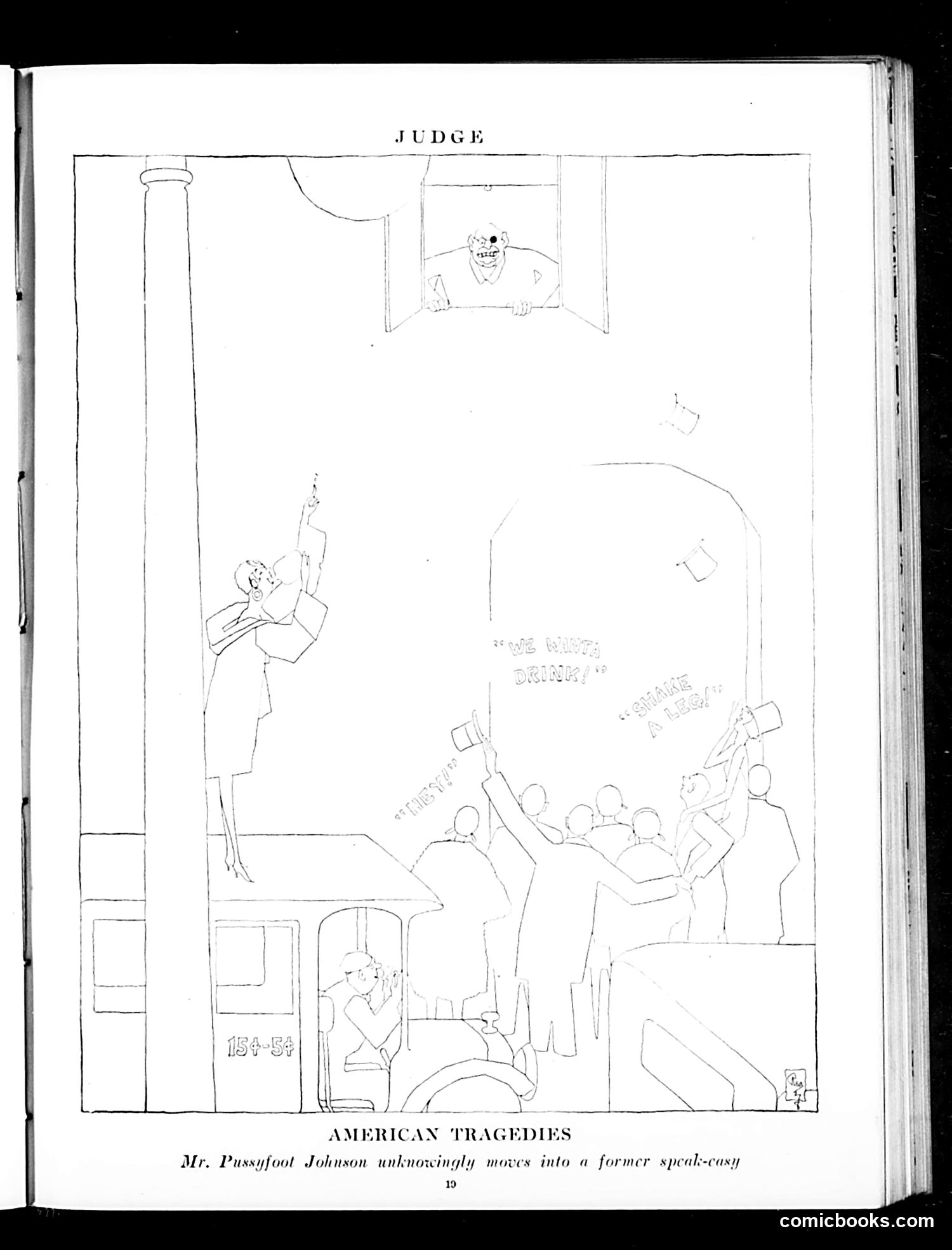
This Judge magazine cartoon satirizes **William "Pussyfoot" Johnson**, a famous Prohibition-era activist and temperance crusader. The joke depicts Johnson unknowingly moving into a building that was formerly an illegal speakeasy (underground bar) during Prohibition. The humor lies in the irony: Johnson, known for aggressively campaigning against alcohol consumption and illegal drinking establishments, has inadvertently become a resident of exactly the type of venue he fought against. The cartoon shows the judge's elevated position overseeing the scene, while various figures below appear to represent the speakeasy's illicit activities. "Pussyfoot" was Johnson's actual nickname, derived from his stealthy investigative tactics. The cartoon mocks both his zeal and the absurdity of Prohibition-era contradictions, suggesting that even crusaders cannot escape the pervasiveness of illegal drinking culture in 1920s America.
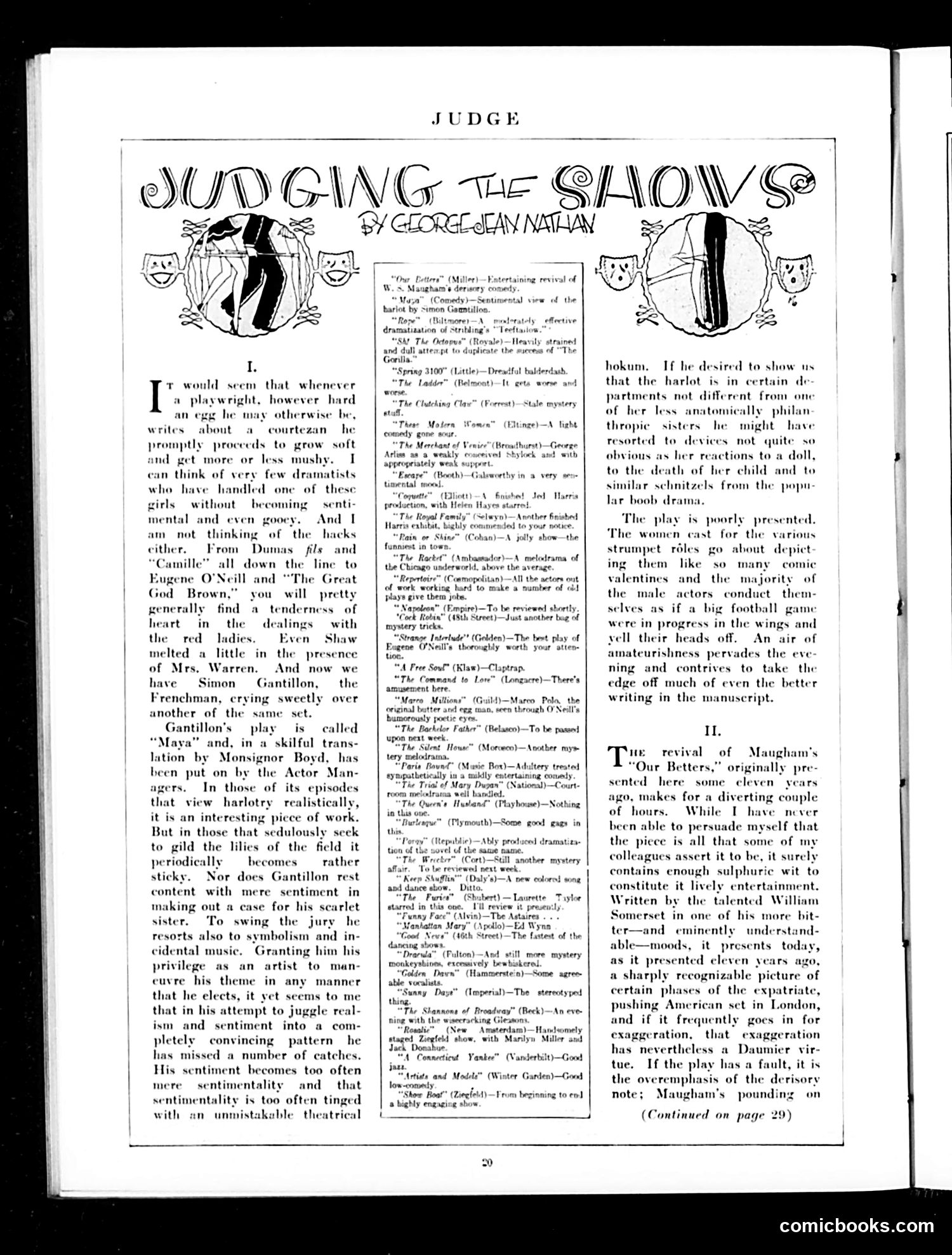
This is a theater review column, not a political cartoon. The page critiques two Broadway productions: **Part I** reviews Simon Gantillon's play about a courtesan, arguing that dramatists—from Alexandre Dumas fils to Eugene O'Neill—sentimentalize prostitutes excessively. Nathan criticizes Gantillon for combining realism with melodrama, creating "mere sentimentality" tinged with "theatrical" hokum. He faults the amateur acting quality and staging, which undercuts the script. **Part II** begins reviewing W. Somerset Maugham's "Our Betters," a comedy revival from eleven years prior. Nathan acknowledges the play entertains adequately, though he disputes colleagues' high praise for it. The page lists numerous other contemporary Broadway productions in small type as reference.
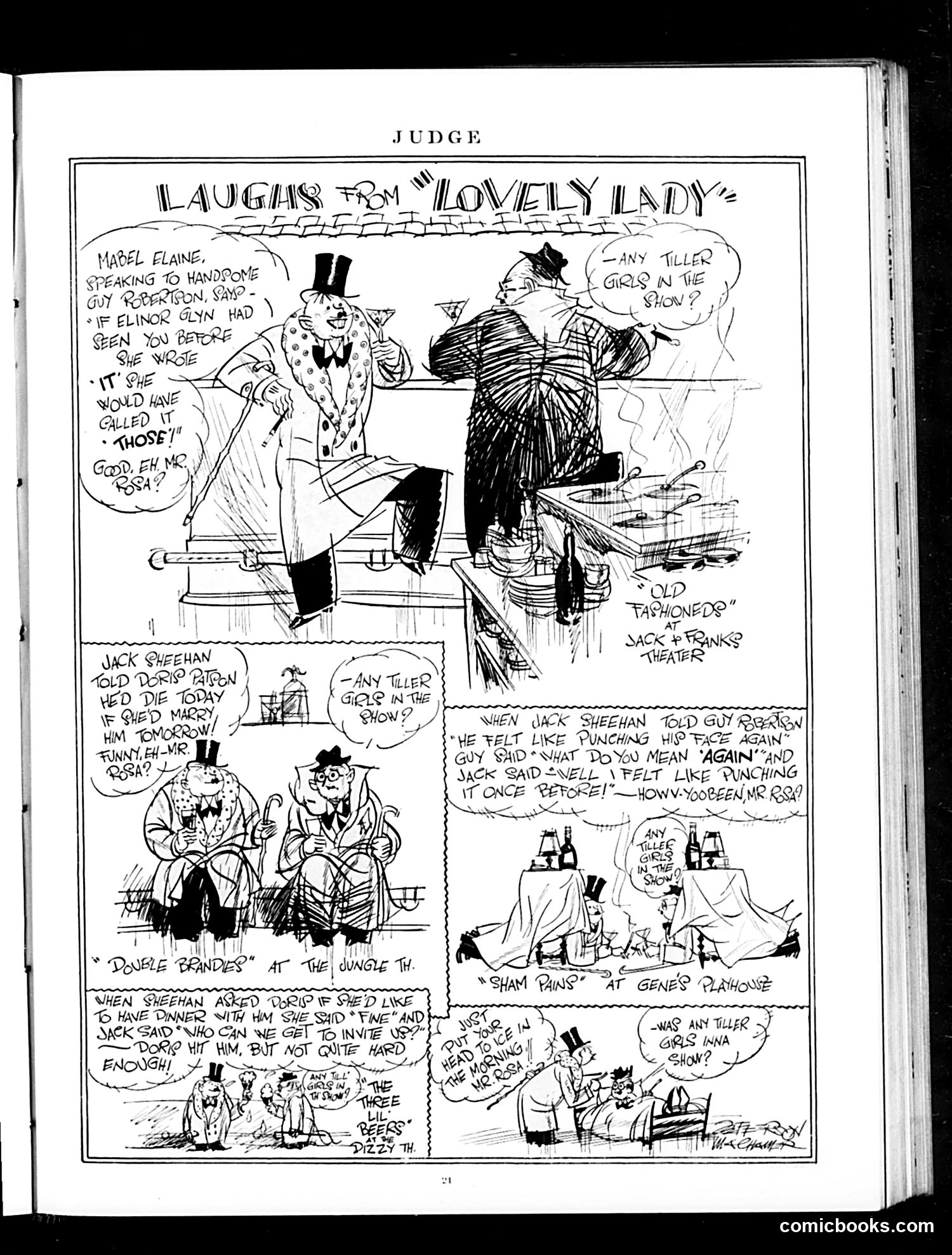
This page collects theatrical gossip and anecdotes about Broadway figures from the early 20th century. The cartoons satirize showbiz personalities through exaggerated caricatures and crude drawings typical of Judge's style. Key references include: - **Elinor Glyn**: A famous novelist/screenwriter known for romantic comedies - **Mabel Elaine, Jack Sheehan, Dario Bacon**: Appear to be theater personalities of the era - The jokes revolve around romantic misunderstandings, drinking ("Double Brandies," "Sham Pains"), and theatrical banter The humor relies on period-specific theatrical gossip and wordplay that would've amused contemporary readers familiar with these performers. References to "tiller girls" (chorus dancers) and nightclub scenes reflect Jazz Age entertainment culture. Without clearer identification of all figures, the specific satirical points remain partially obscure to modern readers unfamiliar with 1920s-era Broadway society.
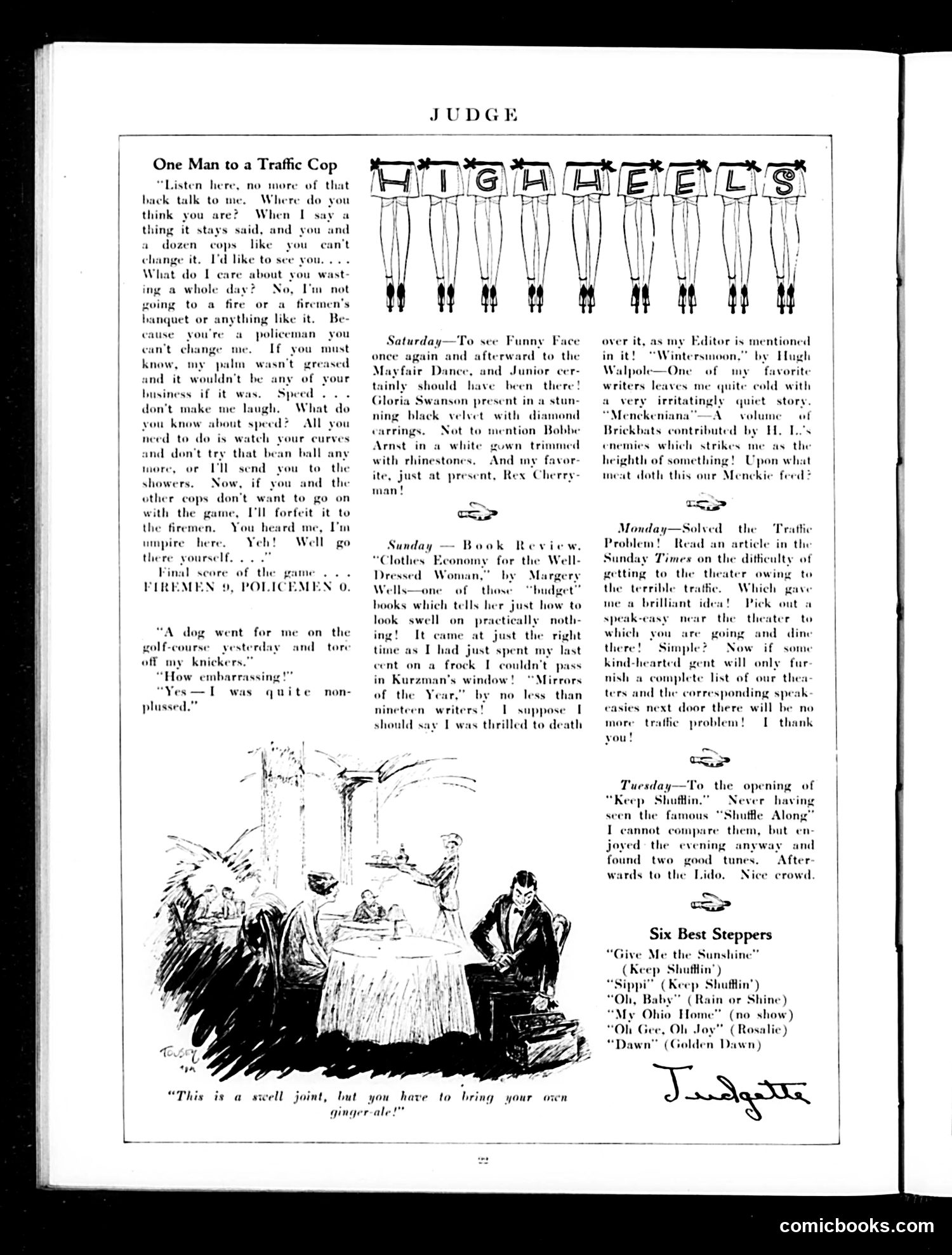
This page contains entertainment commentary and humor typical of 1920s Judge magazine. The main cartoon depicts a confrontation between a traffic cop and an angry motorist who berates the officer with threats and insults, ending with "FIREMEN 9, POLICEMEN 0"—a sports-style scoreboard joke suggesting the motorist has verbally defeated the cop as if in a game. The surrounding text includes a gossip column reviewing Broadway shows and current entertainment (referencing Gloria Swanson, Rex Cherrymen, and the musical "Keep Shufflin'"). There's also a golf anecdote about a dog incident and book reviews of popular titles. The humor reflects 1920s urban frustrations: traffic congestion, police authority tensions, and celebrity culture. The "ginger ale" joke at the bottom likely references Prohibition-era speakeasies. Overall, the page satirizes contemporary social friction and entertainment obsessions of the period, with the traffic cop cartoon being the main satirical piece about class conflict and urban rudeness.
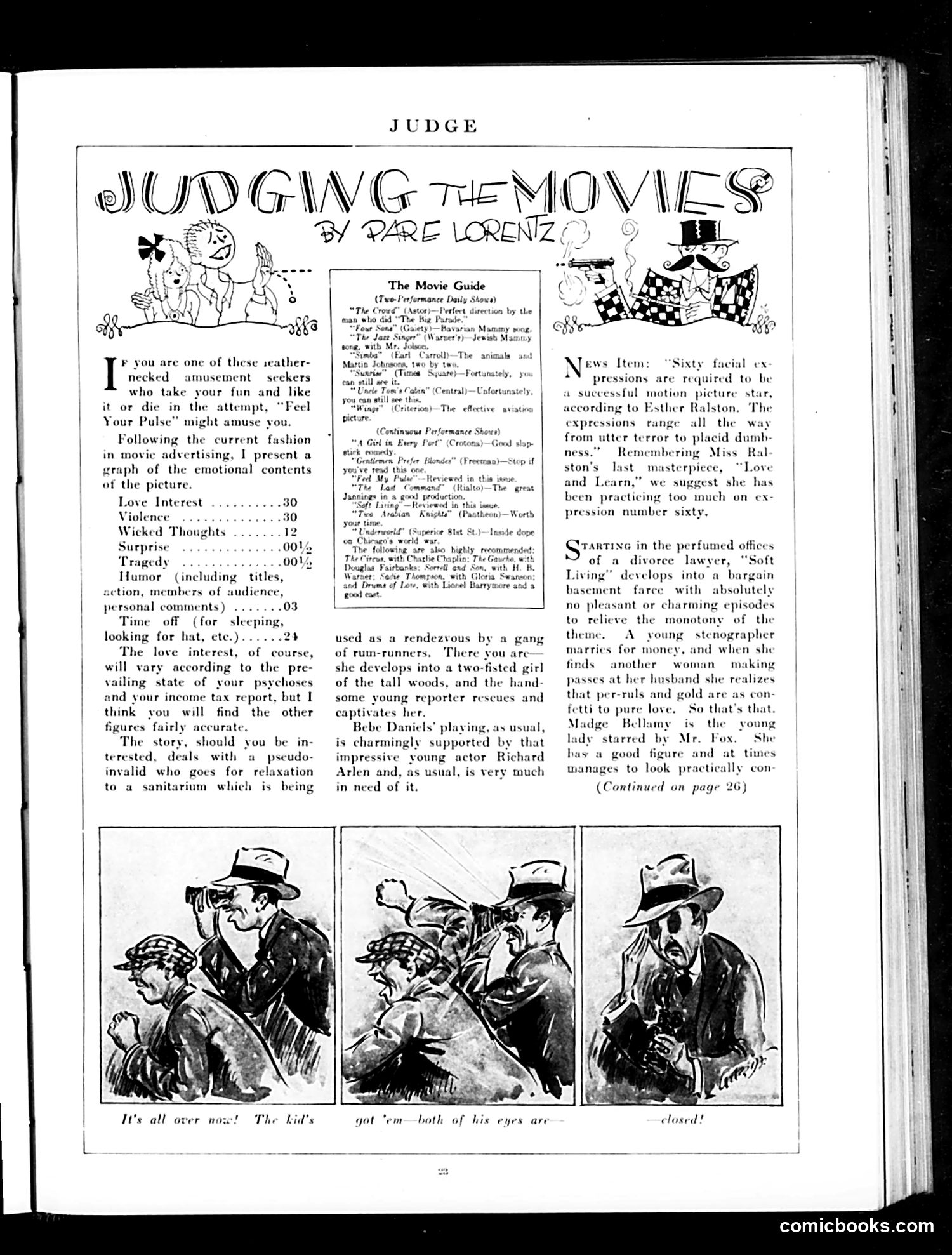
This is a film criticism column disguised as satire. Lorentz mocks shallow moviegoers who demand entertainment above all else, presenting a humorous "emotional content graph" for a film called "Feel Your Pulse"—claiming it contains almost no actual substance (only 0.03% humor, 24% dead time). The three cartoon panels below show what appears to be a slapstick scene, likely from the film being reviewed, depicting physical comedy with characters and a child. The column reviews several 1920s films featuring actors like Bebe Daniels and Madge Bellamy. Lorentz employs gentle mockery: he praises Daniels' "charming" performance while suggesting she needs the supporting actor's talent to carry scenes, and he jokes that actress Esther Ralston has been "practicing" her blank expression (expression #60) too much—implying wooden acting. The satire targets both lowbrow entertainment culture and the era's emerging star system.
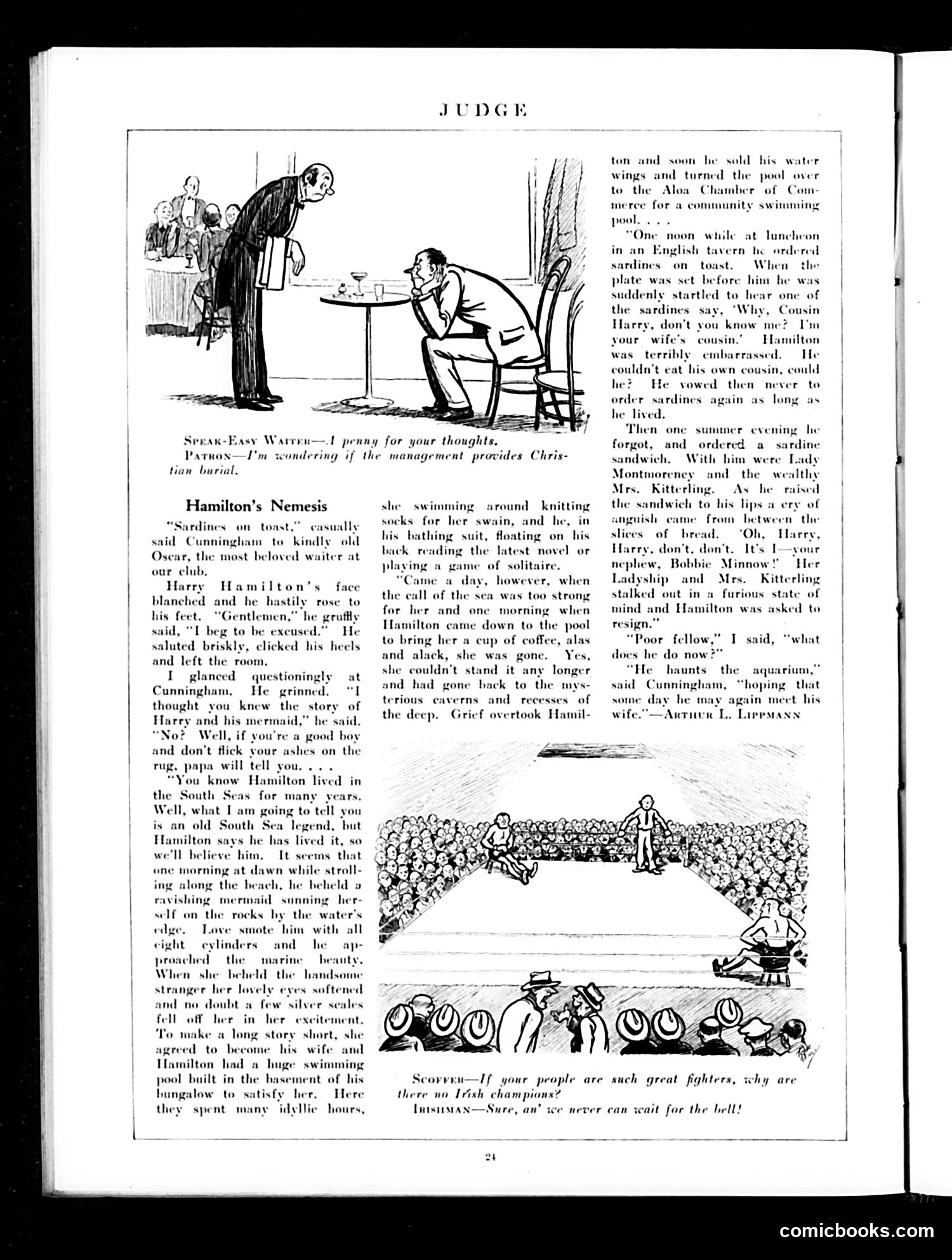
This page contains a humorous short story (rather than political satire) about Harry Hamilton, a wealthy man who lived in the South Seas. The narrative mocks colonial romanticism and absurdity. **The Setup:** Hamilton falls in love with a mermaid, builds her a swimming pool in his mansion basement, but she eventually returns to the sea. **The Joke:** Years later, Hamilton keeps encountering his former mermaid lover—first as a sardine (her "cousin"), later as another sardine (her "nephew")—ruining his meals at fancy establishments and causing social embarrassment. **The Satire:** This gently ridicules wealthy colonial adventurers and their fantastical, self-aggrandizing stories. The story's escalating absurdity (a mermaid's extended family appearing as seafood) undercuts any romantic pretension. The page also contains a separate brief exchange mocking Irish boxing, with stereotyped dialect humor typical of the era.
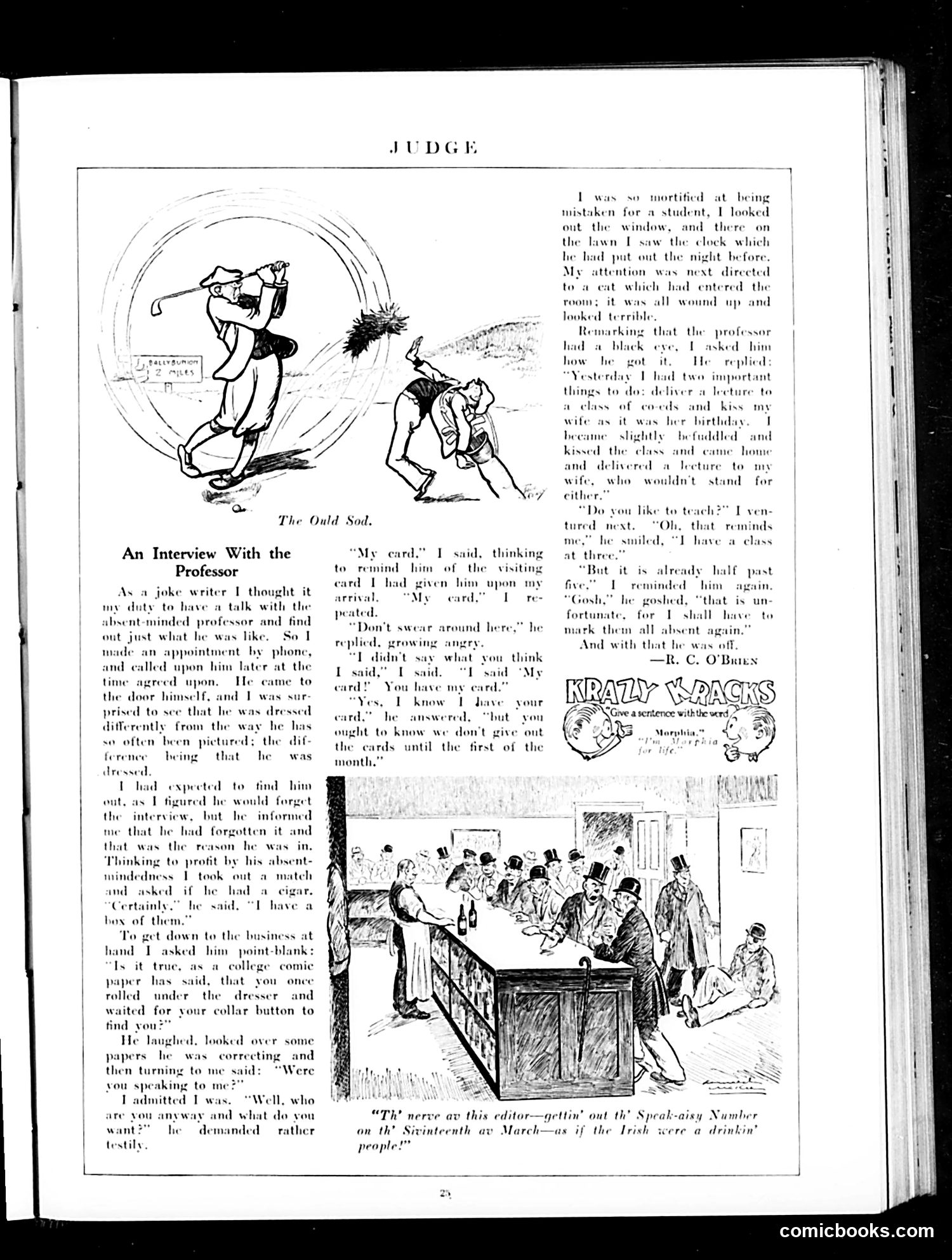
## "The Ould Sod" & "An Interview With the Professor" This page satirizes the absent-minded professor stereotype, a popular comic figure of the era. The interview depicts a professor who is perpetually confused, forgetful, and socially awkward—he forgets his own appointment, mistakes a visitor for a student, and loses track of time so badly he arrives three hours late to a class. The humor trades on academic eccentricity: he confuses kissing his wife with kissing his class, keeps a wound-up clock on the lawn, and sports a black eye from his befuddlement. The "Ould Sod" title and reference to "the Irish" in the lower cartoon suggest Irish-American stereotyping common to Judge's era. The bottom illustration appears unrelated—a speakeasy scene, likely referencing Prohibition-era social commentary about illegal drinking establishments ("speak-easy"). The satire mocks both professorial absent-mindedness and, contextually, Irish-American culture through predictable period stereotypes.
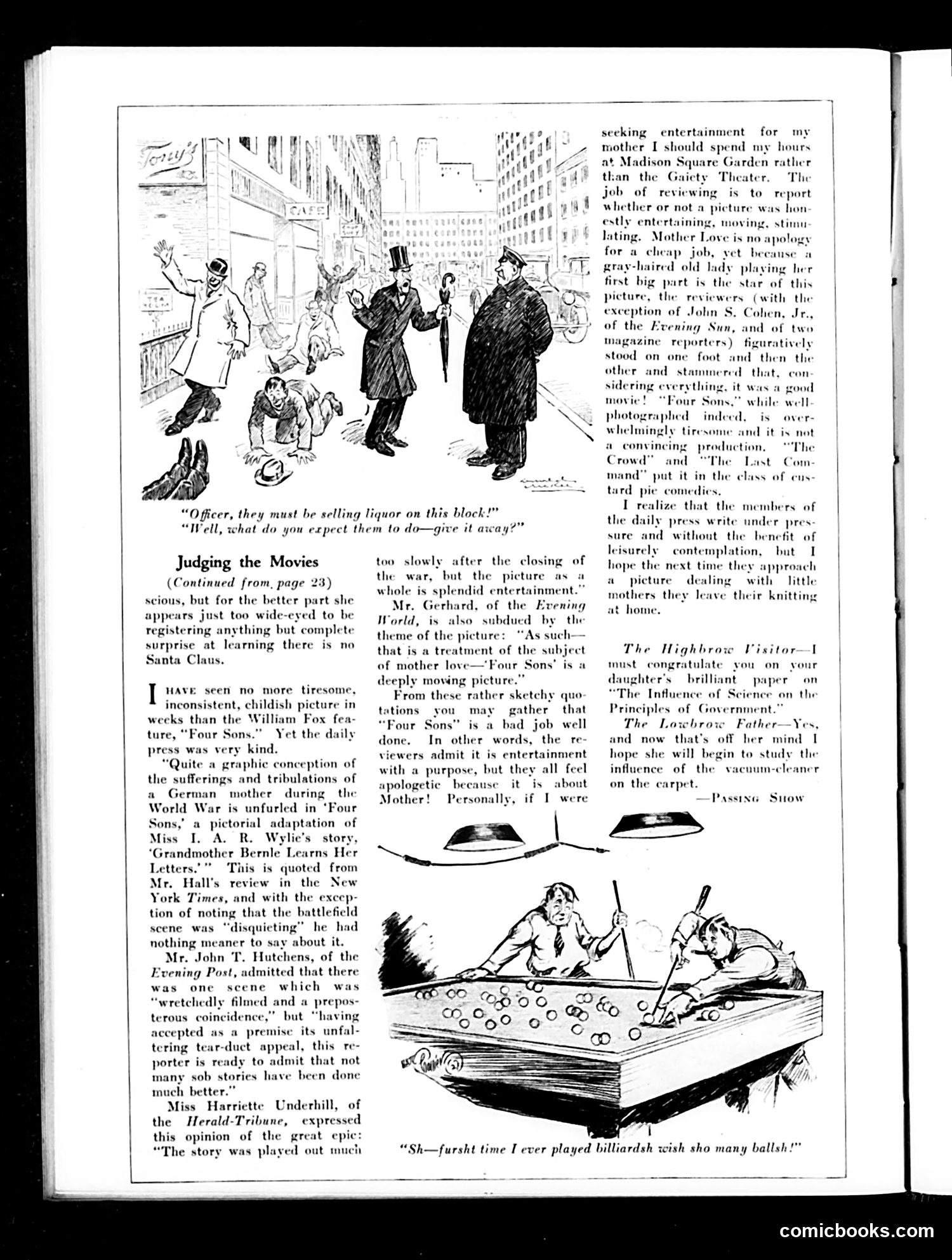
**Top Cartoon:** A street scene satirizing Prohibition enforcement. Police officers encounter someone selling liquor illegally; when questioned what else they expect vendors to do, the joke exposes the absurdity: if you criminalize selling liquor, vendors must give it away—an impossible expectation. This mocks the failure of Prohibition policy. **Main Article:** "Judging the Movies" critiques film reviewers' treatment of *Four Sons*, a William Fox picture about a German mother during World War I. The author argues reviewers gave it favorable notices not on artistic merit but because it's sentimental—featuring an elderly woman in her first major role. The piece attacks critics for abandoning objectivity when emotionally manipulated by "Mother Love" themes, comparing them to being "tear-duct appeal" victims rather than evaluating entertainment quality honestly. **Small Cartoons Below:** Two unrelated vignettes—one about a billiards game, one about domestic life—appear to be filler or humor sketches typical of the magazine format.
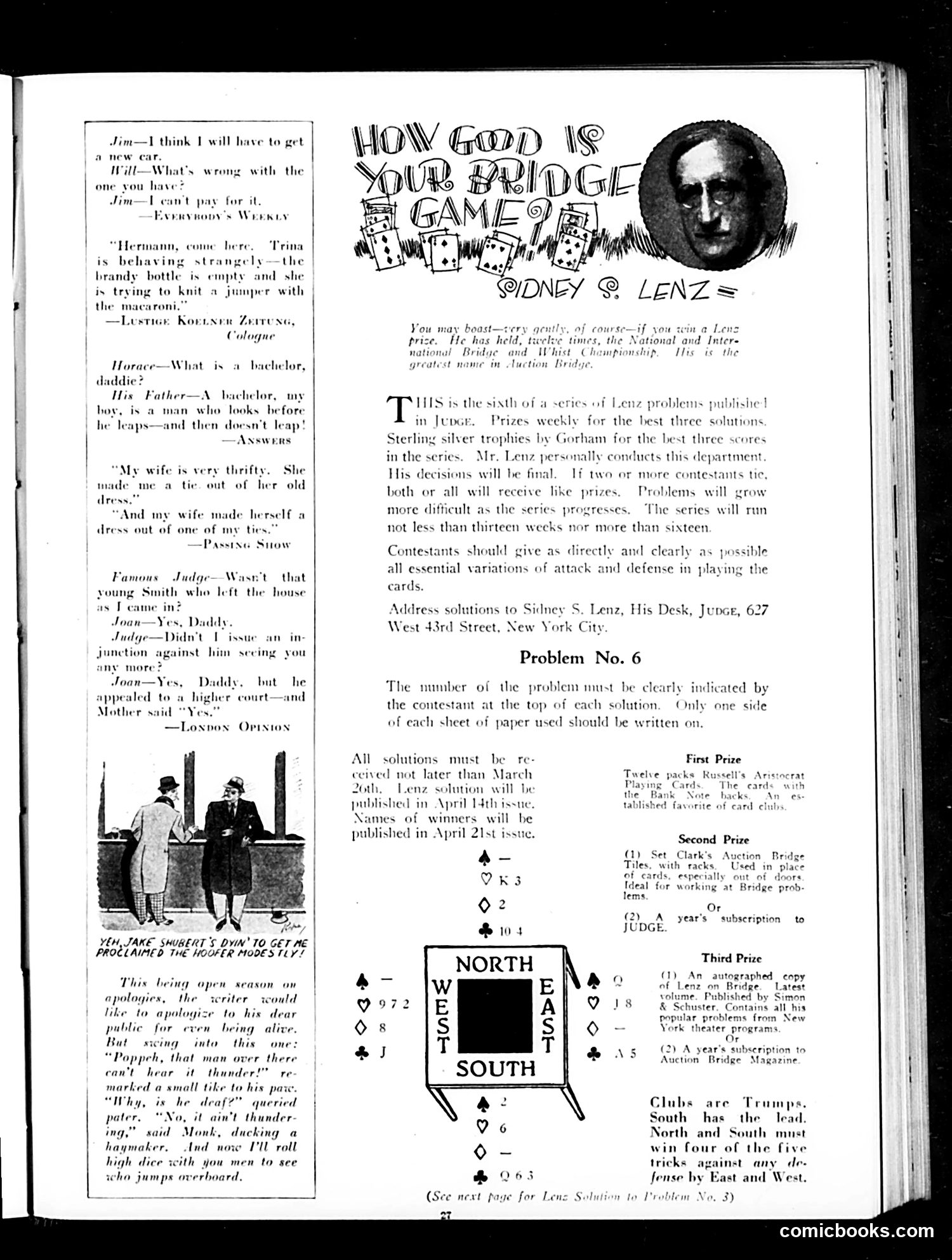
This page contains **humorous one-liners and jokes** rather than political satire. The left column features brief comedic exchanges on domestic and social topics—a man who can't afford his car, a wife's thriftiness, a father explaining what a bachelor is, and a legal anecdote about a young man evading a court injunction through his mother's permission. The right side showcases **Sidney Lenz's bridge card game competition**, the sixth in an ongoing series. Lenz was a prominent bridge expert; the page invites readers to submit solutions to bridge problems for weekly prizes (silver trophies, subscriptions, and Lenz's published books). The cartoon at bottom left appears unrelated to the text above it—a generic domestic scene. **Historical context**: Bridge was a major recreational and competitive activity for upper-class Americans in the early 20th century. Judge magazine regularly featured such puzzles and competitions alongside humor.
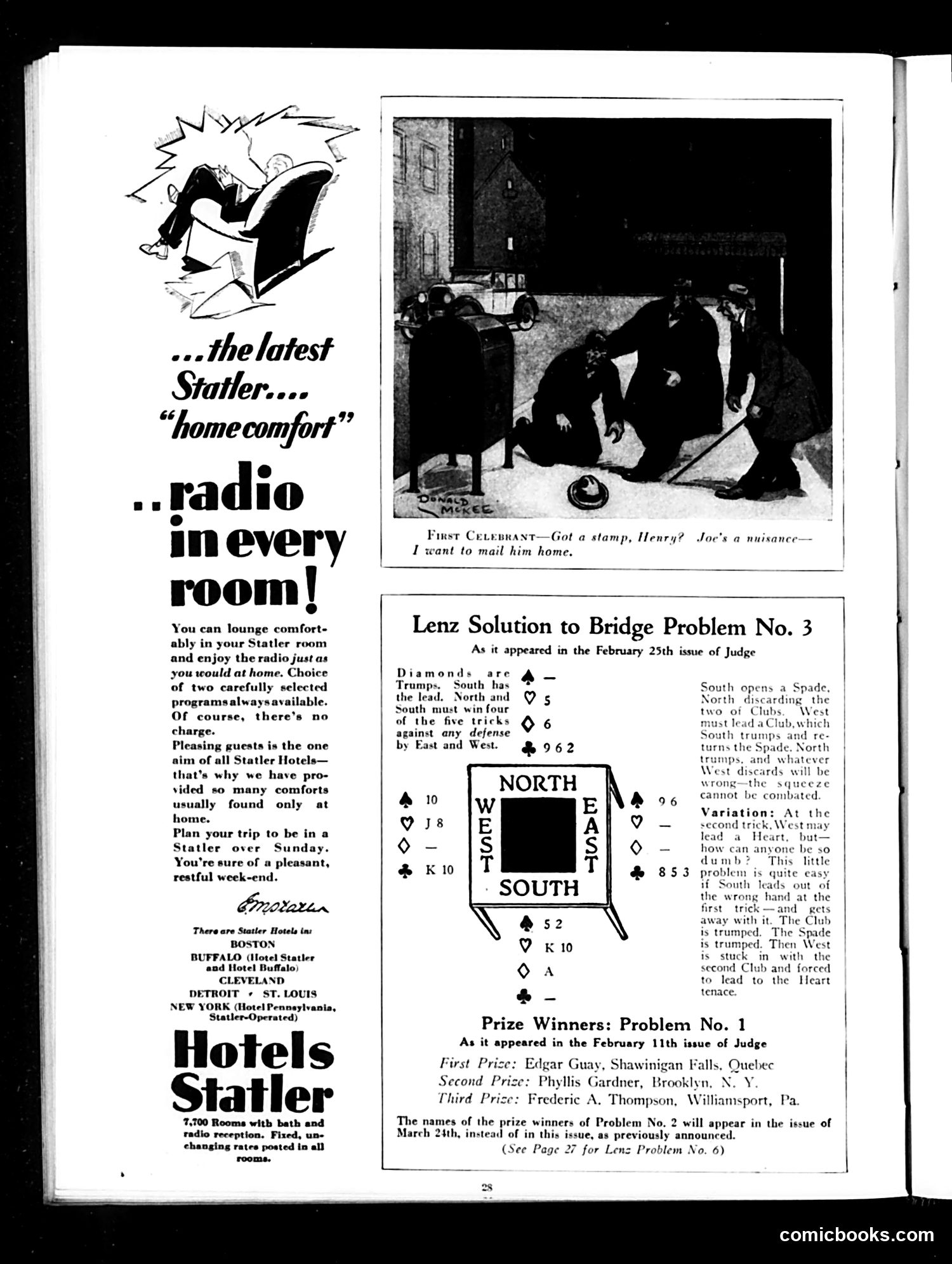
This page is primarily **advertising and bridge puzzle content**, not political satire. The left side features a **Statler Hotels advertisement** emphasizing their "home comfort" amenities, particularly radios in every room—a modern luxury for the era. The cartoon shows a man startled by a radio, humorously suggesting the excitement of this technology. The inset photograph captioned "First Celebrant" appears to be a humorous scene of people mailing someone home, likely commenting on unwelcome guests. The right side contains **"Lenz Solution to Bridge Problem No. 3,"** a bridge card game puzzle solution with detailed explanations, followed by **Prize Winners listings** for previous bridge problems. This reflects Judge's regular feature of publishing bridge puzzles for reader engagement and competition. There is **no political content or satire** on this page—it's primarily commercial advertising and puzzle entertainment typical of 1930s magazine filler.
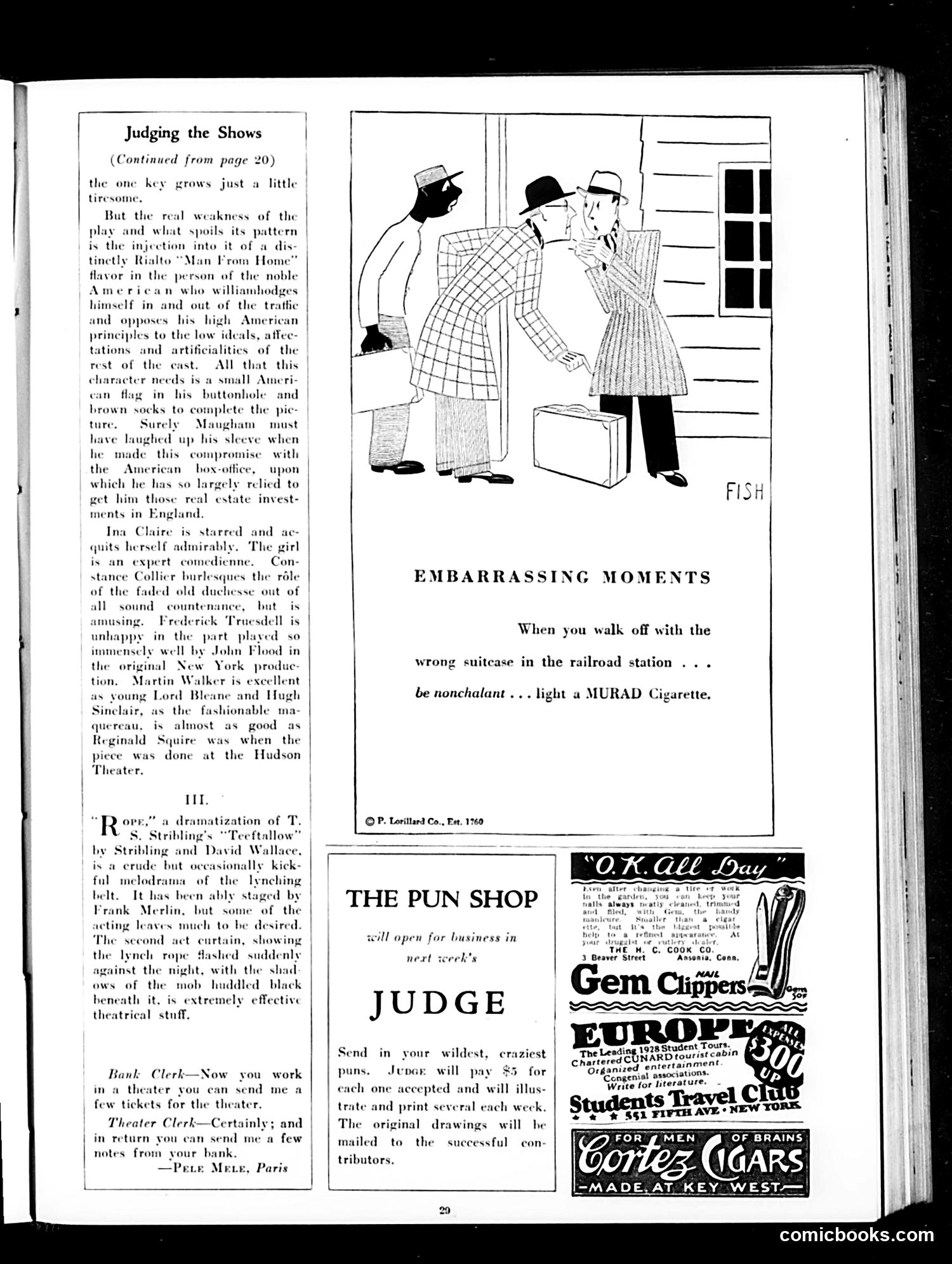
This page primarily contains **theater reviews** and **advertisements** rather than political cartoons. The main cartoon (by Fish) shows an "Embarrassing Moments" scenario: a man awkwardly holding the wrong suitcase at a railroad station while two other travelers look on. The accompanying text suggests the solution is to appear nonchalant by lighting a MURAD Cigarette—satirizing the era's marketing trope that smoking conveyed sophistication and ease. The left column reviews recent theatrical productions, critiquing performances by actors like Ina Claire and discussing a play about lynching in the American South ("Rope"). The reviews suggest Judge's readership was urban, culturally engaged theatergoers. The remainder is **period advertising**: a "Pun Shop" contest offering $5 for accepted puns, plus ads for Gen Clippers, travel clubs, and Cortez Cigars—typical Judge magazine filler targeting middle-class male readers.
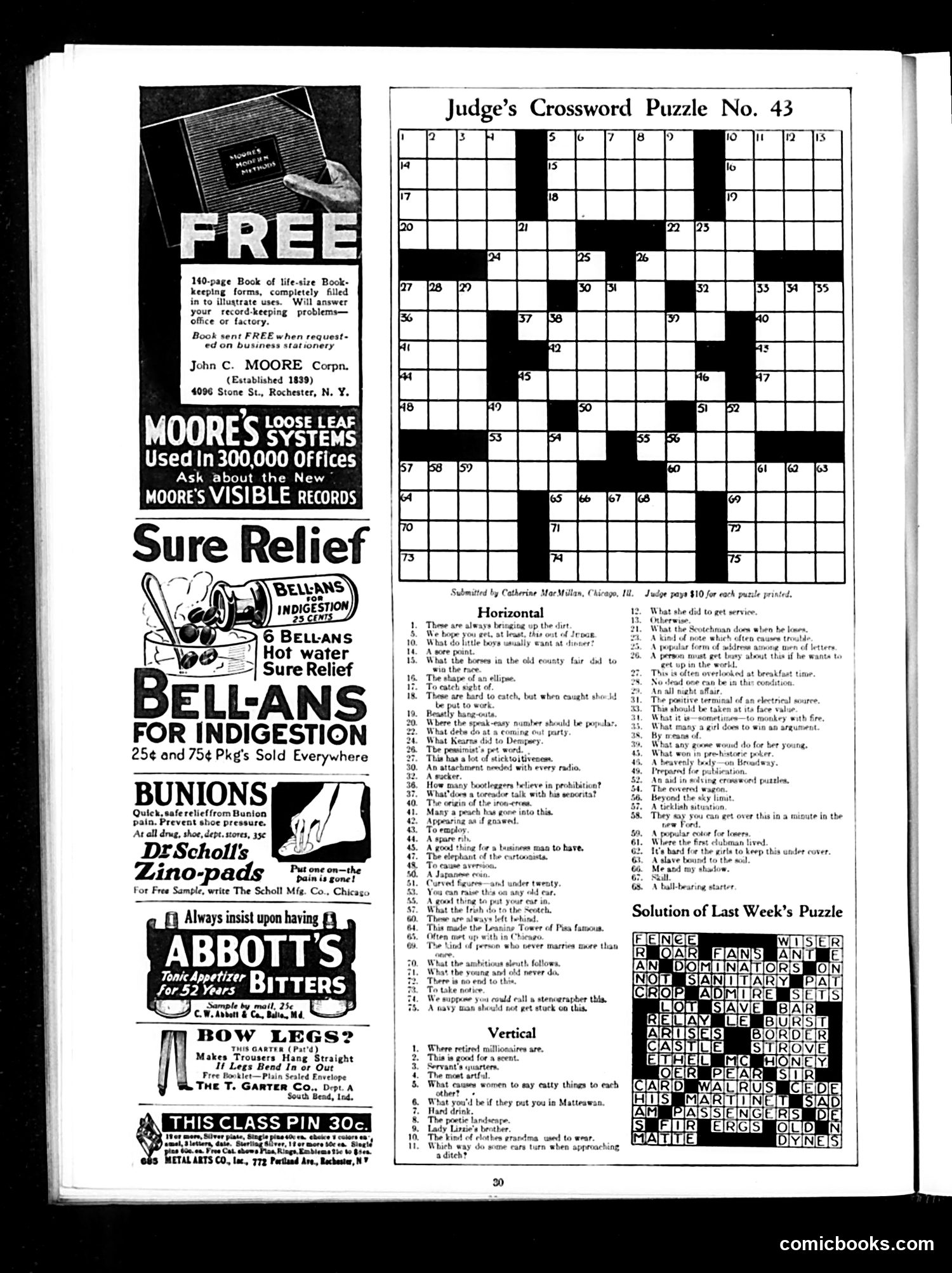
This page is primarily a **crossword puzzle** surrounded by period advertisements. The puzzle itself contains no political satire or cartoon content—it's a straightforward word puzzle with clues submitted by Catherine MacMillan of Chicago. The advertisements flanking the puzzle reflect early 20th-century consumer culture, promoting remedies for common ailments (indigestion, bunions, bow legs) and business products (Moore's bookkeeping systems). These ads are typical of Judge magazine's revenue model rather than satirical content. The clues contain mild humor typical of the era—references to Matteawan (a mental hospital), naval service, and social observations about women—but nothing politically charged. This appears to be filler content rather than the magazine's main satirical feature. The page number (20) suggests this puzzle ran as regular magazine content.
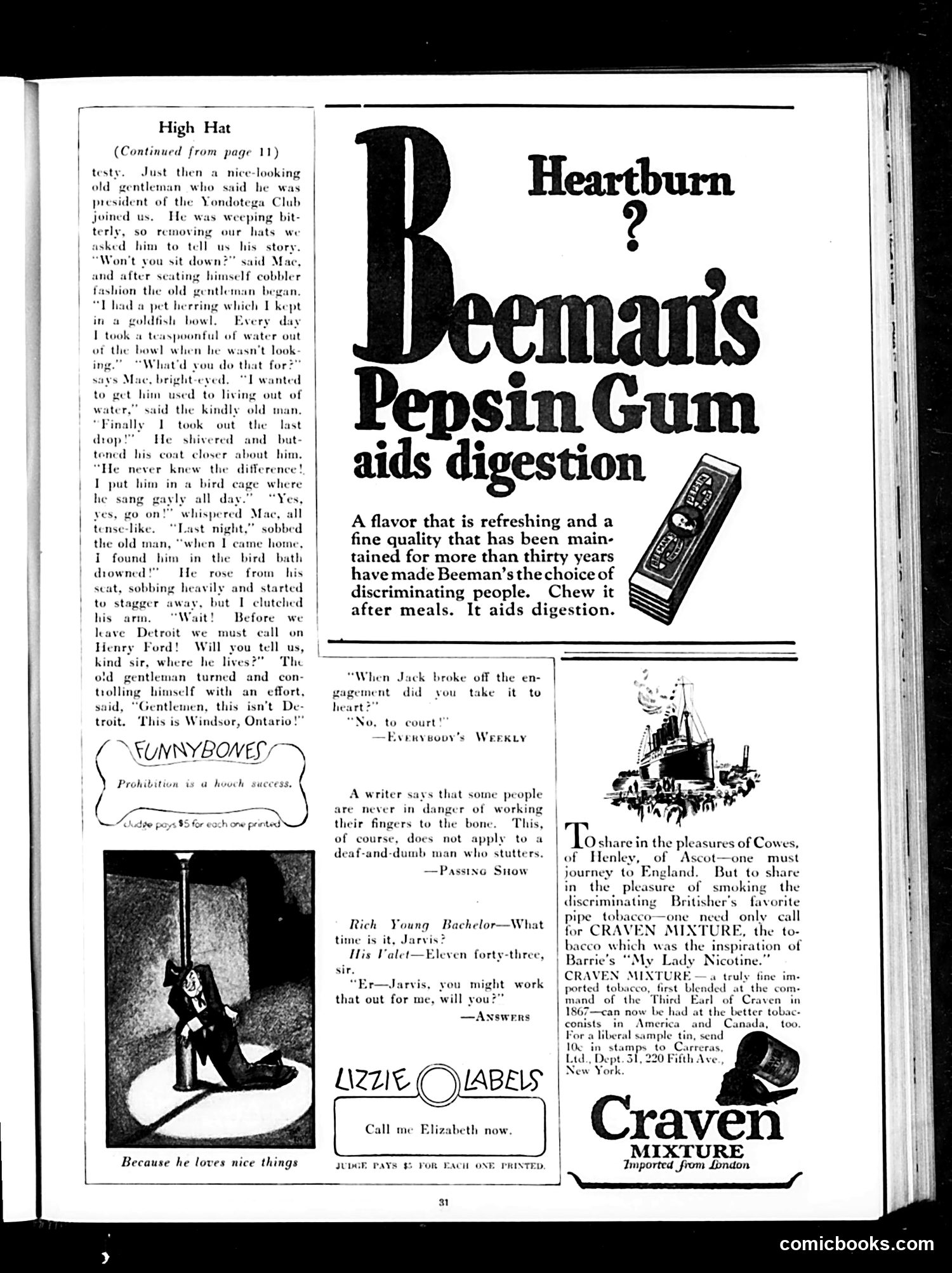
This page from *Judge* (a satirical weekly) contains primarily **humor pieces and advertisements** rather than political cartoons. **Main Content:** The "High Hat" story (continued from page 11) is a shaggy-dog joke: an old gentleman describes raising a pet herring in a goldfish bowl, gradually removing water until it dies—only to reveal he's in **Windsor, Ontario, not Detroit**. The punchline mocks the teller's apparent obliviousness. **Humor Fillers:** Brief one-liners mock Prohibition ("a hooch success"), stuttering deaf-mutes, and a valet's arithmetic. **Advertisements:** The page features product ads for **Beeman's Pepsin Gum** and **Craven Mixture tobacco**—the latter emphasizing its British prestige and availability in America. **Context for Modern Readers:** The humor reflects 1920s sensibilities: disability jokes were considered acceptable, Prohibition was fresh enough for satire, and British products carried aspirational cachet among American consumers.
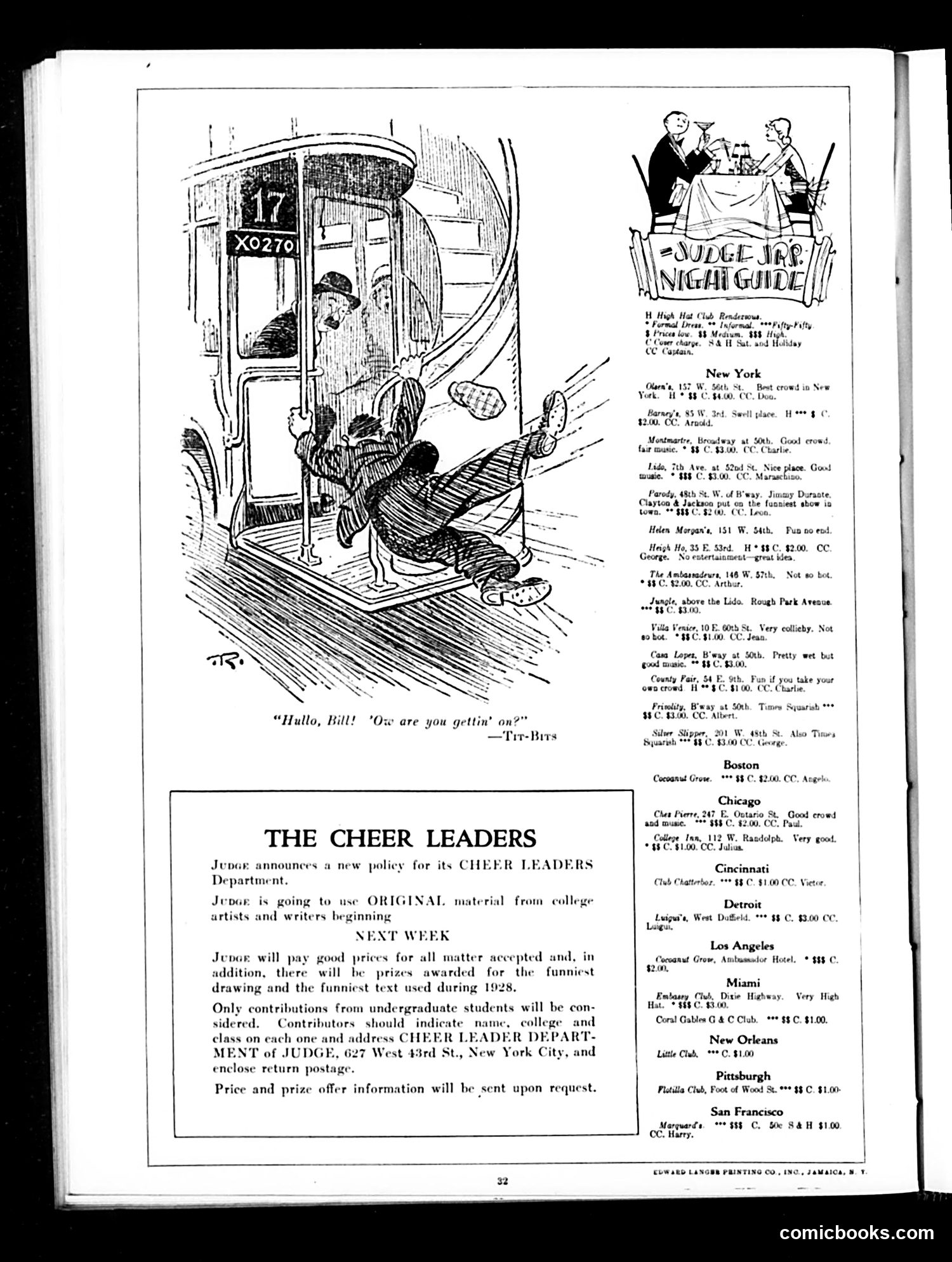
**The Main Cartoon:** The illustration depicts two men in a crowded subway car (marked "17" and "X0270"). One man asks another, "Hallo, Bill! 'Ow are you gettin' on?"—using working-class British dialect ("'Ow"). This is a simple observational humor piece about urban transit crowding, likely satirizing the cramped, uncomfortable conditions of subway travel in late 1920s New York. **The Announcement:** The bulk of the page is a business notice: *Judge* magazine is soliciting original material from college students for its "Cheer Leaders" department, offering payment and prizes for the funniest contributions in 1928. This appears to be an editorial call for submissions rather than satirical content. **The Lists:** The right side contains what appears to be nightclub/speakeasy listings across major American cities (New York, Boston, Chicago, etc.), likely guide recommendations for nightlife venues—relevant to the Prohibition era when such establishments operated.
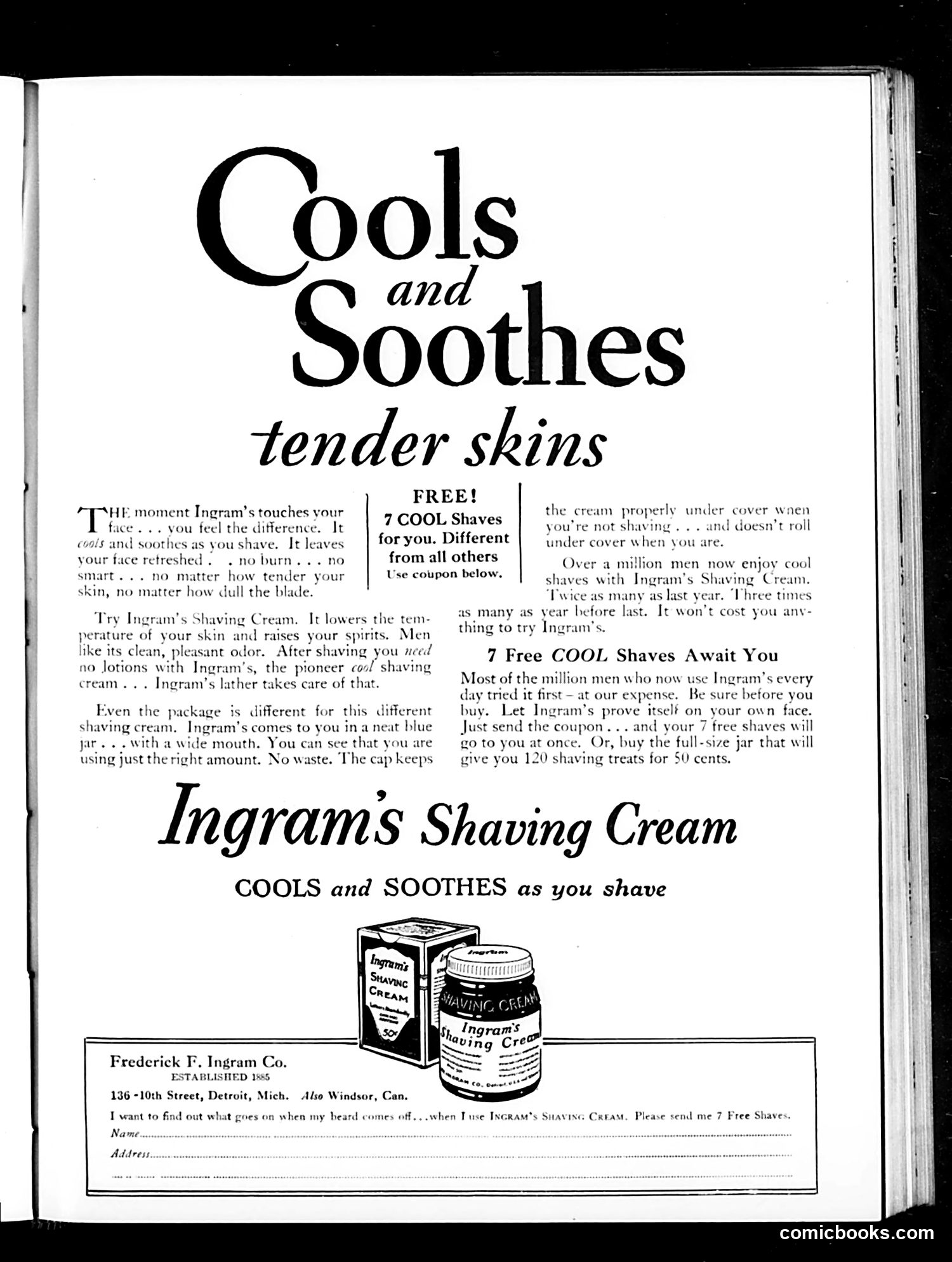
This is not a political cartoon or satirical content—it is a **straightforward product advertisement** for Ingram's Shaving Cream, likely from the early 20th century (the company was established 1885). The page promotes a shaving cream that "cools and soothes" tender skin, emphasizing its unique blue jar packaging and pleasant odor. The marketing pitch focuses on practical benefits: no burn, no irritation, and no need for aftershave lotions. The advertisement includes a promotional offer: readers can mail in a coupon to receive 7 free sample shaves. This was a common sales tactic of the era—getting consumers to try the product free, betting they'd become regular buyers. The company, Frederick F. Ingram Co., was based in Detroit, Michigan, with a branch in Windsor, Canada. There is no satire, political commentary, or hidden meaning here—simply period advertising targeting male consumers concerned about shaving irritation.
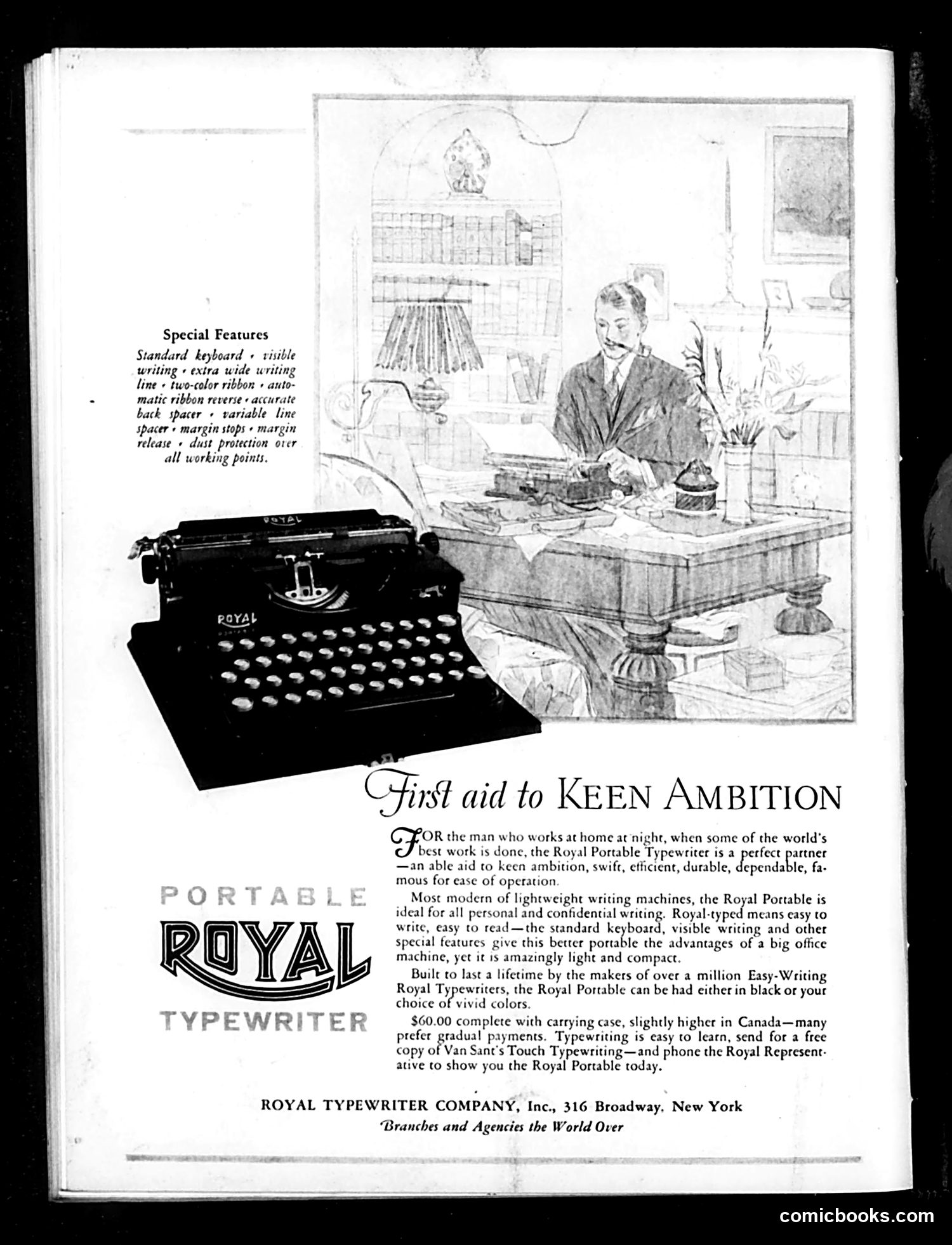
This page is primarily a **product advertisement**, not political satire. It promotes the Royal Portable Typewriter to ambitious professionals, particularly those working independently at night. The illustration shows a man at his desk writing with the typewriter, surrounded by office supplies and papers—depicting the "keen ambition" referenced in the headline. The marketing message emphasizes the machine's modern features (visible writing, standard keyboard, portability) and affordable price ($60 complete with case). The phrase "First aid to keen ambition" uses medical metaphor to position the typewriter as essential equipment for success. The advertisement targets freelance workers and writers seeking professional output quality in a compact, affordable package. This represents typical early 20th-century consumer advertising in *Judge* magazine, mixing aspiration with practical product benefits rather than satirical commentary.