
Judge, 1928-03-17 · page 22 of 36
Judge — March 17, 1928 — page 22: what you’re looking at
What you’re looking at
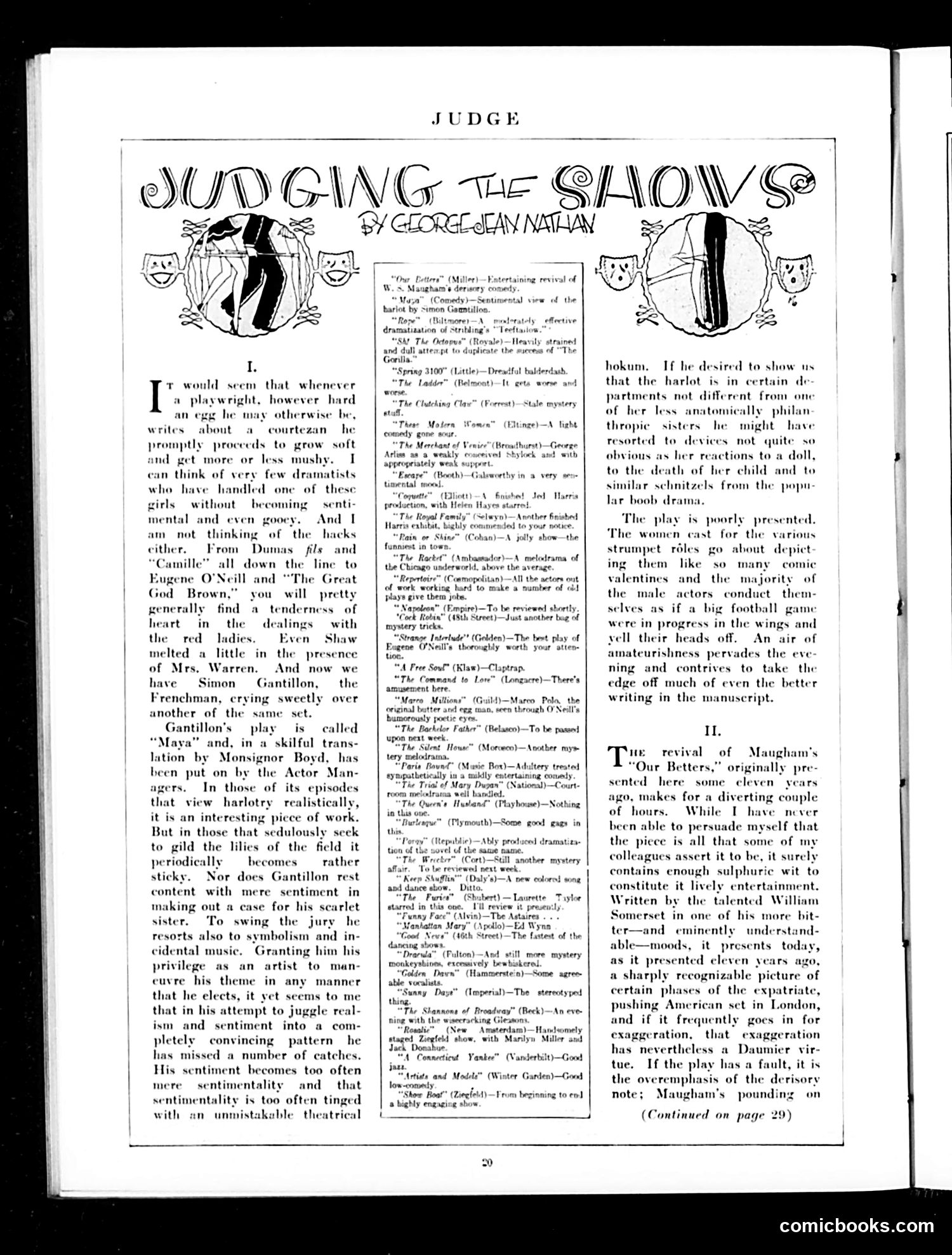
This is a theater review column, not a political cartoon. The page critiques two Broadway productions: **Part I** reviews Simon Gantillon's play about a courtesan, arguing that dramatists—from Alexandre Dumas fils to Eugene O'Neill—sentimentalize prostitutes excessively. Nathan criticizes Gantillon for combining realism with melodrama, creating "mere sentimentality" tinged with "theatrical" hokum. He faults the amateur acting quality and staging, which undercuts the script. **Part II** begins reviewing W. Somerset Maugham's "Our Betters," a comedy revival from eleven years prior. Nathan acknowledges the play entertains adequately, though he disputes colleagues' high praise for it. The page lists numerous other contemporary Broadway productions in small type as reference.
📄 Transcribed text from this page (OCR, searchable)
Machine-transcribed from the original scan — historical spelling and the odd misread are preserved.
JUDGE I. l’ would seem that whenever playwright, however hard sue he may otherwise be, writes about a courtezan he promptly proceeds to grow soft and get more or less mushy. I n think of very few dramatists who have handled one of these girls without becoming — senti- mental and even gooey. And 1 am not. thinking of ‘the hacks cither. From Dumas fils and “Camille” all down the line to Eugene O'Neill and “The Great God Brown,” you will pretty generally find ‘a tenderness of heart in the lings with the red ladies. Even Shaw melted a little in the presence of Mrs, Warren. And now we have Simon Gantillon, — the Frenchman, erying sweetly over another of the same set. Gantillon’s play is called } and, in a skilful trans- lation by Monsignor Boyd, has been put on by the Actor Man- In those of its episodes view harlotry ally it is an interesting piece of work. But in those that sedulously seck to gild the lilies of the field it periodically becomes rather sticky. Nor does Gantillon rest content with mere sentiment in making out a e for his scarlet sister. To swing the jury he resorts also to symbolism and in- cidental music, Granting him his privilege as an artist to. man- cuvre his theme in any manner that he elects, it yet seems to me that in his attempt to juggle real- ism and sentiment into a com- pletely convincing pattern he has missed a number of catches. His sentiment becomes too often mere sentimentality and that timentality is too often tinged with an unmistakable theatrical WG ae BY CICRGLATAN NATHAN SHOWS (Comedy)—Sentir “The Clutching Cla production, with H. orking hard to make a number of cid “Napoleon” (Empire)—To be revie \" (48th Street) —Just another bag of lade’? (Golden) —The best plat "s thoroughly worth your at A Free Souf* (Klae)—Cl The Command to Lon (Longacre)—There’s * (Guild)—Marco Pola, the original butter and egg man, seen through O'Neill's humorously poetic eyes “The Bachelor Father (Relasco)—To be passed ” (Morweo)—Another mys “Paris Ravet™ (Music Bow)— eynopathetically in a mildly entertais "The Trial ef Mary Dugan” (N: (Playhouse)—Nothing * (Plymouth)—Some fond gags in ovel of the same name. * (Cort)—Still another mystery ( i (Daly's)—A pew colors song starred in this one * (Alvin) ~The Astaires . « « Apollo) Ed Wyn The fastest of the And still more mystery excomively bewbishered, * (Hammerste'n)—Some agree with Marlyn Miller and “A Connecticut Yankee (Vanderbilt)—Good | tists and Modsle” (Winter Ganten)—Good Show Boat” (Ziegfe) a highly engaging show rom beginning to end hokum, If he desired to show us that the harlot is in certain de partments not different from one of her less. anater philan thropic sisters he might have resorted to devices not qu obvious a actions to a doll, to the di r child and to similar schnitzels from the popu- lar boob drama. The play ix poorly presented. The women cast for the various strumpet réles go about depict ing them like so many comic valentines and the ority of the male actors conduct them- selves as if a big football game were in progress in the wings and yell their heads off. An air of nateurishness pervades the eve ning and contrives to take the edge off much of even the better writing in the manuscript. Il. Tite revival of Maugham’s “Our Betters,” originally pre- sented here s« eleven” years ago, makes for a diverting couple of hours. While T have never been able to persuade myself that the piece is all that some of my colleagues assert it to be, it surely contains enough sulphuric wit to constitute it lively entertainment. Written by the talented William Somerset in one of his more bit- ter—and eminently understand- able—moods, it presents today, as it presented eleven y arply recognizable picture 1in phases of the expat pushing American set in London, and if it frequently goes in for exaggeration, that) exaggeration has nevertheless a Daumier vir- tue. If the play has a fault, it is the overemphasis of the derisory note; Maugham’s pounding on (Continued on page comicbooks.com