
Judge, 1928-03-17 · page 15 of 36
Judge — March 17, 1928 — page 15: what you’re looking at
What you’re looking at
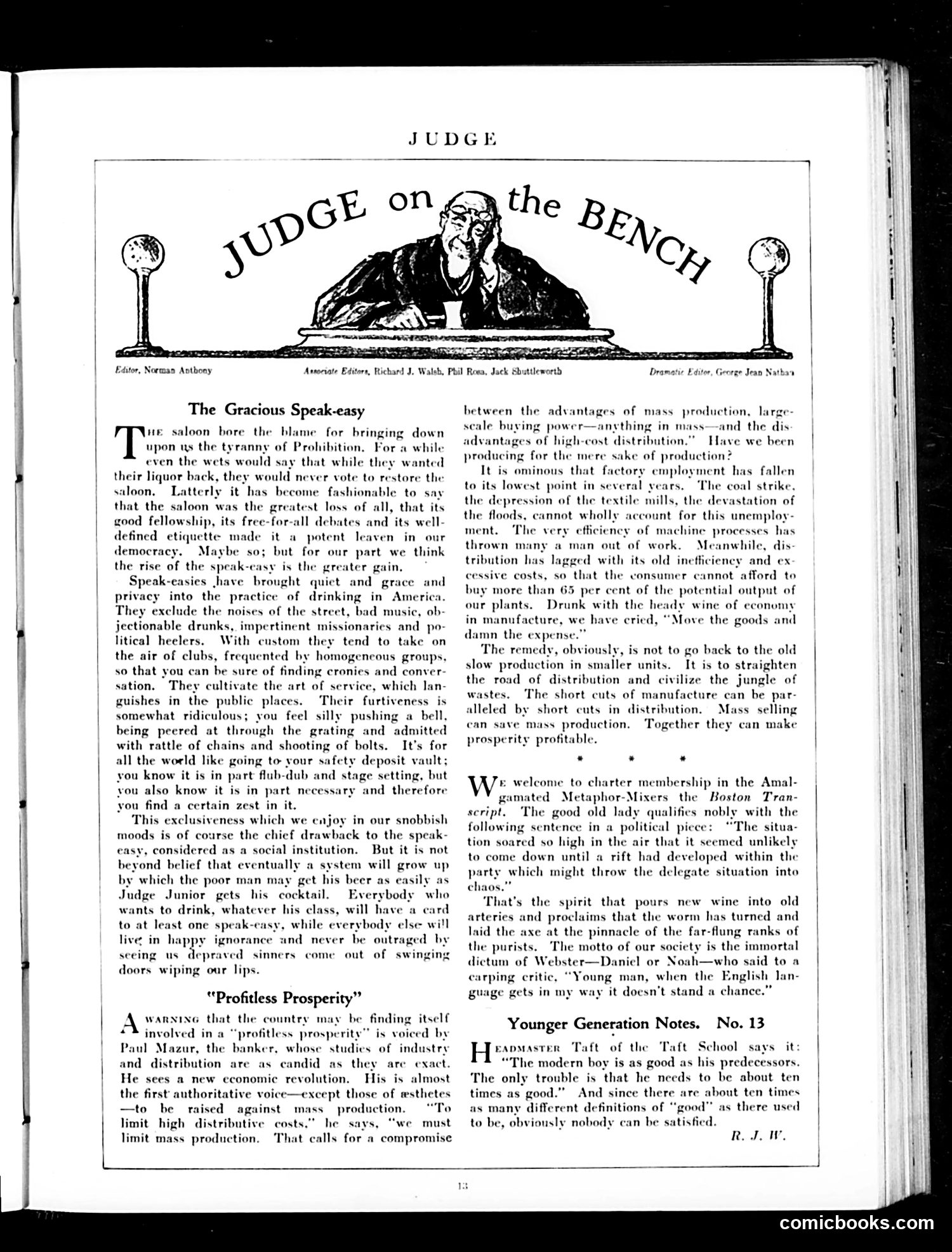
This page contains two satirical articles critiquing American economic and social policies of the Prohibition era. **"The Gracious Speak-easy"** defends illegal bars as superior to pre-Prohibition saloons. The author argues speak-easies have brought "quiet and grace" to drinking by excluding "objectionable drunks" and "political heelers." The satire is tongue-in-cheek—acknowledging the "furtiveness" of sneaking through hidden doors feels "silly" yet necessary. Notably, Judge here endorses Prohibition-era lawbreaking as socially preferable, suggesting the magazine's irreverent stance toward federal alcohol bans. **"Profitless Prosperity"** warns that America's post-war economic boom masks structural problems. Citing banker Paul Mazur, it argues factories produce efficiently but distributors cannot move goods—consumers can afford only 65% of potential output. Unemployment rises despite prosperity. The solution isn't returning to slow production but improving distribution infrastructure and reducing waste. Both pieces reflect 1920s anxieties: Prohibition enforcement, economic inequality despite apparent prosperity, and industrial inefficiency.
📄 Transcribed text from this page (OCR, searchable)
Machine-transcribed from the original scan — historical spelling and the odd misread are preserved.
—— JUDGE Editor, Noeran Anthony The Gracious Speak-easy He saloon bore the blame for bringing down upon us the tyranny of Prohibition. For a while even the wets would say that while they wanted their liquor back, they would never vote to restore the saloon, Latterly it has become. fashio that the saloon was the greatest loss good fellowship, its free-for-all debates and its well- defined etiquette made it potent leaven in our democracy. Maybe so; but for our part we think the rise of the speak-easy is the greater gain, Speak-easies Jhave brought quict and grace and privacy into the practice of drinking in| America. They exclude the noises of the street, bad jectionable drunks, impertinent missionaries and po- litical heelers. With custom they tend to take on the air of clubs, frequented by homogeneous groups, so that you can be sure of finding cronies and conver- sation. They cultivate the art of service, which lan- guishes in the public places. Their furtiveness is somewhat ridiculous; you feel silly pushing a bell, being pecred at through the grating and admitted with rattle of chains and shooting of bolts. It’s for all the woeld like going to your safety deposit vault; you know it is in part flub-dub and stage setting, but you also know it is in part necessary and therefore you find a certain zest in it. This exclusiveness which we enjoy in our snobbish moods is of course the chief drawback to the speak- ', considered as a social institution. But it is not ond belief that eventually a system will grow up by which the poor man may get his beer as easily as Judge Junior gets his cocktail. Everybody who wants to drink, whatever his class, will have a card to at least one speak-casy, while everybody else wi!l live in happy ignorance and never be outraged by seeing us depraved sinners come out of sw doors wiping our lips. able to say 1, that its music, ob- bey “Profitless Prosperity” A WARNING that the country may be finding itself £2 involved in a “profitless prosperity” is voiced by Paul Mazur, the banker, whose studies of industry and distribution ate as candid as they are exact. He sees a new economic revolution. His is almost the first authoritative voice—except those of esthetes —to be raised against mass production.“ limit high distributive costs.” he : we must limit mass production. That calls for a compromise Avsoriate Editors, Richard J. Walsh, Phil Rowa, Jack Shuttleworth Dramatic Editor, George Jean Nathan between the advantages of mass production, large- rale buying power—anything in mass—and the dis advantages of high-cost distribution.” Have we been producing for the mere sake of production? It is ominous that factory employment has fallen to its lowest point in several years. ‘The coal strike. the depression of the textile mills, the devastation of the floods, cannot wholly account for this unemploy- ment. The very efficiency of machine processes has thrown many a man out of work. Meanwhile, dis tribution has lagged with its old inetlicieney and ex cessive costs, so that the consumer cannot afford to buy more than 65 per cent of the potential output of our plants. Drunk with the heady wine of economy in manufacture, we have cried, “Move the goods and damn the expense.” The remedy, obviously, is not to go back to the old slow production in smaller units. It is to straighten the road of distribution and civilize the jungle of wastes. The short cuts of manufacture can be alleled by short cuts in distribution. M. can sa s selling mass production. Together they can make prosperity profitable. . . * WE welcome to charter membership in the Amal- mated Metaphor-Mixers the Boston Tran- script. The good old lady qualifies nobly with the following sentence in a political pic The situa- tion soared so high in the air that it seemed unlikely to come down until a rift had developed within the ty which might throw the delegate situation into chaos.” That's the spirit that pours new wine into old arteries and proclaims that the worm has turned and laid the axe at the pinnacle of the far-flung ranks of the purists. The motto of our society is the immortal dictum of Webster—Daniel or Noah—who said to a carping critic, “Young man, when the English lan- guage gets in my way it doesn’t stand a chance.” Younger Generation Notes. No. 13 H eesestes Taft of the Taft) School says it “The modern boy is as good as his predecessors. The only trouble is that he necds to be about ten times as good.” And since there are about ten times as many different definitions of “ us there used to be, obviously nobody can be satisfied. R.ILW. comicbooks.com