
Judge, 1928-03-17 · page 11 of 36
Judge — March 17, 1928 — page 11: what you’re looking at
What you’re looking at
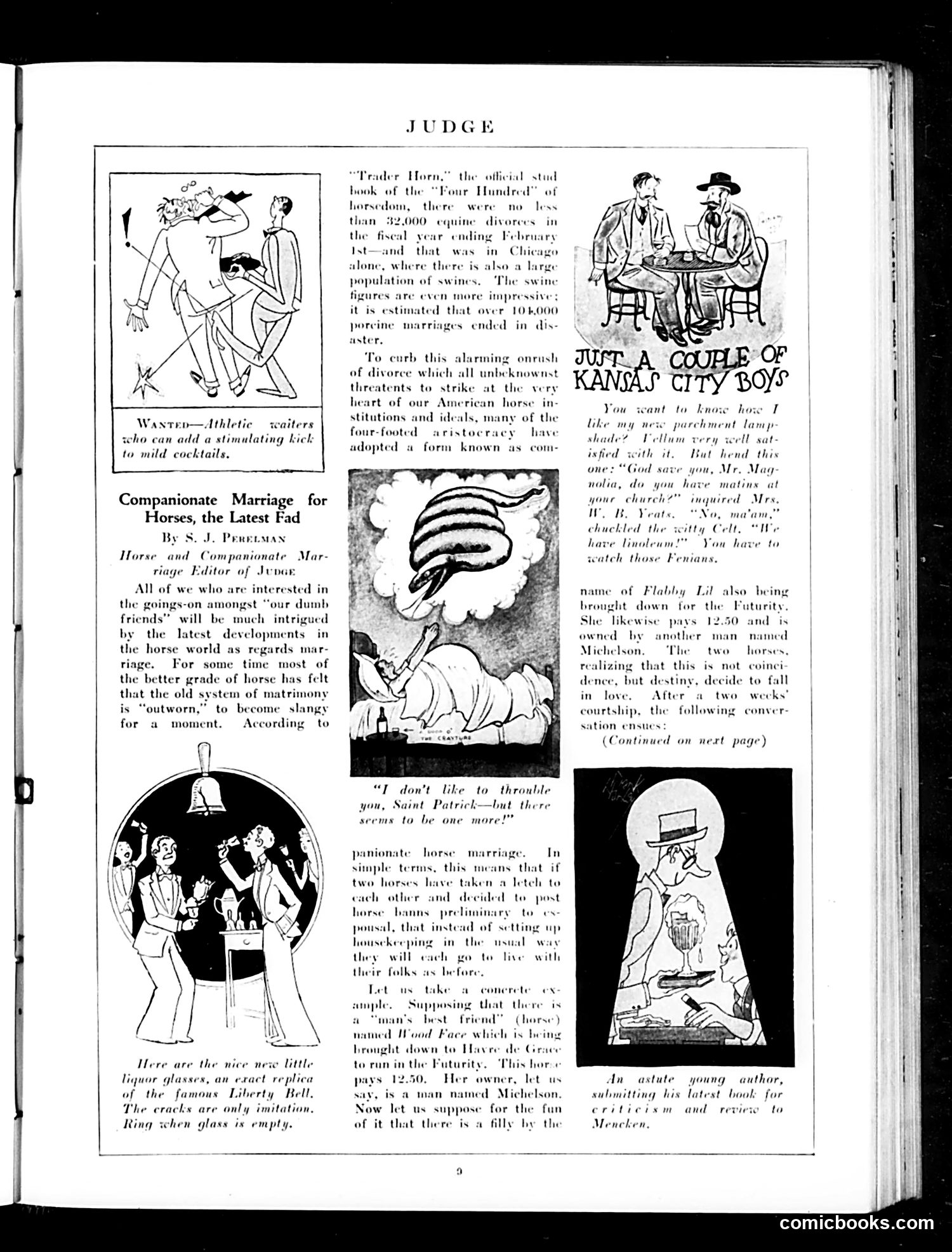
This page satirizes the 1920s "companionate marriage" trend—a progressive movement advocating couples live together without traditional legal marriage or formal household setup—by absurdly applying it to horses. **The satire:** The article mockingly treats horse breeding with the same social-reform language used in contemporary debates about human marriage. It references alarming divorce statistics (32,000 equine divorces in Chicago alone) and proposes horses adopt "companionate" arrangements where couples "live with their folks as before" rather than establishing joint households. **The joke's targets:** Upper-class horse owners ("Four Hundred" of horsedom), progressive social reformers, and perhaps H.L. Mencken (referenced in the sidebar illustration of "an astute young author"), who was a prominent cultural critic of the era. **Additional humor:** Side cartoons mock cocktail culture and Irish stereotypes (the Saint Patrick reference). The overall effect ridicules both progressive marriage reform and the pretentious concern devoted to horse-breeding among the wealthy.
📄 Transcribed text from this page (OCR, searchable)
Machine-transcribed from the original scan — historical spelling and the odd misread are preserved.
a JUDGE Wasteo—aAthletic who can add a stimulating kick to mild cocktails, waiters Companionate Marriage for Horses, the Latest Fad By S.J. Penney Horse and Companionate riage Editor of Jew All of we who are interested in the goings-on amongst “our dumb friends” will be much intrigued by the est’ developments in the horse world as regards mar- riage. For some time most of the better grade of horse has felt that the old system of matrimony to become slangy moment. According to is “outworn,” for a Here are the nice new little liquor glasses, an exact replica of the Liberty Bell, The cracks are only imitation, famous Ring when glass is empty. the “Four Hundred” of there “Trader Horn,” book of the horsedom, were no less than 32,000 equine the fiscal yes ing February Ist—and that Chics alone, where there is also a la population of swines. official stud divorces in was in The sw figures are even more impressive: it is estimated that over 104,000, porcine marriages ended in dis- aster, To curb this alarming onrush of divorce which all unbeknownst threatents to strike at the heart of our American horse in- stitutions and ideals, many of the four-footed aristocracy have adopted a form known as com- very, “1 don’t like to throuble you, Saint Patrick—but there seems to be one more!” panionate horse marriage. In simple terms, this means that if taken a leteh to cach other and decided two horses I to post horse banns preliminary te es pousal, that instead of setting up housekeeping in’ the usual way they will each yo to live their folks as be Tet oust ple. Supposing that there is best) friend” wed Wood Face which is being with ve, a conercte ex a “inan’s (horse) Ir to ran inthe Futurity. ‘This hor « pays 12.50, say, is a man named Michelson. Now let us suppose for the fun of it that there is a filly by the ight down to Havre de Grace Her owner, let us You want te like my new shade? isfied with it. But hend this | one: “God save you, Mr. Mag nolia, do you have mating at i your church?” inquired) Mrs. W. BR. Yeate. “No, matam,” | chuckled the witty Celt, “We seatch those Fenians, ) name of Flabby t She likewise pa owned by Michelson. in love, After courtship, the sation ensues: (Continued on next page) An astute submitting his latest book for criticism Meneken, Lil yght down for the 12.50 and is man ys ier The realizing that this is not dence, but destiny, decide two following JUPT. OF KANSAS CITY BOYS | parchment lamp | Vellum very well sat- two young and nr how T Iso being Futurity. named horses, fall Hi] conver- author, comicbooks.com