
Judge, 1928-03-17 · page 27 of 36
Judge — March 17, 1928 — page 27: what you’re looking at
What you’re looking at
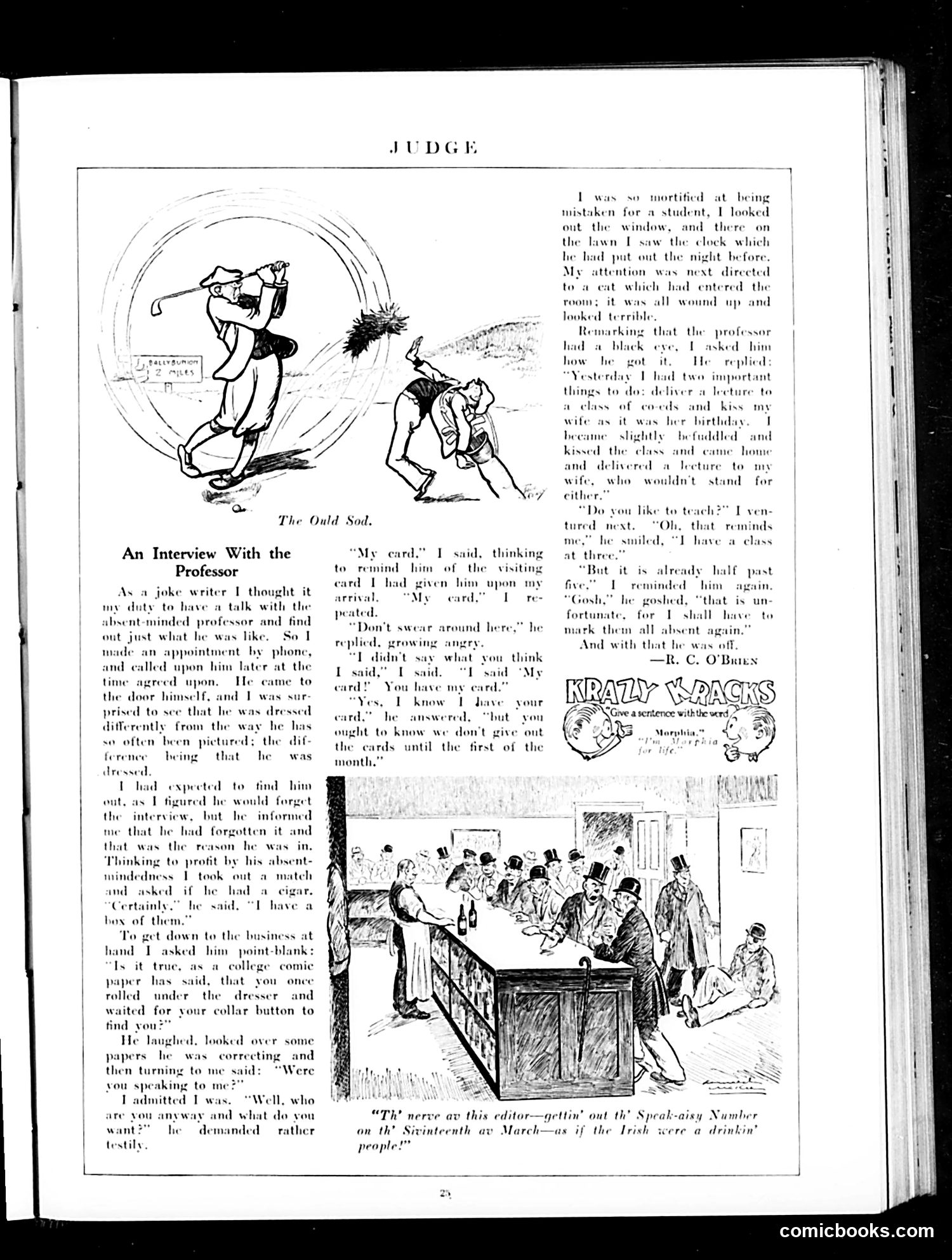
## "The Ould Sod" & "An Interview With the Professor" This page satirizes the absent-minded professor stereotype, a popular comic figure of the era. The interview depicts a professor who is perpetually confused, forgetful, and socially awkward—he forgets his own appointment, mistakes a visitor for a student, and loses track of time so badly he arrives three hours late to a class. The humor trades on academic eccentricity: he confuses kissing his wife with kissing his class, keeps a wound-up clock on the lawn, and sports a black eye from his befuddlement. The "Ould Sod" title and reference to "the Irish" in the lower cartoon suggest Irish-American stereotyping common to Judge's era. The bottom illustration appears unrelated—a speakeasy scene, likely referencing Prohibition-era social commentary about illegal drinking establishments ("speak-easy"). The satire mocks both professorial absent-mindedness and, contextually, Irish-American culture through predictable period stereotypes.
📄 Transcribed text from this page (OCR, searchable)
Machine-transcribed from the original scan — historical spelling and the odd misread are preserved.
The Ould Sod. An Interview With the Professor a joke my duty to have writer 1 thought it a talk with the t-aninded professor and find out just what he was like. Se I an appointment by phone, led upon him later at the He to and To was sur. made and ¢: time the door himself, prised to see that he was dressed ered upon, came differently from the way he has se often been pictured; the dif- ference being that) he — was dressed. [ohad expected to) tind him as T figured he would forget interview, but he informed that he had forgotten it and that was the Thinking to profit by his out, the me Was in, reason he mindedness 1 took out a mdoasked if he had . Certainly.” he said. “LT have a box of them.” To get down to the business at hand I asked him point-blank: Is it true, as a college comic paper has said, that’ you once rolled under the dresser and waited for your collar button to tind you d. looked over some papers he was correcting and then turning to me said: “Were you speaking to me? IT admitted T was. “Well, who are you anyway and what do you want?” he demanded — rather testily. “My card.” 1 said, to remind him of the card Tha arrival, "My — card,” peated. “Don't swear around here,” the month,” cards “Th on th’ he t tok I know 1 answered, dia rweowe de until the inteenth av thinki visiti given him upon my I ores what you think You have my card.” vid “My ve your “but | yon give out first of the nerve av this editor—gettin’ out th’ March— I owas so mortified at) being mistaken for a student, I looked out the window, and there on the lawn [To saw the clock which he had put out the night before. My attention was next dirceted te at which had entered the room; it was all wound up and looked terrible. Remarking that the professor had a black eve, Toasked him how he got it. He replied “Yesterday Thad two important things to do: deliver a lecture te acliss of co-eds and kiss my wife as it was hee birthday i heeame slightly befuddled and kissed the class and came home and delivered a Jeeture to my wife, who wouldn't stand for cither.” “Do you like to teac I ven- tured next. “Oh, that) reminds me.” he smiled, “LT have a class at three.” “But it is already half past five.’ To reminded him again. “Gosh,” he goshed, “that is un- fortunate, for To shall have te mark them all absent again.” And with that he was off —R. C. O'Bites RAT WANS EF, Scie avertece wihtievord 7 i$ ; Speak-aisy Number Trish as if the were a drinkin’ comicbooks.com