
A complete issue · 36 pages · 1928
Judge — February 25, 1928
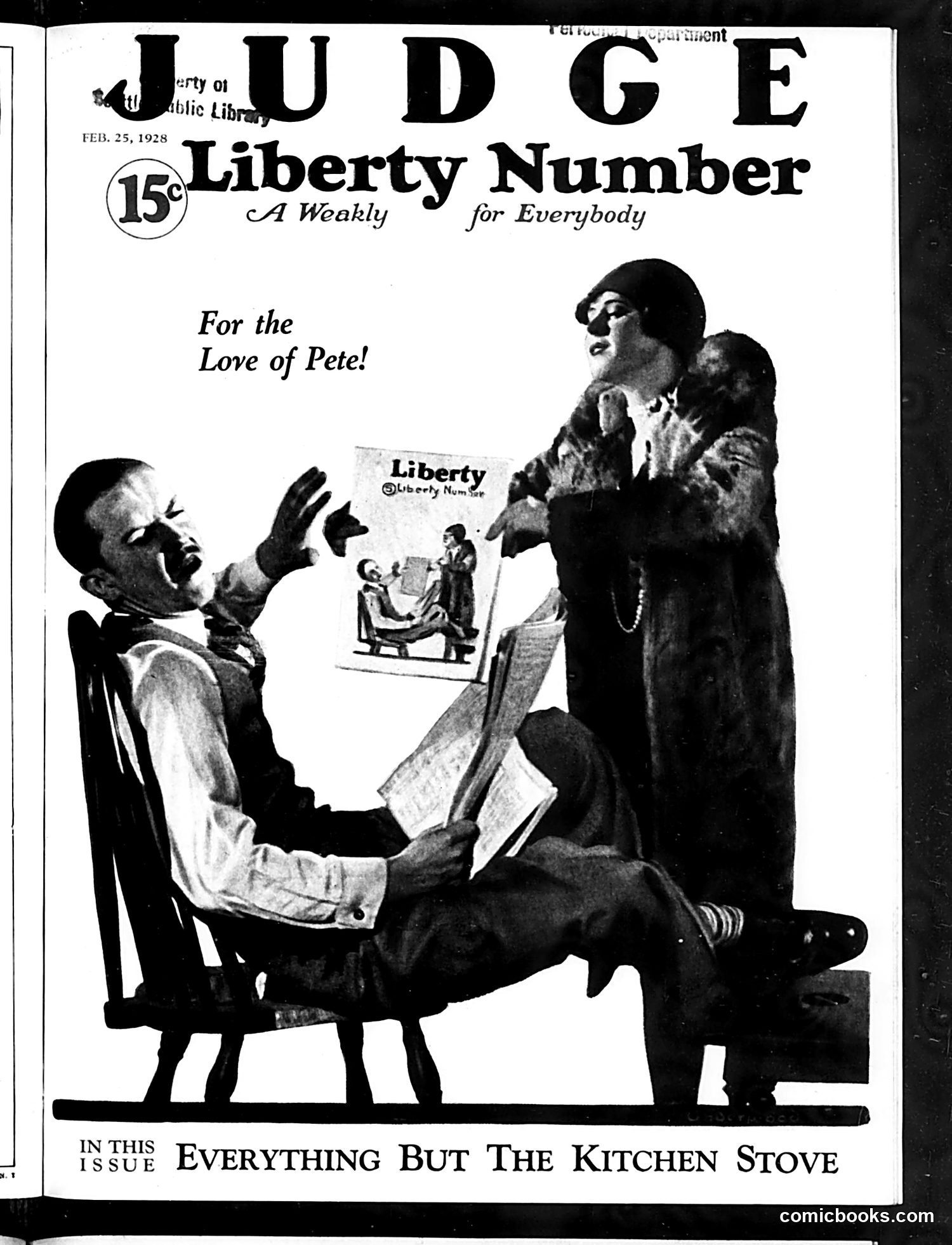
This is Judge's cover advertising their "Liberty Number" issue. The illustration shows a man sitting reading Liberty magazine while a woman stands nearby holding a child, seemingly trying to get his attention. The headline "For the Love of Pete!" and the teaser "Everything But The Kitchen Stove" suggest satirical commentary on domestic life. The joke appears to mock husbands' absorption in reading Liberty magazine—a popular weekly publication of the era—to the neglect of family responsibilities. The woman's gesture of exasperation suggests frustration at being ignored. The phrase "everything but the kitchen stove" was a common 1920s idiom meaning "almost anything imaginable," implying the magazine contains such varied, engaging content that it distracts men from domestic duties. This satirizes both magazine culture and gender dynamics of the period.
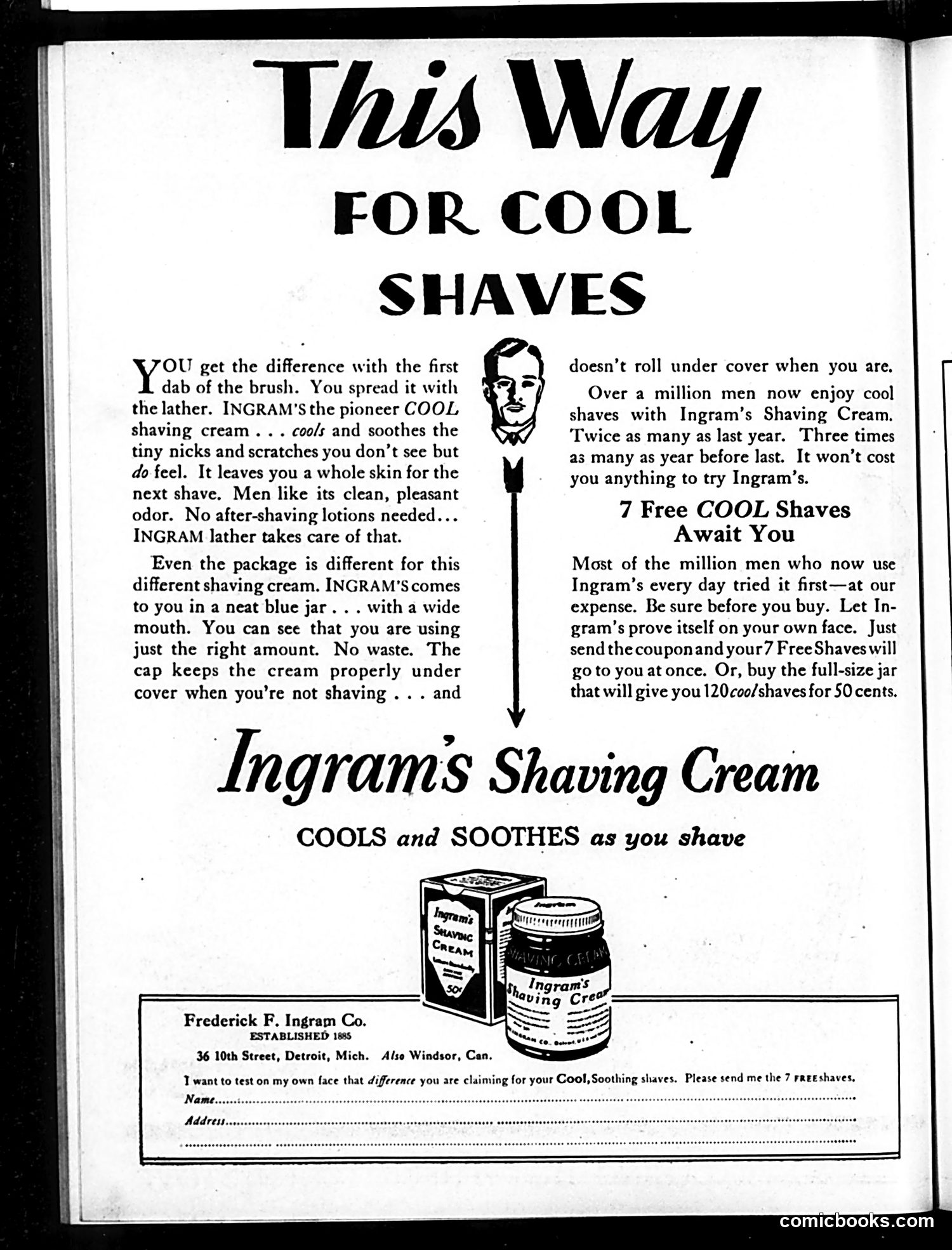
This is **not a political cartoon or satire**—it's a straightforward advertisement for Ingram's Shaving Cream, a real product from the Frederik F. Ingram Co. of Detroit, Michigan. The page promotes the product's key feature: it "cools and soothes" while shaving, addressing minor nicks and scratches. The ad claims over a million men use it and offers a promotional deal: send a coupon for seven free shaves, or buy the full-size jar for 50 cents (yielding 120 shaves). The illustrated male face is simply a generic representation of the target customer—men seeking a superior shaving experience. There is no satire, political commentary, or hidden meaning present on this page.
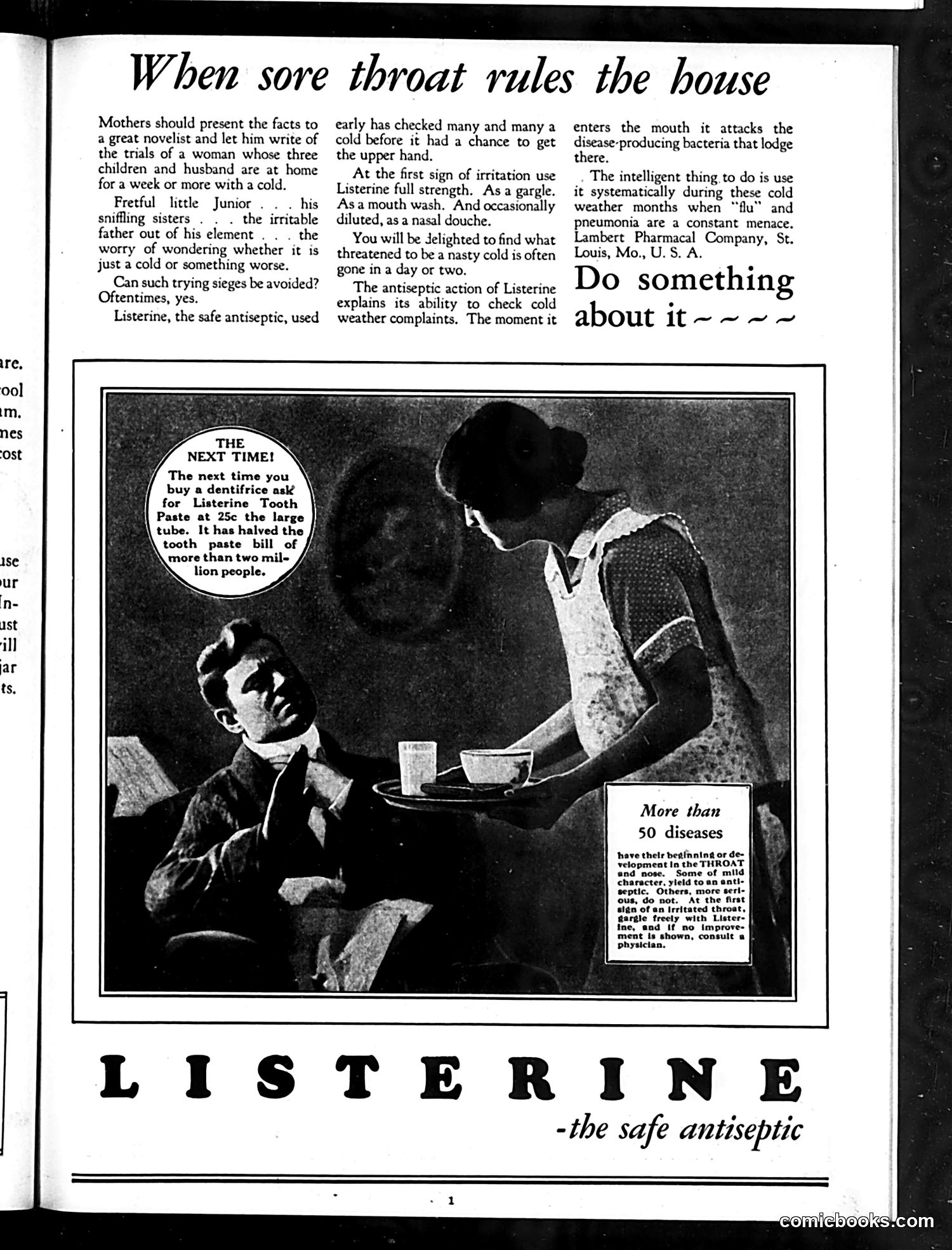
This vintage advertisement for Listerine mouthwash uses domestic humor rather than satire. The "cartoon" shows a worried father being served soup by his wife while apparently ill—illustrating the page's main theme about sore throats disrupting household life. The content is primarily **advertising copy** disguised as helpful advice. It frames Listerine as a preventative antiseptic for colds and sore throats, suggesting mothers use it to protect their families. The "worried father" image creates emotional appeal—showing the domestic disruption caused by illness. The text's reference to "Listerin[e]" as "the safe antiseptic" and mentions of checking "cold weather complaints" reveal this targets anxious parents during winter months. This represents typical early-20th-century medical advertising that made broad health claims about mouthwash.
This editorial column satirizes Judge Lindsey's concept of "companionate marriage"—a progressive 1920s idea advocating easier divorce by mutual consent and birth control access. The editors mock Lindsey's proposal as naive idealism that "vanishes" in practice, arguing marriage remains fundamentally difficult regardless of legal frameworks. The satire targets both Lindsey's optimism and broader 1920s social debates about marriage reform, sexuality, and women's autonomy. References to "self control" and criticism of birth control advocacy reflect conservative anxiety about changing gender roles. The piece also humorously recounts internal Judge magazine politics, suggesting editorial disagreements about which controversial topics deserve serious coverage. The overall tone is skeptical but lighthearted about modernist social experimentation.
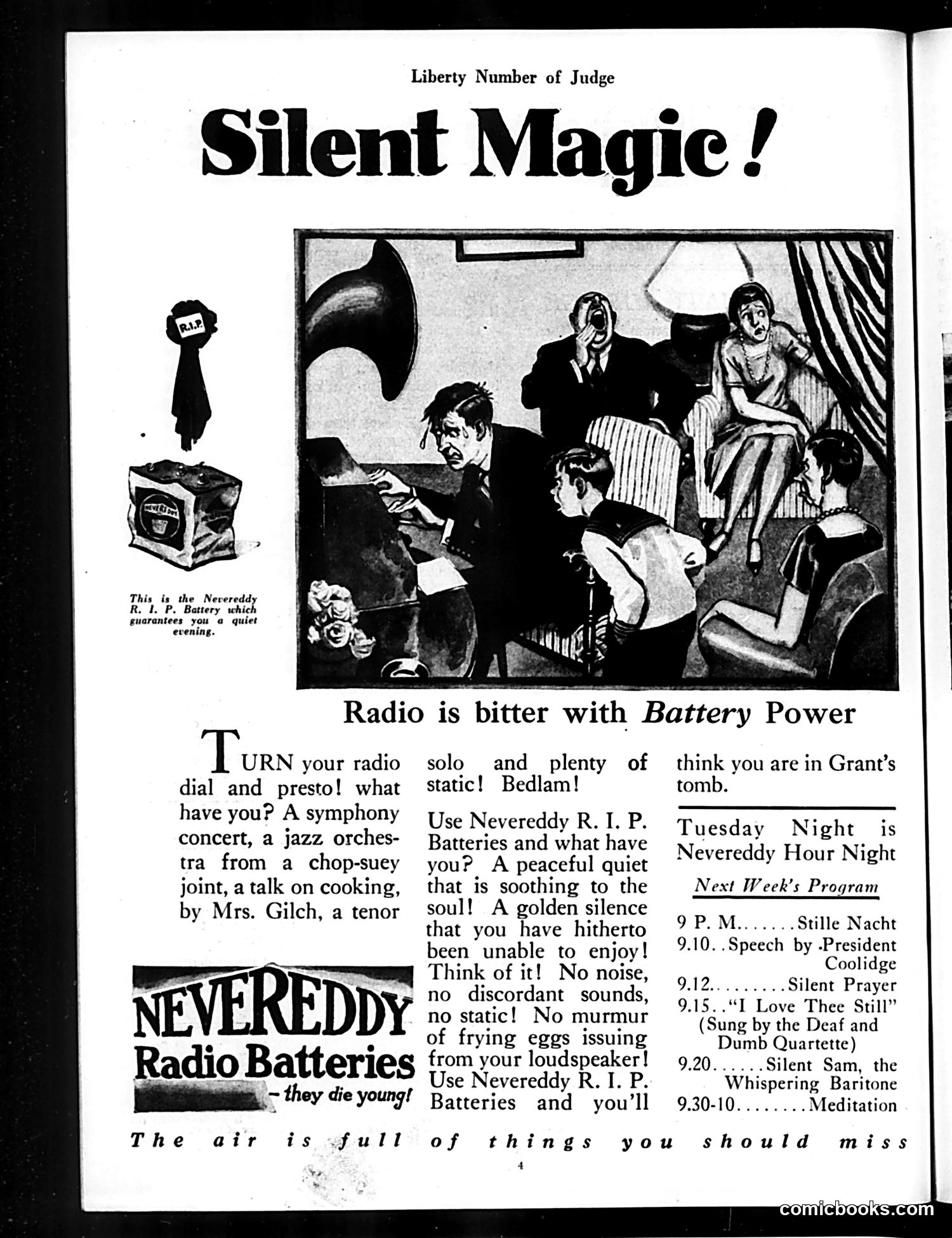
This page is primarily a **Nevereddy Radio Batteries advertisement**, not political satire. The ad uses humor to promote battery-powered radios by contrasting silent, peaceful listening with the noise and static of alternatives. The cartoon depicts a family enjoying a radio program undisturbed—"Silent Magic!" The joke is that Nevereddy batteries eliminate static and interference, creating the "golden silence" of crystal-clear reception. The program schedule lists intentionally absurd or ironic content ("Silent Prayer," "Silent Sam," "Dumb Quartette") that reinforces the noise-free listening experience. The small illustration on the left shows the product alongside a gravedigger with "R.I.P."—a dark joke that competitors' batteries "die young," while Nevereddy's last longer. The satire is commercial rather than political: mocking poor radio technology through humorous exaggeration.
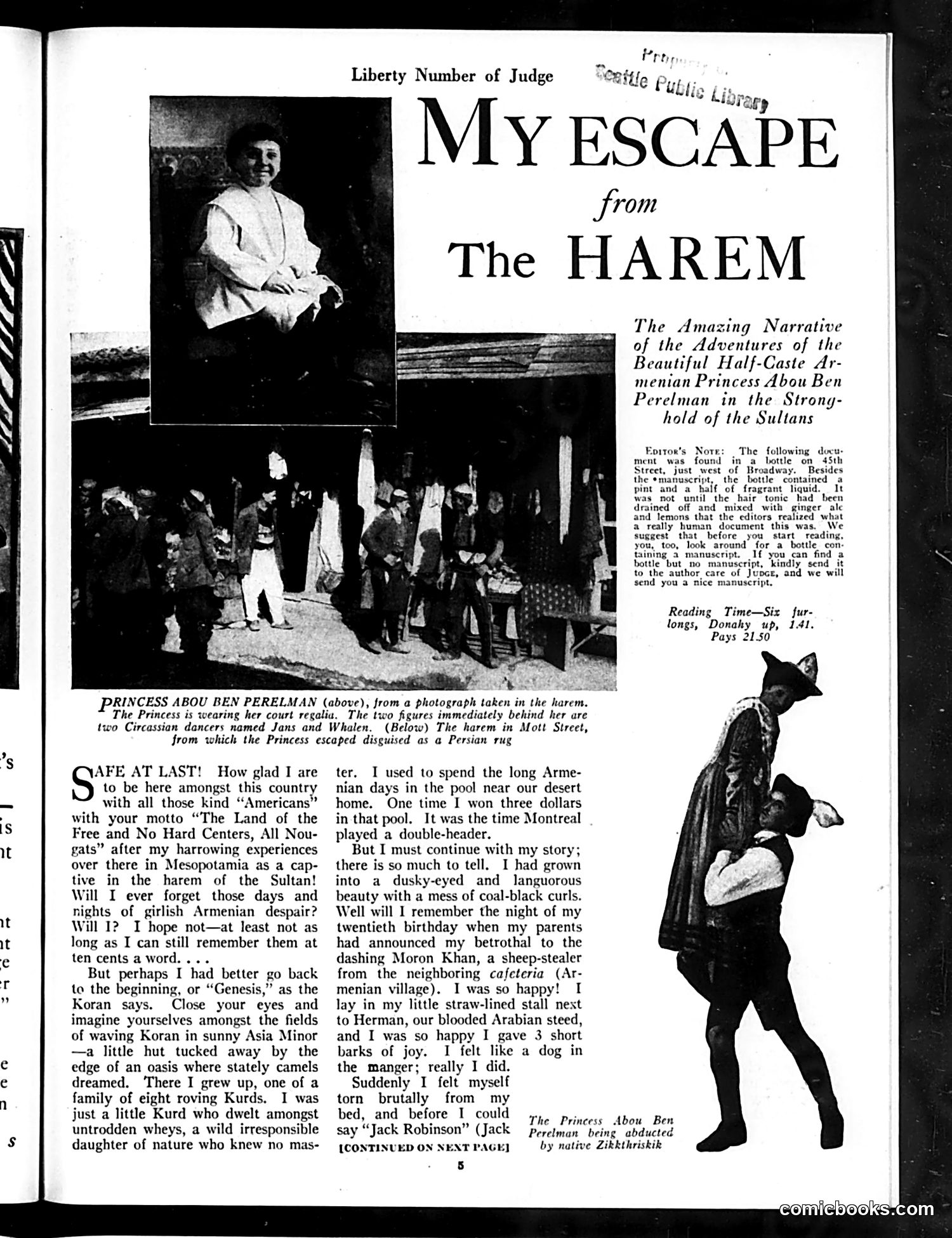
This page presents a serialized adventure story rather than political satire. The headline announces "My Escape from the Harem," attributed to Princess Abou Ben Perelman, described as a "Beautiful Half-Caste Armenian Princess" held in "the Stronghold of the Sultans." The narrative appears to be exotic fiction exploiting early-20th-century Western fascination with Ottoman harems and Middle Eastern mystery. The photos show a woman identified as the princess and a harem scene on Mott Street (likely a staged theatrical recreation in New York). The editor's note reveals this is fabricated entertainment: the "manuscript" was found in a bottle, mixing romantic adventure with comedic exaggeration. Judge presented this as humorous serialized fiction for reader entertainment rather than serious journalism or satire.
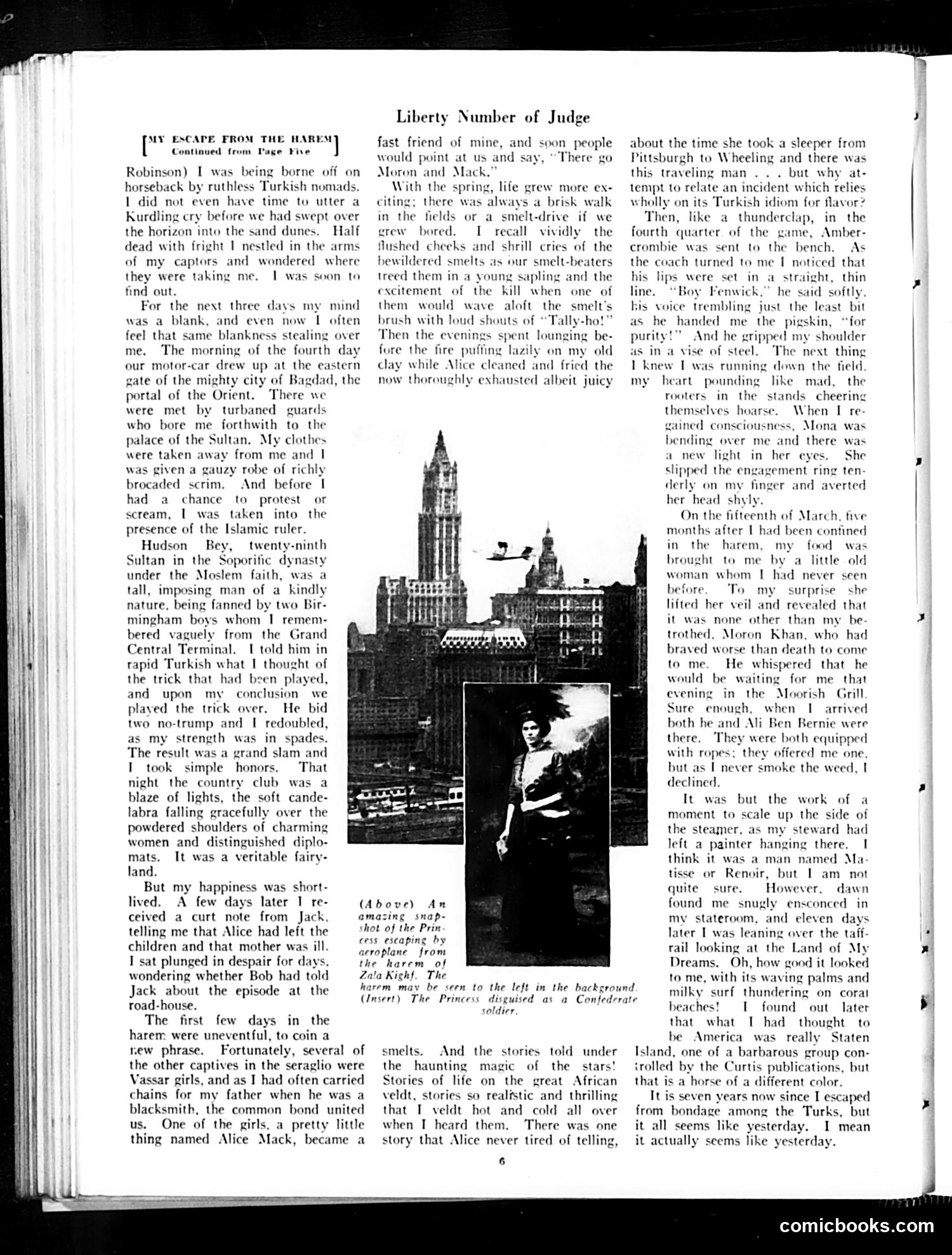
This page presents a serialized adventure story titled "My Escape from the Harem," a comedic fictional account of romantic misadventure in the Ottoman Empire. **The Content:** The narrator, apparently a Western man, has been captured by Turkish nomads and brought to the Sultan's palace. The satire works through absurd juxtapositions: he's introduced to "Hudson Bey," a Turkish Sultan inexplicably being fanned by "two Birmingham boys" from Grand Central Terminal—an impossible detail that signals the humor. **The Joke:** Judge satirizes orientalist fantasies and melodramatic adventure fiction popular in the 1920s. The incongruities (bridge games with sultans, "smelt-drives" in harems, Vassar girls as fellow captives) mock the genre's implausibility. The "Princess escaping by aeroplane" photo caption continues this absurdist tone. **Social Context:** This reflects Jazz Age attitudes toward exotic locales as settings for fantastical escapades, while gently ridiculing the clichés of adventure literature and Western presumptions about the Ottoman world.
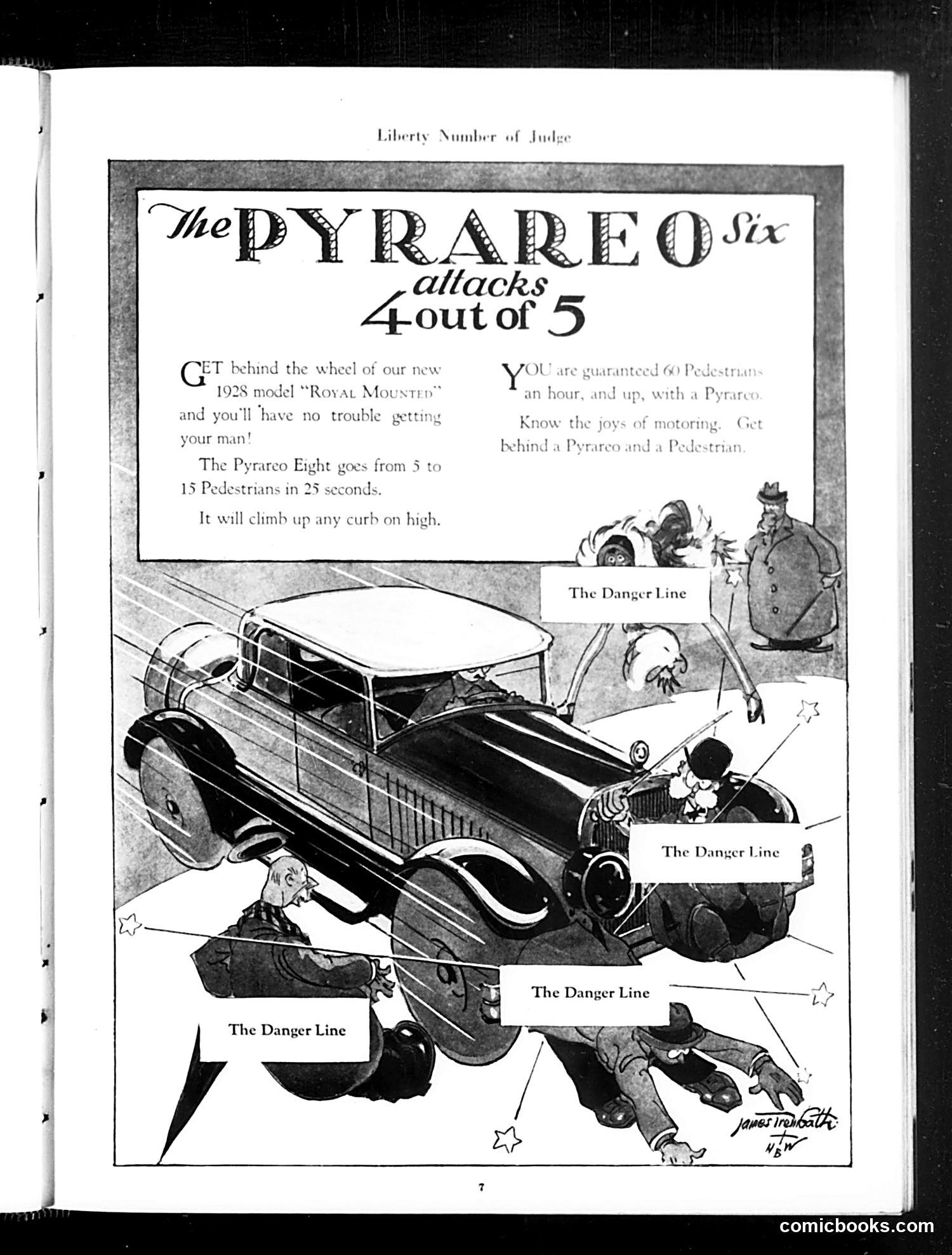
This is an advertisement for the "Pyrareo Six" automobile (1928), presented as dark satire in Judge magazine. The ad humorously claims the car "attacks 4 out of 5" pedestrians, boasting it can accelerate from hitting 5 to 15 pedestrians in 25 seconds. The cartoon illustrates "danger lines" around the vehicle showing pedestrians being struck and knocked down by the car. The satire critiques the era's dangerous driving practices and indifference to pedestrian safety—common problems in 1920s urban areas as automobile ownership surged. The joke is intentionally grotesque: by framing pedestrian casualties as a selling feature, Judge mocks both reckless drivers and the automobile industry's prioritization of speed and power over public safety. This reflects genuine contemporary concerns about traffic accidents and the social cost of rapid motorization.
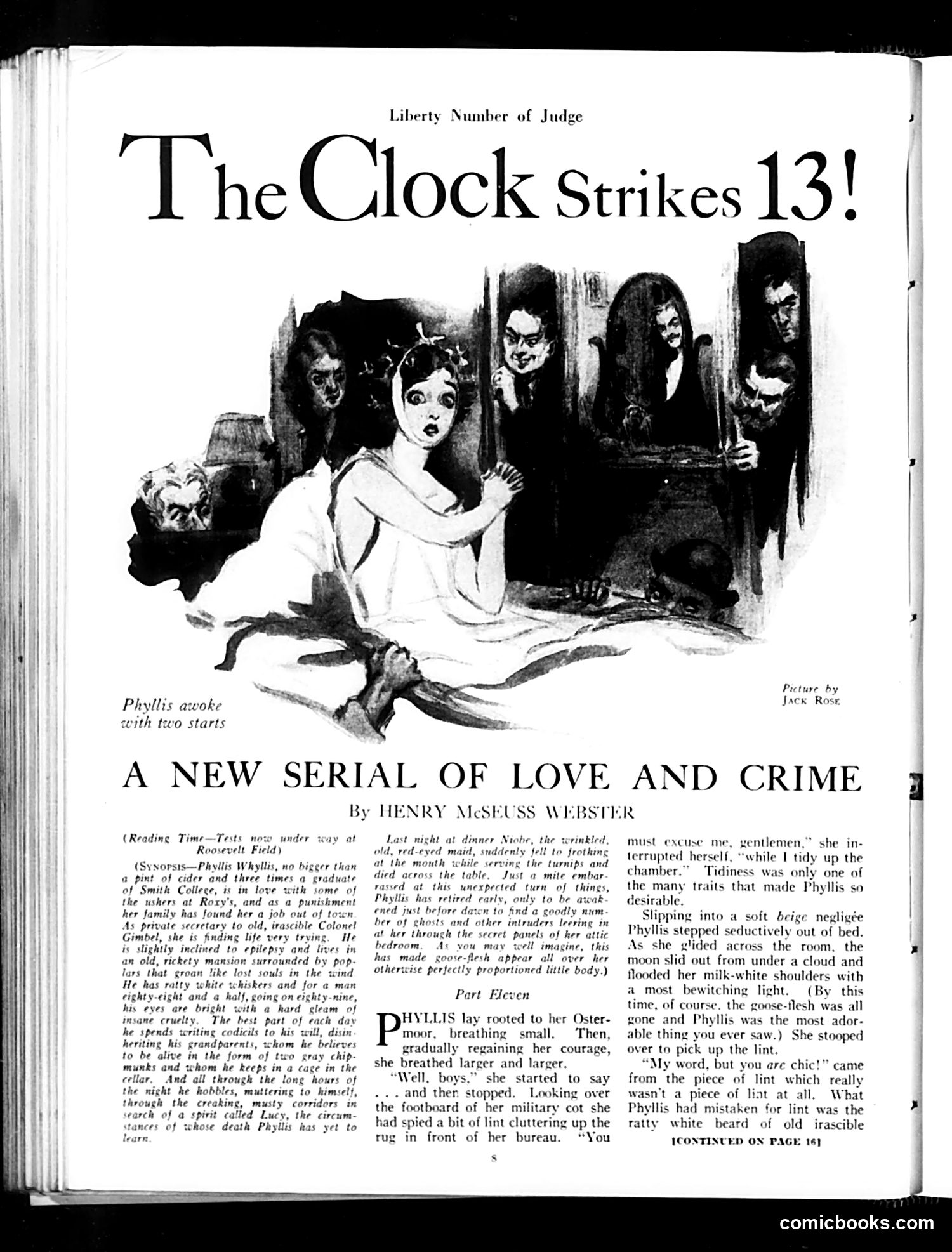
This is the opening installment of a serialized romantic comedy called "The Clock Strikes 13!" — a parody of melodramatic horror and mystery fiction popular in the 1920s-30s. **The Setup:** Phyllis, a young woman employed as secretary to an eccentric, wealthy old colonel living in a creepy mansion, is awakened by ghostly figures peering through her bedroom. The joke is that she's more concerned with tidying a piece of lint than with the supernatural intrusion. When she bends to pick it up, the "lint" speaks to her—it's actually the colonel's long beard. **The Satire:** Judge mocks overwrought serial melodramas (common entertainment of the era) by subverting expectations at every turn. Instead of gothic horror or genuine danger, readers get absurdist humor: a woman's fastidiousness trumps supernatural terror; ghostly threats become romantic comedy setup; and the scary old man is literally caught in a ridiculous position. The illustration by Jack Rose emphasizes the gothic atmosphere the text deliberately deflates—creating humor through incongruity.
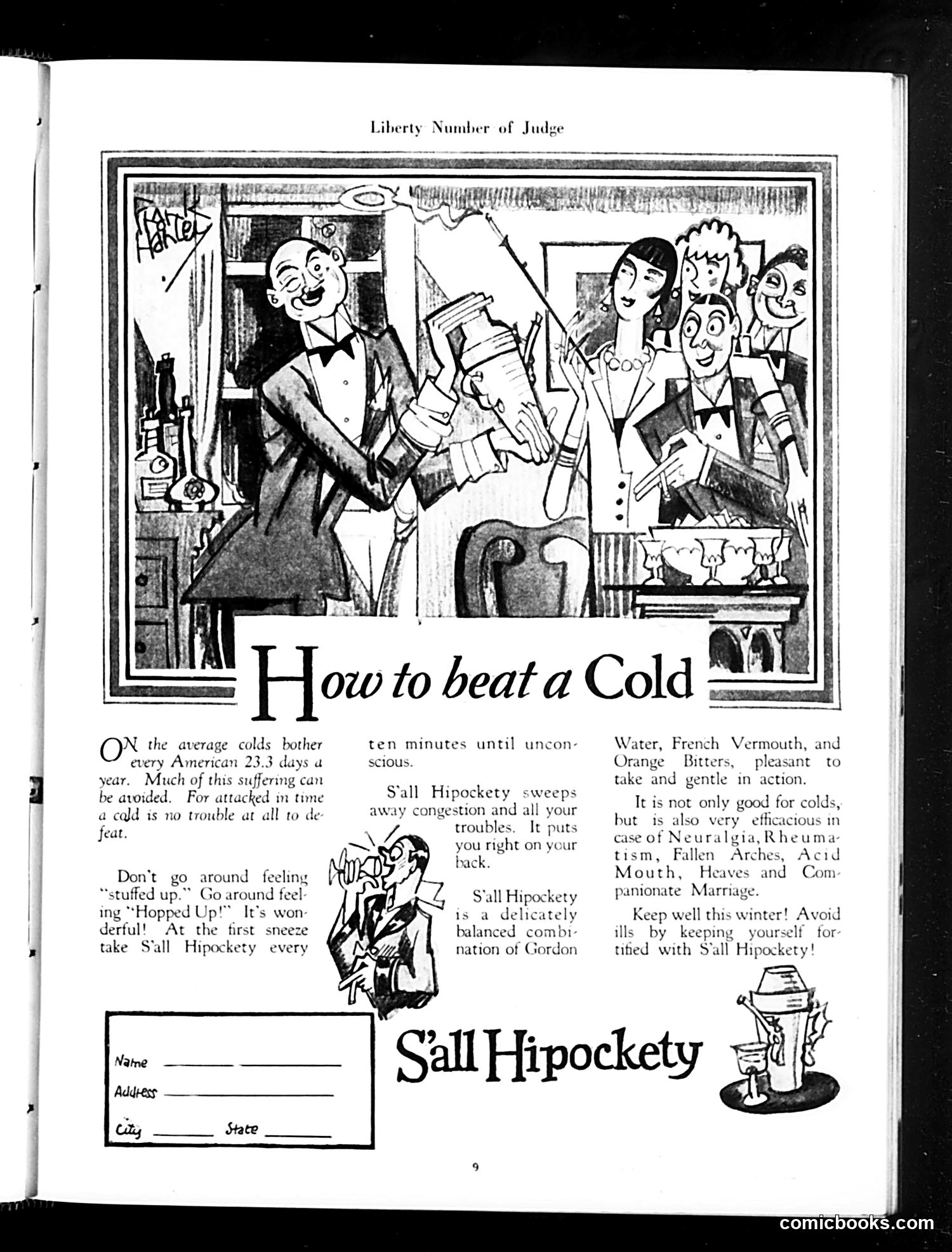
This is primarily **advertising disguised as editorial content**—a common practice in early 20th-century magazines. The page promotes "S'all Hipockety," a patent medicine (likely alcoholic, given references to "Gordon," "French Vermouth," and "Orange Bitters"). The cartoon at top shows a lively social gathering, establishing an aspirational lifestyle: feeling energetic and social rather than sick. The "advice" about colds is satirical wordplay. It puns on "Hopped Up" (stimulated/energetic) and uses absurdist logic: the medicine supposedly makes you feel well by making you feel intoxicated or euphoric, so you don't notice illness. References to treating "Neuralgia, Rheumatism, Fallen Arches, Acid Mouth...and Companionate Marriage" are comedic—listing ridiculous conditions alongside real ones. The humor relies on readers understanding that patent medicines were often ineffective tonics, frequently alcohol-based, marketed with exaggerated health claims. Judge's satirical tone gently mocks both the medicine and consumers' gullibility, while profiting from the advertisement.
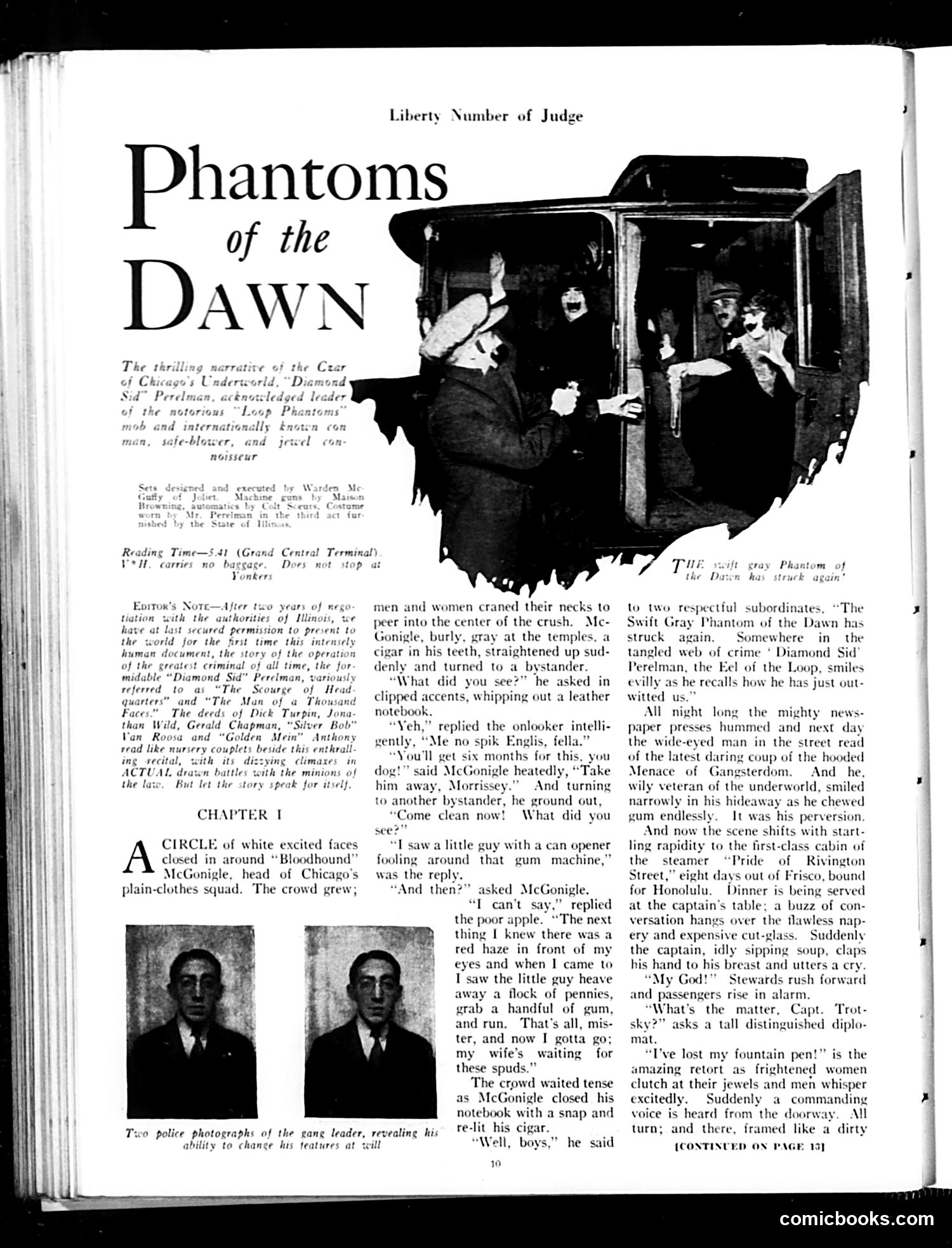
This page presents the opening of "Phantoms of the Dawn," a serialized crime story in Judge magazine. The narrative centers on "Diamond Sid" Perelman, described as Chicago's greatest criminal, and "Bloodhound" McGonigle, the city's plain-clothes police chief. The satire mocks both sensationalist crime journalism and pulp detective fiction popular in this era. When a trivial gum-machine theft occurs, McGonigle dramatically invokes the mysterious "Swift Gray Phantom of the Dawn"—transforming a petty crime into lurid headline news through police theatricality and press hyperbole. The humor lies in the contrast between the mundane reality (a stolen handful of gum) and the grandiose criminal mythology constructed around it. The story then shifts to a ship where a "daring" crime is revealed: a lost fountain pen—again deflating dramatic expectations. Judge satirizes both the public's appetite for sensational crime narratives and the newspapers' complicity in manufacturing criminal legends from ordinary incidents.
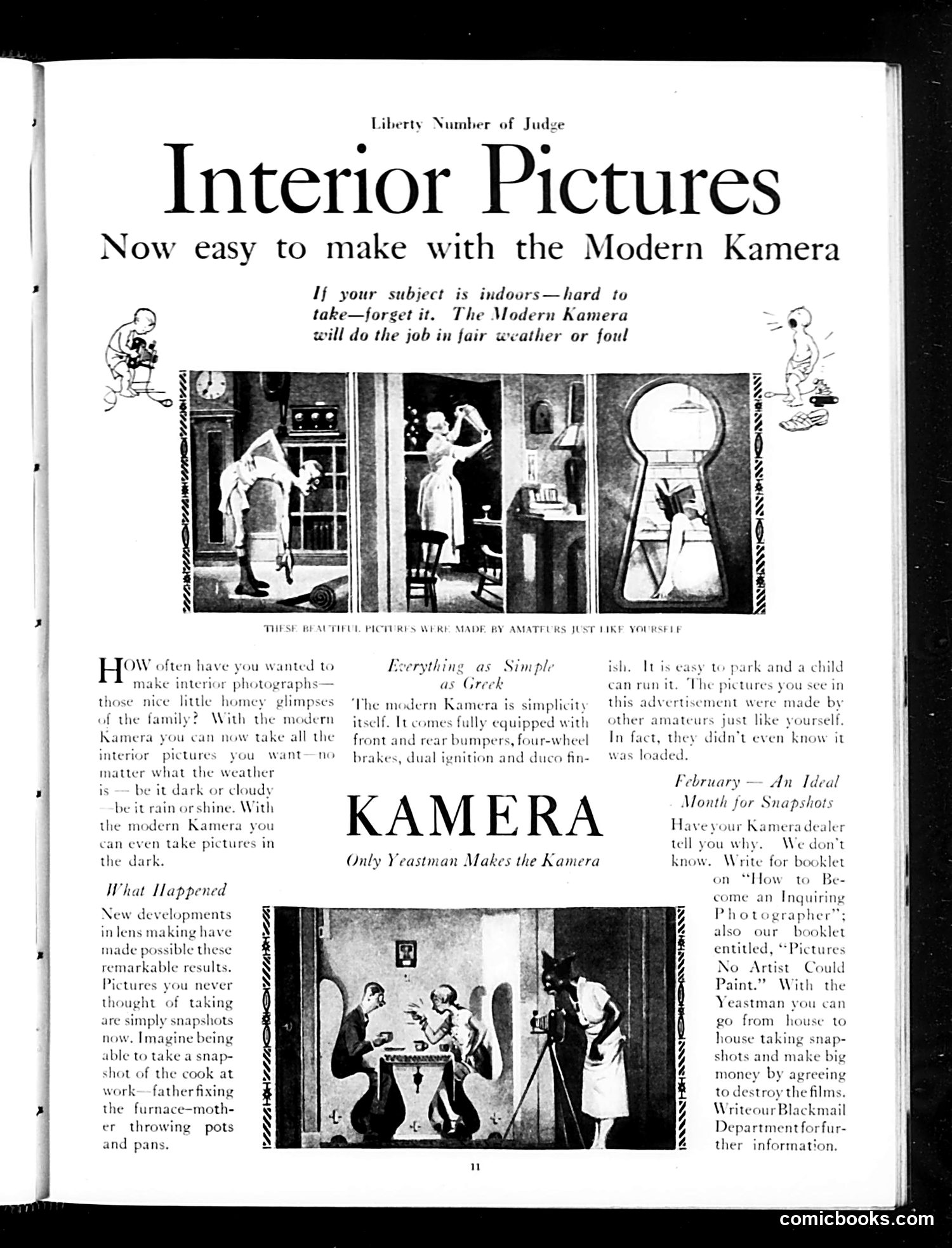
This is a **fake advertisement** satirizing both amateur photography and automobile culture. The page mimics a genuine Kodak/Eastman camera ad but contains absurdist humor throughout. The joke conflates a camera with an automobile—describing it with "front and rear bumpers, four-wheel brakes, dual ignition"—suggesting cameras are becoming as complex and unnecessary as cars. The darkly comic punchline appears in the final section: Yeastman offers a "Blackmail Department" where amateur photographers can earn money by secretly photographing people in their homes, then destroying the films. This escalates the invasion-of-privacy anxiety of snapshot culture into criminal extortion. The smaller photos above show staged domestic scenes—cooking, fixing furnaces, personal moments—emphasizing what private activities could now be photographed without consent. The satire critiques both the camera industry's aggressive marketing and modern technology's threat to domestic privacy.
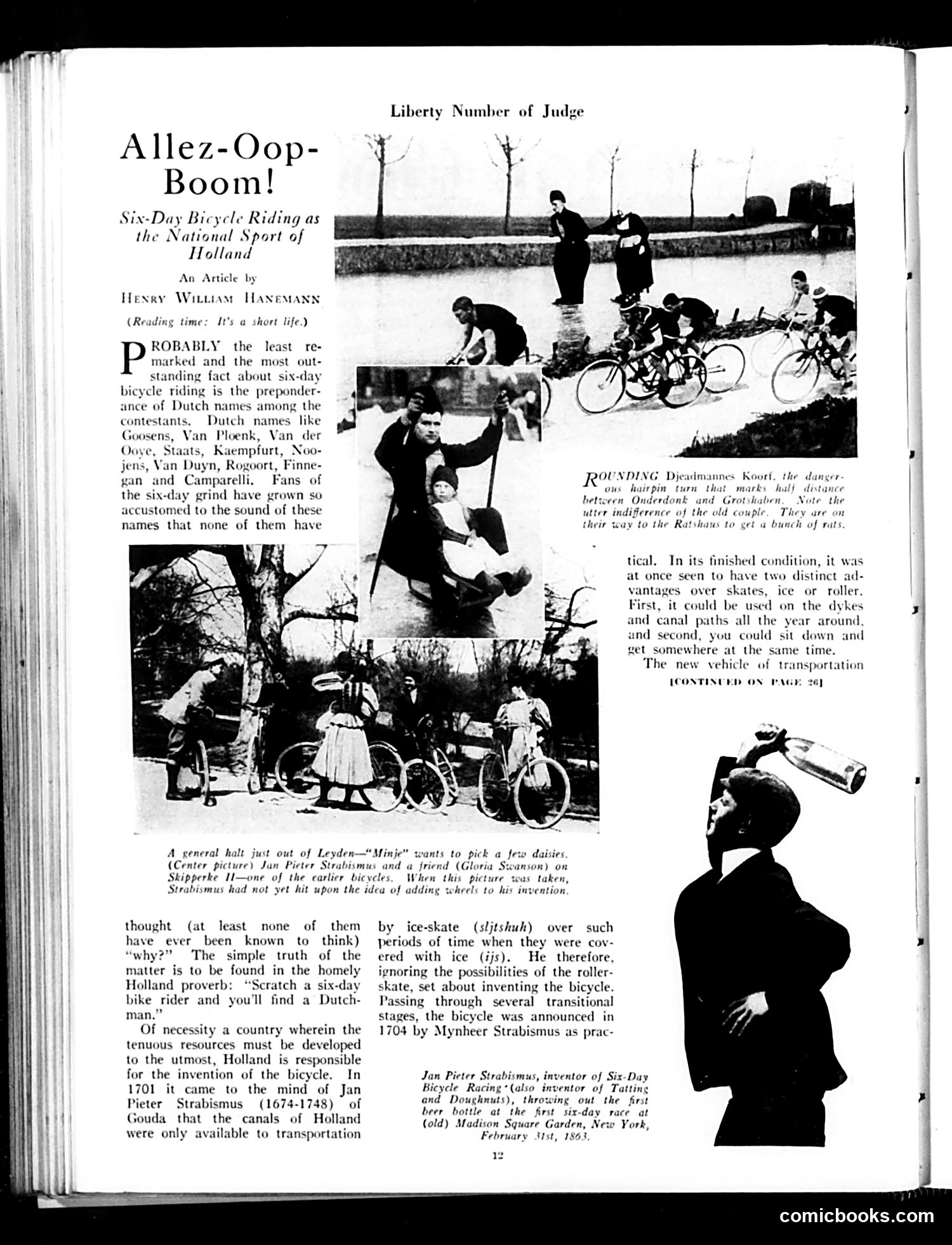
This is a humorous article mocking the Dutch dominance of six-day bicycle racing, a real endurance sport popular in the early 1900s. The piece satirizes how Dutch competitors' names (Goosens, Van Ploenk, etc.) have become so ubiquitous in the sport that fans barely notice. The joke invents a farcical origin story: a fictional Dutch inventor, "Jan Pieter Strabismus" (1674-1748), allegedly created the bicycle in 1701 by adding wheels to ice-skates, since Holland's canals froze over. The absurdist humor culminates in a fake detail—Strabismus throwing "the first beer bottle at the first six-day race" at Madison Square Garden on "February 31st, 1863"—an impossible date (February has 28-29 days), signaling the entire history is fabricated. The photographs show actual six-day racers competing, contrasting real sport with the article's ridiculous fictional backstory. The satire gently mocks both Dutch participation in the sport and the magazine's readers' fascination with it.
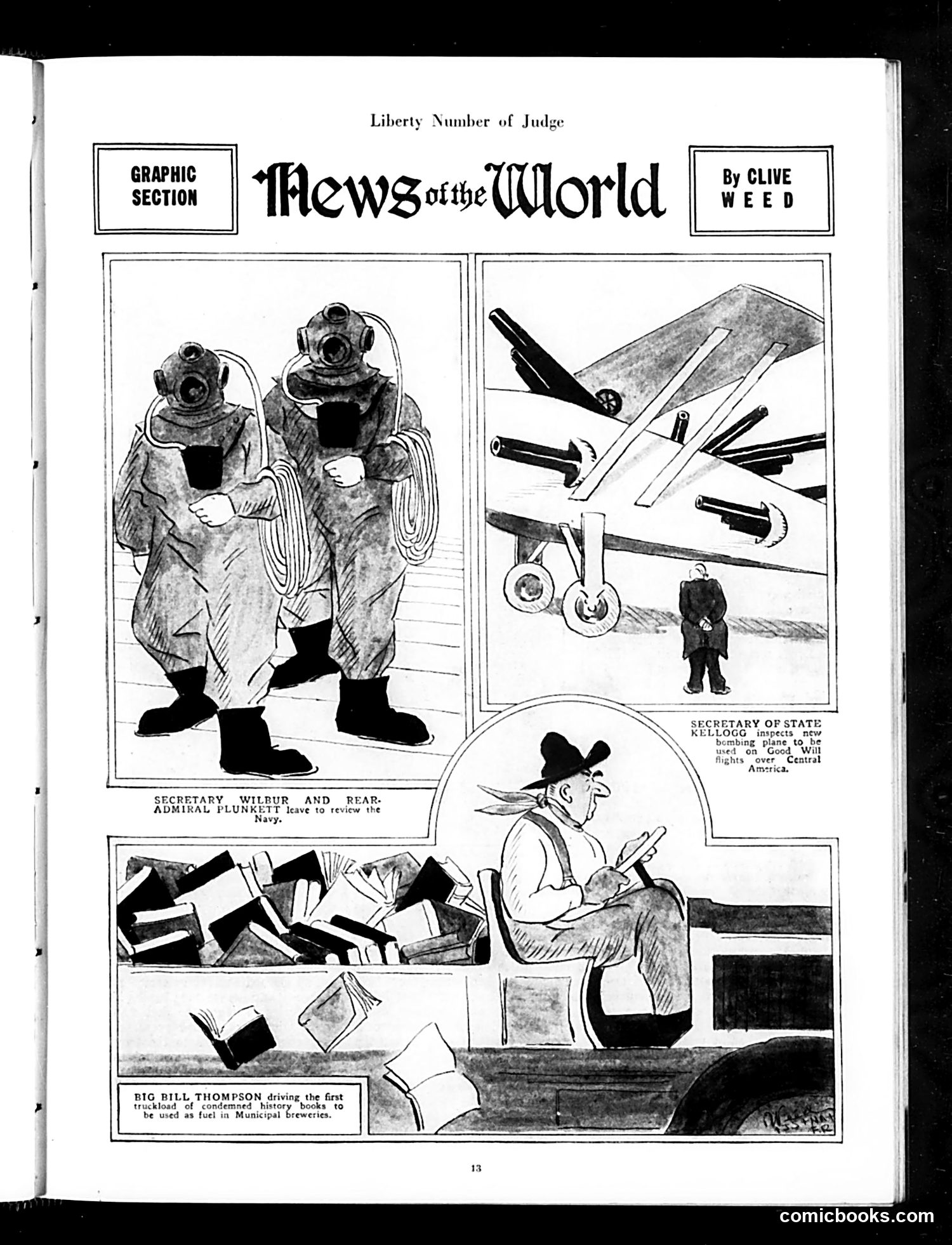
This satirical page by Clive Weed depicts three scenes related to American military and government activities: **Top left:** Secretary Wilbur and a Rear-Admiral in diving suits, apparently reviewing naval matters. **Top right:** Secretary of State Kellogg inspecting a new bombing plane, with a small figure standing beneath the aircraft—likely satirizing government oversight of military aviation development. **Bottom:** "Big Bill Thompson" driving a truck loaded with condemned history books, suggesting censorship or revisionism of historical records. The page's theme appears to be critiquing government officials' involvement in military expansion and historical control during the inter-war period. The satire suggests these leaders are prioritizing military modernization and narrative control over democratic principles, fitting Judge magazine's tradition of political commentary.
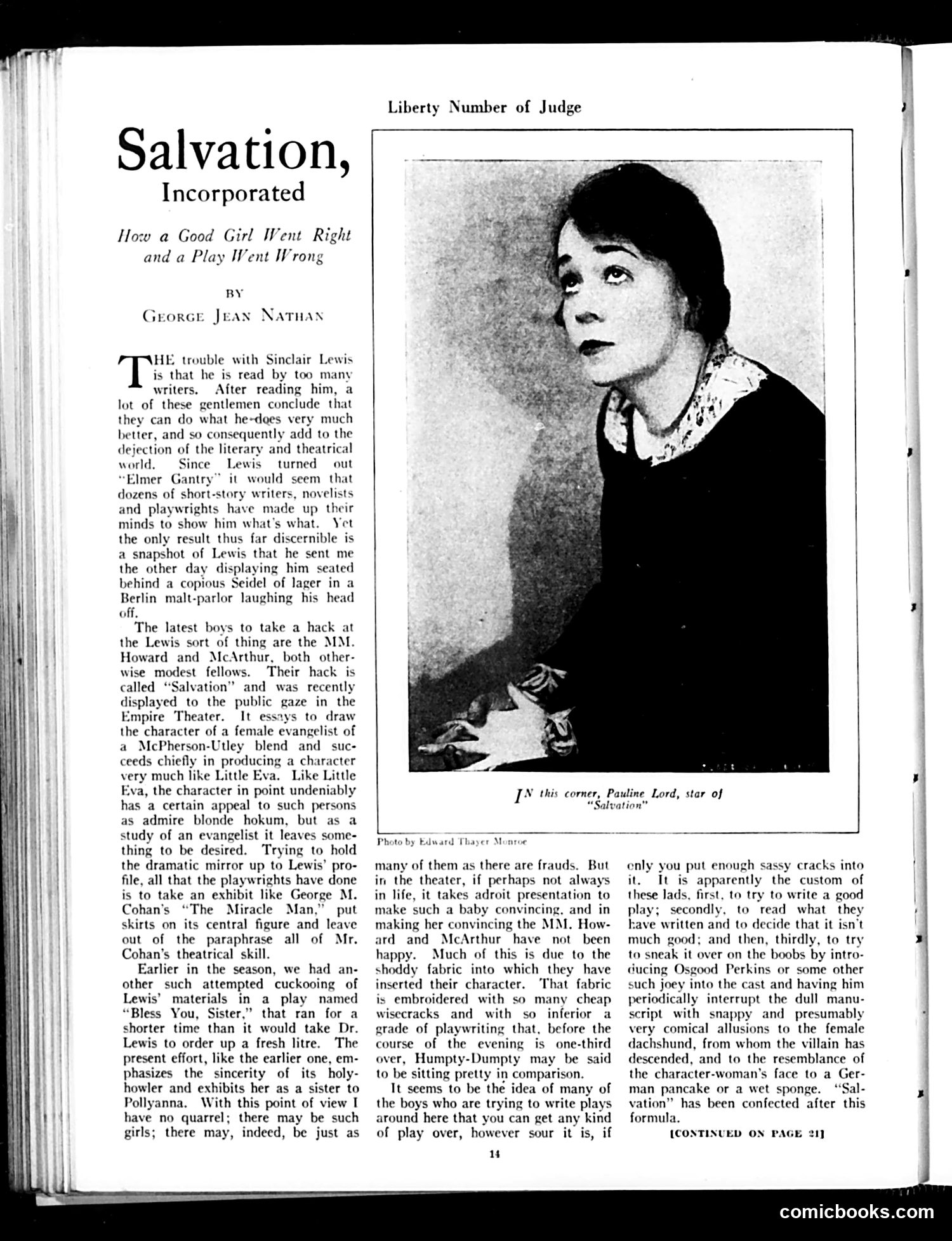
This is a theater review by George Jean Nathan critiquing the play *"Salvation,"* starring Pauline Lord (photographed). Nathan argues the play is a weak imitation of Sinclair Lewis's satirical novel *"Elmer Gantry"* (1927), which had inspired numerous copycat works about hypocritical evangelists. The satire targets both the play and a broader theatrical trend: writers attempting to capitalize on Lewis's success by creating similar stories but lacking his skill. Nathan specifically criticizes how the character—a female evangelist blending McPherson (likely Aimee Semple McPherson, a famous 1920s evangelist) and "Little Eva"—is presented as sentimental rather than genuinely satirical. His main complaint: playwrights compensate for weak scripts by inserting "sassy cracks" and crude jokes (references to dachshunds and German pancakes) rather than crafting actual dramatic substance. The play, he concludes, is poorly constructed theatricality dressed up with cheap wisecracks—a formula-bound failure.
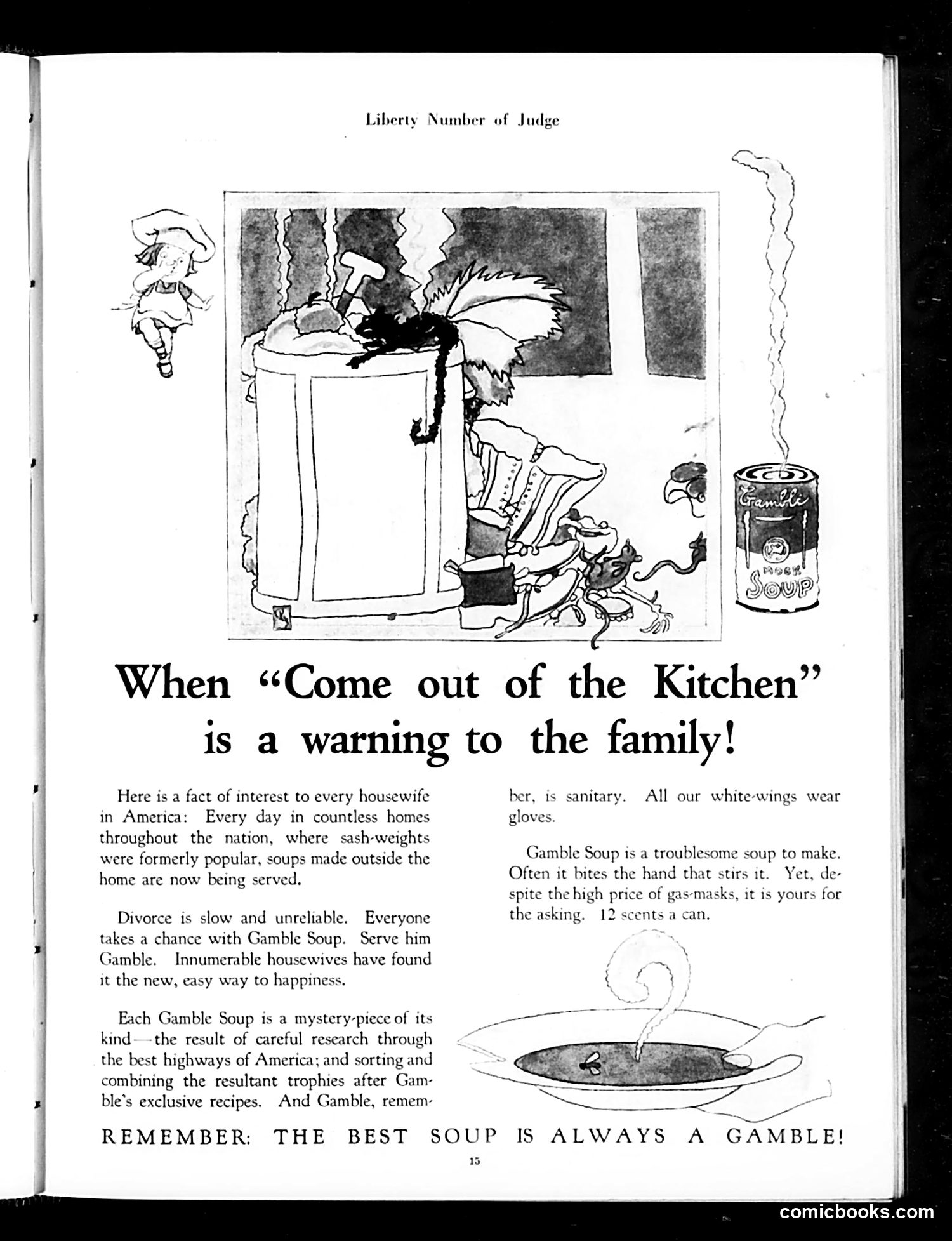
This is a darkly satirical fake advertisement for "Gamble Soup" in Judge magazine. The satire mocks both poorly-made commercial soups and domestic violence. The cartoon depicts a chaotic kitchen scene where a woman wielding a hammer appears to be attacking someone in a large soup pot, with small figures (possibly children) fleeing below. The advertisement's "jokes" are shockingly cynical: it suggests that serving canned soup instead of homemade meals is preferable to divorce as a solution to unhappy marriages—implying wives should poison their husbands with dangerous, contaminated soup instead. References to "sash-weights" (murder weapons), the soup "bites the hand," needing "gas-masks," and describing it as a "troublesome soup" all suggest lethal poisoning. This reflects early 20th-century dark humor about domestic discord, while also satirizing the quality and safety of mass-produced canned foods. The "Liberty Number" theme suggests commentary on women's limited options and freedoms within marriage.
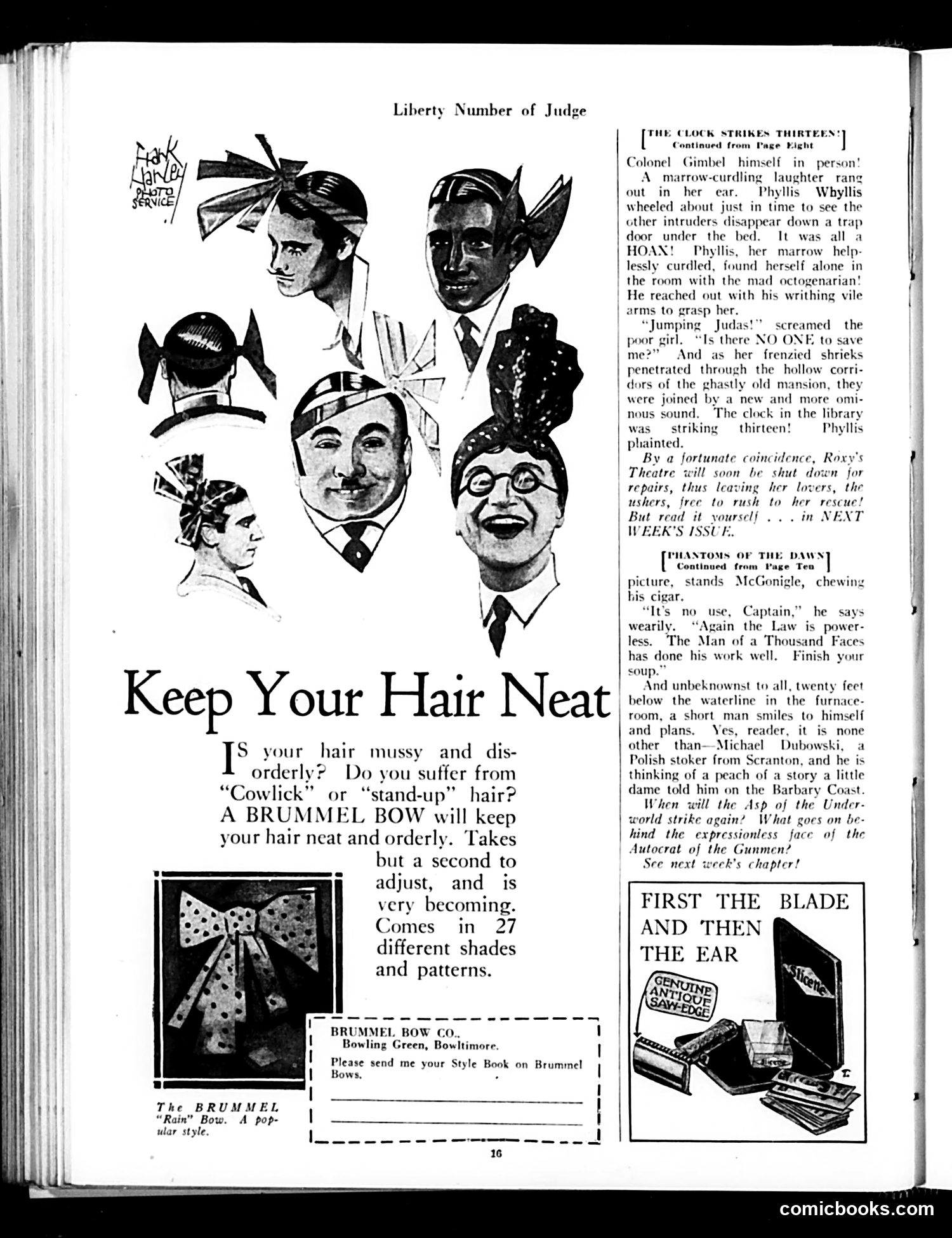
This page mixes advertising with serialized fiction parodies typical of Judge magazine's satirical humor. **The Advertisement:** A "Brummel Bow" hair product advertisement plays on vanity and grooming fashion. The bow ties in various patterns promise to tame unruly hair—a straightforward commercial pitch. **The Fiction Sections:** Two serialized melodramas parody overwrought pulp fiction and silent-film serials popular in the 1920s-30s. "The Clock Strikes Thirteen" features absurdly gothic horror tropes (mad octogenarians, trap doors, a mysteriously ominous clock). "Phantoms of the Dawn" mocks detective/crime serials with ridiculous character names (McGonigle, the "Autocrat of the Gunmen") and implausible plot twists. **The Satire:** Judge ridicules both the breathless melodrama conventions and reader gullibility. The exaggerated cliffhangers and ham-fisted plot devices intentionally expose how silly these popular entertainments were. The inclusion of absurd advertisements alongside fake serialized stories suggests both equally prey on audience credulity.
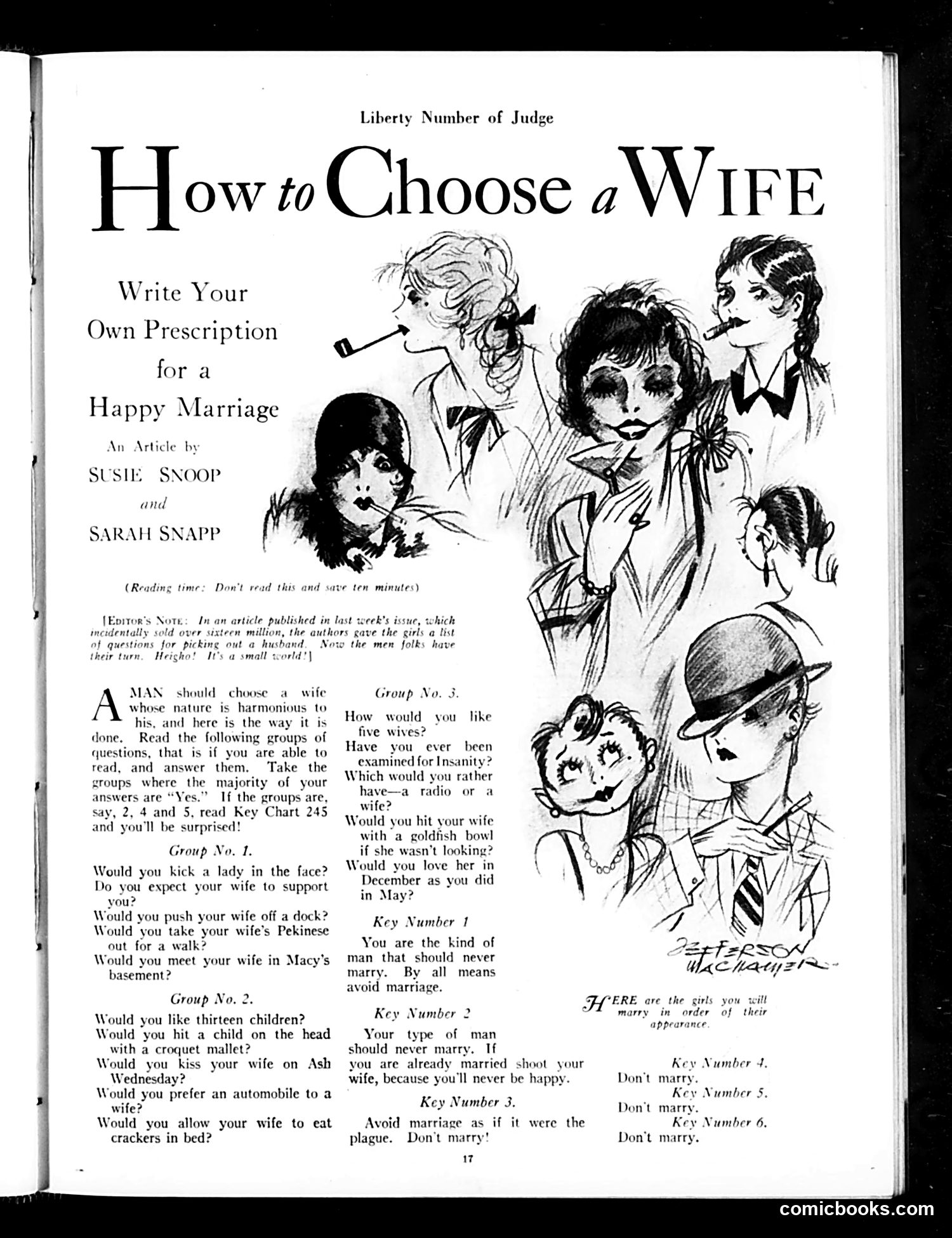
This article by Susie Snoop and Sarah Snapp satirizes both marriage advice literature and male attitudes toward matrimony. Readers answer personality questionnaires grouped by topic—ranging from absurd violence ("kick a lady in the face," "push your wife off a dock") to mundane domestic scenarios (eating crackers in bed, preferring a car to a wife). The satire's point: the "key chart" results are uniformly discouraging. Nearly every outcome advises against marriage entirely, with escalating hostility in Key Number 2 (literally suggesting murder). The illustrated women shown represent "girls you will marry in order of their appearance"—a cynical joke about inevitable matrimonial disappointment. This reflects 1920s-era skepticism about marriage as a social institution, mocking both earnest self-help prescriptions and the period's crude gender relations. The joke is that no man, regardless of answers, should marry at all.
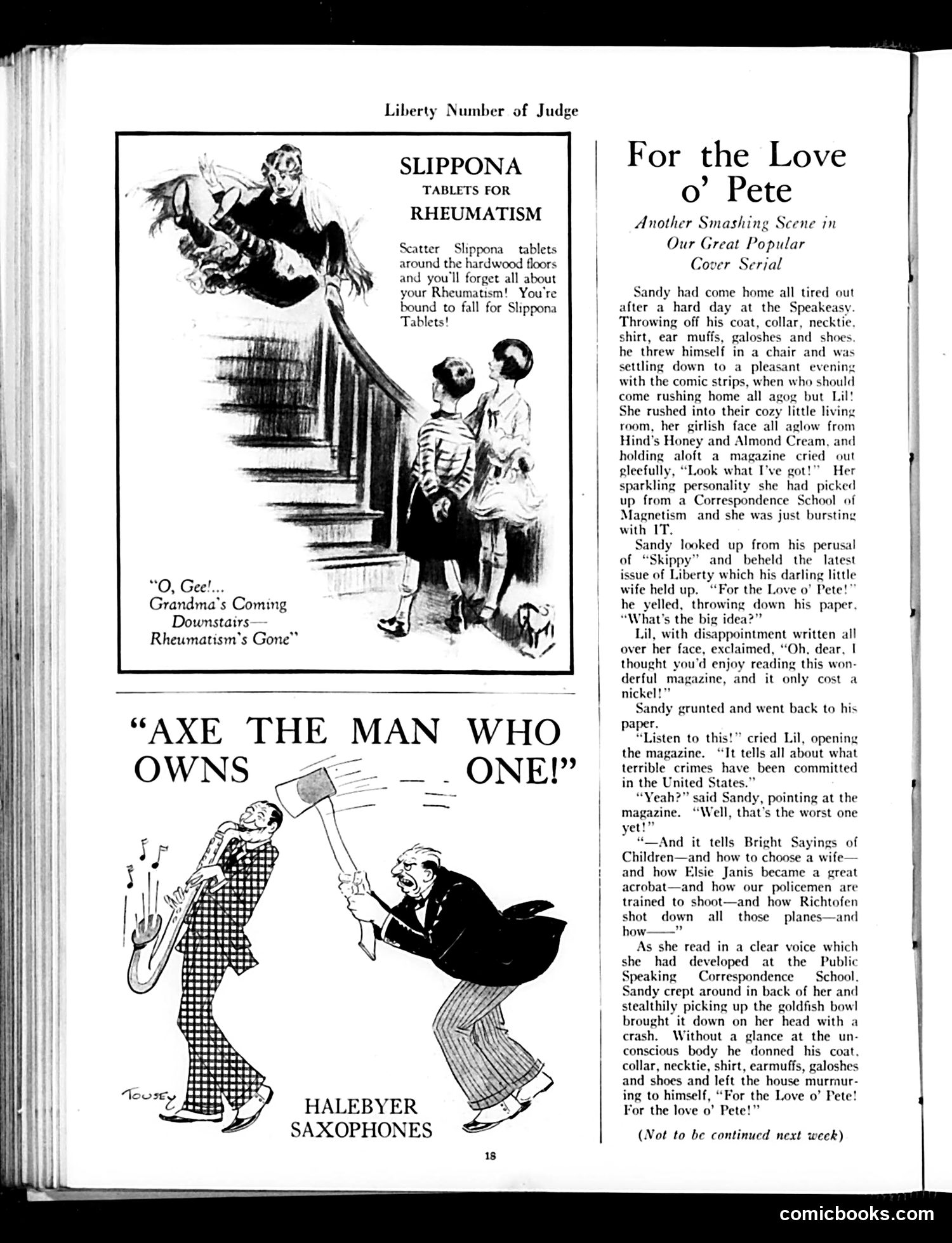
This page contains two separate pieces of 1920s satirical content: **Advertisements**: The top features fake product ads—"Slippona Tablets for Rheumatism" (a slapstick joke about slipping) and "Halebyer Saxophones" (likely a pun). These parody typical magazine advertisements. **Serial Story "For the Love o' Pete"**: A domestic comic narrative satirizing popular magazine culture itself. Sandy, a husband, dismisses his enthusiastic wife Lil's reading from *Liberty* magazine—which advertises itself through this very story. The joke's escalation to Sandy striking his wife with a fishbowl represents exaggerated, darkly comedic frustration at her earnest enthusiasm for the magazine's content (crime stories, self-help articles, celebrity pieces). The humor relies on period assumptions about marital dynamics and mocks both magazine culture's vapid appeal and the "modern wife" stereotype of the Jazz Age. The note "(Not to be continued next week)" is itself a joke—this supposedly popular serial won't continue because of its violent ending.
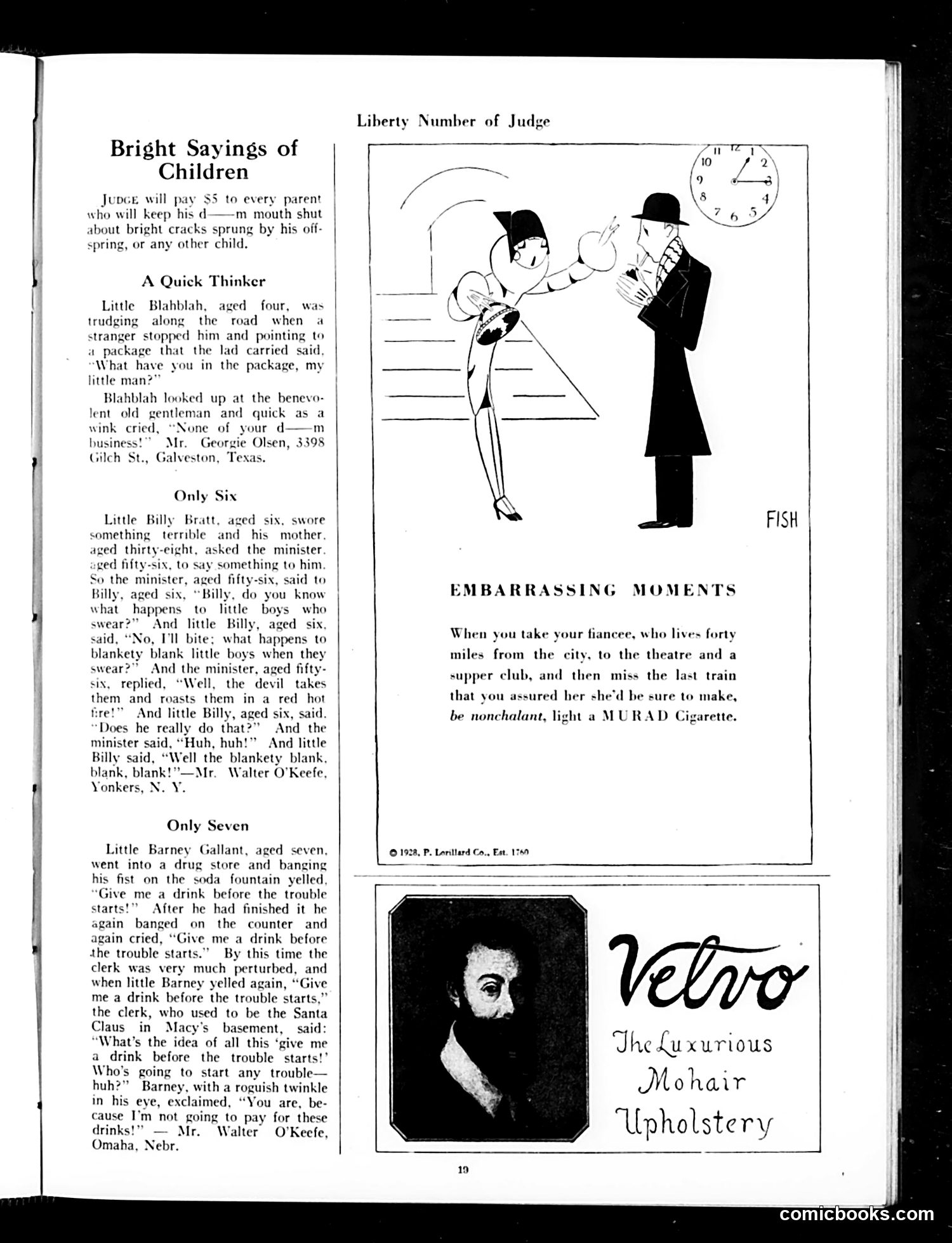
This page from Judge magazine (circa 1928) contains satirical humor typical of the era: **"Bright Sayings of Children"** presents three anecdotes mocking both children and adults. The humor relies on children using profanity and outwitting authority figures—the "quick thinker" Blahblah tells a stranger to mind his business; Billy Bratt frustrates a minister by swearing despite threats of damnation; Barney Gallant tricks a soda clerk into serving free drinks by creating false urgency. The framing device sarcastically offers parents $5 to keep quiet about such incidents, satirizing the contemporary trend of publishing cute children's quotes. **"Liberty Number of Judge"** cartoon shows a man (labeled "Fish") presenting a woman to a judge in a clock-themed setting, likely depicting a marriage or divorce proceeding—a common Judge subject. **"Embarrassing Moments"** is a Murad cigarette advertisement using social anxiety as marketing: missing your train with your fiancée is awkward, so smoke cigarettes to appear nonchalant. The overall tone reflects 1920s sophistication and irreverence toward Victorian propriety.
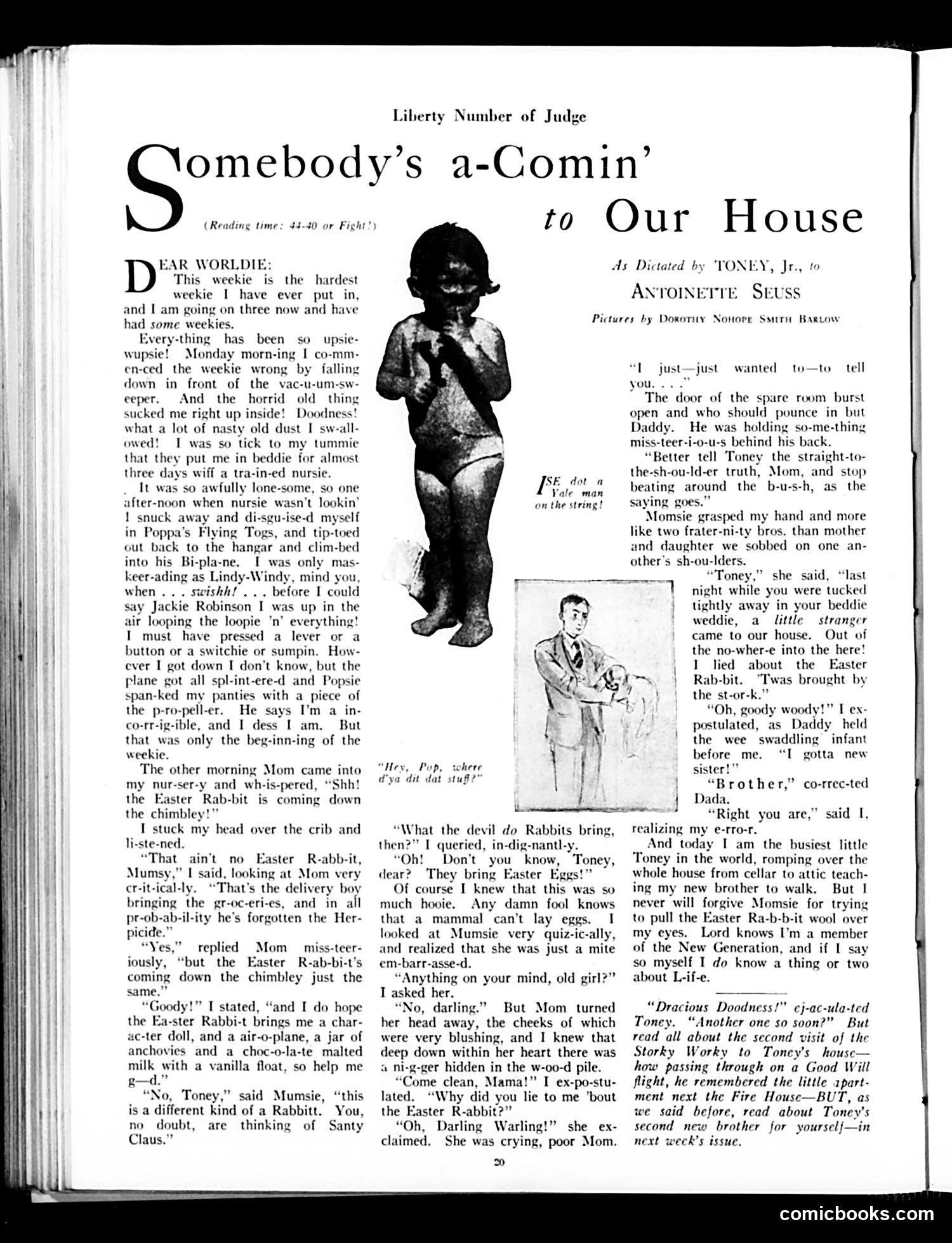
This is a humorous children's story presented in Judge magazine's characteristic style. The narrative, dictated by "Toney, Jr., age 10," recounts a chaotic week of mishaps—falling into a vacuum cleaner, joy-riding in father's airplane—culminating in the revelation that a new baby sibling has arrived. The satire targets genteel parenting euphemisms of the era. The child's mother initially perpetuates the "Easter Bunny" fiction, then the "stork" story, before finally admitting the truth. The humor derives from Toney's precocious skepticism (children instinctively know mammals don't lay eggs) and the parents' discomfort with honest explanation. The piece gently mocks both childish innocence and adult pretense around reproduction and family matters, using exaggerated phonetic spelling to convey a child's speaking patterns—a common Judge convention for comedic effect.
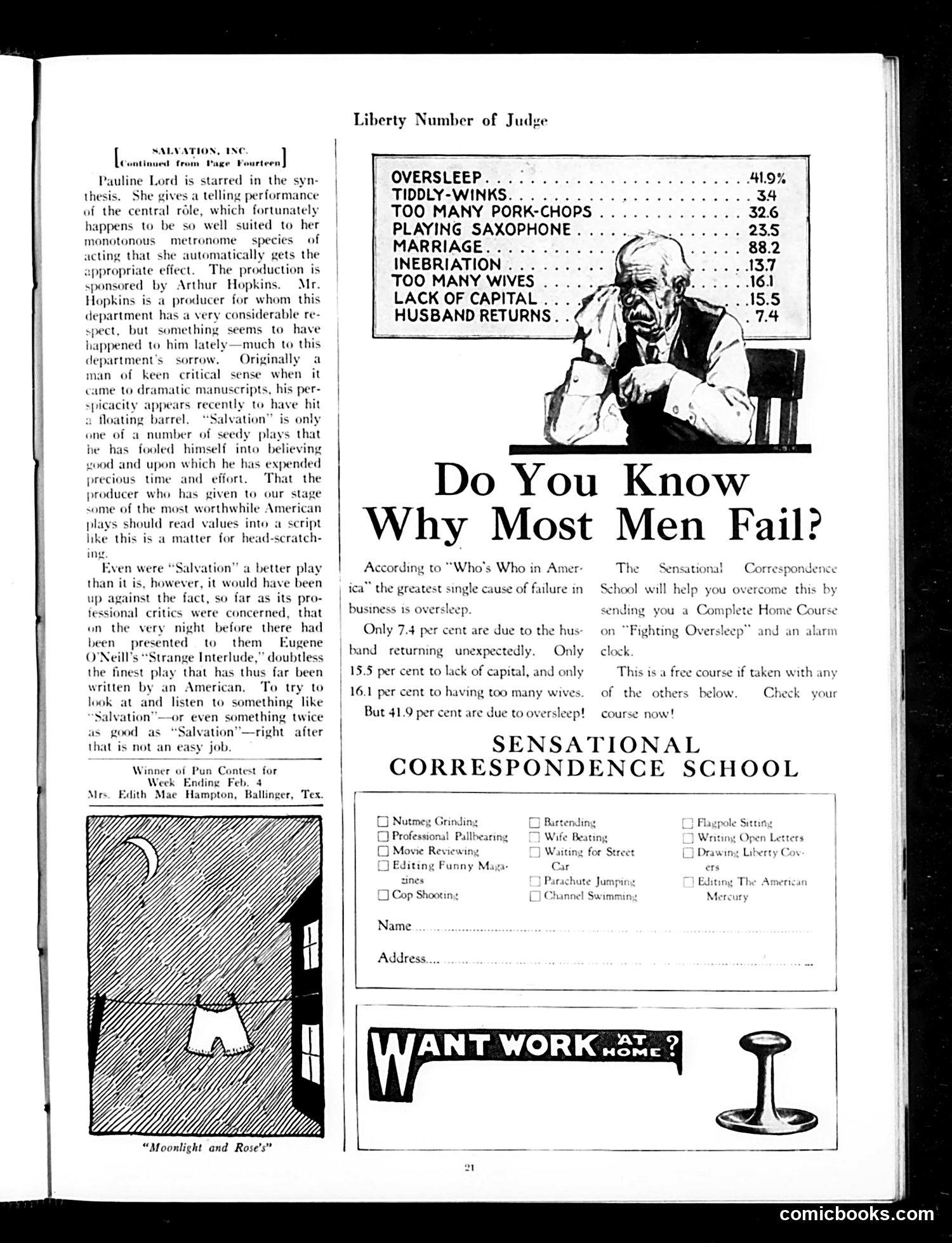
This page contains theater criticism and humorous advertisements typical of 1920s Judge magazine. **Theater Review (Left):** Critic reviews "Salvation," a play starring Pauline Lord, produced by Arthur Hopkins. The review is scathing—dismissing Lord's acting as mechanical and the play itself as "seedy," while expressing disappointment that producer Hopkins has lost his critical judgment. The timing is unfortunate: the play opened the night after Eugene O'Neill's acclaimed "Strange Interlude," making comparison unfavorable. **Main Satire (Center):** "Do You Know Why Most Men Fail?" presents a fake statistical breakdown of business failure causes, dominated by "oversleep" at 41.9%. The joke mocks self-help culture and correspondence schools—the ad then absurdly offers a mail-order course to fight oversleeping, complete with an alarm clock. The satire ridicules both male laziness and the era's proliferation of dubious mail-order education schemes. The page reflects 1920s concerns about work ethic, modern conveniences, and commercial exploitation through fraudulent "self-improvement" programs.
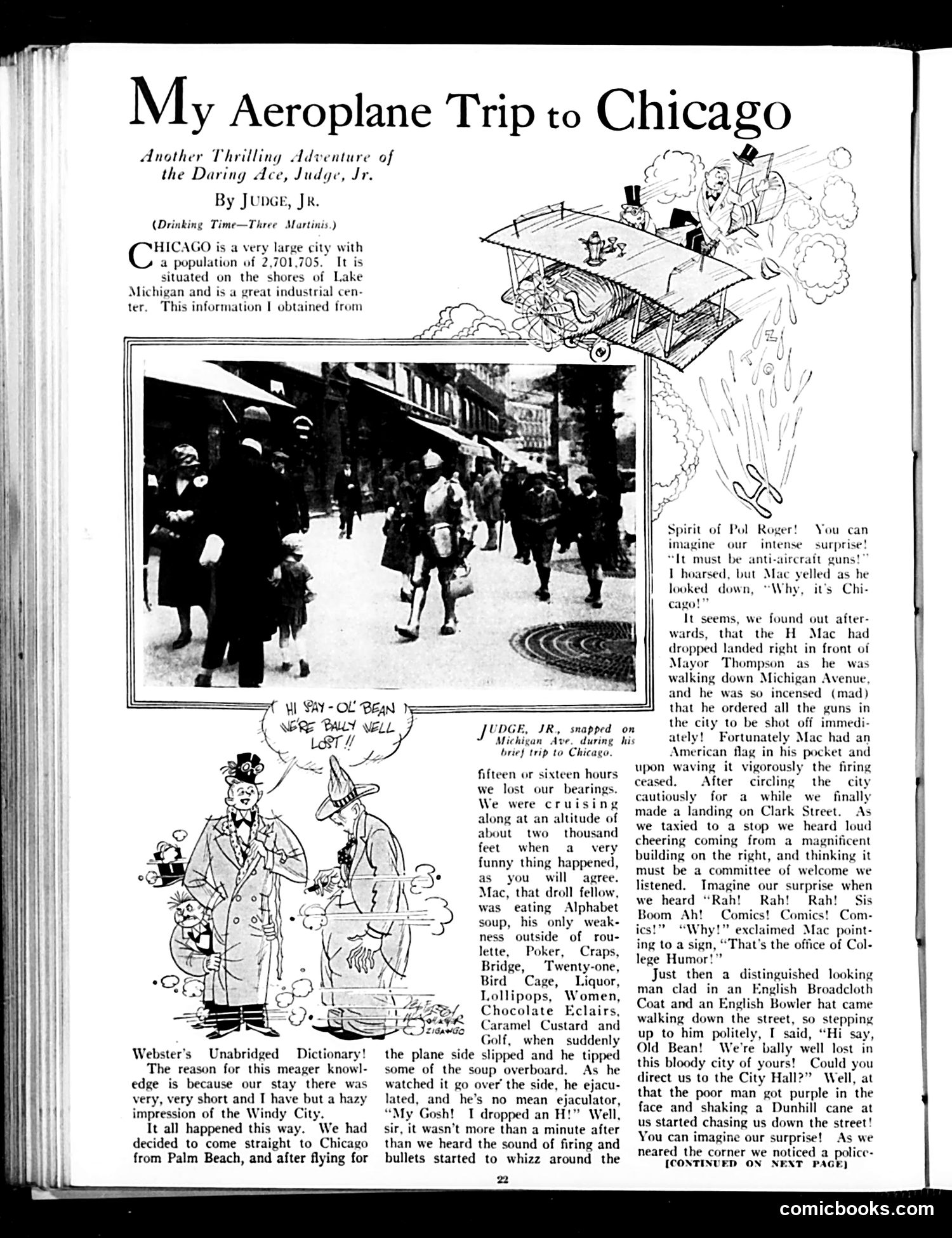
This is a humorous adventure story by "Judge, Jr." (a fictional persona) recounting an absurd airplane trip to Chicago. The satire works on multiple levels: **The Setup:** The narrator claims ignorance about Chicago despite "facts," humorously admitting his knowledge comes from drinking martinis rather than research. **The Joke:** The story escalates absurdly—a character named "Mac" drops alphabet soup overboard; the soup apparently triggers Chicago's entire gun arsenal to fire; Mayor Thompson becomes so enraged he orders all city guns discharged. An American flag stops the bombardment. **Social References:** The piece mocks Chicago's violent reputation (the "Windy City") and Mayor Thompson (likely William "Big Bill" Thompson, Chicago's controversial mayor of that era, known for colorful, aggressive politics). The landing near a "College Humor" office is self-promotional advertising. **The Humor:** Early 20th-century slapstick absurdism—taking mundane events to ridiculous extremes to satirize the city's reputation for violence and chaos.
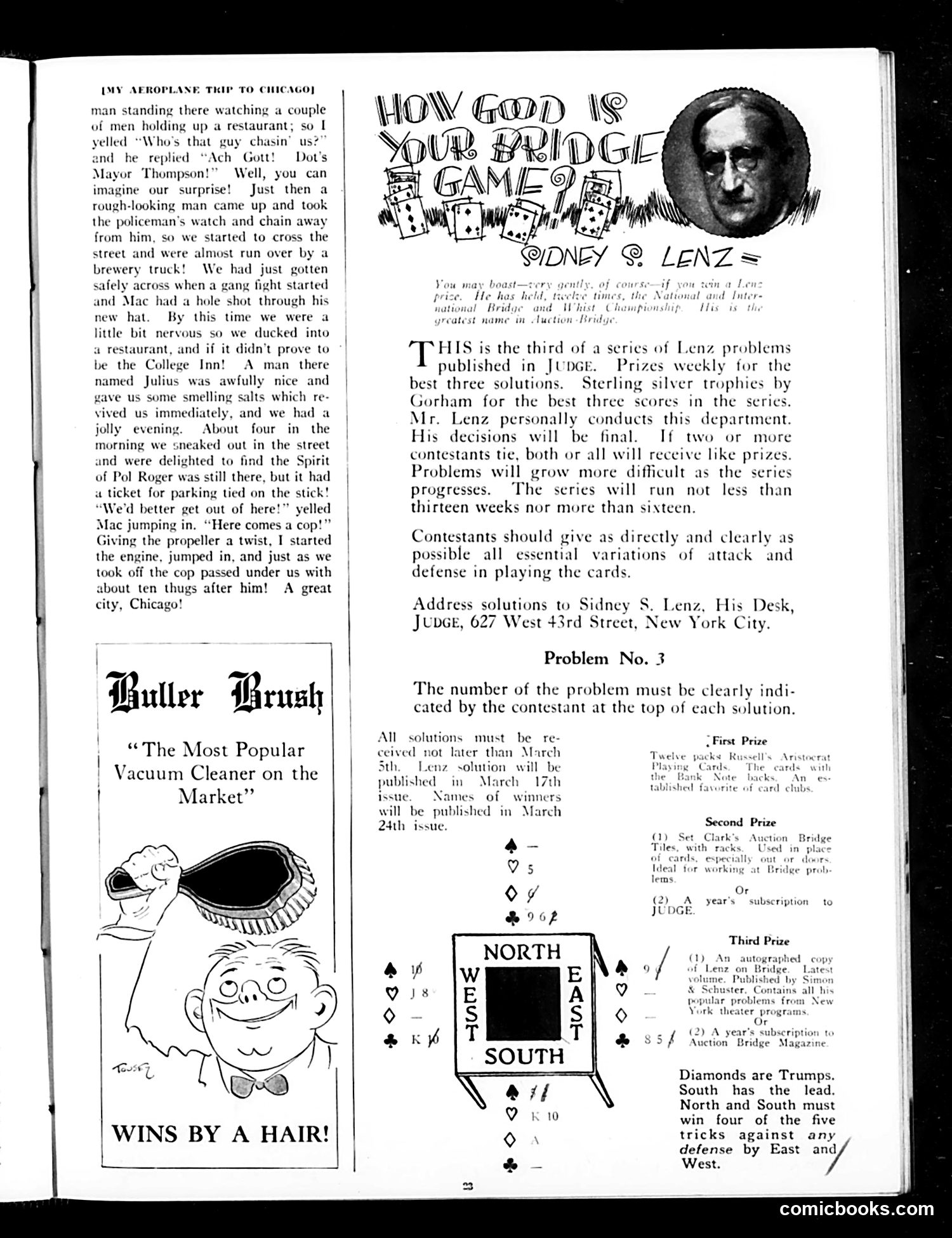
This humorous travel narrative satirizes Chicago's reputation for lawlessness and corruption during the Prohibition era (1920s-early 1930s). The narrator describes a chaotic visit where criminal activity is rampant and seemingly tolerated by authorities. **Key targets of satire:** - **Mayor Thompson**: Named directly as corrupt/complicit—the "rough-looking man" robbing a policeman appears to be under his administration - **Police corruption**: A policeman is robbed; cops chase civilians instead of criminals - **Organized crime**: Gang fights, armed robbery, brewery trucks (likely bootlegging operations) - **General lawlessness**: Parking tickets on abandoned vehicles while violent crime proceeds unchecked The joke's dark irony: Chicago is so crime-ridden that even trivial parking violations matter more than serious felonies. The "College Inn" (a real Chicago establishment) and "Spirit of Pol Roger" (liquor reference) reinforce Prohibition-era themes. This reflects historical reality—Chicago under Mayor William Hale Thompson (1915-1923, 1927-1931) was notorious for mob violence and corruption.
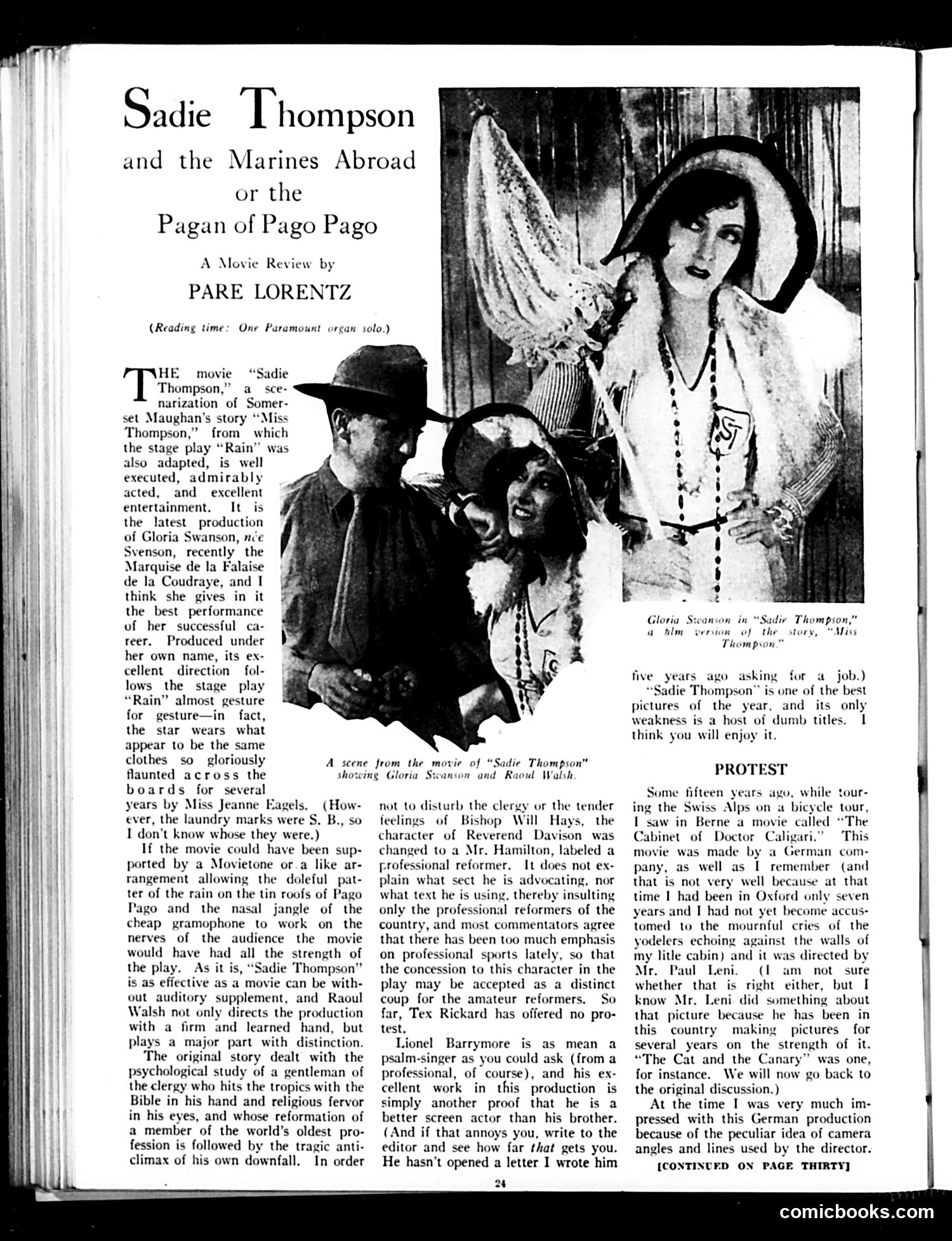
This is a film review by Pare Lorentz praising the silent movie adaptation of Somerset Maugham's "Sadie Thompson" (based on the stage play "Rain"), starring Gloria Swanson. The review praises the film's execution and Swanson's performance. The satire centers on **censorship by Bishop Will Hays**, Hollywood's chief censor. The original story featured a corrupt clergyman; to avoid offending clergy, the character was changed to "Mr. Hamilton, labeled a professional reformer"—a transparent dodge Lorentz mocks. He sarcastically notes this "insults only the professional reformers of the country" and jokes that sports promoter Tex Rickard hasn't protested. The review also contains a secondary jab at **Lionel Barrymore**, praising him as a better actor than his famous brother (likely John Barrymore), with the quip that complaining to the editor won't help—a dig at editorial indifference to reader complaints.
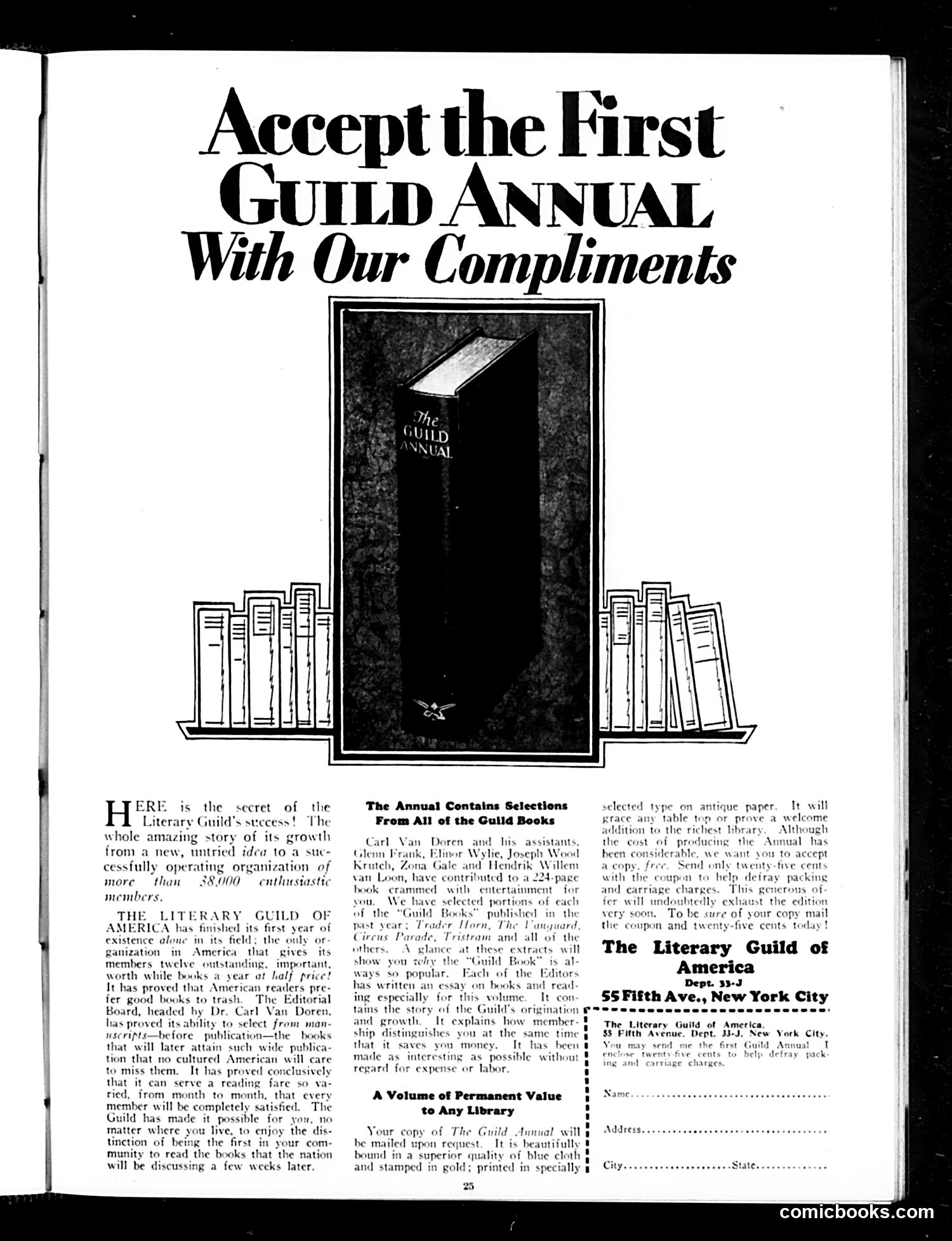
This is primarily **advertising copy**, not a political cartoon. It promotes the Literary Guild of America's inaugural annual anthology. The page celebrates a book club's first-year success: the Guild selects quality literature monthly at discounted prices for members (38,000+ by year one). The central image shows *The Guild Annual*—a curated collection featuring excerpts from published Guild selections. Notable figures mentioned include **Dr. Carl Van Doren** (head editor) and contributors like **Elinor Wylie** and **Joseph Wood Krutch**—respected literary figures of the 1920s-30s. The satire is subtle: the ad ironically positions the Guild as democratizing "cultured" reading. It promises that even readers in remote areas can access the same books as urban sophisticates—a selling point emphasizing social aspiration and exclusivity ("the distinction of being first in your community"). The ornate book imagery and emphasis on "antique paper" and gold stamping reinforce that owning this annual signals refined taste and membership in an intellectual community.
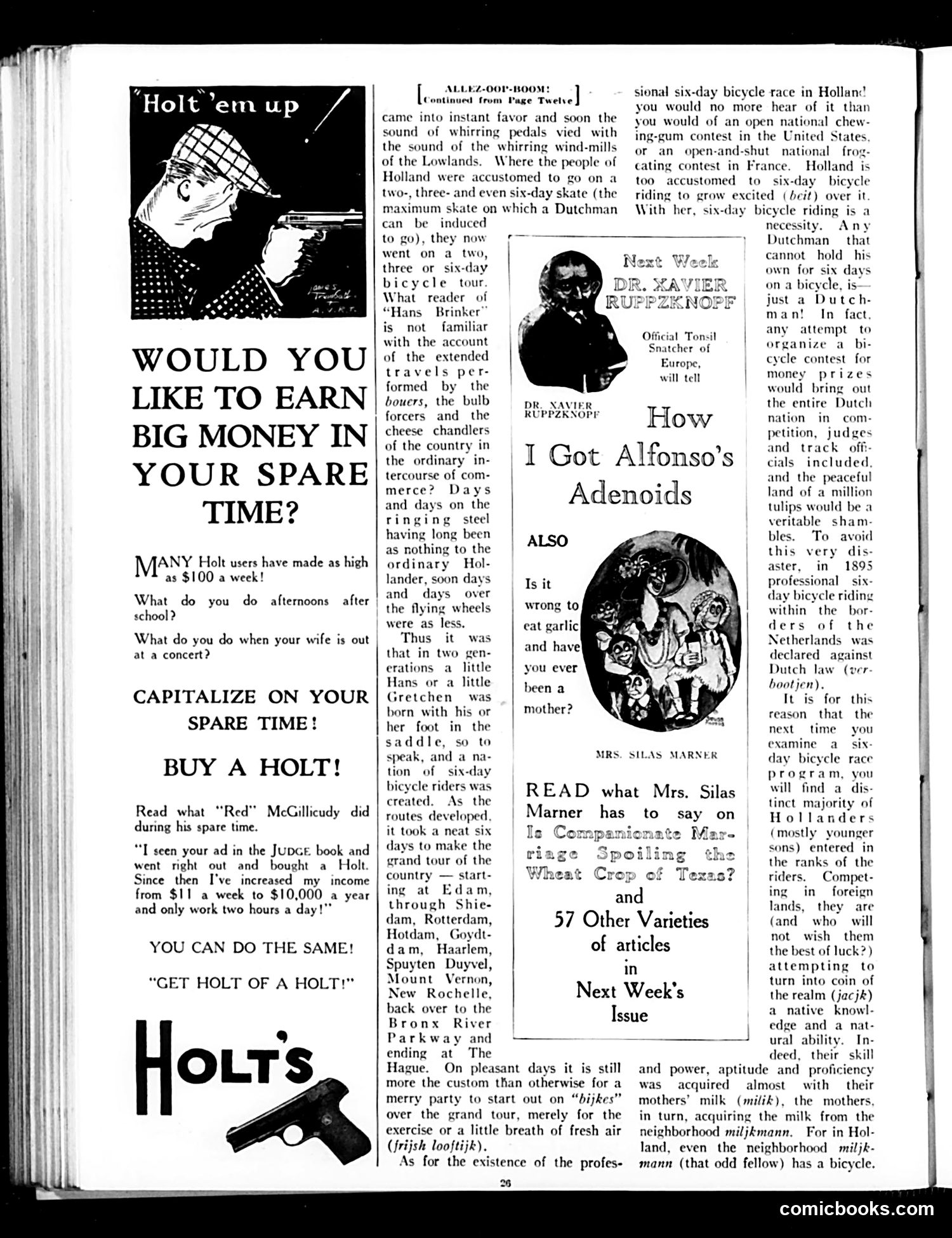
This page blends **advertising and satirical commentary**. The left side promotes "Holt" (likely a bicycle brand) with exaggerated testimonials—a common advertising trope mocking get-rich-quick schemes. The copywriting ("GET HOLT OF A HOLT!") plays on the product name. The right side continues a serialized article about Dutch cycling culture, presenting it as absurdly central to Dutch identity. The satire suggests that Holland has become so bicycle-obsessed that six-day bike races are unnecessary because ordinary citizens already ride constantly as part of daily life. The humor comes from treating bicycle riding as a national obsession comparable to chewing-gum contests in America or frog-racing in France. References to "Hans Brinker" (the famous skating story) and Dutch locations anchor the joke: if skates once defined Dutch culture, bicycles have now replaced them entirely. The text mocks this cultural fixation while pretending to celebrate Dutch cycling prowess—typical Judge satire attacking American consumer culture and national stereotypes.
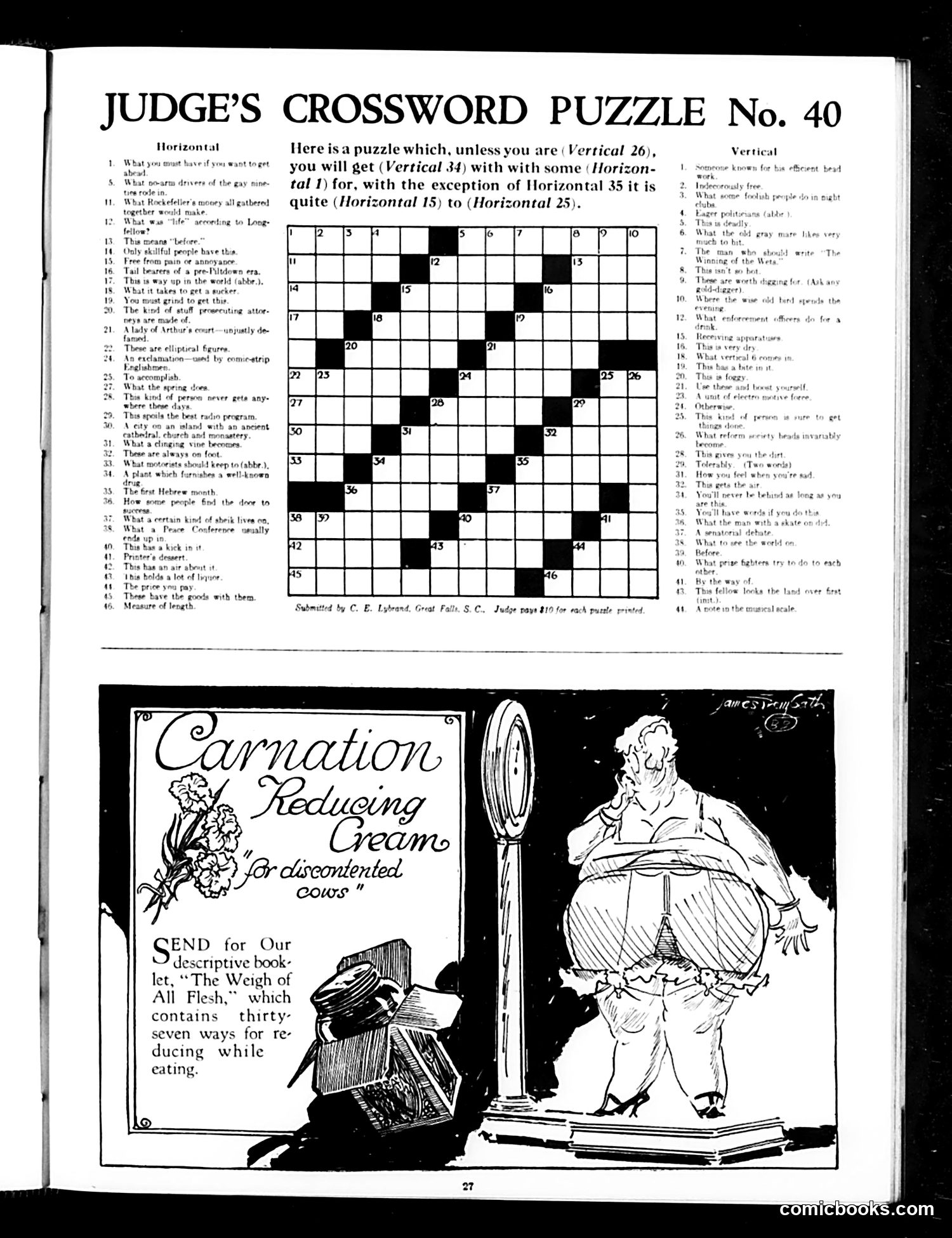
This page contains primarily a **crossword puzzle** (the main content) and a **weight-loss advertisement** below it. The advertisement promotes "Carnation Reducing Cream for discontented cows" alongside a satirical cartoon. The cartoon depicts a portly man looking in a mirror, with the visual joke being an obvious commentary on vanity and weight concerns. The ad's absurdist humor—marketing a reducing cream "for cows"—serves as a thin disguise for mocking human weight anxieties. The accompanying text promotes a booklet titled "The Weigh of All Flesh," offering "thirty-seven ways for reducing while eating," which satirizes the era's fascination with effortless weight-loss solutions. This reflects early 20th-century American consumer culture and social preoccupations with appearance, while using animals and exaggerated physical caricature as typical Judge magazine satirical devices. The humor relies on body-shaming that would be considered crude by modern standards.
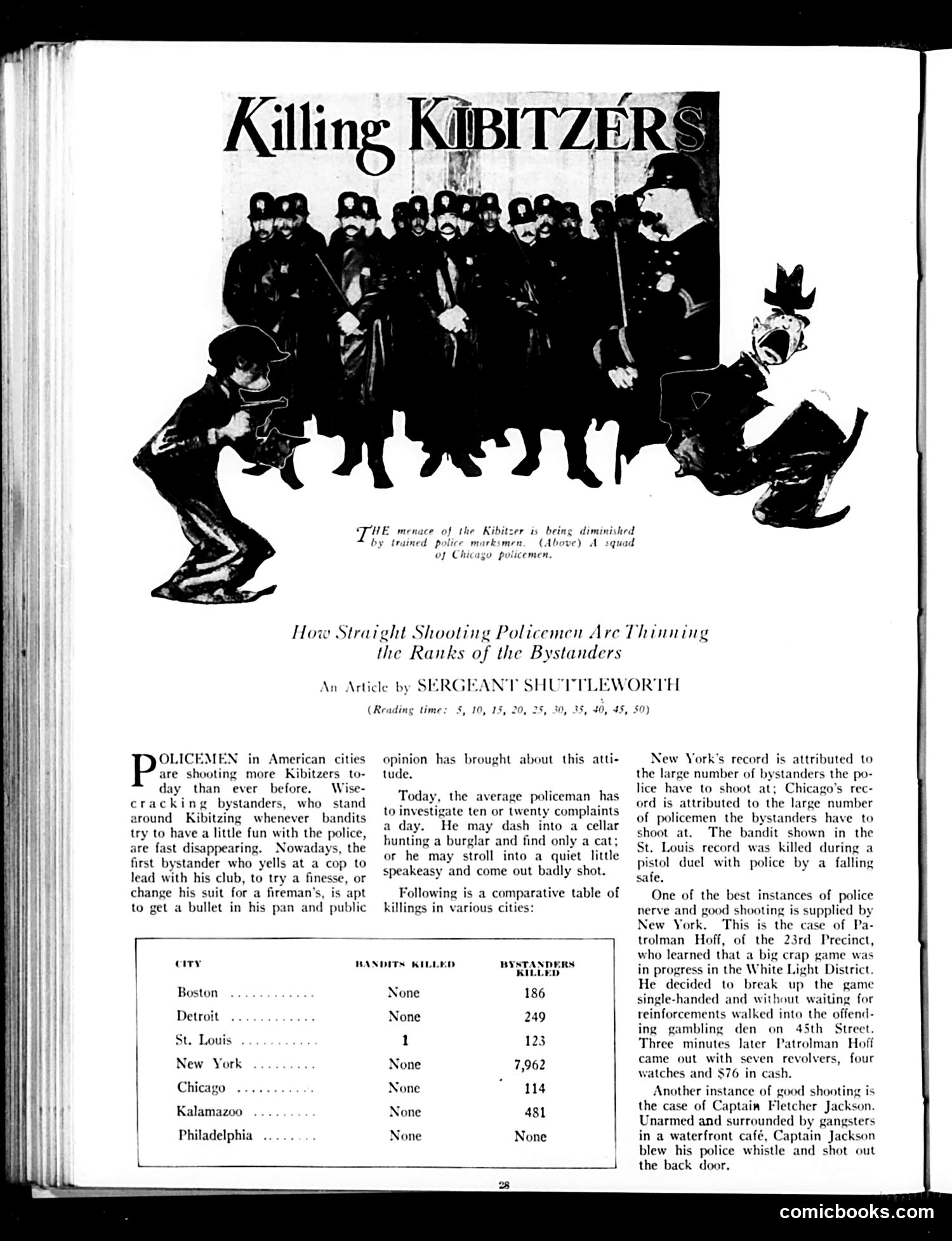
This article satirizes 1920s urban police conduct during Prohibition-era crime crackdowns. "Kibitzers" were street bystanders who heckled or offered unsolicited advice to police during confrontations. The satire's dark premise: police are now shooting innocent bystanders who criticize their tactics. The accompanying table presents a grim joke—comparing cities by "bystanders killed" rather than actual criminals apprehended. New York's 7,962 figure is absurdly high, suggesting rampant trigger-happy policing. The "positive examples" of police heroism are actually illustrations of questionable conduct: a patrolman raiding a gambling operation alone, a captain in a café shootout. The tone treats these as admirable yet tacitly acknowledges the chaos and civilian casualties of aggressive policing. The overall message: American police are increasingly violent and unaccountable, killing more bystanders than criminals while operating with minimal oversight—presented through sardonic humor typical of Judge's social criticism.
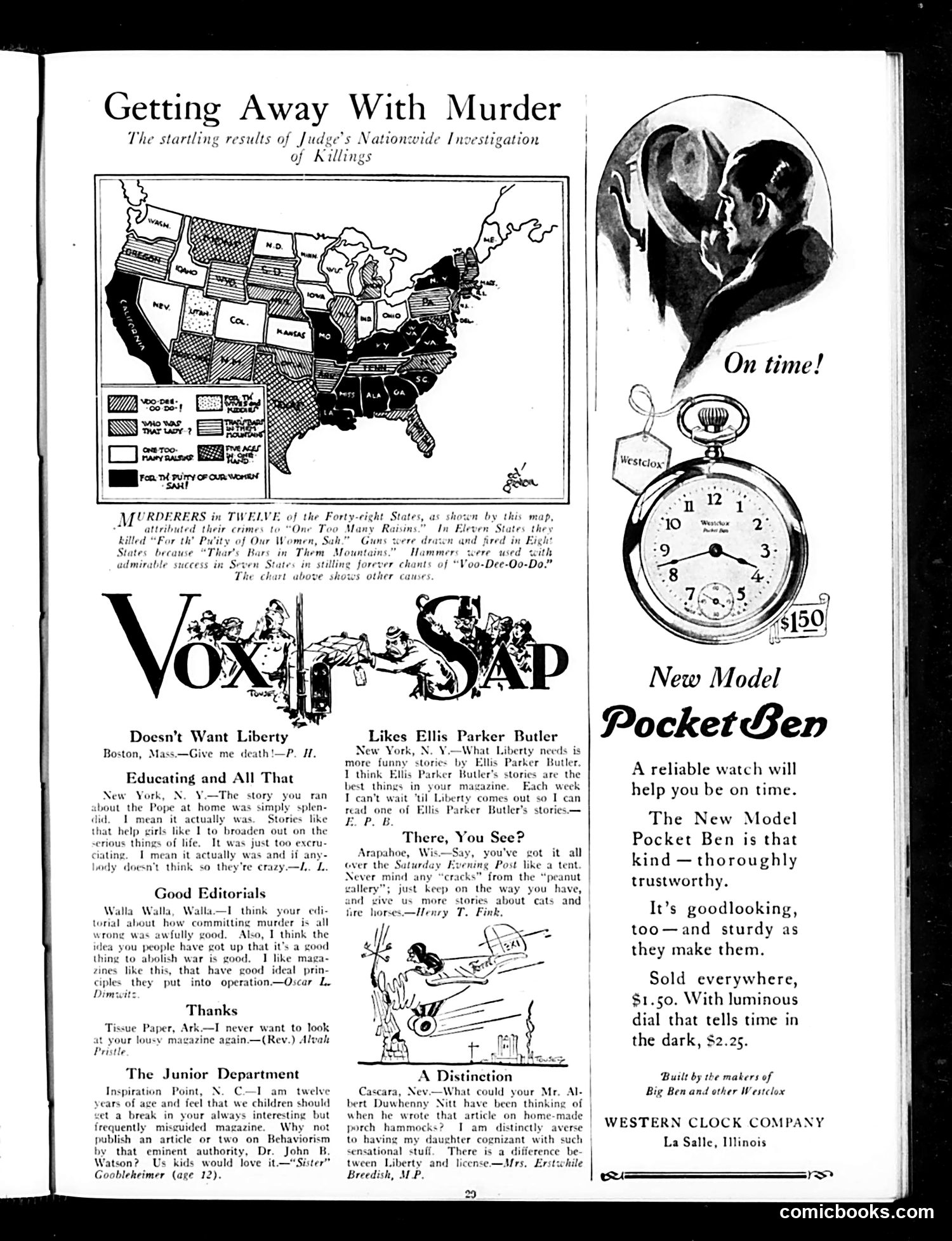
This page presents Judge's satirical investigation claiming murderers in twelve states escaped justice by blaming their crimes on various social causes: "protection of our women," "hard times in the mountains," and "voodoo." The map uses different patterns to categorize these dubious excuses. Below, the "Vox Pop" (reader letters) section mocks both the magazine's content and American society. Readers praise Judge's heavy-handed moralizing about abolishing war and murder while simultaneously requesting lighter entertainment—Ellis Parker Butler humor stories and cat tales. One reader even complains that an article about homemade porch hammocks is too "sensational" for daughters. The satire cuts both ways: Judge ridicules lenient courts and absurd criminal defenses while simultaneously lampooning its own readers' shallow preferences and moral inconsistency. The page is mostly advertising (Pocket Ben watch) with editorial content functioning as self-aware social criticism.
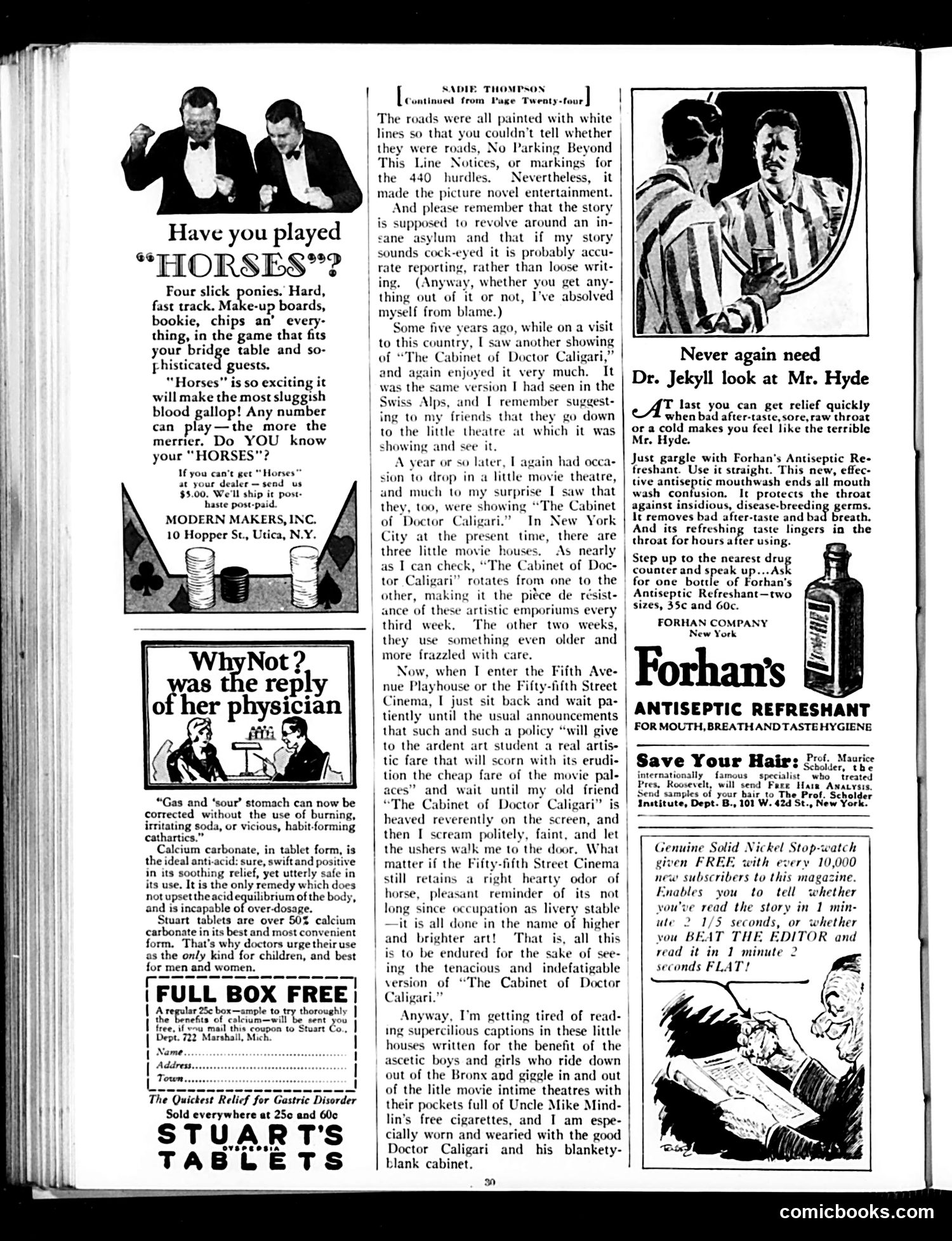
This page is primarily **advertising and serialized fiction**, not political cartoons, though it contains social satire. The main content is a continuation of "Sadie Thompson," a serialized story mocking pretentious art-house cinema. The narrator sarcastically critiques the repeated screening of the German expressionist film "The Cabinet of Dr. Caligari" at upscale Manhattan movie theaters (Fifth Avenue Playhouse, Fifty-fifth Street Cinema). He ridicules how these venues market cheap, repetitive programming as "higher and brighter art" for "ardent art students," while one theater still smells of horses from its former use as a livery stable. The satire targets **1920s cultural snobbery**—the affectation of avant-garde European cinema appreciation among the wealthy, and movie theater owners' exploitation of this pretension through aggressive marketing of mediocre, recycled content as sophisticated entertainment. The page also includes typical period advertisements for a parlor game called "Horses," antacids (Stuart's Tablets), and Forhan's mouthwash.
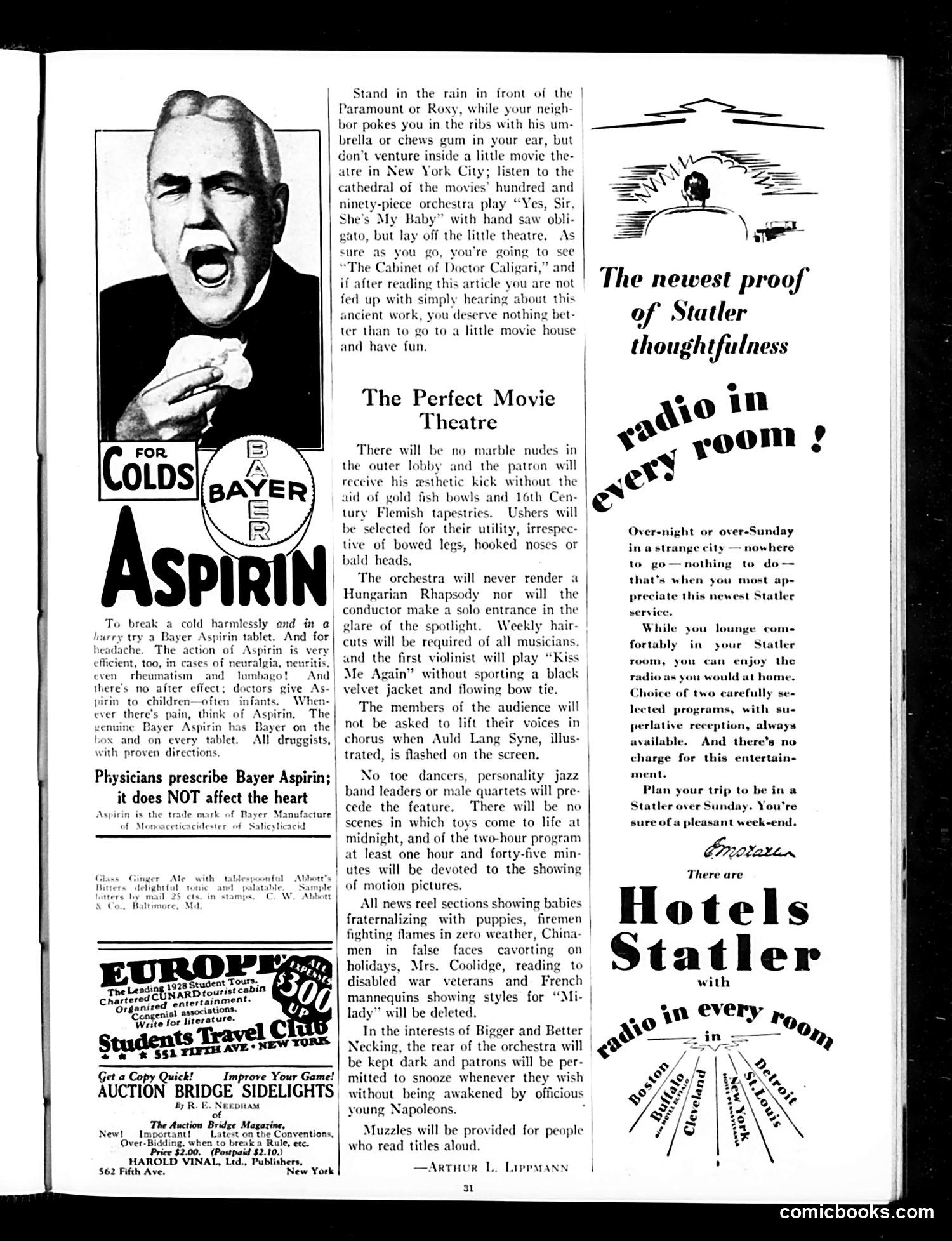
This page contains a satirical article by Arthur L. Lippmann mocking pretentious movie theater culture of the 1920s. The piece ridicules "art house" cinemas (referencing the famous avant-garde film *The Cabinet of Dr. Caligari*) that prioritize aesthetic pretension over entertainment. The satire targets: - Snobbish theater operators who forbid entertainment like jazz bands and dancers - Affected decorum (required haircuts for musicians, formal dress codes) - Audience manipulation (forced sing-alongs, emotional manipulation) - Overly elaborate productions designed to seem "cultured" The author's point: authentic entertainment—not artistic affectation—is what audiences actually want. He advocates for simple, comfortable movie houses where people can enjoy films without pretension or disruption. The page also includes period advertisements for Bayer Aspirin and Statler Hotels, typical of the magazine's commercial content.
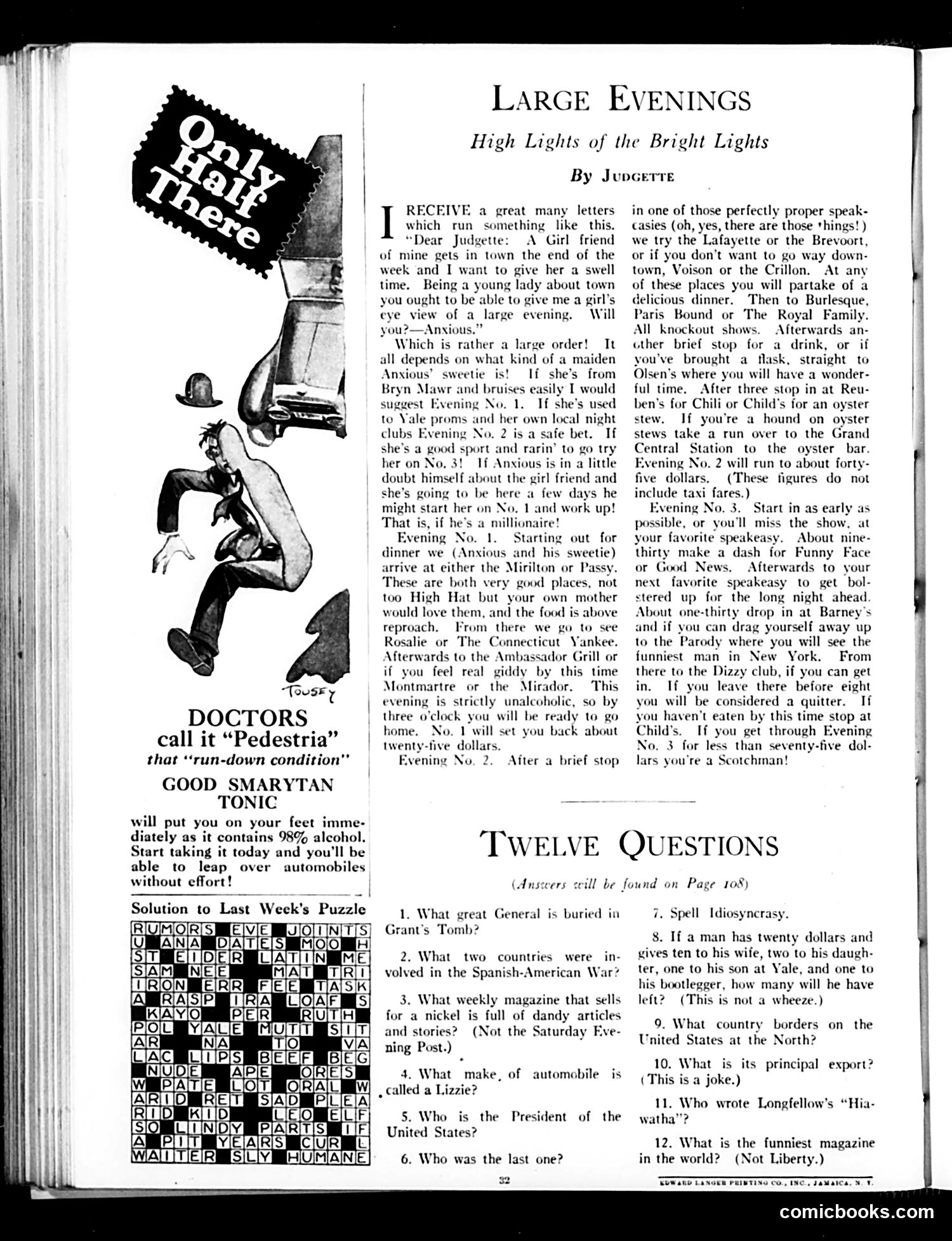
This page satirizes 1920s urban nightlife during Prohibition. The main article, "Large Evenings: High Lights of the Bright Lights," presents three escalating evening itineraries for entertaining a female visitor to the city. **The satire's point:** Despite Prohibition (alcohol ban), the column openly describes visits to "speakeasies" (illegal bars thinly disguised as legitimate establishments). Evening No. 1 is "strictly unalcoholic"; No. 2 includes "a brief stop" at speakeasies; No. 3 involves multiple speakeasy visits and references bringing "a flask." **The joke:** The author treats illegal drinking as normal social activity, openly listing speakeasies by name (Lafayette, Brevoort) and pricing evenings at $25-$75. This mocks both the ineffectiveness of Prohibition and upper-class flouting of the law. **The sidebar ad** parodies this further: "Good Samaritan Tonic" (containing "98% alcohol") supposedly cures "Pedestria"—a made-up condition—satirizing patent medicines used to legally consume alcohol during Prohibition. The overall effect exposes the hypocrisy and widespread lawbreaking among wealthy urbanites during this era.
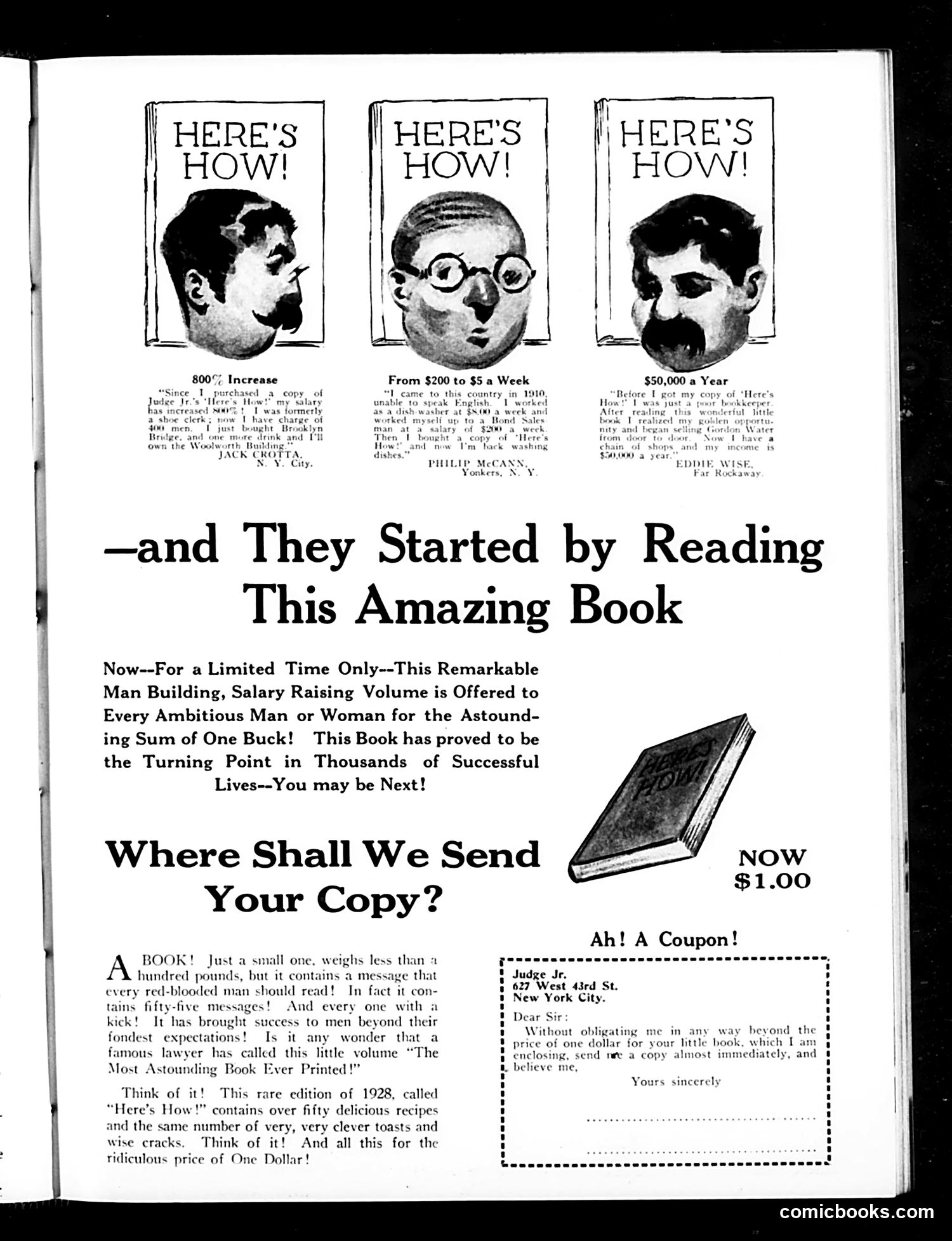
This page is primarily a **fake advertisement** satirizing self-help book scams and get-rich-quick schemes popular in the 1920s. The top three panels mock testimonials from men claiming the book "Here's How!" transformed their finances—one claims an "800% Increase," another went "From $200 to $55 a Week" (clearly worse), and the third claims "$50,000 a Year." The exaggerated, contradictory results expose the con. The advertisement below parodies genuine mail-order book pitches of the era, promising success through reading while charging only $1. It's notably revealed to actually be a **cookbook and joke book**—"fifty delicious recipes" and "very clever toasts and wise cracks"—completely unrelated to the financial success promised. The satire targets both the fraudulent publishers peddling impossible dreams to "ambitious" readers during the prosperity-obsessed Jazz Age, and gullible consumers desperate enough to believe them. The coupon format mimics real advertisements Judge readers would encounter in other publications.

This page from Judge magazine is a straightforward **advertisement for Camel cigarettes**, copyrighted 1927 by R.J. Reynolds Tobacco Company. It contains no political cartoon or satire—it's a paid commercial. The ad claims Camel is "the most popular cigarette in the United States" and emphasizes that quality alone makes it superior. The copy dismisses competitors' health claims ("special treatments to make cigarettes good for the throat"), arguing that only "choice tobaccos" matter. For modern readers, the jarring element is the **complete absence of health warnings**—the ad freely promises smokers can focus only on "pleasure" without concern. This reflects pre-1964 advertising, when cigarette dangers weren't legally mandated to be disclosed and manufacturers actively marketed smoking as harmless.