
A complete issue · 36 pages · 1928
Judge — January 28, 1928
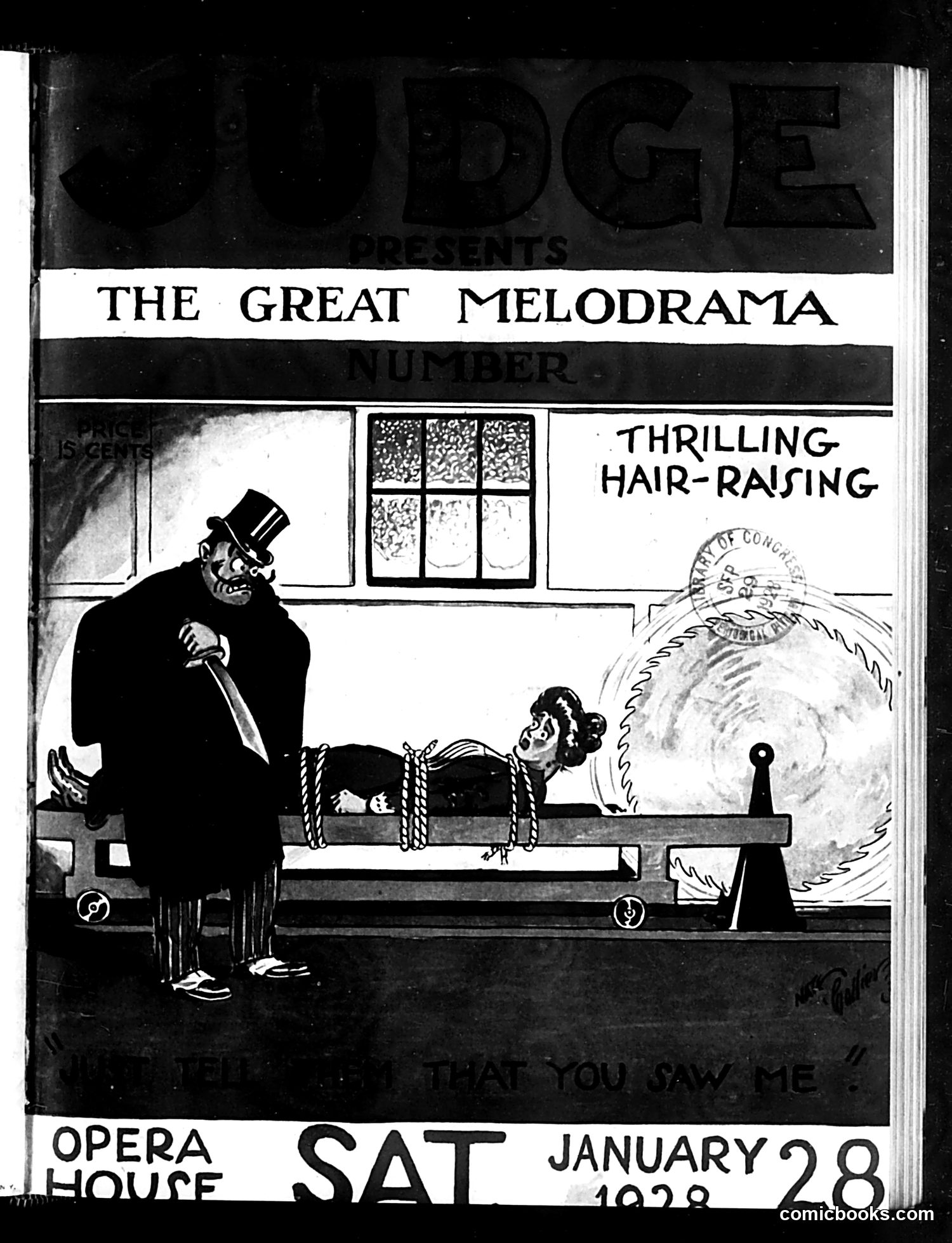
This is an advertisement for an opera house performance featuring a melodrama. The illustration depicts a classic villain-and-victim scene: a menacing figure in a top hat wielding a knife stands over a bound, distressed woman on a table, with what appears to be a saw or circular blade nearby—evoking the "thrilling, hair-raising" torture tropes of Victorian melodrama. The satire likely mocks the exaggerated, overwrought plots and theatrical conventions of melodramatic entertainment popular at the time. The stark black-and-white imagery and lurid setup exemplify the campy, sensationalist style Judge would ridicule as dated entertainment. The ad itself may be presented ironically—promoting the very theatrical excess the magazine usually satirized.
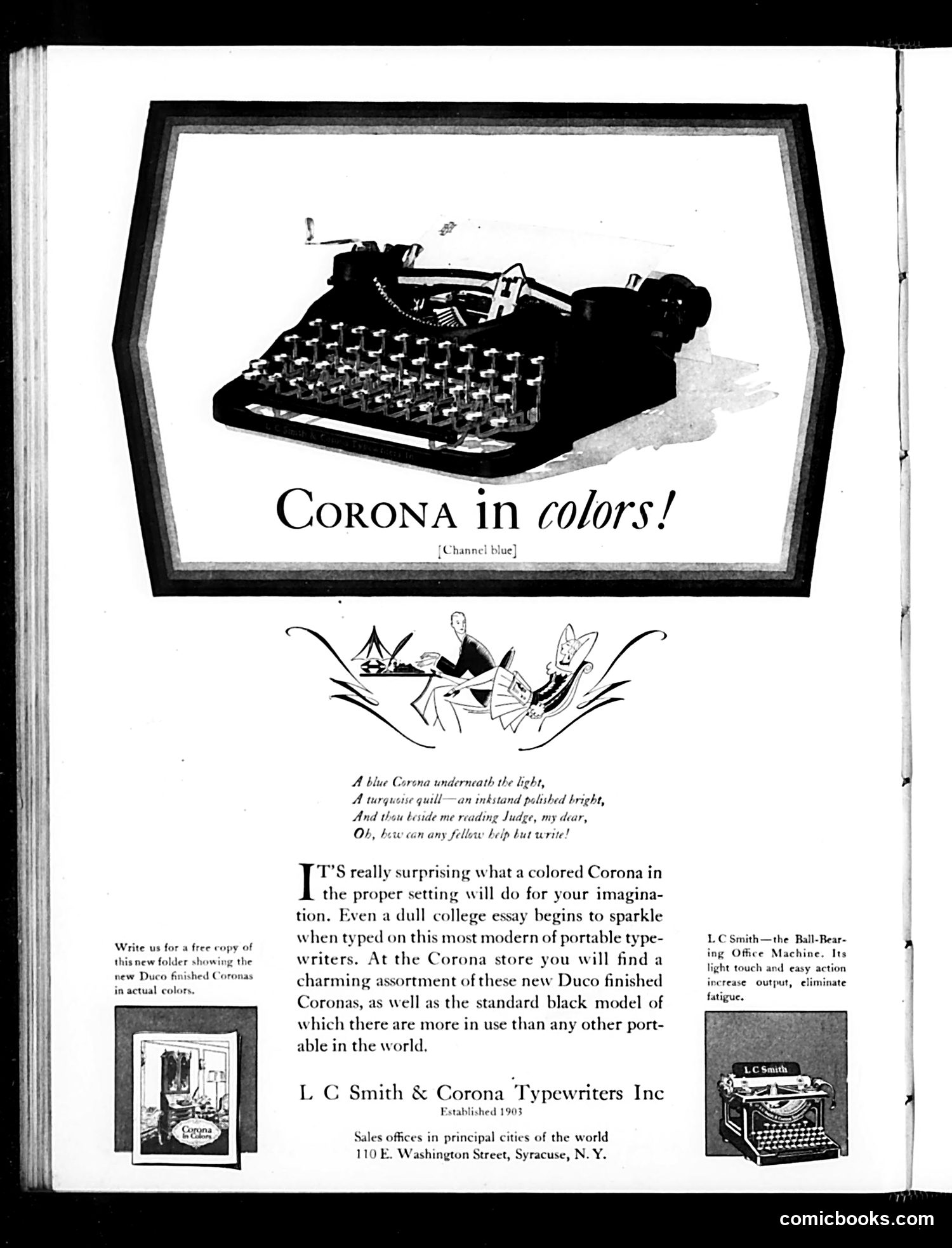
This page is primarily a **product advertisement**, not political satire. It promotes Corona portable typewriters, specifically highlighting a new colored model in "Channel blue." The ad uses whimsical illustrations—including a decorative vignette of figures celebrating beneath the typewriter—to market the machine as modern and desirable. The accompanying verse playfully suggests that typing on a colored Corona will inspire better writing, even for mundane tasks like college essays. The advertisement emphasizes Corona's market dominance ("more in use than any other portable in the world") and targets aspirational consumers. L.C. Smith & Corona Typewriters Inc., based in Syracuse, New York, positioned colored portables as luxury consumer goods during this era of typewriter popularity.
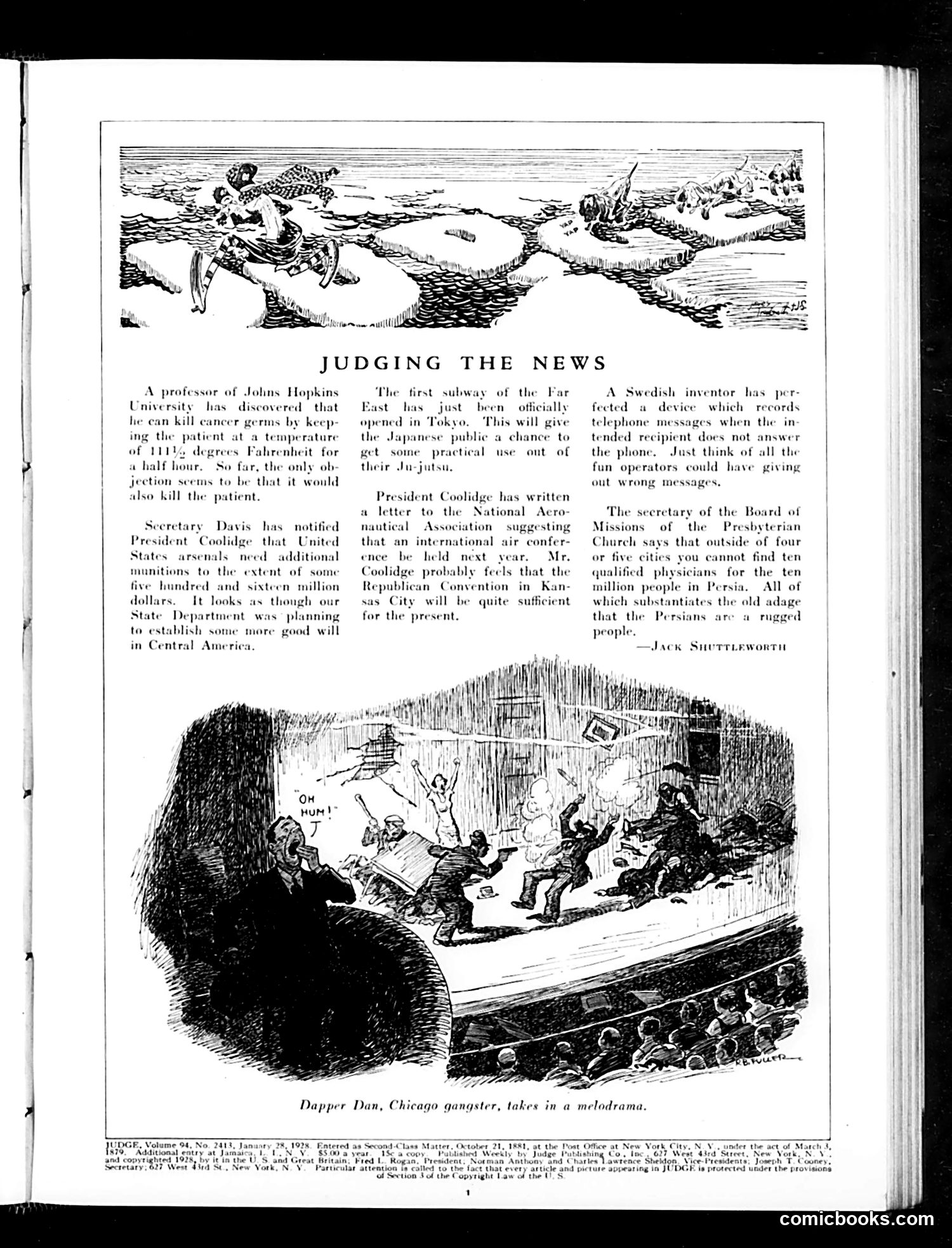
This page from *Judge* magazine contains news commentary and two cartoons. The upper illustration depicts chaotic activity across a landscape, though specific figures are unclear from the image quality. The text section "Judging the News" includes brief satirical comments on contemporary topics: a Johns Hopkins cancer cure, Tokyo's new subway, Swedish telephone technology, and President Coolidge's letter to the National Aeronautical Association regarding an international air conference in Kansas City. The lower cartoon, captioned "Dapper Dan, Chicago gangster, takes in a melodrama," shows figures in a theater box watching a stage performance. The satire appears to mock Chicago's notorious gangster activity by depicting a criminal attending entertainment—likely commenting on the public visibility or audacity of organized crime during Prohibition era Chicago.
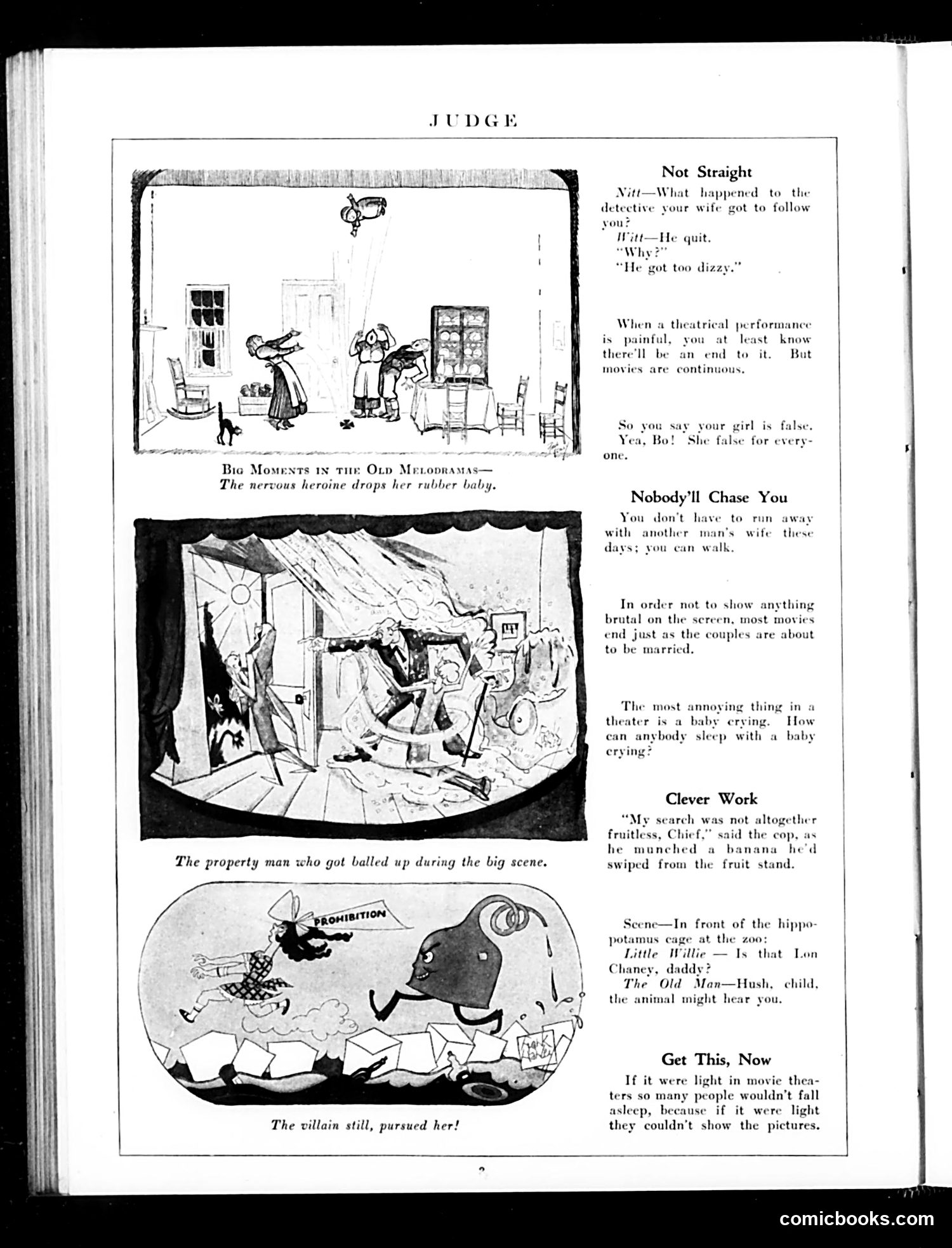
This page contains film criticism humor rather than political cartoons. The sketches mock silent film melodrama conventions—showing overwrought theatrical moments ("Big Moments in the Old Melodramas," "The nervous heroine drops her rubber baby") and slapstick property destruction during dramatic scenes. The commentary criticizes cinema itself: its continuous, emotionally exhausting nature compared to theater; the prevalence of marriage-plot endings; babies crying in theaters; and the artificial brightness needed to show film, which prevents realistic darkness. The "Prohibition" elephant cartoon likely references contemporary alcohol ban enforcement challenges (unclear specific reference without date). Overall, the page satirizes both silent film's technical limitations and narrative predictability—a perspective from cinema's early era when audiences still found the medium novel and sometimes tedious.
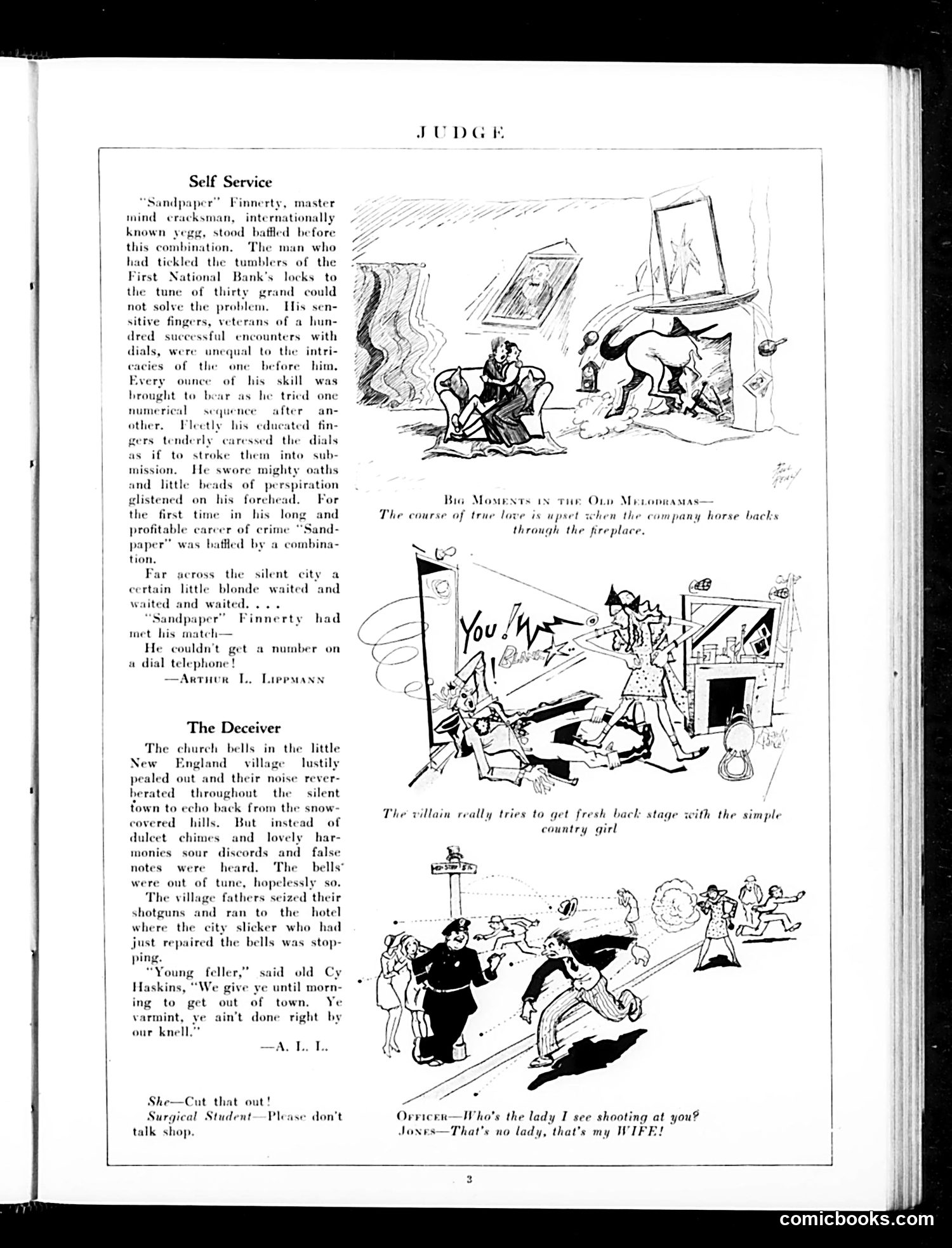
This page contains three satirical stories with accompanying illustrations: 1. **"Self Service"** mocks a safecracker named "Sandpaper" Finnerty who repeatedly fails at robberies, getting caught or foiled each time. The humor lies in his incompetence despite his reputation. 2. **"The Deceiver"** satirizes a con artist in a New England village who poses as a city slicker to seduce a country girl. The villagers catch on and threaten to expel him. The final caption reveals the punchline: the "lady" he's trying to seduce is actually his wife. 3. The visual gags throughout emphasize slapstick humor and romantic/criminal mishaps typical of early 20th-century satirical magazines, targeting themes of urban deception, rural skepticism, and criminal incompetence.
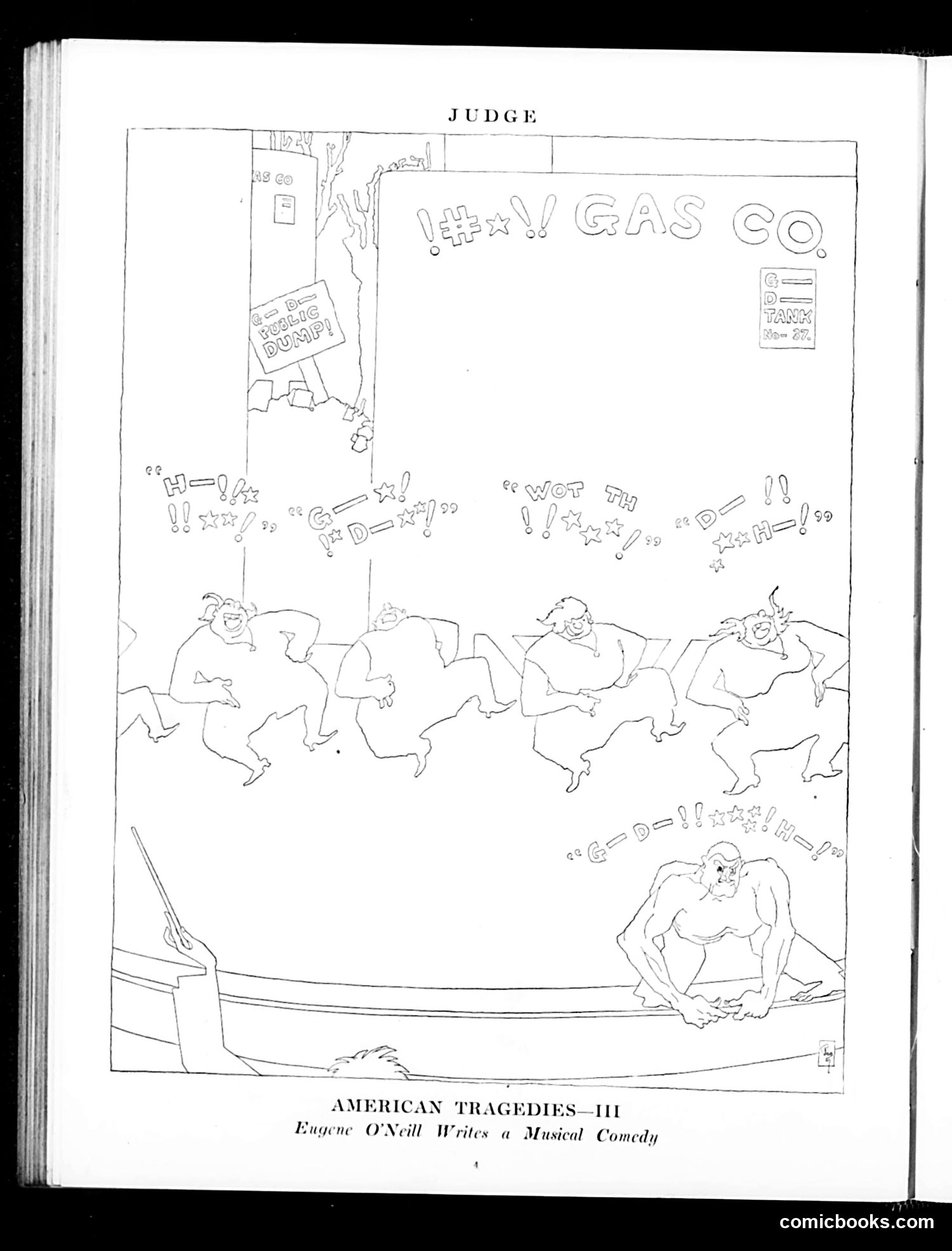
This page satirizes Eugene O'Neill's musical comedy adaptation, titled "American Tragedies—III" at the bottom. The cartoon shows a gas station scene with the sign "!#★·! GAS CO" and a tank gauge visible. Multiple rotund figures dance or move energetically across the middle section, with expletive-like symbols ("H-!", "G-D-!", "WOT TH—!", etc.) floating above them—suggesting crude language or vulgar outbursts. A crouching figure appears at bottom right. The satire likely mocks O'Neill's attempt to create a musical comedy, possibly suggesting the work is crude, chaotic, or involves lowbrow humor. The gas station setting may reference the commercial nature of the production. The cartoon's crude tone mirrors the expletives depicted, making fun of the work's supposed vulgarity or poor taste.
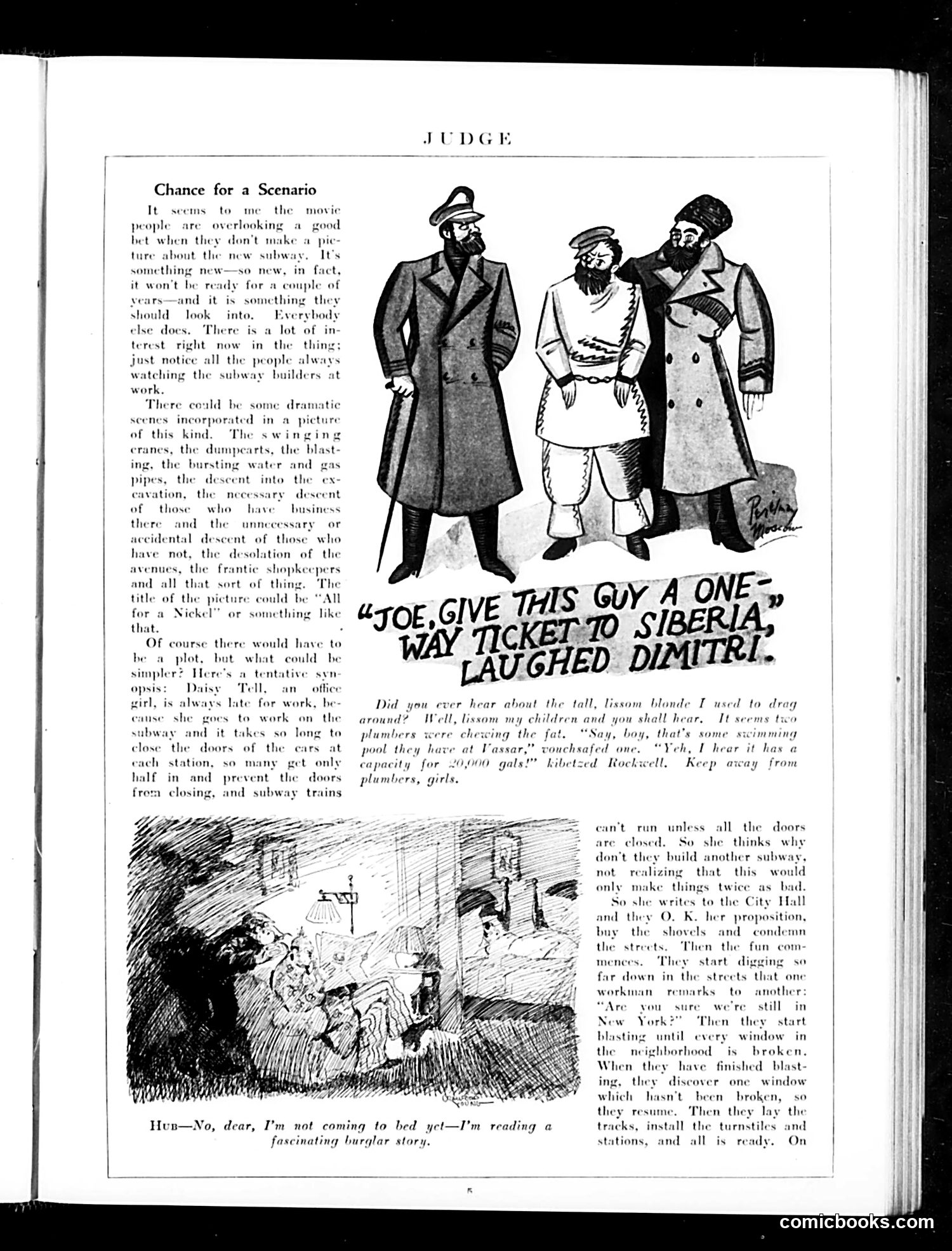
**Top Cartoon**: Three men discuss sending someone to Siberia. The caption "Joe, give this guy a one-way ticket to Siberia, laughed Dimitri" references Russian exile/punishment—likely satirizing Soviet communism or Russian brutality. The joke appears to mock harsh Russian authoritarian practices. **Bottom Cartoon**: Shows a couple in bed. The husband reads "a fascinating burglar story" rather than going to sleep, while his wife (presumably) objects. The caption jokes about prioritizing entertainment over marital duty. **Main Article**: "Chance for a Scenario" proposes a humorous subway-construction movie plot, detailing dramatic scenes (cranes, water pipes, excavation) and bureaucratic chaos. It satirizes both filmmaking trends and New York City's notoriously difficult infrastructure projects and permit processes.
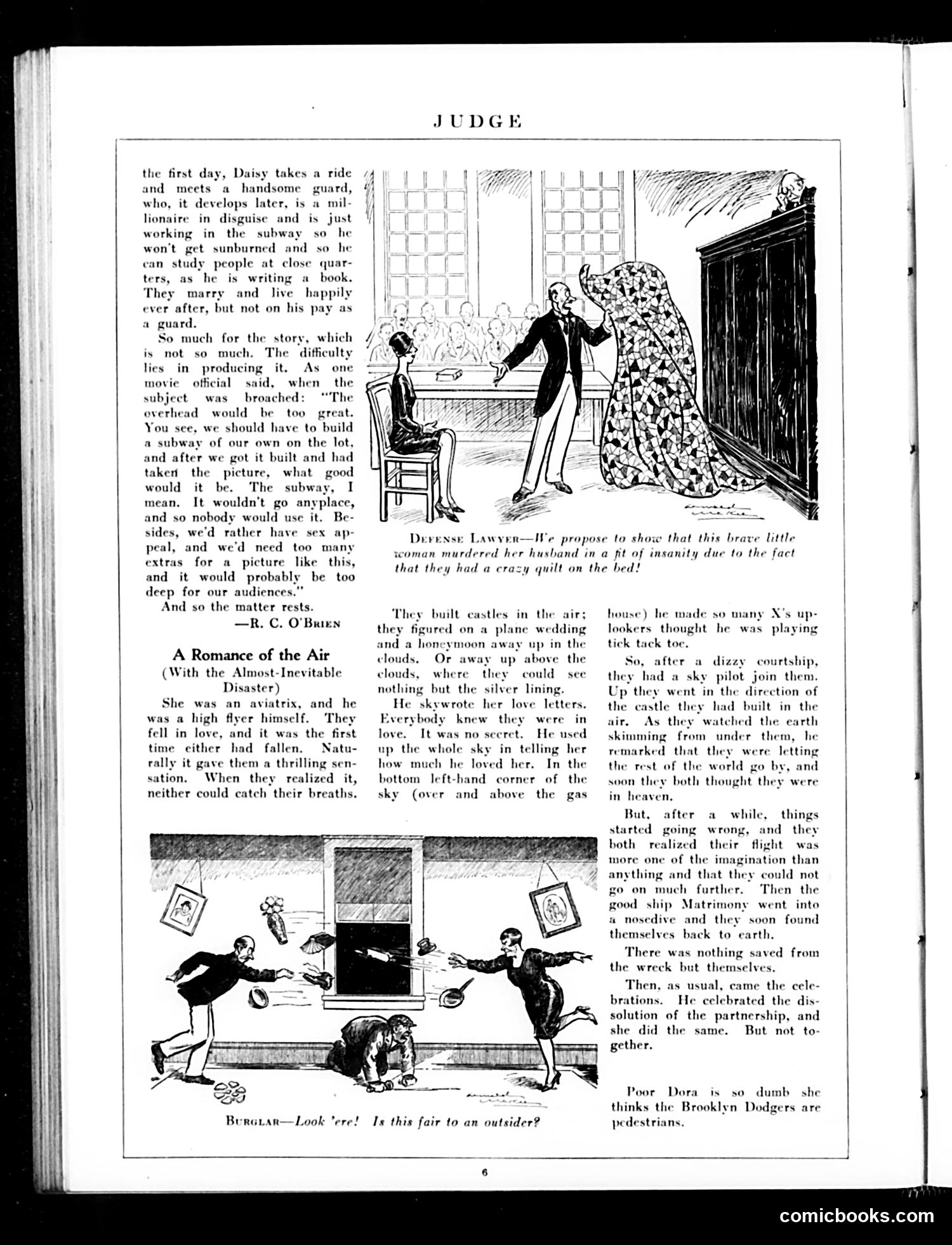
This page satirizes Hollywood's impractical filmmaking through two interconnected stories. The top cartoon mocks a proposed movie about a subway romance; a studio executive explains they can't make it because building an actual subway set would be wasteful—the structure couldn't be reused. The satire criticizes Hollywood's obsession with spectacle and sex appeal over logic. The longer story below parodies romantic aviation films popular in the 1920s-30s. A pilot and aviatrix fall in love, skywrite marriage proposals, and honeymoon "in the clouds." The joke deconstructs the fantasy: their marriage immediately crashes into "nosedive," leaving them divorced but "saved from the wreck." The closing joke about "Dora" thinking Brooklyn Dodgers are pedestrians is unrelated wordplay—typical of Judge's miscellaneous humor pages. Overall, the satire targets Hollywood's sentimental fantasies about romance and aviation as audience escapism disconnected from reality.
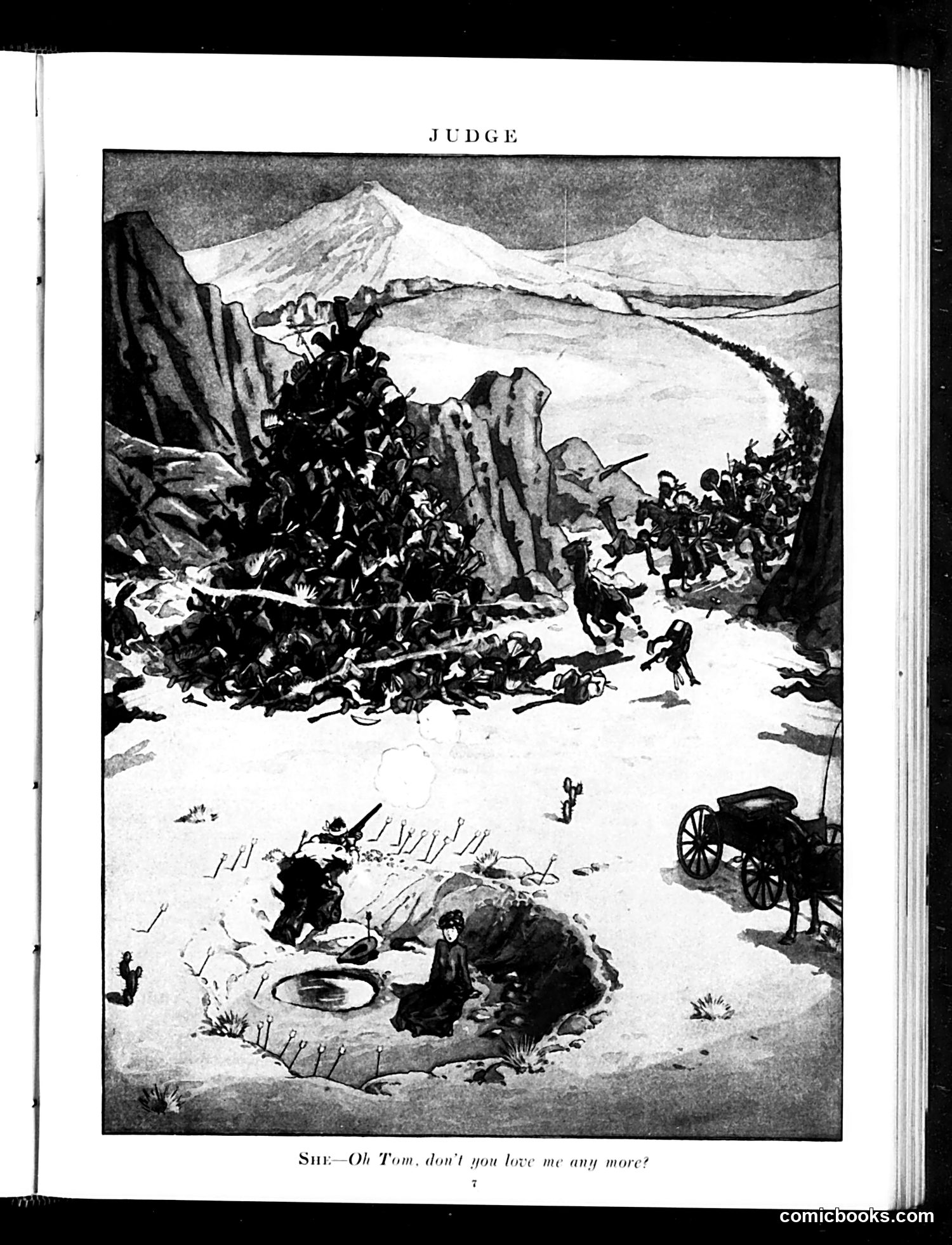
This illustration titled "Judge" depicts a dramatic desert scene with snow-capped mountains in the background. The image shows what appears to be a domestic conflict scenario set in an arid, desolate landscape. A woman (Sue) addresses a man (Tom) with the plaintive question "Oh Tom, don't you love me any more?" The cartoon uses geographic displacement as satire—placing an intimate romantic dispute in an inhospitable, barren wilderness setting. This juxtaposition creates dark humor by suggesting the couple's relationship has deteriorated to such an extreme degree that even a harsh, isolated landscape seems an appropriate setting for their discord. The visual contrast between the dramatic natural scenery and the mundane emotional complaint emphasizes the absurdity of their domestic quarrel.
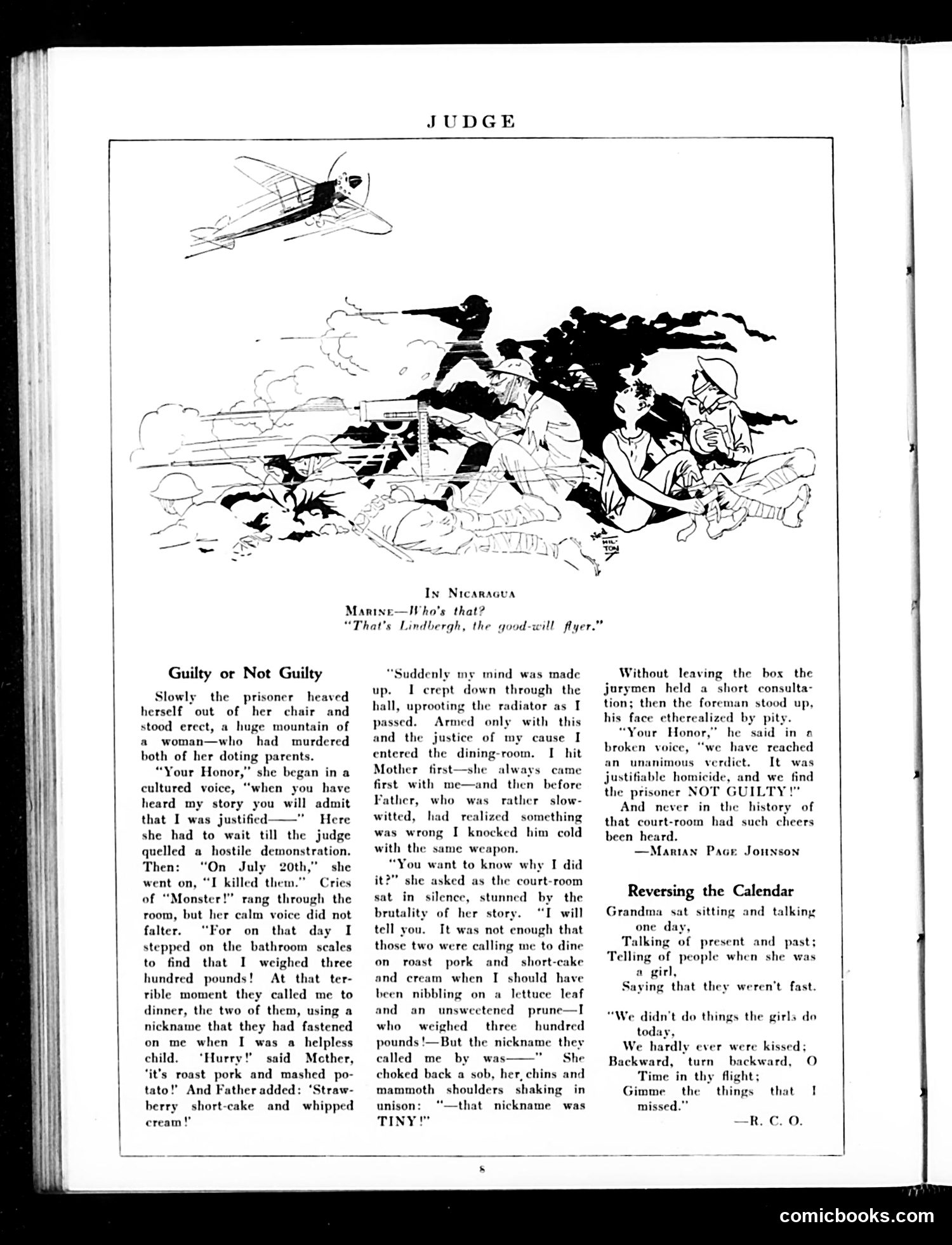
This page contains two satirical pieces from Judge magazine: **"In Nicaragua"** (top): A single-panel cartoon referencing Charles Lindbergh's goodwill aviation tour. A Marine spotter identifies an airplane as "Lindbergh, the good-will flyer" to a companion—likely satirizing Lindbergh's celebrity status and the publicity surrounding his flights. **"Guilty or Not Guilty"** (main story): A darkly humorous courtroom narrative where a woman murders her parents and is acquitted. The satire targets both weight-obsession culture and the absurdity of "justifiable homicide" verdicts. Her stated grievance—that her parents called her "Tiny" despite weighing 300 pounds—is presented as supposedly reasonable justification. The courtroom cheers the "not guilty" verdict, mocking public sentimentality and courtroom logic. **"Reversing the Calendar"** (right): A brief poem where an elderly woman nostalgically laments the sexual restraint of her youth, asking time to return so she can experience the romantic freedoms she missed—satire of generational prudishness and regret.
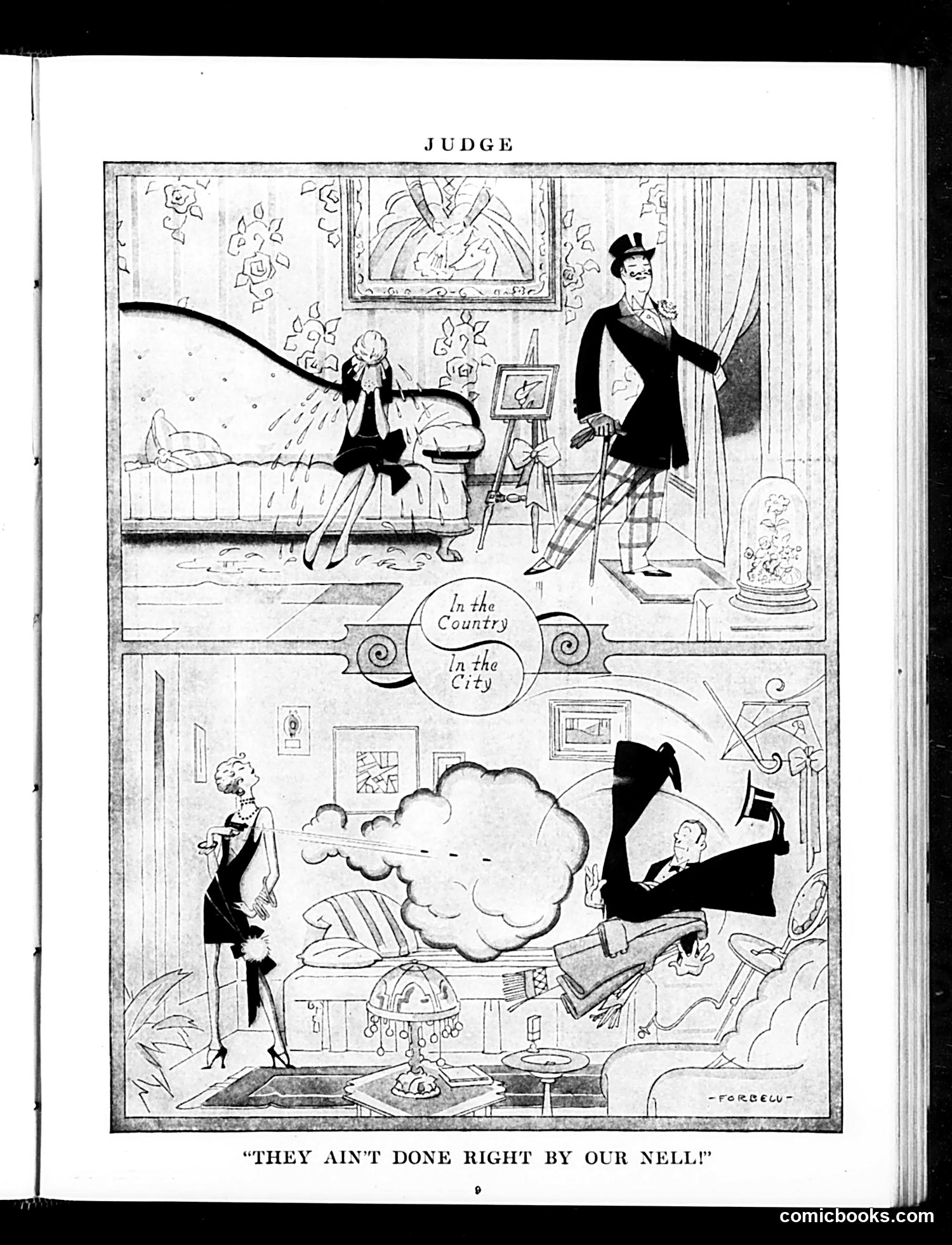
This two-panel cartoon compares country versus city life. The top panel shows a rural setting where a woman appears distressed, gesturing at a man departing. The bottom panel depicts an urban interior where chaos erupts—a man waves a flag amid overturned furniture and smoke. The caption suggests a character named "Nell" has been wronged. The satire likely critiques urban corruption or mistreatment of country folk who move to the city. The contrasting panels emphasize rural innocence versus city chaos and moral failure. Without additional historical context, the specific identity of "Nell" and the precise event referenced remain unclear, but the cartoon's theme—rural vulnerability to urban exploitation—was common Judge magazine material from the early 20th century.
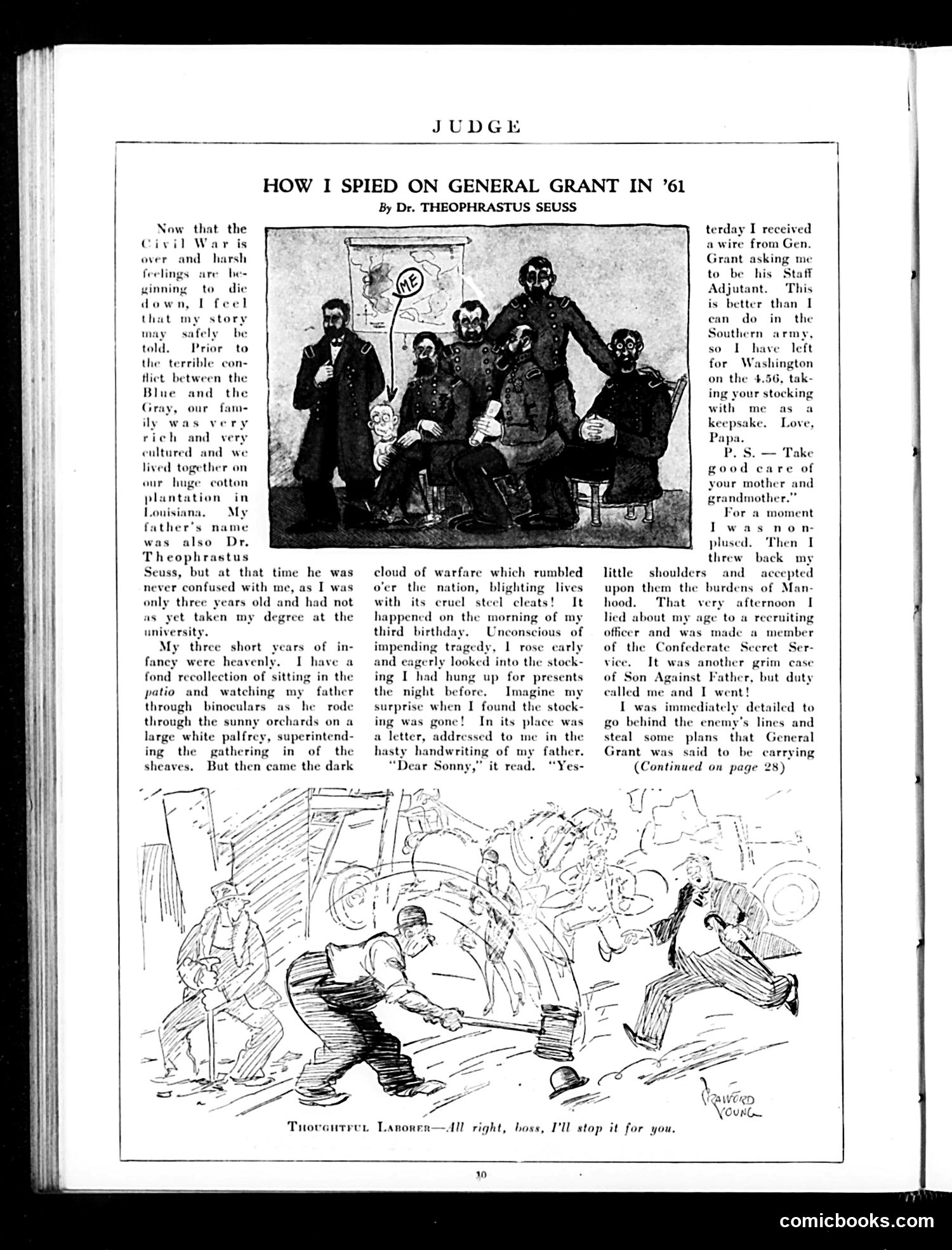
This is a satirical piece by "Dr. Theophrastus Seuss" (clearly a pseudonym playing on the famous children's author), published in *Judge* magazine as Civil War nostalgia humor. The joke centers on an absurdly melodramatic first-person account: a narrator claims that on his third birthday during the Civil War, his father abandoned him to become General Grant's Staff Adjutant—leaving a letter instead of a birthday present. The narrator responds by lying about his age to join the Confederate Secret Service and spy on Grant, framing it as "Son Against Father." The cartoon illustrations depict period Civil War scenes in exaggerated, comedic style. The satire mocks both overly sentimental Civil War memoirs (which were popular) and the ridiculousness of the conflict itself—treating grave historical events with theatrical absurdity. The bottom cartoon's caption ("All right, boss, I'll stop it for you") suggests comic incompetence during wartime. This appears to be humorous nostalgic commentary rather than serious political argument.
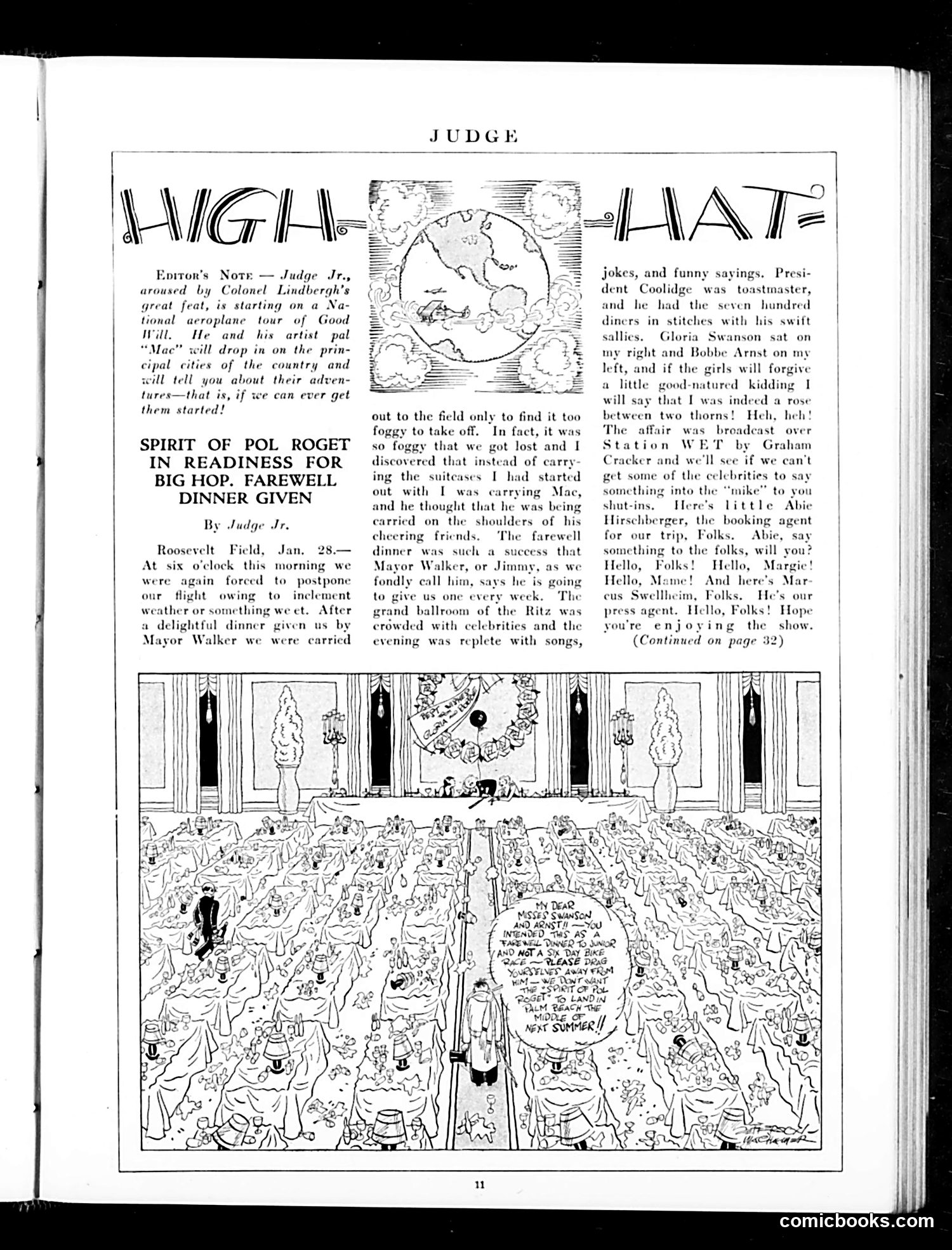
This Judge magazine page satirizes the aviation craze following Lindbergh's 1927 transatlantic flight. "Judge Jr." announces a mock national goodwill tour by airplane, parodying Lindbergh's celebrity status. The humor centers on incompetence: the plane can't take off due to fog, and the narrator loses track of luggage versus his companion "Mae." The elaborate farewell dinner at the Ritz Hotel features celebrities like Gloria Swanson and President Coolidge (as toastmaster), then gets broadcast over radio—mocking how media amplifies such events. The large cartoon below depicts the crowded banquet hall with an insert of crude radio dialogue, poking fun at early radio broadcasting technology and celebrity culture. The satire targets both the exaggerated importance placed on aviation stunts and the emerging celebrity-media machine that sensationalized them. The piece's tone is lighthearted rather than cutting, treating the subject as fashionable excess worth gentle mockery.
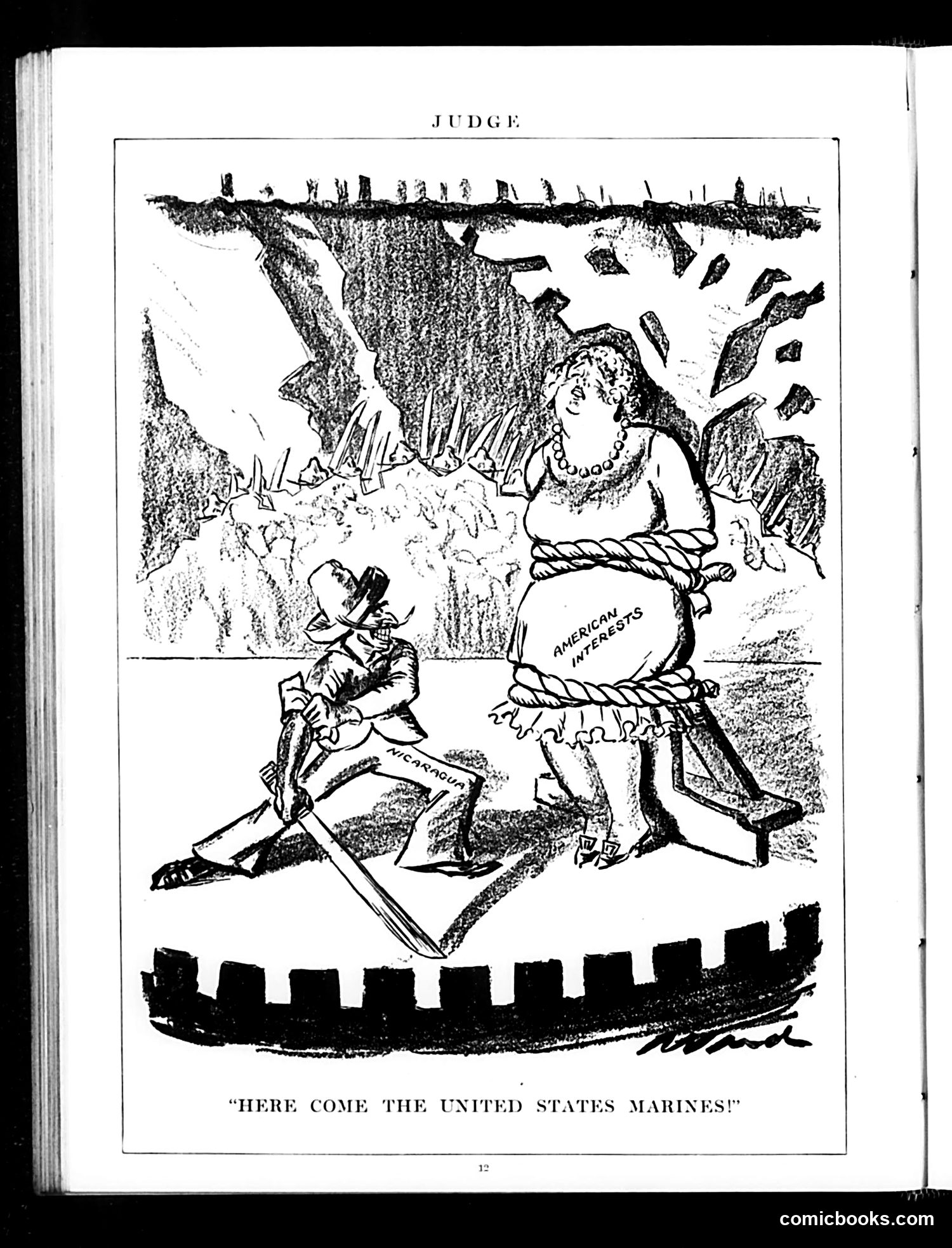
This Judge magazine cartoon titled "Here Come the United States Marines!" depicts a satirical scene where a large, rotund figure labeled "American Interests" is bound with rope, appearing helpless or captured. A smaller military figure (representing a U.S. Marine or soldier) stands ready with a sword, positioned as if to "rescue" these interests. The satire likely critiques American military interventionism—mocking the justification that U.S. military action defends American economic or political interests abroad. The cartoon suggests these interventions may actually be counterproductive or self-defeating, leaving American interests constrained rather than protected. The fortified structures in the background appear to represent foreign conflicts or contested territories where such interventions occurred.
This page from Judge satirizes American political and social issues circa the 1920s. **"An Amateur Is One Who Loves His Game"** celebrates golfer Bobby Jones, who refused a $50,000house gift to preserve amateur status. The article critiques confusing amateur/professional rules rooted in outdated British gentility notions, suggesting these distinctions may eventually disappear—but praises Jones for his integrity regardless. **"Safe for Politocracy"** attacks the Senate's repeated passage of the Norris resolution (proposing January inauguration) while the House blocks it. Judge argues politicians intentionally preserve the current system because "lame duck" sessions—where defeated legislators still serve months after elections—allow manipulation of jobless politicians desperate for appointed positions. The term "politocracy" (rule by politicians' self-interest) encapsulates the satire: the system persists through procedural obstruction serving party loyalty over democratic accountability. **"Younger Generation Notes"** briefly celebrates youth heroism during an ice-rescue, offering positive contrast to political corruption above.
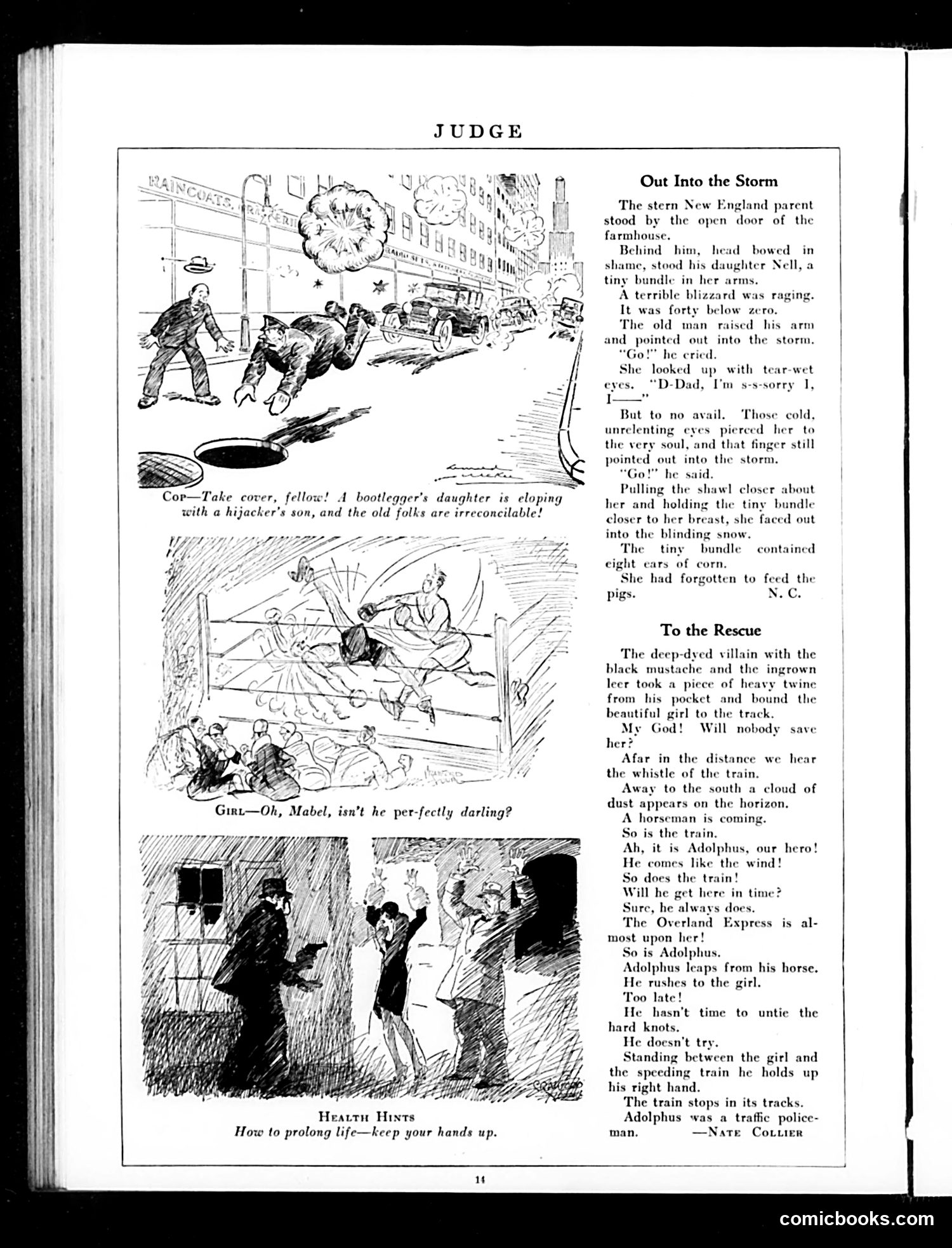
This page contains two satirical stories mocking melodramatic fiction conventions of the era. **"Out Into the Storm"** parodies sentimental Victorian narratives about stern parental judgment. The setup promises tragedy—a shamed daughter cast into a blizzard—but the punchline reveals absurdity: she's being punished for forgetting to feed pigs, and the "tiny bundle" is corn, not a baby. The caption's reference to "bootlegger's daughter" and "hijacker's son" suggests Prohibition-era social anxieties about class conflict and moral corruption. **"To the Rescue"** mocks overwrought melodrama itself, complete with tied-to-railroad-tracks villainy, an approaching train, and a dashing hero arriving on horseback. The joke: Adolphus is merely a traffic policeman who stops the train by holding up his hand—revealing the "thrilling rescue" as mundane bureaucratic authority, not heroic valor. Both pieces ridicule exaggerated storytelling conventions and the gap between melodramatic expectation and prosaic reality.
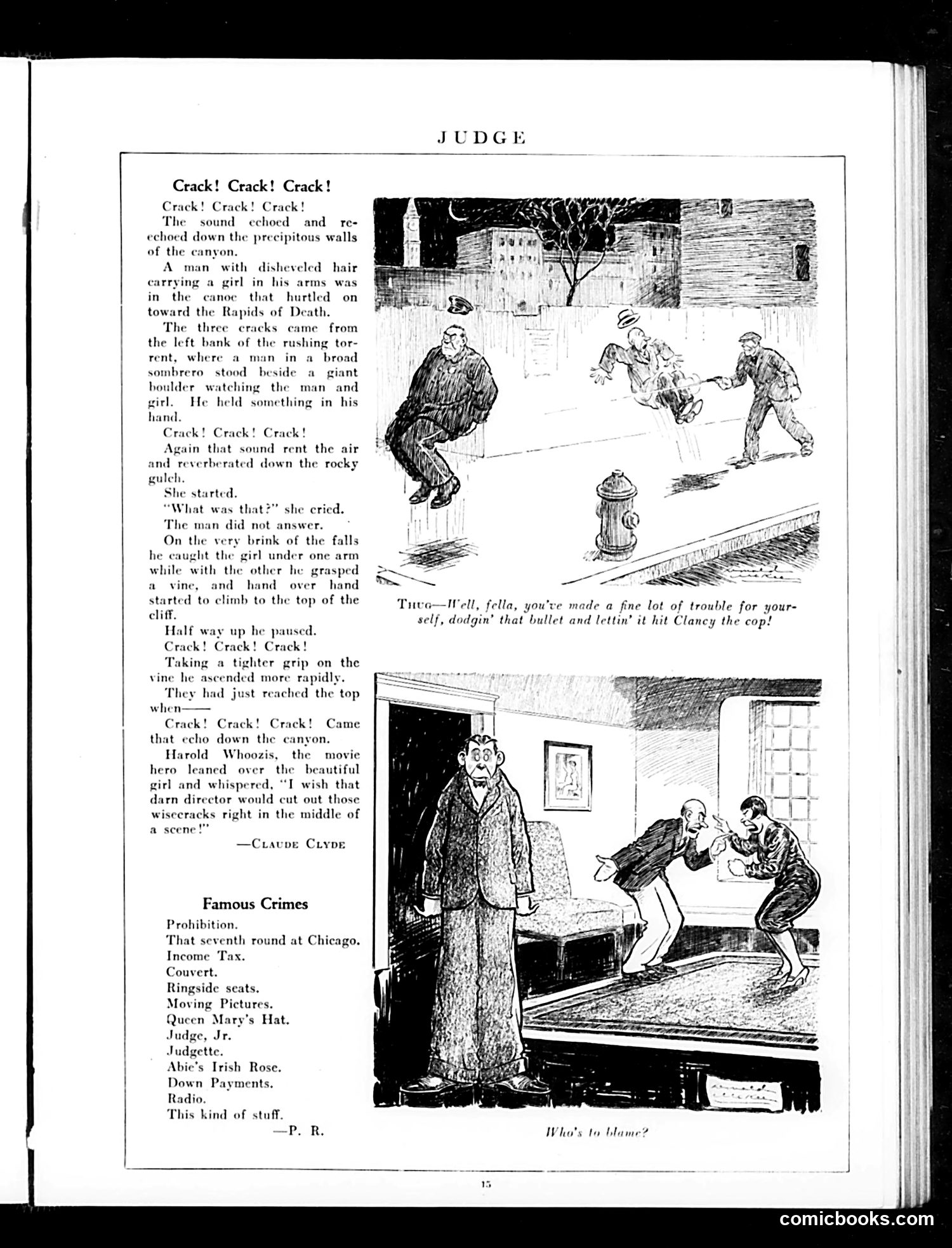
This page satirizes early cinema melodrama. The main text narrates a thrilling silent-film scenario—a hero rescuing a girl from canyon rapids while a gunman fires shots from the bank. The joke appears in the caption: character "Harold Whoozis" (a generic movie-hero name) complains that the director keeps interrupting the dramatic scene with gunshot sound effects, breaking the cinematic tension. The satire targets 1920s film conventions: overwrought adventure plots, poor directorial choices, and the jarring transition to sound cinema (which was revolutionary then). The lower section lists "Famous Crimes," including modern annoyances like "Income Tax," "Radio," and "Moving Pictures"—treating cinema itself as a societal offense alongside Prohibition violations and financial burdens. The cartoons illustrate typical melodramatic movie scenes. The joke works because it mocks both cinema's inherent artificiality and audiences' tolerance for clumsy filmmaking.
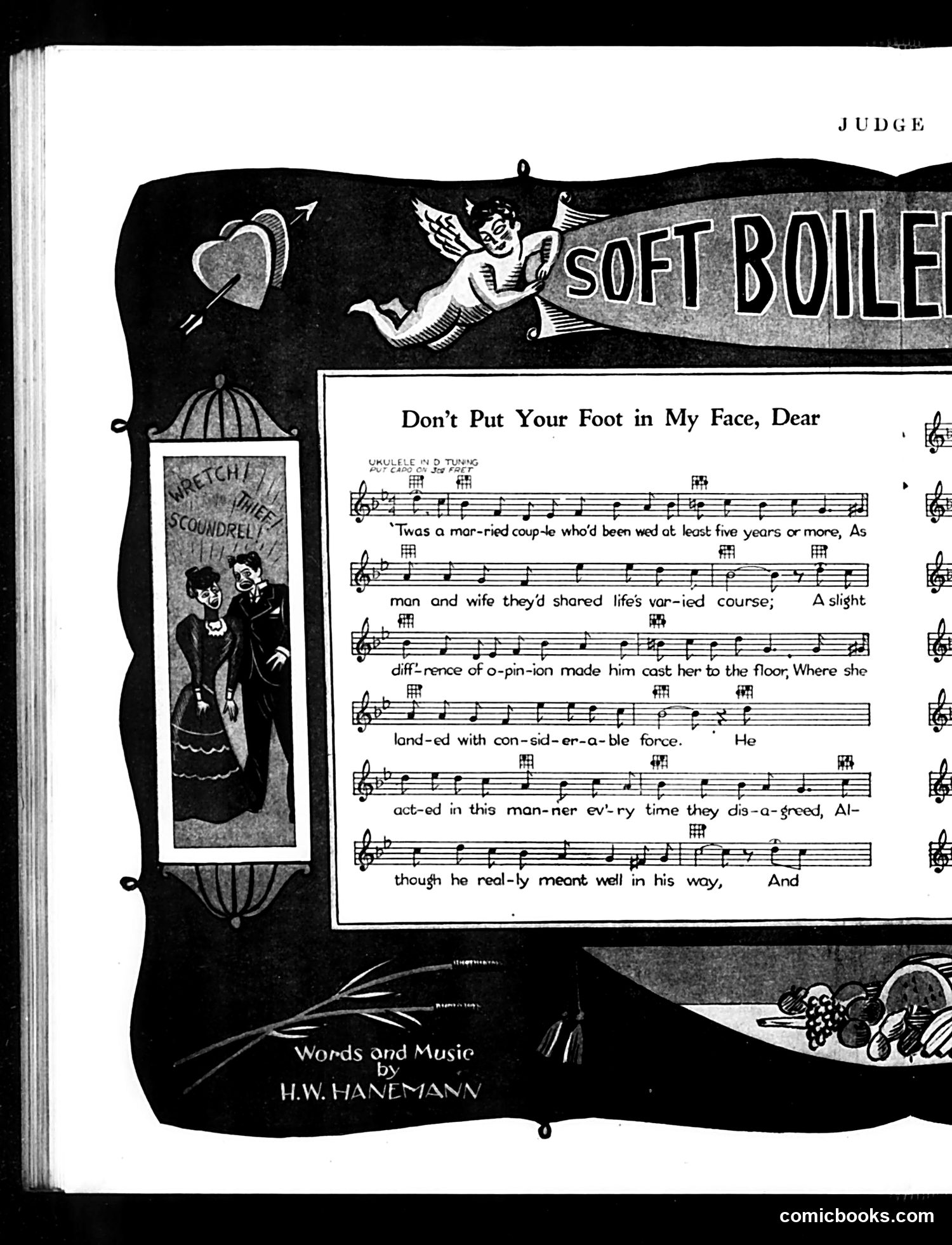
This is a comic song from *Judge* magazine by H.W. Hanemann. The illustration shows a domestic violence scene: a husband literally kicking his wife to the floor during marital disagreements. The "joke" relies on dark humor about spousal abuse—treating violence as comedic entertainment. The song's narrative describes a long-married couple whose "slight difference of opinion" results in him repeatedly knocking her down, though he "really meant well." This reflects early 20th-century attitudes where domestic violence was trivialized in popular entertainment. The cartoon's framing normalizes the abuse through musical performance, making light of what would be recognized today as serious domestic assault. The elaborate decorative border and casual tone underscore how socially acceptable such content was in period publications, while appearing shockingly violent to modern readers.
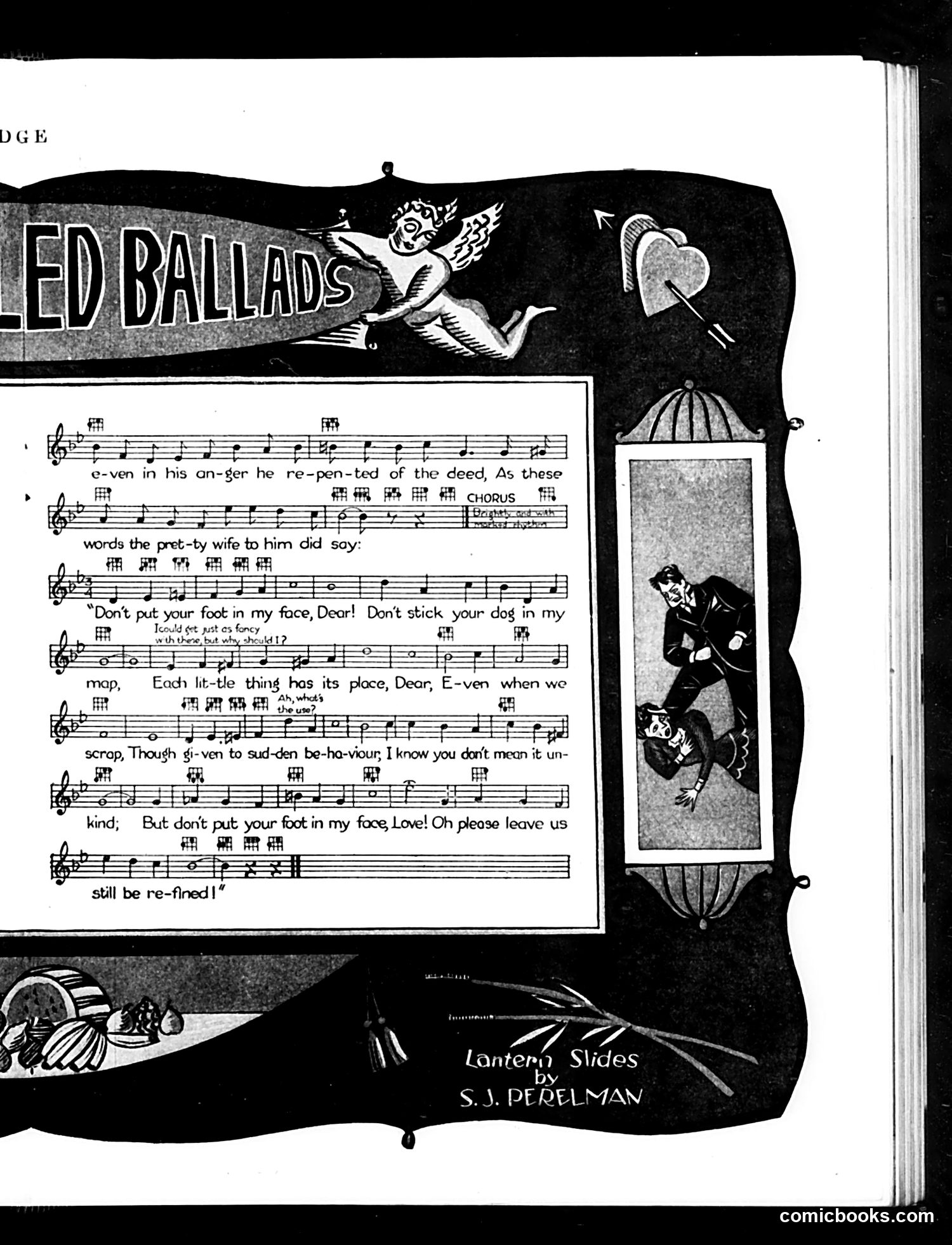
This page presents sheet music for a humorous song titled "Fed Ballads," illustrated with decorative Art Nouveau-style borders featuring a cherub and romantic imagery. The song depicts a domestic dispute where a wife remonstrates with her husband about his crude behavior—specifically "putting his foot in her face" and other vulgar conduct. Her repeated refrain is that "each little thing has its place" and pleads he maintain refinement and civility, even in anger. The satire appears to mock pretentious notions of domestic propriety and "refined" behavior among the upper classes. The juxtaposition of romantic, idealized framing with lyrics about literal physical rudeness creates comic absurdity—the delicate musical presentation contrasts sharply with the crude subject matter. The credits attribute "Lantern Slides" to S.J. Perelman, a renowned humorist, suggesting this was part of illustrated entertainment material popular in the early-to-mid 20th century.
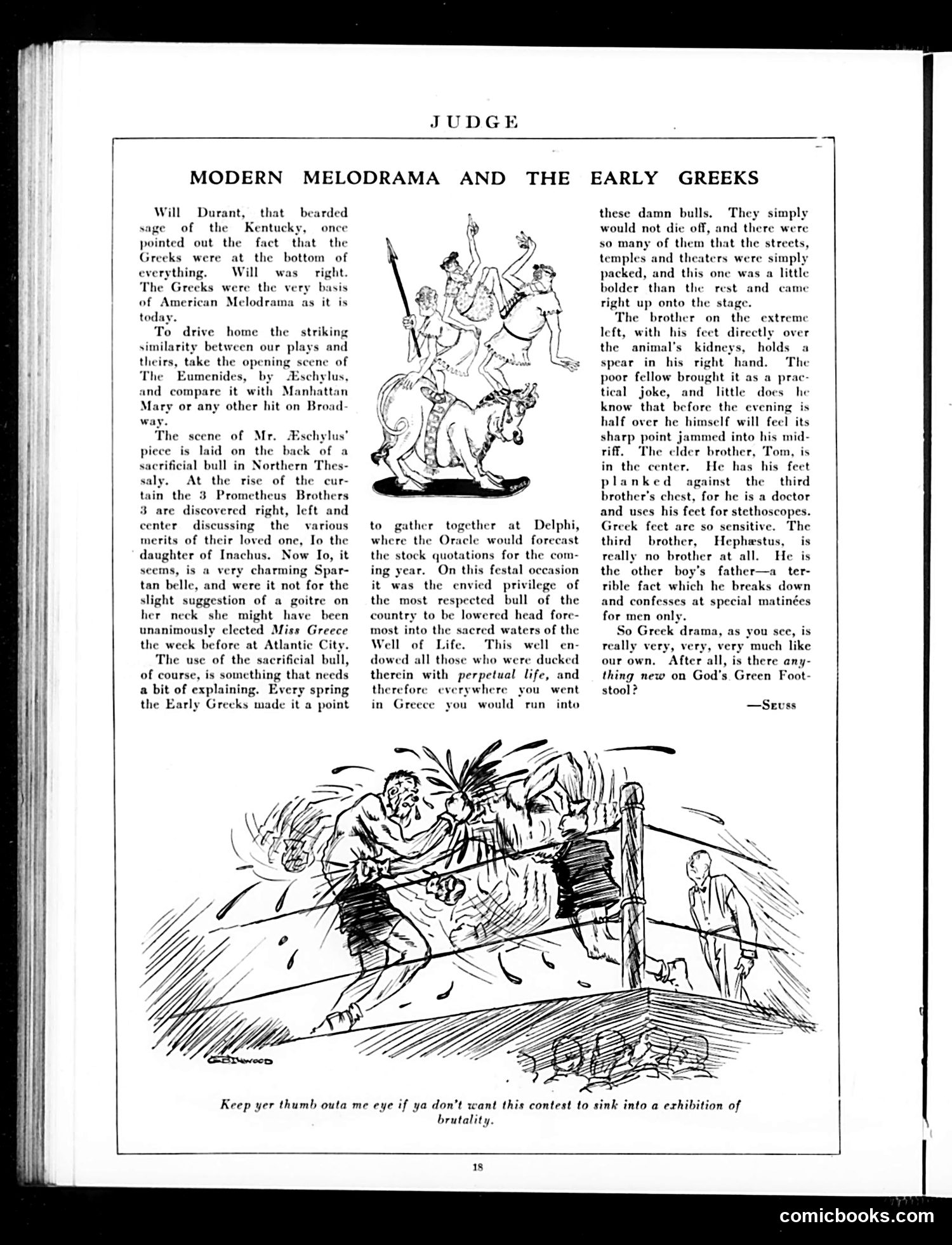
This satirical article compares ancient Greek drama to modern American melodrama, using Will Durant's philosophy as a springboard. The humor works on multiple levels: **The Setup:** The author claims Greek plays like Aeschylus's *The Eumenides* are structurally identical to contemporary Broadway hits like "Manhattan Mary"—both featuring melodramatic conflicts between male characters over a woman. **The Satire:** By describing a Greek scene with absurd modern sensibilities (Miss Greece beauty pageant, stock quotations, a sacrificial bull crashing a stage performance), the piece mocks both: 1. Pretentious comparisons between classical and popular culture 2. The melodramatic conventions of 1920s Broadway (physical comedy, contrived plot twists, all-male matinee performances "for men only") **The Cartoons:** The upper illustration shows the chaotic Greek scene described. The lower cartoon depicts a violent fight, captioning the irony that sophisticated theater risks devolving into "brutality"—whether ancient or modern. **The Point:** Judge suggests American popular entertainment isn't elevated; it's merely classical melodrama repackaged, complete with the same physical slapstick and absurdity.
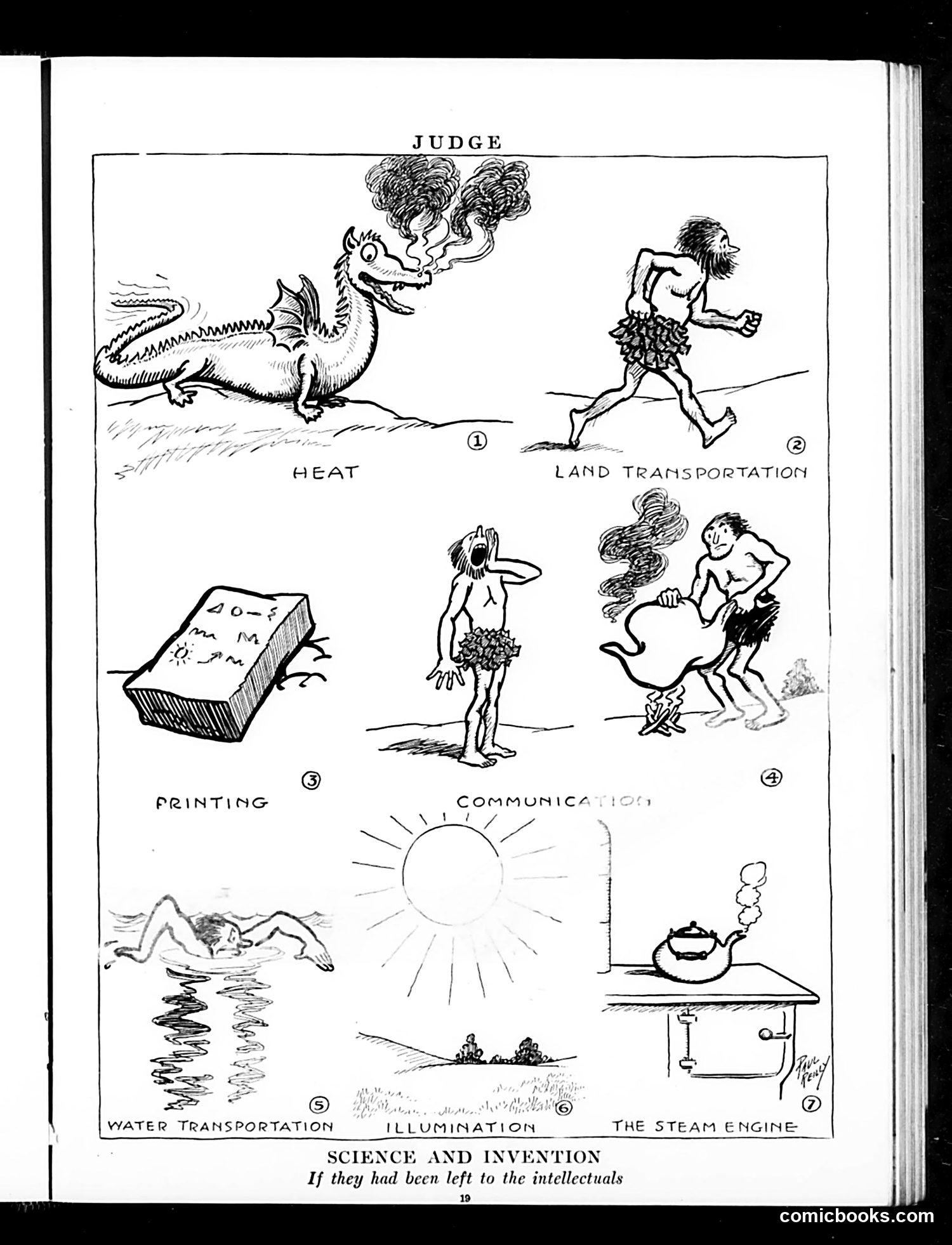
This Judge cartoon satirizes how major technological innovations were developed by practical people rather than theoretical intellectuals. Each numbered panel shows a fundamental invention: 1. **Heat** - represented by fire-breathing dragon (primitive discovery) 2. **Land Transportation** - a person running 3. **Printing** - a printing press 4. **Communication** - two figures with a snake (possibly telegraph or messaging) 5. **Water Transportation** - person swimming 6. **Illumination** - the sun 7. **The Steam Engine** - a functional teapot The subtitle's joke: "If they had been left to the intellectuals" implies these essential inventions would never have existed had academics alone been responsible. The cartoon mocks ivory-tower intellectualism, suggesting practical necessity—not scholarly theory—drove human progress. This reflects late 19th/early 20th-century American skepticism toward elitist European philosophical traditions, celebrating instead the pragmatic "can-do" spirit of inventors and working people.
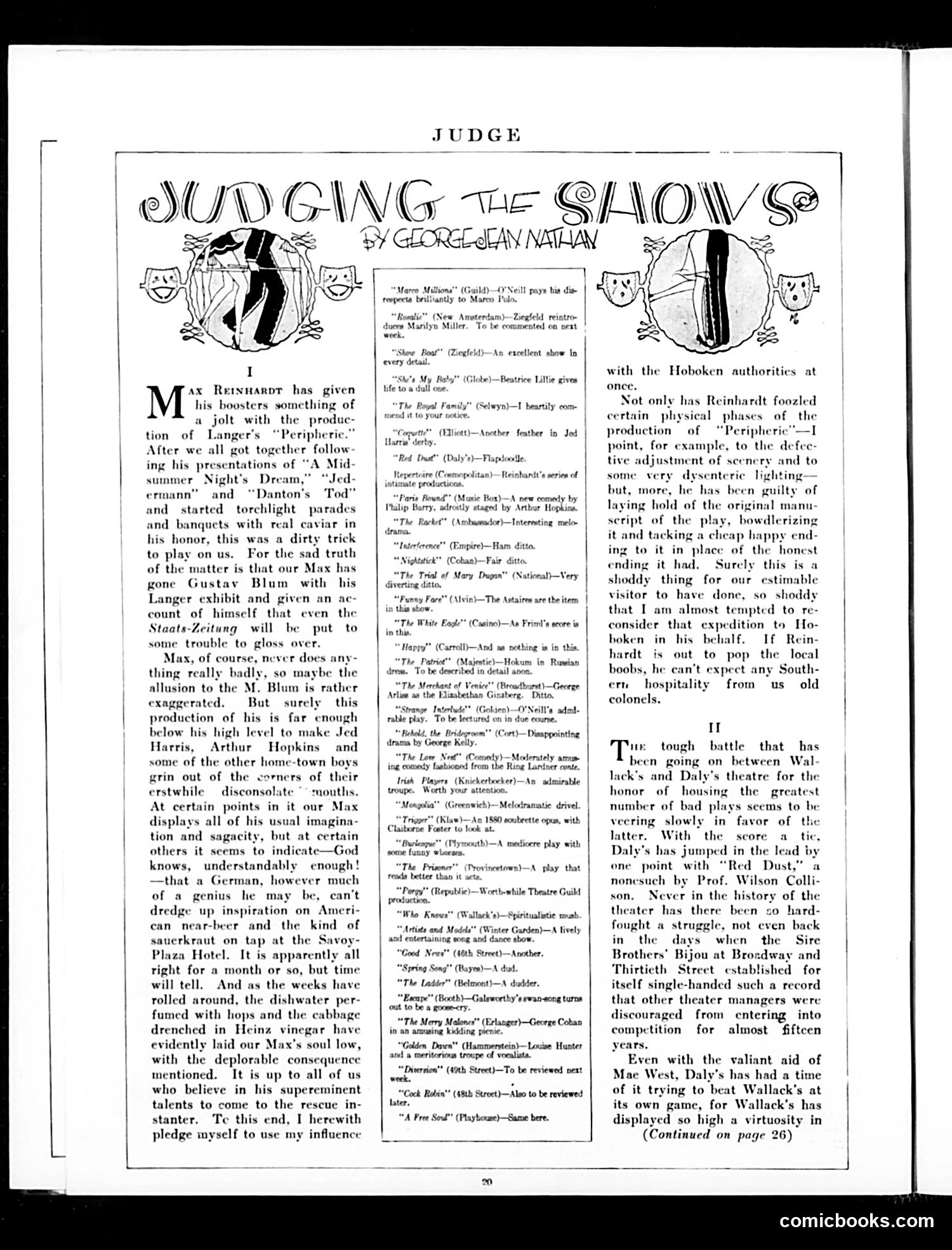
This is a theater review column by prominent drama critic George Jean Nathan. The main text critiques director Max Reinhardt's production of "Peripherie" by Langer, suggesting it represents a disappointing departure from Reinhardt's earlier successes with Shakespeare and classics. Nathan humorously suggests Reinhardt has lost his creative edge in America, attributing this to homesickness—the "dishwater perfumed with hops and cabbage drenched in Heinz vinegar" being a satirical jab at German-American food and culture, implying Reinhardt's artistic soul has been diminished by American conditions. The right column lists brief reviews of current Broadway shows, rating productions from various theaters. The cartoon illustrations (theatrical masks) frame the typical entertainment criticism format of the era, when theater criticism was a major cultural discourse and detailed reviews dominated periodicals like *Judge*.
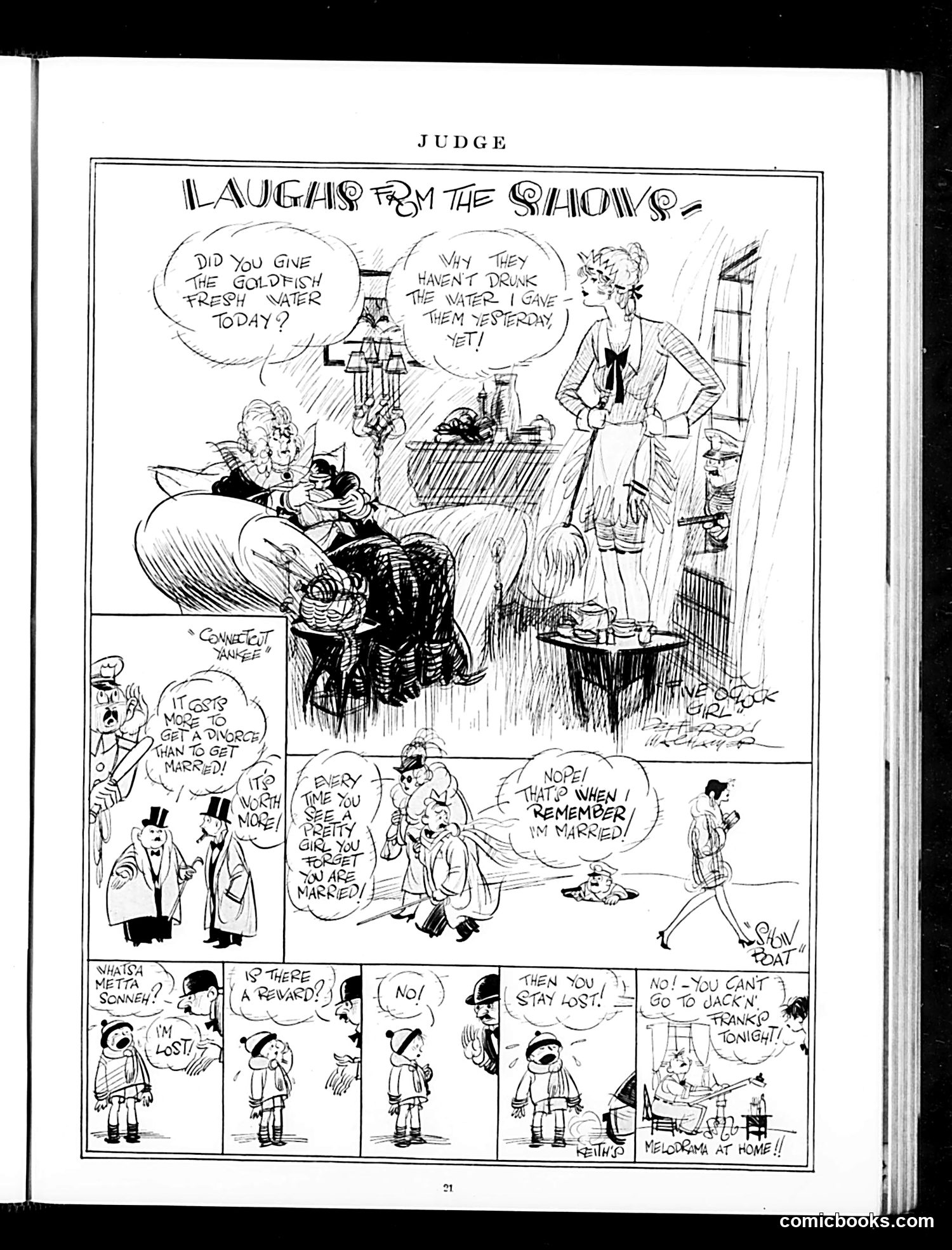
This page contains multiple satirical cartoons mocking domestic life and marriage, typical of Judge magazine's humor. The main cartoon shows a wealthy couple arguing about goldfish care—the husband asks if she fed them fresh water; she responds they haven't drunk yesterday's water yet. This satirizes upper-class domestic squabbles over trivial matters. Below, a subplot involves two men in top hats discussing marriage and divorce, suggesting casual attitudes toward matrimony. The bottom strip follows a lost child being repeatedly told "No!" when asking to stay out or go places, ending with him sent home. This mocks parental discipline and childhood frustration. The satire targets Victorian-era domestic conventions: absurd marital arguments, frivolous wealthy concerns, and strict parental control. The humor relies on recognizing these as exaggerated but familiar social situations to Judge's readers.
This page from *Judge* magazine contains satirical social commentary typical of the 1920s. The main content is a humorous diary entry mocking high society's pretensions. **The "High Heels" Header:** The stylized illustration of women in high heels is decorative, reflecting the fashion-conscious era. **The Satire:** The diary entries (Monday-Wednesday) mock wealthy socialites who describe automobiles using language typically reserved for fashion—treating cars as garments with "bodices," "girdles," and "vanity cases." This absurdist humor highlights the shallow materialism of the leisure class, where even industrial products are reduced to status symbols and aesthetic objects. **"An Odd Collection":** This companion piece humorously describes a wife's inexplicable hobby of collecting toothpaste and cream tube caps—a pointed joke about irrational collecting habits and marital dynamics. The page exemplifies 1920s *Judge* satire: poking fun at consumerism, gender dynamics, and upper-class affectations through exaggeration and deadpan delivery. The tone is lighthearted rather than cutting, reflecting the magazine's entertainment-focused satire.
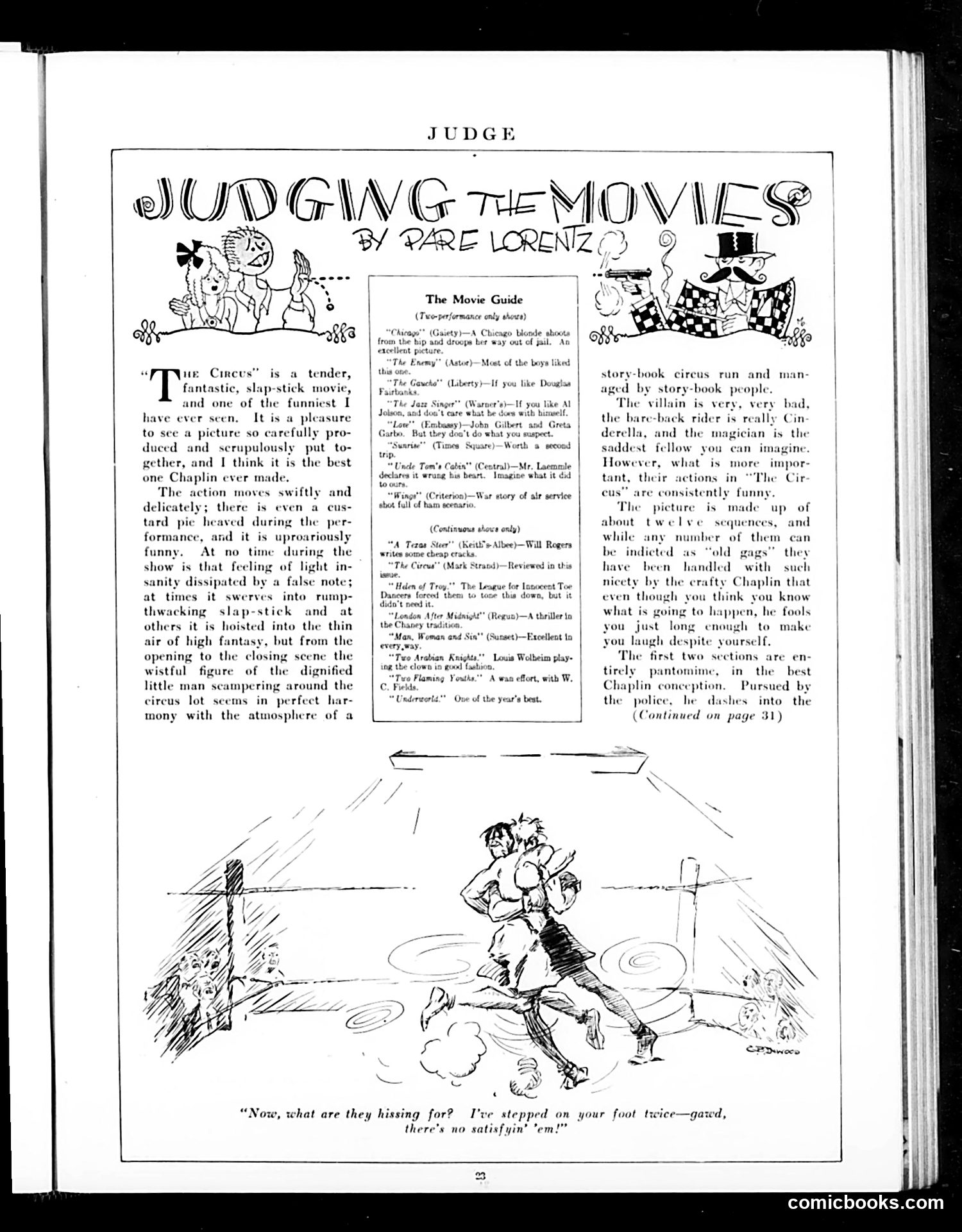
This page reviews Charlie Chaplin's film *The Circus*, praising it as "one of the funniest" and "the best one Chaplin ever made." The review highlights Chaplin's physical comedy—slapstick, custard pies, and pratfalls—balanced with moments of wistful pantomime that elevate the humor into "high fantasy." The cartoon below illustrates a circus performance where an audience member complains about being stepped on repeatedly, sarcastically suggesting the performers are deliberately antagonizing viewers ("there's no satisf yin' 'em"). This likely comments on audience behavior at live performances or how comedians manage difficult crowds. The "Movie Guide" sidebar lists other current films with brief, snappy reviews, a typical feature of *Judge* magazine's entertainment criticism during the silent film era.
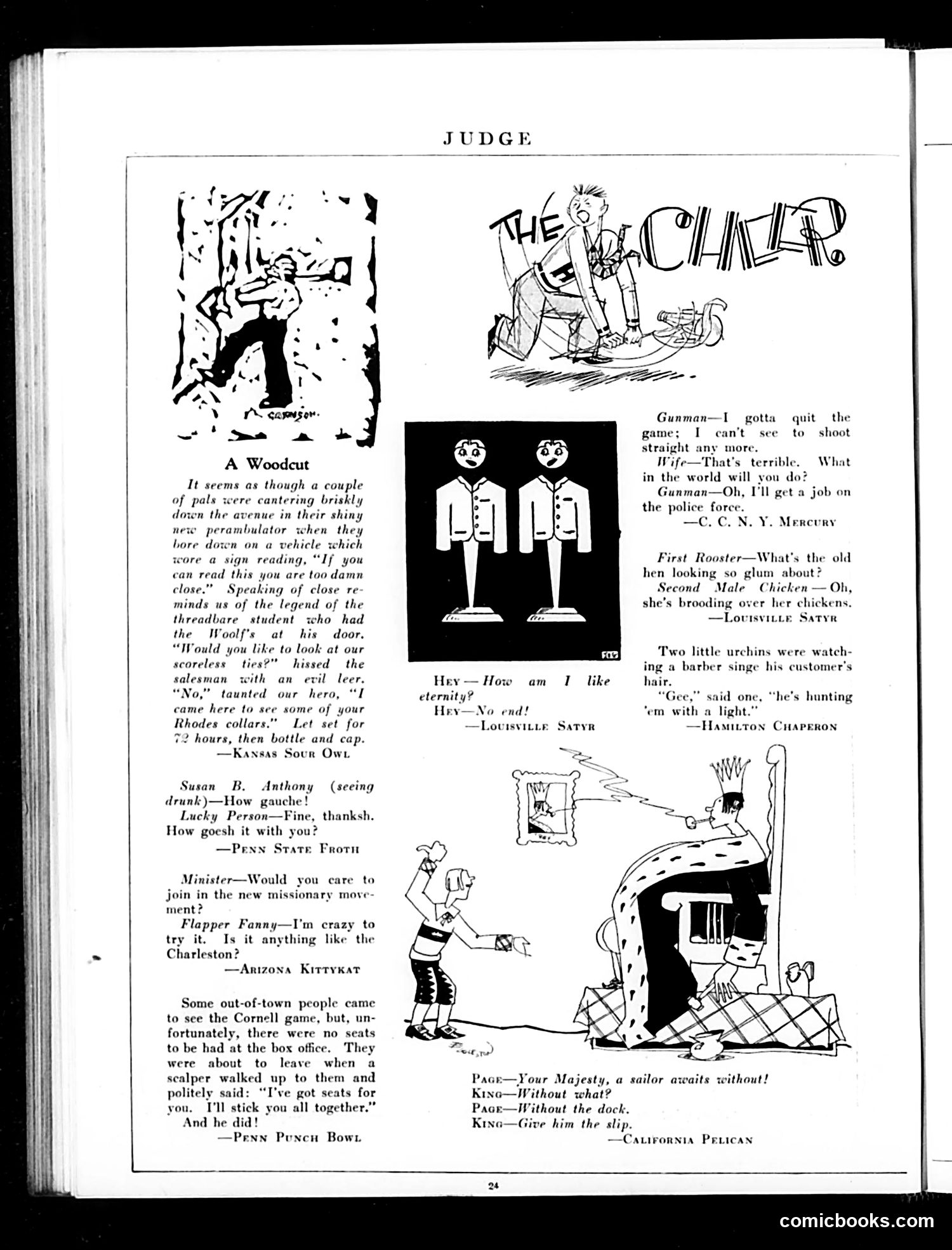
This page from the satirical magazine *Judge* collects various short jokes and cartoon gags typical of 1920s humor. The cartoons and quips reference contemporary topics: the "Charleston" dance (a scandal to older generations), the "flapper" lifestyle, Susan B. Anthony (likely invoking women's suffrage debates), and missionary work. One joke plays on a gangster losing eyesight and joining the police force—satirizing police corruption of the era. The "Woolf" reference appears to be a pun on financial difficulties. The "Rhodes collars" joke involves laundry/clothing humor. A ticket scalper joke at a Cornell game reflects urban entertainment culture. Most humor relies on wordplay ("eternity/no end"), mild puns, and observational comedy about modern life—cars, barbershops, dating. The overall tone is lighthearted social satire rather than sharp political commentary. The crude woodcut illustrations and simple drawings are typical of *Judge's* style, aimed at middle-class readers finding humor in everyday situations and slang of the period.
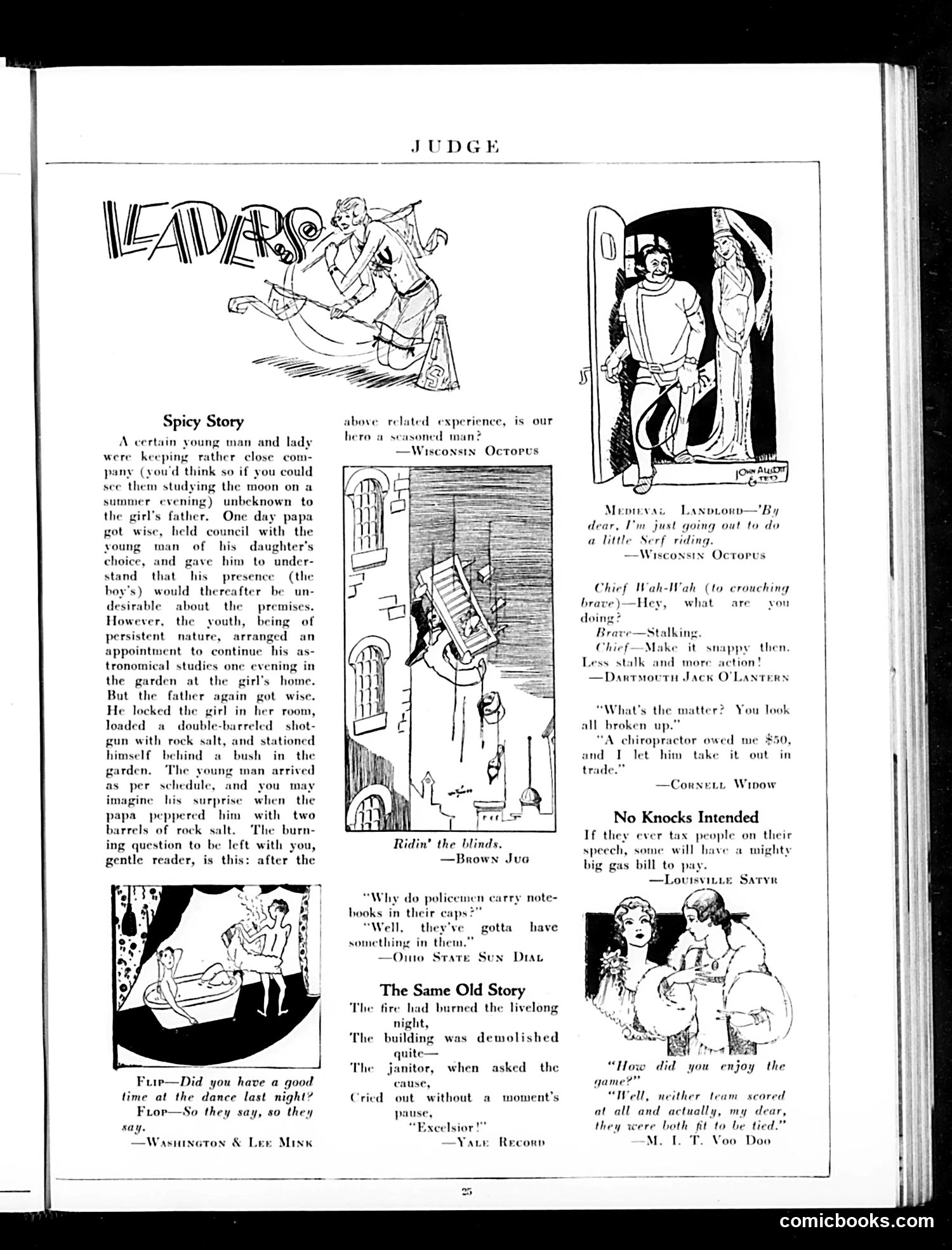
This page from *Judge* contains multiple short humorous items typical of the era's satirical magazine format: **"Spicy Story"** (main feature): A father discovers his daughter's secret courtship and stations himself with a shotgun loaded with rock salt in the garden to drive away the young man. The joke plays on parental vigilance against unsupervised courting—a genuine social concern of the era when chaperoning was expected. **Other items** are brief one-liners mocking various groups: policemen (Ohio State Sun Dial), a janitor responding to a fire (Yale Record), a chiropractor (Cornell Widow), and a woman feigning interest in watching football (M.I.T. Voo Doo). The attributions show these are reprinted from college humor magazines, suggesting *Judge* curated collegiate wit for its readers. The overall tone reflects early-20th-century middle-class anxieties about courtship propriety and pokes fun at institutional figures (police, janitors, doctors) through exaggeration and ironic wordplay rather than sharp political critique.
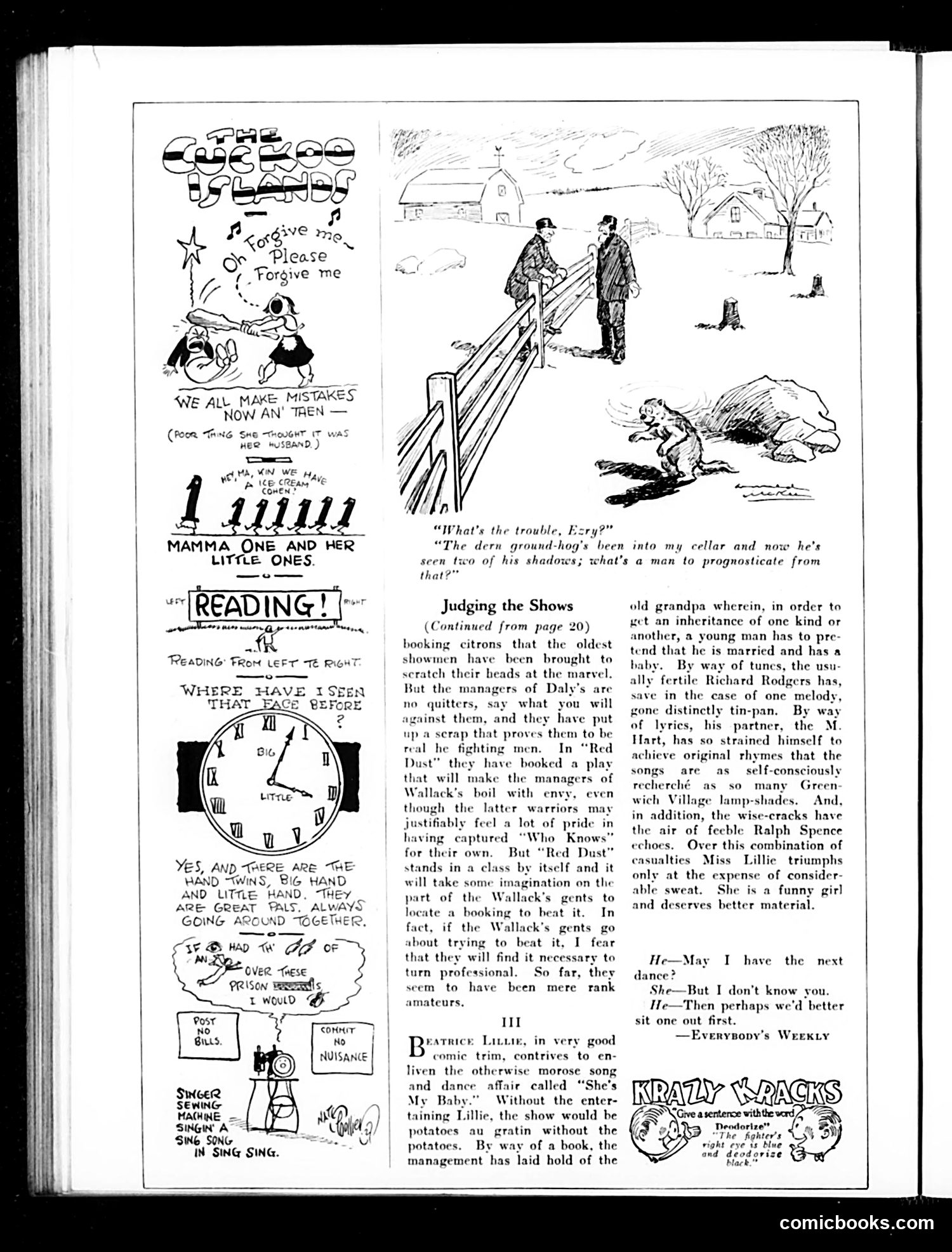
This Judge magazine page contains several unrelated comic features and theater reviews: **Left side comics**: Humorous domestic sketches about parenting mistakes, a child learning to read a clock by identifying its hand positions, and a prison guard singing while working—light observational humor. **Main illustration (top right)**: A rural scene depicting two men discussing a groundhog that allegedly saw "two shadows" in a cellar, playing on Groundhog Day folklore (the animal seeing its shadow predicts winter duration). The joke is the farmer's bewilderment at interpreting an impossible situation. **Theater reviews**: Critical assessments of Broadway productions, particularly praising Beatrice Lillie's performance in "She's My Baby" while criticizing the show's derivative plot and tin-pan alley songs. The reviewer praises the theater company's competitive ambitions. **Bottom right**: A brief romantic exchange joke and an advertisement for "Crazy Whacks" (appears to be a hair product). The page reflects 1920s-30s entertainment culture and popular humor conventions—observational comedy, theater criticism, and sentimental romance gags.
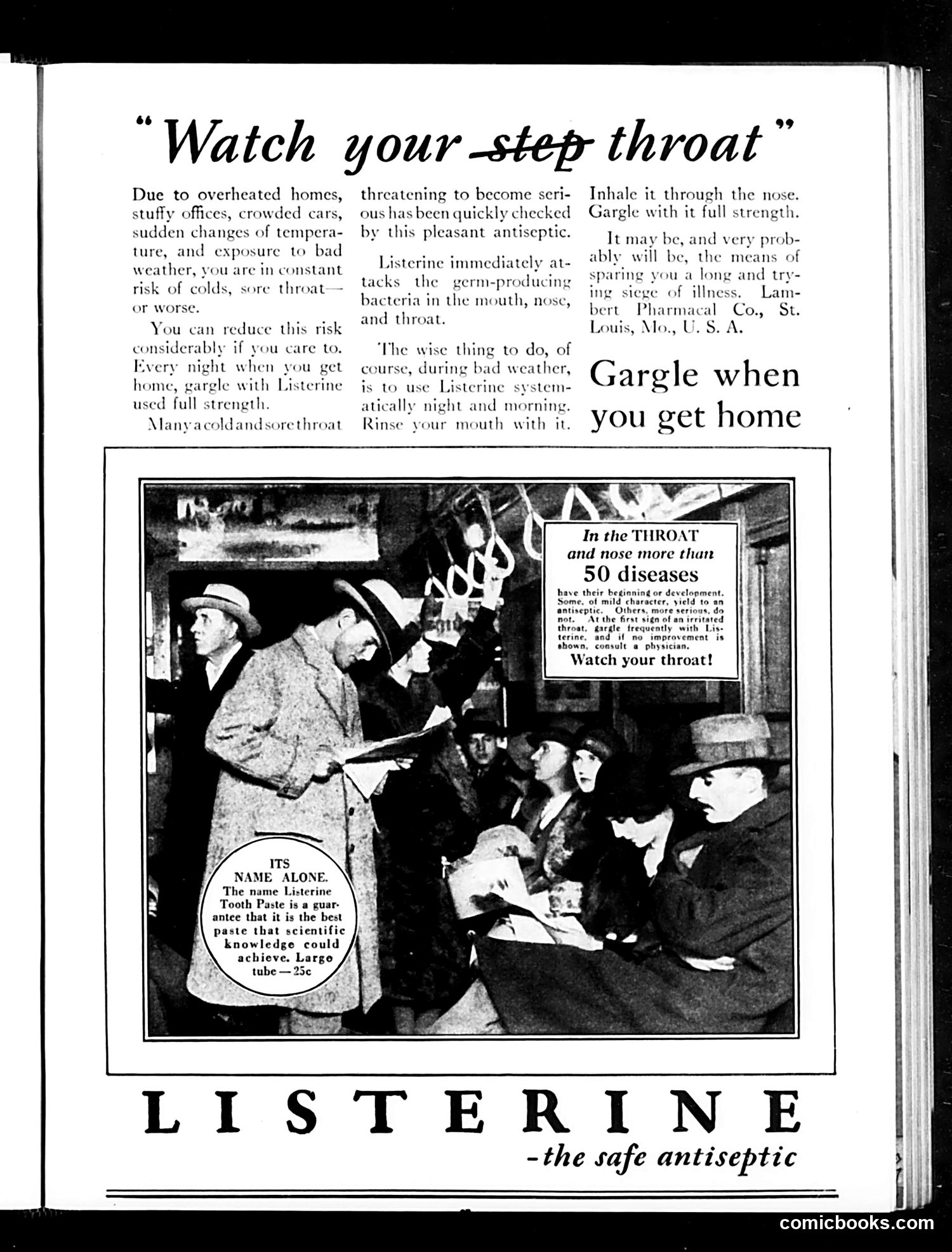
This is primarily a **Listerine advertisement**, not political satire. The page uses a public health angle to promote the antiseptic mouthwash. The illustration shows a crowded urban scene—likely a streetcar or public transport—depicting "overheated homes, stuffy offices, crowded cars" and "exposure to bad weather" that supposedly cause sore throats and colds. The packed conditions visualize the health risks of modern city life in the early 20th century. The satire is mild and self-directed: the ad's pun "Watch your step throat" plays on the common warning "watch your step," suggesting throat health requires as much caution as avoiding accidents. The ad claims Listerine can prevent or quickly remedy colds and sore throats by killing bacteria. It also warns that over 50 diseases begin in the throat, urging readers to gargle daily. This reflects genuine early-20th-century medical concerns about infectious disease transmission, though the antiseptic's actual preventive power was likely overstated.
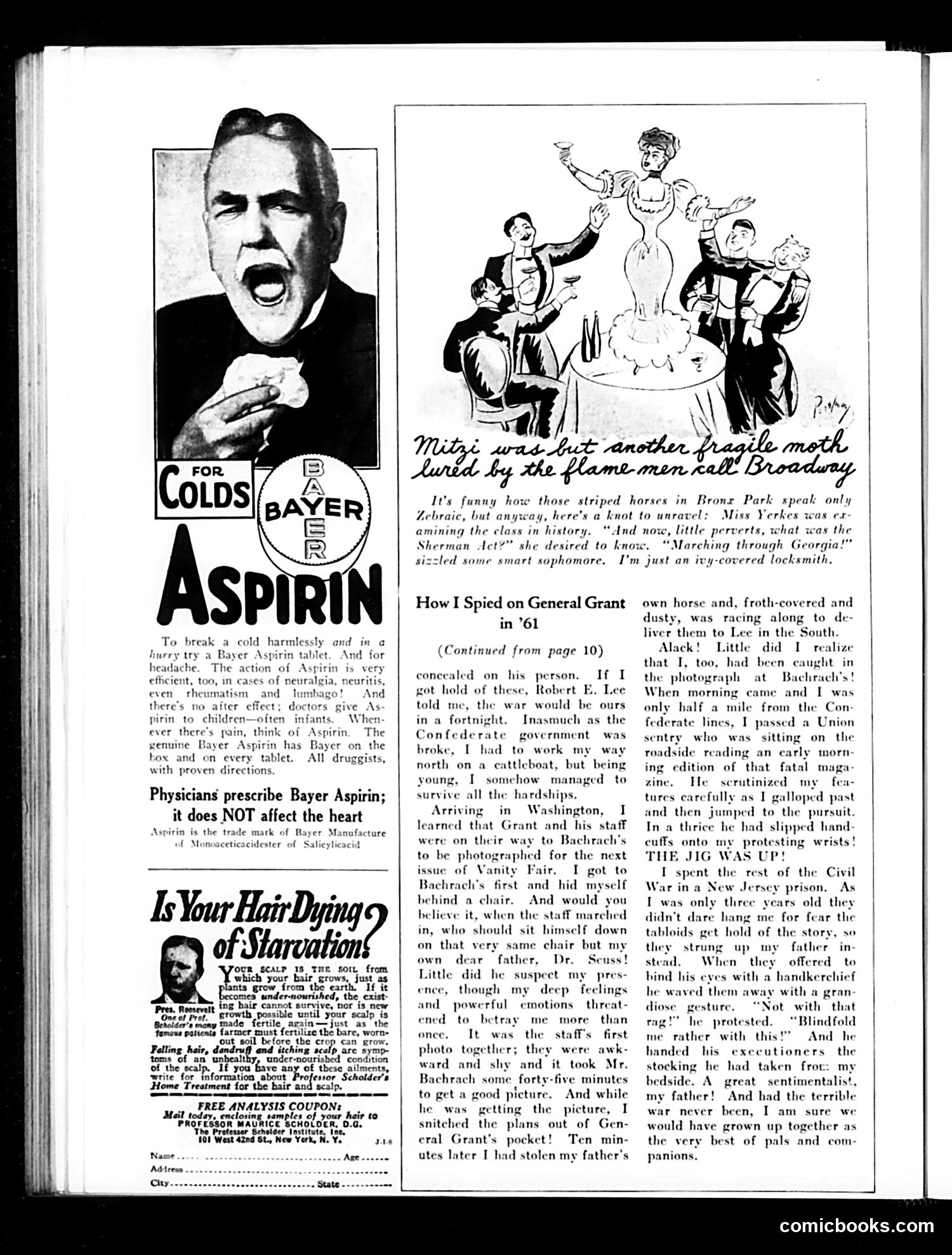
This page contains **advertising and fiction** rather than political satire. The left side features **Bayer Aspirin and hair-loss remedy advertisements** typical of early 20th-century magazines, using testimonials and pseudo-scientific claims. The right side presents a humorous **tall tale titled "How I Spied on General Grant in '61,"** a Civil War spy story played for laughs. The narrator claims to have hidden behind a chair at a Civil War-era photograph session, stolen General Grant's military plans, delivered them to Robert E. Lee, only to discover he'd been photographed—leading to his arrest and imprisonment while only three years old. The absurdist premise (being imprisoned as a toddler, his father's theatrical dignity at execution) is the joke. **Context for modern readers:** This is fictional entertainment, not political commentary. The Civil War reference is historical backdrop rather than contemporary satire. The page reflects Judge's mix of ads and humorous stories typical of early-1900s satirical magazines.
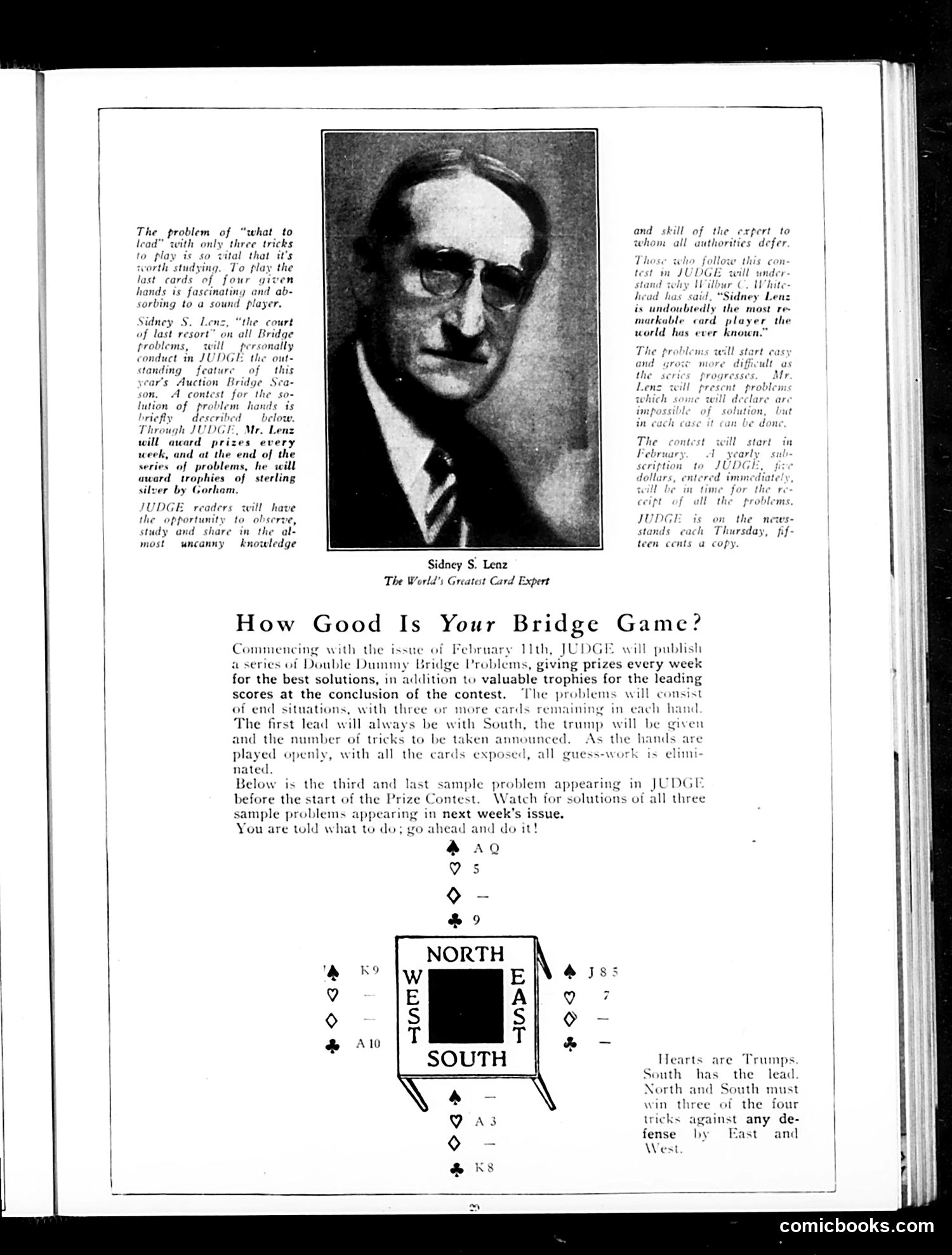
This page announces a new competitive feature in **Judge magazine**: a series of bridge card game problems with weekly prizes. The publication presents **Sidney S. Lenz**, identified as "The World's Greatest Card Expert," as the authority conducting the contest. The content represents bridge as an intellectual pursuit worthy of serious study and competition—a popular leisure activity among educated Americans of the early 20th century. The contest offered monetary prizes and sterling silver trophies, positioning bridge expertise as an admirable skill. The "Double Dummy Bridge Problems" presented end-game scenarios requiring readers to determine optimal card play. This was entertainment that appealed to Judge's affluent, leisure-class readership who engaged in bridge as both social activity and mental challenge. The feature demonstrates how magazines competed for audience engagement through interactive contests.
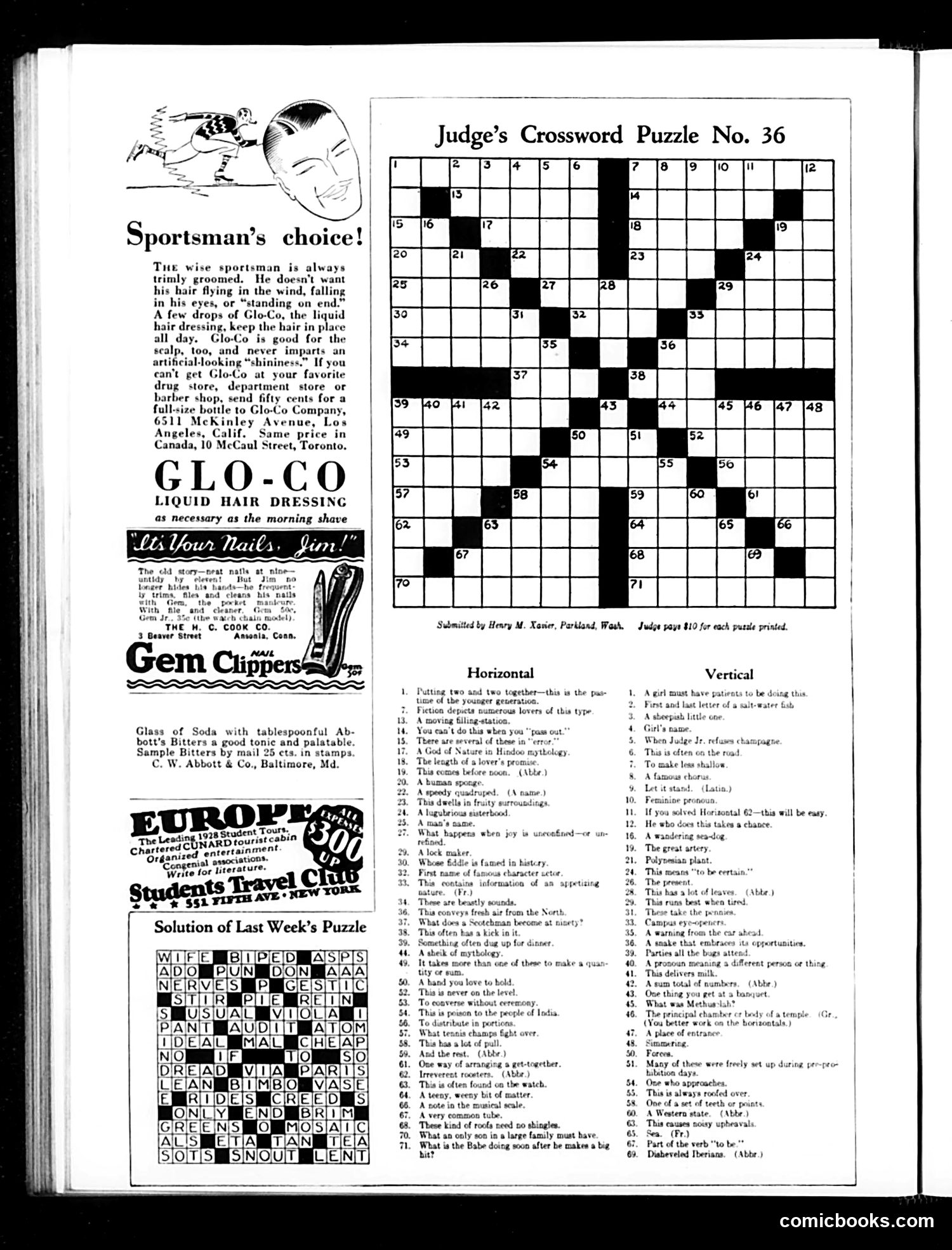
This page is primarily **advertising and a crossword puzzle**, not political satire. The top features a **Glo-Co hair dressing advertisement** depicting a sportsman (athlete) whose groomed appearance is presented as essential to a "wise sportsman." The ad emphasizes that properly styled hair—kept in place throughout the day—is as necessary as morning grooming. This reflects early 20th-century masculine beauty standards and consumer advertising targeting men. Below are additional period product ads: Abbott's Bitters (a medicinal tonic), a nail clipper ("Let Your Nails, Jim!"), and travel/tourism advertisements. The bulk of the page is **Judge's Crossword Puzzle No. 36**, a typical feature offering monetary prizes ($10) for submitted solutions. The puzzle clues contain period-specific references and wordplay typical of 1920s-30s entertainment. At bottom is the solution grid to the previous week's puzzle. **No political cartoon or satire is present**—this is a standard magazine entertainment/advertising page from the era.
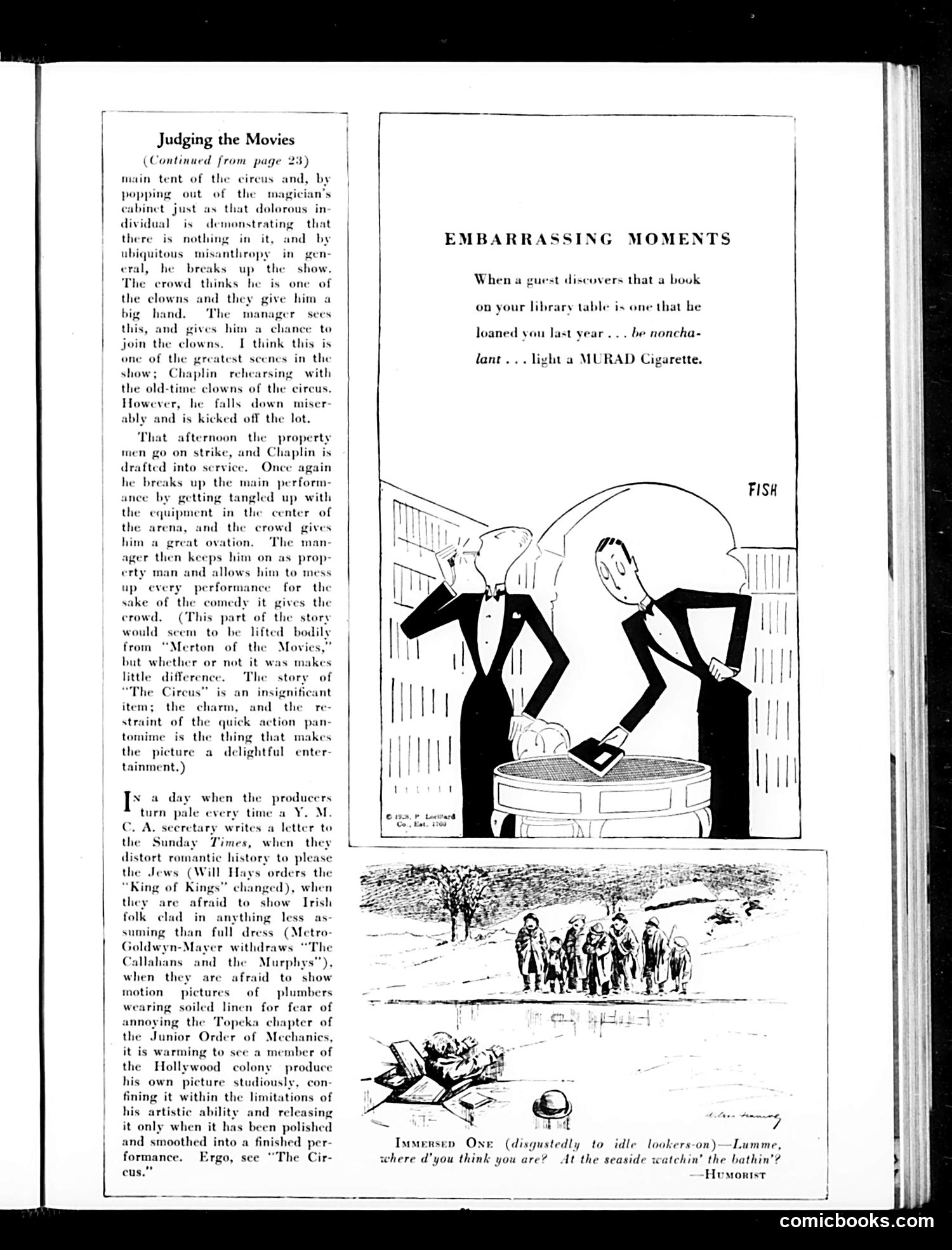
This page contains two satirical pieces from Judge magazine: **Left column ("Judging the Movies"):** A film review praising Charlie Chaplin's *The Circus*, highlighting his physical comedy and pantomime skills. The reviewer critiques Hollywood's self-censorship, citing examples: studios altering *King of Kings* to appease Jewish groups, avoiding Irish stereotypes, and self-policing to prevent offending groups like the Junior Order of Mechanics. The point: Chaplin's independent production represents artistic integrity against corporate timidity and pressure-group complaints. **Right side cartoons:** 1. **"Embarrassing Moments"** (top): A cigarette advertisement disguised as humor—the awkward social situation of discovering a borrowed book on someone's shelf, solved by lighting a MURAD cigarette. 2. **"Fish"** (bottom): A seaside scene where a disheveled man, questioned about his presence, makes a double-entendre joke about "watching the bathin'"—implying voyeurism. Both cartoons reflect 1920s-30s social attitudes and advertising integration into entertainment media.
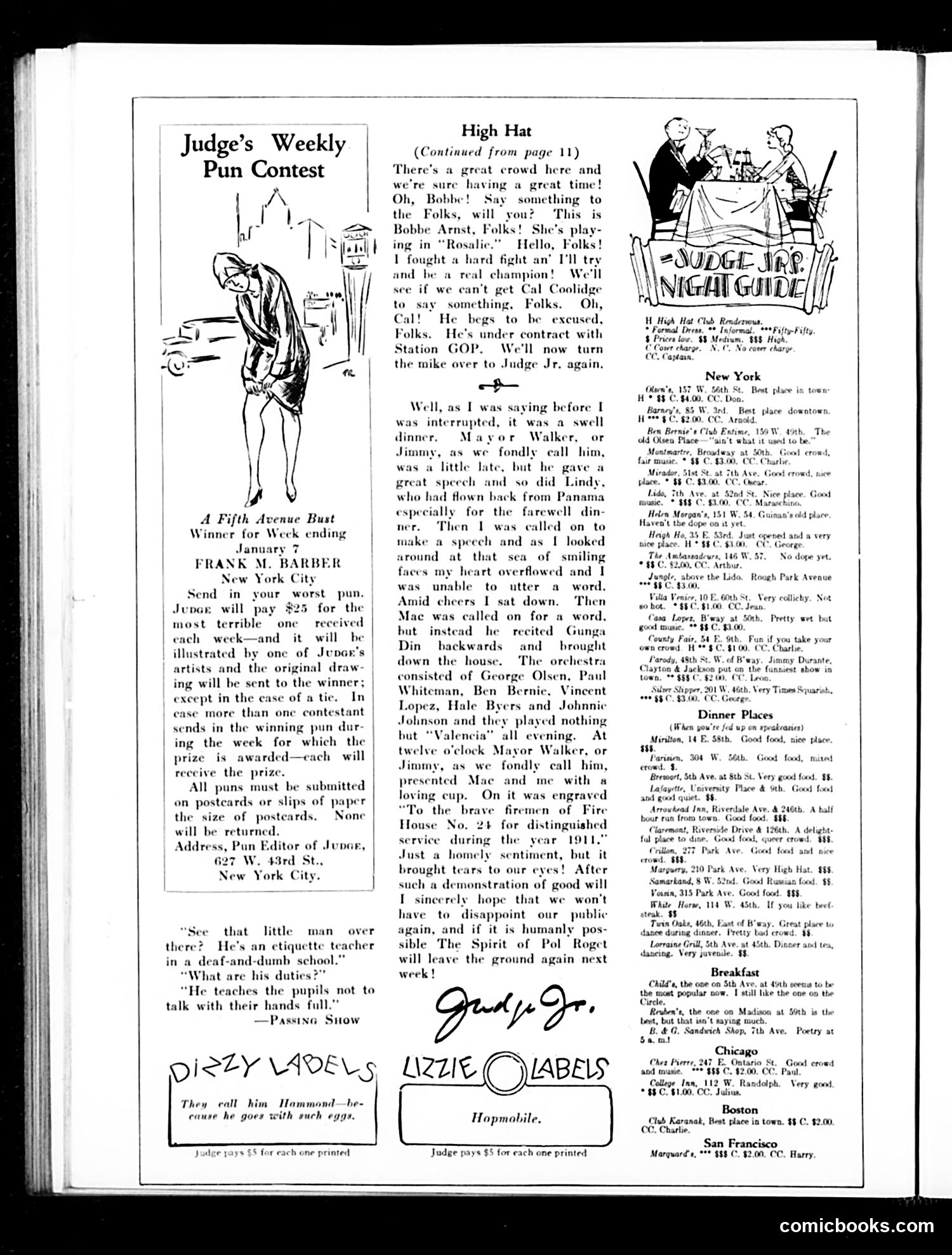
This page from Judge magazine (a major American satirical publication) contains mostly **advertisements and contest information**, not political satire. The main content includes: 1. **"Judge's Weekly Pun Contest"** – A reader-submitted humor competition offering $5 for the "worst pun," with winning entries illustrated by Judge's artists. 2. **"High Hat"** – A society column describing a formal dinner featuring celebrities including Mayor Jimmy Walker, aviator Charles Lindbergh ("Lindy"), Mae West, and bandleaders George Olsen and Paul Whiteman. The column celebrates their toasts and remarks at what appears to be a firefighters' benefit dinner (referencing Fire House No. 24 and service in 1911). 3. **Extensive nightclub and restaurant listings** for New York, Chicago, Boston, and San Francisco – giving prices, atmosphere, and featured entertainers. The page reflects 1920s Jazz Age culture and reflects high-society entertainment venues of the Prohibition era ("speakeasy" references appear in the dining section).
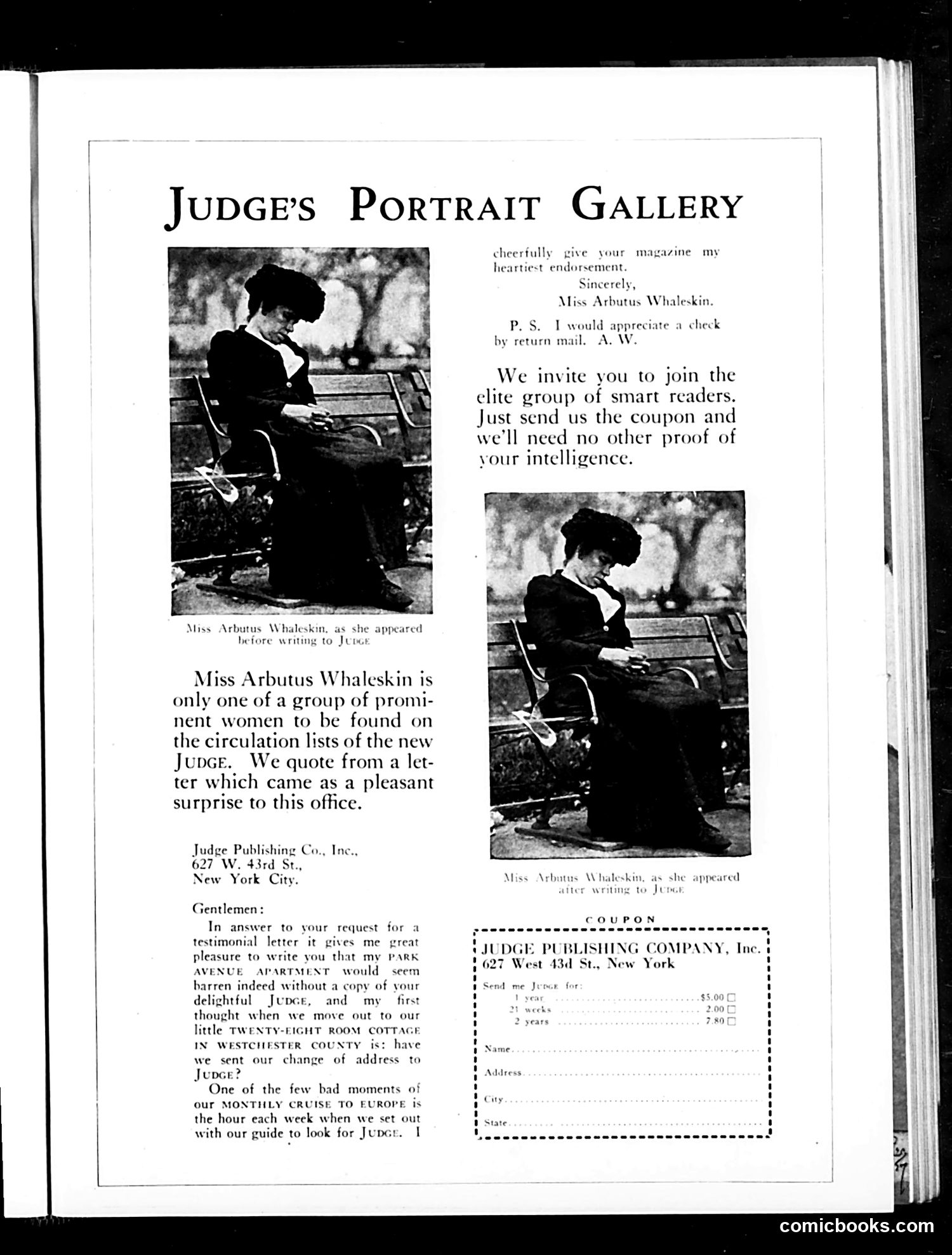
This is primarily **advertising disguised as editorial content**—a common practice in early 20th-century magazines. The satire targets wealthy, pretentious readers rather than political figures. "Miss Arbutus Whaleskin" is a fictional character (the name itself a joke—absurdly pompous). Judge publishes a fabricated testimonial letter where she brags about her luxurious lifestyle: a Park Avenue apartment, a twenty-eight-room Westchester cottage, and monthly European cruises. The humor lies in the **exaggerated materialism and snobbery**—she claims she can't imagine life without *Judge* magazine, even mentioning it during vacations. The accompanying coupon invites readers to join an "elite group of smart readers," sarcastically suggesting that subscribing to *Judge* proves one's intelligence. The satire mocks both wealthy affectation and the magazine's own self-promotional claims.
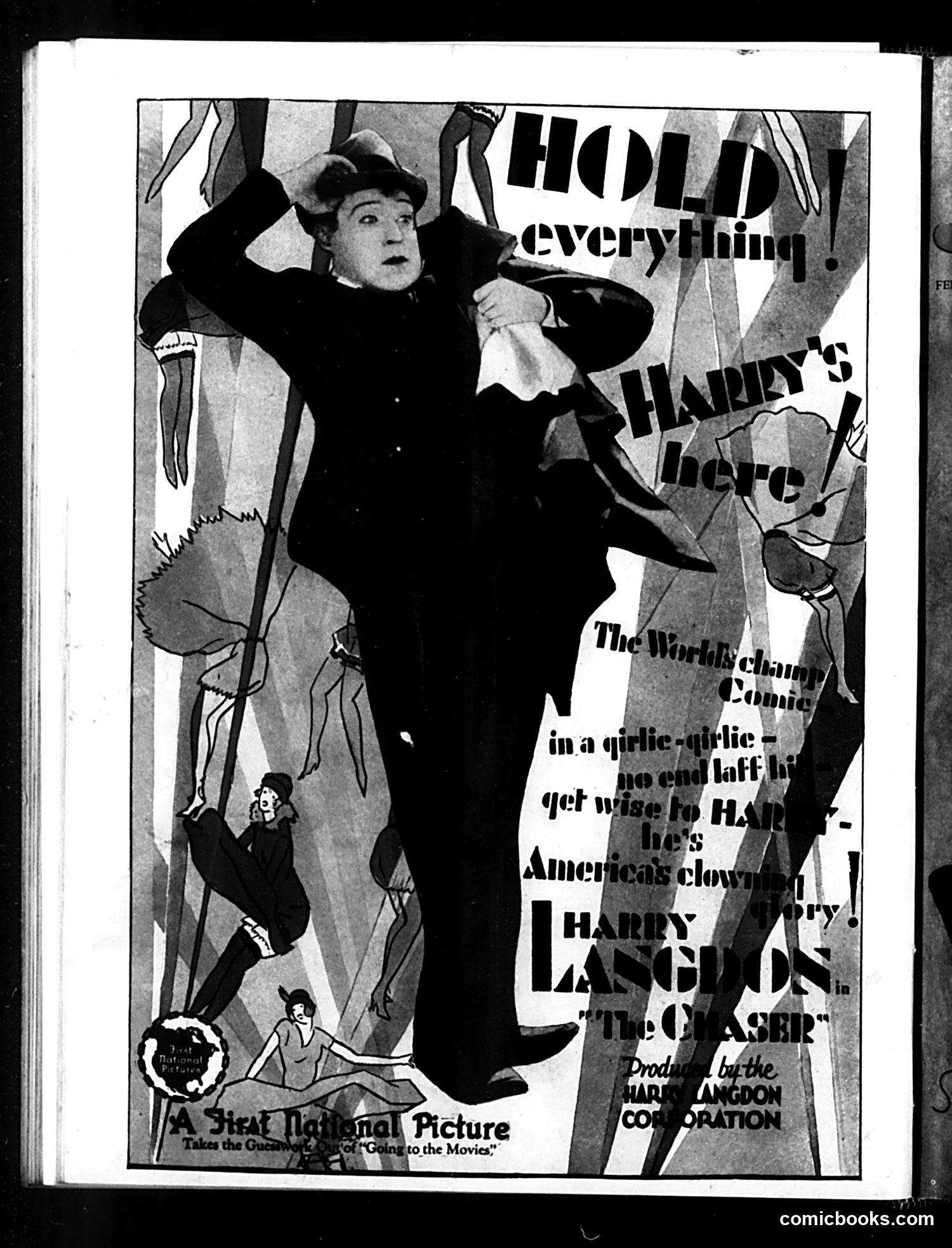
This is a movie advertisement for "The Gasser," a silent film starring Harry Langdon, produced by the Harry Langdon Corporation. The ad emphasizes Langdon's comedic talents, calling him "America's clown" and "the World's Clown Comic." The visual shows a caricatured figure in a bowler hat and dark suit in an exaggerated pose—likely depicting physical comedy typical of silent film slapstick. The smaller figures around him suggest chaos or mayhem he creates. The ad promises "girlie-girlie" humor and physical comedy ("no end laff"). This represents early 1920s cinema marketing, where silent comedians like Langdon, Chaplin, and Keaton were major stars, and their advertisements emphasized their distinctive physical performance styles rather than plot.