
Judge, 1928-01-28 · page 33 of 36
Judge — January 28, 1928 — page 33: what you’re looking at
What you’re looking at
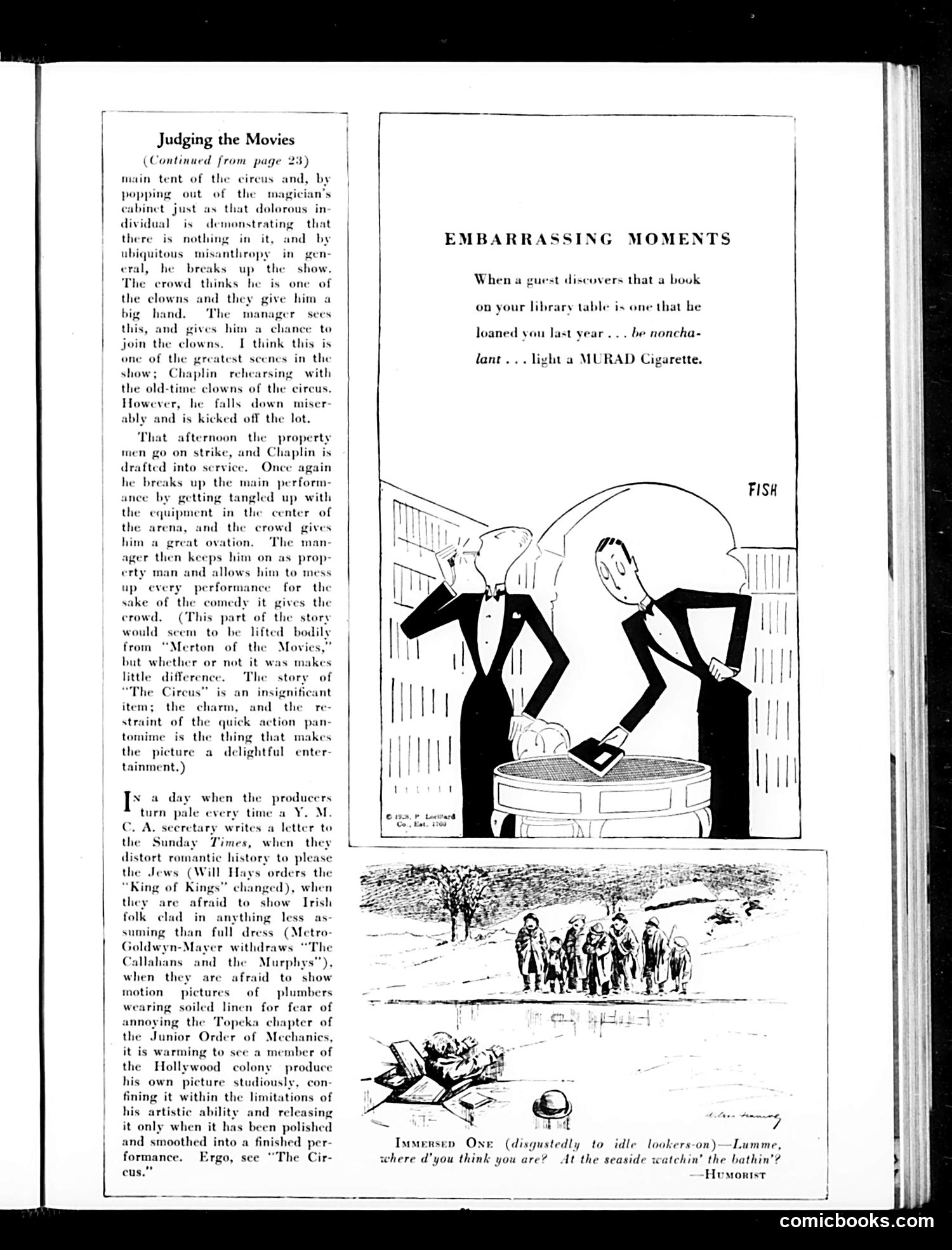
This page contains two satirical pieces from Judge magazine: **Left column ("Judging the Movies"):** A film review praising Charlie Chaplin's *The Circus*, highlighting his physical comedy and pantomime skills. The reviewer critiques Hollywood's self-censorship, citing examples: studios altering *King of Kings* to appease Jewish groups, avoiding Irish stereotypes, and self-policing to prevent offending groups like the Junior Order of Mechanics. The point: Chaplin's independent production represents artistic integrity against corporate timidity and pressure-group complaints. **Right side cartoons:** 1. **"Embarrassing Moments"** (top): A cigarette advertisement disguised as humor—the awkward social situation of discovering a borrowed book on someone's shelf, solved by lighting a MURAD cigarette. 2. **"Fish"** (bottom): A seaside scene where a disheveled man, questioned about his presence, makes a double-entendre joke about "watching the bathin'"—implying voyeurism. Both cartoons reflect 1920s-30s social attitudes and advertising integration into entertainment media.
📄 Transcribed text from this page (OCR, searchable)
Machine-transcribed from the original scan — historical spelling and the odd misread are preserved.
Judging the Movies (Continued from page 23) main tent of the circus and, by popping out of the magician’s cabinet just as that dolorous in dividual’ is demonstrating that there is nothing in it, and by EMBARRASSING MOMENTS ubiquitous misanthropy in’ gen- : » breaks up the show. st crtwd Ghitks We: ln ore When a guest discovers that a book the clownsiand ‘they give: himi.a on your library table is one that be big hand. The manager sees ¢ this, and gives him a chance to join the clowns. I think this is one of the atest scenes in the fant... light a MURAD Cigarette. show; Chaplin rehearsing with the old-time clowns of the circus. However, he fally down miser ably and is kicked off the lot. That afternoon the property men go on strike, and Chaplin is drafted into service. Once again he breaks up the main perform- ance by getting tangled up with the equipment in the center of the a a, and the crowd gives him t ovation. The man- ager then keeps him on as prop- erty man and allows him to mess up’ every performance for the sake of the comedy it gives the crowd. (‘This part of the story would seem to be lifted bodily from “Merton of the Movies,” but whether or not it was makes little difference. The story of “The Circus” is an insignificant item; the charm, and the re- straint of the quick action pan- tomime is the thing that makes the picture a delightful enter- tainment.) loaned you last year... be noncha- Ix a day when the produ turn pale every time a Y C. A. secretary writes a letter to the Sunday Times, when they distort romantic history to please the Jews (Will Hays orders the “King of Kings’ changed), when they are afraid to show Irish folk clad in anything less as- suming than full dress (M Goldwyn-Mayer withdraws Callahans and the Murph when they are afraid to show motion pictures of — plumbers wearing soiled linen for fear of annoying the Topeka chapter of the Junior Order of Mechanics, it is warming to sce a member of the Hollywood colony produce his own picture studiously, con- fining it within the limitations of his artistic ability i : ilera Hinman it only when it has been polishe . 7 / and smoothed into a finished per- ve (disgustedly to idle lookers-on)—Lumme, formance. Ergo, see “The Cir- you are? At the seaside watchin’ the bathin’? cus. Hemorist comicbooks.com