A complete issue · 36 pages · 1927
Judge — November 5, 1927
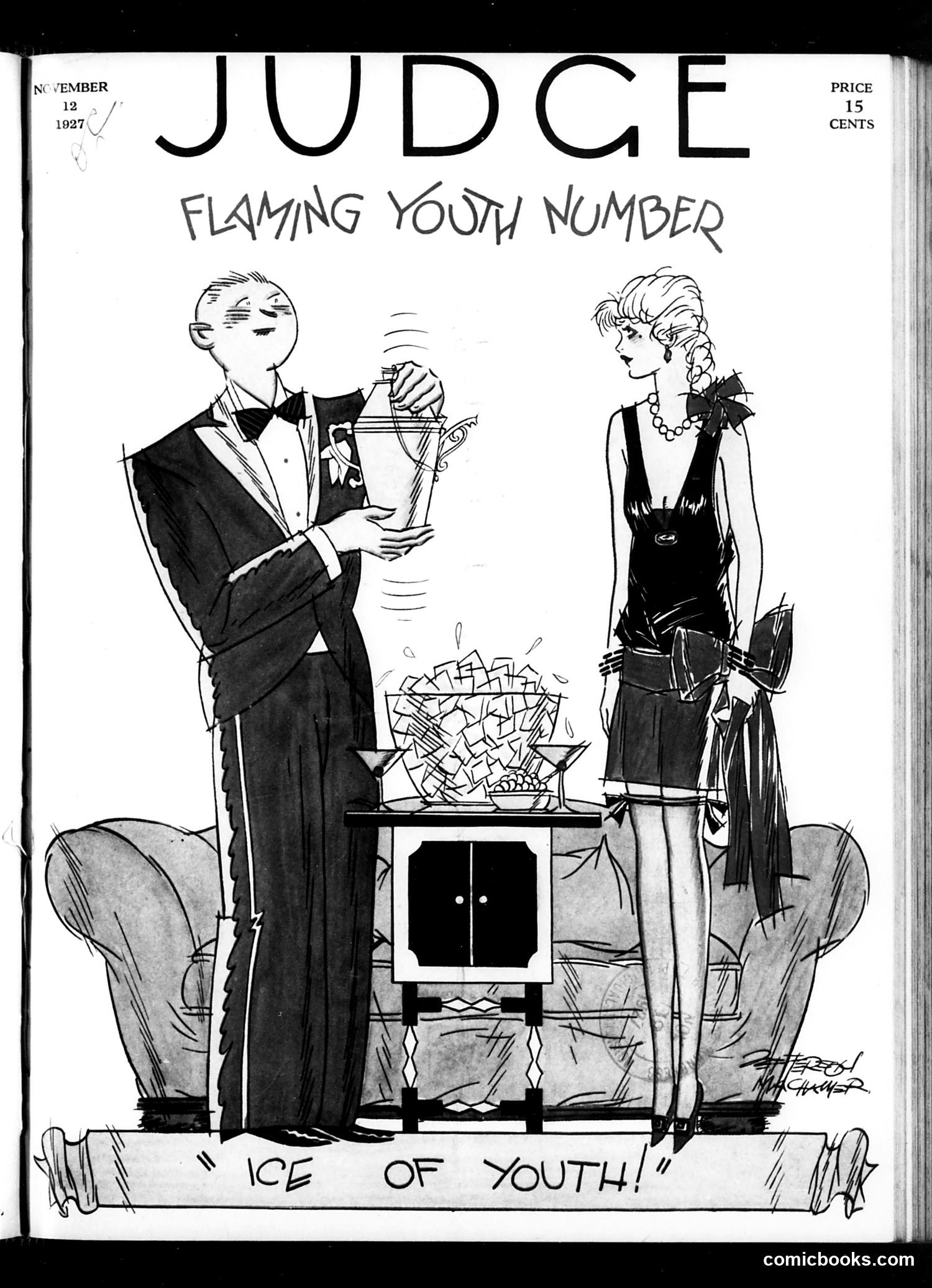
This satirical cover depicts the "Ice of Youth"—a commentary on 1920s social conduct during Prohibition. The elegantly dressed couple represents fashionable young people of the Jazz Age. The man holds a cocktail shaker while the woman watches; the table between them overflows with what appears to be playing cards or confetti, suggesting frivolous entertainments. The cartoon mocks the era's "flaming youth"—a contemporary term for young people who openly defied Prohibition laws and Victorian social norms through drinking, jazz culture, and casual dating. The "ice" metaphor suggests both the coolness/sophistication they cultivated and the literal ice used to chill illegal alcohol. The satire critiques their reckless hedonism during a period of significant social upheaval.
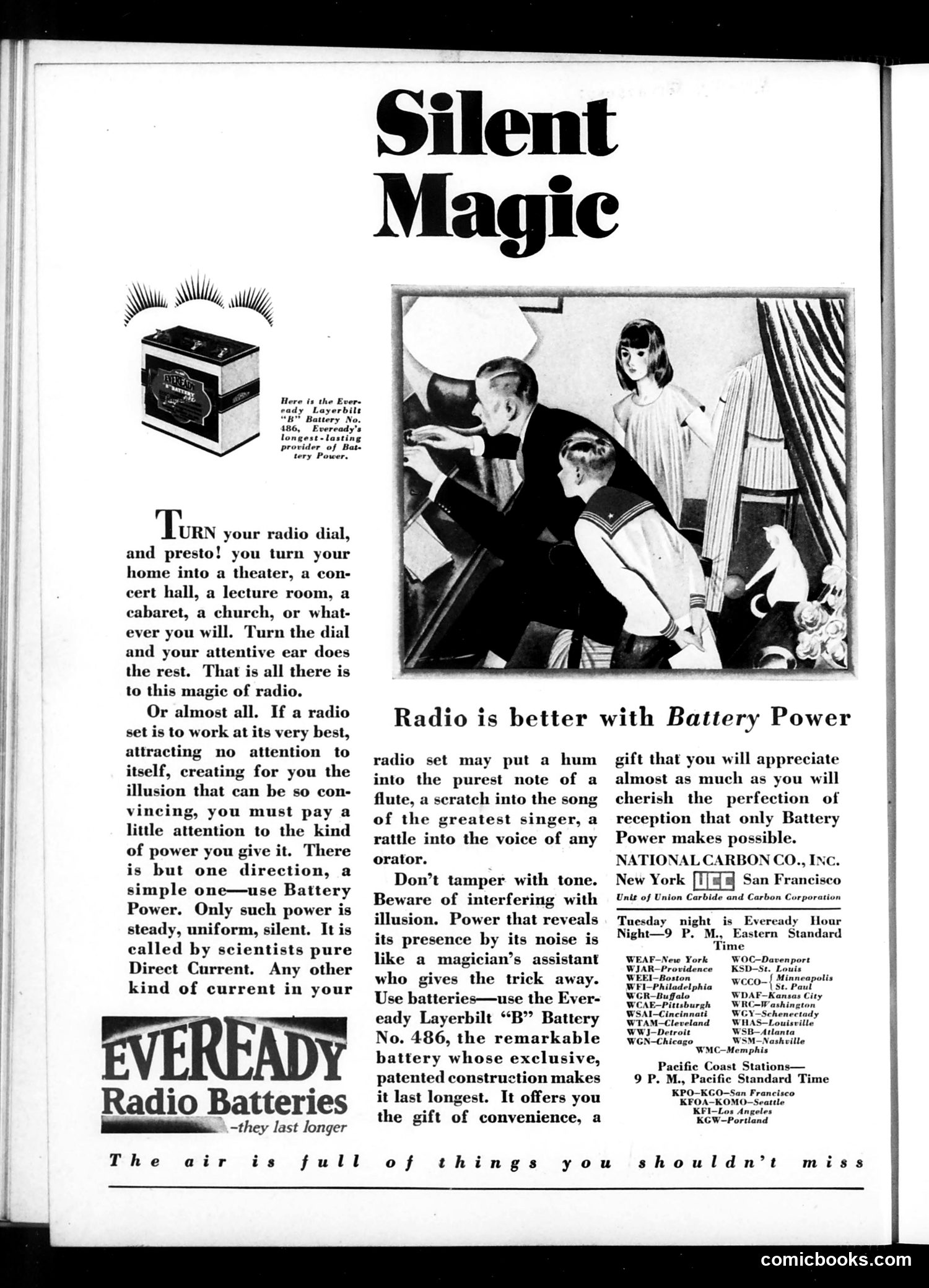
This is primarily a **commercial advertisement**, not political satire. The page promotes Eveready "B" Battery No. 436 for radios, emphasizing superior performance. The "magic" concept refers to radio's transformative power—turning homes into theaters or concert halls through invisible electromagnetic waves. The advertisement argues that while radio's appeal seems magical, it actually depends on reliable **battery power** for optimal performance. The photograph shows a family gathered around an early radio receiver, depicting the social impact of radio technology in what appears to be the 1920s-early 1930s. The ad warns against poor batteries that introduce humming or crackling sounds that "give the trick away"—breaking the illusion of quality reception. This reflects the era when radio was genuinely revolutionary entertainment technology.
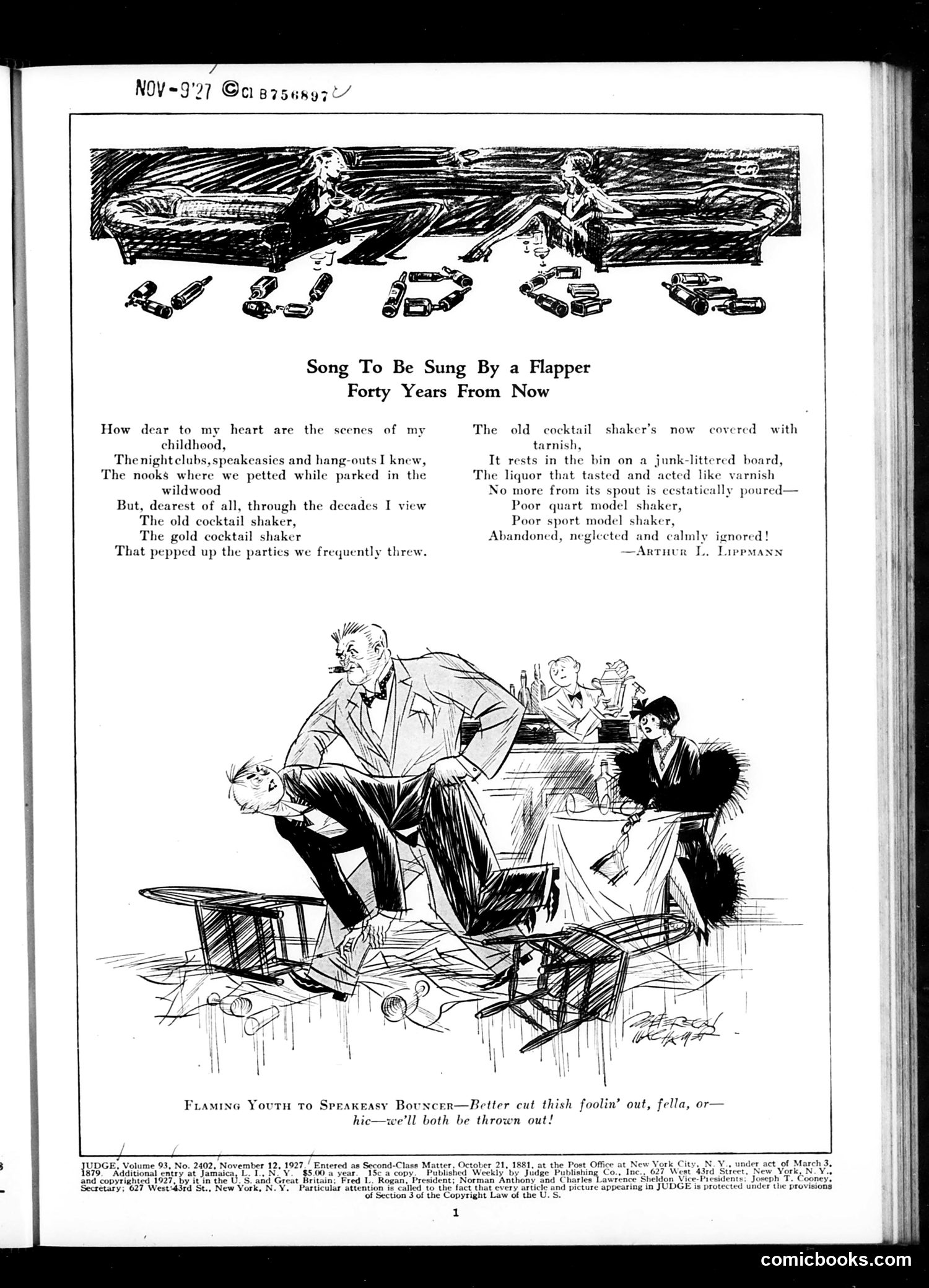
This November 1927 *Judge* page presents two satirical pieces about Prohibition-era culture: **Top section** ("Song To Be Sung By a Flapper Forty Years From Now"): A nostalgic poem mourning the "old cocktail shaker"—mocking how future generations might romanticize 1920s speakeasy culture. It references "junk-littered" shakers and abandoned drinking vessels, satirizing both the Prohibition law and the younger generation's defiant drinking habits. **Bottom cartoon** ("Flaming Youth to Speakeasy Bouncer"): Shows a man being violently ejected from an illegal bar while patrons inside continue drinking. The bouncer's warning—"Better cut this foolin' out, fella, or he-we'll both be thrown out!"—satirizes the constant threat of police raids on speakeasies and the casual violence associated with underground drinking establishments. Both pieces mock Prohibition's failure and the reckless behavior it spawned.
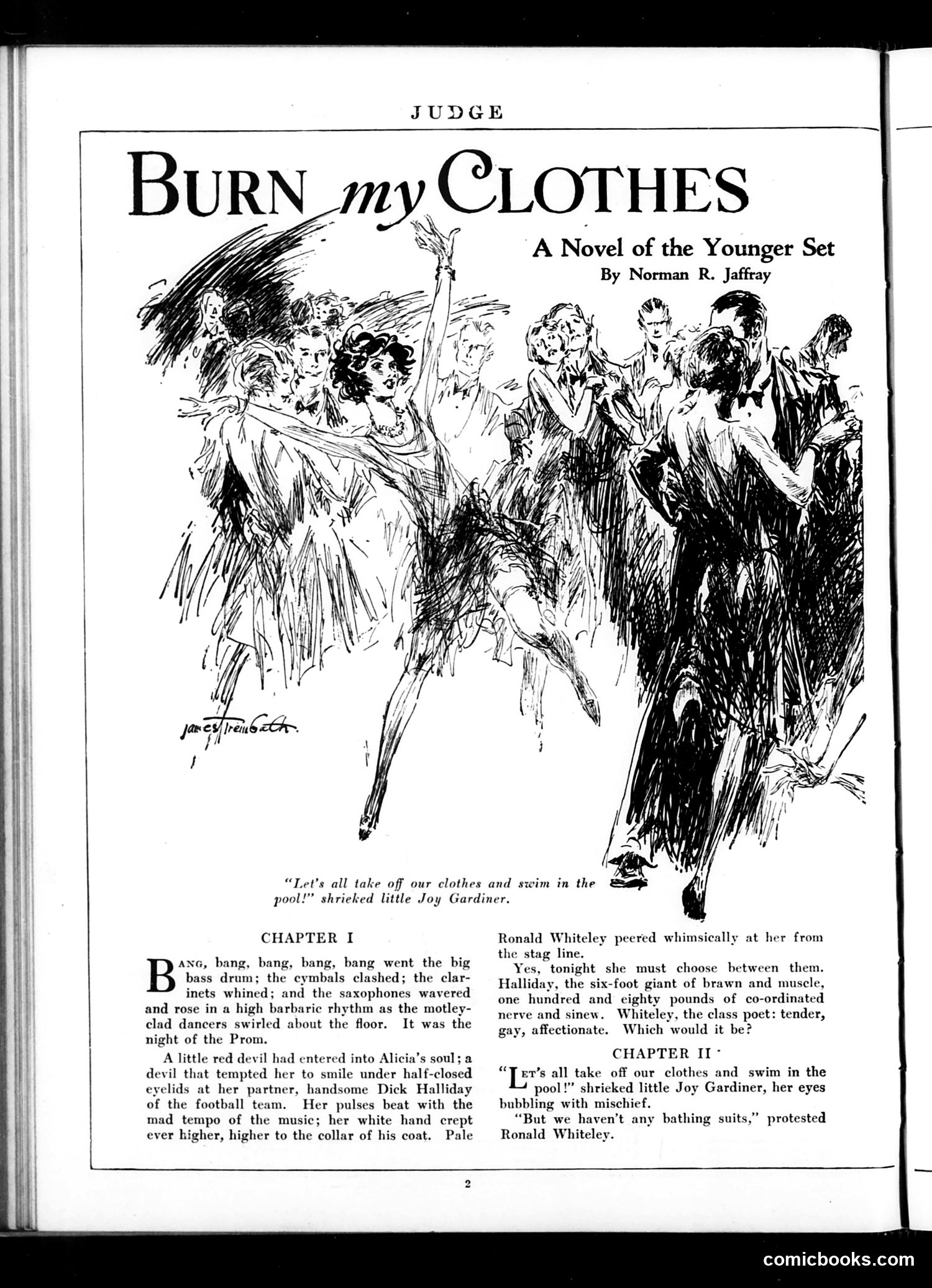
This page introduces a serialized novel titled "Burn My Clothes: A Novel of the Younger Set" by Norman R. Jaffray, depicting youth culture of the era (appears to be 1910s-1920s based on style). The illustration shows young people at what appears to be a prom or dance, with one character suggesting they skinny-dip in a pool. The caption quotes "Joy Gardiner" proposing this scandalous behavior. The sketch satirizes the perceived moral looseness and rebellious attitudes of young society members—a common Judge magazine target. The "younger set" refers to wealthy young people whose behavior was frequently mocked in satirical publications as frivolous, hedonistic, and defiant of Victorian propriety. The joke relies on readers' anxiety about generational decline.
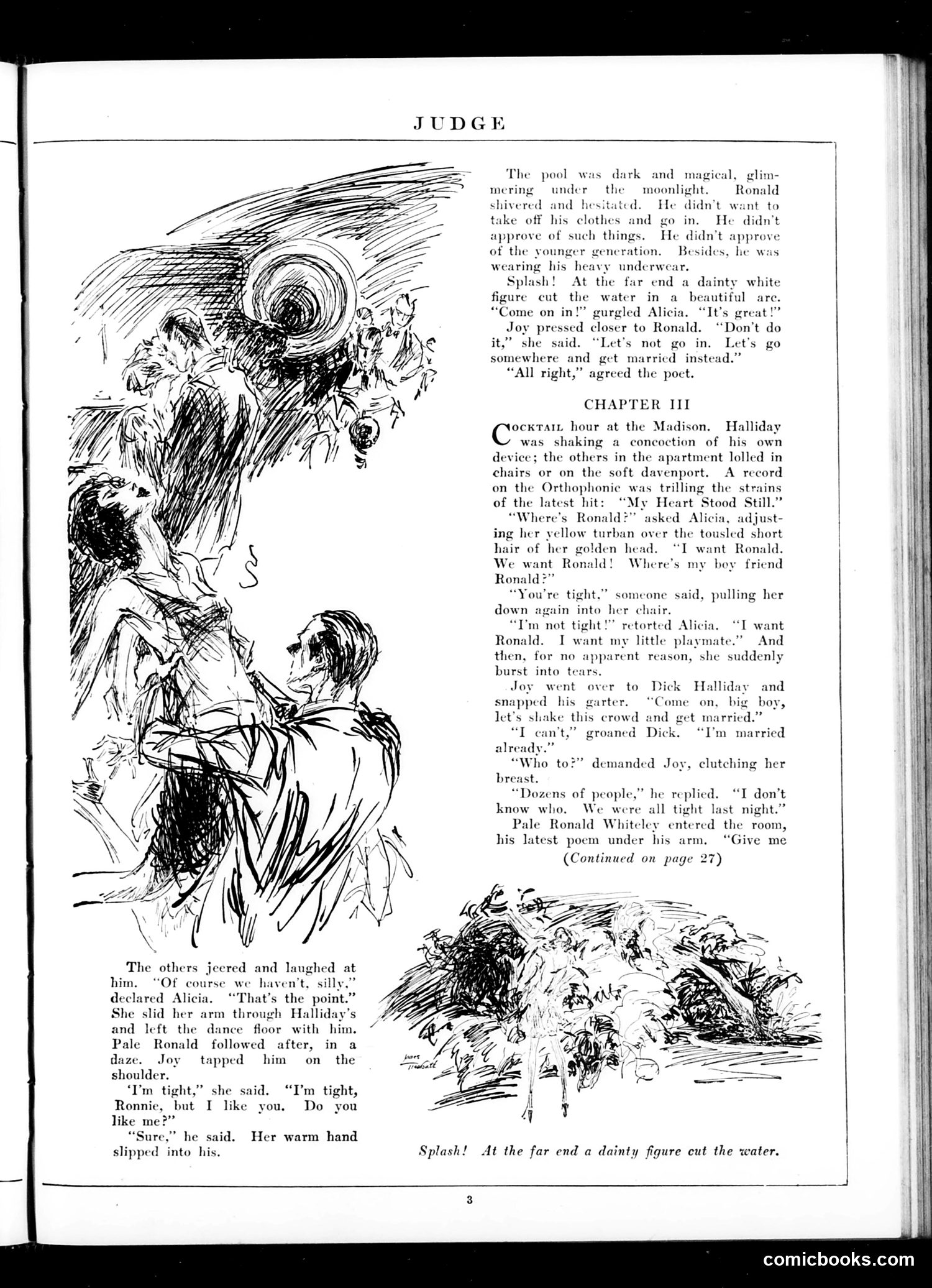
This page contains a fictional narrative ("Chapter III") rather than political satire. The text describes a social scene at the Madison hotel involving characters named Ronald, Alicia, Dick Halliday, and Joy—apparently young bohemian or literary figures engaged in romantic complications and banter about marriage. The accompanying ink illustrations depict people in period dress at what appears to be a social gathering, with one figure labeled "Splash! At the far end a dainty figure cut the water," suggesting an aquatic scene. Without identifying specific historical figures or events in the text or images, this appears to be serialized entertainment fiction typical of Judge magazine's content—satirizing contemporary social mores and romantic entanglements among the urban upper classes rather than addressing direct political commentary.
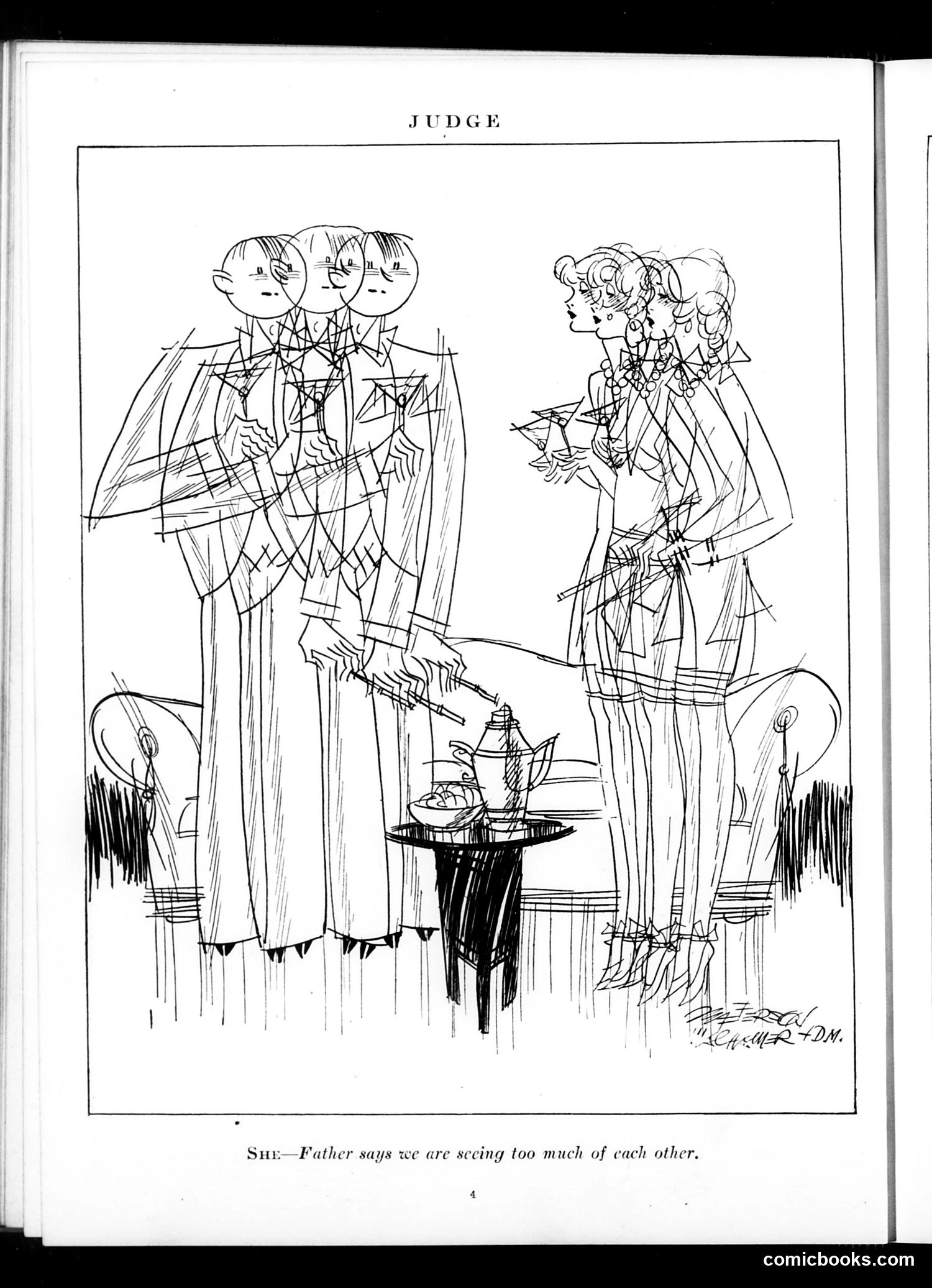
This cartoon titled "Judge" depicts what appears to be a domestic dispute or marital disagreement scene. On the left stand three male figures (possibly judges or authority figures), while on the right stand three female figures. Between them sits a small table with objects suggesting domestic items or evidence of the dispute. The caption reads: "SHE—Father says we are seeing too much of each other." The satire appears to mock the absurdity of parental interference in adult romantic relationships. The formal, imposing presentation of the judges and the woman's somewhat defiant posture suggest commentary on outdated social conventions or generational conflict around courtship and independence. The cartoon likely critiques excessive parental control over adult children's relationships, presenting it as ridiculous overreach requiring judicial intervention.
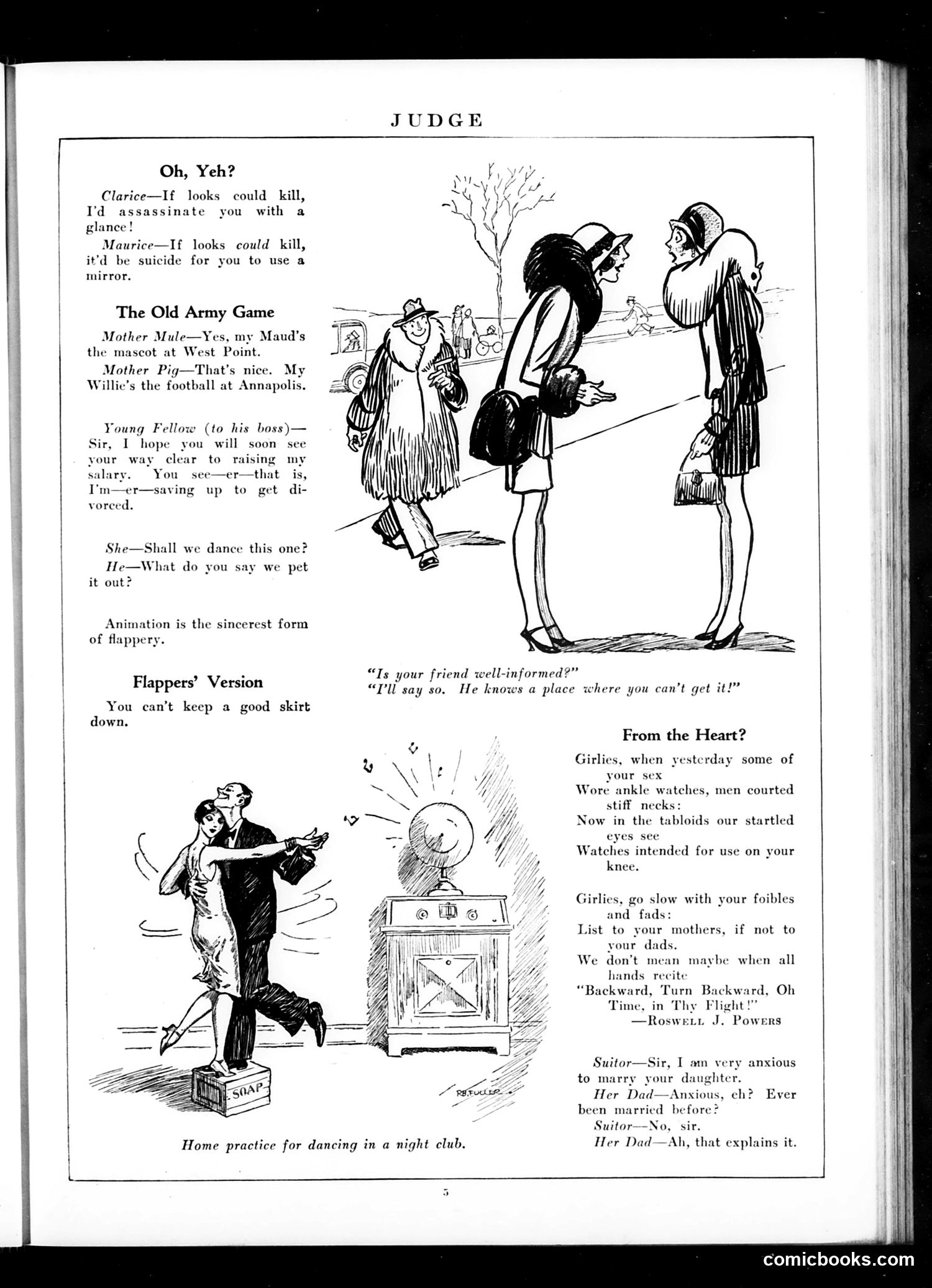
This page contains three separate humorous pieces from what appears to be the 1920s flapper era: 1. **"Oh, Yeh?"** - A brief exchange joking about deadly looks and mirrors, typical period banter. 2. **"The Old Army Game"** - Dialogue about raising salaries and dancing, satirizing workplace dynamics and social climbing. 3. **"Flappers' Version"** - A cartoon showing a woman dancing with a man, captioned "You can't keep a good skirt down," mocking 1920s women's liberation and shortened hemlines that scandalized conservative society. The accompanying illustration labeled "Home practice for dancing in a night club" shows a man practicing dance moves, satirizing the era's nightclub culture. 4. **"From the Heart?"** - A poem warning young women about revealing ankle watches and fashionable foibles, while mocking courtship rituals and generational concerns about propriety.
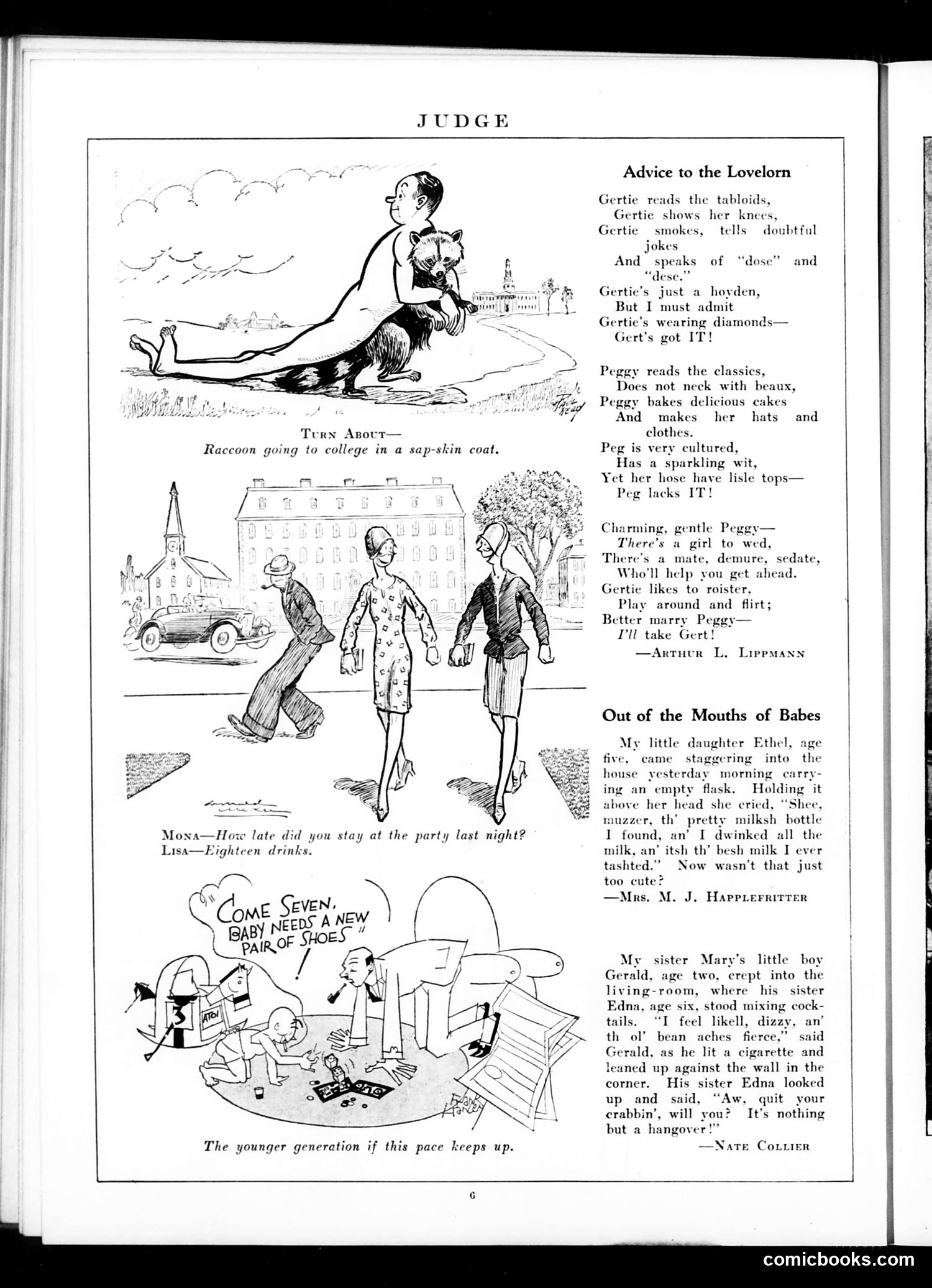
This page satirizes 1920s American youth culture and social anxieties about Prohibition-era behavior. **"Raccoon going to college"** mocks fashionable young men wearing trendy fur coats—"sap-skin" likely referring to naive or foolish youth. **"Eighteen drinks"** and **"The younger generation"** lampoon concerns about youth drinking despite Prohibition (1920-1933), depicting reckless excess. **"Advice to the Lovelorn"** contrasts two women: "Gertie" represents the modern "flapper"—smoking, showing knees, scandalous—yet ironically has "IT" (sex appeal/allure), while "Peggy" is cultured and virtuous but lacks appeal. The poem's conclusion ("I'll take Gert!") cynically suggests men prefer flashy modern women despite claiming to value traditional femininity. This reflects real period anxieties about changing gender roles and morality. **"Out of the Mouths of Babes"** presents dark humor: children innocently reference adult Prohibition-era behaviors—empty flasks and hangovers—treating them as normal, implying widespread drinking despite legal prohibition.
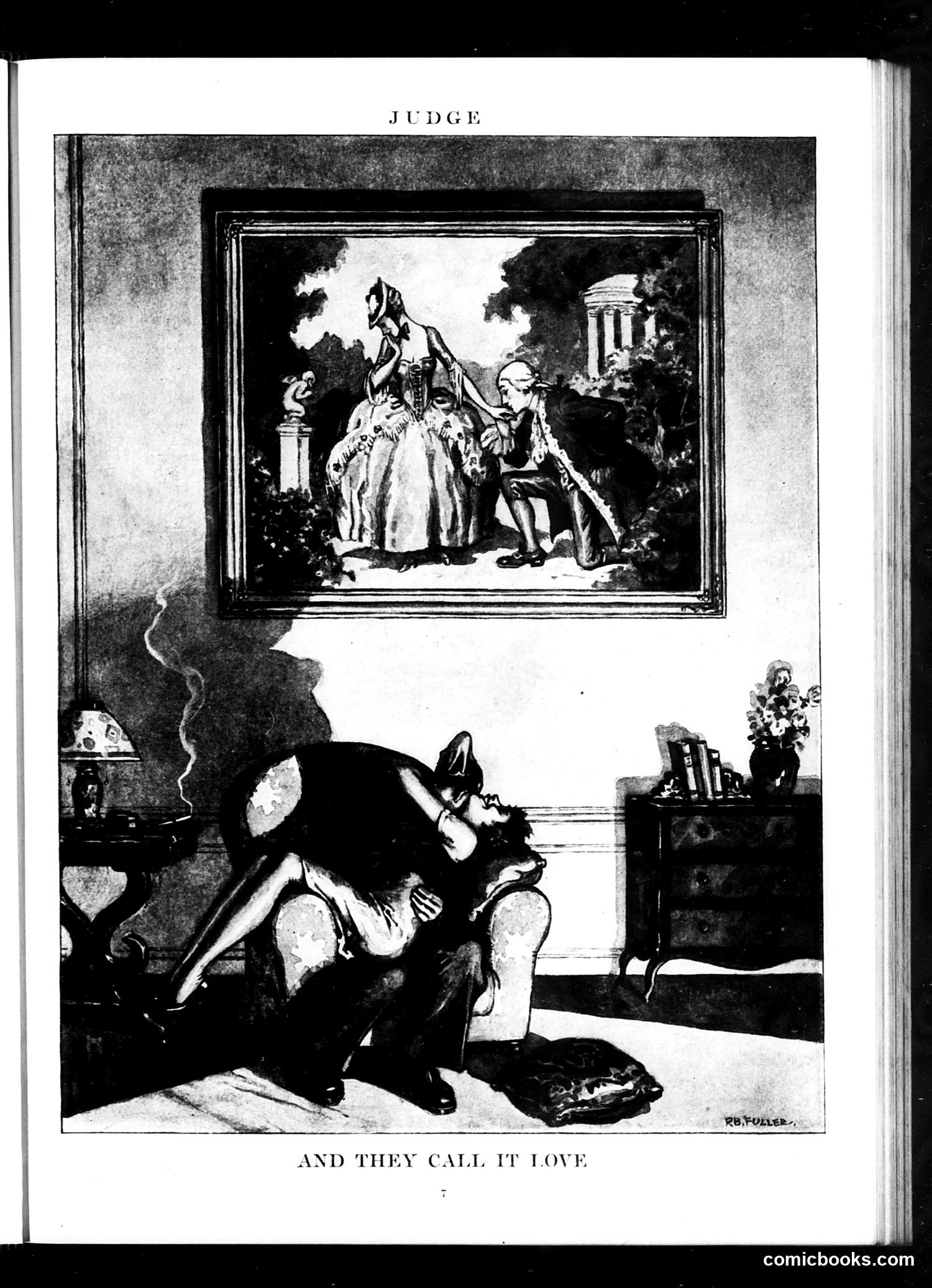
This cartoon by R.B. Fouler depicts a domestic scene with satirical commentary on romantic relationships. A couple lounges together in a parlor while a framed painting above shows what appears to be a classical or historical scene of judgment or authority. The juxtaposition suggests irony: the intimate moment below contrasts with the formal, serious scene depicted above. The title "And They Call It Love" indicates satirical skepticism about the nature of romantic affection. The cartoon likely mocks sentimental notions of love or critiques how society romanticizes relationships. The specific identities of the figures remain unclear, but the composition suggests commentary on class, propriety, or the gap between idealized love and actual domestic reality.
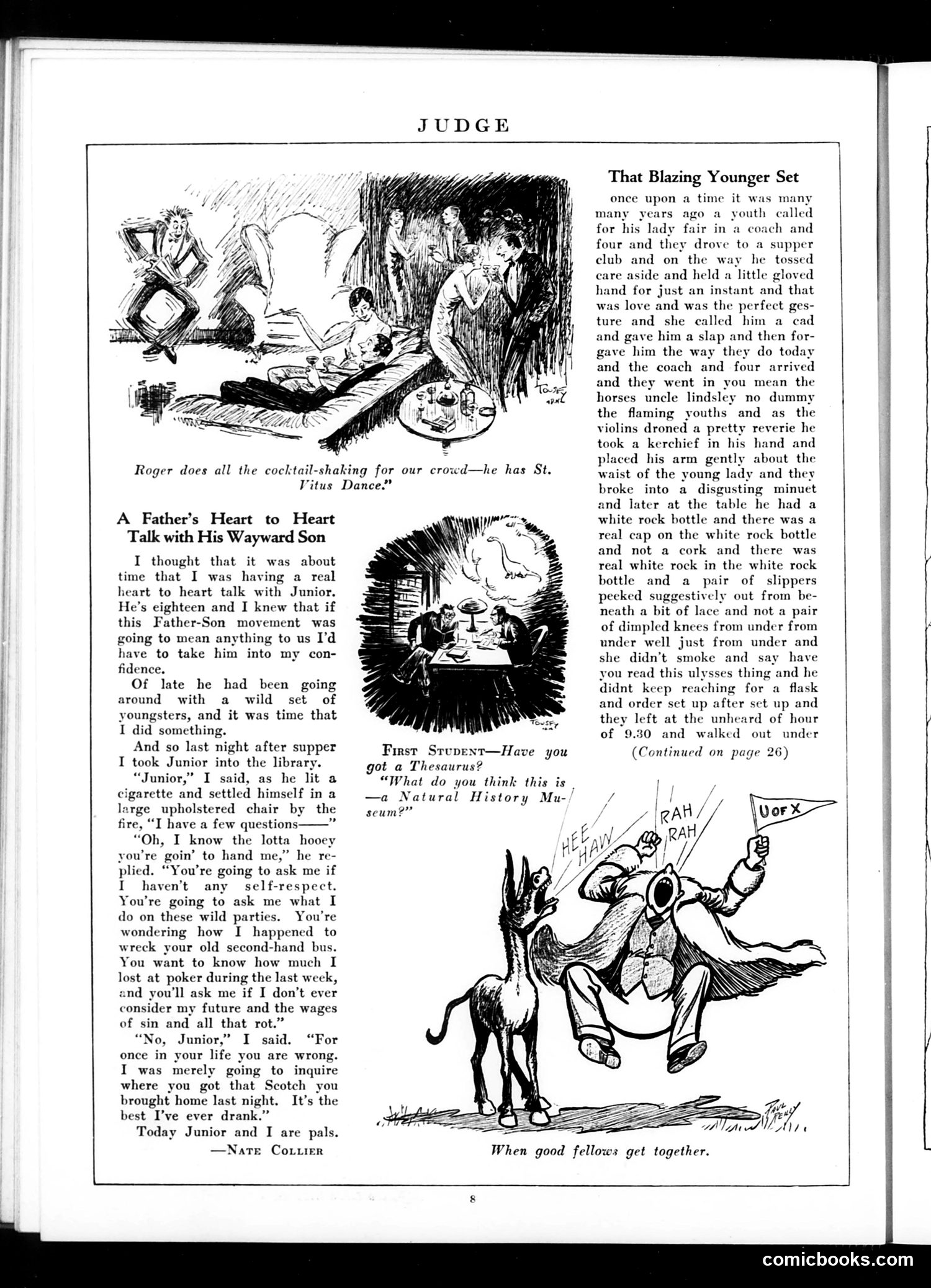
This page satirizes the "Younger Set" of the 1920s Jazz Age through contrasting generational perspectives. **The main cartoons:** 1. **"A Father's Heart to Heart Talk"** (Nate Collier): A father prepared to lecture his wayward eighteen-year-old son about wild parties, wrecked cars, and poker losses instead asks where he got excellent Scotch whiskey—revealing the father's own hypocrisy and appreciation for prohibition-era contraband. The joke: the generation gap closes through shared vice rather than moral instruction. 2. **"That Blazing Younger Set"**: A sardonic narrative contrasting "proper" courtship of the past (chaste gestures, formal carriages) with modern youth behavior—cocktails, dimpled knees, abandoning dates at 9:30 PM. The tone suggests moral disapproval of contemporary dating customs. 3. **"When good fellows get together"**: A chaotic illustration of young men on horseback, apparently intoxicated and rowdy. Together, these pieces mock both the younger generation's hedonism and their elders' inability—or unwillingness—to genuinely reform them.
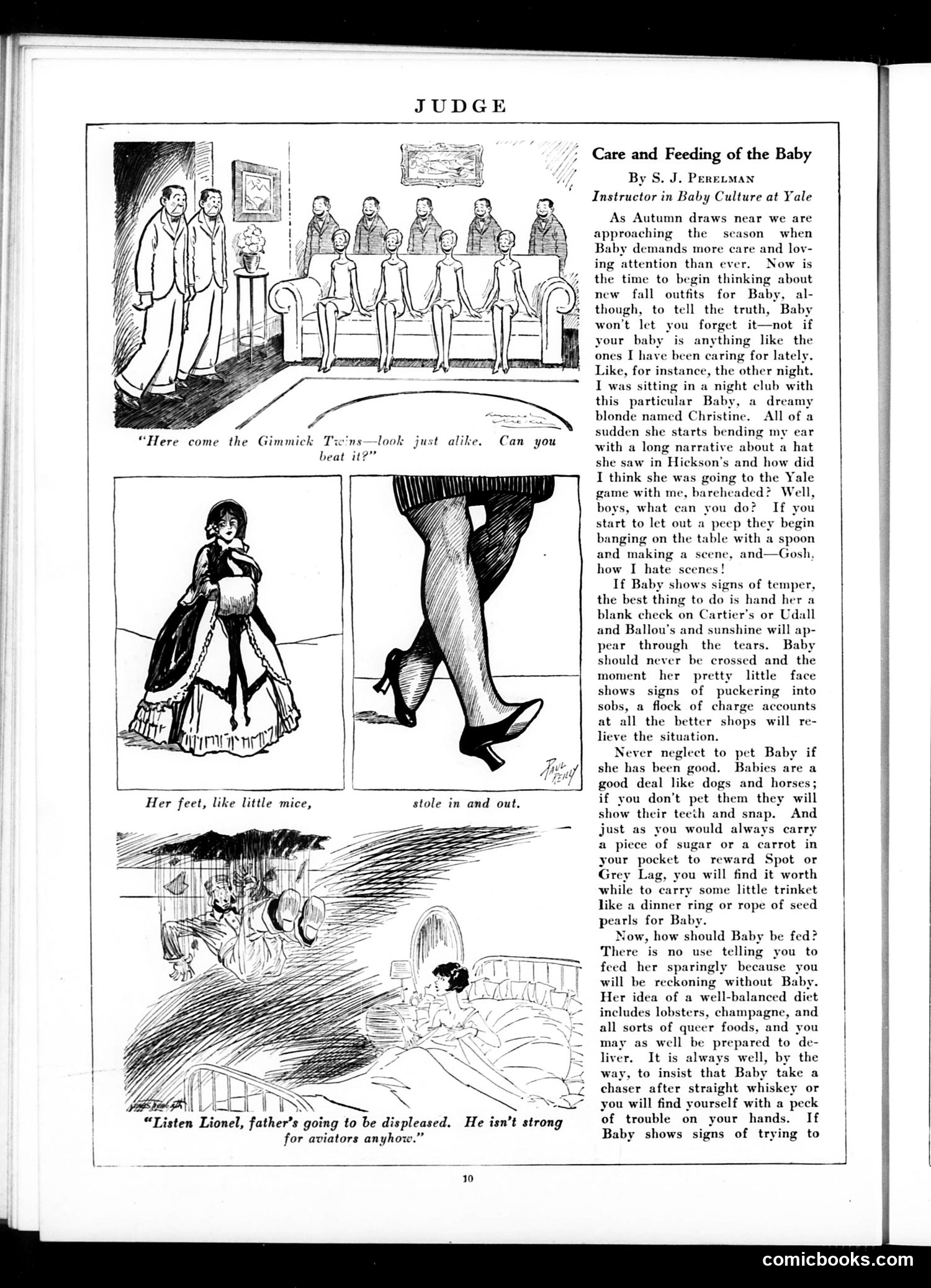
This is a humorous article by writer S.J. Perelman (credited as "Instructor in Baby Culture at Yale") that satirizes wealthy, demanding young women of the era by treating them like infants requiring careful management. The joke: Perelman describes adult female companions as literal "babies" needing constant attention, expensive gifts, and indulgence. He advises male readers to pacify them with blank checks to luxury jewelers (Cartier's, Udall and Ballou's), dinner rings, and seed pearls—rather than actual food or reason. The accompanying cartoons show fashionable women in revealing 1920s-style clothing, emphasizing their frivolousness. The satire targets both the "flapper" generation and the men who enable their materialism. The final cartoon caption about "Lionel" and an aviator father adds class commentary: even privileged families can't control these demanding women. This reflects Jazz Age anxieties about changing female independence and consumer culture.
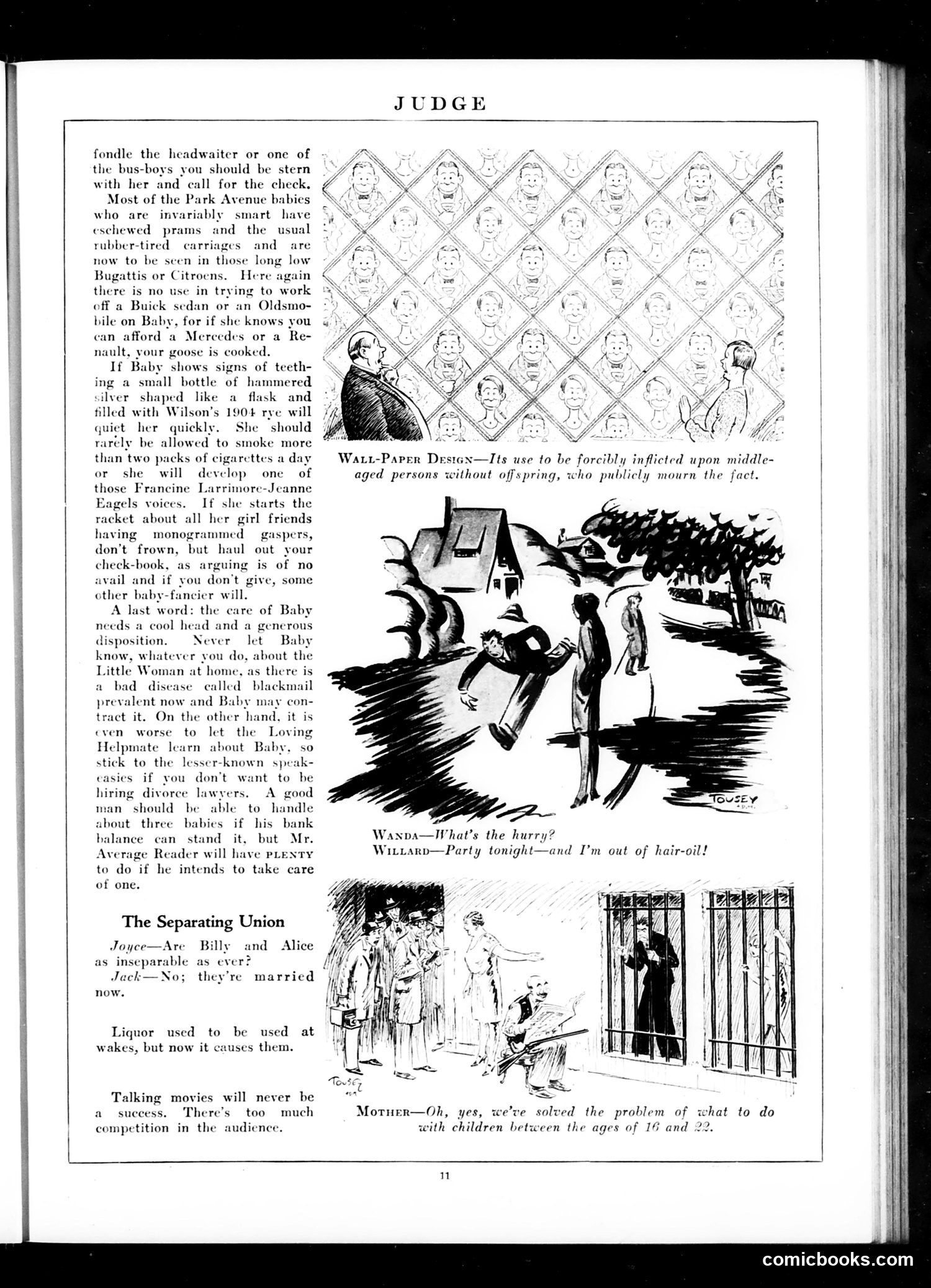
This page contains multiple satirical pieces targeting 1920s upper-class social behaviors: **Main Column**: Mocking wealthy Park Avenue parents and their indulgent treatment of children ("Baby"). The satire criticizes affluent parents who spoil their offspring with expensive cars (Mercedes, Renault) and allow inappropriate habits like smoking and drinking. The underlying joke: modern wealthy parents compete to outspend each other, and their children expect luxury goods. The warnings about "blackmail" and hiding affairs from wives suggest marital infidelity was common among this demographic. **Cartoons**: 1. **Wallpaper Design**: Criticizes an outdated fashion (wallpaper depicting babies) as ridiculous for middle-aged childless people. 2. **Wanda/Willard**: A joke about a man skipping a party due to lack of hair-oil—mocking vanity. 3. **The Separating Union**: A quip that marriage destroys the closeness of couples ("no longer inseparable"). 4. **Mother cartoon**: Jokes about managing teenagers aged 16-22, a persistent parenting challenge. The overall tone satirizes Jazz Age excess, marital discord, and generational conflicts among the wealthy.
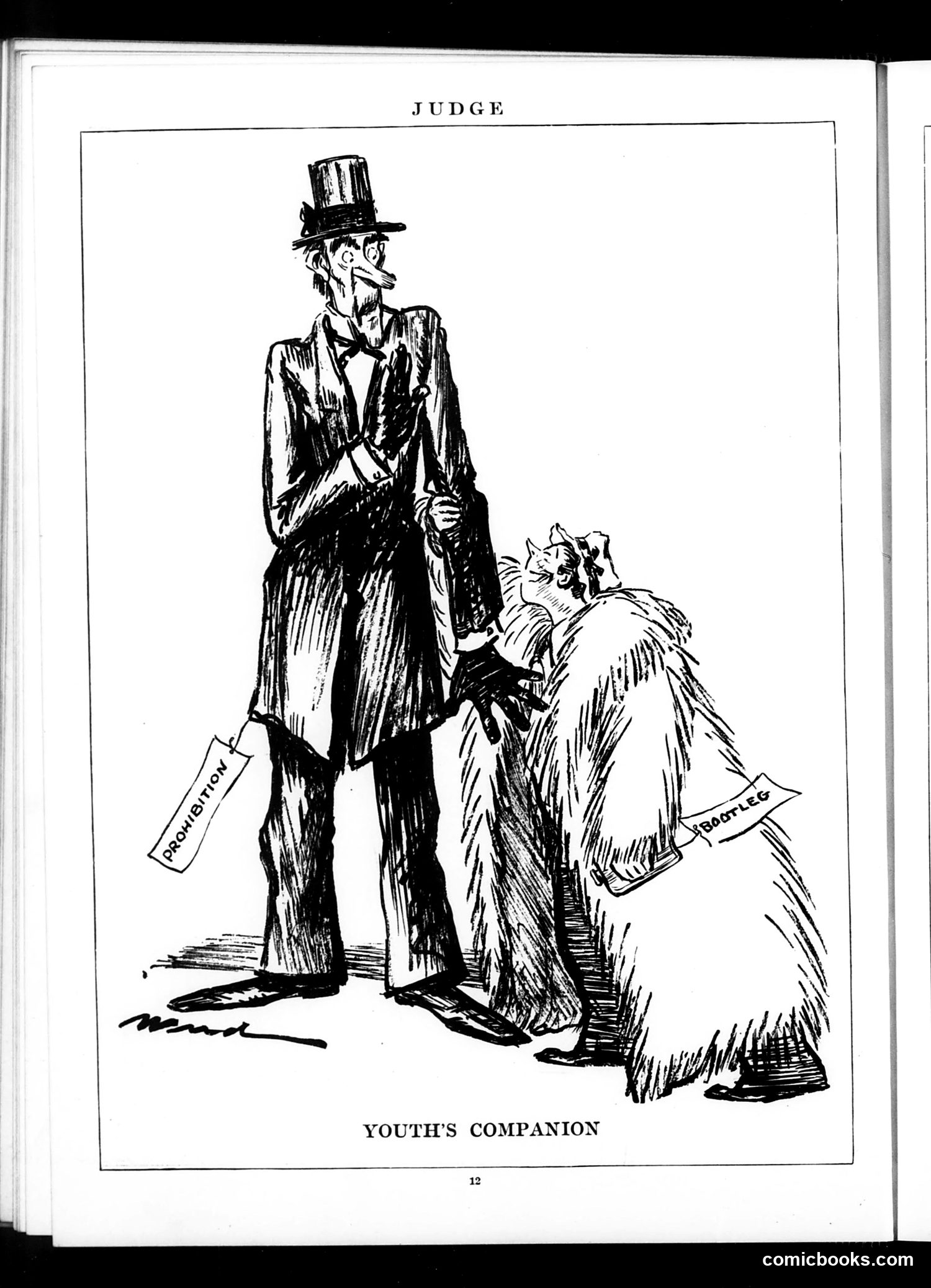
This political cartoon titled "Judge" depicts a tall, thin gentleman in formal attire (top hat, coat) standing above a shorter, rounder figure labeled "Bootleg." The standing figure holds a document labeled "Prohibition," while the kneeling figure represents illegal alcohol production/distribution. The satire criticizes Prohibition's practical failure: despite the legal ban on alcohol, bootlegging thrived as a black market enterprise. The cartoon suggests that the judge (representing law and authority) cannot control or suppress the bootleg trade through mere legal decree—the two figures remain in close, seemingly inseparable relationship. Published in *Judge*, a satirical magazine, this reflects 1920s-1930s American frustration with Prohibition's inability to eliminate alcohol consumption, instead spawning organized crime and corruption.
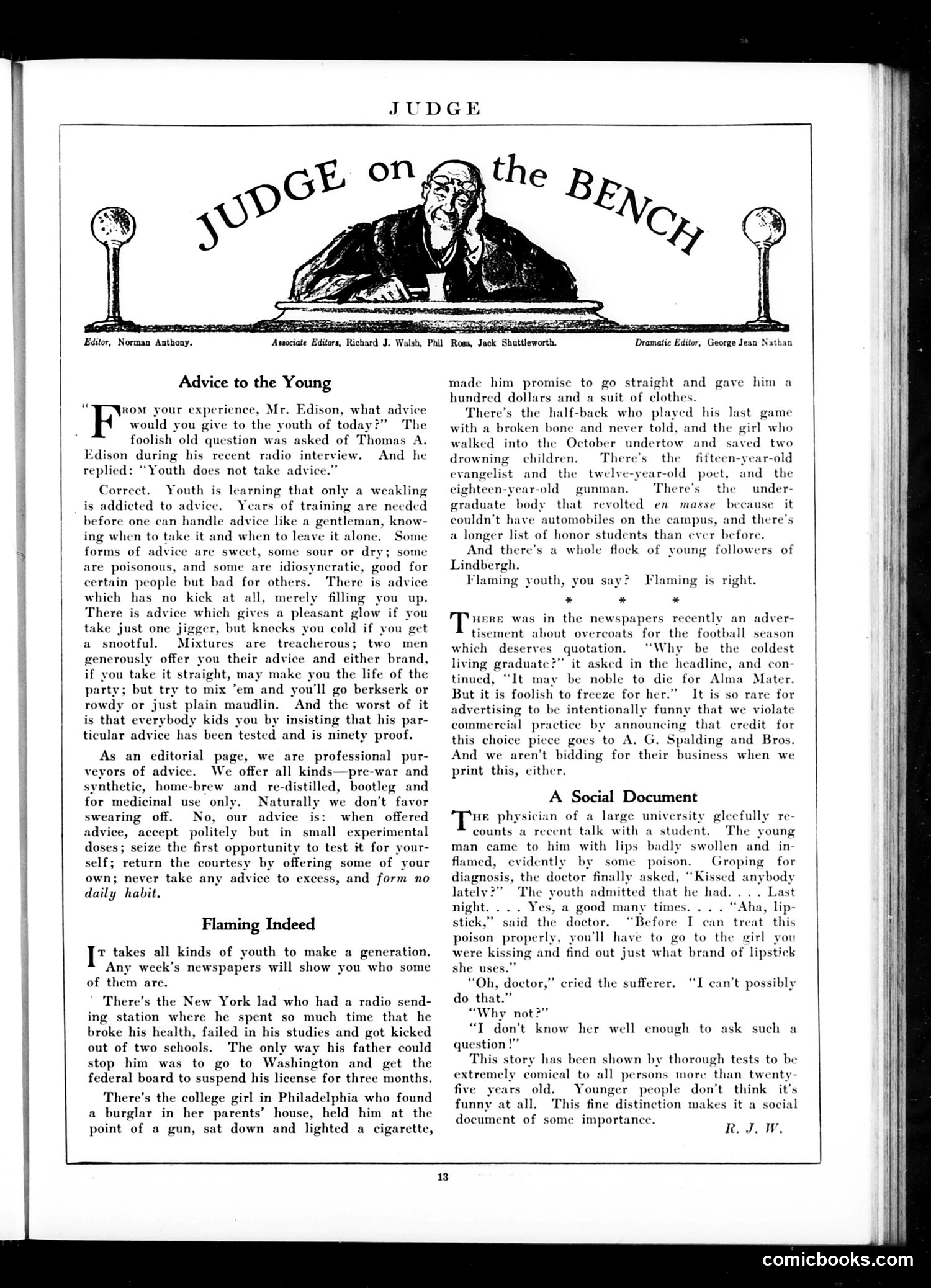
This page from Judge magazine contains three satirical pieces: **"Advice to the Young"** responds to Thomas Edison's radio comment that "Youth does not take advice" by arguing—ironically—that youth correctly rejects guidance. The magazine jokingly compares advice to alcohol: some is poisonous, some provides pleasant effects, some is "bootleg" or "synthetic." Judge's editors self-mockingly acknowledge they're "professional purveyors of advice" while warning against overconsumption. **"Flaming Indeed"** catalogs 1920s youth behaviors: a radio-obsessed boy, a girl coolly confronting a burglar, athletes playing injured, and notably, "young followers of Lindbergh"—referencing Charles Lindbergh's 1927 transatlantic flight, which inspired youth fascination. The piece balances criticism of reckless youth with praise for heroic actions. **"A Social Document"** (incomplete) appears to recount an anecdote about a university physician and a student. The overall tone satirizes 1920s generational anxieties about "flaming youth" while acknowledging genuine youthful vitality and heroism.
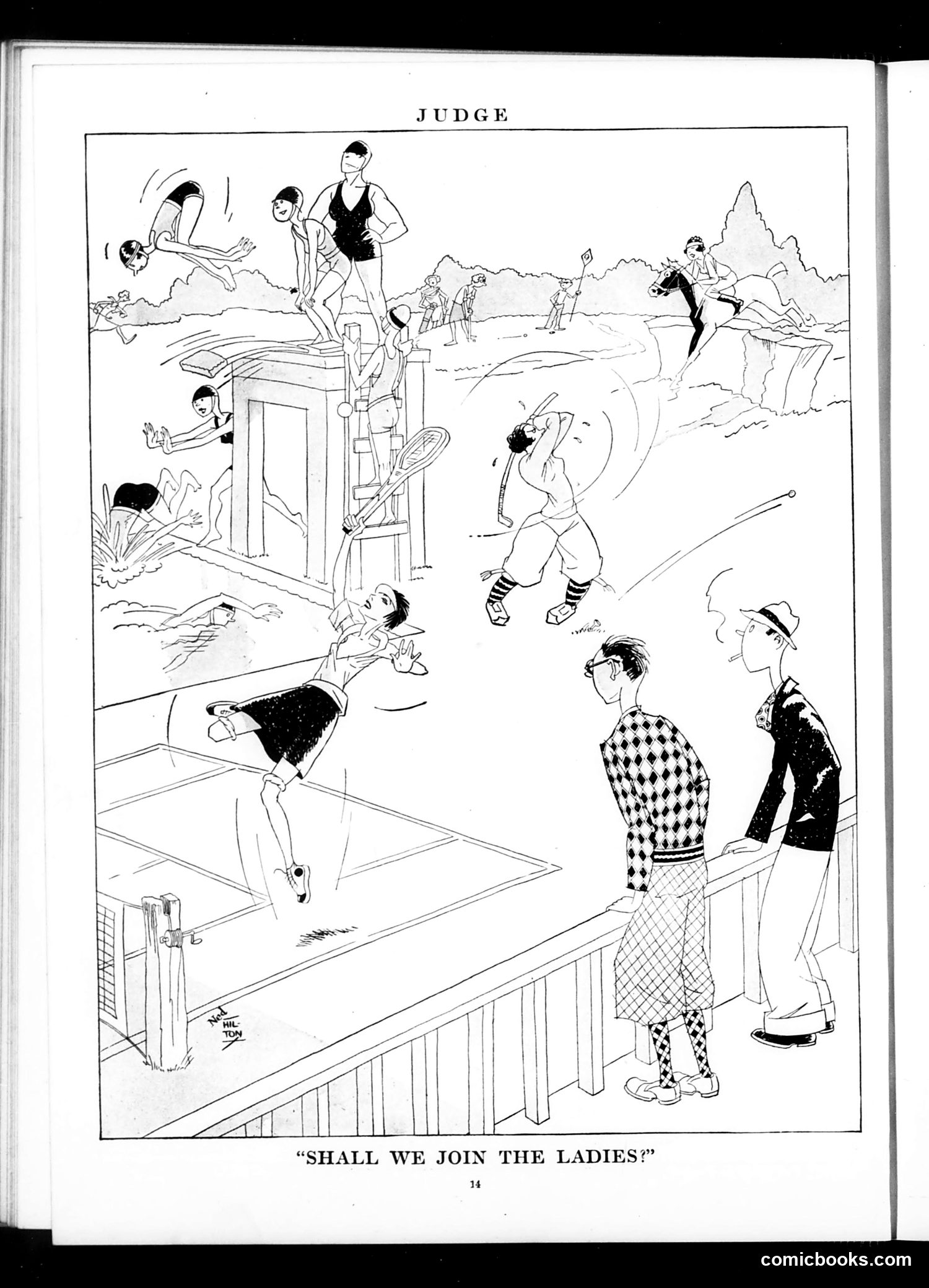
This cartoon depicts a mixed-gender recreational gathering, likely at a country club or resort. The scene shows men and women engaged in various athletic activities—tennis, golf, swimming, and other sports—across a landscape. The caption "Shall We Join the Ladies?" appears to satirize early 20th-century social conventions around gender segregation. Traditionally, after formal dinners, men and women would separate into different rooms. This cartoon seems to mock the absurdity of maintaining such strict divisions when people are already mixing freely in leisure activities. The humor likely targets outdated Victorian propriety—the question suggests men might *ask permission* to join women in sports they're already playing together, highlighting the gap between formal etiquette and actual social practice.
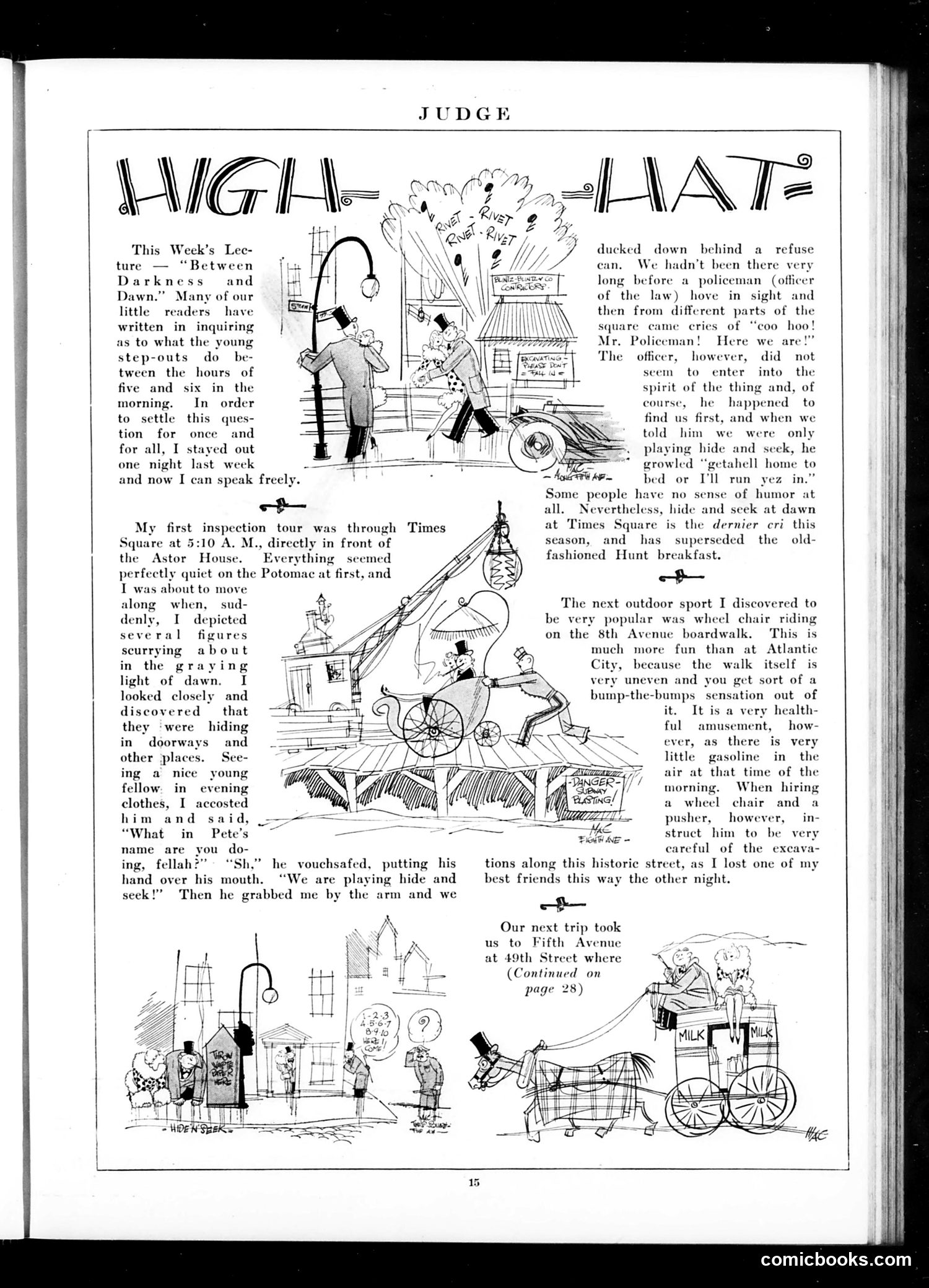
This satirical column describes the author's nocturnal observations of New York City leisure activities, mocking both the pastimes and the people who enjoy them. The piece ridicules **hide-and-seek at dawn in Times Square**—depicting well-dressed adults playing children's games in public spaces, then complaining when a police officer interrupts. The satire suggests this fashionable activity (called the "dernier cri," or height of fashion) has replaced traditional morning entertainments like Hunt breakfast, highlighting the absurdity of wealthy urbanites' recreation. Similarly, **wheelchair riding on the 8th Avenue boardwalk** is portrayed as a trendy but dangerous amusement, with the author casually mentioning losing "one of my best friends" to an excavation accident—darkly comic understatement typical of Judge's acerbic humor. The column targets the leisure class's performative sophistication and frivolous pastimes, suggesting New York's wealthy are bored, attention-seeking, and oblivious to actual hazards around them.
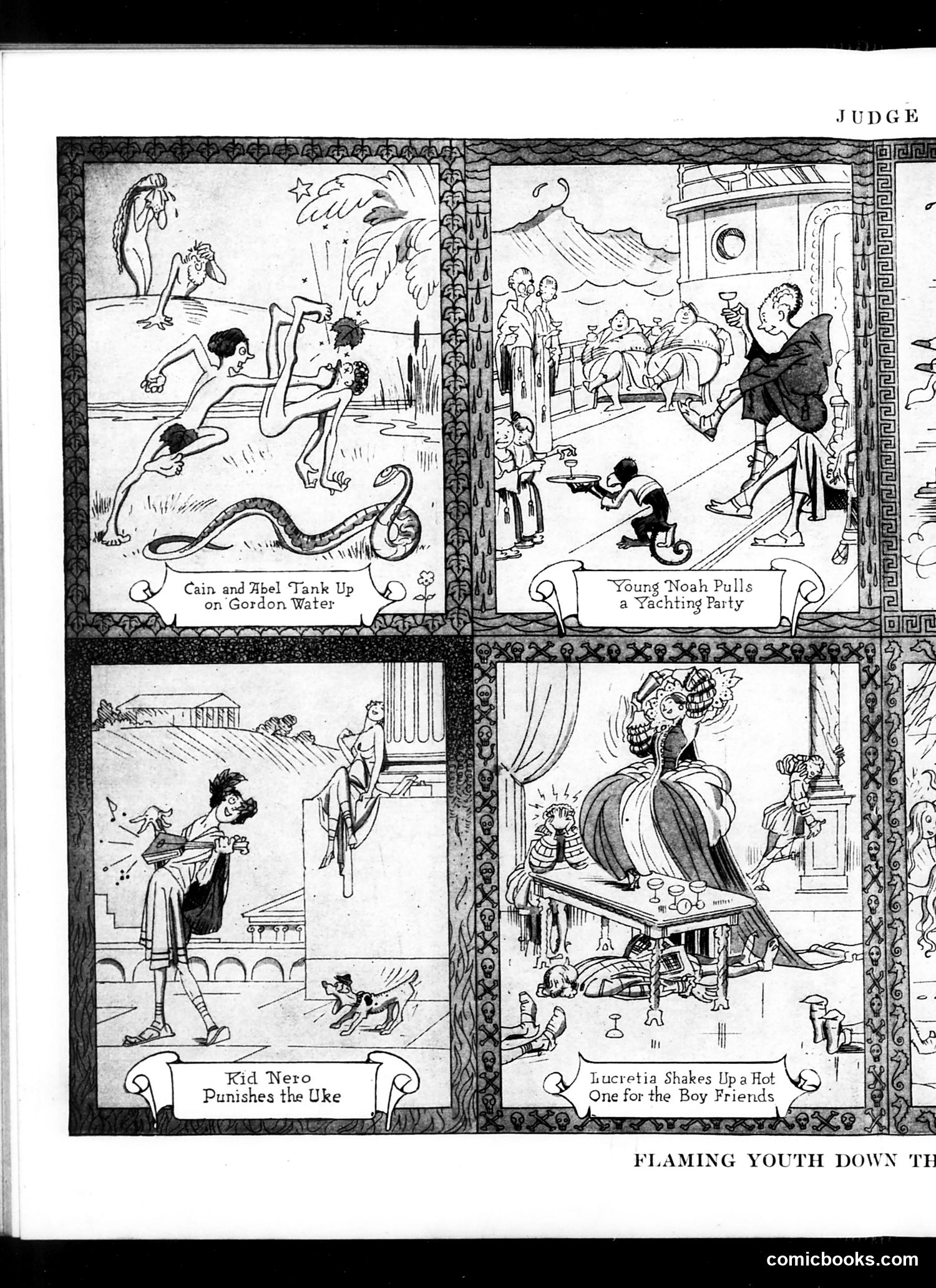
This Judge page satirizes 1920s youth culture through four comic panels with classical/biblical references as ironic titles. **"Cain and Abel Tank Up on Gordon Water"** mocks Prohibition-era speakeasy culture—young men drinking illegal alcohol despite the ban. **"Young Noah Pulls a Yachting Party"** depicts wealthy youth at leisure, likely satirizing their frivolous excess. **"Kid Nero Punishes the Uke"** suggests a young person destroying a ukulele (popular 1920s instrument), evoking the Roman emperor's destructive decadence. **"Lucretia Shakes Up a Hot One for the Boy Friends"** shows a woman preparing drinks, perhaps commenting on changing female social roles. The classical names paired with modern "flaming youth" behavior creates the satire: these young people are portrayed as hedonistic and morally loose, undermining traditional values. The cartoon reflects period anxieties about post-WWI youth rebellion and changing social norms.
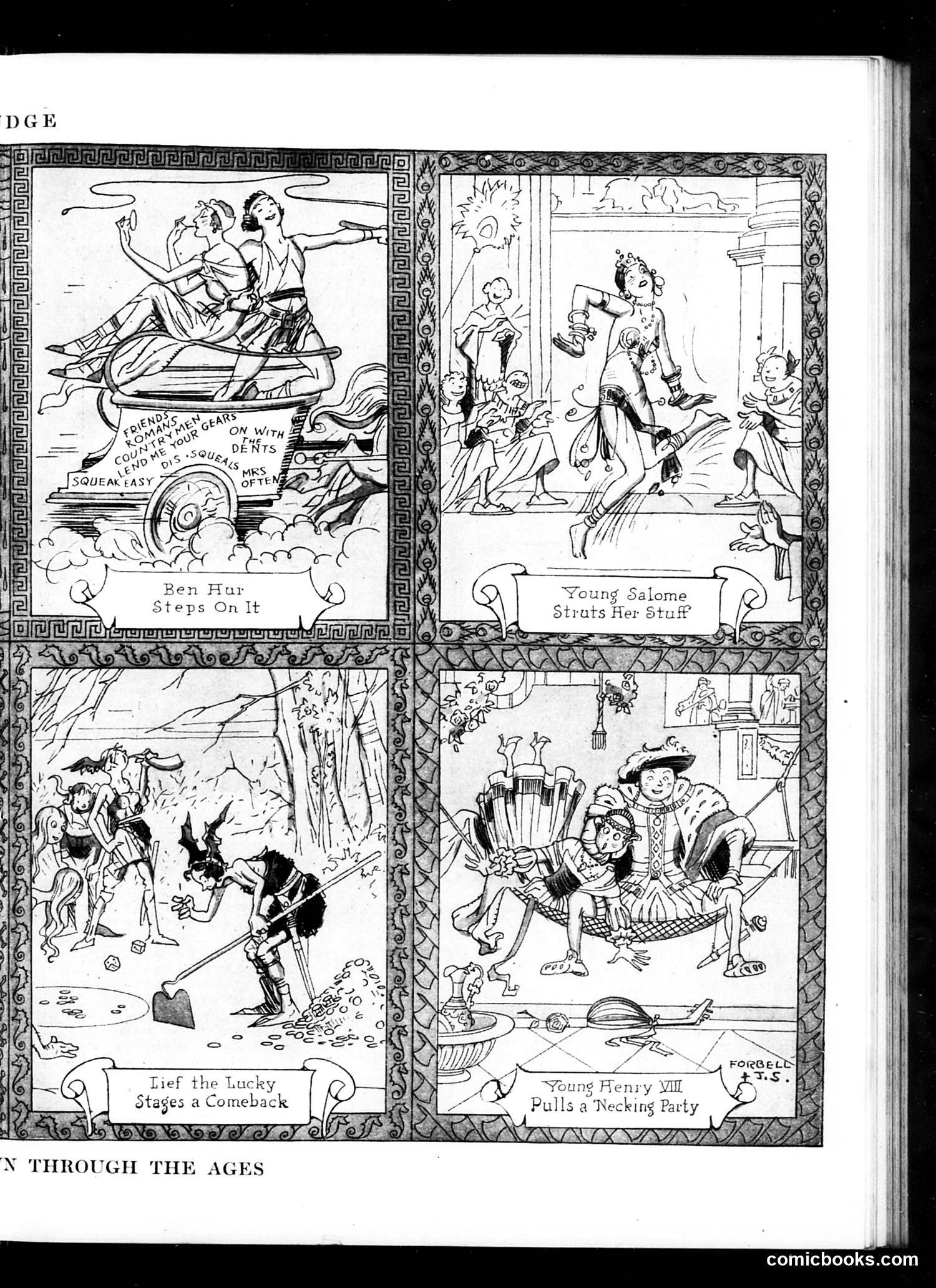
This page presents four historical vignettes as comedic parallels to contemporary behavior. Each panel depicts a famous historical or legendary figure engaging in modern social conduct: **"Ben Hur Steps On It"** shows the ancient charioteer in an automobile, racing recklessly. **"Young Salome Struts Her Stuff"** depicts the biblical dancer performing modern fashionable behavior, likely referencing 1920s "flapper" culture. **"Lief the Lucky Stages a Comeback"** shows the Norse explorer in what appears to be a theatrical or social comeback scenario. **"Young Henry VIII Pulls a Necking Party"** presents the English king engaged in modern romantic behavior. The satire's point: human nature remains constant across ages—vanity, showing off, and romantic pursuits are timeless, despite historical settings. By placing historical figures in modern scenarios, Judge mocks contemporary social behaviors as merely repetitions of age-old human folly.
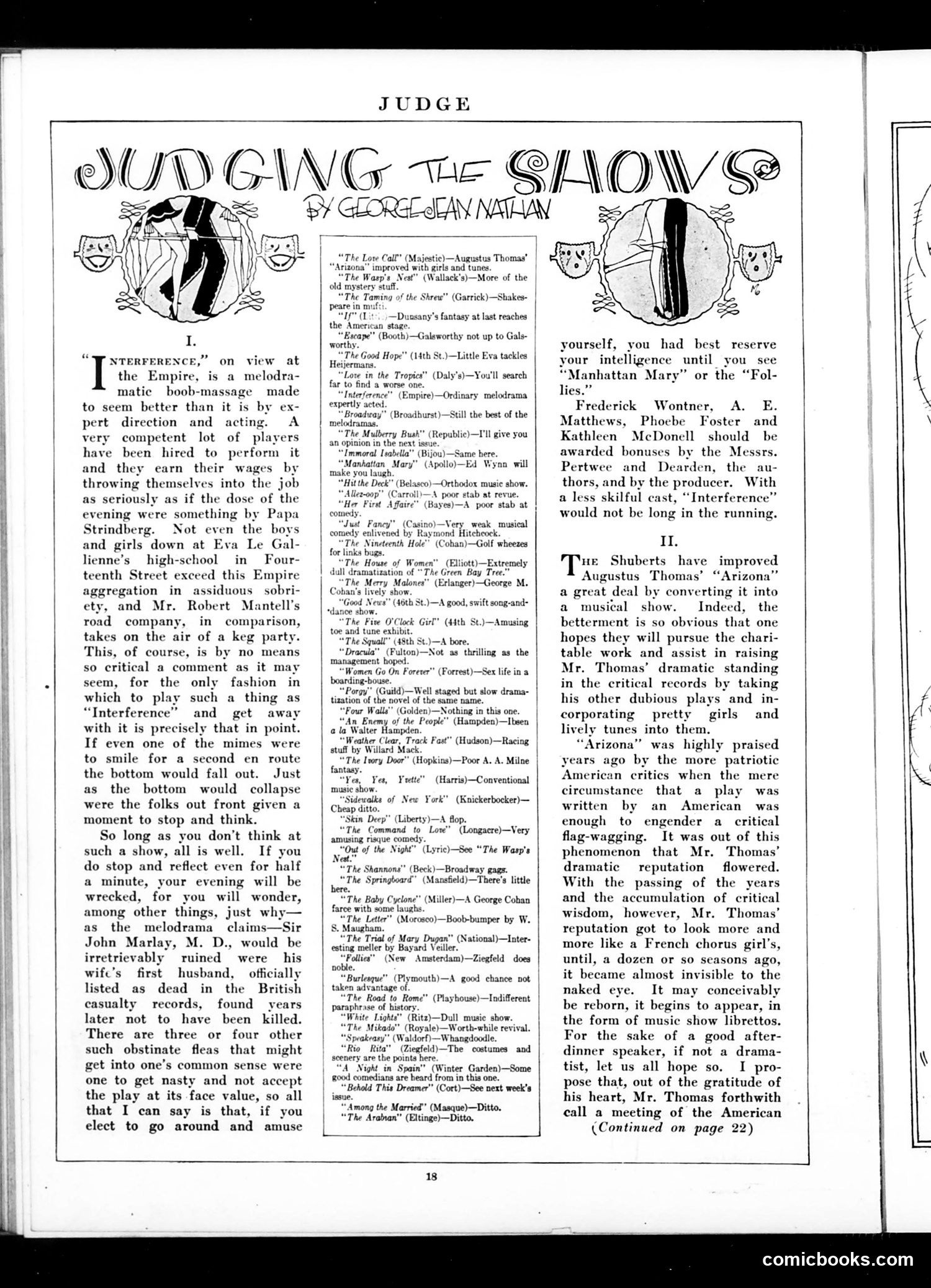
This page is a theater review column, not a political cartoon. Nathan, a prominent drama critic, reviews Broadway productions with witty, caustic commentary. The lead review of "Interference" at the Empire Theatre is illustrative: Nathan argues the melodrama is fundamentally absurd—its plot hinges on ridiculous premises (a man ruined because his wife's first husband, officially dead, might resurface). The play only "works" if audiences never pause to think critically. Nathan praises the *acting* as competent but mocks the *material* itself. The long list that follows catalogs current Broadway shows with one-line verdicts: some praised ("Broadway"—"still the best of the melodramas"), many dismissed as weak, boring, or derivative ("Love in the Tropics"—"You'll search far to find a worse one"). This reflects 1920s theater culture and Nathan's reputation as a sophisticated, unsparing critic who valued artistic integrity over commercial spectacle.
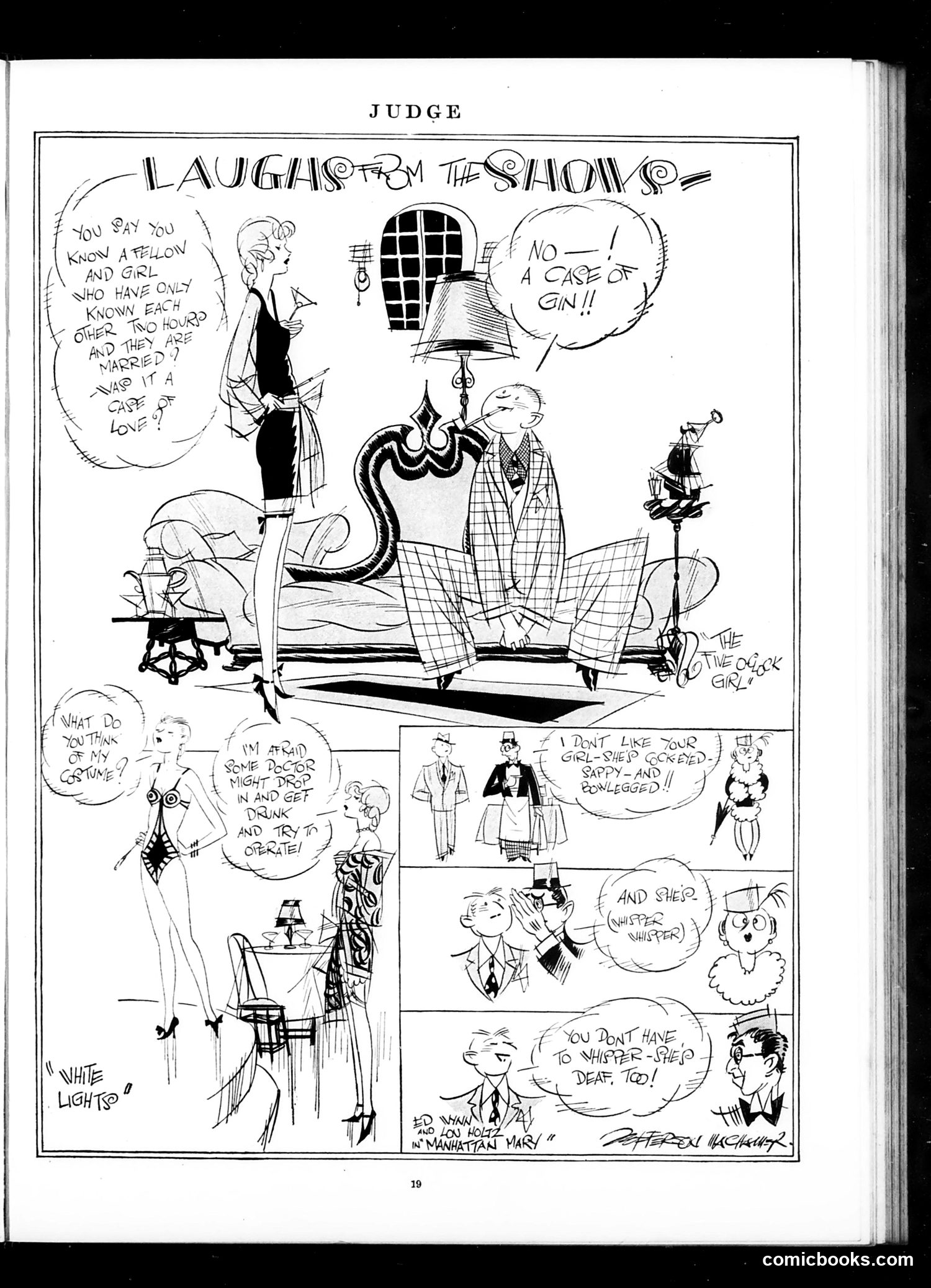
This satirical comic mocks romantic comedies and theatrical conventions of the era. The main panel shows a wealthy man in pajamas reacting with horror ("No! A case of gin!!") to a woman's proposition, inverting typical romantic scenarios. The smaller panels below depict a romantic plot: a man complains about his girlfriend being "uncouth, sappy and vowlegged"; he encounters a sophisticated woman; but she turns out to be deaf (the punchline: "You don't have to whisper, she's deaf too!"). The satire targets both theatrical melodrama and gender stereotypes—particularly how men evaluate women superficially and how "refined" appearances mask unexpected flaws. The humor relies on period-specific assumptions about class, courtship rituals, and disability as comedic fodder. "White Lights" (bottom left) references Broadway theater, anchoring this as commentary on stage comedy conventions.
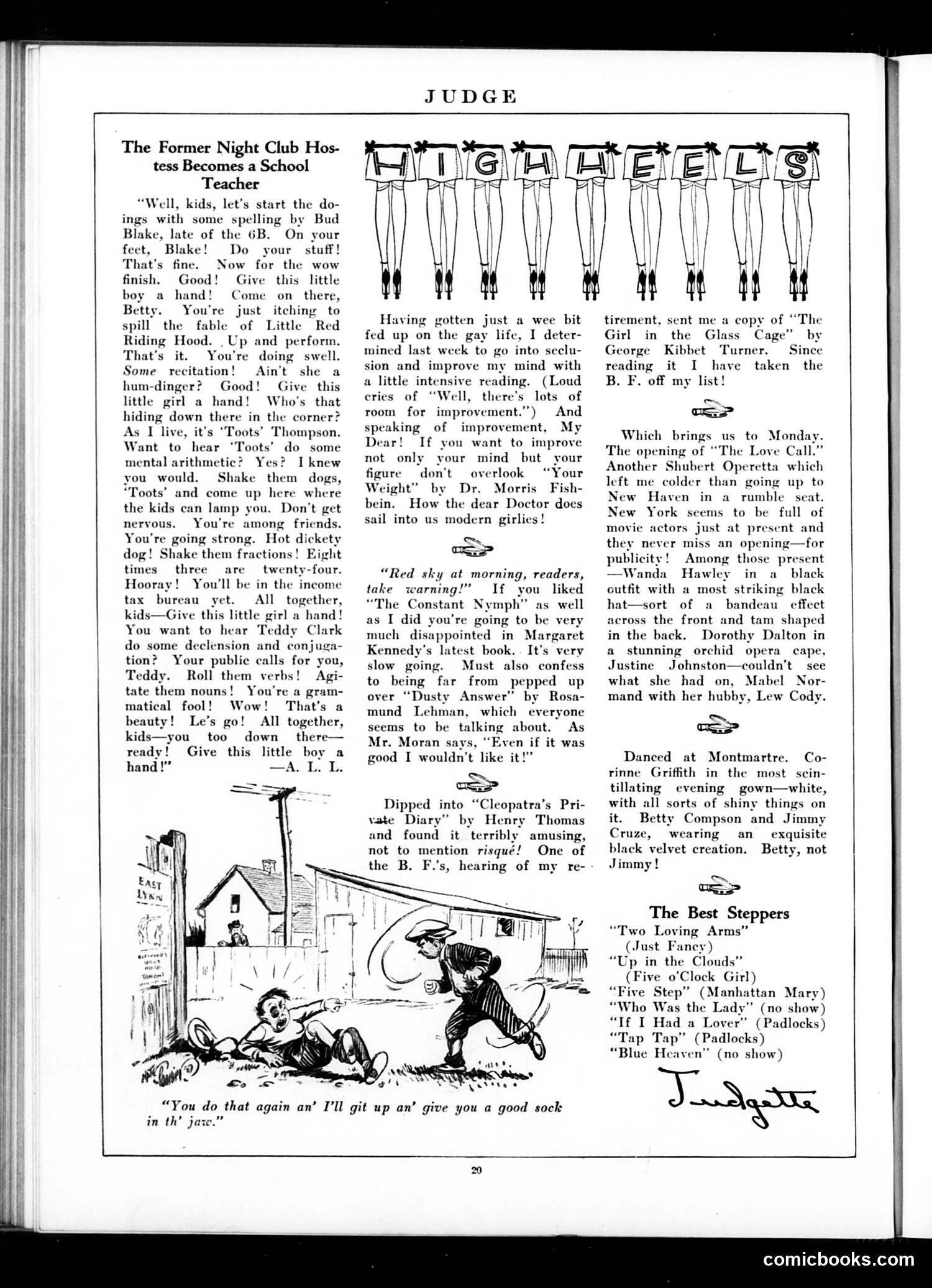
This page contains satirical commentary on 1920s social changes. The main cartoon shows a former nightclub hostess ("late of the GB"—likely a speakeasy) now teaching school, using the slang and showbiz mannerisms of her previous life. The humor mocks both her unsuitability for education and the era's rapid social mobility during Prohibition, when many establishments closed. The adjoining column is a gossip piece about Manhattan's entertainment scene, namechecking silent film actresses (Wanda Hawley, Dorothy Dalton, Mabel Normand, Corinne Griffith, Betty Compson) at theatrical openings and nightclubs. It reviews current books and operettas with arch, dismissive humor typical of Judge's urbane voice. The "Best Steppers" list references dance numbers from current Broadway shows, mixing legitimate productions with speakeasies ("no show"). Overall, the page satirizes Jazz Age excess, women's changing social roles, and the blurring boundaries between high and low entertainment in 1920s New York.
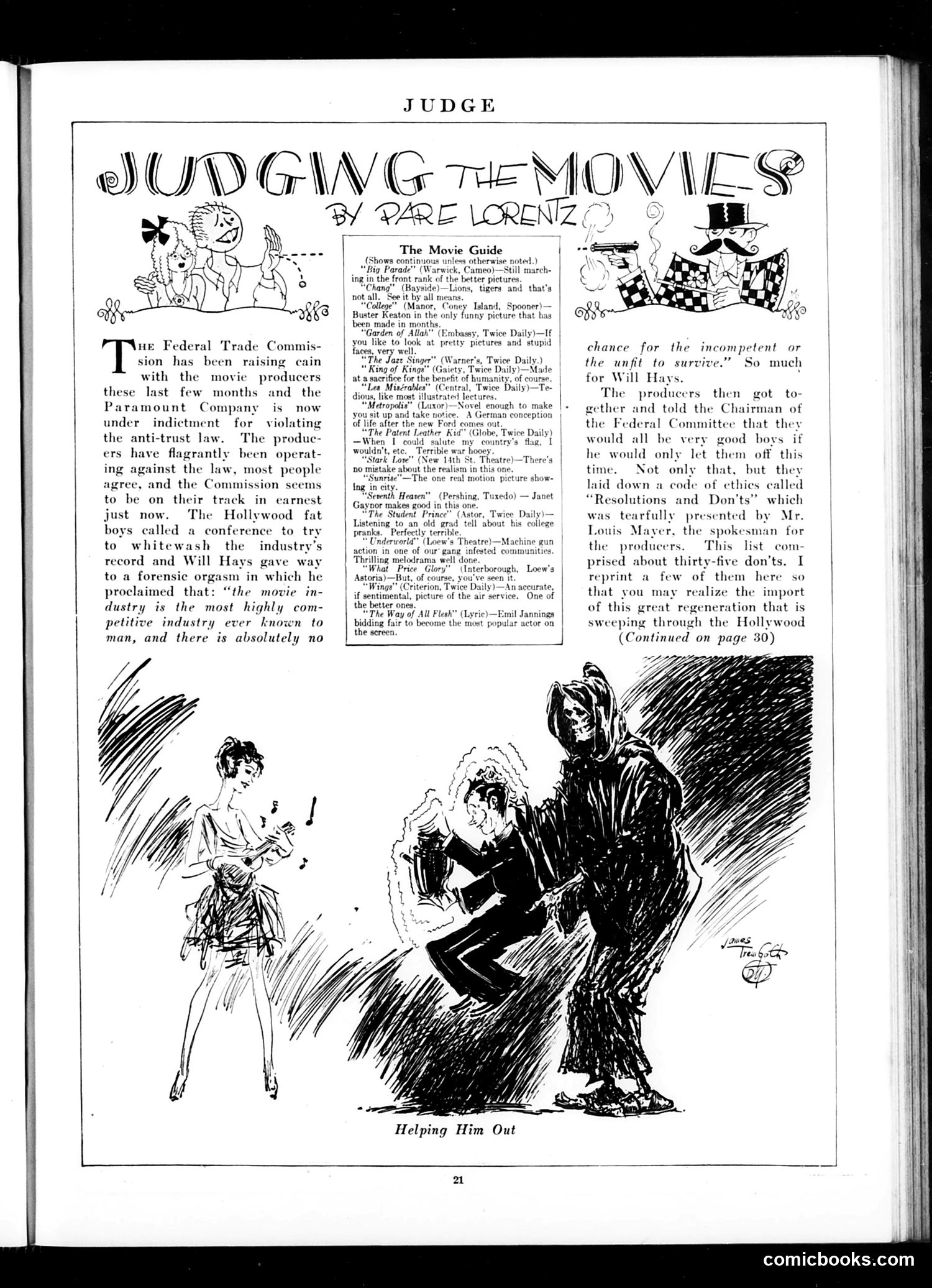
This page satirizes Hollywood's response to Federal Trade Commission antitrust action against Paramount Pictures. The producers, facing legal consequences for violating anti-trust laws, convened to "whitewash the industry's record." Will Hays, the film industry's spokesperson, proclaimed the movie industry "the most highly competitive industry ever known to man"—an absurd claim given the monopolistic practices that prompted the investigation. The producers then presented a self-regulatory code called "Resolutions and Don'ts," tearfully delivered by Louis Mayer. Judge mocks this as performative ethics: the studios claimed they'd "be very good boys" if allowed off, essentially using a toothless code of conduct to avoid genuine legal consequences. The illustration "Helping Him Out" appears to depict industry figures assisting someone in distress—likely satirizing how the code functioned as a rescue mechanism for the implicated studios rather than genuine reform.
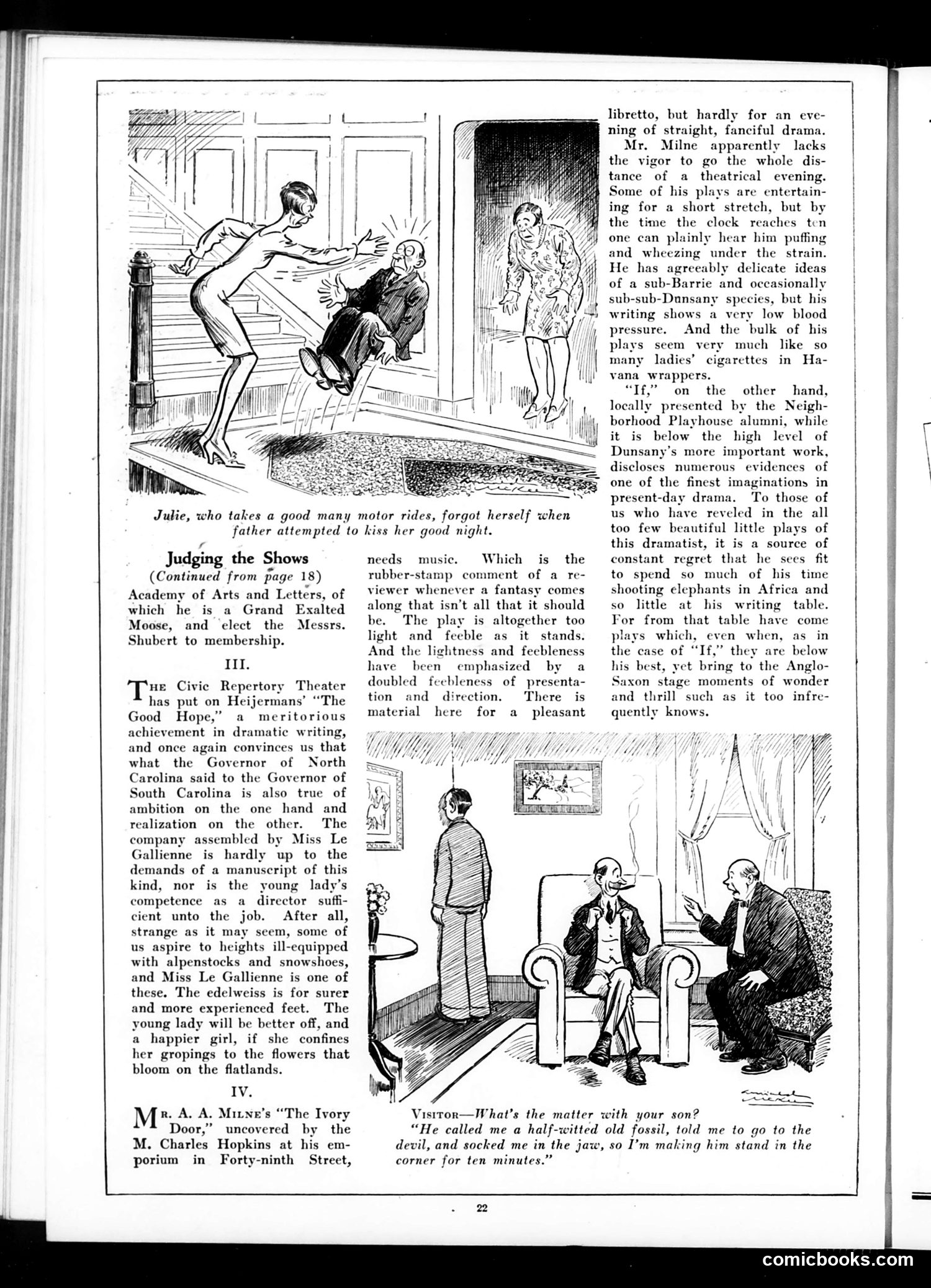
This page from *Judge* contains theater reviews and two cartoons satirizing social behavior. **Top cartoon:** "Julie" depicts a young woman who, excited from automobile rides, physically throws herself at her father when he tries to give her a goodnight kiss—showing how modern motor culture was thought to make young women overstimulated and improper. **Bottom cartoon:** A father punishes his son for calling him a "half-witted old fossil," telling him to "go to the devil," and punching him—yet the punishment is merely standing in the corner for ten minutes. The satire mocks ineffectual parenting and generational conflict; the mild punishment seems absurdly inadequate for such serious disrespect. **Theater reviews** critique contemporary plays, including dismissive comments about A.A. Milne's work as lacking vigor, compared unfavorably to the Irish dramatist Lord Dunsany (who is humorously criticized for spending more time "shooting elephants in Africa" than writing).
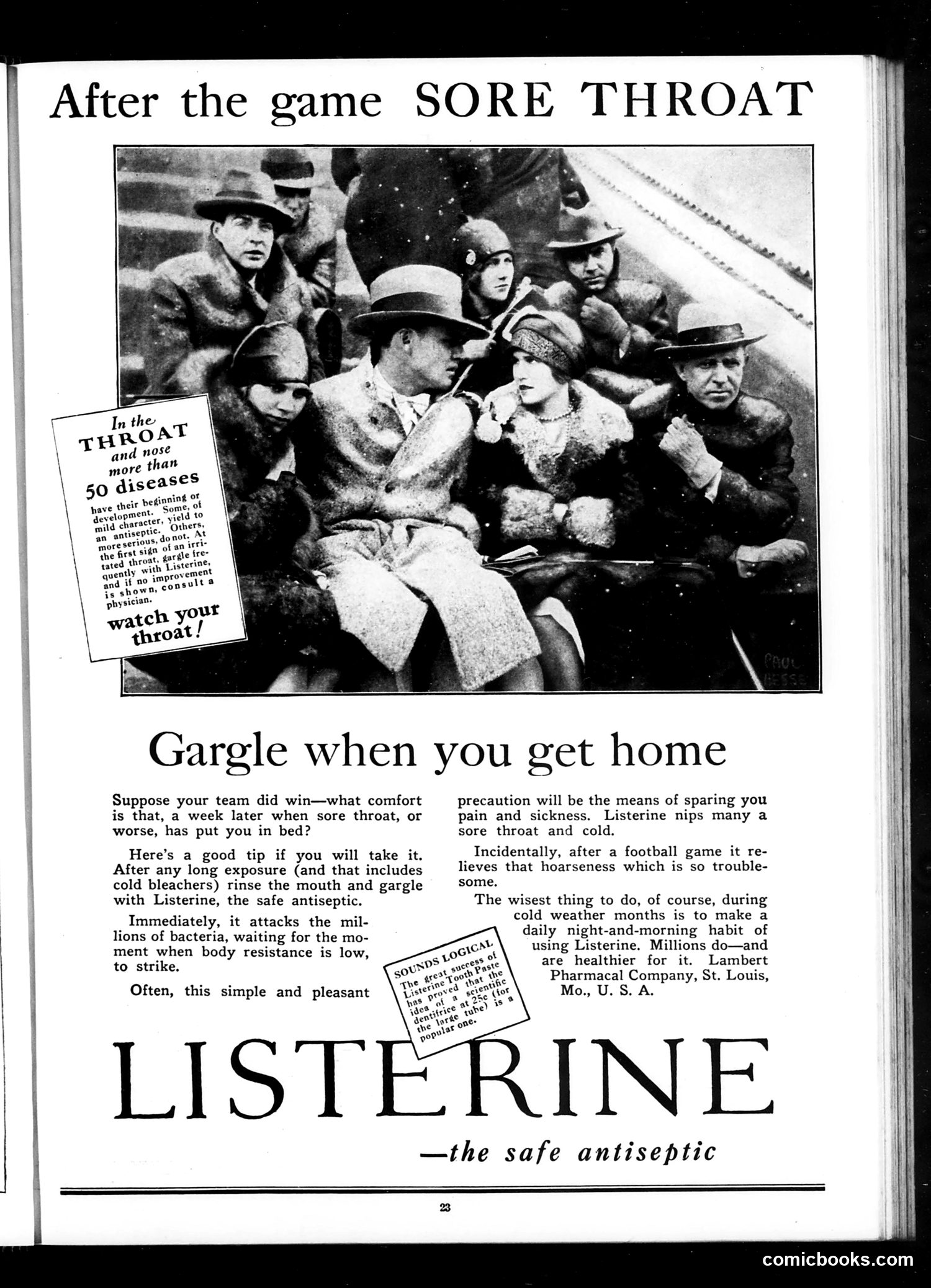
This is primarily a **Listerine advertisement**, not political satire. The page uses a humorous scenario to market mouthwash to sports fans. The image shows spectators at what appears to be a football game, bundled in winter clothing. The headline "After the game SORE THROAT" sets up the advertiser's pitch: attending outdoor sporting events in cold weather causes sore throats and illness. The ad's logic is straightforward: crowded bleachers + cold exposure + lowered immunity = bacterial infection. The solution: gargle with Listerine, marketed as "the safe antiseptic" that kills bacteria before illness develops. This reflects early 20th-century marketing that attributed many illnesses to bacteria and promoted antiseptic products as preventative medicine—claims that would face modern skepticism. The casual sexism in depicting women at the game is period-typical but not the advertisement's focus. This is commercial messaging disguised as helpful advice, not editorial commentary.
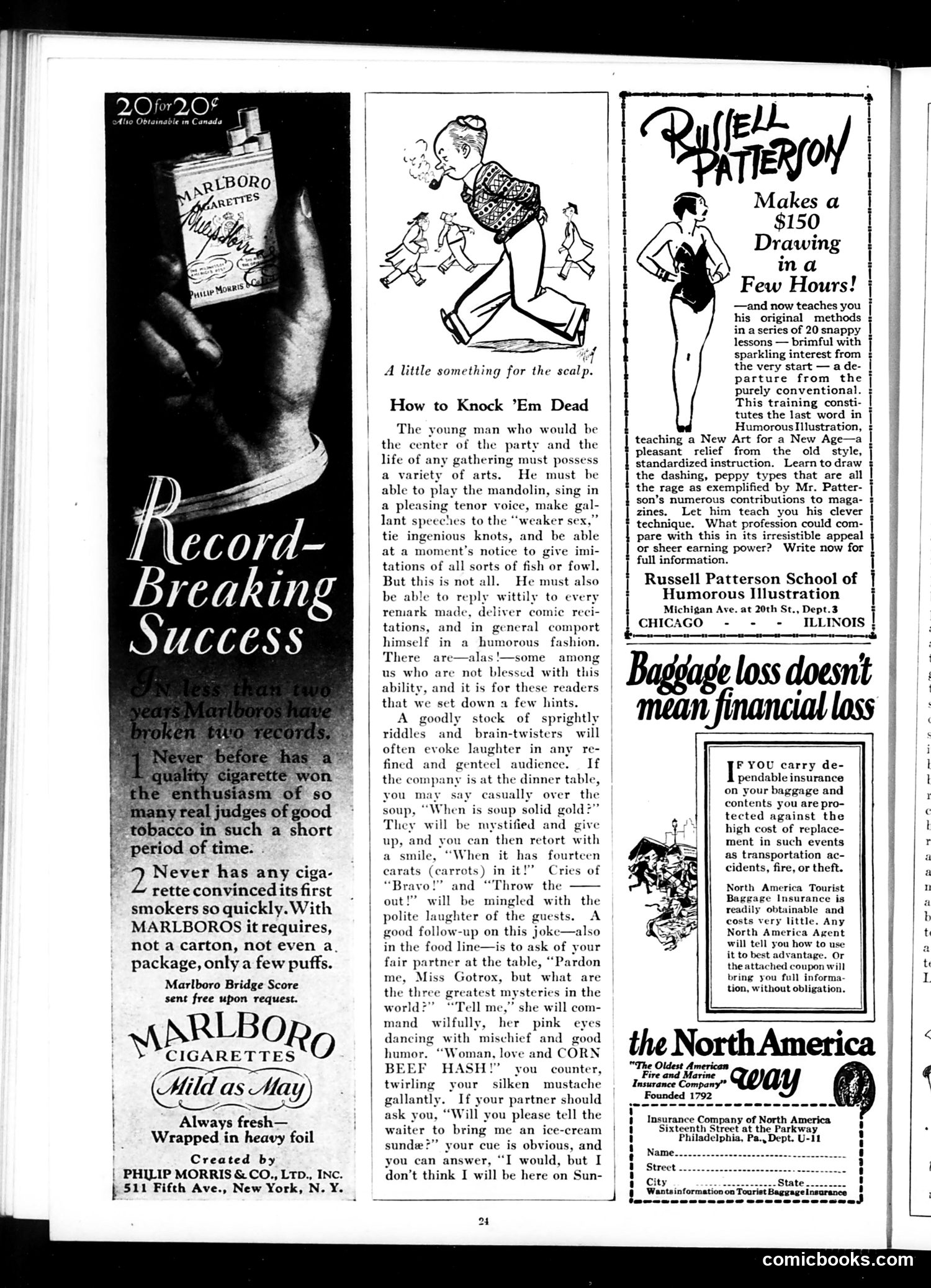
This page is primarily **advertising and instructional content** rather than political satire. It contains: 1. **Marlboro Cigarettes ad** (left): Claims the brand converts smokers faster than competitors, requiring "only a few puffs" for conviction. Includes a "Bridge Score" premium offer—typical 1920s-30s marketing strategy. 2. **"How to Knock 'Em Dead"** (center): Humorous etiquette guide for young men seeking social success. Provides party conversation tricks (riddles, puns about soup and corn beef hash) meant to entertain dinner guests with corny wordplay and witty repartee. 3. **Russell Patterson School of Humorous Illustration** (right): Advertisement for cartooning lessons teaching Patterson's modern style, positioned as superior to "standardized instruction." 4. **North America Insurance** (bottom right): Standard insurance advertisement emphasizing baggage protection. The page reflects 1920s-30s era values: social performance, gender dynamics ("weaker sex"), corporate premium culture, and aspiring illustrators seeking modern artistic training.
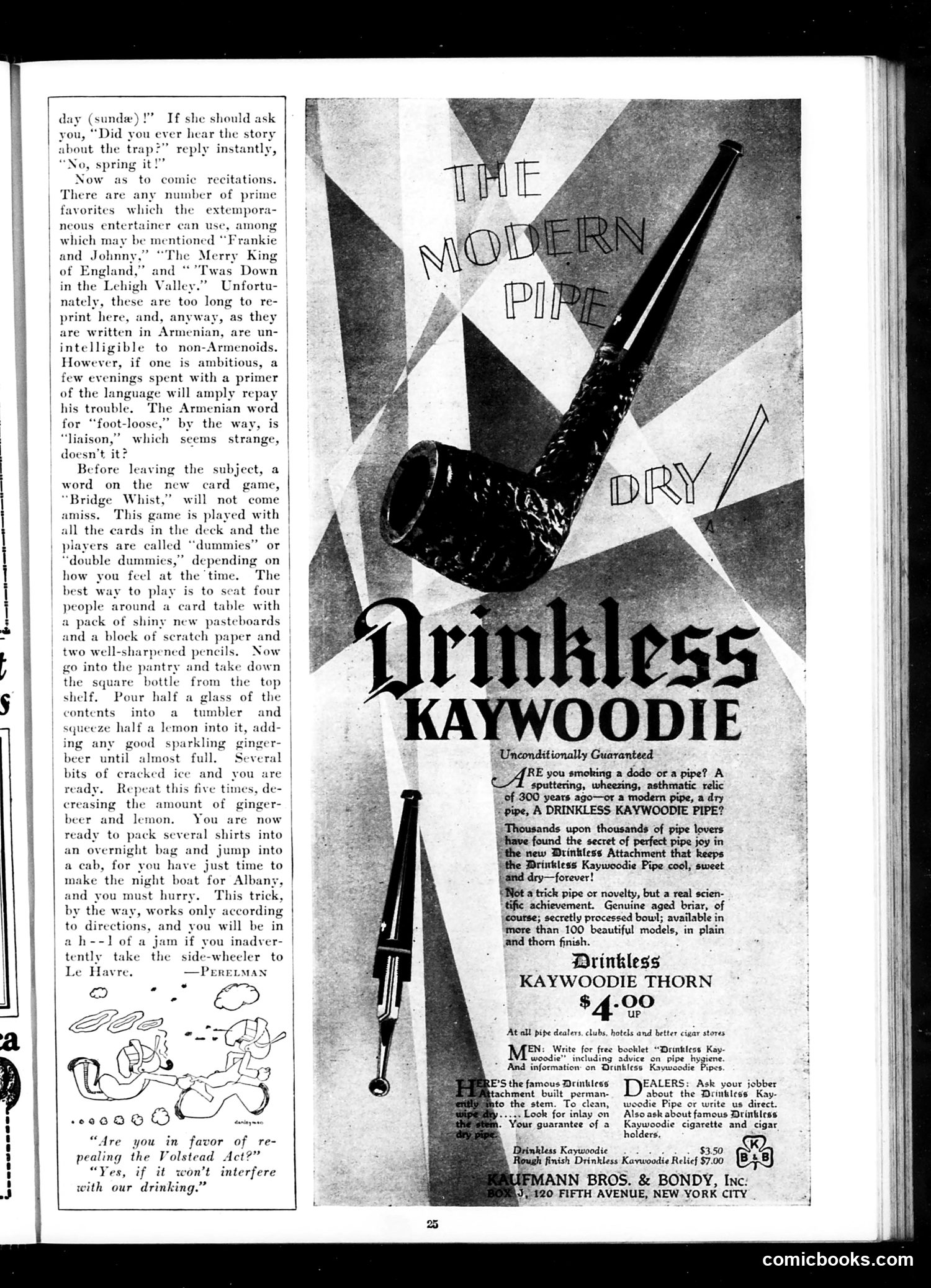
This page contains a humor article and advertisements from Judge magazine. The left column discusses entertaining guests with card games and drinking, culminating in a joke referencing Prohibition: when asked "Are you in favor of repealing the Volstead Act?" (the law enforcing Prohibition), the response is "Yes, if it won't interfere with our drinking"—satirizing the hypocrisy of those who publicly supported or tolerated Prohibition while privately drinking alcohol. The right side is primarily a **product advertisement** for Drinkless Kaywoodie pipes, marketed as "modern" pipes with a special "Drinkless Attachment" that supposedly keeps pipes dry and cool. The ad contrasts this new technology with old pipes described as "sputtering, wheezing, asthmatic relics." This appears to be straightforward advertising rather than satire, though the product name plays on contemporary Prohibition-era sensibilities about drinking.
This page contains mostly **advertisements** for consumer products (Rollfast Skates, Bayer Aspirin, Bell-ans antacid, Piso's cough syrup) interspersed with satirical content. The main story, "That Blazing Younger Set," satirizes **moral panic about 1920s youth culture**. It depicts a proper young man courting a woman named Lucy—paying for dinner, maintaining decorum—yet the narration sarcastically warns that unchaperoned youth are "flaming youths" who will "wreck your life." The joke is that even *proper* behavior by today's standards was viewed with suspicion by conservative elders. A **racist joke** about a Black man consulting a doctor (using the era's offensive terminology) turns on the punchline that the patient won't follow medical advice—a crude ethnic stereotype. The cartoon illustration captioned "How come the stiff neck?" / "Not enough exercise" is a simple visual gag unrelated to politics. Overall, this page reflects **1920s anxieties about changing social norms**, particularly regarding youth independence and dating practices.
This page contains **primarily advertising** rather than satirical content. The dominant feature is a Frigidaire refrigerator advertisement depicting an elegant dinner party, promoting electric refrigerators as affordable household appliances. The advertisement makes a social/economic argument: it claims that Frigidaire users save an average of $105.36 yearly on ice and food waste, and that the purchase price (as low as $180) equals merely "one or two" Thanksgiving dinners—positioning modern refrigeration as economically sensible rather than luxurious. The left column concludes a light romantic comedy story, "Burn My Clothes," with no political content. Below that is a teacher joke about grammar ("mood") with a pun answer. The page includes period advertisements for Abbott's Bitters (a tonic), Cortez Cigars, and a class pin, alongside a crossword puzzle solution. **The satire is minimal**—the page primarily reflects 1920s consumer culture and emerging appliance marketing rather than political commentary.
This page mixes advertisements with humor content typical of early-20th-century satirical magazines. **The Advertisements:** A prominent Martini & Rossi vermouth ad (non-alcoholic) and a "Gentle Annie" sweet cider advertisement dominate the left side. **The Comics/Humor:** - "Leaves from Myrtle's Sketch-book" by Harry Grant Dart shows a cartoon of a man and child with a cat, captioned with domestic humor about the family pet. - "High Hat" (continued from page 15) is a short story snippet about urban youth culture—specifically young people dancing to a street riveter's noise and a couple courting on a milk wagon at dawn. **The Joke Columns:** Multiple brief, pun-based jokes from various publications ("Eve," "Everybody's Weekly," "The Pink 'Un," "Answers"). These target recognizable social types: a Hollywood actress remarrying her ex-husband (memory/divorce humor), a British boxer's insomnia, an Indian dancer living plainly, and a sight-test misunderstanding. The humor relies on wordplay and gentle social observation rather than pointed satire. The page reflects popular entertainment and domestic humor of the era.
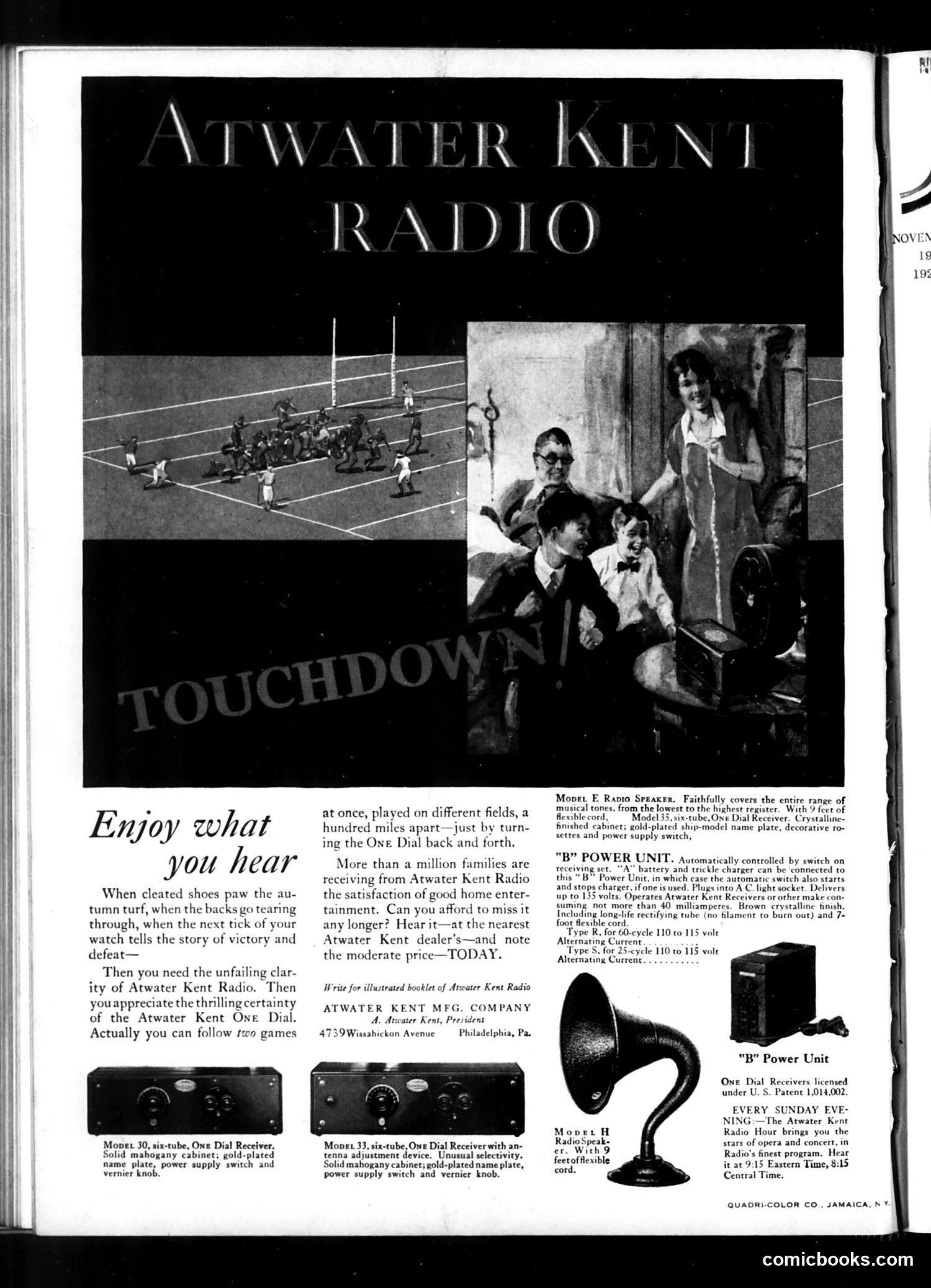
This page contains satirical humor about social conventions and excess during Prohibition-era America (the 1920s). **"The Realist"** depicts a husband who has created an absurdly uncomfortable living situation—opening all windows and running a fan while wrapped in furs and blankets, drinking from a flask—claiming he's trying to make his apartment feel like attending the live Harvard-Yale football game he's listening to on radio. His wife is exasperated by his contradictory behavior and scattered mess. The satire mocks men's obsession with sports and their use of alcohol, while highlighting the disconnect between stated goals and actual behavior. The accompanying dialogue jokes (Young Doctor/Specialist, He-She exchange) provide additional one-liners typical of Judge magazine's format. The remaining content is **commercial advertising** for cigarettes (Fatima), liquor cocktail recipes (The Cowboy), and whiskey (Holloway's), emphasizing the magazine's target demographic of adult male smokers and drinkers.
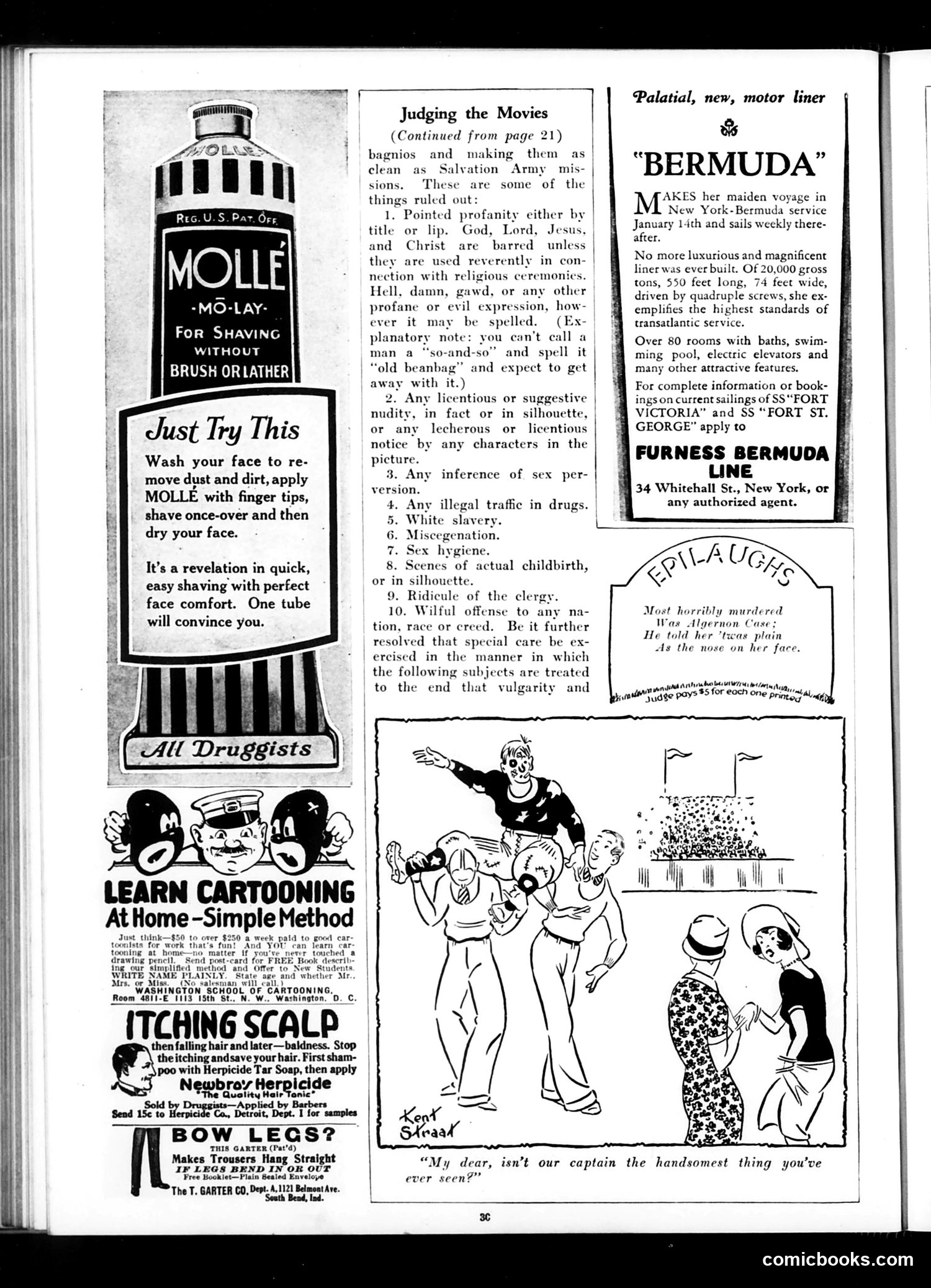
This page is primarily **advertising and editorial content** rather than political satire. The main elements are: **Advertisements** dominate the left side, hawking period grooming products (Molle shaving cream, Herpicide hair tonic, a "bow legs" corrective garter)—typical early 20th-century consumer goods targeting male anxieties about appearance. **"Judging the Movies"** is a serious editorial piece documenting film censorship rules (no profanity, no sexual content, no drug references, etc.), reflecting the Motion Picture industry's self-imposed moral code of this era. **The cartoon** (lower right) shows sailors and women aboard a ship, with a woman asking about the captain's handsomeness. The attached limerick about "Algernon Case" being "horribly murdered" appears to be light, risqué humor—the punchline playing on a double meaning ("plain as the nose on her face"). **The "Bermuda" ship advertisement** promotes a luxury liner's maiden voyage. The page reflects early-20th-century concerns: moral regulation of entertainment, consumer product marketing, and leisure travel advertising.
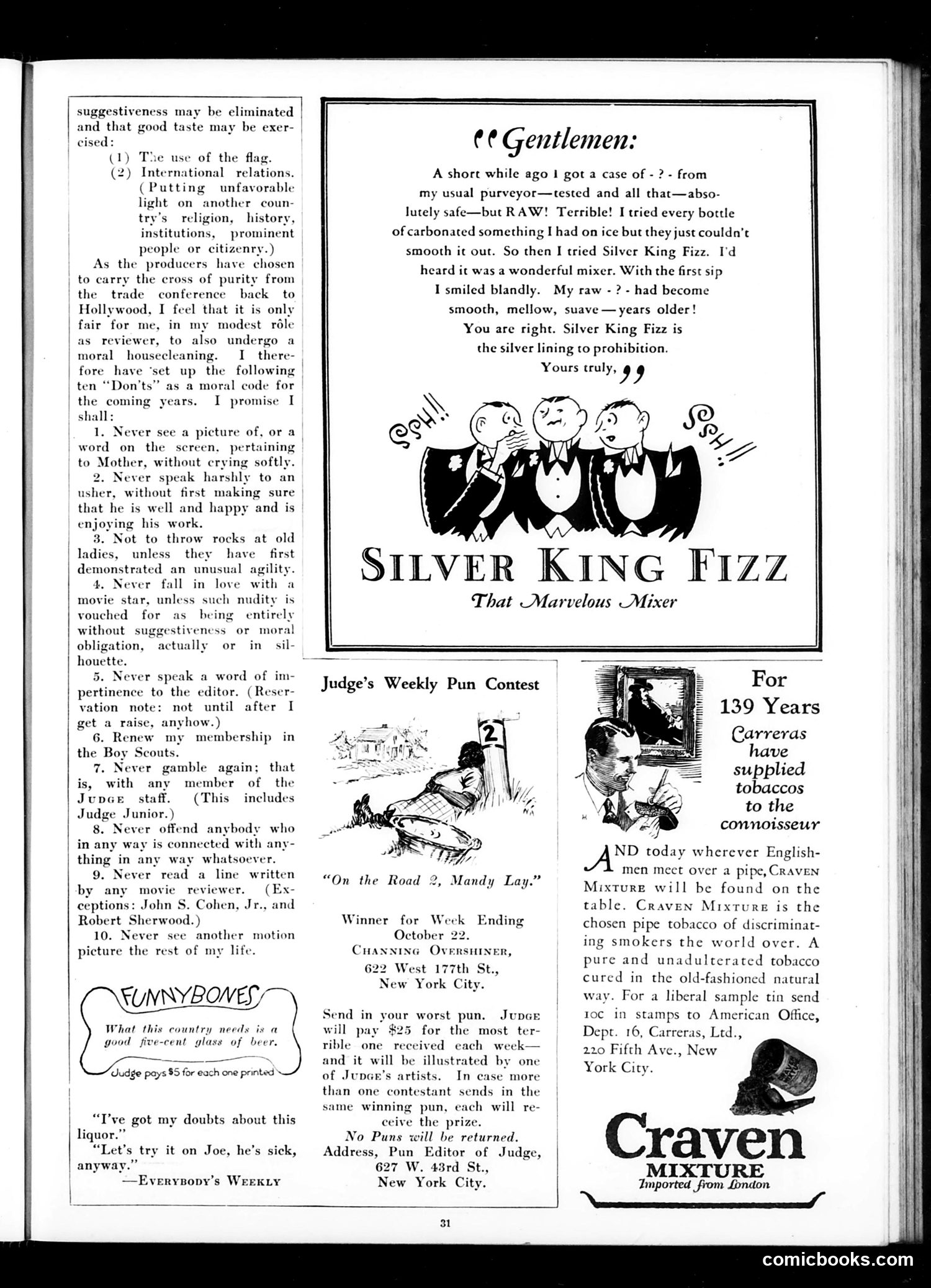
This page contains mostly **advertising and editorial content** rather than political cartoons. The main feature is a **Silver King Fizz advertisement** disguised as a humorous letter. During Prohibition (the 1920s-1930s), the writer humorously describes using this carbonated mixer to make illegal alcohol ("raw - ? -") palatable. The joke plays on Prohibition's irony: the product's legitimate purpose as a mixer becomes absurd when the "something" being mixed is contraband liquor. The cartoon's four cheerful figures toasting represent the appeal of this workaround. Below is a **pun contest** and a **Craven Mixture pipe tobacco advertisement** emphasizing the product's 139-year history and appeal to discriminating smokers. The left column contains editorial "moral guidelines" for movie reviewers—satirizing Hollywood's new Production Code restrictions on film content, which eliminated suggestiveness and controversial themes. Overall, this page reflects **1920s-30s consumer culture and Prohibition-era humor** rather than political satire.
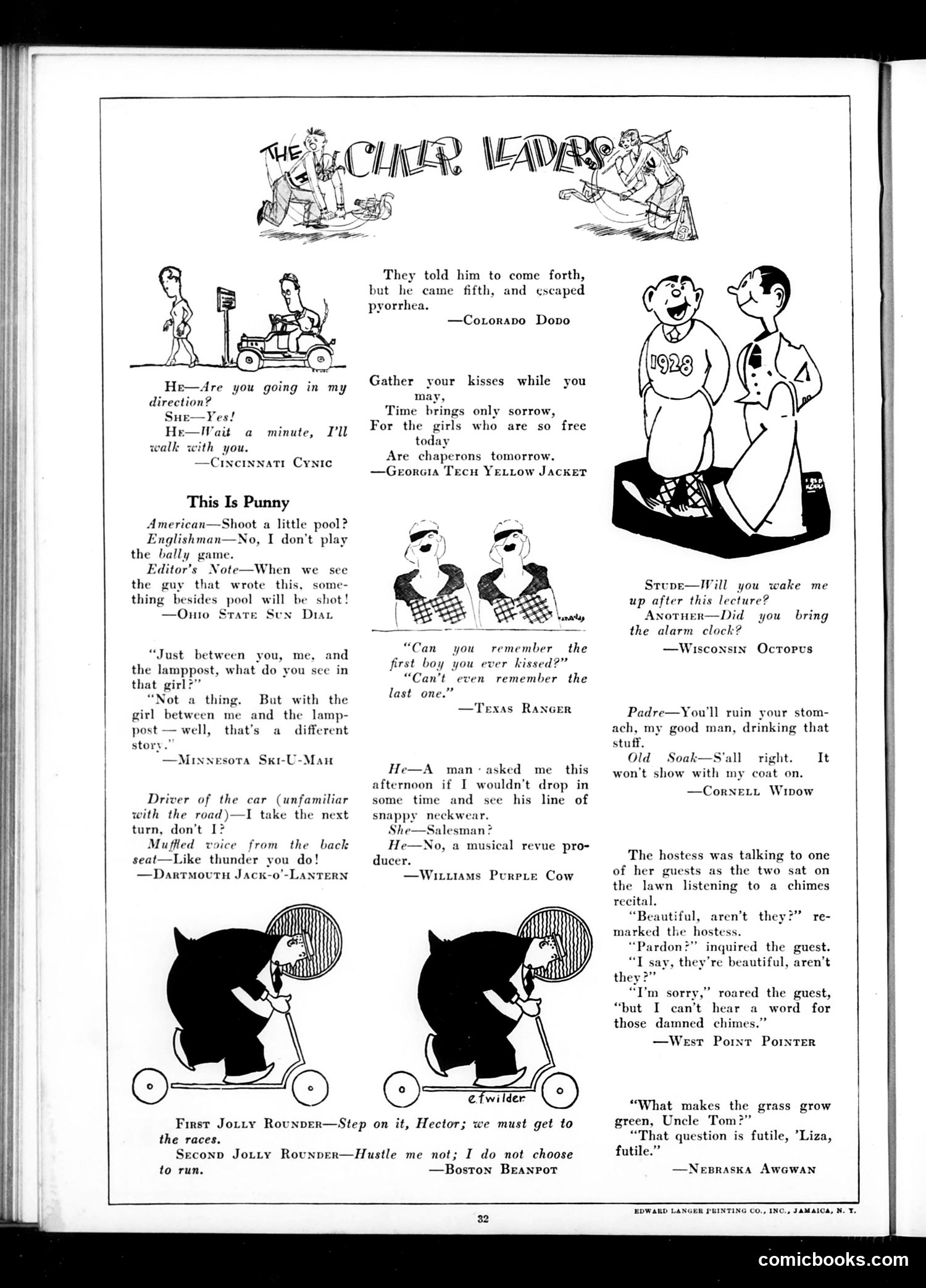
This page contains humor pieces typical of early 20th-century college and satirical magazines. The content consists of short jokes and comic scenarios attributed to various college publications (Cincinnati Cynic, Ohio State Sun Dial, etc.) and mascot-named sources. The humor relies on wordplay and social observation: a man asking directions, an American-British misunderstanding about "pool," flirtation tactics, driving mishaps, and romantic nostalgia. One piece references "pyorrhea" (gum disease) as a punchline. Another mocks young women's changing social status, suggesting liberated "free" girls of the present will become restricted "chaperons tomorrow"—reflecting anxiety about women's changing roles in the 1920s. The cartoons show figures in period dress engaging in courtship scenarios. The "Jolly Rounder" dialogue parodies political speech ("I do not choose to run"—likely referencing Calvin Coolidge's famous 1928 statement). Overall, this represents genteel collegiate humor emphasizing romantic mishaps and social commentary.
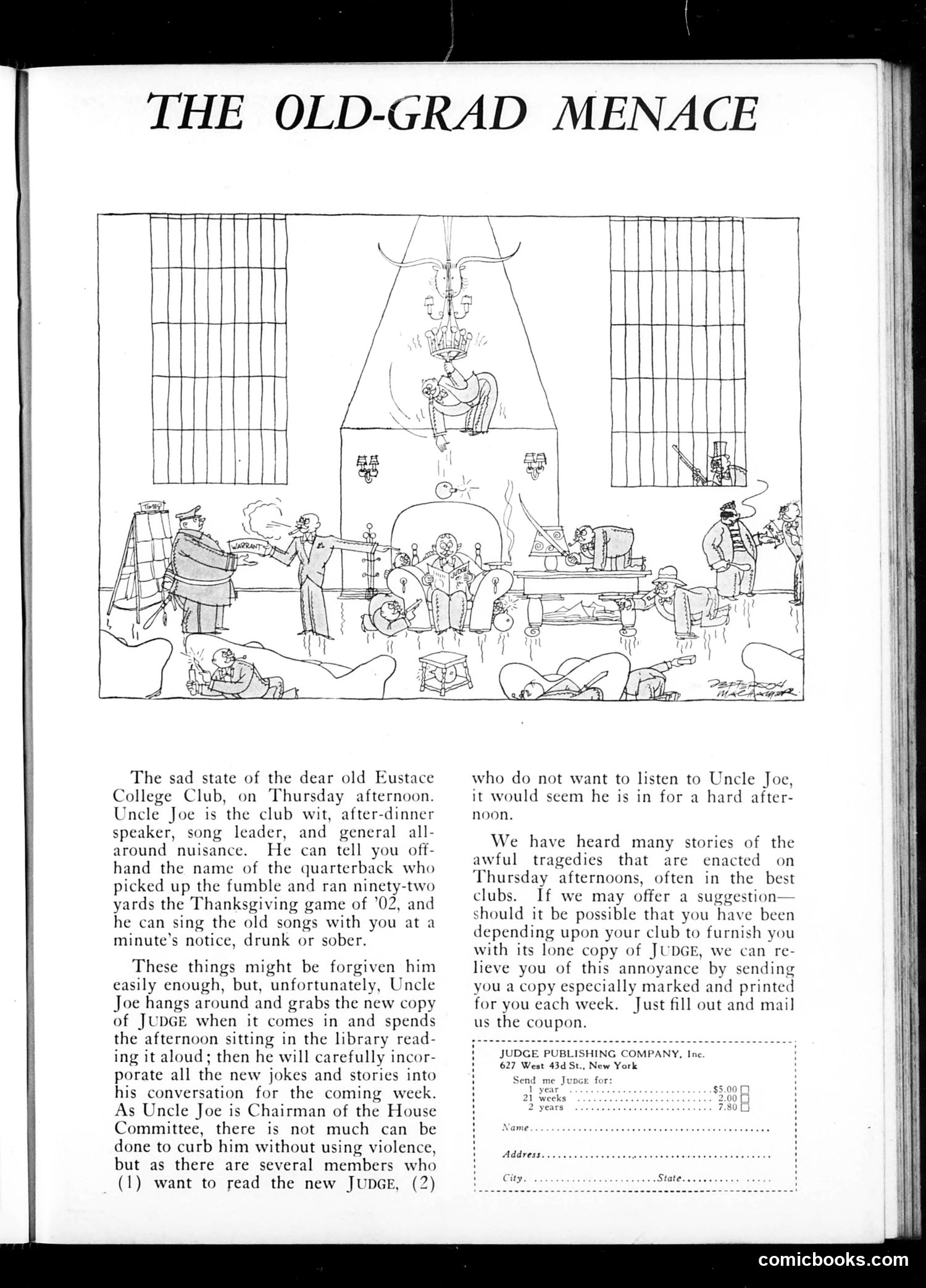
This is satirical advertising disguised as social commentary. The cartoon depicts "Uncle Joe," a stock character representing an annoying club fixture—a perpetually drunk, tedious raconteur who monopolizes conversations with stale anecdotes (like recounting a 1902 football play) and tired songs. The satire's real target: Uncle Joe steals the club's single copy of *Judge* magazine each Thursday, reads it aloud to a captive audience, then plagiarizes its jokes for the week. The cartoon shows other club members trapped in this torture. The joke serves *Judge's* marketing purpose—suggesting that clubs and individuals should subscribe directly rather than rely on shared copies. The "menace" isn't genuinely Uncle Joe but the loss of individual magazine subscriptions. It's a clever advertisement disguised as social satire about club culture and generational annoyance, with a subscription coupon as the punchline.