
Judge, 1927-11-05 · page 24 of 36
Judge — November 5, 1927 — page 24: what you’re looking at
What you’re looking at
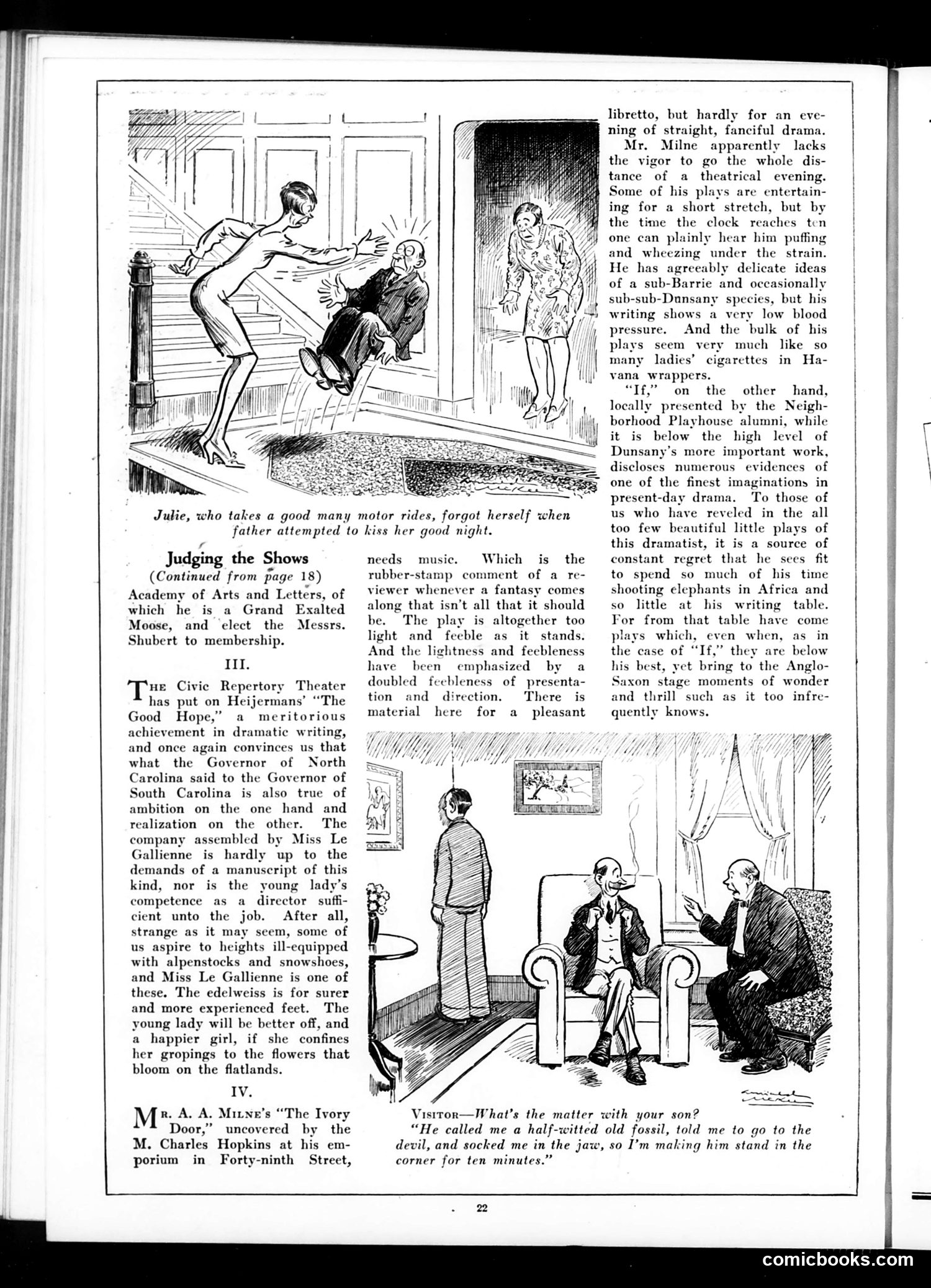
This page from *Judge* contains theater reviews and two cartoons satirizing social behavior. **Top cartoon:** "Julie" depicts a young woman who, excited from automobile rides, physically throws herself at her father when he tries to give her a goodnight kiss—showing how modern motor culture was thought to make young women overstimulated and improper. **Bottom cartoon:** A father punishes his son for calling him a "half-witted old fossil," telling him to "go to the devil," and punching him—yet the punishment is merely standing in the corner for ten minutes. The satire mocks ineffectual parenting and generational conflict; the mild punishment seems absurdly inadequate for such serious disrespect. **Theater reviews** critique contemporary plays, including dismissive comments about A.A. Milne's work as lacking vigor, compared unfavorably to the Irish dramatist Lord Dunsany (who is humorously criticized for spending more time "shooting elephants in Africa" than writing).
📄 Transcribed text from this page (OCR, searchable)
Machine-transcribed from the original scan — historical spelling and the odd misread are preserved.
Julie, who takes a good many motor rides, forgot herself when father attempted to kiss her good night. Judging the Shows (Continued from page 18) Academy of Arts and Letters, of which he is a Grand Exalted Moose, and elect the Messrs. Shubert to membership. Ill. HE Civic Repertory Theater has put on Heijermans’ “The Good Hope,” a meritorious achievement in dramatic writing, and once again convinces us that what the Governor of North Carolina said to the Governor of South Carolina is also true of ambition on the one hand and realization on the other. The company assembled by Miss Le Gallienne is hardly up to the demands of a manuscript of this kind, nor is the young lady’s competence as a director suffi- cient unto the job. After all, strange as it may n, some of us aspire to heights ill-equipped with alpenstocks and snowshoes, and Miss Le Gallienne is one of these. The edelweiss is for surer and more experienced feet. The young lady will be better off, and a happier girl, if she confines her gropings to the flowers that bloom on the flatlands. Iv. r. A. A. Mitne’s “The Ivory Door,” uncovered by the M. Charles Hopkins at his em- porium in Forty-ninth Street, needs music. Which is the rubber-stamp comment of a re- viewer whenever a fantasy comes along that isn’t all that it should be. The play is altogether too light and feeble as it stands. And the lightness and feebleness have been emphasized by a doubled feebleness of presenta- tion and direction. There is material here for a _ pleasant tance of a theatric } Some of his plays are entertain- libretto, but hardly for an eve- ning of straight, fanciful drama. Mr. Milne apparently lacks the vigor to go the whole dis- evening. ing for a short stretch, but by the time the clock reaches ten one can plainly hear him puffing and wheezing under the strain. He has agreeably delicate ideas of a sub-Barrie and occasionally sub-sub-Dunsany species, but his writing shows a very low blood pressure. And the bulk of his lays seem very much like so many ladies’ cigarettes in Ha- vana wrappers. “If,” on the other hand, locally presented by the Neig] borhood Playhouse alumni, while it is below the high level of Dunsany’s more important work, discloses numerous evidences of one of the finest imaginations in present-day drama. To those of us who have reveled in the all too few beautiful little plays of this dramatist, it is a source of constant regret that he sees fit to spend so much of his time shooting elephants in Africa and so little at his writing table. For from that table have come plays which, even when, as in the case of “If,” they are below his best, yet bring to the Anglo- Saxon stage moments of wonder and thrill such as it too infre- quently knows. Vistron—What’s the matter with your son? “He called me a half-witted old fossil, told me to go to the devil, and socked me in the jaw, so I’m making him stand in the corner for ten minutes.” comicbooks.com