
Judge, 1927-11-05 · page 20 of 36
Judge — November 5, 1927 — page 20: what you’re looking at
What you’re looking at
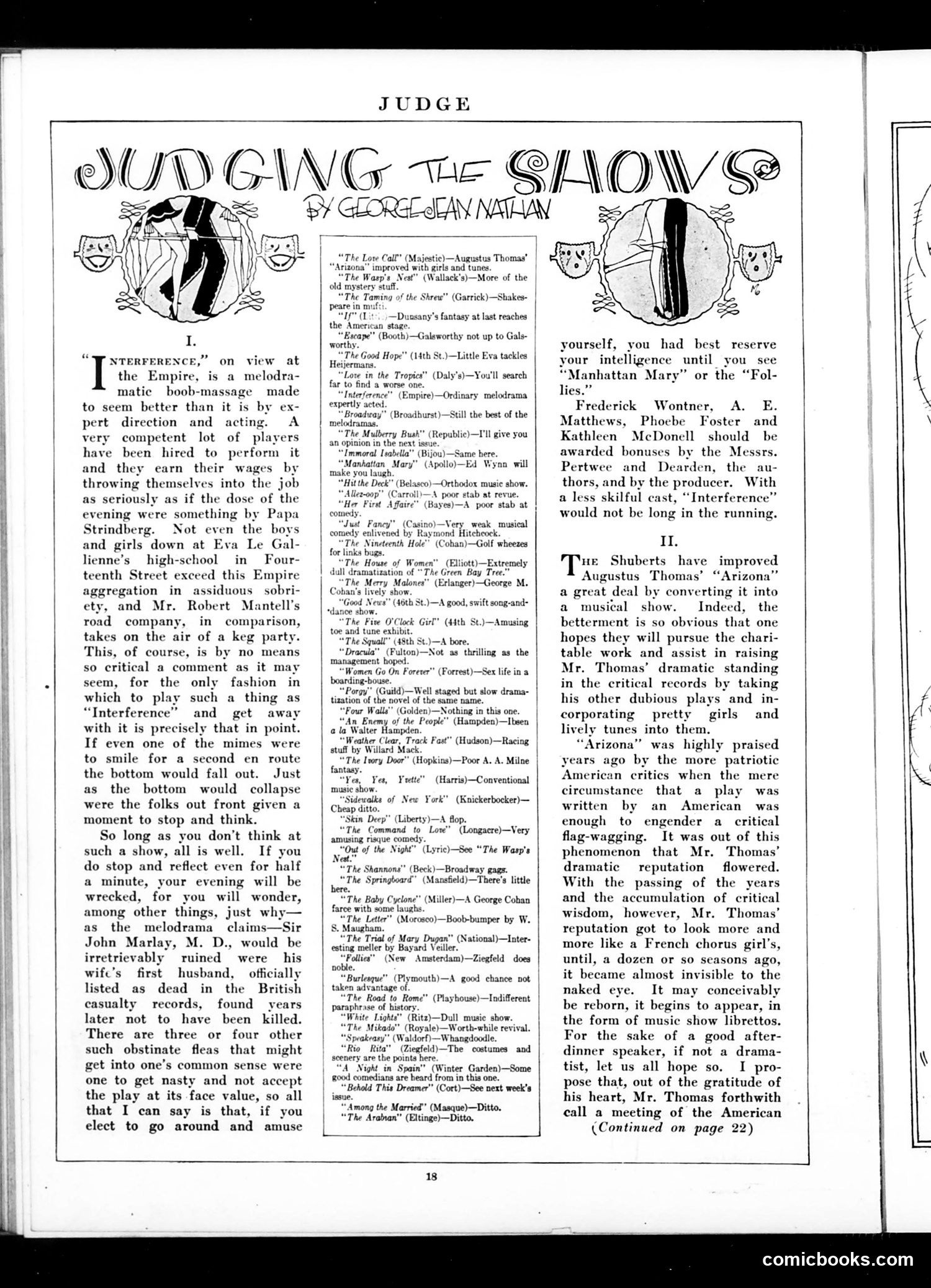
This page is a theater review column, not a political cartoon. Nathan, a prominent drama critic, reviews Broadway productions with witty, caustic commentary. The lead review of "Interference" at the Empire Theatre is illustrative: Nathan argues the melodrama is fundamentally absurd—its plot hinges on ridiculous premises (a man ruined because his wife's first husband, officially dead, might resurface). The play only "works" if audiences never pause to think critically. Nathan praises the *acting* as competent but mocks the *material* itself. The long list that follows catalogs current Broadway shows with one-line verdicts: some praised ("Broadway"—"still the best of the melodramas"), many dismissed as weak, boring, or derivative ("Love in the Tropics"—"You'll search far to find a worse one"). This reflects 1920s theater culture and Nathan's reputation as a sophisticated, unsparing critic who valued artistic integrity over commercial spectacle.
📄 Transcribed text from this page (OCR, searchable)
Machine-transcribed from the original scan — historical spelling and the odd misread are preserved.
i | t | or JUDGE ow ety G we SHOW Se J. i TERFERENCE,” on view at I the Empire, is a melodra- matic boob-massage made to seem better than it is by ex- pert direction and acting. A very competent lot of players have been hired to perform it and they earn their wages by throwing themselves into the job as seriously as if the dose of the evening were something by Papa Strindberg. Not even the boys and girls down at Eva Le Gal- lienne’s high-school in Four- teenth Street exceed this Empire aggregation in assiduous sobri- ety, and Mr. Robert Mantell’s road company, in comparison, takes on the air of a keg party. of course, is by no means so critical a comment as it may seem, for the only fashion in which to play such a thing as “Interference” and get away with it is precisely that in point. If even one of the mimes were to smile for a second en route the bottom would fall out. Just as the bottom would collapse were the folks out front given a moment to stop and think. So long as you don’t think at such a show, all is well. If you do stop and reflect even for half a minute, your evening will be wrecked, for you will wonder, among other things, just why— the melodrama claims—Sir John Marlay, M. D., would be irretrievably ruined were his wifc’s first husband, offici listed as dead in the British casualty records, found years later not to have been killed. There are three or four other such obstinate fleas that might get into one’s common sense were one to get nasty and not accept the play at its face value, so all that I can say is that, if you elect to go around and amuse | L “The Lore Call” (Majestic) —Augustus Thomas’ “Arizona” improved with girls and tunes. us “The Wasp's Nest” (Wallack's)—More of the old my ** (Garrick)—Shakes- any’s fantasy at last reaches the American stage. ‘ape (Booth)—Galeworthy not up to Gals- worthy. “The Good Hope” Heijermans. “Lote in the Tropica” (Daly’s)—You'll search far to find a worse one. “Interference” (Empire)—Ordinary melodrama expertly acted “Broadveay” (Broadburst)—Still the best of the melodramas. “The Mulberry Bush’ (Republic)—I'll give you an opinion in the next issue “Immoral Lsabella” (Bijou) “Manhattan Mary” (Apol make you laugh. ‘ame here. )—Ed Wynn will Hit the Deck” (Belasco)—Orthodox music show. “‘Allez-oop” (Carroll\—A poor stab at revue. “Her First Affaire” (Bayes)—A poor stab at comedy Very weak musical d Hitchcock. (Cohan)—Golf wheezes The Nineteenth Hole for links bugs. “The House of Women” (Elliott)—Extremely dull dramatization of “The Green Bay Tree.” The Merry Malones”” (Erlanger)—George M. 's lively show. —A good, swift song-and- “The Five O'Clock Girl" (44th St.)—Amusing toe and tune exhibit. “The Squall” (48th St.)—A bore. “Dracula” (Fulton)—Not as thrilling as the management hoped. “Women Go On Forever” (Forrest)—Sex life in a boarding-bouse. “Porgy’’ (Guild)—Well staged but slow drama- tization of the novel of the same name. “Four Walls” (Golden)—Nothing in this one. ‘An Enemy of the People’ (Hampden)—Ibsen a la Walter Hampden. “Weather Clear, Track Fast” (Hudson)—Racing stuff by Willard Mack. “The Ivory Door" (Hopkins)—Poor A. A. Milne fantasy. “Yes, Yes, Yeette’ (Harris)—Conventional music show. “Sidewalke of New York’ (Knickerbocker)— Cheap ditto. Skin Deep" (Liberty)—A flop. “The Command to Lowe” (Longacre)—Very amusing risque comed; ‘Out of the Night” (Lyric)—See “The Wasp's Vest The Shannons” (Beck)—Broadway gags. The Springboard” (Mansfield)—There's little here. The Baby Cyclone” (Miller)—A George Coban farce with some laughs. The Letter” (Morosco)—Boob-bumper by W. Maugham. “The Trial of Mary Dugan” (National)—Inter- esting meller by Bayard Veiller. “Follies” (New Amsterdam)—Ziegfeld does noble. “Burlesque” (Plymouth)—A good chance not taken advantage of. “The Road to Rome" (Playhouse)—Indifferent paraphrase of history. “White Light” (Ritz)—Dull music show. The Mikado’ (Royale)—Worth-while revival. “Speakeasy” (Waldorf)—Whangdoodle. “Rio Rita” (Ziegfeld)—The costumes and scenery are the points here. “A Night in Spain” (Winter Garden)—Some good comedians are heard from in this one. “Behold This Dreamer” (Cort)—See next week's insue. “Among the Married” (Masque)—Ditto. “The Arabnan" (Eltinge)—Ditto. (14th St.)—Little Eva tackles | yourself, you had best reserve your intelligence until you see “Manhattan Mary” or the “Fol- lies.” Frederick Wontner, A. E. Matthews, Phoebe Foster and Kathleen McDonell should be awarded bonuses by the Messrs. Pertwee and Dearden, the au- thors, and by the producer. With a less skilful cast, “Interference” would not be long in the running. II. HE Shuberts have improved Augustus Thomas’ “Arizona” a great deal by converting it into a musical show. Indeed, the betterment is so obvious that one hopes they will pursue the chari- table work and assist in raising Mr. Thor dramatic standing in the critical records by taking his other dubious plays and in- corporating lively tun pretty girls and into them. “Arizona” was highly praised rs ago by the more patriotic American critics when the mere circumstance that a play was written by an American was enough to engender a_ critical flag-wagging. It was out of this phenomenon that Mr. Thomas’ dramatic reputation flowered. With the passing of the Ars and the accumulation of critical wisdom, however, Mr. Thomas’ reputation got to look more and more like a French chorus girl's, until, a dozen or so seasons ago, it became almost invisible to the naked eye. It may conceivably be reborn, it begins to appear, in the form of music show librettos. For the sake of a good after- ner speaker, if not a drama- tist, let us all hope so. I pro- pose that, out of the gratitude of his heart, Mr. Thomas forthwith call a meeting of the American (Continued on page 22) ye 18 \ comicbooks.com