
A complete issue · 36 pages · 1927
Judge — October 1, 1927
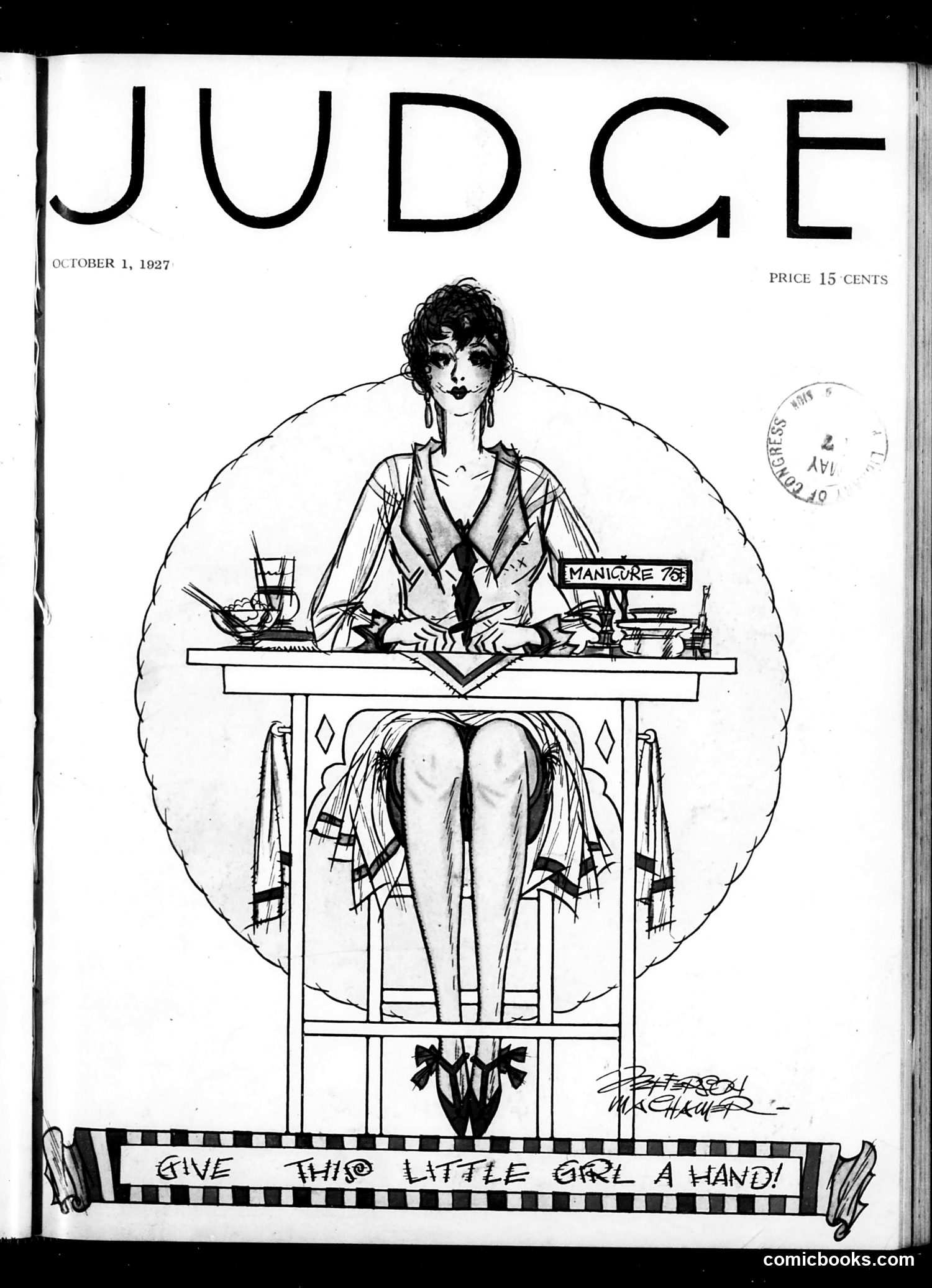
This cover satirizes women's vanity and consumerism in the 1920s. The illustration depicts a fashionable young woman at her vanity table, surrounded by beauty products and grooming supplies (note the "MANICURE 75¢" sign). She's styled in the popular flapper aesthetic of the era—short dark hair, makeup, and fashionable dress. The caption "GIVE THIS LITTLE GIRL A HAND!" appears to mock both the woman's self-absorption and the commercial beauty industry's exploitation of female vanity. The circular background frame emphasizes her as the sole focus of attention. This reflects common 1920s satirical critiques of modern consumer culture, women's independence, and the emerging beauty industry's influence on young women.
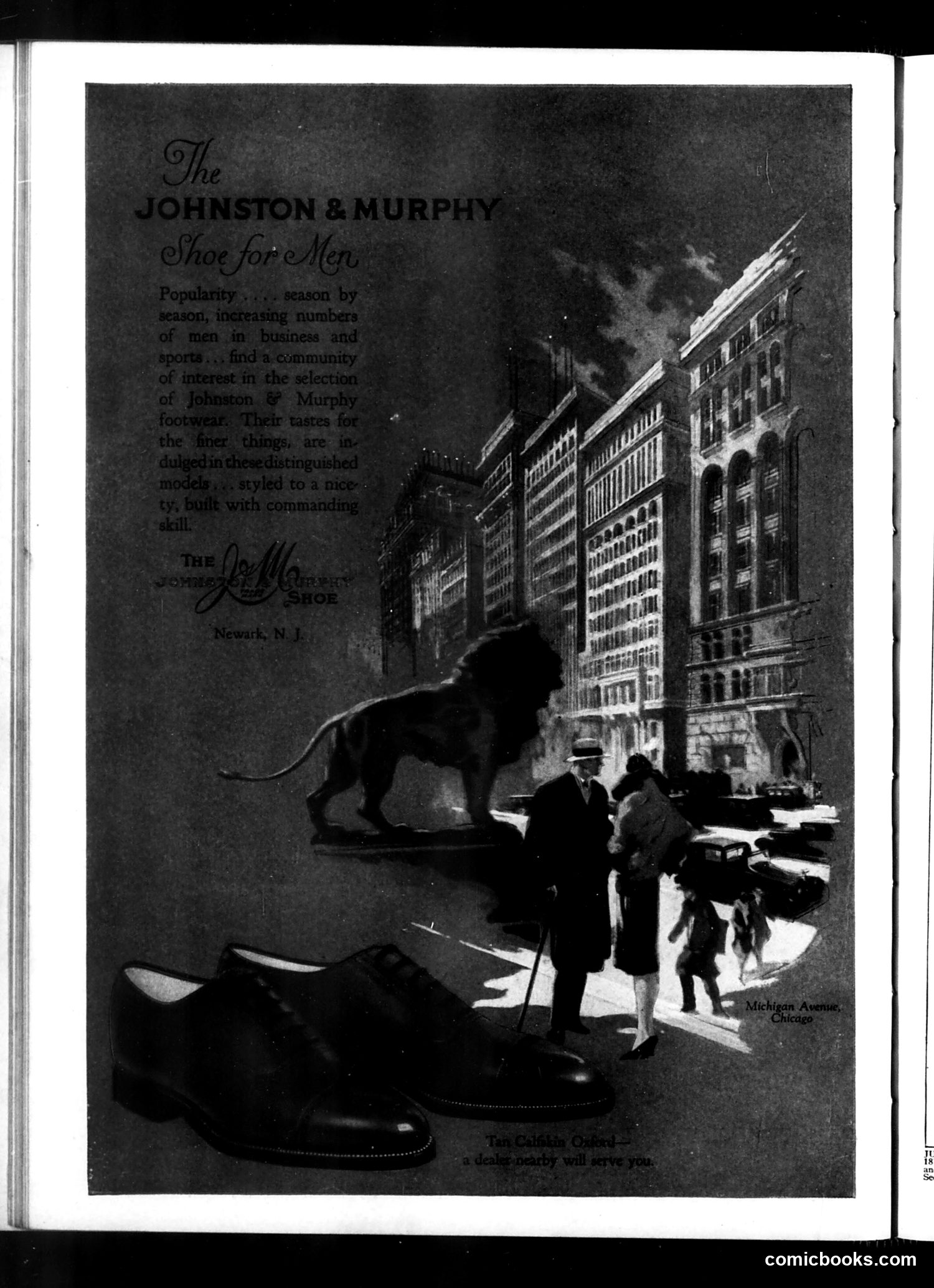
This page is **primarily an advertisement**, not satirical content. It advertises Johnston & Murphy shoes for men, based in Newark, New Jersey. The ad features a dramatic illustration of a **lion statue** (likely referencing the famous lion monument in Chicago's Michigan Avenue, shown in the caption) alongside well-dressed men and women on a city street with tall buildings. The imagery suggests urban sophistication and power. The text emphasizes that Johnston & Murphy shoes gain "popularity season by season" among businessmen and office workers who appreciate their "distinguished models" and quality construction. The lion symbolizes strength and commanding presence—qualities the advertiser wants associated with wearing their shoes. This is straight commercial messaging, not political satire.
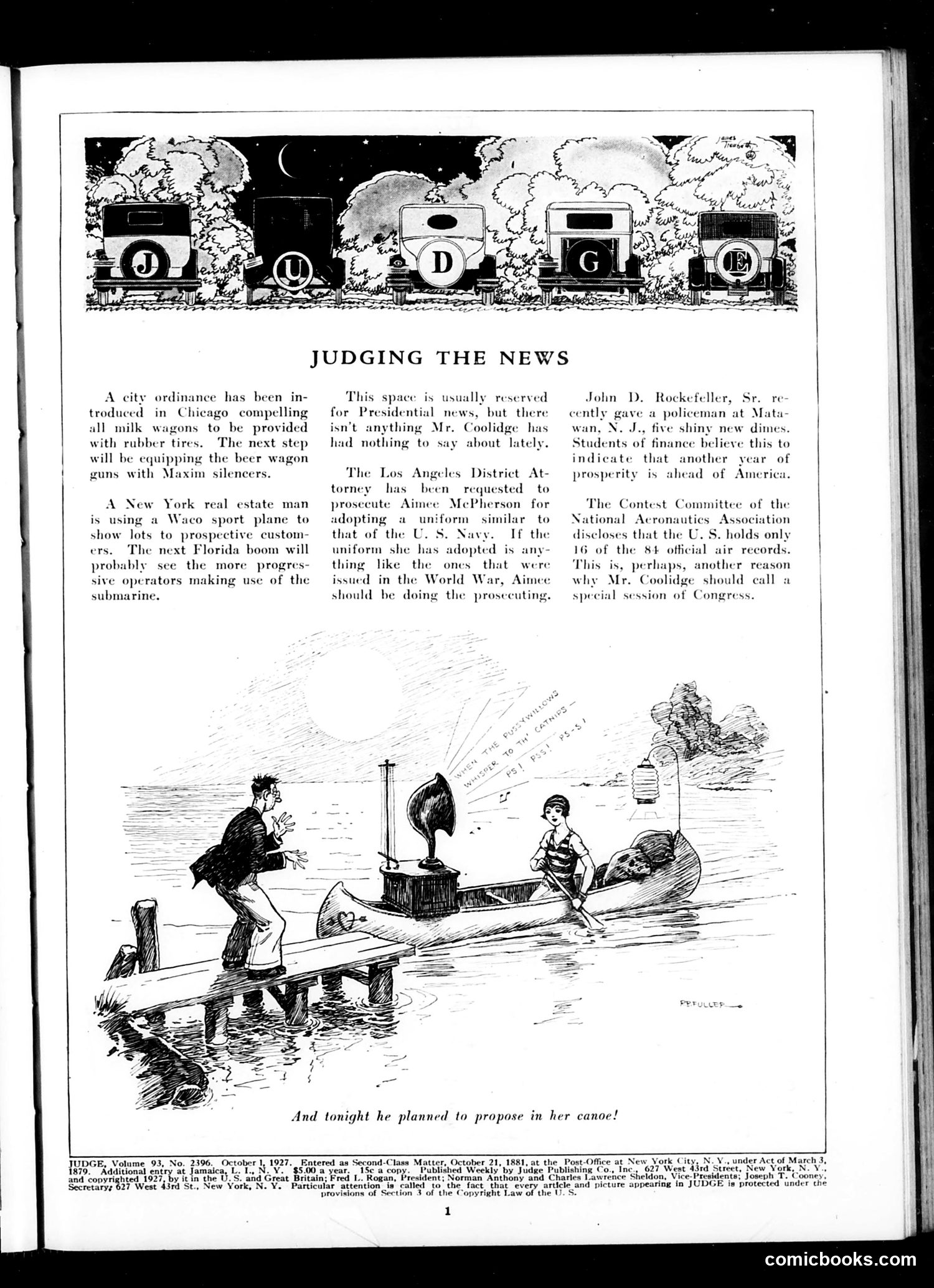
This page contains brief satirical news commentary and a cartoon. The main cartoon depicts a man proposing to a woman in a canoe, with the caption "And tonight he planned to propose in her canoe!" The accompanying news items mock contemporary topics: 1. **Chicago milk wagon regulation** - Mocking a municipal ordinance requiring rubber tires and silencers on beer wagons, suggesting absurd priorities 2. **Real estate promotion** - A New York realtor using a submarine display to attract buyers, implying the "Florida boom" will eventually require underwater property 3. **Anne McPherson uniform controversy** - The Los Angeles District Attorney allegedly requested a Navy-style uniform for prosecuting a case, satirizing bureaucratic pretension 4. **Aviation records** - Commentary on U.S. holding only 16 of 81 official air records, suggesting national decline The cartoon's humor relies on the awkwardness of romantic timing interrupted by the practical (and tippy) setting of a canoe.
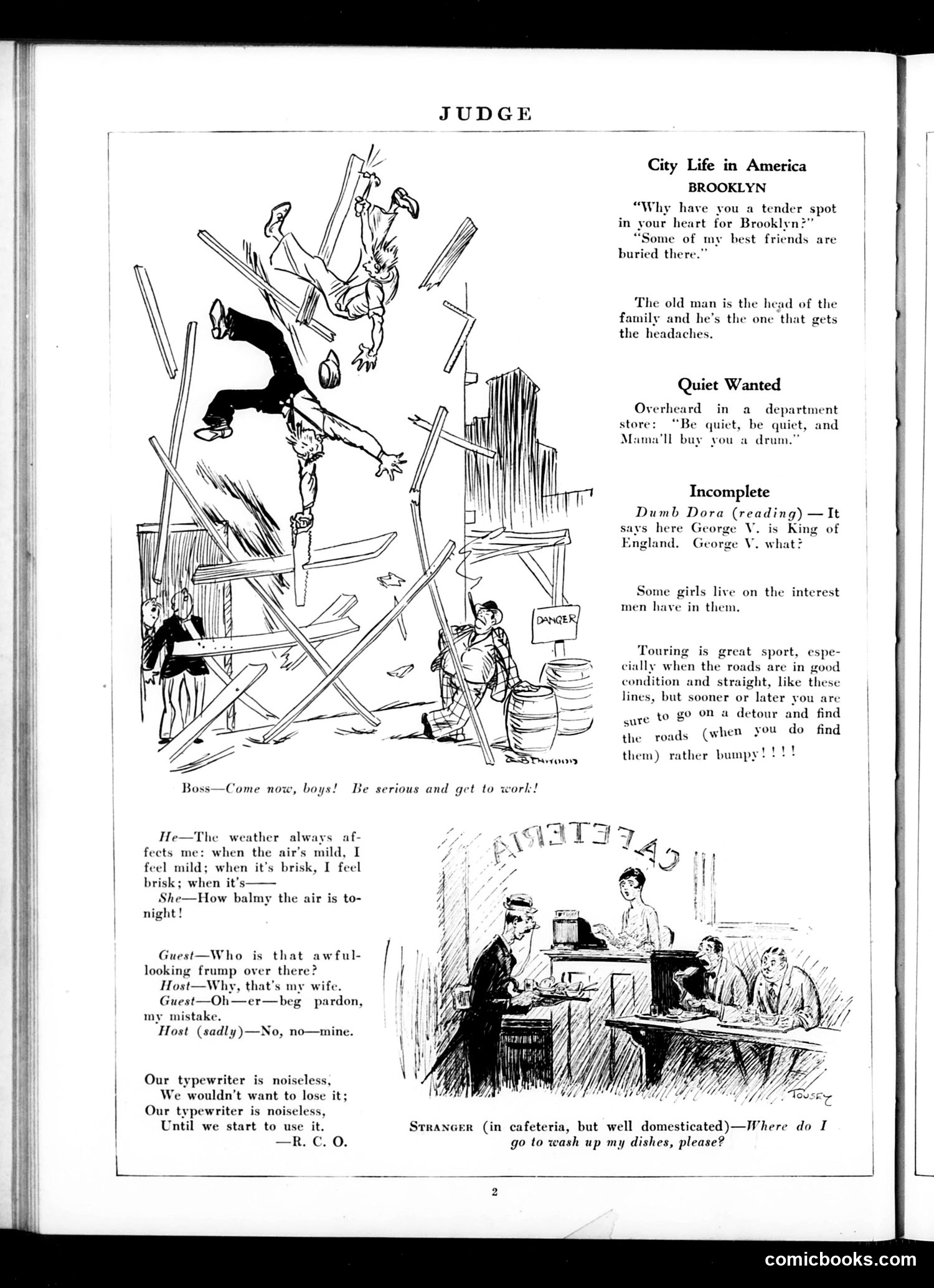
This page contains several unrelated humorous sketches typical of Judge magazine's satirical style: **Top cartoon**: Shows construction workers in chaos as a "Boss" figure attempts to manage them. The satire mocks workplace inefficiency and the difficulty of supervising laborers. **Middle section**: Brief conversational jokes about weather, a guest's awkward appearance, and a typewriter that only works when in use—typical period office humor. **Bottom cartoon**: A stranger in a cafeteria asks where to wash dishes, apparently confused about workplace norms. The humor derives from the social awkwardness of not understanding office etiquette. The right column contains brief anecdotes about Brooklyn sentiment, family dynamics, and consumer behavior—all gentle social observation rather than partisan political commentary. This represents Judge's light satirical approach to everyday American life and manners.
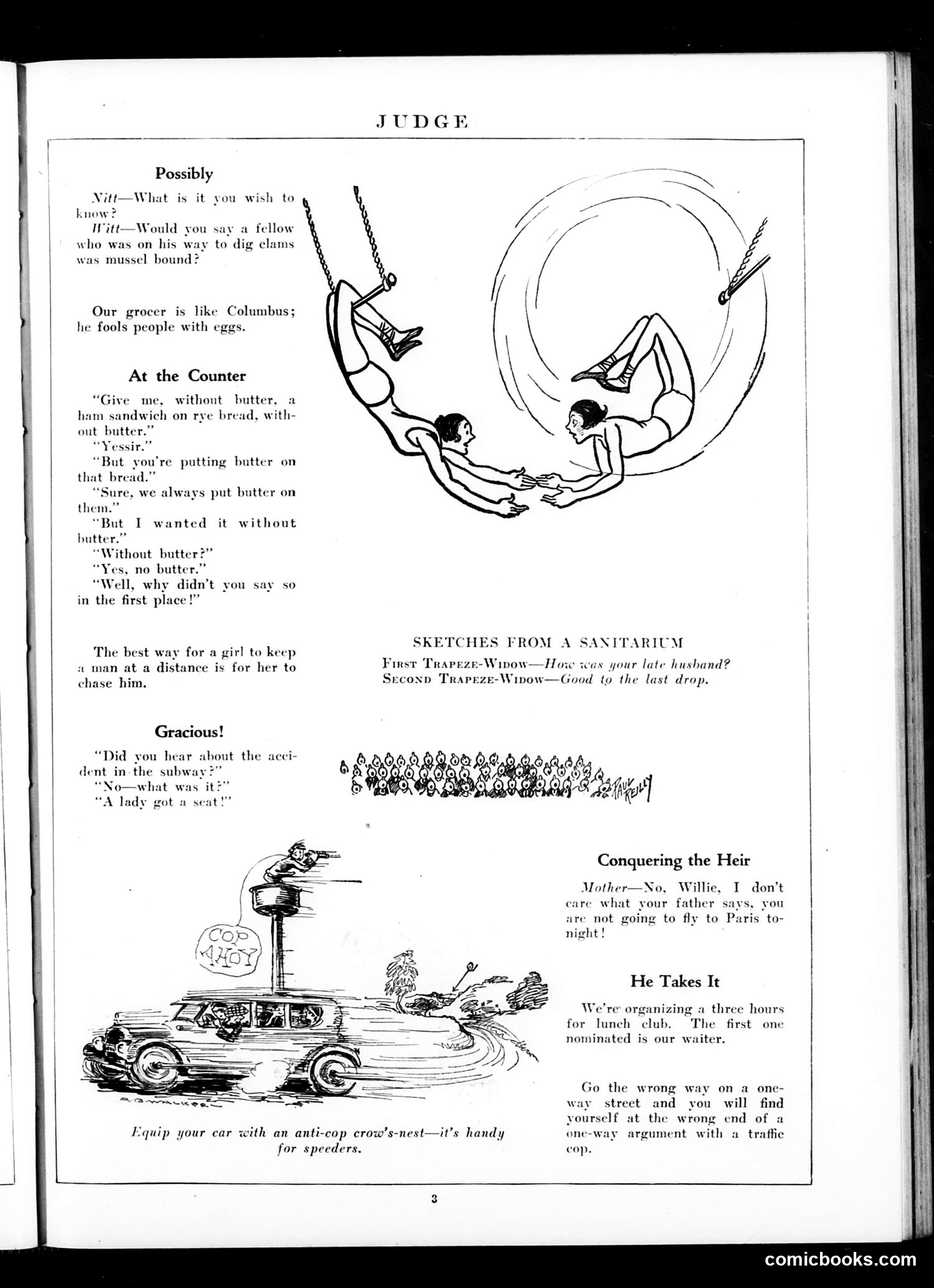
This page contains several unrelated satirical pieces and jokes typical of Judge magazine's format. The **top section** features two vignettes about absurd conversations—one about a grocer "fooling people with eggs" (possibly mocking deceptive retail practices) and a counter dialogue about butter on bread, satirizing overly literal or pedantic customers. The **middle cartoon** titled "Sketches from a Sanitarium" mocks asylum patients, a common satirical subject of the era, with trapeze widows making dark humor about their late husbands. The **bottom cartoon** depicts a car equipped with what appears to be a defensive device labeled "anti-cop crow's-nest" for avoiding police speeders—satirizing both reckless drivers and police enforcement. The final sections contain brief humorous anecdotes about social situations (airplane travel, lunch clubs, traffic arguments), representing typical Judge content: everyday social absurdities treated as fodder for gentle mockery.
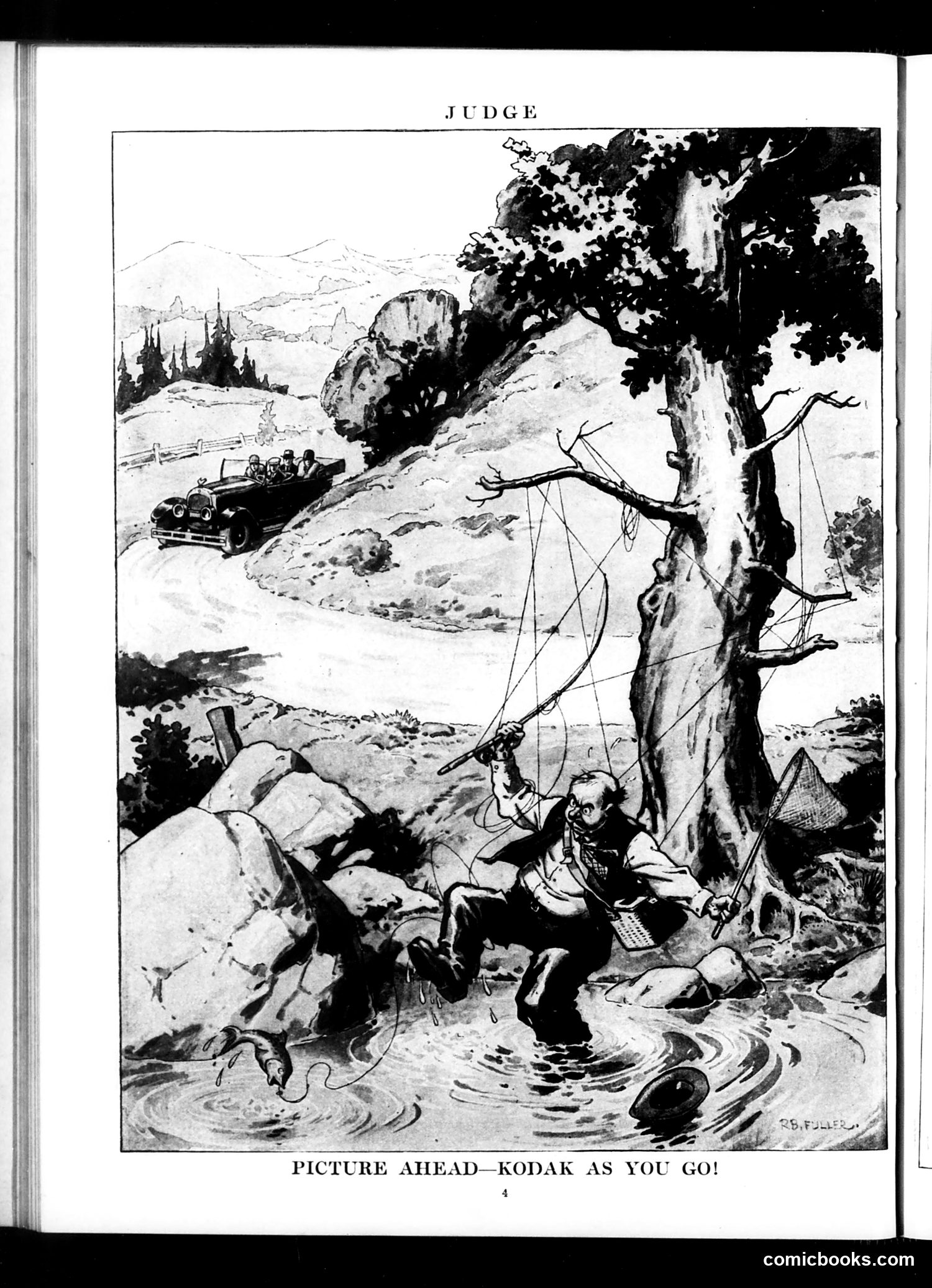
This Judge magazine page features a Kodak camera advertisement illustrated as a comic scene. The caption "Picture Ahead—Kodak as You Go!" promotes portable photography. The illustration shows a humorous camping scene where a tourist with a camera is positioned at a stream, apparently so focused on photographing the landscape that he's unaware of a large insect (appears to be a grasshopper or cricket) looming directly in front of him. Meanwhile, another tourist in an automobile approaches on a mountain road in the background. The joke likely plays on the then-novel idea of amateur photography during travel—suggesting that eager photographers might miss actual events happening right before them while concentrating on capturing pictures. It's promotional satire emphasizing Kodak's portability for outdoor adventures, while gently mocking overzealous photographers.
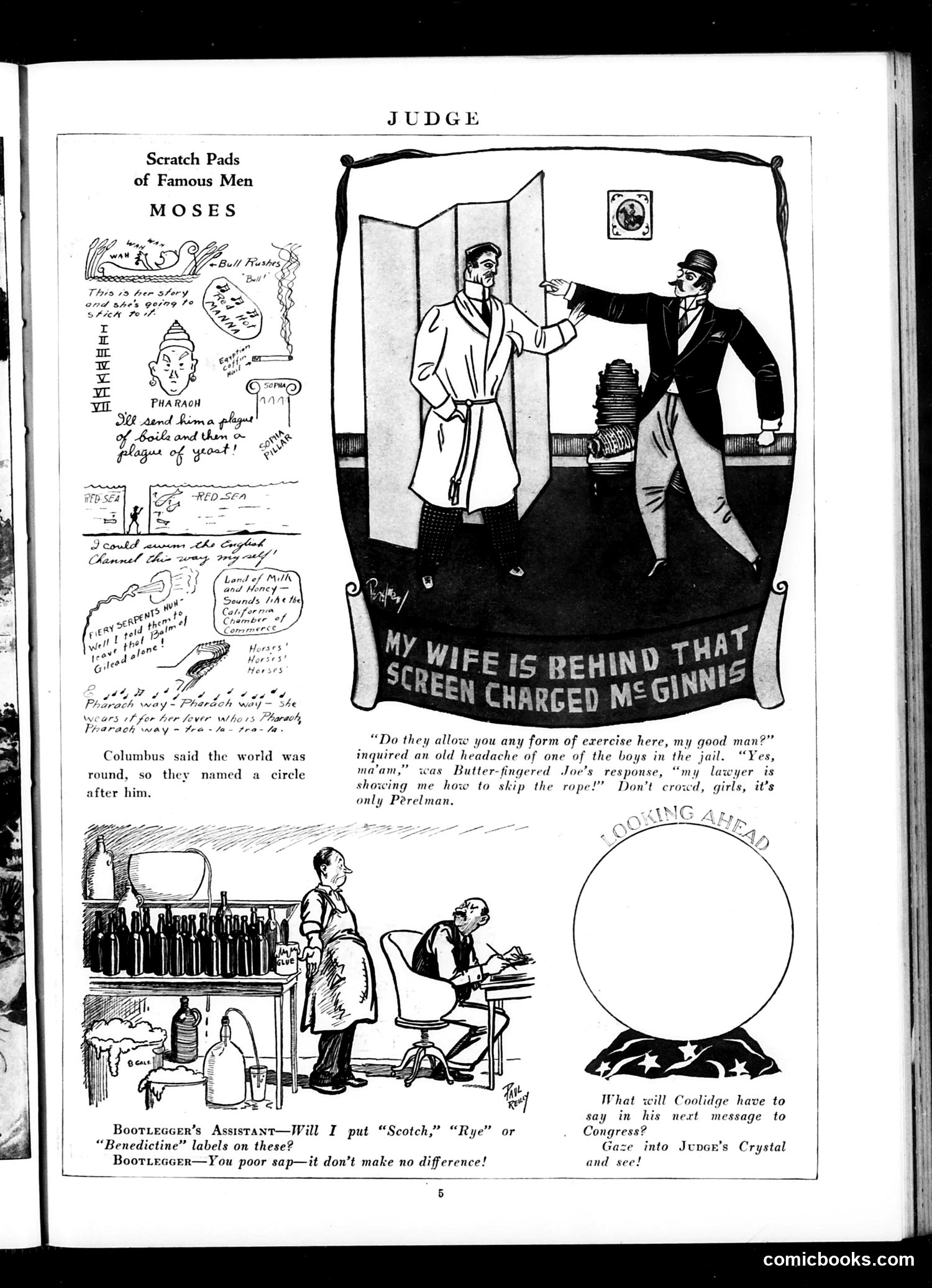
This page contains three distinct cartoons satirizing early 20th-century American life: 1. **"Scratch Pads of Famous Men—Moses"**: A humorous sketch mocking Moses' historical writings and Biblical references. 2. **"My Wife Is Behind That Screen Charged Me Ginnis"**: A jail-scene cartoon where a husband blames his wife for his incarceration, suggesting marital conflict led to legal trouble. The joke plays on domestic discord as criminal motivation. 3. **"Bootlegger's Assistant"**: A Prohibition-era cartoon mocking illegal alcohol distribution. The bootlegger's assistant asks what label to use (Scotch, Rye, or Benedictine), with the bootlegger dismissing the distinction—satirizing how prohibition-era counterfeiters sold indiscriminate fake liquor regardless of claimed brand. 4. **"Looking Ahead"**: A crystal-ball prediction about Coolidge's next Congressional message.
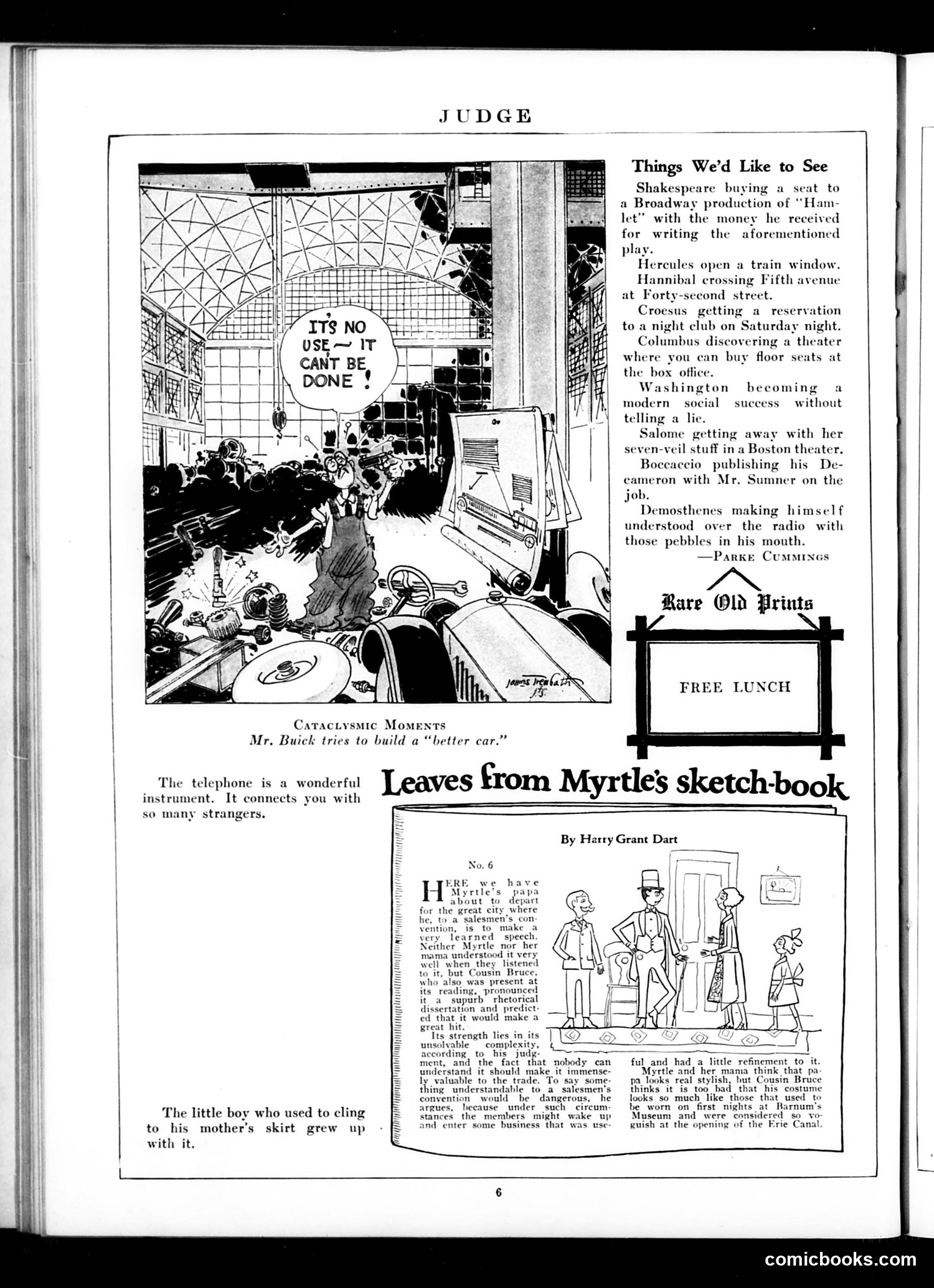
This page contains satirical humor typical of early 20th-century Judge magazine: **"Things We'd Like to See"** is a humorous list of impossible scenarios mixing historical/mythological figures with modern frustrations. Examples include Shakespeare profiting from Hamlet, Hercules opening a train window, and Washington succeeding socially without lying—all satirizing either human nature or contemporary annoyances (like theater box office practices). **"Cataclysmic Moments"** jokes that Mr. Buick (likely referencing the automobile manufacturer) attempts to build a "better car"—implying his current cars aren't good, a typical advertising satire. **"Leaves from Myrtle's Sketchbook"** by Harry Grant Dart depicts a family scene where Myrtle's father delivers an incomprehensible speech. The satire: his unintelligibility is praised by Cousin Bruce as "supurb rhetorical dissertation," mocking how complexity is mistaken for intelligence in sales and public speaking—a critique of empty eloquence. The page reflects Judge's focus on social satire, targeting business pretension, technological limitations, and rhetorical phoniness.
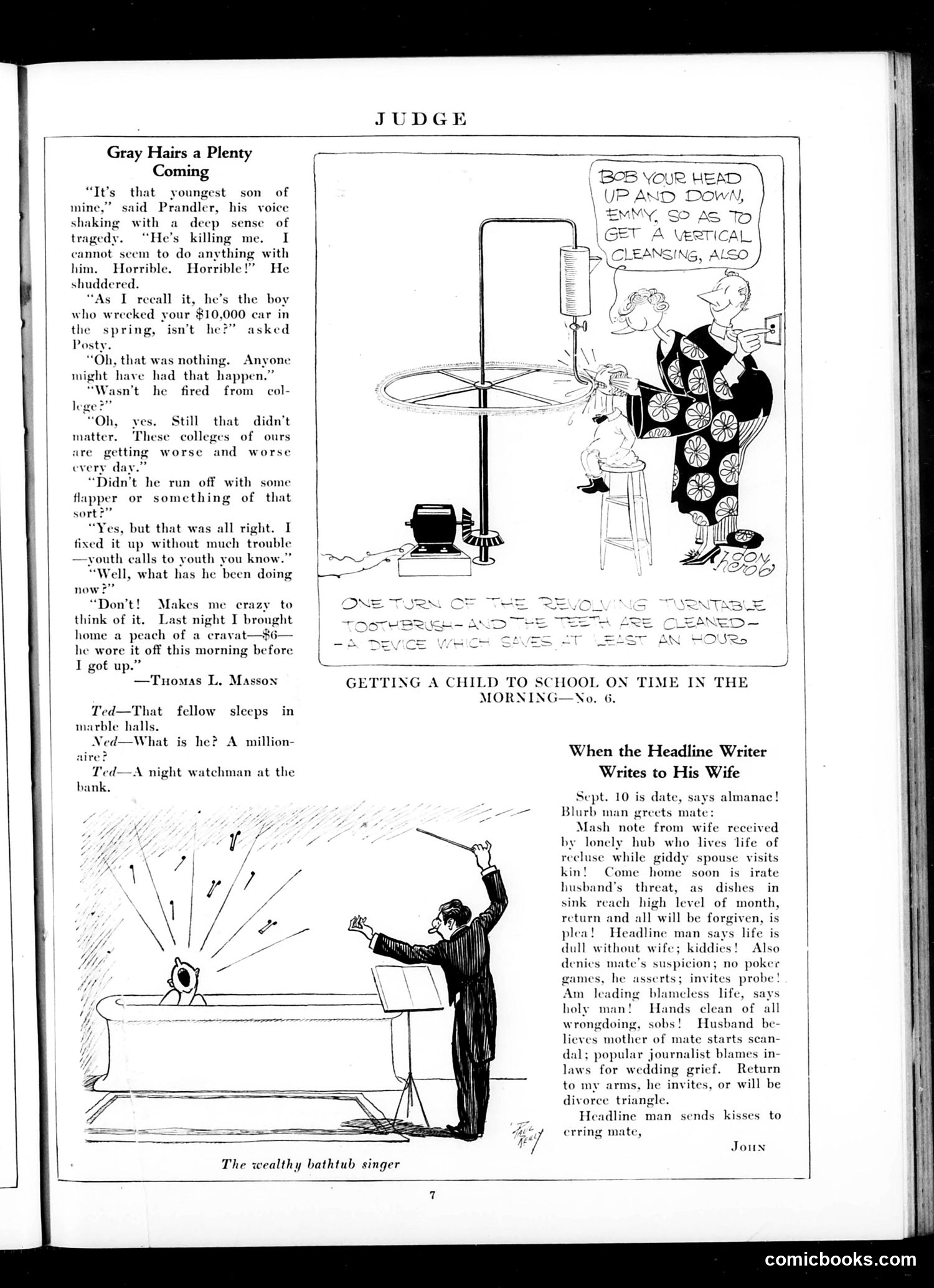
This page contains three satirical pieces mocking early 20th-century American social problems: **"Gray Hairs a Plenty Coming"** depicts a wealthy father's complaint about his irresponsible youngest son. The satire targets parental indulgence: the father dismisses serious misdeeds (wrecking a $10,000 car, expulsion from college, eloping with a "flapper") as minor, blaming external circumstances rather than his son's character. The final offense—the son stealing and wearing his father's expensive cravat overnight—finally provokes outrage, mocking the father's warped priorities. **"Getting a Child to School"** shows domestic chaos with a child and parent needing grooming assistance, satirizing the morning rush and parental exasperation. **"When the Headline Writer Writes to His Wife"** parodies sensationalist newspaper language by presenting a husband's love letter in tabloid-headline style. It mocks both the overwrought dramatic tone of newspaper headlines and the marital discord it describes—a working journalist neglecting home life while pleading innocent of infidelity and gambling. All three target American middle/upper-class domesticity and social hypocrisy.
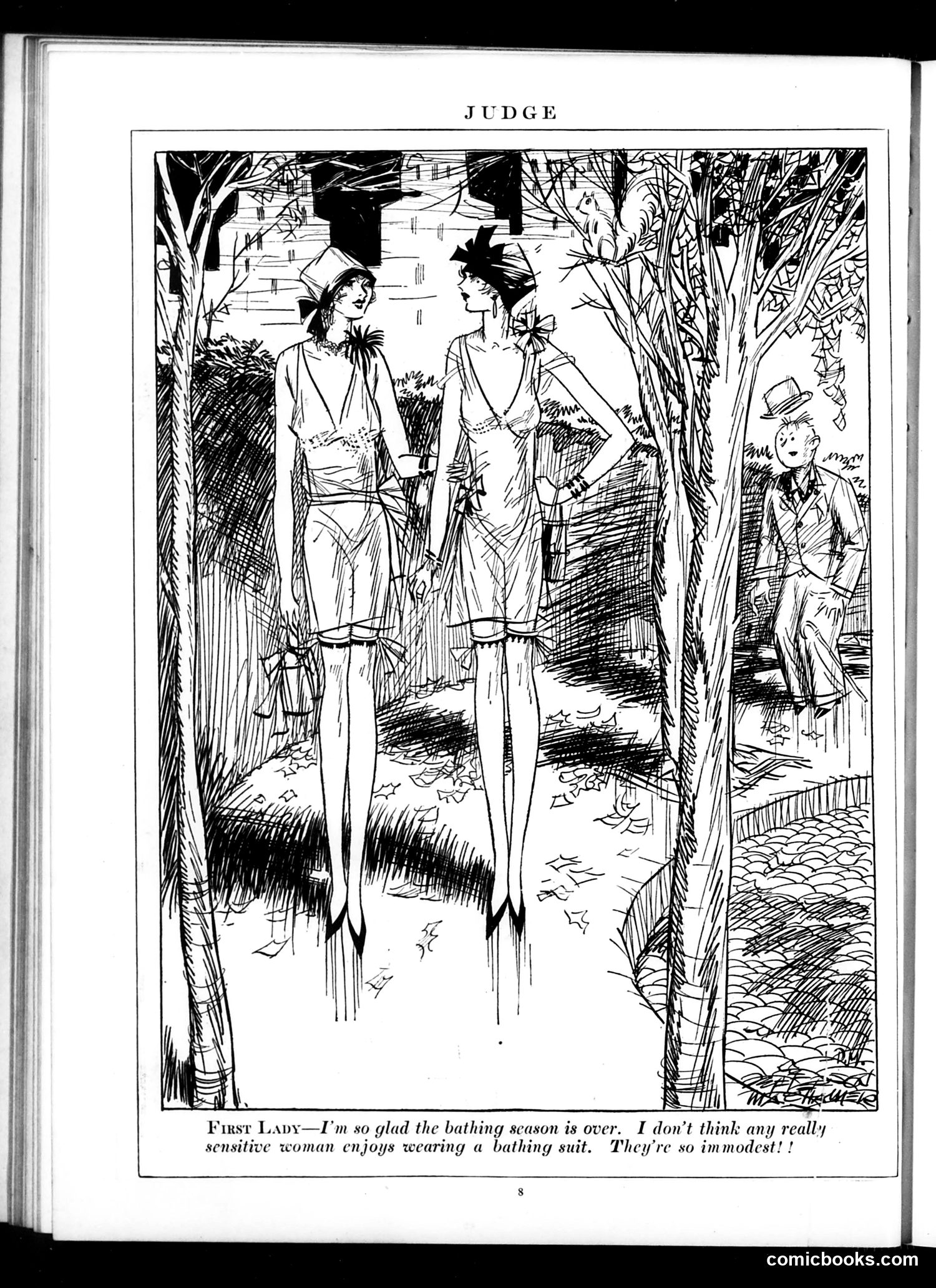
This cartoon satirizes Victorian-era attitudes about women's modesty and fashion. Two elegantly dressed women converse in a wooded setting, with one expressing relief that the bathing season has ended because bathing suits are "immodest." The joke targets the hypocrisy of the era: while women claimed bathing suits violated propriety, they wore form-fitting day dresses with revealing necklines and silhouettes that were equally or more exposing. The cartoon mocks prudish attitudes by having the "sensitive woman" complain about modesty while wearing a dress that contradicts her stated values. This reflects early 20th-century debates about women's clothing, leisure activities, and changing social norms around femininity and body exposure.
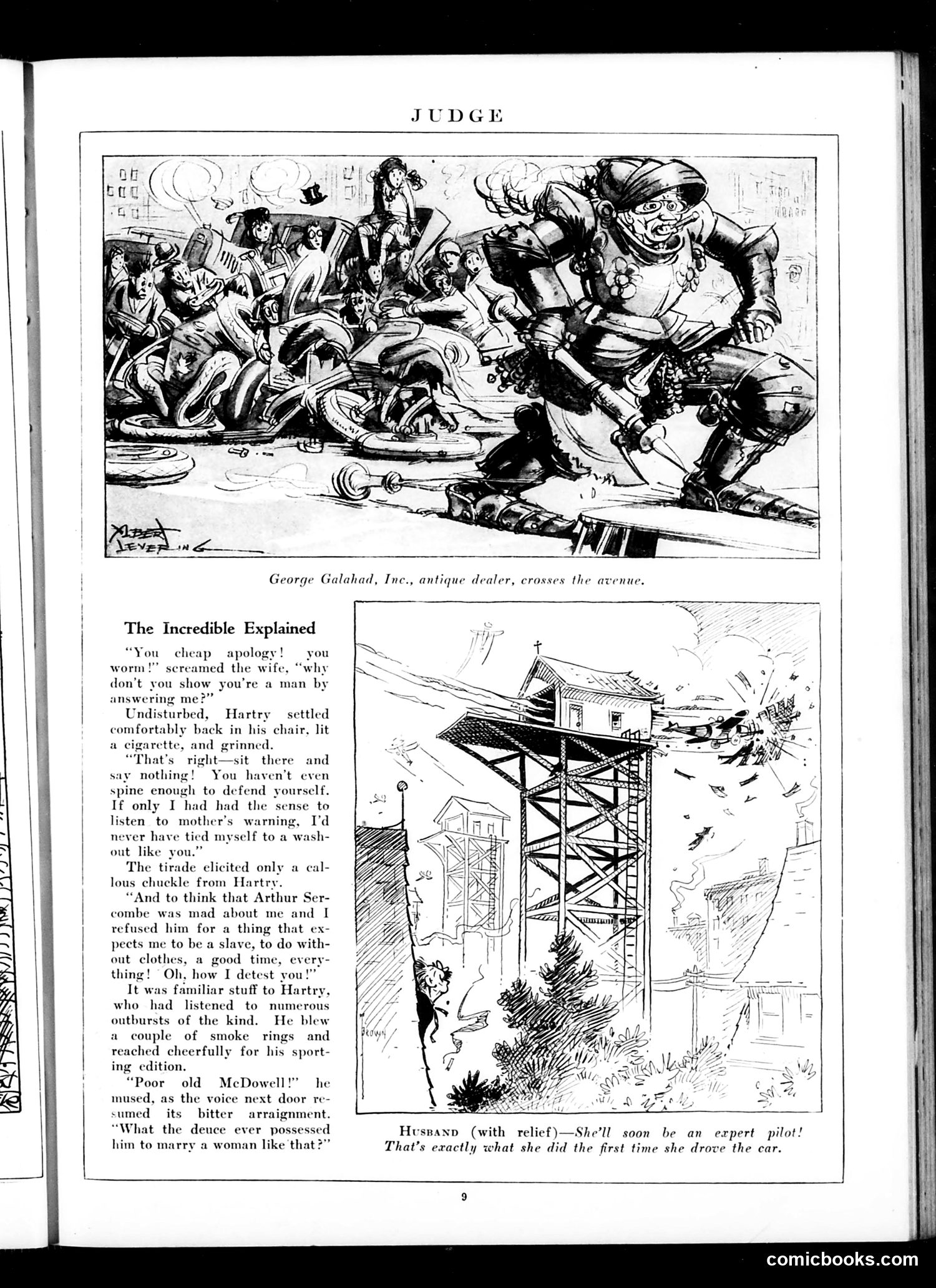
This page contains two separate satirical pieces from *Judge* magazine: **Top cartoon:** A chaotic street scene captioned "George Galahad, Inc., antique dealer, crosses the avenue." The absurdist humor depicts an antique dealer navigating city traffic surrounded by colliding cars and chaos, satirizing the dangers of modern urban traffic and the collision between old-fashioned commerce and modern automobile culture. **"The Incredible Explained":** A domestic comedy about a married couple. The wife verbally berates her husband Hartry for his passivity and lack of spine—he refuses to argue back, instead smoking cigarettes and ignoring her tirades. The joke's punchline (bottom illustration) references her terrible driving: she'll become an "expert pilot" the same way she learned to drive, implying through reckless accident and disaster. The satire mocks nagging wives, henpecked husbands, and women drivers—contemporary stereotypes reflecting early-20th-century attitudes.
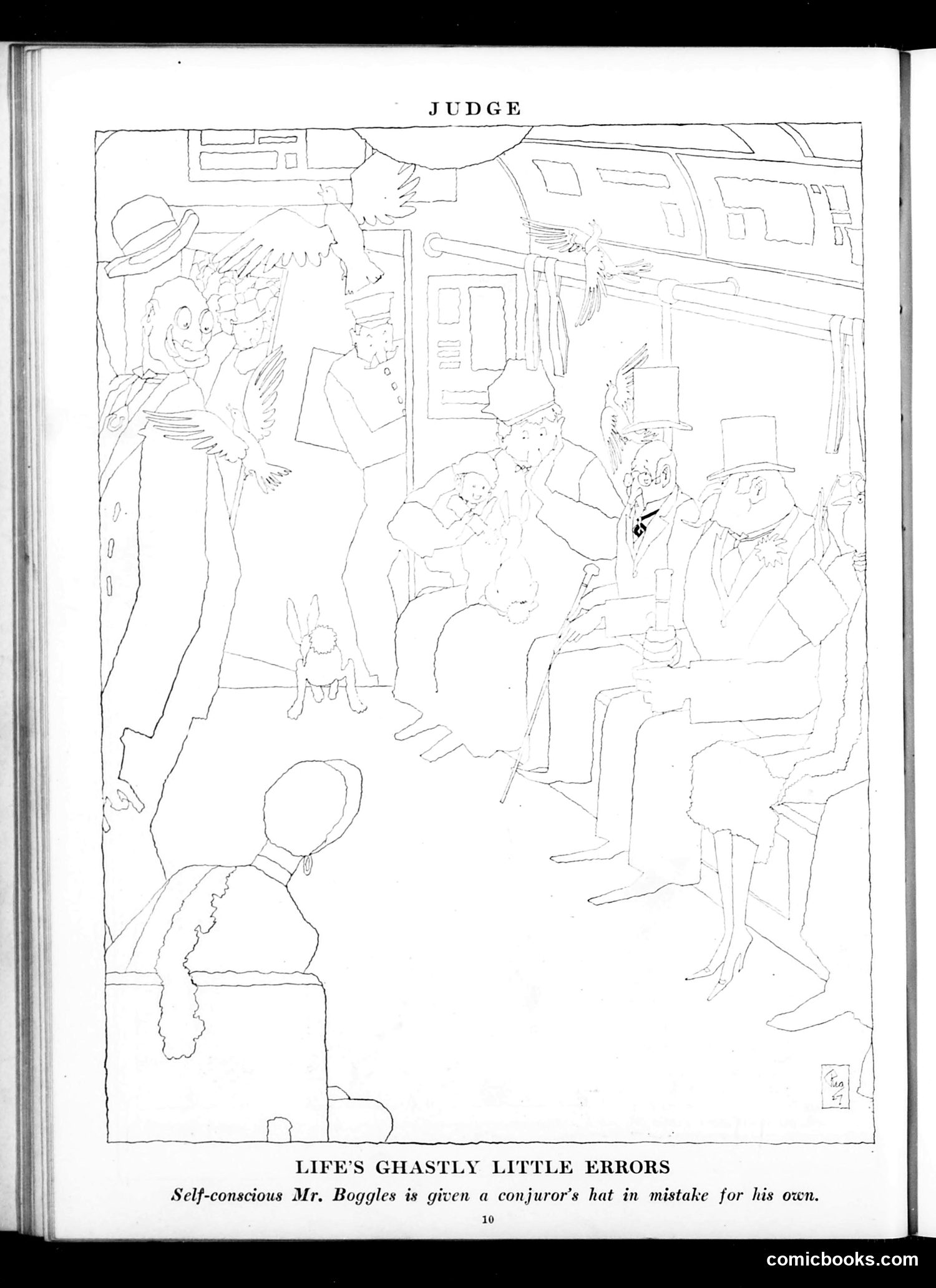
This cartoon satirizes social embarrassment through a case of mistaken identity. Mr. Boggles, characterized as "self-conscious," receives a magician's conjuring hat instead of his own hat—presumably at a social gathering or restaurant. The humor derives from the humiliation of wearing the wrong hat in public, particularly an unusual one associated with stage magic or performance. The joke plays on Victorian-era anxiety about appearing foolish or drawing unwanted attention in polite society. The titled series "Life's Ghastly Little Errors" suggests Judge magazine's recurring focus on mundane social mishaps and the exaggerated mortification they cause self-aware individuals. The cartoon's appeal lies in readers recognizing the universal discomfort of such everyday mix-ups and their social consequences.
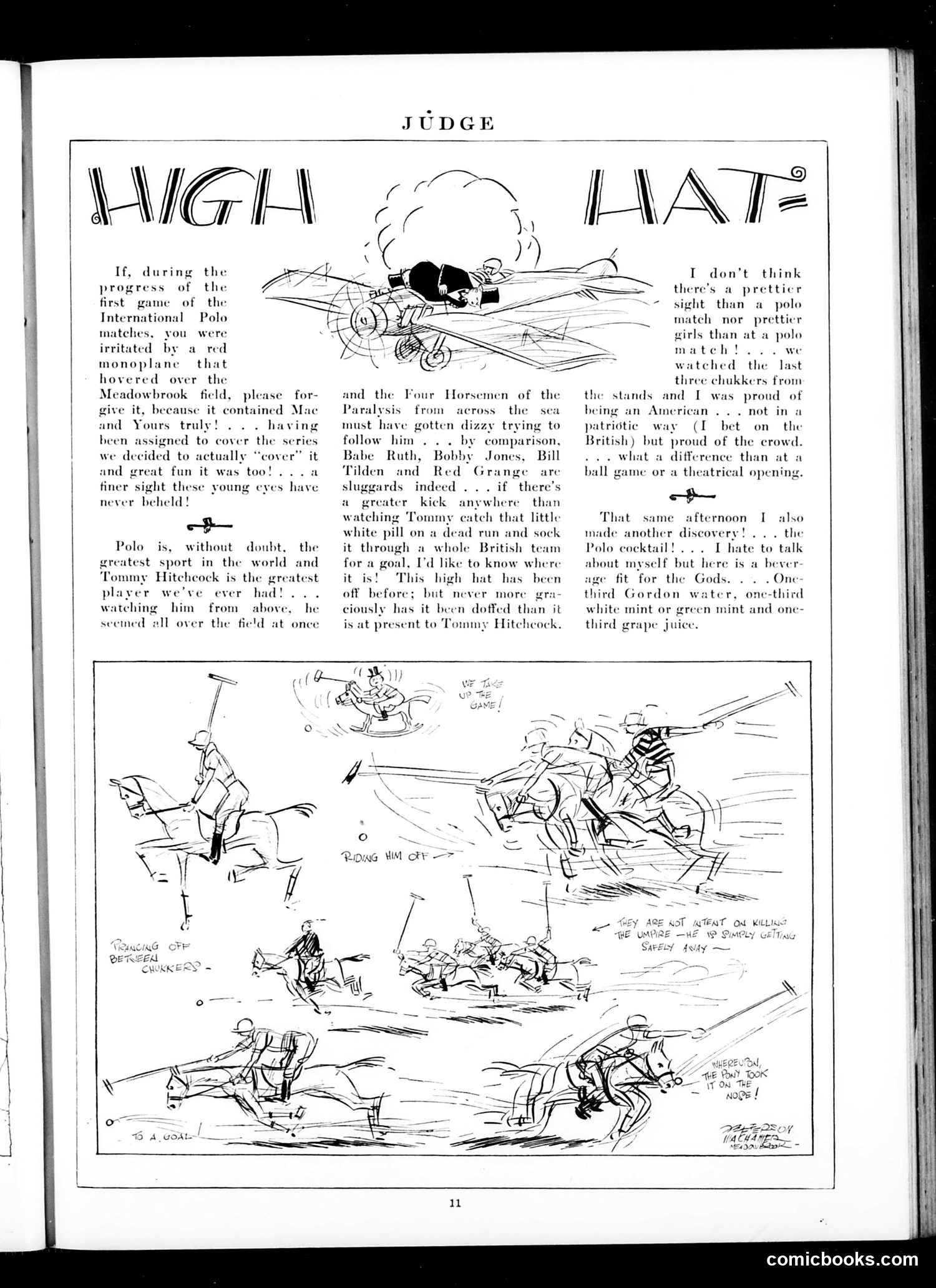
This page celebrates the International Polo matches, likely from the 1920s-30s based on references and style. The author (a Judge writer/illustrator) describes covering the event by airplane and praises **Tommy Hitchcock**, who appears to be America's premier polo player, comparing him favorably to sports legends like Babe Ruth and Bill Tilden. The satire compares British polo team members to "the Four Horsemen of the Paralysis" (likely mocking their playing style). The author humorously contrasts polo matches as refined American spectacles with baseball games and theatrical openings, and invents a silly "Polo cocktail" recipe as a joke. The bottom illustration shows exaggerated polo action scenes. The overall tone is patriotic boosterism mixed with gentle mockery of both British competitors and American sporting culture.
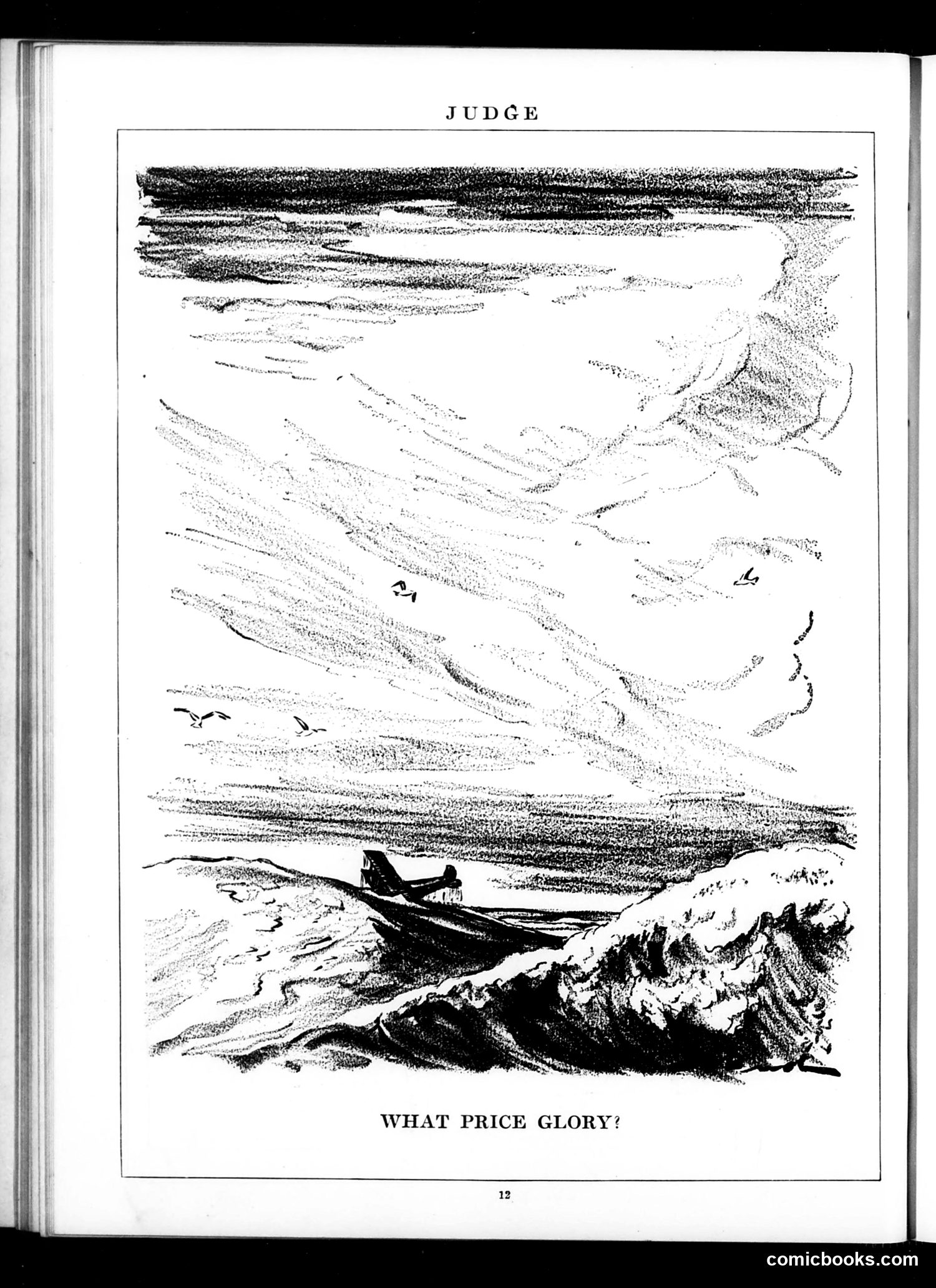
This is an anti-war editorial cartoon showing a wrecked ship beached on rocky shore beneath a stormy sky. The title "What Price Glory?" sarcastically questions whether military glory is worth its cost in destruction and loss. The cartoon likely responds to WWI combat narratives or military propaganda celebrating heroic sacrifice. By depicting only devastation—a shattered vessel, barren landscape, dark clouds—the artist argues that "glory" in war produces ruin, not honor. The phrase "What Price Glory?" was a common anti-war rhetorical device of the early 20th century, used to challenge nationalist fervor by emphasizing war's actual human and material costs rather than its romantic mythology.
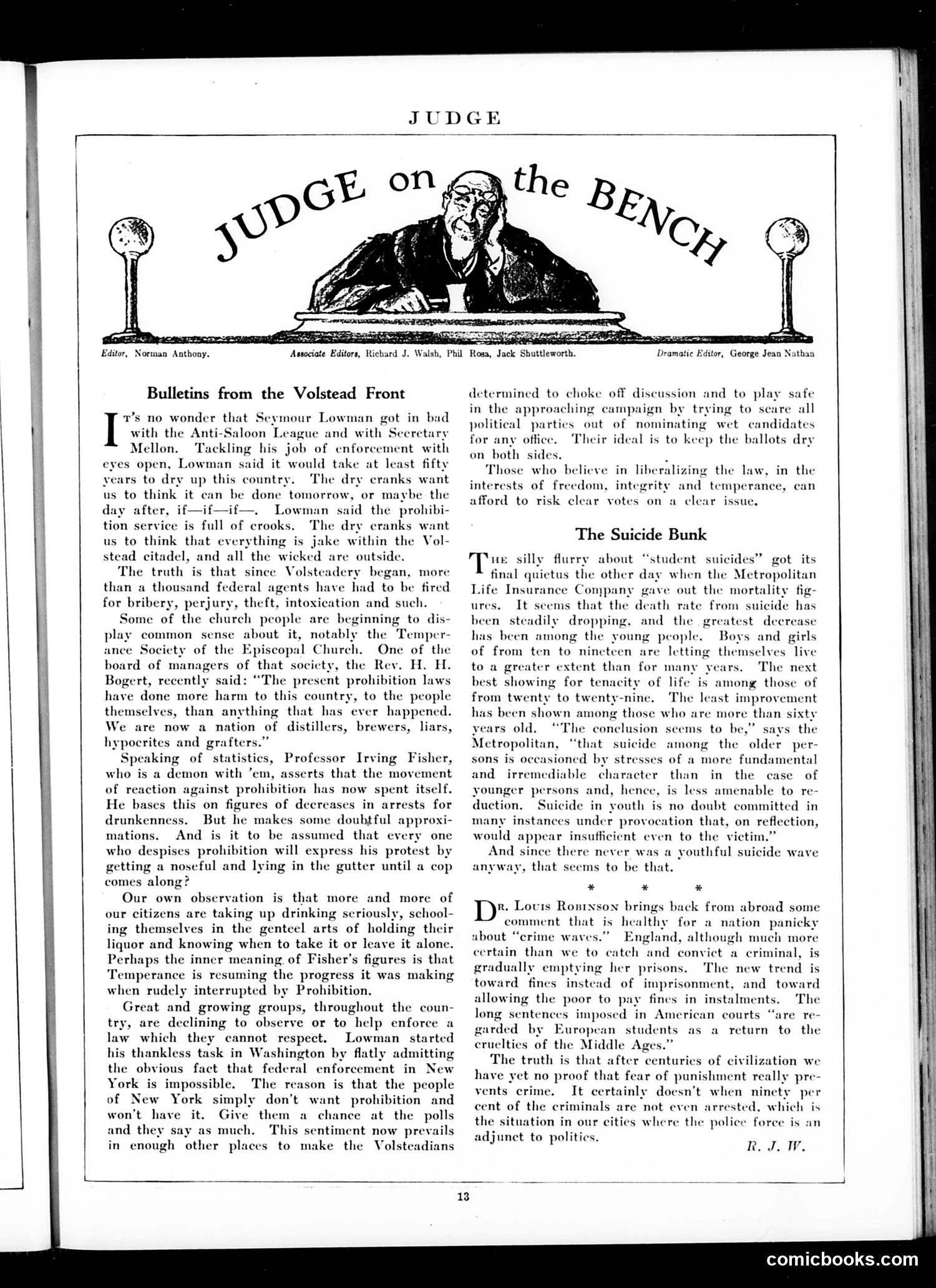
This page from Judge satirizes **Prohibition enforcement** during the Volstead Act era (1920s-1930s). ## Main Content: **"Bulletins from the Volstead Front"** criticizes Seymour Lowman, Prohibition enforcement official, for admitting the policy is failing. The article mocks the Anti-Saloon League's unrealistic expectations while documenting corruption: over 1,000 federal agents fired for bribery and theft. Judge argues Prohibition has backfired—creating criminals and hypocrites rather than temperance. It notes growing public resistance, particularly in New York, and quotes Rev. H.H. Bogert calling the laws more harmful than beneficial. **"The Suicide Bunk"** debunks panic about student suicides, citing Metropolitan Life Insurance mortality data showing death rates among young people actually declining. ## Satire Point: Judge attacks Prohibition as unenforceable, counterproductive policy that generates corruption while the public increasingly ignores it. The magazine advocates for letting voters decide rather than authoritarian dry-faction control.
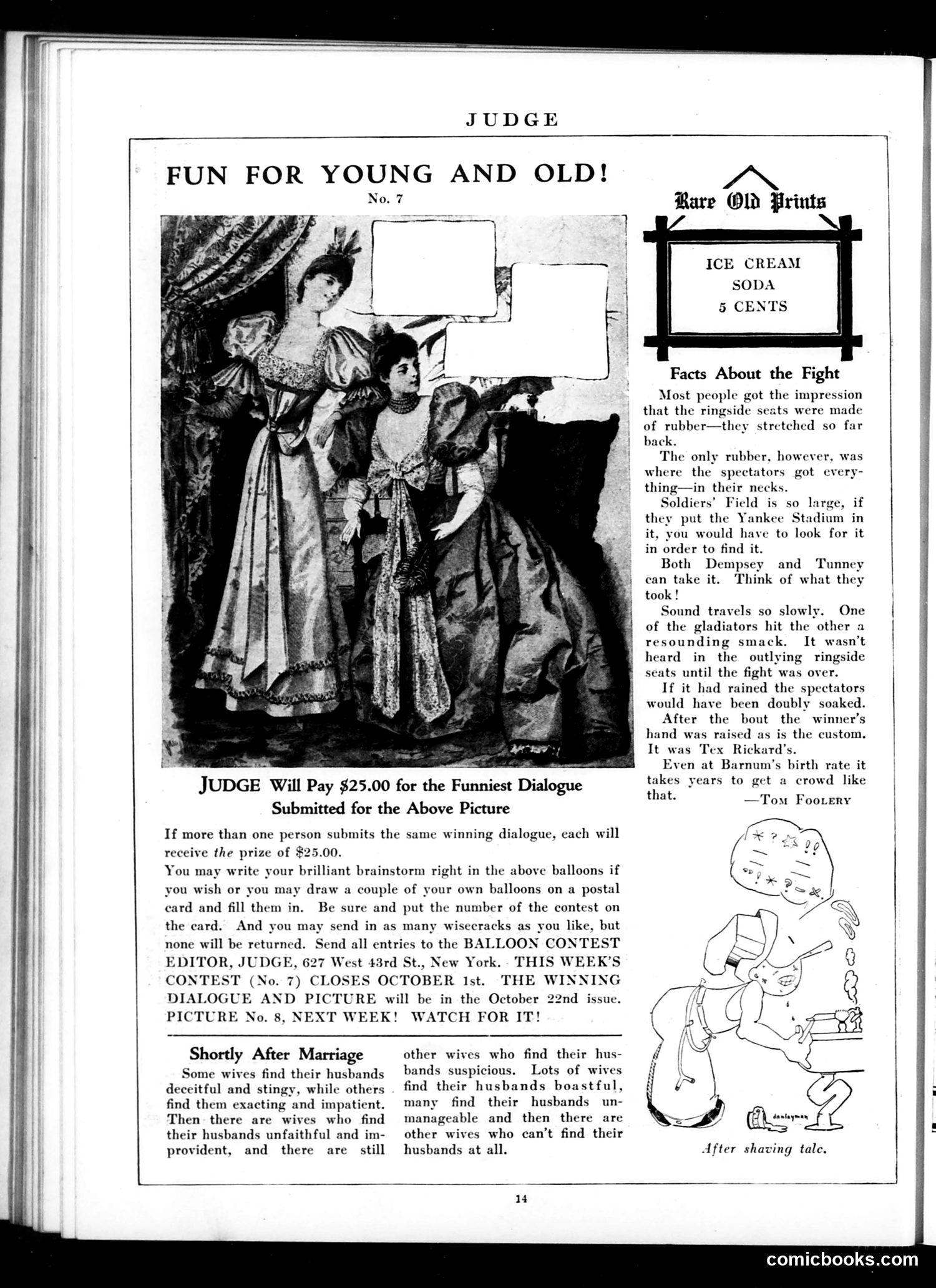
This page from Judge magazine presents a reader-submission cartoon contest. The main image shows two elegantly dressed women in what appears to be an early 20th-century interior, with empty speech balloons for readers to fill in dialogue. Judge offers $25 for the funniest submitted caption, encouraging readers to send entries by October 1st. The page also includes two unrelated sections: a brief satirical essay on marriage troubles titled "Shortly After Marriage," and "Facts About the Fight"—commentary on what appears to be a major boxing match (likely Dempsey-Tunney, given references to both fighters). This piece satirizes the enormous venue size, poor sightlines for spectators, and sound delay at the event. A small cartoon titled "After shaving tale" depicts a man with shaving mishaps. The advertisements include ice cream sodas for five cents, typical of the era.
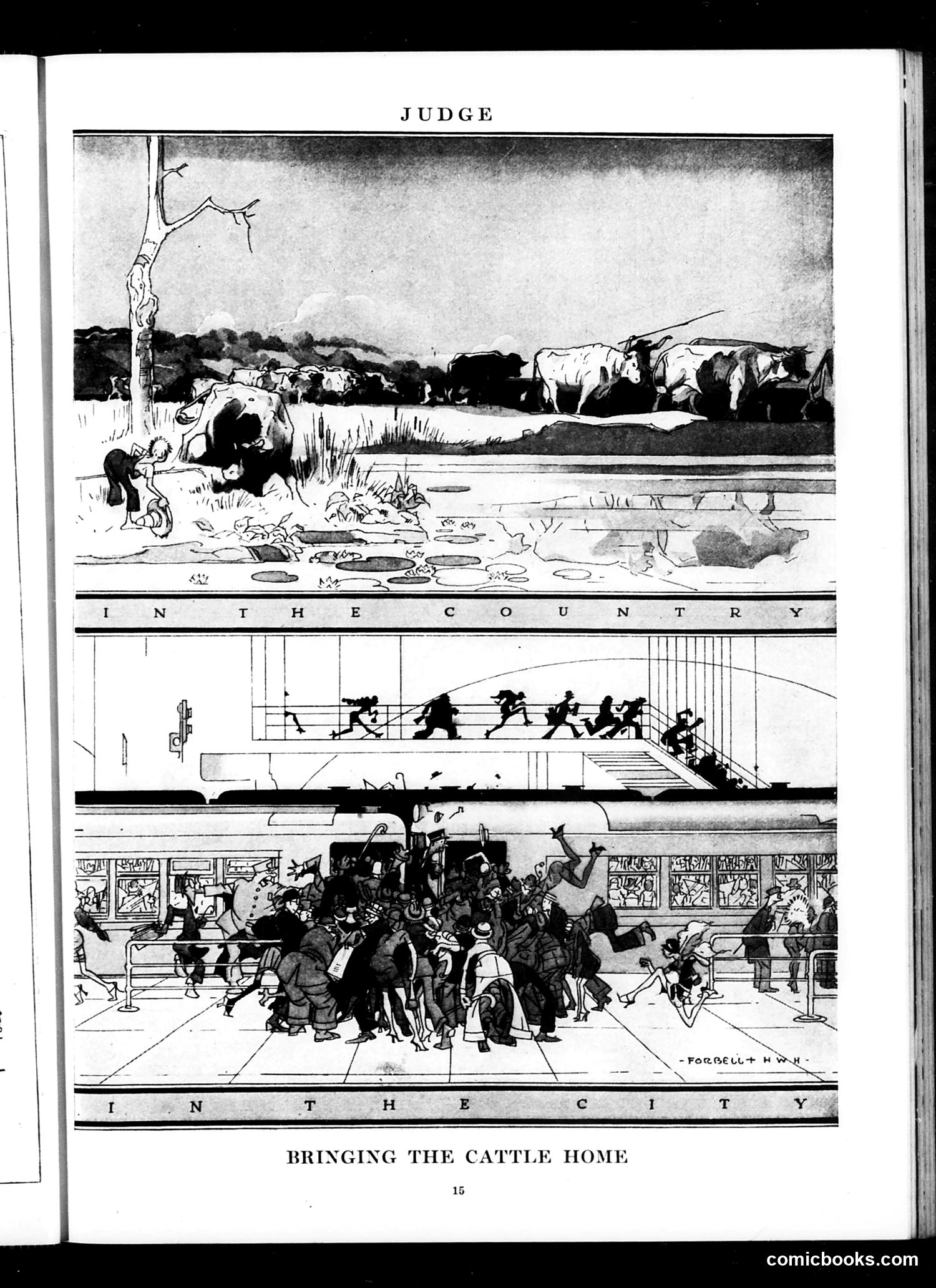
This three-panel satirical cartoon contrasts rural and urban American life. The top panel shows peaceful countryside scenes with cattle and farmers by a river. The middle panel depicts a train or transit car with orderly passengers. The bottom panel dramatically shifts to a chaotic city street scene filled with densely packed, disheveled crowds in apparent disorder. The satire appears to critique urban crowding and social disorder by comparing it unfavorably to rural simplicity. "Bringing the cattle home" likely suggests that city dwellers—referred to as "cattle"—are being herded into increasingly cramped, chaotic urban conditions, contrasting sharply with the pastoral tranquility above. This reflects late 19th/early 20th-century anxieties about urbanization and its social consequences. The artist uses the comic progression to emphasize this criticism.
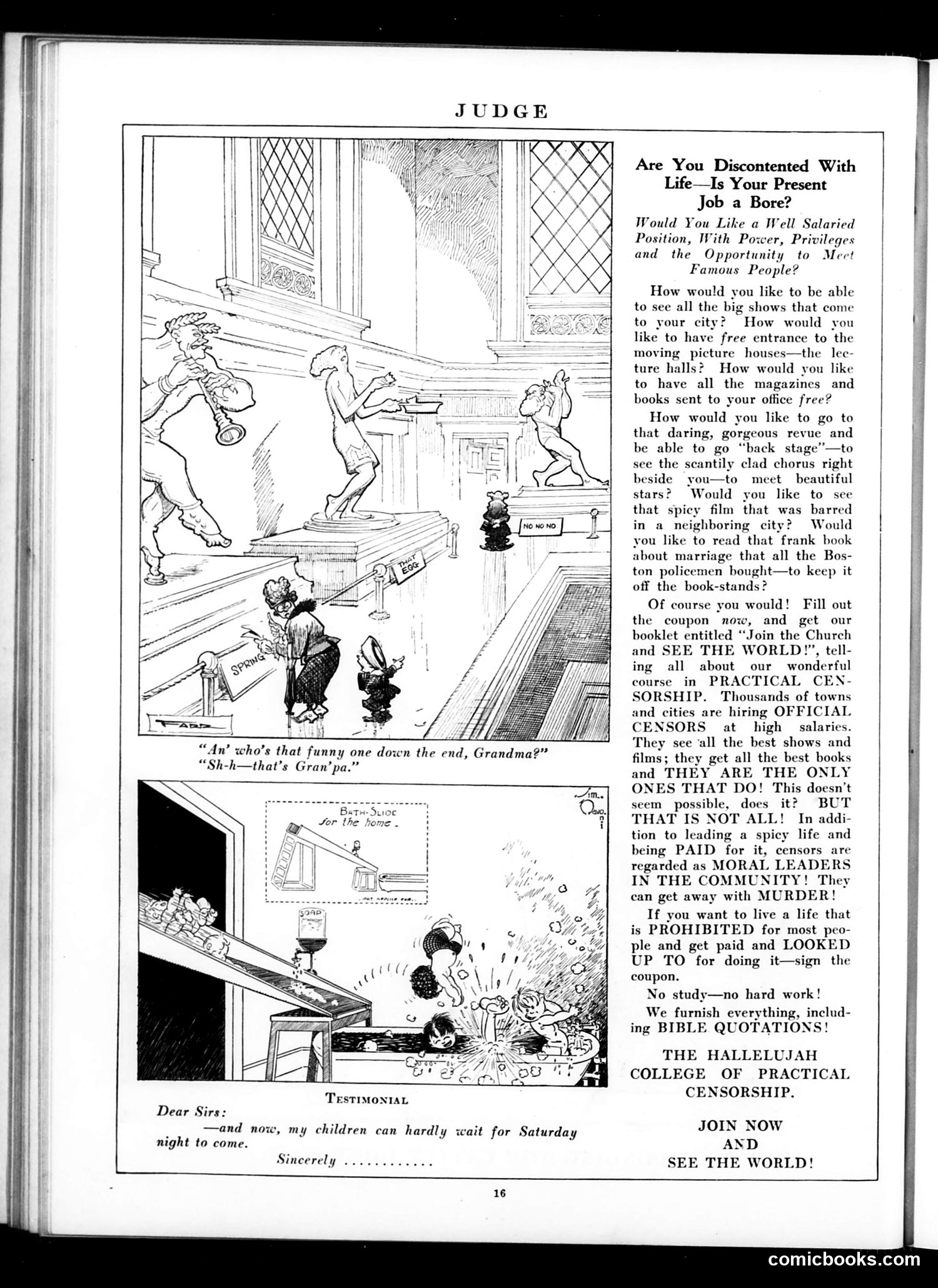
This Judge page satirizes 1920s American censorship boards through mock-advertisement parody. The "Hallelujah College of Practical Censorship" advertises censorship as a cushy job where officials gain access to all the "forbidden" entertainment (shows, films, books) they're paid to suppress—while being simultaneously regarded as moral authorities in their communities. The satire's target: the hypocrisy that censors enjoy exactly the "spicy" content they ban for ordinary citizens. The ad sardonically notes censors can access banned films and books, attend burlesque shows backstage, and read controversial materials—all while being paid and respected as community moral leaders who "can get away with MURDER." The accompanying cartoons show chaotic domestic scenes, likely illustrating the absurdity of censorship enforcement. The testimonial ("my children can hardly wait for Saturday night") implies families attended censored entertainment anyway, undermining the censors' authority.
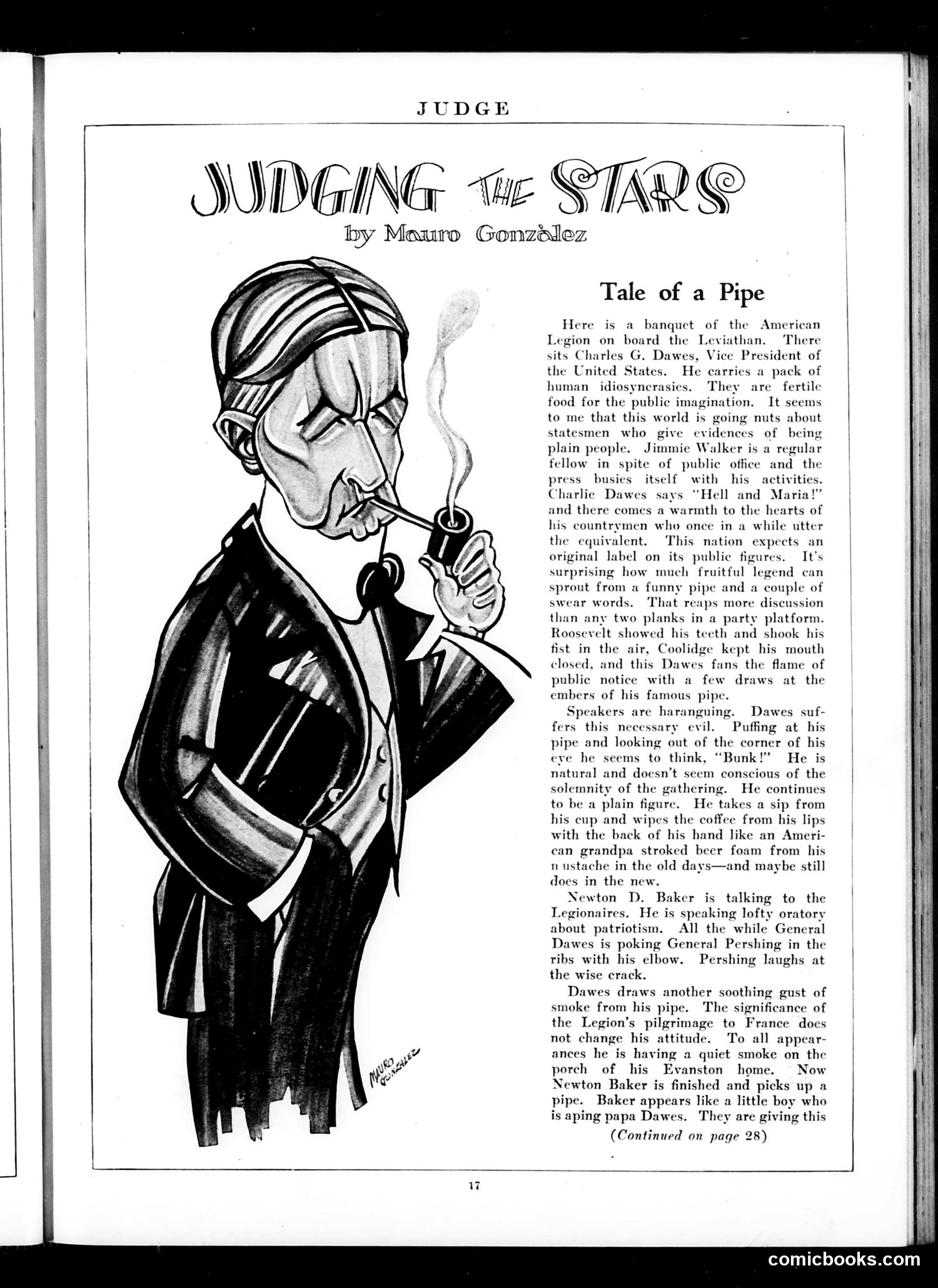
This satirical piece by Mauro Gonzalez mocks Vice President Charles G. Dawes for his famous pipe-smoking habit becoming a public symbol of his "plain people" authenticity. The cartoon depicts Dawes at an American Legion banquet aboard the ship Leviathan, casually smoking while dignified speakers like Newton D. Baker deliver patriotic oratory. The satire targets how the American public elevates trivial personal quirks—a pipe, swearing, casual manners—into meaningful character traits. Gonzalez contrasts this with actual statesmen like Roosevelt (teeth-showing), Coolidge (stoicism), and General Pershing, suggesting Dawes' appeal relies entirely on manufactured folksy image rather than substance. The piece ridicules both Dawes' affectation of ordinariness and the public's hunger for "original labels" on politicians, lamenting how a pipe generates more discussion than policy platforms.
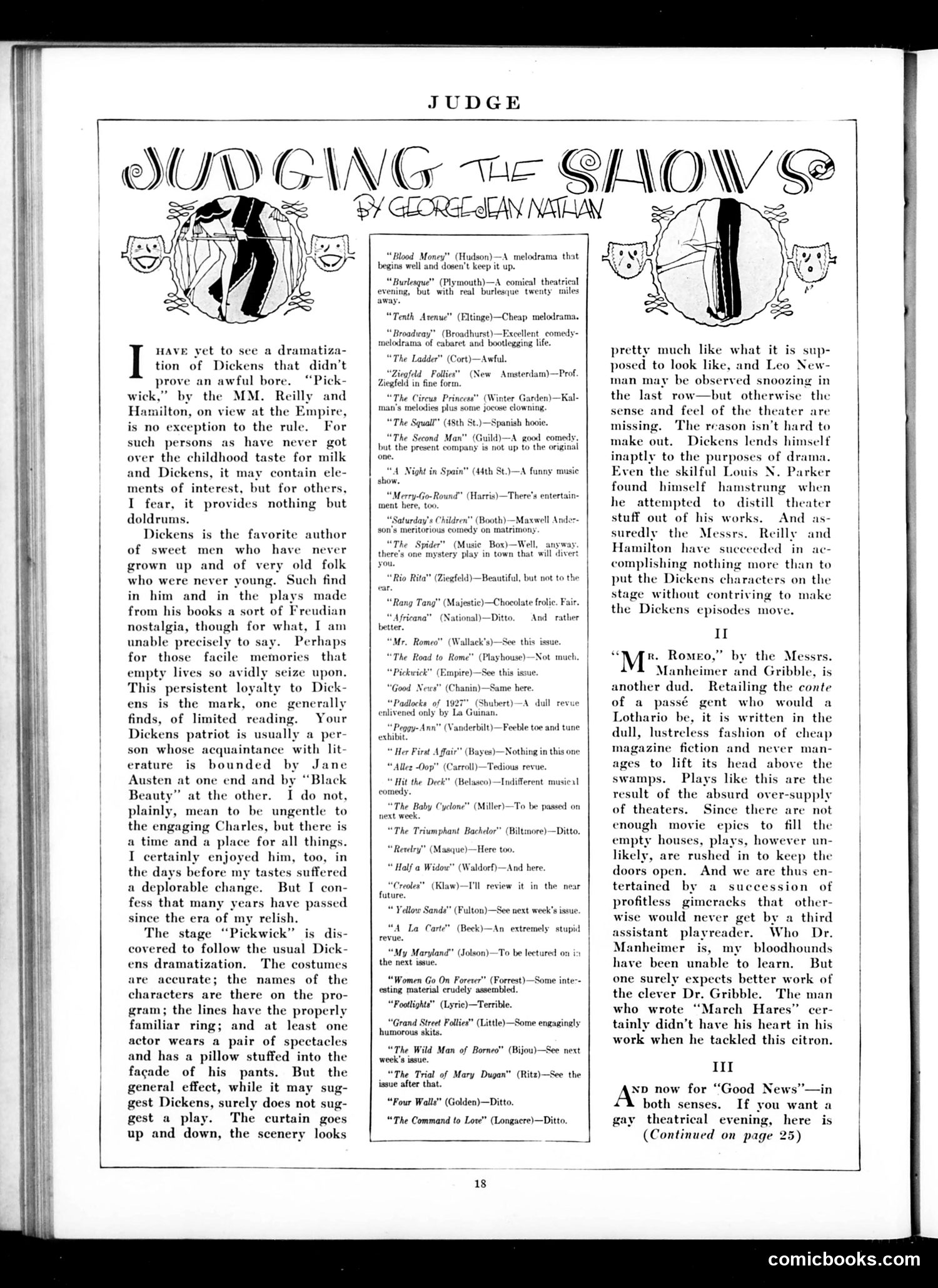
This is a theater review column, not a political cartoon. Nathan was Judge magazine's drama critic, and this page contains his caustic assessments of current Broadway productions (circa mid-1920s, based on references to "Good News" and Ziegfeld Follies). The main article critiques dramatizations of Dickens, particularly "Pickwick" at the Empire Theatre. Nathan argues that Dickens adaptations inevitably disappoint because they reduce his work to scenery and nostalgia without capturing his actual dramatic substance. He specifically faults the Reilly and Hamilton production for merely placing Dickens characters on stage without making the episodes themselves theatrically compelling. The sidebar lists brief, often dismissive reviews of shows like "Mr. Romeo" (called "another dud"), "The Ladder," and various musicals and comedies. Nathan's wit lies in his terse, cutting judgments—typical of Judge's satirical approach to contemporary culture and entertainment.
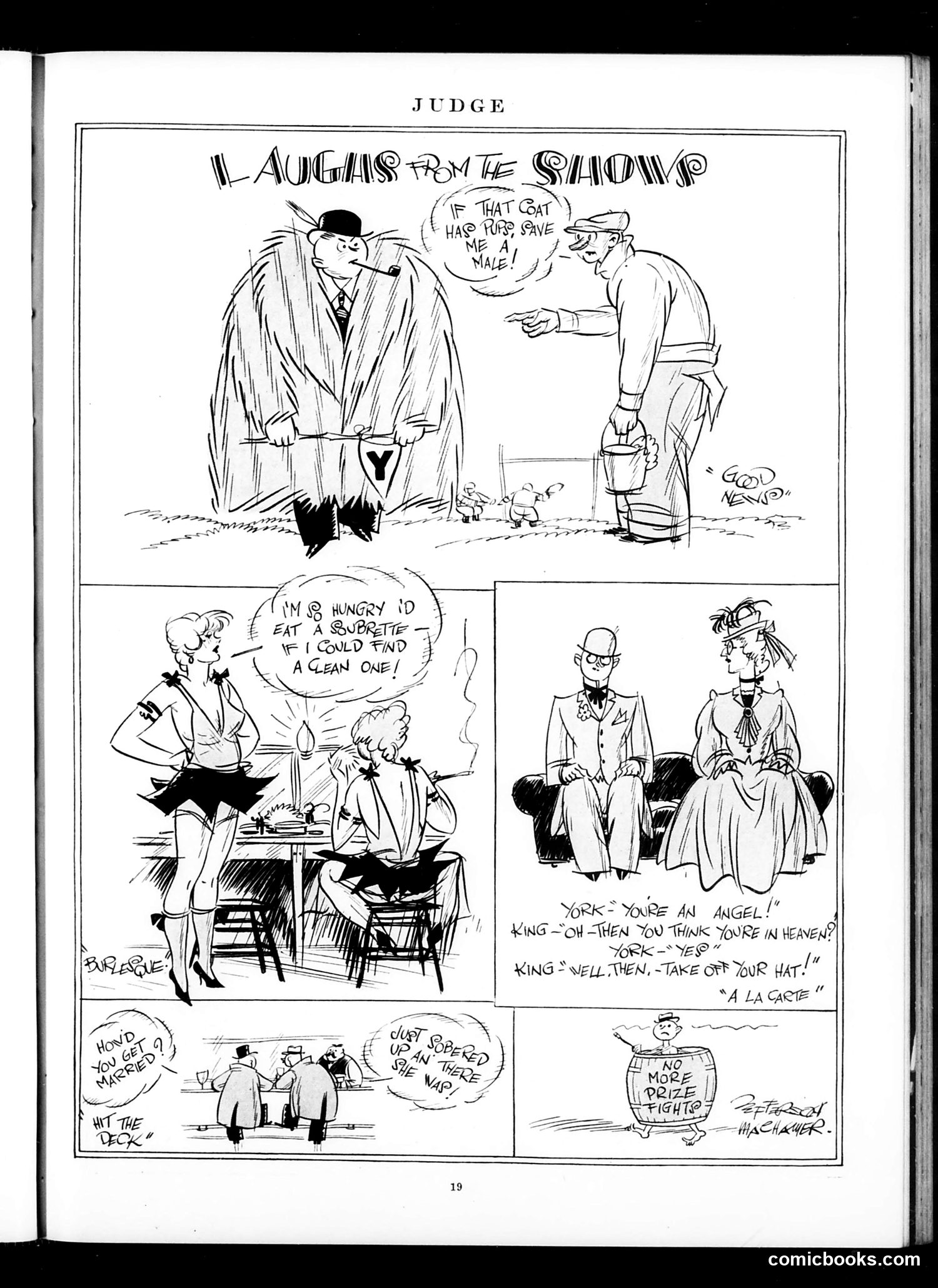
This is a multi-panel comic satirizing theatrical society and etiquette. The top panel features a cat-man character (marked with a "Y" emblem, likely representing a theatrical troupe or organization) with well-dressed gentlemen. The dialogue references the cat saving "me a male," a pun on theatrical casting or romantic prospects. Subsequent panels mock upper-class behavior: a woman complaining about hunger while dining, references to "heaven" and removing one's hat as a sign of respect. The phrase "*A La Carte*" (visible in the third panel) appears to be a pun or theatrical reference. The final panel shows figures discussing prize fights, suggesting satire of theatrical pretension versus lowbrow entertainment interests. Overall, the comic mocks the affectations and contradictions of show-business society—their claims to refinement while pursuing base interests. The unsigned cartoonist uses anthropomorphic and physical humor typical of early-to-mid 20th-century Judge magazine satire.
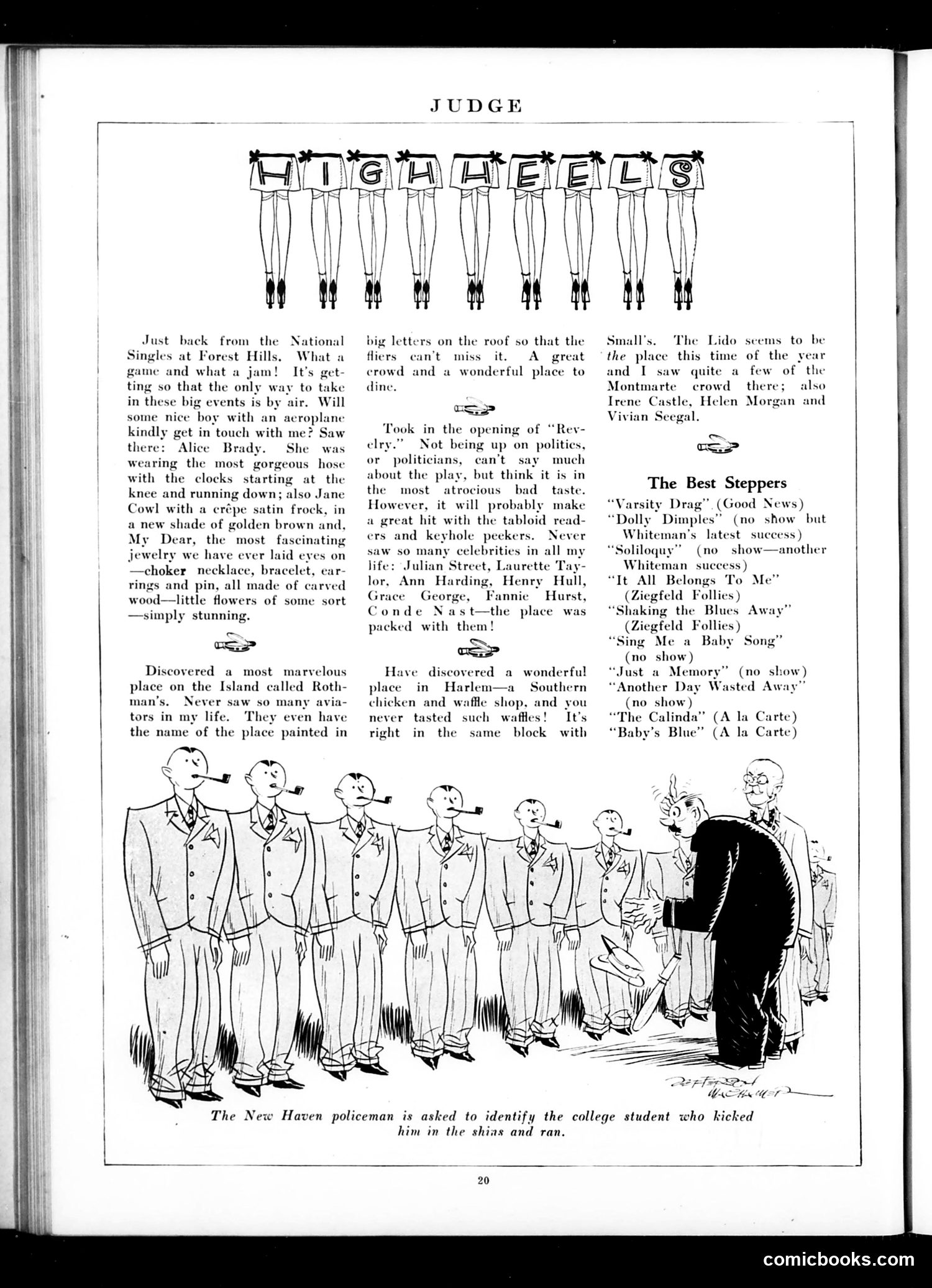
This page from Judge magazine contains social commentary and entertainment gossip. The top cartoon depicts a New Haven policeman asked to identify a college student who kicked him and fled. The joke satirizes the lawlessness of college students in the 1920s—a period when youth rebellion was becoming visible social concern. The identical lineup of young men (drawn with exaggerated features) suggests the difficulty of distinguishing between privileged college boys, implying they operated with impunity. The accompanying text comprises gossipy society column observations about recent cultural events: Forest Hills tennis matches, Broadway theater openings (particularly "Revelry," criticized for bad taste yet likely popular), and nightlife in Harlem. The writer casually name-drops celebrities and mocks both high society and tabloid readers' fascination with celebrity scandal. The list of popular songs reflects 1920s jazz-age entertainment trends. Overall, the page satirizes both youthful misbehavior and elite society's hypocritical obsession with scandal.
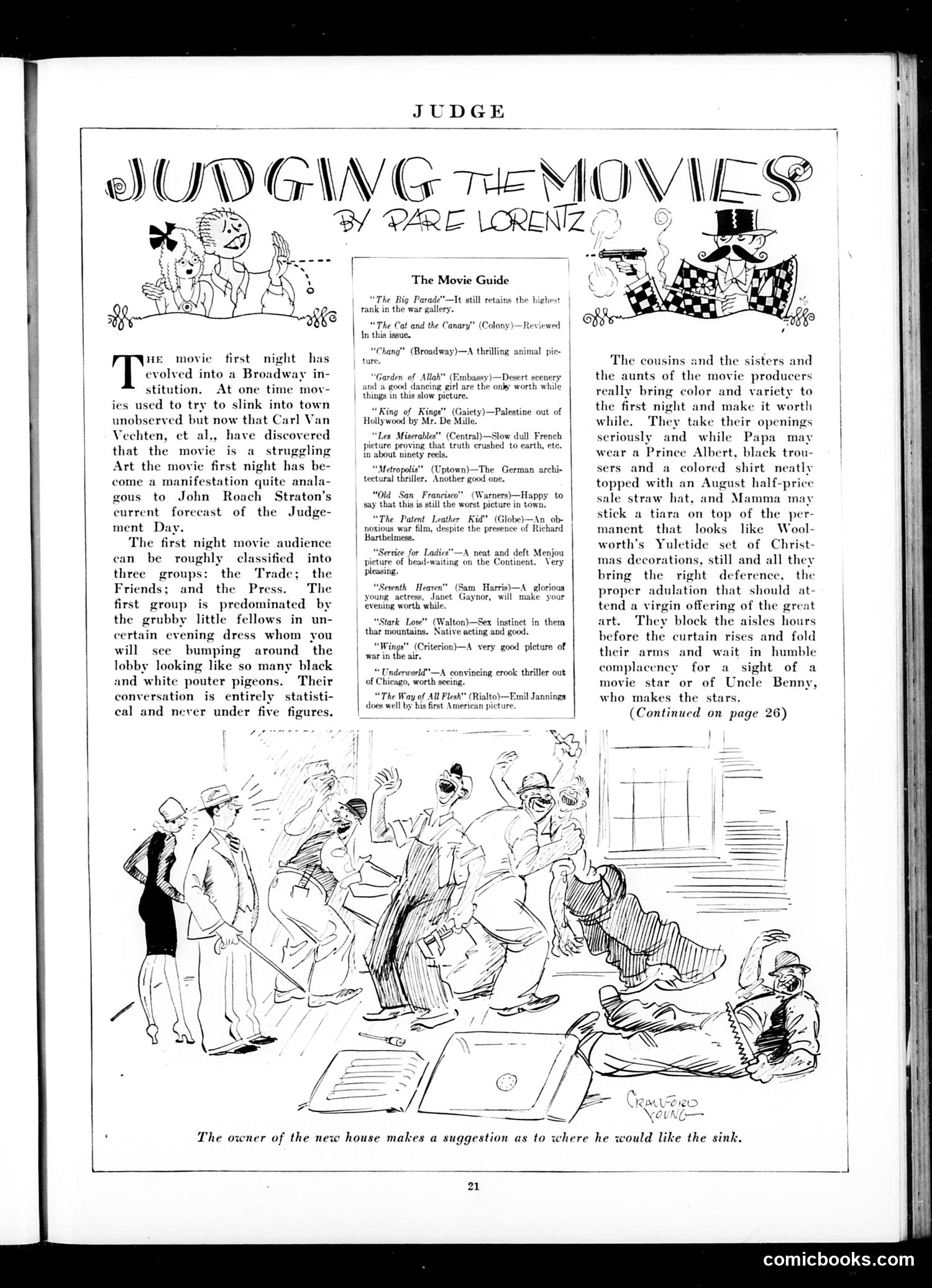
This is a satirical essay by Pare Lorenz about movie premiere culture in the 1920s. The piece mocks the pretension surrounding "first night" movie screenings, which had recently become fashionable social events after intellectuals like Carl Van Vechten promoted cinema as serious art. Lorenz identifies three audience groups: "the Trade" (industry people concerned only with box-office numbers), "Friends," and "the Press." He ridicules the Trade members as "grubby little fellows" dressed formally but acting like "black and white pouter pigeons." The accompanying cartoon depicts the absurdity of a movie premiere—a chaotic scene where well-dressed attendees crowd around as a homeowner tries to make a mundane suggestion about sink placement. This illustrates Lorenz's central joke: movie openings have become pretentious theater where ordinary domestic matters are treated with undeserved solemnity. The sidebar "Movie Guide" reviews current films with tongue-in-cheek commentary, reinforcing the satire's target: the artificial elevation of cinema.
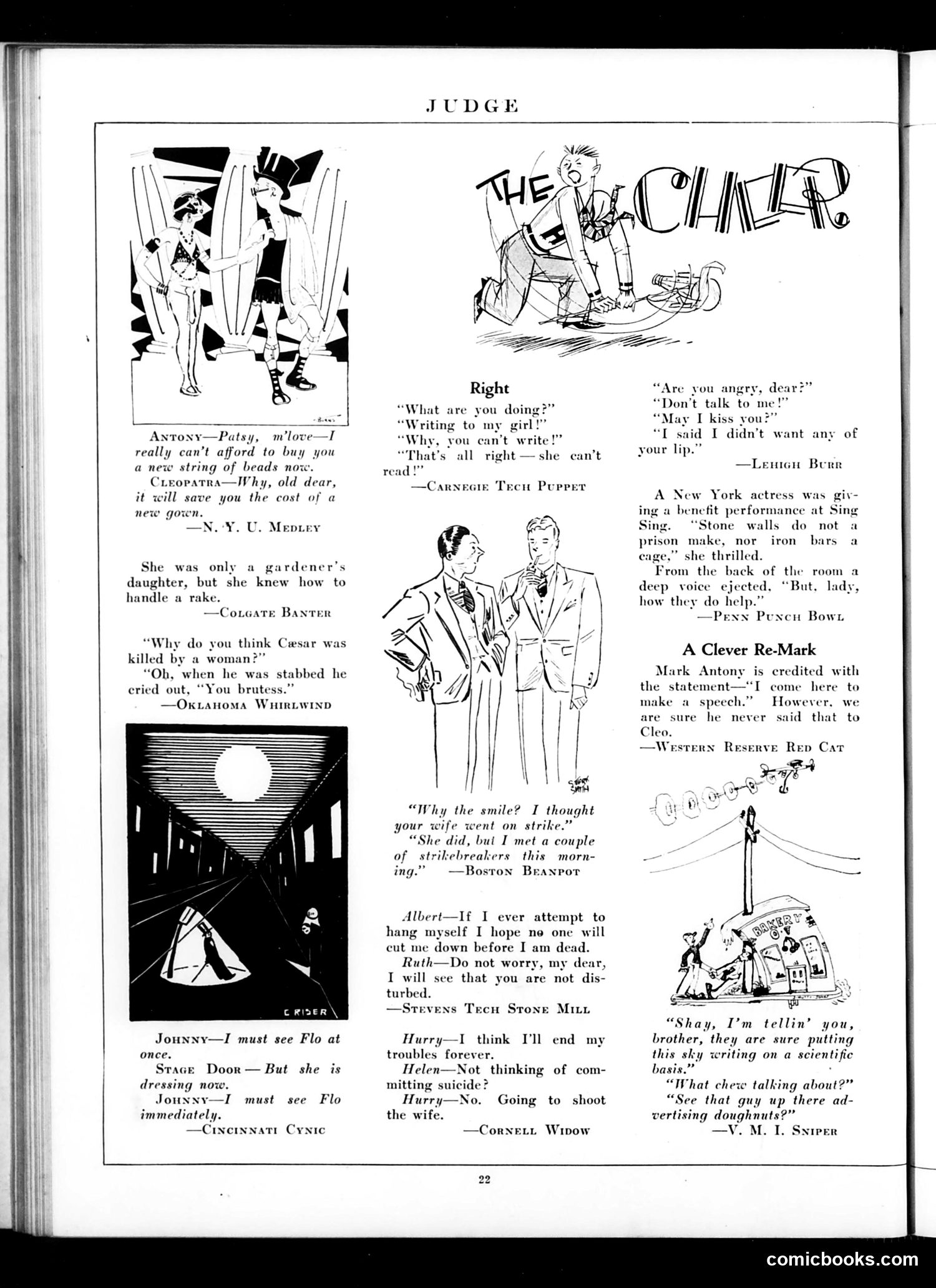
This is a humor page from *Judge* magazine featuring short jokes and comic illustrations typical of early 20th-century American satire. The jokes reflect period attitudes: one mocks women's literacy ("she can't read"), another uses "strikebreakers" as a euphemism for infidelity (referencing contemporary labor strikes). Several jokes center on marital discord and domestic violence treated as punchlines—a man threatening to "shoot the wife" is presented as humorous. The illustrations include a couple in formal dress, a dramatic noir-style tunnel scene, and what appears to be a sky-writing airplane (representing then-novel advertising technology). A reference to "Mark Antony" and Cleopatra makes a crude sexual joke. Another quip attributes a famous quote to Mark Antony while suggesting he'd never say it to his lover. The page represents typical *Judge* content: witty one-liners from various contributors, mixing theatrical references, marital strife humor, and commentary on modern conveniences—all reflecting 1920s-era sensibilities quite alien to contemporary audiences.
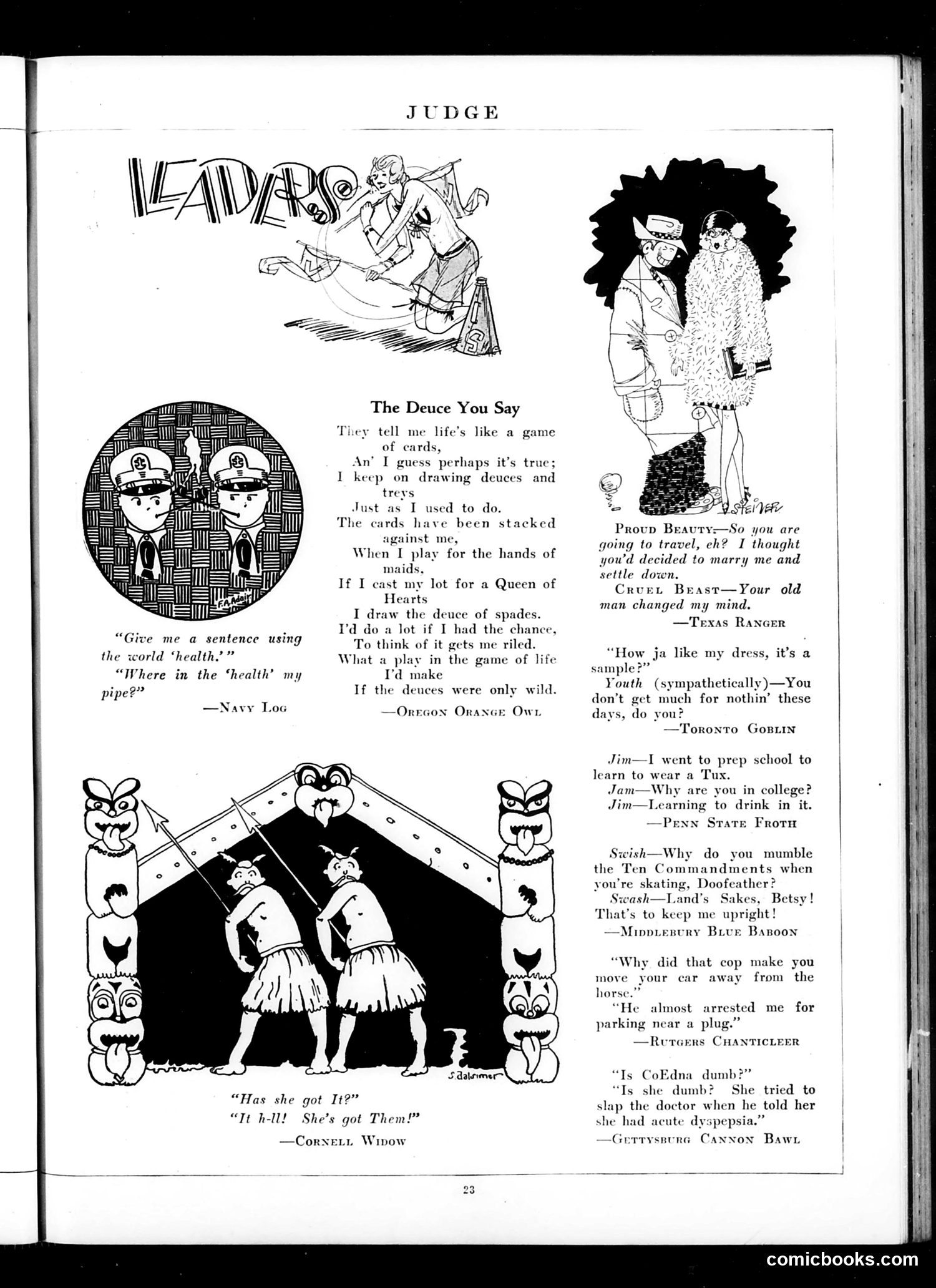
This page from *Judge* contains multiple short jokes and comic illustrations typical of early 20th-century American humor magazines. The content is largely non-political—instead offering social satire and wordplay jokes. Key items include: **"The Deuce You Say"** — A poem about romantic misfortune, using card-game metaphors (drawing low cards, "deuces") to represent life's disappointments, particularly in courting women. **Visual gags** feature stereotypical characters (sailors, judges, flapper-era women) in domestic or romantic situations. **Running jokes** mock contemporary social types: college students, "co-eds" (university women), and various regional "types" identified by humorous pen names (Navy Log, Texas Ranger, Toronto Goblin, etc.). The humor relies on puns ("parking near a plug" meaning near a fire hydrant), mild innuendo, and observational comedy about modern dating and social customs—reflecting Jazz Age attitudes toward youth, education, and gender relations. None appears explicitly political; the satire targets social behaviors rather than policies or politicians.
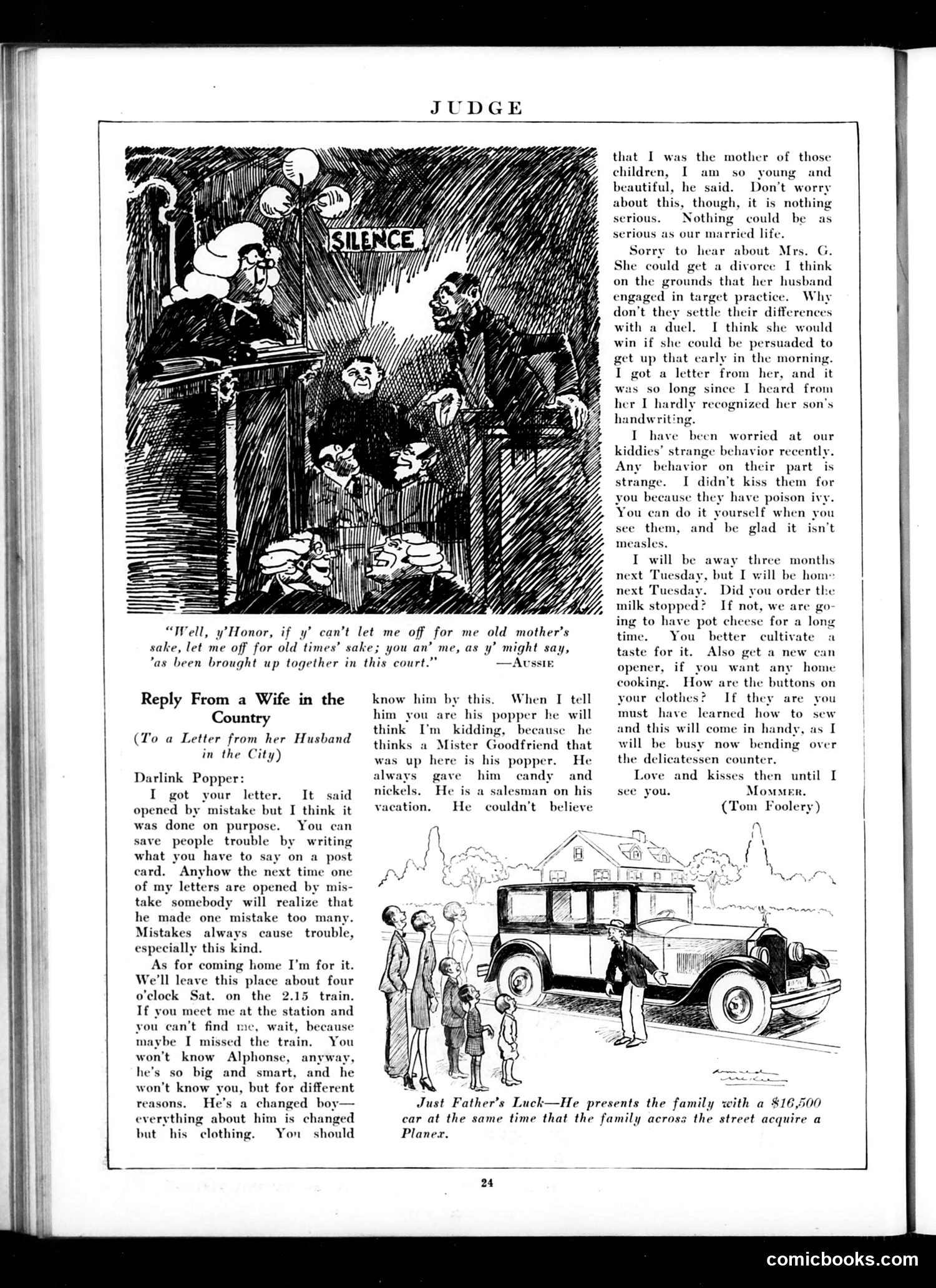
This page contains two satirical pieces about marriage and domestic life: **Top cartoon**: A courtroom scene where a defendant appeals to a judge using the excuse that they grew up together in the court system—implying the defendant is a habitual criminal. The satire mocks both repeat offenders and judicial leniency. **"Reply from a Wife in the Country"**: A wife's sarcastic letter to her city-dwelling husband. The humor relies on marital discord: she suggests opening mail is intentional, hints at infidelity (a "Mister Goodfriend" the children call "popper"/father), mentions another woman's divorce via "target practice" (possibly a shooting incident), and sarcastically describes her children's bad behavior and her own plans to leave. The tone is bitterly comedic—she's threatening him while maintaining deadpan delivery. **Bottom illustration**: "Just Father's Luck" contrasts a father gifting his family an expensive $16,500 car while neighbors across the street acquire a cheaper car—satirizing competitive consumerism and the irony of generosity. The page satirizes early 20th-century urban marriage strain, infidelity anxieties, and materialistic competition.
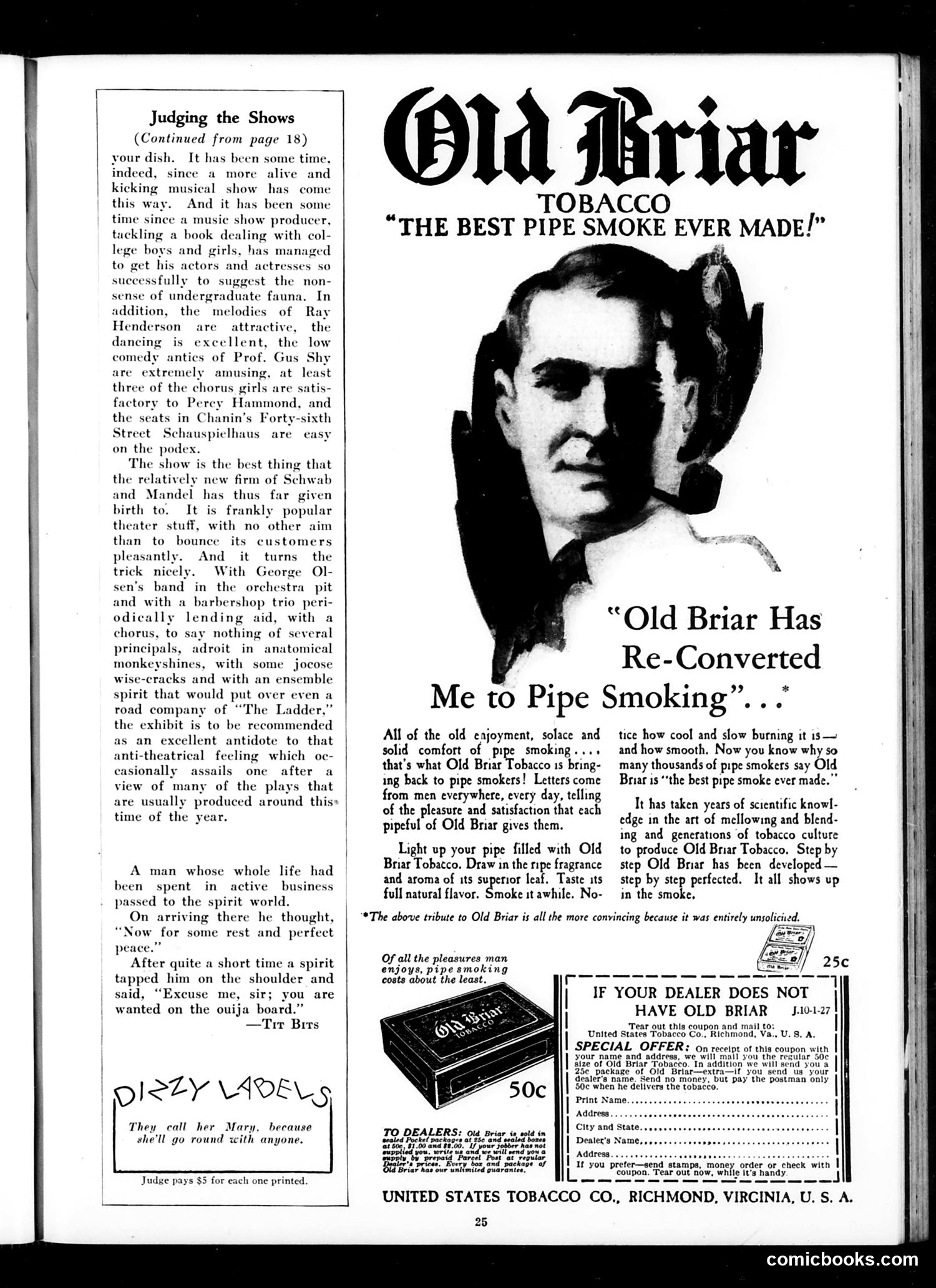
This page is primarily **advertising**, dominated by a full-page Old Briar Tobacco advertisement. The ad uses testimonial marketing, featuring an endorsement claiming the product has "re-converted" a smoker to pipe smoking after years away. The copy emphasizes quality, flavor, and the affordable cost of pipe smoking compared to other pleasures. The page also contains **two minor satirical items**: 1. A theater review praising a college-themed musical show for its lively humor and performances 2. A brief joke at the bottom: "They call her Mary, because she'll go round with anyone"—a crude play on promiscuity, paying $5 to Judge readers for submissions For modern readers, the key takeaway is that early-20th-century magazines like *Judge* blended serious criticism with crude humor and aggressive product advertising. The tobacco ad, now obviously problematic, was presented as wholesome lifestyle marketing without health warnings.
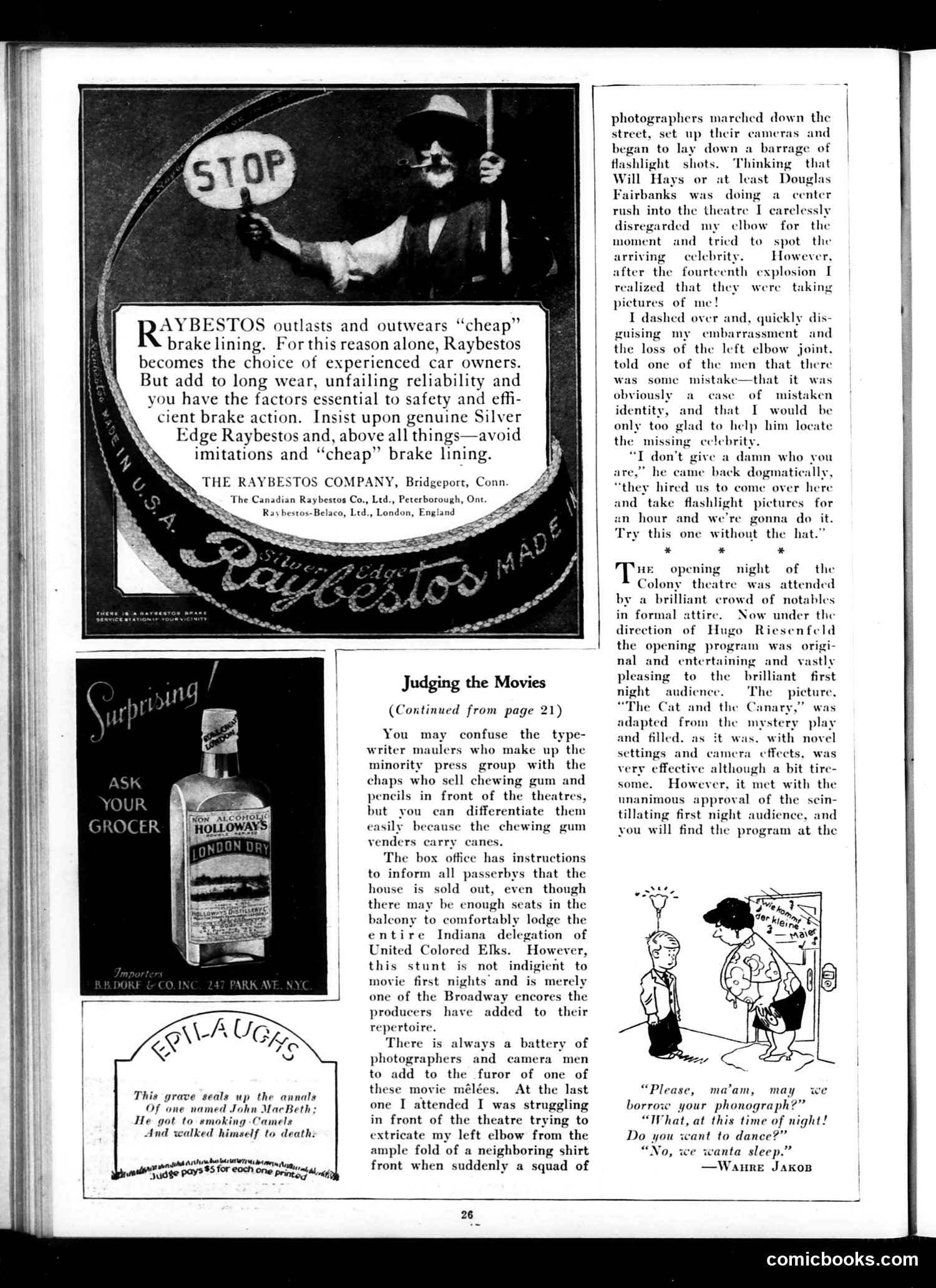
This page is primarily an article about movie premiere culture, with advertising. The main content mocks the theatrical excess of 1920s film openings. The author describes the chaos of a movie premiere: photographers indiscriminately taking flashbulb pictures regardless of who they're photographing, "typewriter maulers" (journalists) distinguishable from gum vendors by their canes, and theater managers falsely claiming sold-out status. The satire targets the superficiality and manufactured spectacle of these events. When the author is accidentally photographed and tries to correct the photographers, they dismiss him—they're just fulfilling a contract to take pictures for an hour, celebrity or not. This mocks both the photographers' indifference and the producers' practice of generating publicity regardless of actual newsworthiness. The referenced film, "The Cat and the Canary," was a real 1927 mystery adaptation. The accompanying joke about borrowing a phonograph for sleep is unrelated period humor about noise complaints.
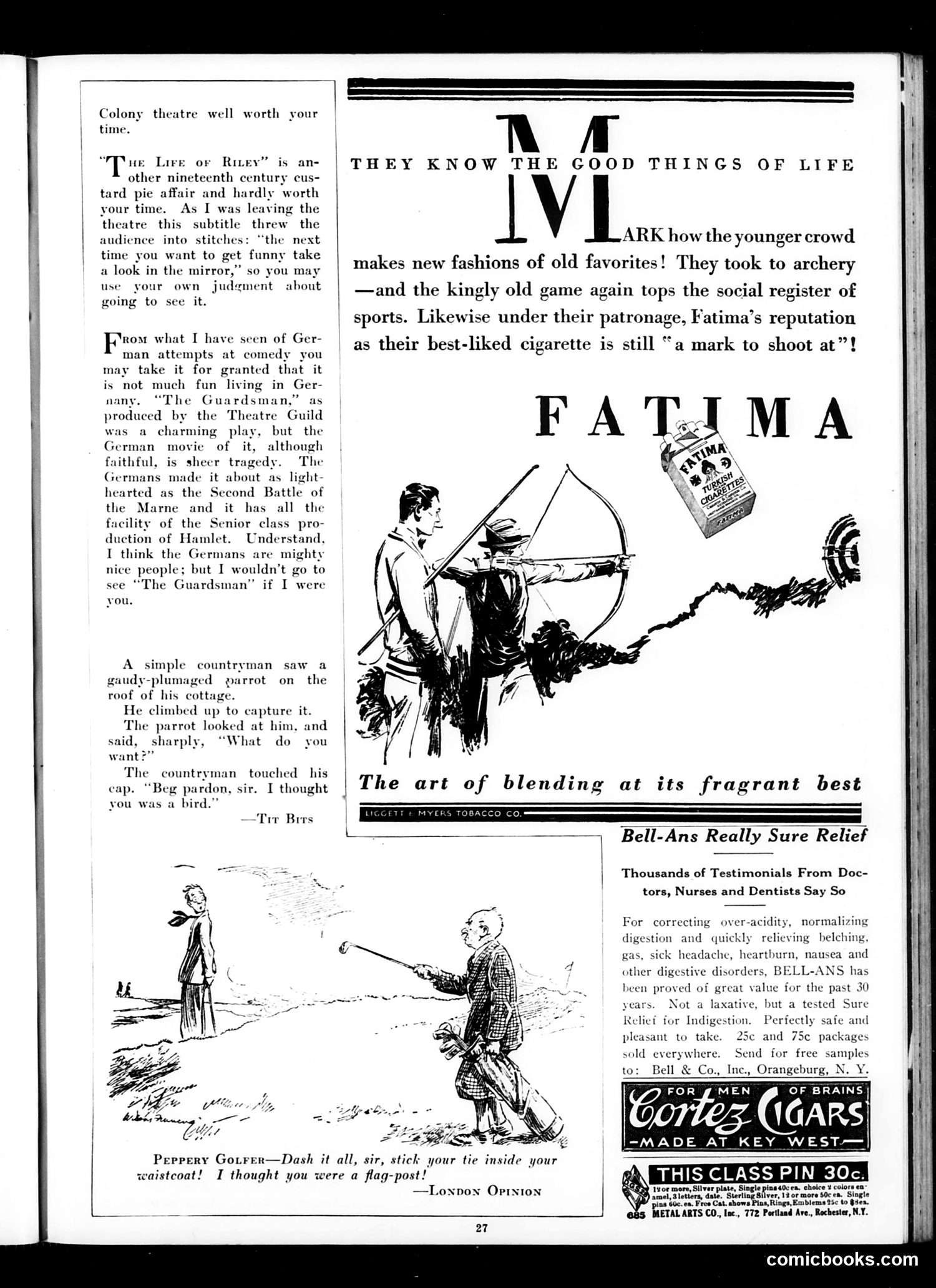
This page contains theater reviews, humorous anecdotes, and advertisements rather than political cartoons. **Theater Reviews:** The critic dismisses "The Life of Riley" as a custard-pie farce and critiques German cinema's attempt at comedy, citing "The Guardsman" as heavy-handed—comparing its tone to WWI's Battle of the Marne rather than light entertainment. The underlying joke is that Germans lack comedic sensibility. **Fatima Cigarette Advertisement:** Features an archer hitting a target, with text playing on the phrase "a mark to shoot at"—meaning something worthy of criticism. The ad claims young people now favor archery as fashionable while Fatima cigarettes remain their preferred brand. **Anecdotes:** Two brief jokes: one about a parrot mistaken for a bird, and one (from London Opinion) about a man's necktie resembling a flagpole. The page reflects 1920s popular culture and advertising before modern health warnings about cigarettes.
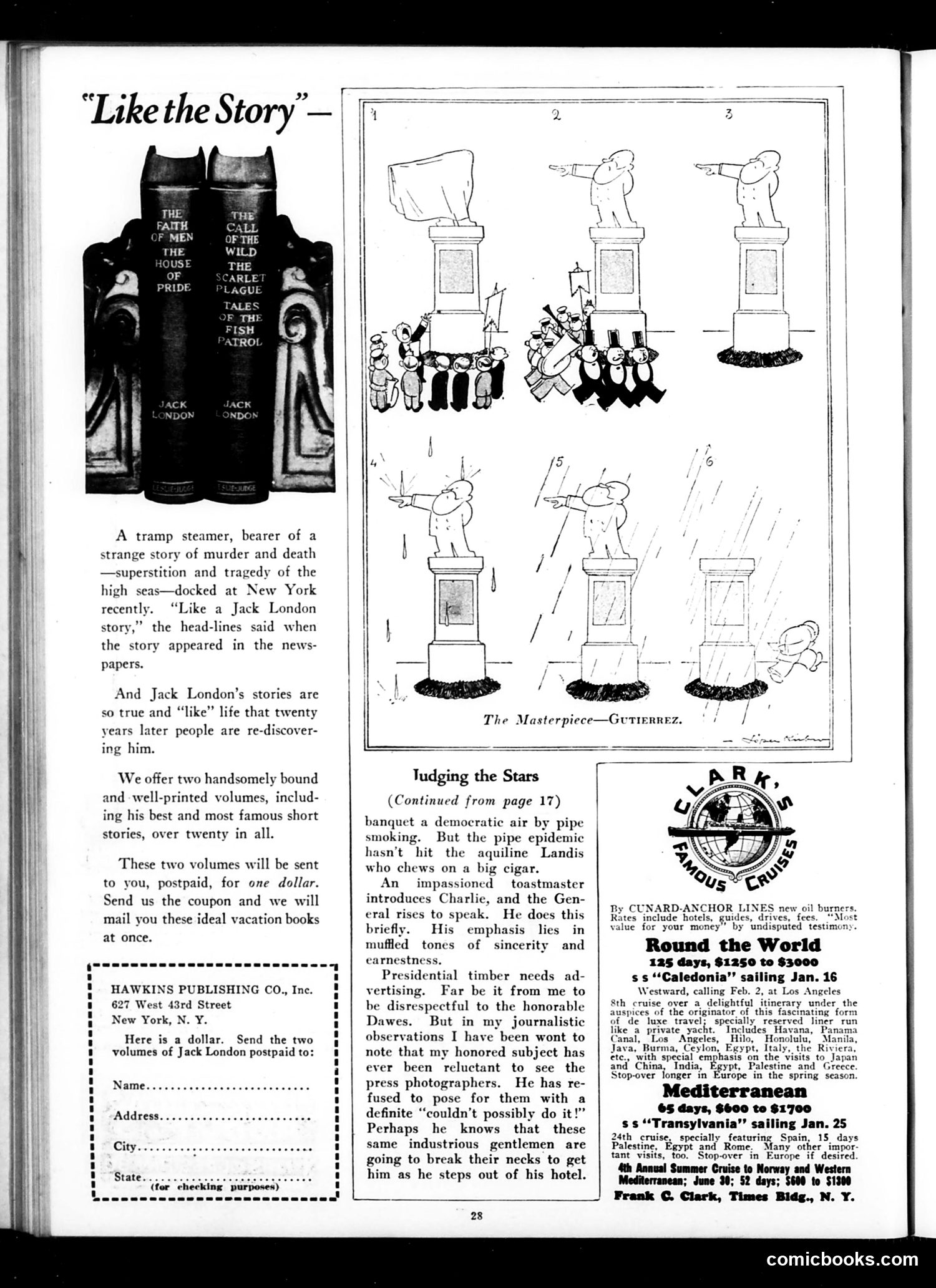
This page contains **primarily advertising and editorial content** rather than political satire. The main feature is a **Jack London book advertisement** promoting two volumes of his short stories for one dollar. The text references a recent news story about a tramp steamer with a murder mystery that journalists compared to London's fiction—illustrating how his realistic adventure tales had become culturally iconic by this period (the page notes people were "re-discovering" him 20 years after his 1916 death). Below is a column titled "Judging the Stars" discussing **Vice President Charles Dawes** and his reluctance to pose for press photographers despite being considered "presidential timber" (potential political ambition). The writer humorously notes Dawes refuses photographers directly but they pursue him anyway. The right side contains **travel advertisements** for cruise lines offering world tours and Mediterranean voyages. The cartoon at top by Gutierrez titled "The Masterpiece" appears to satirize **public monument worship**, showing citizens in various dramatic poses around statues, but context is limited.
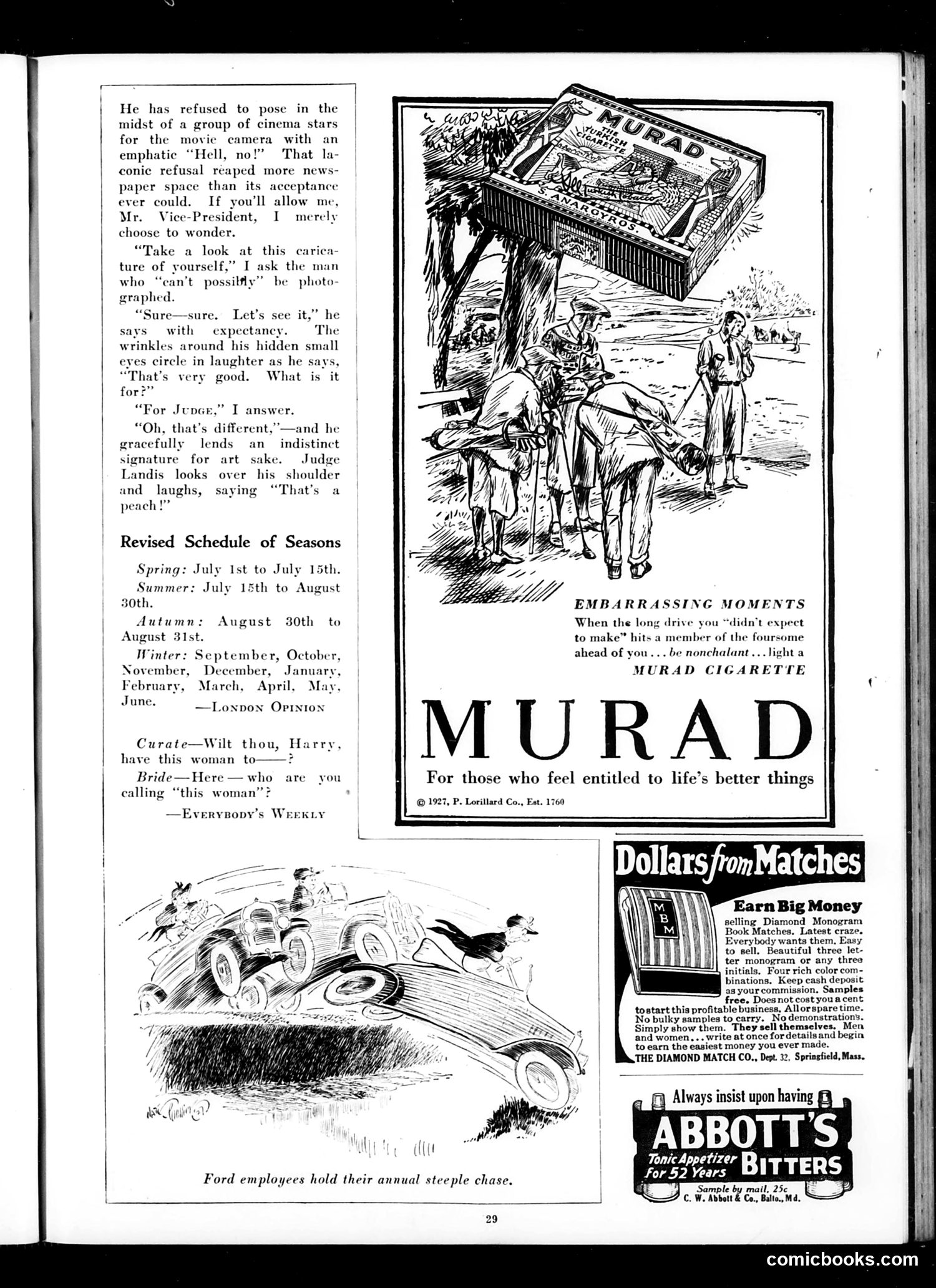
This page from *Judge* (circa 1927) contains mixed editorial and advertising content rather than a coherent political cartoon. The main text piece discusses Judge Landis (baseball's commissioner) refusing to pose with cinema stars for a movie camera, calling it "Hell, no!" The writer mocks this refusal for generating excessive newspaper coverage. When shown a caricature labeled "For Judge," Landis laughs and signs it for "art's sake"—the joke being his willingness to endorse artwork while rejecting film publicity. A secondary exchange mocks British formality: a curate asks "will you have this woman to—?" and the bride protests being called "this woman." The lower cartoon depicts Ford employees in a "steeple chase"—a visual pun on horse racing applied to automobiles, likely satirizing Ford factory competition or labor practices. The remainder is advertising for cigarettes, match-selling schemes, and bitters—typical of the era's magazine format.
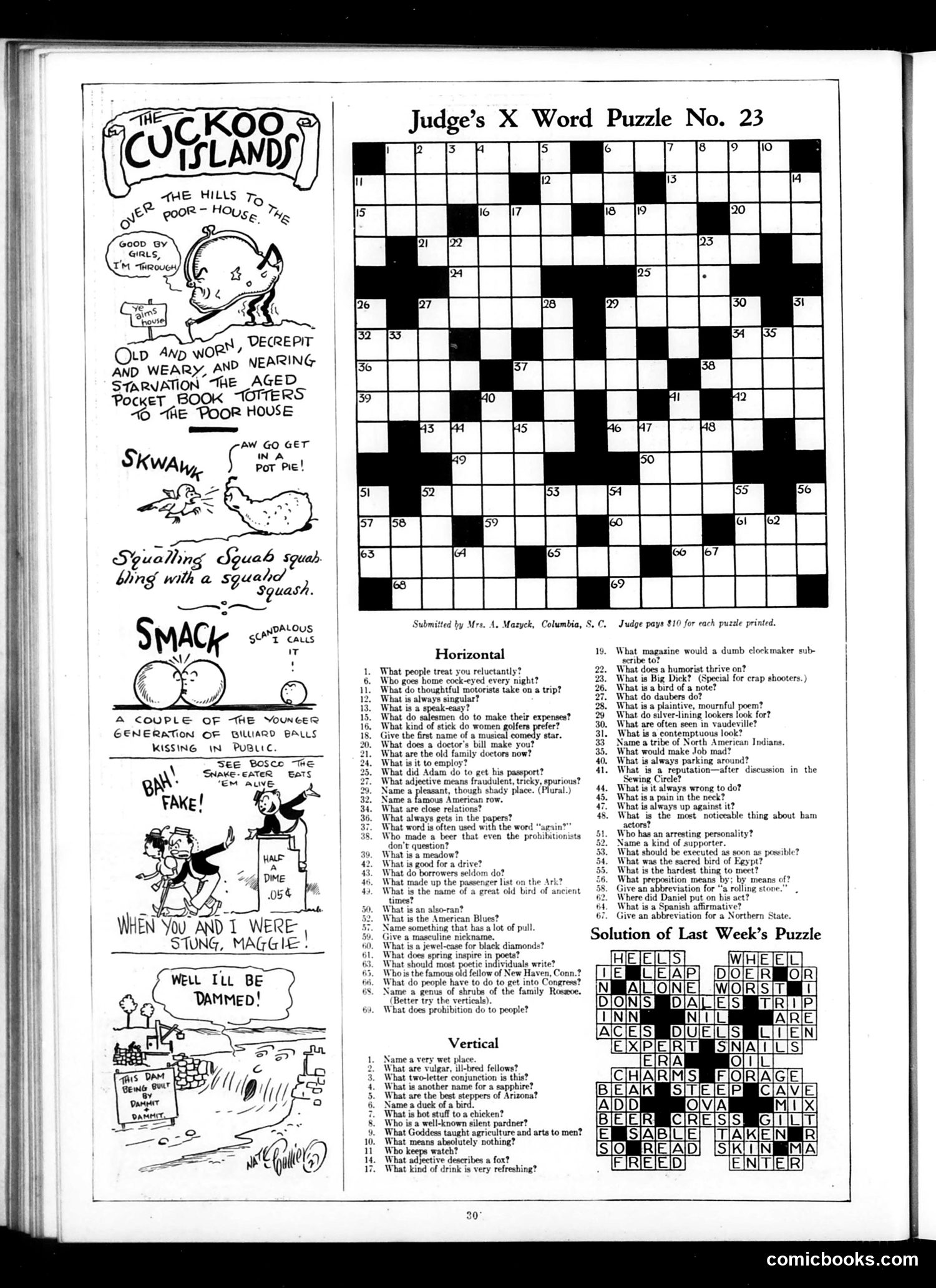
This page from *Judge* magazine features a word puzzle (No. 23) with humorous clues rather than straightforward definitions. The left side contains cartoon vignettes with accompanying jokes that set up the puzzle's playful tone. The cartoons satirize early 20th-century social types: young couples kissing publicly ("scandal"), working-class men getting drunk nightly, and references to aging poverty ("the poor house"). The title "Cuckoo Island" suggests absurdist humor. The puzzle itself is tongue-in-cheek wordplay—clues like "What is a speak-easy?" (a speakeasy bar), "What adjective means fraudulent?" and "What do borrowers seldom do?" (pay back) rely on contemporary slang and social conditions. References to Prohibition ("What does prohibition do to people?") and crap-shooting indicate 1920s-era concerns. The page essentially combines light social commentary with an interactive puzzle, rewarding readers who understood period slang and current events. The $10 payment incentive suggests reader submissions.
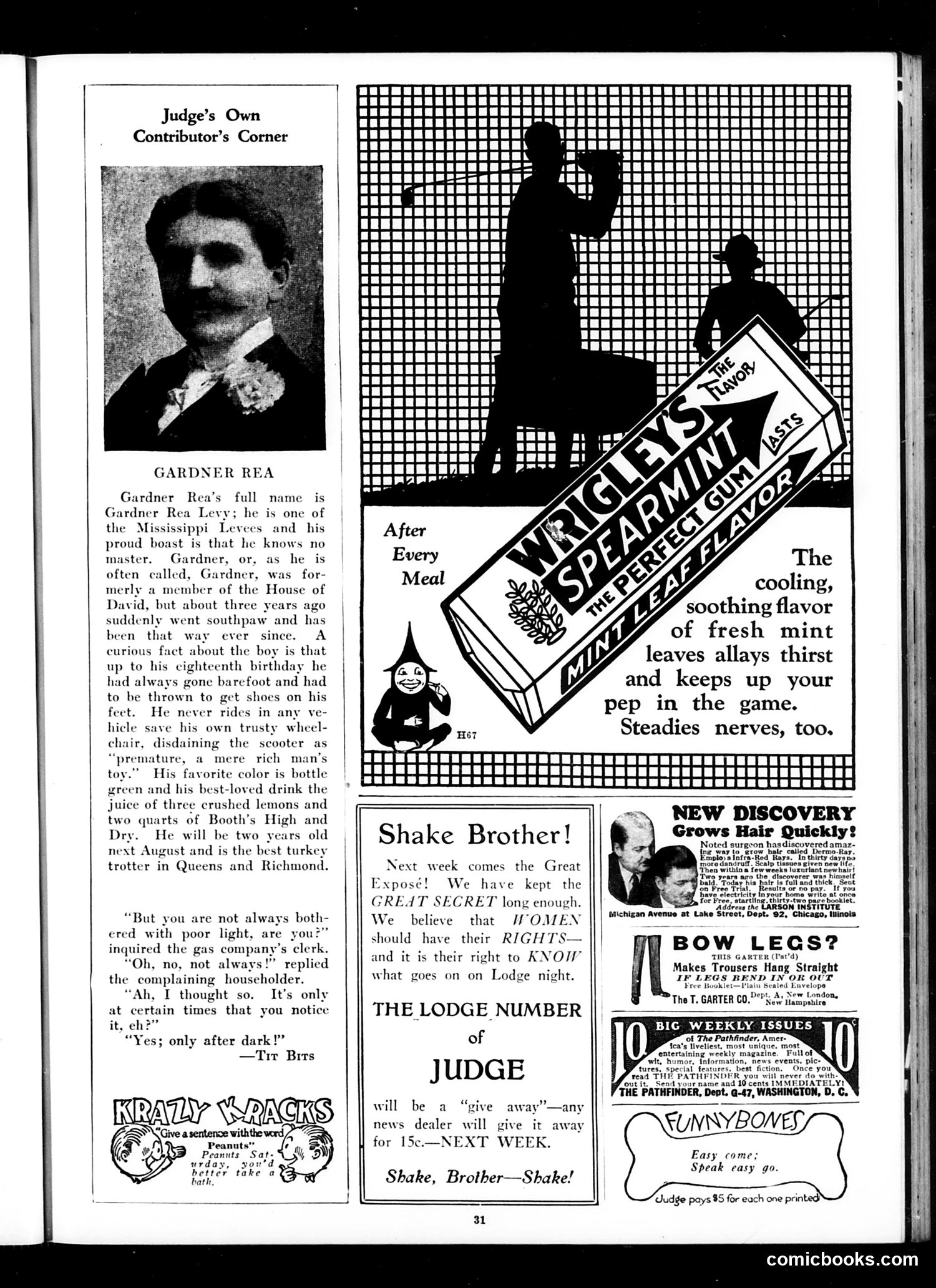
This page combines editorial content with period advertisements. The main satirical piece is "Shake Brother!"—a joke about fraternal lodge secrecy. It announces that next week's *Judge* magazine will reveal "THE LODGE NUMBER of JUDGE" as a giveaway, mocking men's fraternal organizations (like Masons or Elks) that kept their rituals and activities secret from wives and the public. The satire suggests these men's clubs were absurdly secretive about mundane matters. The "Judge's Own Contributor's Corner" is a humorous biographical sketch of Gardner Rea, written in tall-tale style—exaggerating absurd details (barefoot until age 18, two years old next August) as a comedy bit about the contributor himself. The remaining content consists of vintage advertisements: Wrigley's spearmint gum, hair-growth treatments, and leg-straightening devices—typical early 20th-century patent-medicine and novelty ads promising dubious results.
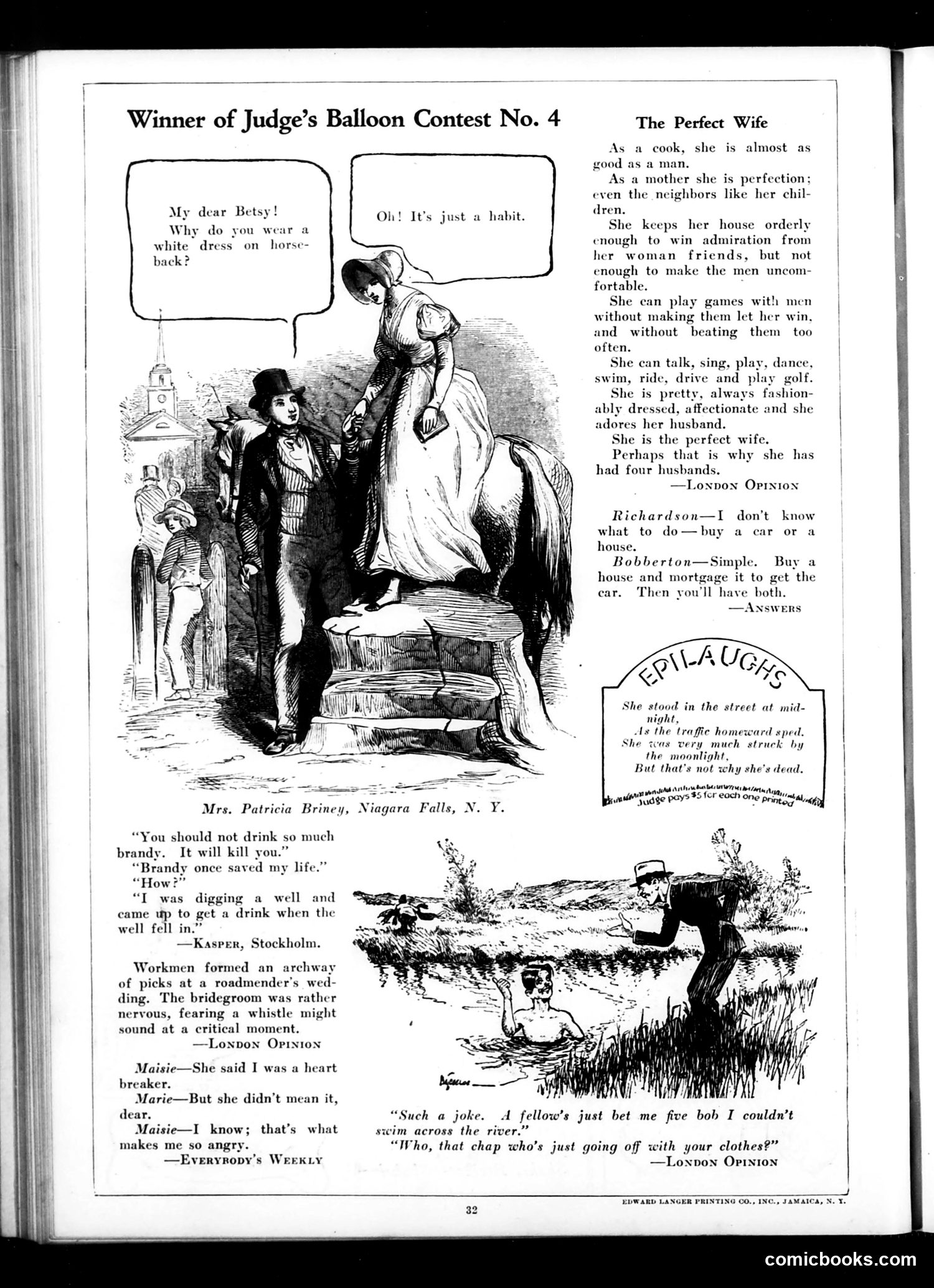
This page contains several unrelated humor pieces typical of Judge's satirical format: **"The Perfect Wife"** (top): A London Opinion piece satirizing the impossible standards for "perfect" womanhood. The humor lies in the contradiction: a woman described as nearly flawless at cooking, mothering, housekeeping, and socializing—yet has been married four times, implying no man could actually keep her. It's social satire on unrealistic feminine ideals. **Main cartoon**: Shows a man on horseback being questioned about wearing a white dress—a visual gag playing on absurdity and cross-dressing humor typical of the era. **Other short jokes**: Include a practical financial quip about mortgaging a house to buy a car, anecdotes about brandy and well-digging, wordplay about "heart breaker," and a punchline about a man stealing someone's clothes while they swim—all standard music-hall style humor. The page reflects early 20th-century Judge content: largely apolitical, focused on domestic situations, gender relations, and working-class mishaps rather than serious political satire.
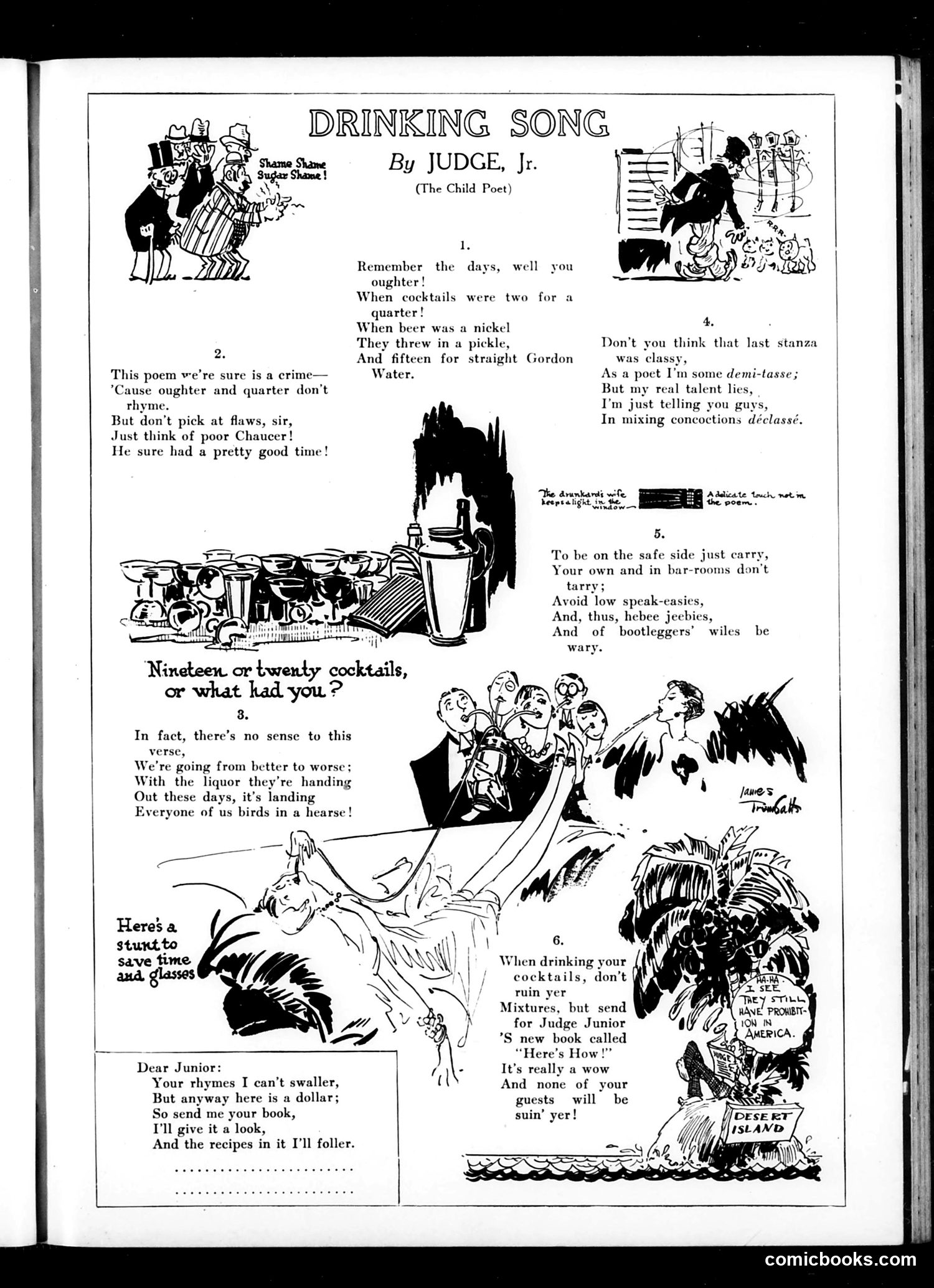
This is Prohibition-era satire (likely 1920s). The poem mocks the bygone days of cheap, legal alcohol—when "cocktails were two for a quarter" and beer cost a nickel with a free pickle. The humor targets multiple angles: the absurd rationing of the past, the current illegality and danger ("bootleggers' wiles"), and the poet's own incompetence (deliberately bad rhymes, mixing "demi-tasse" with "déclassé"). Stanza 3 darkly jokes that modern bootleg liquor is so bad it's killing people ("landing / Everyone of us birds in a hearse"). The final advertisement parodies the situation by offering "recipes"—a cheeky wink that readers know Judge Jr.'s real audience wants cocktail instructions, not poetry. It's social commentary wrapped in self-aware humor about Prohibition's failures and nostalgia for legal drinking.
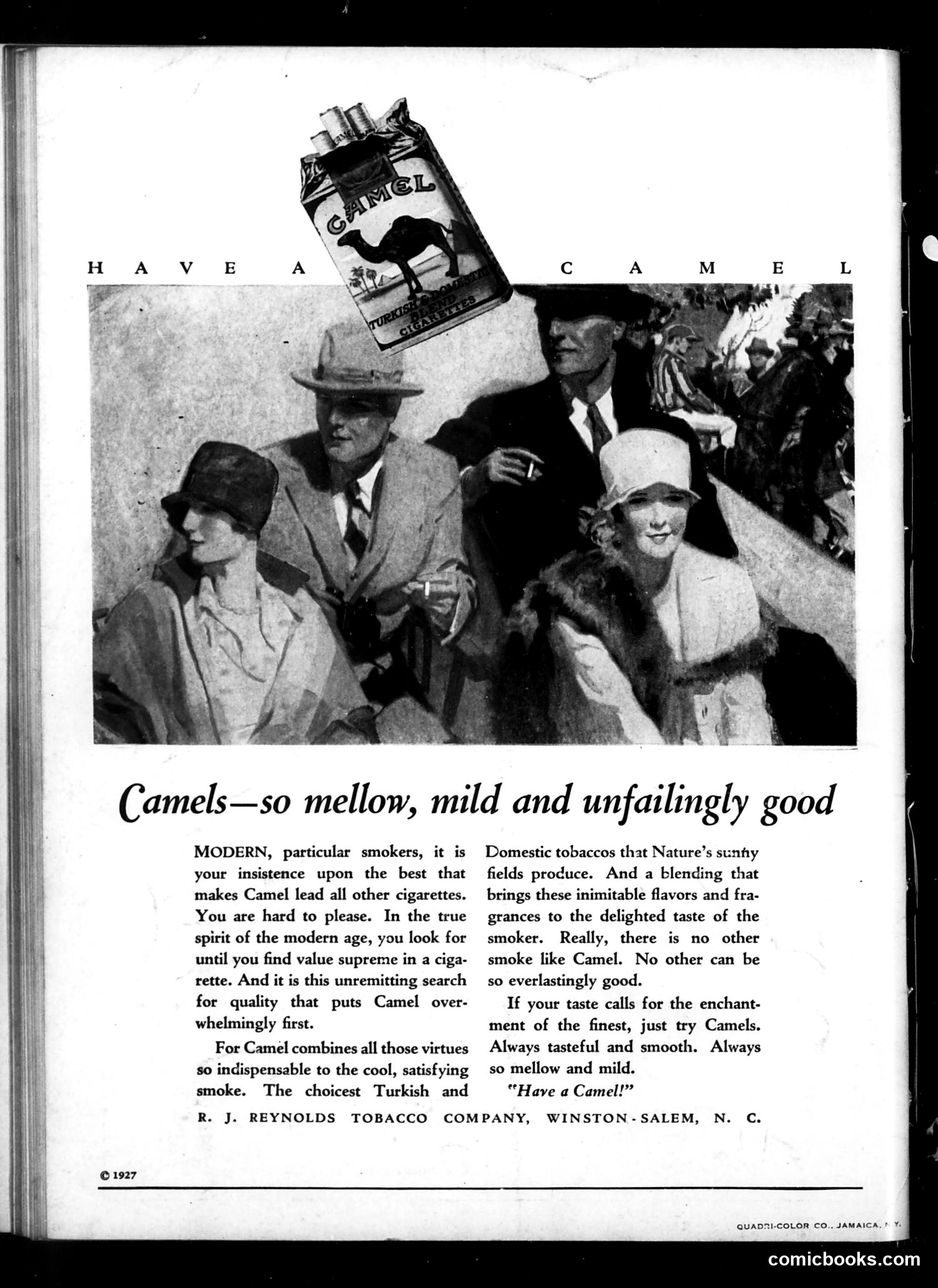
This is a **Camel cigarette advertisement**, not satire or political commentary. Dated 1927, it's a straightforward commercial page from *Judge* magazine. The image shows well-dressed men and women in 1920s attire examining or holding a large Camel cigarette package. The advertisement targets "MODERN, particular smokers," appealing to contemporary values of quality and sophistication. The copy emphasizes Camel's superiority through "Turkish and Domestic tobaccos" and superior blending, positioning the brand as the choice of discerning smokers. The tagline "Have a Camel!" was a famous Camel slogan of the era. **What's notable to modern readers**: This represents pre-regulation cigarette advertising that openly promoted smoking without health warnings, targeting aspirational consumers and normalizing cigarettes as a status symbol—marketing practices now heavily restricted.