
Judge, 1927-10-01 · page 28 of 36
Judge — October 1, 1927 — page 28: what you’re looking at
What you’re looking at
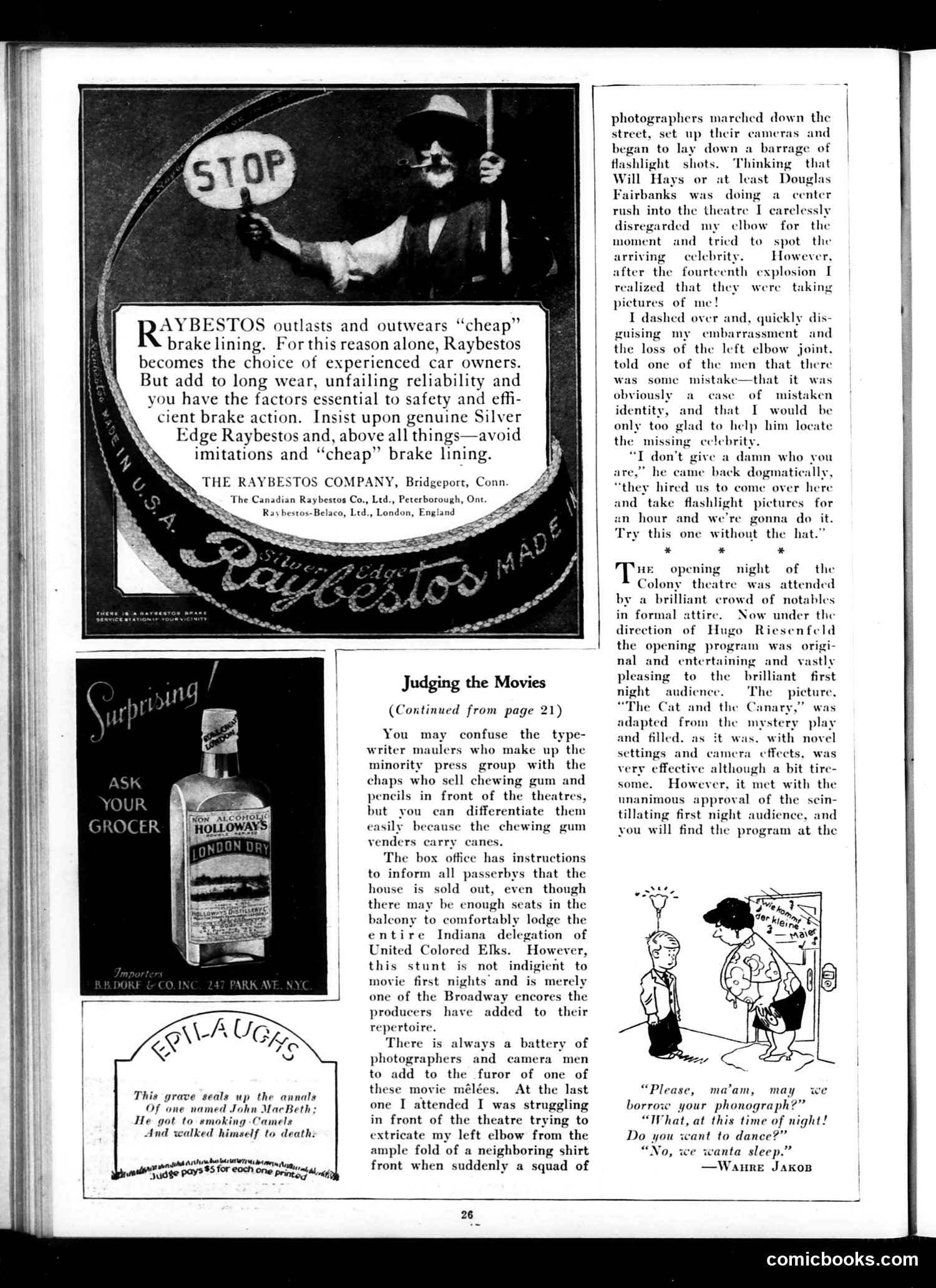
This page is primarily an article about movie premiere culture, with advertising. The main content mocks the theatrical excess of 1920s film openings. The author describes the chaos of a movie premiere: photographers indiscriminately taking flashbulb pictures regardless of who they're photographing, "typewriter maulers" (journalists) distinguishable from gum vendors by their canes, and theater managers falsely claiming sold-out status. The satire targets the superficiality and manufactured spectacle of these events. When the author is accidentally photographed and tries to correct the photographers, they dismiss him—they're just fulfilling a contract to take pictures for an hour, celebrity or not. This mocks both the photographers' indifference and the producers' practice of generating publicity regardless of actual newsworthiness. The referenced film, "The Cat and the Canary," was a real 1927 mystery adaptation. The accompanying joke about borrowing a phonograph for sleep is unrelated period humor about noise complaints.
📄 Transcribed text from this page (OCR, searchable)
Machine-transcribed from the original scan — historical spelling and the odd misread are preserved.
AYBESTOS outlasts and outwears “cheap” brake lining. For this reason alone, Raybestos becomes the choice of experienced car owners. But add to long wear, unfailing reliability and you have the factors essential to safety and effi- N cient brake action. Insist upon genuine Silver Edge Raybestos and, above all things—avoid imitations and “cheap” brake lining. THE RAYBESTOS COMPANY, Bridgeport, Conn. The Canadian Raybestos Co., Ltd., Peterborough, Ont. Raybestos-Belaco, Ltd., London, England This grave seals up the annals Of one named John MacBeth: He got to smoking Camels And walked himself to death: ns aitgha ister aibinns tug, asl wee pays #5 10F COCA One print gy Judging the Movies (Continued from page 21) You may confuse the type- writer maulers who make up the minority press group with the chaps who sell chewing gum and pencils in front of the theatres, but you can differentiate them easily because the chewing gum venders carry canes. The box office has instructions to inform all passerbys that the house is sold out, even though there may be enough seats in the balcony to comfortably lodge the entire Indiana delegation of United Colored Elks. However, this stunt is not indigient to movie first nights’ and is merely one of the Broadway encores the producers have added to their repertoire. There is always a battery of photographers and camera men to add to the furor of one of these movie mélées. At the last one I attended I was struggling in front of the theatre trying to extricate my left elbow from the ample fold of a neighboring shirt front when suddenly a squad of street, set up their cameras and began to lay down a barrage of hlight shots. ‘Thinking that s or at least Douglas was doing a center rush into the theatre I carelessly disregarded my elbow for the moment and tricd to spot. the riving celebrity. However, ter the fourteenth explosion I realized that they were taking pictures of I dashed over and, quickly dis- guising my embarrassment and the loss of the left elbow joint, told one of the men that there was some mistake—that it was obviously a case of mistaken identity, and that I would be only too glad to help him locate the missing celebrity. “T don’t give a damn who you ” he came back dogmatically, “they hired us to come over here and take flashlight pictures for an hour and we're gonna do it. Try this one without the hat.” * * * Te opening night of the Colony theatre was attended by a brilliant crowd of notables in formal attire. Now under the direction of Hugo Riesenfeld the opening program was origi- nal and entertaining and vastly pleasing to the brilliant first night audience. The _ picture, “The Cat and the Canary,” was adapted from the mystery play and filled. as it was. with novel settings and camera effects, very effective although a bit tire- some. However, it met with the unanimous approval of the scin- tillating first night audience, and you will find the program at the “Please, ma’am, may we borrow your phonograph?” “What, at this time of night! Do you want to dance?” “No, we wanta sleep.” —Waure Jakos comicbooks.com