
Judge, 1927-10-01 · page 15 of 36
Judge — October 1, 1927 — page 15: what you’re looking at
What you’re looking at
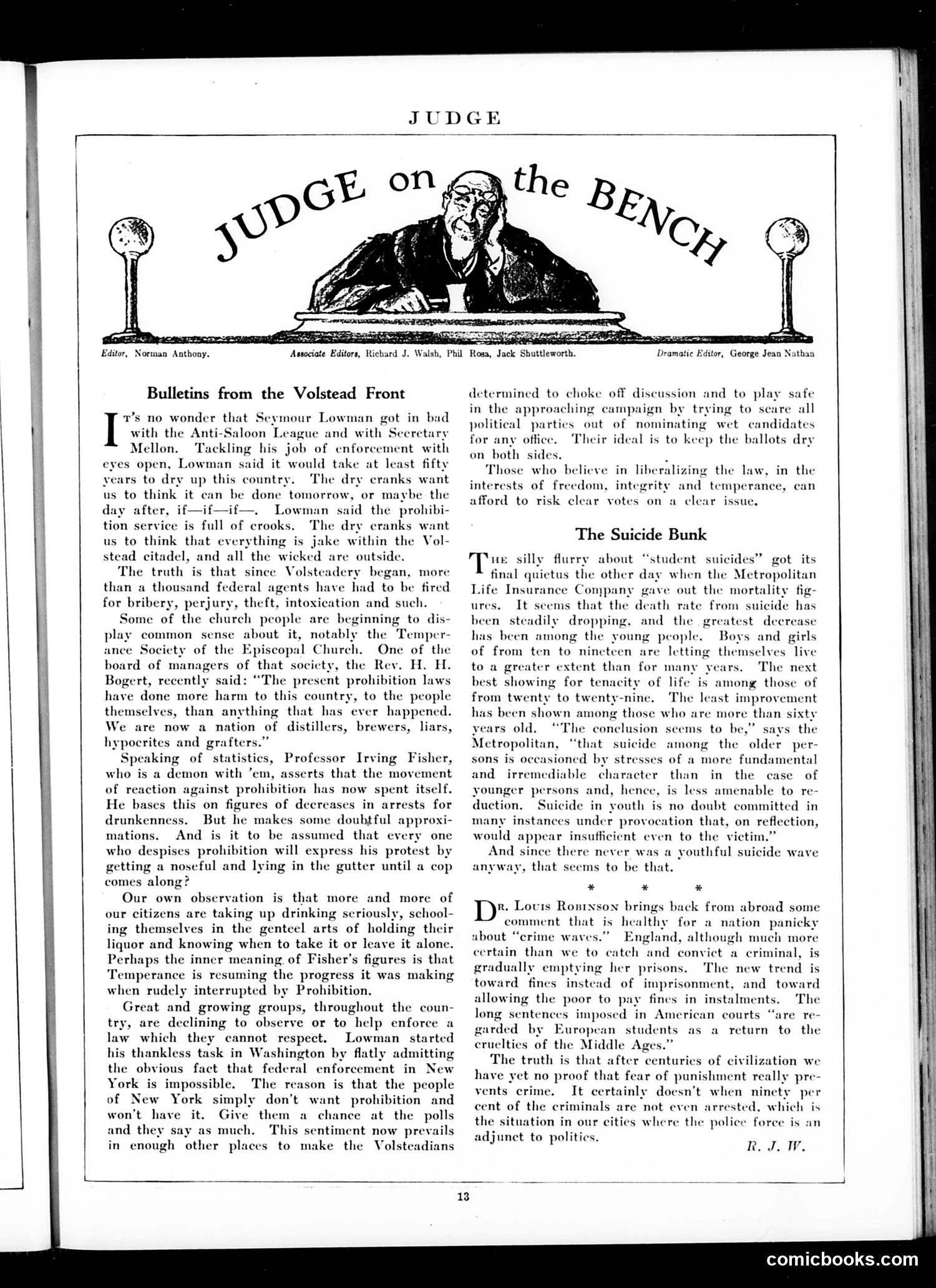
This page from Judge satirizes **Prohibition enforcement** during the Volstead Act era (1920s-1930s). ## Main Content: **"Bulletins from the Volstead Front"** criticizes Seymour Lowman, Prohibition enforcement official, for admitting the policy is failing. The article mocks the Anti-Saloon League's unrealistic expectations while documenting corruption: over 1,000 federal agents fired for bribery and theft. Judge argues Prohibition has backfired—creating criminals and hypocrites rather than temperance. It notes growing public resistance, particularly in New York, and quotes Rev. H.H. Bogert calling the laws more harmful than beneficial. **"The Suicide Bunk"** debunks panic about student suicides, citing Metropolitan Life Insurance mortality data showing death rates among young people actually declining. ## Satire Point: Judge attacks Prohibition as unenforceable, counterproductive policy that generates corruption while the public increasingly ignores it. The magazine advocates for letting voters decide rather than authoritarian dry-faction control.
📄 Transcribed text from this page (OCR, searchable)
Machine-transcribed from the original scan — historical spelling and the odd misread are preserved.
JU DGE Editor, Norman Anthony. Bulletins from the Volstead Front v’s no wonder that Seymour Lowman got in bad with the Anti-Saloon ‘League and with Secret: v Mellon. Tackling his job of enforcement with es open, Lowman said it would take at least fifty urs to dry up this country. The dry cranks want us to think it can be done tomorrow, or maybe the day after, if—if—if—. Lowman said the prohibi- tion serv is full of crooks. The dry cranks want us to think that everything is jake within the Vol- stead citadel, and all the wicked are outside. The truth is that since Volsteadery began, more than a thousand federal agents have had to be fired for bribery, perjury, theft, intoxication and such. Some of the church people are beginning to dis- play common sense about the ‘Temper- ance Society of the Episcopal Church. One of the board of managers of that society, the Rev. H. H. Bogert, recently said: “The present prohibition laws have done more harm to this country, to the people themselves, than anything that has ever happened. We are now a nation of distillers, brewers, liars, hypocrites and grafters.” Speaking of statistics, Professor Irving Fisher, who is a demon with ’em, asserts that the movement of reaction against prohibition has now spent itself. He bases this on figures of decreases in arrests for drunkenness. But he makes some doubtful approxi- mations. And is it to be assumed that every one who despises prohibition will express his protest by getting a noseful and lying in the gutter until a cop comes along? Our own observation our citizens I dry , notably is that more and more of are taking up drinking seriously, school- ing themselves in the genteel arts of holding their liquor and knowing when to take it or leave it alone. Perhaps the inner meaning. of Fisher’s figures is that Temperance is resuming the progress it was making when rudely interrupted by Prohibition. Great and growing groups, throughout the coun- try, are declining to observe or to help enforce a law which they cannot respect. Lowman started his thankless task in Washington by flatly admitting the obvious fact that federal enforcement in New York is impossible. The reason is that the people of New York simply don’t want prohibition and won't have it. Give them a chance at the polls and they ss s much. This sentiment now prevails in enough other places to make the Volsteadians Auociate Editors, Richard J. Walsh, Phil Rosa, Jack Shuttleworth. Dramatic Editor, George Jean Nathan determined to choke off discussion and to play safe in the approaching campaign by trying to scare all political parties out of nominating wet for any office. on both sides. Those candidates Their ideal is to keep the ballots dry in liberalizing the integrity and tempe afford to risk clear votes on a clear issue, who believe interests of freedom, in the ance, can The Suicide Bunk [ue silly flurry about “student suicides” got its final quietus the other day when the Metropolitan Life Insurance Company gave out the mortality fig- ure It seems that the death rate been steadily dropping, and the has been among the young people. of from ten to nineteen are lettin to a greater extent than for many y best showing for tenacity of life from twenty to twenty-nine. from suicide has greatest decrease Boys and girls themselves live The next is among those of The least improvement has been show n among those who are more than sixty ars. } “The conclusion scems to be,” says the Metropolitan, “that suicide among the older per- sons is occasioned by stresses of a more fundamental and irremediable character than in the case of younger persons and, hene duction, many would is less amenable to re- Suicide in youth is no doubt committed in ances under provocation that, on reflection, ppear insufficient even to the victim.” And since there never was a youthful suicide wave anyway, that seems to be that. ins * * * D: Louis Roninson brings b: comment that is healthy for a nation panicky about “crime waves.” England, although much more to catch and convict a criminal, is gradually emptying her prisons. The new trend is toward fines instead of imprisonment, and toward allowing the poor to pay fines in instalments. The long sentences imposed in American courts “are re- garded by European students as a return to the crueltics of the Middle Ages.” The truth is that after centuries of civilization we have yet no proof that fear of punishment really pre- vents crime. It certainly doesn’t when ninety per cent of the criminals are not even arrested, which is the situation in our cities where the police force is an adjunct to politics. ck from abroad some ain than we JW. comicbooks.com