
A complete issue · 36 pages · 1927
Judge — September 17, 1927
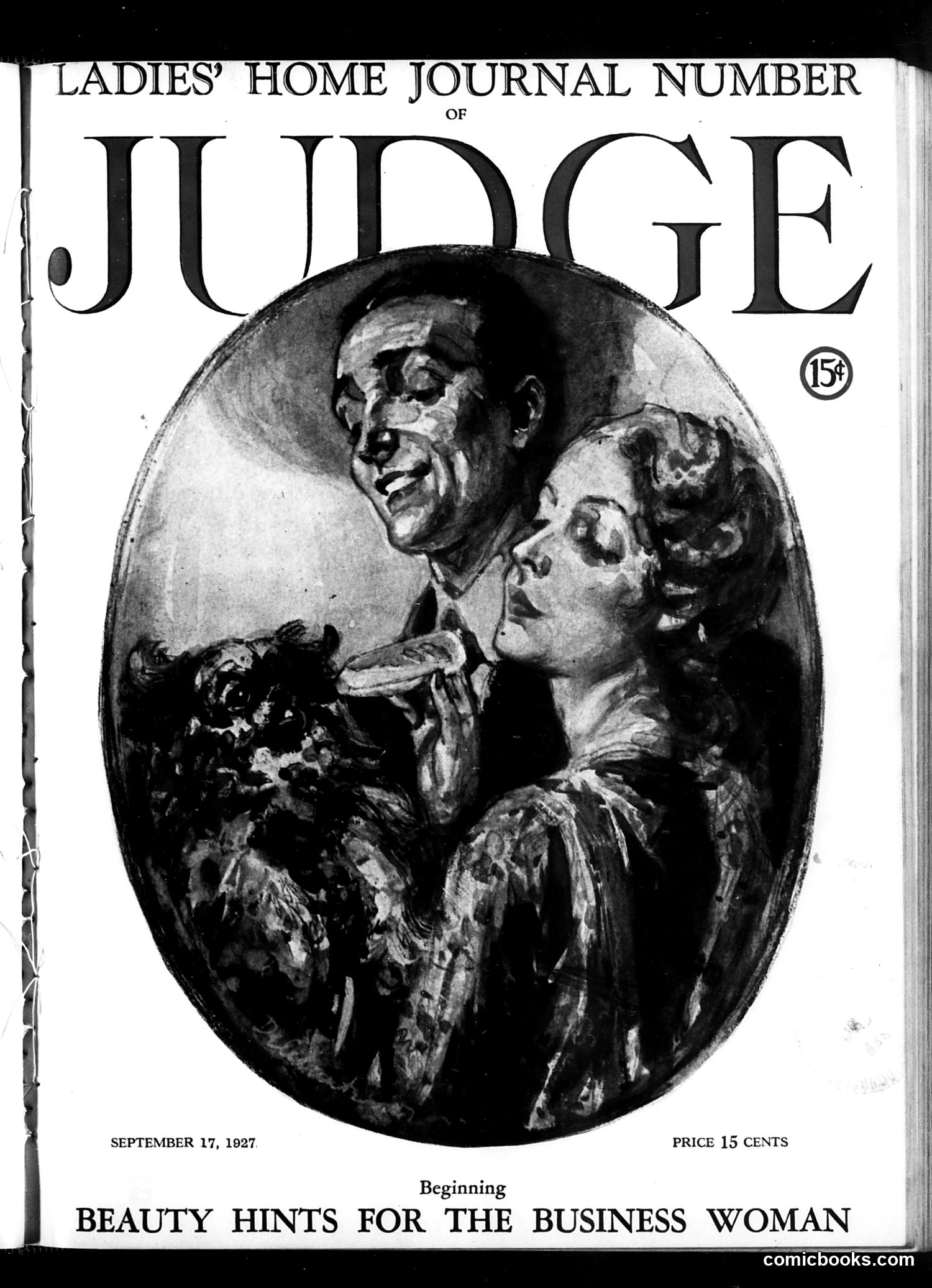
This is the cover of Judge magazine from September 17, 1927. The illustration shows two figures—a man and woman—admiring a small dog, rendered in an oval vignette style typical of the era. The cover announces "Beauty Hints for the Business Woman," suggesting the issue addresses the emerging social phenomenon of women entering the workforce during the 1920s. The domestic scene—a couple with a pet—appears to gently satirize or comment on modern working women by presenting an idealized, traditionally feminine domestic moment. The specific satire is unclear without additional context, but likely plays on tensions between women's new economic independence and conventional expectations of femininity and domesticity. The price of 15 cents and magazine's satirical nature suggest social commentary on gender roles during this transitional period.
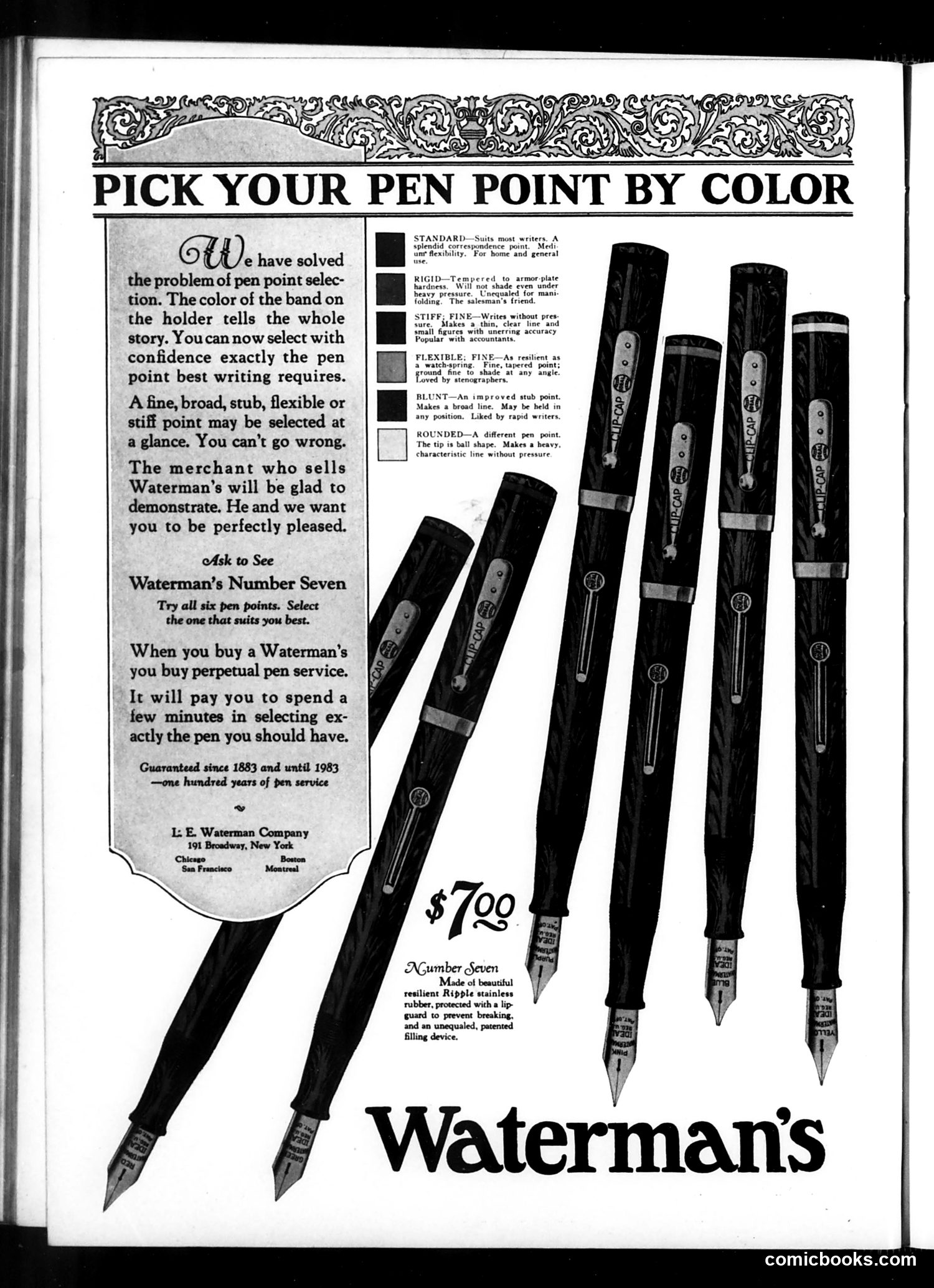
This is **not a cartoon or satirical content** — it's a straightforward advertisement for Waterman's fountain pens. The page promotes the "Number Seven" model at $7.20, emphasizing that different pen nib types (standard, hard, stiff fine, flexible fine, blunt, and rounded) suit different writing needs. The ad's main selling point is consumer choice: buyers can select the exact pen point matching their writing style. The copy stresses Waterman's reliability ("guaranteed since 1883") and promises merchants will demonstrate all options to ensure customer satisfaction. There is no political satire or social commentary here. This represents early 20th-century marketing strategy: positioning a premium product through customization and expert service.
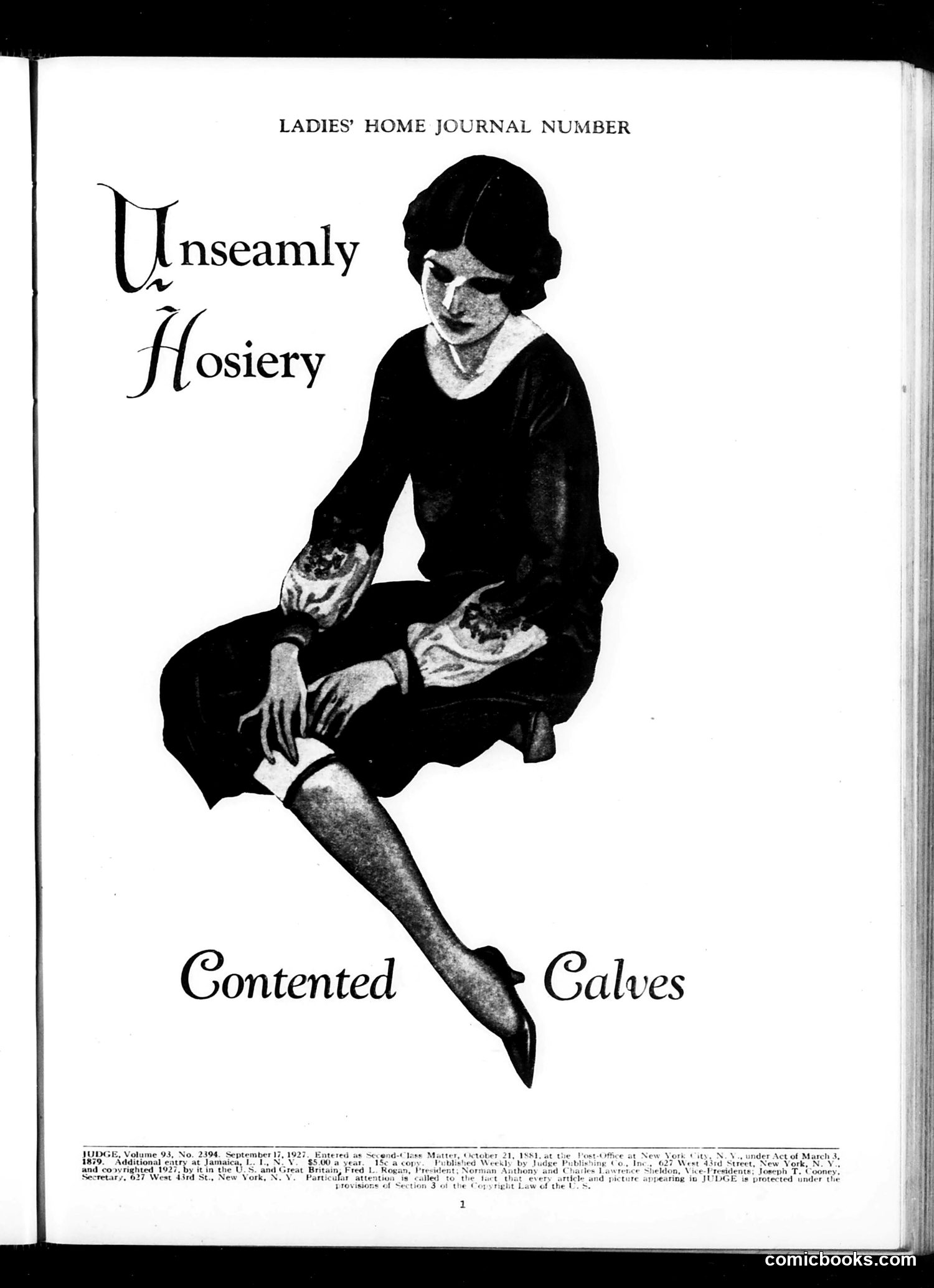
This is a Ladies' Home Journal advertisement from Judge magazine (September 12, 1927, based on the masthead). It's not political satire but rather a commercial ad promoting hosiery. The image shows a stylized woman in 1920s fashion—short dark hair (a "bob" cut typical of the era), dark dress, and notably, her legs prominently displayed wearing hosiery. The headline "Unseamly Hosiery" is a pun: "unseemly" sounds like "un-seamy," suggesting hosiery without visible seams. The phrase "Contented Calves" is another pun referencing the leg muscles being shown off. The advertisement emphasizes the modern woman's display of legs—a social shift in the 1920s when women's hemlines rose significantly and such visibility was still somewhat daring. The satire targets marketing language that plays on fashion trends and women's vanity.
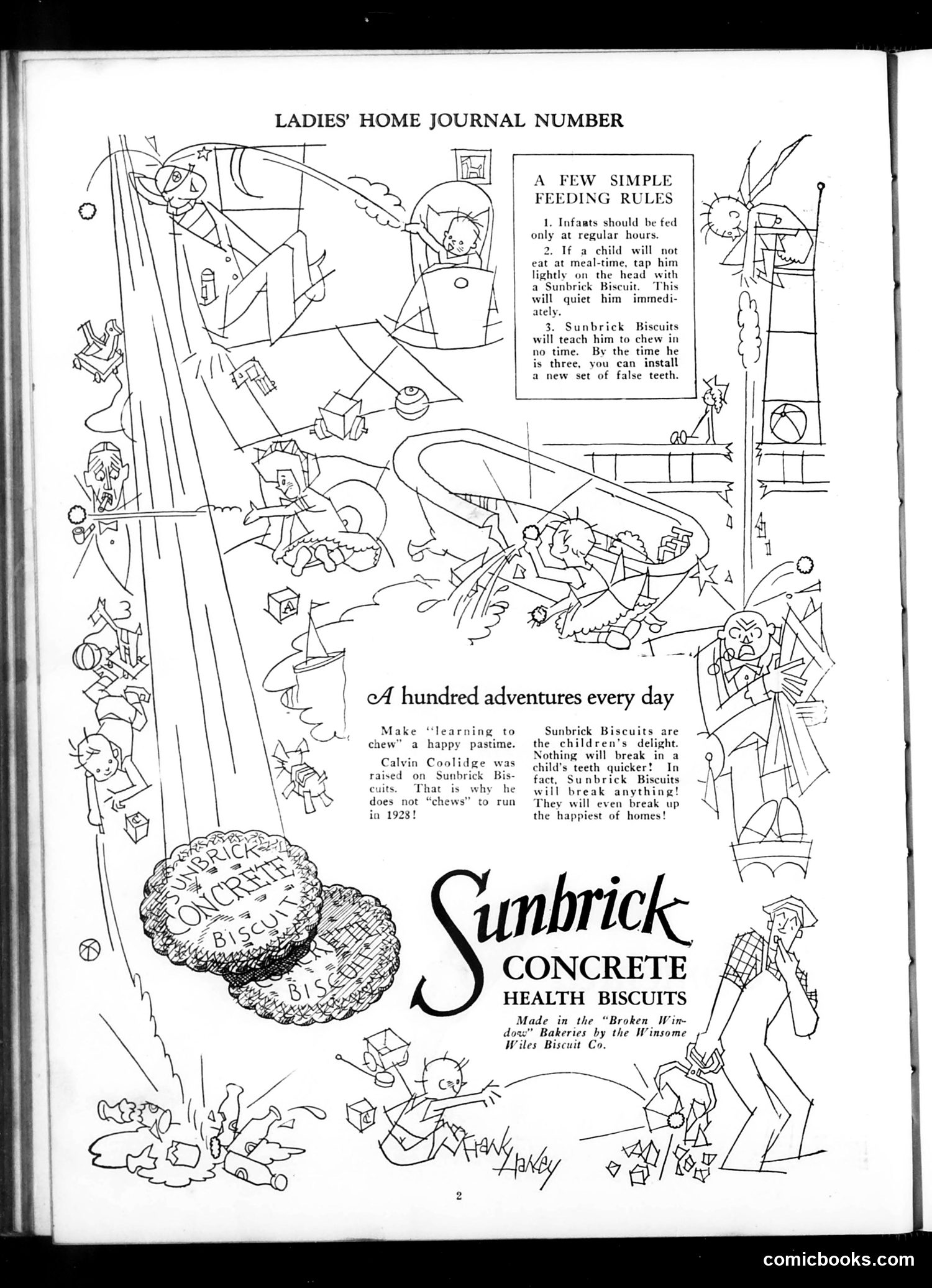
This page is primarily a **Sumbrick Concrete Health Biscuits advertisement** rather than political satire. The chaotic illustration depicts children engaged in numerous activities—playing, eating, climbing—to visualize the advertiser's claim that their product provides "a hundred adventures every day." The accompanying text references **Calvin Coolidge**, the U.S. President (1923-1929), claiming he was "raised on Sumbrick Biscuits" and therefore "does not 'chews' to run in 1928" (a pun on Coolidge's famous statement "I do not choose to run"). This is mock endorsement humor. The "feeding rules" box offers tongue-in-cheek parenting advice about the biscuits' durability and teething benefits. The overall tone is lighthearted advertising humor rather than serious political commentary.
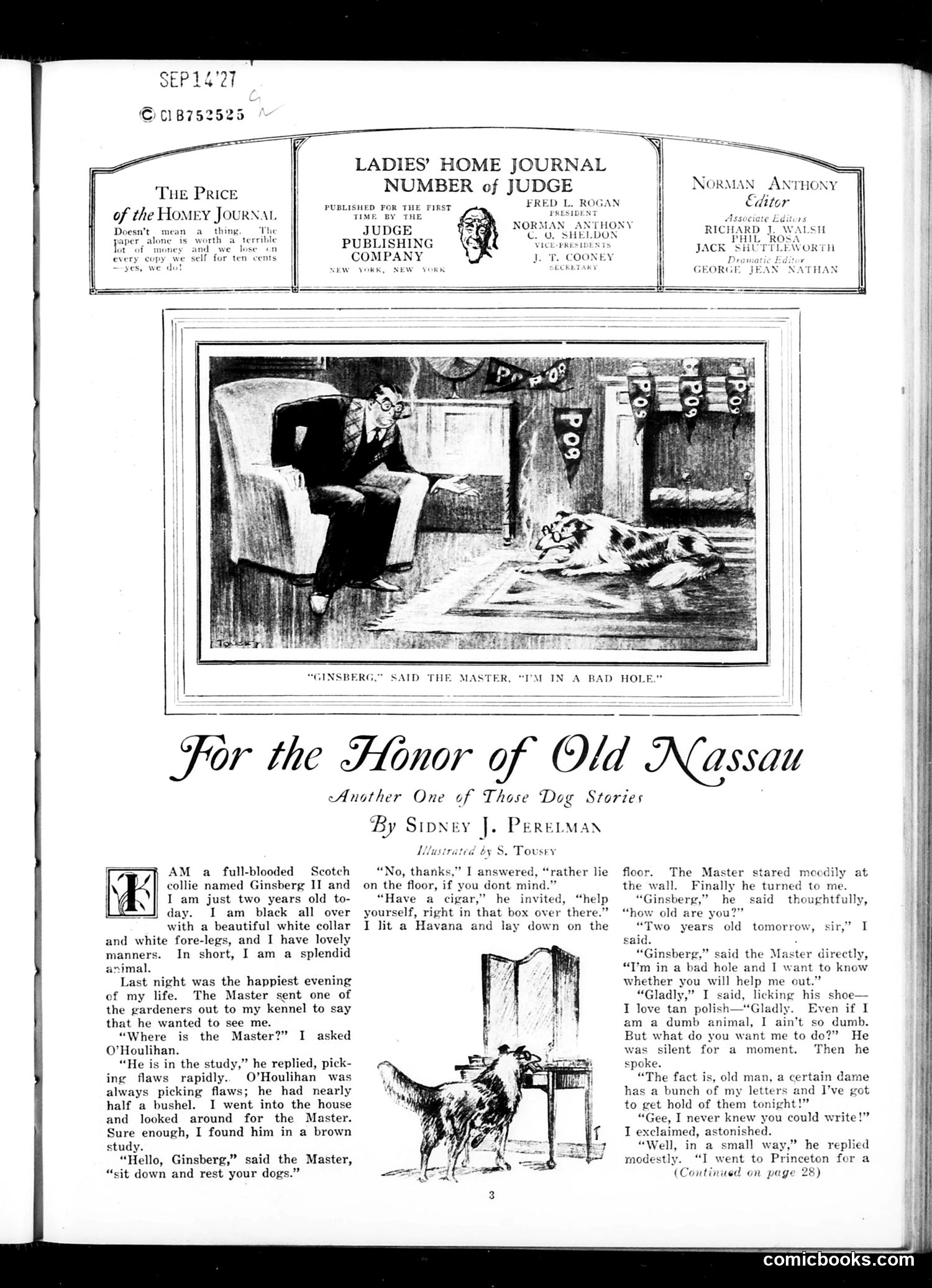
This page presents a dog story by Sidney J. Perelman, illustrated by S. Tousey. The narrative describes a Scotch collie named Ginsberg who belongs to a Master. The story appears to be humorous fiction rather than political satire. The top cartoon shows a man in a study with a dog lying on the floor, captioned "Ginsberg," said the Master, "I'm in a bad hole." This illustrates the opening of the story where the Master seeks the dog's help with unspecified troubles. The magazine's masthead identifies this as *Ladies' Home Journal Number of Judge*, published by the Judge Publishing Company. This is primarily a literary/entertainment page rather than political commentary—typical of Judge's mixed content combining satire with fiction and humor pieces.
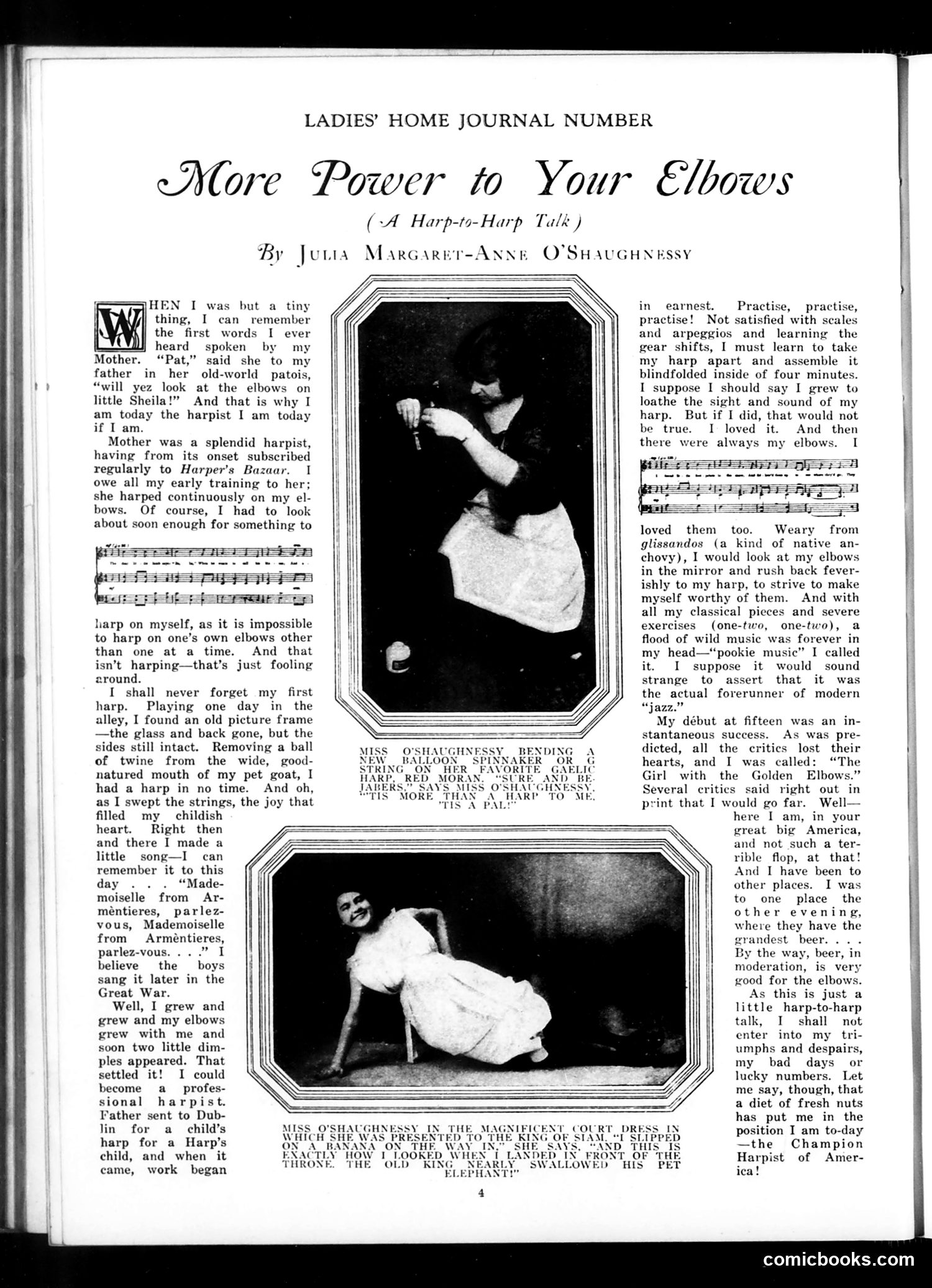
This is not a political cartoon or satire page. It's a feature article titled "More Power to Your Elbows" by Julia Margaret-Anne O'Shaughnessy, published in *Ladies' Home Journal*. The piece is a humorous memoir about the author's experience learning to play the harp as a child. Two photographs show O'Shaughnessy demonstrating harp-playing posture and technique. The article uses playful language to describe her childhood musical training and eventual success as a professional harpist, culminating in her becoming "Champion Harpist of America." This is lifestyle/entertainment content aimed at female readers, not political commentary.
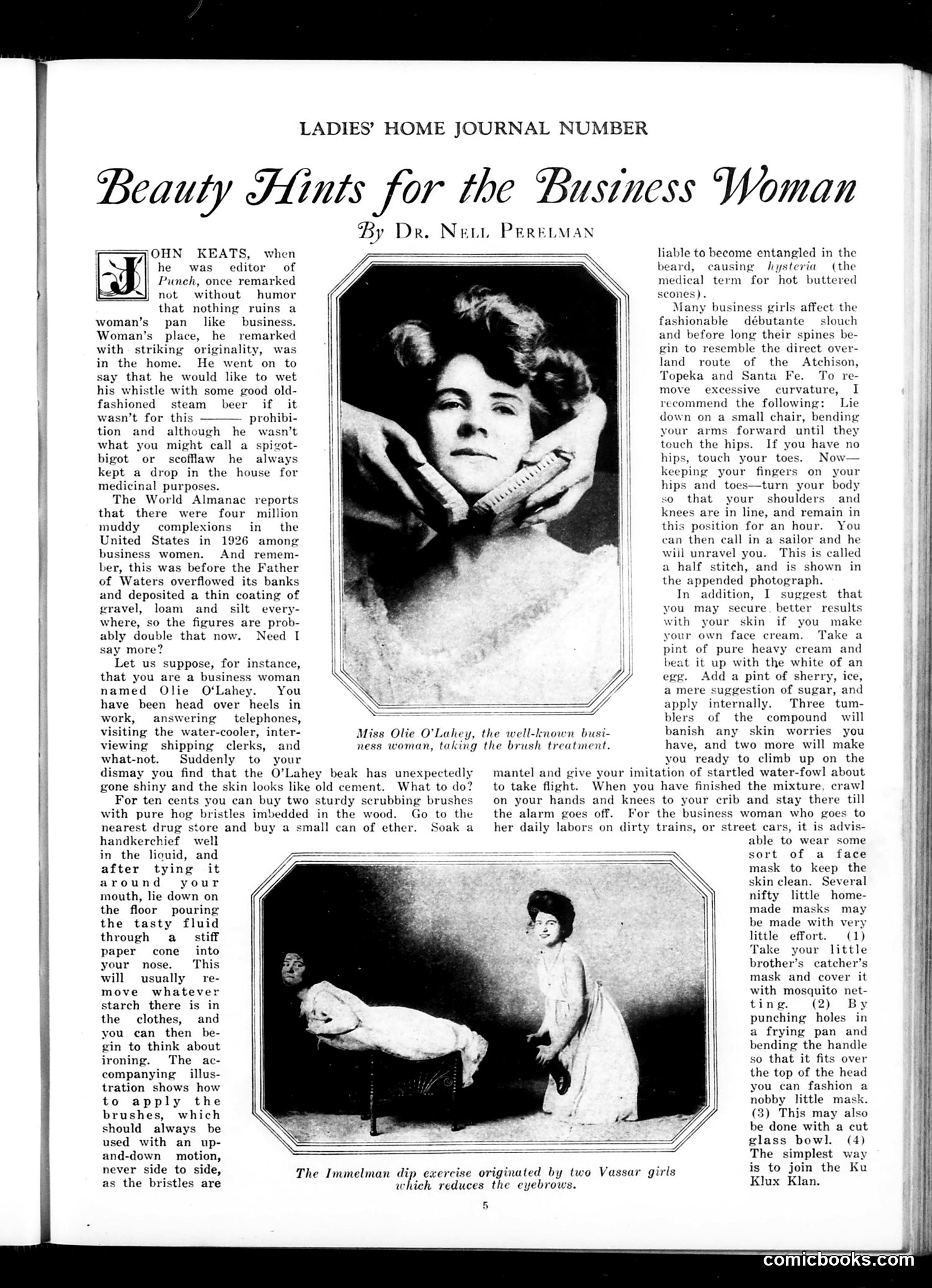
This is not political satire but a practical advice column by Dr. Nell Perelman for working women. The page presents beauty and grooming tips for female office workers, a demographic that had grown significantly (the text references four million "muddy complexioned" business women in the U.S. by 1926). The two photographs demonstrate specific treatments: the upper image shows Miss Olie O'Lahey receiving a "brush treatment," while the lower image illustrates the "Immelman dip exercise" (a gymnastics movement) for reducing eyebrows. The advice includes skincare remedies, posture exercises, and homemade face masks—practical guidance reflecting 1920s concerns about maintaining professional appearance despite demanding office work on "dirty trains" or in dusty environments.
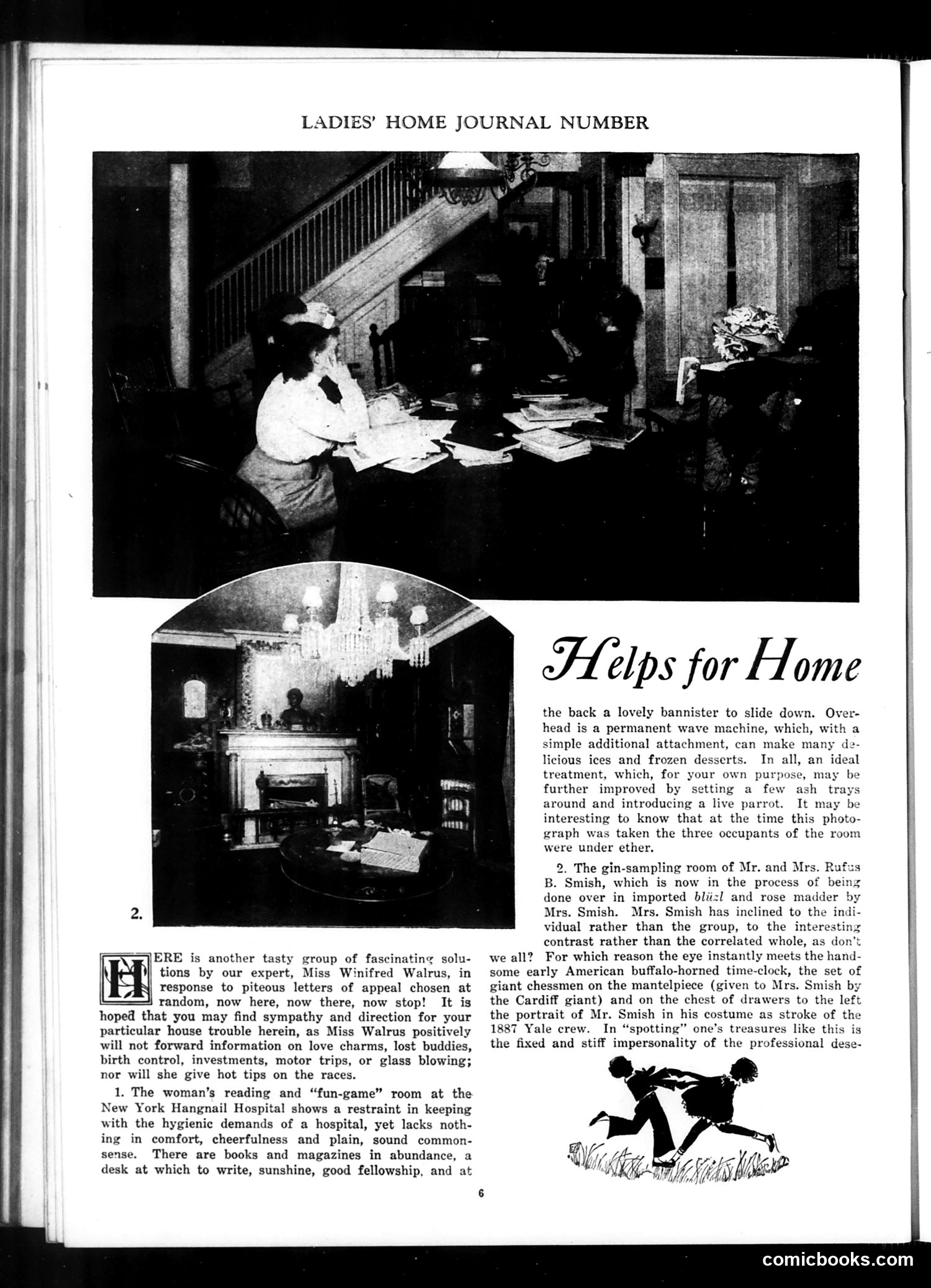
This is a humorous advice column by fictional expert "Miss Winifred Walrus," satirizing the serious home-improvement content popular in women's magazines of the era. The satire works through absurdist exaggeration: **Image 1** depicts a hospital recreation room presented as an ideal domestic space—but the joke is hidden in the text: the three occupants "were under ether" (anesthetized), making the cheerful setting darkly comedic. **Image 2** mocks affluent interior decorating pretensions. Mrs. Smish's "gin-sampling room" features ostentatious decor (imported materials, giant chess pieces, Yale crew memorabilia) presented with pompous seriousness. The humor lies in the overwrought description of obvious status symbols masquerading as tasteful design choices. The column's disclaimer that Miss Walrus won't answer questions about "love charms, lost buddies, birth control...or glass blowing" further emphasizes the satirical tone—parodying advice columns' typical scope while suggesting absurdist concerns alongside practical ones.
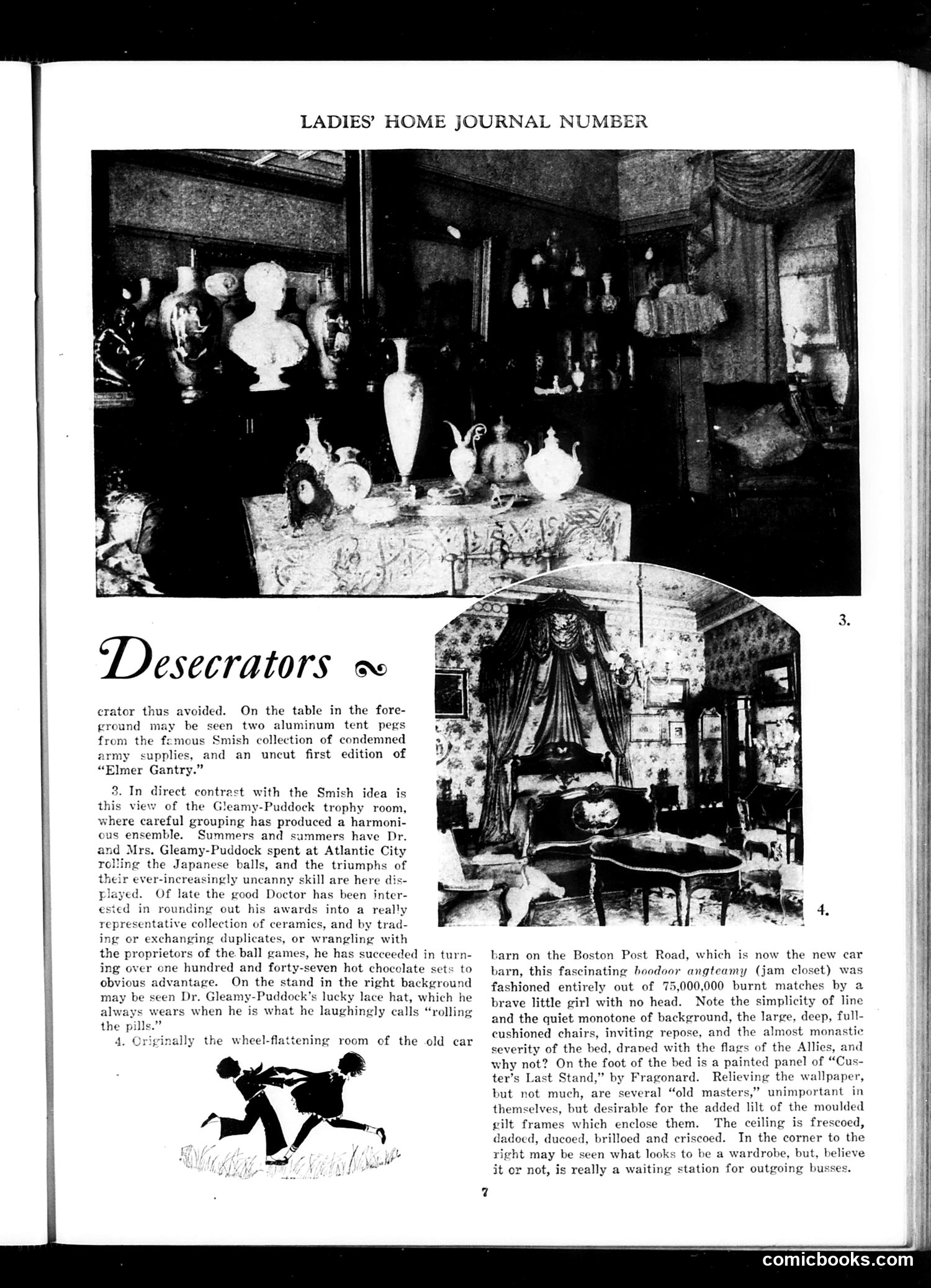
This page satirizes wealthy collectors and their pretentious home decoration practices. The article contrasts two approaches to displaying collections: **The "Smish" method** (image 3): Cluttered, tasteless accumulation—including army surplus tent pegs and a first edition of "Elmer Gantry" (Sinclair Lewis's 1927 novel mocking American hypocrisy), suggesting ostentatious but ignorant collecting. **The "Gleamy-Puddock" approach** (image 4): Supposedly refined, but the text mockingly describes absurdities—a bedroom fashioned from 75 million burnt matches "by a brave little girl with no head," paintings by Fragonard, overwrought decoration ("frescoed, dadoed, ducoed")—exposing how wealthy collectors use pseudo-intellectual language and fake "old masters" to disguise bad taste. The satire targets Gilded Age excess and the nouveau riche's desperate attempts at cultural legitimacy through acquisition rather than genuine aesthetic understanding.
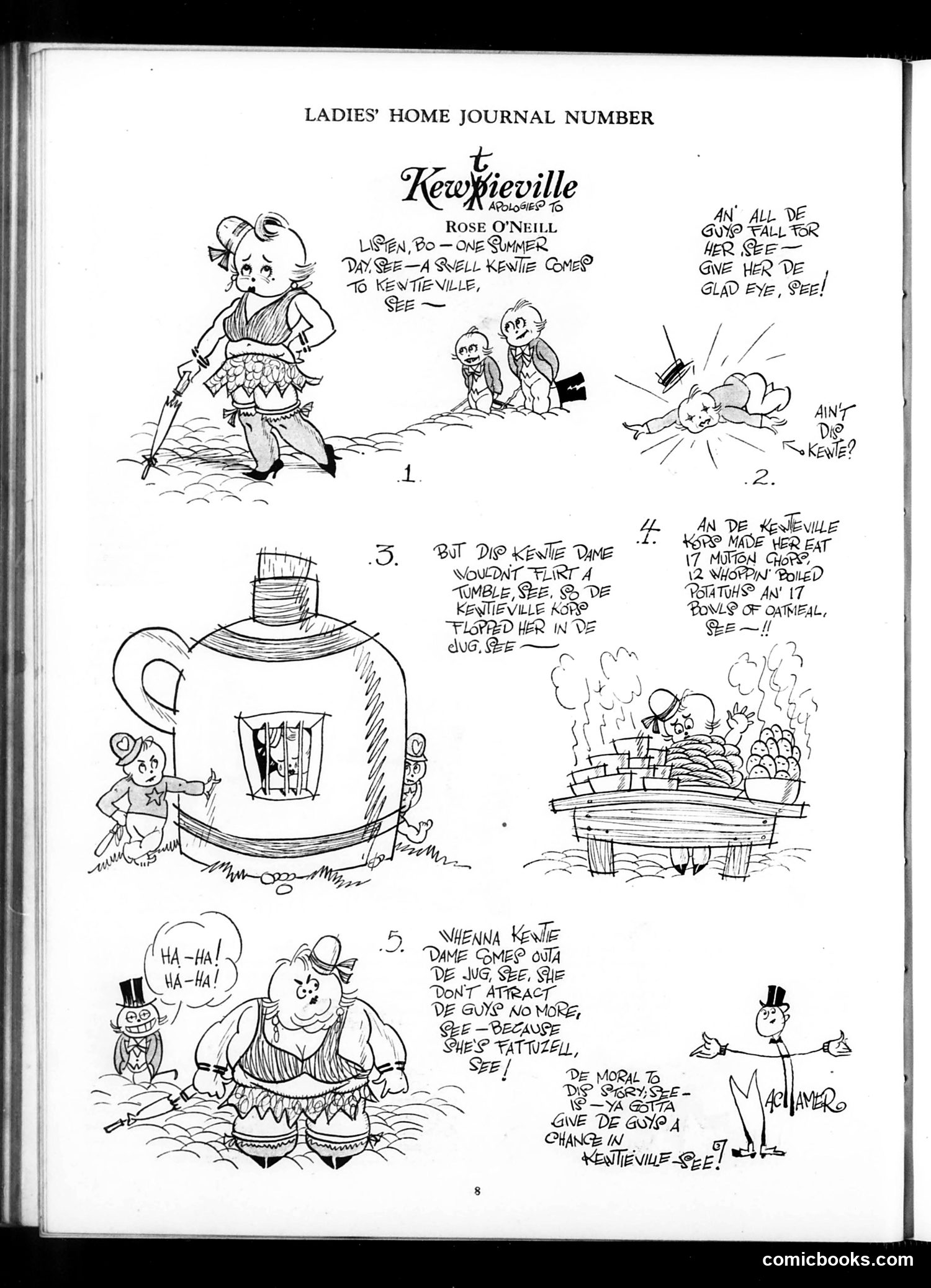
This is a humorous comic strip featuring O'Neill's popular "Kewpie" characters—cherubic elves that were a major commercial success in the early 20th century. The narrative, told in exaggerated dialect, follows a young woman ("Rose O'Neill") visiting Kentieville, where she encounters various misadventures: being knocked down by a kewpie, dining extravagantly, and discovering that overeating has made her unattractive to suitors. The humor relies on physical comedy, the contrast between refined ladies' magazine content and crude rural speech, and the era's preoccupation with female beauty and weight. The comic serves as both entertainment and subtle social commentary—mocking both the vanity of modern women and the superficiality of courtship. O'Neill's Kewpies were whimsical, mischievous creatures used to satirize human folly.
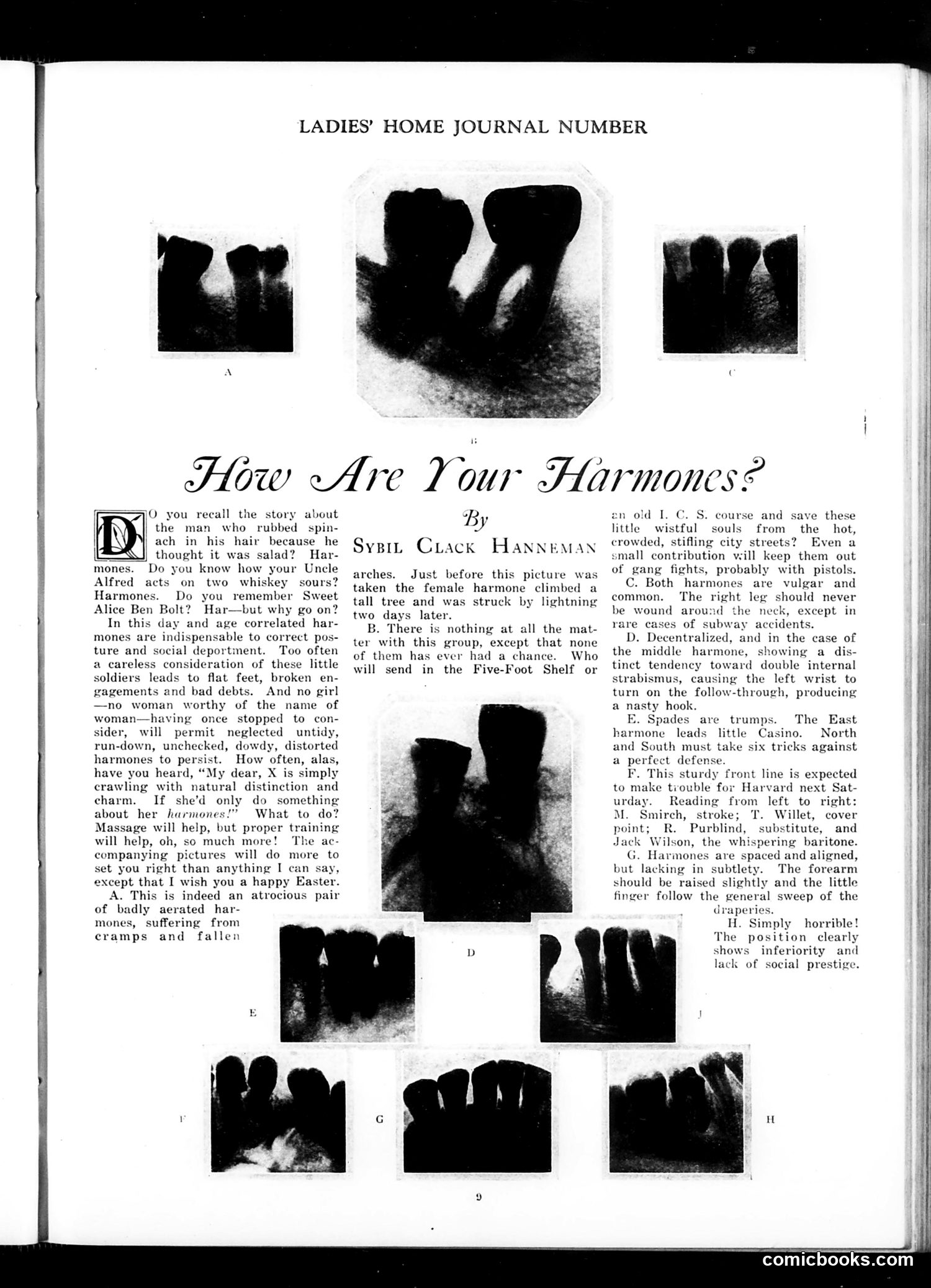
This article by Sybil Clack Hanneman satirizes the 1920s-era obsession with "hormones" as an explanation for social behavior and posture. The accompanying photographs of feet and legs in various positions mock the pseudoscientific advice literature that was ubiquitous at the time. The satire works by applying serious hormone-theory language to trivial physical details—commenting on leg position, wrist angle, and foot spacing as indicators of "social prestige" or "inferiority." References to specific people (M. Smirch, T. Willet, Jack Wilson) appear to be contemporaneous Judge regulars or public figures, though their exact identities are unclear. The piece ridicules both the fad of attributing personality to hormones and the etiquette-obsessed culture that judged character through posture. The absurd commentary (lightning strikes, subway accidents, "spades are trumps") undercuts the pseudo-expert tone, revealing the whole enterprise as nonsense dressed in scientific language.
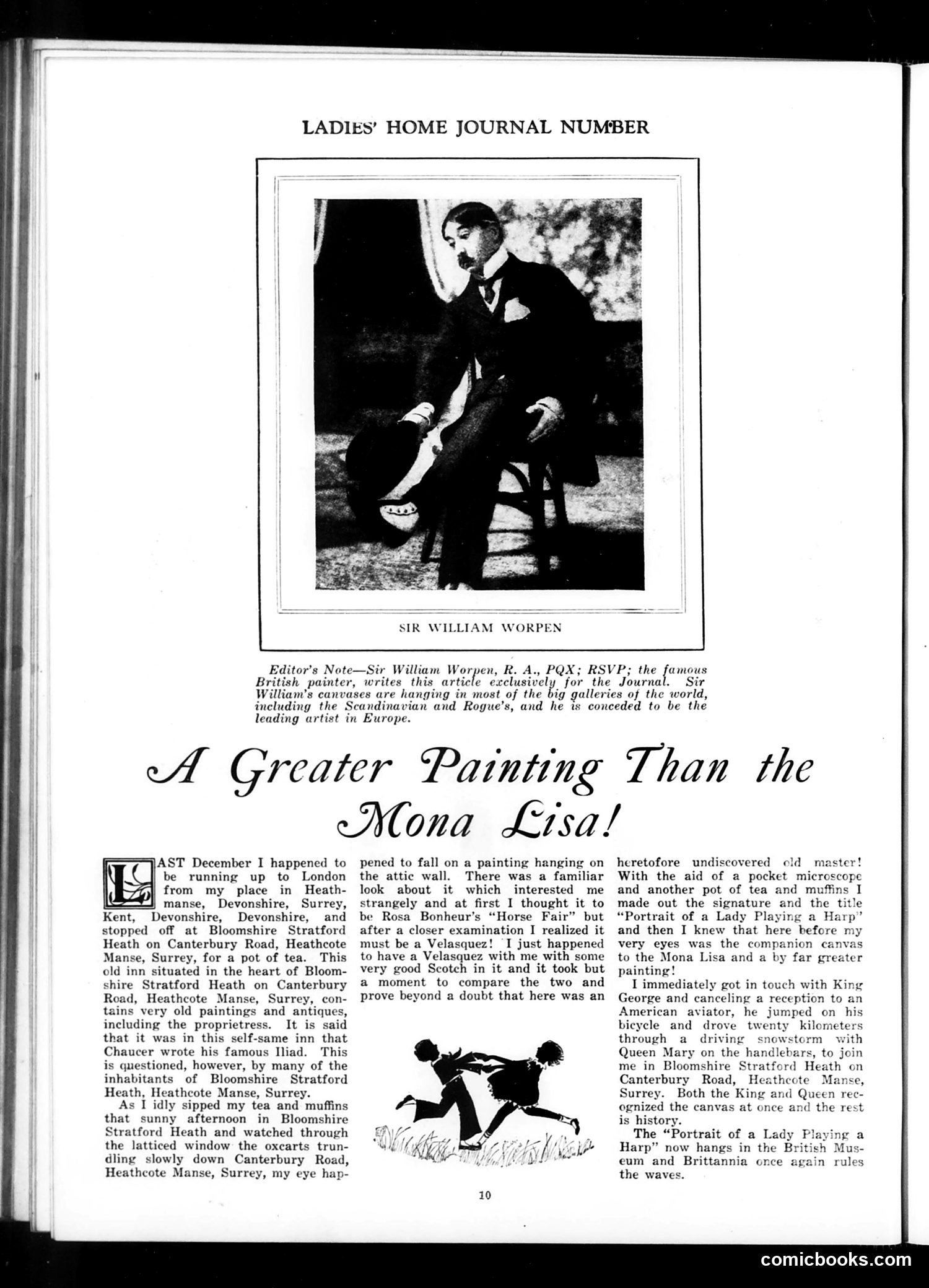
This is a humorous tall tale satirizing art world pretension and British pomposity. The unnamed narrator claims to have discovered a lost masterpiece by the Spanish painter Velázquez—supposedly superior to the Mona Lisa—in a dusty English inn attic. The satire works through absurd escalation: the casual discovery, the narrator's instant "expertise" with a pocket microscope, the comparison made over scotch and tea, and the climactic arrival of King George and Queen Mary who bicycle through a snowstorm to validate the find. The joke mocks: - Art-world snobbery and the mystique surrounding "old masters" - British self-importance (involving the monarchy in an art authentication) - The narrator's unwarranted confidence in identifying priceless works Sir William Worpen, credited as the article's author, appears to be a fictional persona—part of the satire itself. The piece parodies how prestigious artists and publications promote dubious "discoveries" with affected authority.
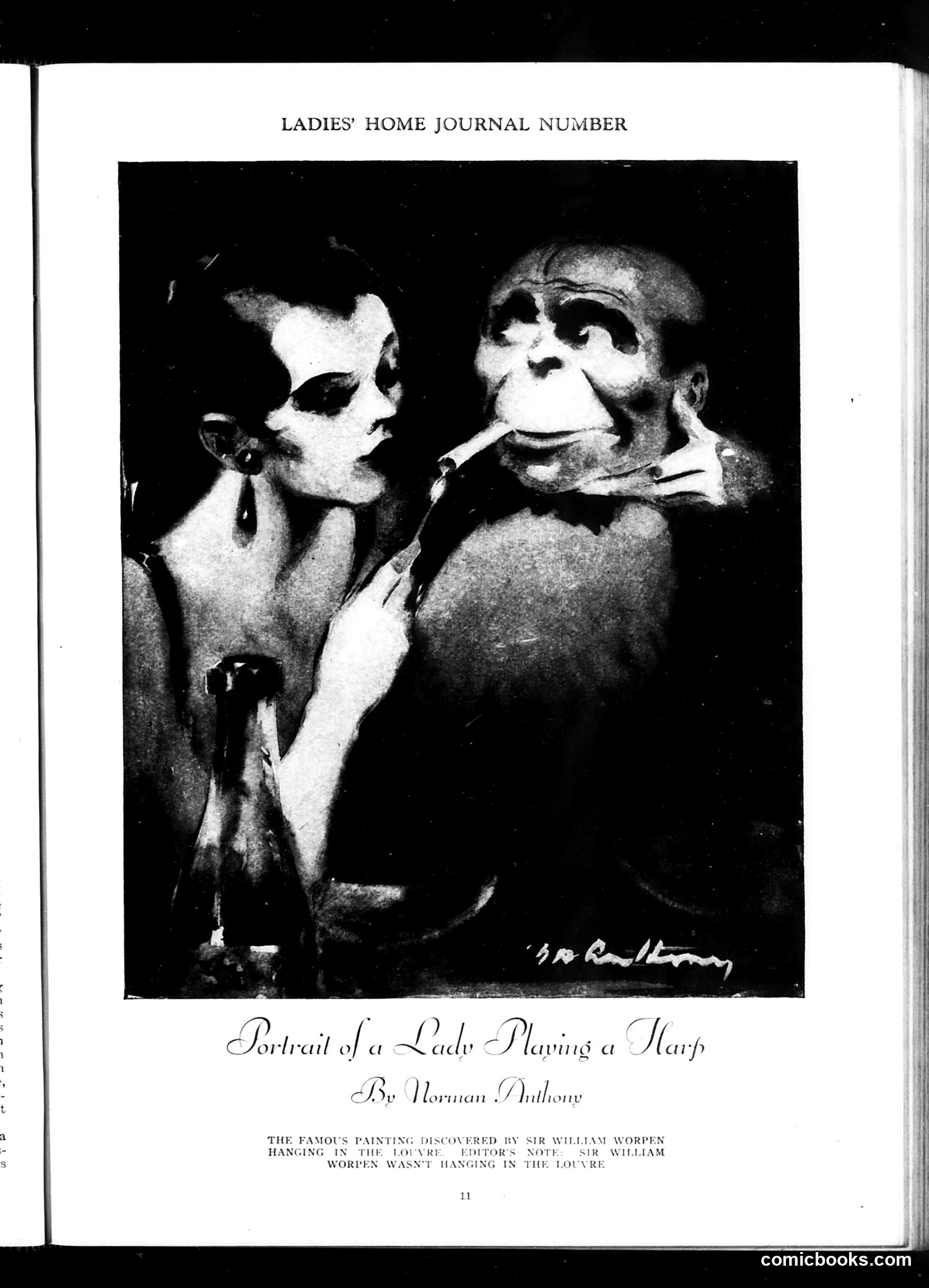
This page presents a satirical artwork caption. The image shows two figures wearing animal masks—one appearing ape-like—in an intimate pose. The caption credits it as "Portrait of a Lady Playing a Harp" by Norman Anthony, claiming it's a famous painting discovered by Sir William Worpen hanging in the Louvre. The joke operates on multiple levels: The editor's note provides the punchline—a deliberate misreading of the caption to suggest Sir William Worpen (rather than the painting) was hanging in the Louvre, implying he was executed or hanged there. Additionally, the crude animal-masked figures mockingly juxtapose crude zoological imagery with high-art pretension, satirizing art world pomposity and false attribution claims. The humor targets both art establishment vanity and the absurdity of passing off crude work as masterpieces.
This is a satirical editorial from Judge magazine's Ladies' Home Journal parody issue, not a cartoon. The piece mocks male magazine editors' patronizing attitude toward female readers. The satire targets editors who: - Claim authority over women's behavior (fashion, morality, domesticity) - Profit from advertising while pretending editorial guidance is disinterested - Expect women's unquestioning obedience to prescribed roles - Resent women's actual independence (smoking, discussing sex frankly, exposing knees, using cosmetics) The humor lies in the editors' transparent contradiction: they blame women for not following their advice while simultaneously profiting from ads encouraging the very behaviors they condemn. The piece exposes how magazines simultaneously infantilize women ("pretty, empty heads") while exploiting their purchasing power—charging $35,000 per advertisement spread. References to Lucy Stone and Mrs. Bloomer invoke 19th-century feminists, suggesting women's growing independence troubles the editors. The tone is sardonic throughout, using the editors' own voice to expose their hypocrisy.
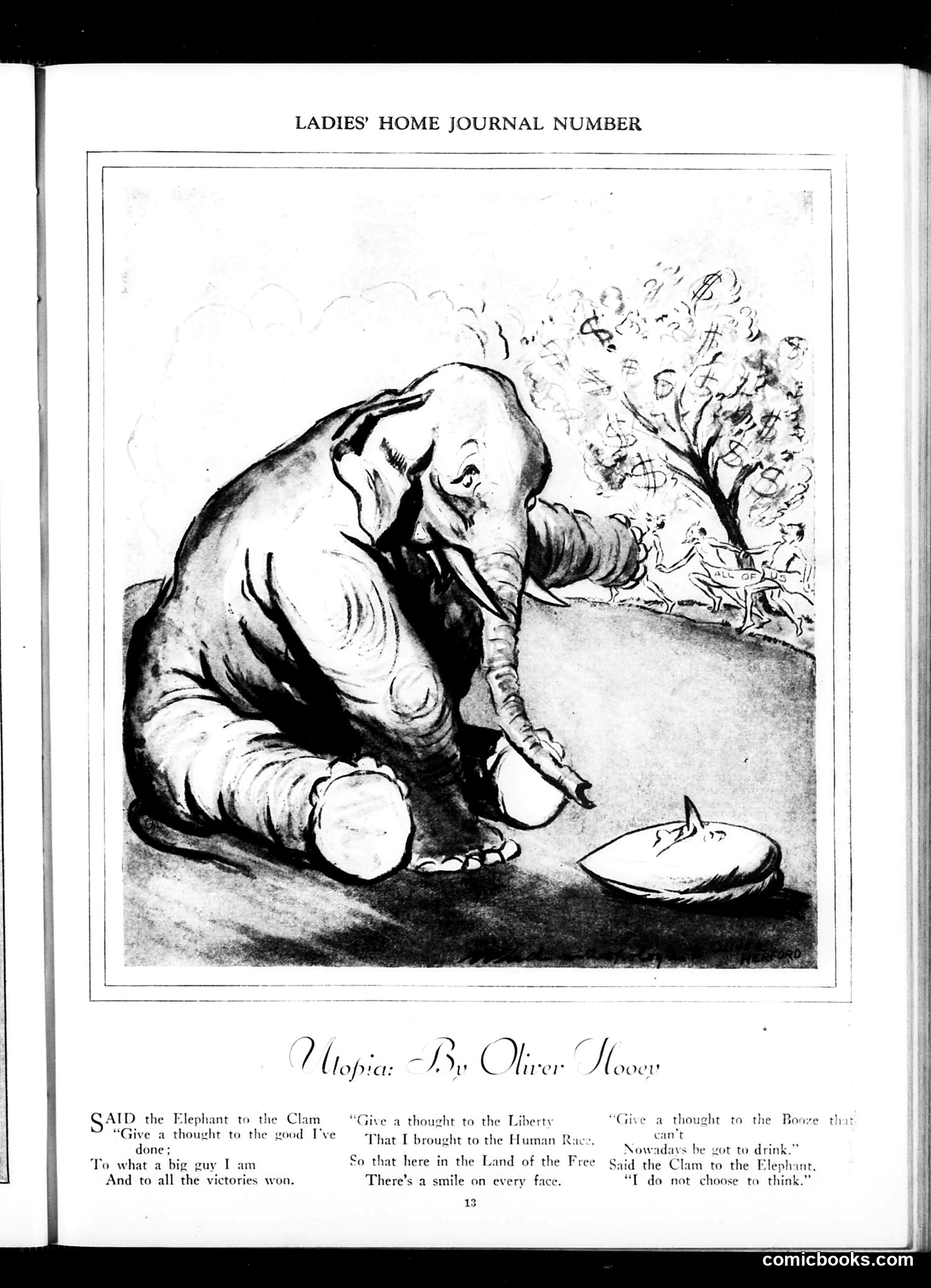
This cartoon satirizes American prosperity and complacency through a dialogue between an Elephant (representing the Republican Party or American establishment) and a Clam (representing the working class or average citizen). The Elephant boasts of its accomplishments and victories, expecting gratitude. The Clam's response—"I do not choose to think"—is the satirical punch line, suggesting that ordinary Americans are content to remain willfully ignorant rather than critically examine their circumstances. The cartoon likely critiques post-war American triumphalism and materialism (the references to "Liberty" and "Booze" suggest Prohibition-era politics). It implies that prosperity has made citizens passive and unthinking, unwilling to engage with serious social or political questions. The title "Utopia" is ironic—this supposed perfect society is actually one where people deliberately avoid thought.
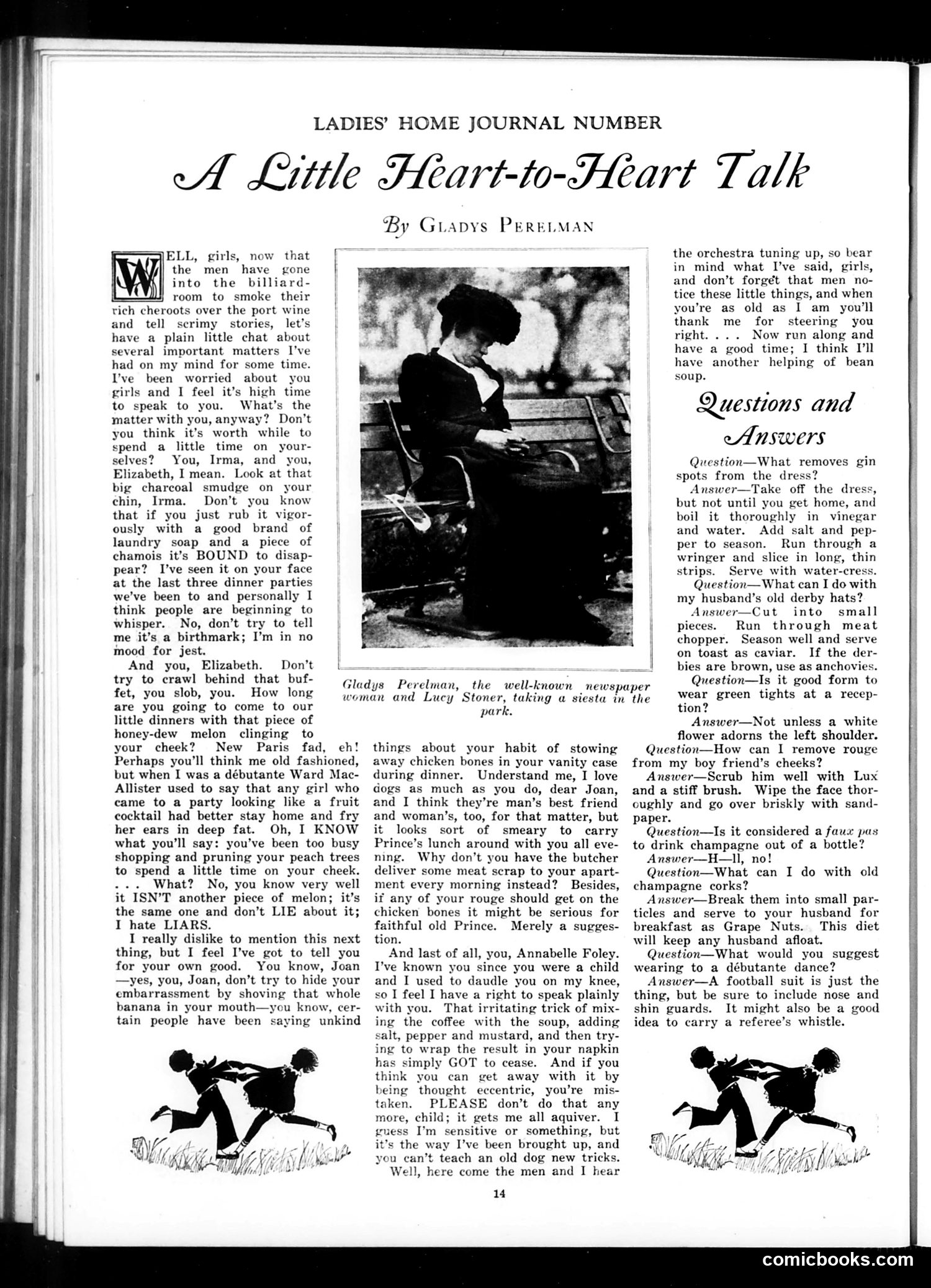
This is a satirical piece by Gladys Perelman (wife of humorist S.J. Perelman) mocking uptight Victorian etiquette culture and snobbish social gatekeeping. **The Setup:** An older society matron delivers a patronizing "heart-to-heart talk" to younger women after dinner, criticizing their appearance and manners in exaggerated detail—smudged chins, melon stuck to cheeks, storing chicken bones in vanity cases for dogs, mixing soup with coffee. **The Satire:** The piece ridicules how rigid social rules infantilize women and how arbitrarily these rules are enforced. The matron invokes Ward McAllister (a real 1880s-90s society arbiter famous for strict etiquette) to justify outdated standards. She demands conformity while claiming sensitivity. **The Joke:** The absurdity escalates—mixing soup and coffee is presented as genuinely scandalous behavior requiring intervention. The piece exposes how controlling and trivial upper-class women's social expectations were. The accompanying illustrations show women in physical comedy poses, reinforcing the mockery of taking these petty rules seriously.
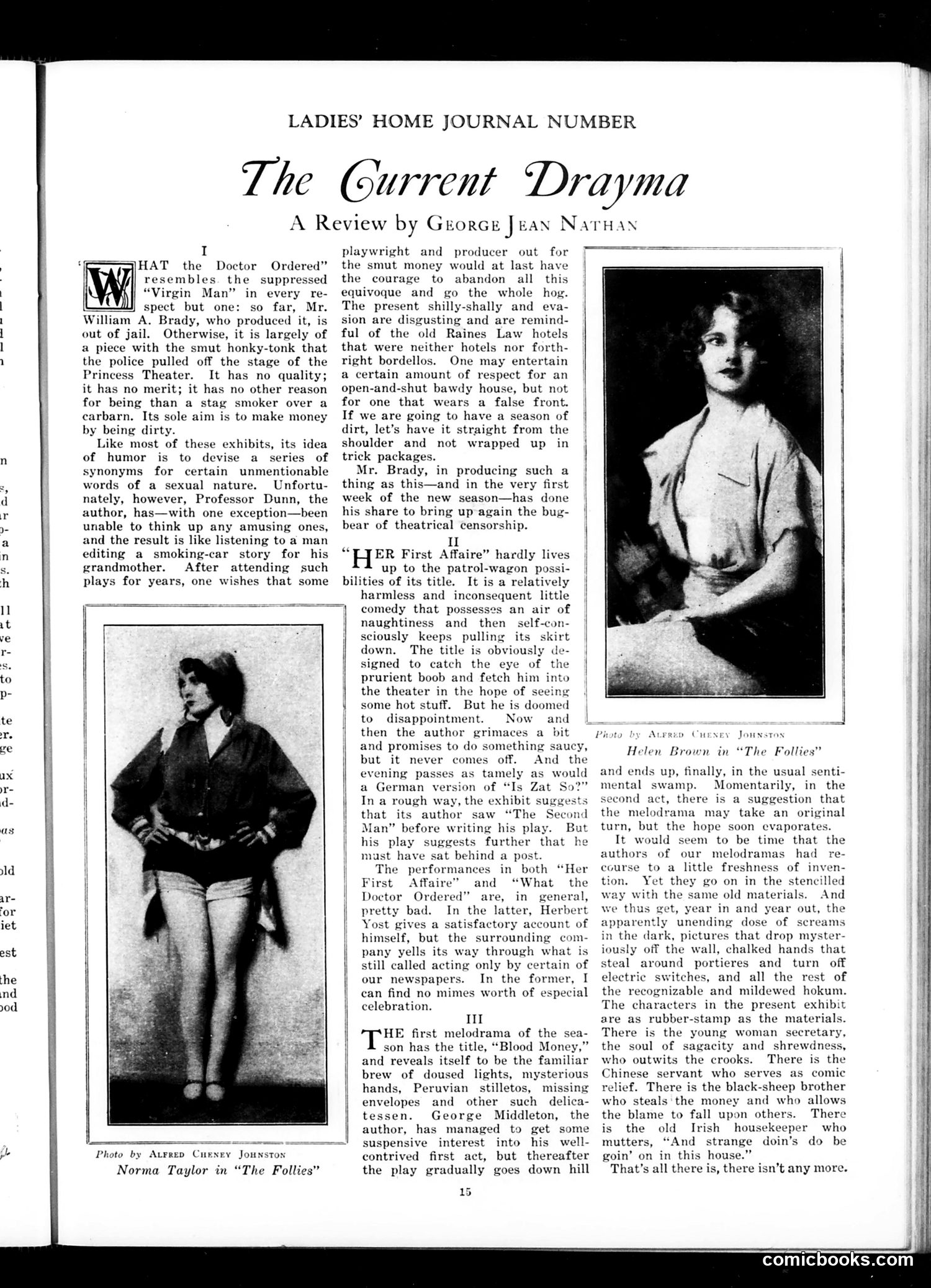
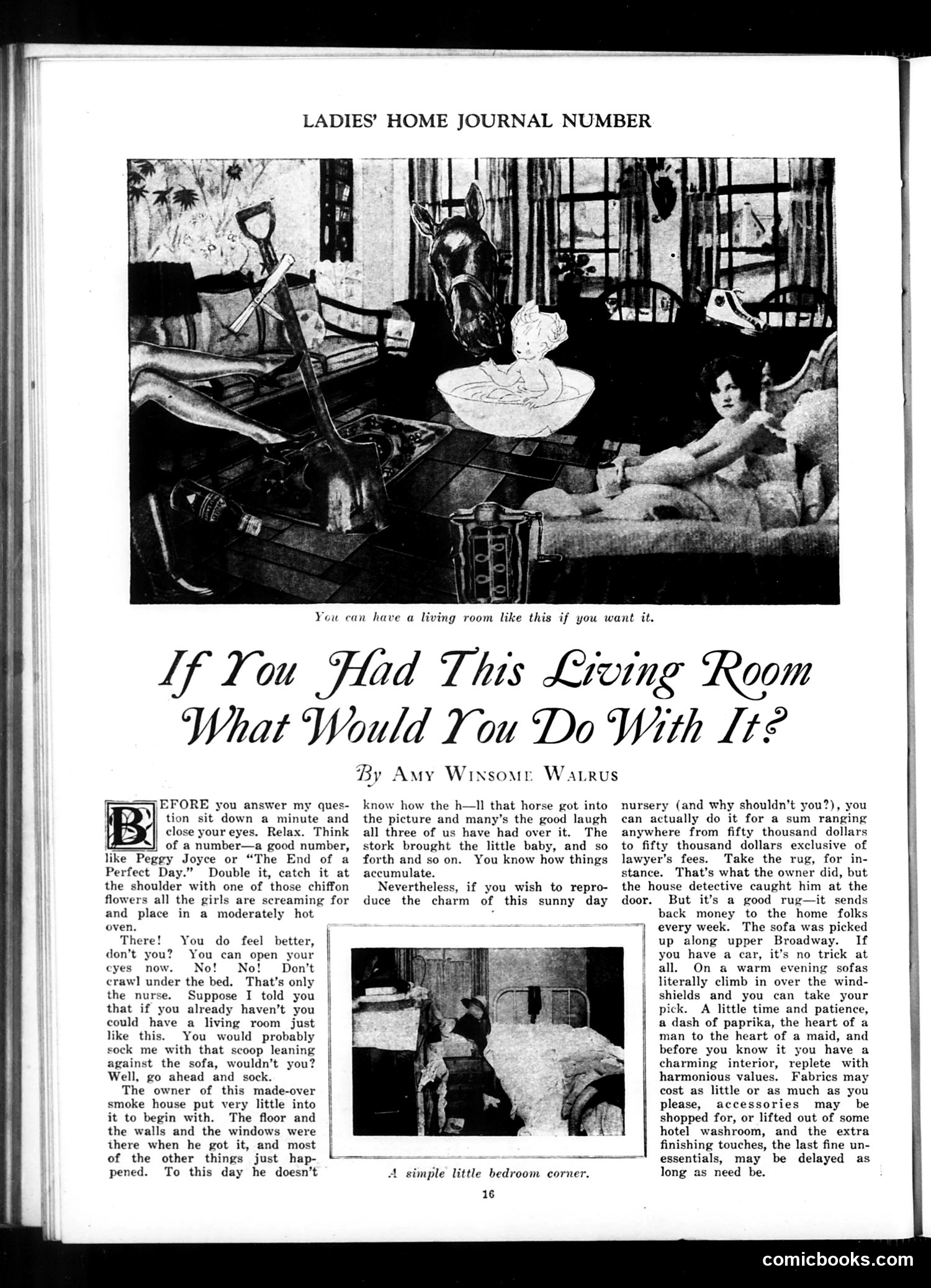
This is not a political cartoon but rather a **humorous advice article** about home decoration by Amy Winsome Walrus in *Judge* magazine. The piece satirizes the aspirational lifestyle promoted in home-décor journalism of the era. It opens with absurdist humor ("think of a number...place in a moderately hot oven") to mock readers' fantasies about achieving elegant interiors. The core satire: the author describes an actual living room and asks what readers would do with it, then reveals the owner achieved this look almost accidentally in a converted smoke house with minimal investment—yet admits you could spend "$50,000 exclusive of lawyer's fees" to replicate it. The joke undercuts both wealth-obsessed decorating culture and the pretense that taste requires expense. Practical tips (steal a sofa from Broadway, furniture "climbs in" cars, raid hotel washrooms for accessories) suggest that stylish homes rely partly on luck, patience, and resourcefulness rather than pure spending power. This reflects 1920s anxieties about conspicuous consumption and changing class markers during a period of economic prosperity.
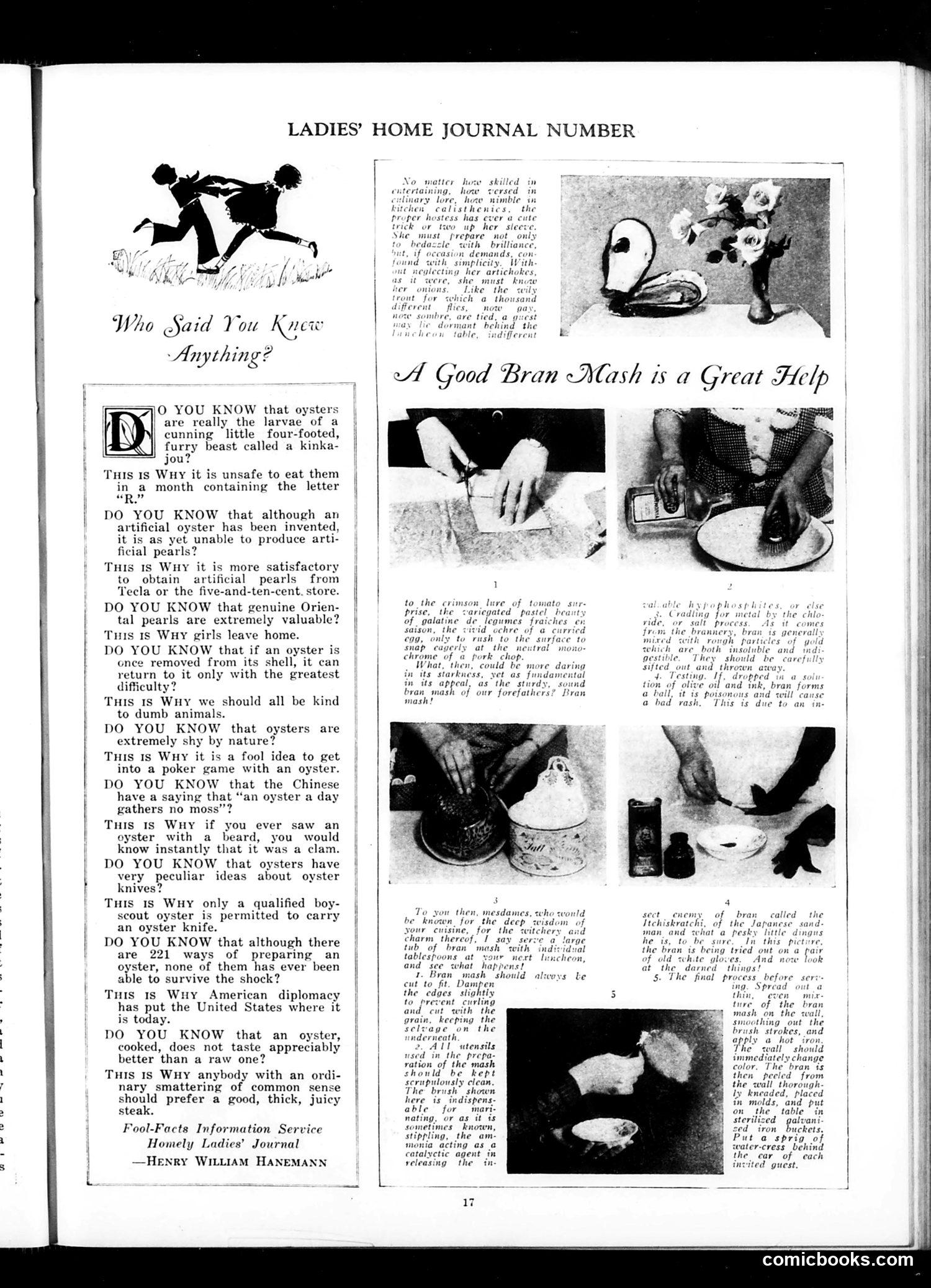
This is a humorous fake "educational" column that deliberately presents absurd, false "facts" about oysters paired with ridiculous pseudo-logical conclusions. The joke is the format itself: each claim begins "DO YOU KNOW that..." followed by obvious nonsense (oysters are larvae of a "kinkajou"; they play poker; Chinese saying "an oyster a day gathers no moss"), then explains "THIS IS WHY" with absurd reasoning. The satire mocks pseudo-intellectual popular knowledge and the era's tendency to present dubious "facts" as wisdom. The final example connects oyster peculiarities to American diplomacy—a dig at government policies. The author attributes this to a "Fool-Facts Information Service," making the mockery explicit. It's gentle social satire targeting both credulous readers and the magazine format itself. The facing page about bran mash appears to be unrelated domestic/cooking advice.
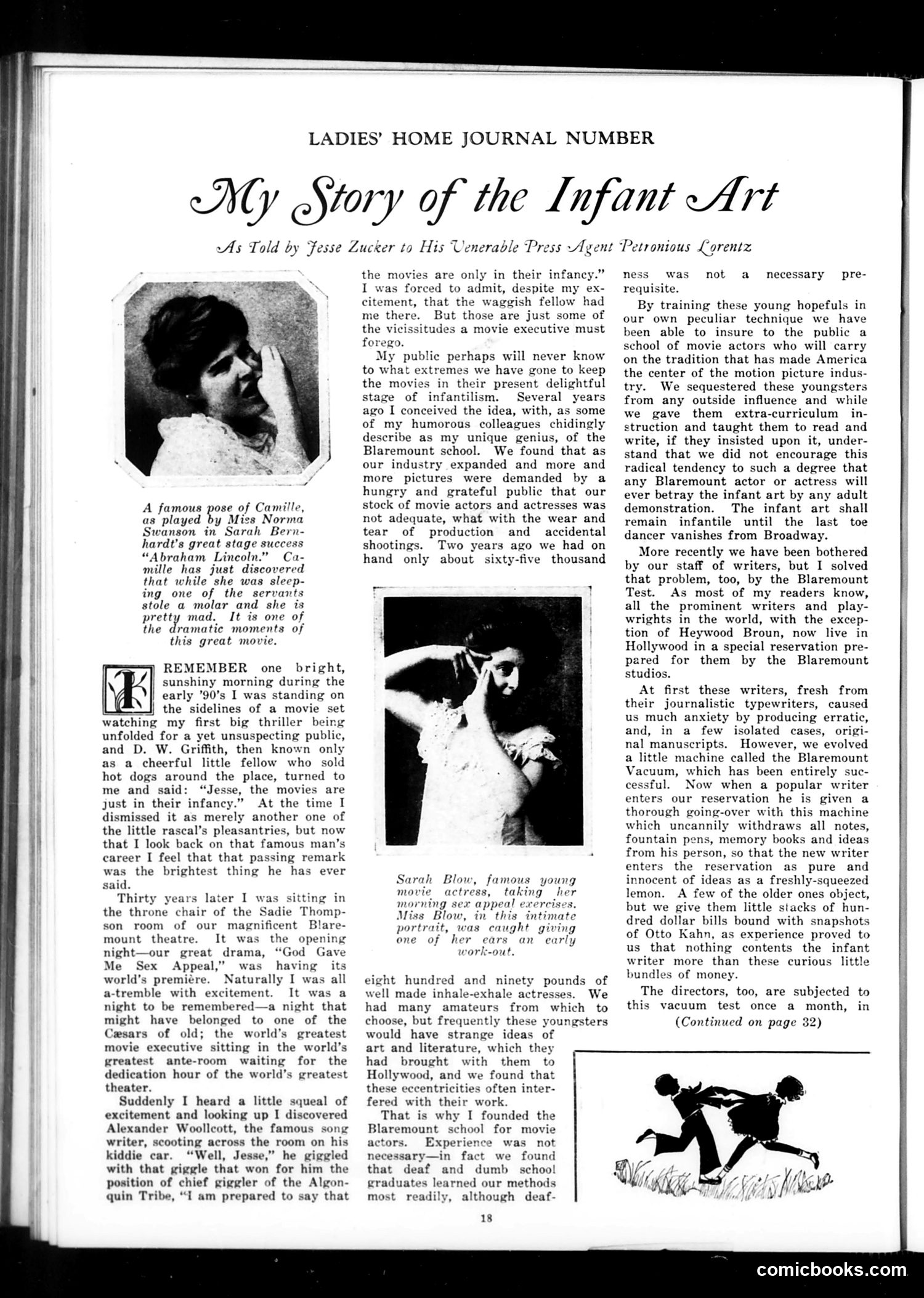
This is a satirical essay by "Jesse Zucker" (a fictional character) mocking the early motion picture industry's pretensions and commercialism. The piece lampoons: **The subject**: Hollywood's treatment of cinema as a serious art form despite its genuine infancy. The narrator absurdly claims to have engineered the "Blaremount school" to manufacture compliant actors—famously graduates from deaf and dumb schools because they require no training in "art." **The satire targets**: - Executive self-importance and manufactured gravitas around a still-juvenile medium - The industry's shameless exploitation of desperate performers - Actors' lack of actual talent or education, presented as intentional corporate strategy **The photos** show silent film actresses in exaggerated "dramatic" poses, reinforcing the satire about overwrought melodrama masquerading as sophisticated cinema. **References**: D.W. Griffith (real film pioneer) and Alexander Woollcott (real Algonquin Round Table wit) appear as characters validating the narrator's self-aggrandizing mythology. The humor lies in the narrator's oblivious boasting about deliberately suppressing artistic integrity—inadvertently revealing Hollywood's actual priorities.
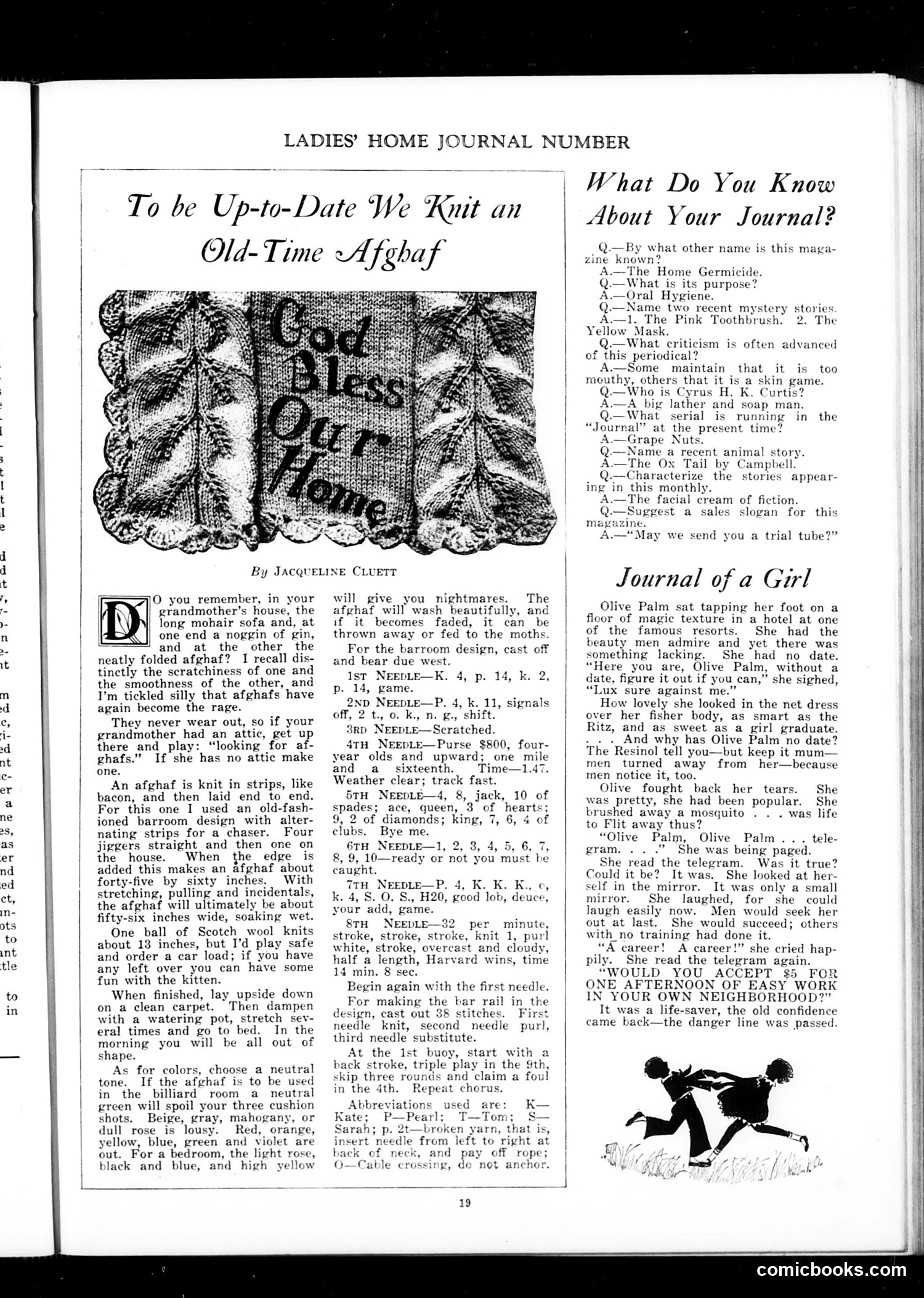
This is a **satirical parody issue** mimicking the *Ladies' Home Journal*, a genuine women's magazine of the era. The humor works through absurdist confusion of categories: **The "afghaf" knitting article** deliberately intersperses knitting instructions with horse-racing terms, card-game notation, and rowing commands—making the instructions nonsensical while maintaining serious instructional tone. It's mocking both overly-detailed crafting guides and the magazine's earnest domesticity. **The "What Do You Know" quiz** satirizes the *Journal's* self-importance by mixing legitimate questions with absurd ones (claiming the magazine's purpose is "Oral Hygiene" and its editor is a "big lather and soap man"—puns on toiletries). **"Journal of a Girl"** appears to be a mock-serious romantic fiction piece, poking fun at the sentimental serialized stories the *Journal* actually published. The overall point: Judge is ridiculing the *Ladies' Home Journal* for its pretentious tone, confusing advice, and saccharine content—standard satirical territory for Judge magazine toward mainstream publications.
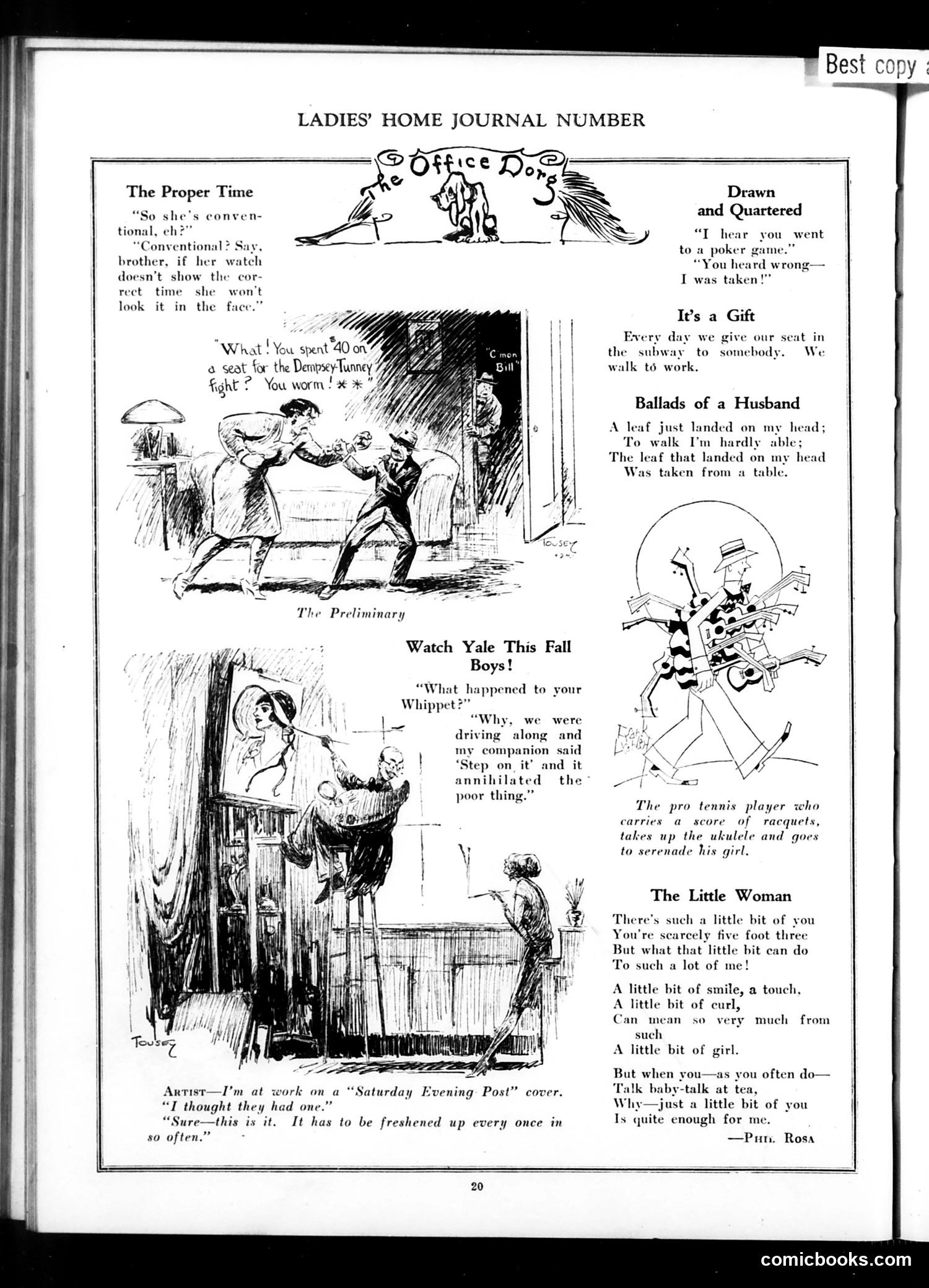
This is a humor page from *Judge* magazine featuring domestic comedy and light satire aimed at middle-class readers. The cartoons and poems mock conventional social behaviors and gender dynamics of the era. "The Proper Time" jokes about wives' vanity—a woman won't acknowledge her watch is wrong because she won't "look it in the face." "Drawn and Quartered" uses wordplay on a poker game ("I was taken"). "The Preliminary" shows a couple arguing about wasting money on a boxing match ticket. The poems are sentimental domestic comedy: "Ballads of a Husband" plays on literal interpretations (a leaf landed on his head from a table), while "The Little Woman" sentimentalizes a small wife's emotional power over her husband. "It's a Gift" jokes about giving up subway seats. These represent typical *Judge* fare: gentle mockery of marriage, women's materialism, and conventional courtship—designed to amuse affluent readers about their own social world rather than challenge it.
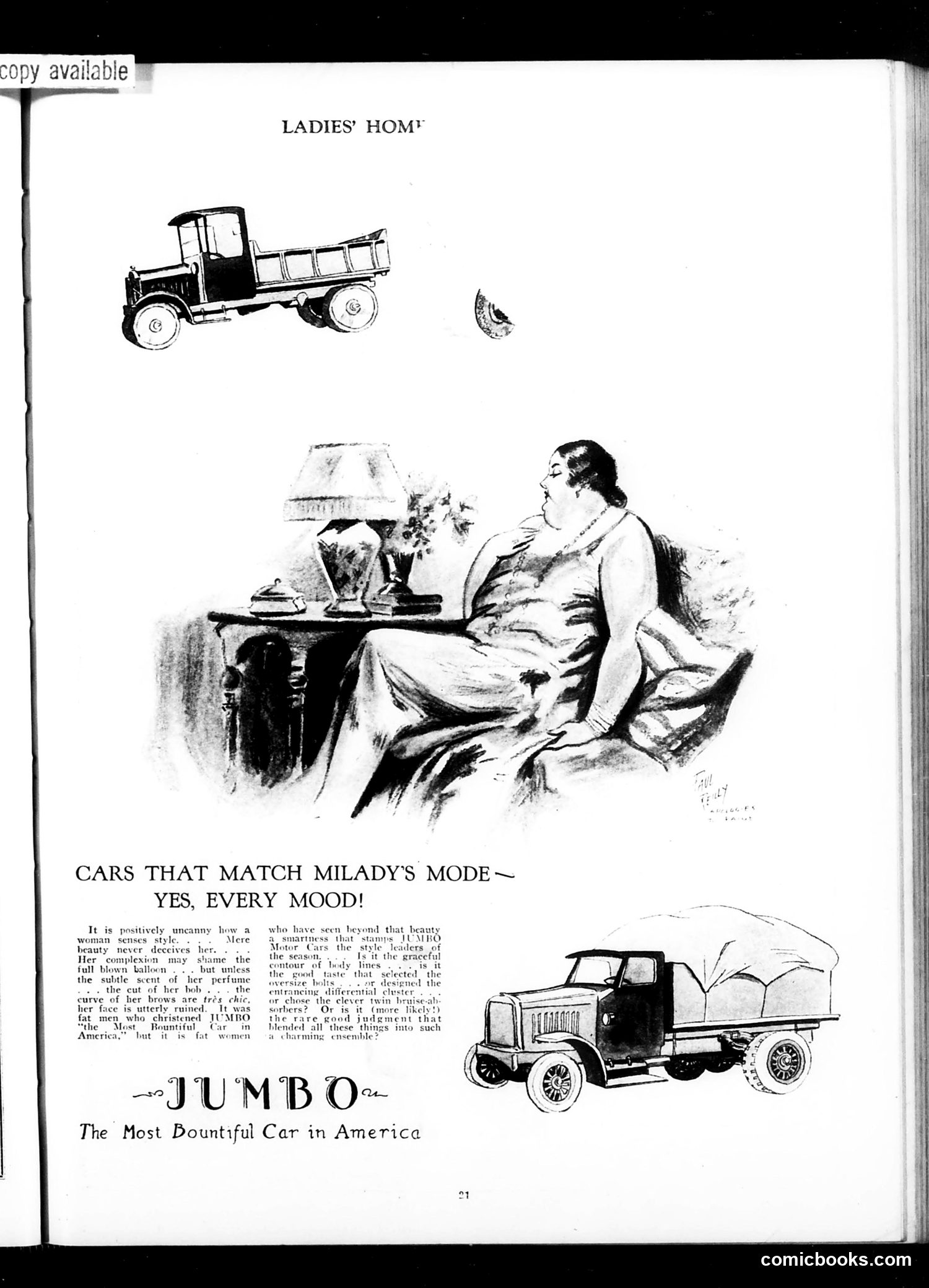
This is a **Jumbo automobile advertisement** disguised as humorous social commentary in *Judge* magazine's "Ladies' Home" section. The cartoon depicts a heavyset woman relaxing at home, and the ad plays on a crude visual joke: the Jumbo car is marketed as matching a woman's "mood" and physical attributes. The text suggests that just as a woman's beauty or appearance might be "uncanny," the Jumbo's generous proportions similarly suit various feminine types. The phrase "The Most Bountiful Car in America" is deliberately double-edged—"bountiful" referring both to the car's spacious design and sarcastically to the woman's size. **What it reveals**: Early 1900s advertising shamelessly used body-shaming humor to sell cars, particularly targeting women drivers. The joke relies on fat-shaming while simultaneously positioning automobiles as status symbols for the emerging female consumer market. It reflects both period misogyny and the novelty of marketing cars to women.
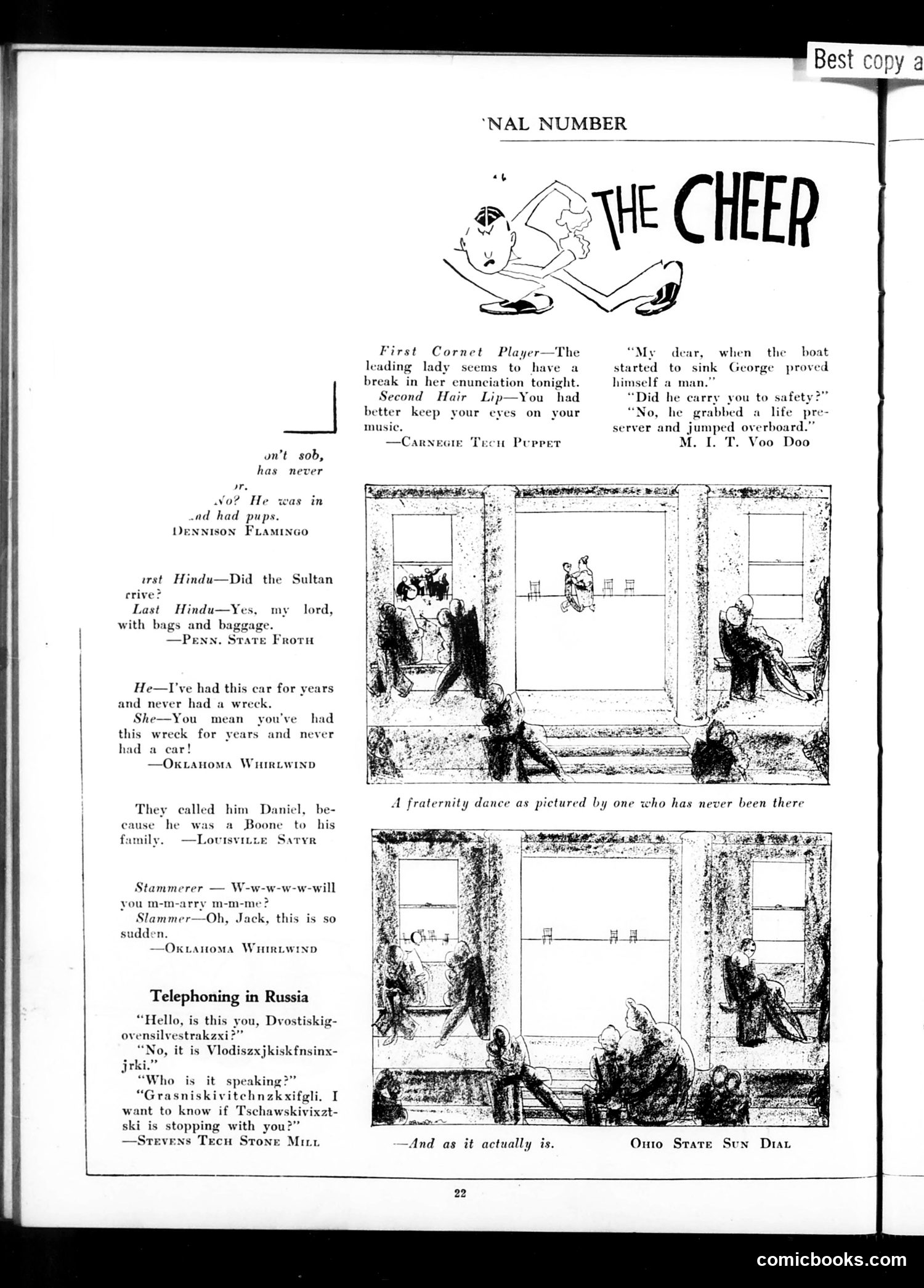
This page from Judge contains several brief humor items typical of early 20th-century American satirical magazines: **The main cartoon "The Cheer"** shows what appears to be a fraternity dance scene, with the caption noting it's "as pictured by one who has never been there" versus "as it actually is"—contrasting an imagined chaotic view with reality. The joke satirizes outsiders' misconceptions of fraternity life. **The text jokes** include: - A pun about a car being a "wreck for years" - A play on the name "Daniel Boone" (a "boon") - A stammerer's marriage proposal - Russian telephone exchanges (mocking incomprehensibly long Russian names as a joke about linguistic differences) - A boat-sinking anecdote where the man abandons his companion These are gentle, observational humor pieces targeting dating, cars, speech impediments, foreign cultures, and masculine behavior—reflecting common satirical targets of the era.
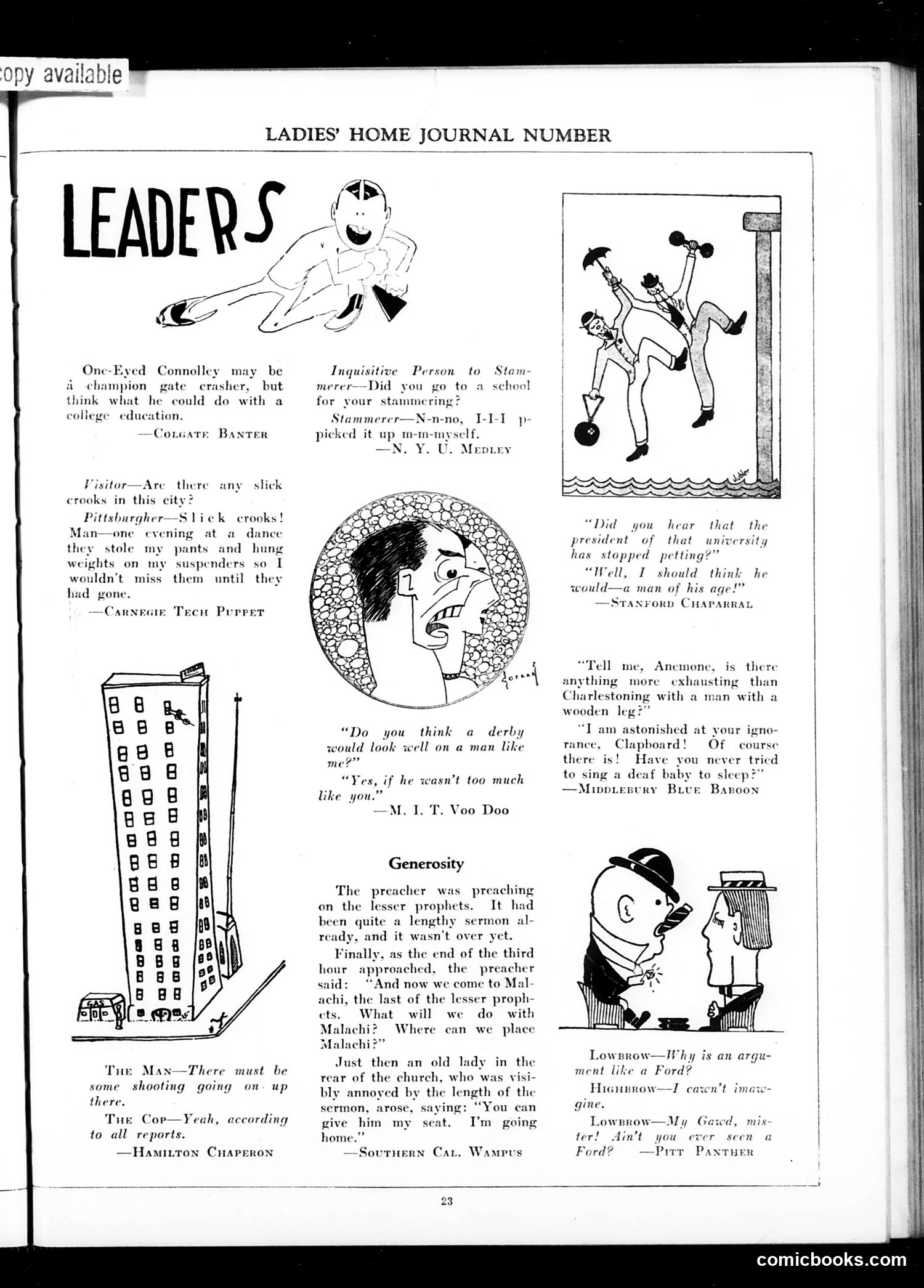
This page from *Judge* magazine contains period humor jokes and cartoons targeting 1920s college culture and social trends. **Main jokes:** - References to "gate crashers," college education, and stammering reflect 1920s campus life - "Charlestoning" alludes to the Charleston dance craze of that era - The "petting" joke references 1920s moral panics about young people's dating behavior - The wooden leg and "singing a deaf baby to sleep" are absurdist humor typical of the era - The Ford joke plays on Model T's reputation as unreliable ("can't imagine") **Context:** This is a "Leaders" humor section with witty one-liners attributed to various colleges (Carnegie Tech, N.Y.U., M.I.T., Stanford, etc.). The cartoons mock contemporary social anxieties: auto theft, church sermon length, physical appearance standards, and modern romance. The humor relies heavily on wordplay and topical references that required period knowledge to appreciate—most jokes now read as obscure rather than funny to modern audiences.
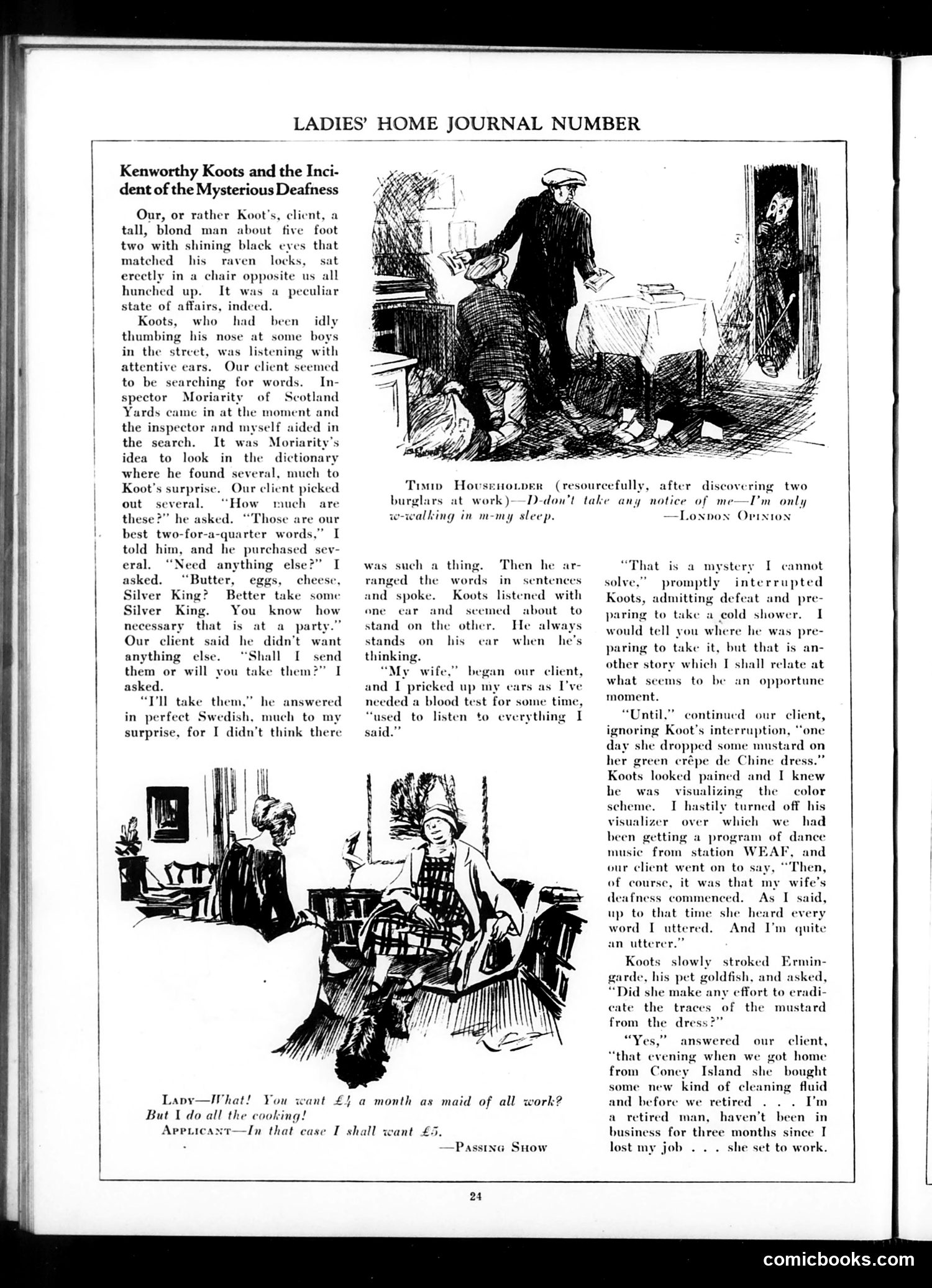
This is a humorous detective story rather than political satire. The narrative follows Kenworthy Koots (a fictional detective character) investigating a client's complaint about his wife's sudden deafness. The joke centers on a mundane domestic incident: the wife stopped listening to her husband after he complained about mustard on her dress. The satire targets husbands' obliviousness—the client claims his wife heard "every word" he said until that moment, implying she deliberately ignored him afterward as punishment or dismissal. The accompanying small cartoon shows a job applicant negotiating wages with a lady employer, making a separate domestic-labor joke about cooking duties. The overall piece parodies mystery fiction tropes while satirizing early-20th-century gender relations and marriage dynamics—specifically the stereotype of nagging husbands and wives who "mysteriously" stop listening to them.
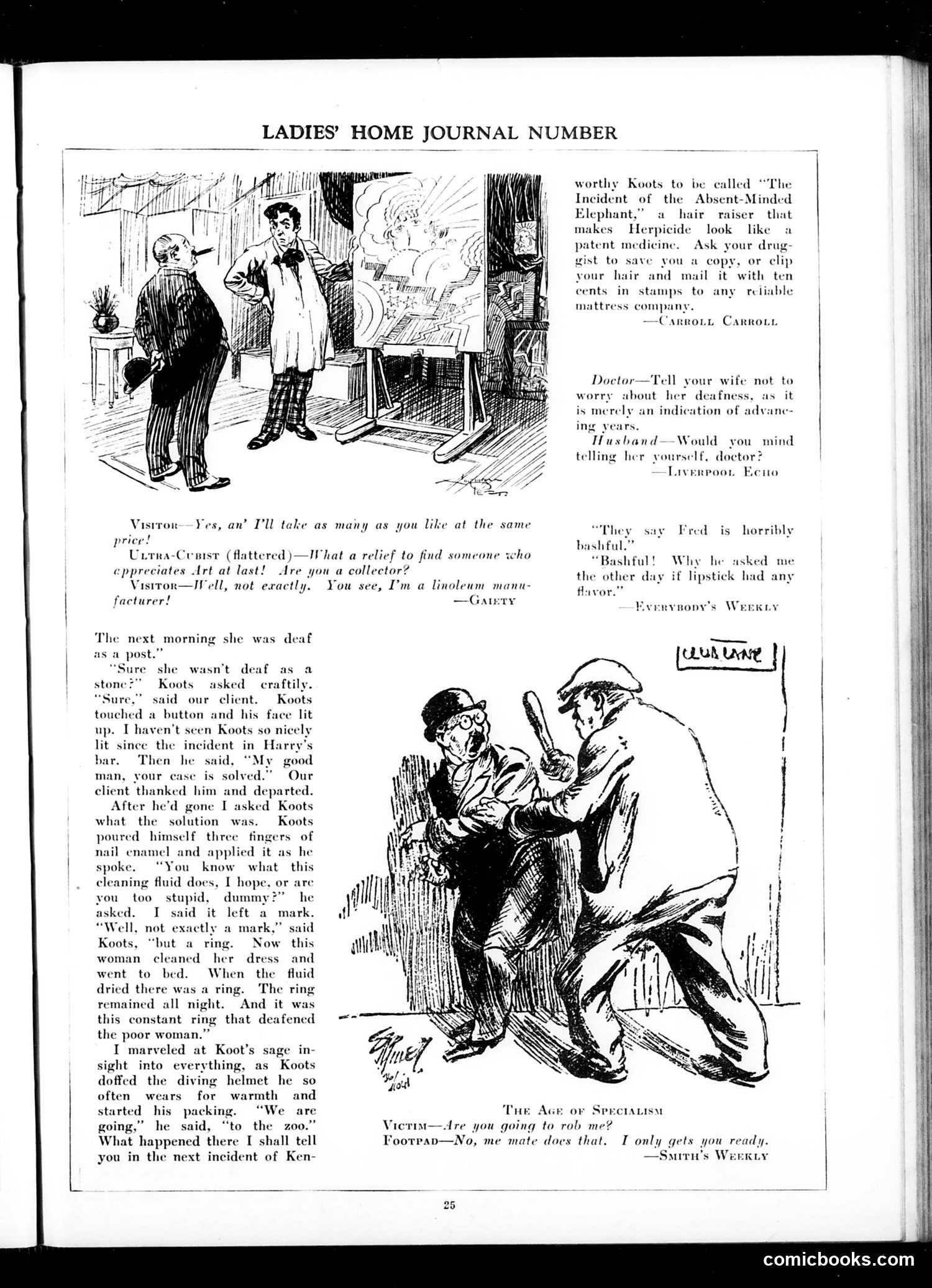
This page from the satirical magazine *Judge* contains multiple unrelated jokes and illustrations typical of early 20th-century humor. The top cartoon depicts an art dealer ("Ultra-Cruist") meeting a potential buyer ("Visitor"). The joke's premise: the visitor claims to be a "linoleum manufacturer" rather than an art collector—deflating the dealer's pretension that he's finally found an appreciative patron. The middle section is a comedic narrative about "Koots," a character solving a case of a woman who became deaf. The punchline relies on absurdist logic: cleaning fluid left a ring that "deafened" her (a pun on "rung"/"rang"). The bottom cartoon, titled "The Age of Specialism," shows a mugger assuring his victim he won't rob him—his partner does that. The victim only gets "ready," satirizing job specialization and division of labor in modern society. The page also includes unrelated advice columns and quips about deafness, bashfulness, and lipstick, typical of *Judge*'s miscellaneous humor format.
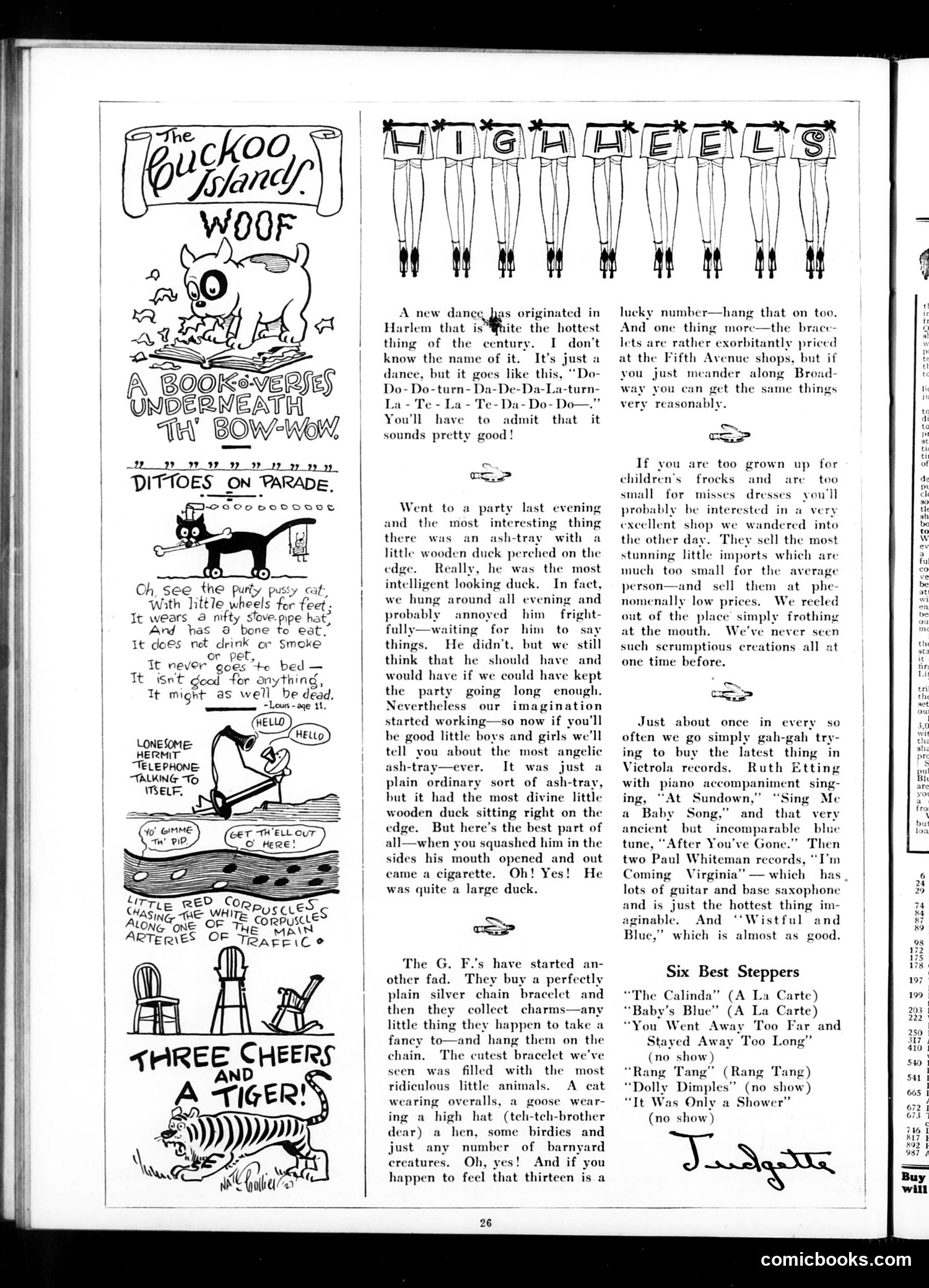
This page features light satirical commentary on 1920s social trends and fads, rather than political content. The left side contains whimsical illustrated verses mocking contemporary crazes: a mechanical toy cat, a hermit talking to himself on a telephone, and absurdist animal characters. The right side's prose discusses current fashions and entertainments—a new dance craze from Harlem ("Do-Do-turn-Da-De-La"), novelty ash-trays with decorative ducks, charm bracelets sold at inflated prices on Fifth Avenue versus cheaper Broadway versions, and Victrola records by popular performers like Ruth Etting and Paul Whiteman. The satire gently ridicules consumer culture and trend-chasing among the wealthy ("G.F.'s"—likely "Gold Diggers" or similar slang), while noting more affordable alternatives exist. The humor assumes readers recognize these as silly, transient fads. Modern readers should note the references to Harlem jazz culture, mechanical novelties, and 1920s recording artists that were genuinely popular at the time.
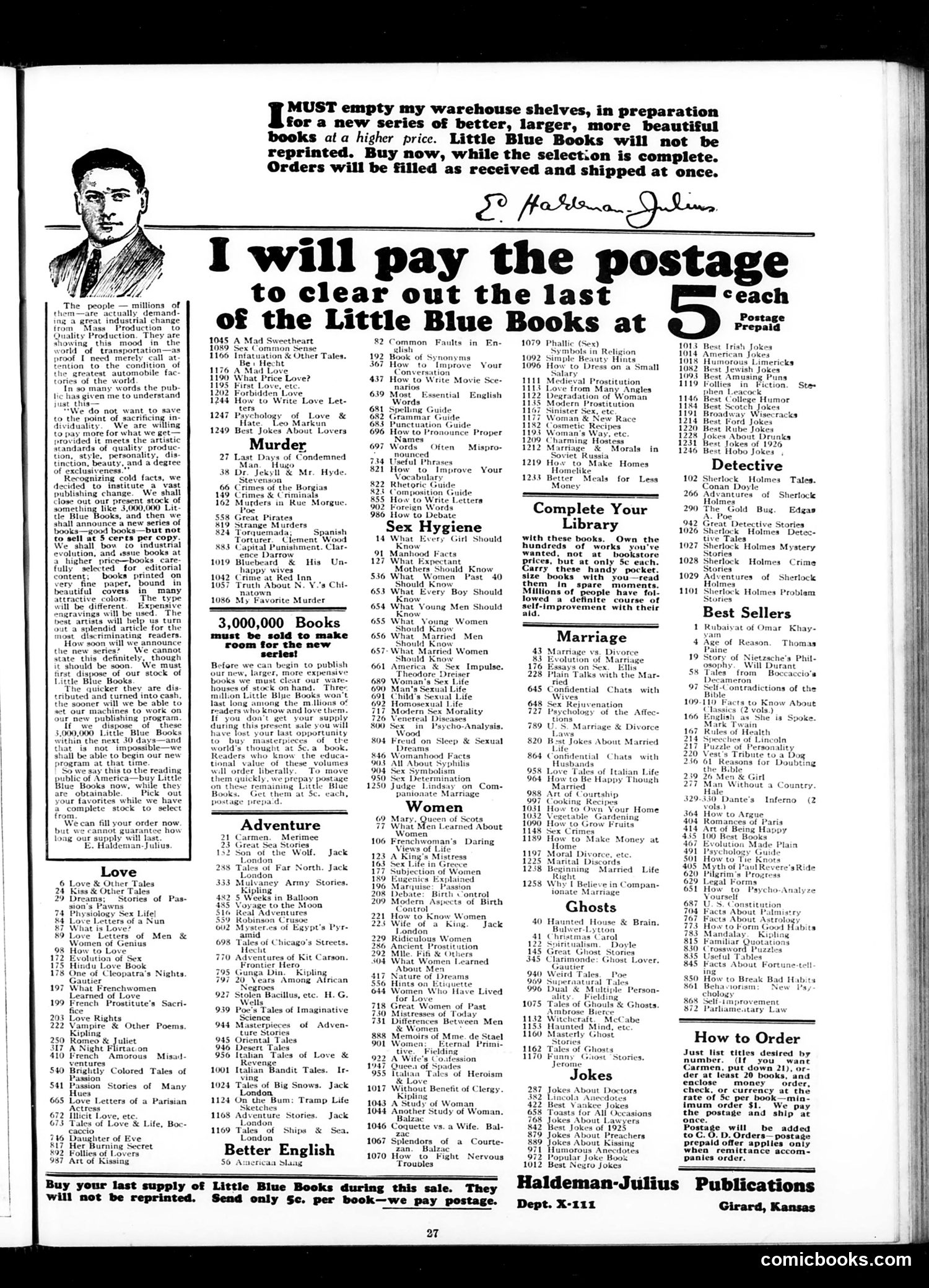
This is primarily a **publisher's advertisement**, not a political cartoon. E. Haldeman-Julius, publisher of the "Little Blue Books" series, is clearing 3 million inexpensive books (5¢ each) to make room for a new, higher-quality, more expensive book line. **The Sales Pitch:** Haldeman-Julius claims the public wants "quality" and "exclusiveness" over cheap mass production—they're willing to pay more for better paper, bindings, and artistic design. He's using this as justification for discontinuing the affordable Little Blue Books. **The Social Context:** This reflects 1920s consumer culture tensions between **mass production/affordability** versus **quality/prestige**. The company appeals to middle-class desires for refinement and distinction. **The Irony (likely unintentional):** The page is packed with listings of sensational titles—"Crimes of the Borgias," "Bluebeard," sexual content ("Physiology of Sex Life")—suggesting these "cheap" books weren't intellectually inferior, just inexpensively packaged.
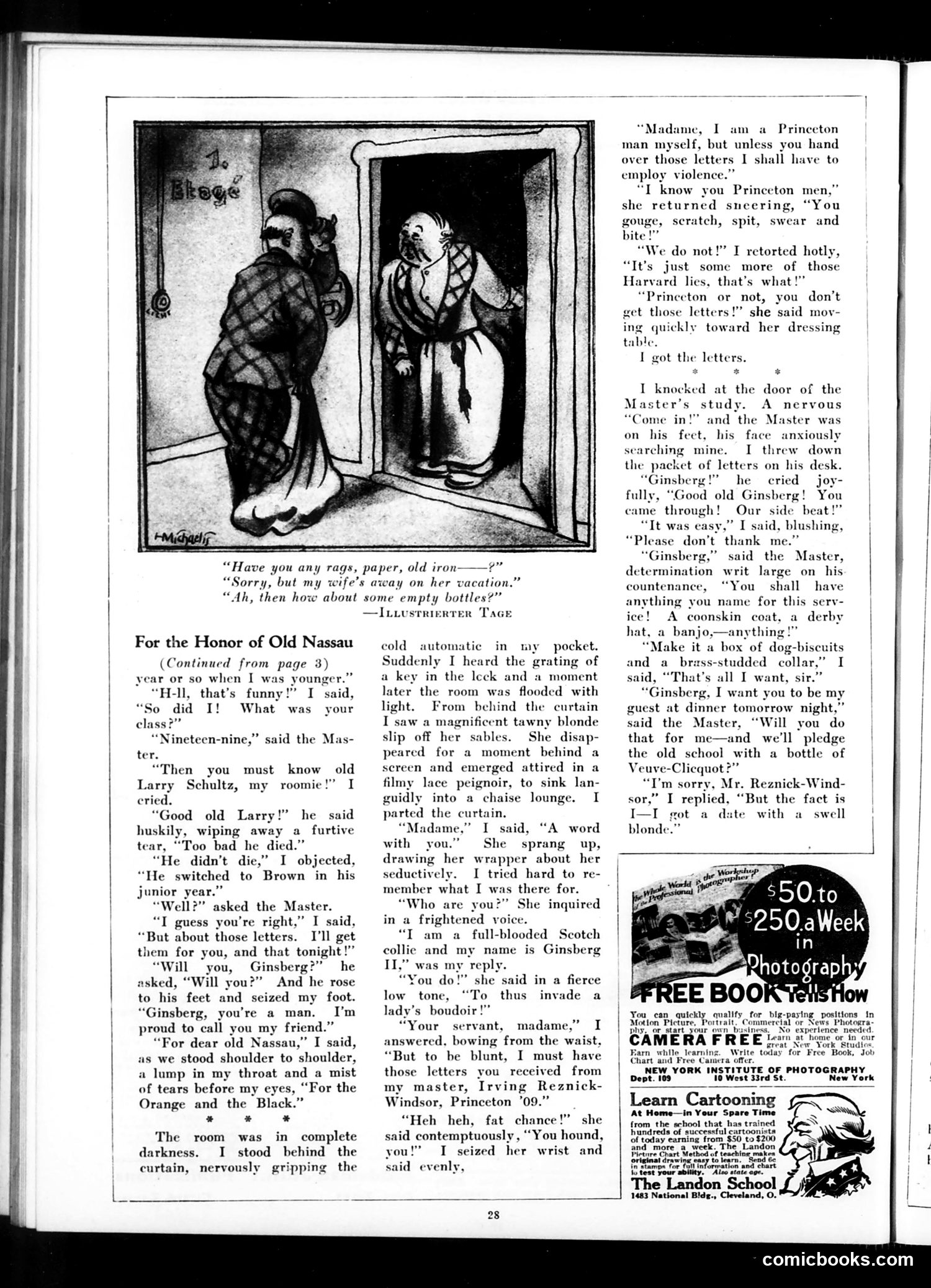
This page contains a serialized humorous story lampooning Ivy League rivalry and student honor codes. The narrative depicts a Princeton student narrator who retrieves compromising love letters for his college's "Master" (administrator), competing against Harvard's reputation for underhanded tactics. The satire mocks: 1. **College rivalry**: Princeton vs. Harvard stereotypes—Princeton men portrayed as violent brutes, Harvard as liars 2. **Institutional honor codes**: The absurd notion that stealing letters constitutes defending "Old Nassau" 3. **Class pretension**: References to coonskin coats, expensive wines, and social hierarchies 4. **Romantic melodrama**: A mysterious blonde woman and intrigue typical of period pulp fiction The cartoon illustration shows a seduction scene fitting the story's plot. The overall effect parodies both earnest college loyalty and the melodramatic romance stories popular in early 20th-century magazines—suggesting these institutions took themselves far too seriously.
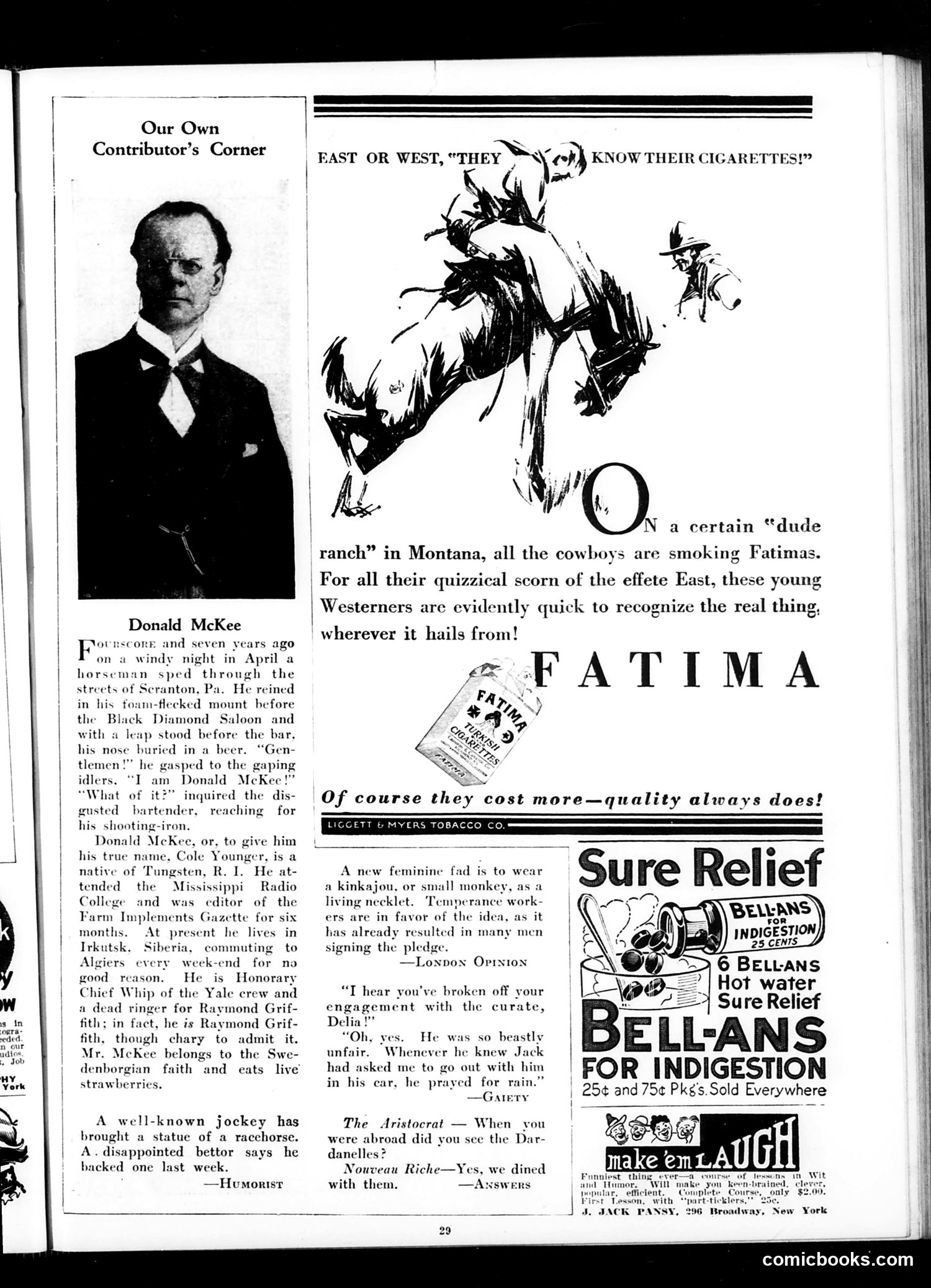
This page mixes humor content with advertisements. The main cartoon depicts cowboys on a Montana "dude ranch" smoking Fatima cigarettes, with the caption suggesting that despite Eastern sophistication, Western ranch hands recognize quality tobacco "wherever it hails from." The satire plays on the period's East-versus-West cultural divide—mocking pretentious Eastern attitudes while implying even rugged Westerners appreciate refined products. The "Contributor's Corner" features a humorous biography of Donald McKee (actually Raymond Griffith), a absurdist profile mixing real details with nonsensical ones (attending "Mississippi Radio College," commuting to Algiers from Siberia)—typical of Judge's surreal comedy style. Supporting jokes mock social pretension: a jockey buying a racehorse statue, a curate praying for rain to prevent dates, and a "nouveau riche" confusing the Dardanelles Strait with people. The page is dominated by period advertisements for Fatima cigarettes, Bell-ans antacid, and a "make 'em laugh" instruction book—standard for 1920s magazines.
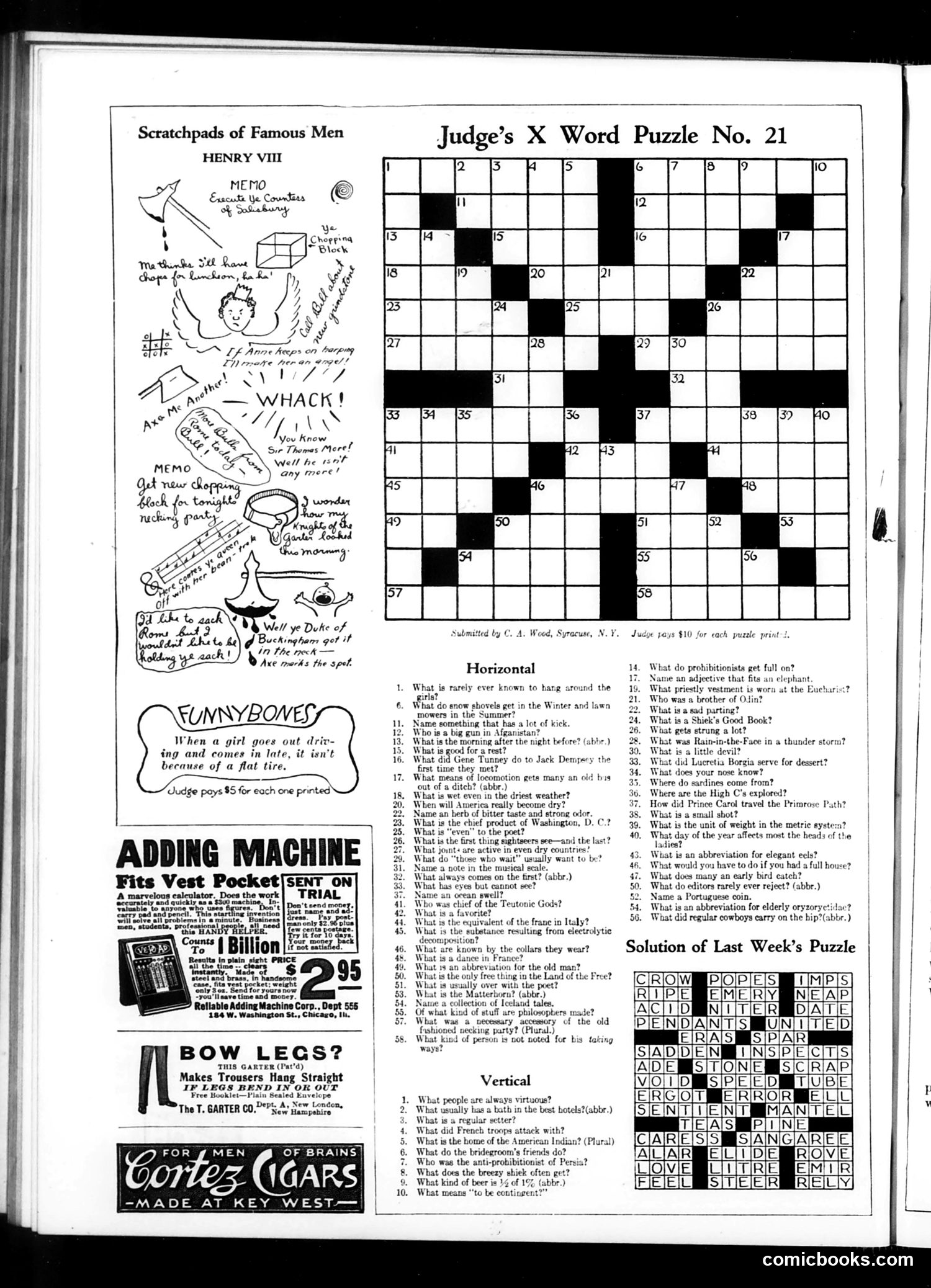
This page is primarily a crossword puzzle with advertisements and a single cartoon feature called "Funny Bones." **The "Funny Bones" Cartoon:** The joke is a social commentary on dating behavior: "When a girl goes out driving and comes in late, it isn't because of a flat tire." This implies young women used automotive troubles as an excuse for late nights out—likely covering up unsupervised socializing or romantic encounters that would have been improper in the 1920s-era context. The humor relies on readers' understanding that "car trouble" was a recognized cover story of the period. **The Advertisements:** The page features vintage ads for an adding machine (a early calculator), a device to straighten bow legs, and Cortez cigars. These reflect early 20th-century consumer culture and products now obsolete. **The "Scratchpads" Section:** Shows Henry VIII's doodles and memos—mostly crude jokes about court figures and executions, presented as his personal notes. The crossword clues reference 1920s-era topics: Prohibition, famous figures like Gene Tunney, and contemporary slang.
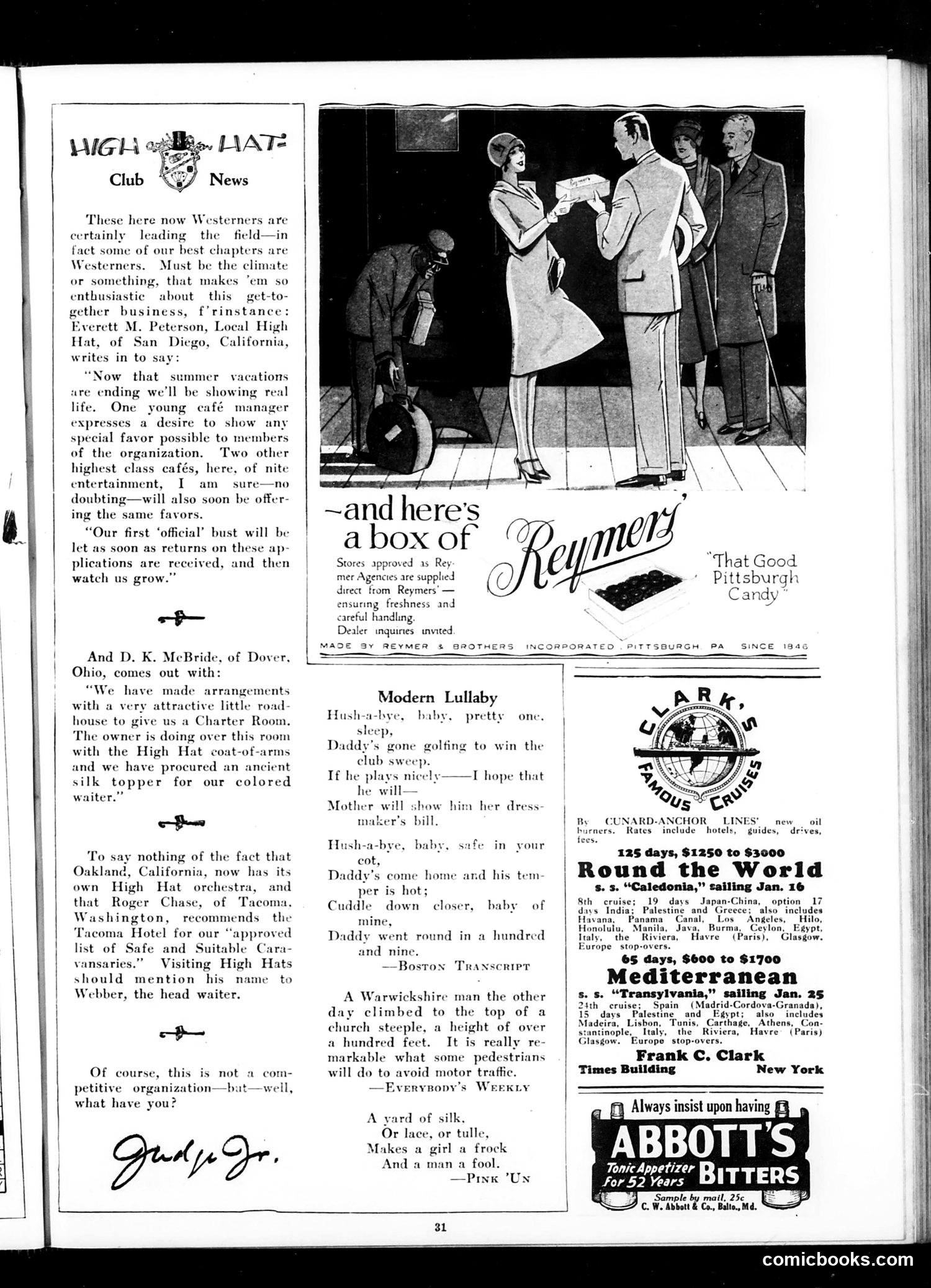
This page primarily contains **club news and advertisements** rather than political satire. The "High Hat" appears to be a social/fraternal organization with chapters across America, particularly strong in the Western states. The main content celebrates the club's expansion: members describe securing venues (roadhouses, cafés, hotels) offering special accommodations and amenities to High Hat members. One Ohio member notes arranging a "Charter Room" at a roadhouse, having it decorated with the club's coat-of-arms and placing "an ancient silk topper for our colored waiter"—language reflecting casual 1920s-era racial attitudes. The "Modern Lullaby" poem satirizes domestic life, joking about golf outings, angry husbands, and wives' shopping bills—typical period humor about marriage tensions. The page is dominated by **travel and product advertisements** (Reymers candy, cruise lines, Abbott's Bitters), which was standard for Judge magazine. There are **no identifiable political figures or major satirical cartoons** visible here—this is essentially a social/commercial page.
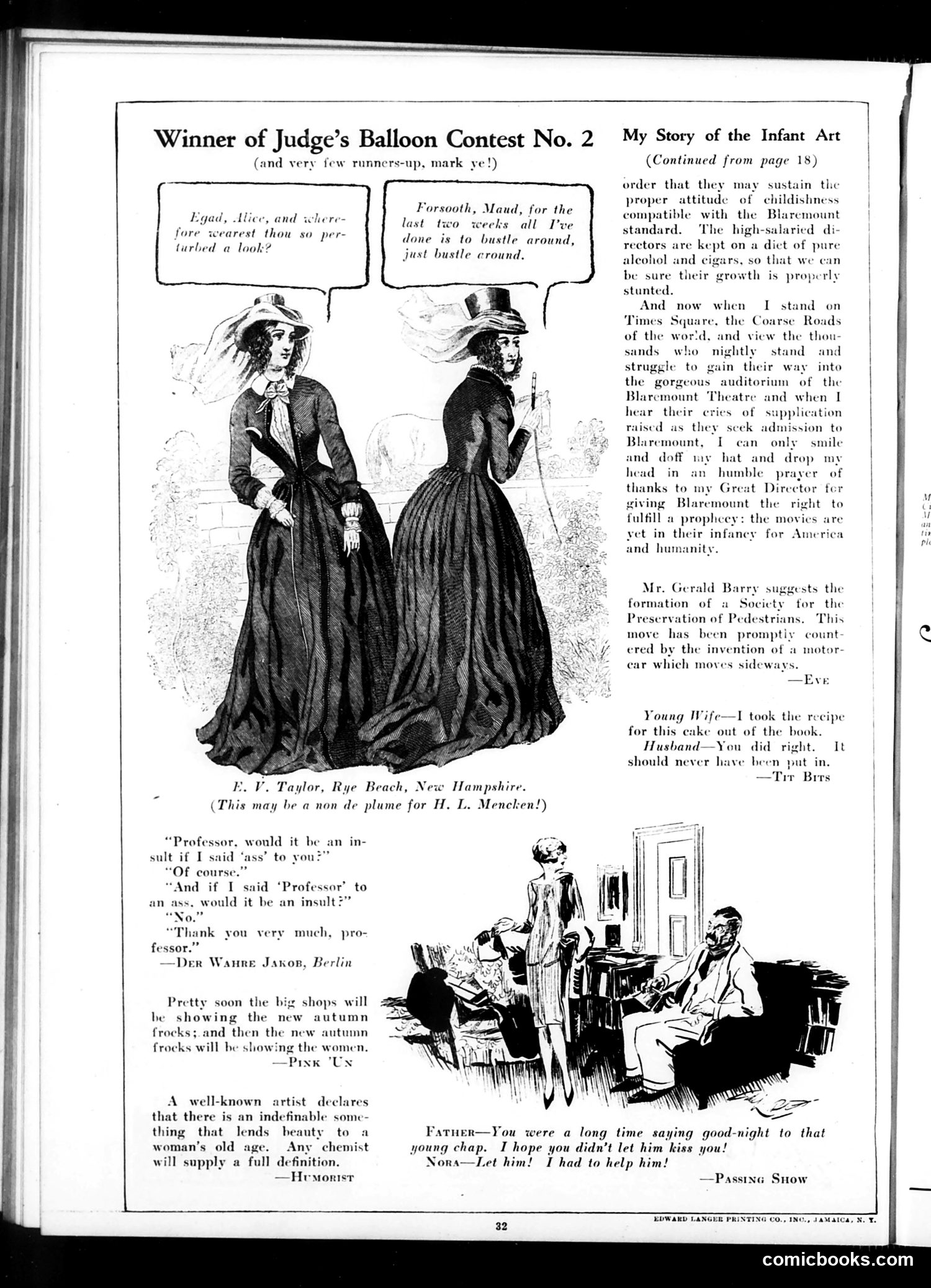
This page from the satirical magazine Judge contains multiple unrelated humor pieces typical of early 20th-century American comedy magazines. The main illustrated feature shows two fashionably dressed women in conversation, attributed to "E. V. Taylor, Rye Beach, New Hampshire" (possibly a pseudonym for H.L. Mencken). The joke concerns one woman's agitation about "bustling around"—likely satirizing the frantic social activities of upper-class women. The right column continues a serialized piece titled "My Story of the Infant Art," appearing to mock the emerging film industry and its pretensions, with references to "Blaremount Theatre" and directorial control over child actors. Scattered throughout are brief jokes and witticisms on varied topics: a philosopher's wordplay about insults, Mr. Gerald Barry's satirical proposal for a "Society for the Preservation of Pedestrians" (countered by sideways-moving motorcars), fashion trends, chemistry and aging, and a domestic comedy about a young woman's romantic encounter. The humor reflects 1920s sensibilities regarding class, gender roles, and modern technology.
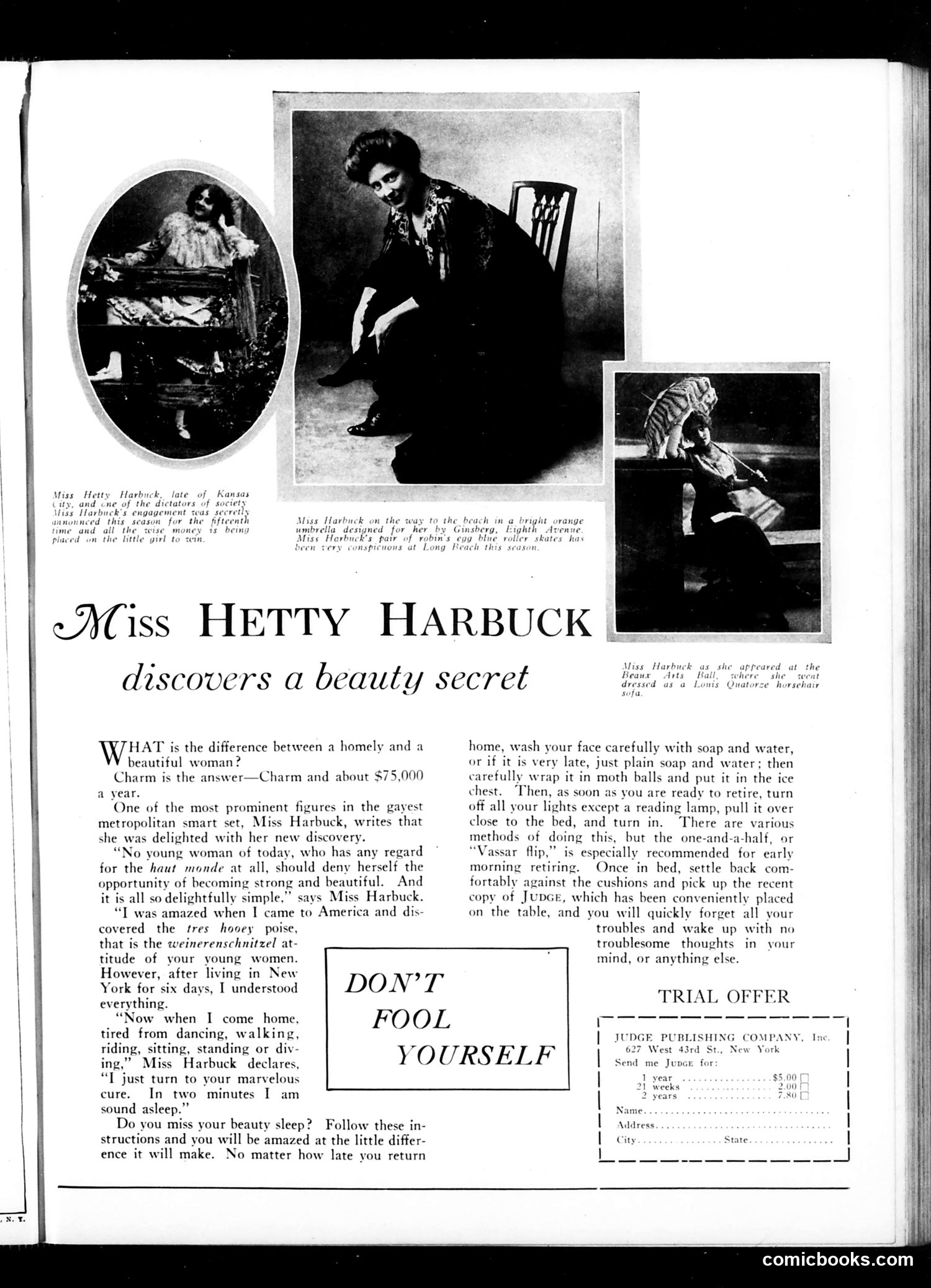
This page satirizes wealth-obsessed American high society and the pursuit of beauty through consumption. Miss Harbuck, described as "one of the most prominent figures in the gayest metropolitan smart set," represents the shallow socialite—her charm allegedly worth "$75,000 a year." The satire targets her pretentious European affectations (she speaks of "très hooey poise" and "weinerenschnitzel attitude") despite having lived in America only six days. Her absurd "beauty secret" is merely sleeping well and reading *Judge* magazine—mocking both her vanity and advertising claims that beauty requires expensive routines. The photographs showing her in fancy dress, on the beach with designer accessories, and at formal events emphasize that her "beauty" depends entirely on money and appearance maintenance, not genuine charm. This is essentially a **self-advertisement disguised as satire**—the trial subscription offer suggests Judge readers should embrace the joke while subscribing to the magazine that exposes such absurdities.
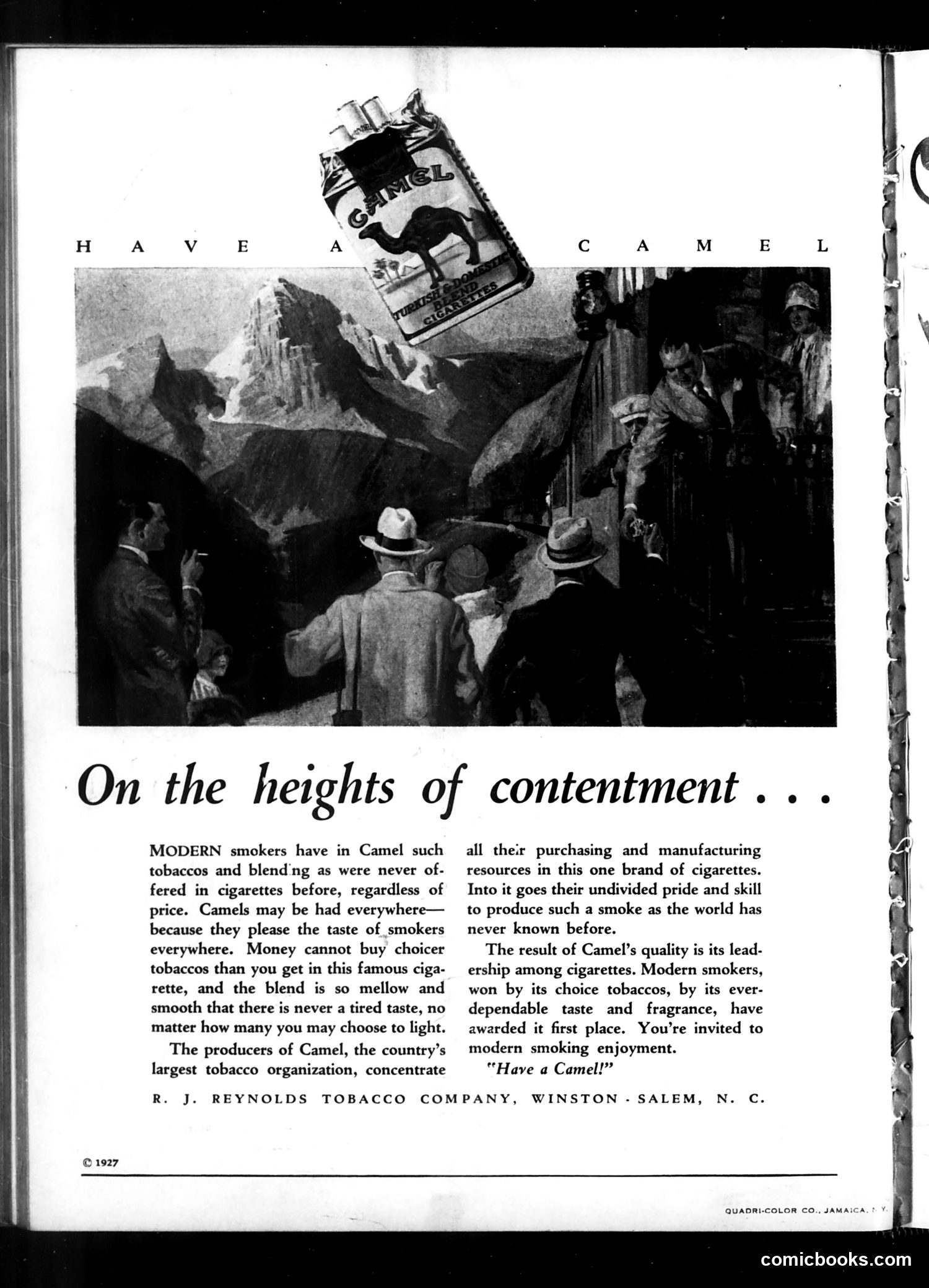
This is **not a cartoon or satire**—it's a full-page **Camel cigarette advertisement** from 1927. The image shows a dramatic mountain scene with tourists viewing a peak, with a giant Camel cigarette package looming overhead. The phrase "On the heights of contentment" plays on the mountain imagery to suggest smoking Camel brings satisfaction. The ad makes typical 1920s tobacco marketing claims: superior blend, quality tobaccos, superior taste, and leadership in the market. It concludes with the famous slogan "Have a Camel!" This appears in *Judge*, a satirical magazine, but the page itself is commercial advertising, not editorial content or satire. It represents the era when cigarette advertising faced no health warnings and companies could make unqualified quality claims. Modern readers should note this predates any regulatory restrictions on tobacco marketing by decades.