
Judge, 1927-09-17 · page 17 of 36
Judge — September 17, 1927 — page 17: what you’re looking at
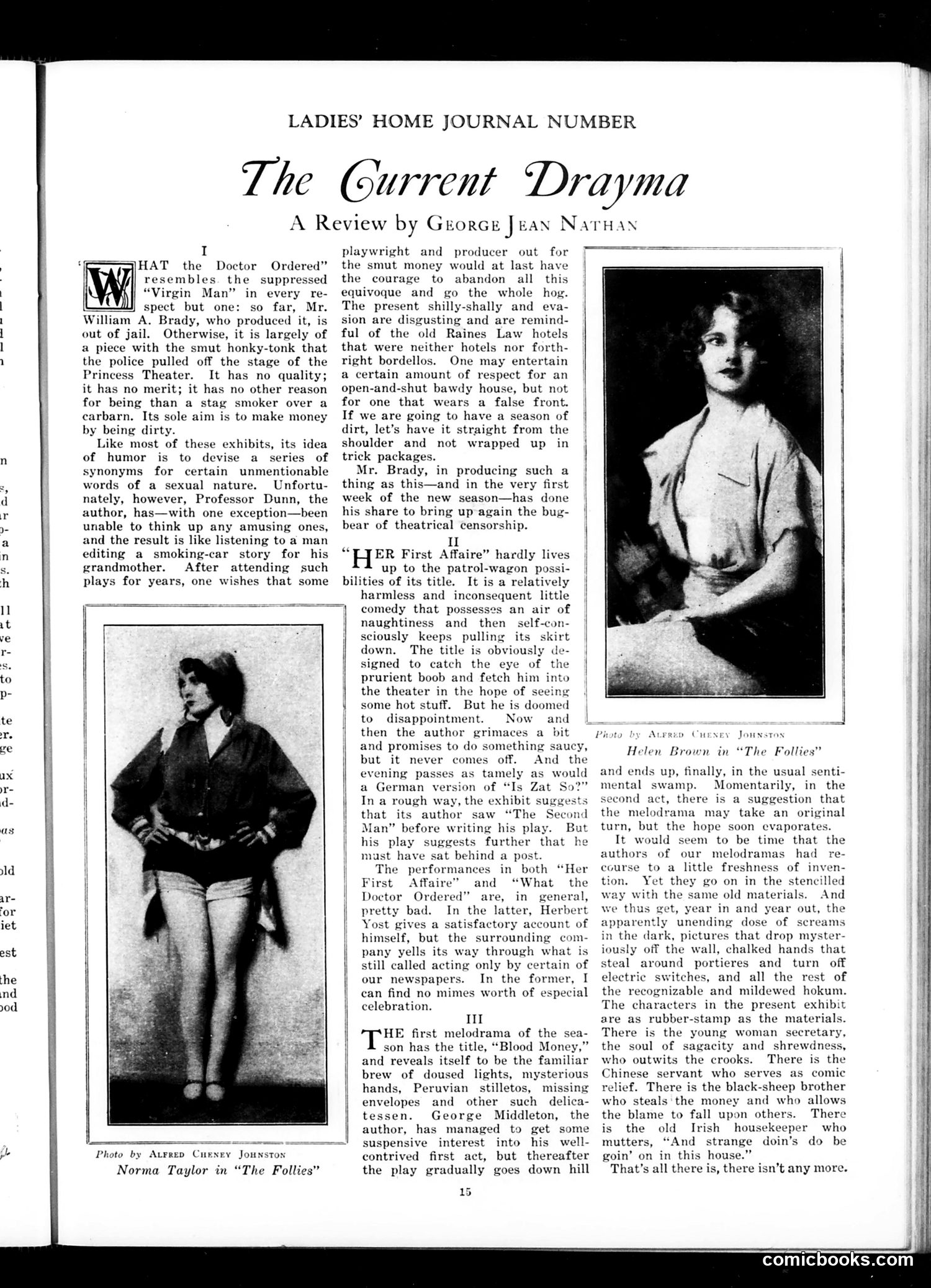
A restored page from Judge, 1927-09-17. Page through the whole issue in the reader above.
📄 Transcribed text from this page (OCR, searchable)
Machine-transcribed from the original scan — historical spelling and the odd misread are preserved.
| 7 i, | 1 ce ux yr d- as LADIES’ HOME JOURNAL NUMBER The (Surrent Drayma A Review by Grorce Juan Naruan I Doctor Ordered” ‘| HAT the \ resembles. the suppressed | }) f\{| “Virgin Man” in every re- spect but one: so far, Mr. William A. Brady, who produced it, is out of jail. Otherwise, it is largely of a piece with the smut honky-tonk that the police pulled off the stage of the Princess Theater. It has no quality; it has no merit; it has no other reason for being than a stag smoker over a earbarn. Its sole aim is to make money by being dirty. Like most of these exhibits, its idea of humor is to devise a series of synonyms for certain unmentionable words of a sexual nature. Unfortu- nately, however, Professor Dunn, the author, has—with one exception—been unable to think up any amusing ones, and the result is like listening to a man editing a smoking-car story for his grandmother. After attending such plays for years, one wishes that some playwright and producer out for the smut money would at last have the courage to abandon all this equivoque and go the whole hog. The present shilly-shally and e sion are disgusting and are remind- ful of the old Raines Law hotels that were neither hotels nor forth- right bordellos. One may entertain a certain amount of respect for an open-and-shut bawdy house, but not for one that wears a false front. If we are going to have a season of dirt, let’s have it straight from the shoulder and not wrapped up in trick packages. in producing such a thing as this—and in the very first week of the new season—has done share to bring up again the bug- r of theatrical censorship. Il “ ER First Affaire” hardly lives up to the patrol-wagon pc bilities of its title. It is a relatively harml and inconsequent little oto by Atrrep Cueney Jounston Norma Taylor in “The Follies” | comedy that pos: s an air of naughtiness and then self-con- sciously keeps pulling its skirt | down. The title is obviously de- signed to catch the eye of the prurient boob and fetch him into the theater in the hope of seeing { some hot stuff. But he is doomed | to disappointment. Now and | then the author grimaces a bit and promises to do something saucy, but it never comes off. And the evening passes as tamely as would a German version of “Is Zat So?” In a rough way, the exhibit su that its author saw “The Second Man” before writing his play. But his play suggests further that he must have sat behind a post. The performances in both “Her First Affaire” nd “What the Doctor Ordered” are, in general, | pretty bad. In the latter, Herbert Yost gives a satisfactory account of himself, but the surrounding com- | pany yells its way through what is | still called acting only by certain of } i) | our newspapers. In the former, I can find no mimes worth of especial | celebration. UI ] HE first melodrama of the sea- son has the title, “Blood Money, | and reveals itself to be the familiar | brew of doused lights, mysterious | hands, Peruvian. stilletos, missing | envelopes and other such delica- | tessen. George Middleton, the | author, has managed to get some suspensive interest into his well- contrived first act, but thereafter the play gradually goes down hill 15 Photo by Avraep Cuene Jounstos Helen Brown in “The Follies” and ends up, finally, in the usual senti- mental swamp. Momentarily, in the second act, there is a suggestion that the melodrama m: take an original turn, but the hope soon evaporates. It would seem to be time that the authors of our melodramas had_ re- course to a little freshness of inven- tion. Yet they go on in the stencilled v with the same old materials. And we thus get, year in and year out, the ap 2 unending dose of s as in the dark, pictures that drop myster- iously off the wall, chalked hands that steal around portieres and turn off electric switches, and all the rest of the recognizable and mildewed hokum. The characters in the present exhibit are as rubber-stamp as the materials. There is the young woman secre the soul of sagacity and shrewdness, who outwits the crooks. There is the Chinese servant who ves as comic relief. There is the black-sheep brother who steals the money and who allows the blame to fall upon others. There is the old Irish housekeeper who mutters, “And strange doin’s do be goin’ on in this house.” That’s all there is, there isn’t any more. comicbooks.com