
Judge, 1927-09-17 · page 12 of 36
Judge — September 17, 1927 — page 12: what you’re looking at
What you’re looking at
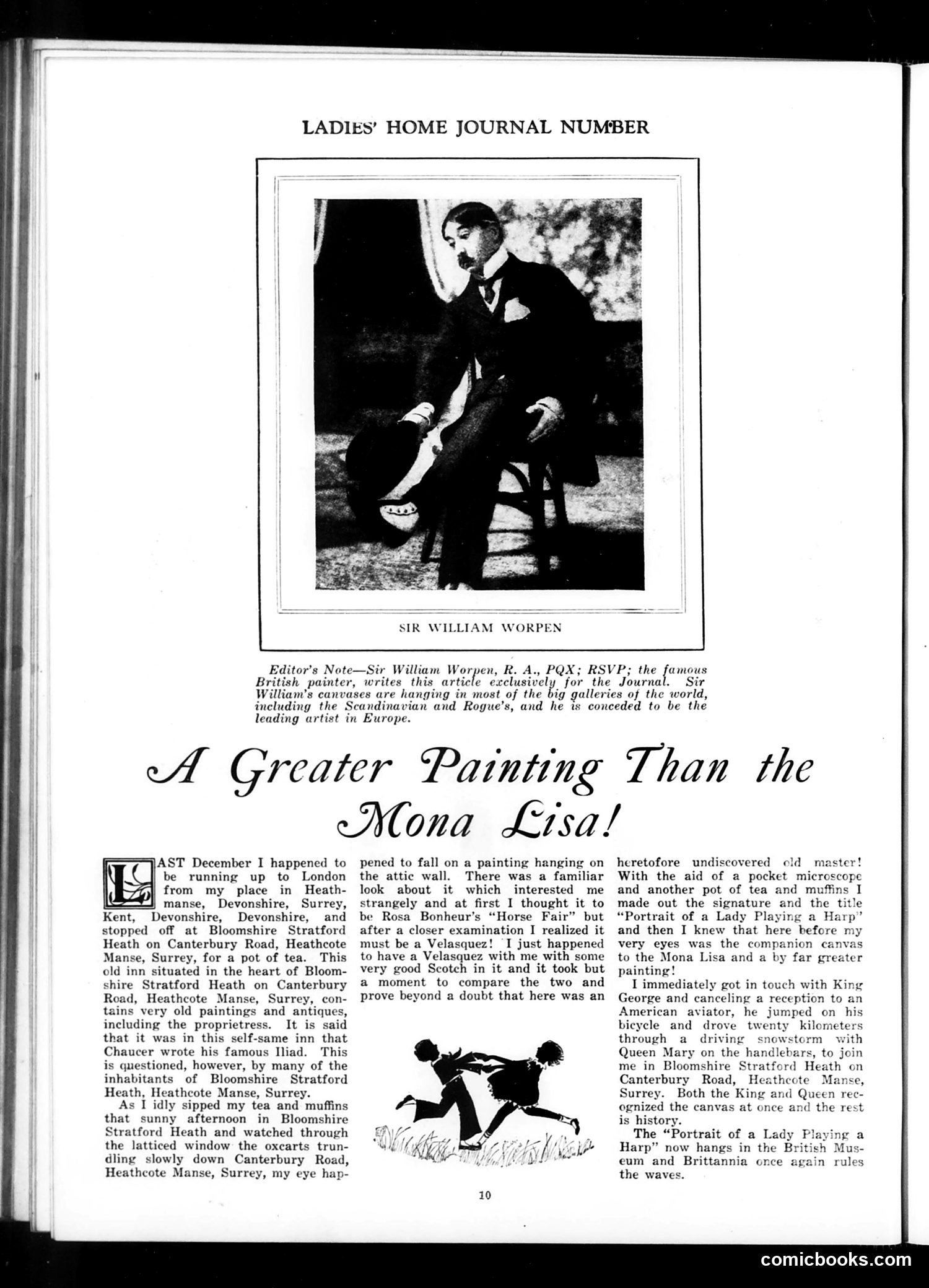
This is a humorous tall tale satirizing art world pretension and British pomposity. The unnamed narrator claims to have discovered a lost masterpiece by the Spanish painter Velázquez—supposedly superior to the Mona Lisa—in a dusty English inn attic. The satire works through absurd escalation: the casual discovery, the narrator's instant "expertise" with a pocket microscope, the comparison made over scotch and tea, and the climactic arrival of King George and Queen Mary who bicycle through a snowstorm to validate the find. The joke mocks: - Art-world snobbery and the mystique surrounding "old masters" - British self-importance (involving the monarchy in an art authentication) - The narrator's unwarranted confidence in identifying priceless works Sir William Worpen, credited as the article's author, appears to be a fictional persona—part of the satire itself. The piece parodies how prestigious artists and publications promote dubious "discoveries" with affected authority.
📄 Transcribed text from this page (OCR, searchable)
Machine-transcribed from the original scan — historical spelling and the odd misread are preserved.
Editor’s Note—Si Bri AST December I happened to i be running up to London | Z|, from my place in Heath- manse, Devonshire, Surrey, Kent, Devonshire, Devonshire, and stopped off at Bloomshire Stratford Heath on Canterbury Road, Heathcote Manse, Surrey, for a pot of tea. This old inn situated in the heart of Bloom- shire Stratford Heath on Canterbury Road, Heathcote Manse, Surrey, con- tains very old paintings and antiques, including the proprietress. It is said that it was in this self-same inn that Chaucer wrote his famous Iliad. This is questioned, however, by many of the inhabitants of Bloomshire Stratford Heath, Heathcote Manse, Surrey. As I idly sipped my tea and muffins that sunny afternoon in Bloomshire Stratford Heath and watched through the latticed window the oxcarts trun- dling slowly down Canterbury Road, Heathcote Manse, Surrey, my eye hap- SIR WILLIAM WORPEN William Worpen, R. A., PQX; RSVP; the h painter, writes this article exclusively William’s canvases are hanging in most of the bi including the famous for the Journal. Sir ig galleries of the world, candinavian and Rogue's, and he is conceded to be the leading artist in Europe. eA Greater Painting Than the Mona Lisa! pened to fall on a painting hanging on the attic wall. There was a familiar look about it which interested me strangely and at first I thought it to be Rosa Bonheur’s “Horse Fair” but after a closer examination I realized it must be a Velasquez! I just happened to have a Velasquez with me with some very good Scotch in it and it took but a moment to compare the two and prove beyond a doubt that here was an heretofore undiscovered old master! With the aid of a pocket microscope and another pot of tea and muffins I made out the signature and the title “Portrait of a Lady Playing a Harp’ and then I knew that here before my very eyes was the companion cz aS to the Mona Lisa and a by far gr er painting! I immediately got in touch with King George and canceling a reception to an American aviator, he jumped on his bicycle and drove twenty kilometers through a driving snowstorm with Queen Mary on the handlebars, to join me in Bloomshire Stratford Heath on Canterbury Road, Heathcote Manse, Surrey. Both the King and Queen rec- ognized the canvas at once and the rest is history. The “Portrait of a Lady P Harp” now hangs in the Br eum and Brittannia once a the waves. comicbooks.com