
Judge, 1927-09-17 · page 9 of 36
Judge — September 17, 1927 — page 9: what you’re looking at
What you’re looking at
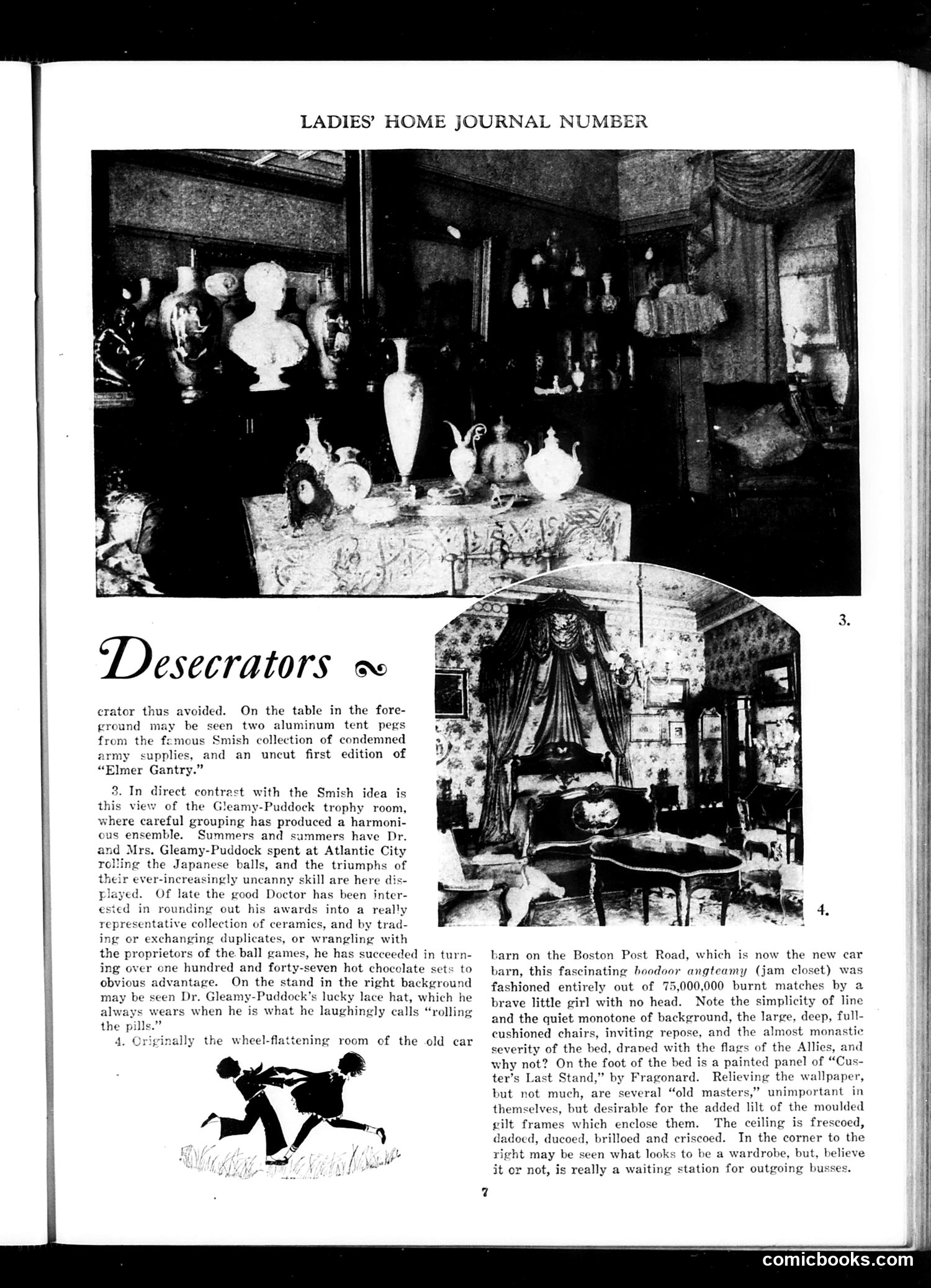
This page satirizes wealthy collectors and their pretentious home decoration practices. The article contrasts two approaches to displaying collections: **The "Smish" method** (image 3): Cluttered, tasteless accumulation—including army surplus tent pegs and a first edition of "Elmer Gantry" (Sinclair Lewis's 1927 novel mocking American hypocrisy), suggesting ostentatious but ignorant collecting. **The "Gleamy-Puddock" approach** (image 4): Supposedly refined, but the text mockingly describes absurdities—a bedroom fashioned from 75 million burnt matches "by a brave little girl with no head," paintings by Fragonard, overwrought decoration ("frescoed, dadoed, ducoed")—exposing how wealthy collectors use pseudo-intellectual language and fake "old masters" to disguise bad taste. The satire targets Gilded Age excess and the nouveau riche's desperate attempts at cultural legitimacy through acquisition rather than genuine aesthetic understanding.
📄 Transcribed text from this page (OCR, searchable)
Machine-transcribed from the original scan — historical spelling and the odd misread are preserved.
LADIES’ HOME JOURNAL NUMBER Desecrators Go erator thus avoided. On the table in the fore- ground may be seen two aluminum tent pegs from the nous Smish collection of condemned army supplies, and an uncut first edition of “Elmer Gantry.” 3. In direct contrast with the Smich idea is this view of the Gleamy-Puddock trophy room, where careful grouping has produced a harmoni- ous ensemble. Summers and summers have Dr. and Mrs. Gleamy-Puddock spent at Atlantic City ing the Japanese balls, and the triumphs of r ever-increasingly uncanny skill are here di ed. Of late the good Doctor has been int esied in rounding out his awards y representative collection of ceram and by trad- ing or exchanging duplicates, or wrangling with the proprietors of the ball games, he has succeeded in turn- ing over one hundred and for ven hot chocolate to obvious advantage. On the stand in the right background may be seen Dr. Gleamy-Puddock’s lucky lace hat, which he always wears when he is what he laughingly calls “rolling the pills.” nally the wheel-flattening room of the old car barn on the Boston Post Road, which is now the new car barn, this fascinating hoodoor angteamy (jam closet) was ashioned entirely out of 75,000,000 burnt matches by a brave little girl with no head. Note the simplicity of line and the quiet monotone of background, the large, deep, full- cushioned chairs, inviting repose, and the almost monastic severity of the bed, draved with the flags of the Allies, and why not? On the foot of the bed is a painted panel of “Cus- ter’s Last Stand,” by Fragonard. Relieving the wallpaper, but not much, are several “old masters,” unimportant in themselves, but desirable for the added lilt of the moulded gilt frames which enclose them. The ceiling is frescoed, dadoed, ducoed, brilloed and criscoed. In the corner to the right may be seen what looks to be a wardrobe, but, believe it or not, is really a waiting station for outgoing busses. comicbooks.com