
A complete issue · 36 pages · 1927
Judge — September 10, 1927
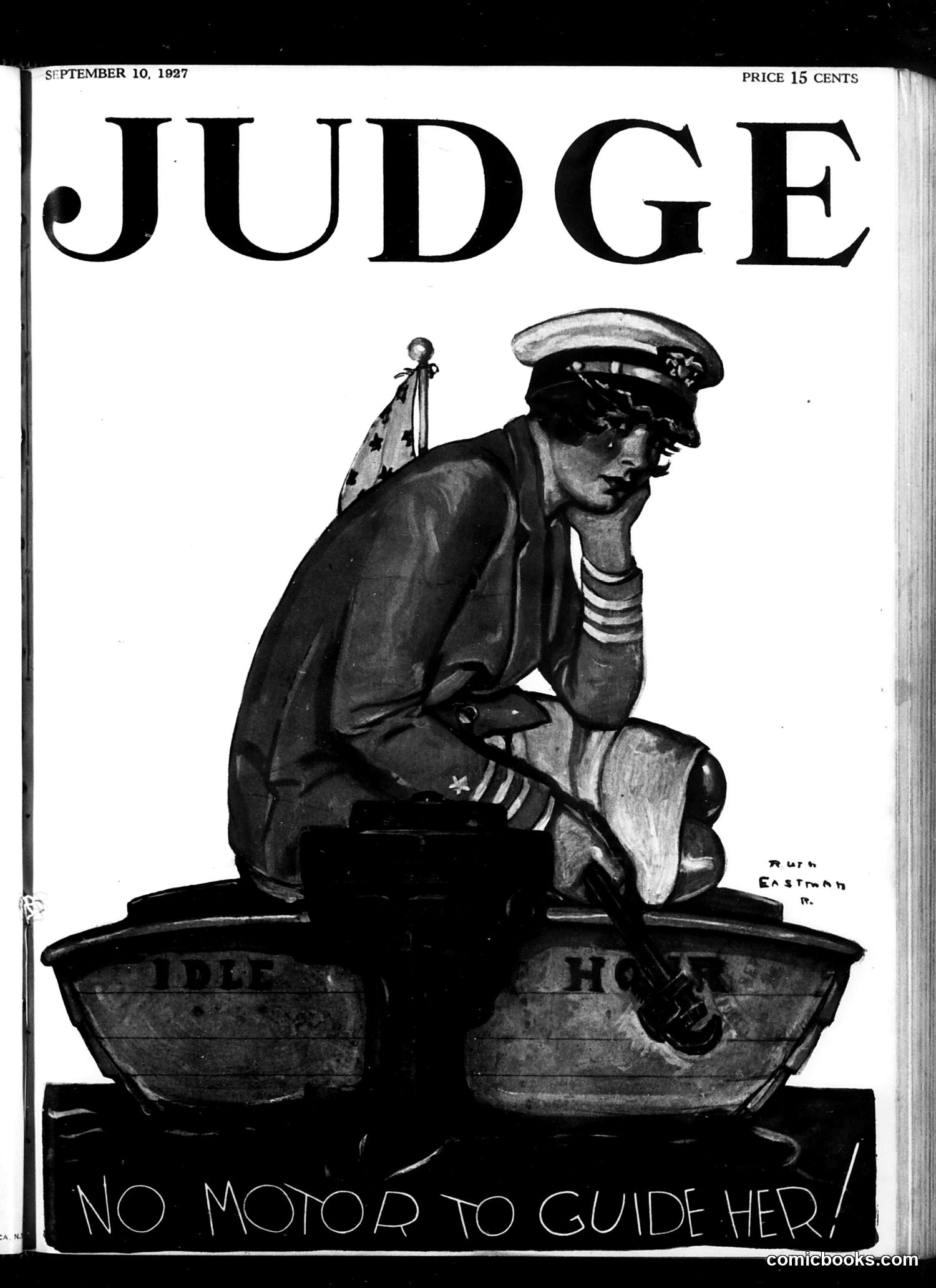
This cover depicts a sailor sitting in a small rowboat labeled "HOPE" and "HOME," holding what appears to be a steering mechanism or rudder. The caption reads "NO MOTOR TO GUIDE HER!" The cartoon likely satirizes a contemporary situation involving nautical navigation or maritime policy, though the specific reference is unclear without additional context from the magazine's contents. The sailor's appearance—with striped shirt and cap—is stereotypically rendered for the era. The phrase "no motor to guide her" suggests criticism of inadequate leadership or direction in some endeavor, possibly relating to government policy, international relations, or domestic governance during the 1920s. The "Hope" and "Home" labels suggest the cartoon comments on American prospects or direction during this period.
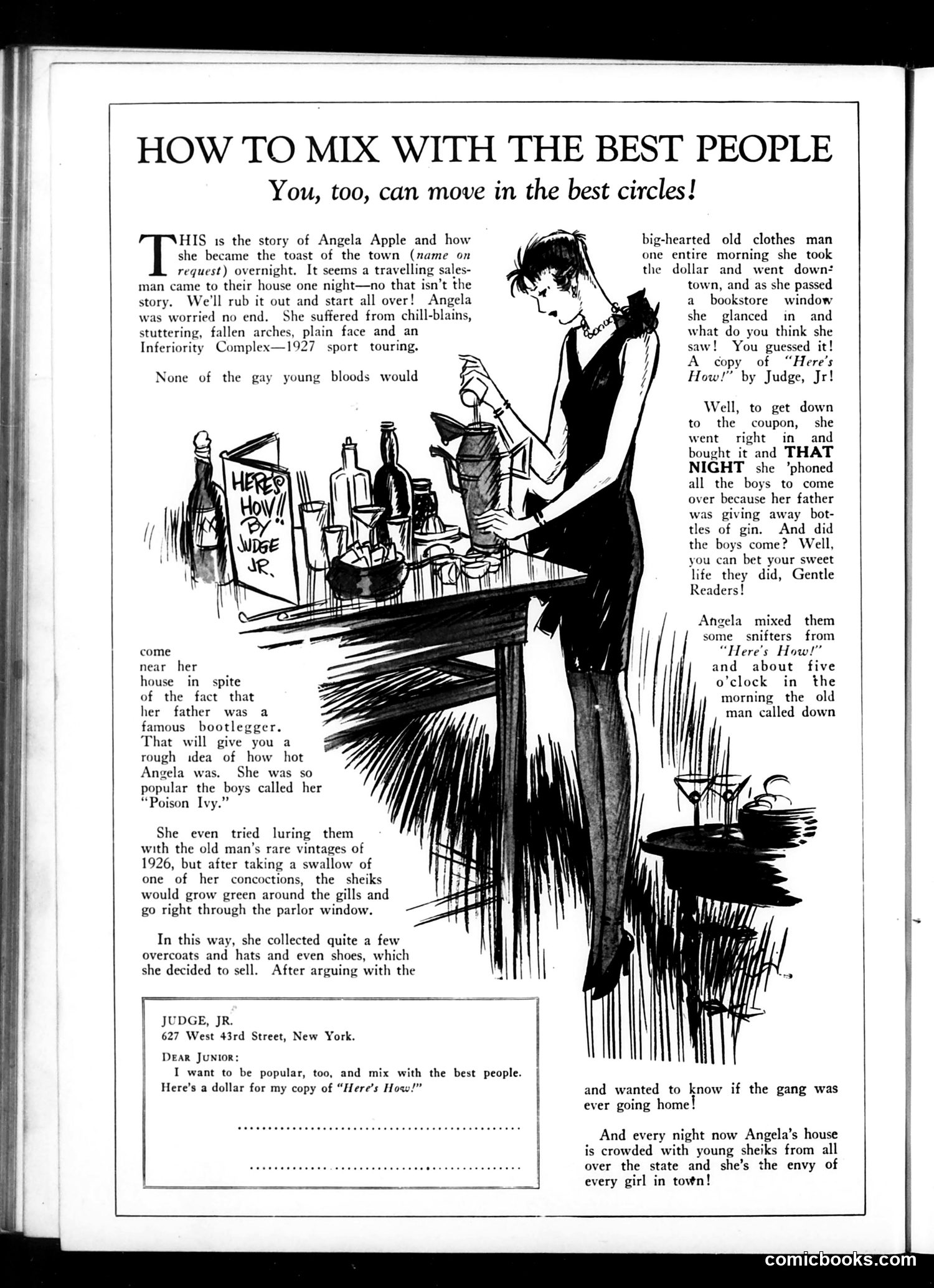
This is an advertisement disguised as satirical commentary, promoting a book called *"Here's How!"* by Judge, Jr. The piece mocks a young woman named Angela Apple who becomes socially popular by hosting parties where she serves alcohol—specifically gin and cocktails mixed from her bootlegger father's supply. The satire targets Prohibition-era social climbing. Angela gains status among "the best people" and "young sheiks" by providing illicit liquor, making her the envy of every girl in town. The underlying joke critiques how easily social popularity could be purchased through access to illegal alcohol during Prohibition (1920-1933). The dotted-line coupon at bottom invites readers to buy the book to learn Angela's social secrets, making this primarily a sales pitch wrapped in period humor about bootlegging and status-seeking.
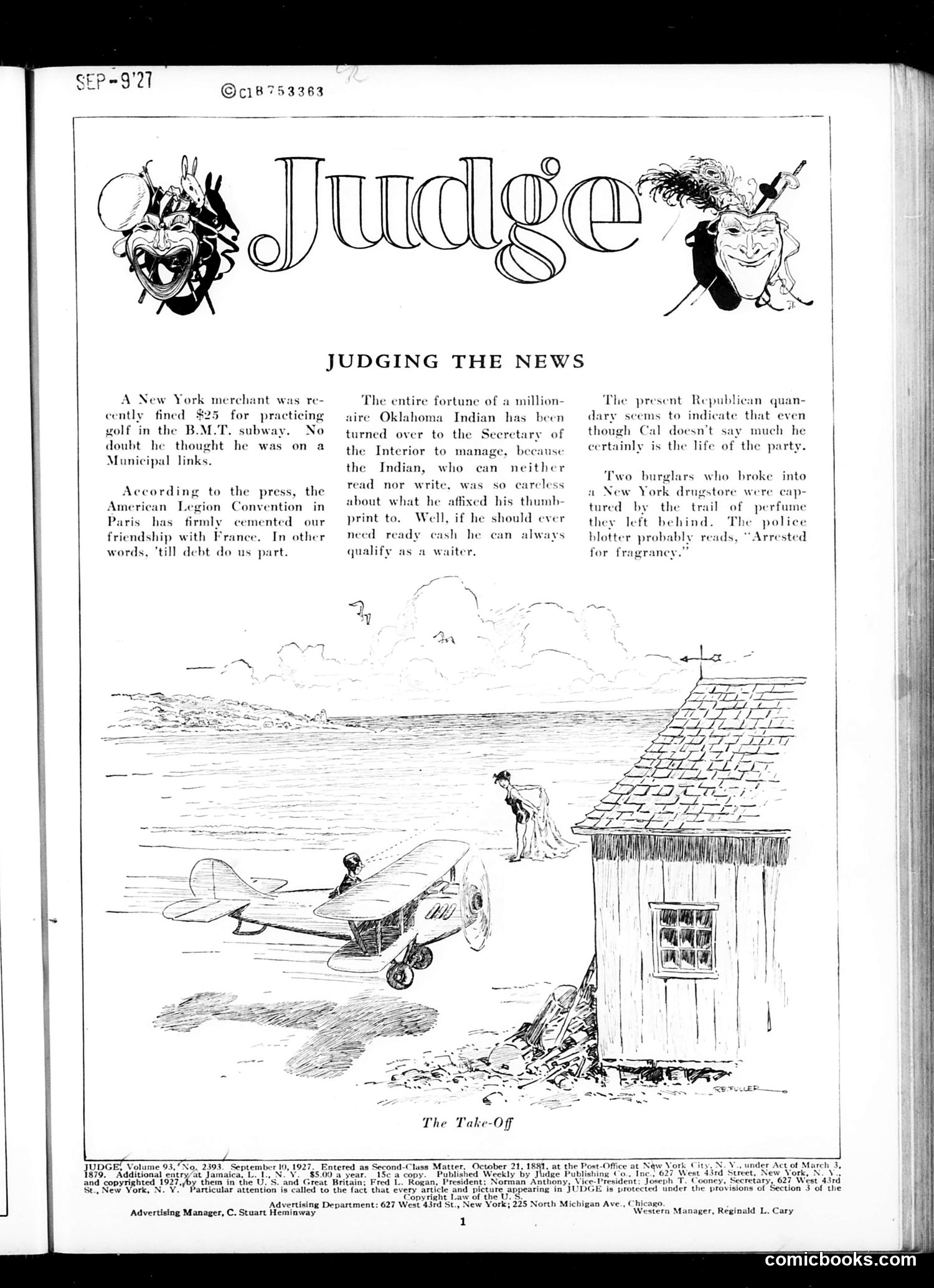
This page presents "Judging the News"—satirical commentary on current events with accompanying cartoon. **The News Items:** - A New York merchant recovered $25 for practicing golf in the BMT subway - An Oklahoma Indian millionaire's fortune transferred to the Interior Secretary due to the Indian's illiteracy - Republican Party criticism regarding Cal(vin Coolidge) - Two burglars caught via perfume trail, humorously arrested "for fragrancy" **The Cartoon "The Take-Off":** The illustration depicts a homemade aircraft with figures near a rural shed, likely satirizing early aviation's crude, experimental nature or amateur flying attempts. The chaotic scene suggests humor about aviation's risks and improvisation. The overall page uses news briefs to mock bureaucratic absurdity, political leadership, and contemporary American misadventures during the 1920s era.
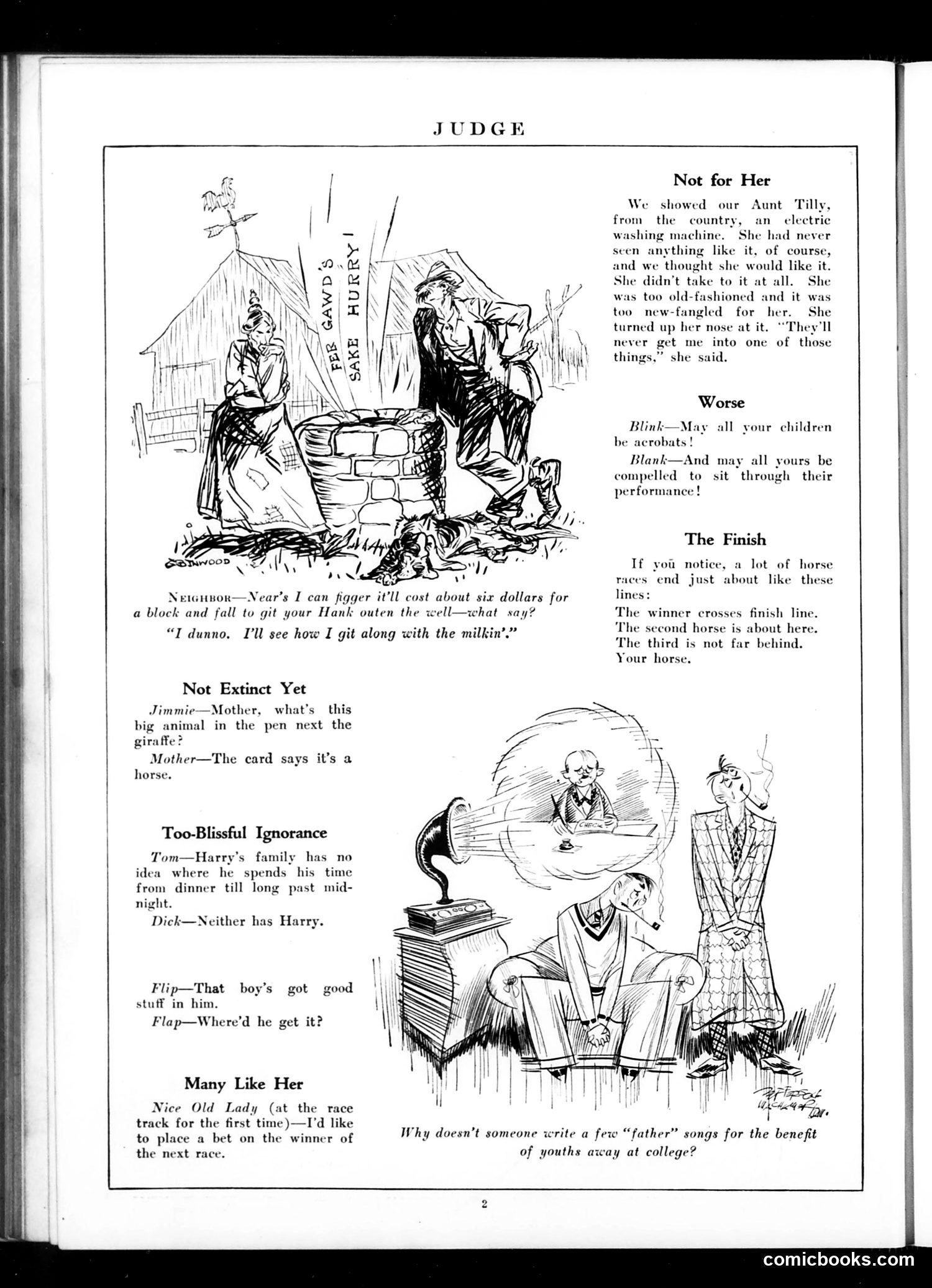
This page contains six separate joke panels typical of Judge's satirical humor. The comics mock everyday social situations rather than specific political figures or events: - **"Not for Her"**: Ridicules an elderly aunt rejecting modern washing machines as too newfangled - **"Not Extinct Yet"**: A child mistakes a horse for a giraffe - **"Too-Blissful Ignorance"**: Adults joke about a boy's mysterious evening activities - **"Worse"**: Competing curses between acquaintances - **"The Finish"**: Horse race commentary - **"Many Like Her"**: An elderly woman at the racetrack The bottom cartoon depicts college students daydreaming about future success while listening to music, captioning: "Why doesn't someone write a few 'father' songs for the benefit of youths away at college?" The humor targets generational differences, class pretensions, and romantic aspirations typical of early 20th-century American comedy.
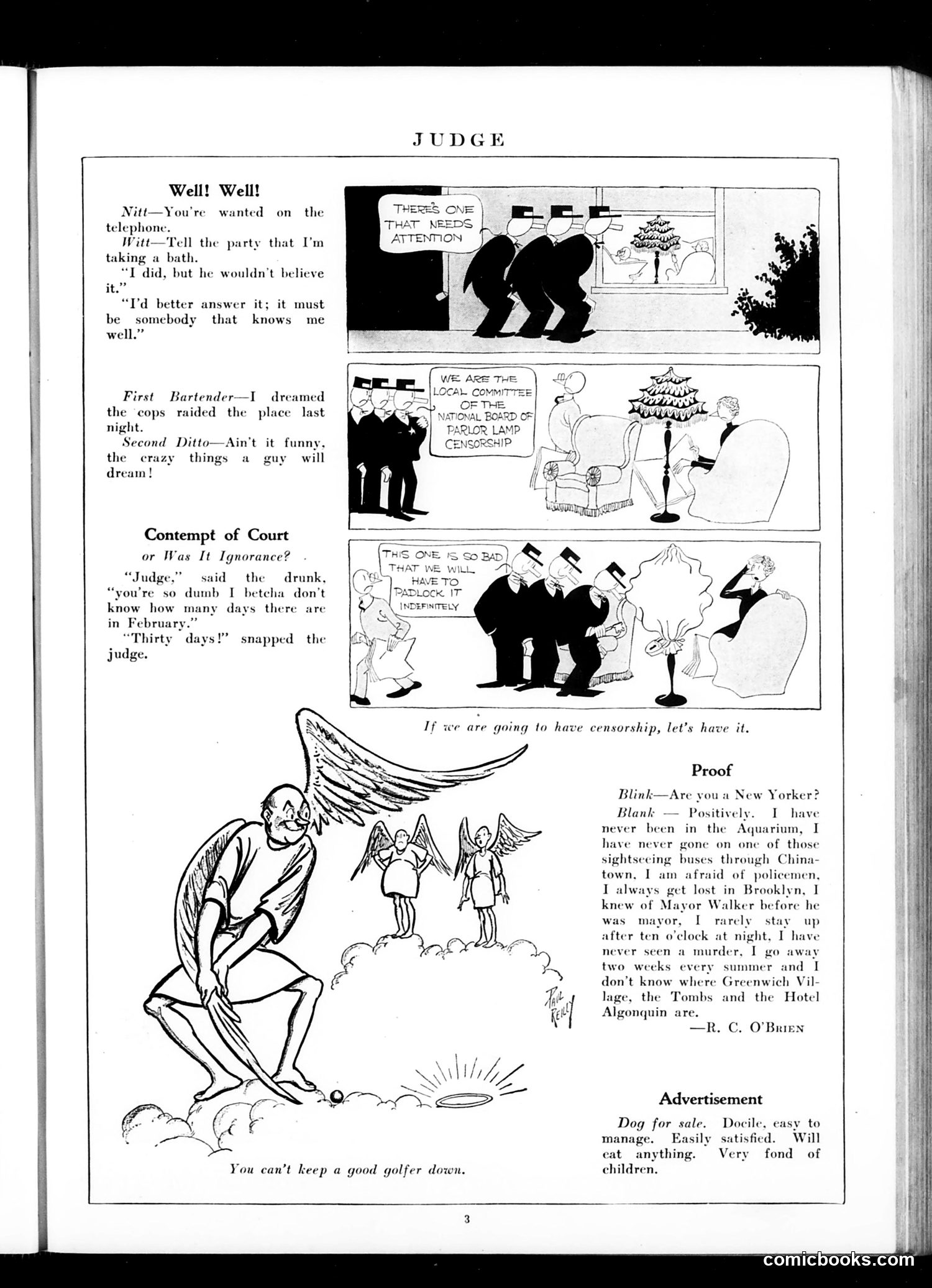
This page contains three distinct pieces: **"Judge" (top comics):** A humorous scenario about a drunk man avoiding a phone call by claiming he's bathing. The joke relies on the absurdity of the excuse. **"Contempt of Court":** A dialogue where a drunk questions a judge's authority, receiving a sharp rebuke. This satirizes disrespect for judicial authority. **"Proof" (bottom right):** A testimonial by "R.C. O'Brien" parodying how New Yorkers are often stereotyped as unsophisticated—never visiting cultural sites, afraid of police, unfamiliar with neighborhoods. The exaggeration mocks such stereotypes. **"You can't keep a good golfer down":** An illustration of a supernatural golfer, likely making a pun about persistence despite obstacles. **Advertisement:** A straightforward dog-for-sale listing. The page's humor relies on period-specific social observations about urban life, judicial respect, and regional stereotypes.
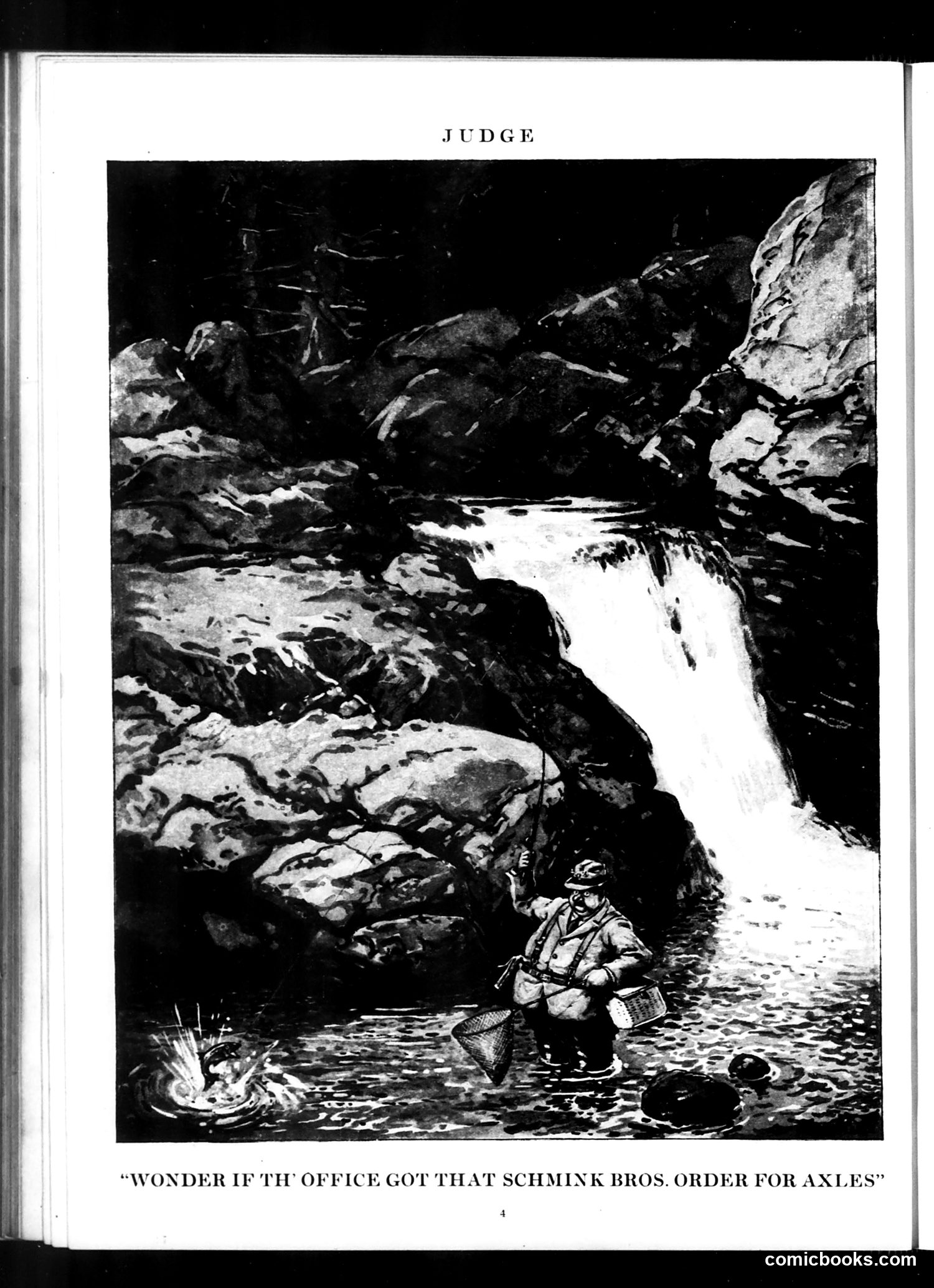
This Judge magazine cartoon satirizes bureaucratic incompetence. A fisherman stands in a stream beneath a waterfall, seemingly unable to catch fish despite ideal conditions. The caption suggests he's wondering whether "th' office" received a Schmink Bros. order for axles—implying that essential supplies never arrived due to administrative failure. The joke plays on the frustration of waiting for business orders to be processed. Schmink Bros. appears to be a real axle manufacturer. The cartoon mocks how office workers' mistakes or delays can leave field workers (here, the fisherman as metaphor) unable to do their jobs effectively. It's satire about the gap between headquarters bureaucracy and practical work on the ground.
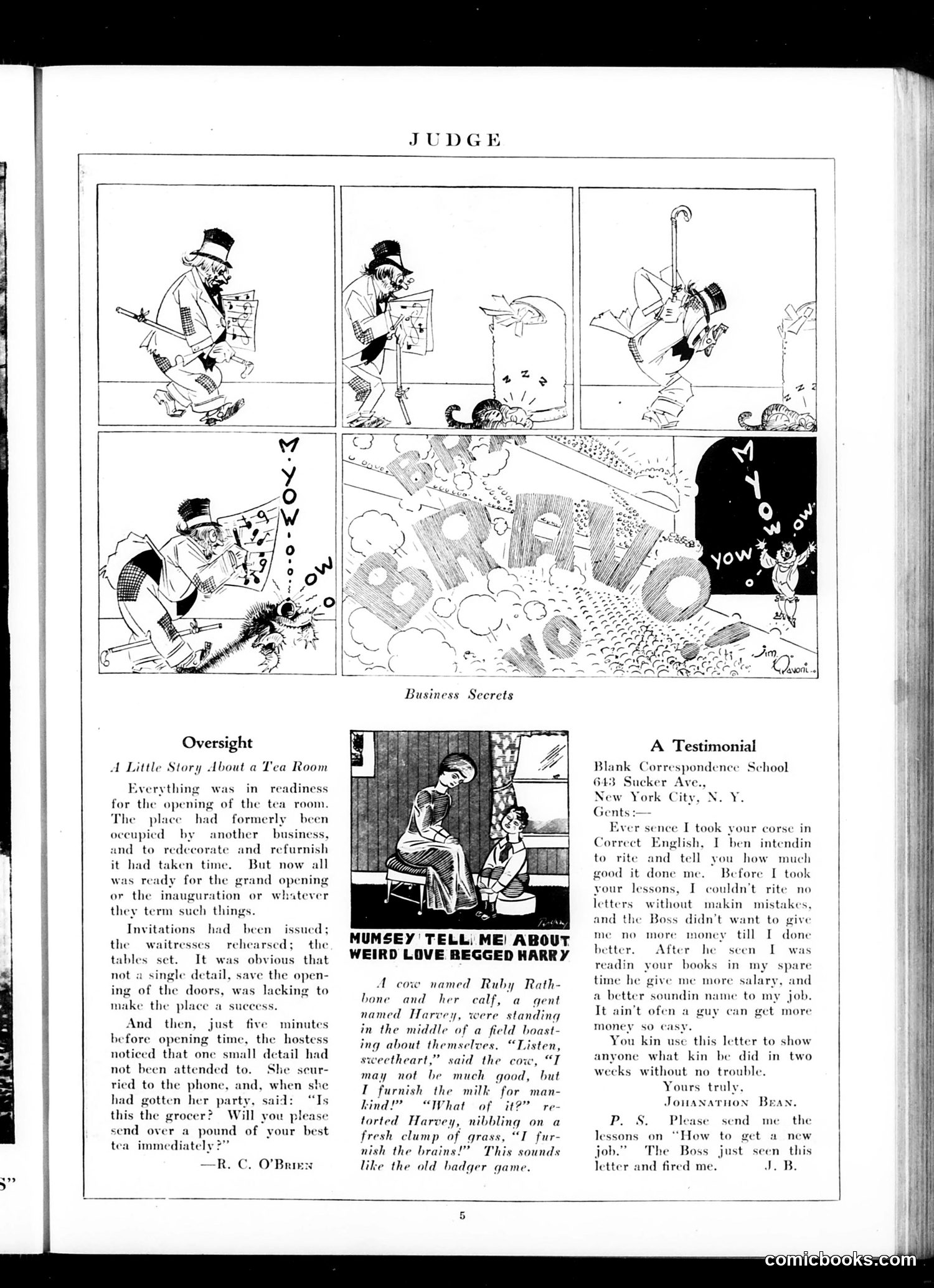
The top comic strip titled "Business Secrets" depicts a judge examining what appears to be a building or business operation through magnifying glasses and inspection tools. The satire likely critiques judicial oversight of business practices or corruption investigations—a judge supposedly "judging" or inspecting commercial activities, with the punchline suggesting inadequate or theatrical scrutiny. Below are reader submissions: "Oversight" humorously recounts a tea room opening where the hostess forgot minor details; "A Little Story About a Tea Room" describes a domestic dispute; and "A Testimonial" features a student praising a correspondence school's English courses. The page represents Judge's typical mix of satirical comics and humorous reader anecdotes, reflecting early 20th-century American social commentary on business, education, and domestic life.
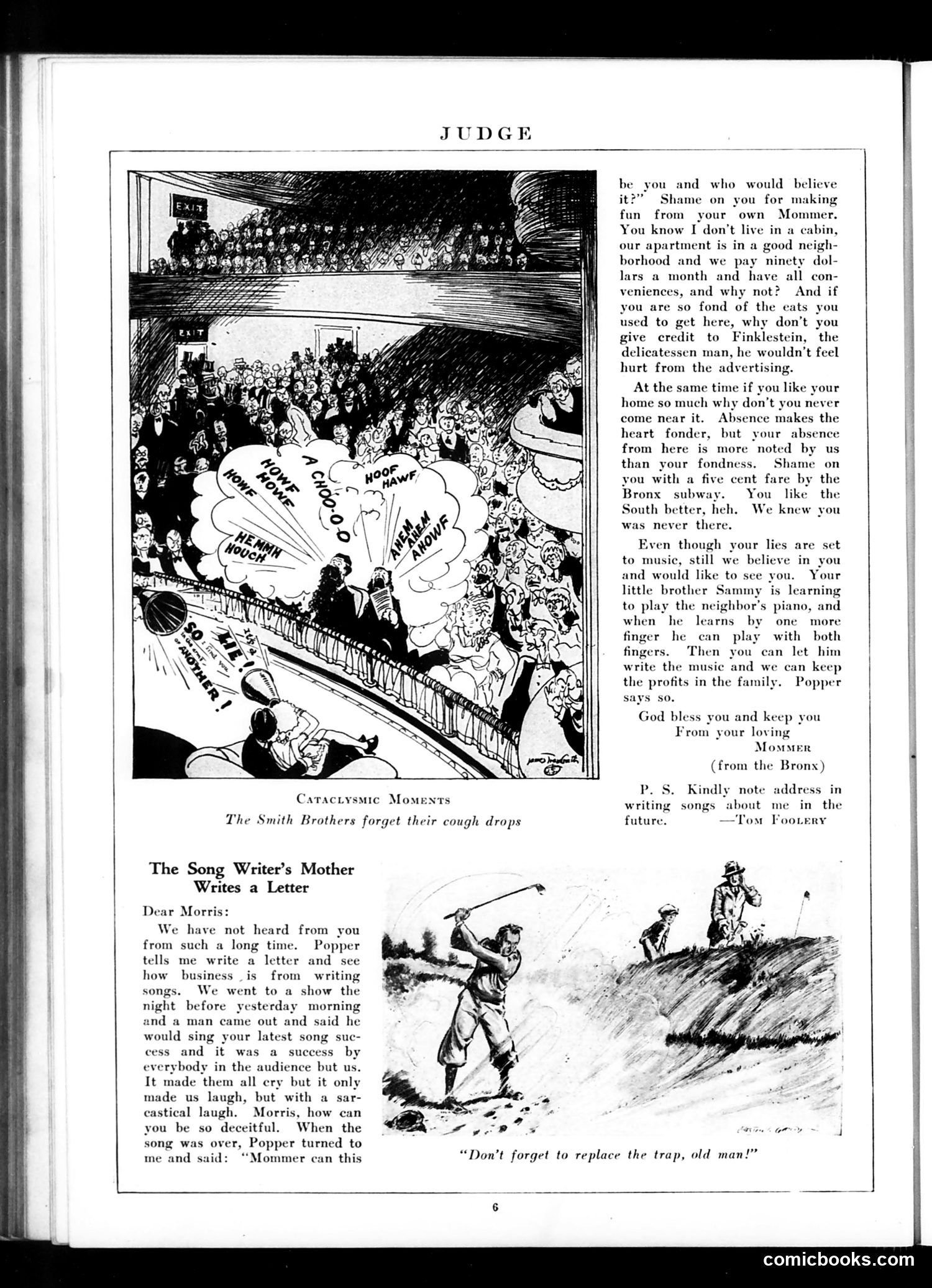
This page contains two separate pieces: **Top cartoon ("Cataclysmic Moments"):** Shows the Smith Brothers (famous cough drop manufacturers) performing at what appears to be a theatrical venue, with their advertising slogans ("Trade Mark," "Don't Cough," "Hemmoo") visible in speech bubbles. The satire jokes that even these famous medicine pitchmen have "forgotten their cough drops" — the cartoon puns on their brand identity by showing them at a non-commercial performance. **Bottom section:** A letter from a mother in the Bronx to songwriter Morris (Tom Foolery), complaining humorously that her son won't come home because he's absorbed in writing songs for the theater. She sarcastically praises his success while needling him about neglecting his family. The accompanying illustration shows a golfer, unrelated to the letter's content. Both pieces use gentle humor about commercial promotion and artistic ambition.
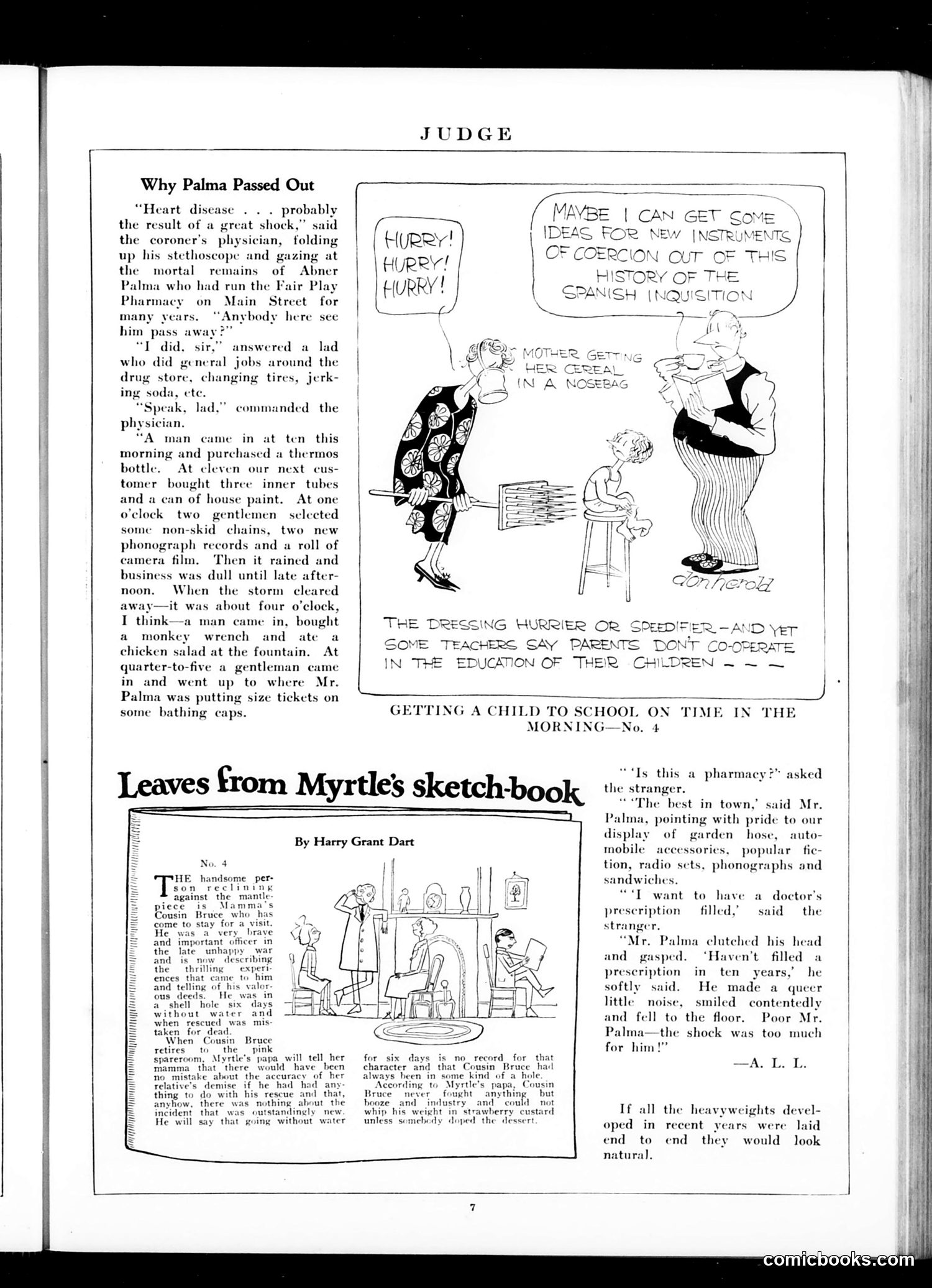
This page contains three distinct satirical pieces: **"Why Palma Passed Out"** mocks the decline of traditional pharmacies. Mr. Palma, who ran a pharmacy for years, dies of shock when a customer actually requests a prescription—his first in a decade. The joke satirizes how drugstores had become general merchandise vendors selling everything from automobile accessories to sandwiches, abandoning their original pharmaceutical purpose. The coroner's diagnosis of "heart disease from shock" is the darkly comic punchline. **"The Dressing Hurrier"** (cartoon) satirizes parents' morning routines with children, depicting a frazzled mother trying to rush her child to school while the child moves at a snail's pace. **"Leaves from Myrtle's Sketch-book"** humorously portrays "Cousin Bruce," a war veteran boring his hosts with exaggerated war stories (six days in a shell hole without water) that he presents as extraordinary, when the family finds them utterly unremarkable. All three pieces target American middle-class life and social pretension through domestic situations.
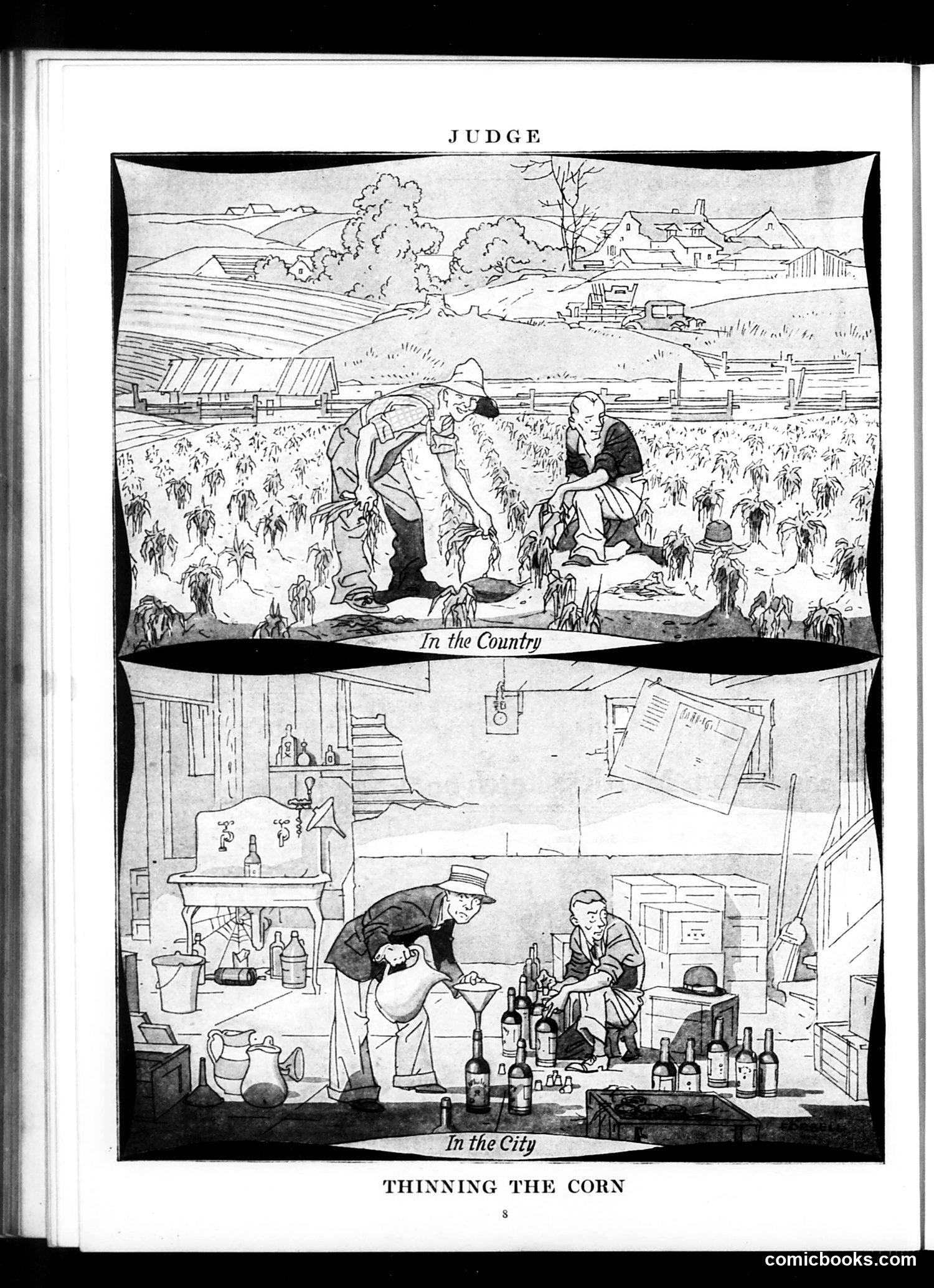
This two-panel satire contrasts rural and urban approaches to "thinning the corn" — a farming practice of removing excess seedlings to help crops thrive. **"In the Country" (top):** Farmers thin corn naturally through honest labor in the fields. **"In the City" (bottom):** A well-dressed man appears to be thinning corn through alcohol consumption and excess — surrounded by numerous bottles. His companion sits nearby amid similar indulgence. The cartoon satirizes the contrast between rural productivity and urban excess or vice. The metaphor suggests city dwellers "thin" their resources (or themselves) through dissipation rather than productive work. This likely reflects early 20th-century tensions between agrarian values and urban decadence, possibly critiquing Prohibition-era drinking culture or general urban moral decay, depending on publication date.
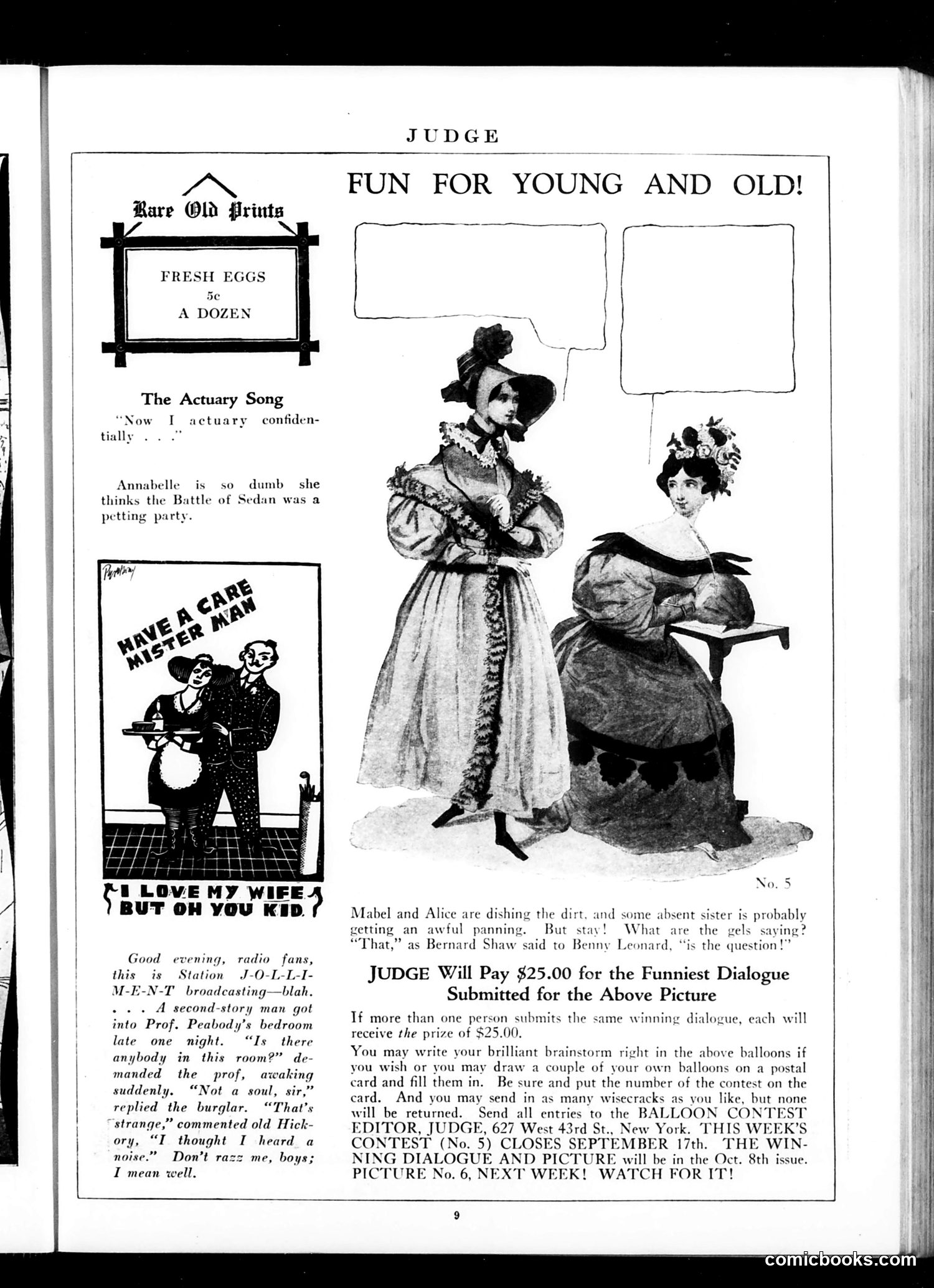
This page from **Judge** magazine features a reader-participation contest typical of the era. The main content is Picture No. 5, showing two women gossiping—"Mabel and Alice are dishing the dirt"—with empty speech balloons. Readers are invited to submit witty dialogue for $25 prize money, with entries due September 17th. The surrounding content includes period humor: jokes about an "actuary" (insurance professional), references to the Battle of Sedan (Franco-Prussian War, 1870), and vaudeville-style gags (a burglar breaking into a professor's bedroom). The advertisement for "Fresh Eggs 5¢ a Dozen" and musical references ("I Love My Wife But Oh You Kid") ground this in the pre-WWI era. The satire targets contemporary social conventions—women's gossip, romance, and absurd educational gaps—reflecting Judge's focus on middle-class American foibles and entertainment.
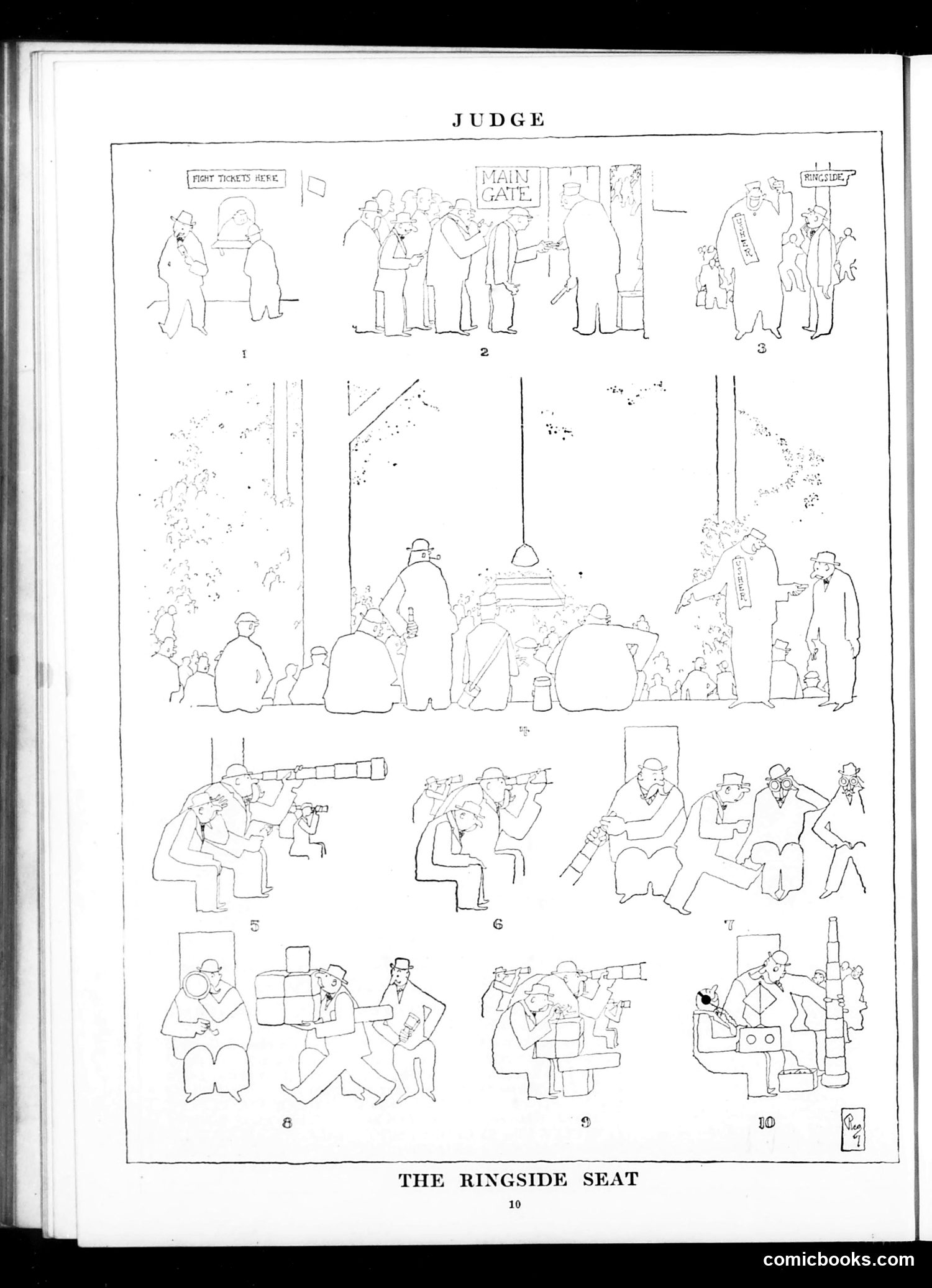
This is a humorous cartoon sequence depicting the experience of attending a boxing match. The panels progress from purchasing tickets (panel 1) through entering via the main gate (panel 2-3), to taking ringside seats (large central panel showing a crowded arena), and then through various comedy scenarios involving spectators trying to watch the fight while dealing with obstructions, other patrons, and the chaos of the venue. The joke centers on the irony of paying premium prices for "ringside seats"—supposedly the best view—only to have one's view repeatedly blocked by standing spectators, falling equipment, or other obstacles (panels 5-10). The satire mocks the frustrating reality of live sporting event attendance, a relatable complaint about boxing matches and similar venues popular in early 20th-century America.
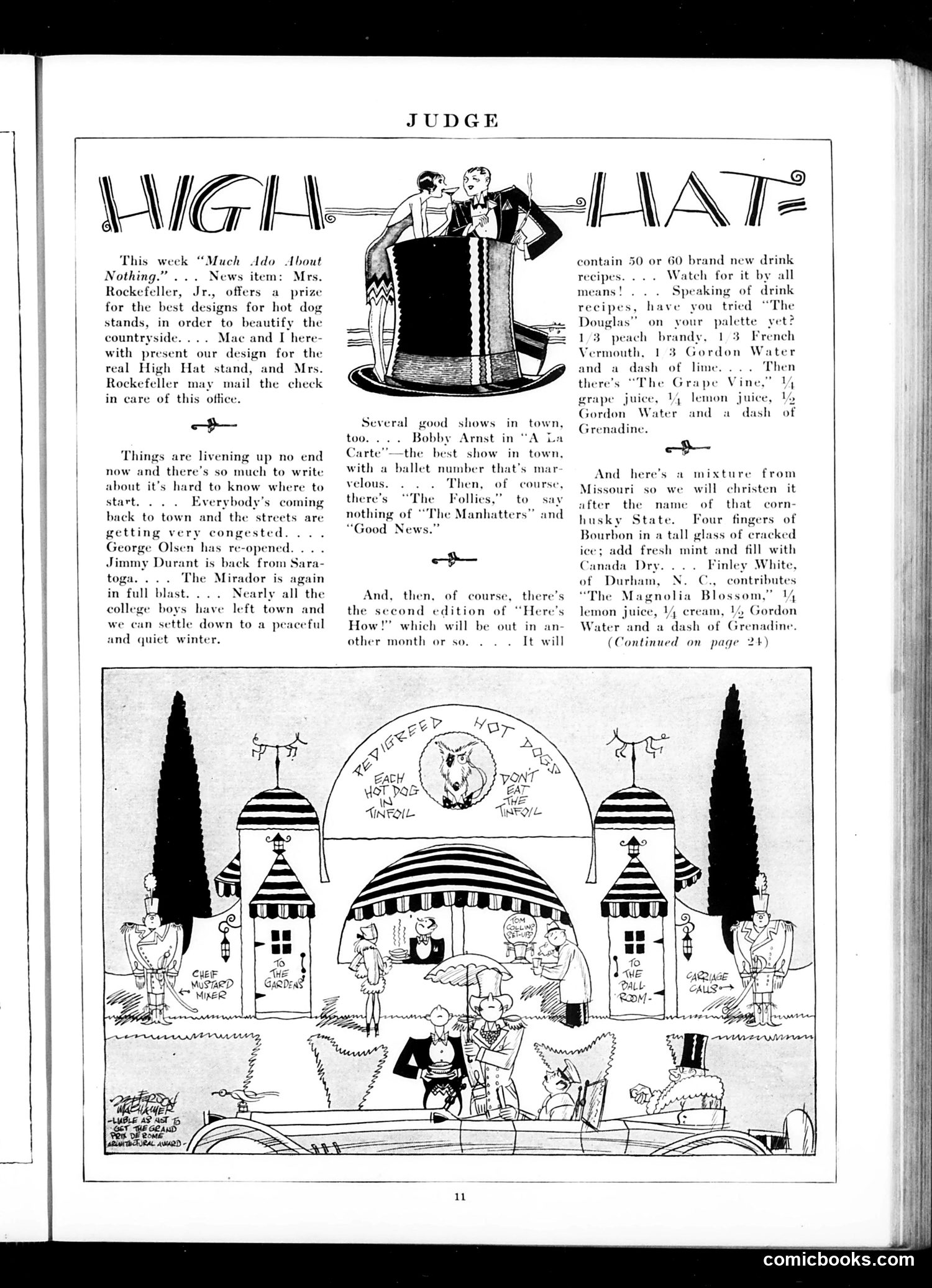
This page combines social commentary with lifestyle content typical of 1920s Judge magazine. The top cartoon mocks Mrs. Rockefeller Jr.'s philanthropic effort to beautify countryside hot dog stands by presenting an absurdly ornate "High Hat stand"—a towering, pretentious structure that satirizes wealthy dilettantes imposing fancy aesthetics onto working-class commercial spaces. The surrounding text is gossipy social commentary about New York city life: theater reviews (Bobby Arnst, The Follies, The Manhatters, Good News), returning socialites, and notably, **cocktail recipes**—indicating this was published during Prohibition, when alcohol consumption was illegal but widely practiced among the affluent. The recipes use coded language ("drink recipes") and feature named cocktails like "The Douglas" and "The Magnolia Blossom," reflecting the era's speakeasy culture. The satire targets both wealthy philanthropy and the hypocrisy of Prohibition-era elite who publicly supported temperance while privately enjoying elaborate cocktails.
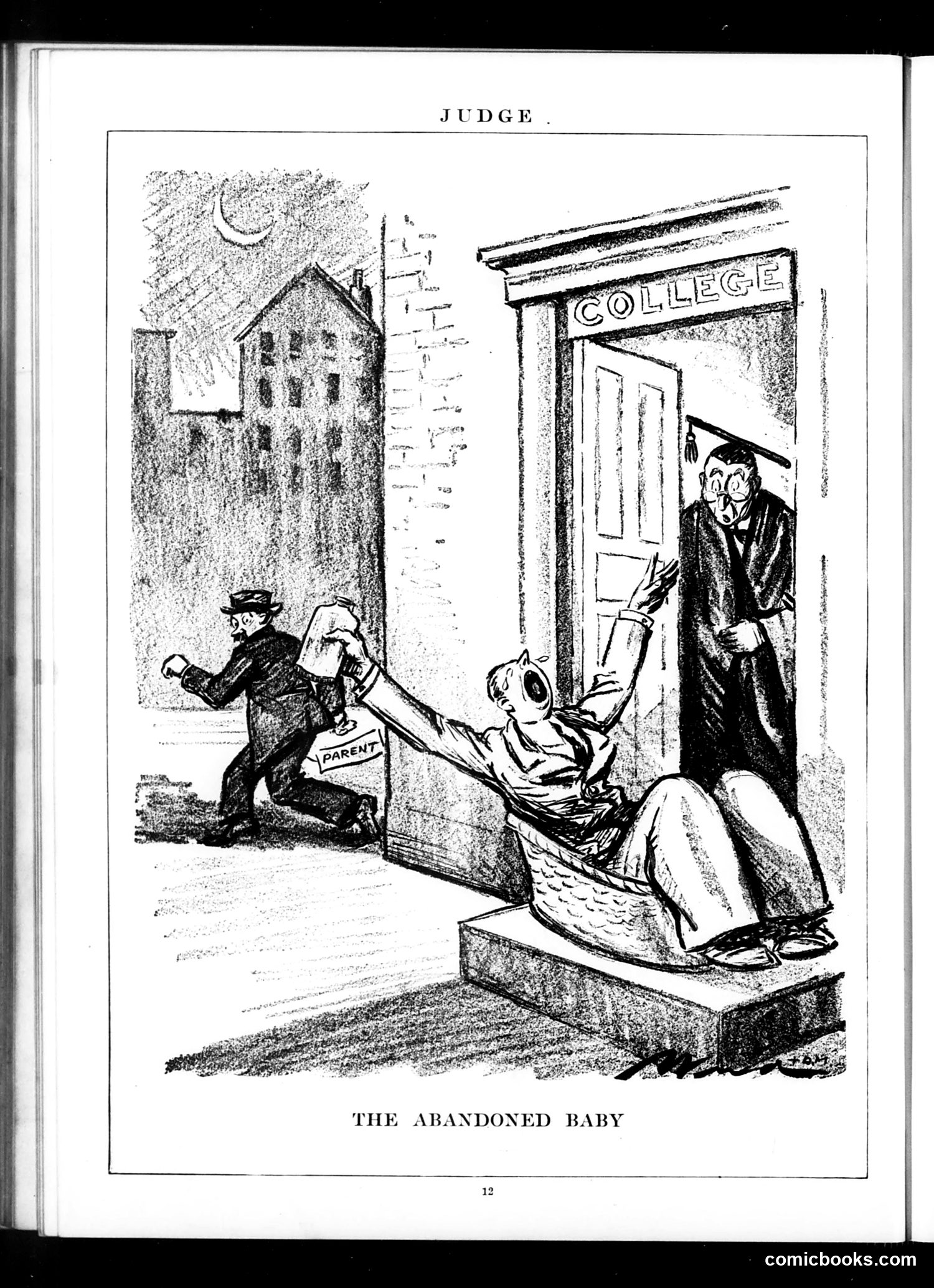
This cartoon depicts a social commentary on education and parental responsibility. A well-dressed figure (likely representing a parent or guardian, marked with "PARENT") sits outside a college building, appearing to hand off or abandon a baby to a stern-looking college official at the doorway. The satire critiques parents who outsource their children's education and moral upbringing entirely to colleges, treating educational institutions as convenient places to deposit parental duties. The nighttime setting with the crescent moon adds drama, suggesting parents' neglect occurs under cover of darkness. The cartoon likely reflects early-20th-century anxieties about changing family structures and the expanding role of colleges in American life, mocking the assumption that institutions could or should replace parental guidance and supervision.
**Main Article: "Hoover for President?"** The editorial debates whether Herbert Hoover, currently Secretary of Commerce, should run for president in 1928. The author argues *against* this, contending that while the presidency is theoretically powerful, it has become weakened by Congress (citing how Harding and Coolidge were undermined). Hoover's strength lies in his unglamorous, behind-the-scenes competence—best exemplified by his effective work at Commerce. The satire suggests that elevating him to the presidency would actually diminish his influence, as the office now grants less real power than his current position. **Secondary Item: Legion Veterans** A brief, melancholic piece notes that American Legion members returning from Europe are no longer the young "doughboys" of World War I (10 years prior). They now show age and family responsibilities. The author laments that a new generation of schoolchildren "has not known either the suffering fears, the hardships or the exaltation of war," hoping they never will—a poignant contrast to the aging veterans.
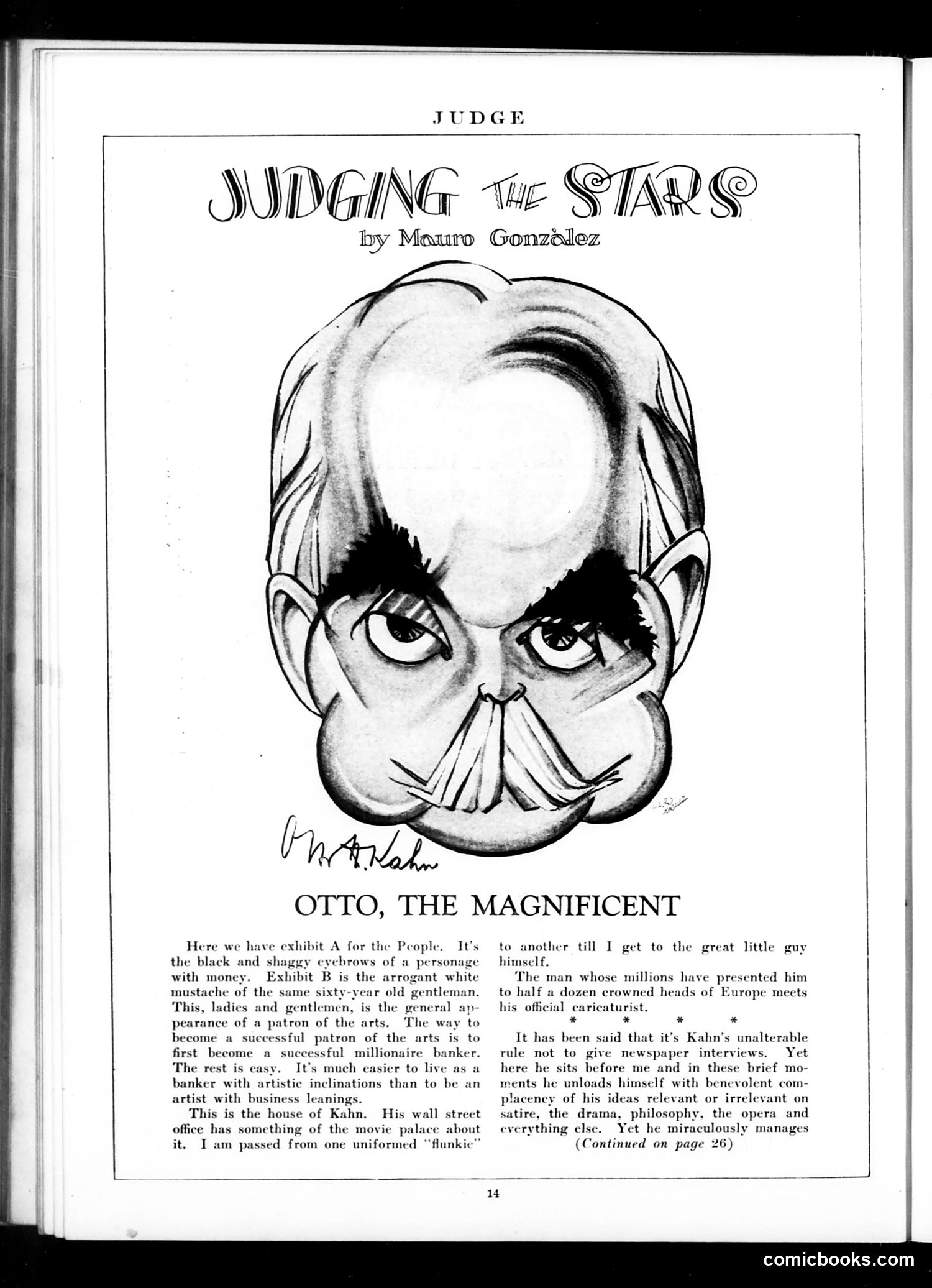
This is a satirical caricature of Otto Kahn, a prominent wealthy banker and art patron of the Gilded Age era. The cartoon mocks the pretensions of the ultra-rich who become patrons of the arts. The satire's central point: Kahn's wealth—not genuine artistic sensibility—qualified him as a tastemaker. The text sarcastically notes that becoming an arts patron simply requires first becoming a "successful millionaire banker," implying the rest follows automatically. The exaggerated features (shaggy eyebrows, arrogant mustache) emphasize his imposing persona, while the description of his mansion's theatrical grandeur ("movie palace") and numerous uniformed servants underscores his ostentatious display of wealth. The piece ironically notes Kahn normally refuses press interviews, yet here he is speaking to the cartoonist. The humor suggests that despite his pretense to cultural sophistication, he's ultimately just a wealthy businessman playing the role of enlightened patron.
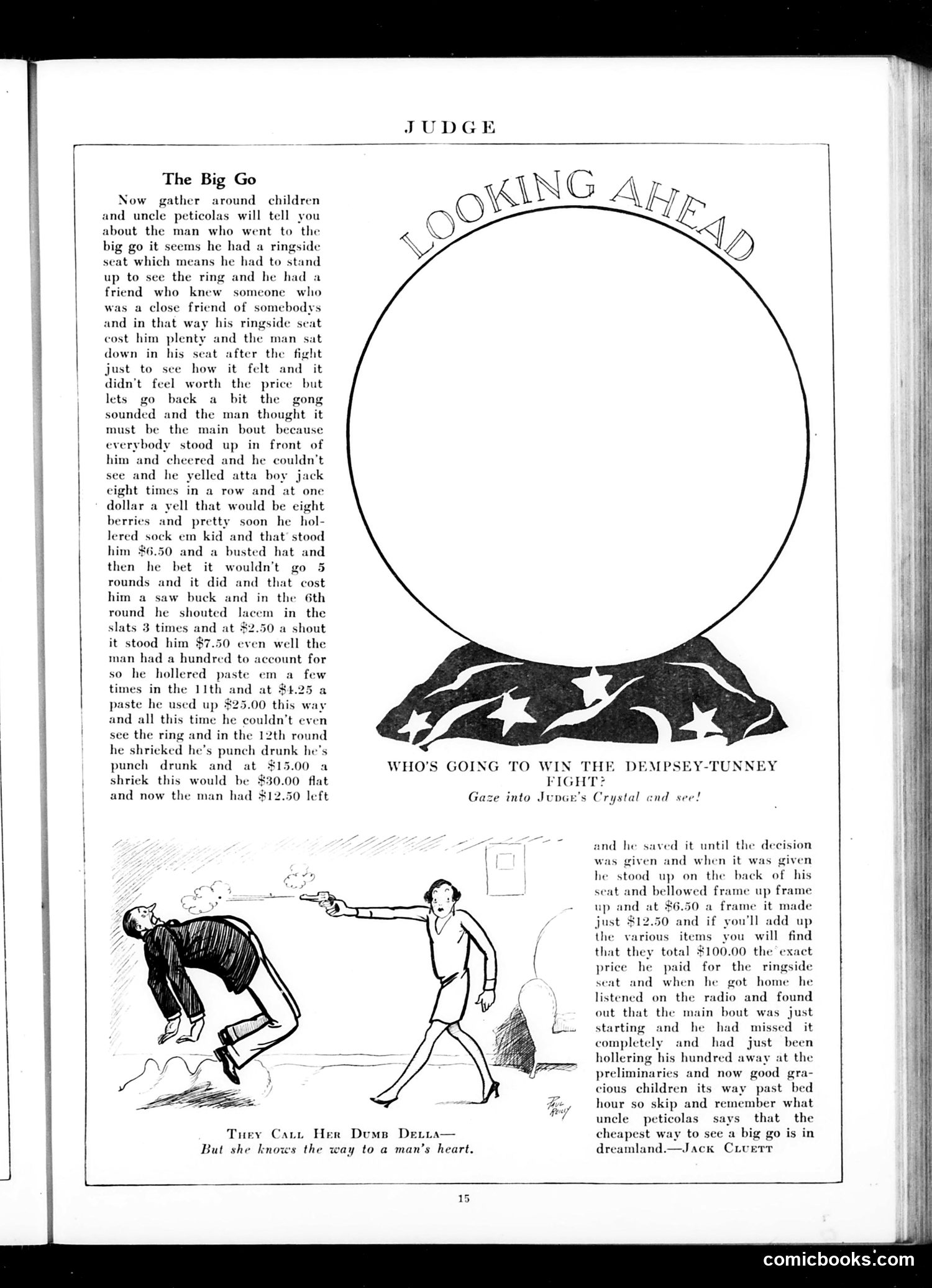
This page satirizes the cost and experience of attending a major boxing match, likely the famous Dempsey-Tunney fight (referenced in the "Looking Ahead" crystal ball feature). **"The Big Go"** is a humorous narrative by Jack Clevett about a man who purchased an expensive ringside seat but couldn't actually see the ring because spectators blocked his view. The joke details how he spent his entire $100 seat cost by yelling encouragement at boxers during preliminary rounds—at $1 per yell, $6.50 for shouting encouragement, $7.50 for more outbursts, etc.—only to discover via radio that he'd missed the main event entirely and wasted his money on the preliminaries. The accompanying sketch, "They Call Her Dumb Della," shows a woman boxing or sparring, with the caption suggesting she understands men despite her apparent naiveté. The satire targets both the inflated costs of attending boxing events and the gullible fan willing to pay premium prices while gaining nothing of value—a critique of commercialized sports and consumer excess during the 1920s.
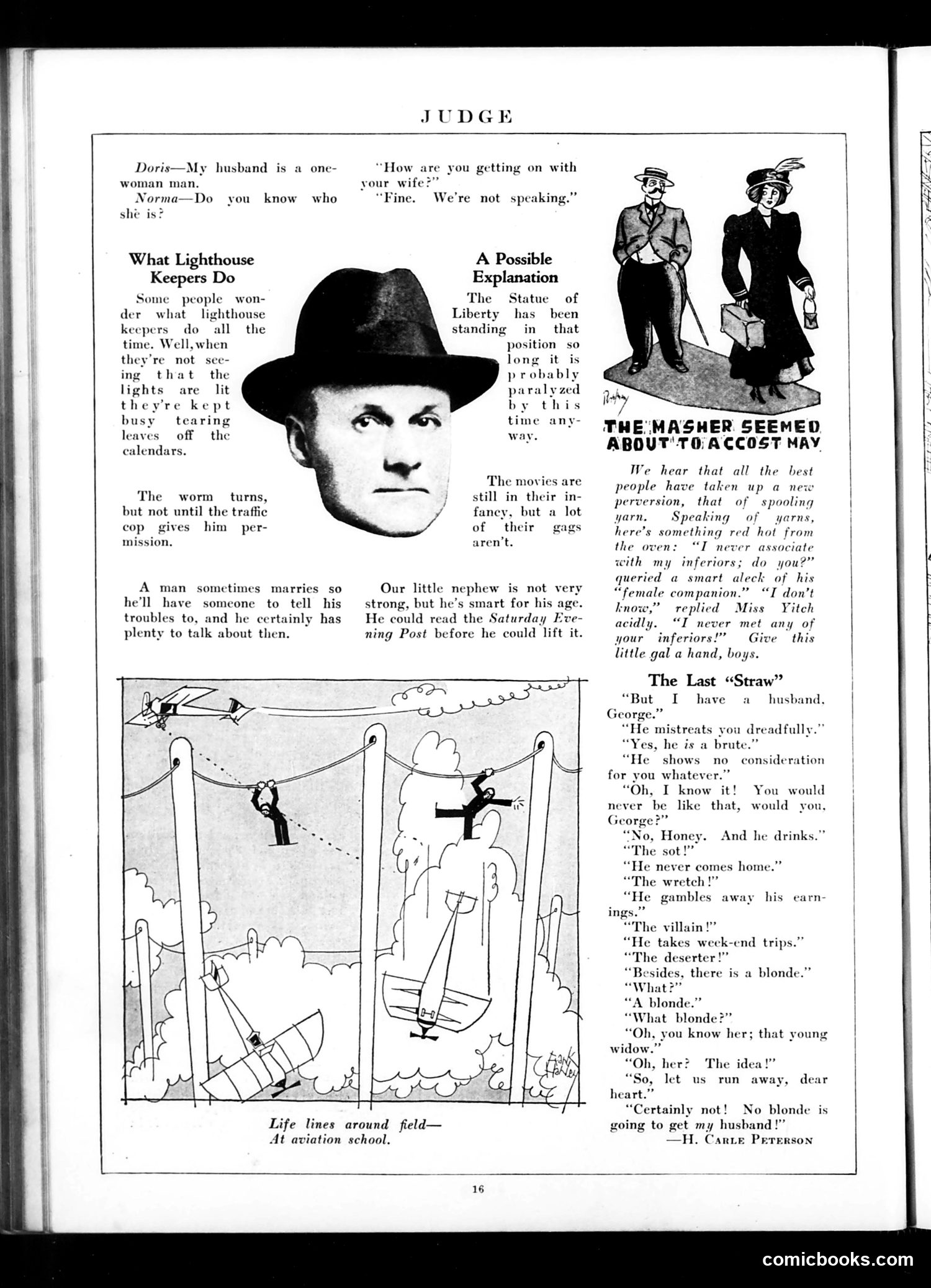
This page from Judge contains several short humor items and cartoons typical of early 20th-century American satire. **The jokes** mock domestic life: wives complaining about husbands, marital discord, and infidelity. One piece, "The Last 'Straw,'" presents a wife cataloging her husband's failures (drinking, gambling, affairs) yet refusing to leave him—satirizing women's limited options and economic dependence despite mistreatment. **"What Lighthouse Keepers Do"** offers absurdist humor about bureaucratic tedium—lighthouse keepers tearing calendar pages as their primary occupation. **The aviation cartoon** shows men suspended on life lines at an aviation school, illustrating the era's experimental and dangerous early aviation training. **"The Masher Seemed About to Accost May"** depicts street harassment, a common complaint in this period. The overall tone reflects Judge's typical blend of social observation, mild cynicism about marriage and gender relations, and light mockery of modern institutions—all presented through jokes rather than sharp political critique.
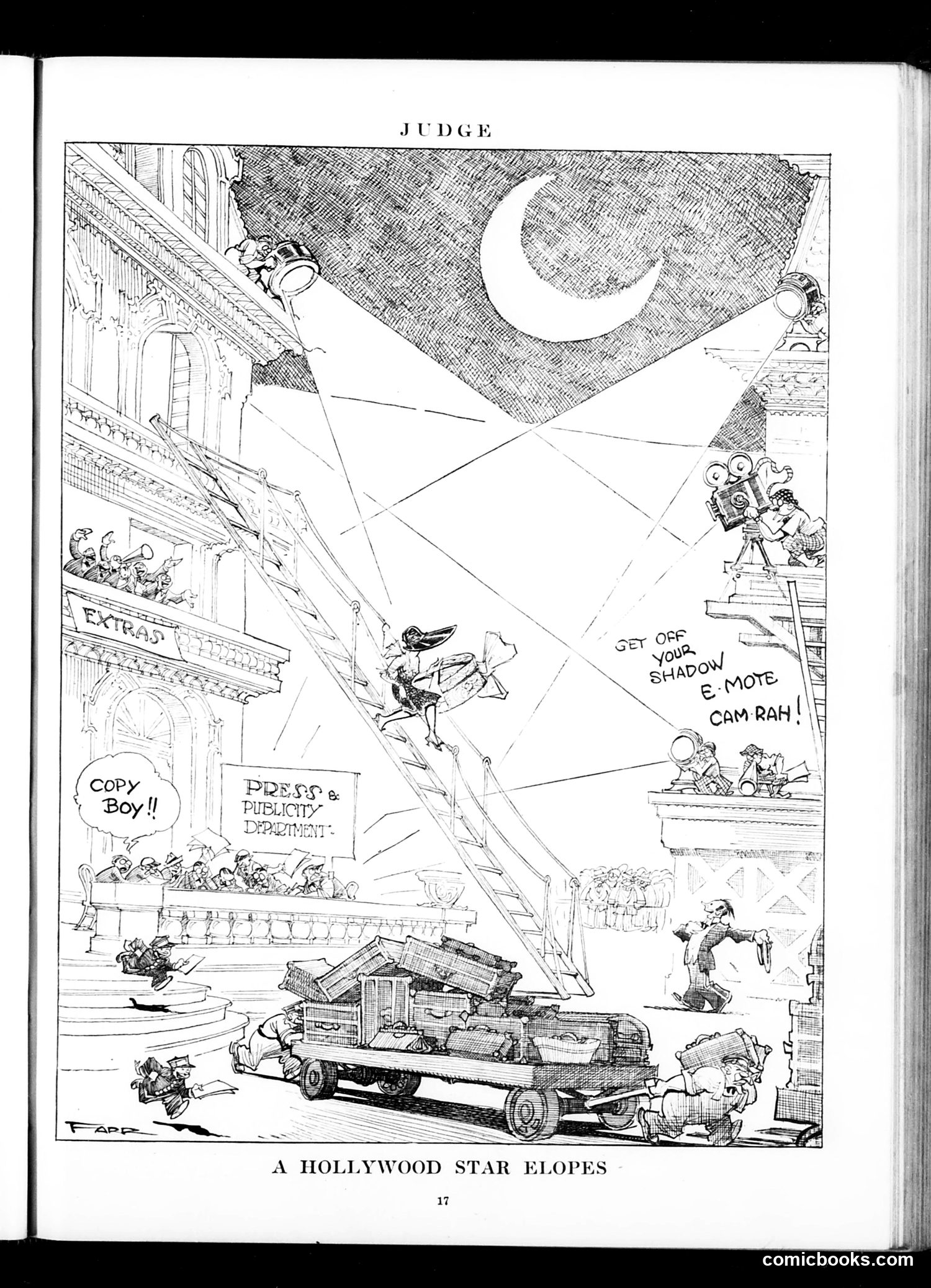
This single-panel cartoon satirizes Hollywood's theatrical scandal and media sensationalism. A star is depicted eloping (running away to marry secretly), scaling down the exterior of what appears to be a grand building—likely a studio or hotel—using a rope while searchlights beam overhead. The scene parodies the dramatic, over-the-top nature of Hollywood gossip. Various onlookers shout instructions ("Copy Boy!", "Get off your shadow, B. Mote, Cam Rah!"), representing journalists and publicity departments scrambling to capture the scandal. The Press & Publicity Department sign suggests the media circus surrounding celebrity elopements. The cartoon mocks both Hollywood's manufactured drama and the media's obsessive coverage of celebrity personal lives—themes that remain relevant today, reflecting early 20th-century celebrity culture.
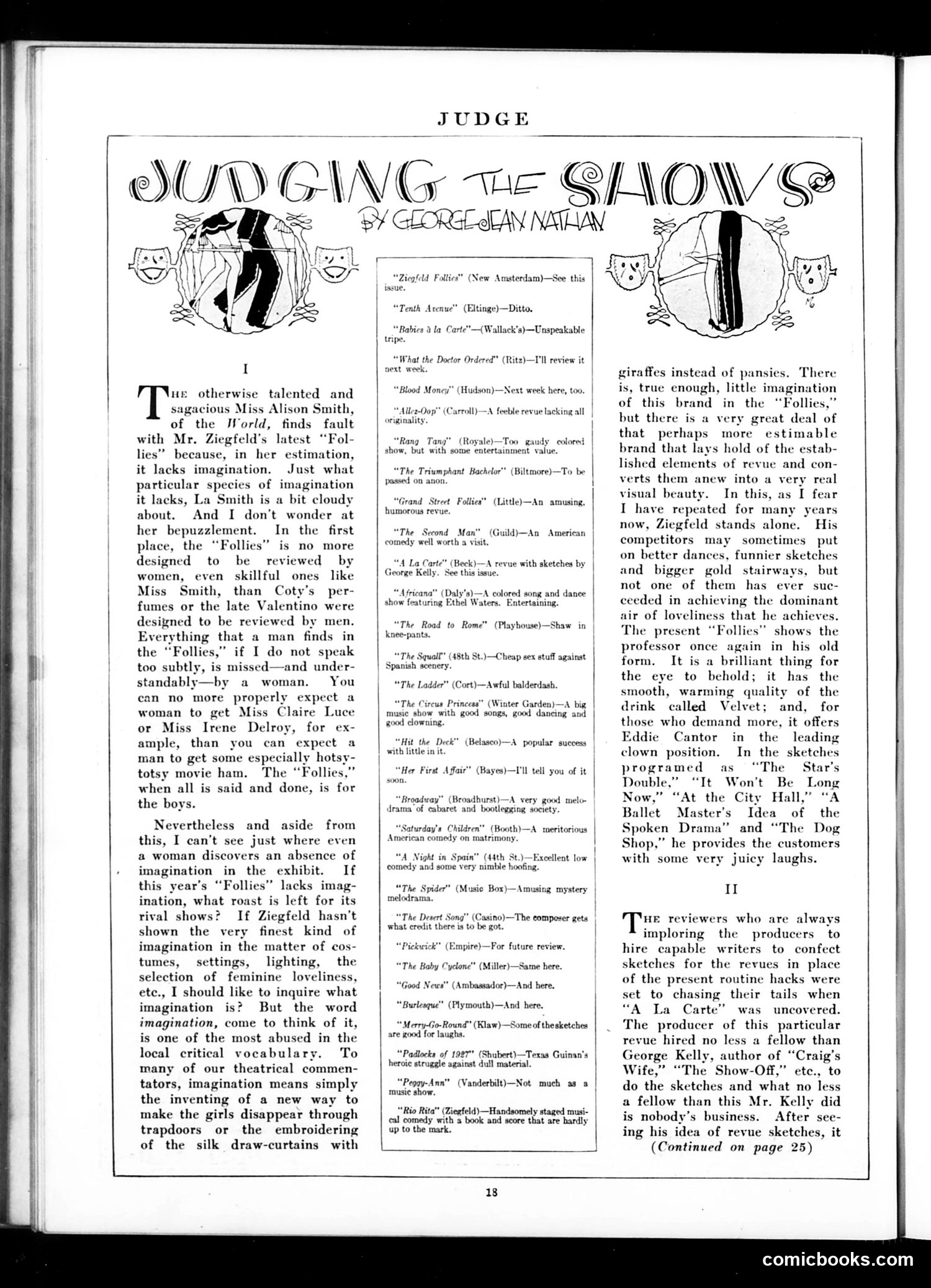
This is a theater review column by George Jean Nathan critiquing Broadway shows, particularly addressing a critic named Alison Smith of *the World* newspaper who faulted Florenz Ziegfeld's latest "Follies" revue for lacking imagination. Nathan argues Smith's critique is fundamentally misguided: the "Follies" isn't designed for women reviewers anyway—it's male entertainment featuring attractive women, dancing, and spectacle. He contends that even if it lacked imagination, competitors haven't done better. He satirizes the abuse of the word "imagination" in theater criticism, suggesting critics mistake mere technical novelty (girls disappearing through trapdoors, decorated curtains) for genuine creativity. The accompanying list reviews current Broadway productions, using Nathan's sardonic voice to assess shows like *Rio Rita*, *The Ladder*, and *Africana*.
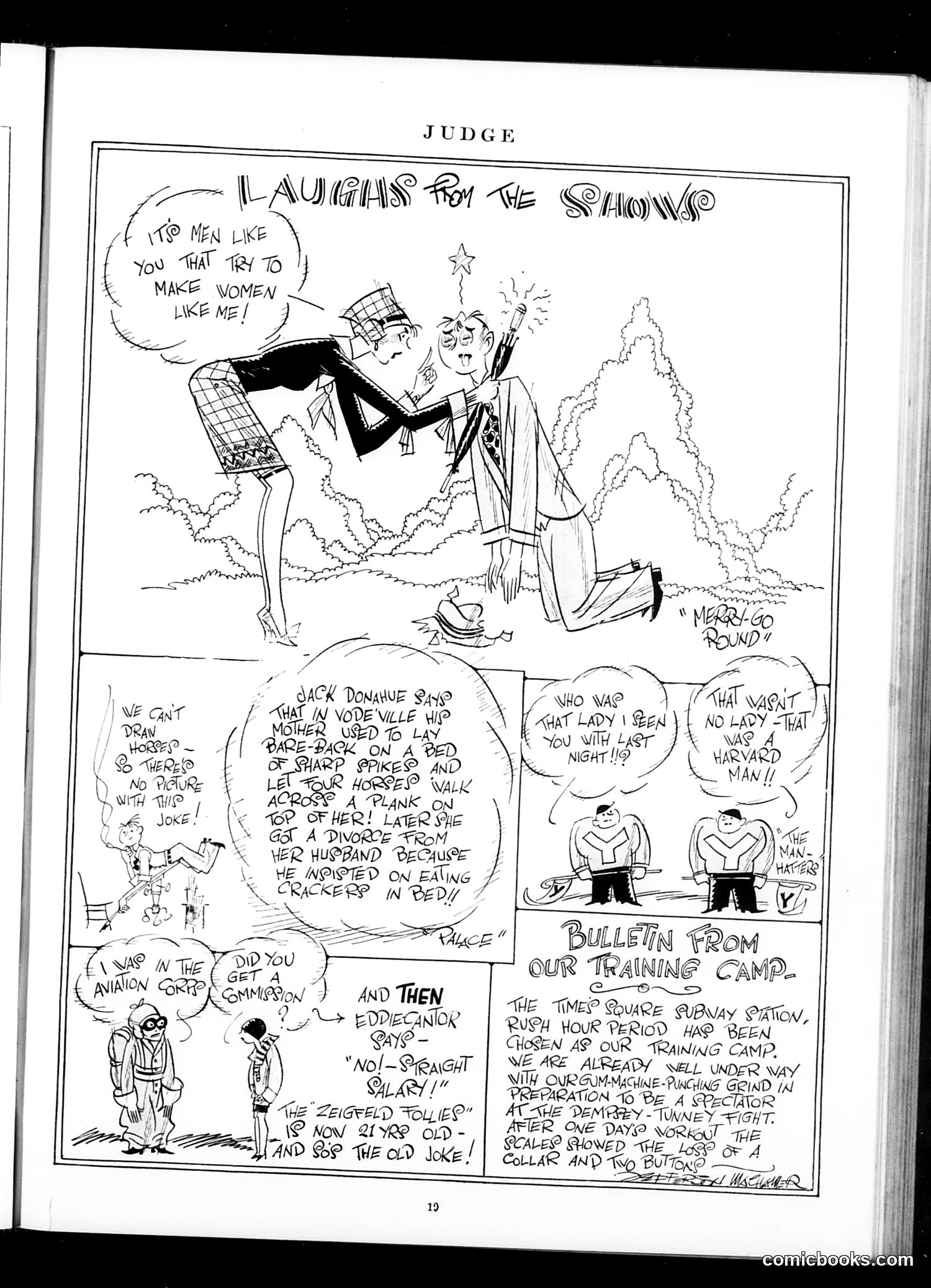
This page contains vaudeville-era humor mocking romantic and marital scenarios. The top cartoon shows a man attempting to seduce a woman by claiming men like him try to make women "like me"—satirizing transparent pickup lines. The middle section features crude jokes about vaudeville performers, including references to Mack Donohue and the Ziegfeld Follies (a famous Broadway revue). The humor relies on absurdist scenarios about infidelity and divorce, typical of early 20th-century comic exaggeration. The bottom section, "Bulletin From Our Training Camp," appears to reference boxing training, mentioning weight scales and a "Demsey-Tunney Fight," likely alluding to the famous 1926-1927 heavyweight boxing matches between Jack Dempsey and Gene Tunney. The overall tone is crude, male-oriented humor focused on show business personalities and physical comedy—characteristic of Judge magazine's satirical approach to entertainment and popular culture.
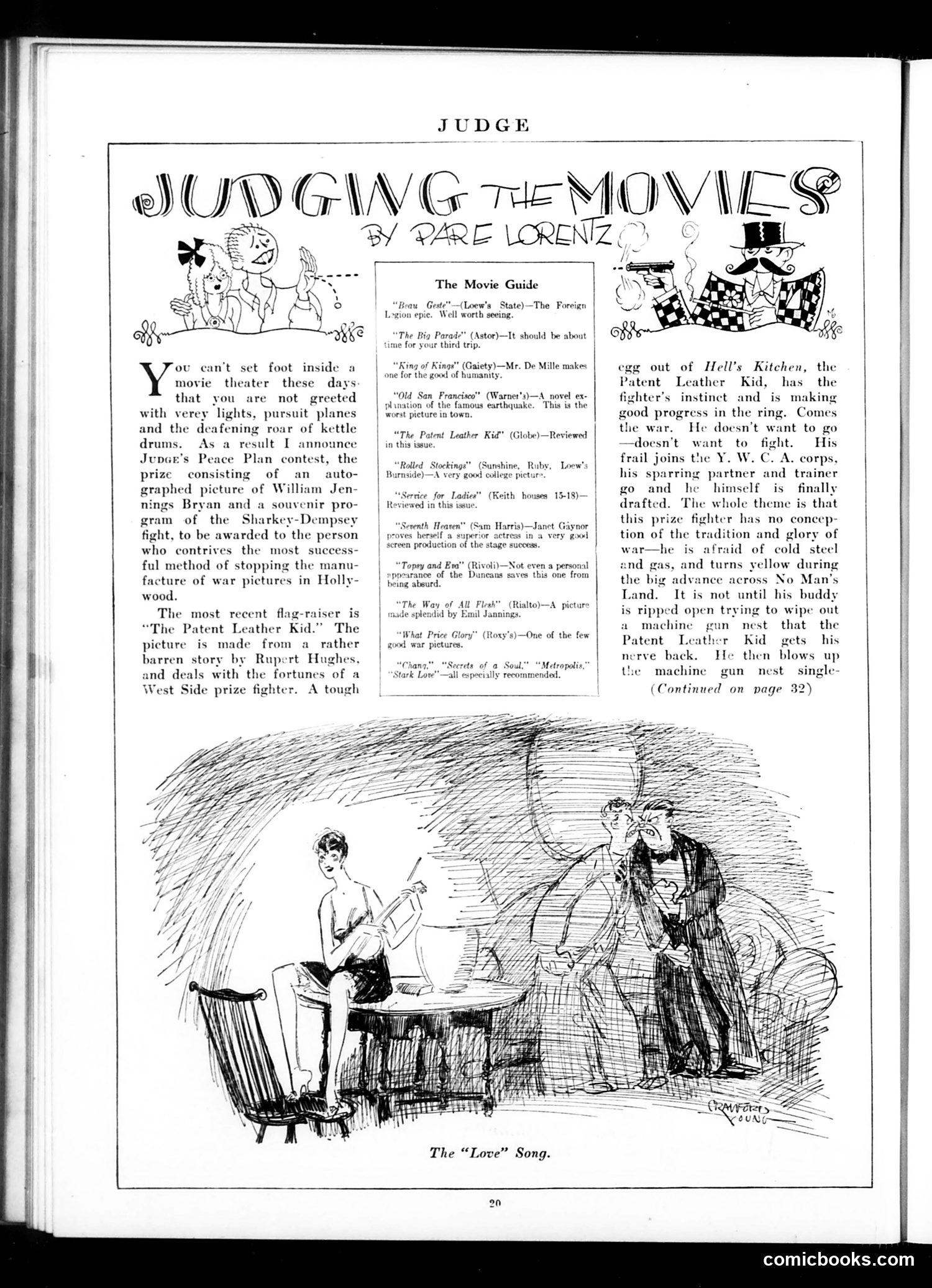
This is a film review column accompanied by a cartoon sketch titled "The 'Love' Song." The reviews critique recent war-themed movies, reflecting post-WWI American attitudes. The column satirizes Hollywood's treatment of war through films like *The Patent Leather Kid*, which the reviewer criticizes for romanticizing combat. The sketch depicts what appears to be a sentimental domestic scene—likely illustrating the contrast between civilians' romanticized view of war and soldiers' actual experiences. Lorenz's commentary suggests skepticism toward "flag-raiser" war pictures, noting that *The Patent Leather Kid* comes from a "barren story." The reference to Judge's "Peace Plan contest" (offering William Jennings Bryan memorabilia) further indicates the magazine's anti-war stance. Overall, the page represents 1920s progressive critique of Hollywood's perceived glorification of warfare during a period of growing pacifist sentiment in America.
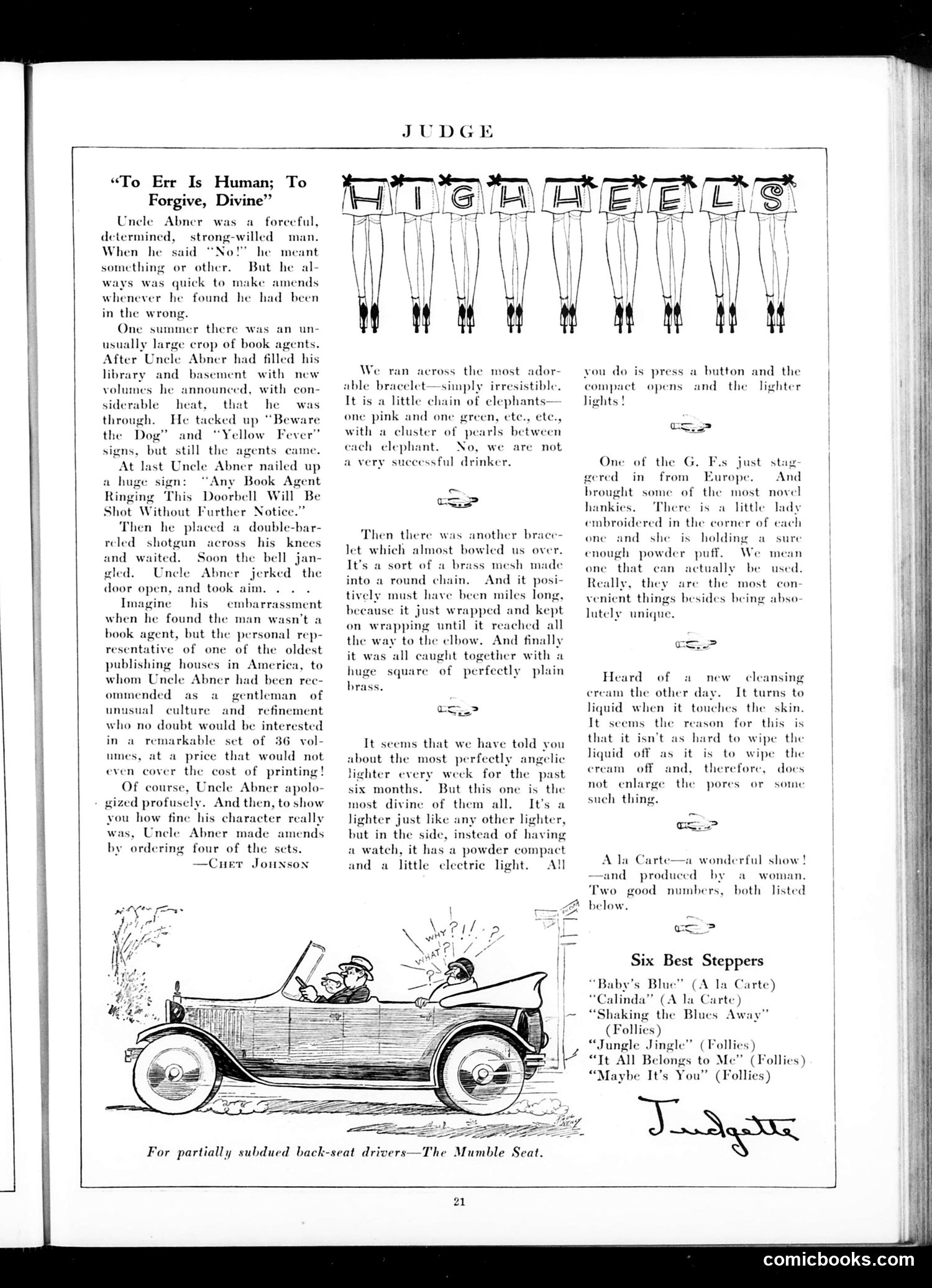
This page contains two distinct sections: **Left side - Story "To Err Is Human; To Forgive, Divine":** A humorous anecdote about Uncle Abner, a gruff man who posts threatening signs against book agents and aims a shotgun at his doorbell. He accidentally almost shoots a legitimate publishing representative instead of a book agent. To make amends for his error, he apologizes and—ironically—purchases four expensive book sets from the very industry he'd been trying to repel. The satire mocks both overzealous salesmen and wealthy men's pretensions to culture. **Right side - "Highaheels" column:** Product commentary on fashionable accessories (bracelets, lighters, powder compacts, handkerchiefs) and entertainment. Lists six popular song "steppers" (hit songs) from theatrical productions like the *Follies* and *A la Carte*. The cartoon at bottom depicts a car with two occupants being splashed, captioned about "back-seat drivers." The page is primarily satirical social commentary and advertising disguised as editorial content, typical of Judge's format.
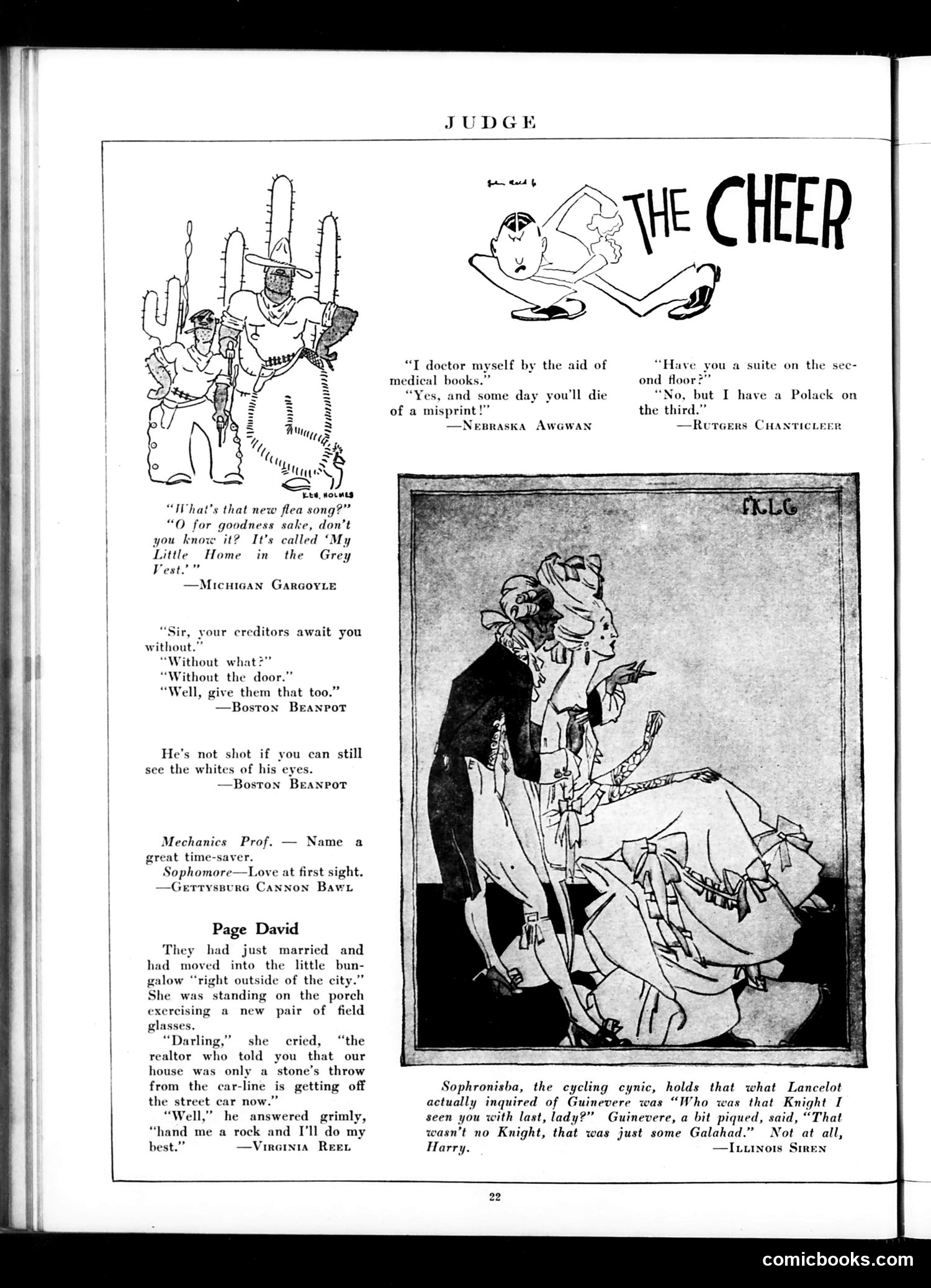
This is a humor page from *Judge* magazine featuring various jokes and a illustrated story. The top section contains brief quips attributed to different people—mostly playing on wordplay and misunderstandings. For example, a Nebraska Awgwan joke involves a doctor who self-treats with medical books, leading to a pun about dying "of a misprint." The main illustration depicts "Sophronisba, the cycling cynic"—an ongoing character apparently known for cynical observations. The caption presents a Arthurian legend joke: when Guinevere mentions seeing "that Knight" with Lancelot, she's actually referring to "some Galahad" (not a knight), creating confusion about medieval courtly romance. The "Page David" story at bottom is a domestic humor piece about newlyweds: the realtor claimed their house was a "stone's throw" from the streetcar line, but it's actually too far. The husband sarcastically offers to throw a rock at the departing streetcar conductor. The humor relies on puns, misheard statements, and everyday domestic situations—typical of early-20th-century American magazine comedy.
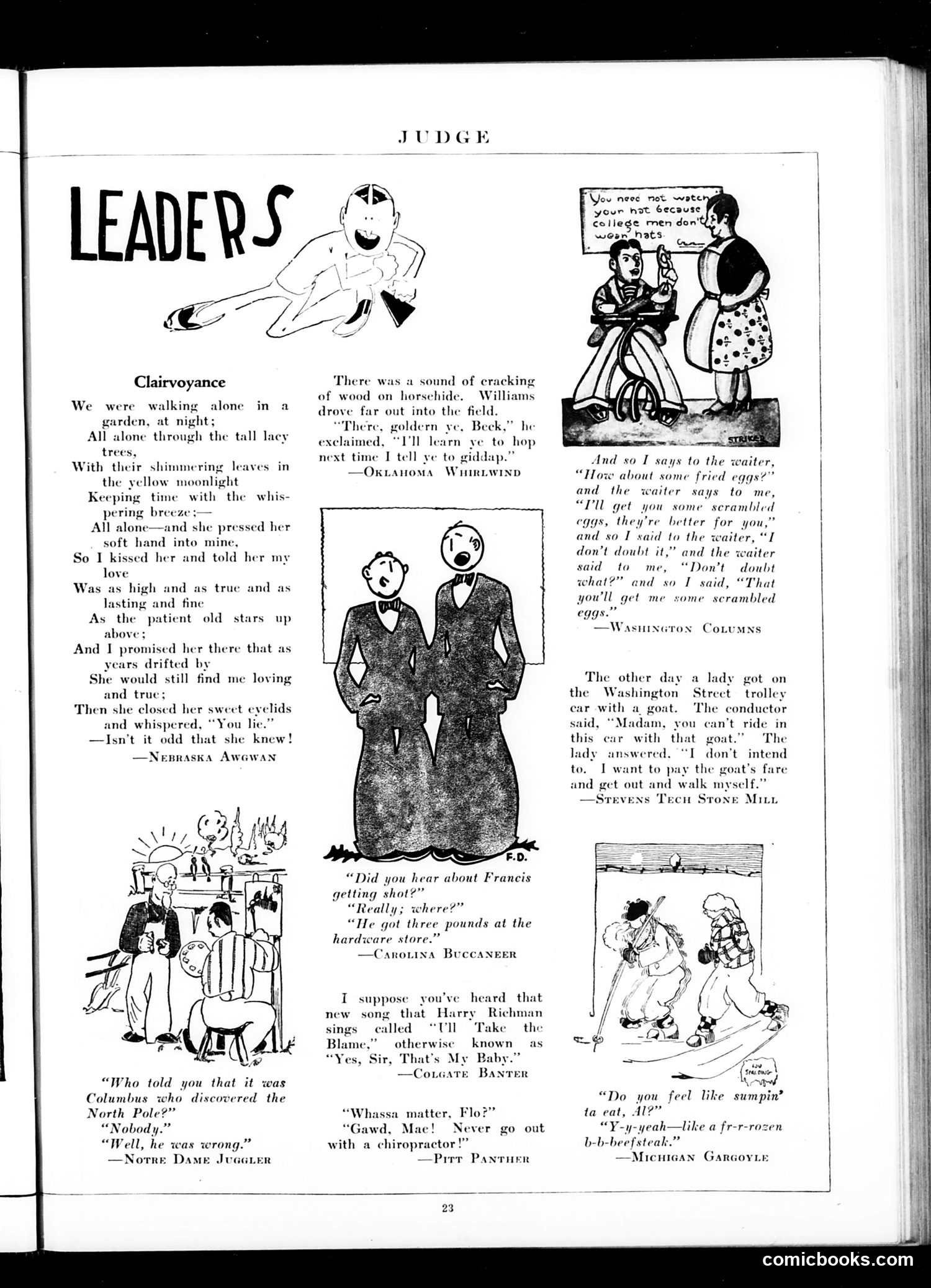
This page from *Judge* contains a collection of short jokes and humorous anecdotes typical of 1920s satirical magazines. The content reflects period concerns and casual attitudes: **Key humor includes:** - A romantic poem about a woman's supposed clairvoyance (she "knew" he loved her) - Jokes about malapropisms: Columbus "discovering the North Pole" (geographical confusion); Francis getting "shot" at a hardware store (misunderstanding "pounds") - A reference to Harry Richman's popular song "Yes, Sir, That's My Baby" - Urban transit humor: a woman boarding a trolley with a goat, refusing to have the animal ride but willing to pay its fare - Physical comedy cartoons showing slapstick scenarios **Social context:** The jokes assume readers share knowledge of contemporary songs and public figures. The "college men" reference in an advertisement suggests targeting educated, younger audiences. The humor is gentle, focusing on wordplay and situational misunderstandings rather than sharp political satire, reflecting *Judge*'s role as light entertainment for middle-class readers.
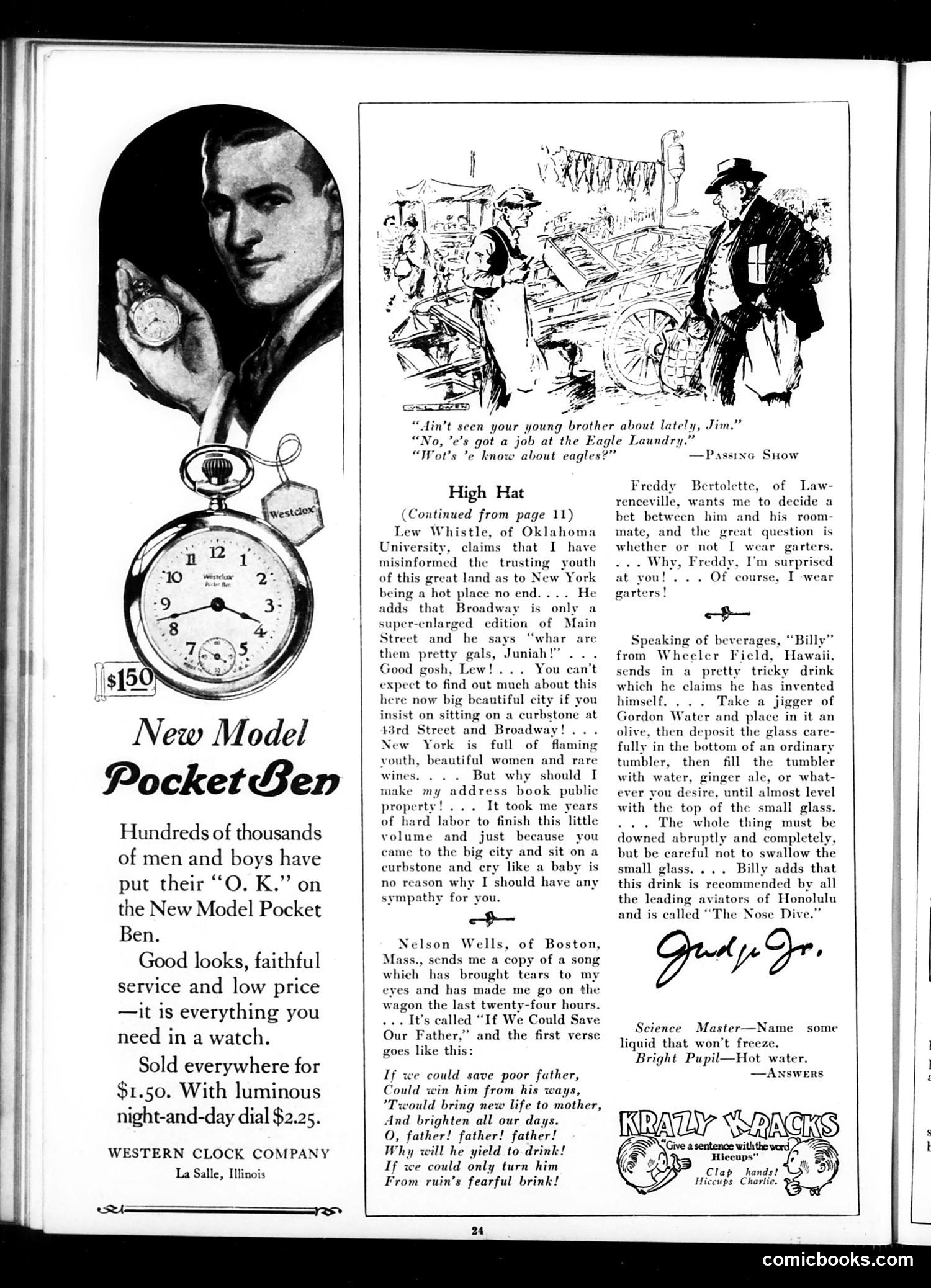
This page is primarily **advertising** for the Westex Clock Company's "Pocket Ben" watch ($1.50), alongside a humor column called "High Hat." The cartoon at top depicts a working-class British exchange—a man asking another if he's seen his young brother lately. The punchline joke plays on the phrase "Eagle Laundry" (a real business): the brother got a job there, but the questioner misunderstands, asking "What's he know about eagles?"—treating it as if the brother literally works with birds. This is simple wordplay humor targeting working-class characters' supposed ignorance. The "High Hat" column contains letters from readers to the author (appears to be a humor columnist). Topics include: an Oklahoma university student's complaints about New York not being as exciting as promised; a Boston reader sharing a sentimental temperance song about saving one's father from drink; and Hawaiian reader's invented cocktail recipe. The page reflects **1910s-1920s sensibilities**: class-based humor, temperance movement references, and lighthearted reader correspondence typical of Judge magazine's satirical-but-accessible approach to American life.
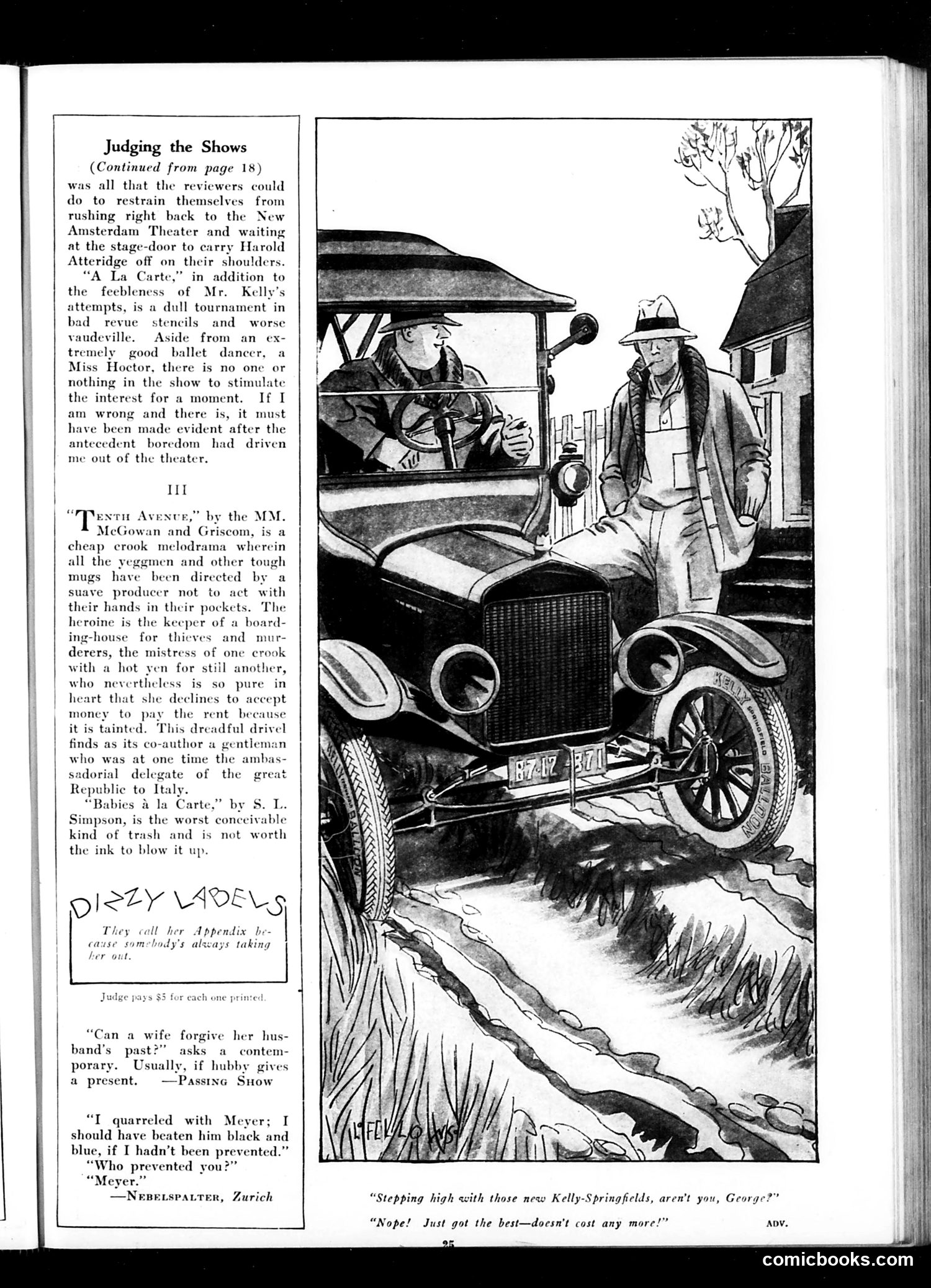
This page contains theater reviews and advertisements from Judge magazine. The main illustrated cartoon depicts two men with an early automobile, discussing the vehicle's tires. The text mentions "Kelly-Springfields" (a tire brand) and "the best," suggesting this is a disguised advertisement for that product. The left column contains scathing reviews of three Broadway shows: "A La Carte" (criticized as tedious), "Tenth Avenue" (called cheap melodrama), and "Babies à la Carte" (dismissed as worthless trash). The reviewers name specific creators like Harold Atteridge and S.L. Simpson. Below are humorous quips—one about wives forgiving husbands' pasts, another mocking a man named Meyer—typical of Judge's satirical commentary style. The overall page mixes genuine theater criticism with advertising disguised as editorial content, reflecting early 20th-century publishing practices where commercial interests blended seamlessly with journalism.
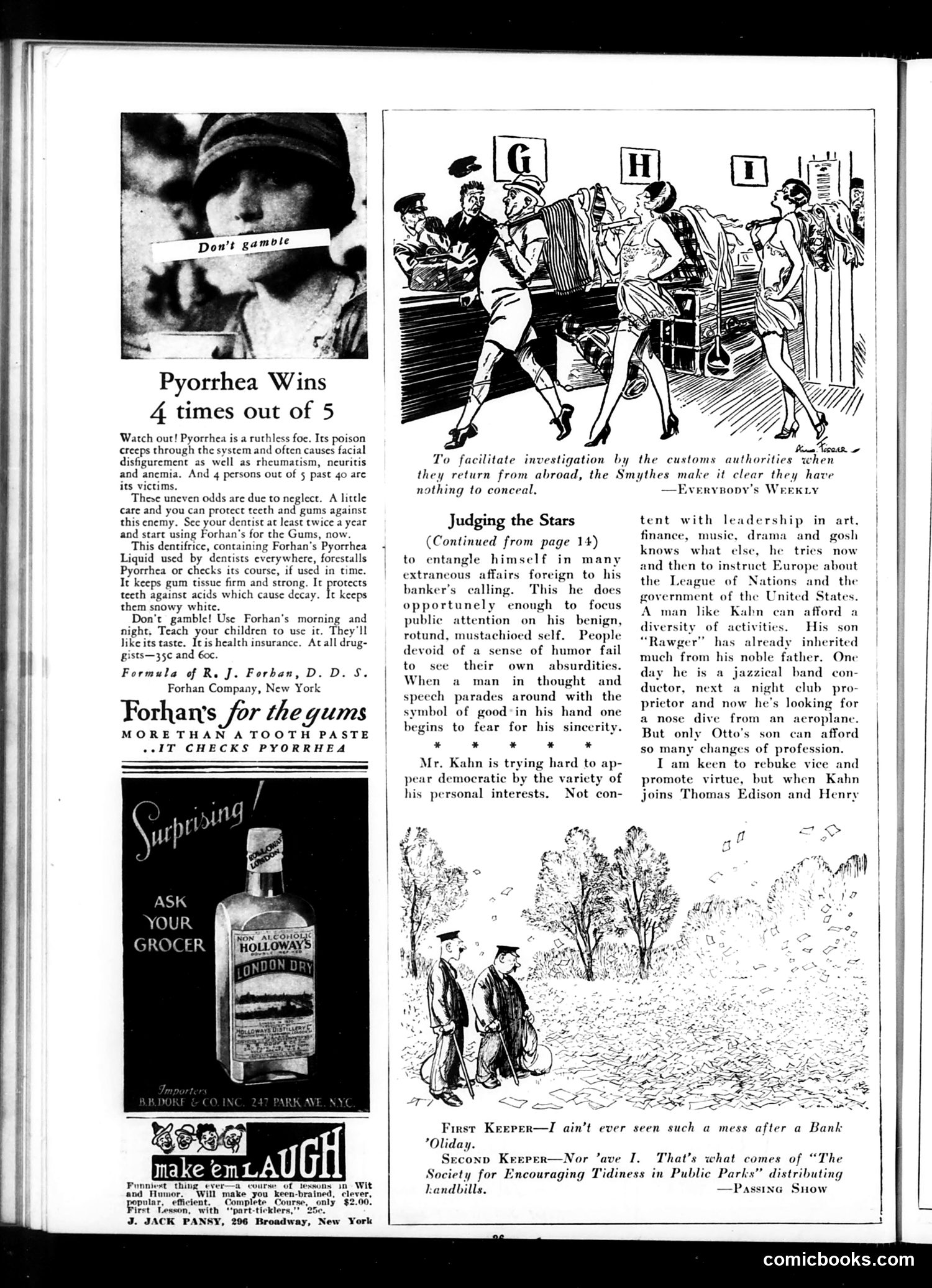
This page contains three distinct items: **Left side:** Advertisements for Forhan's toothpaste (targeting pyorrhea/gum disease) and a "make 'em LAUGH" comedy course. **Right side cartoon:** Titled "Judging the Stars," this appears to be a continuation of a column about prominent wealthy figures. The text critiques a banker (likely Otto Kahn, explicitly named) for using charitable and cultural patronage—art, music, drama, the League of Nations—as a cover for self-promotion and social climbing. The satirist suggests Kahn's ostentatious "good works" mask insincerity. His son is mocked as a dilettante, jumping between careers (jazz conductor, nightclub manager, aviator) only because wealth allows it. **Bottom cartoon:** A simple joke about bank failures and their messy aftermath. Two keepers discuss disorder following a "Bank Holiday" (likely referencing 1933 bank closures), attributing the chaos to a "Society for Encouraging Tidiness in Public Parks"—absurdist humor about bureaucratic ineffectiveness.
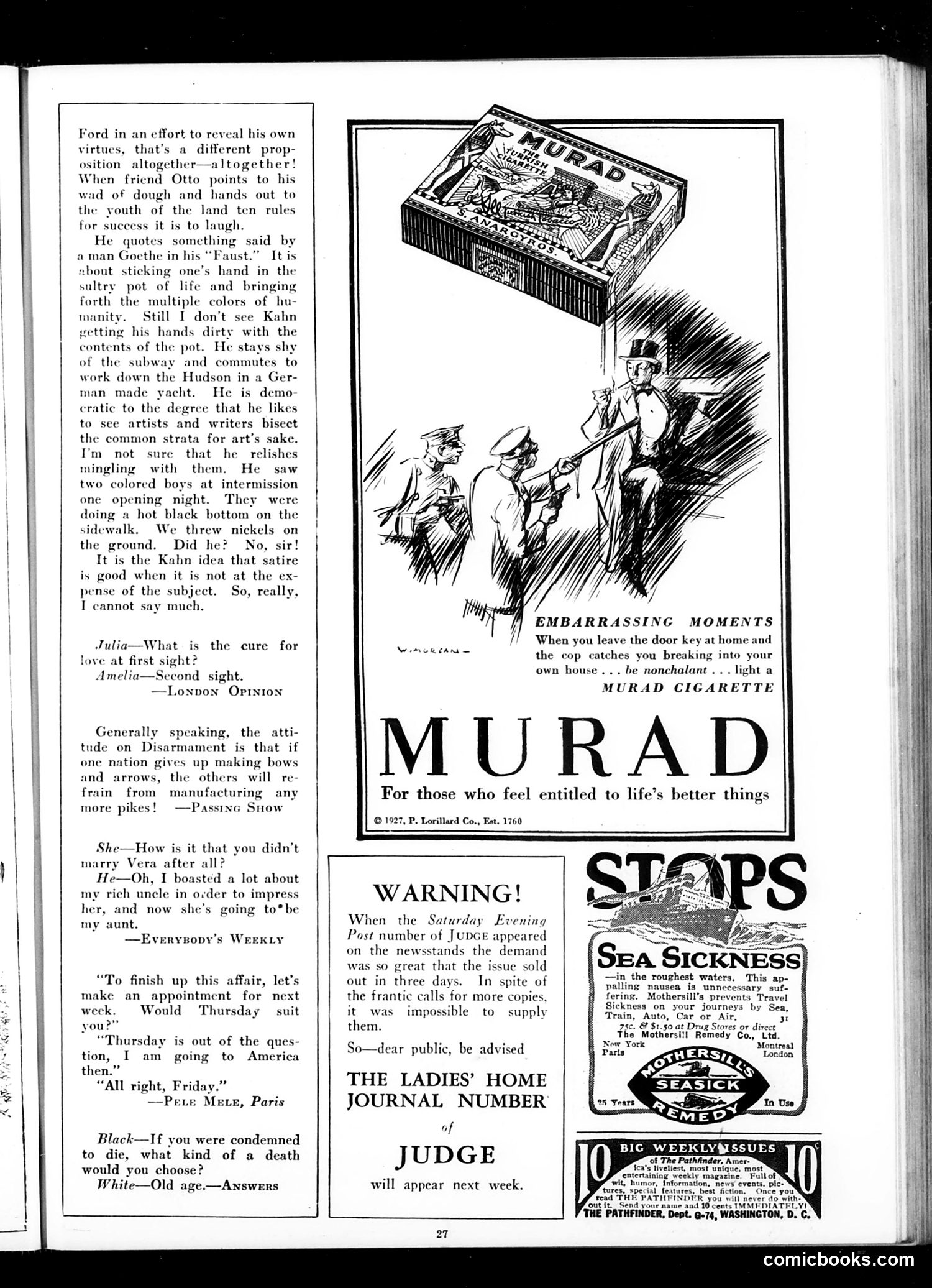
This page contains miscellaneous satirical content typical of Judge magazine. The main cartoon (upper right) depicts "Embarrassing Moments"—a man caught breaking into his own house by a police officer, with the caption suggesting he should remain calm and smoke a Murad cigarette. This is humorous social satire playing on the awkwardness of the situation. The left column features witty one-liners and brief satirical pieces mocking various subjects: Otto Kahn (likely the wealthy industrialist/arts patron) for his hypocrisy—preaching humanitarian virtues while remaining aloof from common people; disarmament talks as naive; and other light social commentary. The advertisements (Murad cigarettes, Mothersill's seasickness remedy, and The Pathfinder magazine) are period-typical products. A warning announces that Judge's Ladies' Home Journal parody issue sold out in three days, indicating the magazine's popularity circa 1927. The humor relies on recognizing contemporary figures (Kahn) and understanding 1920s social pretensions and anxieties.
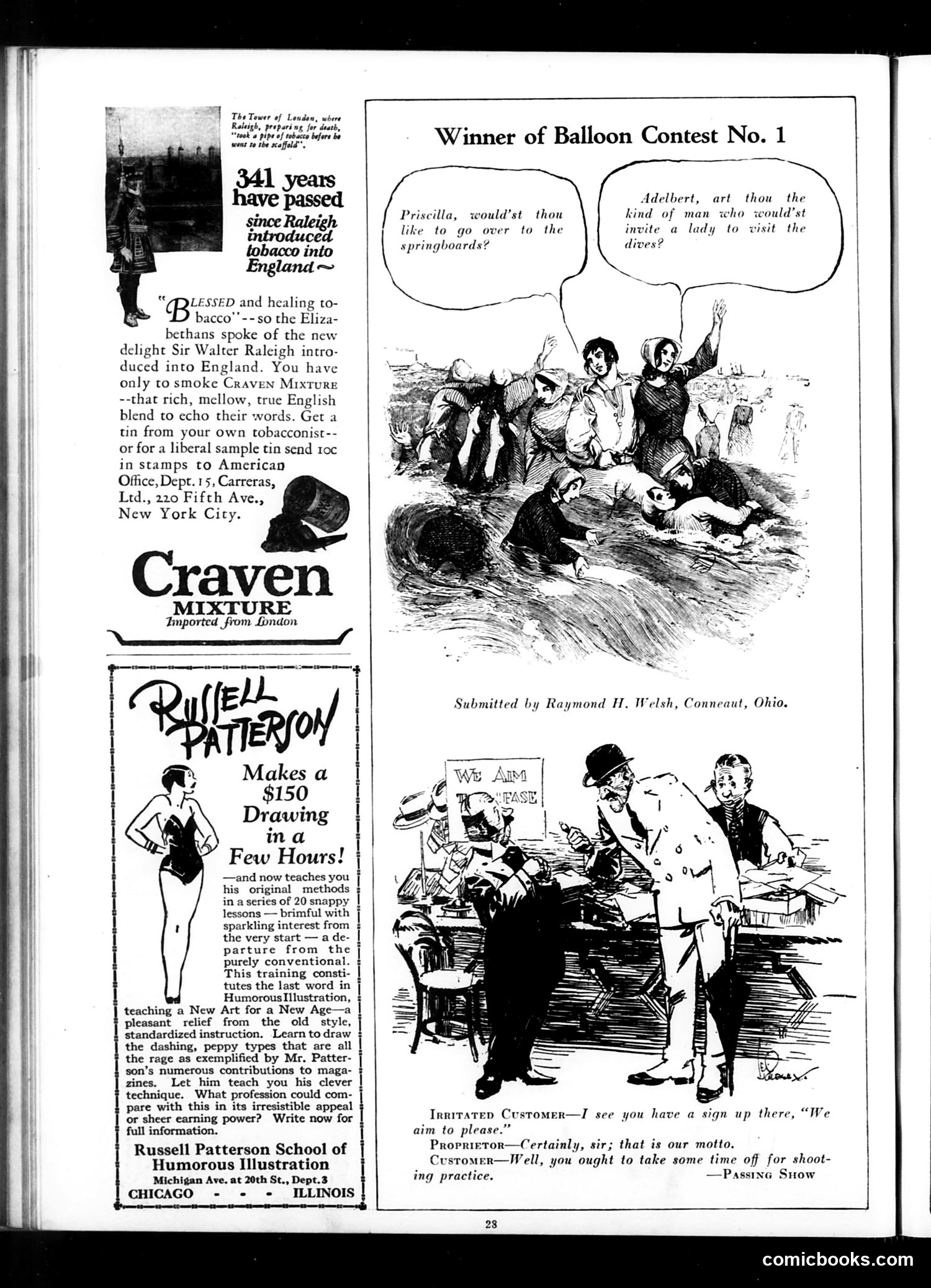
This page contains three distinct elements: **Top Left:** A tobacco advertisement referencing Sir Walter Raleigh's historical introduction of tobacco to England 341 years prior. It romanticizes smoking as an "Elizabethan delight," using period language to market Craven Mixture tobacco imported from London. **Center:** A cartoon titled "Winner of Balloon Contest No. 1" showing people at what appears to be a swimming or diving area. The dialogue uses archaic speech ("would'st thou") to create gentle humor about social awkwardness—a man inviting a woman to dive. **Bottom Right:** A brief joke about customer service, where a customer sarcastically suggests a shop owner needs shooting practice rather than aiming to please customers—a play on the phrase "aim to please." **Bottom Left:** Advertisement for Russell Patterson's School of Humorous Illustration, promoting cartooning lessons and Patterson's modern "peppy" drawing style. The page is primarily advertising-driven, with modest cartoon humor typical of Judge's satirical approach to everyday social situations.
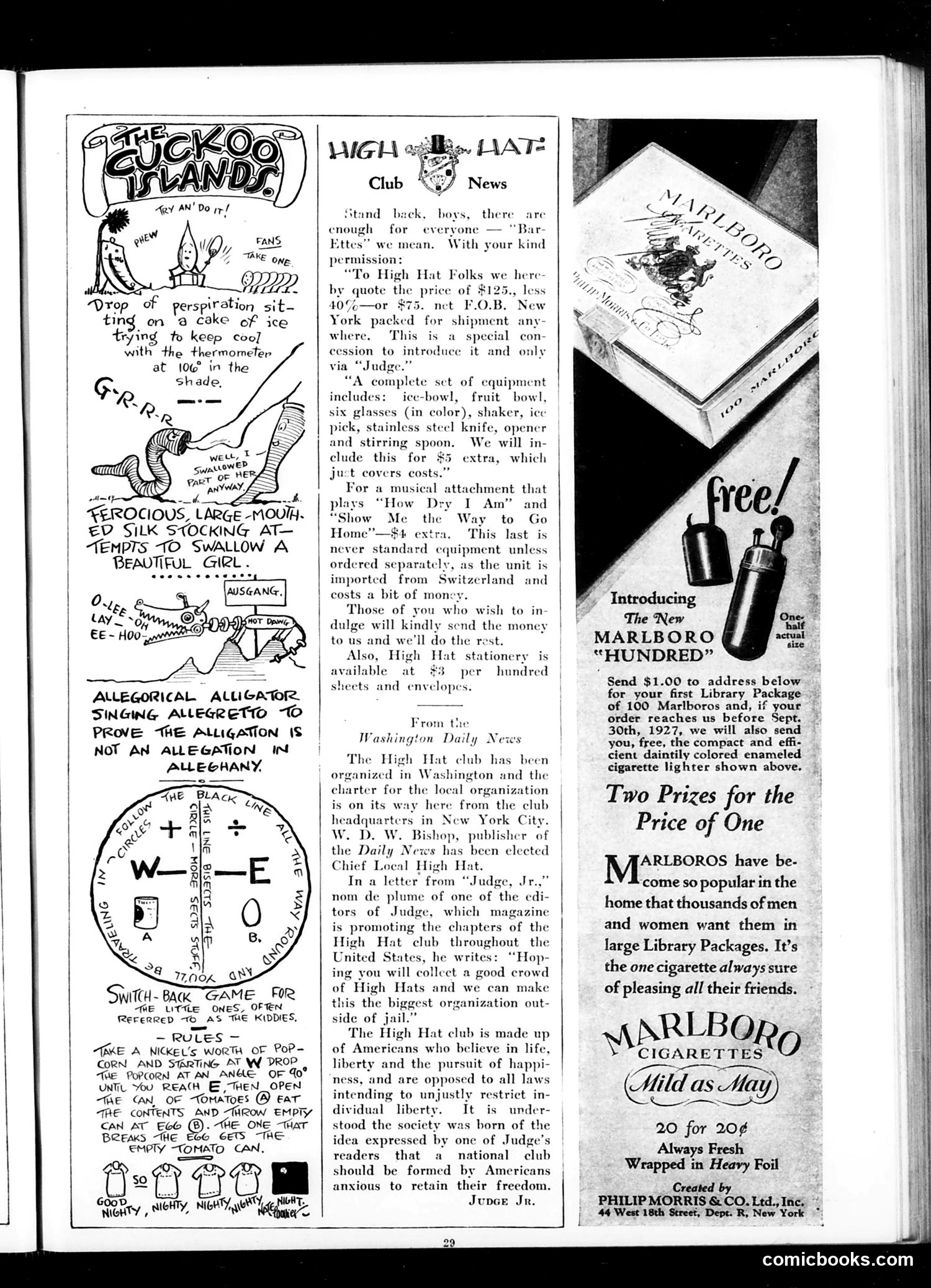
This page combines humor cartoons with club promotion and cigarette advertising, circa 1927. **Left side cartoons:** Humorous sketches depicting summer heat discomfort (a perspiration drop on ice), an alligator attempting to swallow a woman in silk stockings, and children's games with popcorn and tomatoes. These are largely nonsensical visual gags typical of Judge's comedic style—no specific political reference. **Center text:** Promotes the "High Hat Club," a real organization founded to oppose Prohibition and defend individual liberty. The club sold cocktail equipment (ice bowls, shakers, glasses) by mail, circumventing alcohol restrictions. The $125 price (less 40% discount, F.O.B. New York) and Swiss-imported musical attachments suggest this targeted affluent readers. This directly satirizes Prohibition-era workarounds. **Right side:** Marlboro cigarette advertisement offering a "Library Package" of 100 cigarettes with a free enameled lighter—marketing to bulk buyers. The page exemplifies how Judge operated: anti-Prohibition satire mixed with consumer advertising appealing to the same libertarian-minded, relatively wealthy audience.
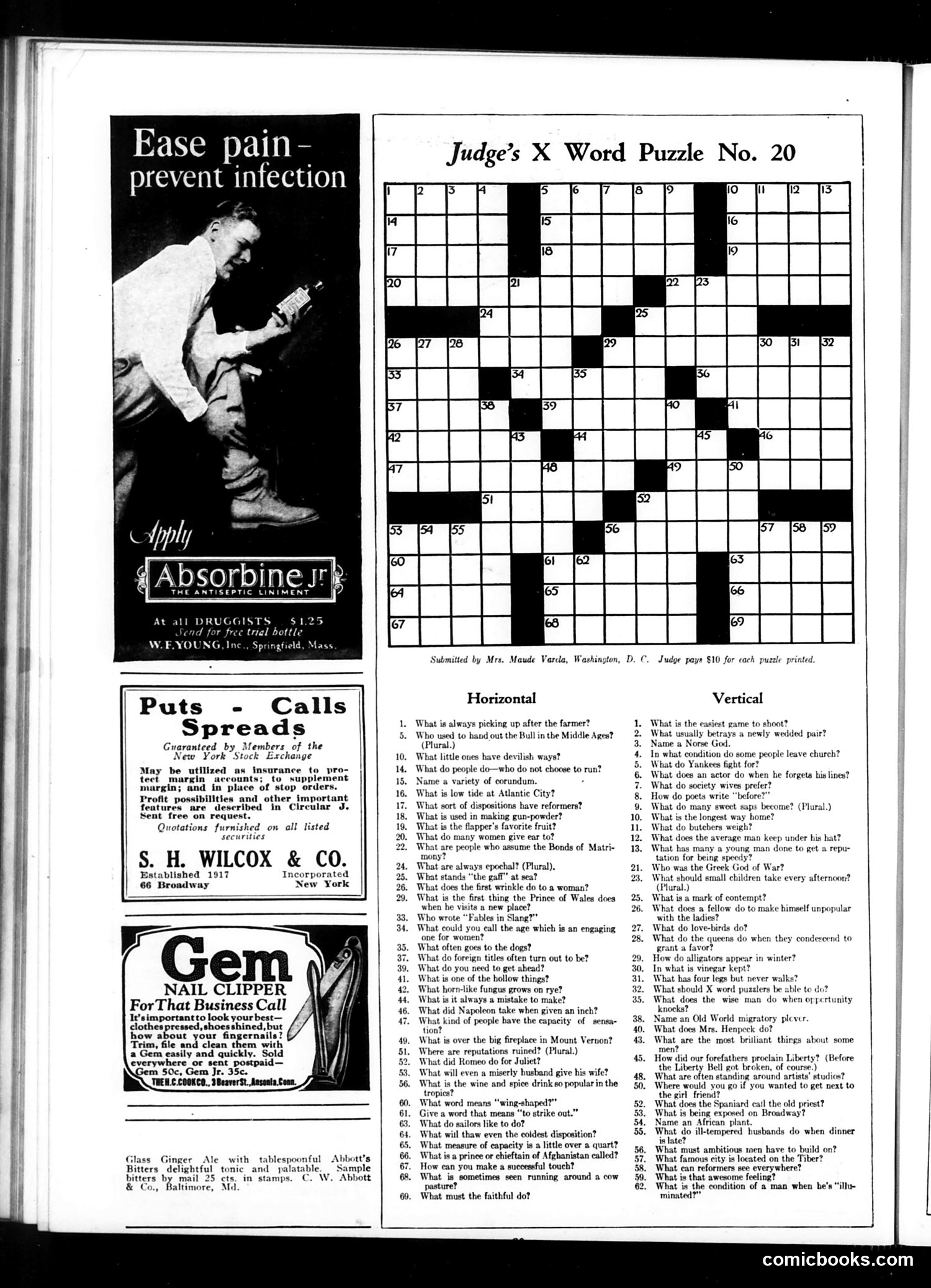
This page is primarily **advertisements and a crossword puzzle**, not satirical content. The ads include: - **Absorbine Jr.** (antiseptic liniment for pain/infection prevention) - **S. H. Wilcox & Co.** (stock market financial services, offering "Puts" and "Calls" spreads) - **Gem Nail Clipper** (grooming product) - Various patent medicines The centerpiece is **"Judge's X Word Puzzle No. 20,"** a crossword submitted by Mrs. Maude Vare of Washington, D.C., with $10 prize payment offered. The clues reflect typical 1920s-era references: the Prince of Wales, flappers, reformers, and period slang. This appears to be a **regular puzzle feature** in Judge magazine rather than satirical editorial content. The advertising reflects contemporary consumer products and financial services of the era, but contains no visible political satire or cartoon commentary on current events.
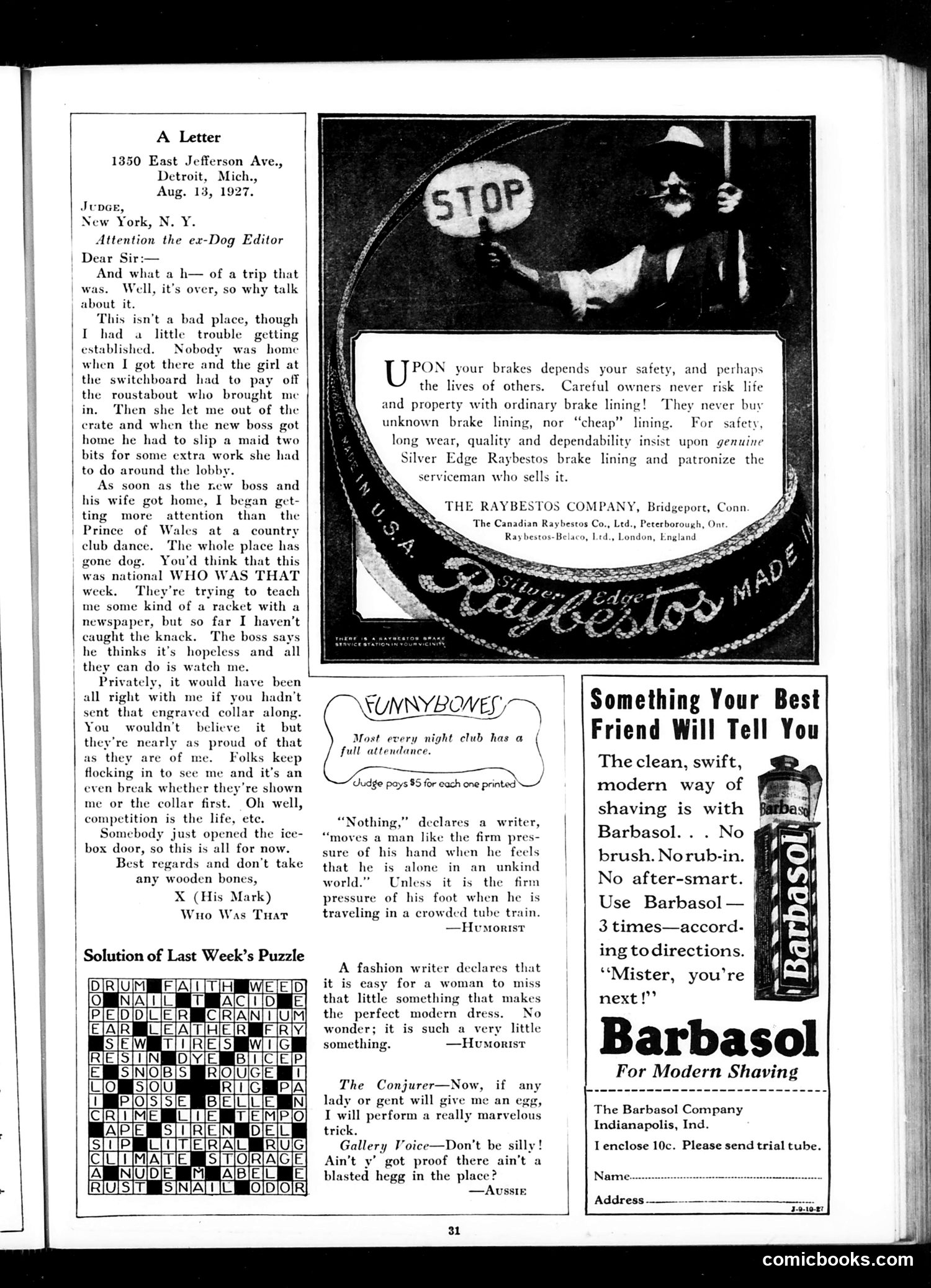
This page is primarily **a humorous letter to the editor**, not a political cartoon. The main content is a comic letter signed "X (His Mark)" — written from a dog's perspective after being relocated to Detroit. The joke involves the dog complaining about its chaotic arrival, the family's obsession with showing off both the dog and its engraved collar, and concluding that competition (being upstaged by the collar) is "the life." The page also contains: - A crossword puzzle solution - Several brief "Funny Bones" one-liners about modern life - **Advertisements** for Raybestos brake lining and Barbasol shaving cream The dog-letter is light social satire mocking suburban pretension and materialism—the family values the status symbol (the fancy collar) nearly as much as the pet itself. There are no identifiable political figures or significant historical references on this page.
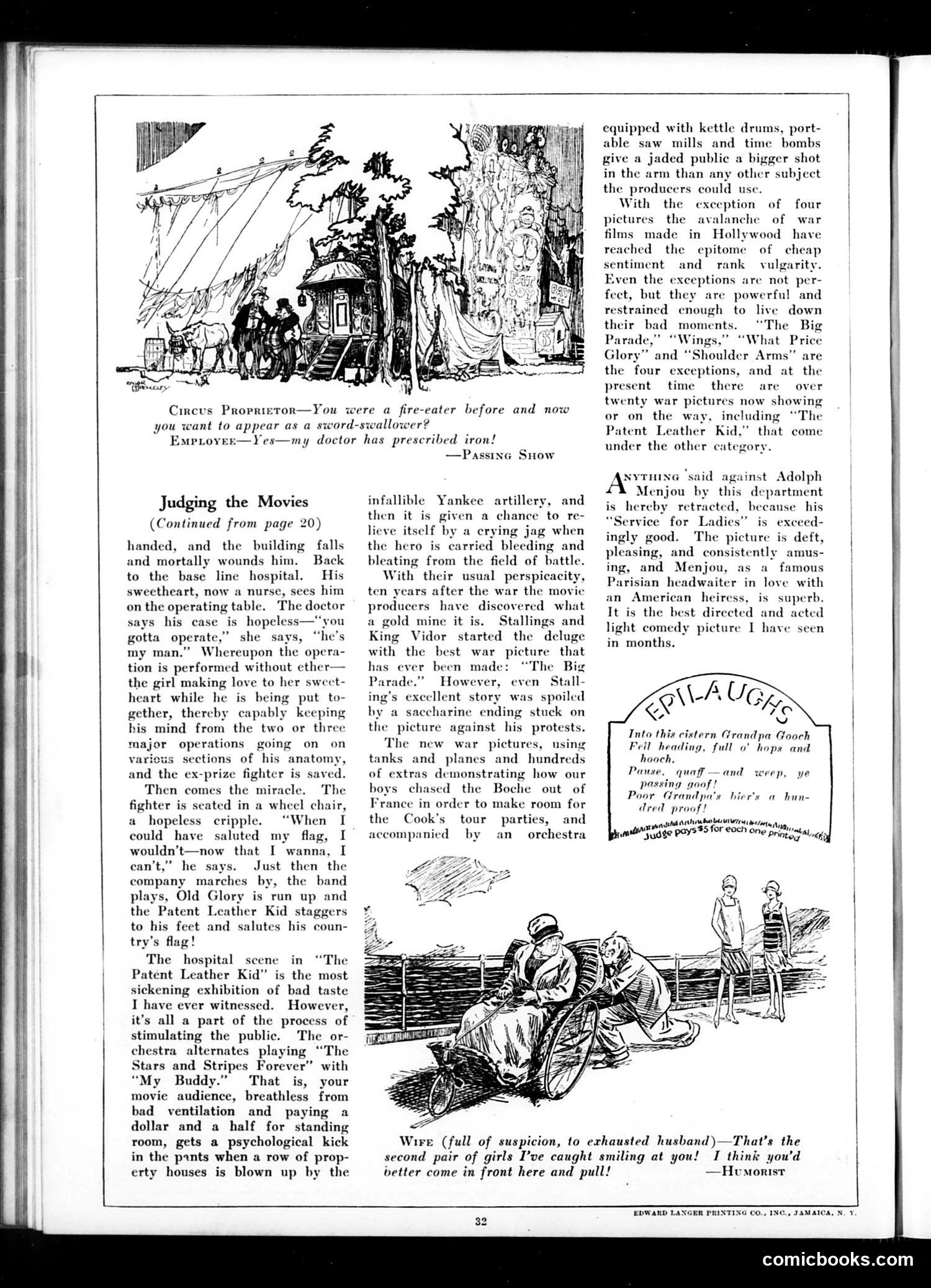
This page reviews contemporary war films and other Hollywood productions. The main article critiques "The Patent Leather Kid," a war film featuring an injured soldier-turned-cripple who miraculously stands to salute the flag—criticized as emotionally manipulative melodrama using patriotic imagery and orchestral accompaniment (martial music mixed with "My Buddy") to exploit audiences. The critic praises genuinely excellent war films like "The Big Parade," "Wings," and "Shoulder Arms" but condemns the proliferation of inferior war pictures churned out by Hollywood producers capitalizing on post-WWI sentiment. The article argues these films use sensational combat footage (tanks, planes, extras) and saccharine emotional manipulation rather than authentic storytelling. The cartoons below—a circus scene and a couple's beach encounter—are unrelated comic vignettes typical of Judge's satirical content, using visual humor and witty captions for general amusement.
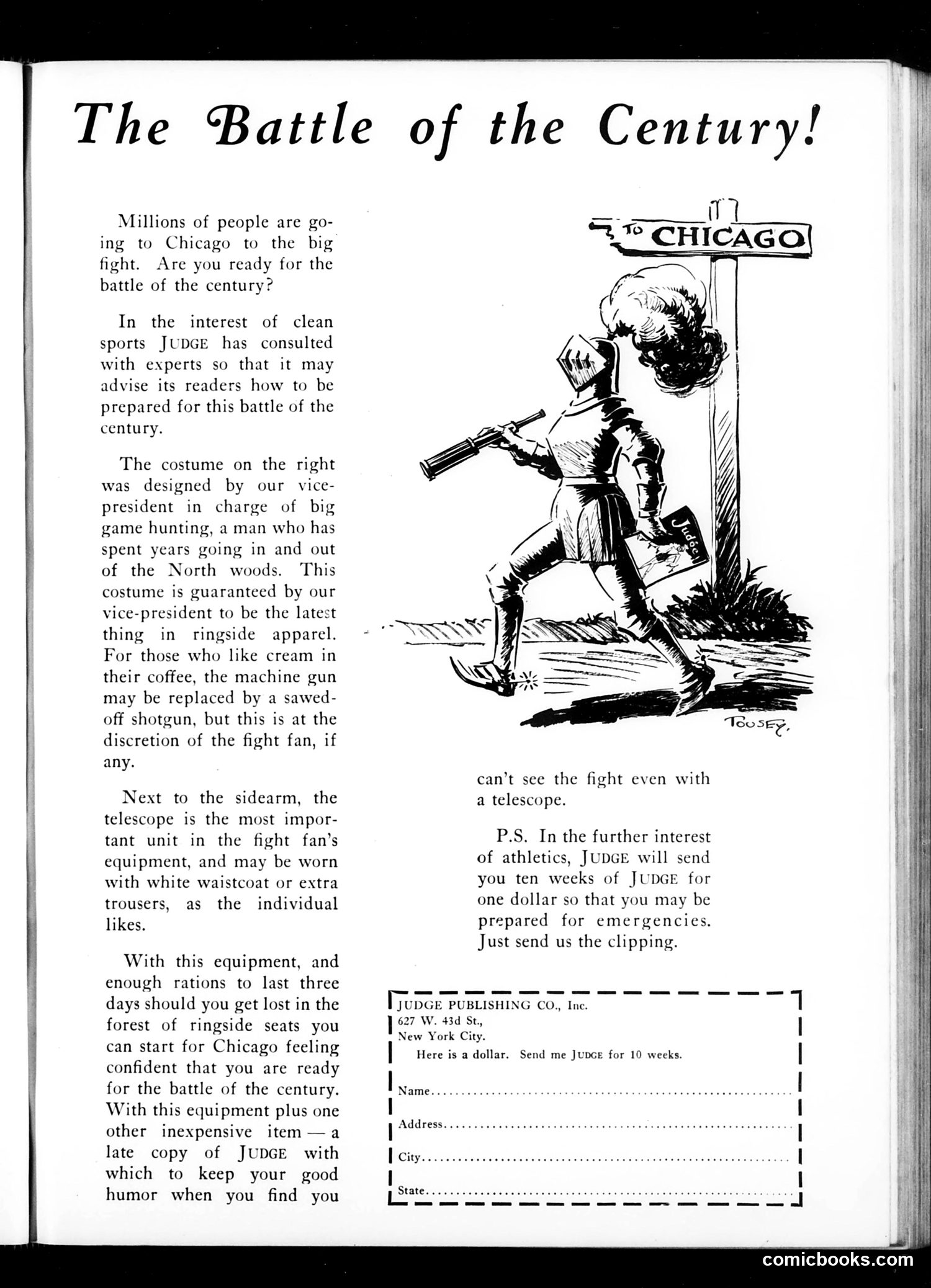
This page satirizes the massive public excitement surrounding a major boxing match coming to Chicago (likely the 1920s era, based on style). Judge mocks the event's hype by presenting absurdly excessive "preparation" advice for attending ringside. The humor targets several things: overcrowded venues so packed that spectators can't actually see the fight even with telescopes; the circus-like atmosphere treating the event as warfare requiring military gear (machine guns, shotguns, three-day rations); and the broader American tendency toward hype and commercialism around sports. The illustration shows a figure in hunting/combat attire with weapons and binoculars—ridiculing both the macho posturing around boxing and the impracticality of attending such a crowded event. The closing joke—that readers need Judge magazine to "keep your good humor when you find you can't see the fight"—underscores the satire: the real spectacle is the crowd, not the boxing match itself.
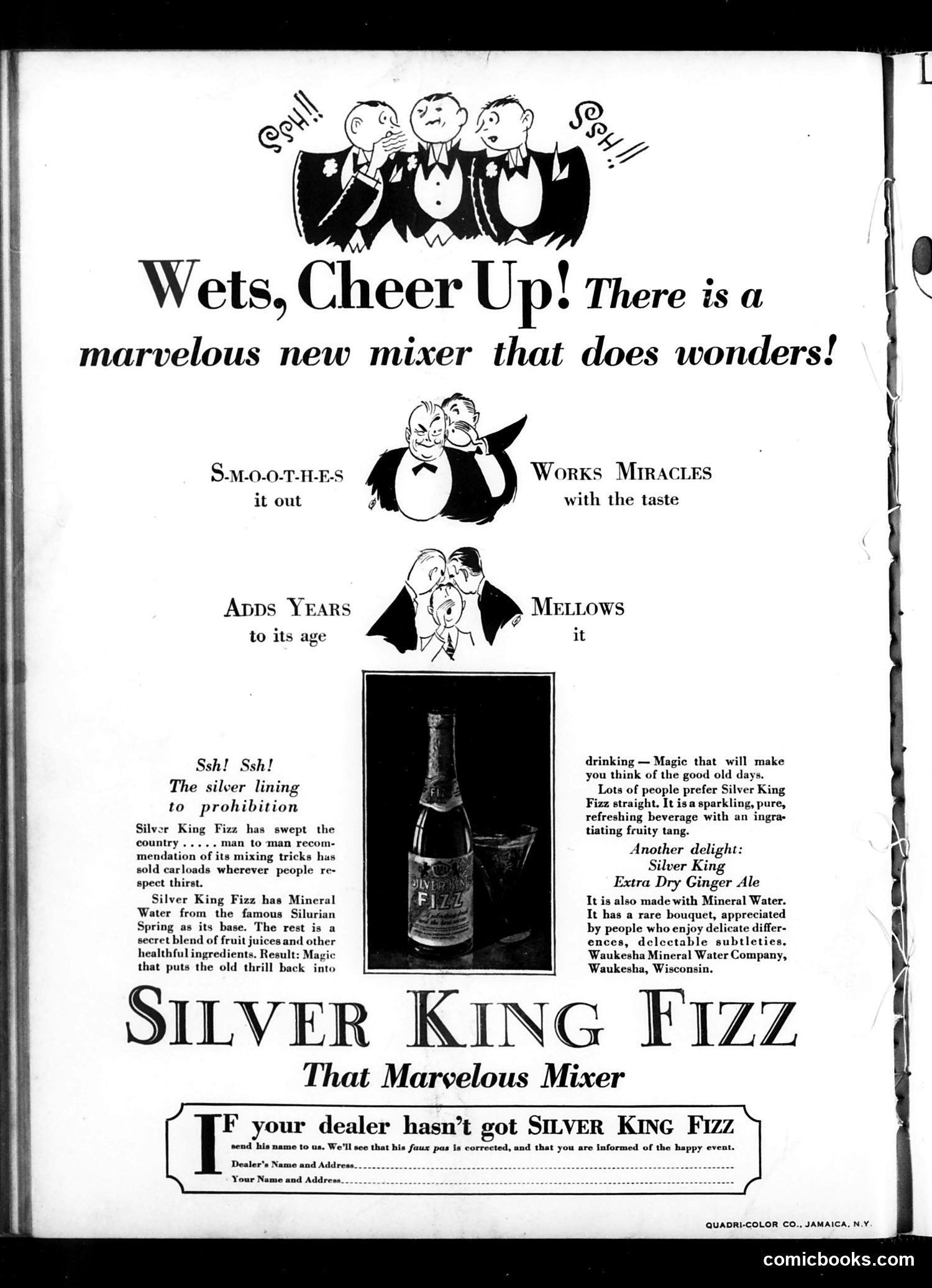
This is a **Prohibition-era advertisement** (likely 1920s-early 1930s) for a non-alcoholic mixer. The opening cartoon shows three men in formal wear saying "Gosh!" and "Sh!" — expressing relief and secrecy, referencing the illegal drinking culture during Prohibition. The ad's central joke plays on "the silver lining to prohibition": since alcohol was banned, people sought creative alternatives. Silver King Fizz positioned itself as a sophisticated "mixer" that could replace actual cocktails, using mineral water and fruit juices to evoke "the good old days" of drinking before Prohibition. The rhyming descriptors ("S-M-O-O-T-H-E-S it out," "Works Miracles with the taste," "Mellows it") humorously suggest the product could somehow compensate for missing alcohol. The ad openly acknowledges Prohibition while winking at customers' nostalgia for legal drinking, making it an artifact of American drinking culture during a unique regulatory moment.