
Judge, 1927-09-10 · page 20 of 36
Judge — September 10, 1927 — page 20: what you’re looking at
What you’re looking at
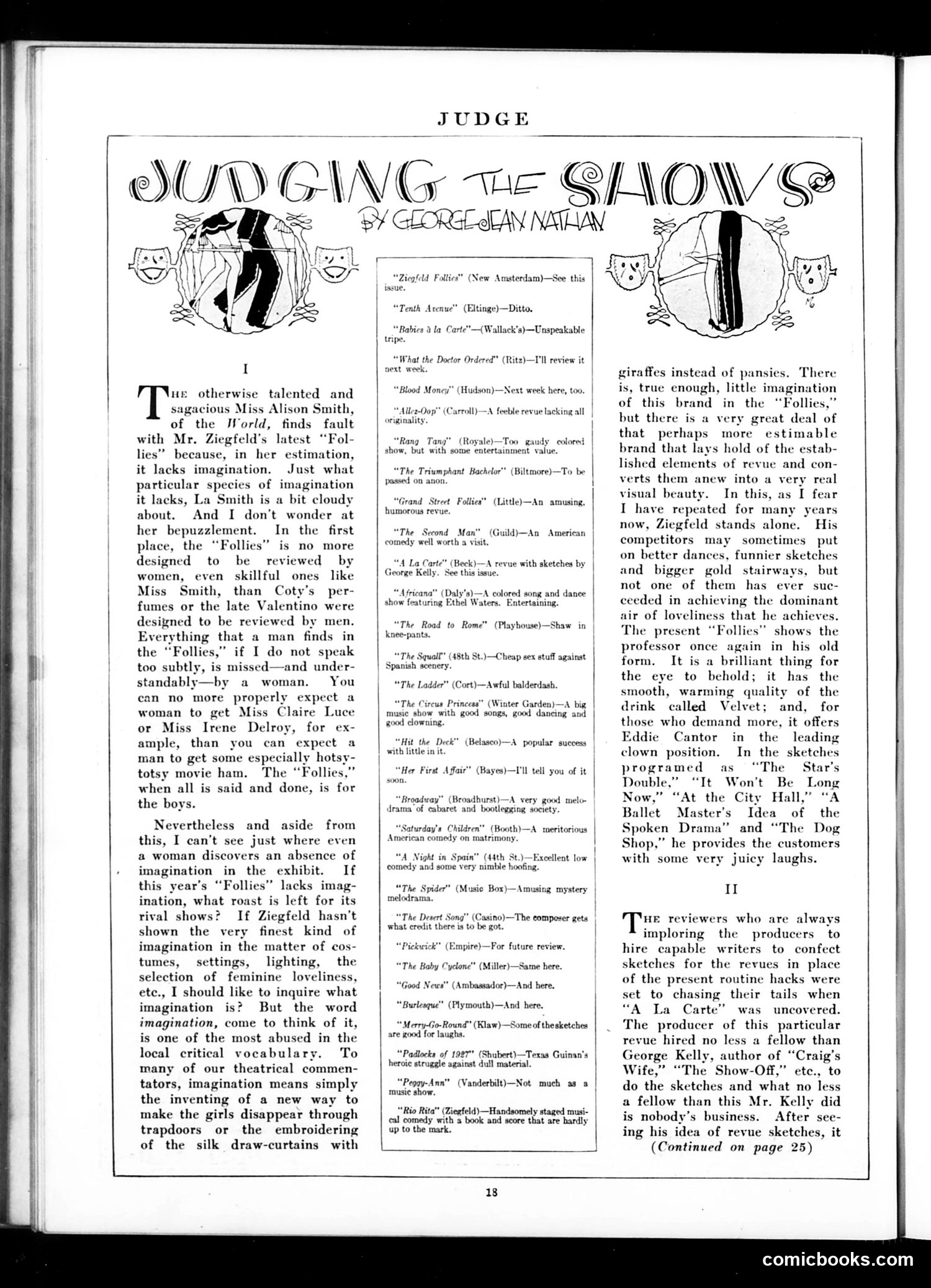
This is a theater review column by George Jean Nathan critiquing Broadway shows, particularly addressing a critic named Alison Smith of *the World* newspaper who faulted Florenz Ziegfeld's latest "Follies" revue for lacking imagination. Nathan argues Smith's critique is fundamentally misguided: the "Follies" isn't designed for women reviewers anyway—it's male entertainment featuring attractive women, dancing, and spectacle. He contends that even if it lacked imagination, competitors haven't done better. He satirizes the abuse of the word "imagination" in theater criticism, suggesting critics mistake mere technical novelty (girls disappearing through trapdoors, decorated curtains) for genuine creativity. The accompanying list reviews current Broadway productions, using Nathan's sardonic voice to assess shows like *Rio Rita*, *The Ladder*, and *Africana*.
📄 Transcribed text from this page (OCR, searchable)
Machine-transcribed from the original scan — historical spelling and the odd misread are preserved.
\ GI He otherwise talented and agacious Miss Alison Smith, of the World, finds fault with Mr. Ziegfeld’s latest ‘Fol- lies” because, in her estimation, it lacks imagination. Just what particular species of imagination it lacks, La Smith is a bit cloudy about. And I don’t wonder at her bepuzzlement. In the first place, the “Follies” is no more designed to be reviewed by women, even skillful ones like Miss Smith, than Cot per- fumes or the late Valentino were designed to be reviewed by men. Everything that a man finds in the “Follies,” if I do not speak too subtly, is missed standably—by a woman. can no more properly expect woman to get Miss Claire Luc or Miss Irene Delroy, for ex- ample, than you can expect man to get some especially hots3 totsy movie ham. The “Follies, when all is said and done, is for the boys. Nevertheless and aside from this, I can’t see just where even a woman discovers an absence of imagination in the exhibit. If this year’s “Follies” lacks imag- ination, what roast is left for its rival shows? If Ziegfeld hasn't shown the very finest kind of imagination in the matter of cos- tumes, settings, lighting, selection of feminine loveli ete., I should like to inquire what imagination is? But the word imagination, come to think of it, is one of the most abused in the local critical vocabulary. To many of our theatrical commen- tators, imagination means simply the inventing of a new way to make the girls disappear through trapdoors or the embroidering of the silk draw-curtains with JUDGE gfrld Follies” (New Amsterdam)—See this | issue “Tenth Avenue” (Eltinge)—Ditto. “Babies la Carte"—{Wallack’s)—Unspeakable What the Doctor Ordered” (Rite! next week. "Il review it “Blood Money"* (Hudson)—Next week here, too. *Allea-Oop" (Carroll) —A feeble revue lacking all originality “Rang Tang” (Roys colored show, but with some e. “The Triumphant Bachelor" (Biltmore)—To be passed on anon. “Grand Street Follies (Little)—An amusing, humorous revue “The Second Man (Guild)—An American comedy well worth a visit, “4 La Carte” (Beck)—A revue with sketches by George Kelly. See this issue. “Africana” (Daly's)—A colored song and danee show featuring Ethel Waters. Entertaining. “The Road to Rome” (Playhouse)—Shaw in knee-pants. “The Squall” (48th St.) —Cheap sex stuff against | Spanish scenery. “The Ladder” (Cort)—Awful balderdash. “The Circus Princess” (Winter Garden)—A big | music show with good songs, good dancing and good clowning. “Hit the Deck” (Belasco)—A popular success with little in it. “Her First Affair” (Bayes)—I'll tell you of it “Broadway” (Broadhurst)—A very good n drama’ of cabaret and bootlegging society. Yurday’s Children” (Booth)—A meritorious American comedy on matrimony. “A Night in Spain" (44th St.) —Exeellent low comedy and some very nimble hoofing. “The Spider” (Music Box)—Amusing mystery melodrama. “The Desert Song” (Casino)—The eomposer gets what credit there is to be got. ‘ckwick”” (Empire)—For future review. “The Baby Cyclone” (Miller)—Same here. “Good News (Ambassador)—And here. “Burleaque" (Plymouth)—And here, “Merry-Go-Round” (Klaw)—Some of thesketches are good for laughs. “Padlocks of 1927" (Shubert)—Texas Guinan's heroic struggle against dull material. “Pegay-Ann” (Vanderbilt)—Not much as a | music show. “Rio Rita” (Ziegfeld) —Handsomely staged musi- cal comedy with a book and score that are hardly: up to the mark. NG ae SHOW Se $Y ‘ GEORGETAN NATHAN giraffes instead of pansies. There is, true enough, little imagination of this brand in the ollies,” but there is a very great deal of that perhaps more estimable brand that lays hold of the estab- lished elements of revue and con- verts them anew into a very real visual b In th as I fear I have repeated for many years now, Ziegfeld stands alone. His competitors may sometimes put on better dances, funnier sketches and bigger gold stairways, but not one of them has ever suc- ceeded in achieving the dominant air of loveliness that he achieves. The present “Follies” shows the professor once again in his old form. It is a brilliant thing for the eye to behold; it has the smooth, warming quality of the drink called Velvet; and, for those who demand more, it offers Eddie Cantor in the leading clown position. In the sketche programed as “The Star's Double,” “It Won't Be Long Now,” “At the City Hall,” “A Ballet Master's Idea of the Spoken Dra ’ and “The Dog Shop,” he provides the customers with some very juicy laughs. II HE reviewers who are always imploring the producers to hire capable writers to confect sketches for the revues in place of the present routine hacks were set to chasing their tails when “A La Carte” was uncovered. The producer of this particular revue hired no less a fellow than George Kelly, author of “Craig’s Wife,” “The Show-Off,” ete., to do the skete! and what no less a fellow than this Mr. Kelly did is nobody’s busines After see- ing his idea of revue sketches, it (Continued on page 25) comicbooks.com