
Judge, 1927-09-10 · page 15 of 36
Judge — September 10, 1927 — page 15: what you’re looking at
What you’re looking at
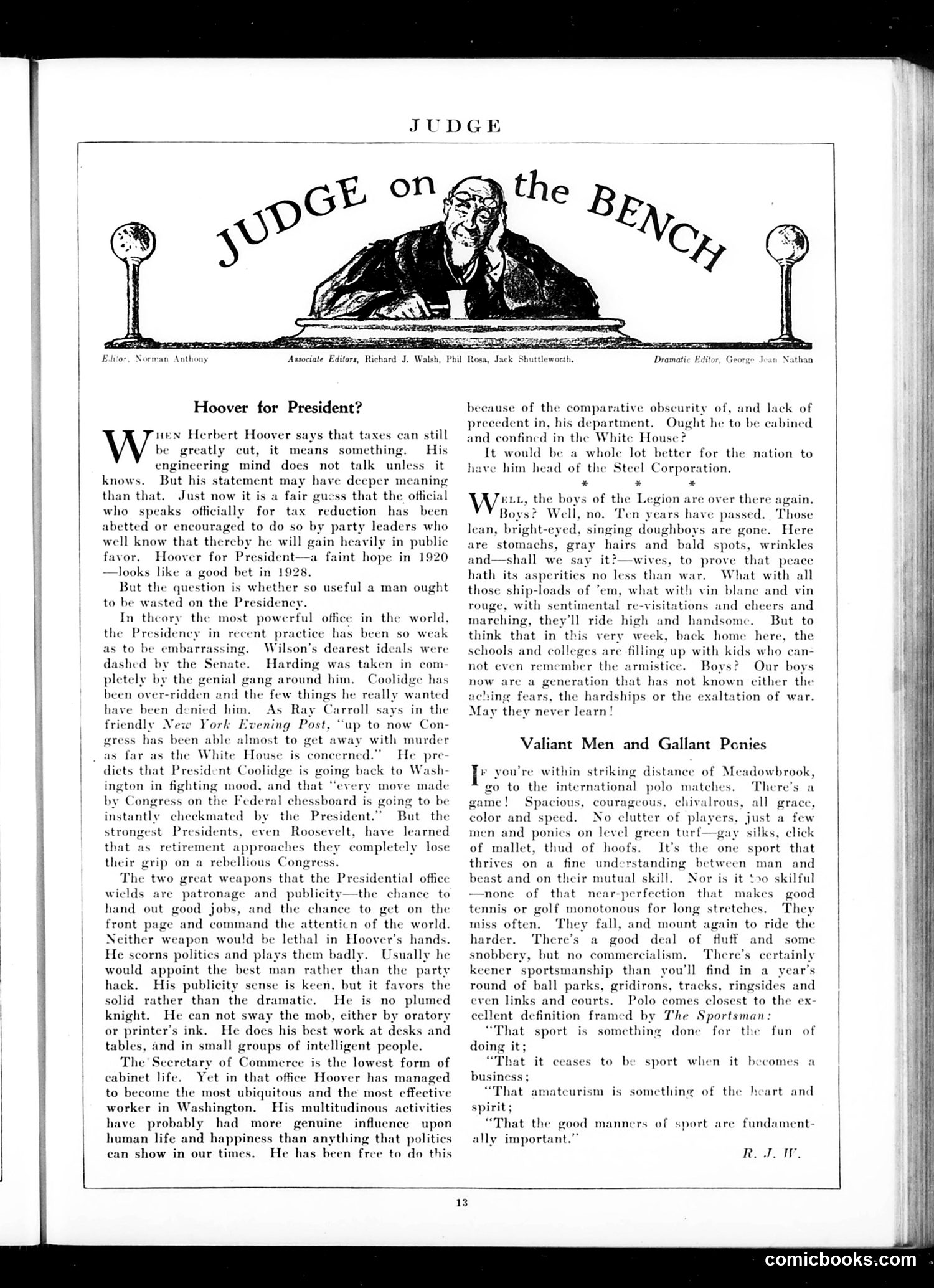
**Main Article: "Hoover for President?"** The editorial debates whether Herbert Hoover, currently Secretary of Commerce, should run for president in 1928. The author argues *against* this, contending that while the presidency is theoretically powerful, it has become weakened by Congress (citing how Harding and Coolidge were undermined). Hoover's strength lies in his unglamorous, behind-the-scenes competence—best exemplified by his effective work at Commerce. The satire suggests that elevating him to the presidency would actually diminish his influence, as the office now grants less real power than his current position. **Secondary Item: Legion Veterans** A brief, melancholic piece notes that American Legion members returning from Europe are no longer the young "doughboys" of World War I (10 years prior). They now show age and family responsibilities. The author laments that a new generation of schoolchildren "has not known either the suffering fears, the hardships or the exaltation of war," hoping they never will—a poignant contrast to the aging veterans.
📄 Transcribed text from this page (OCR, searchable)
Machine-transcribed from the original scan — historical spelling and the odd misread are preserved.
Hoover for President? ys that taxes can still en Herbert Hoover s be greatly cut, it means something. His engineering mind does not talk unless. it But his statement may have deeper meaning than that. Just now it is a fair guess that the. offic who speaks officially for tax reduction has been abetted or encouraged to do so by party leaders who well know that thereby he will avily in public favor. Hoover for President—a faint hope in 1920 —looks like a good bet in 1928. knows. But the question is whether so useful a man ought to be wasted on the Presidency. In theory the most powerful office in the world, ak the Presidency in recent practice has been so wi as to be embarrassing dashed by the Se: Harding was taken in com- pletely by the genial gang around him. Coolidge has been over-ridden and the few things he really wanted have been denied him. As Ray Carroll says in the friendly » York Evening Post, “up to now Con- gress has been able almost to get away with murder as far as the White House is concerned.” He pre dicts that President Coolidge is k to Wash ington in fighting mood, and that “every move made by Congress on the Federal chessboard is going to be instantly checkmated by the President.” But the est’ Presidents, even Roosevelt, have learned retirement approa Wilson’s dearest ideals w “ 1es they completely lose their grip on a rebellious Congress. The two great weapons that the Presidential office wields are patronage and publicity—the chance to hand out good jobs, and the chance to get on the front page and command the attenticn of the world. Neither weapon would be lethal in Hoover's hands. He scorns politics and plays them badly. Usually he would appoint the best man rather than the party hack. His publicity sense is keen, but it favors the solid rather than the dramatic. He is no plumed knight. He can not sway the mob, either by oratory or printer’s ink. He does his best work at desks and tables, and in small groups of intelligent people. he Secretary of Commerce is the lowest form of cabinet life. Yet in that office Hoover has managed to become the most ubiquitous and the most effective worker in Washington. His multitudinous activities have probably had more genuine influence upon human life and happiness than anything that politics can show in our times. He has been free to do this JUDGE because of the comparative obscurity of, and lack of precedent in, his department. Ought he to be cabined and confined in the White House? It would be a whole lot better for the nation to ave him head of the Steel Corporation. * * * W: Li, the boys of the Legion are over there again. Boys? Well, no. Ten years have passed. Those lean, bright-eyed, singing doughboys are gone. Here are stomachs, gray hairs and bald spots, wrinkles and—shall we say it?—wives, to prove that peace hath its asperit What with all those ship-loads of ’em, what with vin blane and vin rouge, with sentimental re-visitations and cheers and marching, they'll ride high and handsome. But to think that in this very week, back home here, the schools and colleges are filling up with kids who can- member the armistice. Boys? Our boys generation that has not known cither the ng fears, the hardships or the exaltation of war. May they never learn! »s no less than war. not even Valiant Men and Gallant Ponies you're within striking distance of Meadowbrook, go to the international polo matches. There's a game! Spacious, courageous. chivalrous, all grace, No clutter of players, just a few men and ponies on level green turf—gay silks, click of mallet, thud of hoofs. It’s the one sport that thrives on a fine understanding between man and beast and on their mutual skill. Nor is it to skilful —none of that near-perfection that makes good tennis or golf monotonous for long stretches. They miss often. They fall, and mount again to ride the There’s a good deal of fluff and some snobbery, but no commercialism. color and speed. harder. There's. certainly keener sportsmanship than you'll find in a y round of ball parks, gridirons, tracks, ringsides even links and courts. Polo comes closest to the cellent definition framed by The Sportsman: “That sport is something done for the fun of doing it; “That it ceases to be sport when it becomes a business ; “That amateurism is something of the heart and spirit; “That the good manners of sport are fundament- ally important.” Rh. J. W. comicbooks.com