
A complete issue · 36 pages · 1927
Judge — August 27, 1927
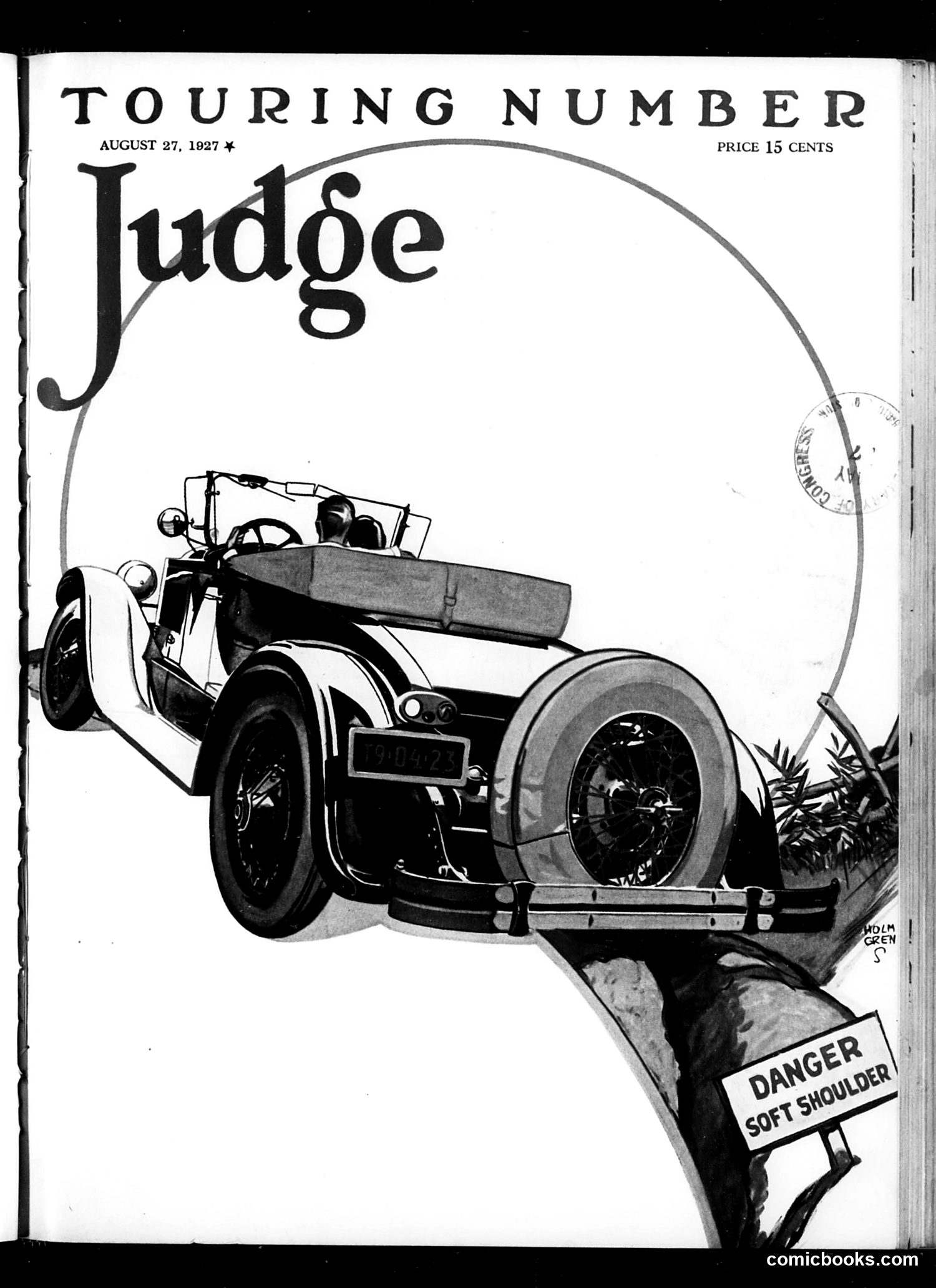
This is a **touring number** (special issue) featuring an automobile advertisement or cautionary illustration. The cover shows a vintage 1920s touring car loaded with luggage, positioned precariously on what appears to be a cliff edge or dangerous road shoulder. A spare tire hangs from the rear. The warning label "DANGER—SOFT SHOULDER" references both the literal road hazard and serves as double entendre about unsafe traveling conditions. This appears to be **safety-themed satire** common to the era, warning motorists about the dangers of poorly maintained roads or reckless driving during the automobile boom of the 1920s. The illustration critiques either dangerous driving habits or inadequate road infrastructure that made motoring hazardous for tourists exploring America's roads.
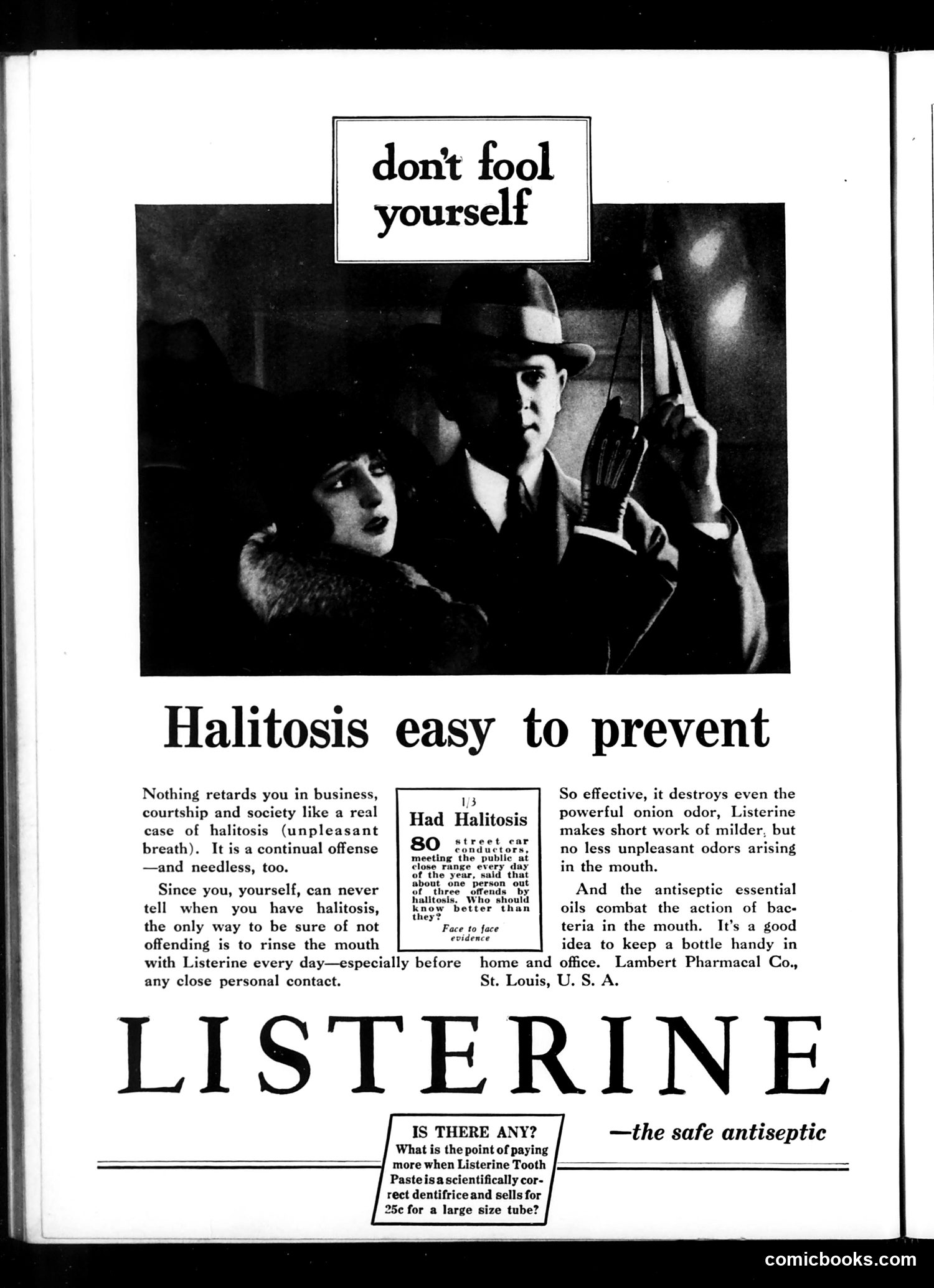
This is primarily a **Listerine advertisement**, not political satire. The page uses a melodramatic noir-style scene showing what appears to be three figures in dark clothing and hats—suggesting criminals or suspicious characters in a dramatic confrontation. The ad's central claim: halitosis (bad breath) damages business, courtship, and social standing. The tagline "don't fool yourself" warns that only daily Listerine use prevents this social catastrophe. The dramatic imagery is deliberate—the ad equates bad breath with criminality or moral failure, employing fear-based marketing common to early 20th-century advertising. The small text mentions halitosis surveys and positions Listerine's antiseptic properties against bacteria. This reflects period attitudes treating hygiene as a moral/social obligation, with advertising using shame as motivation.
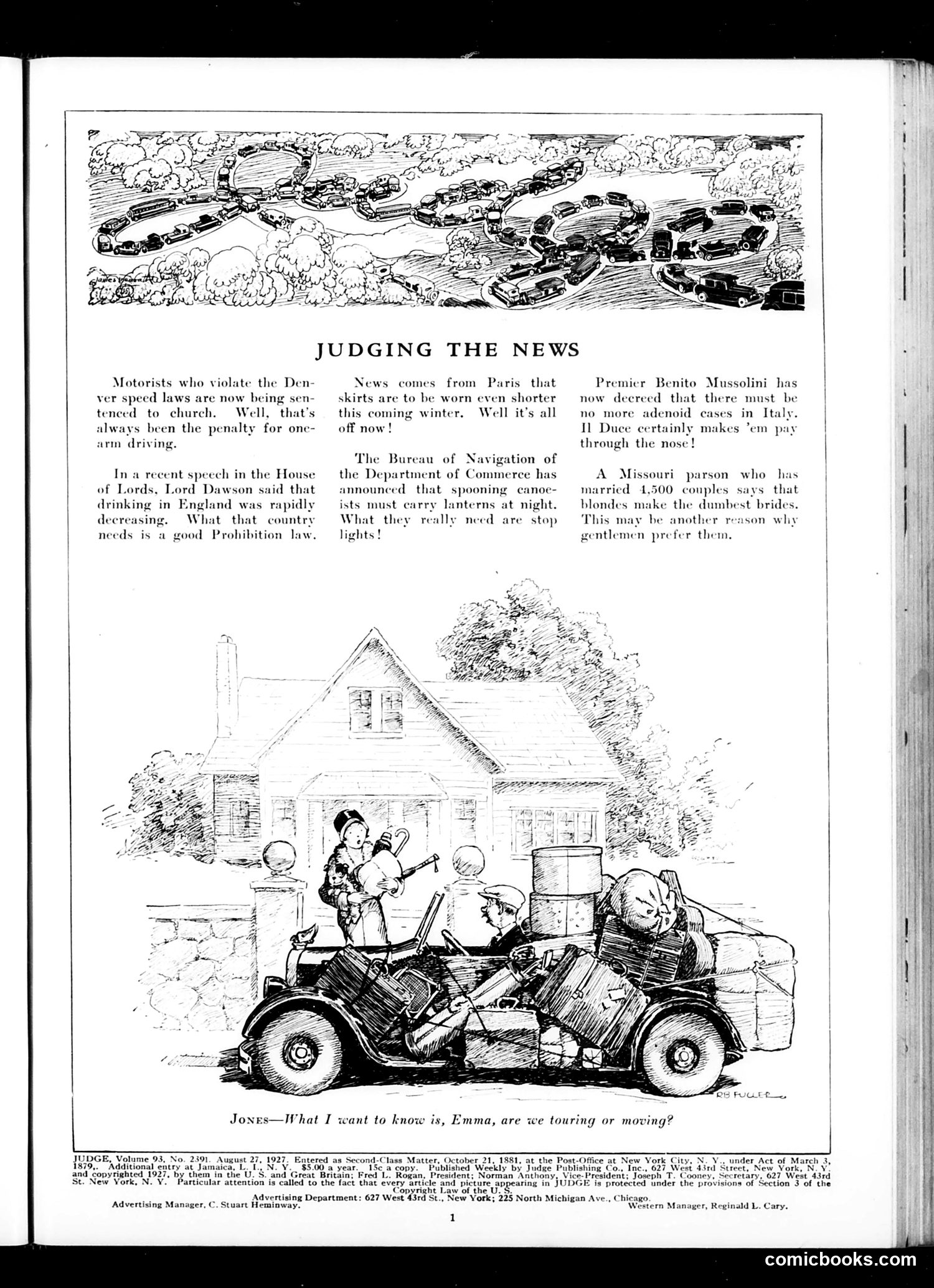
This page satirizes contemporary news items through brief commentary and a cartoon. The main cartoon depicts a family packed into an overloaded car, with Mr. Jones asking his wife "are we touring or moving?" — mocking the trend of Americans purchasing automobiles and cramming possessions into them for road trips, blending vacation with relocation. The text items mock: speeding motorists facing church penalties; declining drinking in England (presumably post-Prohibition); canoeists required to carry lanterns; Mussolini's decree against cologne in Italy; and blonde women marrying wealthy men. The overall theme celebrates automotive culture while poking fun at its excesses and the absurd regulatory responses it generates. The crowded car perfectly captures 1920s anxieties about rapid motorization's social consequences.
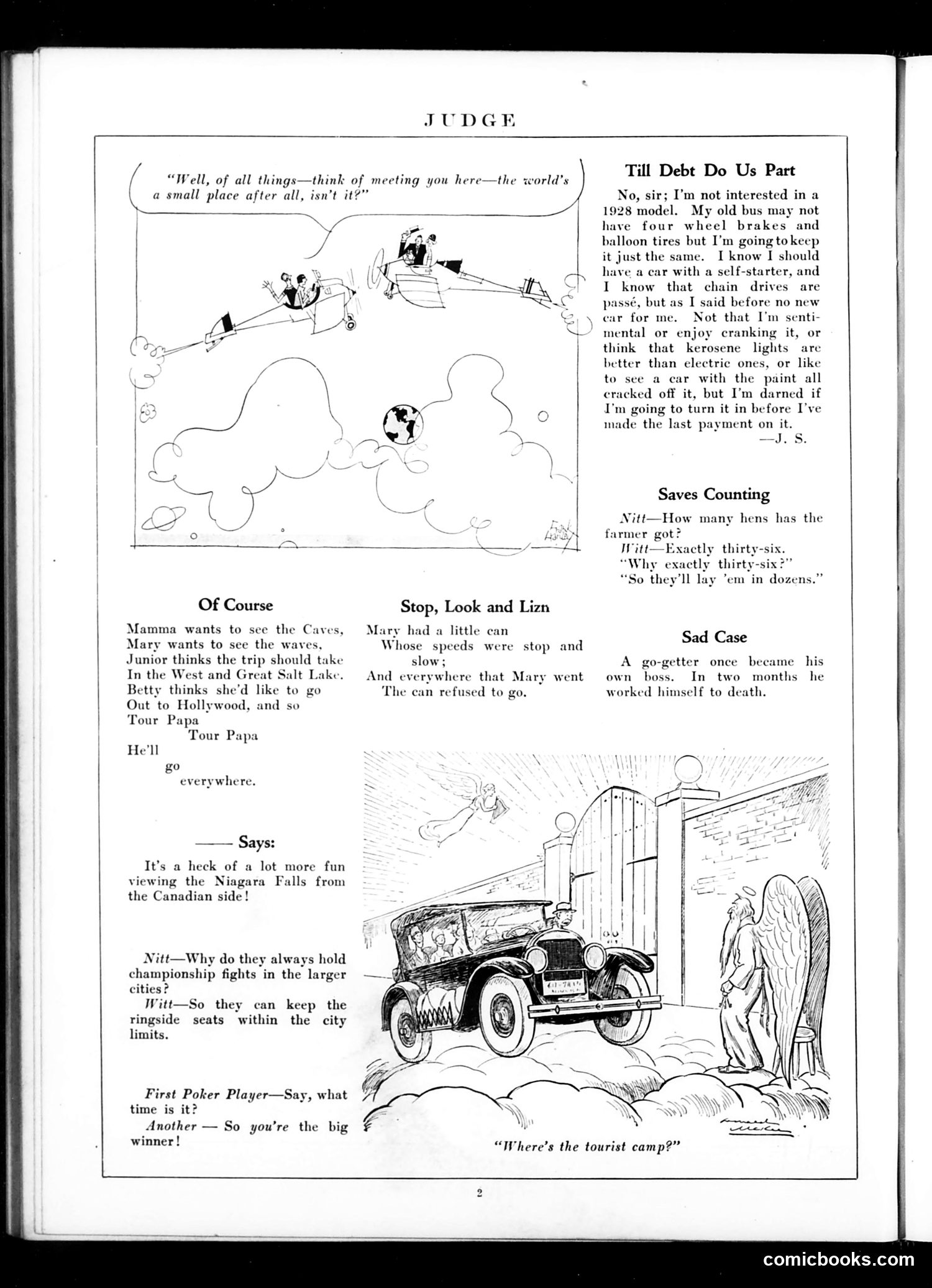
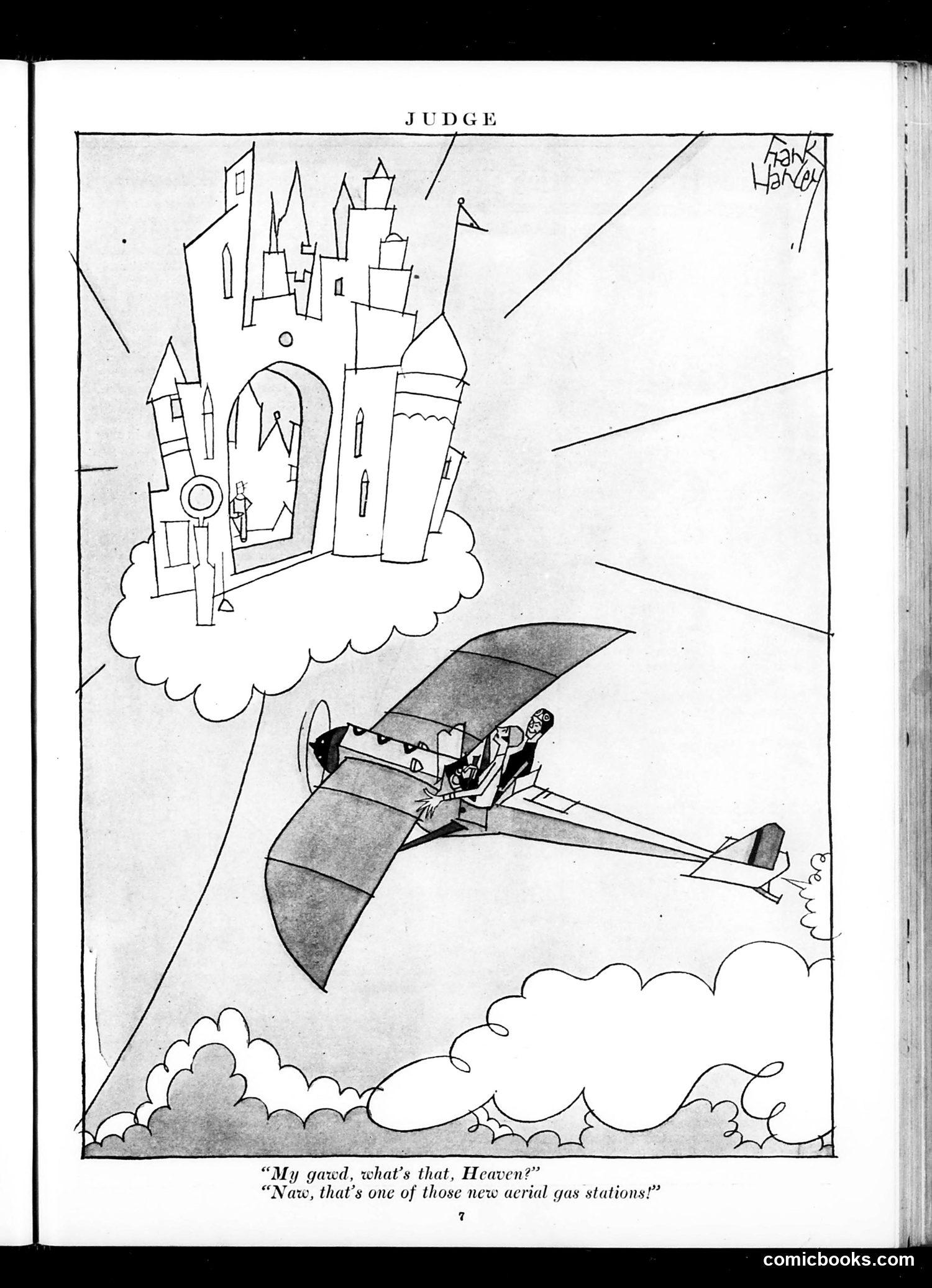
This page contains several unrelated humor pieces typical of Judge magazine's format: **Top cartoon**: Shows people in flying vehicles amid clouds, discussing travel. The joke satirizes how even visiting exotic locations feels mundane in modern times. **"Of Course" poem**: Family members list various tourist attractions they want to visit, poking fun at predictable vacation itineraries. **"Stop, Look and Lizn"**: A pun-titled piece about a stubborn can that refuses to work—likely mocking consumer product reliability. **"Sad Case"**: Brief anecdote about a self-made boss who worked excessively. **Bottom cartoon**: Shows a vintage automobile arriving at what appears to be Heaven's gates, with an angel asking "Where's the tourist camp?"—sarcastically suggesting even the afterlife has become a tourist destination. The page reflects 1920s-30s preoccupations with modern tourism, automobiles, and consumerism.
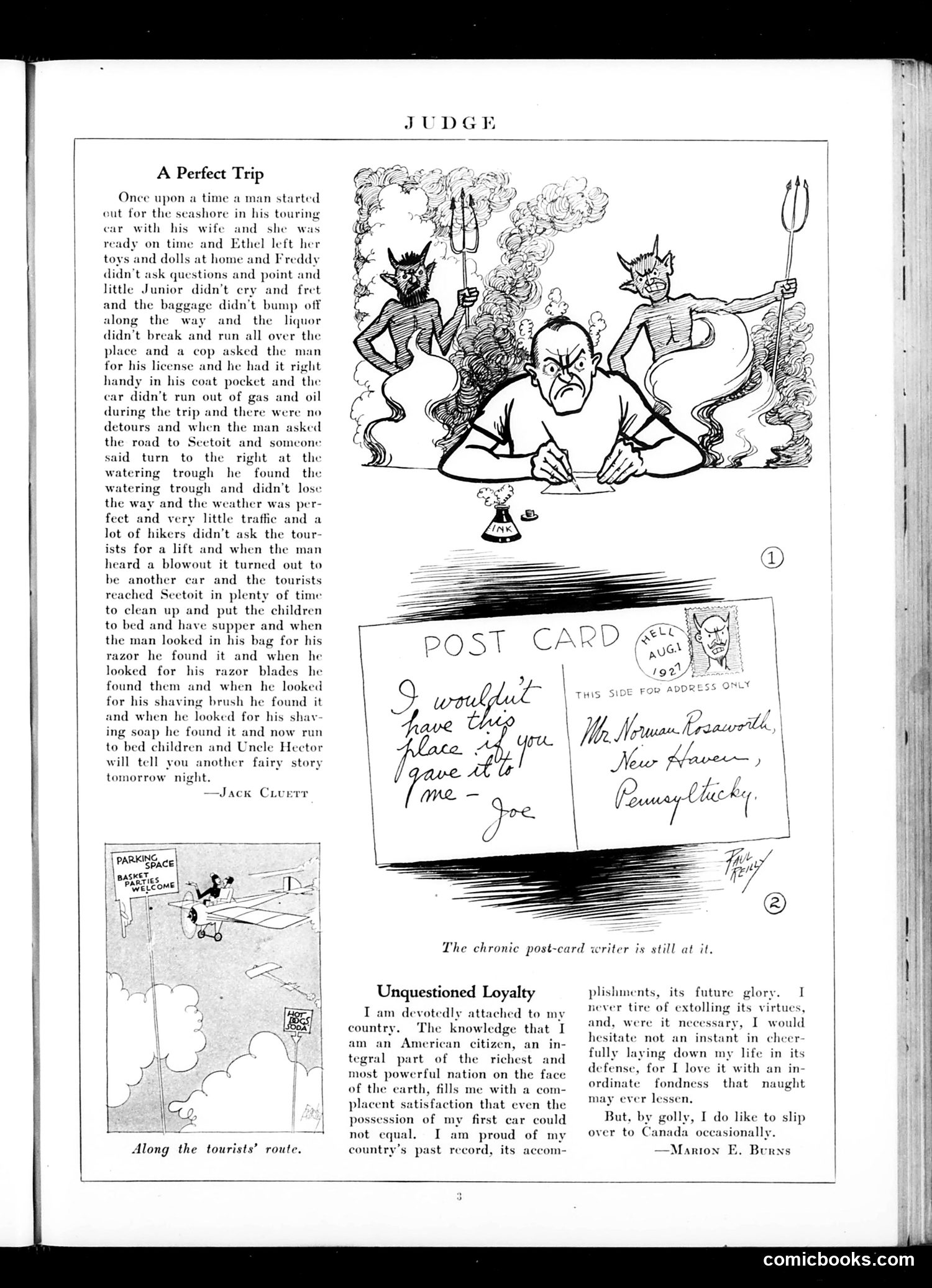
This cartoon satirizes an idealized American family road trip. The story describes a man whose vacation supposedly goes flawlessly—no lost luggage, no traffic, no arguing children, perfect weather, no breakdowns—concluding with him finding his razor and shaving soap exactly when needed. The illustration shows demons or devils tormenting a bald man, suggesting the *actual* reality behind such fantasies. The joke is the stark contrast between the narrator's absurdly perfect account and the visual depiction of vacation chaos and frustration. The postcard insert labeled "Chronic post-card writer" reinforces the theme: tourists exaggerate their experiences in correspondence home, claiming wonderful trips they probably didn't have. This mocks both vacation culture and human tendency to inflate pleasant narratives.
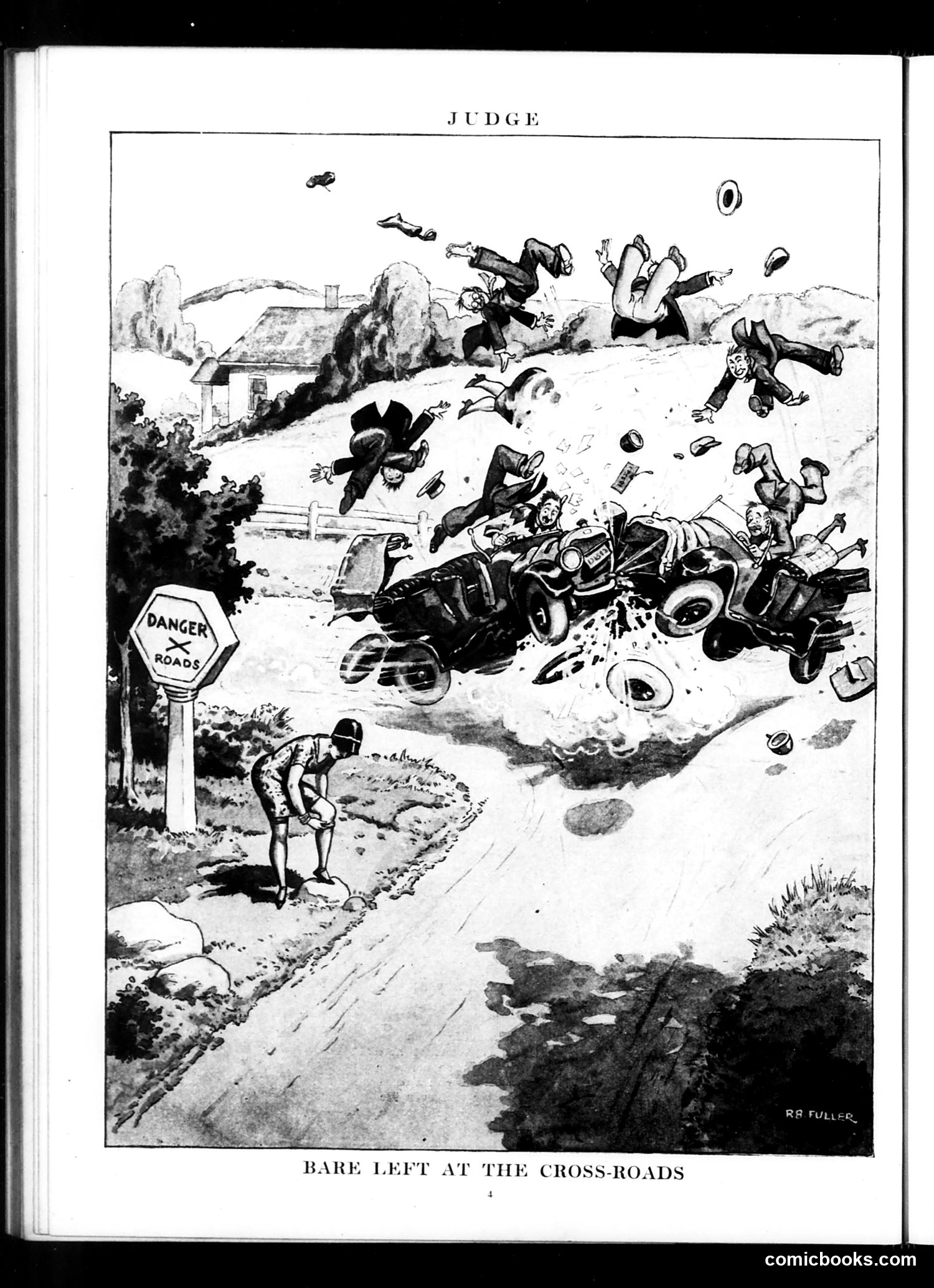
This cartoon satirizes dangerous driving behavior at rural intersections. The image shows a catastrophic multi-car crash at a crossroads marked with a "Danger Roads" warning sign. Multiple automobiles have collided violently, with passengers and debris flying through the air. A young boy stands near the sign looking distressed, apparently a witness to the chaos. The title suggests ironic commentary on traffic directions—"bare left" (possibly a pun on "bear left") at dangerous intersections. The cartoon likely critiques reckless driving speeds and drivers' failure to heed safety warnings, particularly at rural crossroads where visibility and control were problematic. This reflects early 20th-century concerns about automobile safety as cars became more common.
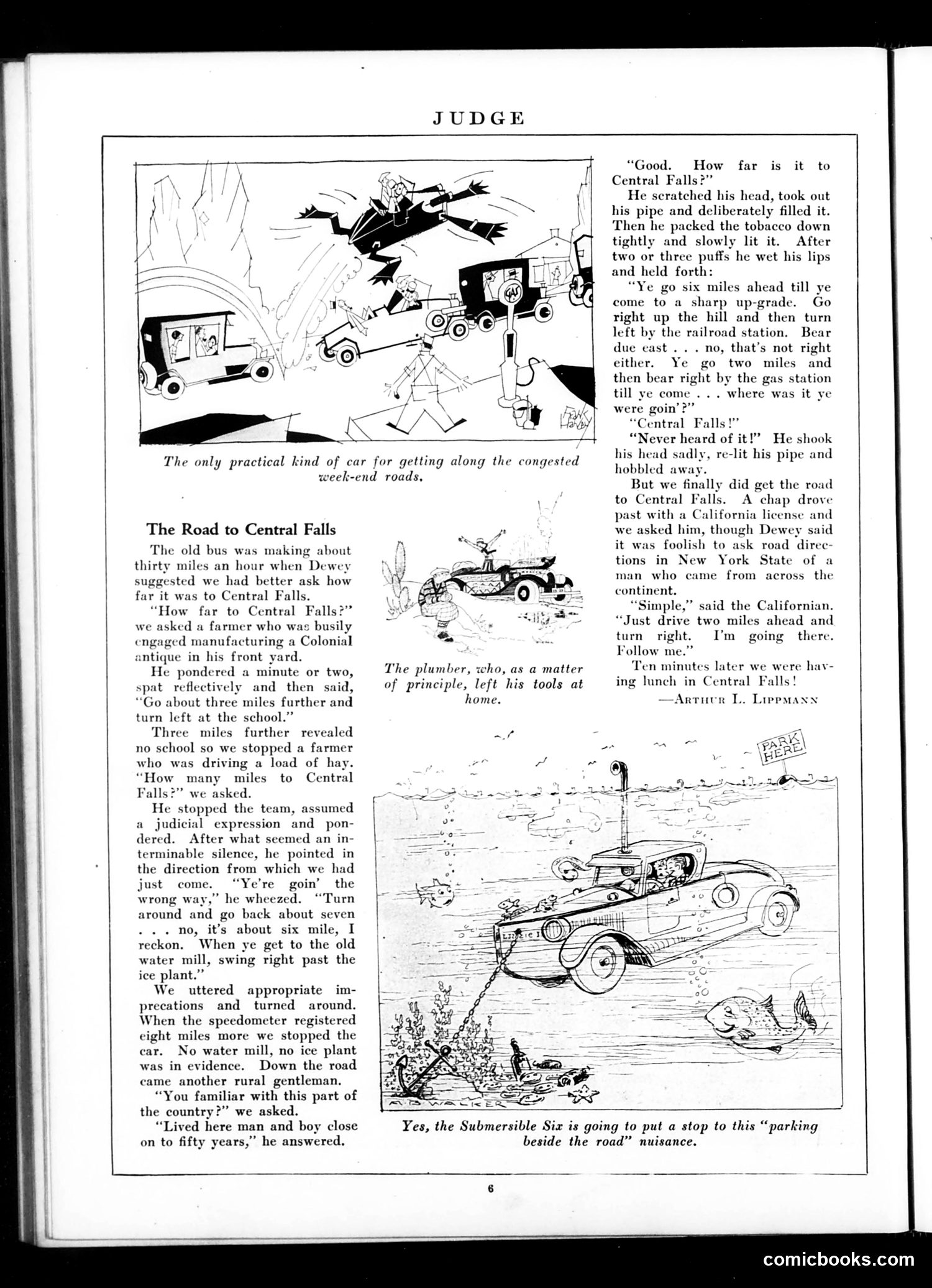
This piece satirizes rural directions and the absurdity of asking locals for help navigating country roads. The humor centers on a common American experience: farmers' inability (or unwillingness) to give clear directions. Each rural man consulted provides contradictory, vague, or nonsensical guidance—pointing backward, referencing non-existent landmarks (the water mill, ice plant, school), and constantly revising their answers. The punchline arrives when a *Californian* visitor—someone from far away, assumed to know nothing of the area—gives clear, simple directions that actually work. The satire cuts both ways: mocking both rural confusion/obstinacy AND the city dweller's prejudice that an outsider couldn't possibly help. The accompanying cartoon illustrations of chaotic weekend traffic and the "Submersible Six" car joke about cars being impractical on crowded roads, adding to Judge's commentary on modern automotive inconvenience.
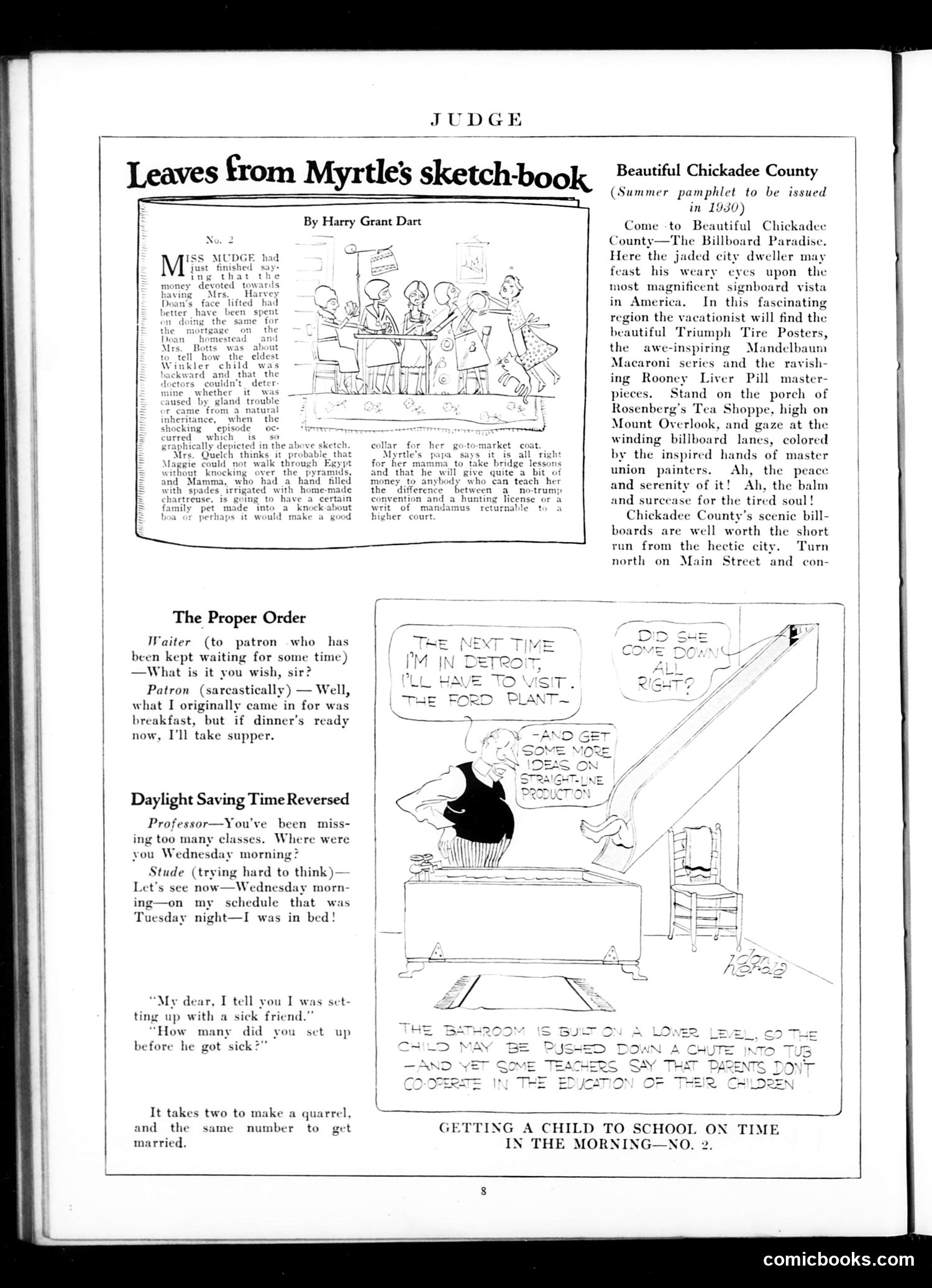
This page from Judge (circa 1930, based on the "Summer pamphlet to be issued in 1930" reference) contains satirical commentary on American consumer culture and social absurdities. **"Leaves from Myrtle's Sketchbook"** saririzes aggressive billboard advertising by ironically promoting "Beautiful Chickadee County" as a tourist destination—but the attraction is merely the billboards themselves (Triumph Tires, Rooney Liver Pills, etc.). The joke mocks how ubiquitous roadside advertising had become, transforming the landscape into commercial signage. Other brief humor pieces address timeless frustrations: a waiter's sarcasm about serving delays, a student confused by Daylight Saving Time, and the domestic struggle of getting children ready for school on time. The cartoons and jokes target recognizable aspects of 1930s American life: consumerism, bureaucratic scheduling confusion, and parenting challenges—all presented through quick, punchy satirical observations typical of Judge magazine's format.
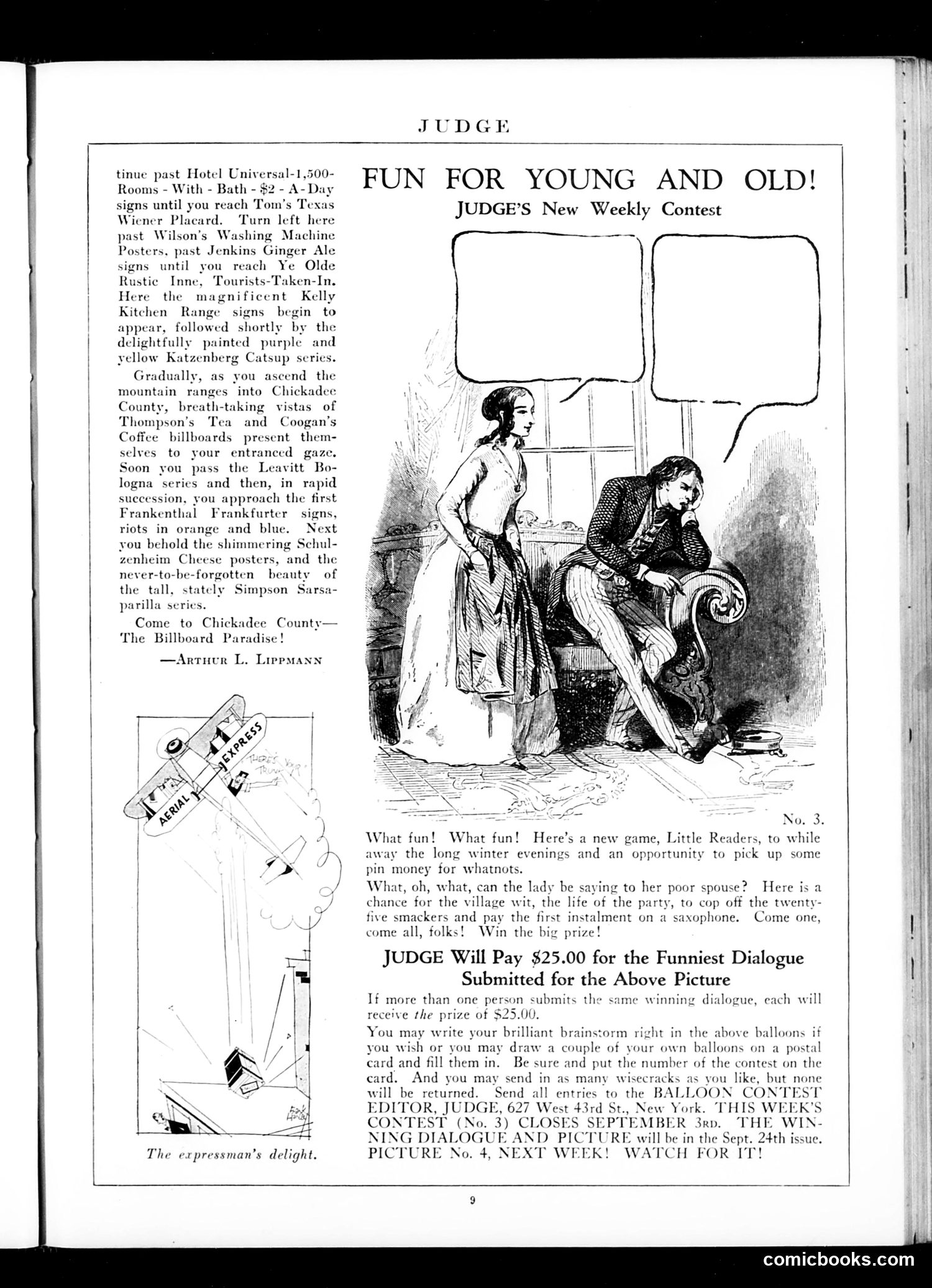
This page combines satirical editorial content with a reader contest. **Left side:** Arthur L. Lippmann's piece "The Billboard Paradise" saririzes American roadside advertising excess. It mocks the proliferation of commercial billboards cluttering the landscape—mentioning brands like Tom's Wieners, Wilson's Washing Machine, Kelly Kitchen Range, Katzeneberg Catsup, and others. The satire suggests that billboards have so colonized the countryside that they comprise the primary "vista" travelers encounter. The accompanying sketch of an expressman amid billboards reinforces this critique. **Right side:** Judge's "Weekly Contest" invites readers to caption Picture No. 3, showing a woman and man in domestic conversation, offering $25 for the "funniest dialogue." This was common magazine content of the era—participatory humor contests engaging readers. **Context:** This reflects early 20th-century anxieties about unchecked commercial advertising transforming the American landscape, a concern still relevant today.
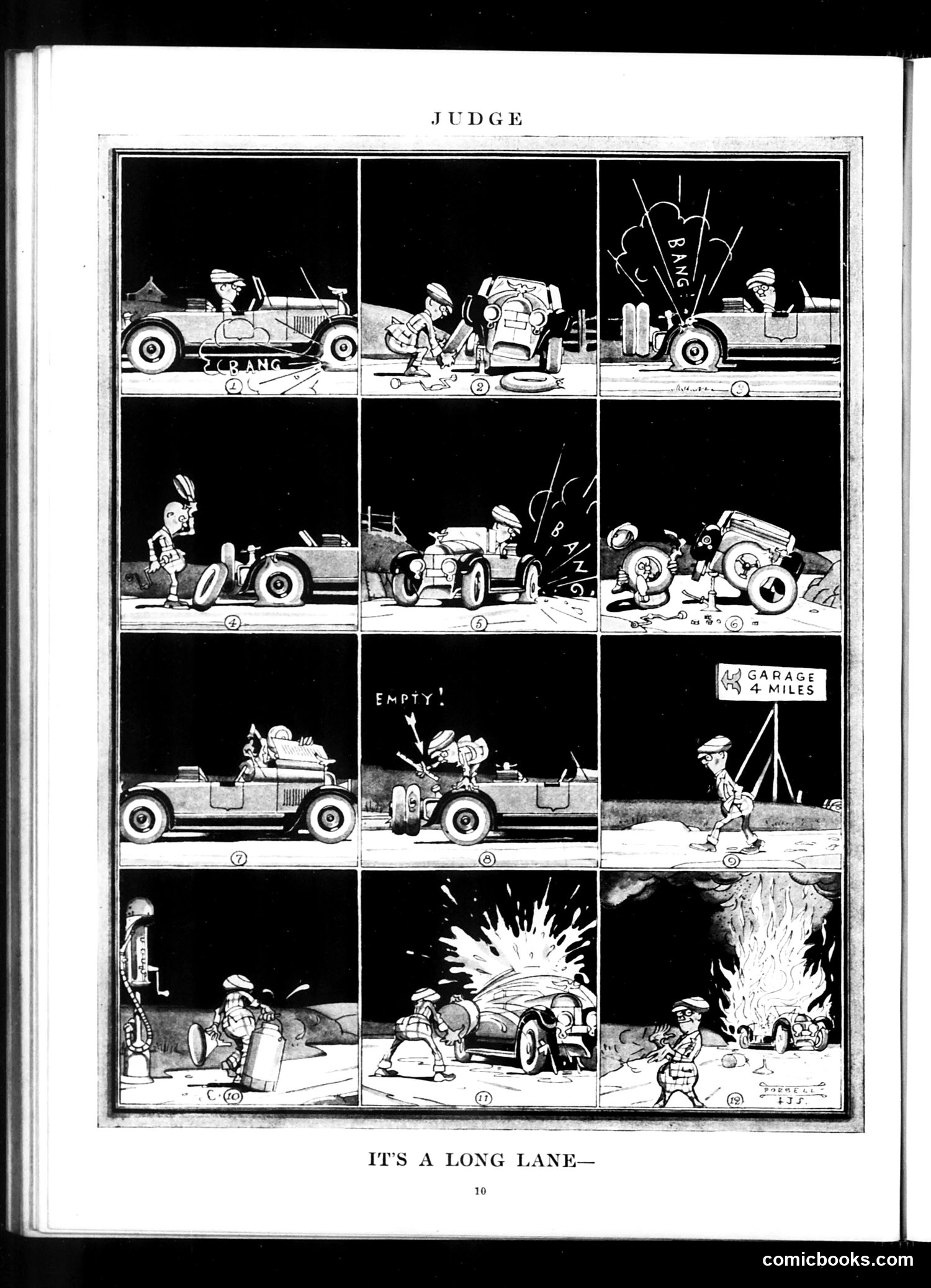
This is a sequential comic strip depicting a slapstick narrative about automobile racing and competition. The story follows two rival racers: one labeled "GANG" and another competitor. The sequence shows: 1. Both racers competing in a race 2. A crash or collision occurring 3. One racer running out of fuel ("EMPTY!") 4. The stranded racer walking to a garage "4 miles" away 5. A dramatic explosion or fire destroying the other racer's vehicle The title "It's a Long Lane" suggests the moral that misfortune eventually catches up with everyone—here, the initially winning racer suffers catastrophic failure while his rival, though disadvantaged, survives. The humor derives from physical comedy, role reversals, and the ironic twist of fate in competitive racing contexts typical of 1920s-30s automotive satire.
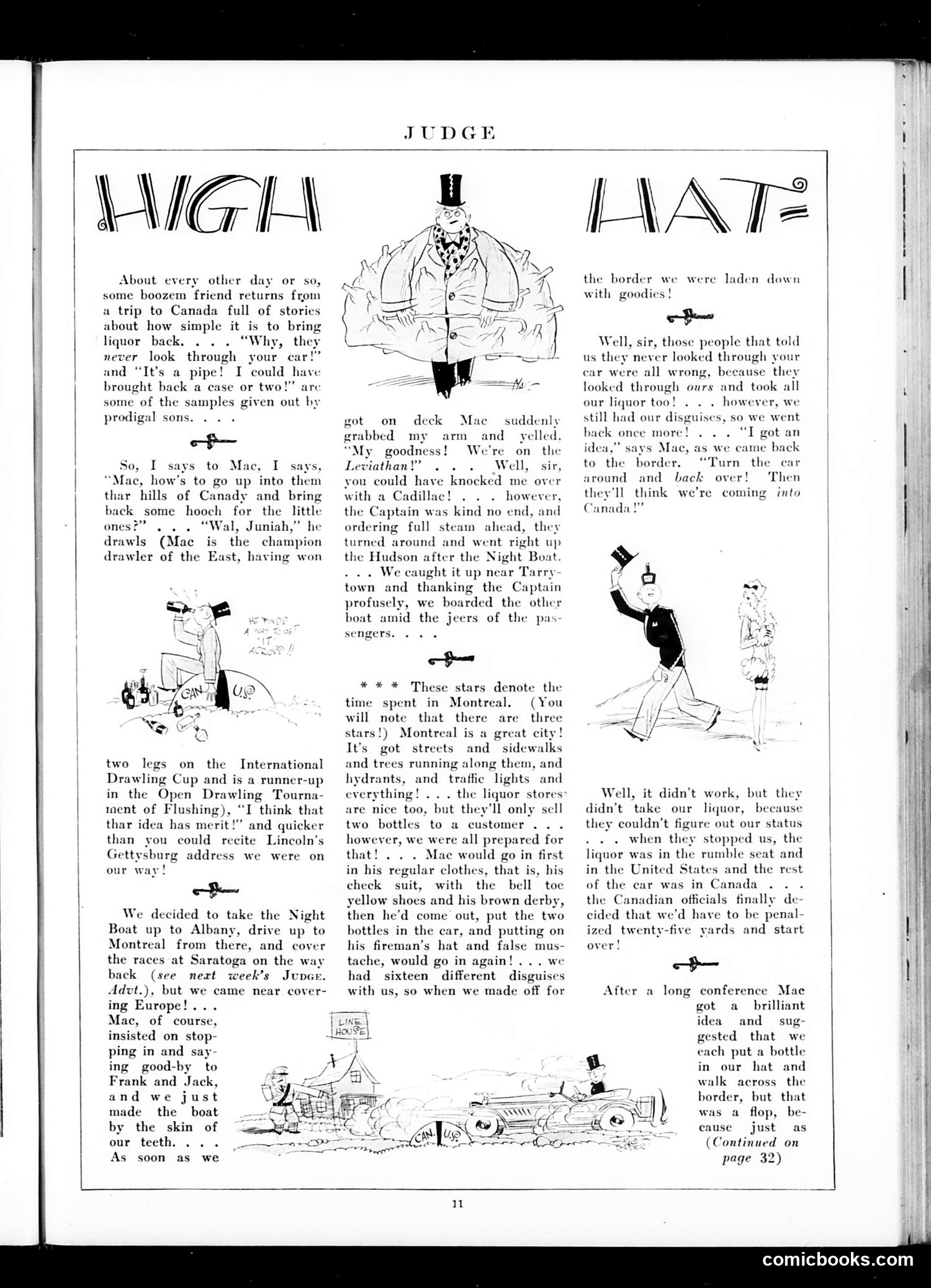
This is a humorous story about Prohibition-era liquor smuggling from Canada. The narrator and his friend "Mac" attempt to illegally transport alcohol across the U.S.-Canada border, employing increasingly absurd tactics: Mac uses multiple disguises (including a fireman's hat and false mustache) to purchase bottles in Montreal, and they later plan to hide liquor in car seat cushions and hat brims. The satire targets both the ineffectiveness of Prohibition enforcement and the casual, almost comedic attitude Americans took toward breaking the law. The Canadian border officials' inability to determine the car's jurisdiction (straddling U.S./Canadian territory) adds to the absurdist humor. The detailed illustrations of their ridiculous schemes emphasize the satire's point: that Prohibition was widely flouted and enforcement was comically inadequate.
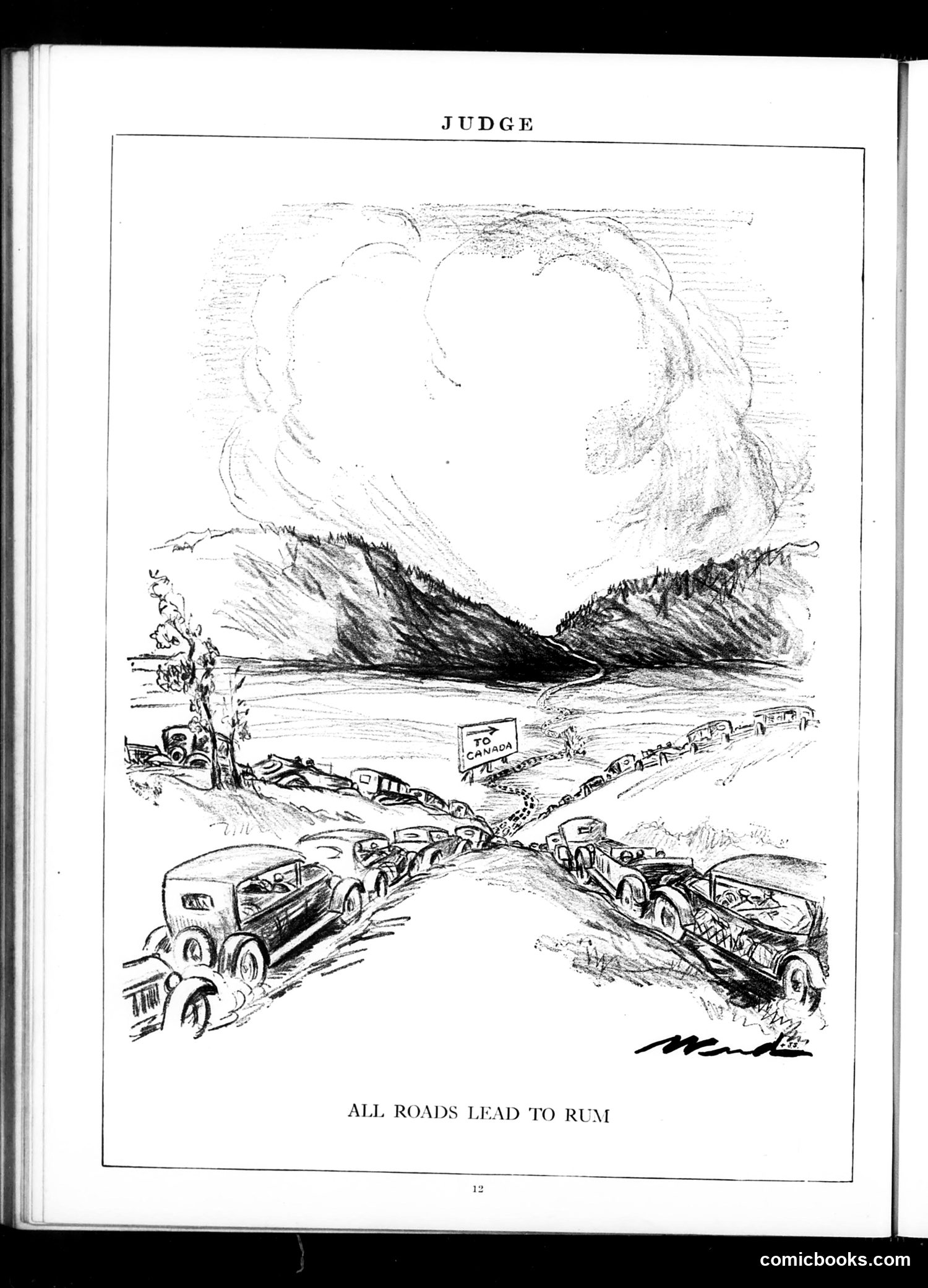
This is a political cartoon from *Judge* magazine satirizing Prohibition-era traffic and lawlessness. The image shows multiple automobiles converging on a destination marked "Canada" across a body of water, with mountains in the background. The caption "All Roads Lead to Rum" is a play on the classical phrase "All Roads Lead to Rome." The cartoon mocks how Americans circumvented Prohibition (1920-1933) by traveling to Canada to obtain alcohol illegally. The converging car routes represent the widespread practice of bootlegging and smuggling rum across the U.S.-Canada border. The satire criticizes both the futility of Prohibition enforcement and the public's widespread disregard for the law, suggesting that despite government restrictions, citizens consistently found ways to access alcohol.
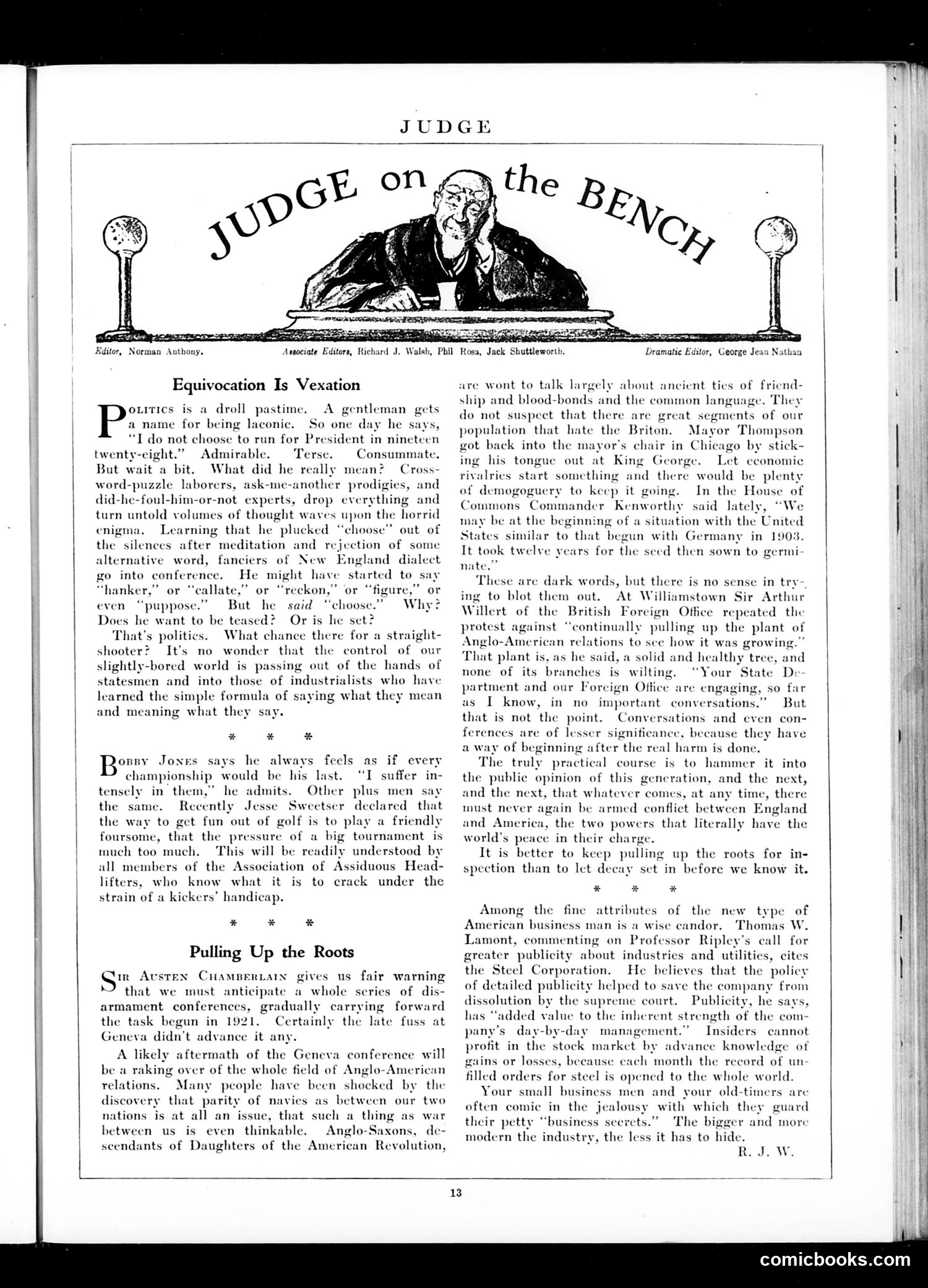
This page from Judge (a prominent American satirical magazine) contains three editorial pieces attacking political equivocation and discussing Anglo-American relations. The lead article mocks President Coolidge's famous non-committal statement: "I do not choose to run for President in nineteen twenty-eight." The satire criticizes his deliberately vague language—people debated whether "choose" meant he wouldn't run or was merely being coy. Judge argues such political ambiguity represents poor leadership, contrasting it with industrialists who "say what they mean." The second piece discusses Chicago Mayor Thompson, who previously gained popularity by anti-British rhetoric ("sticking his tongue out at King George"). The final section warns that Anglo-American tensions—despite shared language and heritage—remain real. It references British officials' concerns (Sir Arthur Willert, Commander Kenworthy) that economic rivalry could breed conflict, comparing potential US-UK tensions to pre-WWI US-German relations. Judge advocates maintaining the relationship rather than complacently assuming shared blood-bonds guarantee peace.
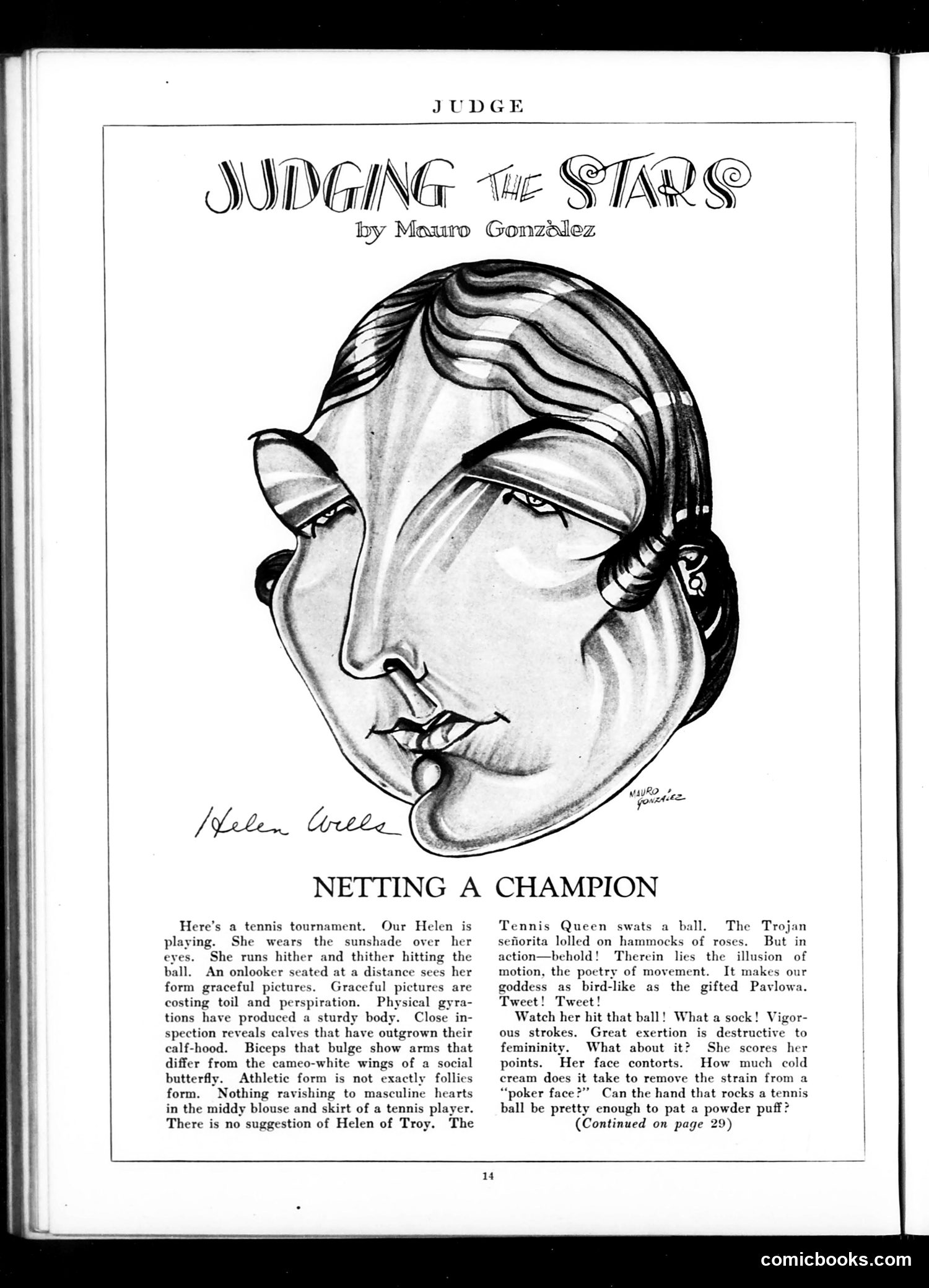
This satirical piece mocks the tension between athletic achievement and feminine beauty ideals in early 20th-century America. "Helen" is a tennis champion whose physical prowess is undeniable—she plays with vigor and wins—but the author emphasizes that her athletic success comes at the cost of traditional femininity. The satire targets the contradiction in society's expectations: Helen's muscular development ("calves that have outgrown their calf-hood," "bulging biceps") is necessary for her championship performance, yet these same features violate contemporary beauty standards that prized delicate, "cameo-white" femininity. The piece sarcastically notes her "poker face" during competition and asks whether hands strong enough to hit a tennis ball can remain "pretty enough to pat a powder puff." The reference to "Helen of Troy" underscores the gap between mythic feminine beauty and athletic female bodies. The satire critiques both women athletes (for their unfeminine appearance) and society's impossible standards.
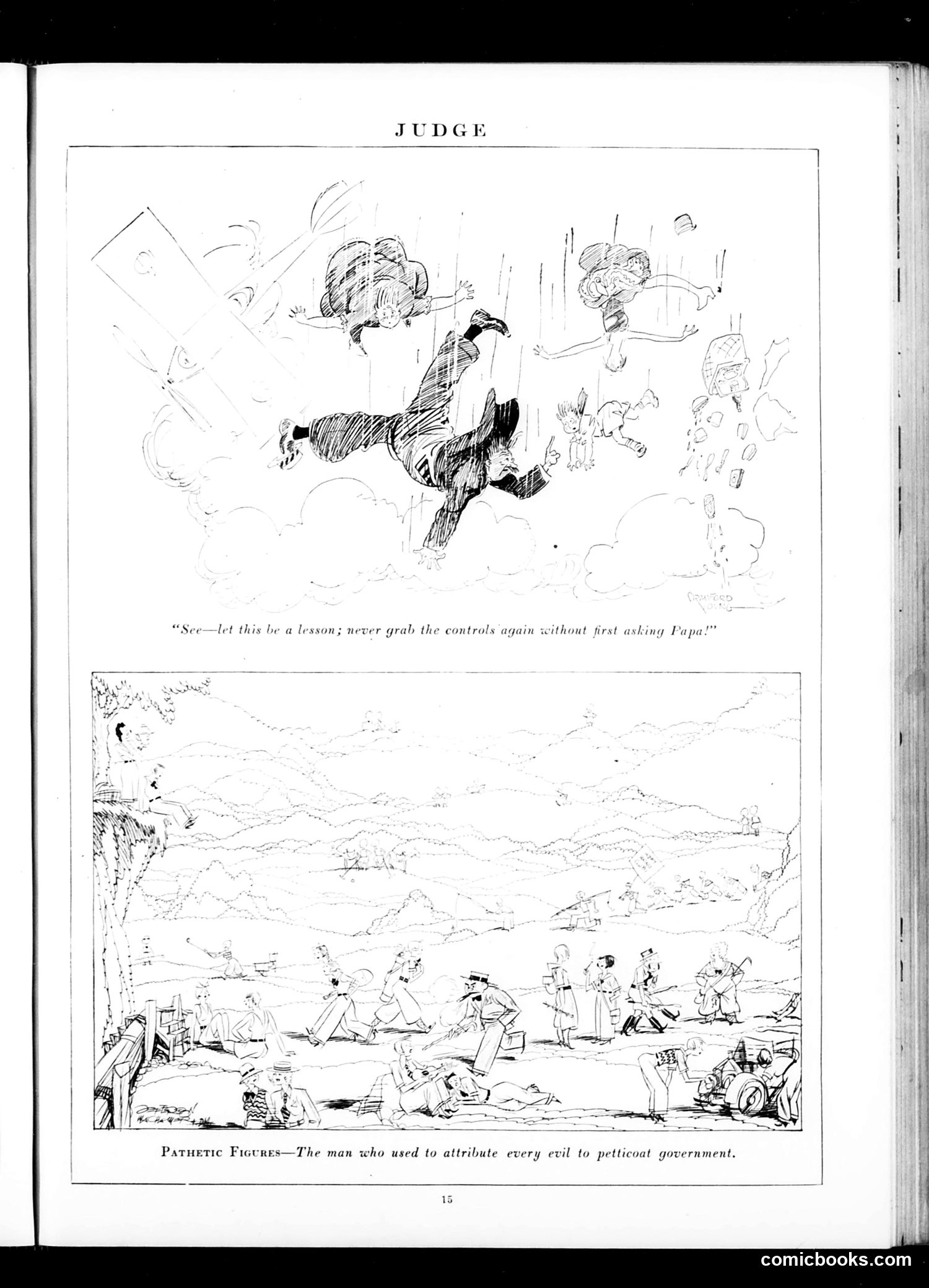
This page from *Judge* magazine contains two cartoons titled "Judge" satirizing a political figure. The top cartoon shows a man being violently thrown about in clouds, seemingly by unseen forces—depicting chaos and loss of control. The bottom cartoon, titled "Pathetic Figures," illustrates a landscape where various people are engaged in destructive activities: fighting, destroying property, and causing general mayhem. The caption explains the satire's target: "The man who used to attribute every evil to petticoat government"—meaning a politician who previously blamed women's influence (or women's suffrage/political participation) for society's problems. The cartoons ironically show that without that convenient scapegoat, he's left flailing amid actual societal chaos and destruction, suggesting his complaints about "petticoat government" were baseless excuses rather than genuine explanations for real problems.
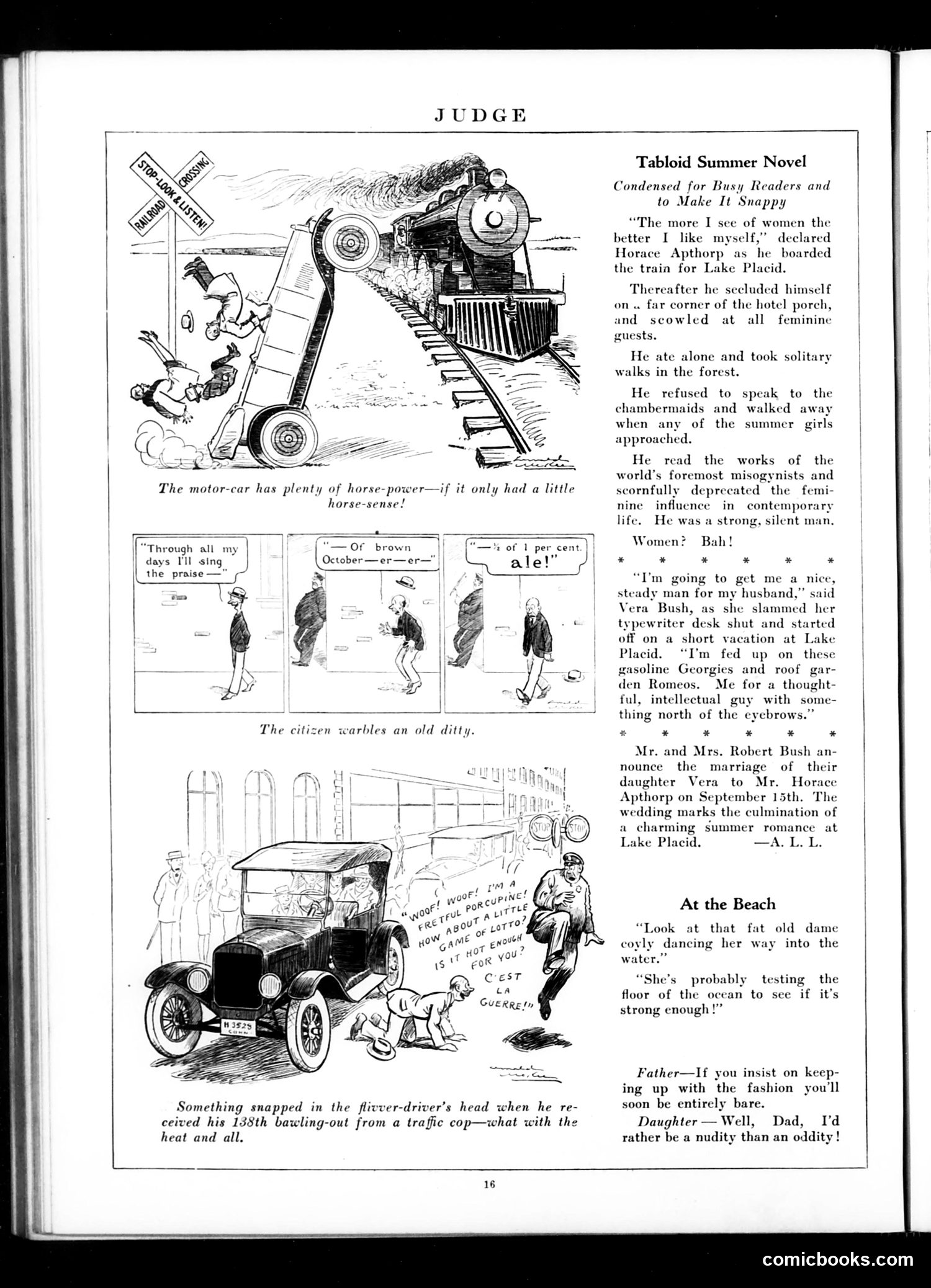
This page from *Judge* magazine presents a humorous "tabloid summer novel" satirizing early 1920s dating and gender relations. The main narrative mocks a misogynistic man named Horace Apthorp who publicly despises women, only to fall for Vera Bush—a modern, independent woman seeking an intellectual partner. The irony is their inevitable marriage, suggesting such contrived romantic outcomes were popular tabloid fodder. The automotive cartoons mock car culture and traffic enforcement: one jokes that automobiles lack "horse-sense" (a pun on horsepower), while another depicts a driver's mental breakdown after repeated traffic citations in summer heat—commentary on the era's growing automobile frustration and police authority. The beach dialogue satirizes fashion debates of the period, with a father criticizing women's increasingly revealing bathing suits, and his daughter defending them as preferable to being "odd." This reflects genuine 1920s anxiety about changing women's fashion and social roles during the flapper era.
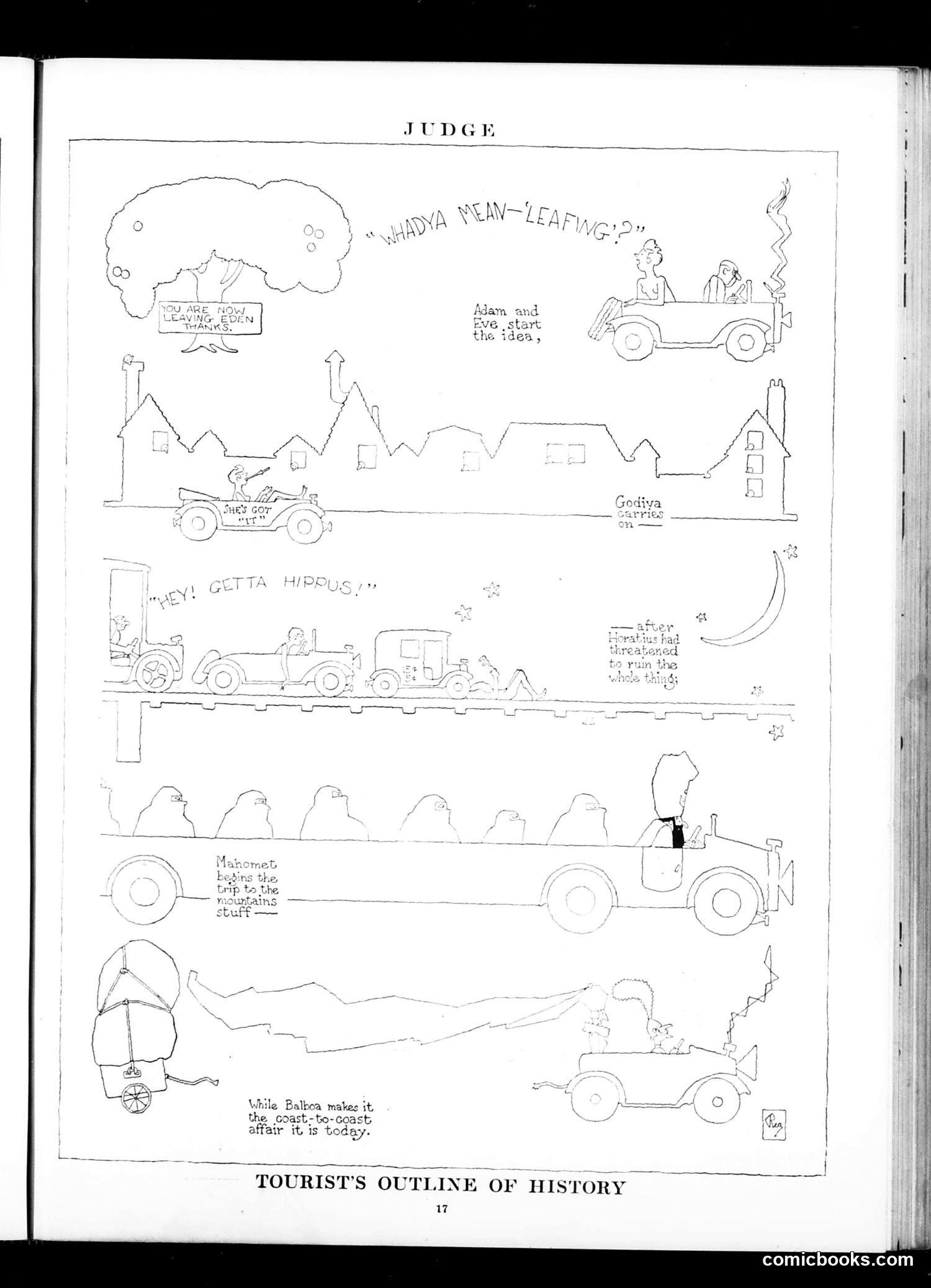
This is a satirical cartoon sequence mocking how tourists experience history superficially. It traces human progress from Adam and Eve's invention of the automobile, through various eras, culminating in Balboa's "coast-to-coast affair." The joke satirizes how modern tourists—depicted driving through each historical period—reduce complex historical events to quick vehicle-based sightseeing. Each panel shows characters racing through history in cars: from Genesis to Gothic architecture to what appears to be a train era ("Hey! Gotta hippus!") to a covered wagon journey to mountains, and finally Balboa's expedition reimagined as automotive tourism. The satire targets the shallow, rushed consumption of history by 1920s-30s automobile tourists who treat major historical developments as mere backdrop for their road trips. It's both mocking tourists' superficiality and celebrating—ironically—the car culture that enables this "swift" passage through history.
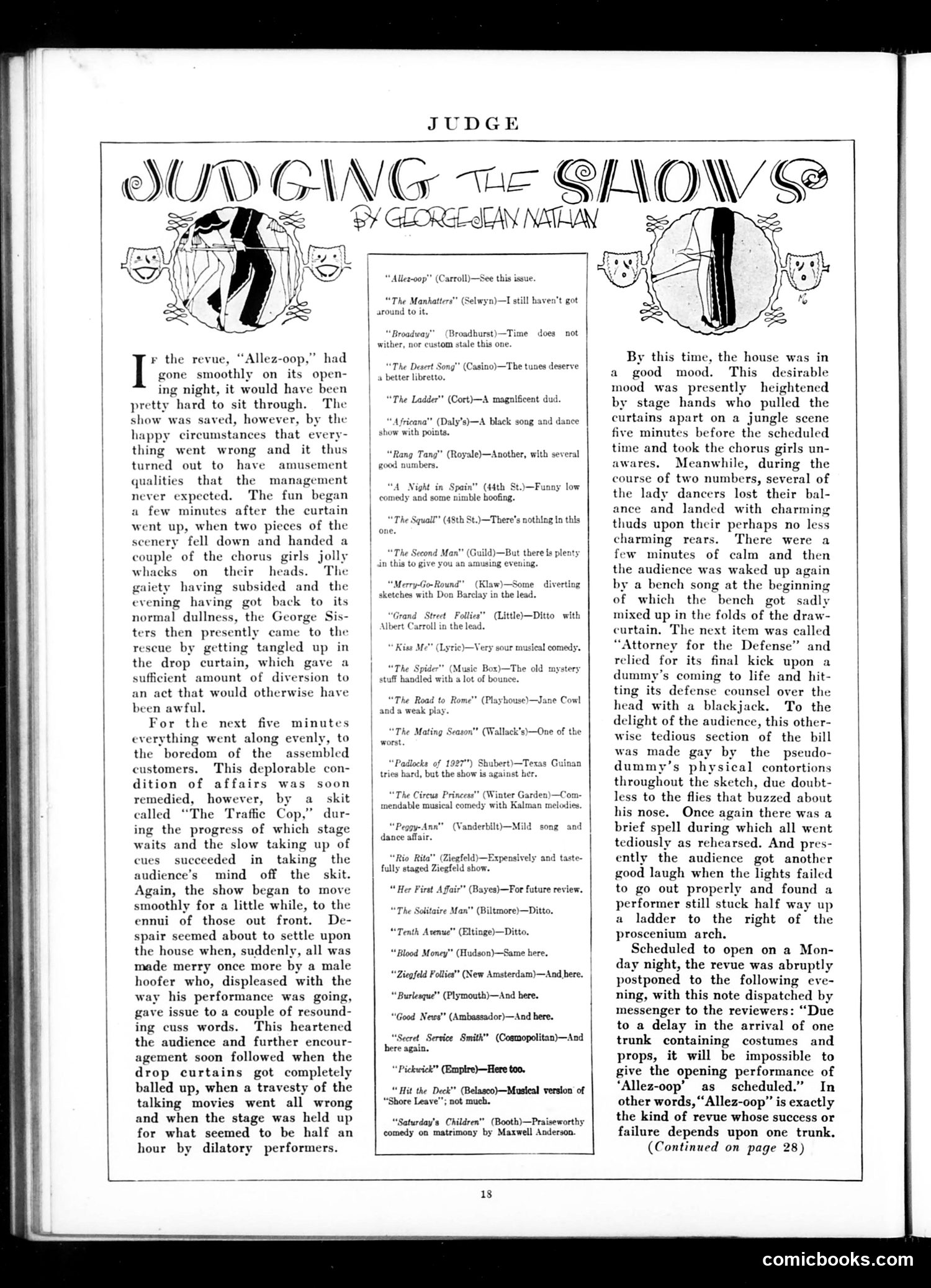
This is a theater review column by George Jean Nathan, Judge's drama critic. Rather than traditional reviews, Nathan satirizes Broadway's 1927 season by arguing that the revue "Allez-oop" succeeded *because* everything went wrong—scenery collapsed, curtains tangled, cues were missed, performers cursed on stage. Nathan's joke is that technical disasters and incompetence accidentally provided entertainment value the show's actual content couldn't deliver. He catalogs other current Broadway productions in a dismissive list format, offering one-liners about shows like "Rio Rita" and "Good News." The cartoon panels flanking the text (showing theatrical masks and performers) are generic Broadway imagery. This is primarily a text-based theater column using humor to critique both a specific failed production and the broader state of 1920s Broadway entertainment.
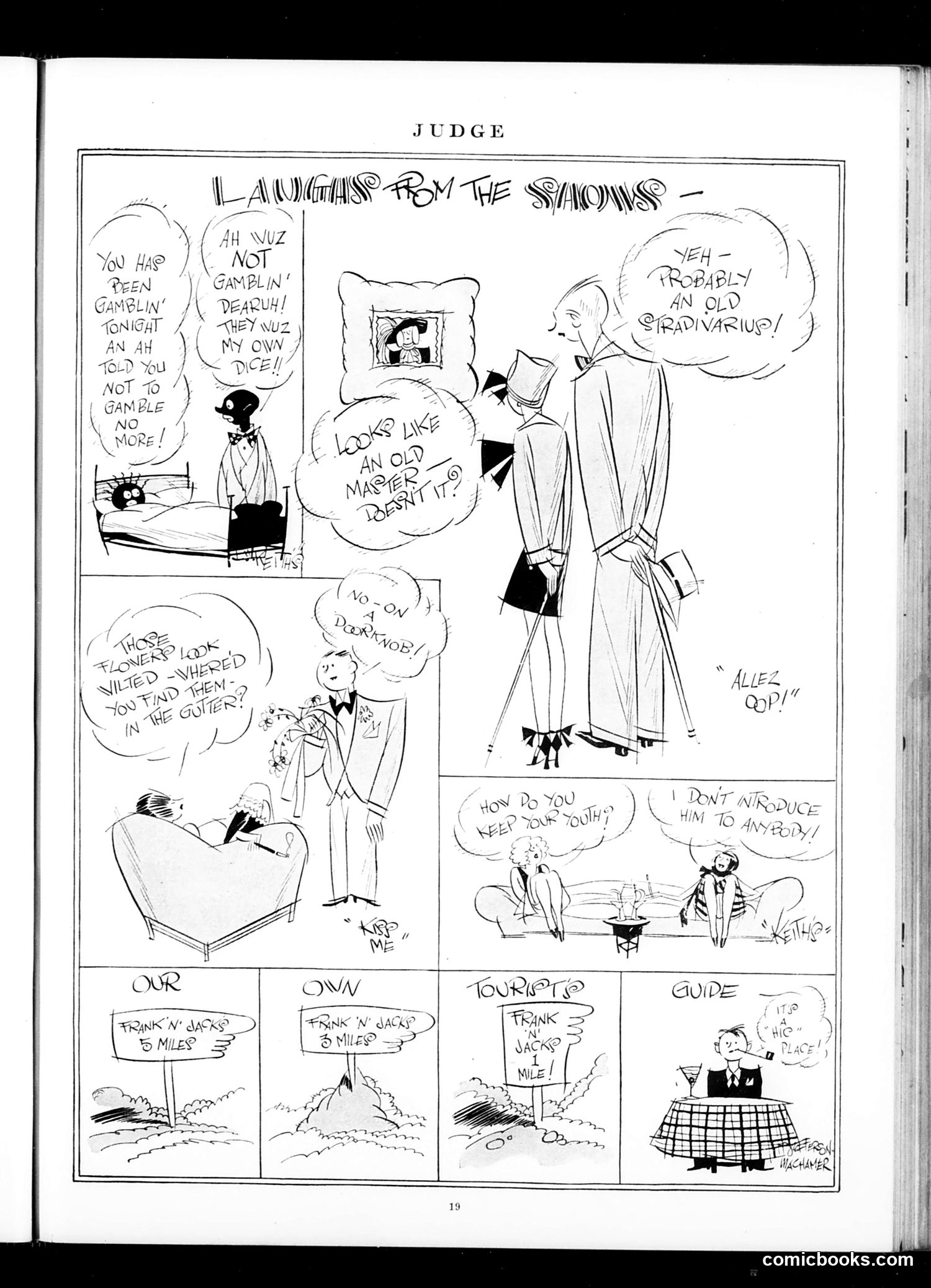
This page contains multiple cartoons satirizing gambling and moral hypocrisy. The main narrative depicts a man caught gambling by what appears to be his wife or authority figure. When confronted, he denies gambling ("Ah wuz not gamblin', dearuh!"), claiming he's merely playing with dice he owns. The satire targets **unconvincing denials and self-deception** — the man's obvious lie about innocent dice-playing is presented as absurdly transparent. The bottom section parodies tourism marketing, showing roadside signs advertising "Frank 'n' Jacks" establishments at increasing distances, then a tour guide advertising the same place. This likely mocks the **commercialization of frontier/rural attractions** and misleading advertising common to early-20th-century American tourism. The cartoon's humor relies on recognizing obvious falsehoods and the gap between marketing promises and reality.
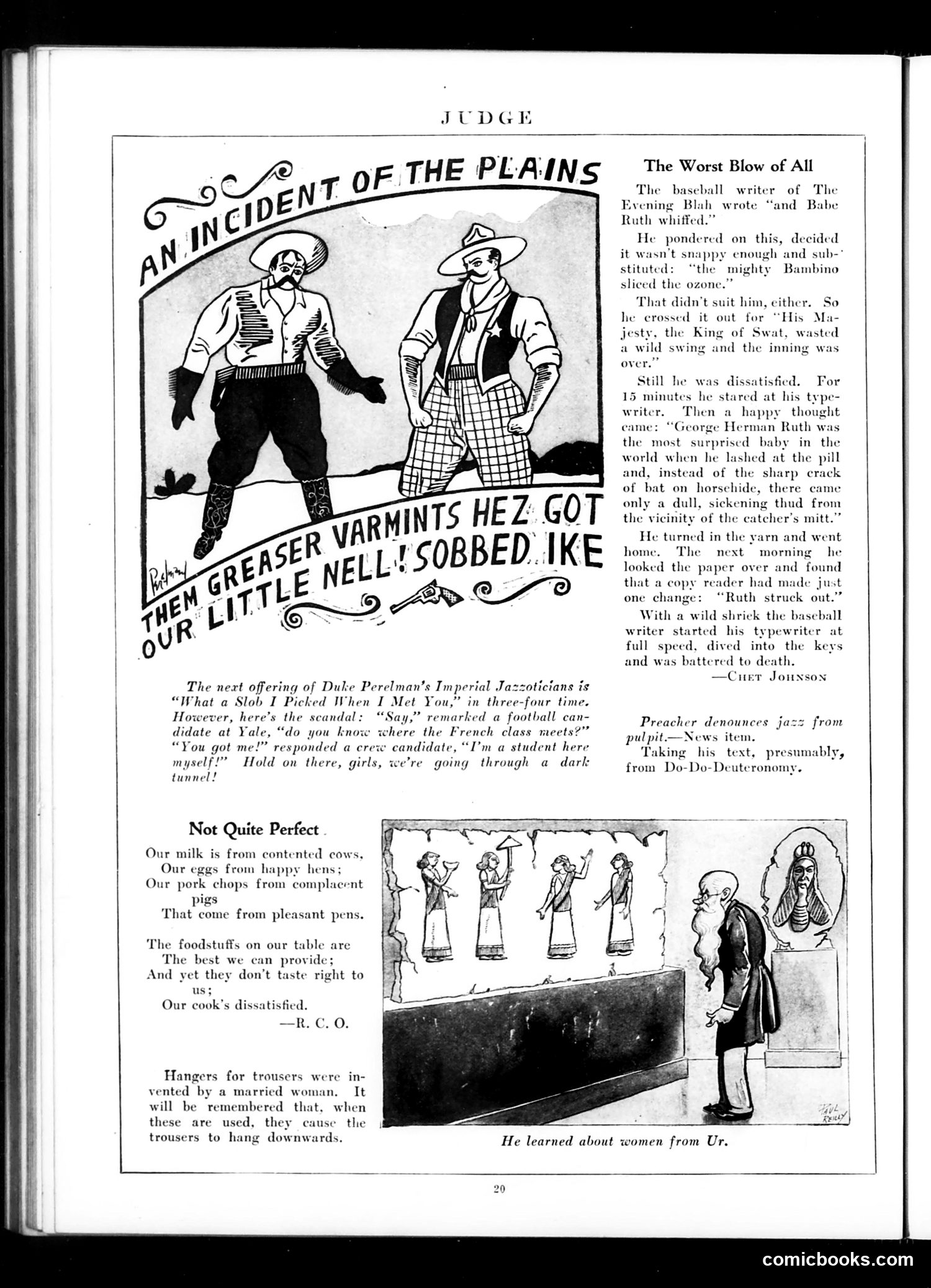
This page contains several satirical pieces reflecting early-20th-century American humor: **"An Incident of the Plains"** depicts two cowboys in a Western-style confrontation, with text referencing "Greaser varmints" and a character named "Nell." The cartoon satirizes Wild West adventure narratives popular in the era. **"The Worst Blow of All"** mocks sportswriting pretension. A baseball writer for "The Evening Blah" repeatedly rewrites a description of Babe Ruth striking out, searching for increasingly flowery language ("the mighty Bambino sliced the ozone," "His Majesty, the King of Swat"). When the copy editor simply reduces it to "Ruth struck out," the writer's frustration becomes literally violent—he attacks his typewriter and dies. The satire targets overwrought sportswriting conventions. **"Not Quite Perfect"** ironically catalogs farm-to-table wholesomeness, concluding the cook remains dissatisfied anyway. **The bottom cartoon** shows a man learning "about women" from an art gallery, apparently from classical or Renaissance female nudes—satirizing naive education about the opposite sex.
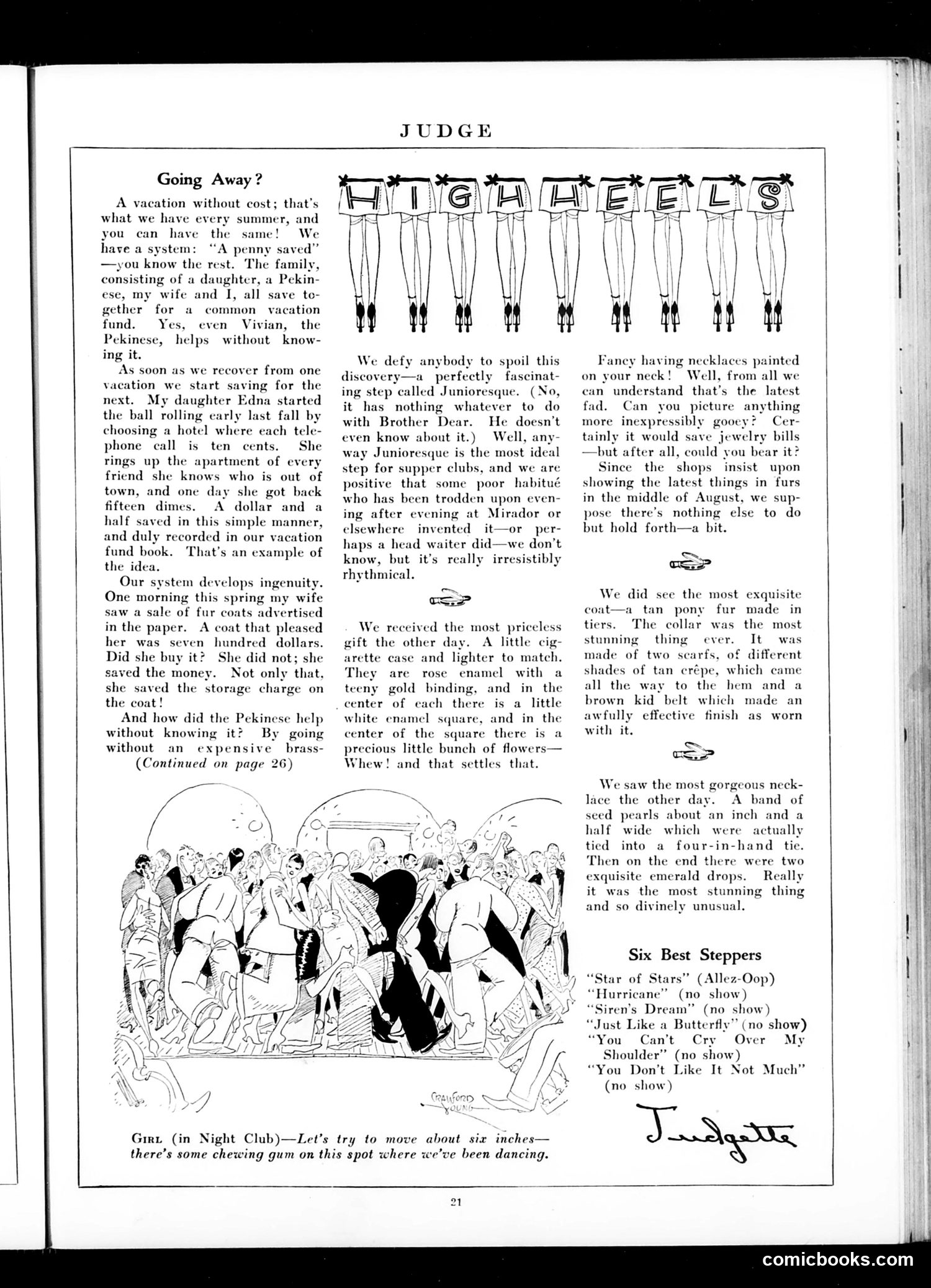
This page from *Judge* (a satirical magazine) contains two distinct pieces: **Main Article: "Going Away?"** A humorous essay about a family's penny-pinching vacation fund system. The author describes absurd money-saving tactics—his daughter makes paid phone calls to out-of-town friends, his wife avoids buying a fur coat to save storage fees, and even their Pekinese dog unknowingly contributes by forgoing an expensive brass collar. The satire mocks Depression-era frugality and how families obsessively saved for vacations. **Bottom Cartoon** A crowded nightclub scene where a couple tries to dance in a tiny space. The woman requests they "move about six inches" to avoid chewing gum on the floor—satirizing the cramped, unsanitary conditions of speakeasies or nightclubs during Prohibition. **Side Commentary** Brief fashion observations mocking contemporary trends: painted-on necklaces, elaborate pearl necklaces, and expensive fur coats—likely targeting wealthy readers' conspicuous consumption despite the economic climate. The humor targets both working-class frugality and upper-class frivolity.
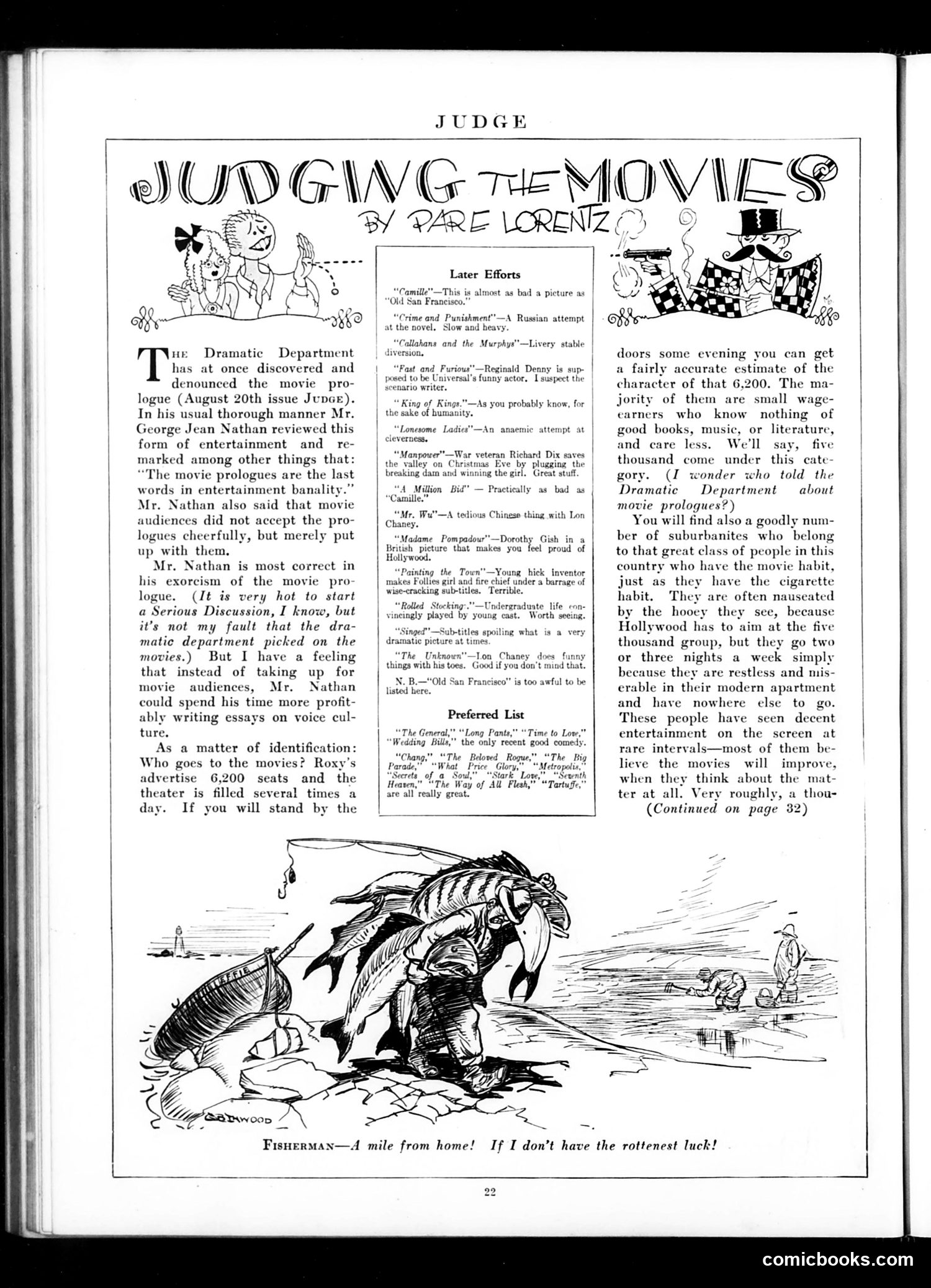
This page critiques 1920s Hollywood filmmaking through two complementary pieces: **The Main Article** by Pare Lorentz examines movie prologues—live stage performances preceding films—which critic George Jean Nathan dismissed as "entertainment banality." Lorentz defends movie audiences against Nathan's snobbery, arguing that cinema attracts primarily working-class wage-earners and suburban habitual moviegoers who lack cultural sophistication. He suggests Hollywood deliberately targets this "five thousand group" with lowbrow content, though audiences occasionally encounter quality films. **"Later Efforts" Section** offers sharp one-sentence reviews of contemporary films, using names like Lon Chaney and Dorothy Gish to satirize specific movies as tedious, slow, or poorly executed. Titles like "Painting the Town" and "Rolled Stockings" suggest formulaic plots about youth and urban life. **The Cartoon** (bottom) shows a fisherman overwhelmed by a giant fish—a visual metaphor for cinema's chaotic entertainment industry. The overall satire mocks both pretentious film critics and Hollywood's pandering to unsophisticated audiences.
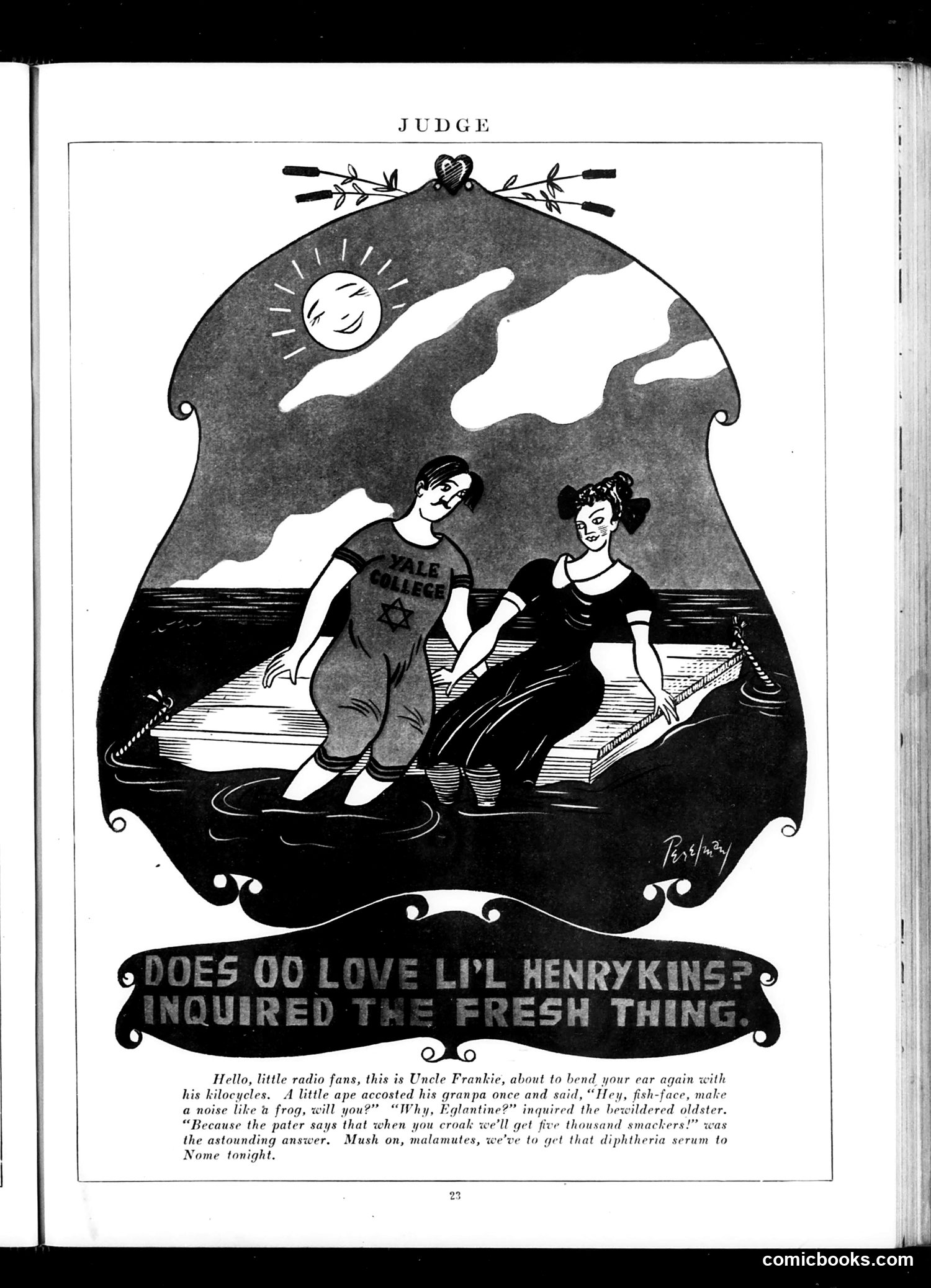
This is a satirical piece mocking early radio programming and its audience. The cartoon depicts two children listening to "Uncle Frankie," a radio personality, while the text presents a crude joke about a child asking his grandfather to "make a noise like a frog" so the child can collect a reward when the grandfather dies ("croaks"). The satire targets: 1. **Radio entertainment's low quality** — mocking the simplistic, often nonsensical content broadcast to listeners 2. **Gullible audiences** — depicting radio fans as naive, childlike consumers 3. **Commercial radio** — suggesting the medium traffics in crude humor and dubious claims The "diphtheria serum" reference appears to be a non-sequitur typical of the absurdist humor Judge employed. The overall tone is dismissive of radio culture as entertainment beneath serious consideration.
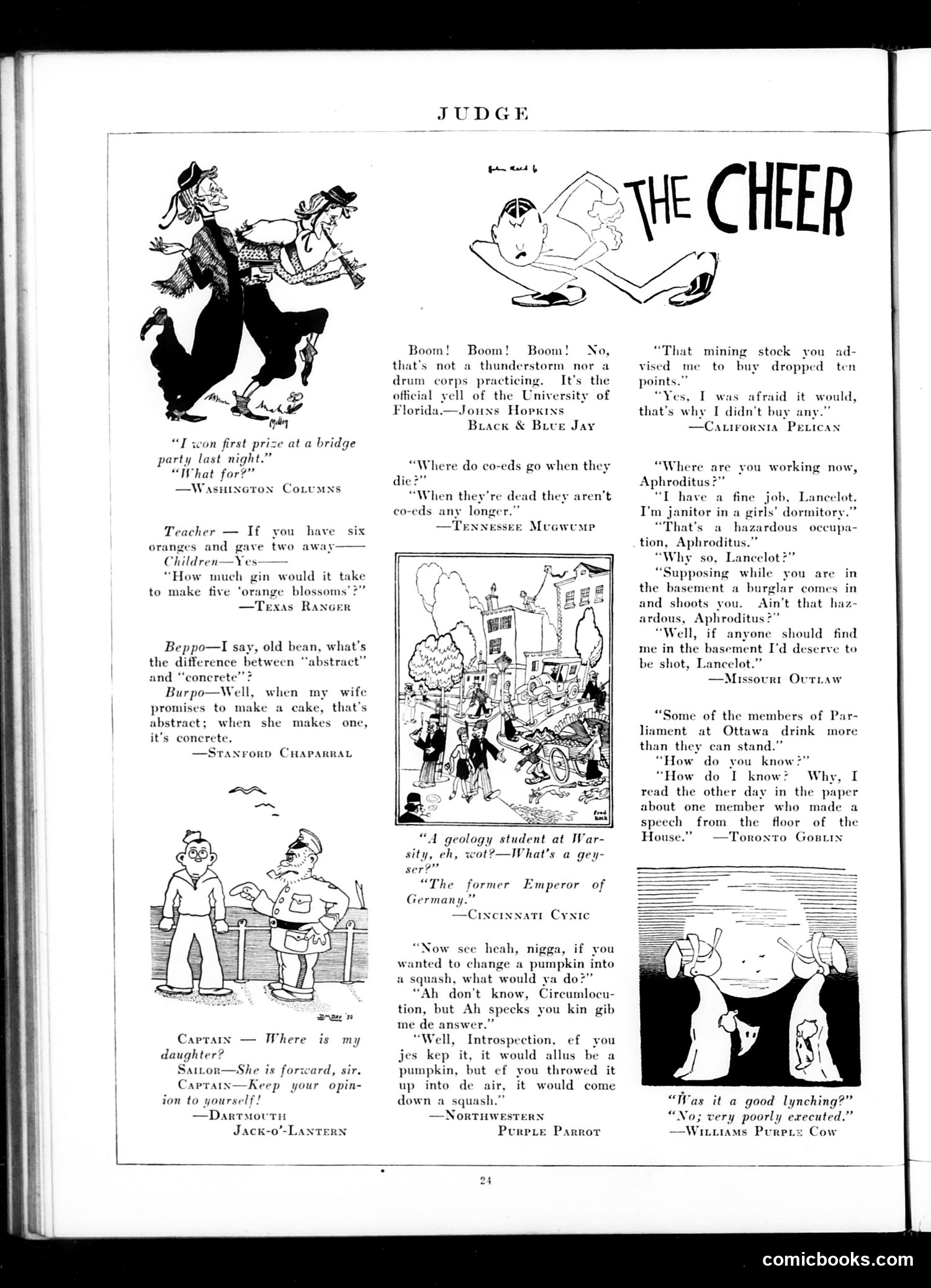
This page collects brief satirical jokes typical of early 20th-century American humor. The main cartoon depicts chaos at what appears to be a college or university gathering—the title references "The Cheer," likely mocking school spirit or institutional pride. Key jokes target: - **Gender relations**: A captain ordering a sailor to suppress his opinion about the captain's daughter being "forward" (sexually available) - **College culture**: Mocking university yells, co-eds, and student behavior - **Racial stereotypes**: A dialogue using deeply offensive period dialect about pumpkins and squashes - **Social pretension**: A character named "Aphroditus" working as a dormitory janitor, with dark humor about potential danger - **Political drunkenness**: Canadian Parliament members drinking excessively The humor relies heavily on period attitudes about class, gender, and race that are now repugnant. The overall tone is cynical about institutions, respectability, and romantic propriety—common themes in Judge's satirical approach.
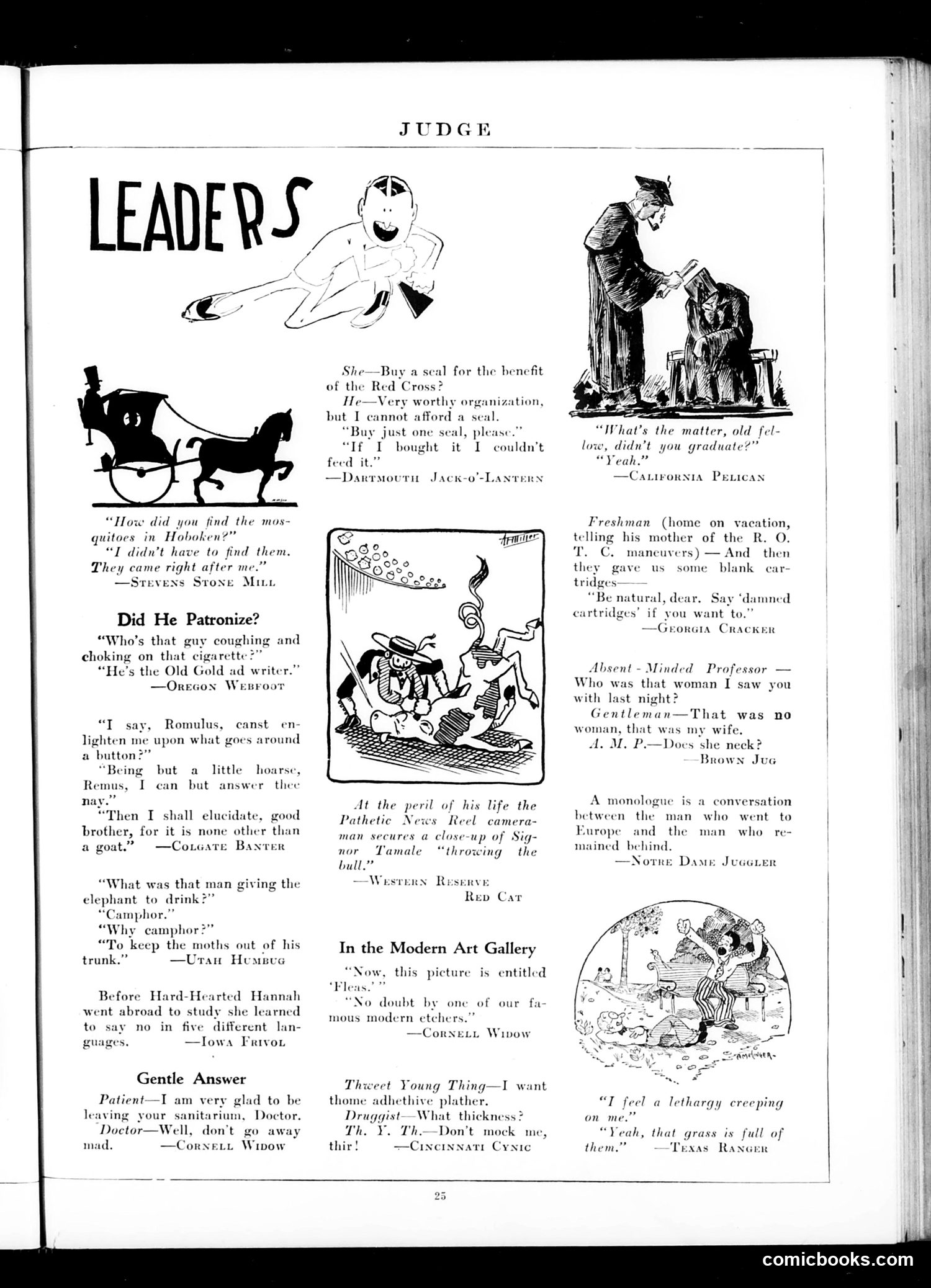
This is a humor page from *Judge*, featuring short jokes and satirical cartoons typical of early-20th-century American comedy magazines. The content includes: **Joke Types:** - Puns and wordplay (mosquitoes in Hoboken, button/goat riddle, camphor in elephant's trunk) - Social commentary on courtship ("She—Buy a seal for Red Cross?") - Observations about modern life (modern art snobbery, absent-minded professors, returning travelers) - Mild satire on institutions (sanitariums, ROTC military training) **The Cartoons:** Feature caricatured figures in situations depicting everyday absurdities—a man examining a tree stump, jazz musicians, and social scenarios. **No Specific Political Figures:** Unlike many *Judge* pages, this appears focused on general social satire rather than targeting particular politicians or events. The Red Cross reference suggests wartime context, but specifics aren't identifiable from the page alone. The humor reflects period sensibilities: class-conscious exchanges, gender dynamics, and emphasis on clever wordplay over narrative comedy.
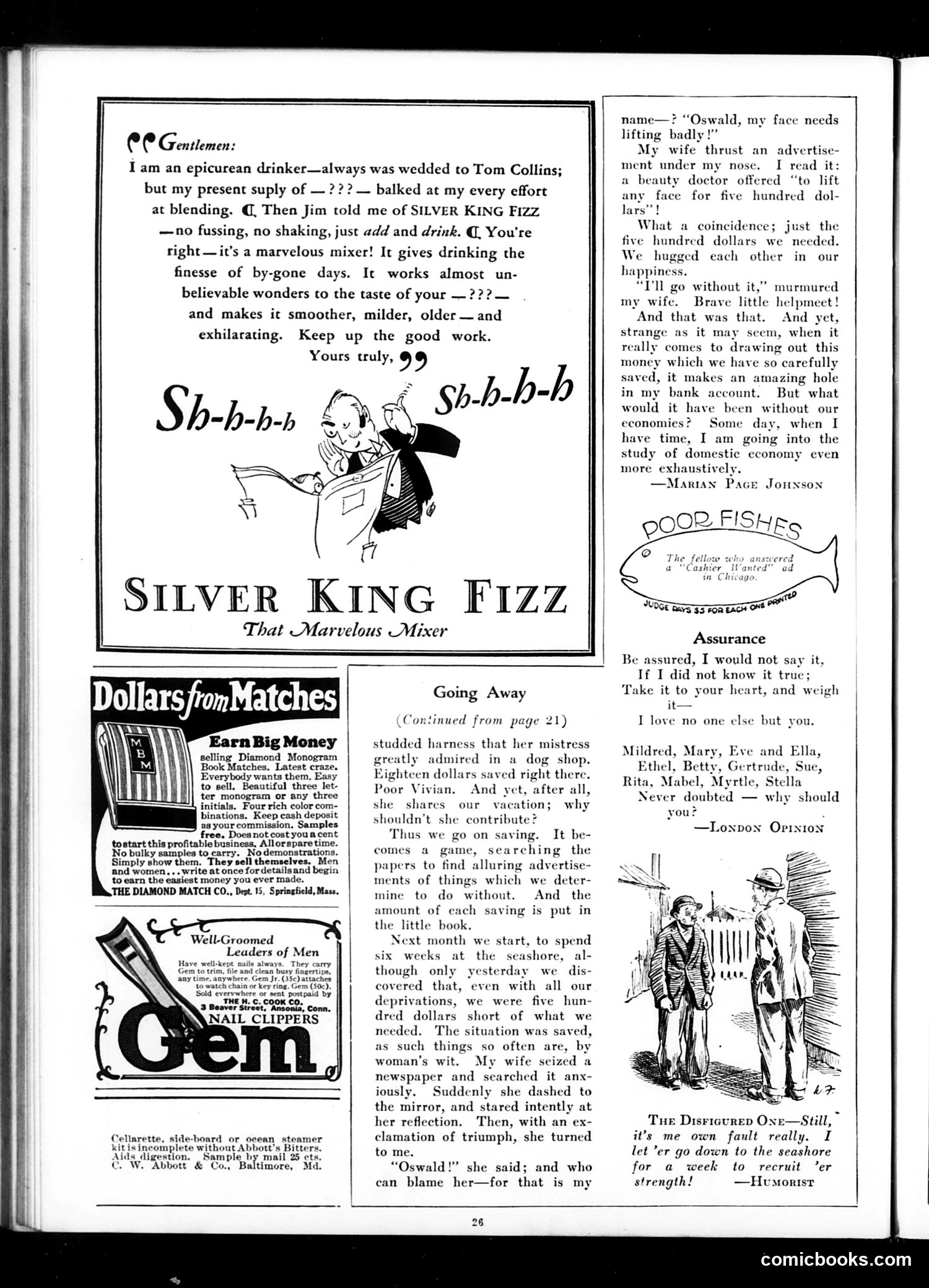
This page mixes advertisements with short humorous pieces typical of early 20th-century satirical magazines. **Main Content:** A fictional letter praising "Silver King Fizz" mixer (an advertisement disguised as reader mail—a common advertising technique). The writer, identifying himself as "an epicurean drinker," enthusiastically endorses the product for mixing drinks. **Story "Going Away":** A domestic humor piece where a husband and wife scrimp and save for a vacation, only to discover they're still $500 short. The wife's solution: she finds an advertisement for a face-lifting procedure costing exactly $500 and offers to skip it so they can go to the seashore instead—an ironic commentary on vanity versus marital priorities. **Other Content:** Period advertisements for matchbook sales, nail clippers, and bitters; brief humorous poems about love and marital discord. The satire targets consumer culture and the emerging advertising industry's persuasive power over domestic decision-making.
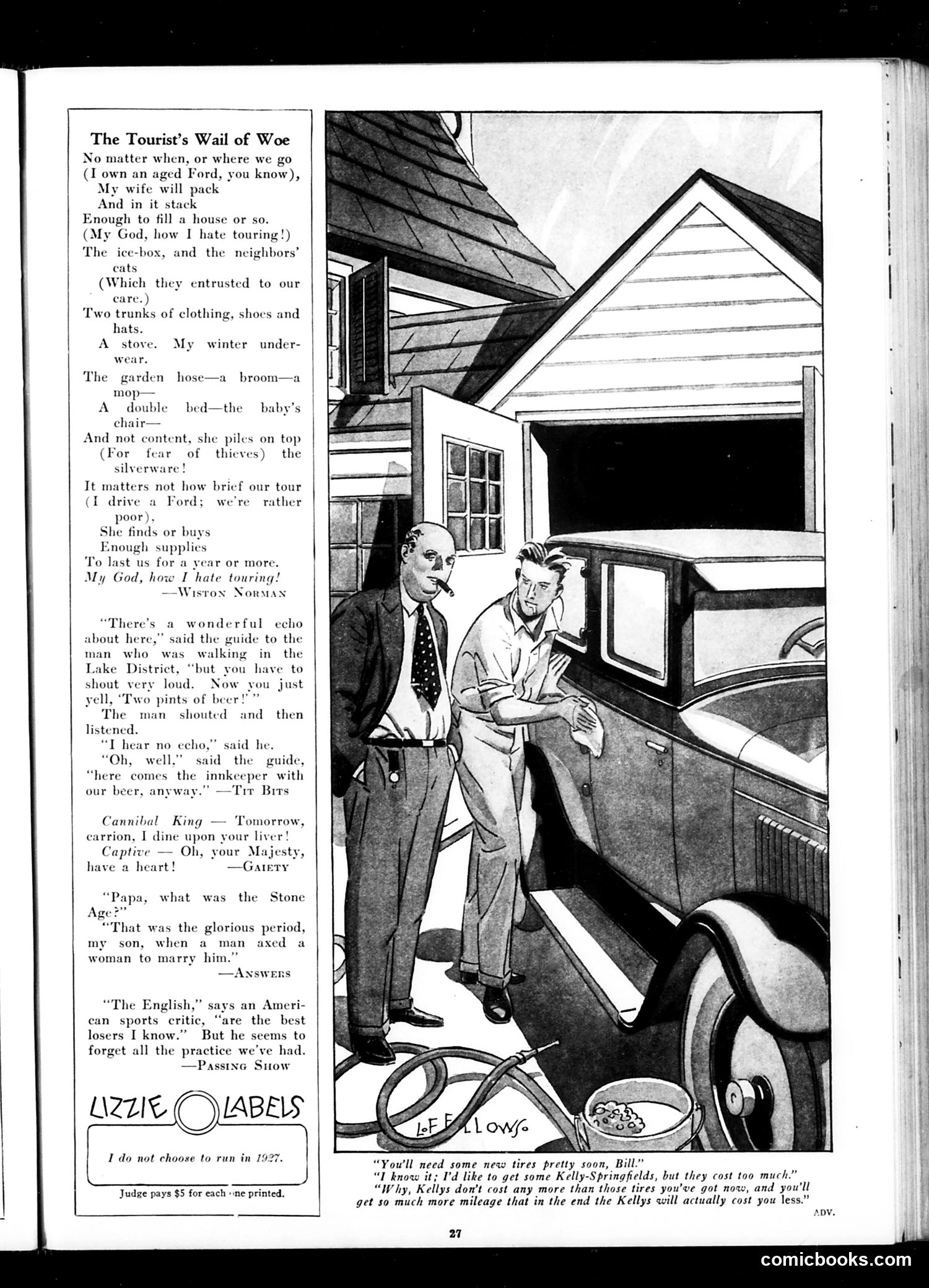
This page contains multiple brief satirical pieces typical of 1920s humor: **"The Tourist's Wail of Woe"** (by Winston Norman) mocks middle-class automobile tourism. It depicts a husband's frustration that his wife overpacks their aged Ford with household items, animals, and supplies for even brief trips—transforming touring into domestic burden. The satire targets the era's new car culture and changing leisure habits. **The Lake District echo joke** plays on tourist gullibility and rural innkeeper cunning—the "echo" is actually the innkeeper arriving with beer the tourist must purchase. **The Cannibal King** bit is period-typical minstrelsy humor (unclear if satirical intent). **The Lizzie Labels section** references Calvin Coolidge's famous 1927 statement "I do not choose to run," with a joke about political indecision. **The Kelly-Springfields tire advertisement** disguises itself as cartoon dialogue, using comparative value to sell premium tires. The page reflects 1920s preoccupations: automobile ownership, consumer goods, and emerging advertising techniques.
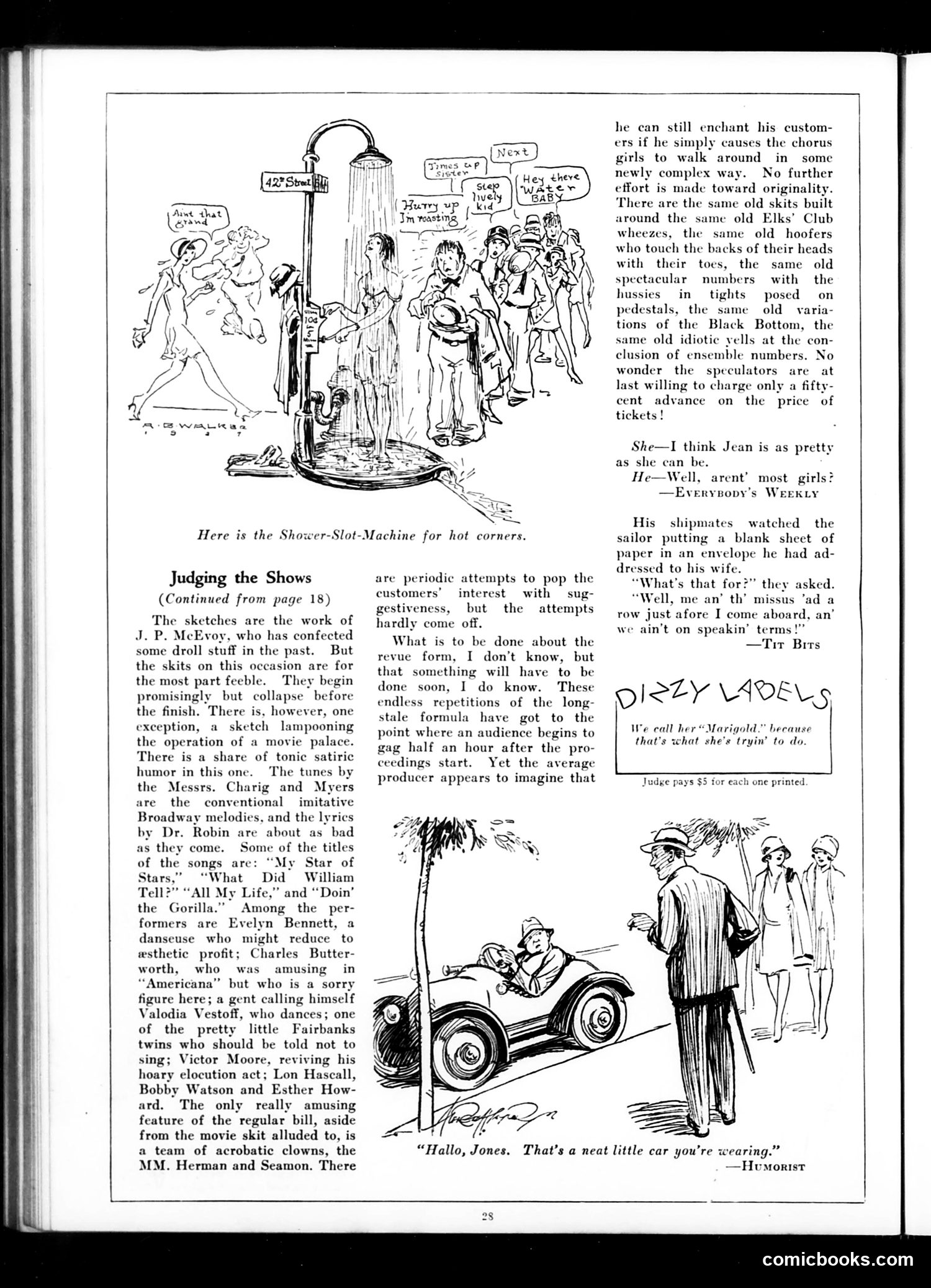
This page contains theater criticism and humorous cartoons from Judge magazine. **Main Content:** The essay "Judging the Shows" reviews a Broadway revue, criticizing its formulaic nature. The critic argues that producers keep recycling stale entertainment—the same comedy skits about Elks' Clubs, the same hoofers, the same "Black Bottom" dance variations—expecting audiences to remain entertained. The reviewer laments that audiences now lose interest halfway through performances. **Cartoons:** 1. **Top cartoon**: Depicts a "Shower-Slot-Machine for hot corners"—a humorous invention where coins operate a shower that douses people on a street corner, apparently referencing theatrical "hot corners" or heated moments. 2. **Bottom cartoon**: A sailor shows shipmates a blank letter addressed to his wife, explaining they had a fight before he shipped out and aren't "on speakin' terms." The page also includes brief jokes, including one calling a woman "Marigold" because of what "she's tryin' to do" (suggesting pregnancy). The overall tone satirizes both entertainment industry staleness and relationship troubles.
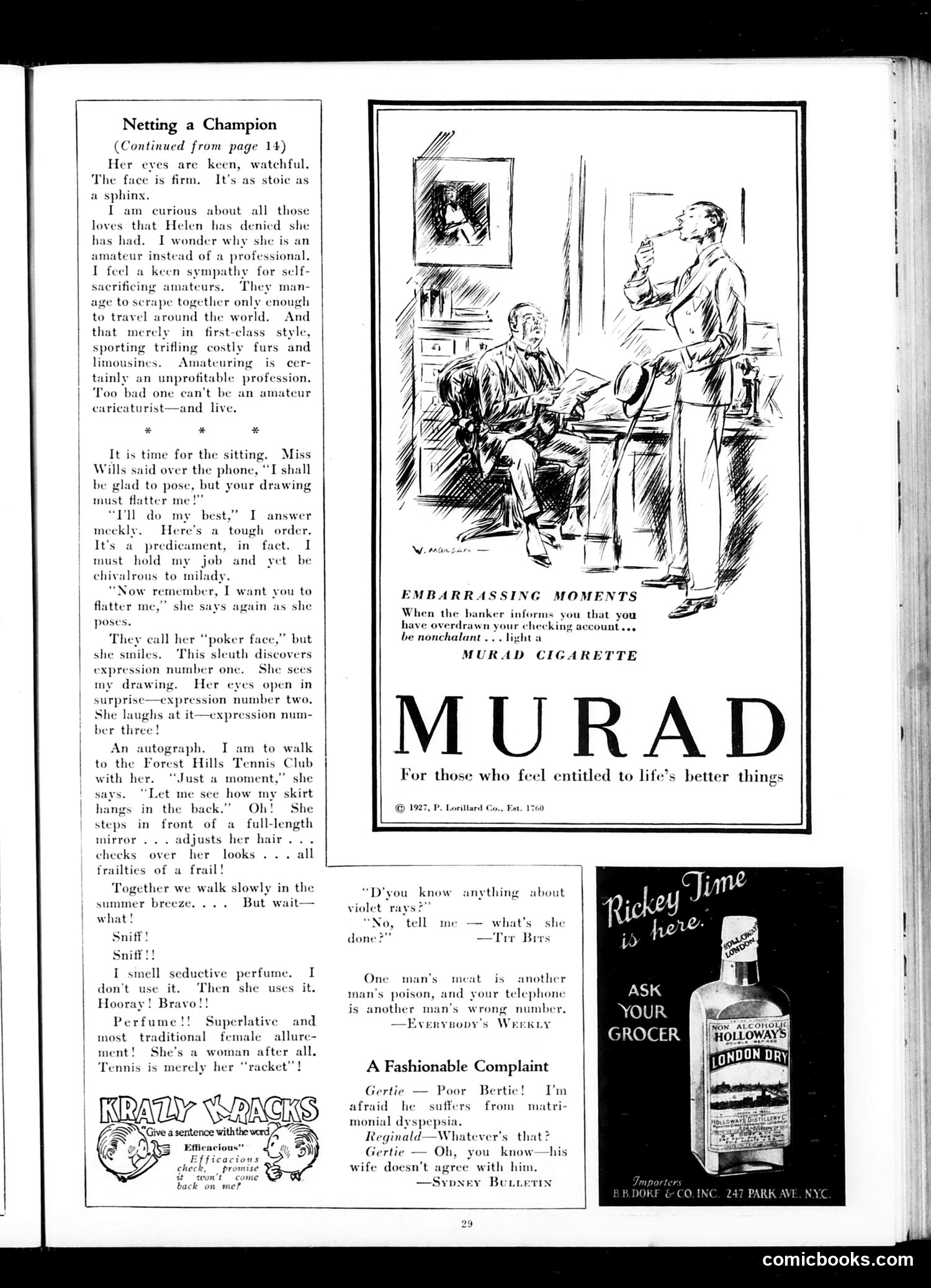
This piece satirizes the pretensions and contradictions of amateur female athletes, specifically targeting Helen Wills (the famous tennis champion, though not named). The narrator—a society cartoonist—observes that Wills maintains "amateur" status despite the wealth and lifestyle (furs, limousines, world travel) typically associated with professionals. The satire highlights the hypocrisy: she claims amateurism while living luxuriously, yet refuses lucrative professional opportunities. The piece mocks her vanity—obsessing over appearance in mirrors despite her "poker face" persona—and her use of perfume, undermining the serious athlete image. The cartoonist's struggle to "flatter" her while maintaining artistic integrity satirizes women's demand for flattery disguised as professional portraiture. The accompanying jokes about "embarrassing moments" (bank overdrafts, marital discord) reinforce the period's dismissive view of women's concerns as trivial and vain.
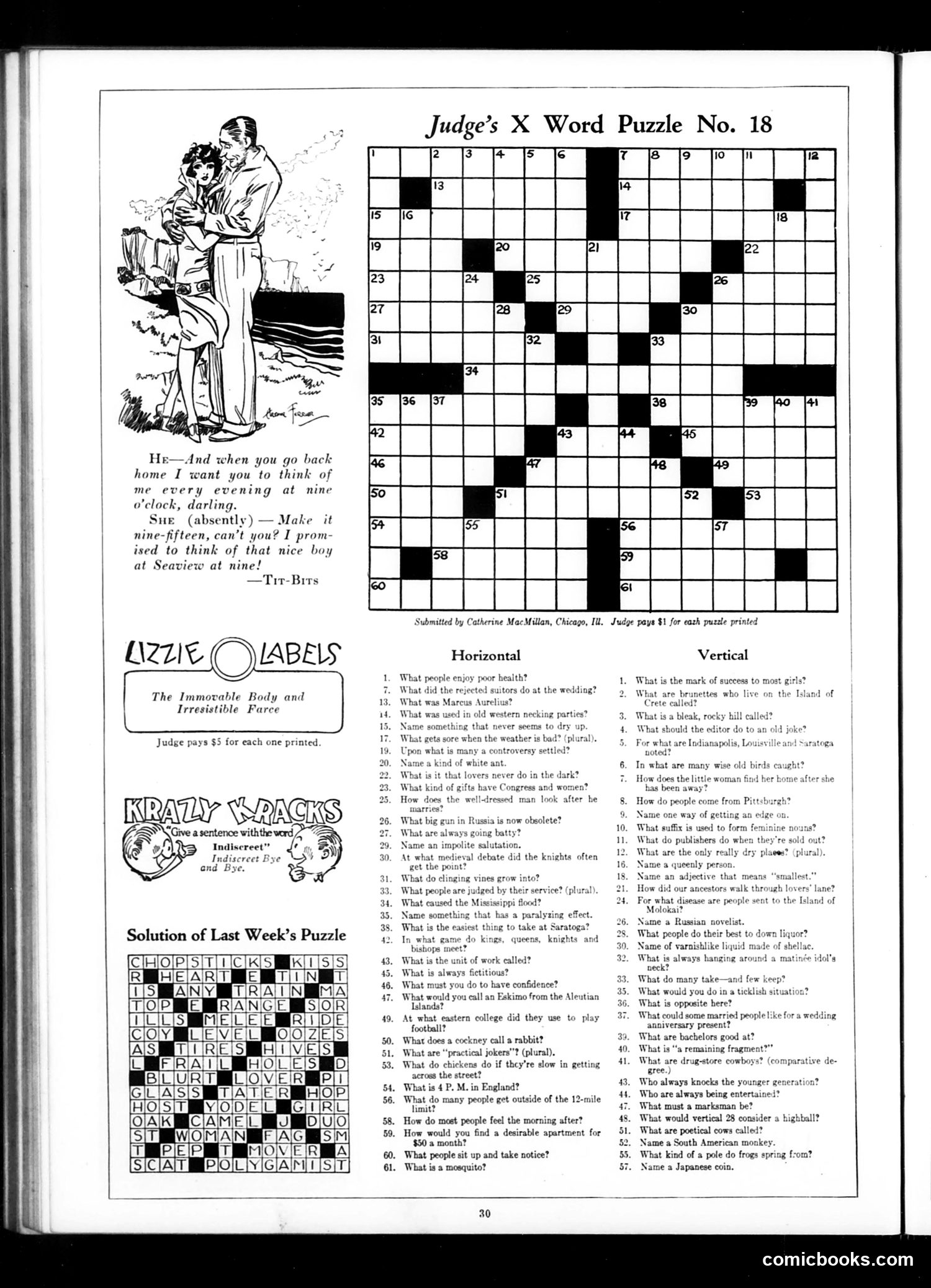
This page primarily contains a **crossword puzzle** with humorous clues rather than a political cartoon. The small illustration at top shows a romantic couple with dialogue—a comedic bit about infidelity: a woman tells her boyfriend she'll think of him every evening at 9 o'clock, then admits she promised another man the same time slot, asking to move it to 9:15. It's credited to "Tit-Bits," a humor publication. The crossword clues are intentionally amusing wordplay and riddles ("What people enjoy poor health?" "What are 'practical jokers'?"). Below is a section called "Lizzie Labels" (an advice/humor feature) and "Krazy Klacks" (another puzzle), plus the solution to the previous week's crossword. This is **entertainment content**—puzzle pages were standard magazine filler, not political satire. The humor is lighthearted domestic comedy and clever riddles, typical of Judge magazine's offerings for leisure activity.
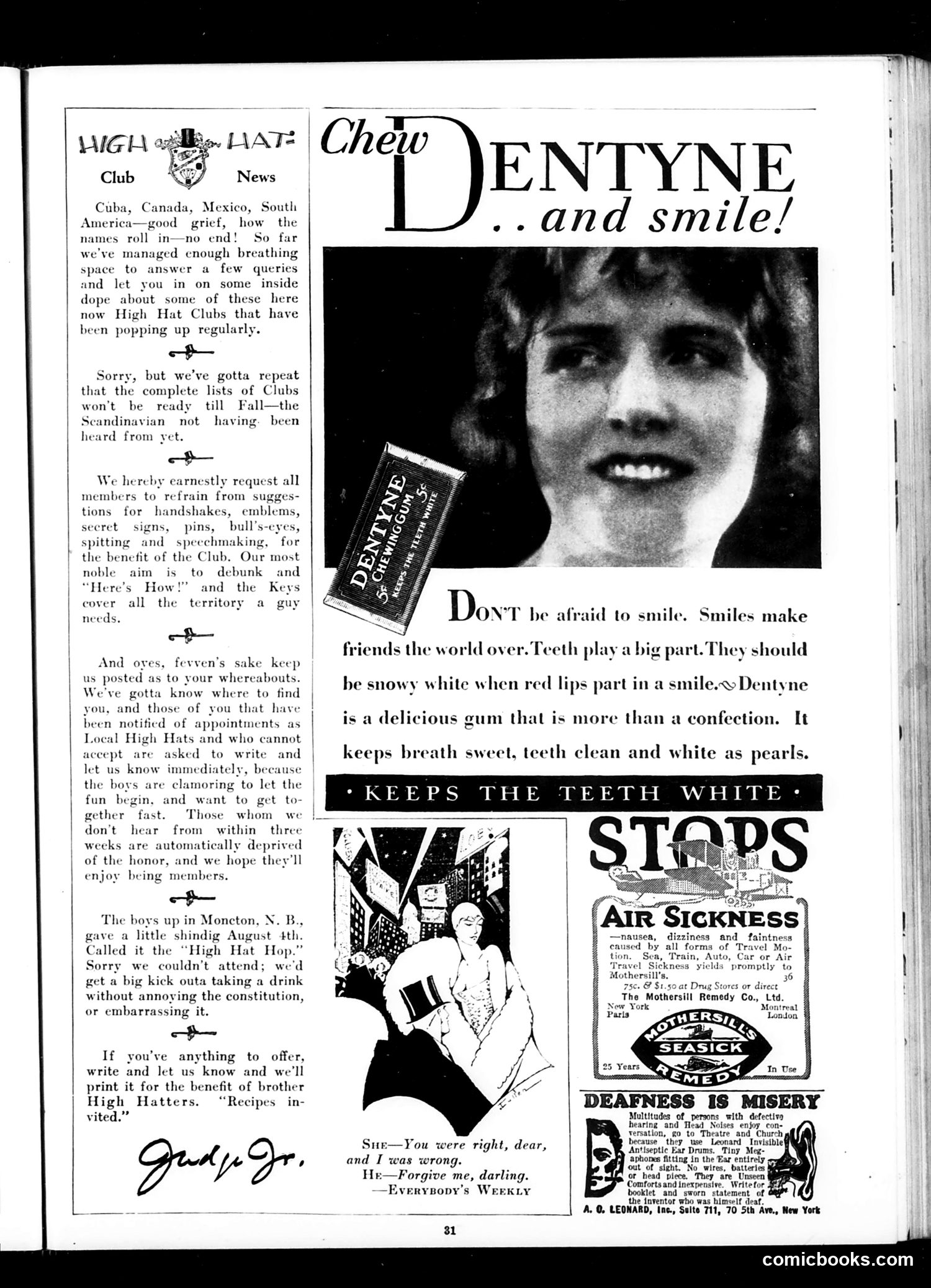
This page contains **primarily advertising and club news**, not political satire. The left column features "High Hat Club News"—editorial announcements about a social organization expanding to Cuba, Canada, and Mexico. The editors humorously request members stop suggesting elaborate club paraphernalia (handshakes, emblems, pins) and maintain decorum. They mention a "High Hat Hop" in Moncton, N.B., and note that members can submit "recipes" for club activities. The right side is dominated by **period product advertisements**: Dentyne chewing gum (with a smiling woman), Mothersill's travel sickness remedy, and Leonard's invisible ear drums for hearing loss. These ads use common early-20th-century marketing appeals—beauty, health solutions, and discreet medical devices. The only humor derives from the club's internal dynamics and the somewhat absurd juxtaposition of ads. This appears to be a filler/community-interest page rather than satirical content targeting specific political figures or events.
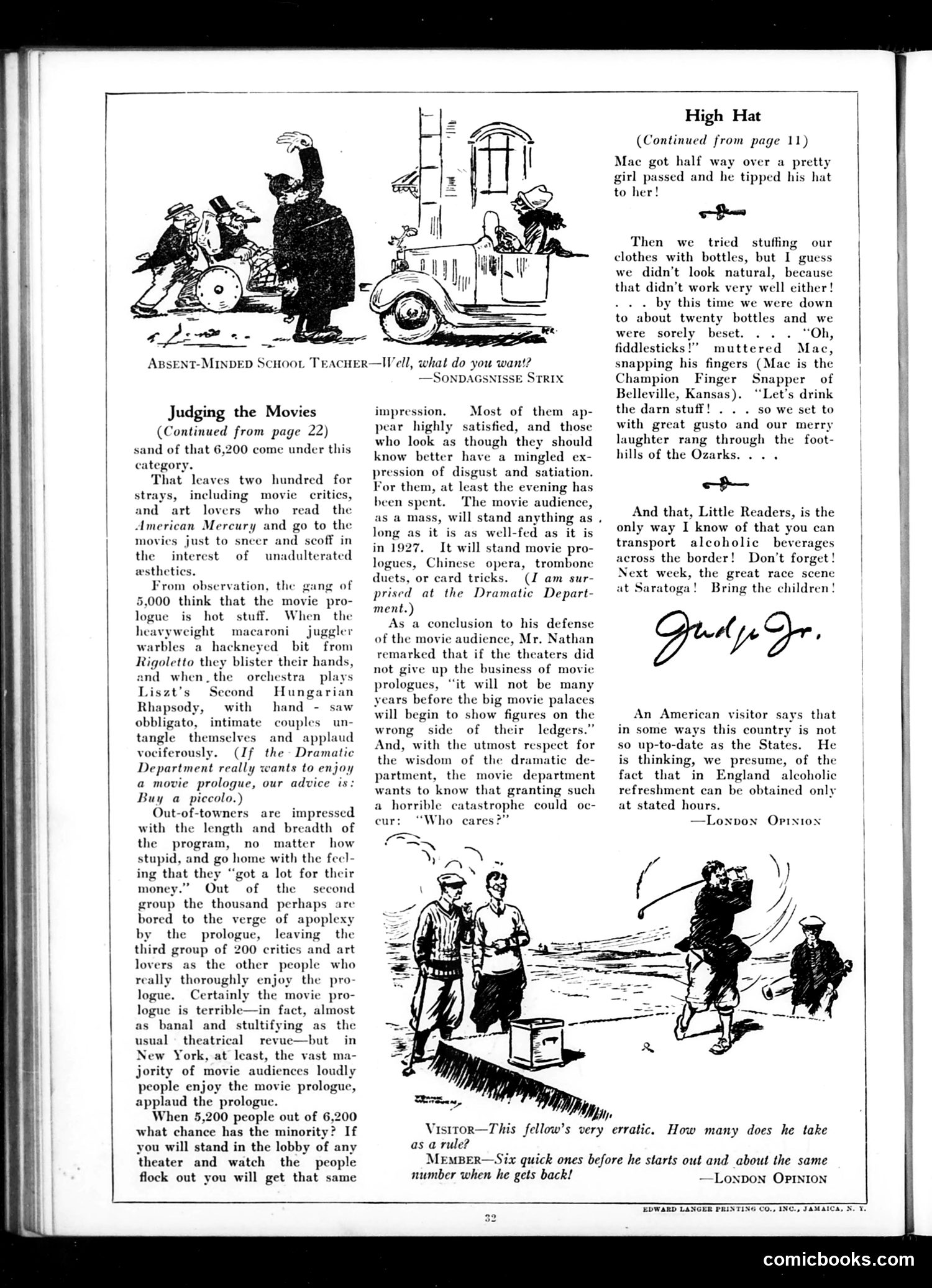
This page contains three satirical pieces from Judge magazine: **"Absent-Minded School Teacher"** (top cartoon): A simple visual gag showing a distracted teacher tipping his hat to a girl while children with a wagon await his attention—illustrating absent-mindedness. **"Judging the Movies"** (main article): Social commentary on 1920s movie theater audiences. The author argues that of 6,200 moviegoers, 5,000 enjoy movie prologues (musical performances before films) uncritically, while only 200 are sophisticated critics. The piece satirizes mass entertainment appeal versus intellectual standards—typical of 1920s anxieties about lowbrow versus highbrow culture. References to "Rigoletto" and "Liszt's Second Hungarian Rhapsody" establish the critic's sophisticated taste. **"High Hat"** (narrative): A humorous Prohibition-era tale about smuggling alcohol across the border by hiding bottles in clothing. **Bottom cartoons**: Two British humor pieces mocking an American visitor's observations about England's limited bar hours, and questioning someone's drinking habits. The page reflects 1920s concerns: mass culture, Prohibition, and transatlantic social differences.
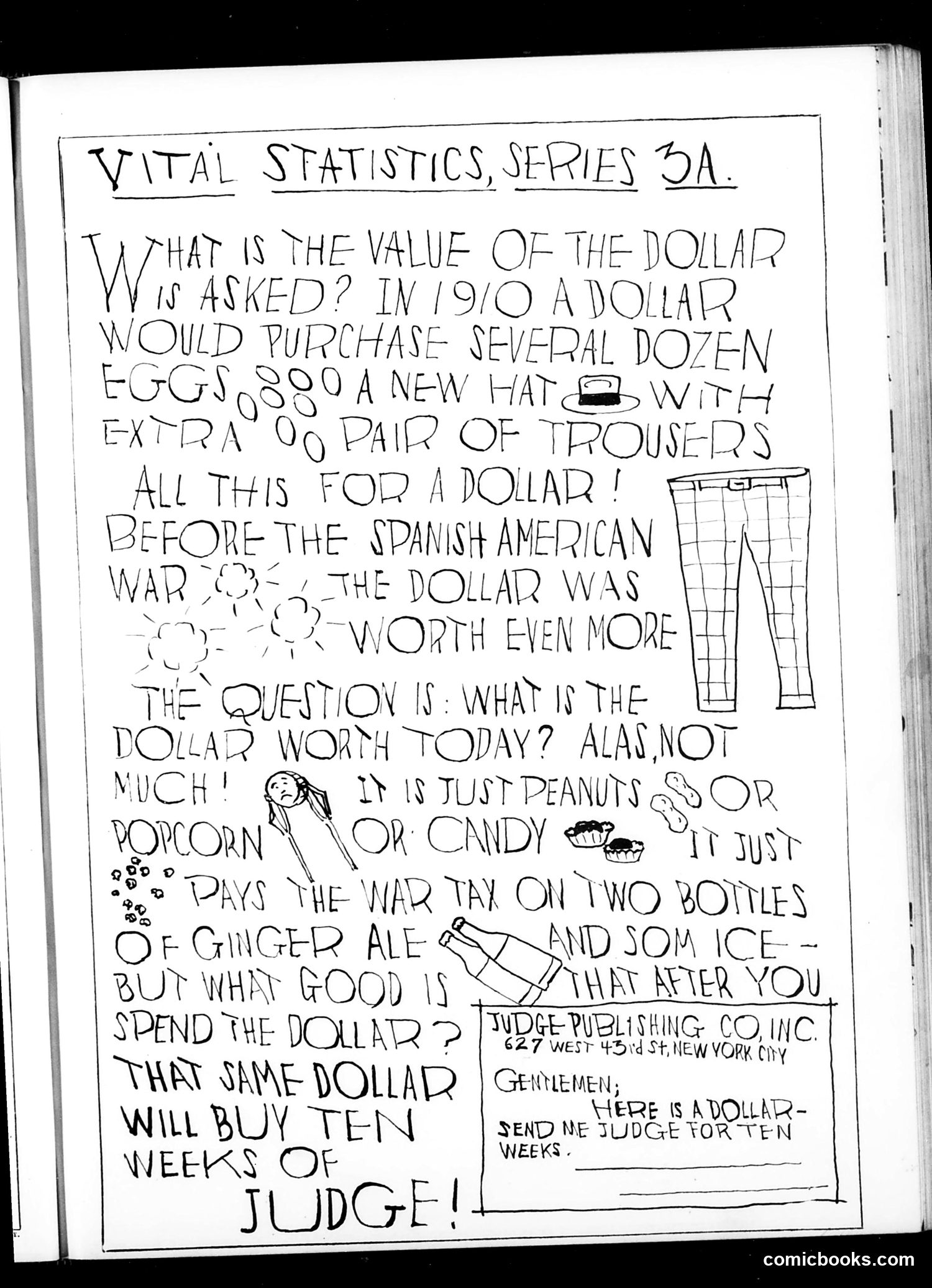
This is a satirical piece about **currency inflation and declining purchasing power** following the Spanish-American War (1898). The cartoon contrasts what a dollar could buy *before* the war—multiple eggs, clothing, food items—with its drastically reduced value afterward. The humor lies in the punchline: that same dollar now buys only "ten weeks of JUDGE!" This is **self-promotional advertising** disguised as social commentary. Judge magazine is making a joke about inflation while simultaneously pitching itself as the only worthwhile use for devalued currency. The message: your dollar has lost value everywhere else, so spend it on our magazine instead. The piece reflects genuine post-war economic concerns about inflation and fiscal policy, common topics in satirical publications of the era, while using humor to hawk subscriptions.
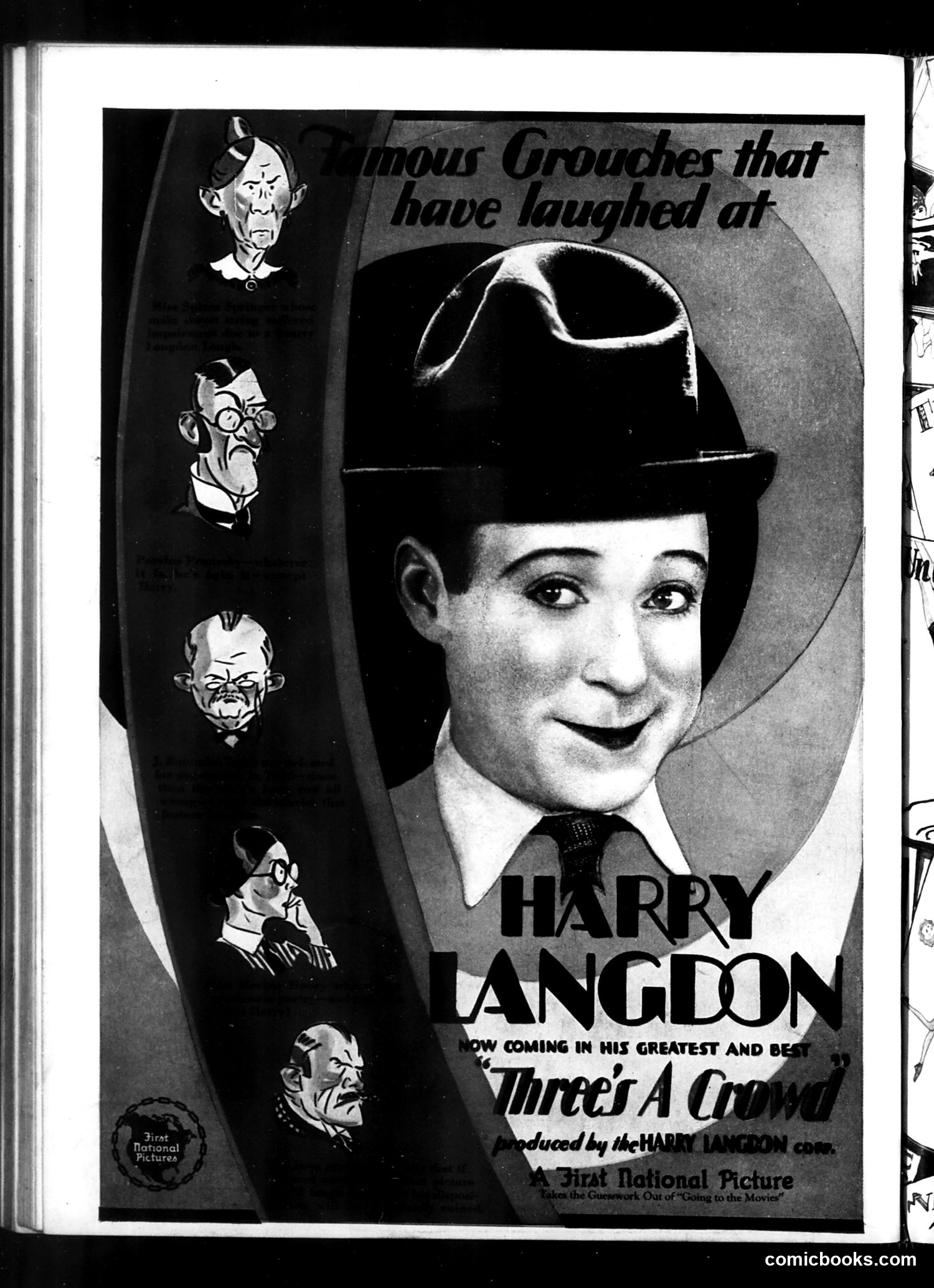
This is primarily a **movie advertisement** rather than political satire. It promotes Harry Langdon's film "Three's a Crowd," produced by the Harry Langdon Company and distributed by First National Pictures. The page features: - A large headshot of comedian Harry Langdon wearing a bowler hat - Five caricatured character faces along the left margin (labeled as "Grouches that have laughed at") - Standard promotional language emphasizing this as his "greatest and best" film **Context**: Langdon was a major silent-film comedian of the 1920s-30s, comparable to Chaplin or Keaton. The caricatures likely depict various character types he portrays in the film, meant to showcase his comedic range. This appears to be a straightforward entertainment advertisement rather than editorial commentary.