
Judge, 1927-08-27 · page 8 of 36
Judge — August 27, 1927 — page 8: what you’re looking at
What you’re looking at
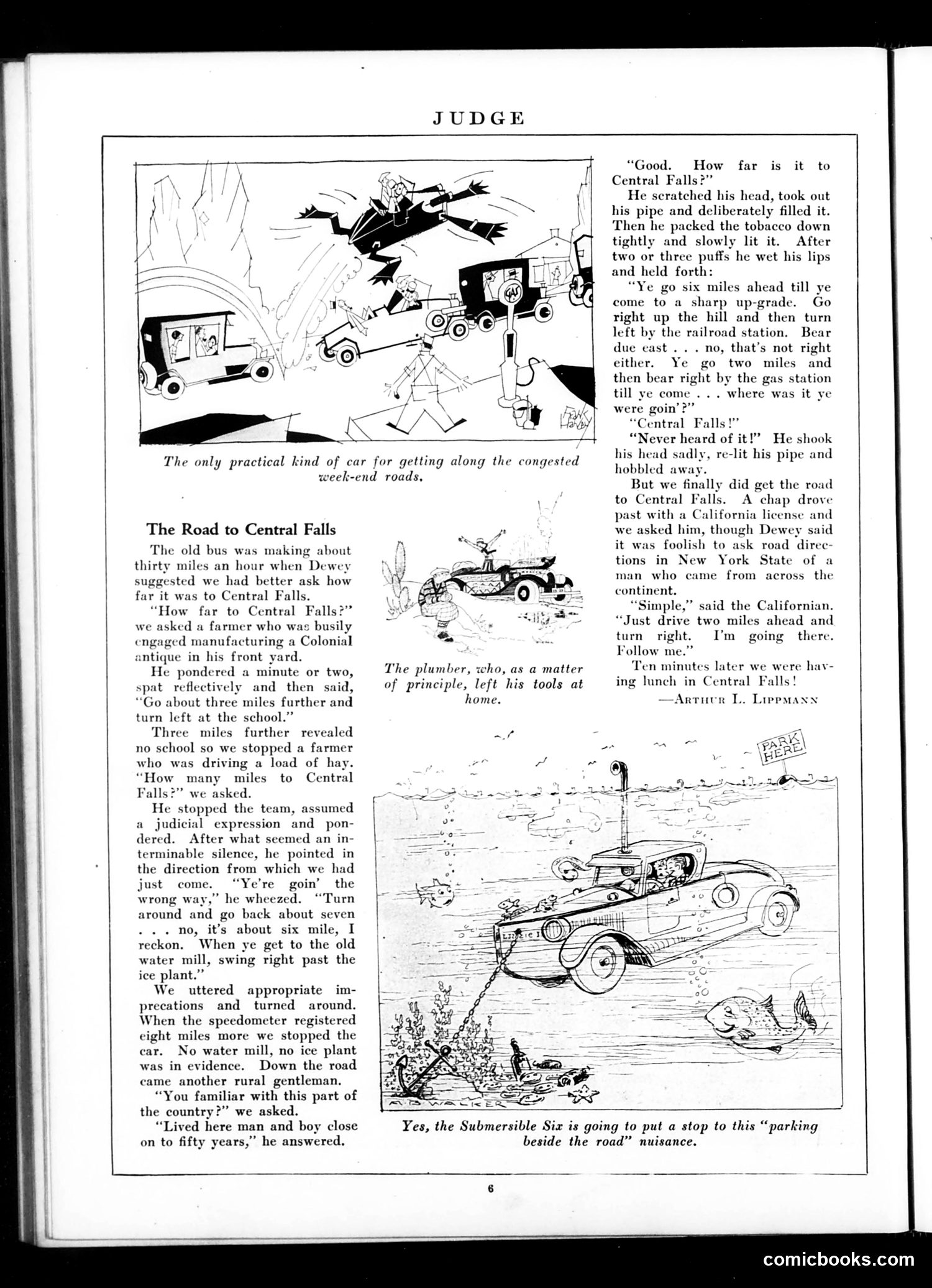
This piece satirizes rural directions and the absurdity of asking locals for help navigating country roads. The humor centers on a common American experience: farmers' inability (or unwillingness) to give clear directions. Each rural man consulted provides contradictory, vague, or nonsensical guidance—pointing backward, referencing non-existent landmarks (the water mill, ice plant, school), and constantly revising their answers. The punchline arrives when a *Californian* visitor—someone from far away, assumed to know nothing of the area—gives clear, simple directions that actually work. The satire cuts both ways: mocking both rural confusion/obstinacy AND the city dweller's prejudice that an outsider couldn't possibly help. The accompanying cartoon illustrations of chaotic weekend traffic and the "Submersible Six" car joke about cars being impractical on crowded roads, adding to Judge's commentary on modern automotive inconvenience.
📄 Transcribed text from this page (OCR, searchable)
Machine-transcribed from the original scan — historical spelling and the odd misread are preserved.
“Good. How Central Falls?” He scratched his head, took out id deliberately filled it. far is it to tightly and slowly lit it. After two or three puffs he wet his lips and held forth: “Ye go six miles ahead till ye come to a sharp up-grade. Go right up the hill and then turn left by the railroad station. Bear due east . . . no, that’s not right either. Ye go two miles and then bear right by the station till ye come . . . where was it ye were goin’ “Central Falls!” The Road to Central Falls The old bus was making about thirty miles an hour when Dewey suggested we had better ask how far it was to Central Falls. “How far to Central we asked a farmer who we engaged manufacturing antique in his front yard. He pondered a minute or two, spat reflectively and then said, “Go about three miles further and turn left at the school.” Three miles further revealed no school so we stopped a farmer j who was driving a load of hay. } “How many miles to Central Falls?” we asked. He stopped the team, assumed a judicial expression and pon- dered. After what seemed an in- terminable silence, he pointed in the direction from which we had j just come. “Ye’re goin’ the } wrong way,” he wheezed. “Turn } around and go back about seven . .. no, it’s about six mile, I reckon. When ye get to the old water mill, swing right past the ice plant.” We uttered appropriate im- precations and turned around. When the speedometer registered eight miles more we stopped the No water mill, no ice plant in evidence. Down the road came another rural gentleman. “You familiar with this part of the country?” we asked. “Lived here man and boy close on to fifty years,” he answered, > busily a Colonial The only practical kind of car for getting along the congested week-end roads, “Never heard of it!” He shook his head sadly, re-lit his pipe and hobbled 4 A chap drove past with a California license and we asked him, though Dewey said it was foolish to ask road direc- tions in New York State of a man who came from across the continent, “Simple,” said the Californian. “Just drive two miles ahead and turn right. I’m going there. Follow me.” Ten minutes later we were hav- ing lunch in Central Falls! The plumber, who, as a matter of principle, left his tools at home. —Arruver L. Lippmann Yes, the Submersible Six is going to put a stop to this “parking beside the road” nuisance. comicbooks.com