
Judge, 1927-08-27 · page 15 of 36
Judge — August 27, 1927 — page 15: what you’re looking at
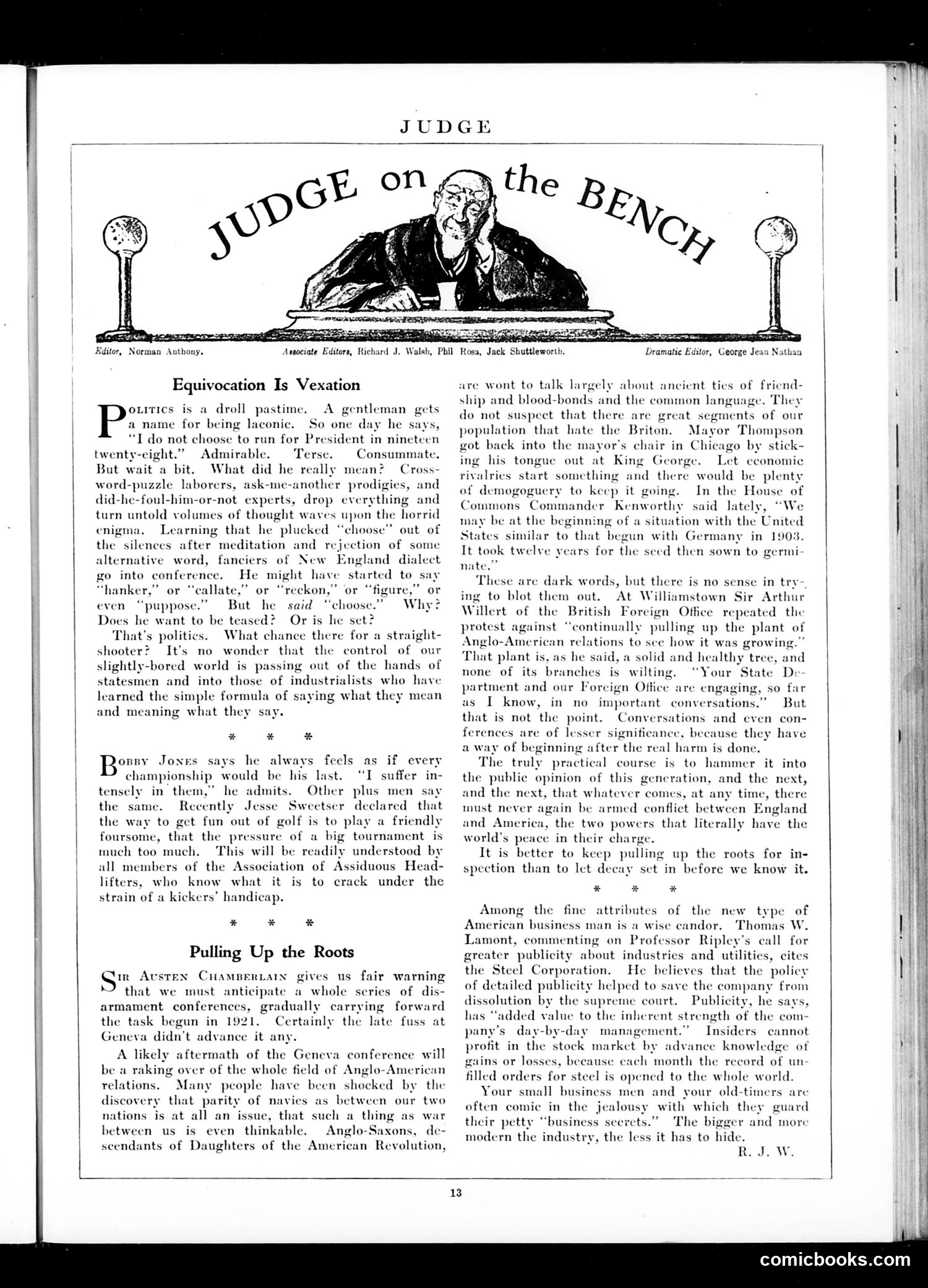
What you’re looking at
This page from Judge (a prominent American satirical magazine) contains three editorial pieces attacking political equivocation and discussing Anglo-American relations. The lead article mocks President Coolidge's famous non-committal statement: "I do not choose to run for President in nineteen twenty-eight." The satire criticizes his deliberately vague language—people debated whether "choose" meant he wouldn't run or was merely being coy. Judge argues such political ambiguity represents poor leadership, contrasting it with industrialists who "say what they mean." The second piece discusses Chicago Mayor Thompson, who previously gained popularity by anti-British rhetoric ("sticking his tongue out at King George"). The final section warns that Anglo-American tensions—despite shared language and heritage—remain real. It references British officials' concerns (Sir Arthur Willert, Commander Kenworthy) that economic rivalry could breed conflict, comparing potential US-UK tensions to pre-WWI US-German relations. Judge advocates maintaining the relationship rather than complacently assuming shared blood-bonds guarantee peace.
📄 Transcribed text from this page (OCR, searchable)
Machine-transcribed from the original scan — historical spelling and the odd misread are preserved.
JUDGE Editor, Norman Authony. Equivocation Is Vexation outtics is a droll pastime. A gentleman gets P: name for being laconic. So one day he “TI do not choose to run for President in nineteen twenty-eight.” Admirable. Terse. Consummate. But wait a bit. What did he really mean? Cross- word-puzzle laborers, ask-me-another prodigies, and did-he-foul-him-or-not experts, drop everything and turn untold volumes of thought waves upon the horrid enigma, Learning that he plucked “choose” out of the silences after meditation and rejection of some alternative word, fanciers of New England dialect go into conference. He might have started to say “hanker,” or llate,” or “reckon,” even “puppose.” But he said “choose. Does he want to be teased? Or is he set? That's polities. What chance there for a st shoote It’s no wonder that the control of our slightly-bored world is passing out of the hands of statesmen and into those of industrialists who have learned the simple formula of saying what they mean and meaning what they say. or “figure,” or Why? ight- * * * Bo" Jones says he always feels as if every championship would be his last. “I suffer in- tensely in them,” he admits. Other plus men say the same. Recently Jesse Sweetser declared that the way to get fun out of golf is to play a friendly foursome, that the pressure of a big tournament is much too much. This will be readily understood by all members of the Association of Assiduous Head- lifters, who know what it is to crack under the strain of a kickers’ handicap. * * * Pulling Up the Roots ir Austen Cuamperca es us fair warning that we must anticipate a whole series of dis- armament conferences, gradually carrying forward the task begun in 1921. Certainly the late fuss at Geneva didn’t advance it any. A likely aftermath of the Geneva conference will be a raking over of the whole field of Anglo-American relations. Many people have been shocked by the discovery that parity of navies as between our two nations is at all an issue, that such a thing as war between us is even thinkable. Anglo- ons, de- scendants of Daughters of the American Revolution, $ssociate Editors, Richard J. Walsh, Phil Rosa, Jack Shuttleworth. Dramatic Editor, George Jean Nathan are wont to talk largely about ancient tics of friend- ship and blood-bonds and the common language. They do not suspect that there are great segments of our population that hate the Briton. M: got back into the mayor's chair in Cl yor Thompson ago by stick- ing his tongue out at King George. Let economic rivalries start something and there would be plenty of demogoguery to kecp it going. In the House of Commons Commander Kenworthy said lately, “We may be at the beginning of a situation with the United States similar to that begun with Germany in 1903. It took twelve years for the seed then sown to germi nate.” g hese are dark words, but there is no sense in try to blot them out. At Williamstown Sir Arthur Willert of the British Foreign Office repeated the protest against “continually pulling up the plant of Anglo-American relations to see how it was growing.” That plant is, as he said, a solid and healthy tree, and none of its branches is wilting. “Your State D: partment and our Foreign Office are engaging, so far as I know, in no important conversations.” But that is not the point. Conversations and even con- ferences are of lesser significance, because they have away of beginning after the real harm is done. The truly practical course is to hammer it into the public opinion of this generation, and the next, and the next, that whatever comes, at any time, there must never again be armed conflict between England and America, the two powers that literally have the world’s peace in their charg It is better to keep pulling up the roots for in- spection than to let decay set in before we know it. * * ¥ Among the fine attributes of the new type of American business man is a wise candor. Thomas W. Lamont, commenting on Professor Ripley's call for greater publicity about industries and utilities, cites the Steel Corporation. He believes that the policy of detailed publicity helped to save the company from dissolution by the supreme court. Publicity, he says, has “added value to the inherent strength of the com- y-by Insiders cannot profit in the stock market by advance knowledge of gains or losses, because each month the record of un filled orders for steel is opened to the whole world. Your small business men and your old-time often comic in the jealousy with which they g their petty “business secrets.” The bigger and more modern the industry, the less it has to hide. R. J. W. pany’s day-by-day management.” comicbooks.com