
A complete issue · 36 pages · 1927
Judge — February 12, 1927
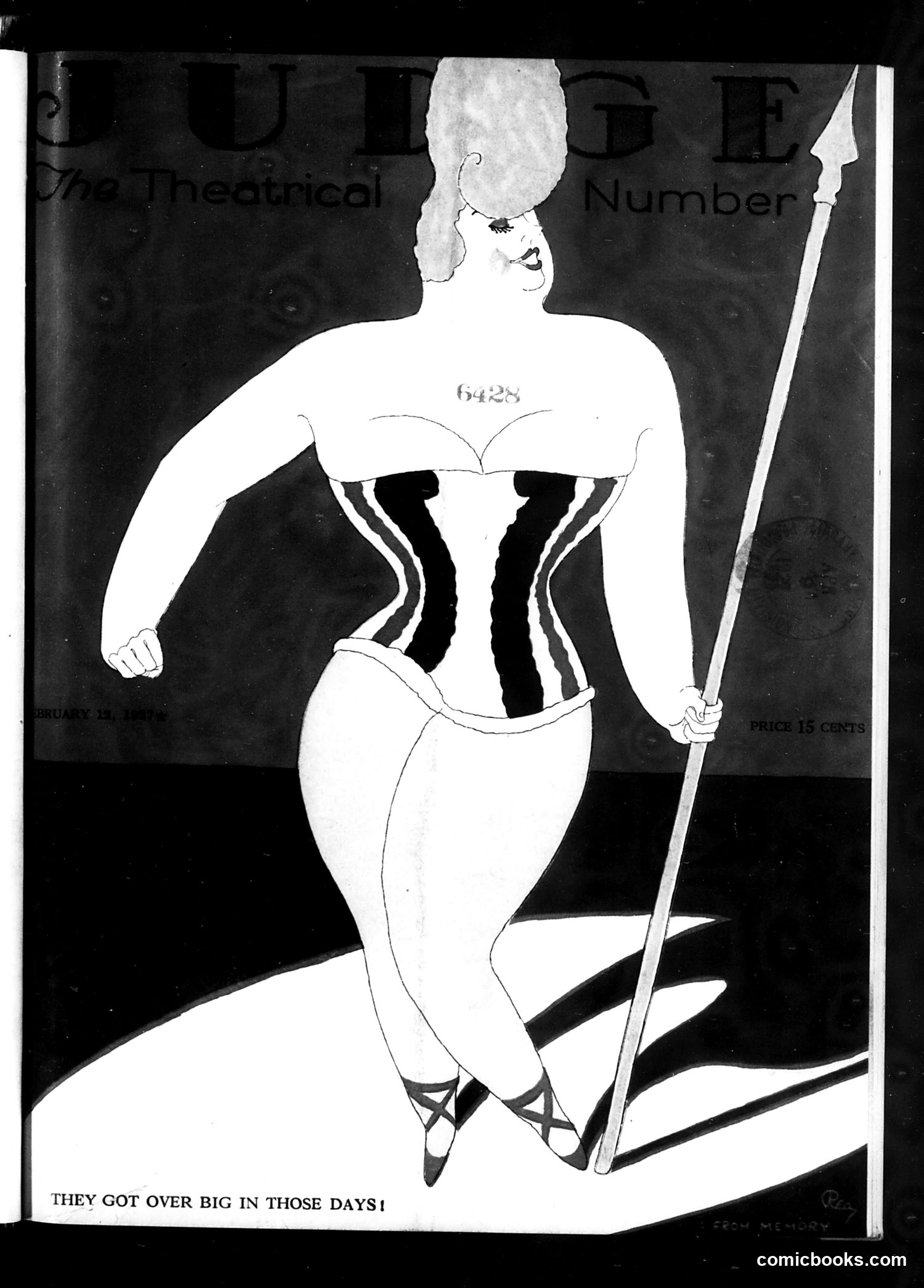
This appears to be a theatrical or burlesque magazine cover from Judge, featuring an exaggerated female figure in a corset and heeled shoes. The caption "THEY GOT OVER BIG IN THOSE DAYS!" suggests nostalgia or commentary on past performance styles. The visible text mentions "The Theatrical Number" and a price of 15 cents, indicating this is a special issue focused on theater and entertainment. The drawing style—with bold black and white contrasts and caricatured proportions—is typical of early-to-mid 20th century satirical illustration. Without clearer OCR text or visible date information, the specific theatrical reference or performer being satirized remains unclear, though the exaggerated anatomy appears to mock theatrical costume conventions or particular performers of that era.

This page is **not a cartoon or satire**—it's a straightforward **product advertisement** for Eveready Layerbilt batteries, manufactured by National Carbon Co., Inc. The ad promotes the "Heavy-Duty Battery" featuring new "Layerbilt construction," emphasizing its economy and longevity compared to competitors. It claims the Layerbilt No. 486 lasts more than twice as long while costing no more than other batteries. The advertisement includes two battery product photos and technical copy explaining the construction advantages: flat current-producing elements with automatic connections that maximize usable space and provide efficient performance. This appears in *Judge*, but represents commercial advertising rather than editorial satire or political commentary.
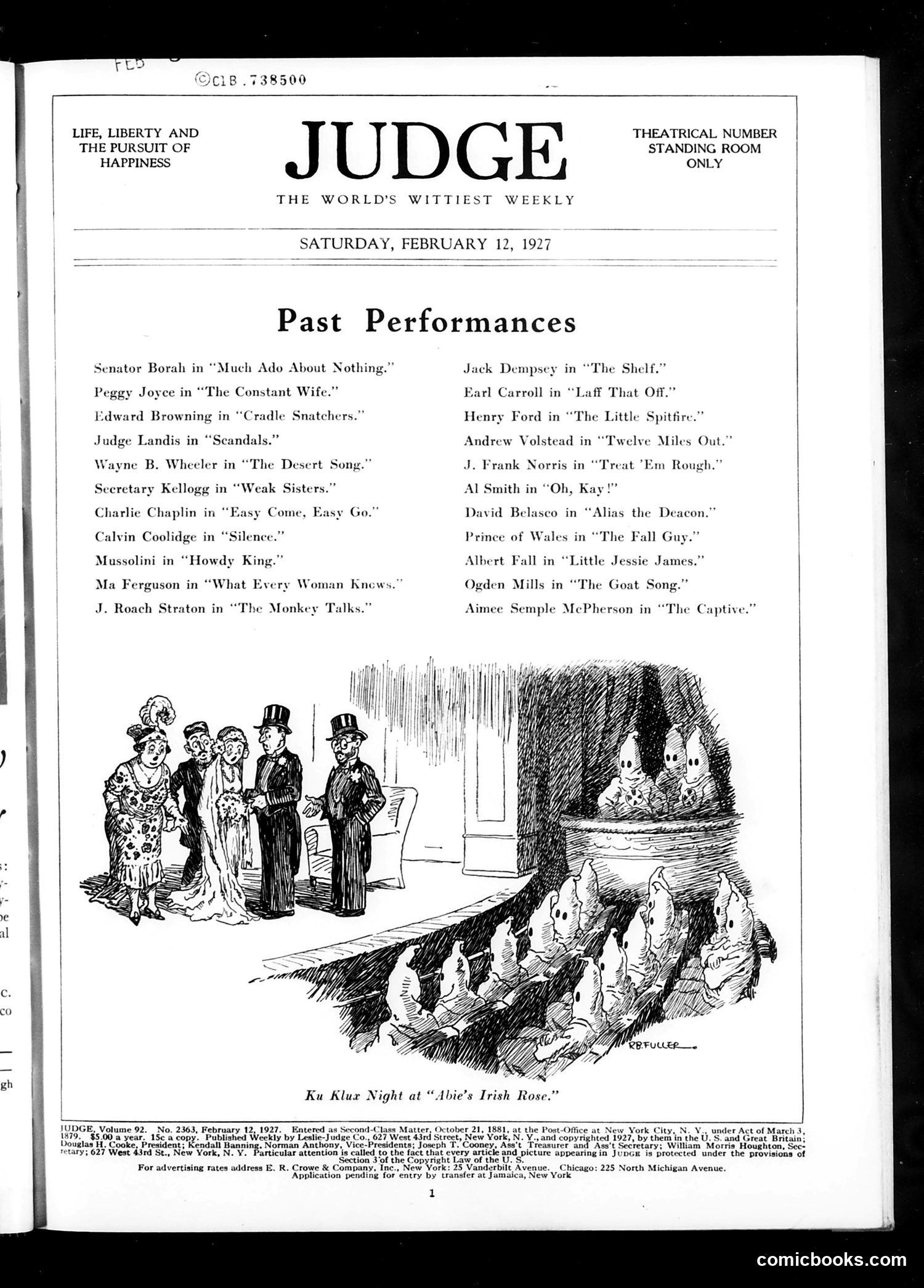
The cartoon titled "Ku Klux Night at 'Abie's Irish Rose'" depicts Ku Klux Klan members (shown as robed figures in the foreground) apparently attending or disrupting a performance of the play "Abie's Irish Rose." This is satire about the KKK's intolerance. "Abie's Irish Rose" (1922) was a popular Broadway comedy centered on interfaith romance between Jewish and Irish-Catholic characters—exactly the kind of ethnic diversity the nativist KKK opposed. The joke mocks the absurdity of Klan members attending a show celebrating the very pluralism they claimed to oppose. The "Past Performances" list above references Hollywood and theatrical figures, establishing the entertainment context. This reflects the 1920s resurgence of KKK activity and contemporary tensions over American identity and immigration.
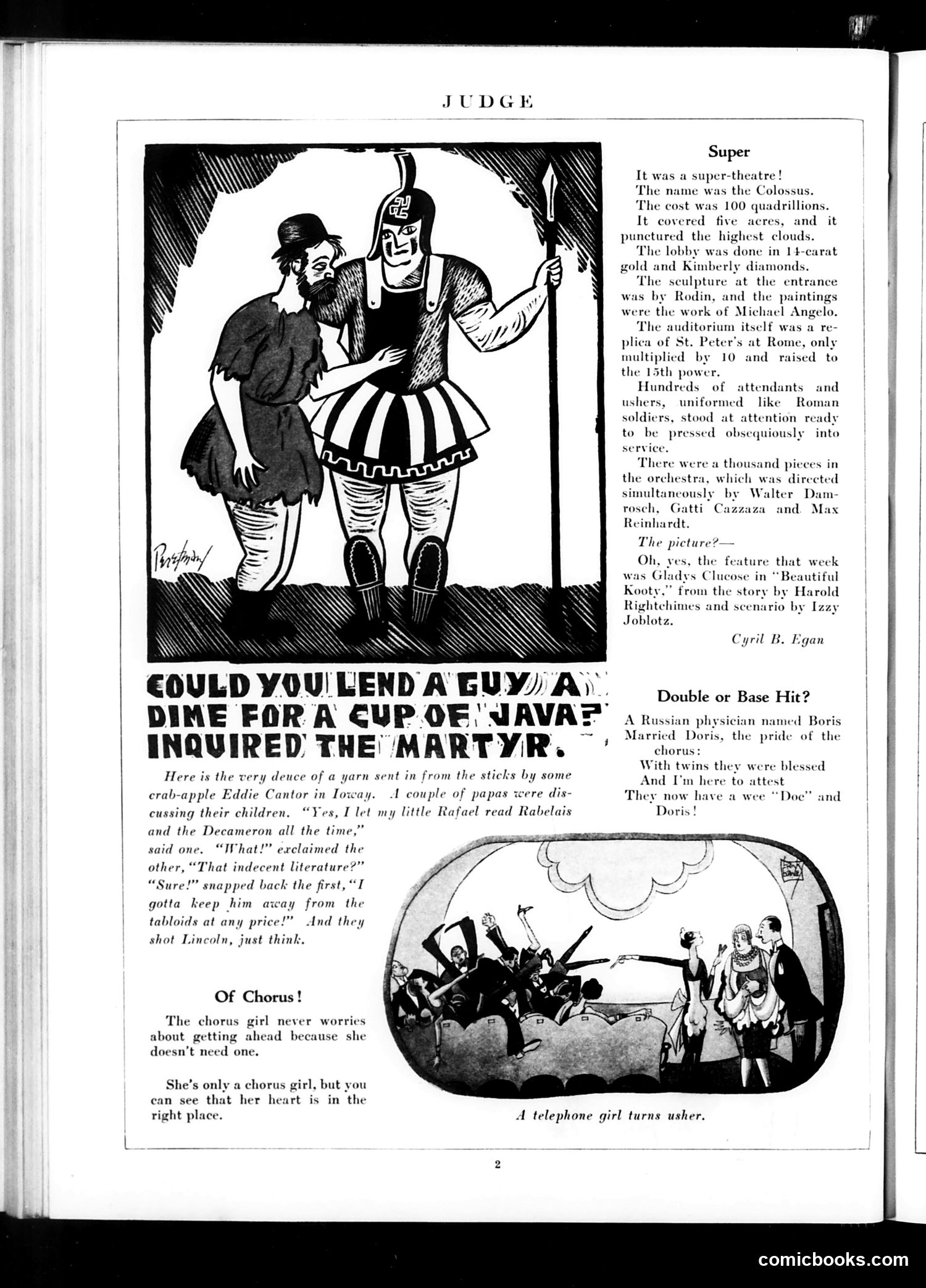
This page contains theatrical humor from the Jazz Age era. The top cartoon depicts a glamorous performer in elaborate costume being admired, satirizing the extravagance of contemporary theater productions—specifically mocking the "super-theatre" trend with astronomical budgets (100 quadrillions mentioned) and star-studded casts. The middle section ridicules pretentious parenting through a dialogue about children reading classic literature like Rabelais, suggesting some parents use high-brow references to seem cultured while actually avoiding engagement with their kids. The bottom cartoon about "chorus girls" offers gentle satire on theatrical performers, suggesting they succeed through charm and character rather than ambition—a commentary on entertainment industry hierarchies of the era. Overall, the page mocks theatrical excess, literary pretension, and entertainment culture conventions of the 1920s-30s.
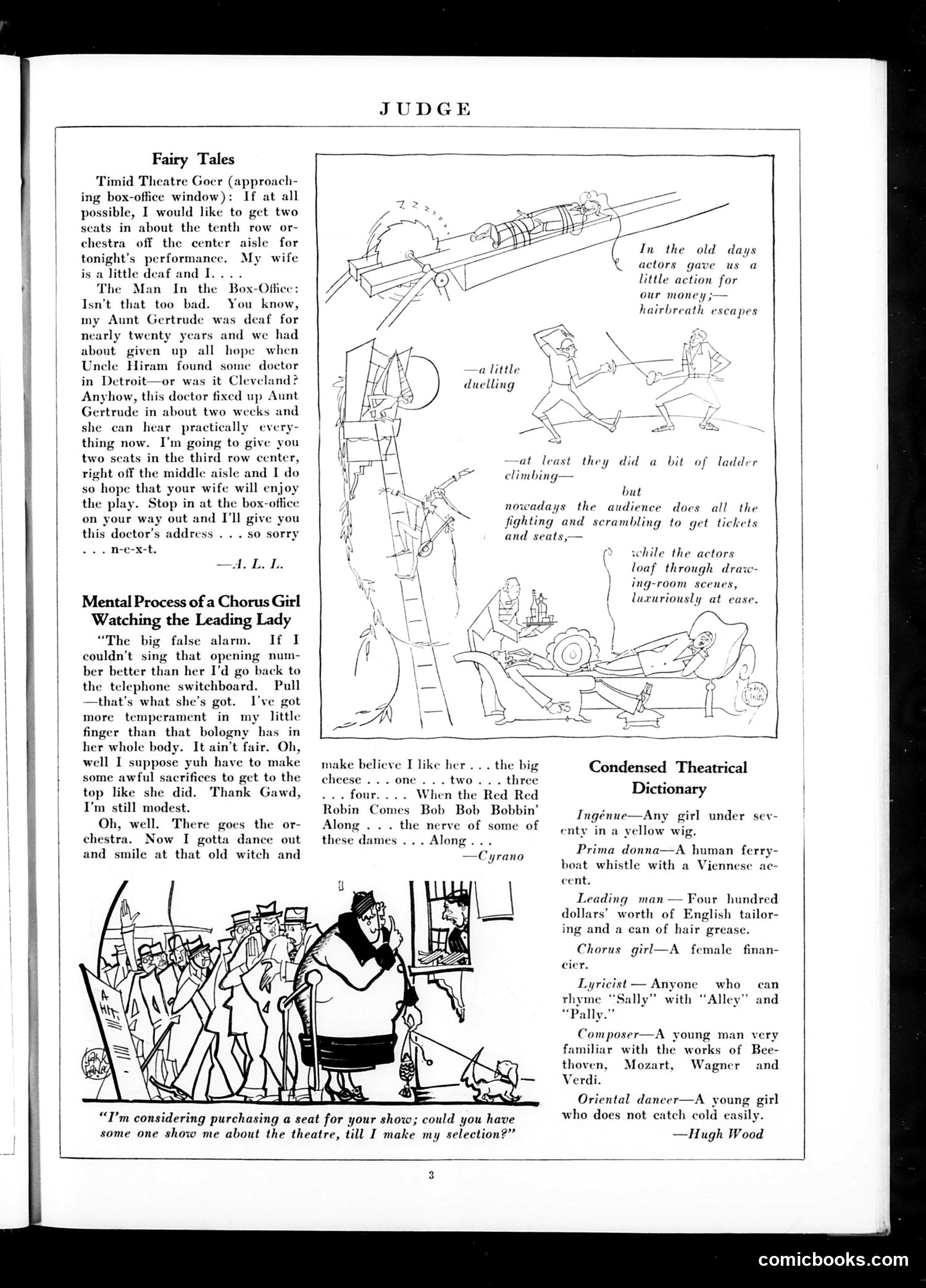
This page contains theatrical humor rather than political content. The main cartoon depicts a theater manager conducting an orchestra while surrounded by crowded, chaotic patrons. The caption reads: "I'm considering purchasing a treat for your shoe; could you have some one shove me about the theatre, till I make my selection?" The joke satirizes the terrible theater experience—overcrowding, jostling crowds, and uncomfortable conditions—making shoe-shopping seem preferable to attending a show. The surrounding text includes audience complaints about poor sightlines and cramped seating, alongside a "Condensed Theatrical Dictionary" offering humorous definitions (like defining a "chorus girl" as "a female financier"). The content targets early 20th-century theater industry problems: inadequate venues, poor audience accommodation, and theatrical pretension.
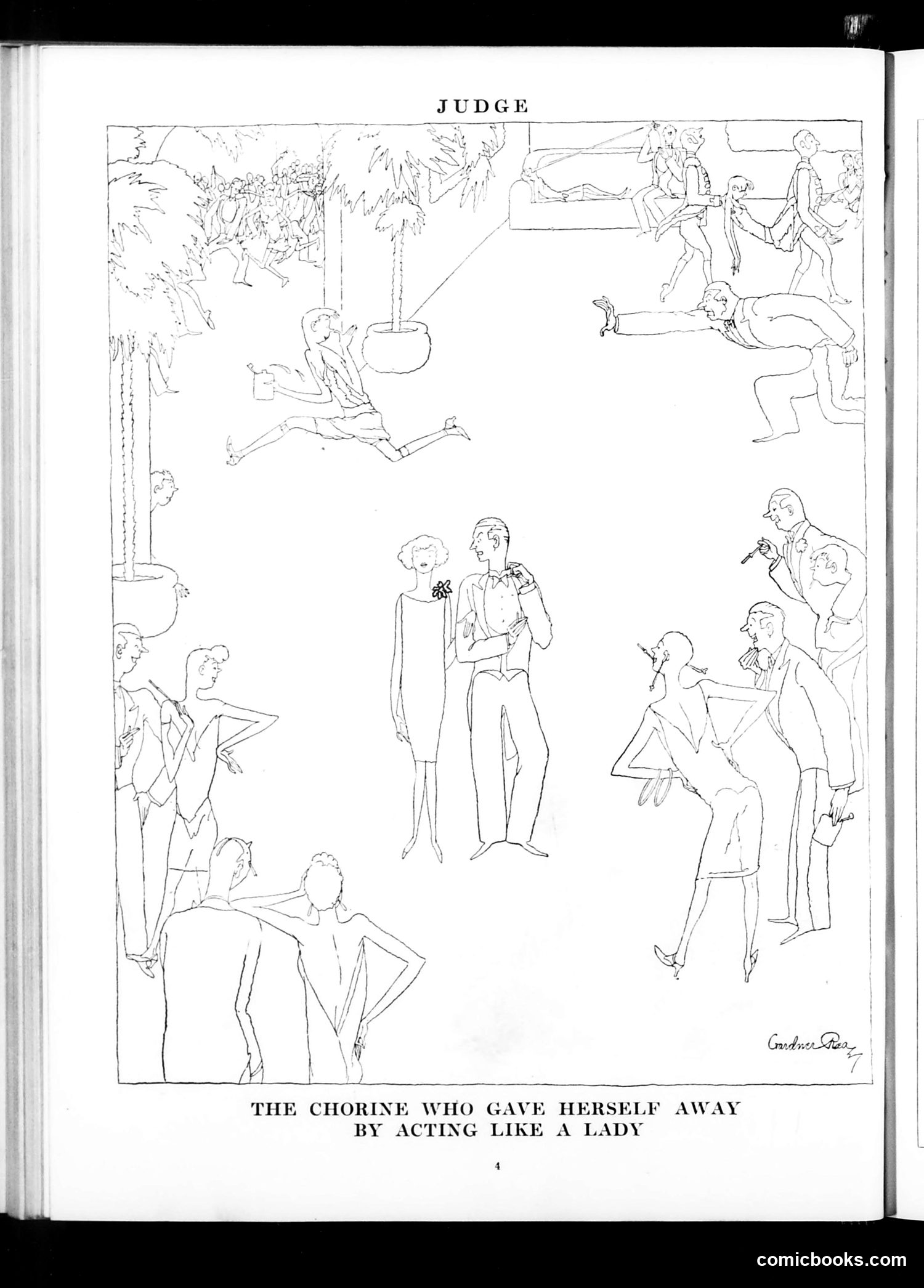
This Judge cartoon satirizes early 20th-century theater culture. A "chorine" (chorus girl) stands at center in an elegant dress alongside a uniformed military officer, surrounded by onlookers in what appears to be a social venue with tropical plants. The satire targets the social pretensions of chorus girls who attempted to "marry up" or gain respectability through theatrical careers. By dressing and acting "like a lady," this character presumably attracted higher-status attention (the officer), but the cartoon's title suggests this strategy paradoxically "gave her away"—exposing her true chorus-girl origins rather than achieving the social elevation she sought. The joke reflects class anxieties and gender commentary typical of Judge's era.
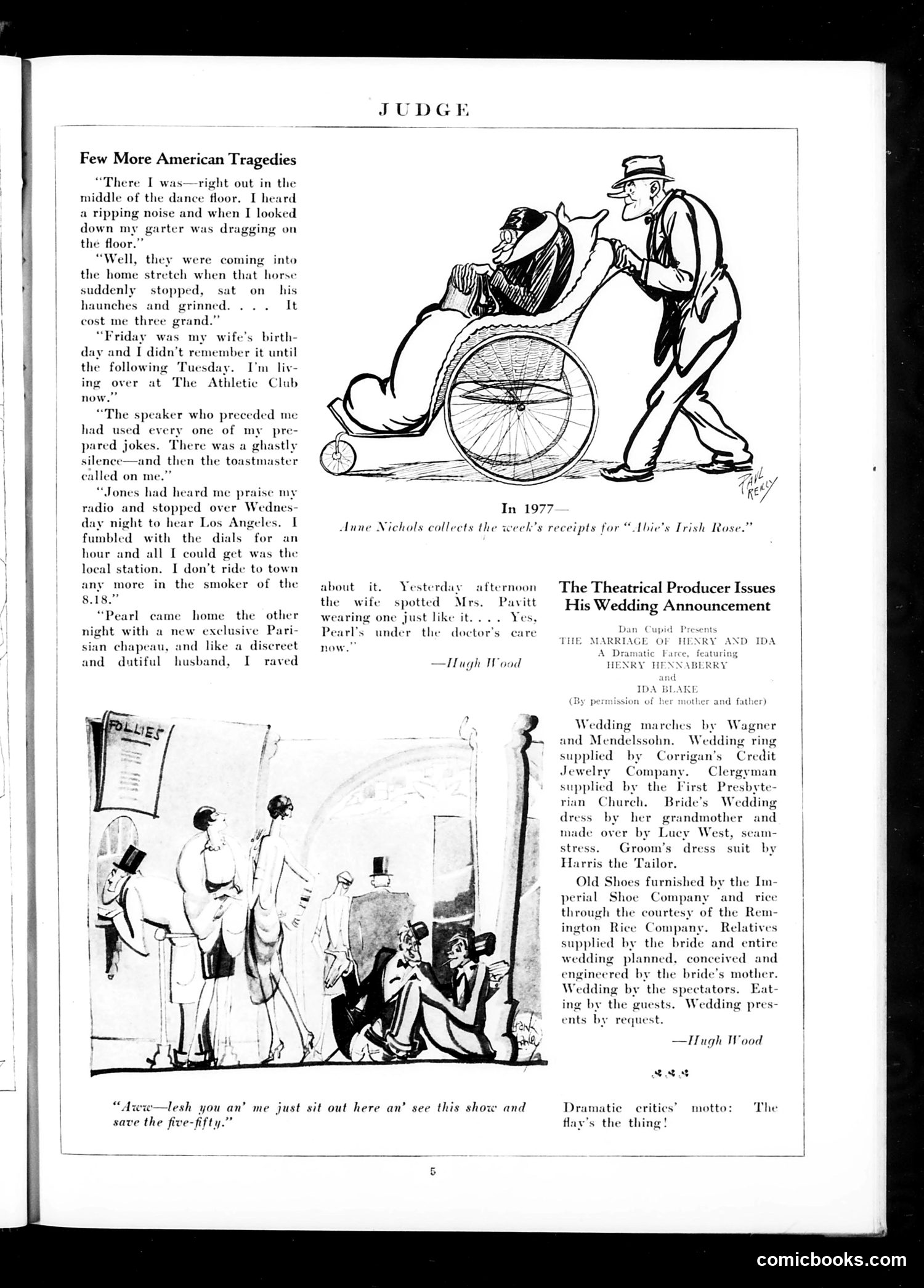
This page contains humorous anecdotes about domestic mishaps and social embarrassments. The top cartoon depicts a man struggling to push a woman in a broken-down automobile, captioned about collecting receipts for "Ike's Irish Rose" (a popular 1920s play). The bottom cartoon shows a domestic scene with people examining shoes, with the caption "Awk—lesh you an' me just sit out here an' see this shoe and save the five-fifty"—a joke about marital penny-pinching during an entertainment outing. These satirize ordinary middle-class American life: relationship tensions, financial anxieties, and social awkwardness. The "tragedies" are comedically mundane domestic failures rather than actual crises, reflecting Judge's humor aimed at urban American readers navigating modern social expectations and budget constraints.
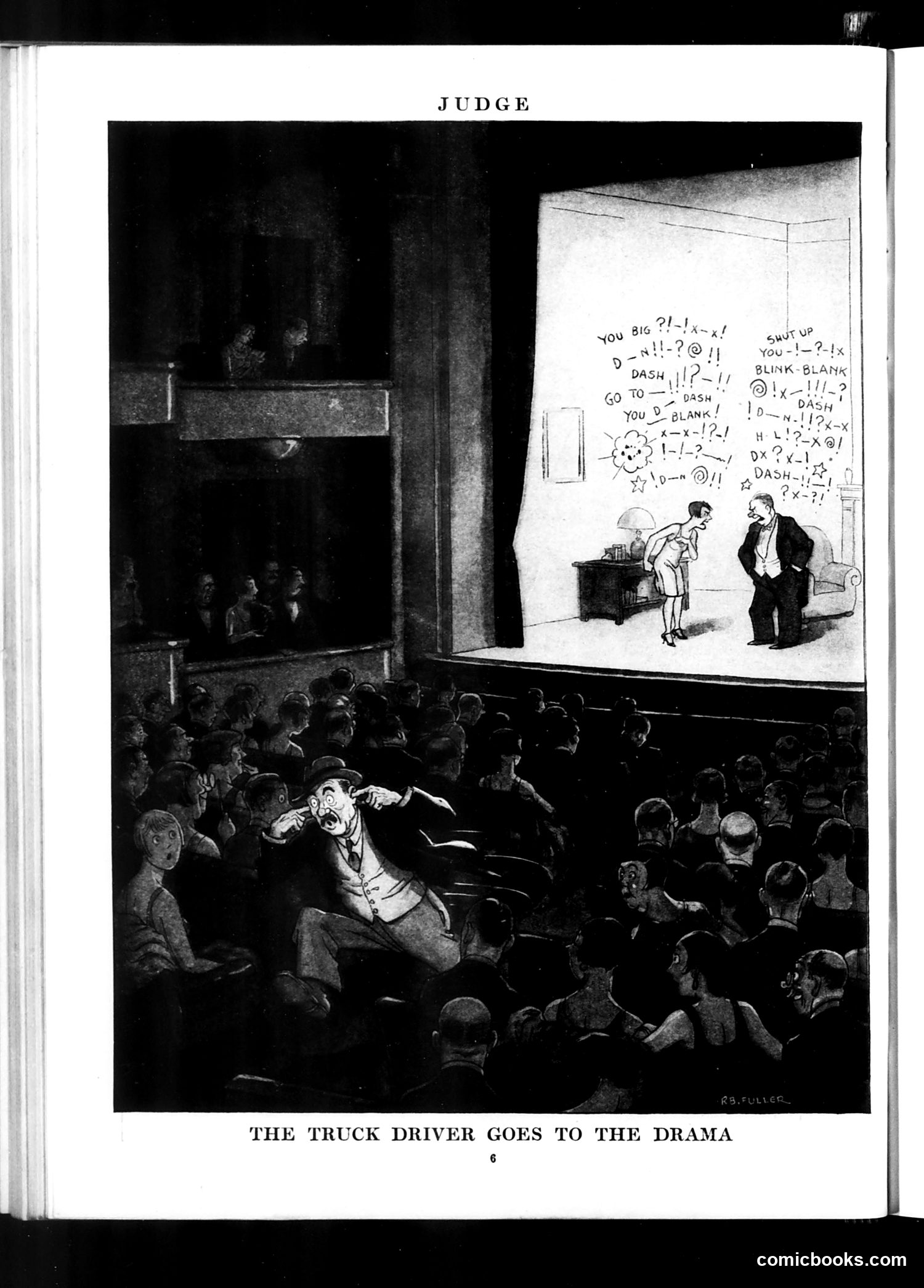
This Judge cartoon satirizes the contrast between highbrow theater and working-class audiences. The central figure—a truck driver, identifiable by his casual dress and exaggerated facial expression of bewilderment—sits among well-dressed theatergoers watching an avant-garde performance on stage. The stage display features abstract mathematical equations and nonsensical text ("YOU BIG ?!-!×—", "DASH", "BLINK BLANK"), suggesting an experimental or modernist theatrical production incomprehensible to ordinary people. The driver's shocked, confused expression mocks both the pretentiousness of such "drama" and the cultural gap between intellectual/artistic elites and working-class Americans. The humor relies on class-based comedy: the suggestion that serious theater has become so abstract and meaningless that even attending it bewilders the average person.
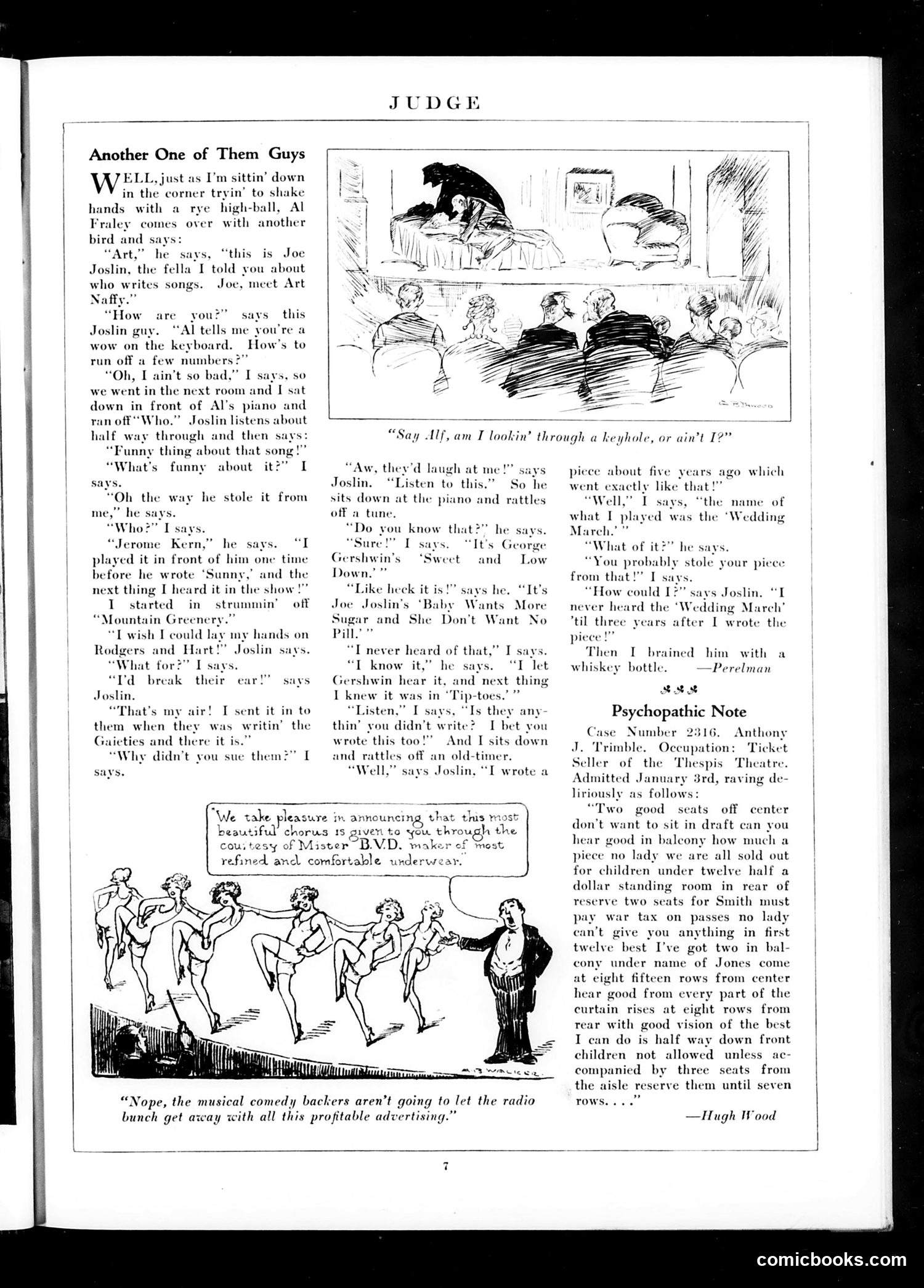
This is a humorous narrative about Joe Joslin, a songwriter who chronically claims that famous composers stole his melodies. The story follows a piano performance where Joslin insists that George Gershwin's "Sweet and Low Down" is actually his composition "Baby Wants More Sugar and She Don't Want No Pill," and that Jerome Kern plagiarized from him. The satire targets musicians who habitually make unsubstantiated plagiarism accusations. When confronted with evidence—such as the "Wedding March"—Joslin absurdly claims he wrote it years *before* hearing it, revealing the illogic of his complaints. The accompanying cartoons mock theater ticketing absurdities and advertising in broadcasting. The page satirizes both delusional creative types and the entertainment industry's chaotic practices of the era.
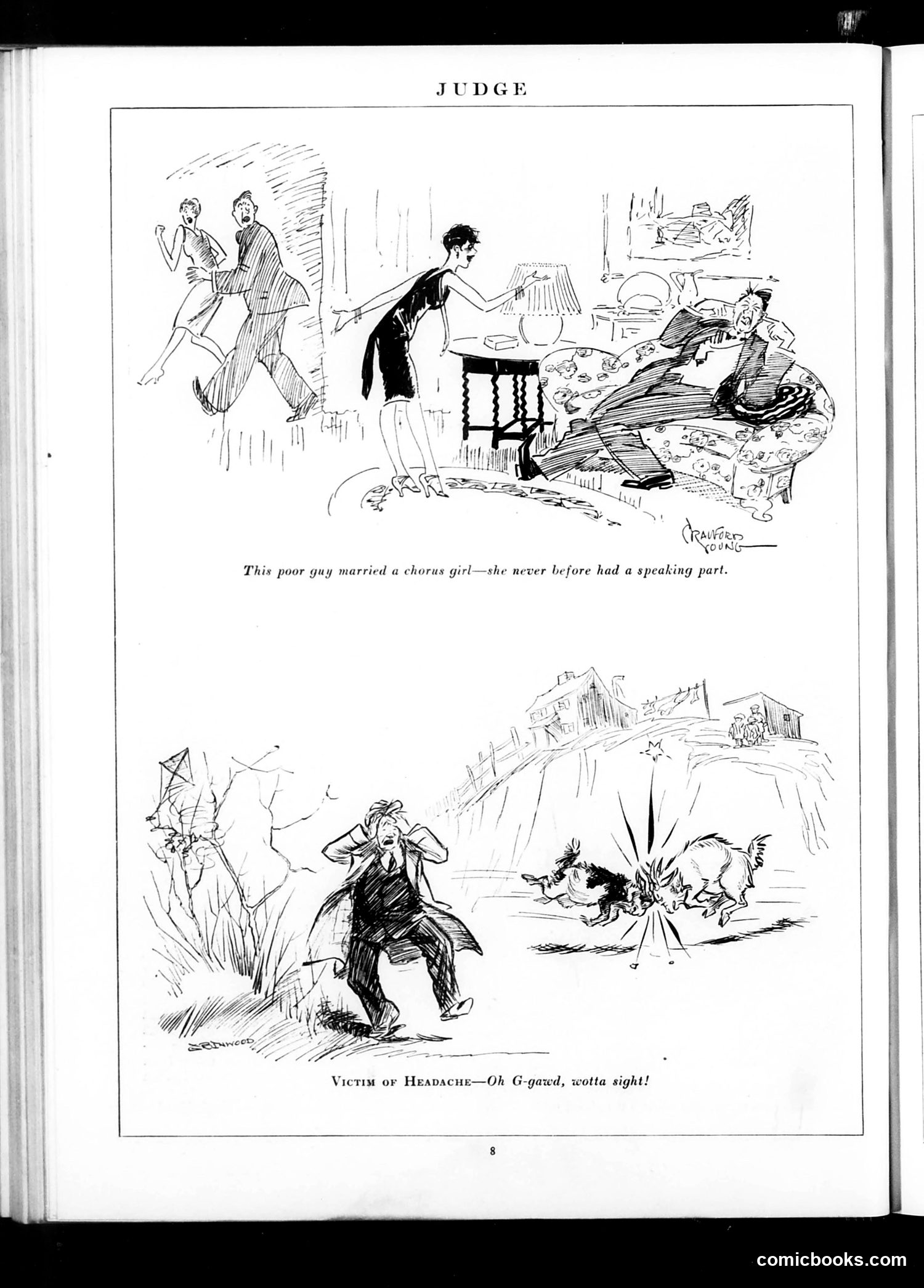
This page contains two unrelated satirical cartoons from *Judge* magazine. **Top cartoon**: Depicts a husband apparently distressed while his wife speaks animatedly to guests. The joke mocks the social expectation that chorus girls (dancers in theatrical productions) were decorative but silent performers. By marrying one, the husband unexpectedly gained a talkative spouse—implying chorus girls were selected for appearance rather than intellect or conversation skills. It's satirizing both the entertainment industry's treatment of women and the husband's apparent regret. **Bottom cartoon**: Shows a man suffering outdoors with animals nearby, captioned "Victim of Headache—Oh G-aved, wotta sight!" This appears to be a separate joke about someone experiencing a severe headache in an unfortunate rural setting, likely playing on period slang or dialect humor. Both rely on period-specific social attitudes toward women performers and colloquial language no longer in common use.
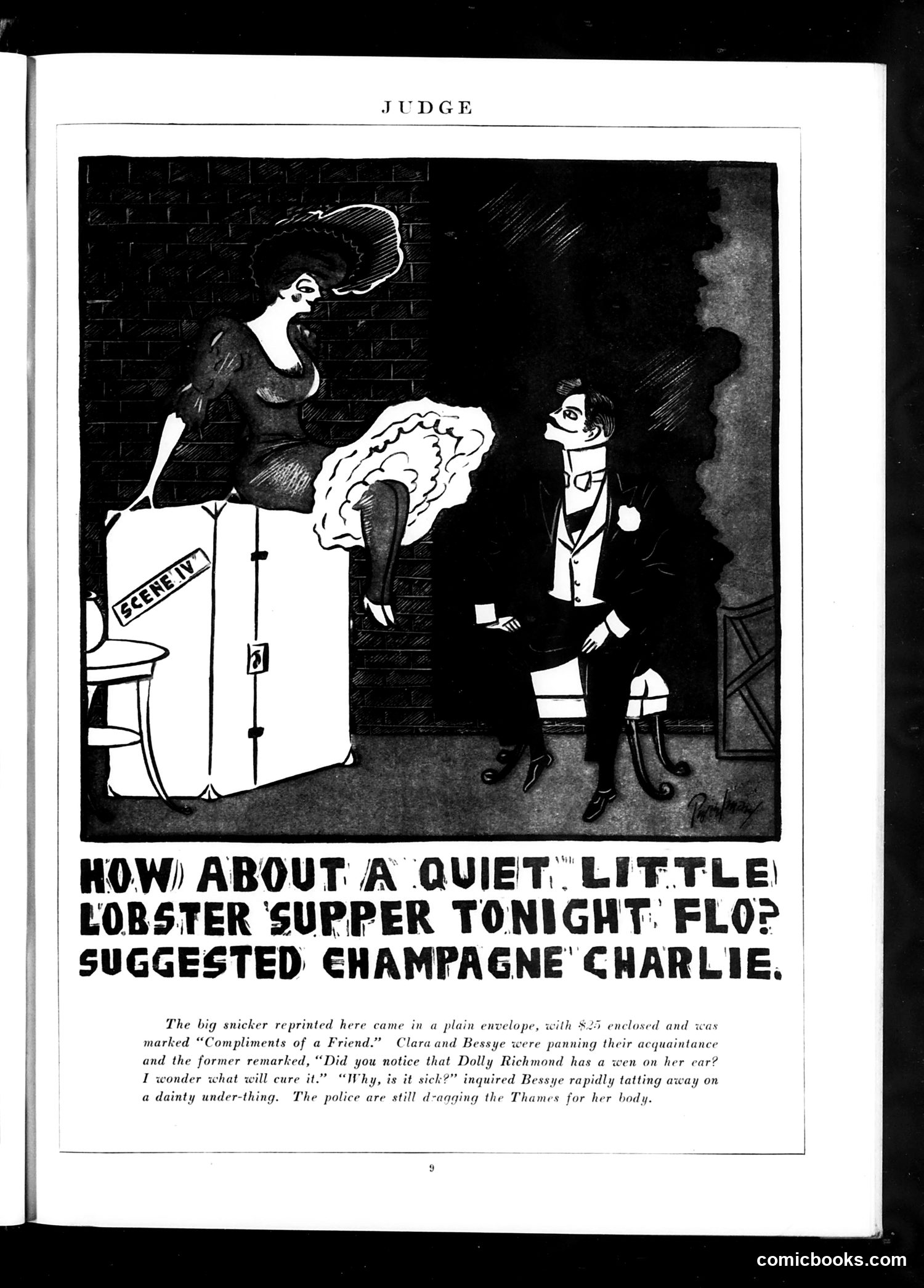
This page contains a single cartoon satirizing extramarital affairs and social scandal. A well-dressed woman (appearing to represent a society figure) leans from a secretarial desk marked "SECRET" while addressing a smaller man in formal attire, proposing a "quiet little lobster supper" with "suggested champagne." The accompanying text reveals the actual joke: it's a reproduced anonymous note sent with $25, suggesting infidelity. The commentary then shifts to gossip about "Dolly Richmond" having a facial blemish, with dark humor ending in a reference to dragging the Thames for "her body"—implying scandal led to death. The cartoon satirizes Gilded Age society's hypocrisy: public respectability masking private impropriety, casual cruelty in gossip, and the severe social consequences (even death) for women caught in scandal. "Champagne Charlie" likely references a known society figure of the era.
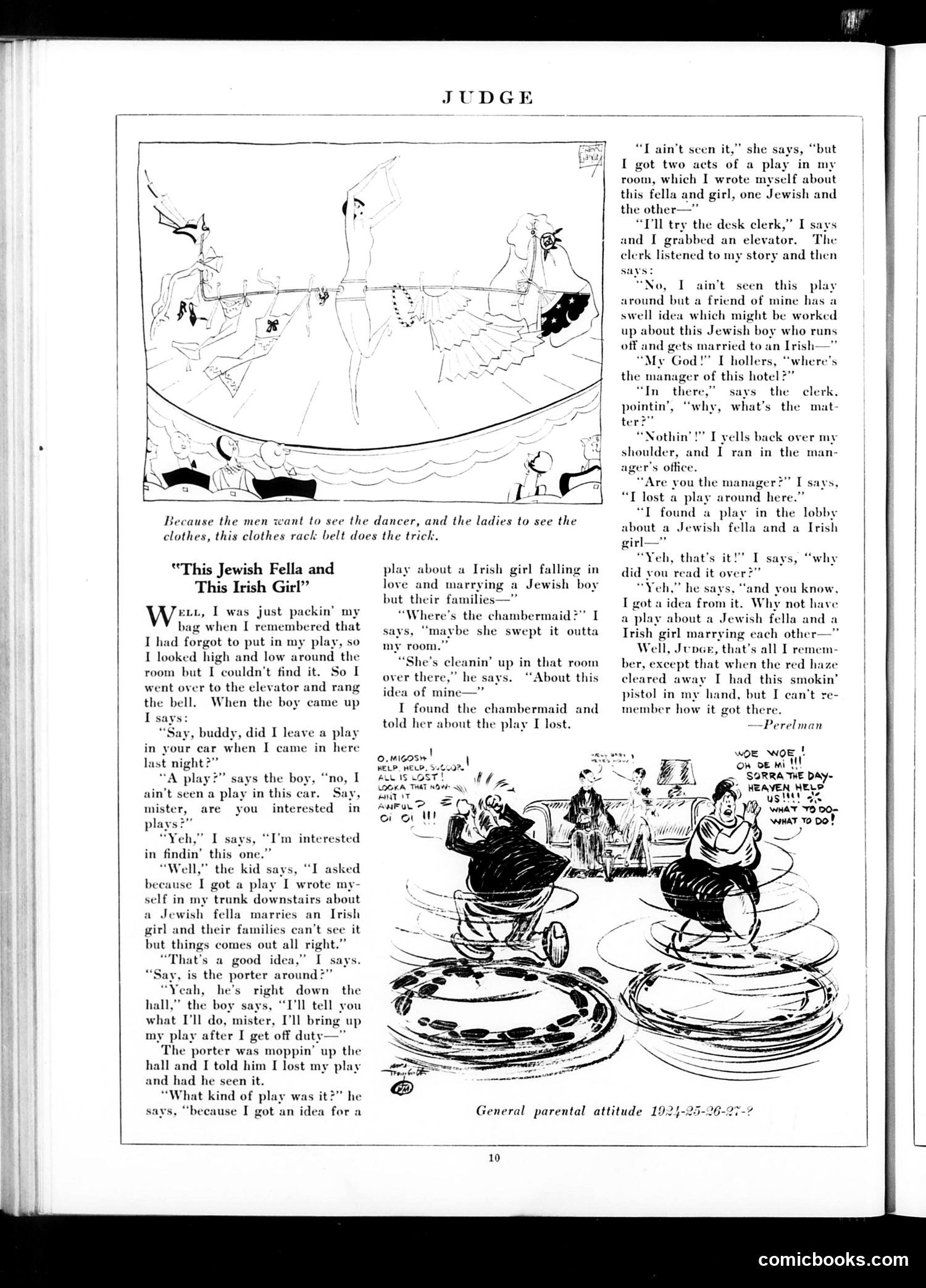
This page satirizes the glut of intermarriage comedies popular in 1920s theater. A playwright loses his script about a Jewish boy and Irish girl whose families object but reconcile. As he searches a hotel, *every staff member he encounters*—elevator boy, porter, chambermaid, desk clerk, manager—reveals they've independently written the *identical play concept*. The joke exposes how formulaic and derivative these ethnic-comedy plots had become: the premise was so common and creatively exhausted that multiple people casually invented it separately. The final illustration shows characters frantically discussing the ubiquitous plot while the narrator (illustrated as increasingly frazzled) ends by mentioning a "smokin' pistol"—darkly implying he's murdered someone in frustration over this comedic cliché. The satire targets both the theatrical market's predictability and audiences' appetite for safe, stereotypical ethnic humor.
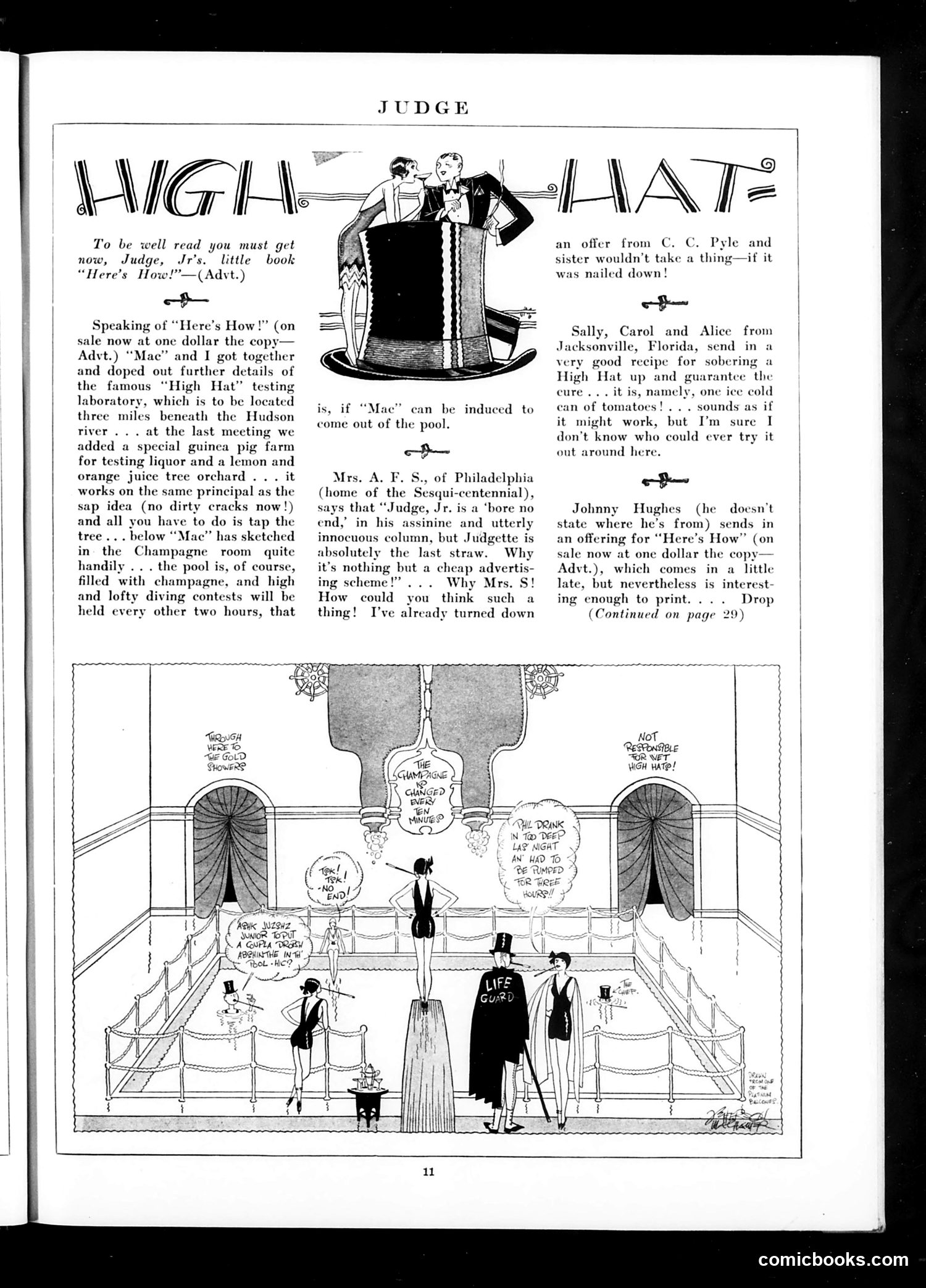
This page from *Judge* magazine is primarily **advertising disguised as editorial content**. The main feature is a humorous "High Hat Testing Laboratory" — a fictional facility supposedly being established beneath the Hudson River to test Prohibition-era liquor alternatives and mixers. The satire targets **Prohibition's absurdity**. The "laboratory" comically proposes testing substitutes like champagne pools, lemon-orange juice orchards, and tomato juice (suggesting early "Bloody Mary" remedies). This mocks both the enforcement of Prohibition and Americans' creative attempts to circumvent it. The page is largely **filler promoting "Here's How!" book** (priced one dollar), with reader letters commenting on Judge Jr.'s column. One Philadelphia reader sarcastically criticizes the column as cheap advertising—which the editor playfully acknowledges while denying lucrative sponsorship offers. The cartoon at bottom depicts the fictional laboratory's interior with diving contests and champagne pools, visualizing the absurdist premise. The overall tone is lighthearted mockery of Prohibition-era culture.
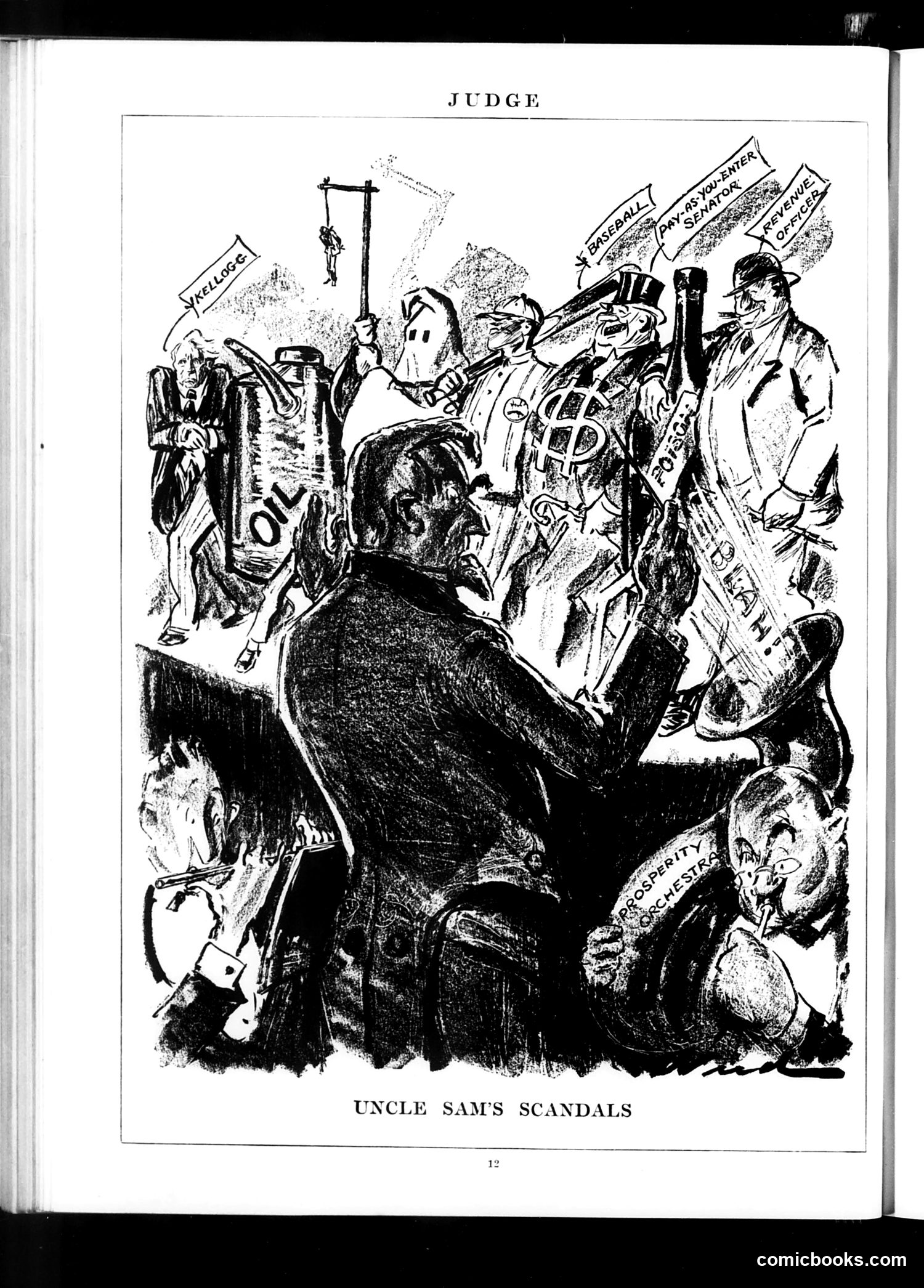
This political cartoon depicts a judge (seated, in profile, facing right) presiding over various scandals involving Uncle Sam—personified as a rotund figure. The characters arrayed before the judge carry banners and labels referencing different controversies: visible text includes "NEGLIGENCE," "GENERAL," "PRIVATE SECRETARY," and references to "PROSPERITY" and "ORCHESTRATED." The satire criticizes Uncle Sam's government for multiple simultaneous scandals requiring judicial oversight. The crowded, chaotic composition emphasizes the abundance of misconduct. Without the publication date, the specific scandals remain unclear, but the cartoon suggests widespread corruption or mismanagement across government agencies that demand a judge's intervention—a common satirical theme in Judge magazine's commentary on American governance.
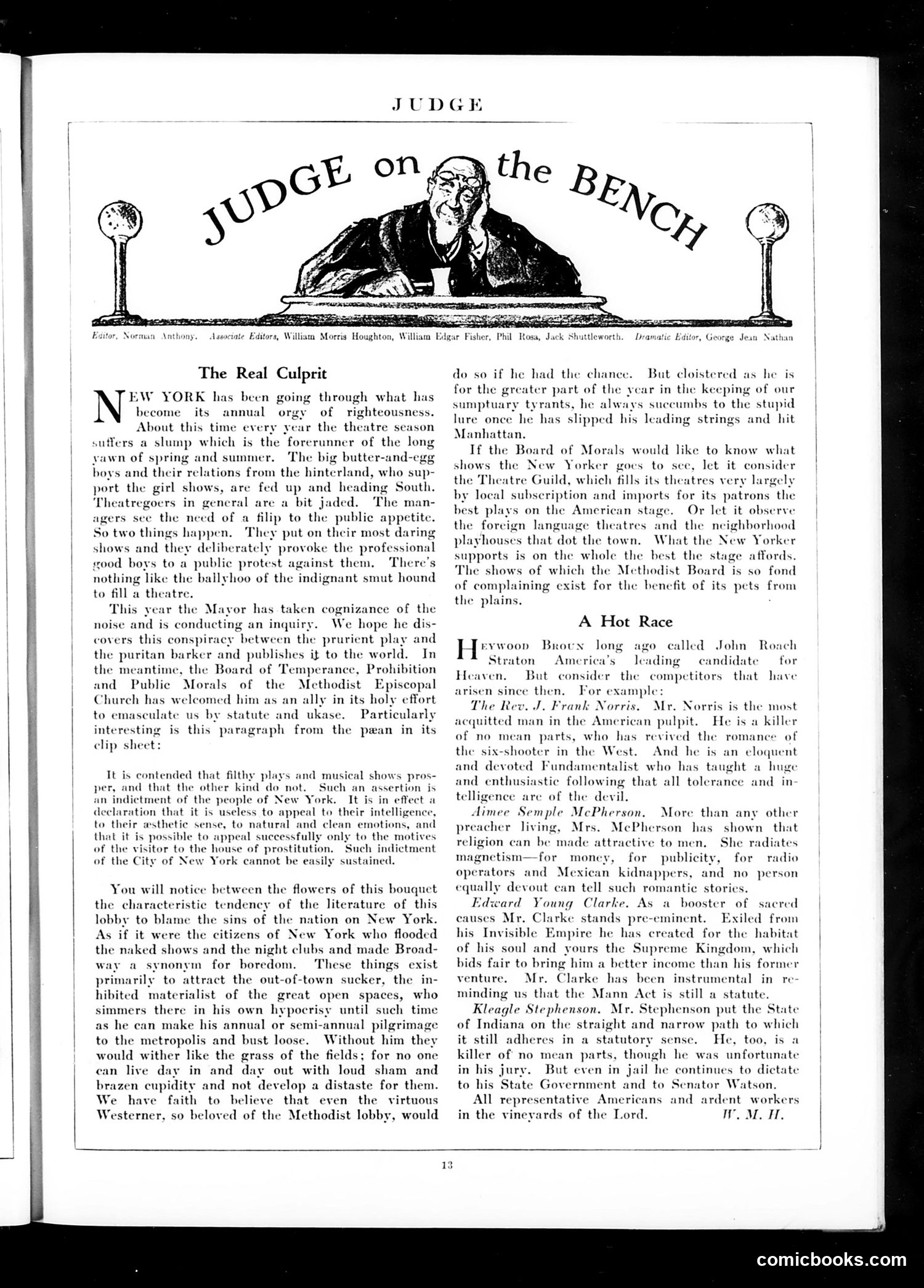
This page satirizes what Judge calls "the annual orgy of righteousness" in New York City—the practice of theatrical producers deliberately staging provocative shows, then moral reformers publicly condemning them, generating publicity that fills theaters. The editorial argues the real culprit isn't the shows themselves, but rather out-of-town visitors ("butter-and-egg boys," "the great open spaces" crowd) who crave entertainment they're denied elsewhere. Judge mocks the Methodist Episcopal Church's Board of Temperance and Prohibition for blaming New York rather than acknowledging that visitors demand such entertainment. The piece also critiques the hypocrisy of moral guardians, suggesting they incorrectly believe appeals to intelligence work better than entertainment. Judge defends New York audiences, noting they patronize quality theater (like the Theatre Guild) when given the chance. The "Hot Race" section begins profiles of rival preachers seeking moral leadership—positioning religious figures as competitors for public attention, mirroring the theatrical controversy above.
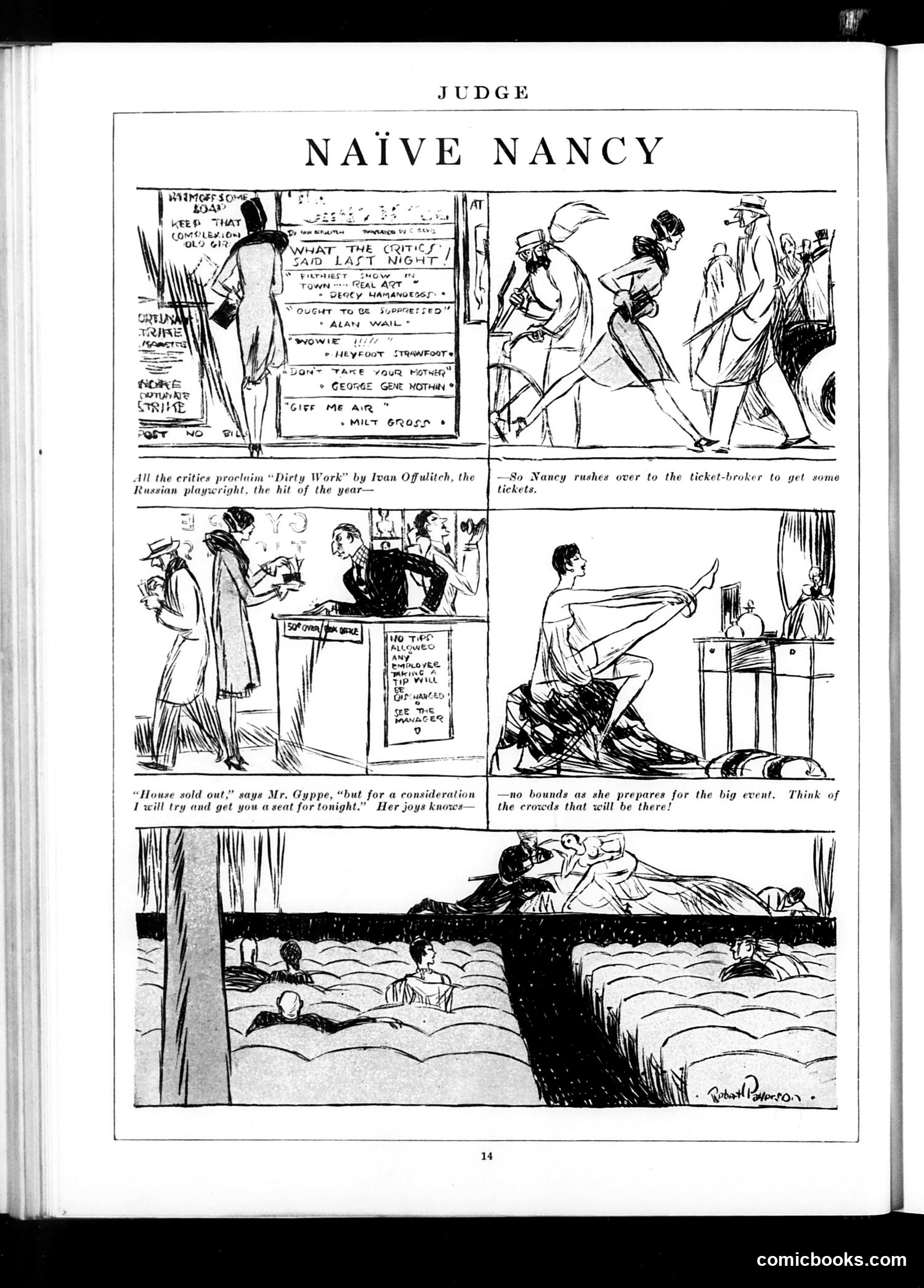
This is a multi-panel satirical comic mocking a young woman's gullible enthusiasm for high-culture pretension. "Nancy" becomes obsessed with seeing a critically acclaimed Russian play ("Dirty Work" by Ivan Offulitch), treating it as the cultural event of the season. The satire targets several things: the snobbish worship of European avant-garde theater among aspiring sophisticates; the ticket-broker's opportunistic price-gouging ("for a consideration"); and Nancy's breathless, irrational excitement despite having no actual knowledge of the play's merit. The final panel—showing her at a crowded public swimming pool instead—suggests the "big event" she anticipated was a humiliating anticlimax or that she was duped entirely. The comic ridicules both pretentious cultural consumption and the naive, status-seeking behavior it inspires in impressionable people.
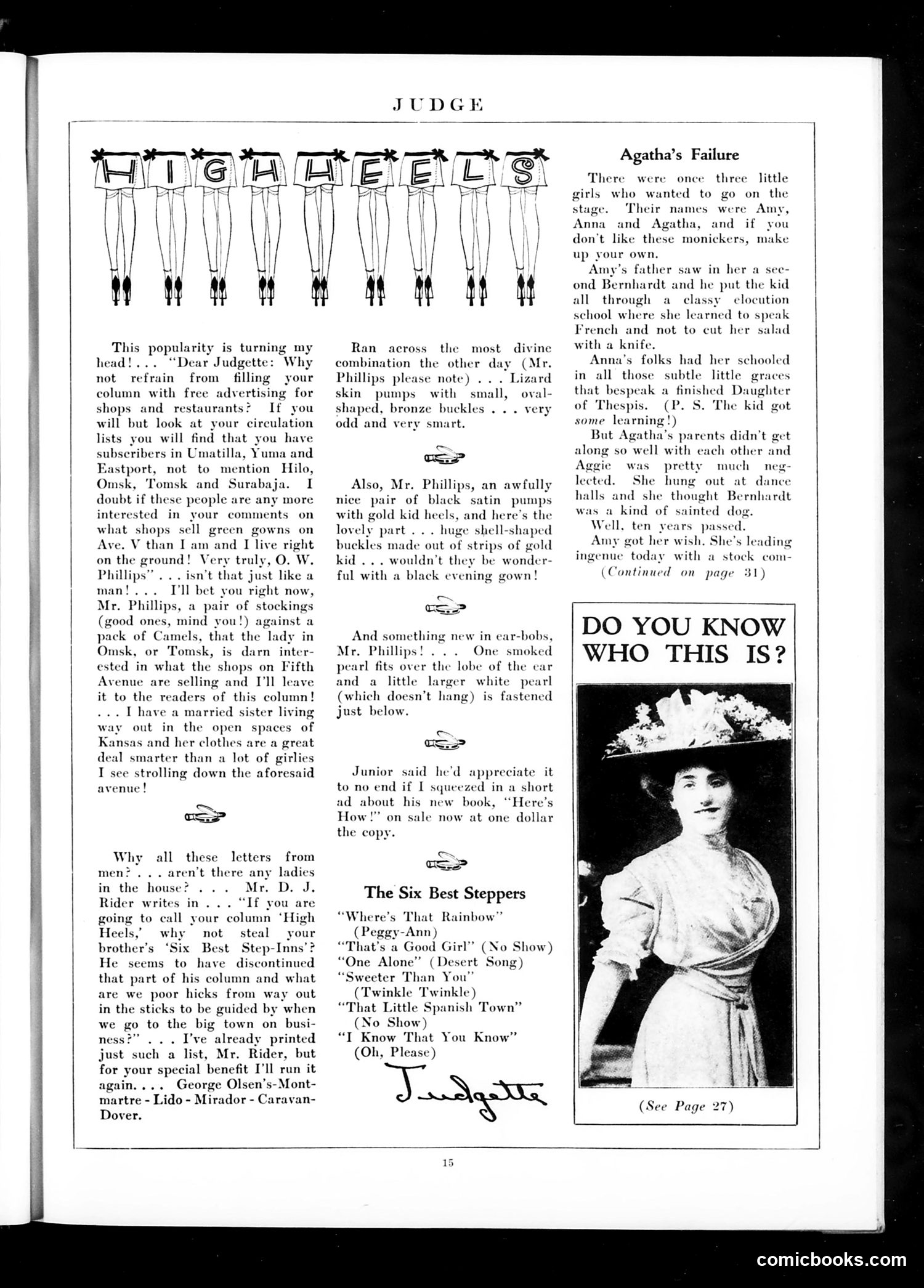
This page from *Judge* magazine contains a satirical advice column called "High Heels" addressing reader complaints about its content and tone. **The Main Satire**: A male reader (O.W. Phillips) complains the column wastes space with frivolous shopping recommendations for remote subscribers in places like Omsk and Kansas. The columnist (Judgette) sarcastically responds by *proving his point wrong*—she bets him stockings versus Camels that rural women actually *are* interested in Fifth Avenue fashion, citing her married sister in Kansas as evidence. The joke mocks masculine dismissiveness of women's fashion interests while defending women's right to such concerns. **Secondary Content**: The page includes song recommendations ("The Six Best Steppers"), a short story fragment about three aspiring actresses named Amy, Anna, and Agatha (with Agatha failing due to parental neglect), and a "mystery woman" photograph teasing readers. **Cultural Context**: References to specific Broadway shows (*Desert Song*, *No Show*) and Fifth Avenue shops date this to the 1920s, reflecting postwar American consumerism and changing attitudes toward women's independence and leisure interests.
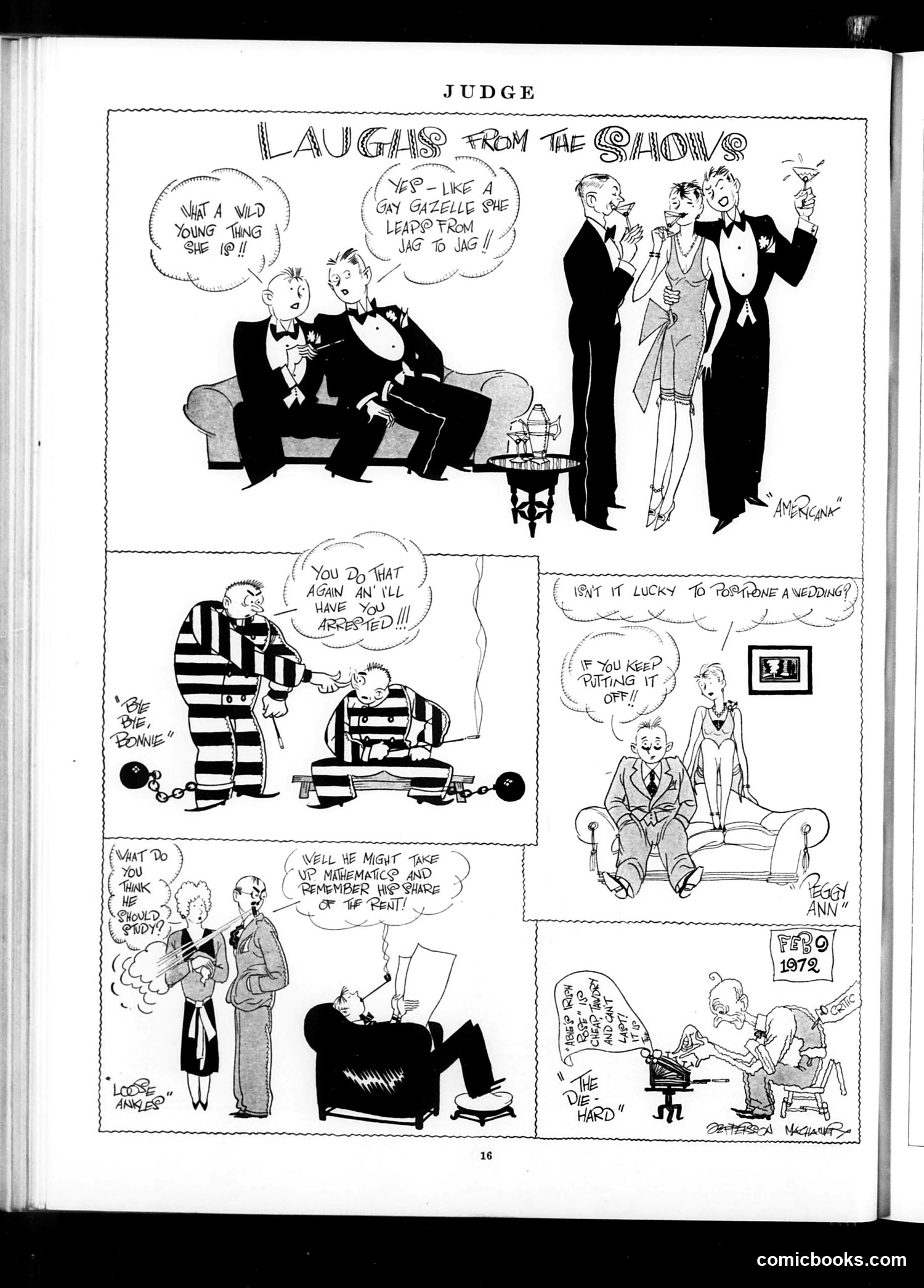
This is a multi-panel satire about marital infidelity and consequences. The top panel shows wealthy socialites at a party discussing a woman's scandalous behavior—"like a gay gazelle she leaped from jag to jag" (suggesting promiscuity and nightclub hopping). Subsequent panels follow the narrative: a man is arrested repeatedly ("you do that again an' I'll arrest you"), depicted in prison stripes. The domestic consequence appears in the middle panels, where a wife confronts her husband about postponing their wedding repeatedly. The final panel, dated "Feb 9, 1929," shows the couple with children labeled "The Hard," suggesting they finally married but faced difficulties. The humor targets Jazz Age excess and moral decline—themes common to 1920s satirical magazines. The cartoon mocks both the frivolous wealthy pursuing illicit affairs and the legal/domestic consequences that eventually catch up with them, reflecting contemporary anxieties about changing social morality during the Roaring Twenties.
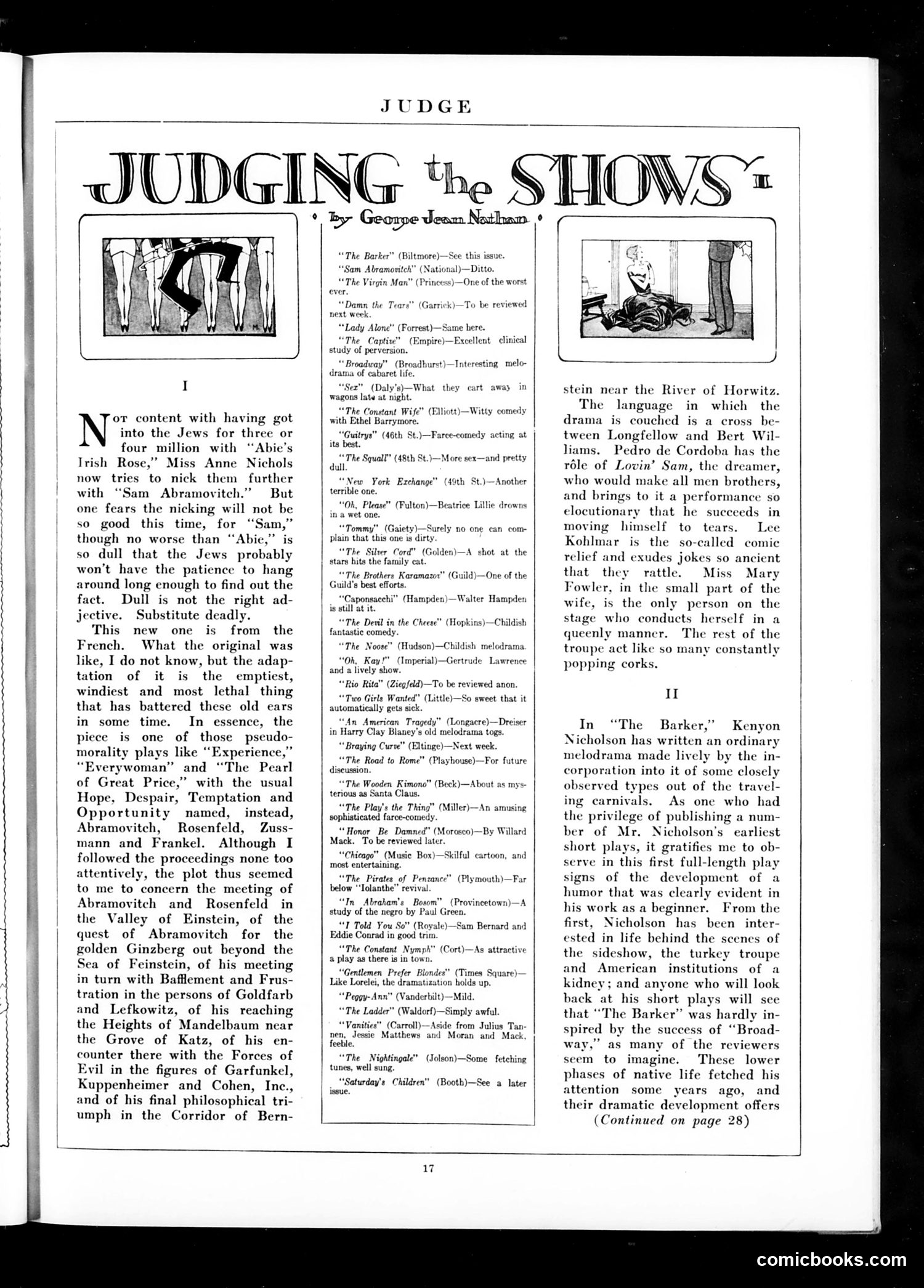
This is a theater review column by George Jean Nathan, Judge's drama critic. The page contains two illustrations showing scenes from Broadway productions, but the main content is Nathan's caustic assessment of current theater offerings. The central critique targets Anne Nichols' new play "Sam Abramovitch," following her commercial success with "Abie's Irish Rose." Nathan savages it as deadly dull—a pseudo-morality play with allegorical Jewish character names (Abramovitch, Rosenfeld, Ginzberg, etc.) representing abstract concepts like Hope and Despair. He dismisses it as adapted from French material, finding it the "emptiest, windiest and most lethal thing" he's encountered. The column then reviews numerous Broadway shows with brief, often withering comments. Nathan's style is characteristic of 1920s sophisticated theater criticism—witty, elitist, and dismissive of commercial sentimentality or obvious plots.
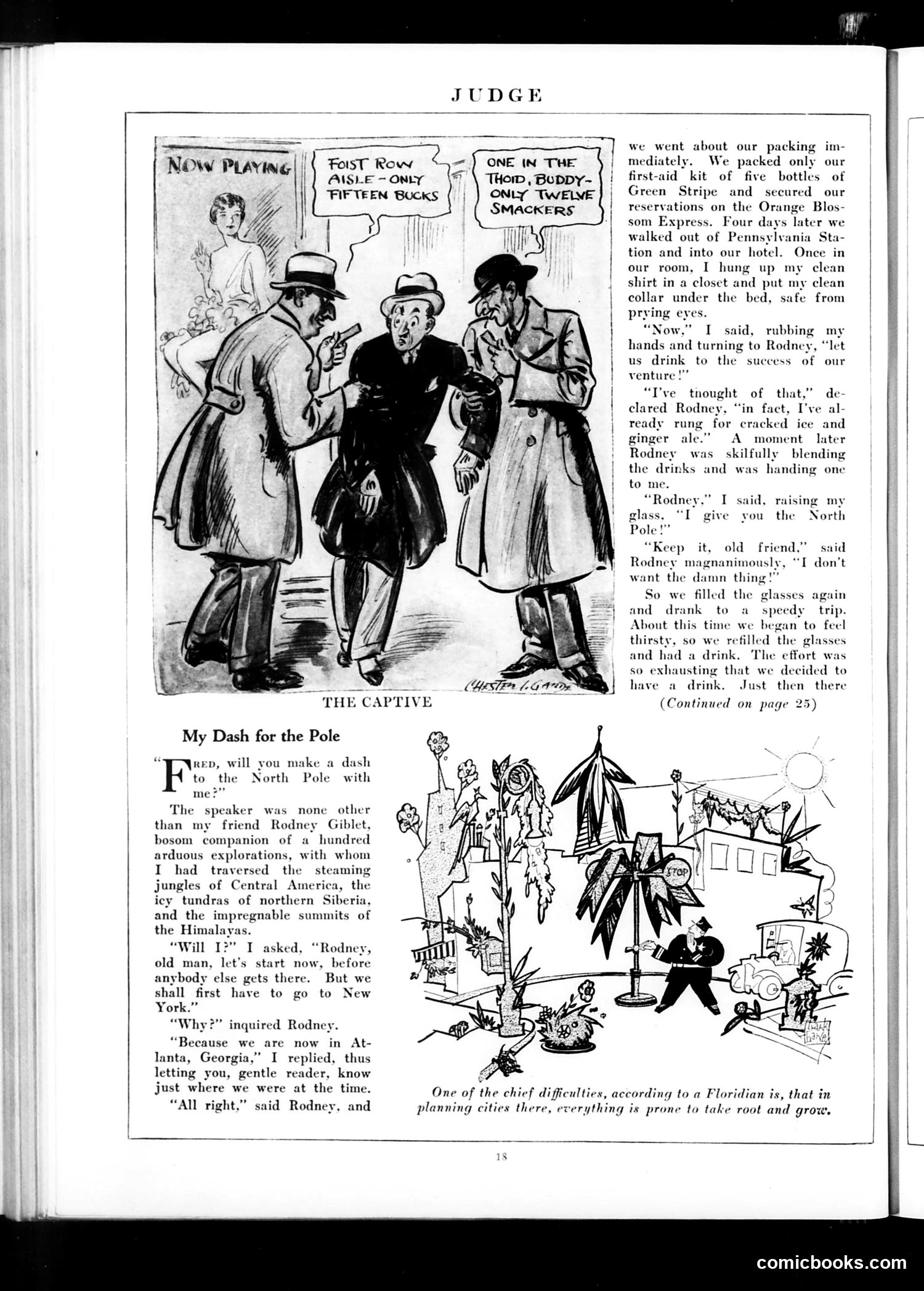
This humorous short story satirizes early 20th-century polar exploration mania—a popular cultural obsession following real expeditions to the North and South Poles. The joke centers on the narrator and his friend Rodney planning an Arctic expedition with characteristic incompetence. The satire works on multiple levels: they're so poorly prepared they must travel to New York first; their "packing" consists entirely of alcohol (Green Stripe bottles); and rather than embarking immediately, they spend their time drinking, becoming progressively less capable. The cartoonist mocks both the frivolous enthusiasm for dangerous exploration and the drunken leisure of affluent American men who treat extreme adventures as casual social outings. The accompanying illustration shows three men in a theater, discussing ticket prices—a separate, unrelated vignette. The bottom caption about Florida city planning appears to be filler content typical of Judge magazine's format.
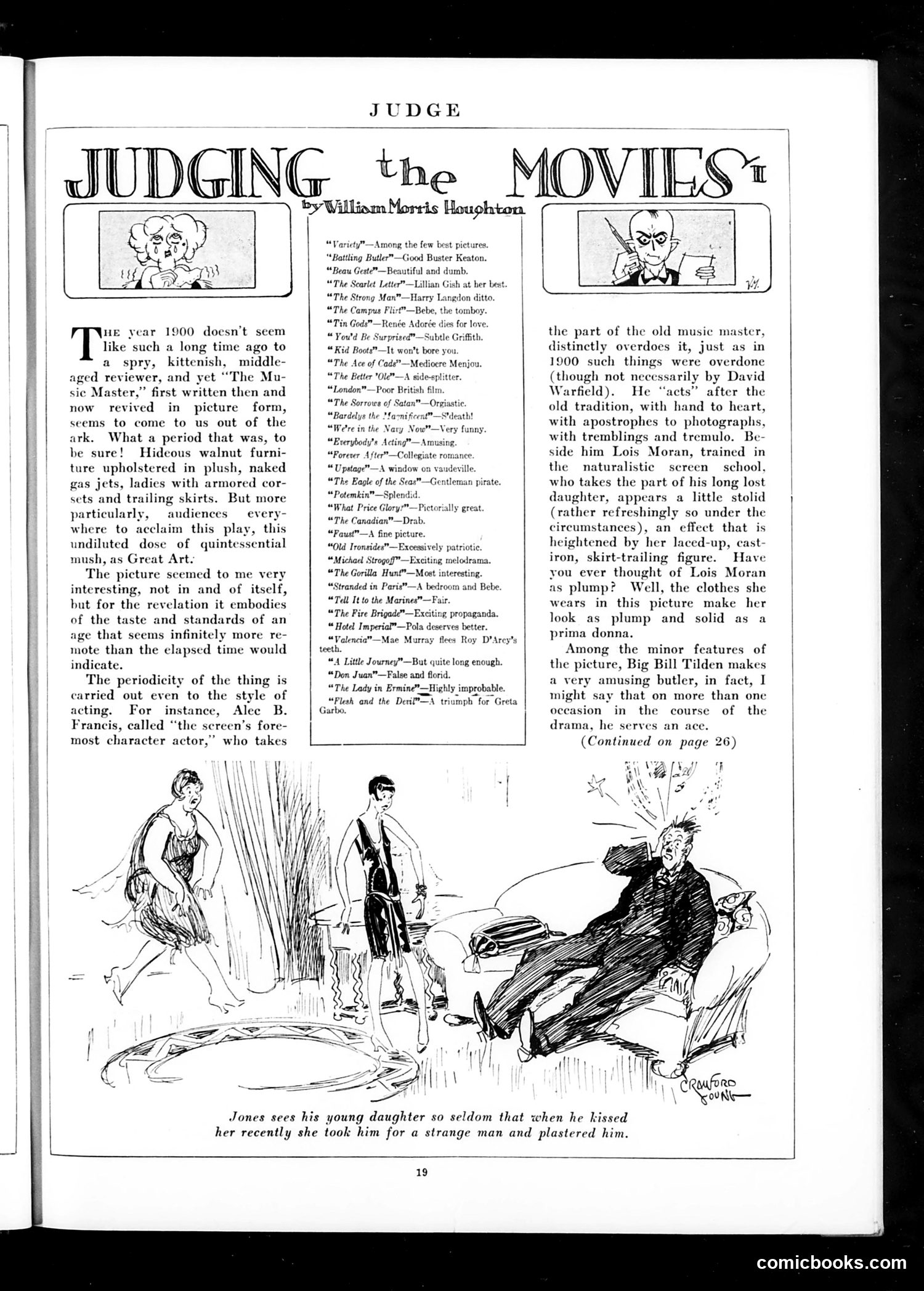
This is William Morris Haughton's column reviewing 1920s films for *Judge*, a satirical magazine. The main cartoon illustrates a review of "The Music Master," a stage play adapted to film. Haughton critiques the film for its outdated 1900 theatrical style—overwrought acting with exaggerated gestures (hand to heart, apostrophes to photographs). He contrasts the hammy performance of Alec B. Francis in the title role with the more naturalistic screen acting of Lois Moran, the younger actress, noting her period costume makes her appear "plump and solid as a prima donna." The cartoon's caption shows a father so unfamiliar with his daughter that when she recently kissed him, he mistook her for a stranger and hit her—satirizing the melodramatic, unrealistic plot typical of early theatrical adaptations. The accompanying list reviews dozens of contemporary films, rating their quality with brief, often witty comments about stars like Buster Keaton, Lillian Gish, and Greta Garbo. Big Bill Tilden (the tennis champion) appearing as a butler gets an ace/tennis pun.
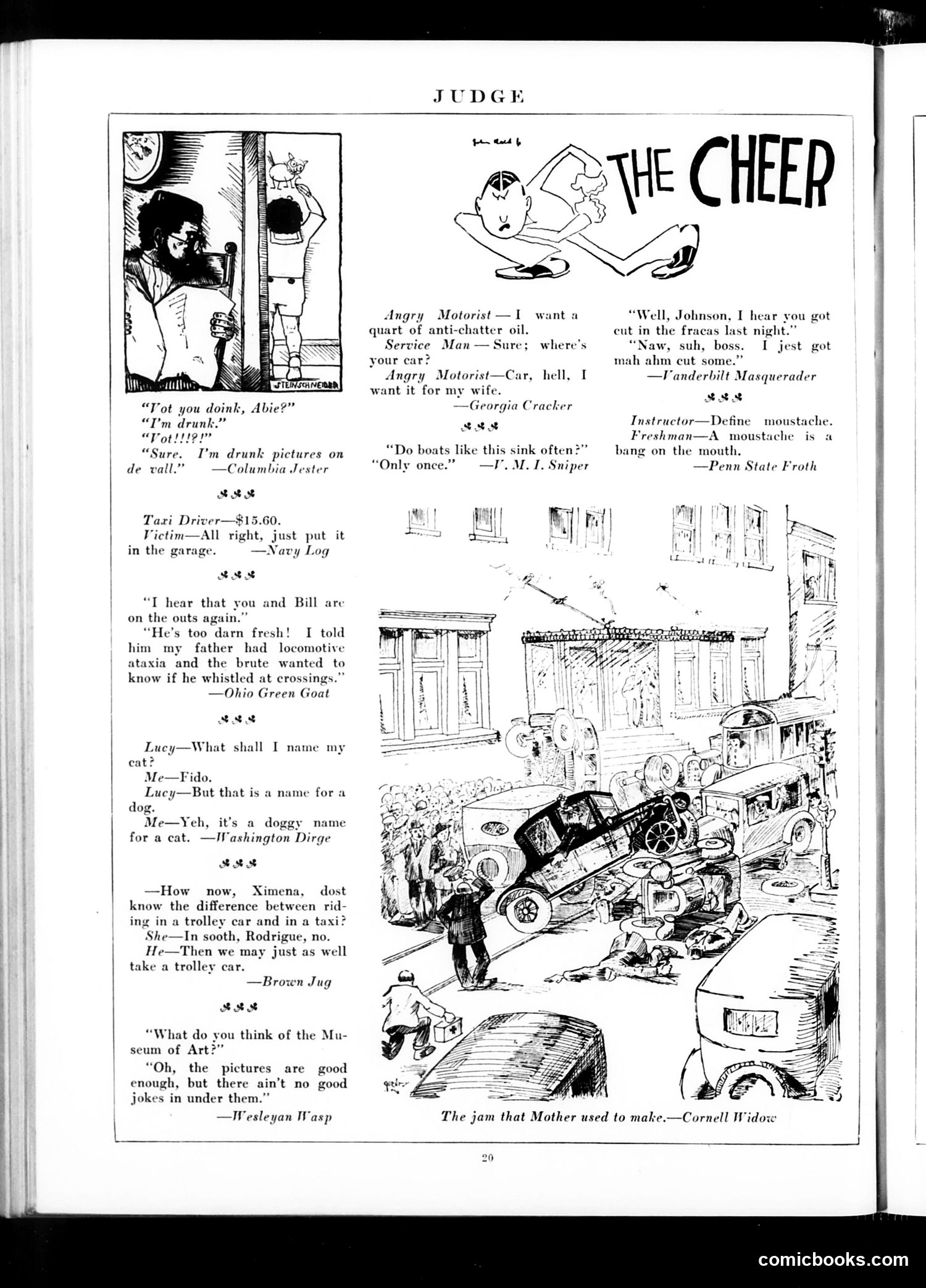
This page collects short jokes and quips from various college humor magazines (Columbia Jester, Navy Log, Ohio Green Goat, etc.), rather than presenting unified cartoons. The humor relies on early 20th-century stereotypes and wordplay: - "Abie" references a Jewish character (common ethnic humor of the era) - A "drunken immigrant" joke relies on ethnic caricature - Gender-based humor portrays wives as nagging ("anti-chatter oil") - Racial dialect humor ("Naw, suh, boss") depicts African American speakers - Absurdist puns (naming a cat "Fido," confusing trolleys with taxis) - A large illustration shows a chaotic auto collision, captioned with a reference to homemade jam The satire targets contemporary urban life (taxis, motorists, museums) and domestic relations. Most jokes depend on ethnic and racial stereotypes that were normalized in 1920s college publications but would be considered offensive today.
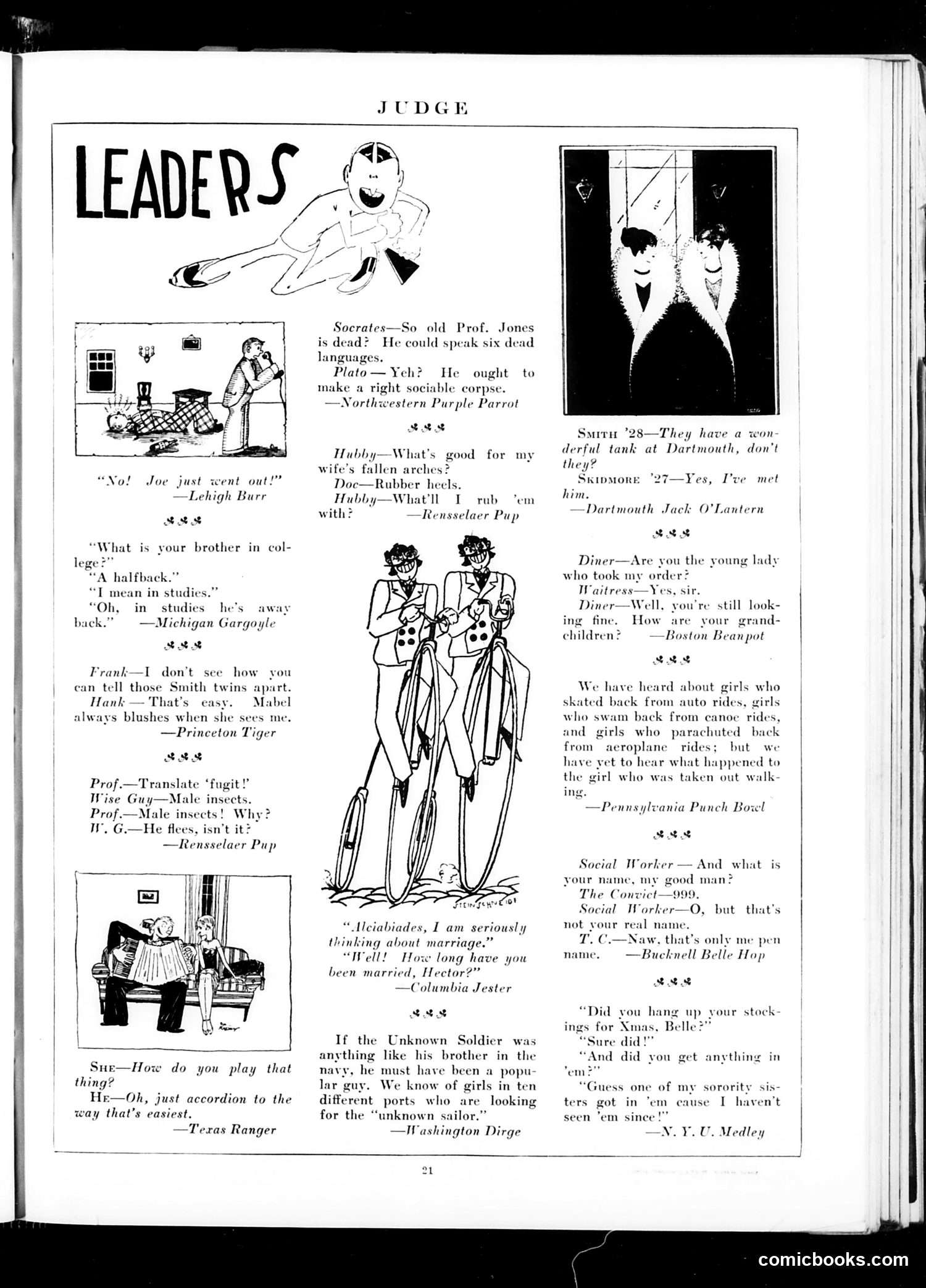
This page collects brief humorous jokes and quips, mostly from college humor publications of the 1920s era. The content reflects typical collegiate and social satire of the period: **Main themes:** - **Academic humor**: Jokes about professors (the Socrates/Plato exchange mocking pedantic scholarship), translation mishaps, and student life - **Dating/romance**: Multiple jokes about courtship, marriage proposals, and female behavior—reflecting post-WWI social anxieties about changing gender roles - **Class commentary**: References to "fallen arches" (economic struggle), a convict's "pen name," social workers interviewing the poor - **Sexual innuendo**: Several jokes employ double-entendre about women's behavior on dates and in relationships The cartoon illustrations show typical 1920s artistic style. The overall tone is lighthearted but somewhat condescending toward women's independence and working-class subjects. This represents mainstream American humor of the Jazz Age—witty but reflecting period attitudes toward class and gender.
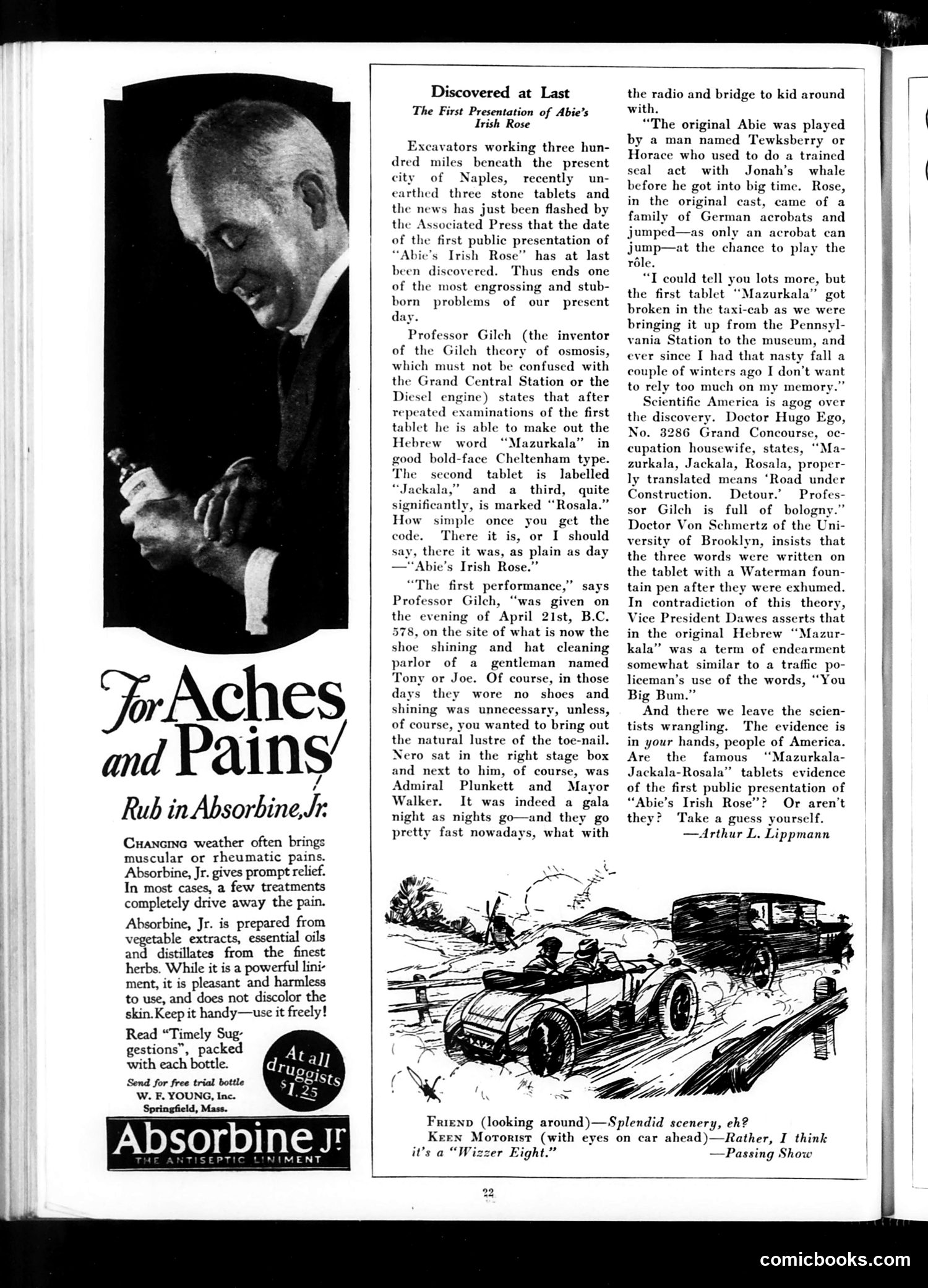
This page combines an **advertisement** (Absorbine Jr. liniment) with a **satirical article** mocking the wildly popular Broadway play "Abie's Irish Rose." The satire, titled "Discovered at Last," humorously claims that archaeologists in Naples have unearthed ancient stone tablets proving "Abie's Irish Rose" debuted in 578 B.C. The joke mocks both the play's unprecedented run (it had been performing for years) and the absurdity of its cultural dominance. Fake "Professor Gilch" and other invented experts offer ridiculous "translations" of supposed Hebrew words on the tablets. The cartoon caption at bottom shows a motorist in a car, with one character admiring scenery while another comments it's a "Wizzer Eight"—likely a car model reference, perhaps hinting that even natural beauty gets overshadowed by commercial products. The satire's point: "Abie's Irish Rose" was so omnipresent in 1920s American culture that it seemed ancient and eternal—a humorous exaggeration of its cultural penetration.
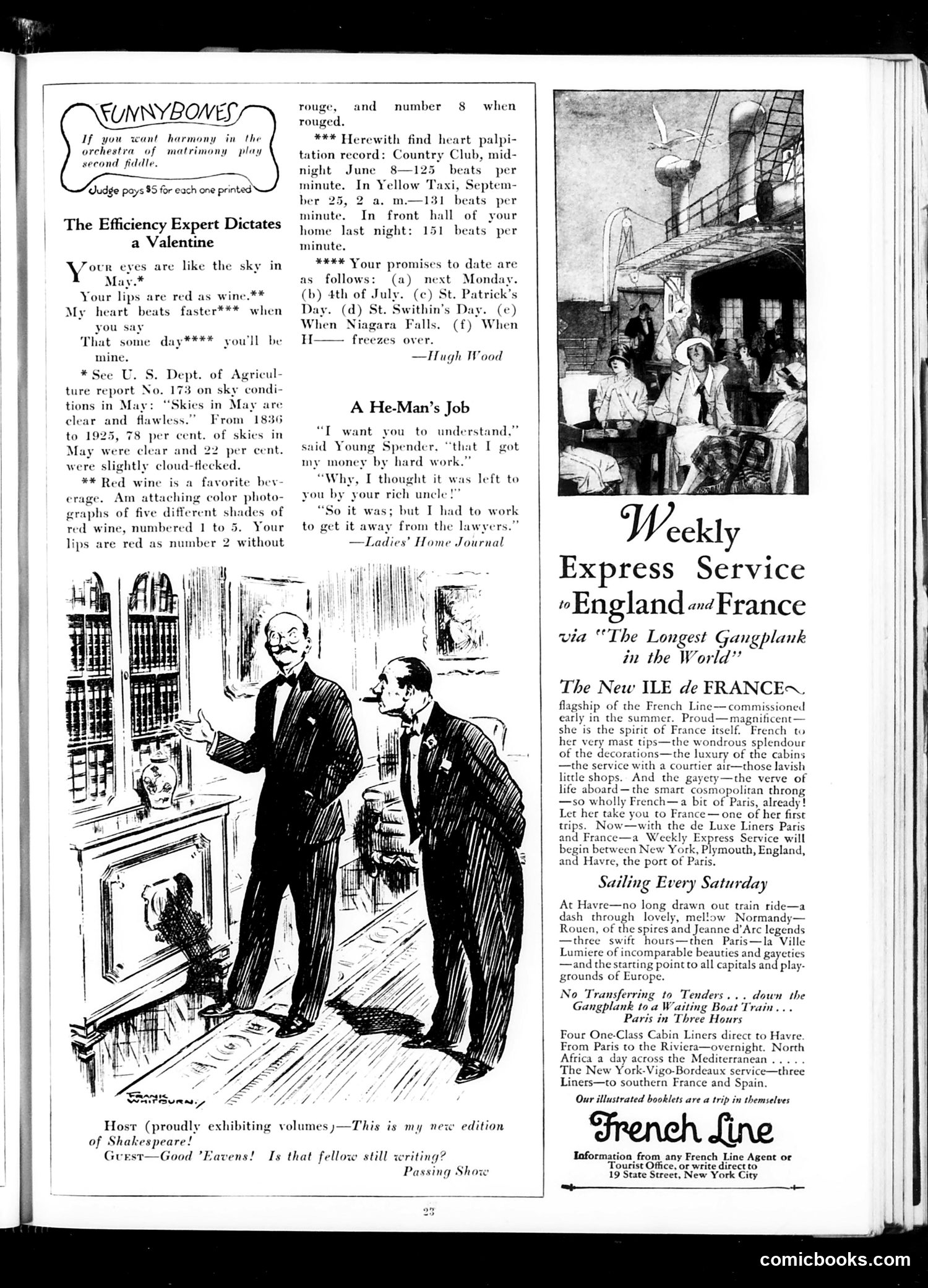
This page contains three distinct pieces: **"The Efficiency Expert Dictates a Valentine"** (left): Satirizes the early-20th-century "efficiency expert" movement—a real trend applying industrial optimization to all aspects of life. The joke mocks a romantic valentine reduced to bureaucratic pedantry: the lover cites USDA agricultural data to describe "eyes like the sky," provides wine-color sample swatches, includes heart palpitation measurements from various dates, and catalogs promises as footnoted items. The humor lies in treating intimate emotion as a quantifiable, documentable process—the antithesis of romance. **"A He-Man's Job"** (lower left): A brief anecdote about Young Spender claiming to have "earned" inherited wealth through work. The humor is in the revelation that his "hard work" was actually fighting lawyers to claim his uncle's bequest—inverting the self-made man narrative. **"Weekly Express Service to England and France"** (right): A full-page French Line advertisement for luxury ocean liner service, unrelated to the humor content. The page reflects 1920s anxieties about industrialization and rationalization intruding into personal life.
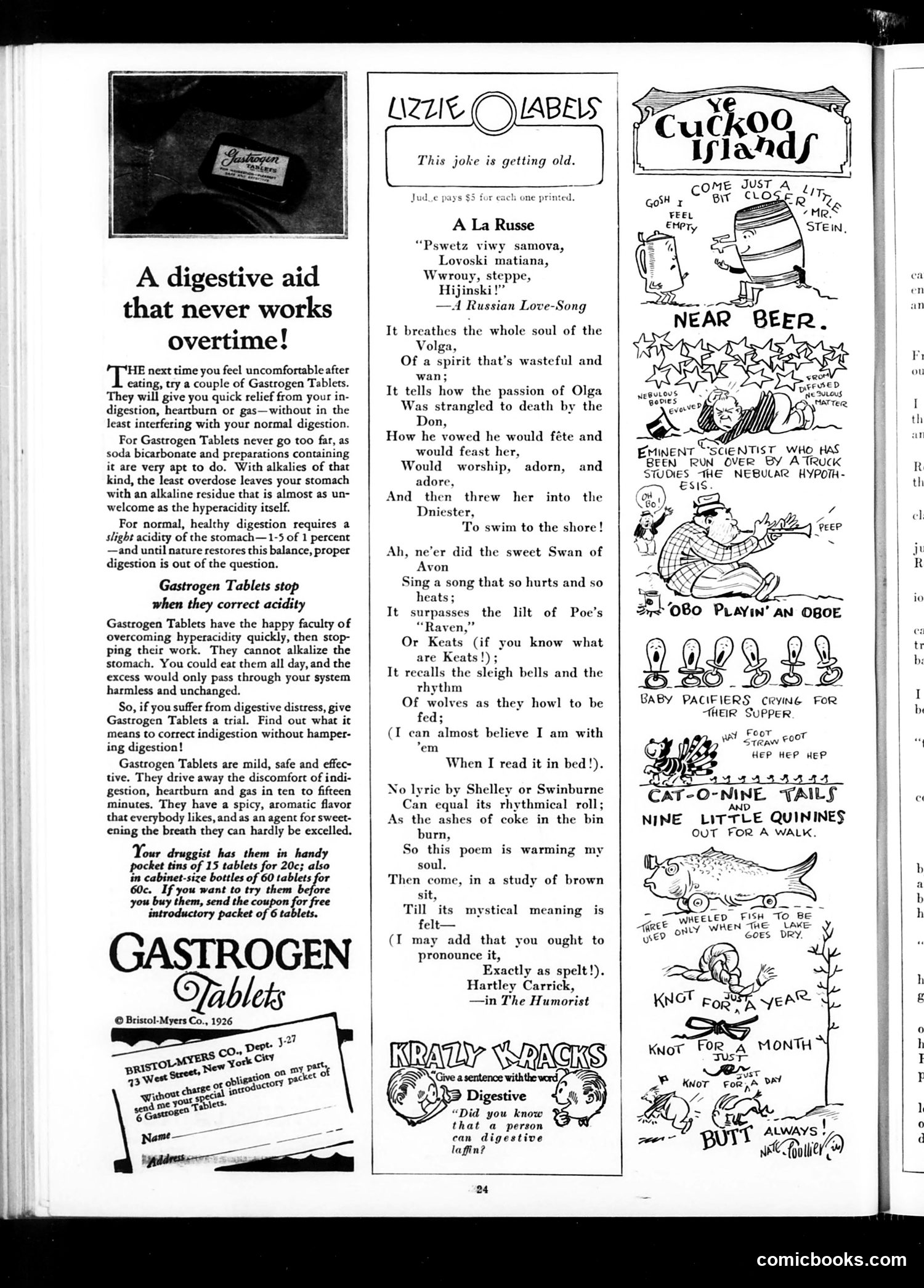
This page mixes advertising with light humor typical of Judge magazine. The **left side is a Gastrogen Tablets advertisement**—a digestive aid claiming to relieve indigestion without over-alkalizing the stomach, a concern of the era. The pitch emphasizes moderation and "natural" balance in digestion. The **center features "A La Russe"** by Hartley Carrick, a humorous poem mocking overwrought Russian romantic literature. It parodies melodramatic Russian love songs with absurd imagery (lovers drowning in rivers, wolves howling), exaggerating their emotional extremes. The joke is that such literature seems ridiculous to English readers, yet somehow compelling. The **right side shows "Lizzie O Labels"**—joke one-liners with crude cartoon illustrations: "Cuckoo Islands" (near beer), "OBO Playin' an Oboe," "Baby Pacifiers," "Cat-o-Nine Tails," and puns on "knots" (timing measurements). These are simple, groan-worthy wordplay jokes—the kind of disposable humor magazines used as filler. Overall, this is a typical Judge page mixing commercial content with literary satire and lightweight humor.
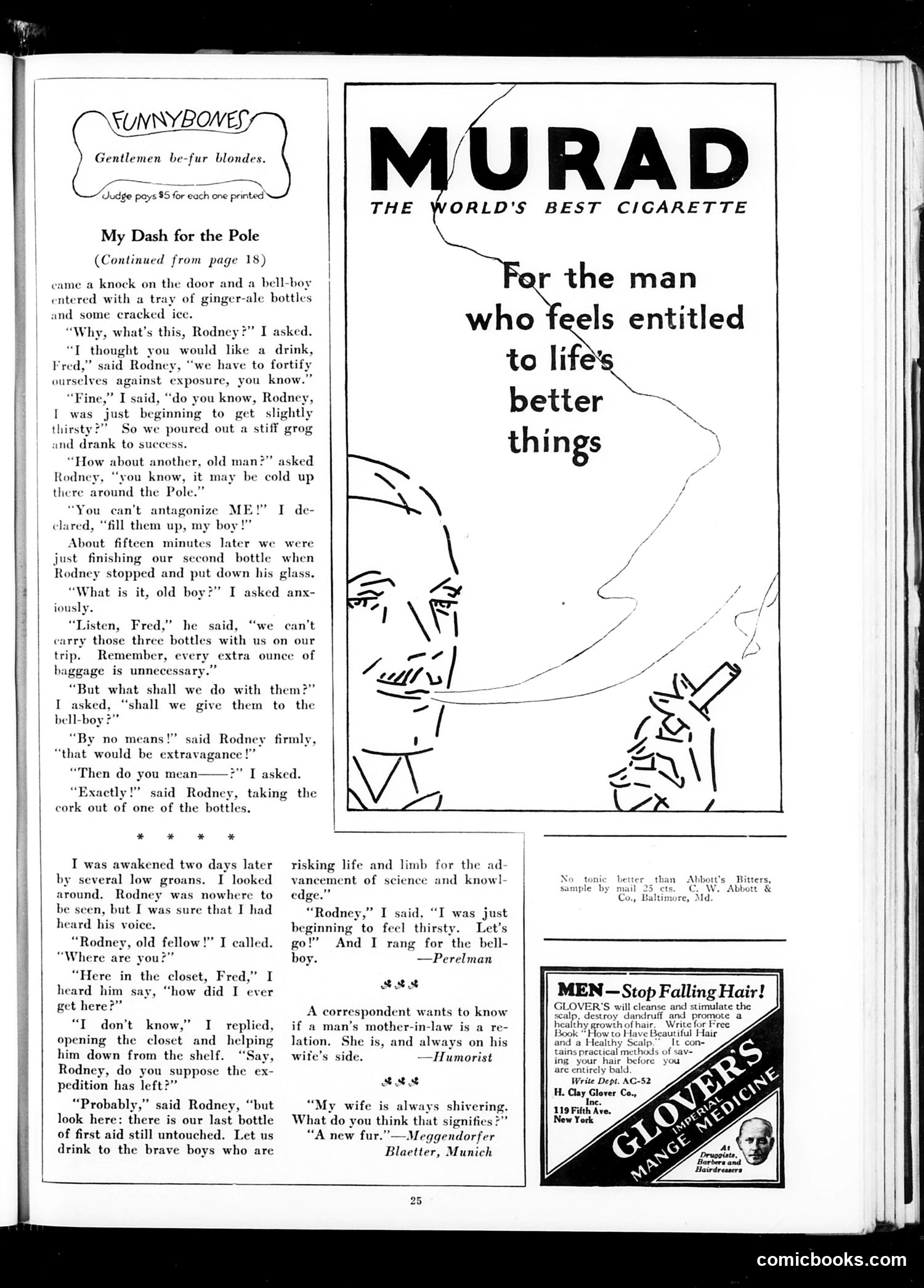
This page contains two distinct elements: **Left side: "My Dash for the Pole"** — A humorous short story (continued from page 18) about two men preparing for an Arctic expedition. The joke centers on their illogical priorities: they bring three bottles of liquor, then argue they must drink them rather than carry them as "unnecessary baggage." One character ends up hiding in a closet. The satire mocks poor planning and rationalizing away excess. **Right side: Murad Cigarette Advertisement** — A full-page ad claiming Murad cigarettes are "the world's best" for men who feel "entitled to life's better things." The illustration shows a man's profile. This reflects early 20th-century advertising that associated luxury products with superiority and entitlement—a marketing approach that would be considered excessive and tone-deaf today. **Bottom: Two small ads** — One for hair loss treatment, another satirizing wives' materialism (a "new fur" explains shivering). Both reflect period gender stereotypes common in Judge magazine's humor.
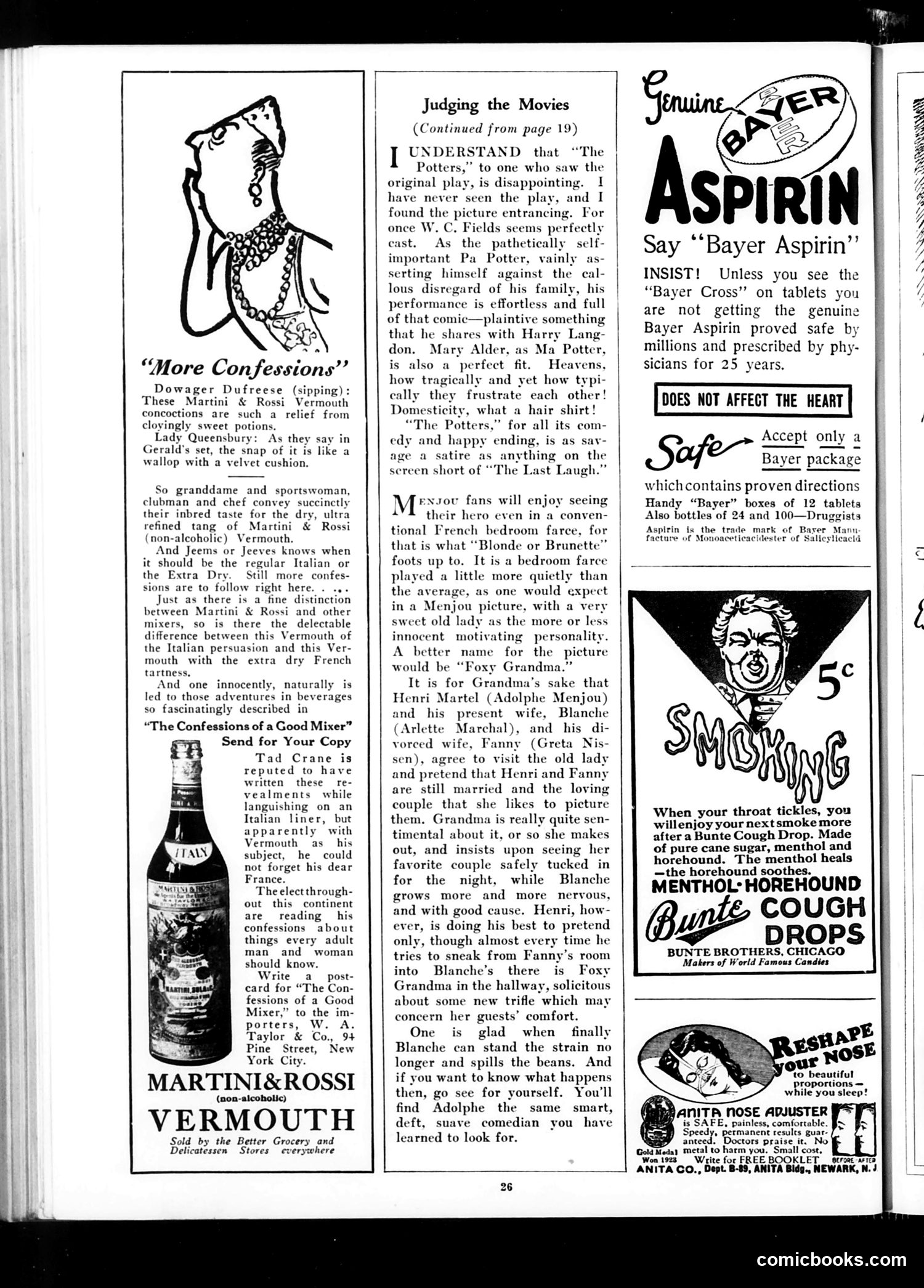
This page contains two sections: a **vermouth advertisement** and a **film review column**. The ad features two aristocratic women ("Dowager Dufreese" and "Lady Queensbury") praising Martini & Rossi non-alcoholic vermouth as sophisticated and refined—a satire of pretentious upper-class taste. The humor lies in wealthy people boasting about drinking *non-alcoholic* vermouth while using affected language about "Italian persuasion" and "French tartness," mocking their obsession with appearing cultured. The movie reviews discuss films starring **W.C. Fields** ("The Potters") and **Adolphe Menjou** ("Blonde or Brunette"). The critic praises Fields's performance as a sympathetic, bumbling father figure, comparing him to silent comedian Harry Langdon. The second review describes a bedroom farce plot involving infidelity and deception, calling it essentially a vehicle for an innocent grandmother character—hence the suggested title "Foxy Grandma." Both sections reflect 1920s-30s entertainment and consumer culture.
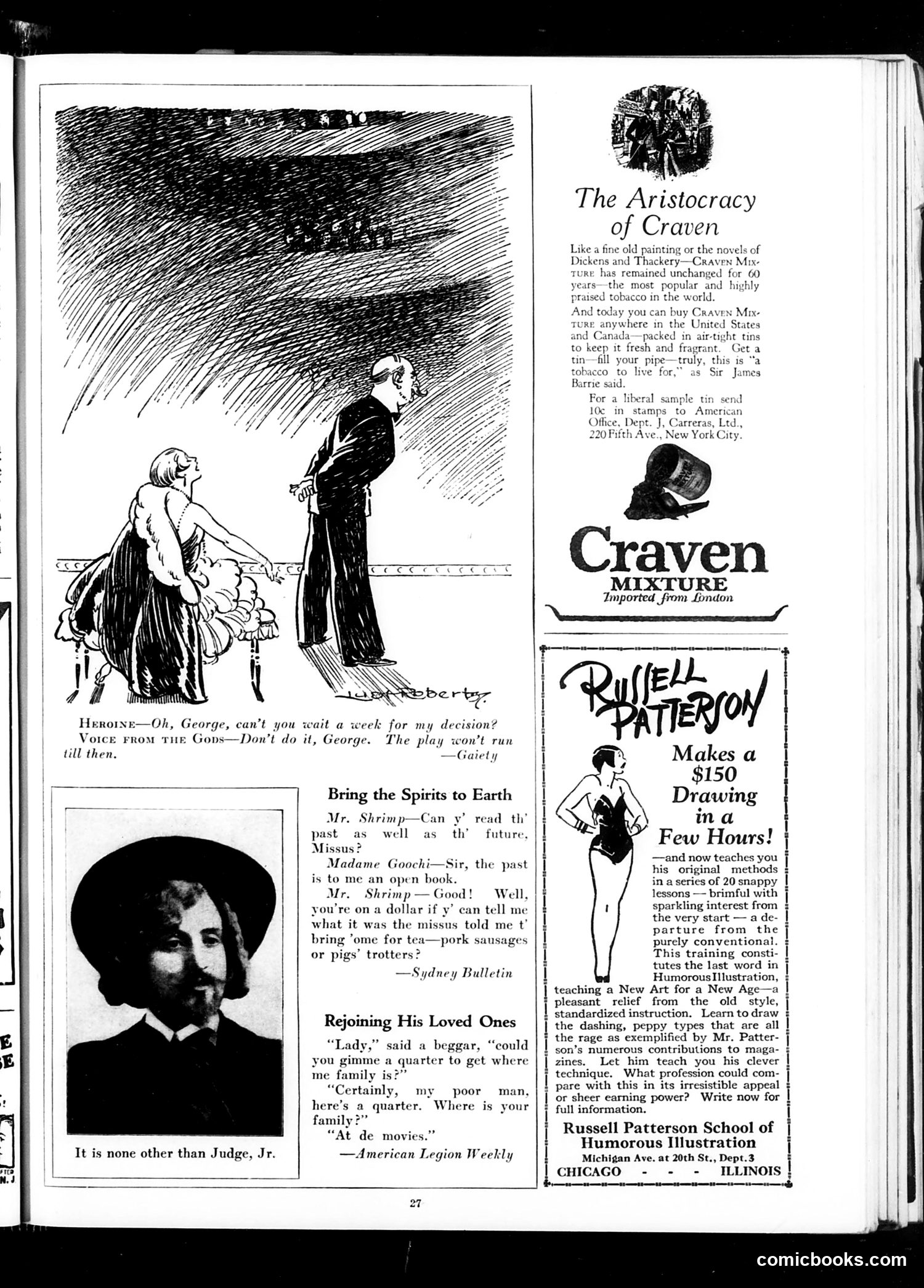
This page contains multiple satirical pieces typical of early 20th-century Judge magazine: **Main cartoon (top left):** A woman seeks a man's decision on marriage ("can't you wait a week?"), while a disembodied "Voice from the Gods" warns him against it—likely satirizing either hesitant suitors or the supernatural intervention trope in theater (referencing "The Gaiety" play mentioned). **Middle section:** Three brief joke pieces mock spiritualism and marital discord. "Bring the Spirits to Earth" ridicules a fortune teller who claims to read the past but cannot answer a simple question about what his wife told him to buy for dinner—satire on fake psychics. "Rejoining His Loved Ones" jokes darkly that a beggar's family is "at de movies" rather than home, mocking both poverty and cinema's cultural grip. **Right side:** Advertisements for Craven tobacco (emphasizing tradition) and Russell Patterson's drawing school, which appears to be the magazine's own commercial content. The page reflects 1920s concerns: skepticism toward spiritualism, anxieties about cinema's social impact, and gender dynamics in courtship.
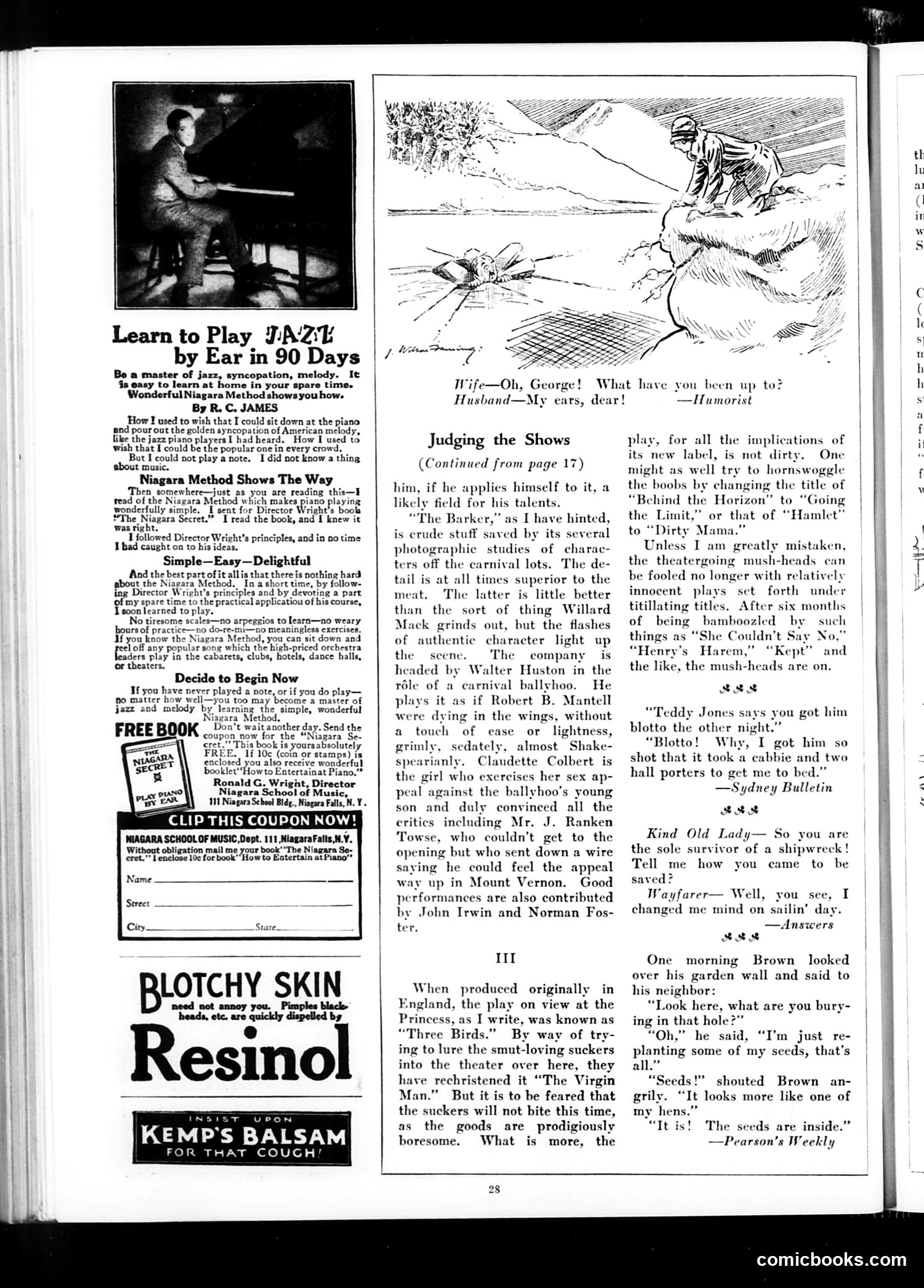
This single-panel cartoon depicts a domestic scene where a wife confronts her husband about his activities, with his reply about his "ears" suggesting either a humorous misunderstanding or an absurd excuse. The humor relies on the wife's accusatory tone contrasting with the husband's apparently innocent (or deliberately evasive) response. The cartoon appears to be a standard domestic humor piece common to Judge magazine—satirizing marital dynamics and miscommunication between spouses. Without additional context, the specific joke's full meaning is unclear, but it likely plays on either a misheard conversation or an unexpectedly mundane explanation for something the wife suspects is problematic. The style and format are typical of early-to-mid 20th century magazine humor.
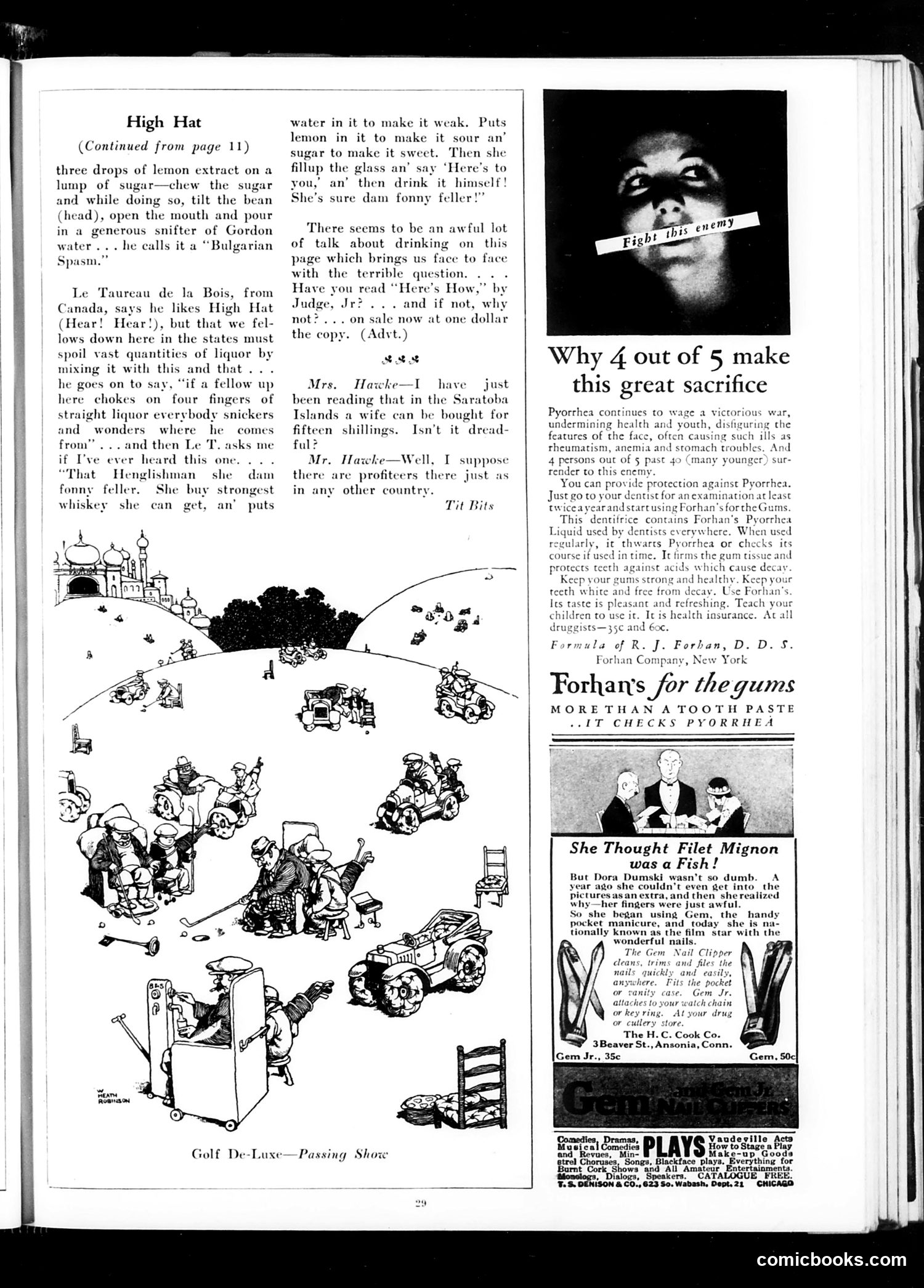
This cartoon satirizes wealthy leisure culture and conspicuous consumption during the Jazz Age. The illustration depicts an elaborate seaside resort scene where affluent golfers enjoy lavish amenities—multiple recreational activities, servants, automobiles, and entertainment—while playing golf. The surrounding text humorously documents upper-class drinking customs, featuring anecdotes about elaborate cocktail preparation methods and cultural pretensions around liquor consumption. A Canadian character's comment about American "profiteers" mocking British drinkers adds class commentary. The overall satire targets the excessiveness and absurdity of wealthy people's leisure pursuits during the Roaring Twenties, when economic prosperity created ostentatious displays of wealth. Judge magazine regularly mocked such upper-class excess and affectation as targets for humor.
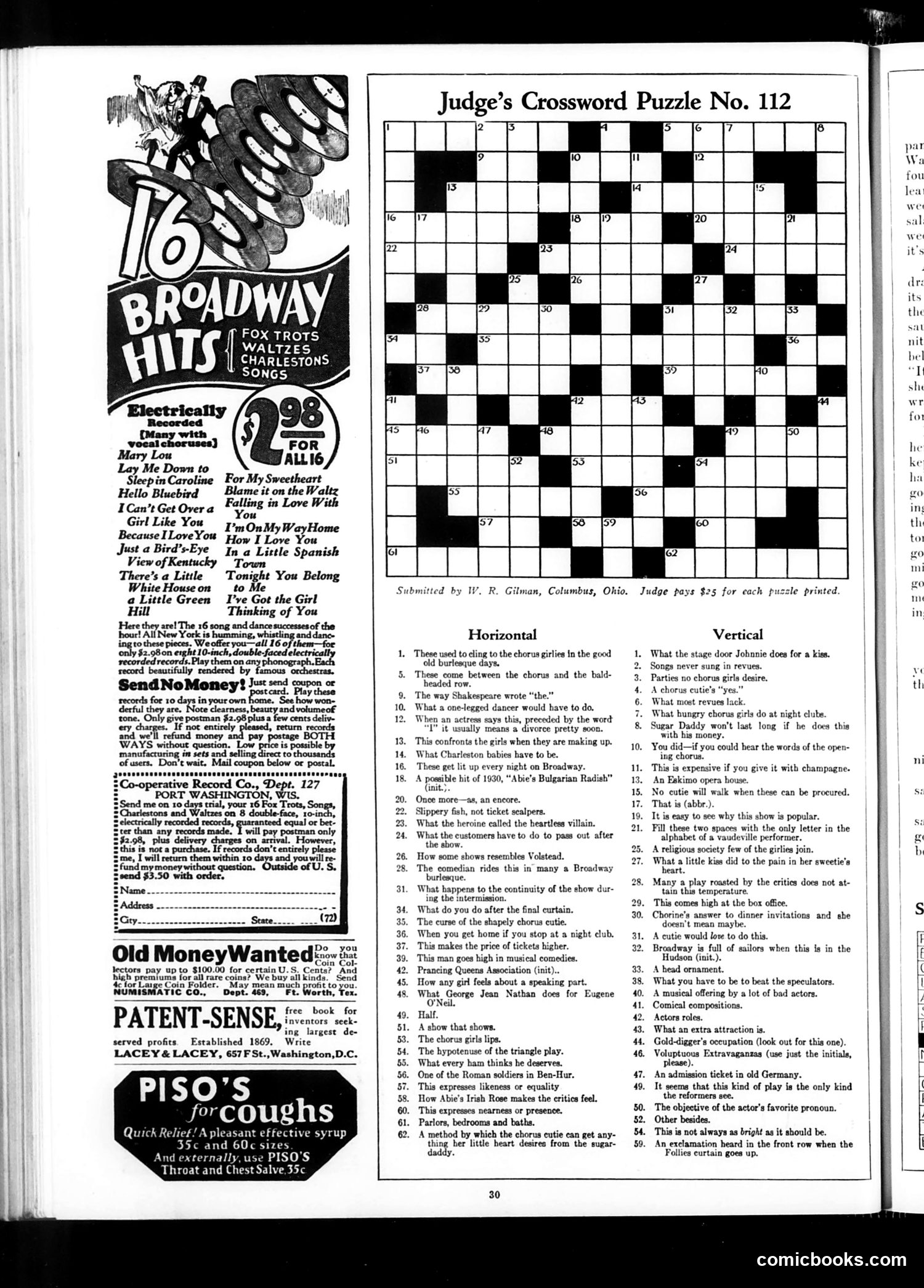
This page from **Judge magazine** (a satirical publication) contains primarily **advertising** and a crossword puzzle themed around **Broadway theater and burlesque entertainment** from the 1920s-30s era. **Key context for modern readers:** The ads emphasize period consumer goods: phonograph records of "fox trots" and "Charlestons" (popular dances), coin collecting, and patent medicines. The crossword clues extensively reference **burlesque theater culture**—"chorus girlies," "bald-headed row" (front-row seats), "sugar daddies," and stage-door customs. References to plays like *Abie's Irish Rose* and critic George Jean Nathan anchor it to contemporary Broadway. The humor assumes reader familiarity with theater types: ham actors, one-legged dancers doing specialty acts, and the financial dynamics of wealthy older men supporting young performers. The tone is lighthearted and worldly rather than moralistic about these entertainment-industry practices.
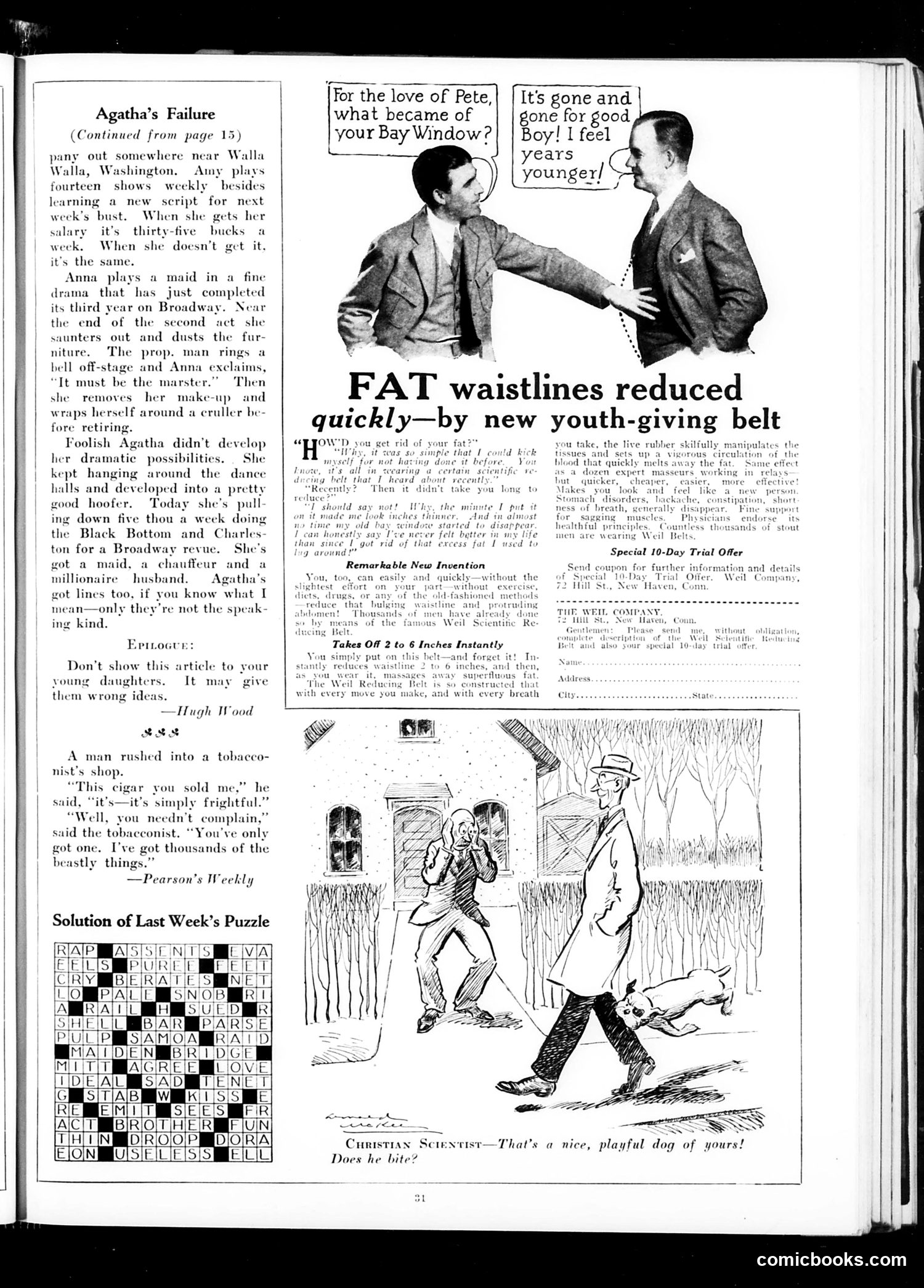
This page contains mixed editorial content, primarily featuring: **Main Advertisement**: A "youth-giving belt" that claims to reduce waistlines quickly. Two men discuss the product—one asking what happened to the other's "Bay Window" (period slang for a protruding belly), with the response that it's "gone for good." The ad promises the belt uses "live rubber" to stimulate circulation and reduce fat. **"Agatha's Failure" Story**: A serialized narrative about aspiring actresses in early 1920s theater, contrasting those struggling in minor roles (earning $35/week) versus Agatha, who became a successful dancer/performer earning $5,000 weekly on Broadway, complete with servants and a wealthy husband. **Humor Sections**: Short jokes from *Pearson's Weekly* about cigars and a complaint about product quality. **Cartoon**: Shows a Christian Scientist with a playful dog, captioned about the dog's pleasant nature. The satire reflects 1920s concerns: the theatrical industry's precariousness, beauty standards emphasizing slimness, and the era's fascination with quick-fix remedies.
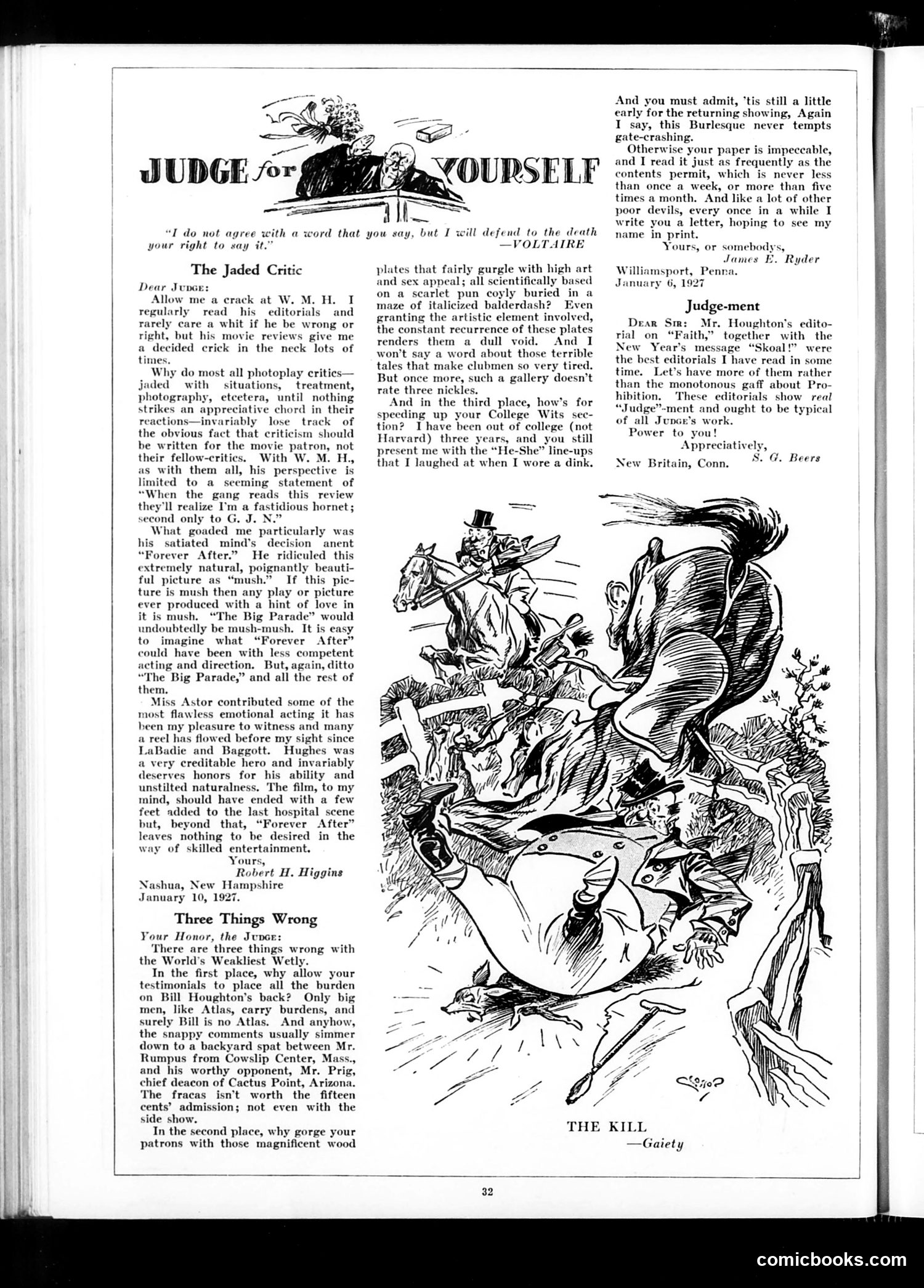
This page features reader letters critiquing Judge's film and humor sections, rather than political cartoons. The main content includes: **"The Jaded Critic"**: A reader attacks film critic W.M.H. for writing dismissively about "Forever After" as "mush." The letter defends the film's emotional authenticity and praises actors Mary Astor and Jack Holt, arguing critics should write for general audiences, not to impress fellow critics with cynicism. **"Three Things Wrong"**: Another reader criticizes Judge's own content—specifically its "World's Weakliest Wetly" section, complaining about: oversized woodcut illustrations that are repetitive, tired jokes about mundane disputes, and outdated college humor ("He-She" references). The cartoon titled **"The Kill"** (by Gluety) depicts a horseman in hunting attire, apparently capturing game. These letters reflect 1920s magazine culture, where readers actively engaged with editorial choices and debated artistic merit versus accessibility in popular entertainment.
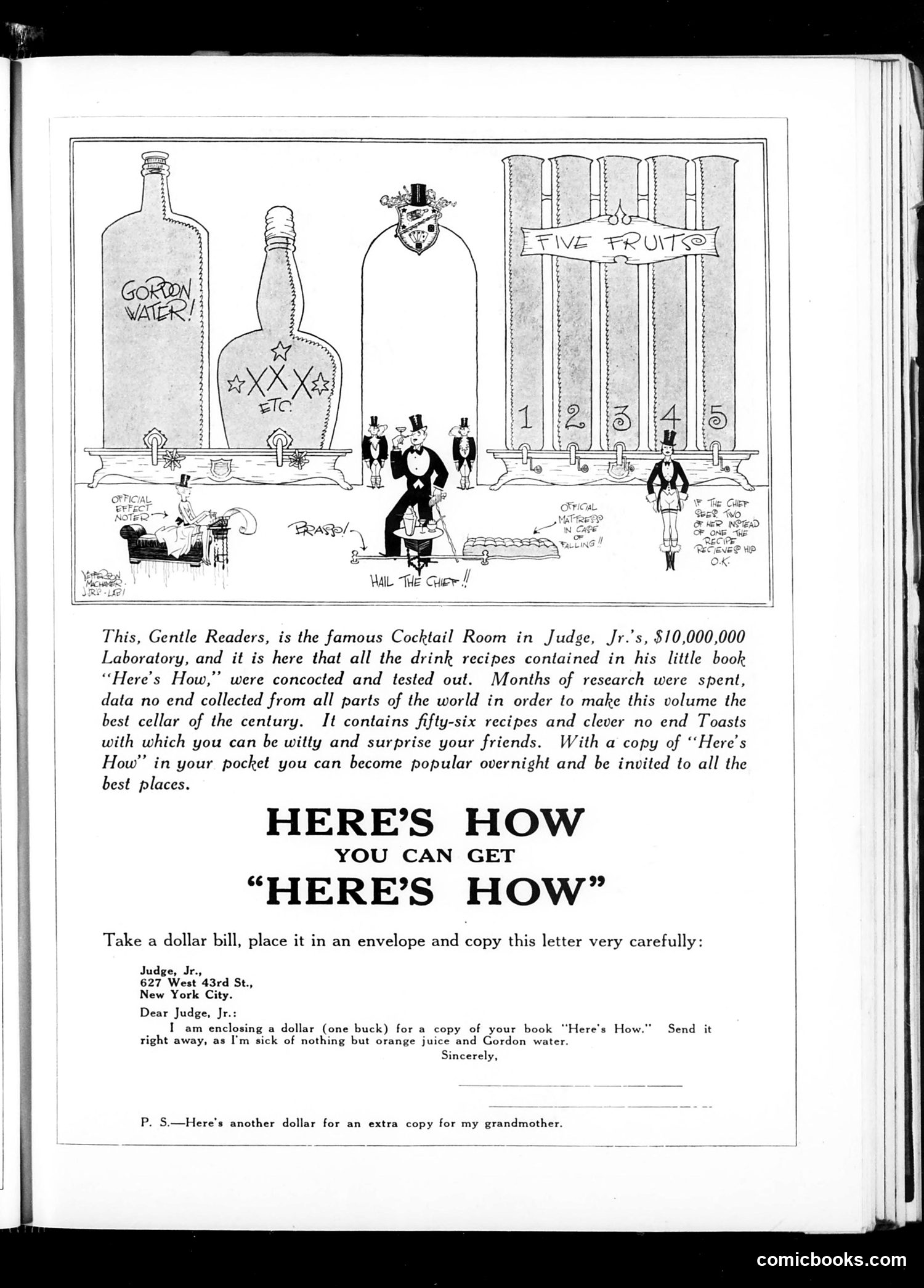
This is primarily **advertising content** for a cocktail recipe book titled "Here's How," presented as satirical humor in Judge magazine (likely 1920s, given Prohibition-era references). The cartoon depicts an elaborate "Cocktail Room" laboratory where drinks were supposedly researched and tested. The satire is that during **Prohibition** (when alcohol was illegal), the text humorously mentions being "sick of nothing but orange juice and Gordon water"—transparent code for forbidden alcohol. The joke targets the absurdity of Prohibition: people openly advertised cocktail recipes through mail-order while the law officially banned alcohol. The "$10,000,000 laboratory" and pseudo-scientific presentation mock how elaborate and serious people treated circumventing the law. Judge magazine itself was satirizing Prohibition's ineffectiveness and widespread public defiance of it. The advertisement's openness suggests the law was largely ignored or openly mocked by the magazine's readers.
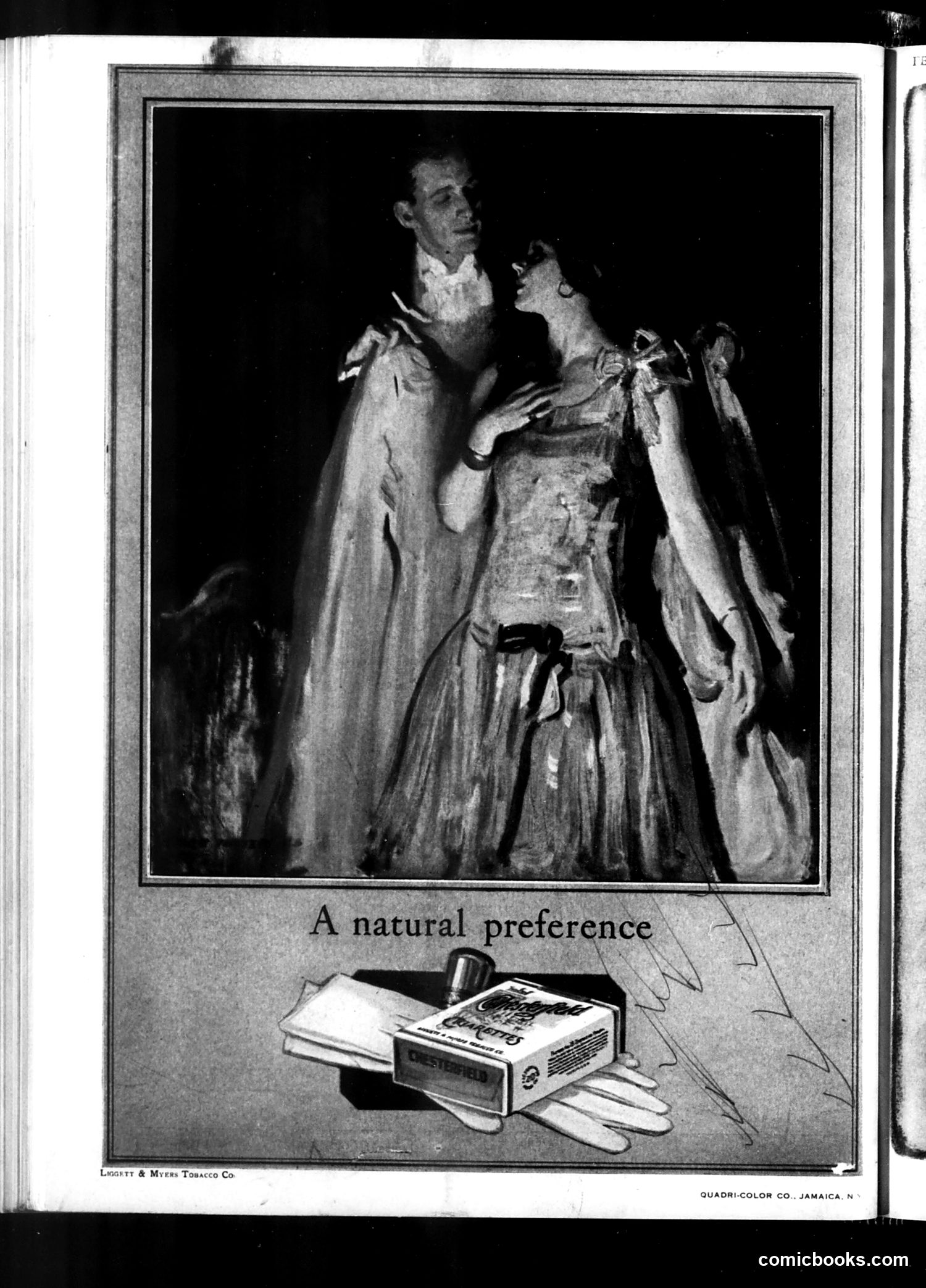
This is a tobacco advertisement from *Judge* magazine, not a political cartoon. The image shows a man and woman in theatrical/elegant dress with the caption "A natural preference." Below them is a product image showing a cigarette box and loose cigarettes, credited to "Liggett & Myers Tobacco Co." The ad's message plays on gender and romance: it suggests that women naturally prefer this particular cigarette brand, using the intimate scene between the well-dressed couple to imply sophistication and desirability. The "natural preference" framing attempts to normalize smoking as an inherent choice—a common advertising strategy of the era before modern health warnings. This reflects early 20th-century marketing that associated cigarettes with modernity, romance, and social status.