
Judge, 1927-02-12 · page 19 of 36
Judge — February 12, 1927 — page 19: what you’re looking at
What you’re looking at
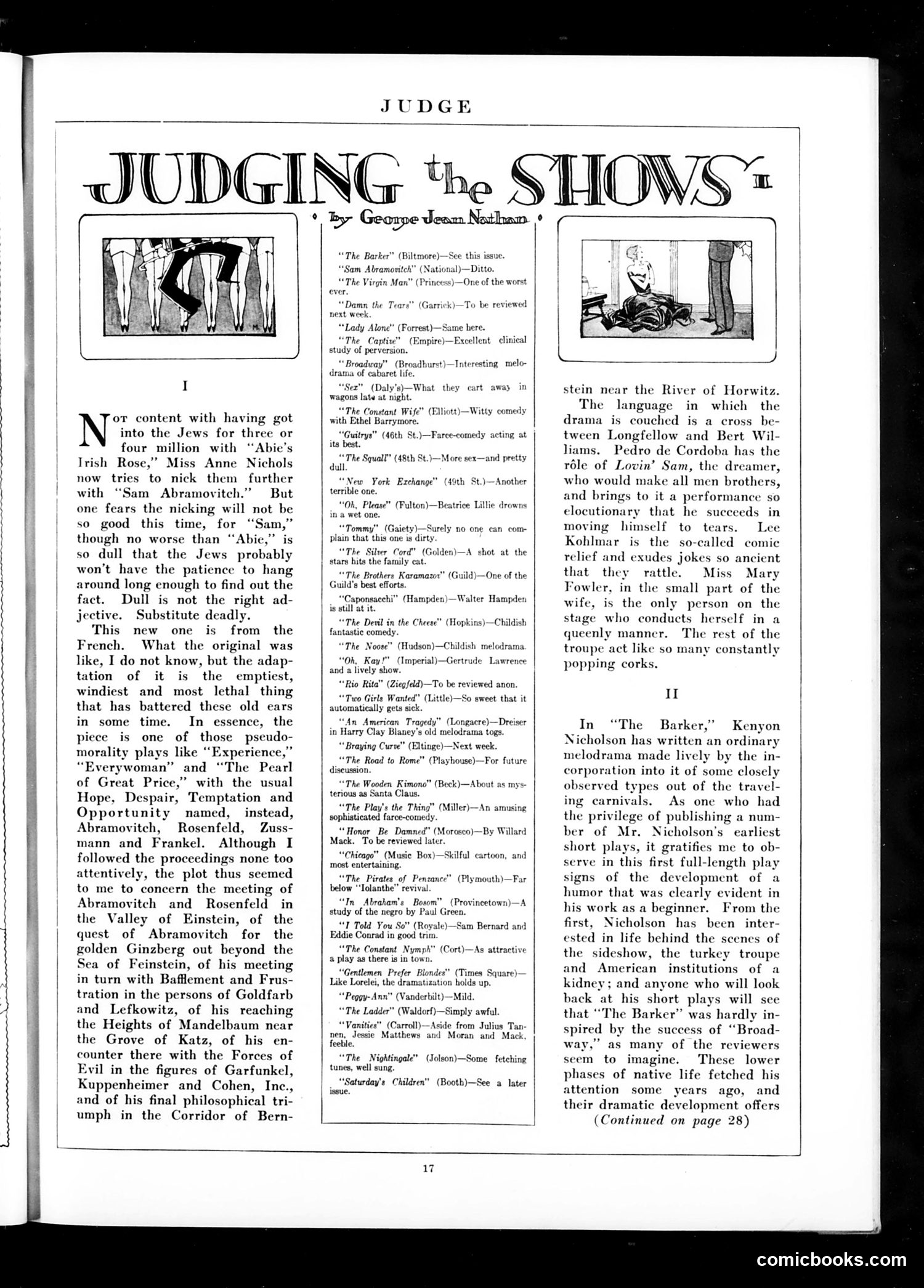
This is a theater review column by George Jean Nathan, Judge's drama critic. The page contains two illustrations showing scenes from Broadway productions, but the main content is Nathan's caustic assessment of current theater offerings. The central critique targets Anne Nichols' new play "Sam Abramovitch," following her commercial success with "Abie's Irish Rose." Nathan savages it as deadly dull—a pseudo-morality play with allegorical Jewish character names (Abramovitch, Rosenfeld, Ginzberg, etc.) representing abstract concepts like Hope and Despair. He dismisses it as adapted from French material, finding it the "emptiest, windiest and most lethal thing" he's encountered. The column then reviews numerous Broadway shows with brief, often withering comments. Nathan's style is characteristic of 1920s sophisticated theater criticism—witty, elitist, and dismissive of commercial sentimentality or obvious plots.
📄 Transcribed text from this page (OCR, searchable)
Machine-transcribed from the original scan — historical spelling and the odd misread are preserved.
| scence sini JUDGE oT content with having got four million with ‘Abie’s Irish Rose,” Miss Anne Nichols now tries to nick them further with “Sam Abramovitch.” But one fears the nicking will not be so good this time, for “Sam,” though no worse than ‘Abi is so dull that the Jews probably won't have the patience to hang around long enough to find out the fac Dull is not the right ad- jective. Substitute deadly. This new one is from the French. What the original was like, I do not know, but the adap- tation of it is the emptiest, windiest and most lethal thing that has battered these old ears in some time. In ence, the piece is one of th pseudo- morality plays like “Experience,” “Everywoman” and “The Pearl of Great Price,’ with the usual Hope, Despair, Temptation and Opportunity named, instead, Abramovitch, Rosenfeld, Zu: mann and Frankel. Although I followed the proceedings none too attentively, the plot thus seemed to me to concern the meeting of Abramovitch and Rosenfeld in the Valley of Einstein, of the quest of Abramovitch for the golden Ginzberg out beyond the Sea of Feinstein, of his meeting in turn with Bafflement and Frus- tration in the persons of Goldfarb and Lefkowitz, of his reaching the Heights of Mandelbaum near the Grove of Katz, of his en- counter there with the Forces of Evil in the figures of Garfunkel, Kuppenheimer and Cohen, Inc., and of his final philosophical tri- umph in the Corridor of Bern- by Geonpe Jeam Nathan » The Barker” (Biltmore) mm Abramovitch” (National)—Ditto. The Virgin Man” (Princess)—One of the worst ever. “Damn the Tears” next week “Lady Alone" (Forrest)—Same here. “The Captive” (Empire)—Excellent study of perversion. (Broadhurst See this issue. (Garrick)—To be reviewed clinical * Broadway" Interesting melo- cart away in at night. “The Constant W with Ethel Barrymore * (Elliott)—Witty comedy “Guitrys” its best. “The Squall” (48th St.)—More sex—and pretty dull “New York Exchange” terrible one. (46th St.)—Farce-comedy ting at (49th St.) —Another “Oh, Please” (Fulton)—Beatrice Lillie drowns in a wet one. Tommy" (Gaiety)—Surely no one can com- plain that this one is dirty “The Silver Cord” (Golden)—A stars hits the family cat. The Brothers Karamazov Guild's best efforts. (Hampden)—Walter Hampden shot at the uild)—One of the aponsacchi" is still at it. “The Devil in the Cheese” fantastic comedy “The Noose” “Oh, Kay!" (Imperial)—Gertrude and a lively show. “Rio Rita” (Ziegfeld)—To be reviewed anon. “Two Girls Wanted” (Little)—So sweet that it automatically gets sick. (Hopkins) —Childish (Hudson)—Childish melodrama. Lawrence “An American Tragedy" (Longacre)—Dreiser in Harry Clay Blaney’s old melodrama togs. “ Braying Curve” (Eltinge)—Next week. “The Road to Rome” diseussion (Playhouse)—For future “The Wooden Kimono” (Beck)—About as mys- terious as Santa Claus. “The Play's the Thing” sophisticated farce-comedy “Honor Be Damned” (Morosco)—By Willard Mack. To be reviewed later. “Chicago” (Music Box)— most entertaining, (Miller)—An amusing Skilful cartoon, and “The Pirates of Penzance” below “Iolanthe” revival “In Abraham's Bosom” study of the negro by Paul “I Told You So” (Royale) Eddie Conrad in good trim “The Constant Nymph” a play as there is in town, (Plymouth)—Far (Provincetown) —A ree Sam Bernard and (Cort)—As attractive “Gentlemen Prefer Blondes” (Times Like Lorelei, the dramatization holds up. “Peggy-Ann” (Vanderbilt)—Mild. “The Ladder” (Waldorf}—Simply awful. Vanities” (Carroll)—Aside from Julius Tan- Jeasie Matthews and Moran and Mack quare) “The Nightingale” tunes, well sung. “Saturday's Children” issue. (Jolson)—Some fetching (Booth)—See a later JUDGING "be SHOWS" | J stein near the River of Horwitz. The language in which the drama is couched is a cross be- tween Longfellow and Bert Wil- liams. Pedro de Cordoba has the réle of Lovin’ Sam, the dreamer, who would make all men brothers, and brings to it a performance so elocutionary that he moving himself to tears. Lee Kohlmar is the so-called comic relief and exudes jokes so ancient that they rattle. Miss Mary Fowler, in the small part of the wife, is the only person on the stage who conducts herself in a queenly manner. The rest of the troupe act like so many constantly popping corks. succeeds in II In “The Barker,” Kenyon Nicholson has written an ordinary melodrama made lively by the in- corporation into it of some closely observed types out of the travel- ing carnivals. As one who had the privilege of publishing a num- ber of Mr. Nicholson's earliest short plays, it gratifies me to ob- serve in this first full-length play signs of the development of a humor that was clearly evident in his work as a beginner. From the first, icholson been inter- ested in life behind the scenes of the sideshow, the turkey troupe and American institutions of a kidney; and anyone who will look back at his short plays will see that “The Barker” was hardly in- has spired by the success of ‘“Broad- way,” as many of the reviewers seem to imagine. These lower phases of native life fetched his attention some years ago, and their dramatic development offers (Continued on page 28) comicbooks.com