
Judge, 1927-02-12 · page 21 of 36
Judge — February 12, 1927 — page 21: what you’re looking at
What you’re looking at
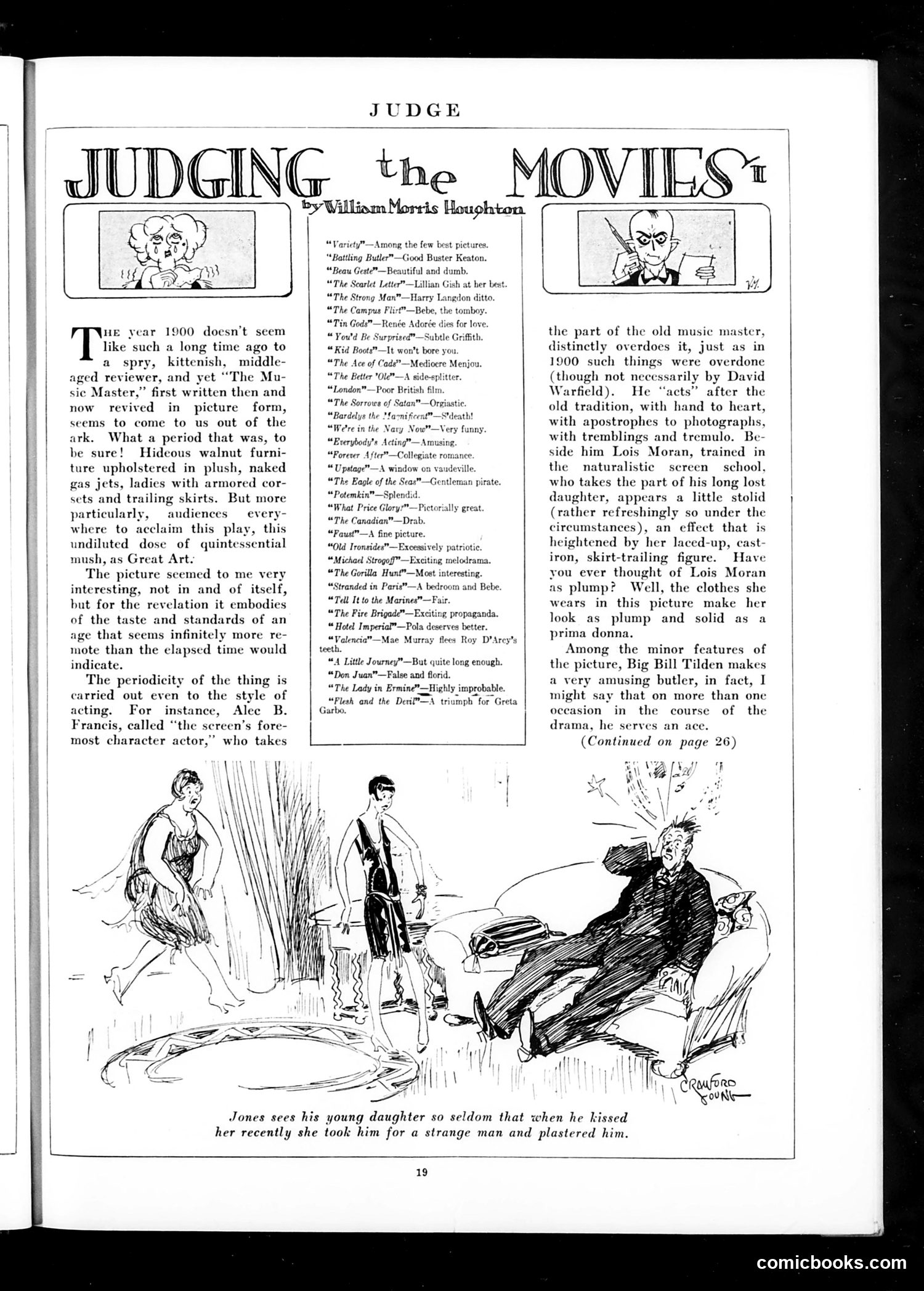
This is William Morris Haughton's column reviewing 1920s films for *Judge*, a satirical magazine. The main cartoon illustrates a review of "The Music Master," a stage play adapted to film. Haughton critiques the film for its outdated 1900 theatrical style—overwrought acting with exaggerated gestures (hand to heart, apostrophes to photographs). He contrasts the hammy performance of Alec B. Francis in the title role with the more naturalistic screen acting of Lois Moran, the younger actress, noting her period costume makes her appear "plump and solid as a prima donna." The cartoon's caption shows a father so unfamiliar with his daughter that when she recently kissed him, he mistook her for a stranger and hit her—satirizing the melodramatic, unrealistic plot typical of early theatrical adaptations. The accompanying list reviews dozens of contemporary films, rating their quality with brief, often witty comments about stars like Buster Keaton, Lillian Gish, and Greta Garbo. Big Bill Tilden (the tennis champion) appearing as a butler gets an ace/tennis pun.
📄 Transcribed text from this page (OCR, searchable)
Machine-transcribed from the original scan — historical spelling and the odd misread are preserved.
1900 doesn’t seem a long time ago to a spry, kittenish, middle- aged reviewer, and yet ‘The Mu- sic Master,” first written then and now revived in picture form, seems to come to us out of the ark. What a period that was, to be sure! Hideous walnut furni- ture upholstered in plush, naked jets, ladies with nd trailing skirt particular] where to acclaim this play, th undiluted dose of quintessential mush, as Great Art: The picture seemed to me very interesting, not in and of itself, but for the revelation it embodies of the taste and standards of an age that seems infinitely more re- mote than the elapsed time would indicate. The periodicity of the thing is carried out even to the style of cting. For Alec B. ancis, called ‘ n’s fore- who takes E year | like such mored cor- But more every se audience instance, ‘the scre F most character actor,” JUDGE G the MOVI by Villiom Morris mann “Variety”—Among the few best pictures. “Battling Butler” —Good Buster Keaton. “Beau Geste”—Beautiful and dumb. “The Scarlet Letter” —Lillian Gish at her best. “The Strong Man”—Harry Langdon ditto. “The Campus Flirt”—Bebe, the tomboy. “Tin Gods”—Renée Adorée dies for love. “ You'd Be Surprised” —Subtle Griffith. “Kid Boots”—It won't bore you. “The Ace of Cads”—Mediocre Menjou. “The Better "Ole”—A splitter. “London” —Poor British film. “The Sorrows of Satan” —Orgiastic. “Bardelys the !$arnificent”—S'death! “We're in the Nary Now"—Very funny. “Brerybody’s Acting”—Amusing. “Forever After Zollegiate romance “ Upstage”—A window on vaudeville. “The Eagle ofthe Seas” Gentleman pirate ictorially great. “The Canadian” —Drab. “Paust”—A fine picture. “Old Tronsides”—E: essively patriotic. “Michael Strogof”—Exciting melodrama. “The Gorilla Hunt”—Most interesting. “Stranded in Paris”—A bedroom and Bebe. “Tall It to the Marines”—Fair. “The Pire Brigade”—Exciting, propaganda. “ Hotel Imperial”—Pola deserves better. “Valencia” —Mae Murray flees Roy D'Arcy’s teeth. “4 Little Journey” —But quite long enough. “Don Juan”—False and florid. “The Lady in Ermine" —Highly improbable. Flesh ond the Derif®—A triumph for Greta Garbo. Jones sees his young i. so seldom that when he V4. the part of the old music master, distinctly overdoes it, just as in 1900 such things were overdone (though not necessarily by David Warfield). He “acts” after the old tradition, with hand to heart, with apostrophes to photographs, with tremblings and tremulo. Be- side him Lois Moran, trained in the naturalistic school, who takes the part of his long lost daughter, appears a little stolid (rather refreshingly so under the circumstances), an effect that is heightened by her laced-up, cast- iron, skirt-trailing figure. Have you ever thought of Lois Moran as plump? Well, the clothes she wears in this picture make her look as plump and solid as a prima donna. Among the minor features of the picture, Big Bill Tilden makes a very amusing butler, in fact, I might say that on more than one occasion in the course of the drama, he serves an ace. (Continued on page 26) screen issed her recently she took him for a strange man and plastered him. 19 comicbooks.com