
A complete issue · 36 pages · 1926
Judge — September 18, 1926
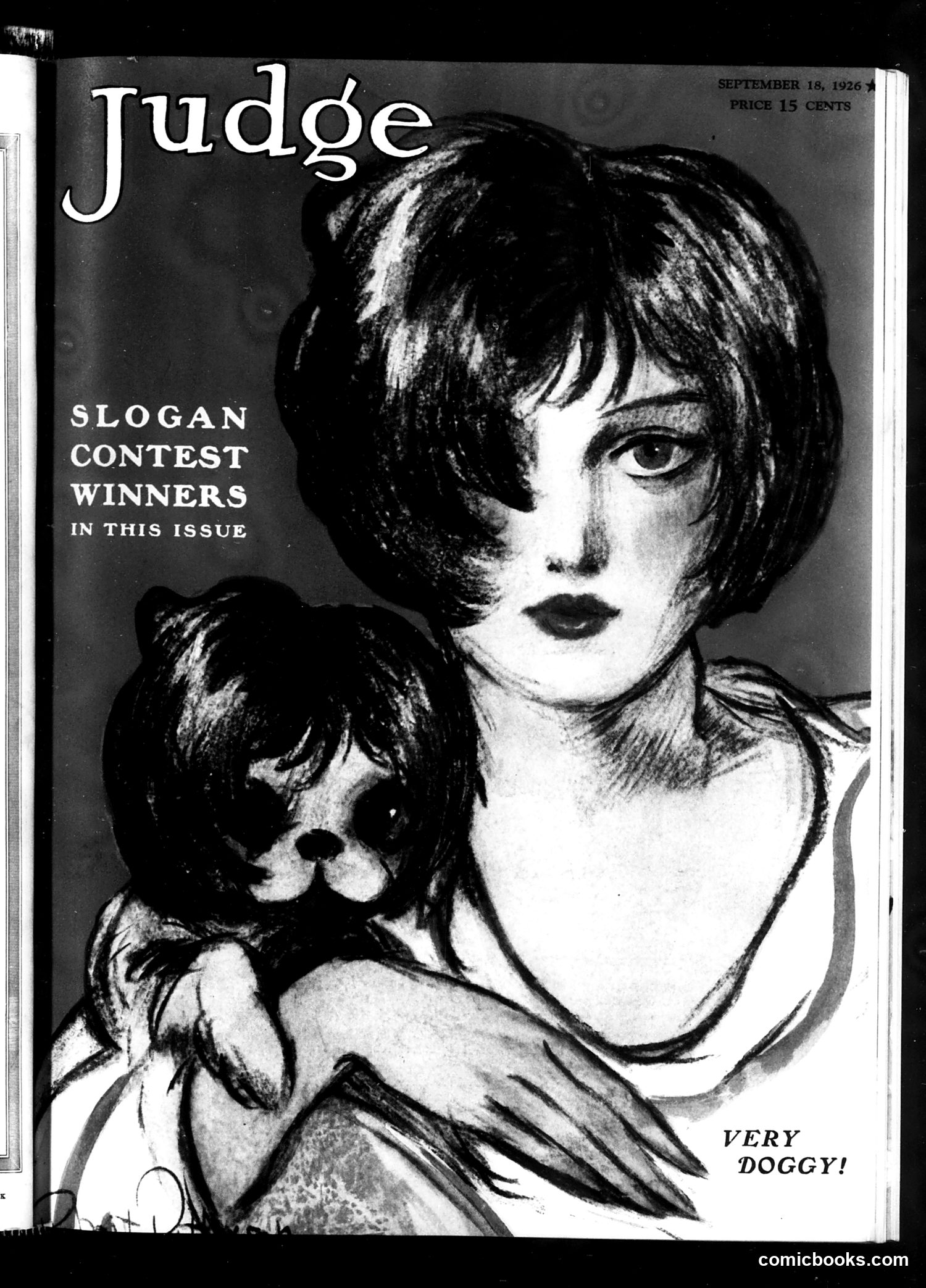
This is a **magazine cover**, not a political cartoon. The image shows a fashionable young woman with a 1920s bob haircut holding a small dog, with the caption "VERY DOGGY!" The cover announces a **"Slogan Contest Winners"** feature inside the issue. The humor appears to be a play on words: the phrase "very doggy" likely refers to both the literal dog in the image and contemporary slang usage (unclear exactly how "doggy" was slang in 1926, but the pun is intentional). The stylish woman represents the modern "flapper" aesthetic popular in the Jazz Age. The cover is primarily a humorous visual pun rather than political satire—typical of Judge's lighter entertainment-focused content of this era.
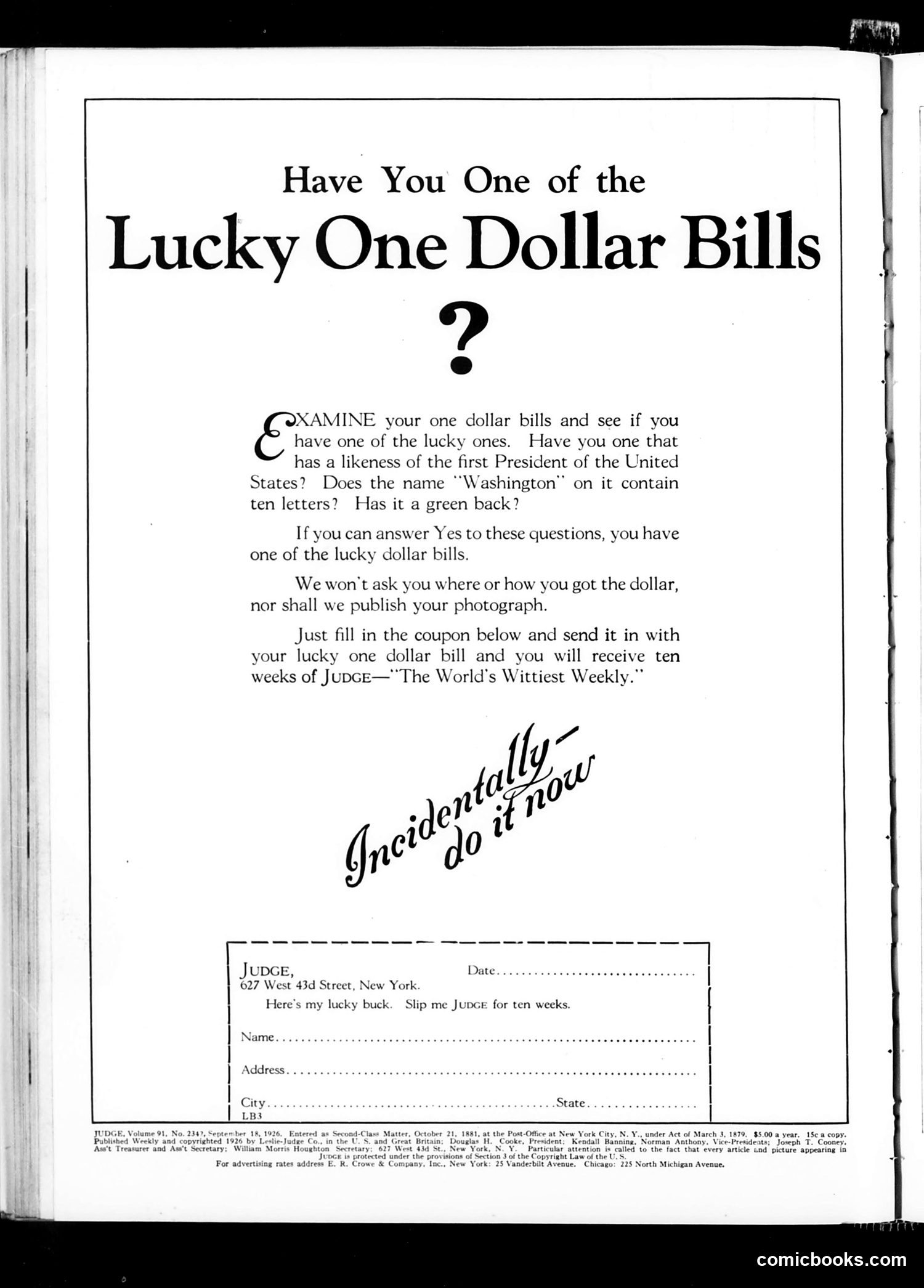
This page is primarily an advertisement, not a political cartoon. It promotes "Lucky One Dollar Bills" to readers of Judge magazine (dated September 18, 1926, based on the footer). The ad invites readers to examine their dollar bills for specific criteria: a portrait of the first U.S. President (George Washington), the word "Washington" containing ten letters, and a green back. If a bill meets these conditions, the owner is declared to have a "lucky" dollar bill. Readers are encouraged to mail their lucky dollar bill to Judge's offices in exchange for a ten-week subscription to Judge magazine, described as "The World's Wittiest Weekly." The tagline "Incidentally, do it now" adds promotional urgency. This appears to be a circulation-building scheme using the appeal of lucky money.
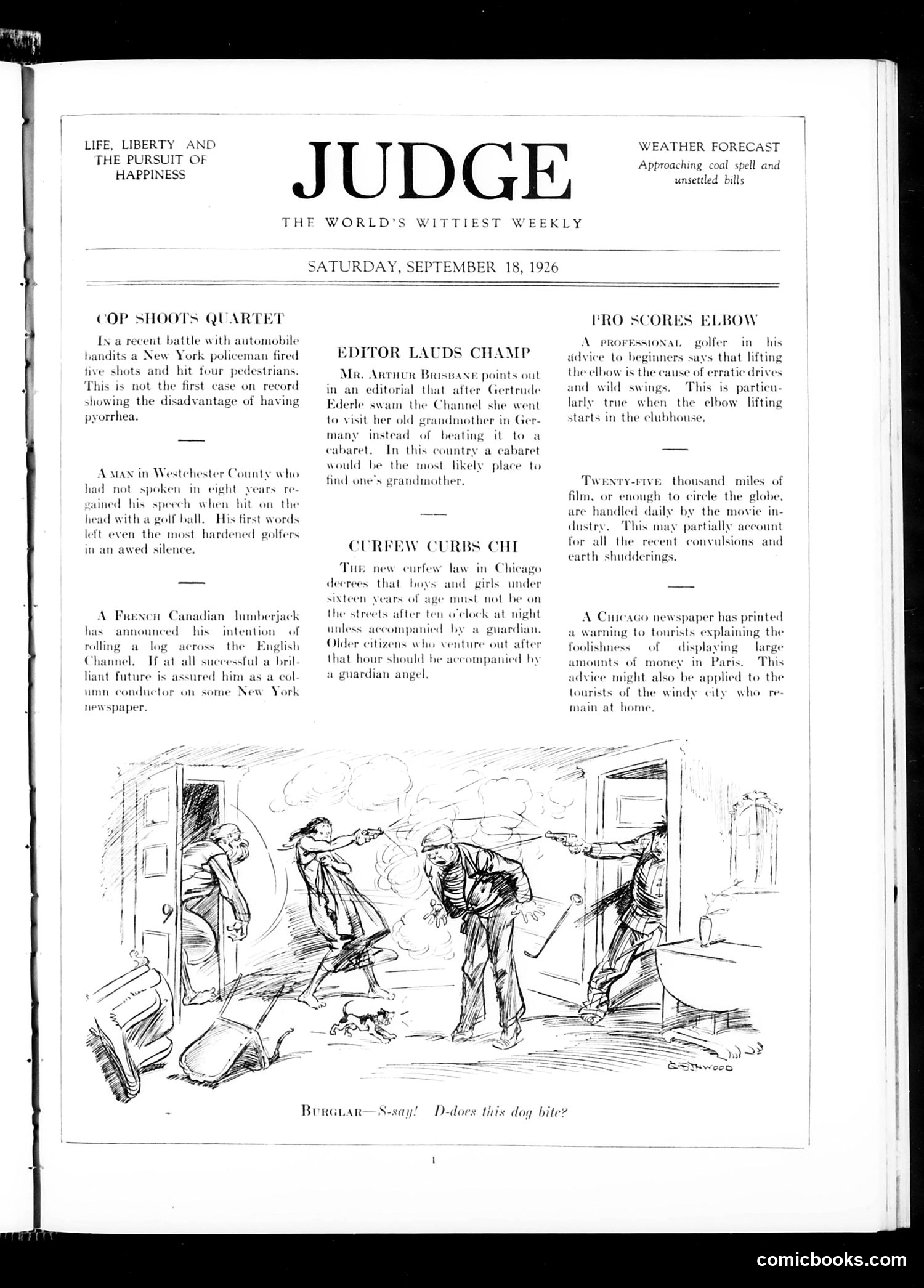
The main cartoon depicts a home invasion scene titled "Burglar—S-say! Does this dog bite?" It's a straightforward comedic illustration: a burglar confronts a homeowner about whether the dog poses a threat during a robbery. The humor relies on the burglar's nervous concern about the dog despite committing a crime—absurd priorities in a dangerous situation. The page's text articles are brief humorous observations: one about a New York policeman gaining weight after being hit by a golf ball, another about a French-Canadian lumberjack planning to log-roll across the English Channel, and commentary on various social topics like Chicago's curfew laws and golf technique. These are light, whimsical pieces typical of Judge's satirical style—wordplay and absurdist scenarios rather than pointed political commentary.
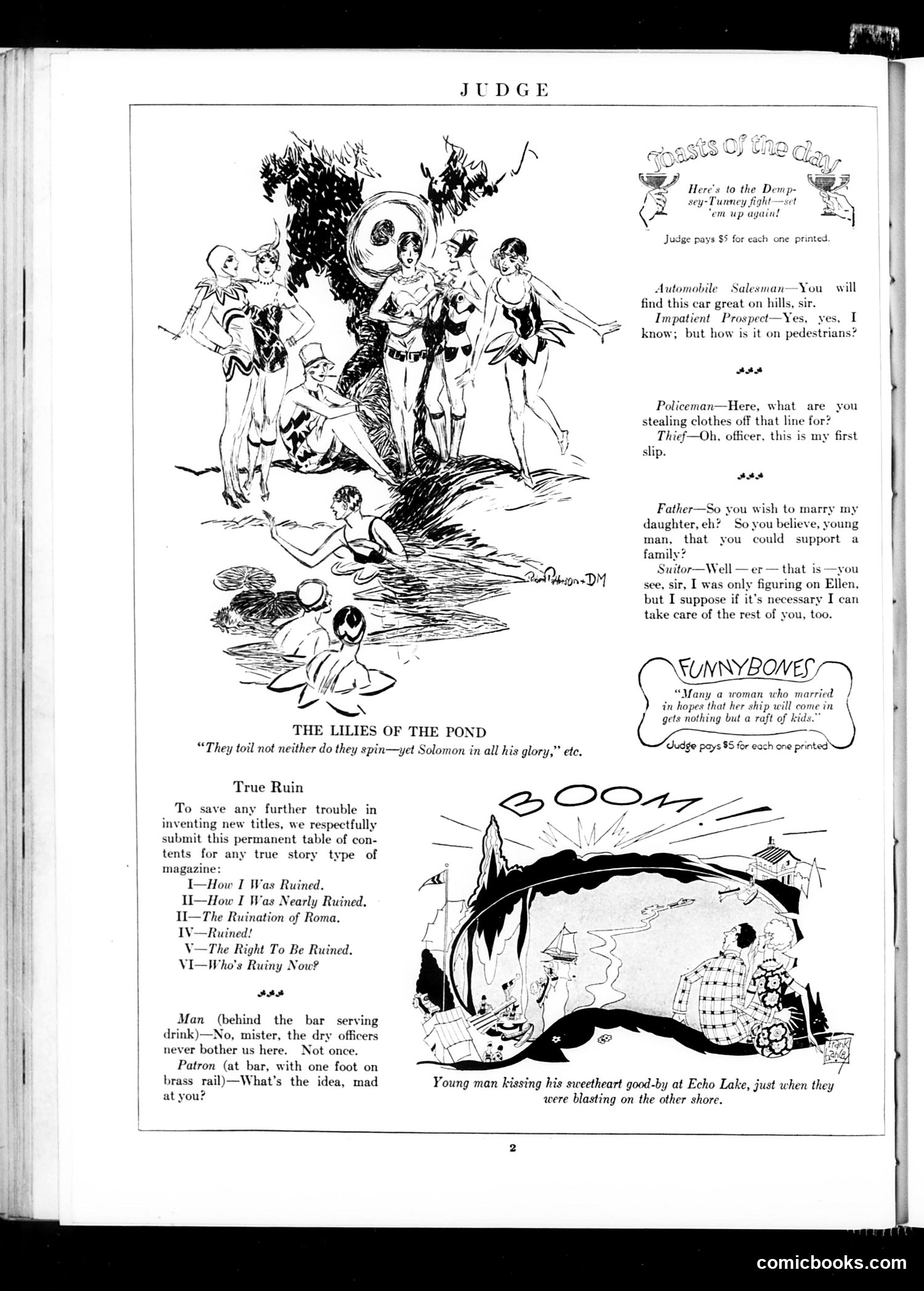
This page contains several satirical humor pieces typical of Judge magazine's style. **"The Lilies of the Pond"** depicts various figures in absurd situations—likely commentary on frivolous behavior or social pretension, though specific references are unclear without additional context. **"Roasts of the Day"** offers brief comic dialogues: an automobile salesman pitches to a skeptical prospect; a policeman confronts a thief; a father questions a sailor suitor about supporting his daughter. These are generic social humor—no specific political figures appear identifiable. **"Funny Bones"** presents a one-liner joke about marriage expectations. **"Boom"** shows a young couple interrupted mid-kiss by an explosion across a lake—slapstick humor about romantic disruption. The page emphasizes broad social satire and domestic comedy rather than specific political commentary.
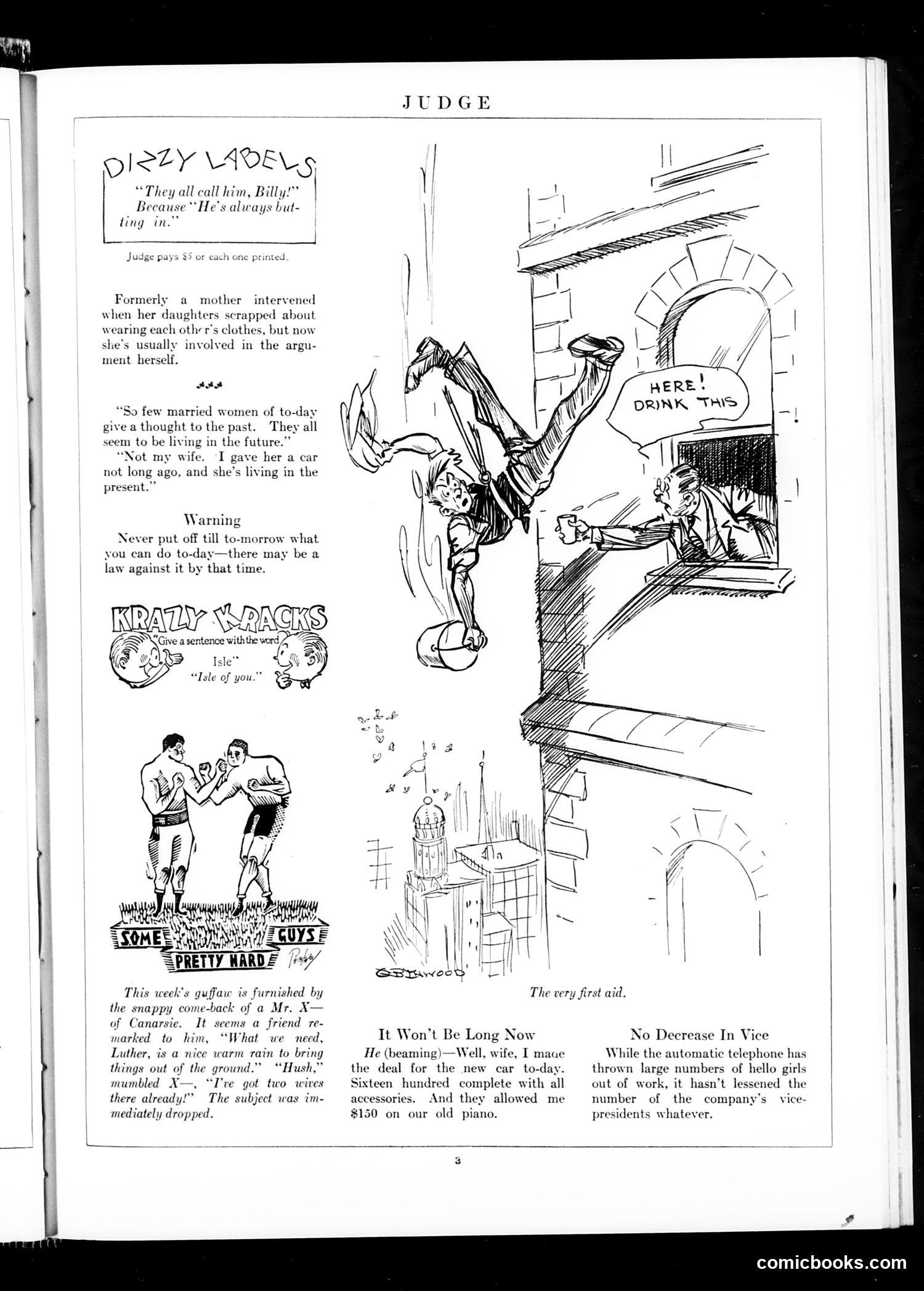
This page from *Judge* magazine features several satirical items: **"Dizzy Labels"** mocks wives arguing over clothing, with the judge awarding $7 per printed submission. **"The First Aid"** cartoon shows a man offering a drink to someone who appears to be falling or in distress from a window—likely satirizing ineffective or absurd "solutions" to problems. **"Krazzy Kwacks"** contains wordplay puns on "Isle" and boxing humor about "Some Guys Pretty Hard." **"It Won't Be Long Now"** depicts a couple purchasing a new car on installment ($150 down on a piano), satirizing consumer debt and the American fascination with buying things on credit. **"No Decrease in Vice"** references telephone operators, commenting on workplace automation and its failure to reduce moral problems. The page reflects early 20th-century concerns about consumer credit, gender relations, and modern anxieties.
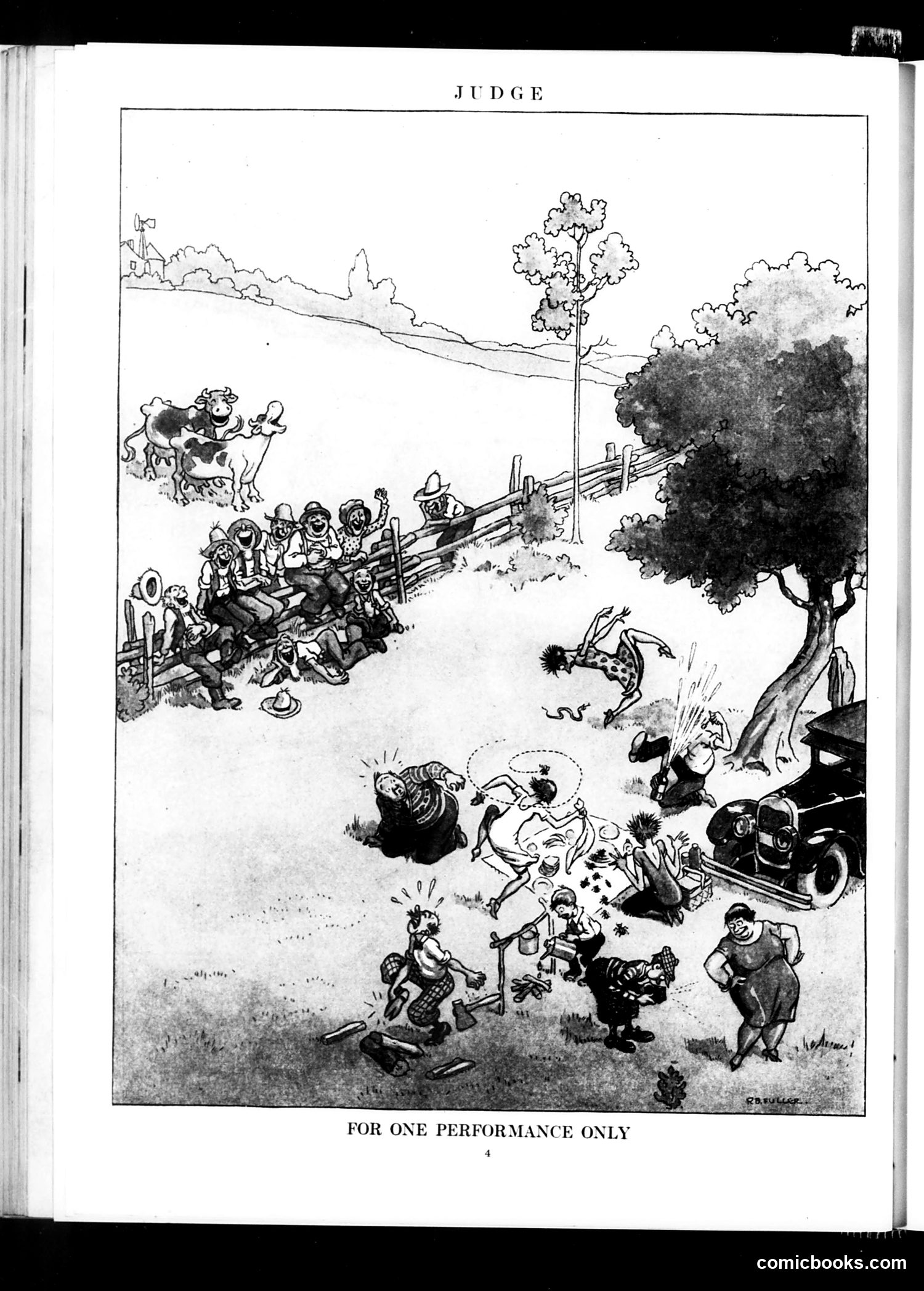
This Judge cartoon satirizes rural or small-town life through slapstick chaos. The scene depicts a makeshift theatrical performance or circus event where an audience sits on bleachers (upper left) watching pandemonium unfold below. The joke appears to center on incompetence and disorder: performers and spectators are sprawled chaotically across the ground, a car has crashed or overturned (right side), and various figures are in disarray. The title "For One Performance Only" suggests this disaster was so complete that no repeat showing would be possible—the event failed spectacularly. The cartoon mocks rural entertainment aspirations and small-town attempts at organizing public events, treating such efforts as inherently comedic failures.
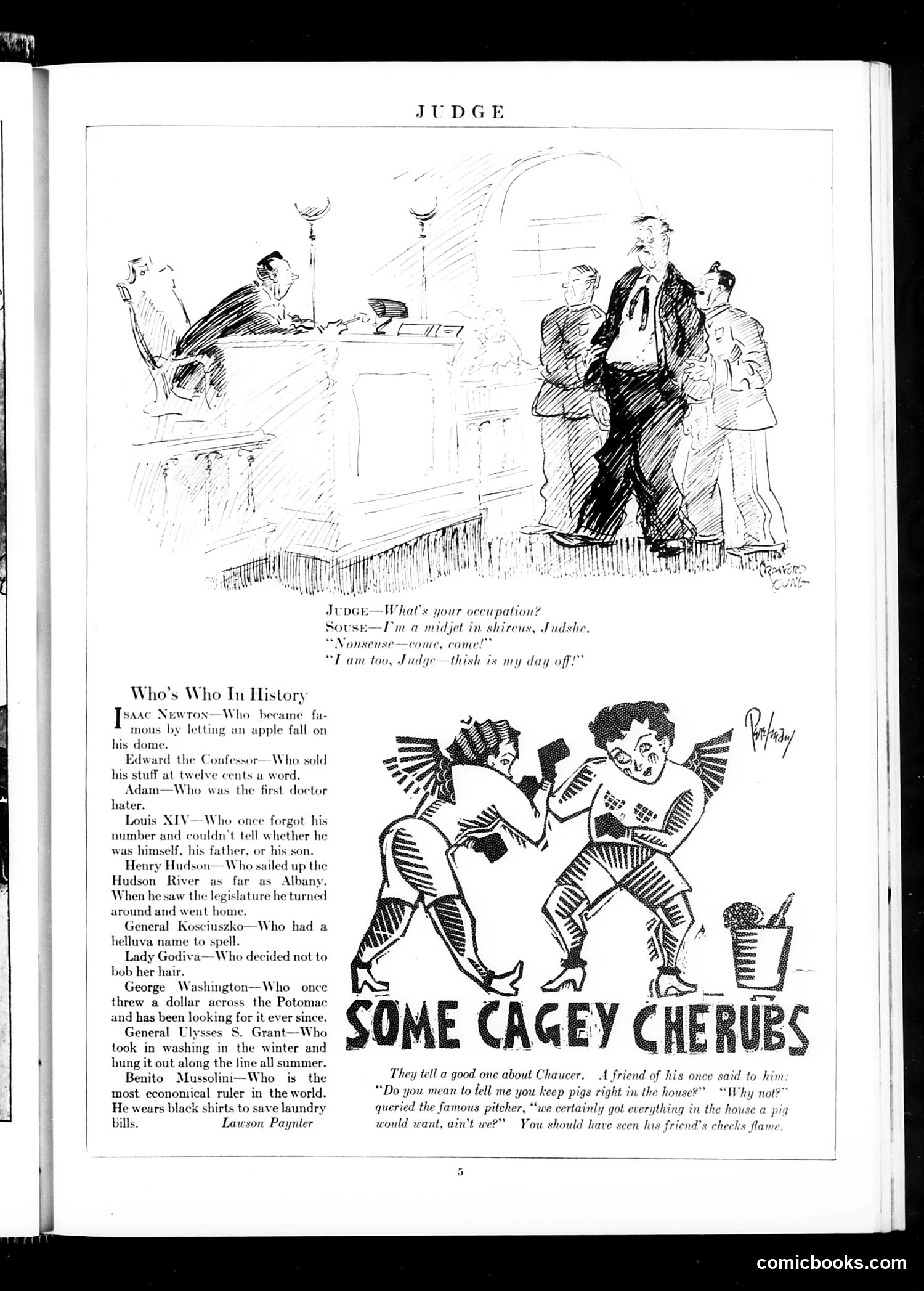
**Top Cartoon ("Judge"):** A courtroom scene where a judge questions a defendant's occupation. The defendant claims to be "a midget in shireus, Judske" [OCR error], prompting the judge's exasperated response: "This is my day off!" The satire mocks frivolous or absurd courtroom cases that waste judicial time. **"Who's Who in History":** A humorous list of famous historical figures with tongue-in-cheek descriptions—Isaac Newton (apple anecdote), Edward the Confessor, Adams, Louis XIV, etc. This appears to be lighthearted educational humor. **"Some Cagey Cherubs":** An illustrated joke about a famous pitcher (likely Chaucer reference) who keeps pigs in his house, with cherubic figures depicted humorously. The humor centers on the pitcher's domestic eccentricities. The page blends courtroom satire with historical and sports-related humor.
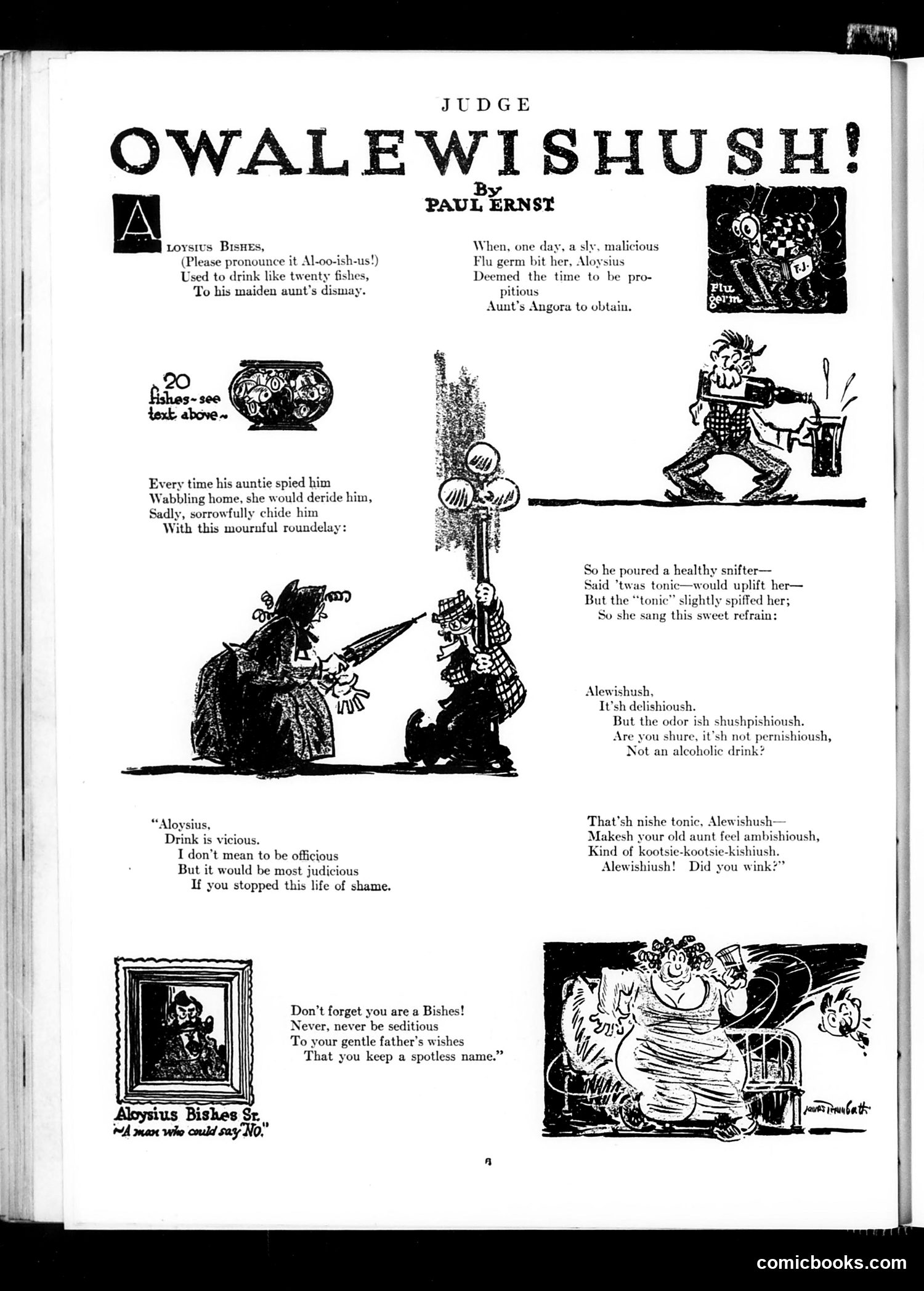
This Paul Ernst comic mocks temperance advocacy and changing attitudes toward alcohol during Prohibition era America. **The setup**: Young Aloysius Bishes is a habitual drunkard whose maiden aunt constantly scolds him about his drinking, citing family honor and morality. **The joke**: When Aloysius falls ill with flu, he gives his aunt alcohol disguised as "tonic" medicine (a common pretext for drinking during Prohibition). The aunt, tasting it, becomes tipsy herself—slurring her speech into "Alewishush"—and secretly enjoys it despite her moral lectures. **The satire**: The comic ridicules the hypocrisy of temperance moralists who publicly condemn drinking while privately enjoying alcohol. It also mocks the excuse of medicinal "tonics" used to justify alcohol consumption when it was restricted. The repeated slurred pronunciation emphasizes both intoxication and the absurdity of the aunt's position: she condemns drinking publicly but succumbs to it immediately when presented in acceptable guise.
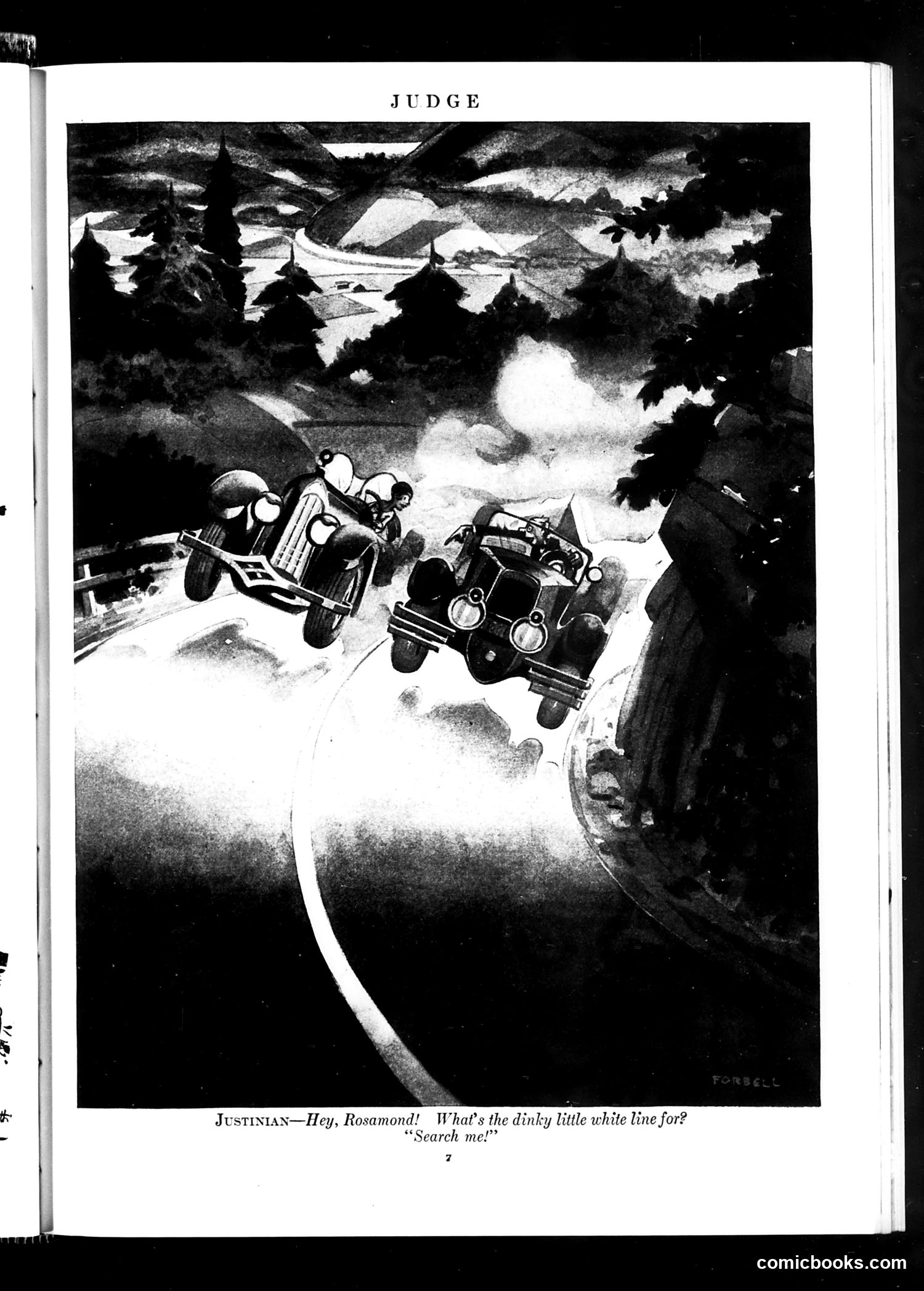
This cartoon depicts two vintage automobiles on a mountain road, with one driver (identified as "Justinian") asking another driver (named "Rosamond") about a "dinky little white line" on the road. The satire appears to reference the **novelty of road markings**—likely center line paintings that were relatively new infrastructure in early-to-mid 20th century America. The joke is that these drivers don't understand the purpose of the white line dividing the road, suggesting the public's unfamiliarity with modern traffic safety innovations. The cartoon mocks both ignorance of new driving conventions and perhaps the slow adoption of standardized road safety measures. The title "JUDGE" indicates this is from the satirical magazine of that name, known for social and political commentary.
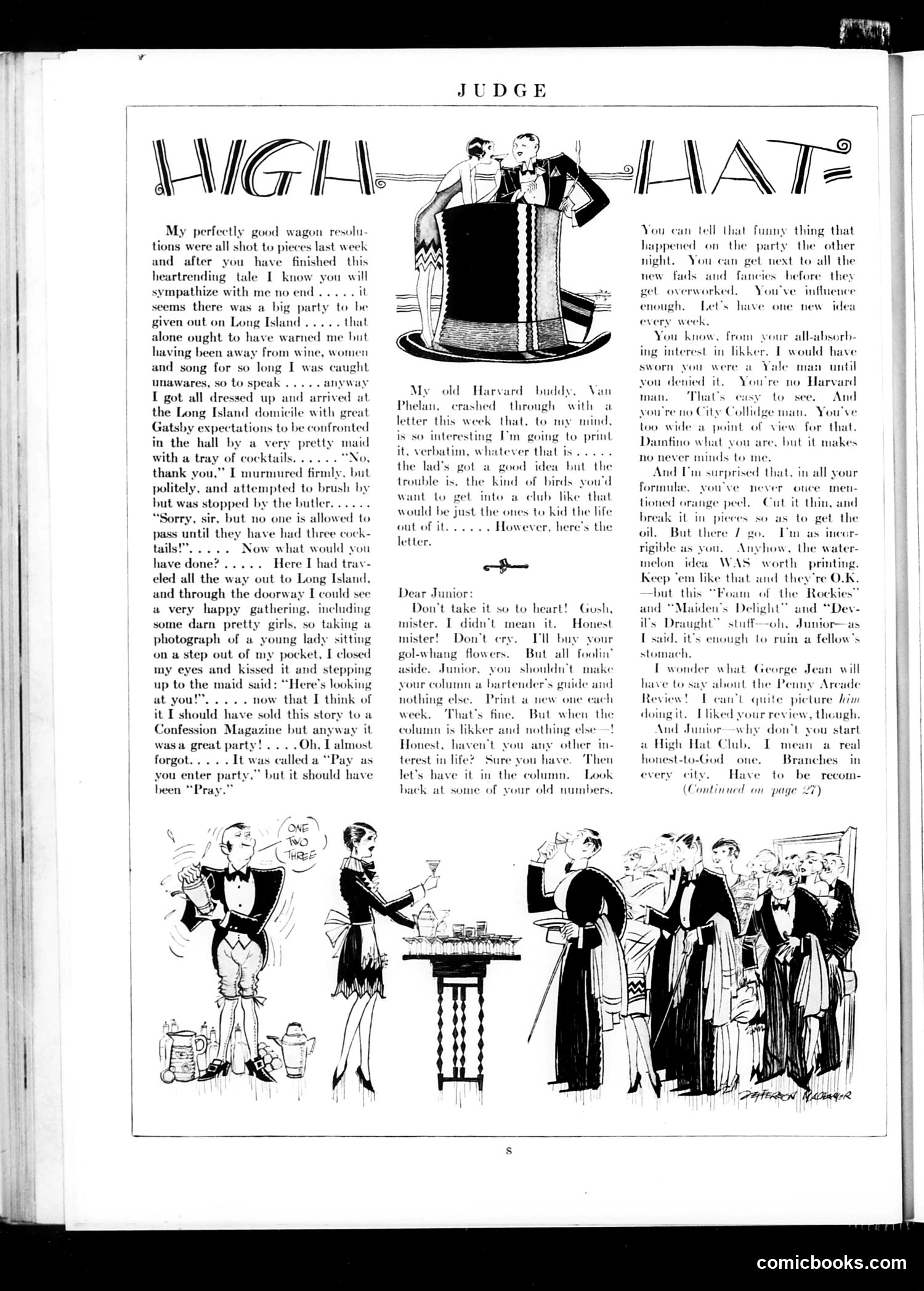
This page satirizes 1920s social drinking culture and clubmen's excess. The main article mocks a narrator who breaks his "wagon resolutions" (sobriety pledges) at a Long Island party where cocktails are mandatory before entry—a dig at Prohibition-era speakeasy culture. The accompanying letter from "Van Phelan" humorously critiques a gossip columnist (likely "Junior") who obsesses over cocktail recipes and drinking instead of covering broader social interests. Van suggests the writer lacks Yale/Harvard credentials and urges him to feature varied content like the "watermelon idea" while avoiding pretentious drink names like "Foam of the Rockies." The cartoons below illustrate the drinking-focused party scene and the social circles these pieces describe. The satire targets how Prohibition drove cocktail culture underground into private clubs while wealthy men performed sophistication through exclusive memberships and elaborate mixed drinks—a commentary on the era's hypocrisy and excess.
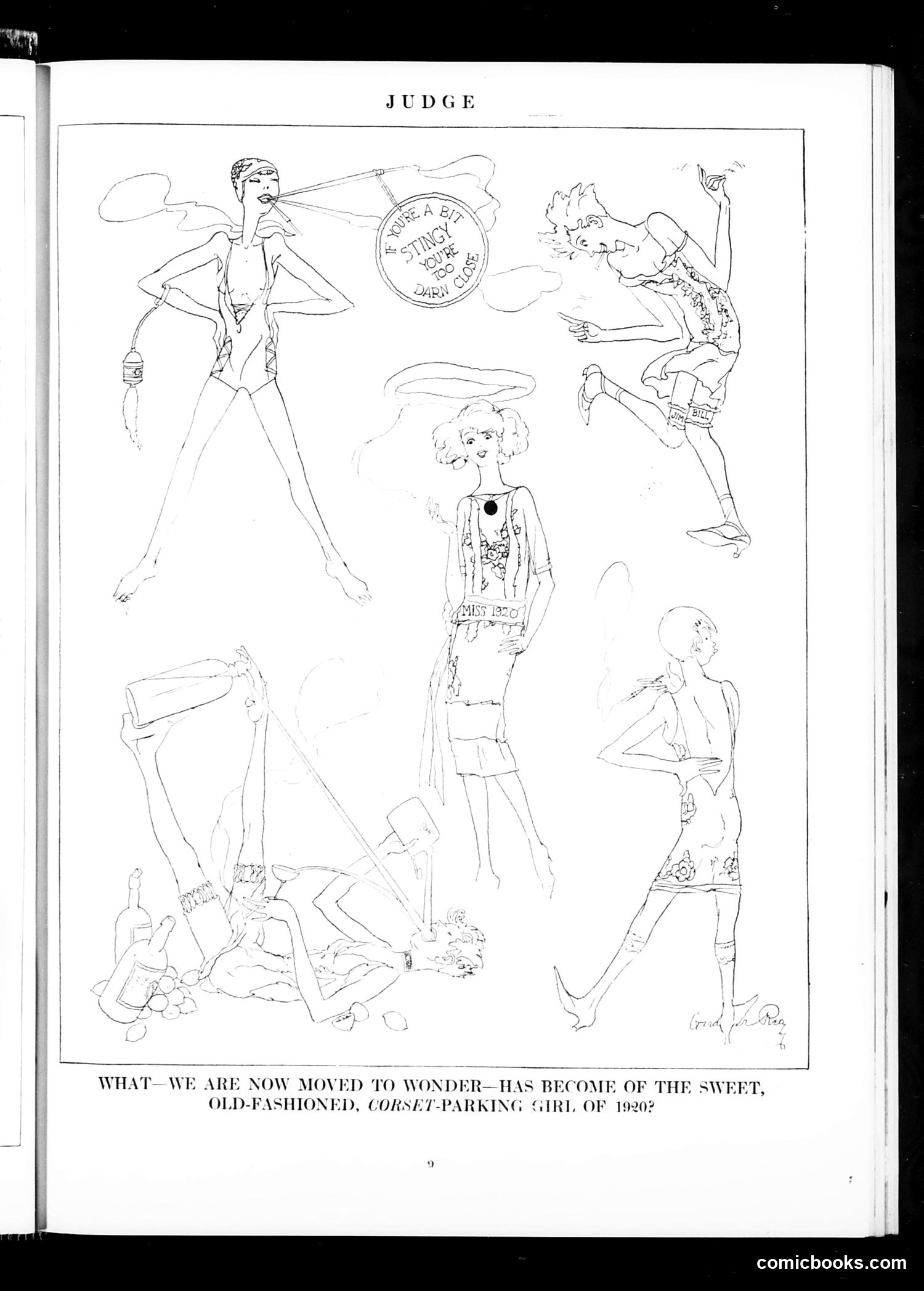
This satirical page from *Judge* magazine contrasts the modest "corset-parking girl of 1920" with modern (presumably 1920s-era) women. The central figure, labeled "Miss 1920s," wears minimal clothing and a halo, suggesting ironic innocence despite her scandalous appearance. Surrounding figures display increasingly free and uninhibited behavior—some partially undressed, one with a drink, others in active, unladylike poses. The satire mocks the rapid shift in women's fashion and social behavior during the Jazz Age. "Corset-parking" references the old practice of women removing restrictive corsets during dates—itself considered risqué. The cartoon suggests that 1920s women have become far more liberated and brazen than their predecessors, presenting this transformation as shocking to traditional sensibilities. This reflects genuine cultural anxiety about changing gender roles and morality during the 1920s.
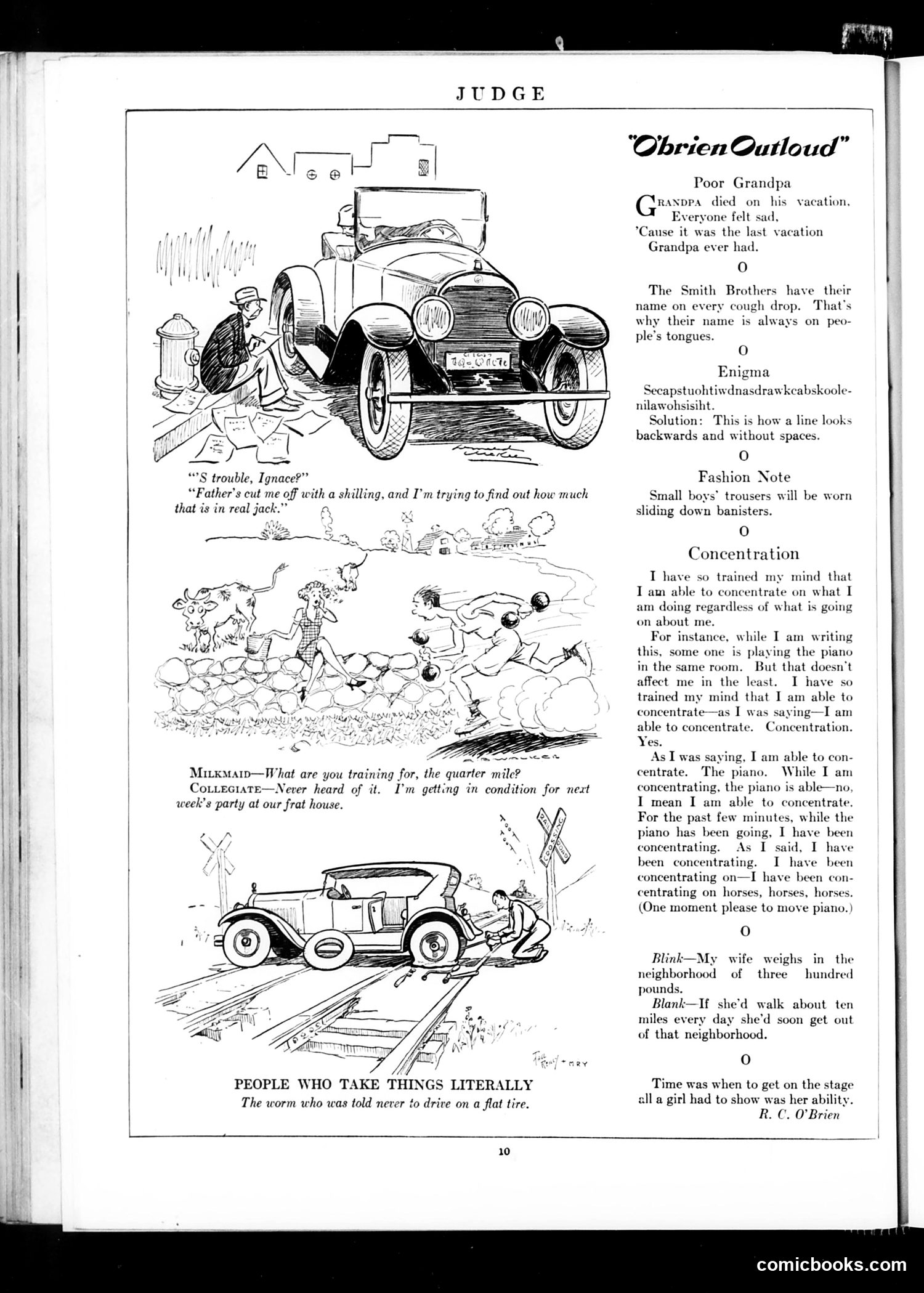
This page from Judge magazine (undated but early 20th century based on automobile styles) contains several short humorous pieces satirizing American social types and absurdities: **"People Who Take Things Literally"** ridicules those who interpret figurative language as fact—the cartoon shows a man literally following advice never to "drive on a flat tire" by driving *across* railroad tracks instead of on the road. **The dialogue jokes** mock shallow concerns: a wealthy young man upset about being "cut off with a shilling," and a college student training for a fraternity party rather than athletic competition. **"Poor Grandpa"** is dark humor about an elderly man's final vacation. **"Fashion Note"** sarcastically suggests boys' fashions involve sliding down banisters. **"Concentration"** parodies the ability to focus—the author claims mastery while being repeatedly distracted by piano music, the humor lying in his obliviousness to his own contradiction. Together, these reflect Judge's satirical mission: mocking American vanity, foolishness, and social pretension through brief, witty observations about everyday life.
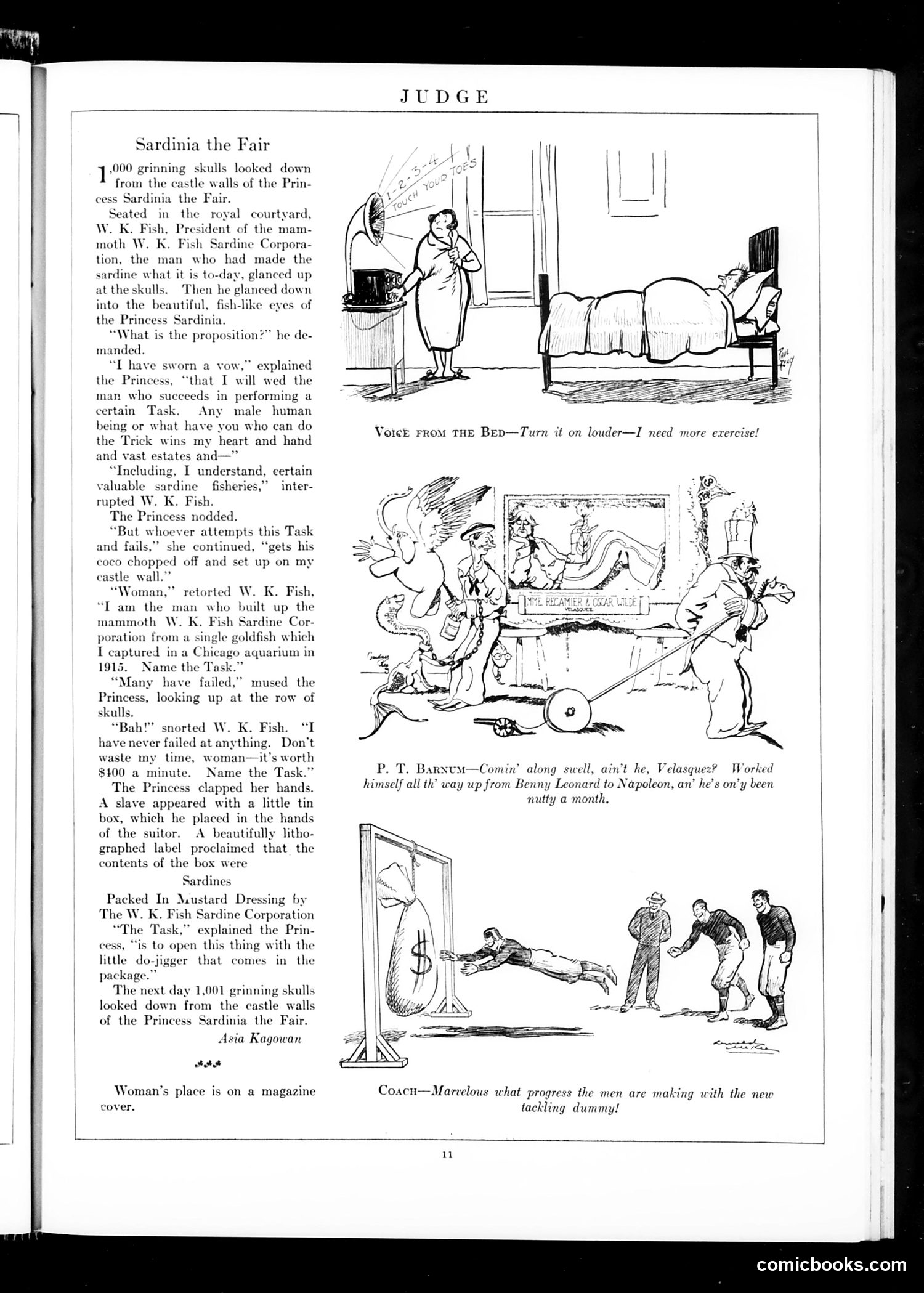
This is a humorous fairy tale parody mocking **W. K. Fish, a real sardine corporation magnate**. The joke: Fish is so obsessed with business success that when offered a princess and vast estates, he agrees to an impossible "task"—opening a tin of sardines using only the tiny opener included in the package. The satire targets Fish's arrogance and commercial single-mindedness. He boasts of building his empire from "a single goldfish" and claims he "never failed at anything," yet he cannot accomplish a simple, everyday consumer task. The 1,001 skulls represent previous suitors who failed, creating dark comedy around the trivial obstacle. The other cartoon snippets appear to reference **P. T. Barnum** (famous showman) and boxing/athletic culture, likely separate satirical pieces in the magazine. **Context for moderns**: This reflects early 20th-century American satire about industrial magnates and their detachment from ordinary life.
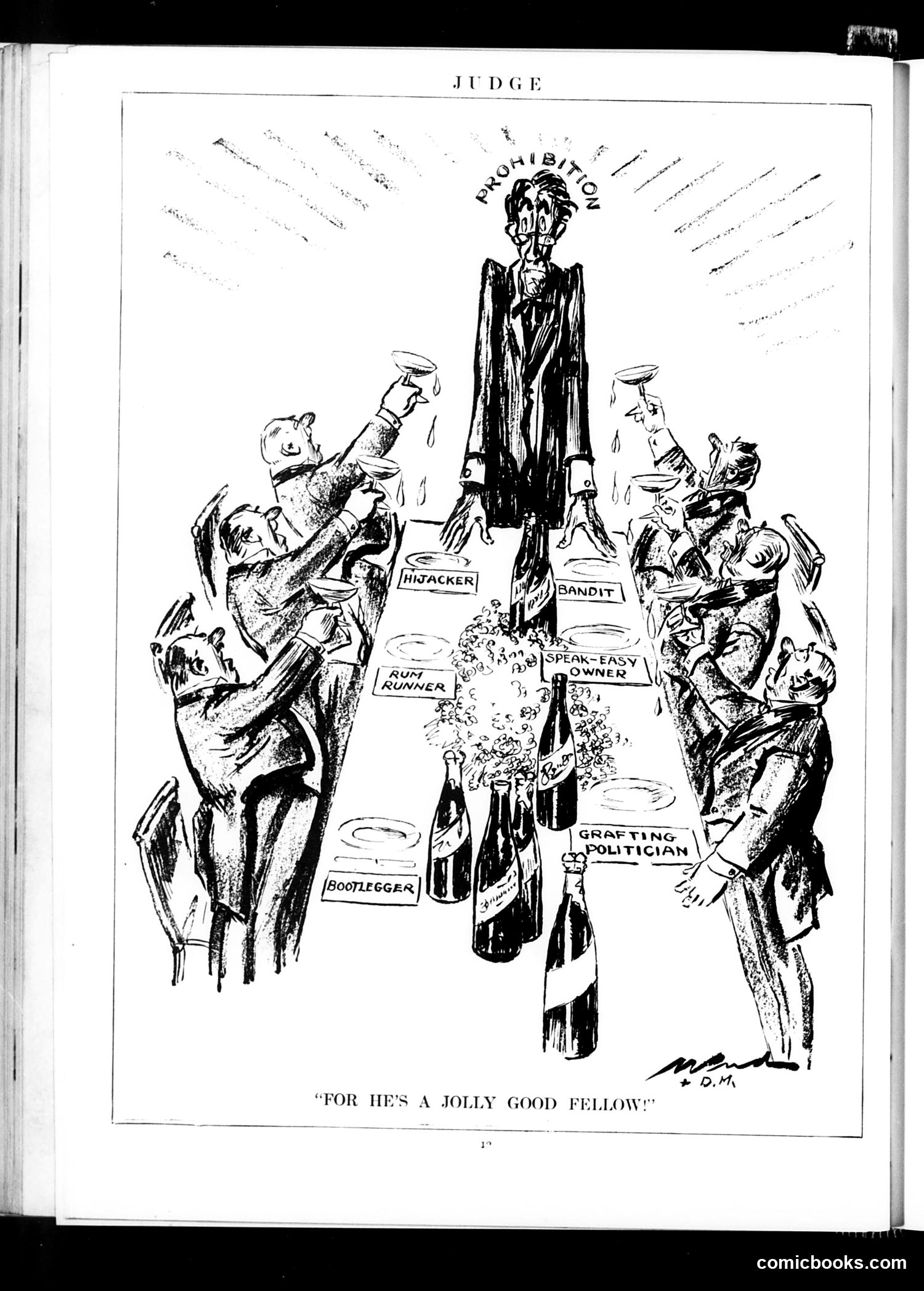
This Prohibition-era cartoon satirizes corrupt politicians. A tall, skeletal figure labeled "PROHIBITION" stands at center, surrounded by demons or devils representing various criminal enterprises: "BOOTLEGGER," "RUM RUNNER," "HIJACKER," "BANDIT," "SPEAK-EASY OWNER," and "GRAFTING POLITICIAN." The figures are toasting the central Prohibition figure with drinks and bottles, while singing the famous drinking song (ironically, given the subject). The satire mocks how Prohibition laws, intended to eliminate alcohol consumption, instead created a thriving criminal underworld and corrupted public officials who profited from illegal liquor trade. The cartoon suggests Prohibition's "success" merely enriched criminals and dishonest politicians—making it, perversely, a "jolly good fellow."
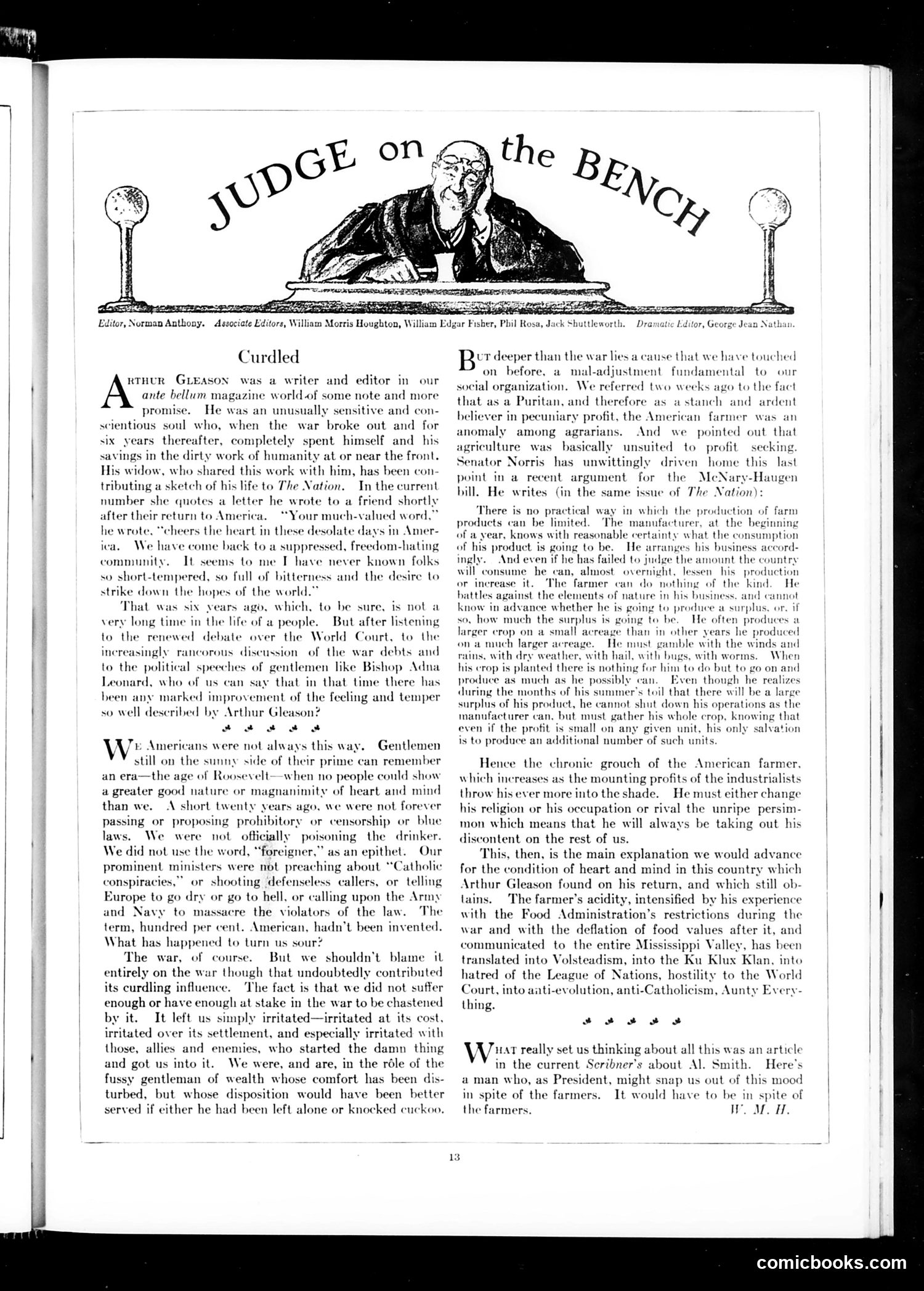
This editorial column by an unnamed Judge critic addresses post-WWI American social deterioration. The piece argues that writer Arthur Gleason correctly observed in 1919 that America had become "suppressed, freedom-hating"—and six years later (appears to be ~1925), nothing has improved. The satire targets American hypocrisy and sourness. Pre-war America was magnanimous and tolerant; now it's intolerant (attacking "Catholic conspiracies"), censorious (pushing prohibition), and paranoid (inventing "100% American" rhetoric). The critic blames not just the war itself, but deeper structural problems: American farmers, Puritan-influenced to seek profit, are fundamentally misaligned with agriculture's nature. The overall argument: America's post-war bitterness stems from being an irritated wealthy person whose comfort was disrupted—not genuinely chastened by sacrifice—like "a fussy gentleman of wealth" knocked "cuckoo" rather than reformed.
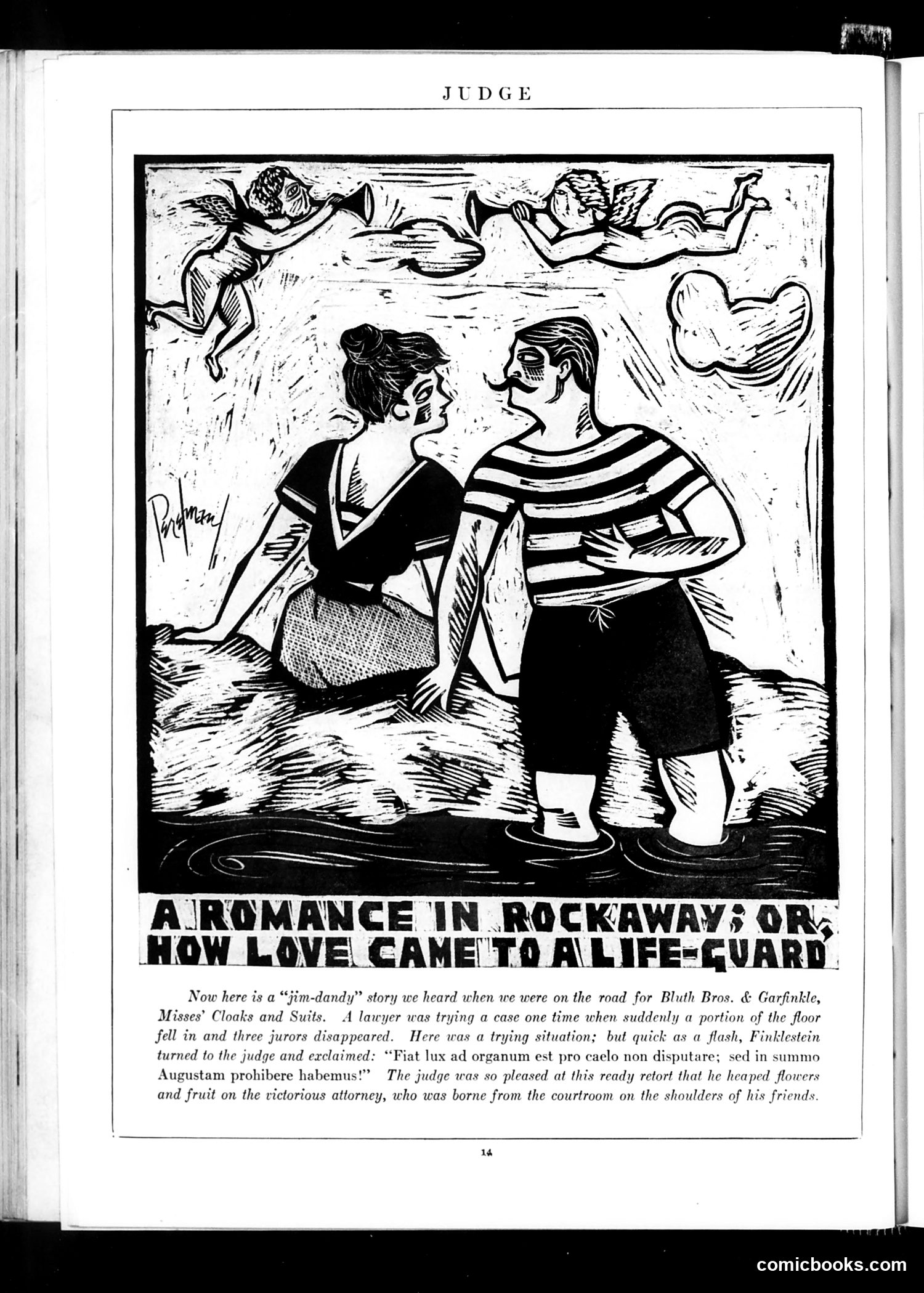
This is a humorous anecdote rather than political satire. The joke centers on a lawyer named Finklestein who impresses a judge with a rapid, seemingly erudite Latin response during a courtroom crisis. The setup: during a trial, the courtroom floor collapses, three jurors disappear. Rather than panic, Finklestein delivers an elaborate Latin phrase to the judge. The punchline appears to be that his impressive-sounding but meaningless classical rhetoric so delights the judge that he becomes a hero, carried from court on his friends' shoulders. The satire targets the pretentiousness of legal professionals who use obscure language to appear intelligent, and judges who reward showmanship over substance. The title's reference to "Rockaway" (a New York beach area) and "life-guard" suggests this is likely a tall tale structure, typical of Judge magazine's humorous storytelling. The accompanying woodcut illustration shows two figures in water, presumably illustrating the "life-guard" theme.
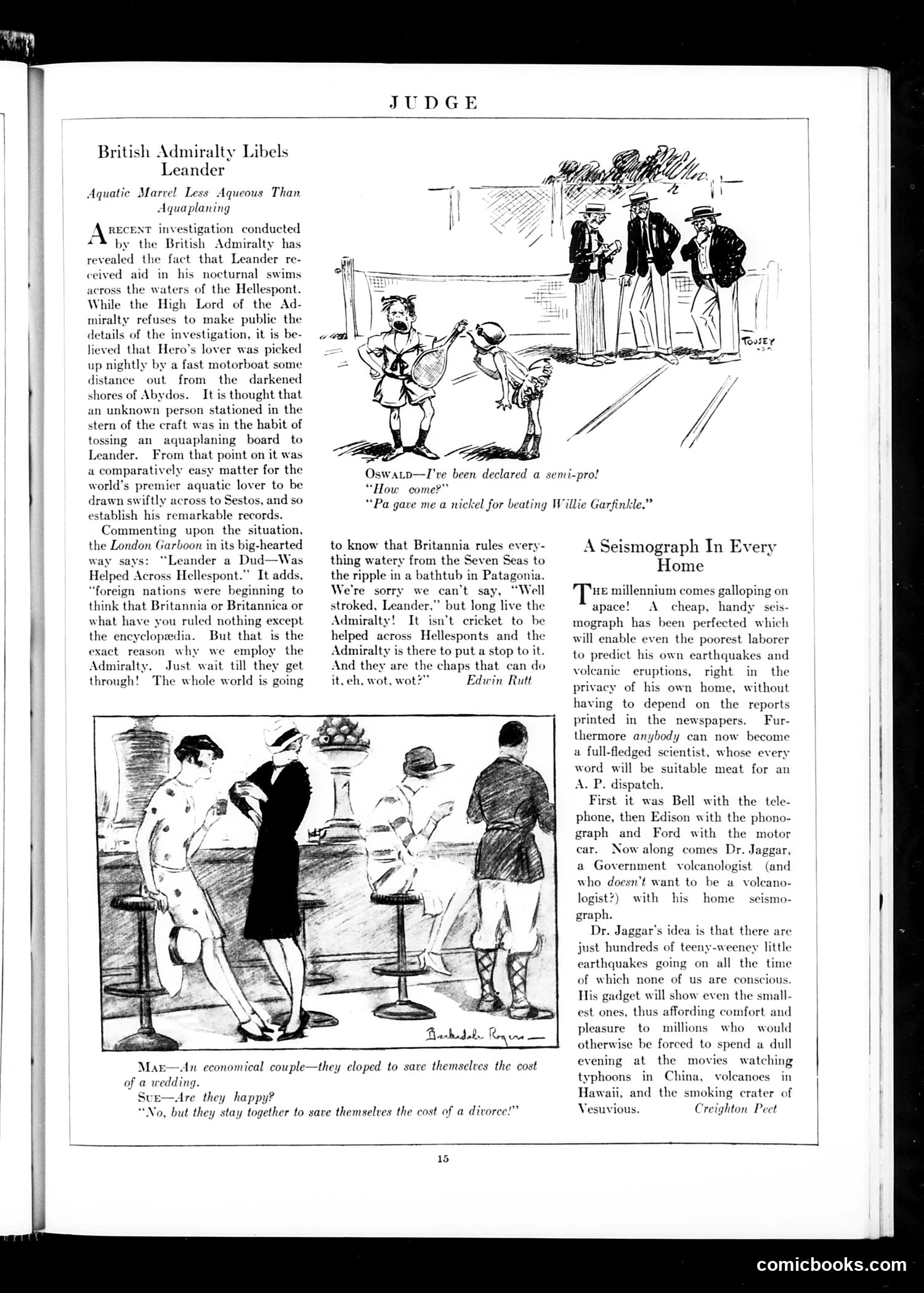
**"British Admiralty Libels Leander"**: This satirical piece mocks the British Admiralty by alleging they aided swimmer Leander (the mythological lover who swam the Hellespont nightly) using modern technology—specifically an aquaplaning board towed by motorboat. The joke attacks British pride: the Admiralty supposedly "helped" achieve a famous swimming record, undermining the romantic legend. The cartoon suggests Britain over-relies on technology and cheating while claiming naval superiority ("Britannia rules everything watery"). **"A Seismograph In Every Home"**: This satirizes the democratization of science and technology. Dr. Jaggar (a real volcanologist) has invented a home seismograph, mocking the notion that ordinary people can now become "scientists" with gadgets, just as Bell, Edison, and Ford made technology commonplace. The absurdist punchline suggests people would use it for entertainment rather than practical benefit—watching home earthquake readings instead of going to movies. Both pieces employ gentle mockery of technological progress and institutional pretension.
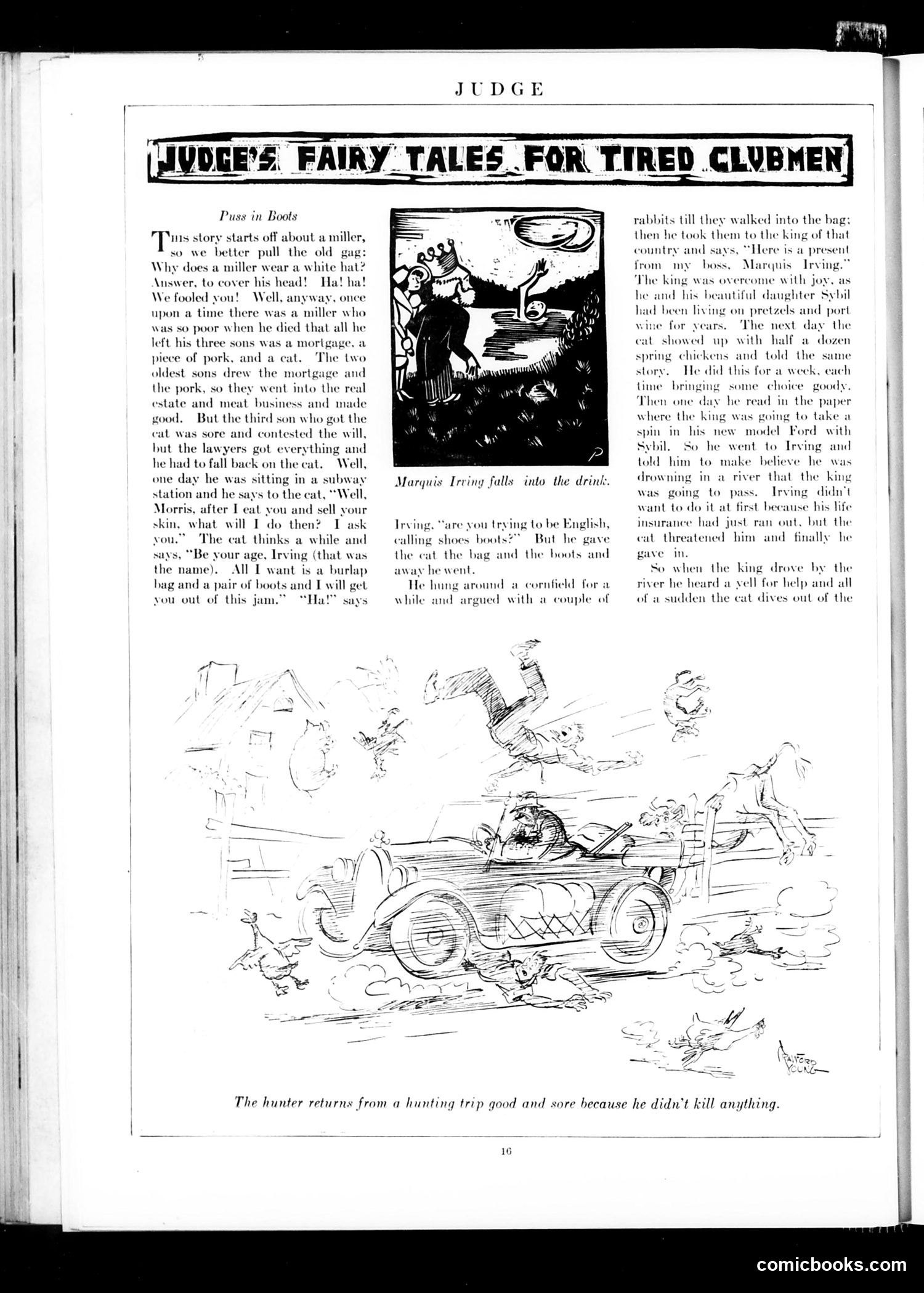
This is a humorous retelling of the classic fairy tale "Puss in Boots," adapted for a modern (early 20th-century) audience. The story follows a poor miller's youngest son, Irving, who receives only a cat as inheritance. The clever cat secures Irving's fortune by presenting game to a king, eventually arranging Irving's marriage to the king's daughter Sybil. The satire targets contemporary concerns: the son's initial poverty and reliance on lawyers who "got everything," the family's desperation, and Irving's reluctance to fake drowning until threatened—suggesting both cynicism about romance and commentary on insurance fraud. The cat's use of a "new model Ford" updates the fairy tale to the modern era, mocking both wealth-seeking and the absurdity of traditional stories transplanted to contemporary life. The overall tone is lighthearted mockery of both poverty and social climbing.
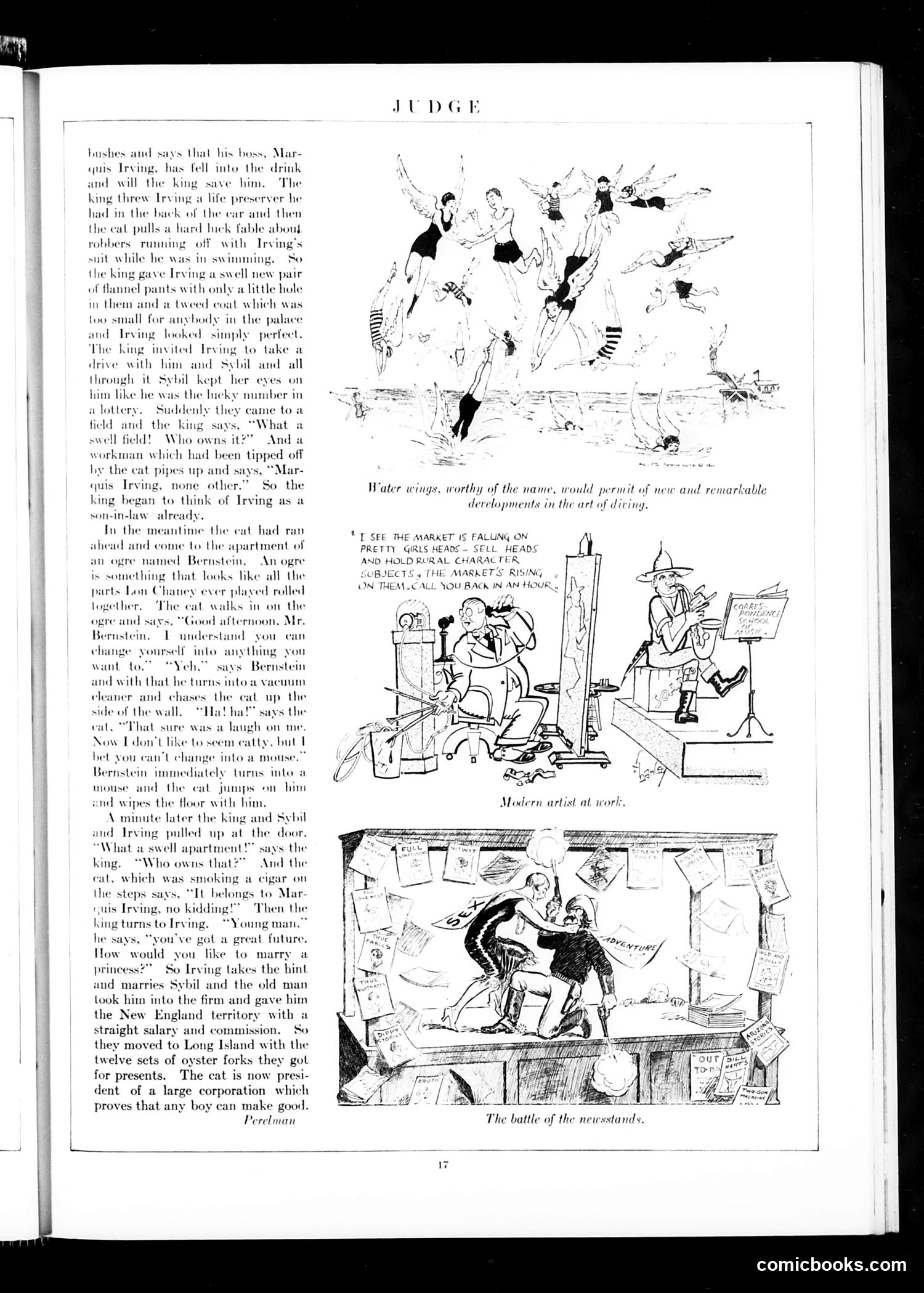
This page contains a satirical fairy-tale narrative by S.J. Perelman (credited as "Perelman") that parodies the "Puss in Boots" story. The plot follows a clever cat who manipulates a king into believing a penniless man named Irving (working for "Marquis Irving") is wealthy and worthy of marrying the king's daughter Sybil. **The satire targets:** - Social climbing and the importance of appearances over reality in American society - The gullibility of the wealthy elite - How cunning manipulation can secure fortune and status The accompanying illustrations humorously depict the absurd scenarios—Irving rescued from water, a modern artist's studio, and a "battle of the newsands" (likely referencing stock market or media competition). The bottom dialogue mocks stock market speculation, showing a trader advising to sell "pretty girls heads" while the market is falling, then buy when it rises—crude satire on treating human commodities cynically.
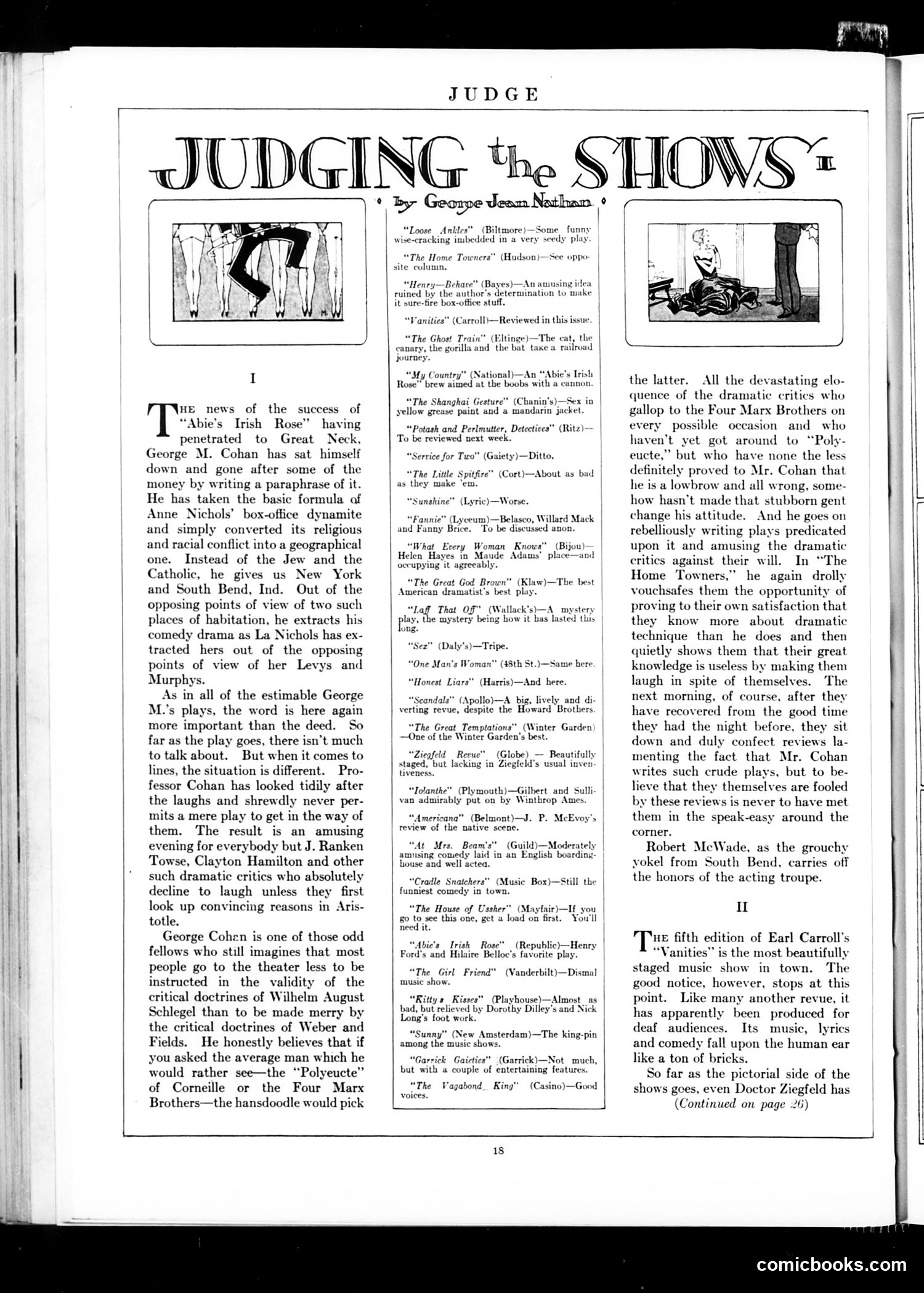
This is George Jean Nathan's theatrical review column for Judge magazine. The page contains two cartoon illustrations flanking a detailed critique of Broadway shows and George M. Cohan's recent work. **The Central Point:** Nathan sardonically criticizes George M. Cohan for writing derivative plays. Cohan adapted "Abie's Irish Rose" (a successful religious/cultural comedy by Anne Nichols) into a geographical variation set in New York and South Bend, prioritizing commercial appeal over artistic merit. Nathan argues Cohan's plays succeed despite crude writing because dramatic critics—whom he mocks as pompous and self-deluded—attend every performance seeking validation of their own superior taste. He suggests these critics enjoy the shows despite themselves, then write negative reviews to maintain critical credibility. **The Satire:** Nathan ridicules both Cohan's theatrical formula and the pretentiousness of drama critics who fool themselves into thinking they're sophisticated while being entertained by lowbrow material. The cartoons likely illustrate these theater-world absurdities, though specific details are unclear from reproduction quality.
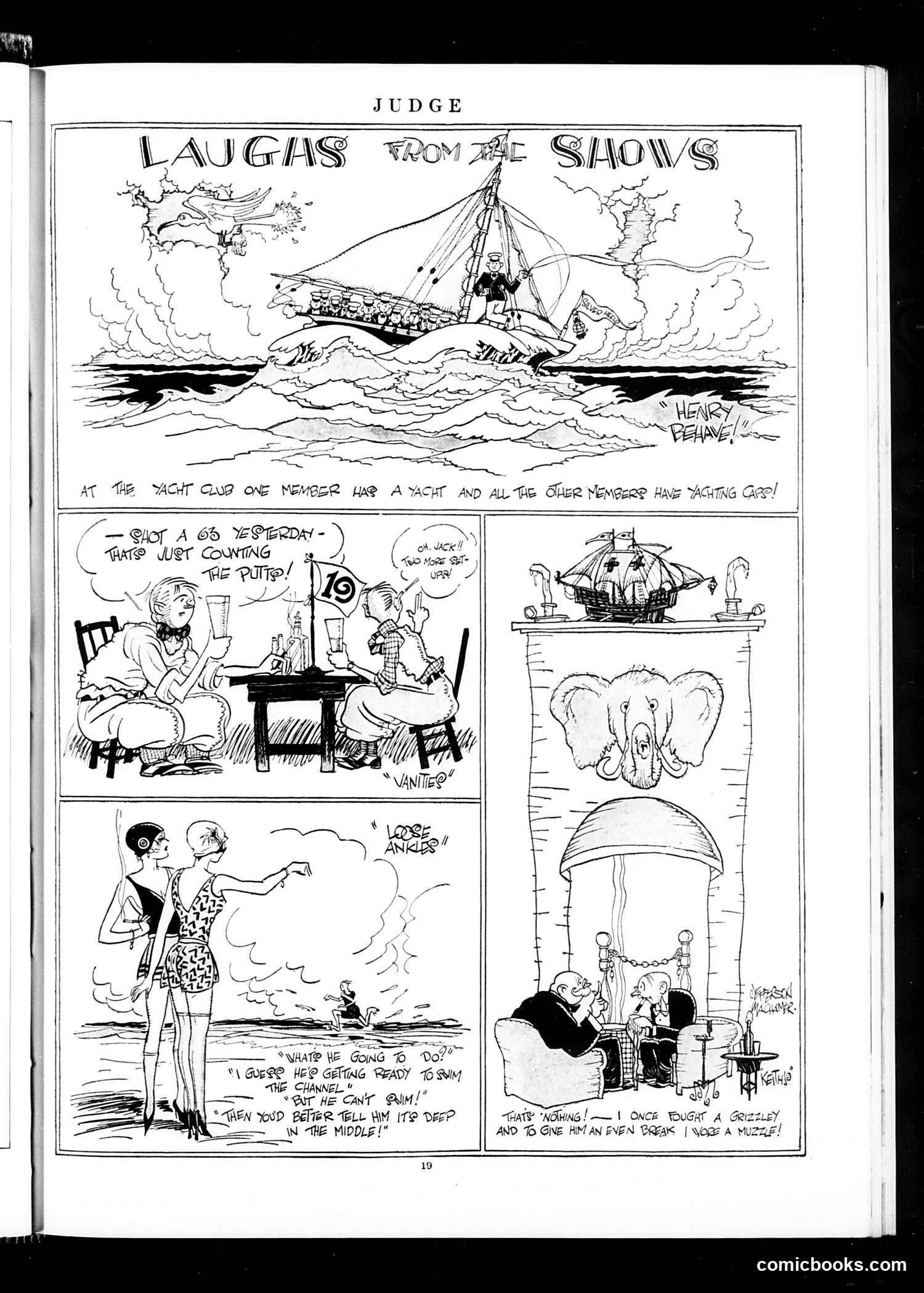
This page satirizes wealthy yacht club members through several interlocking jokes about class pretension and one-upmanship. The top panel establishes the setting: at an exclusive yacht club, one member actually owns a yacht while others merely claim sailing credentials. The middle-left comic shows two men boasting over drinks—one bragging about shooting a 66 yesterday while golfing; the other responds with exaggerated claims about his own exploits. The bottom-left depicts a woman on a beach warning a man about dangerous currents, leading to absurdist dialogue where he counters her safety concerns with increasingly ridiculous claims about his swimming prowess. The right panel shows wealthy men in an ornate boat discussing past hunting adventures, with one recounting how he once "bought a gorilla" and gave it "an even break" by providing a muzzle. The satire targets upper-class male vanity and competitive boasting—each character desperately attempts to out-do others with exaggerated stories, regardless of logic or safety, to maintain social standing.
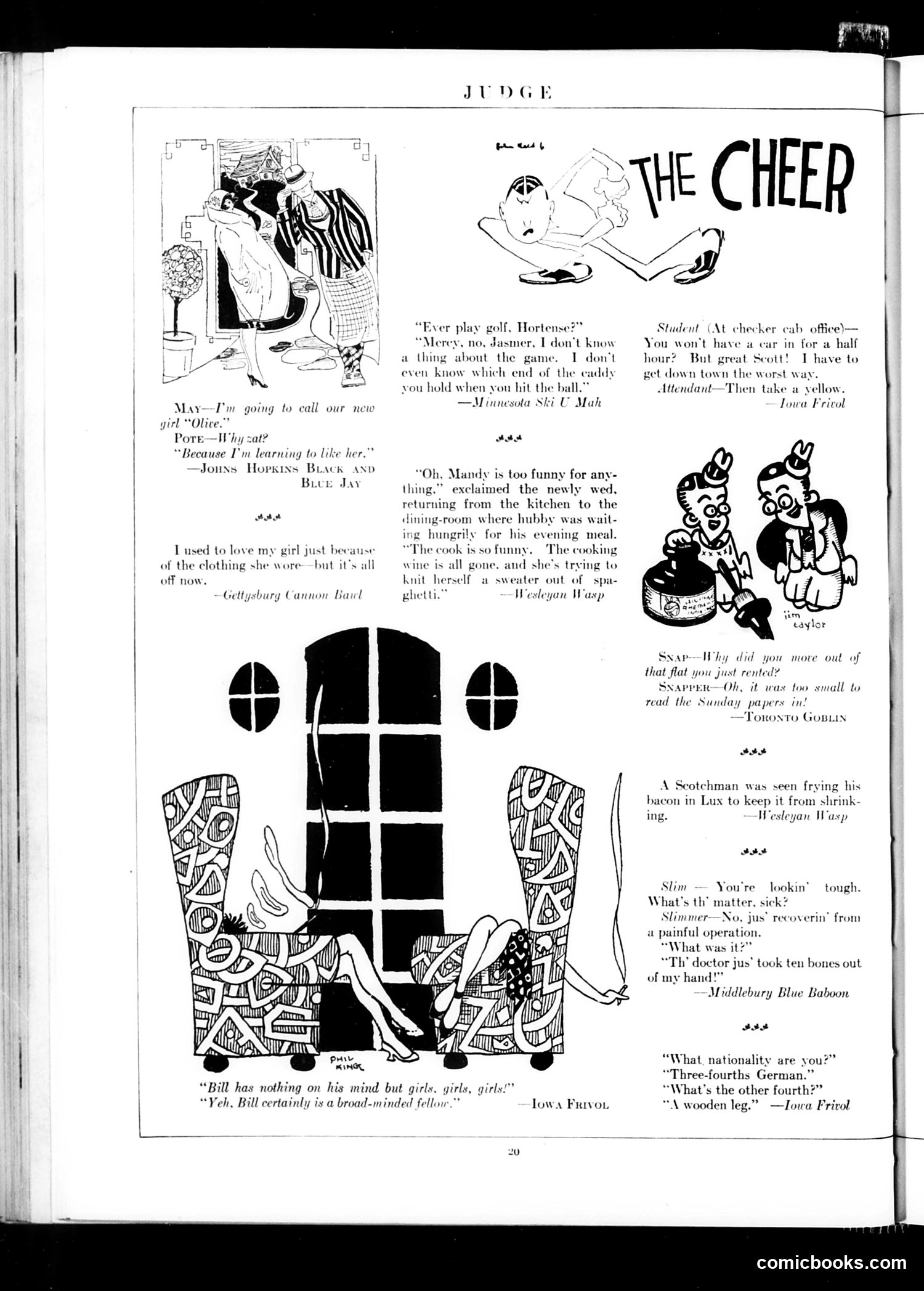
This page collects brief comedic anecdotes and jokes typical of early 20th-century American humor magazines. The cartoons and quips mock social conventions and domestic life: **Key humor targets:** - **Dating/Romance**: Men's shallow preferences (judging women by clothing or appearance) - **Golf culture**: Absurd ignorance among the upper class about the sport's basic rules - **Newlyweds**: A wife amused by her cook's desperation (using cooking wine and spaghetti instead of proper materials) - **Taxicabs**: Impatience with transportation delays - **Small living spaces**: Urban apartment living too cramped to read newspapers - **Ethnic stereotypes**: A Scotsman's miserliness (frying bacon in laundry soap to prevent shrinkage); a person of mixed German and wooden-leg heritage (disability as punchline) The humor relies on exaggeration, domesticity, and casual prejudice typical of the era. Most jokes target either romantic incompetence or working-class/immigrant eccentricity.
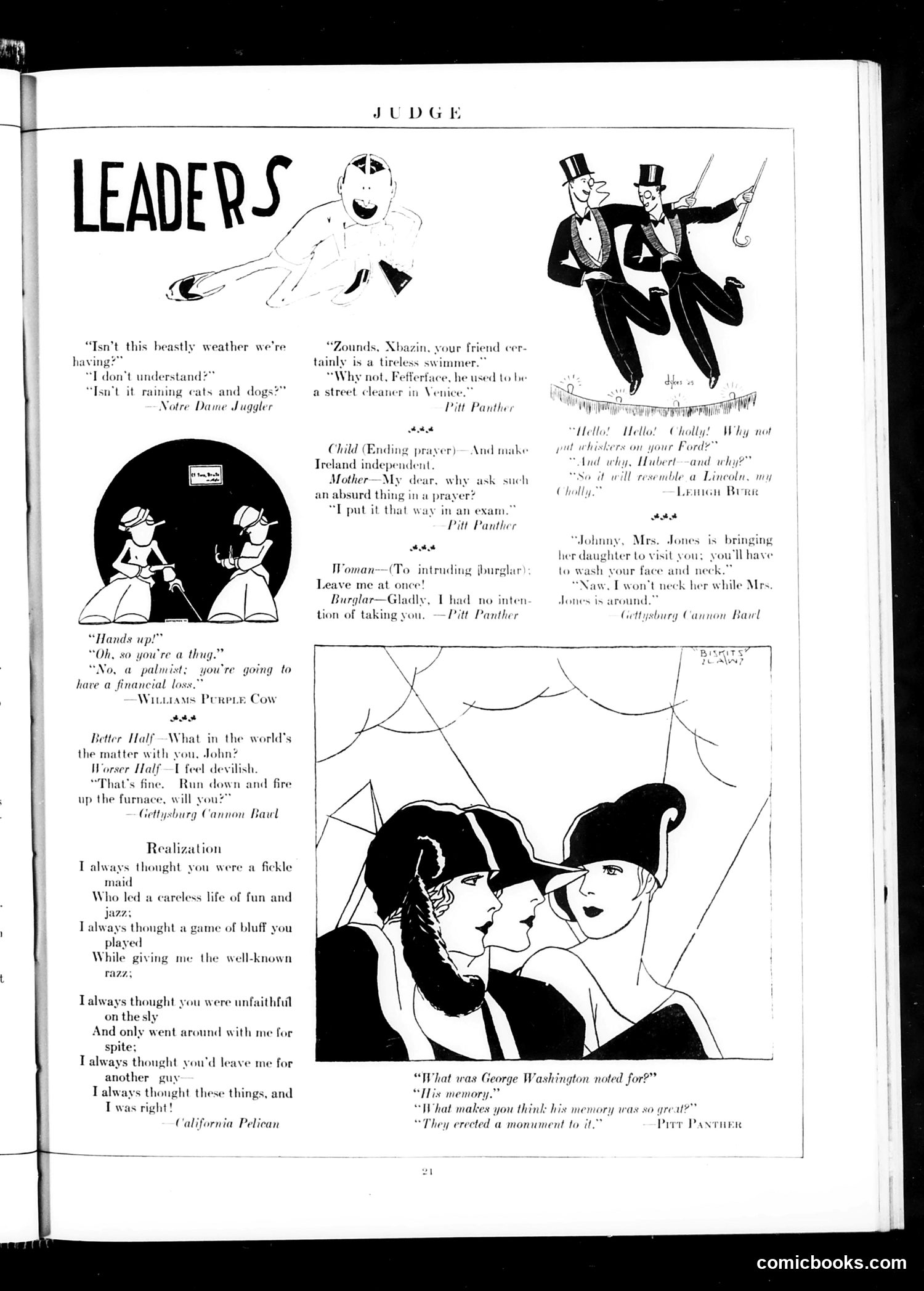
This page collects brief humorous quips and cartoons typical of Judge's early-20th-century satirical format. The jokes range from wordplay to social commentary: **Key recurring themes:** - **Class and pretension**: Multiple jokes mock nouveau-riche affectation (adding "whiskers" to a Ford to resemble a Lincoln; references to Venice street cleaners). - **Gender dynamics**: A burglar rejecting a woman ("I had no intention of taking you"); a young man avoiding necking with a visitor; husband-wife banter about marital discord. - **Ethnic/immigrant humor**: References to "Xbazin" and Venice suggest period stereotyping. - **Youth culture**: Jazz-age dating, exam cheating, and romantic fickleness. **The Washington monument cartoon** (bottom right) plays on the double meaning of "memory"—conflating the monument's physical existence with George Washington's cognitive abilities. The overall tone reflects Judge's upper-class, somewhat cynical perspective on American social life during the Jazz Age, mixing wordplay with gentle mockery of contemporary manners and pretensions.
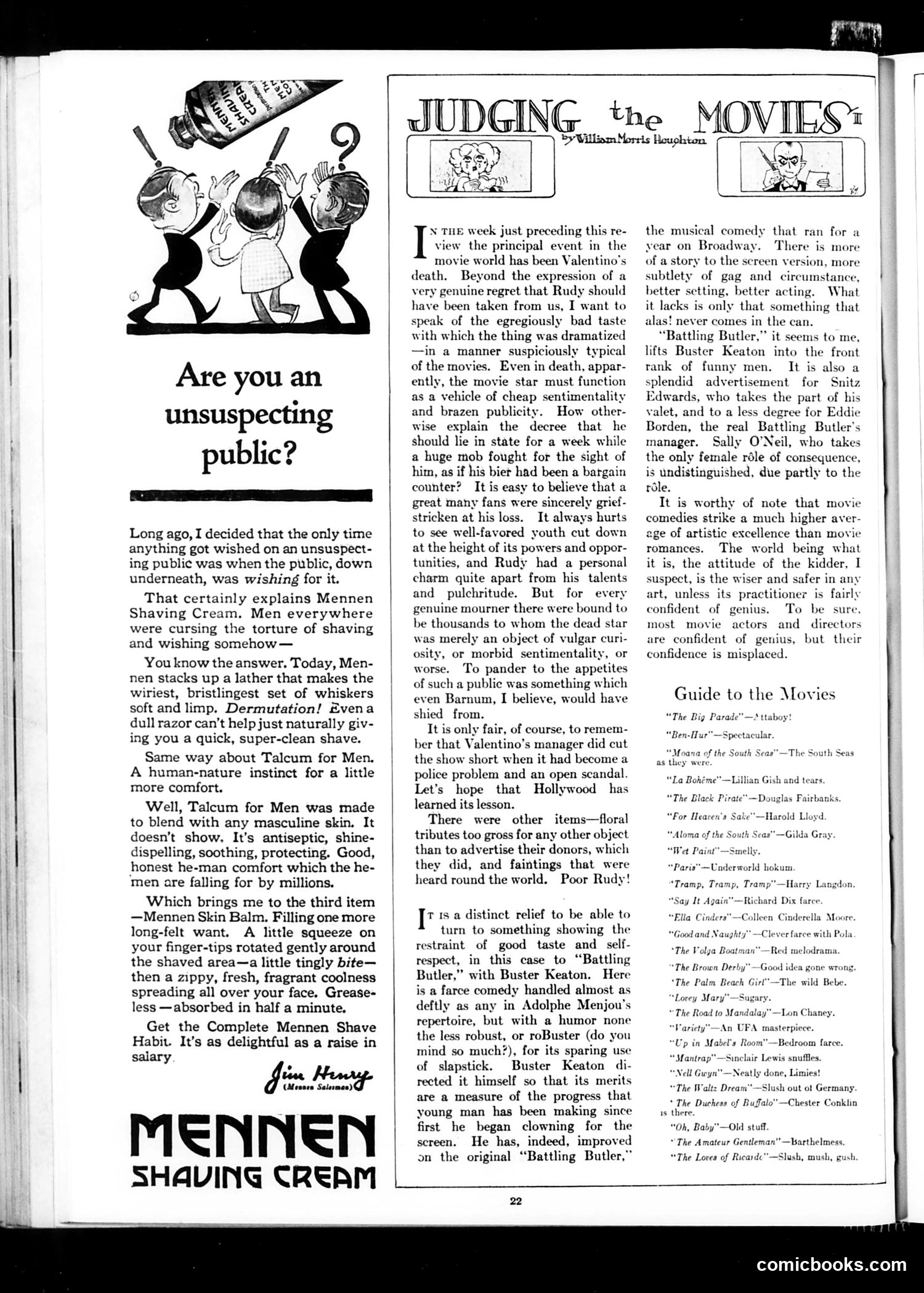
This page contains a **Mennen shaving cream advertisement** and a film review column titled "Judging the Movies" by William Morris Houghton. The ad uses pseudo-psychological reasoning: it claims men "wished for" better shaving products, so Mennen naturally filled that desire—a marketing tactic suggesting the product meets an unspoken public need. The movie review discusses **Rudolph Valentino's recent death** (August 1926). Houghton criticizes Hollywood's exploitation of his funeral—specifically that his body lay in state for a week while crowds mobbed the venue. He condemns this as vulgar sensationalism and "cheap sentimentality," arguing the spectacle pandered to morbid curiosity rather than genuine mourning. He then praises **"Battling Butler"** starring Buster Keaton as a refreshing counterexample of good taste and restraint in comedy filmmaking. Keaton's directing shows artistic progress and humor without relying solely on slapstick. The broader point: Hollywood's cynical commercialization of tragedy versus genuine artistic merit.
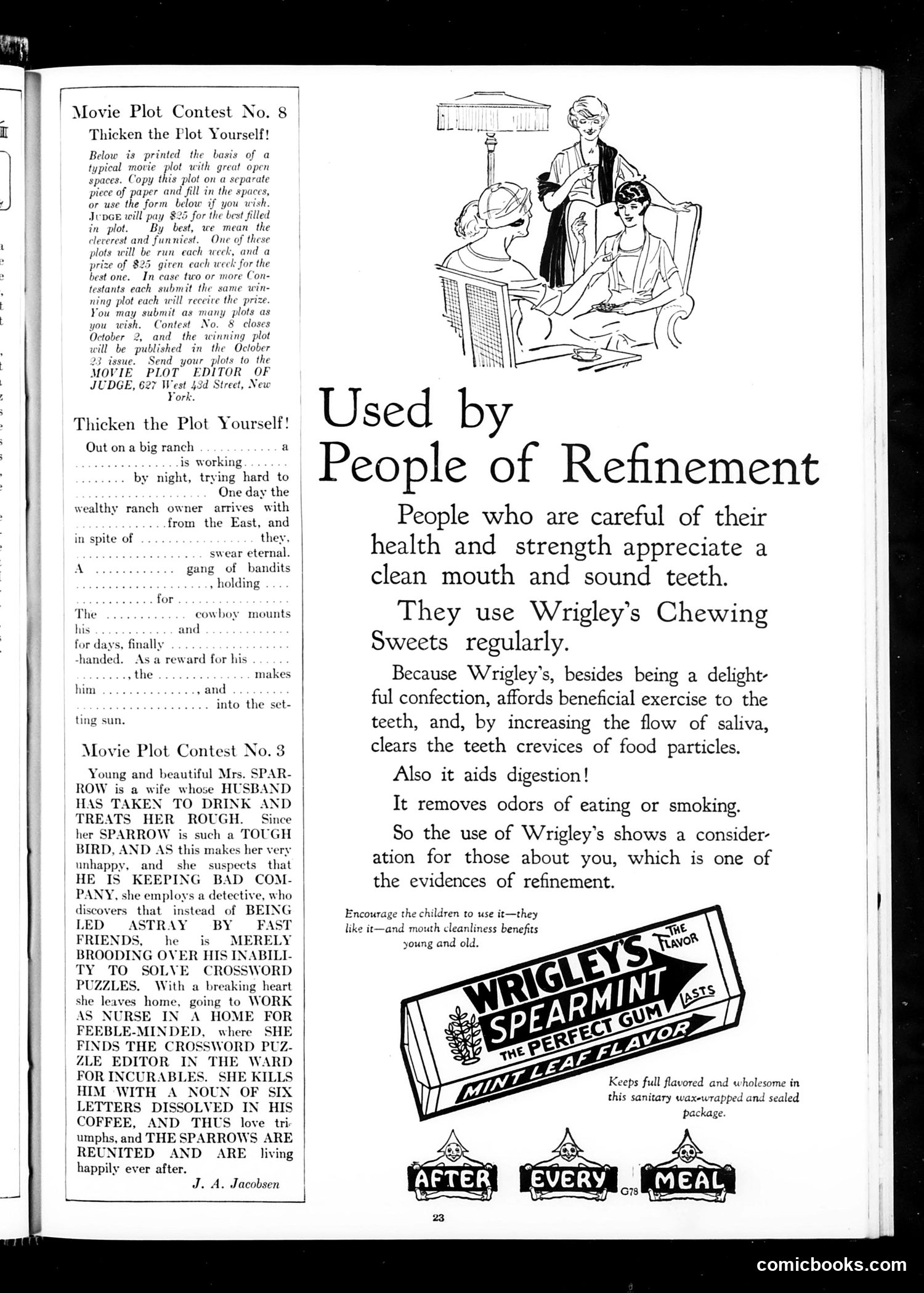
This page contains two elements: a **movie plot contest** and a **Wrigley's gum advertisement**. The contest invites readers to complete formulaic Western movie plots with fill-in-the-blanks, offering $25 prizes. The sample plots showcase early 20th-century movie tropes: ranch settings, virtuous heroines, and melodramatic conflicts. One plot satirizes the era's obsession with crossword puzzles—a husband's drinking problem is actually crossword-puzzle anxiety, resolved when his wife murders a "crossword puzzle editor" in an insane asylum. The **Wrigley's advertisement** positions chewing gum as a marker of social refinement and hygiene. It appeals to aspirational readers by claiming gum use demonstrates consideration for others and aids digestion—standard advertising claims of the era mixing dubious health benefits with social aspiration. The phrase "People of Refinement" directly links product consumption to class status, a common advertising strategy of this period. Together, they represent Judge magazine's dual function: entertainment and commercial revenue.
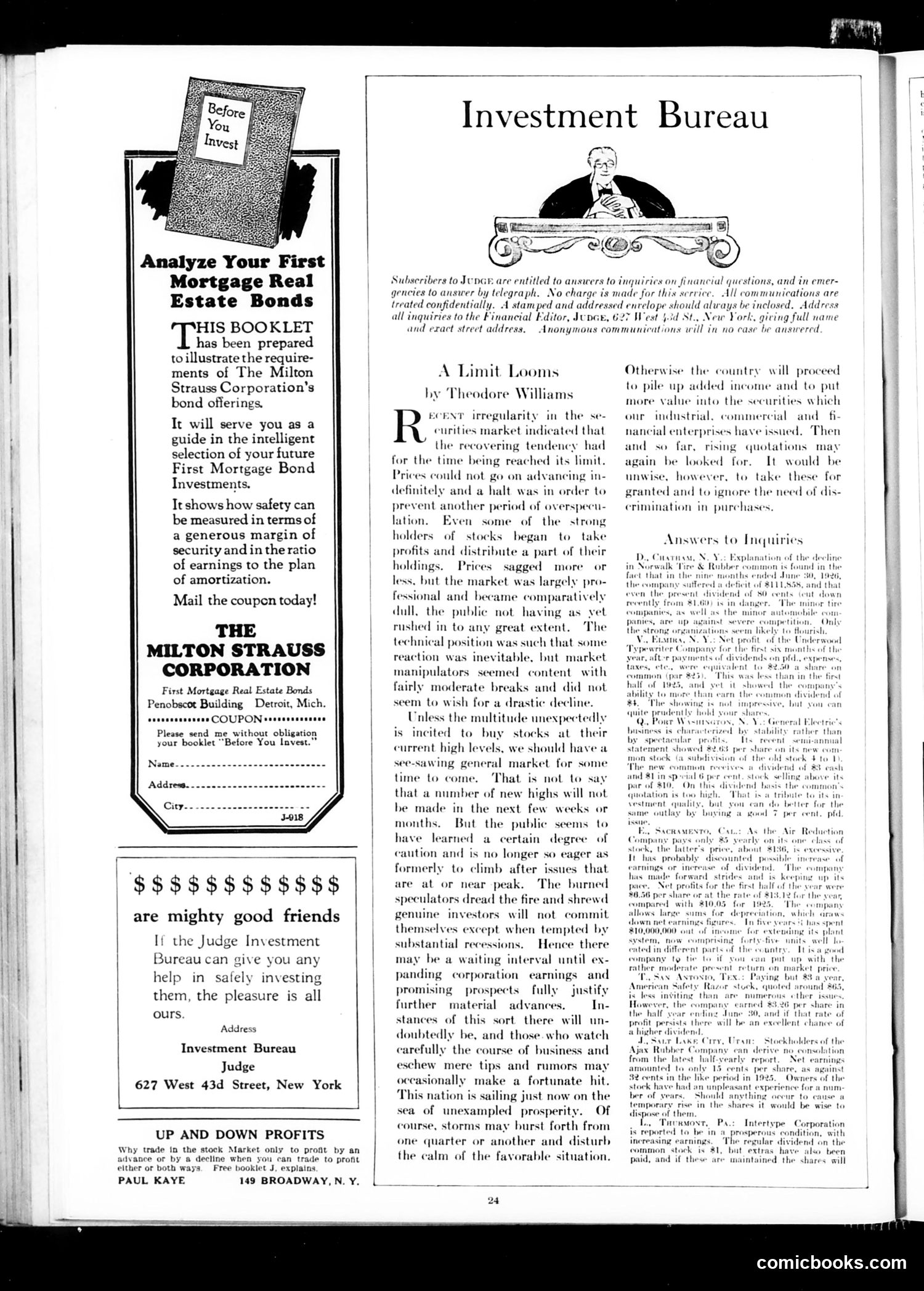
This page combines financial journalism with period advertising, typical of Judge magazine's dual purpose. **Main Article**: Theodore Williams's "A Limit Looms" discusses stock market volatility in what appears to be the early 1920s post-war boom period. Williams warns that the securities market's recovery has plateaued—prices can't advance indefinitely. He notes that strong stockholders are taking profits, the public hasn't yet rushed in massively, and manipulators seem content with "fairly moderate breaks." Williams advocates caution: investors should wait for corporate earnings to justify prices rather than chasing tips and rumors. **Advertisements**: The page promotes investment guides and services from the Milton Strauss Corporation and Judge's own Investment Bureau, positioning themselves as trustworthy guides for "safe investing." **Historical Context**: This reflects 1920s American optimism about "unexampled prosperity" alongside warnings about speculation—foreshadowing the 1929 crash that would vindicate caution advocates like Williams.
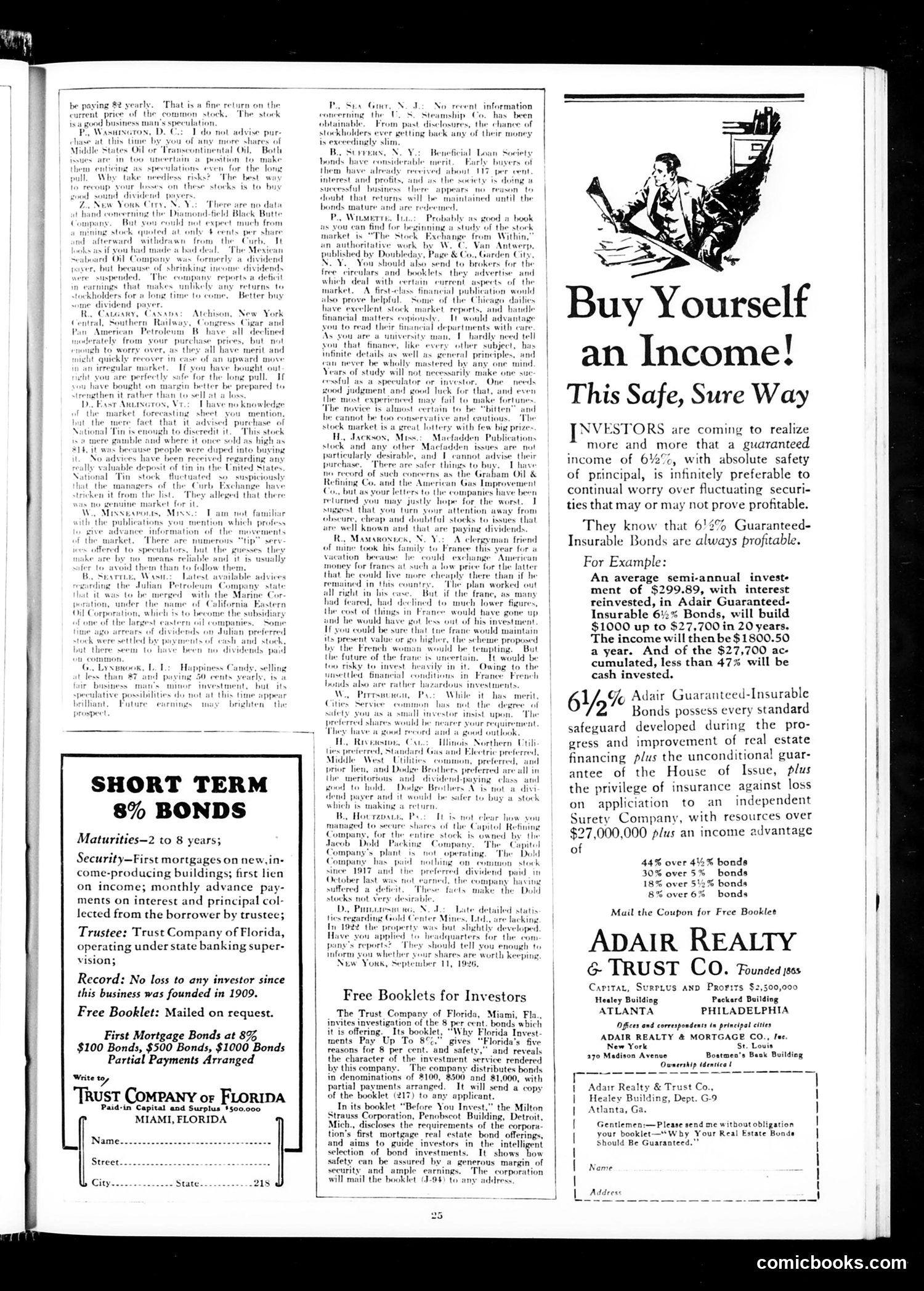
This page is primarily **financial advertising and investment advice**, not political satire. The dominant cartoon—showing a man being ejected from a chair—illustrates the main advertisement: "Buy Yourself an Income! This Safe, Sure Way." The cartoon's meaning is straightforward: impulsive or poorly-informed investing leaves you vulnerable to being thrown out (financially ruined). The advertisement promotes Adair Realty & Trust Co.'s guaranteed bonds paying 6½%, positioned as a safer alternative to speculative stock-picking. The left column contains reader questions about dubious investments (Transcontinental Oil, tin stocks, various companies) answered by what appears to be the magazine's investment advisor, cautioning against risky ventures. This reflects the post-1909 era's concerns about stock market speculation and fraud—topics Judge satirized, though this particular page emphasizes practical financial guidance over humor or political commentary.
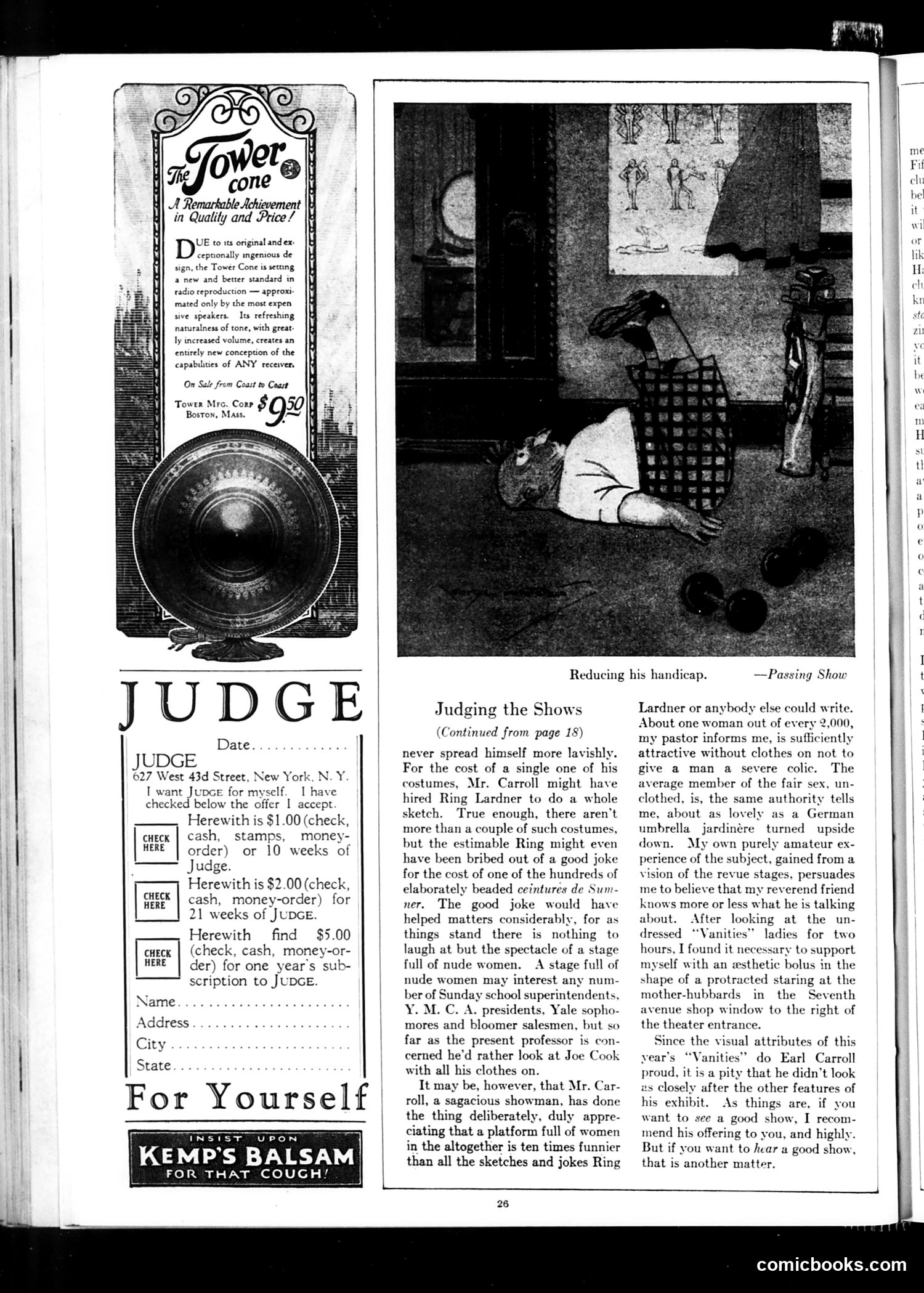
This page contains **advertising and a theater review**, not political cartoons. The main content is a critique of Earl Carroll's theatrical revue "Vanities." The reviewer (identified as the "Professor") sarcastically praises the show's visual spectacle—specifically its extensive use of nude female performers—while lamenting the complete absence of actual comedy or wit. He contrasts Carroll's expensive costume budgets with Ring Lardner's skill at writing jokes, suggesting Carroll chose nudity over substance. The reviewer employs deadpan humor, claiming that nudity itself is ten times funnier than actual jokes, and describes the "average" unclothed woman as about as attractive as "a German umbrella jardinière turned upside down." **The satire targets**: Earl Carroll's artistic priorities and 1920s revue culture's reliance on sexual display rather than performance quality. **Left side**: Advertisement for "The Tower Cone" radio speaker ($9.50) and Judge magazine subscription offers.
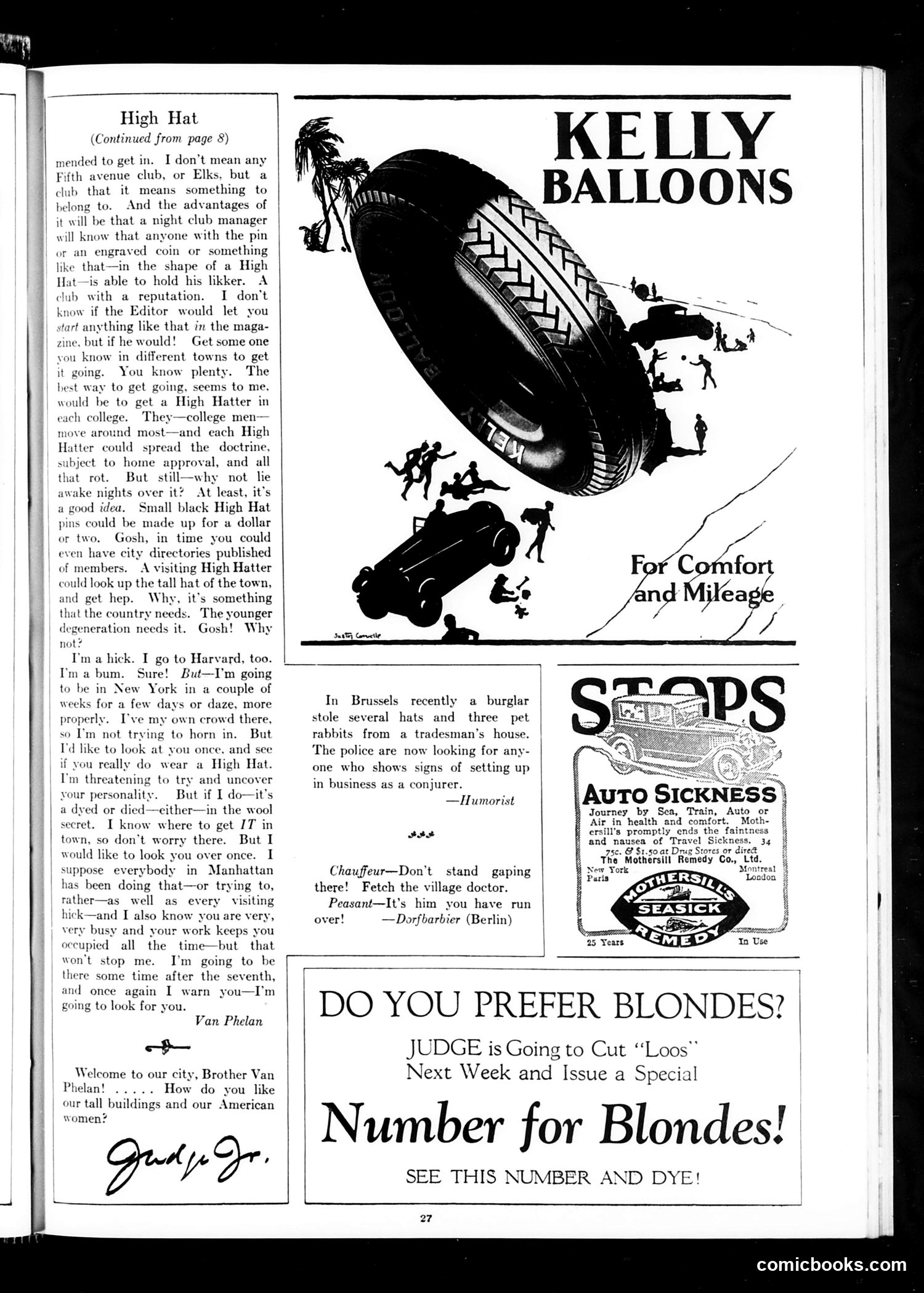
This page contains several distinct elements from a 1920s-era Judge magazine: **"High Hat" Column**: A humorous letter proposing an exclusive social club for college men who can "hold their liquor," with membership pins shaped like top hats. The writer suggests spreading this drinking culture through college networks. This satirizes both Prohibition-era drinking culture and the pretentiousness of fraternal organizations. **Kelly Balloons Advertisement**: A straightforward car tire ad featuring a dramatic crash scene. **Brief Humor Items**: Small jokes about a Brussels burglar and a peasant-chauffeur accident—typical short satirical pieces. **"Do You Prefer Blondes?" Advertisement**: Judge announces a special "Number for Blondes" with the tagline "See This Number and Dye!" This jokes about hair dyeing while likely referencing the cultural obsession with blonde hair during the 1920s flapper era. The page is primarily **humorous social commentary and advertising** rather than political satire. It reflects Jazz Age attitudes toward drinking, class, and gender.
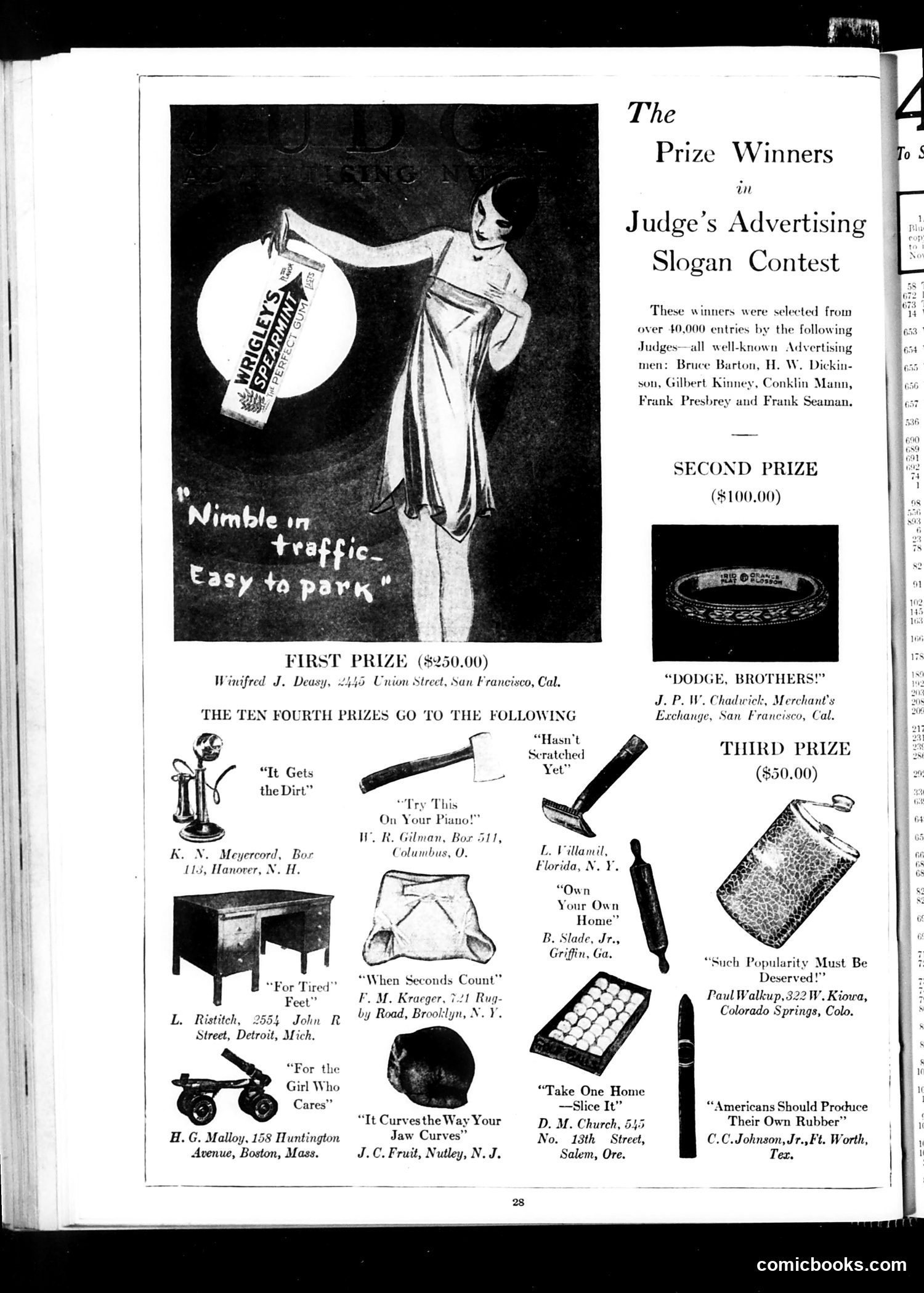
This page announces winners of Judge magazine's advertising slogan competition, judged by prominent advertising executives. The first-prize winning entry, "Nimble in traffic, easy to park," promotes what appears to be an automobile (likely a compact car model), visualized through an art deco illustration of a woman displaying the vehicle. The remaining prizes showcase product slogans for everyday consumer goods: cleaning products, furniture, musical instruments, beauty/grooming items, and rubber products. The context reflects 1920s-30s American consumer culture and manufacturing, when domestically-produced goods were promoted as desirable. The slogan "Americans Should Produce Their Own Rubber" specifically references the contemporary rubber supply concern—natural rubber was imported from overseas colonies, making domestic rubber production a matter of economic nationalism and industrial self-sufficiency during this era.
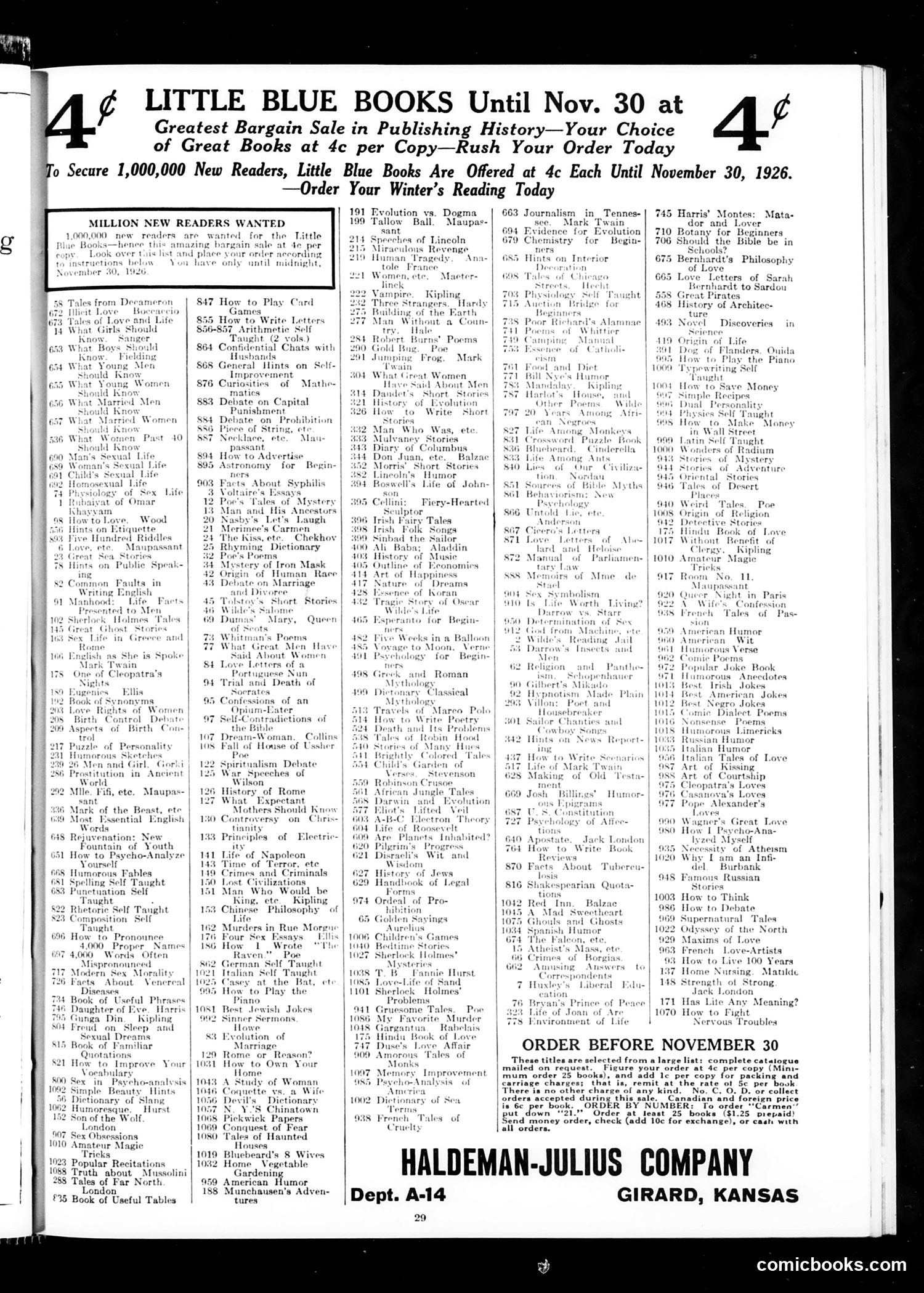
This page is **not a cartoon or satirical content** — it is primarily a **mail-order book advertisement** from the Haldeman-Julius Company (Girard, Kansas), dated 1926. The page announces a massive clearance sale of "Little Blue Books" at 4¢ per copy through November 30, 1926, claiming to target "1,000,000 new readers." The bulk of the content consists of a numbered catalog listing approximately 1,000 titles available for purchase. The book selection reveals early 20th-century popular and mass-market interests: classic literature (Poe, Kipling, Maupassant), practical self-help (grammar, rhetoric, etiquette), sexuality and reproduction guides (birth control, sexual life), psychology (Freud, psychoanalysis), and humor. Many titles address sexual frankness unusual for the era, suggesting Haldeman-Julius marketed provocative content to working-class readers. This is a **commercial document**, not satire — it demonstrates how publishing democratized literature through inexpensive editions.
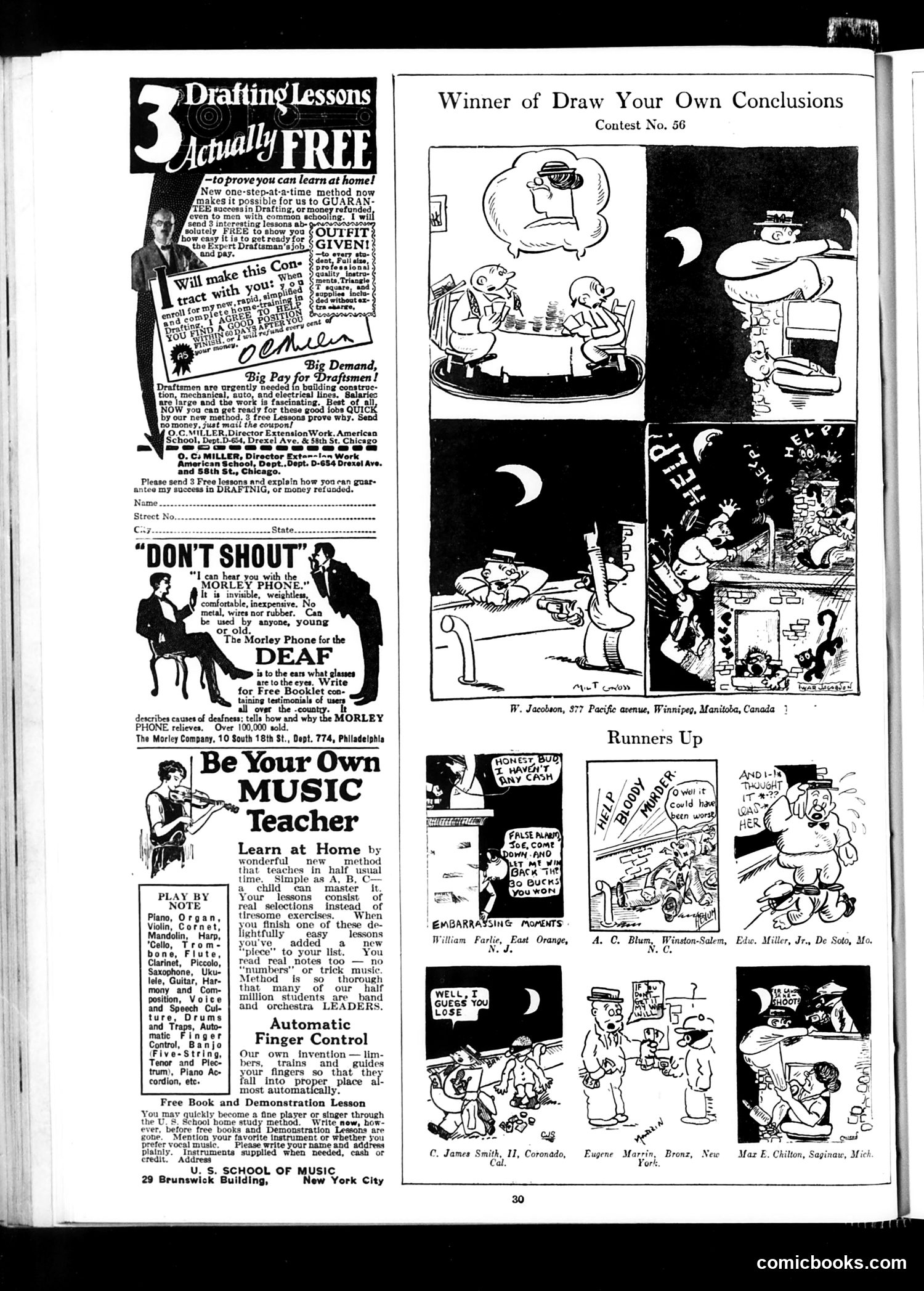
This page is primarily **advertising**, featuring multiple mail-order educational services popular in early 20th-century American magazines: drafting lessons, hearing aids (the "Morley Phone" for deaf users), music instruction, and music teaching methods. The ads emphasize learning "at home" and promise quick success—common marketing appeals of the era. The only editorial cartoon content is the "Draw Your Own Conclusions" contest winner section (top right), showing cartoon panels with humorous scenarios. The winning entry by W. Jacobson depicts what appears to be domestic or social comedy situations, though specific details are difficult to discern from the image quality. The "Runners Up" section displays additional cartoon submissions, suggesting this was an ongoing reader-participation feature in Judge magazine. **Key context for modern readers**: These ads reflect a pre-internet era when correspondence courses and self-teaching materials were the primary means of adult skill-building and career advancement, particularly for working-class Americans seeking better employment.
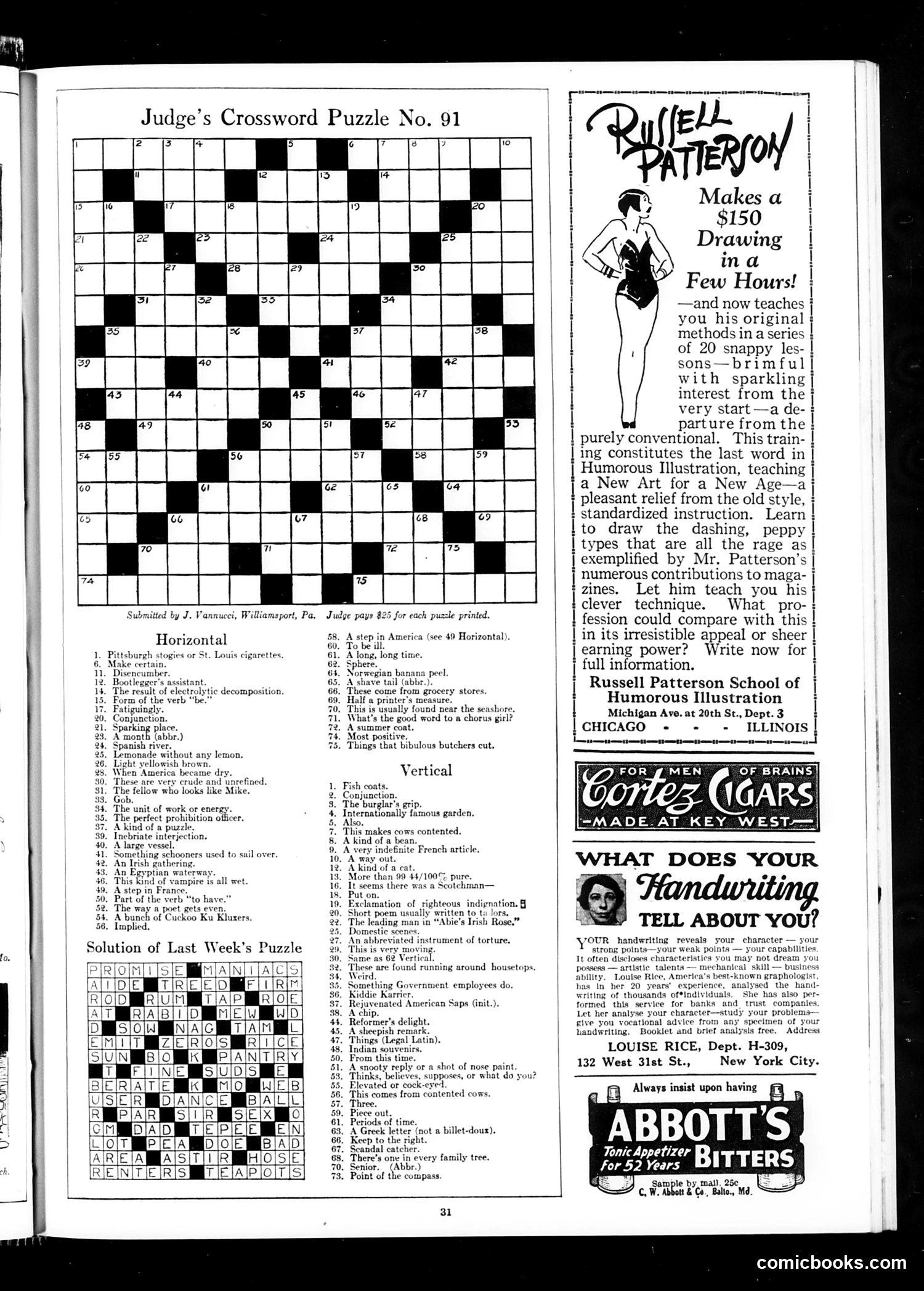
This page is primarily a **crossword puzzle** submitted by J. Vannucci of Williamsport, PA, with Judge offering a $25 prize for publication. The clues heavily reference **Prohibition-era American culture** (the 1920s-early 1930s). Recurring themes include: - Alcohol references: "Pittsburgh stogies or St. Louis cigarettes" (code for booze), "The perfect prohibition officer" (an ironic impossibility), "bibulous butchers," "inebriate interjection" - Dry America nostalgia: "when America became dry," "Lemonade without any lemon" (watered-down substitute) - Period slang: "chorus girl," "the burglar's grip" The surrounding **advertisements** are typical of the era: Russell Patterson's correspondence school for cartooning, Cortes Cigars, handwriting analysis by Louise Rice, and Abbott's Bitters. **Context for modern readers**: Judge used crosswords as vehicles for topical humor, embedding contemporary social commentary (Prohibition's failures, speakeasies, bootlegging) into wordplay that would amuse readers familiar with these realities despite official "dryness."
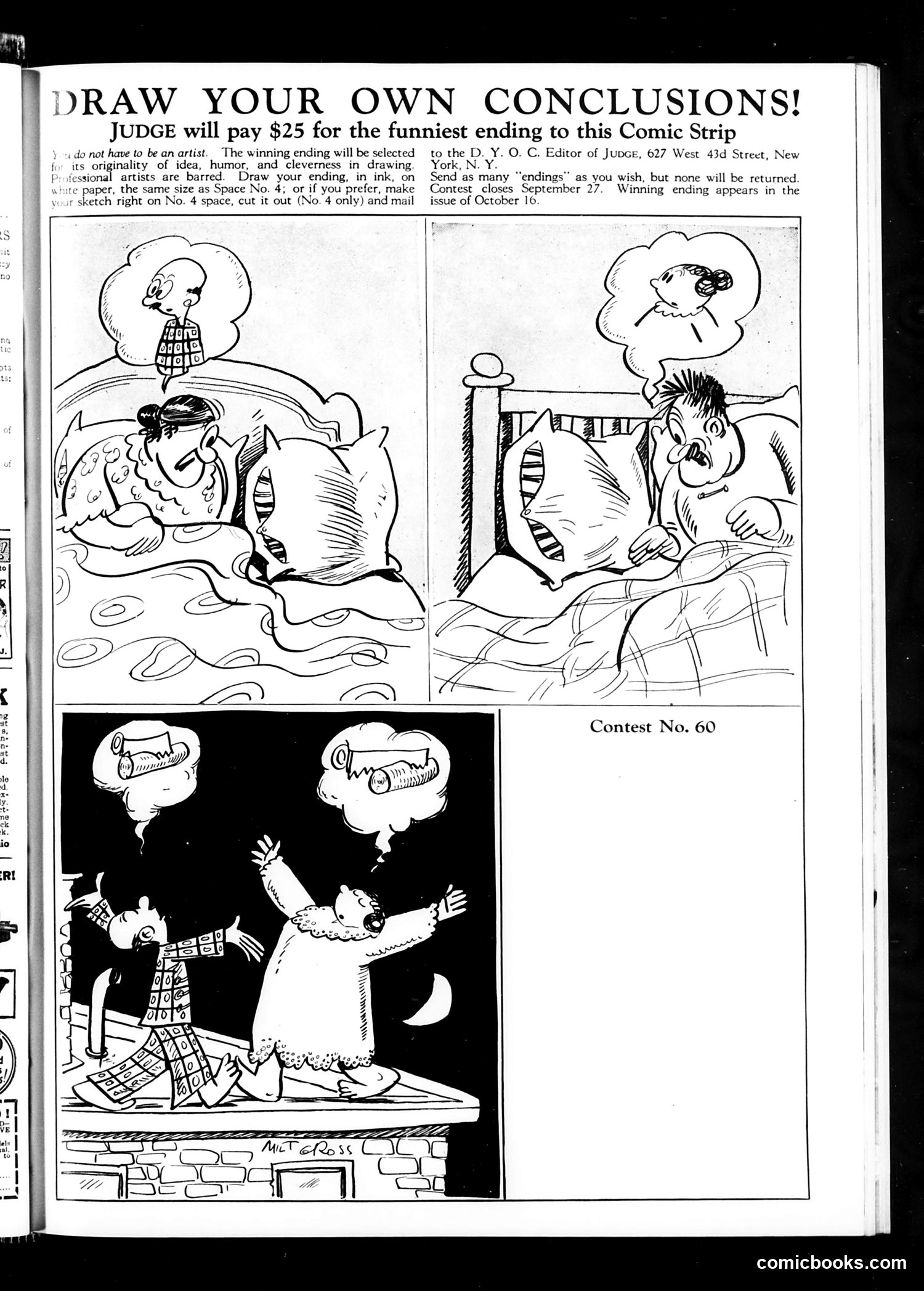
This is a reader-participation contest page, not a political cartoon. Judge magazine invited readers to complete an unfinished comic strip for a $25 prize. The three panels show a domestic bedroom scene: Panel 1 depicts a woman in bed with exaggerated features (likely ethnic caricature, common to era publications). Panel 2 shows a man in bed, apparently reacting with disgust or alarm. Panel 3, the completed example by artist "Mel Cross," shows both figures outside on a rooftop at night, juggling what appear to be sausages while thinking about food—a punchline suggesting marital discord or absurdist humor. The contest invited amateur submissions to finish the strip with humorous endings. This reflects early 20th-century magazine culture combining reader engagement with the casual ethnic stereotyping typical of period American humor publications.
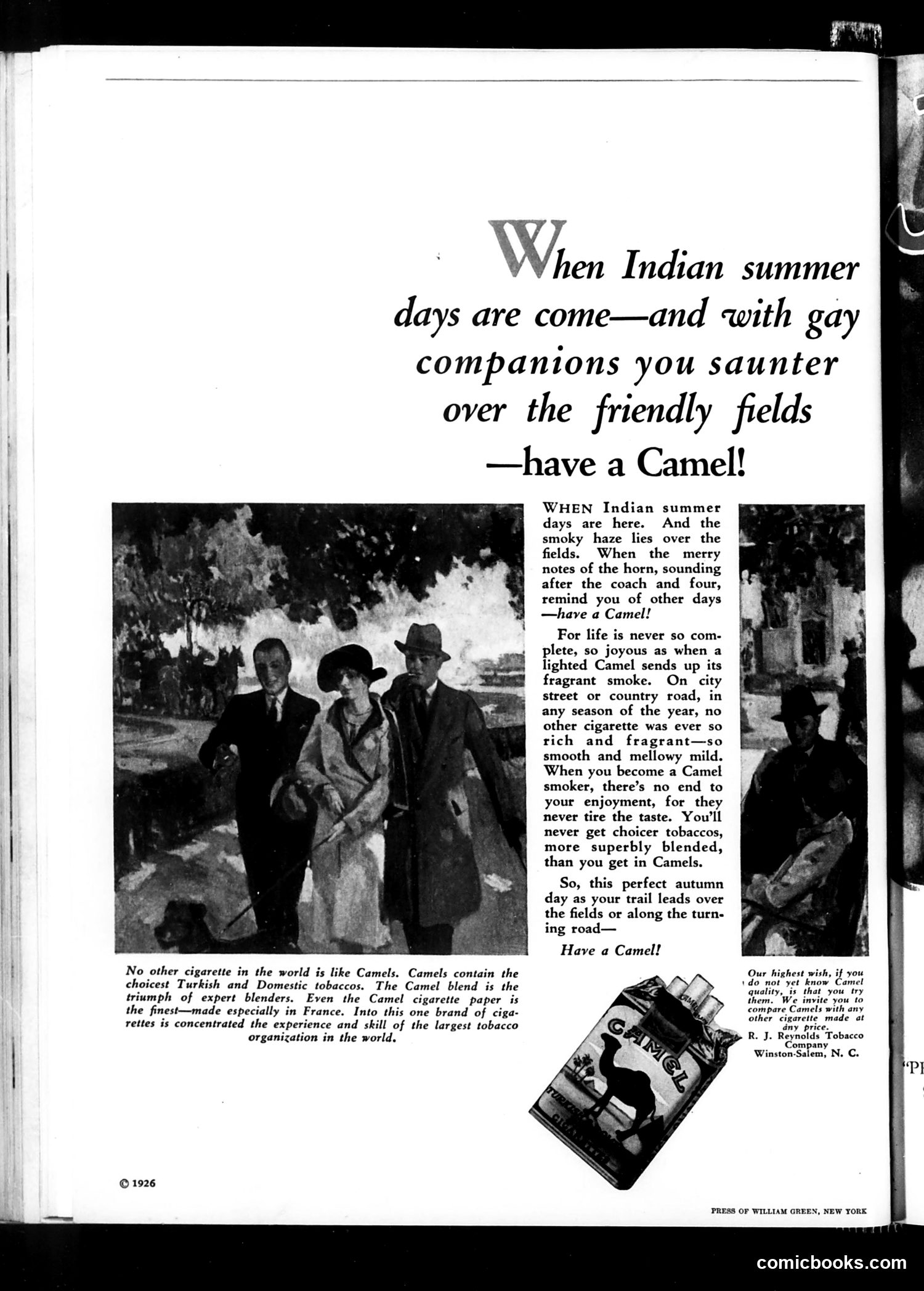
This is a **Camel cigarette advertisement**, not a political cartoon or satire. Published in 1926 by Judge magazine, it's a straightforward commercial promoting cigarettes to aspirational, leisured audiences. The ad depicts three well-dressed figures enjoying an "Indian summer" countryside outing—evoking upper-class recreational pursuits like fox hunting ("the coach and four"). The imagery romanticizes smoking as integral to genteel leisure and natural beauty. The text emphasizes Camel's "Turkish and Domestic tobaccos," superior blending, and French cigarette paper—appealing to sophistication and quality. There is no satirical content here; Judge simply sold advertising space to major corporations like R.J. Reynolds. **For modern readers**: This reflects 1920s marketing that openly linked cigarettes to lifestyle aspiration and social status, before health warnings existed. The casual, celebratory tone toward smoking—and targeting of leisure-class imagery—would be unthinkable in contemporary advertising.