
Judge, 1926-09-18 · page 15 of 36
Judge — September 18, 1926 — page 15: what you’re looking at
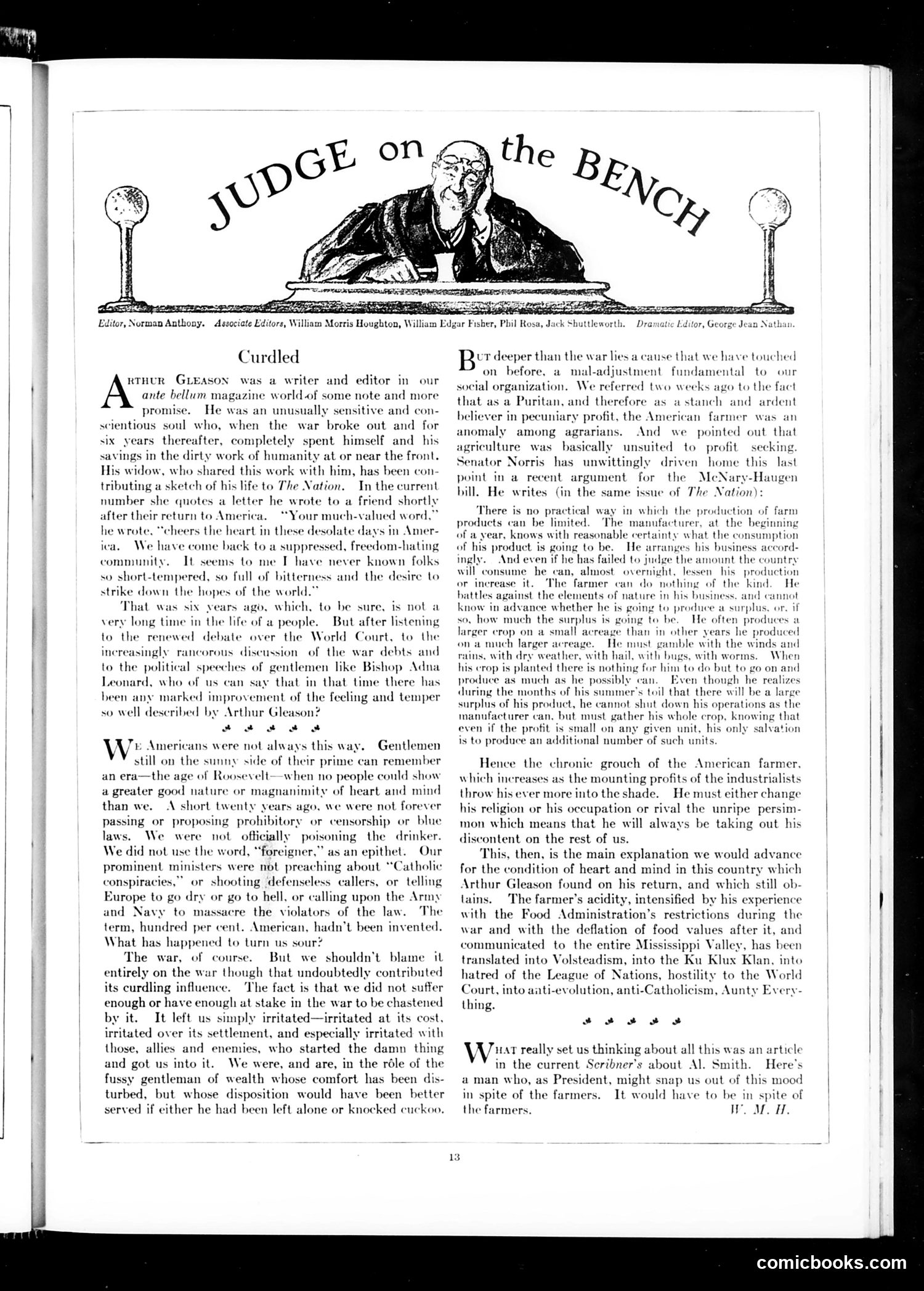
What you’re looking at
This editorial column by an unnamed Judge critic addresses post-WWI American social deterioration. The piece argues that writer Arthur Gleason correctly observed in 1919 that America had become "suppressed, freedom-hating"—and six years later (appears to be ~1925), nothing has improved. The satire targets American hypocrisy and sourness. Pre-war America was magnanimous and tolerant; now it's intolerant (attacking "Catholic conspiracies"), censorious (pushing prohibition), and paranoid (inventing "100% American" rhetoric). The critic blames not just the war itself, but deeper structural problems: American farmers, Puritan-influenced to seek profit, are fundamentally misaligned with agriculture's nature. The overall argument: America's post-war bitterness stems from being an irritated wealthy person whose comfort was disrupted—not genuinely chastened by sacrifice—like "a fussy gentleman of wealth" knocked "cuckoo" rather than reformed.
📄 Transcribed text from this page (OCR, searchable)
Machine-transcribed from the original scan — historical spelling and the odd misread are preserved.
Curdled RTHUR GLEASON was a writer and editor in our ante bellum magazine world.of some note and more promise. He w an unusually sensitive and con- scientious soul who, when the war broke out and for six years thereafter, completely spent himself and his savings in the dirty work of humanity at or near the front. His widow, who shared this work with him, has been con- tributing a sketch of his life to The Nation. In the current number she quotes a letter he wrote to a friend shortly after their return to Ameri a. “Your much-valued word,” he wrote, “cheers the heart in these desolate days in Amer- ica. We have come back to a suppressed, freedom-hating community. It seems to me T have never known folks so short-tempered, so full of bitterness and the desire to strike down the hopes of the world.” That was six years ago. which, to be sure, is not a very long time in the life of a people. But after listening to the renewed debate over the World Court, to the increasingly rancorous discussion of the war debts and to the political speeches of gentlemen like Bishop Adna Leonard, who of us can say that in that time there has been any marked improvement of the feeling and temper so well described by Arthur Gleason? Ae eae W: Americans were not alwa Gentlemen still on the sunny side of their prime can remember an era—the age of Roosevelt—when no people could show a greater good nature or magnanimity of heart and mind than we. Ss ago. we were not forever passing or proposing prohibitory or censorship or blue laws. We were not officially poisoning the drinker. We did not use the word, “foreigne ys this way \ short twenty y as an epithet. Our prominent ministers were not preaching about “Catholic conspiracies,” or shooting ‘defenseless callers, or telling Europe to go dry or go to hell, or calling upon the Army and Navy to massacre the violators of the law. The term, hundred per cent. American, hadn't been invented. What has happened to turn us sour? The war, of course. But we shouldn't blame it entirely on the war though that undoubtedly contributed its curdling influence. The fact is that we did not suffer enough or have enough at stake in the war to be chastened by it. It left us simply irritated—irritated at its cost, irritated over its settlement, and especially irritated with those, allies and enemies, who started the damn thing and got us into it. We were, and are, in the réle of the fussy gentleman of wealth whose comfort has been dis- turbed, but whose disposition would have been better served if either he had been left alone or knocked cuckoo. worth, Dramatic Editor, George Jean Nathau B: r deeper than the war lies a cause that we have touched on before, a maladjustment fundamental to our social organization. We referred two weeks ago to the fact that as a Puritan, and therefore as a stanch and ardent believer in pecuniary profit, the American farmer was an anomaly among agrarians. And we pointed out that agriculture was basically unsuited to profit. secking. Senator Norris has unwittingly driven home this. last point in a recent argument for the MeNary-Haugen bill. He writes (in the same issue of The Nation): There is no practical way in which the production of farm products can be limited. The manufacturer, at the beginning of a year, knows with reasonable certainty what the consumption of his product is going to be. He arranges his business accord- ingly. And even if he has failed to judge the amount the country will consume he can, almost overnight, lessen his production or increase it. The farmer can do nothing of the kind. He battles against the elements of nature in his business. and can know in advance whether he is going to produce a surplus. « so, how much the surplus i larger crop on a small acre on a much larger acre rains, with dry weathe not if yoing to be. He often produces a than in other years he produced He must gamble with the winds and with hail, with bugs, with worms. When his crop is planted there is nothing for him te but to go on and produce as much as he possibly « Even though he realizes during the months of his summer's toil that there will be a large surplus of his product, he cannot shut down his operations as the manufacturer can, but must gather his whole crop, knowing that even if the profit is small on any given unit, his only salvation is to produce an additional number of such units Hence the chronic grouch of the American farmer, which increases as the mounting profits of the industrialists throw his ever more into the shade. He must either change his religion or his occupation or rival the unripe persim- mon which means that he will always be taking out his discontent on the rest of us. This, then, is the main explanation we would advance for the condition of heart and mind in this country which Arthur Gleason found on his return, and which still ob- tains. The farmer’s acidity, intensified by his experience with the Food Administration’s restrictions during the war and with the deflation of food values after it, and communicated to the entire Mississippi Valley, has been translated into Volsteadism, into the Ku Klux Klan, into hatred of the League of Nations, hostility to the World Court, into aati-evolution, anti-Catholicism, Aunty Every- thing. es 2s ts Se SD Wis really set us thinking about all this was an article in the current Scribner's about Al. Smith. Here's a man who, as President, might snap us out of this mood in spite of the farmers. It would have to be in spite of the farmers. WoM. A. comicbooks.com