
A complete issue · 36 pages · 1926
Judge — August 21, 1926
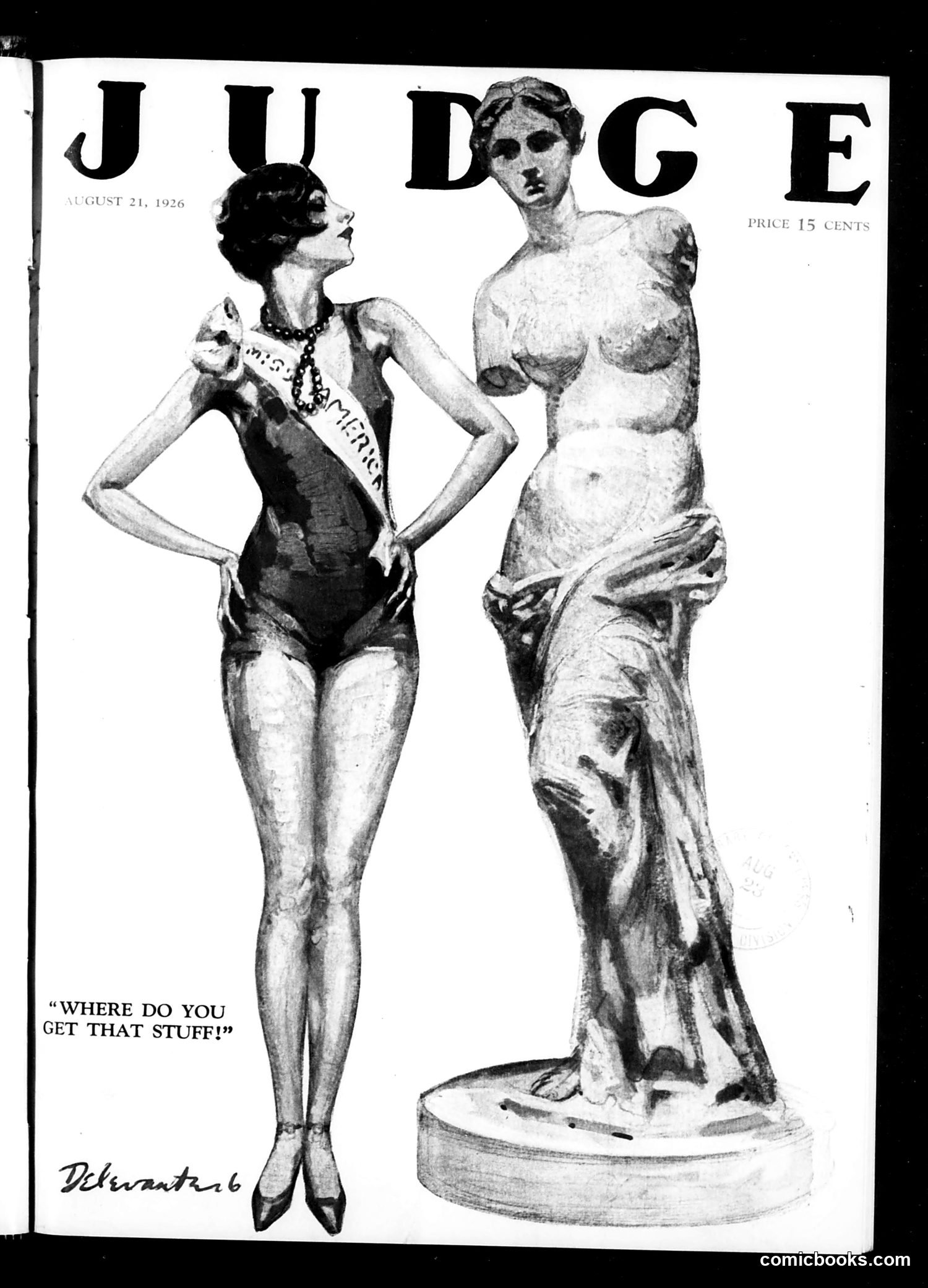
This satirical cartoon compares a woman in a modern 1920s bathing suit (left) with a classical Greek or Roman statue (right). The caption—"WHERE DO YOU GET THAT STUFF!"—appears to be mocking the classical aesthetic ideals represented by the statue. The joke likely critiques the contrast between traditional notions of feminine beauty and the "new woman" of the Jazz Age. The flapper-era bathing suit represented a radical departure from Victorian modesty, and this cartoon satirizes the tension between classical artistic ideals and modern fashion's streamlined, more androgynous silhouettes. The comparison suggests the modern woman's body doesn't match romanticized classical standards—a commentary on 1920s debates about changing femininity and beauty standards.
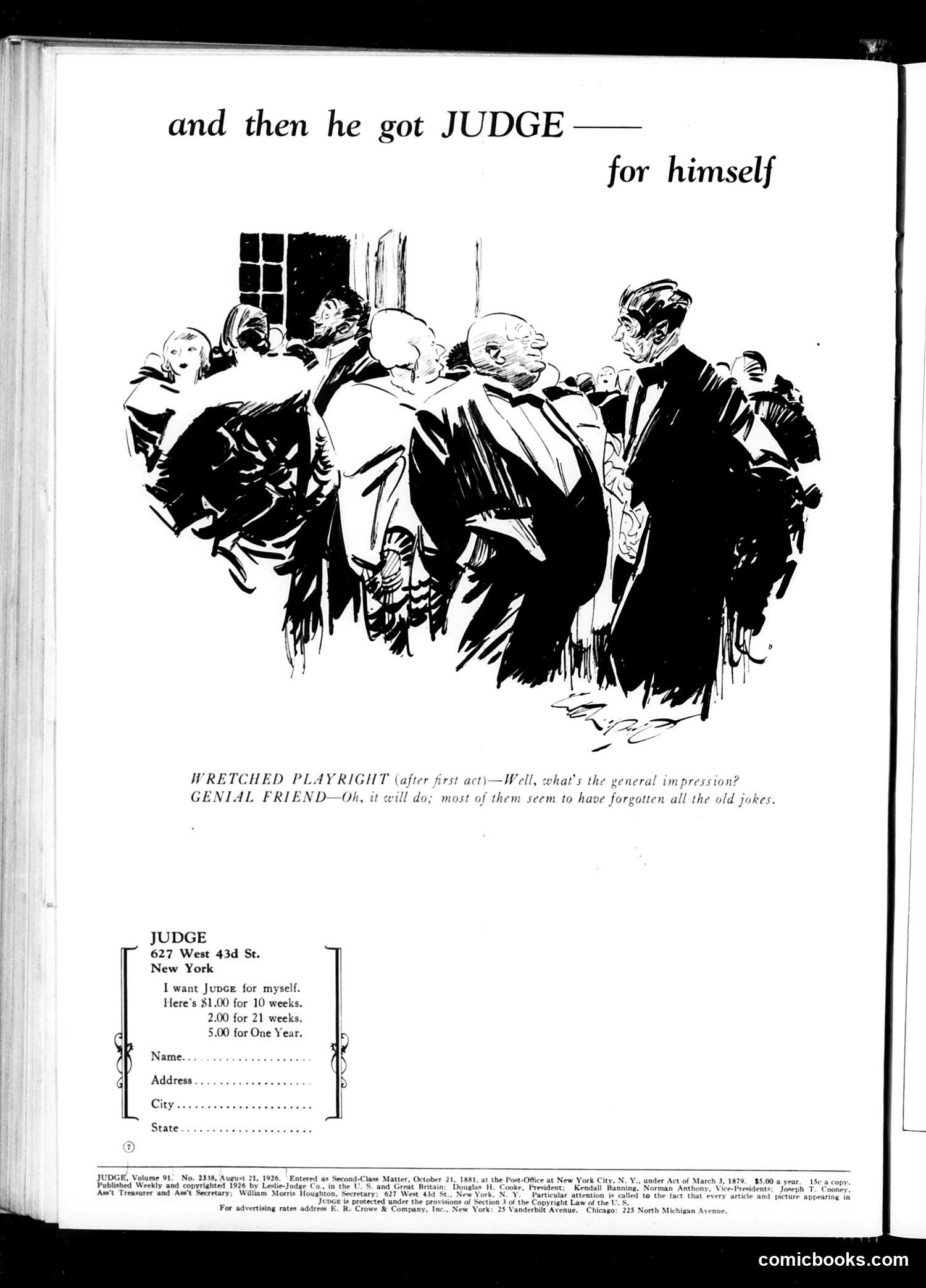
This page satirizes a theatrical flop through a sketch titled "Wretched Playwright" (after first act). A playwright asks a general friend about audience reaction; the friend replies that spectators "seem to have forgotten all the old jokes," suggesting the play relies on stale, recycled material rather than original wit. The headline "and then he got JUDGE — for himself" promotes Judge magazine as a subscription product, implying readers can obtain independent judgment/critical opinion. The subscription box offers 10-week ($1), 21-week ($2), and annual ($5) rates. The cartoon ridicules theatrical mediocrity and lazy writing while simultaneously marketing Judge as an arbiters of taste and quality—a clever double message combining social commentary with advertising.
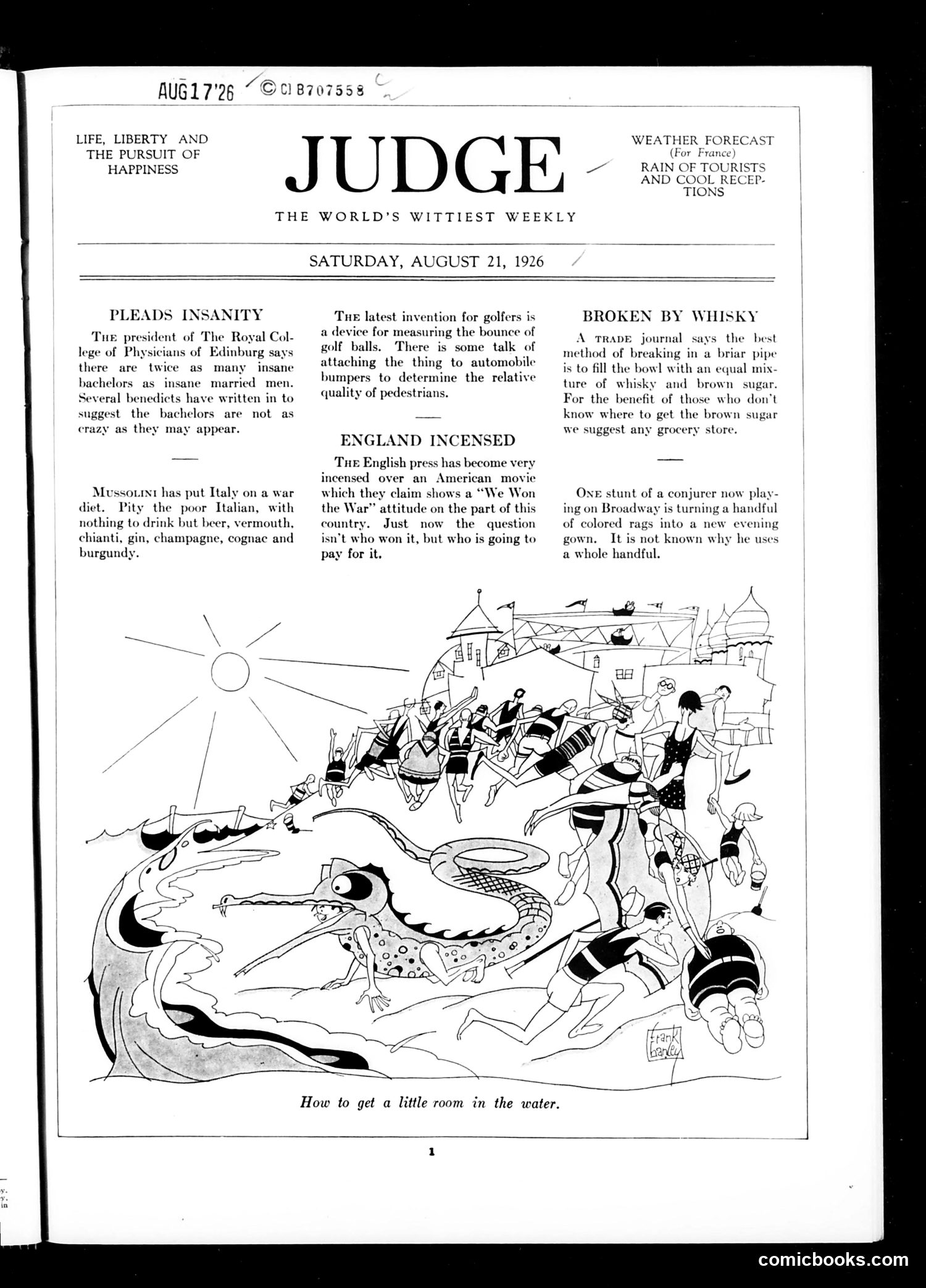
The main cartoon, captioned "How to get a little room in the water," satirizes overcrowded public beaches in summer 1926. It depicts beachgoers in various comedic predicaments with sea creatures—people cramped together, some being chased by what appears to be an alligator or sea serpent, others tangled with fish and marine life. The humor derives from the contrast between the idyllic seaside vacation and the chaotic reality: beaches were packed with visitors, offering little personal space. The cartoonist uses exaggeration and the intrusion of dangerous wildlife to mock the impossibility of finding solitude or comfort at popular swimming destinations during this era of growing leisure and automobile travel enabling beach access.
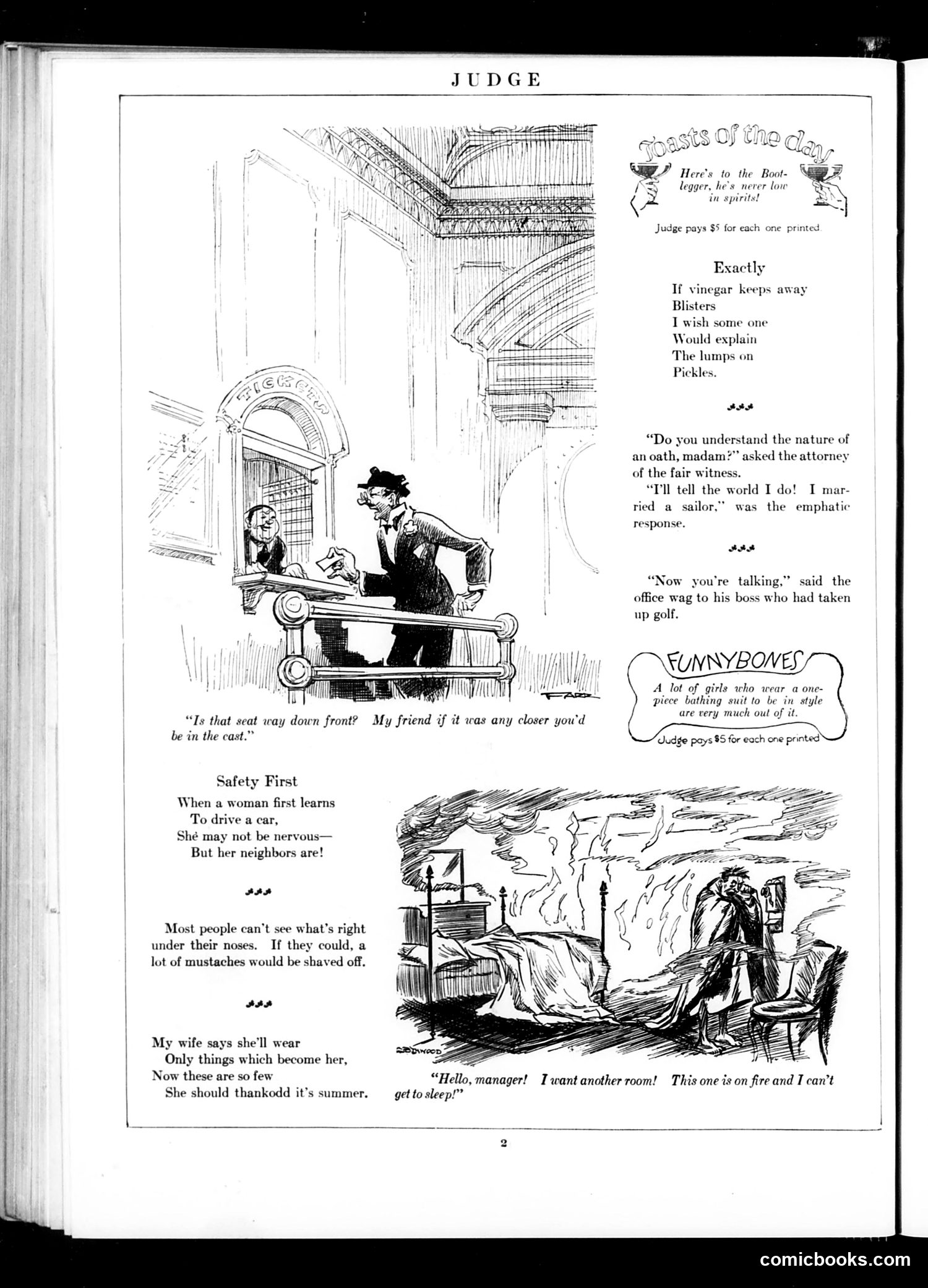
This page contains several humorous vignettes rather than political commentary. The main cartoon shows two men on a bench outside a building—one asking if the seat faces the right direction, with the punchline about being "in the east," likely referencing directional/orientation confusion as comedy. The "Safety First" section satirizes early automotive safety concerns, joking that women drivers are dangerous to neighbors' mustaches and that wives rarely wear things they should keep. "Boatloads of the Day" mocks a naval officer's oath testimony. The "Funny Bones" section jokes about women wearing one-piece bathing suits being unfashionable. The bottom cartoon depicts a hotel guest complaining about a room "on fire," creating a double-meaning joke. These are workplace/social humor pieces typical of Judge's light satirical style, not political commentary.
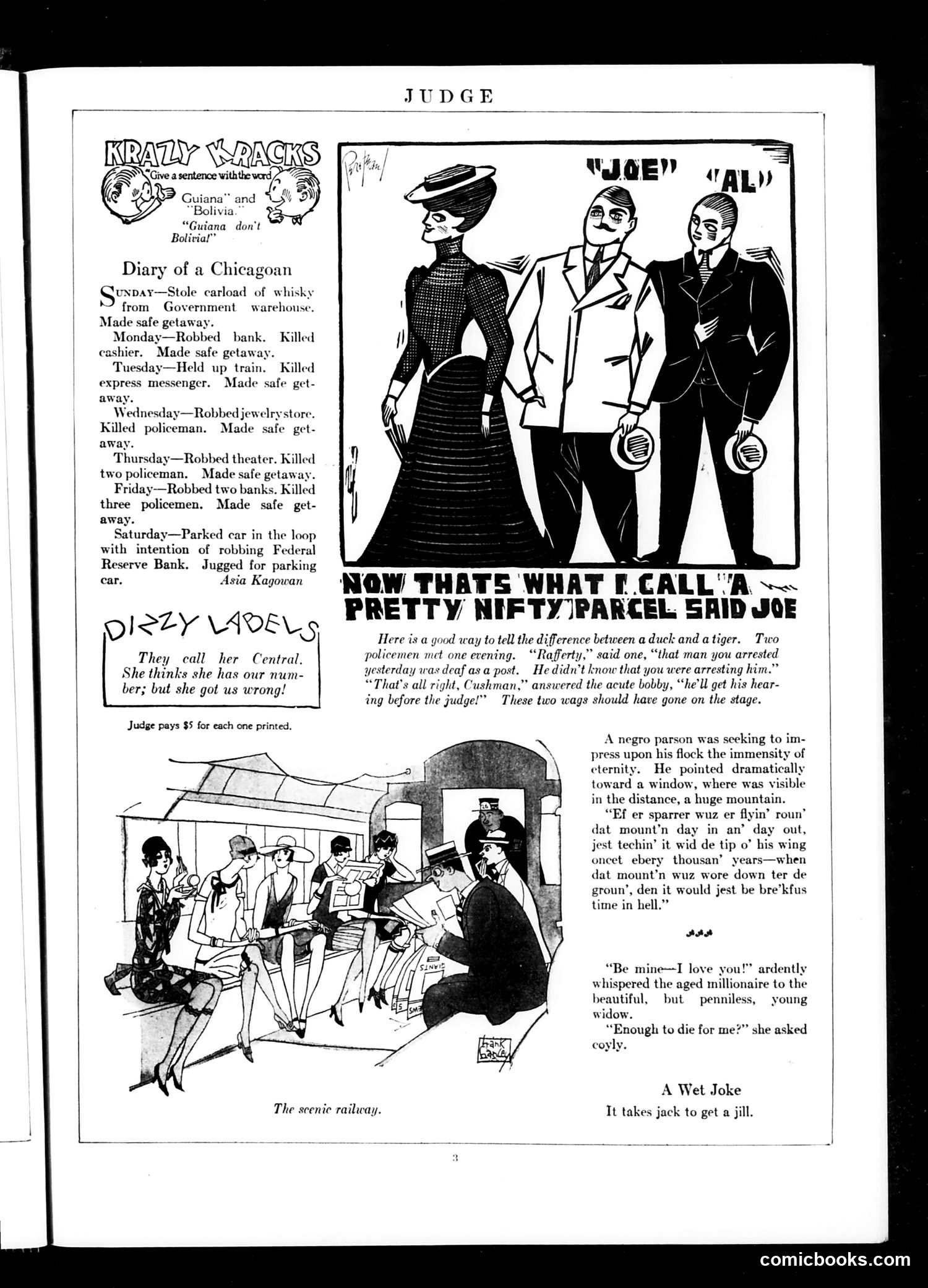
This page contains several satirical pieces typical of Judge magazine's humor: **"Krazy Kracks"** mocks a woman calling herself "Central" who incorrectly thinks she's a telephone operator—the joke plays on confusion about technology or identity. **"Diary of a Chicagoan"** satirizes a criminal's weekly schedule of robberies and murders, implying Chicago's reputation for organized crime and lawlessness during Prohibition era. **"Nifty/Nifty/Swell Ship Joe"** appears to depict criminal types or gangsters, playing on names and criminal stereotypes. The bottom sections include jokes about seduction and dated racial humor reflecting period prejudices—specifically, stereotyped dialect humor that was common but deeply offensive by modern standards. The overall page reflects 1920s American anxieties about crime, urban corruption, and social change during Prohibition.
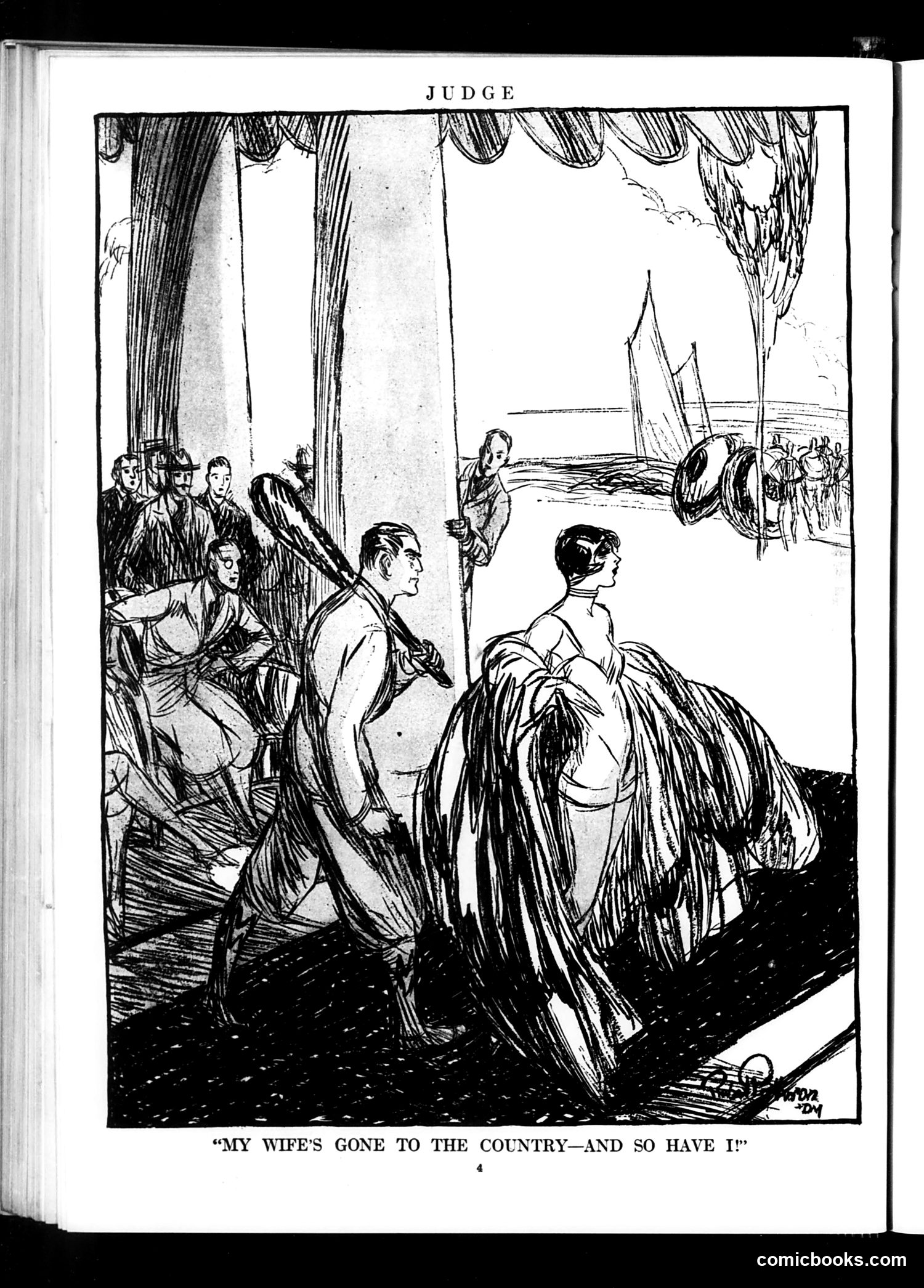
This cartoon satirizes the upper-class summer exodus, a common theme in early 20th-century American humor. The caption suggests a husband claiming he's also left the city, yet the image reveals him enjoying himself at what appears to be a seaside resort or beach pavilion—surrounded by women in fashionable dress. The satire targets marital hypocrisy: the husband either fibbed to his wife about his whereabouts, or he's pursuing leisure activities (potentially flirtation or romance) away from her watchful eye. The well-dressed crowd, elegant striped tent, and distant sailboats indicate this is an upscale vacation destination, poking fun at how wealthy Americans maintained dual social lives during summer season.
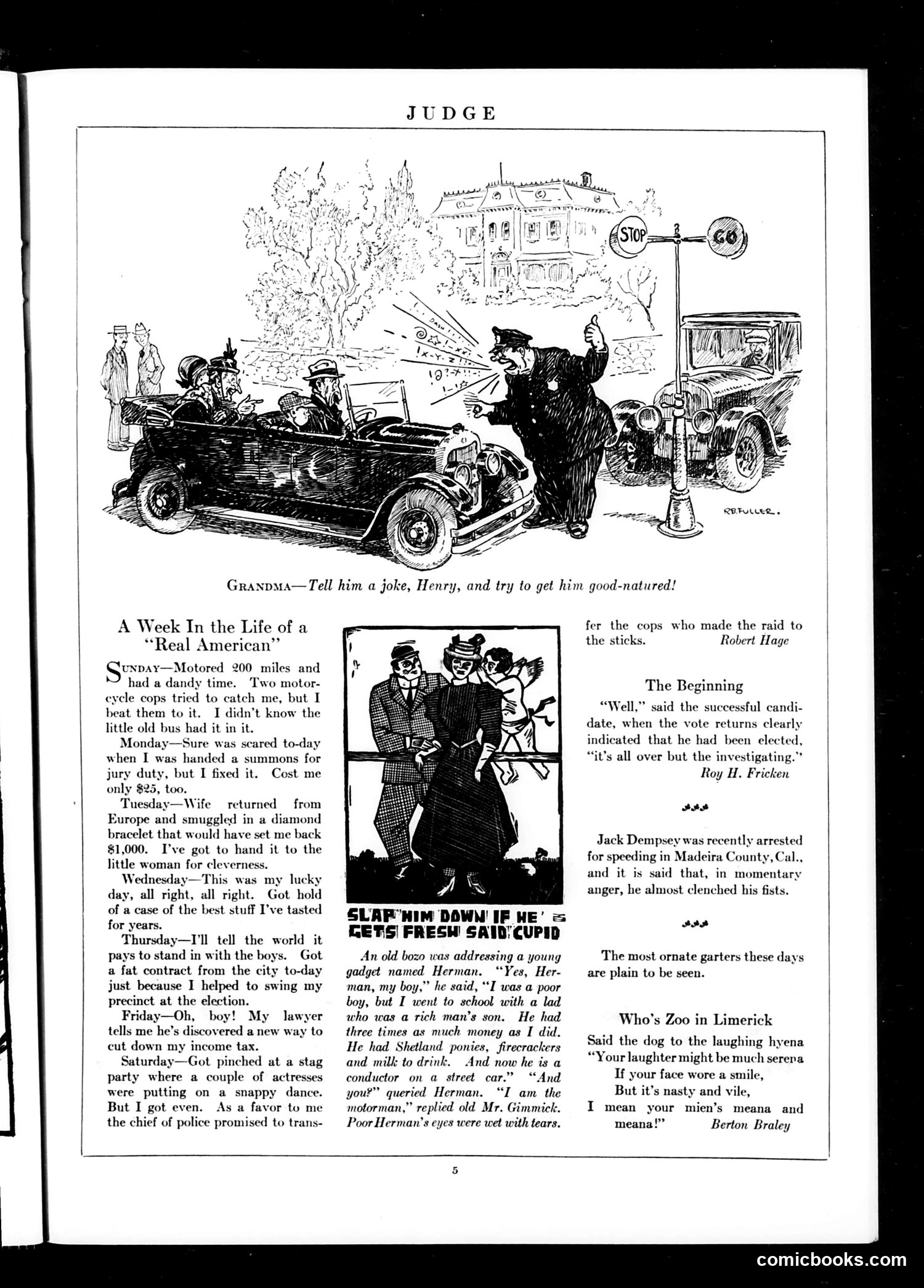
**Main Cartoon (Top):** The cartoon depicts a police officer stopping a car at a traffic stop sign on Route 66. A stern-looking official gestures while the car's occupants appear defensive. The humor satirizes overzealous traffic enforcement—the officer seems to be treating a routine traffic violation with excessive seriousness, as if it were a major crime. This reflects 1920s-era concerns about expanding police authority and the absurdity of strict traffic regulation enforcement. **Text Content:** "A Week in the Life of a 'Real American'" humorously chronicles everyday legal troubles—speeding fines, tax issues, stag parties, and police raids. The piece mocks how ordinary citizens constantly encounter law enforcement and legal complications through mundane activities, satirizing the increasing bureaucratic entanglement of American life during this era.
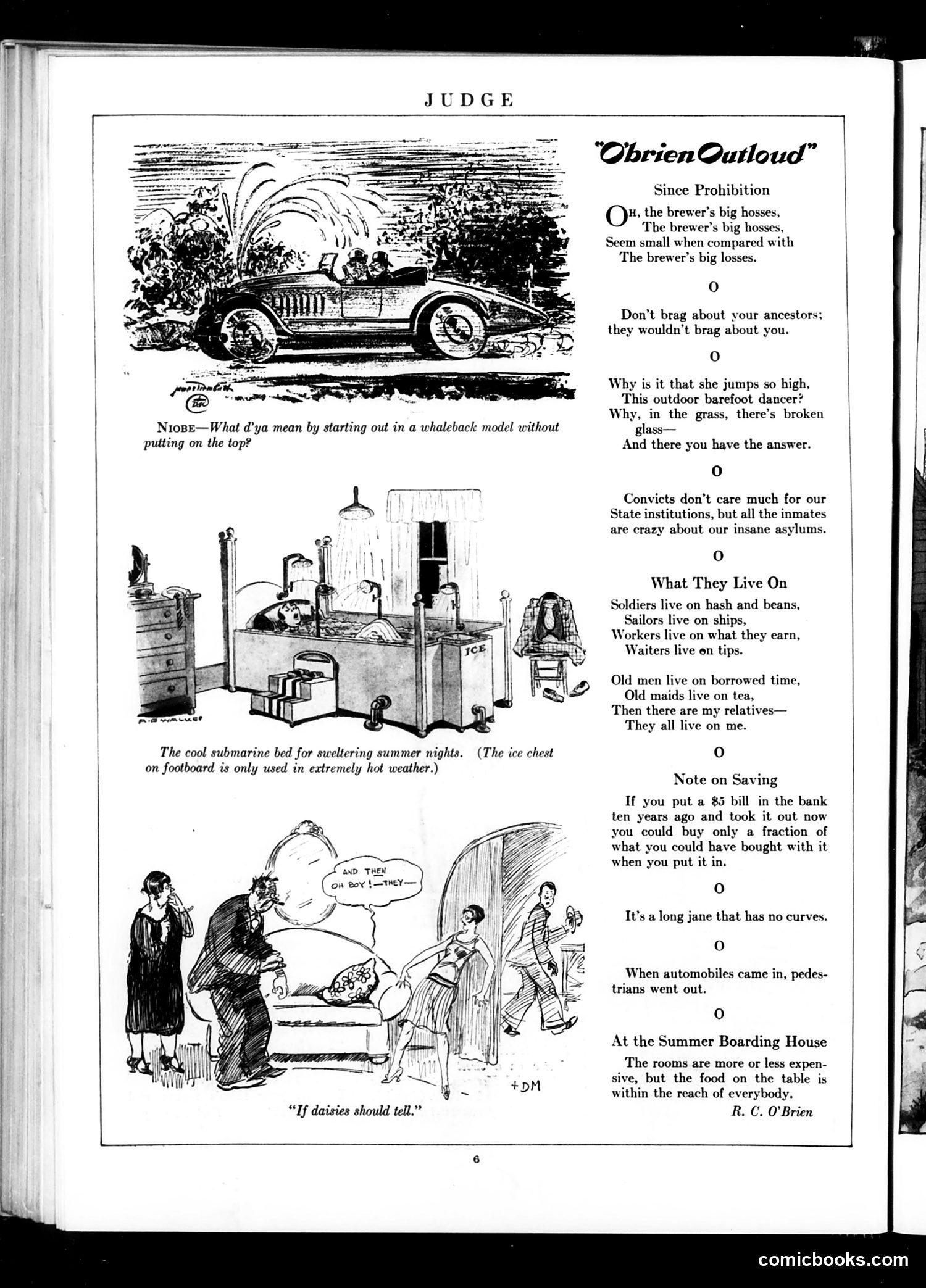
This page from *Judge* contains satirical commentary on 1920s American life, primarily post-Prohibition. **Main Content:** The "O'Brien Outloud" column by R.C. O'Brien offers humorous observations on contemporary issues. Key targets include: - **Prohibition's economic impact**: Breweries suffered massive losses after alcohol was banned (1920) - **Social commentary**: Jokes about class, family obligations, inflation, and changing urban life - **Automobiles**: References the recent car boom replacing pedestrian culture - **Inflation/savings**: Notes how $5 has lost purchasing power over a decade—early commentary on economic decline **Cartoons:** Three illustrated jokes accompany the text, including one showing people discussing summer cooling methods and another about two figures (caption: "If daisies should tell"), likely a mild romantic or domestic humor piece. The overall tone is sardonic observation of post-WWI American culture, economic anxiety, and social change—typical of *Judge*'s satirical approach to contemporary life.
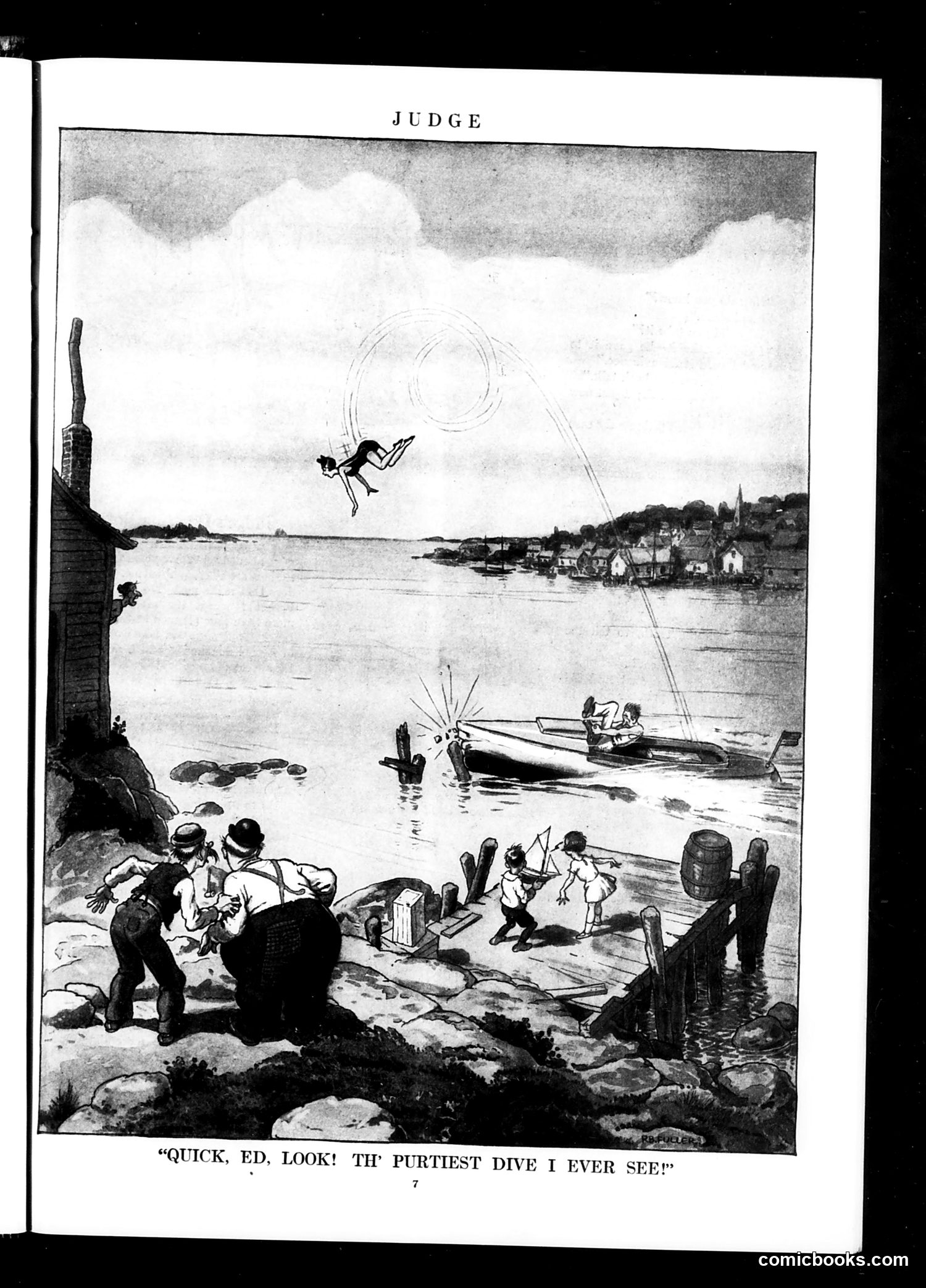
This is a humorous cartoon from *Judge* magazine depicting a beach or waterfront scene. Two working-class men in the foreground watch a person executing an elaborate diving maneuver from a rope into the water, while boats and a coastal village appear in the background. The joke hinges on the word "dive"—the speakers mistake an acrobatic dive for a "dive" in the slang sense: a disreputable bar or establishment. Their rural or unsophisticated dialect ("th' purtiest") and their misinterpretation creates the humor. The cartoon satirizes class differences and the gap between working-class vernacular and refined behavior, a common *Judge* theme of the era.
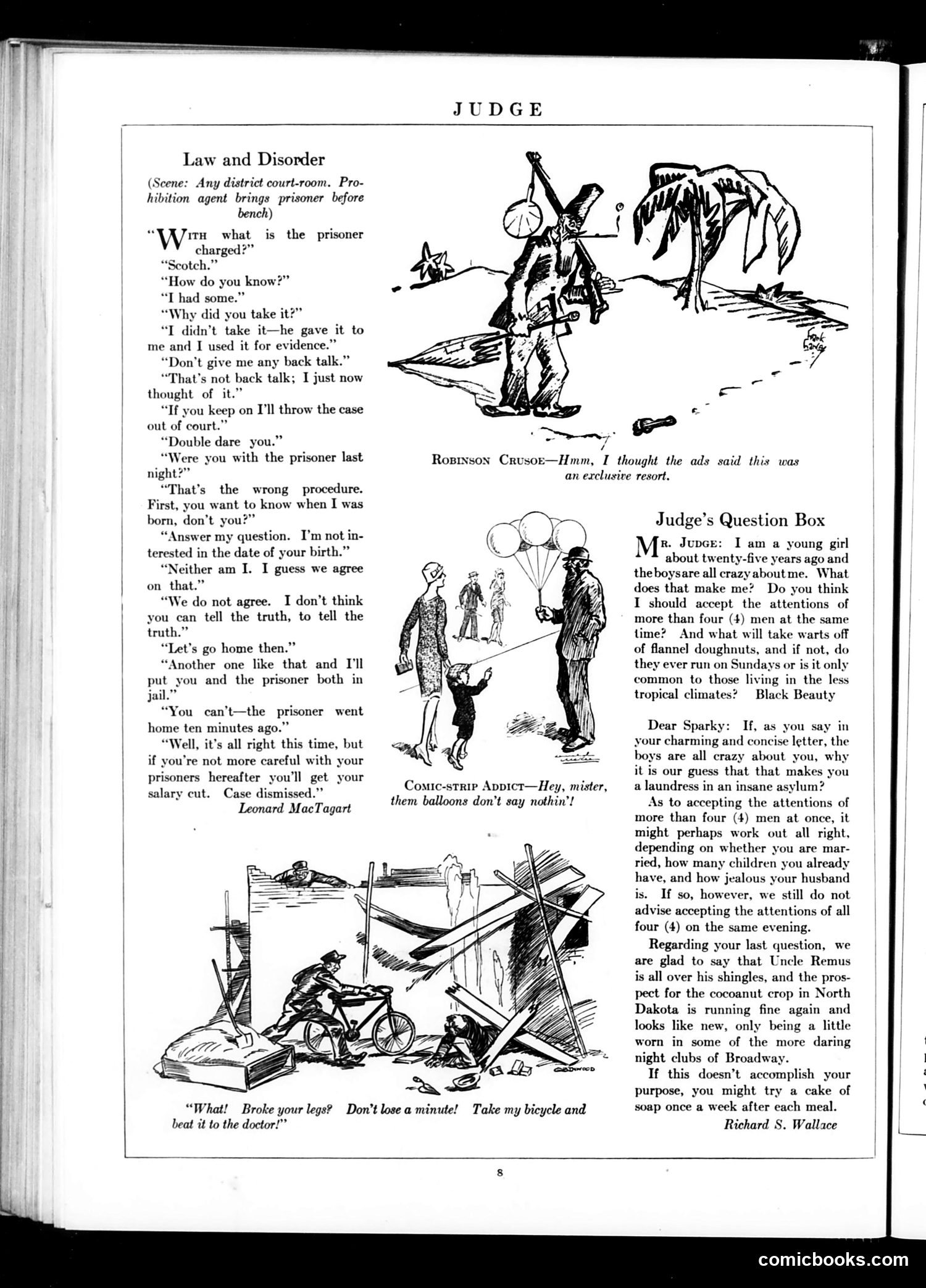
This page satirizes Prohibition-era law enforcement through a comedic courtroom sketch. A prohibition agent brings a prisoner before a judge, charged with possessing "Scotch" whiskey. The humor hinges on the witness's absurd logic: he claims he didn't steal the liquor but received it and used it as "evidence"—a transparent dodge mocking how Prohibition agents and courts operated. The judge's increasingly frustrated exchanges—threatening to dismiss the case, jail both parties, cut salaries—parody the chaos and incompetence of Prohibition enforcement. The punchline: the prisoner has already left the courthouse, rendering the entire proceeding pointless. The accompanying cartoons mock other social absurdities: Robinson Crusoe's vacation resort, comic-strip dialogue balloons, and bicycle accidents. The "Judge's Question Box" offers deliberately nonsensical advice, further ridiculing the era's social pretensions and bureaucratic confusion during Prohibition's enforcement period.
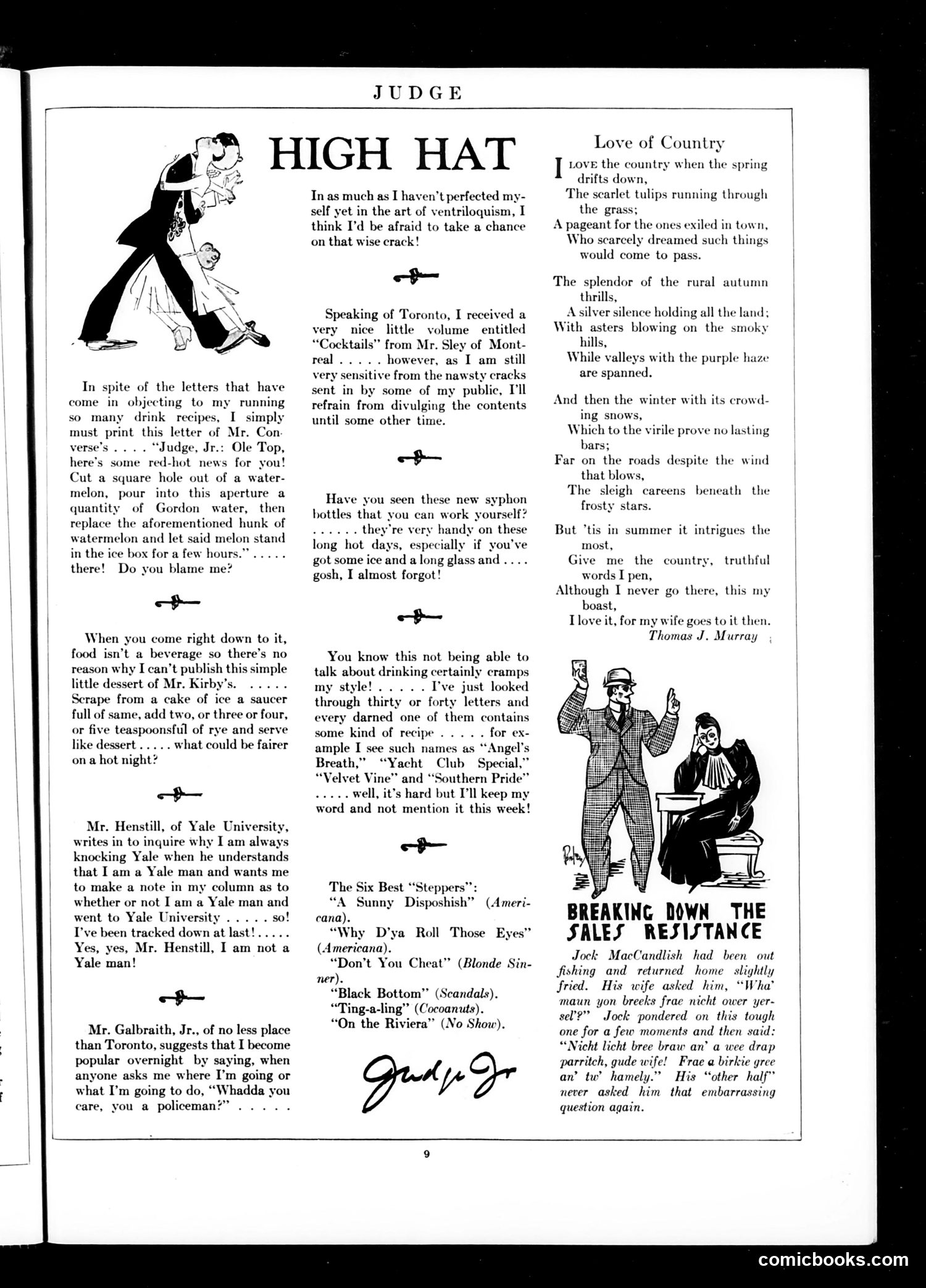
This page from *Judge* (a satirical magazine) features the columnist's humorous musings on various topics, primarily alcohol and social etiquette during Prohibition-era America. **Main Content:** The "High Hat" column satirizes readers' complaints about the author publishing cocktail recipes. The joke relies on Prohibition irony—the author facetiously claims he *must* publish drink recipes disguised as food (watermelon desserts, ice scraped from cakes with rye whiskey), circumventing censorship while flouting the law's spirit. **Social References:** - The author responds to a Yale University reader questioning his school loyalty (suggesting elite university tribalism) - A Toronto reader suggests adopting street slang ("Whadda you care, you a policeman?") to seem relatable—the author humorously admits he lacks ventriloquism skills to carry this off **Satire:** The fundamental joke mocks Prohibition enforcement: Americans openly discuss cocktails by code-names like "Angel's Breath" and "Southern Pride," while pretending compliance. The column pokes fun at both the law's ineffectiveness and public hypocrisy. The secondary poem celebrates rural life while admitting the author never visits—a gentle parody of romantic sentimentality.
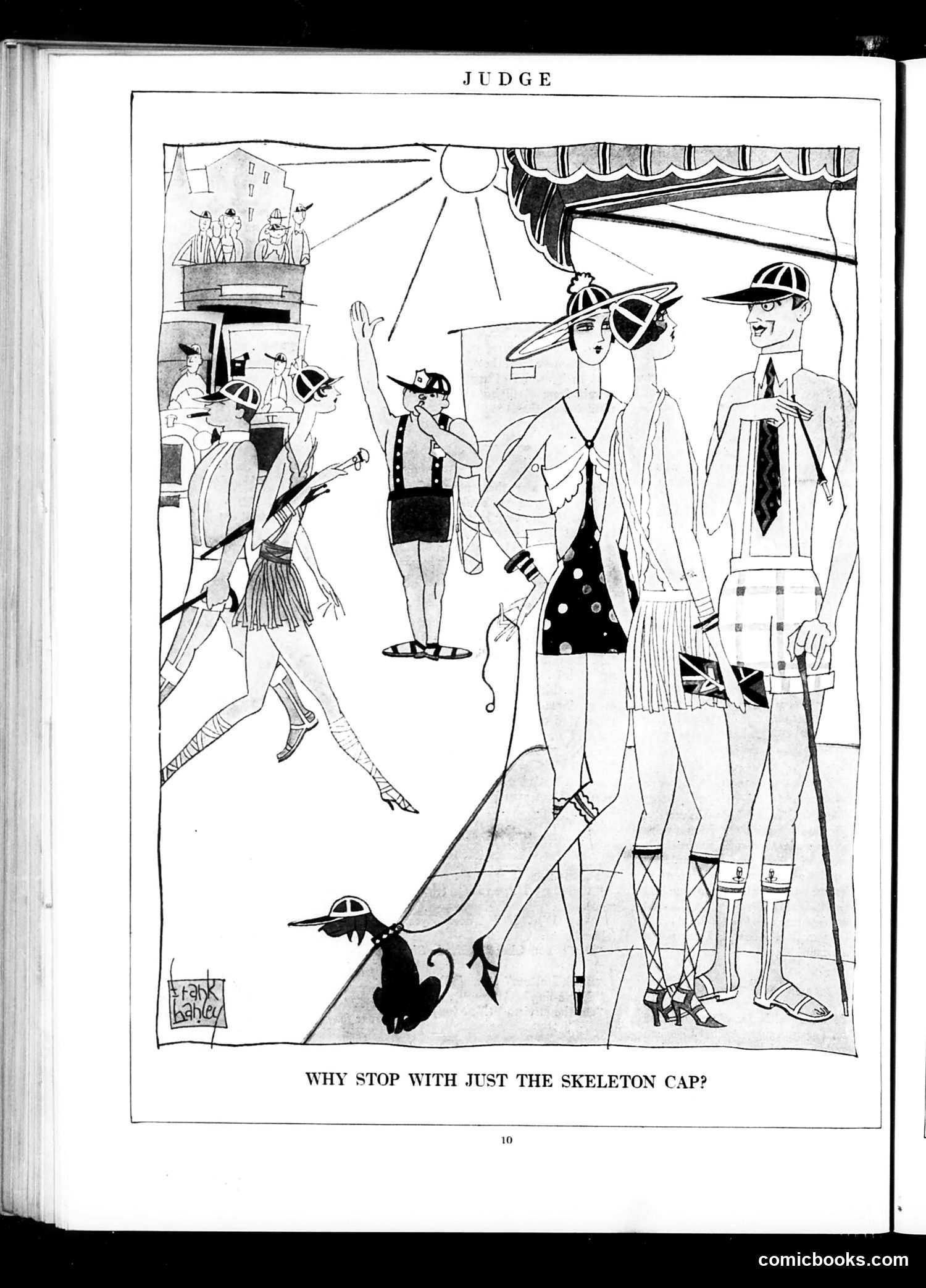
This is a satirical cartoon from *Judge* magazine depicting a beach or seaside scene. The caption "Why Stop with Just the Skeleton Cap?" appears to be making fun of fashion trends, specifically skeleton or skull-themed accessories that were apparently popular at the time. The cartoon shows fashionable people at what appears to be a beach resort (note the tower/observation deck on the left and the awning above). The joke seems to suggest that if skeleton imagery is fashionable enough to wear as a cap, why not extend the theme to other clothing or accessories—mocking the excess of following trendy but morbid aesthetic choices. The style and imagery suggest this is from the 1920s-1930s era. The specific fashion reference and cultural context of the "skeleton cap" trend is unclear without additional historical documentation, but the satire targets frivolous or extreme fashion adoption among the leisure class.
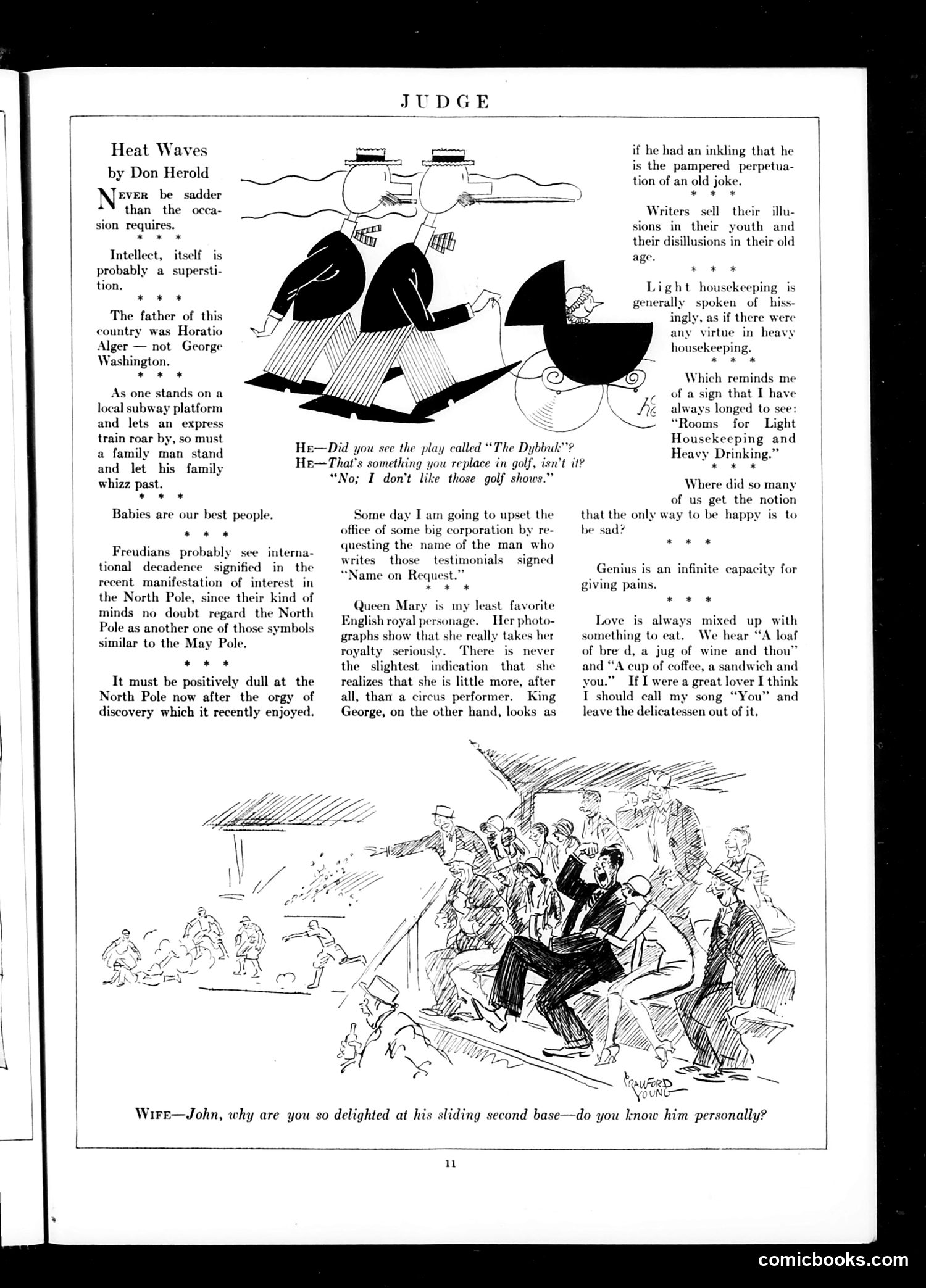
This page features **Don Herold's satirical column** of brief, cynical observations on American life, paired with two cartoons. The top cartoon depicts a couple in a car suffering through extreme heat, humorously illustrating the titular "heat waves." The column's aphorisms mock contemporary American values: Horatio Alger (the rags-to-riches myth) replacing George Washington as the national ideal; the replacement of parental attention with material comfort; and Queen Mary's overly serious royalty versus King George's apparent awareness he's part of an "old joke." The bottom cartoon shows a baseball game with a wife questioning her husband's enthusiasm for a player—likely satirizing how Americans bond over sports despite barely knowing the athletes involved. Throughout, Herold presents cynical but accessible humor: critiques of advertising testimonials, observations about love and food, and jabs at both British royalty and American social pretensions. The tone is **mildly nihilistic**—typical Judge magazine fare mocking modern life's absurdities.
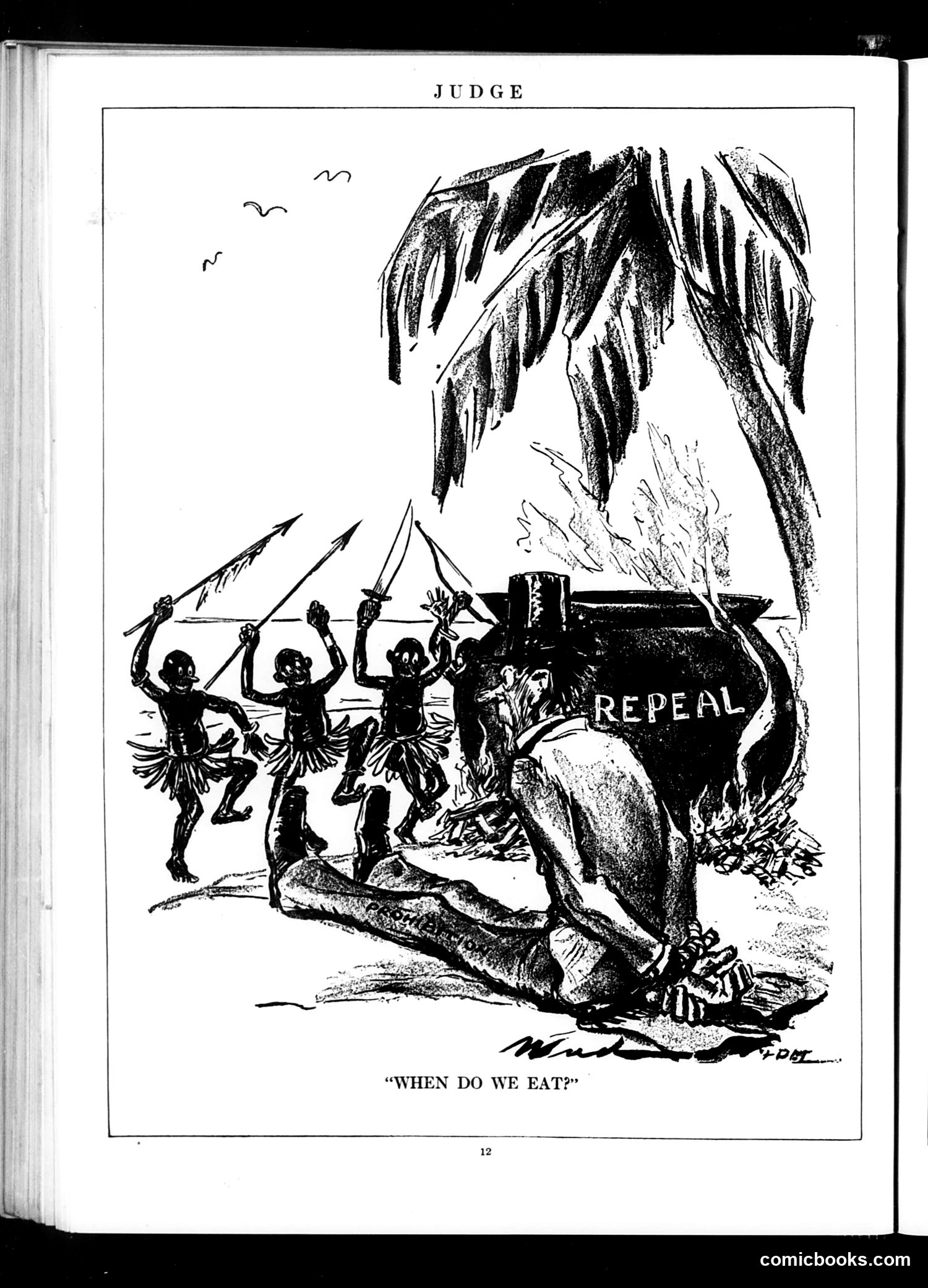
This political cartoon depicts indigenous people dancing around a large cauldron labeled "REPEAL," with a dead body in the foreground. The title "When Do We Eat?" makes the grim implication explicit. The cartoon satirizes opposition to Prohibition repeal. Those advocating to repeal the Eighteenth Amendment (Prohibition) are depicted as "savages" through racist caricature—a common rhetorical strategy of the era. The dying figure represents Prohibition itself. The satire works on two levels: it mocks repeal advocates as primitive/uncivilized, while simultaneously suggesting their eagerness to "consume" alcohol again (literally and figuratively) makes them cannibalistic or barbaric. This reflects Judge magazine's apparent anti-repeal stance using deeply offensive racial imagery typical of 1930s American political discourse.
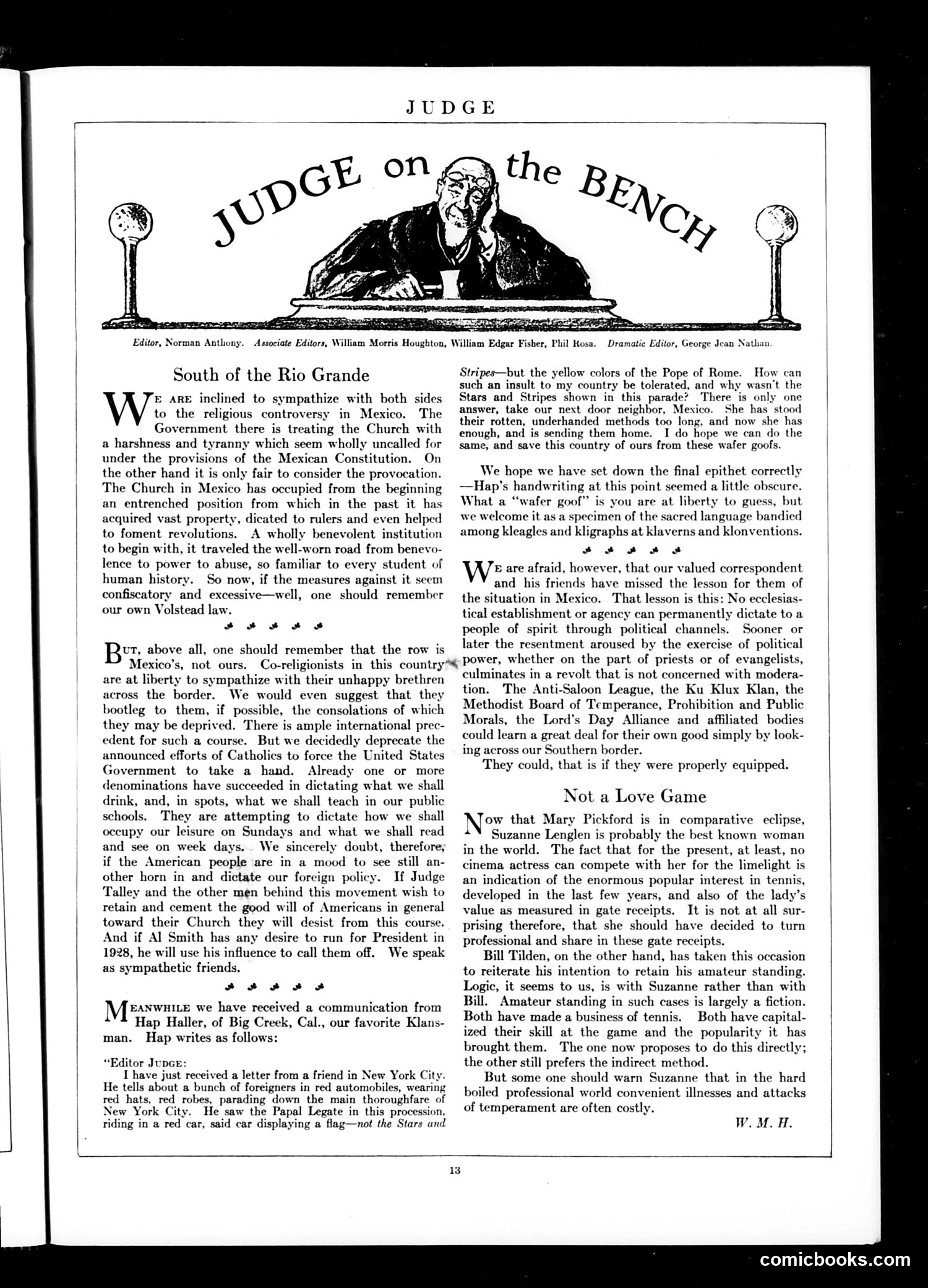
This page from Judge magazine (editor Norman Anthony) contains editorial commentary on two topics: **"South of the Rio Grande"**: The editors discuss Mexico's religious conflict—acknowledging the Catholic Church's historical abuses of power while sympathizing with American Catholics concerned about persecution. However, they warn against American Catholic pressure groups (notably Al Smith, a prominent Catholic politician) attempting to influence U.S. foreign policy. They compare this to Prohibition's moral dictation. **"Not a Love Game"**: Brief commentary on actresses Mary Pickford and Suzanne Lenglen losing prominence to each other and to professional athletes. **The "Hap Haller" Section**: A satirical letter from a fictional KKK member ("Klansman") complaining about a Papal Legate's parade in New York with red papal flags instead of American flags. Judge ridicules the writer's anti-Catholic, nativist sentiment while using the Mexican Church persecution as a cautionary tale against religious institutional overreach—implying the KKK's xenophobic response mirrors Mexico's heavy-handed tactics.
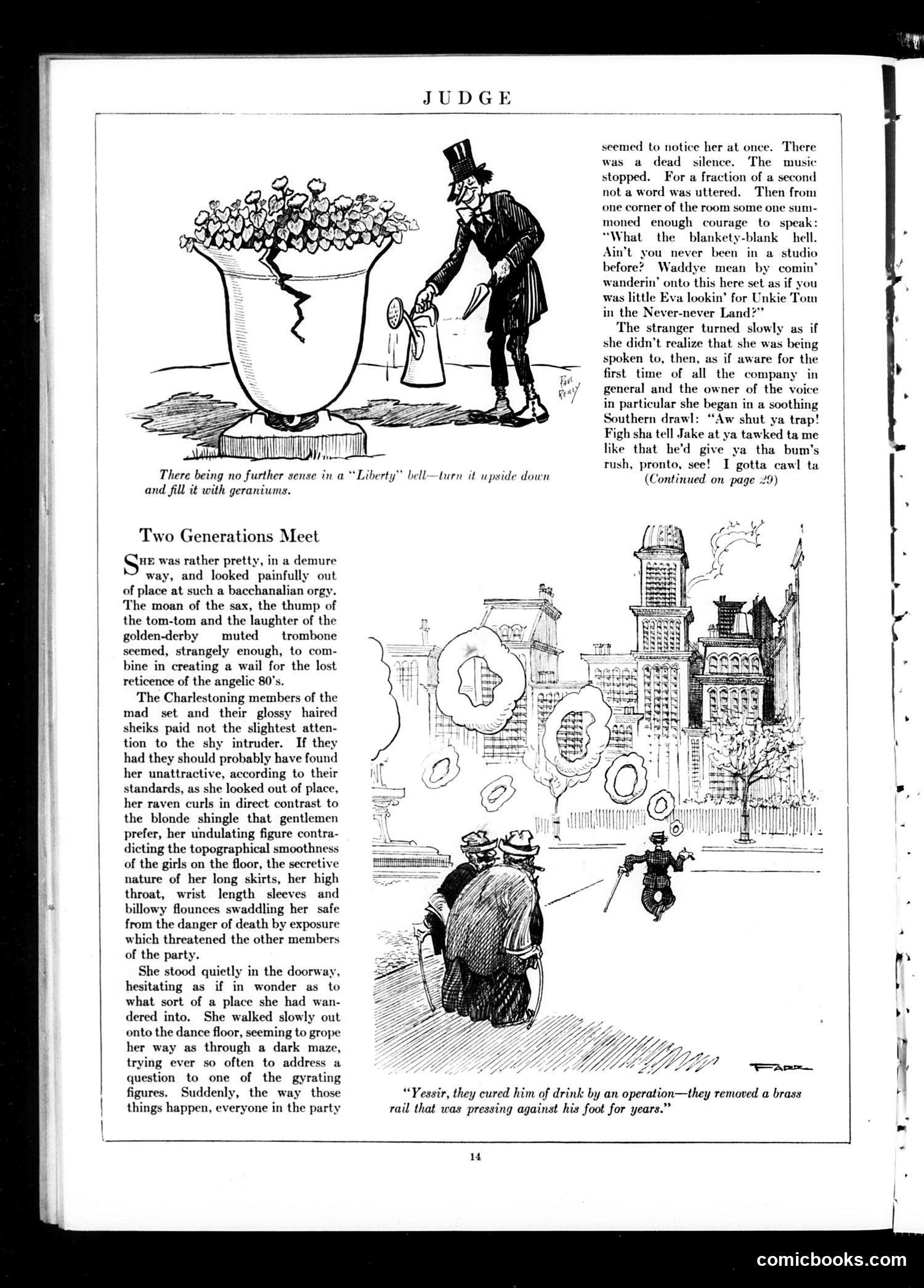
This page satirizes the generational divide of the 1920s through the story "Two Generations Meet." A conservatively dressed young woman from an earlier era (the "angelic 80's") accidentally wanders into a modern jazz-age party—a "bacchanalian orgy" of Charlestoning, drinking, and loose morality. The satire contrasts her modest appearance (long skirts, high collar, billowy sleeves) with the fashionable "golden-derby" crowd's revealing "shingle" hairstyles and modern dancing. When she speaks in a genteel manner, a crude partygoer responds aggressively in slang, then she retaliates with Southern dialect threats about "Jake," implying connections to unsavory characters. The top cartoon mocks the impracticality of the "Liberty" bell as a flower pot—a visual pun on liberty itself becoming decorative rather than meaningful. The bottom cartoon jokes about surgical "cures" for drinking through absurdist logic. The page captures Judge's critique of 1920s youth culture as crude, immoral, and in conflict with Victorian propriety.
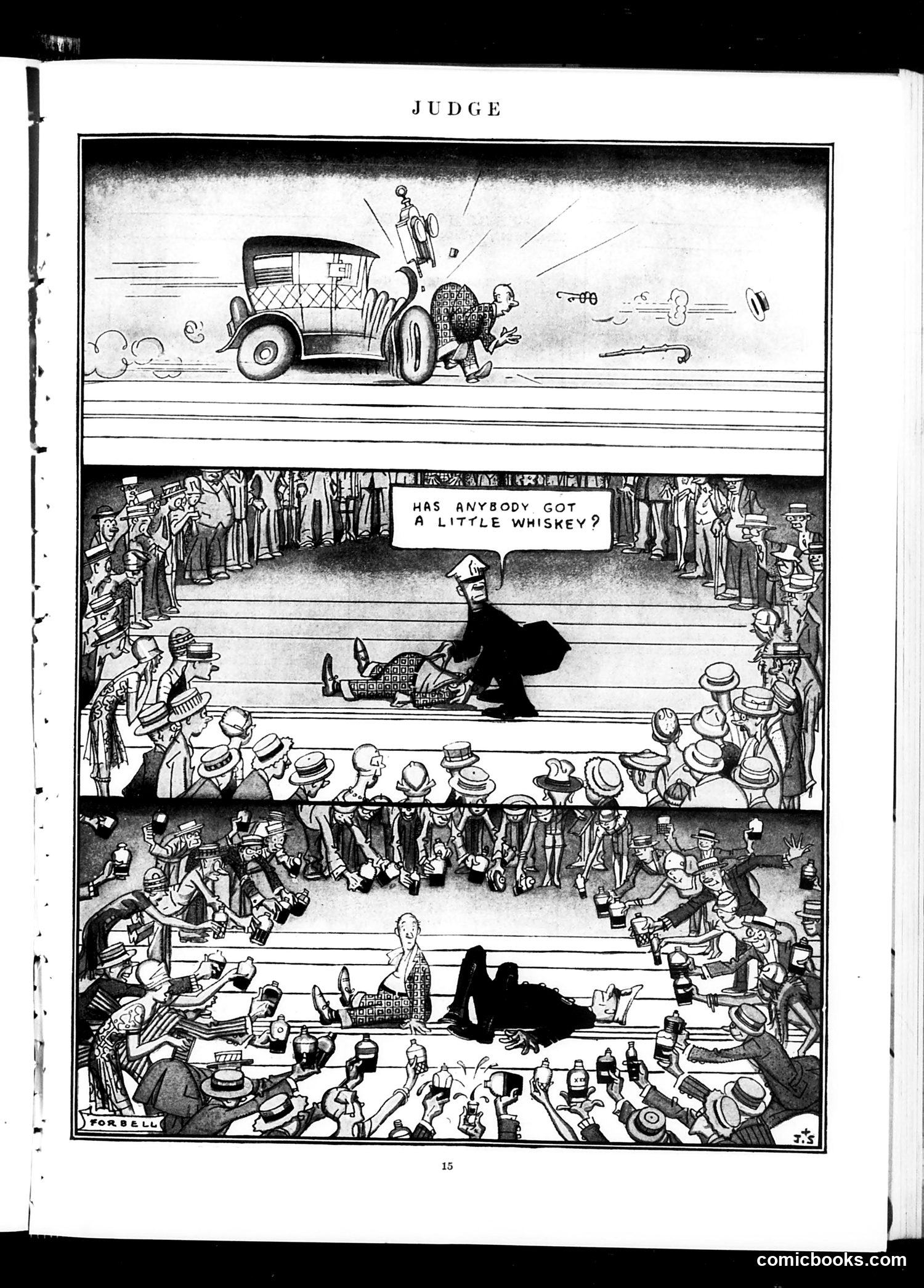
This page contains two cartoons satirizing Prohibition-era America. The top panel shows a car accident scene with chaotic debris flying, likely mocking reckless driving during the 1920s. The bottom panel depicts a courtroom scene where a judge lies on the floor asking "Has anybody got a little whiskey?" This is the satire's core joke: it mocks judicial hypocrisy during Prohibition (1920-1933). While ordinary citizens faced arrest for alcohol possession, the cartoon suggests judges themselves violated the laws they enforced, seeking whiskey even in their own courtrooms. The crowded gallery of observers emphasizes the public nature of this hypocrisy. The cartoon critiques the widespread disregard for Prohibition among authority figures and the era's widespread bootlegging culture.
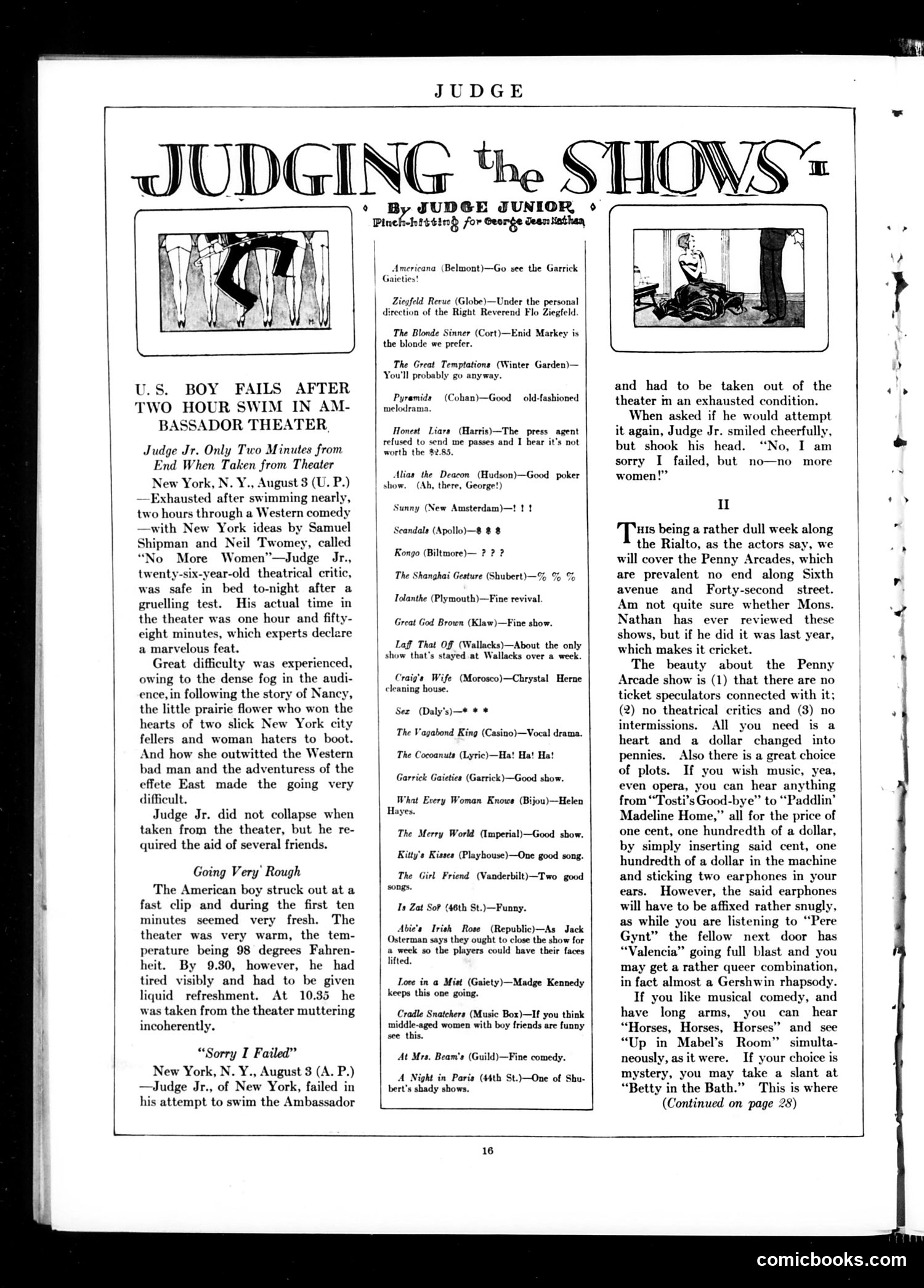
This page contains theater reviews by "Judge Junior" for various Broadway shows, presented as satirical commentary on New York theater circa August 1926. The main story describes Judge Jr.'s stunt: swimming nearly two hours through a Western comedy ("No More Women") at the Ambassador Theater as an endurance test. He became exhausted and had to be removed, reportedly saying he wouldn't attempt it again—a humorous jab at both the show's length and theatrical tedium. The bulk of the page lists brief, witty reviews of contemporary Broadway productions (Ziegfeld Follies, The Great Temptations, etc.), employing Judge magazine's signature irreverent tone. The secondary article jokes about the "Penny Arcades" along 42nd Street as an alternative to legitimate theater—no critics, no speculators, just a nickel and earphones for entertainment. The satire targets both theatergoers' endurance and the era's theatrical establishment.
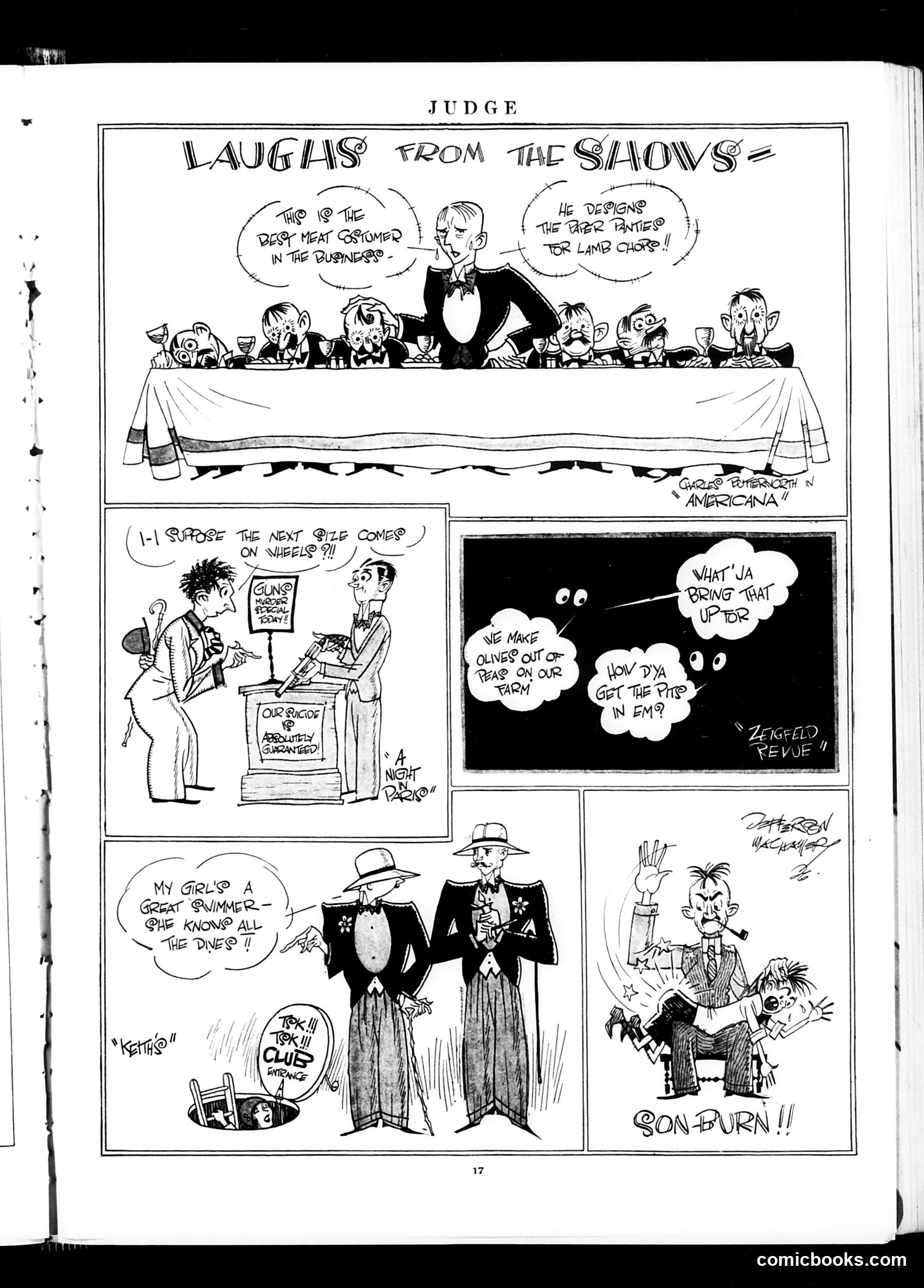
This page collects four separate editorial cartoons satirizing early 20th-century American business and social practices. The top panel mocks meatpacking industry practices, with a formal dinner where a businessman boasts about selling "the best meat customer in the business" and designing "fancier pants for lamb chops"—likely criticizing deceptive marketing of questionable meat products. The second cartoon appears to reference a boxing/sporting business with poor financial returns ("absolutely bankrupted"). The third depicts two figures discussing a girl who "knows all the dives"—likely satirizing loose morality or questionable entertainment venues. The final panel titled "Con Burn!" shows apparent violent chaos, though its specific reference is unclear from the visible text. The overall theme appears to be exposing fraud, deception, and corruption in American commerce and entertainment. The cartoonist(s) names are partially visible but difficult to read with certainty.
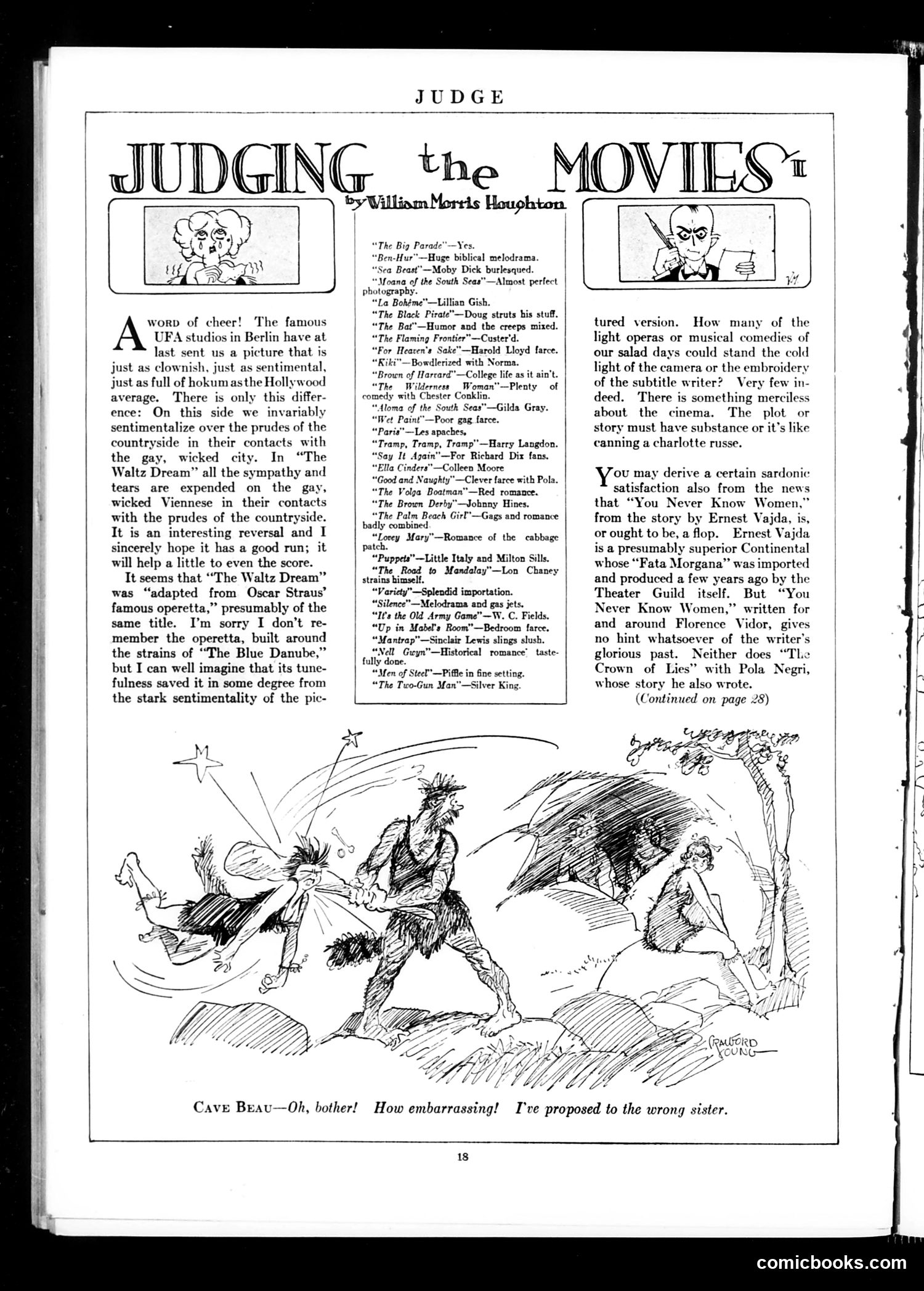
This page reviews contemporary films (likely from the mid-1920s based on titles like "The Big Parade" and "Ben-Hur"). The main text compares German UFA studio productions to Hollywood output, noting both are equally sentimental and hokum-filled—the difference being *whose* sentiments are centered. German films romanticize poor country folk encountering wicked city folk; American films reverse this. The cartoon illustrates "Cave Beau," a slapstick scenario where a man has proposed to the wrong sister—a common silent-film trope playing on confusion and embarrassment. The humor derives from the physical comedy of mistaken identity. The film reviews in the boxed list are brief judgments (some positive, some dismissive) of current releases, with particular criticism that earnest writer Ernest Vajda's "You Never Know Women" fails to reflect his earlier reputation, suggesting cinema exposes weak material.
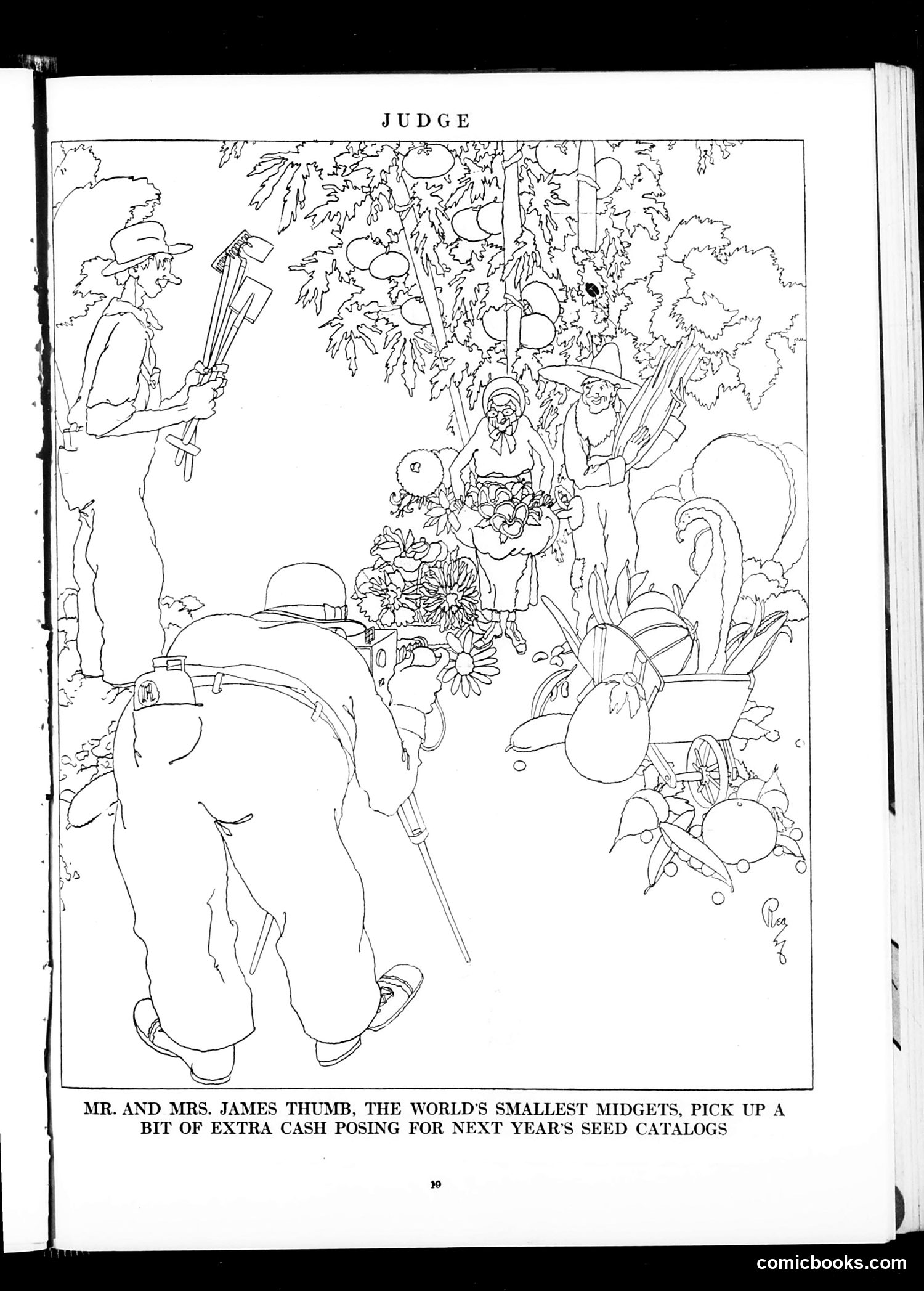
This is a satirical cartoon from *Judge* magazine titled "Judge." The illustration depicts Mr. and Mrs. James Thumb, identified as "the world's smallest midgets," posing among oversized vegetables and plants in a garden setting. The satire mocks the couple's attempt to earn "extra cash" by appearing in seed catalog photographs. The joke relies on visual contrast: tiny human figures positioned among gargantuan produce create the illusion that the vegetables are normal-sized, thereby appearing larger and more impressive to catalog customers. The humor targets both the commercial exploitation of people with dwarfism and the deceptive advertising practices of seed companies, which used such tricks to exaggerate crop yields. It's a commentary on how businesses manipulate imagery for profit, using human performers in undignified ways.
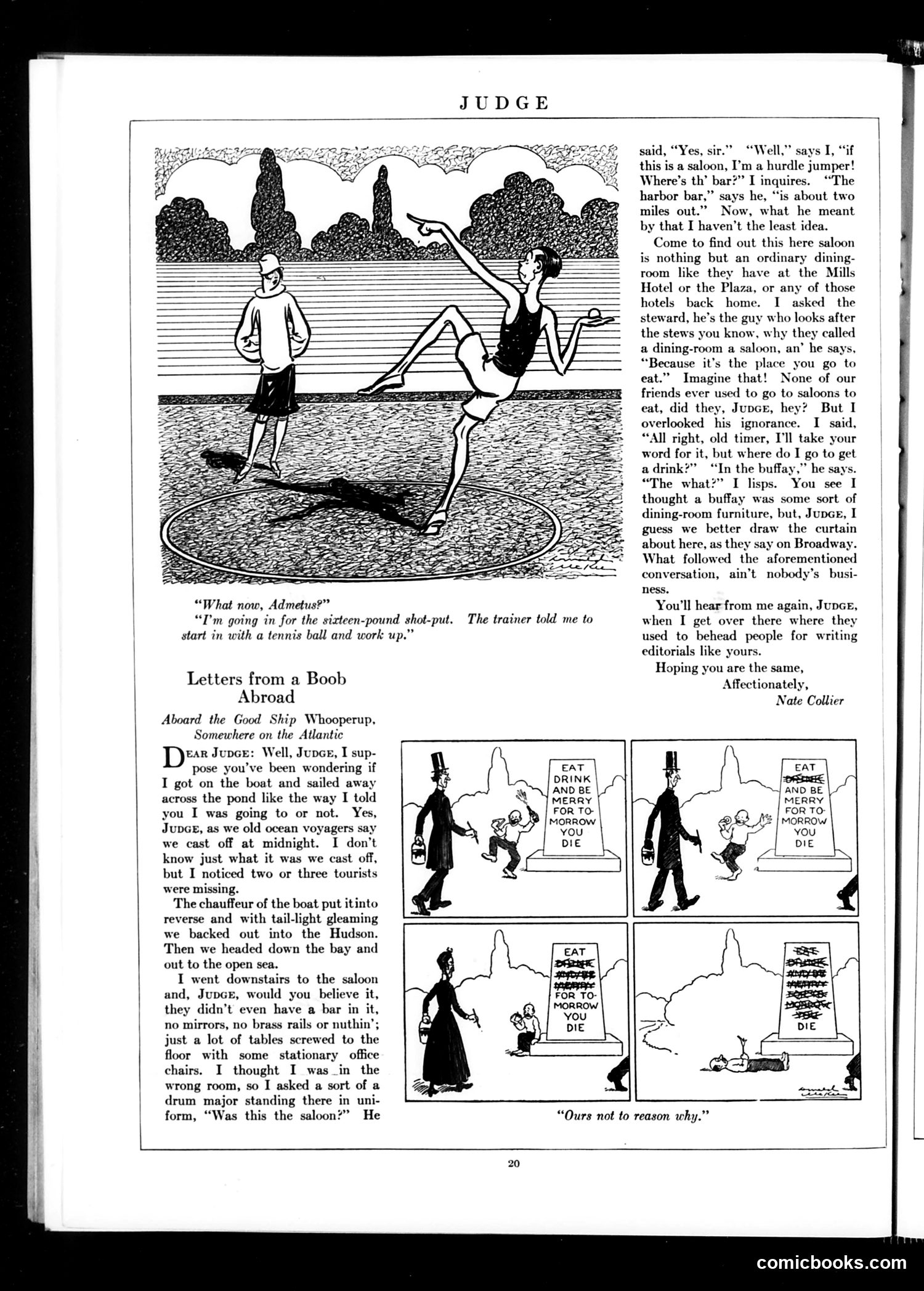
This page contains two satirical pieces from *Judge* magazine: **"Letters from a Boob Abroad"** is a humorous letter from a naïve traveler aboard a ship (the "Good Ship Whooperup"). The joke centers on the writer's confusion about maritime terminology and shipboard amenities. He mistakes the ship's dining room for a "saloon" (expecting a bar), misunderstands "harbor bar" as a drinking establishment, and confuses "buffet" with furniture. The satire targets unsophisticated American travelers abroad and their comical misunderstandings of unfamiliar terms and customs. The accompanying cartoon shows a man in formal dress demonstrating exercise routines with absurd logic—training with a tennis ball to prepare for shot-put competition—mocking impractical preparation methods. The signature "Nate Collier" appears to be the author. The overall tone satirizes both provincial American attitudes and the pretensions of leisure travel during what appears to be the early 20th century.
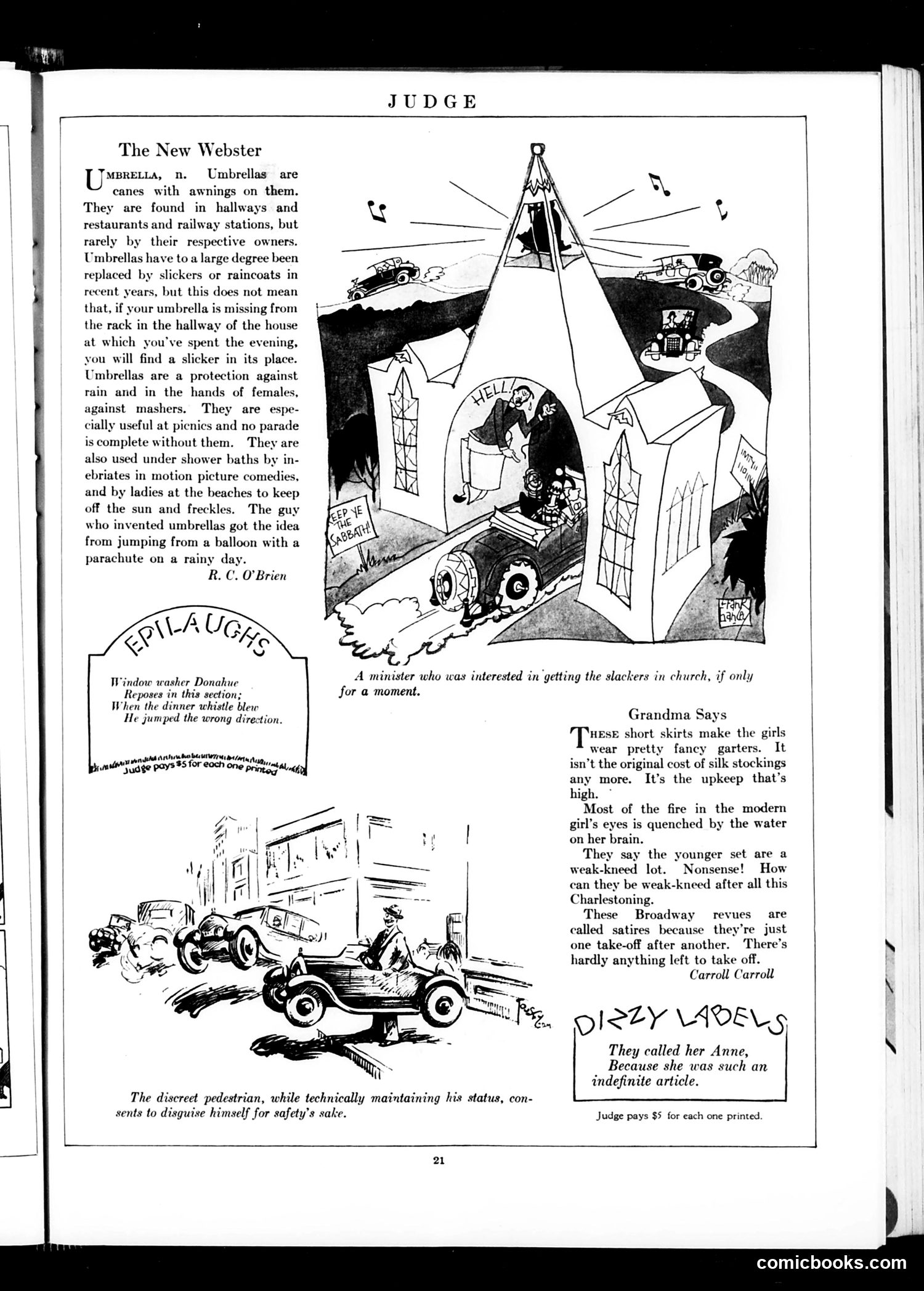
This page from Judge contains several satirical pieces typical of 1920s American humor: **"The New Webster"** is a humorous dictionary entry defining "umbrella" — the joke being that umbrellas mysteriously disappear from homes despite being found everywhere else. It's a relatable observation about everyday theft/borrowing. **The cartoons** depict: 1. A "minister interested in getting slackers in church" — likely referencing post-WWI social concerns about civic duty and church attendance 2. A worker mishearing a factory whistle, jumping the wrong direction — slapstick humor about industrial workplace confusion 3. A "discreet pedestrian" disguising himself for safety — appears to reference concerns about public safety or perhaps Prohibition-era vigilance **"Grandma Says"** offers elderly commentary on modern trends: short skirts, the "Charleston" dance craze, and flapper culture — generational humor mocking youth fashions and behavior. **"Dizzy Labels"** is a one-liner wordplay joke about someone named Anne being "an indefinite article." The page reflects 1920s concerns: post-war adjustment, Prohibition, changing social mores, and generational tensions between traditional and modern values.
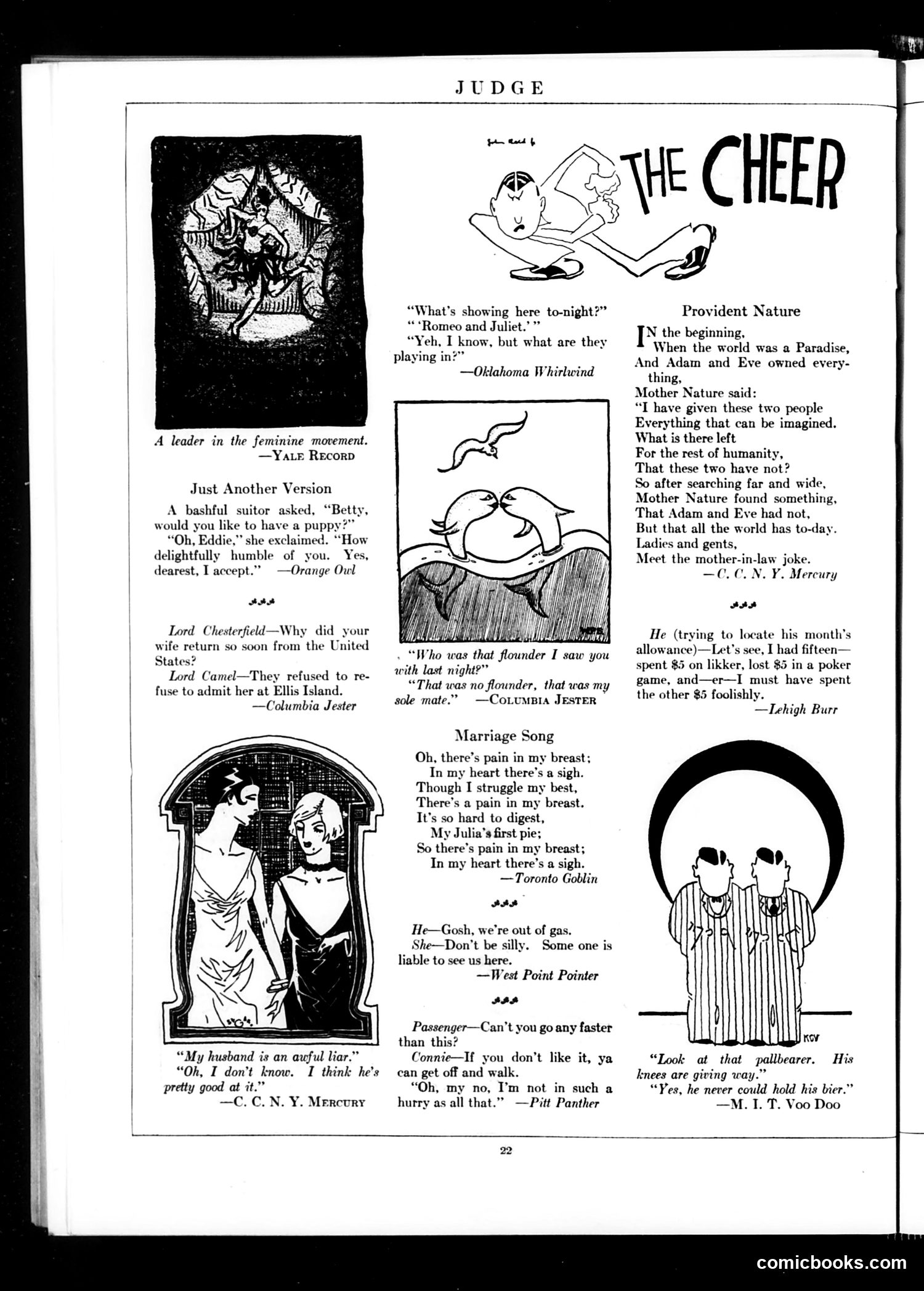
This is a humor compilation page from *Judge* magazine featuring jokes and satirical commentary on early 20th-century social themes. **Key Content:** The page opens with references to the "feminine movement" (women's suffrage/rights era). Several jokes mock gender dynamics: a woman's humble acceptance of a marriage proposal, wives refusing Ellis Island entry, and husbands as liars. **Main Satire:** "Provident Nature" is the centerpiece—a poem explaining that Mother Nature gave Adam and Eve everything except one thing: the **mother-in-law joke**. This is satirical commentary on how pervasive and universal mother-in-law jokes had become in American culture, treating them as humanity's sole remaining misfortune after paradise. **Other Jokes:** Most remaining content targets newlyweds and marriage: indigestion from a wife's terrible cooking, running out of gas on dates, and puns about pallbearers "holding their bier" (beer/bearing grief). The overall tone reflects Jazz Age anxieties about changing gender roles, modern courtship, and matrimonial discord—presented through ribald college humor from various university publications.
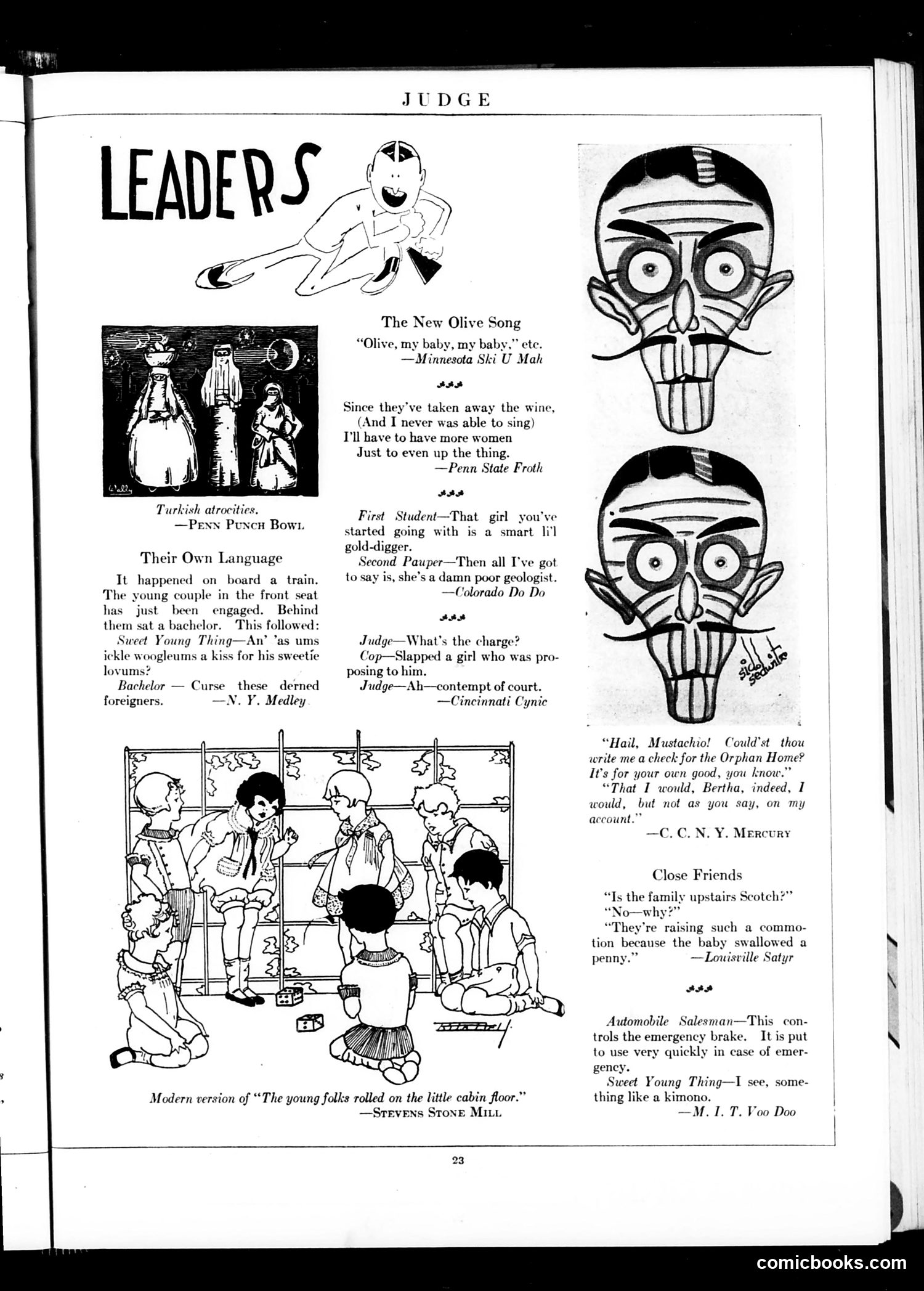
This page from *Judge* (a satirical weekly) collects brief humorous observations and jokes typical of early 20th-century American humor. **Key Content:** The "Turkish atrocities" reference likely alludes to Ottoman massacres (common scandal topics in American press circa 1900s-1920s). The cartoon shows figures in traditional dress. Most items are short comedic sketches: a couple using baby-talk that annoys a nearby bachelor; a Prohibition-era song (wine taken away, so pursue women instead); college student jokes about gold-diggers and geology; a judge's pun on "contempt of court." **Social Context:** The humor reflects period attitudes—casual mockery of foreign cultures, gender stereotypes (women as mercenary), Prohibition's impact, and class assumptions. The "emergency brake/kimono" joke assumes readers find non-Western objects absurdly unfamiliar. **The Point:** This is light satirical entertainment targeting educated, middle-class American readers—witty wordplay and social observation rather than pointed political critique.
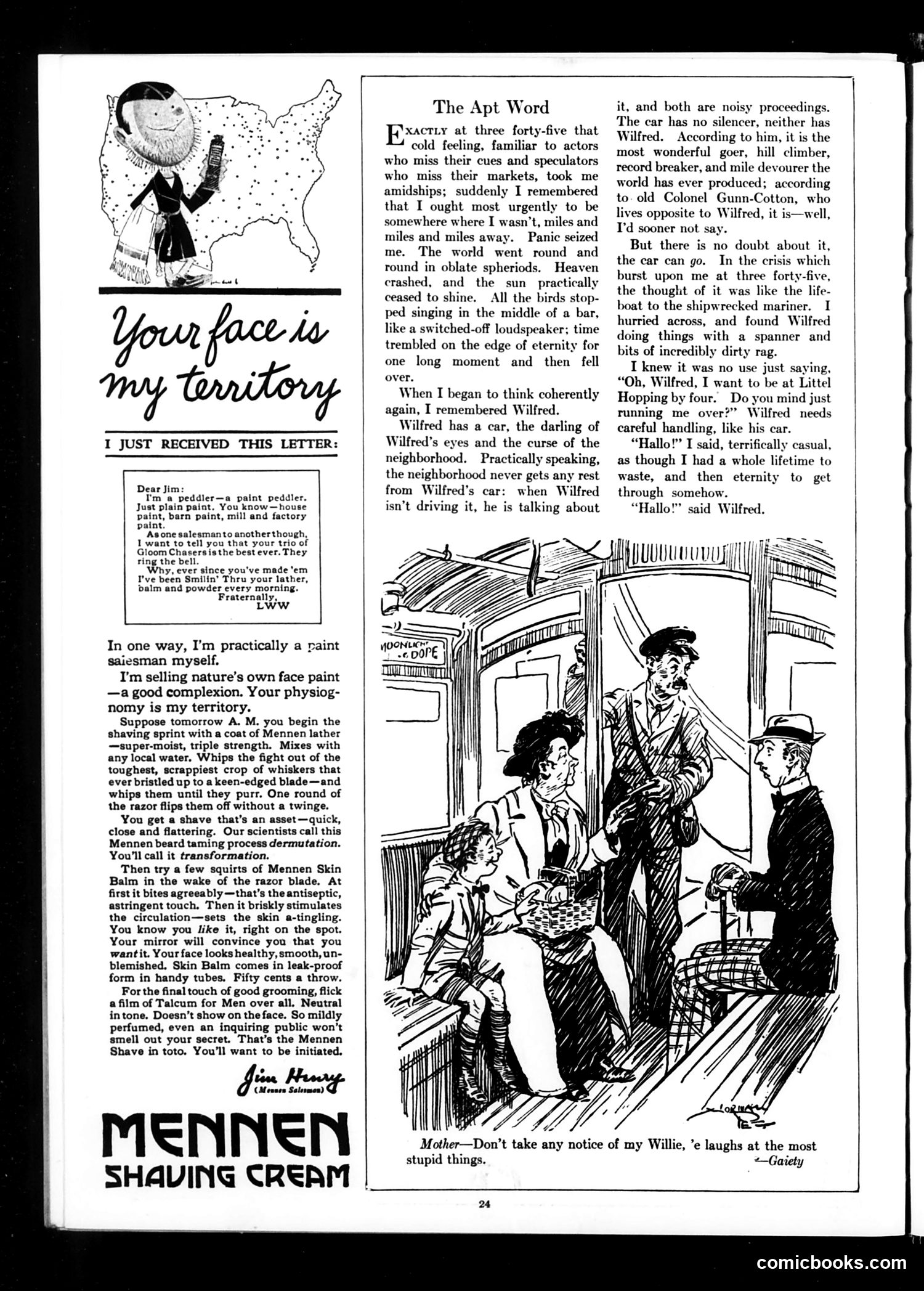
This Judge magazine page contains two distinct elements: **Left side:** A Mennen Shaving Cream advertisement disguised as editorial content—a letter from a satisfied "paint peddler" customer praising the product's "Gloom Chasers" trio (lather, balm, powder). The copywriter uses sales language heavy with period slang ("rings the bell," "Smilin' Thru") to promote grooming as masculine self-improvement. **Right side:** "The Apt Word," a short humorous story about a man seized by inexplicable panic at 3:45 PM who impulsively seeks out his neighbor Wilfred and his notoriously loud, temperamental automobile. The narrator describes Wilfred's car as the neighborhood nuisance—praised by Wilfred himself but despised by locals like "Colonel Gunn-Cotton." The cartoon illustration shows three figures (likely mother, son, and visitor) in what appears to be a domestic interior. The satire targets both masculine consumer culture and the universal absurdity of seeking help from unreliable friends during crises.
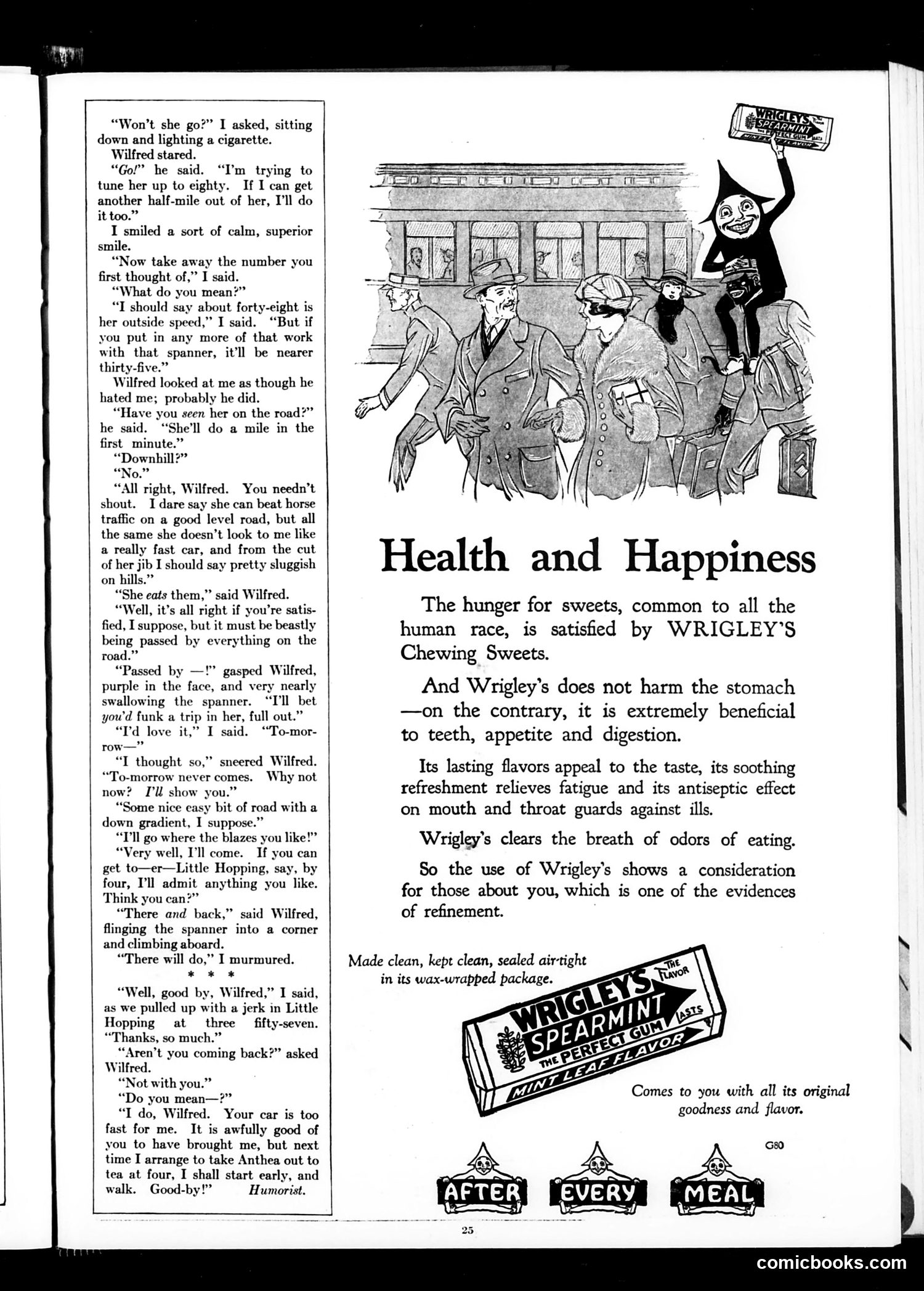
**Left side:** A humorous short story titled "Humorist" depicts two men arguing about an automobile's performance. The narrator baits his friend Wilfred into a speed challenge to Little Hopping by four o'clock, then deliberately arrives at 3:57—proving the car is actually quite fast. The joke relies on the narrator's clever manipulation and Wilfred's gullibility. **Right side:** A full-page advertisement for Wrigley's Spearmint chewing gum, featuring period illustrations of people and a product image. The ad makes health claims typical of early 20th-century advertising—asserting gum benefits teeth, digestion, and breath, while promoting it as a marker of social refinement and consideration for others. The page combines a satirical narrative about male competitiveness and one-upmanship with contemporary advertising that presents consumer products as moral virtue. Both reflect Jazz Age attitudes about status, modernity, and social propriety.
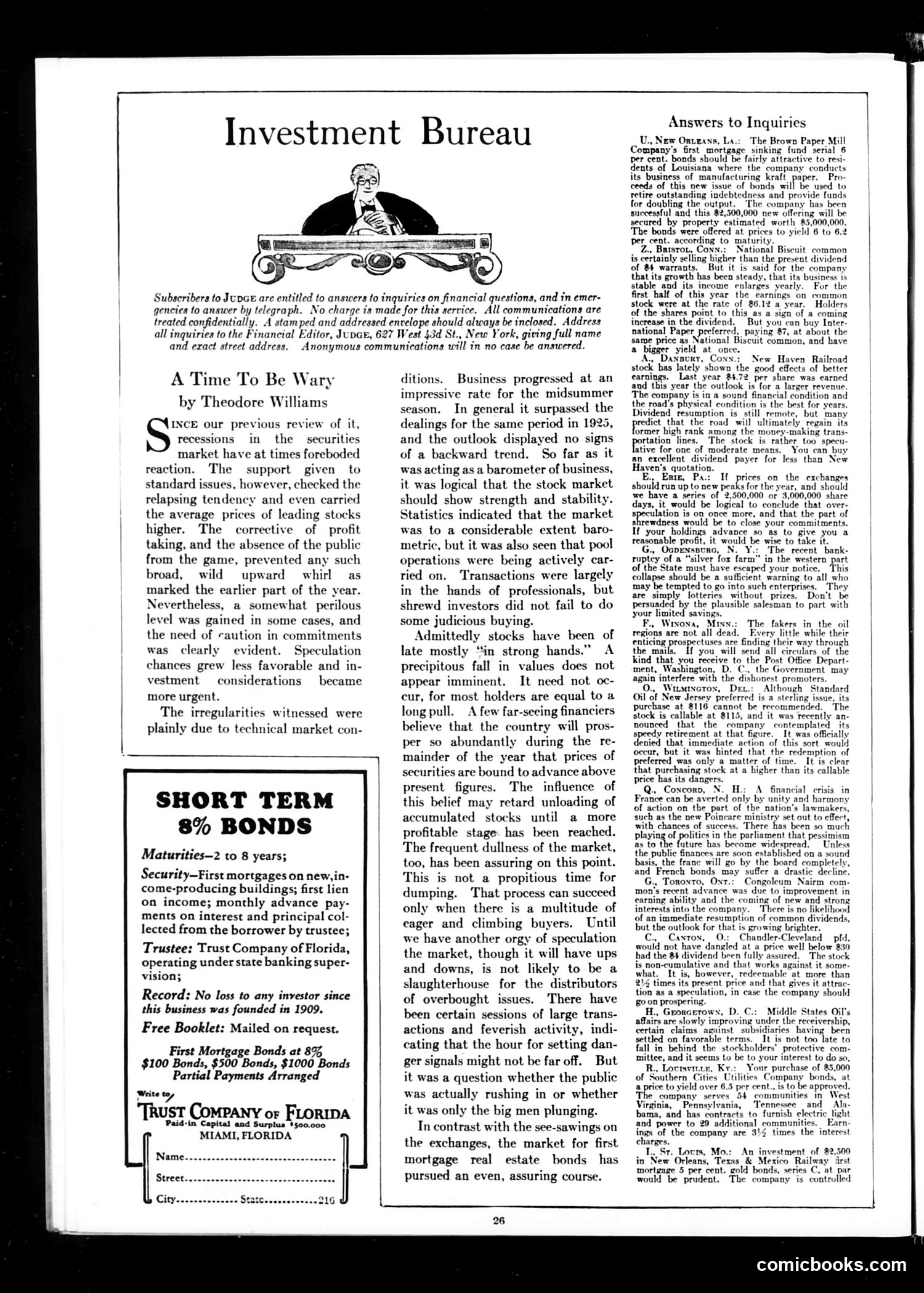
This page from *Judge* magazine presents financial advice rather than political satire. The masthead illustration shows a bespectacled financial expert at a desk—a generic representation of professional authority rather than a specific caricature. The main content is Theodore Williams's column "A Time To Be Wary," which discusses 1920s stock market conditions. Williams warns against excessive speculation despite recent market strength, cautioning that while professional investors are active, the general public should exercise caution. He notes "pool operations" (coordinated trading by insiders) are artificially supporting prices. The page is largely an advertisement for the Trust Company of Florida's 8% bonds, emphasizing safety with claims of "no loss to any investor since 1909." The satire, if present, is subtle: the contrasting messages—*Judge* simultaneously offering cautious investment advice while prominently advertising a specific bond offering—might implicitly mock the financial industry's self-interested guidance during the pre-1929 boom period.
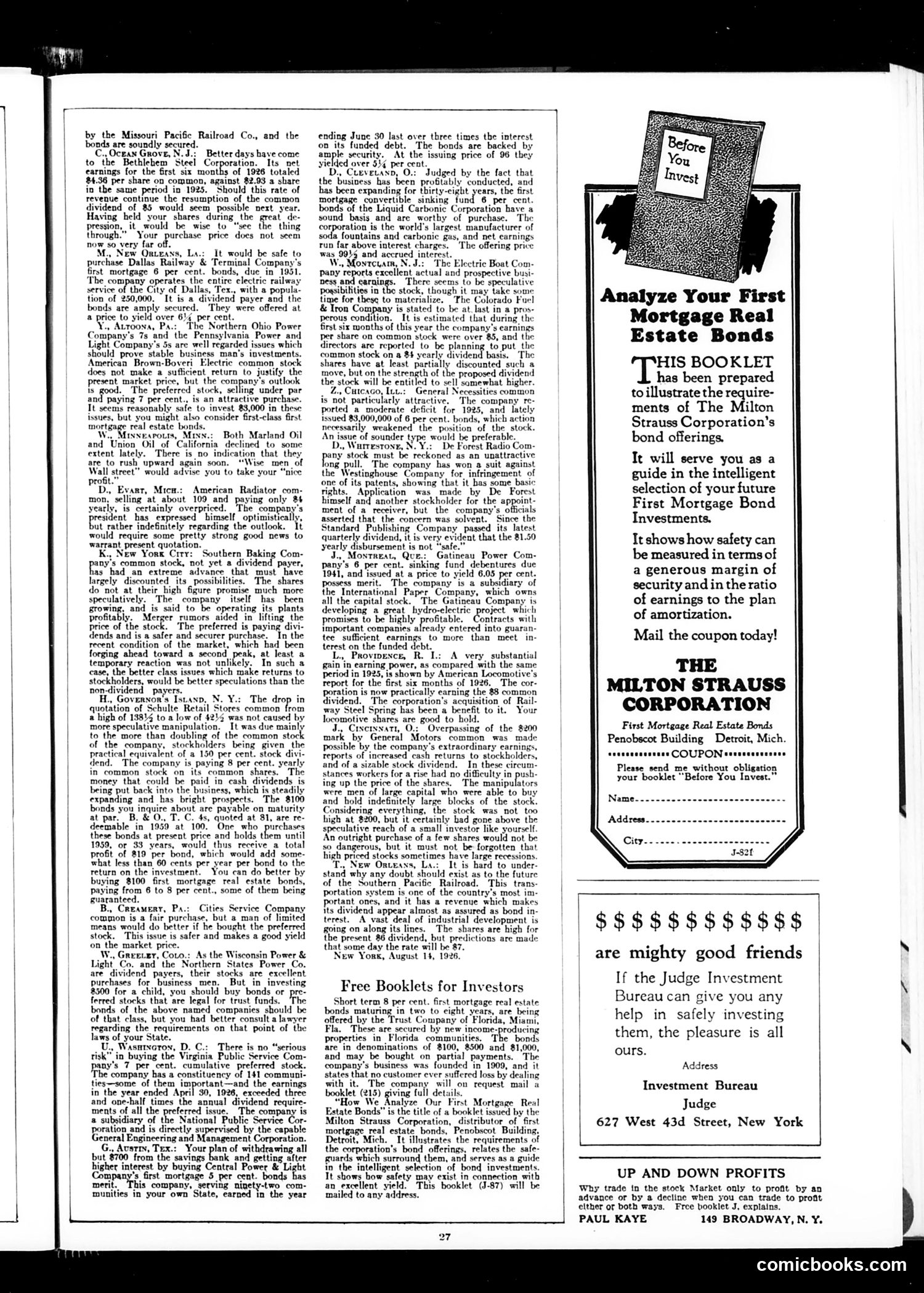
This page from Judge magazine (dated August 14, 1926, per the visible date) is primarily **financial advice content**, not political satire. The main text consists of an "Investment Bureau" column answering readers' questions about stocks and bonds. The right side features an **advertisement for the Milton Strauss Corporation**, promoting a booklet about first mortgage real estate bonds as safe investments—emphasizing "safety" and "margin of security" for investors. The cartoon labeled "Before You Invest" (top right) appears to show a figure cautioning potential investors, though specific details are unclear from the image. **Historical context**: This August 1926 content was published during the prosperous mid-1920s, just three years before the 1929 stock market crash. The financial advice—recommending railroad bonds, utilities, and industrial stocks—reflects pre-Depression confidence in American markets and corporate stability. The page targets middle-class investors seeking guidance on managing their savings and portfolio decisions.
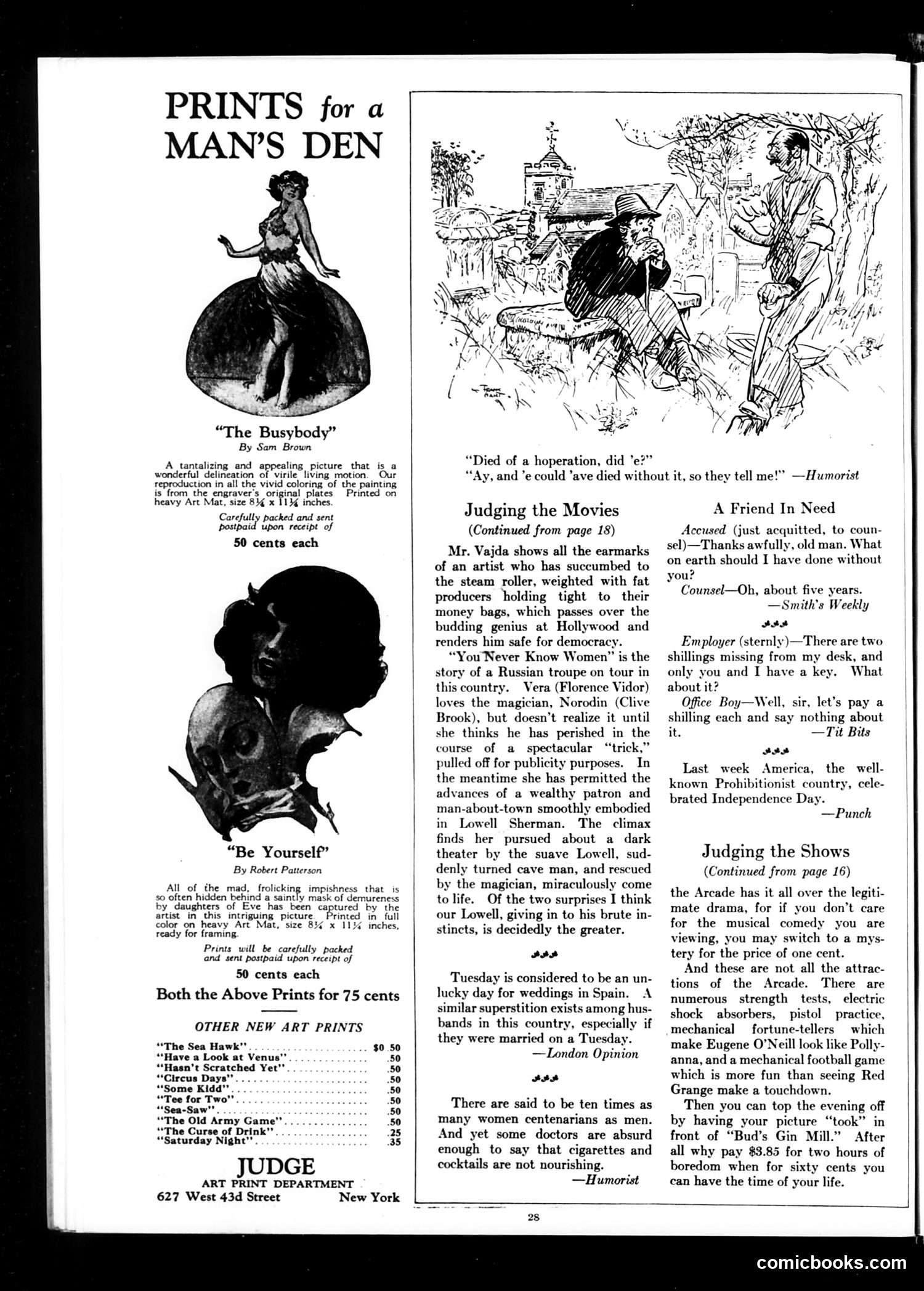
This is primarily an **advertising page** for Judge's art print department, showcasing prints suitable for decorative display in men's personal spaces. The two main prints advertised are "The Busybody" (by Sam Brown) and "Be Yourself" (by Robert Patterson)—both 50 cents each. The imagery suggests early 20th-century aesthetic preferences: "The Busybody" depicts a woman in an elegant pose, while "Be Yourself" emphasizes playful femininity ("mad, frolicking impishness"). The page also contains **brief humorous anecdotes** typical of Judge magazine's satirical content, including jokes about British working-class speech ("Died of a 'operation"), marriage superstitions, gender stereotypes about female longevity despite smoking/drinking, and comparisons between vaudeville entertainment and legitimate theater. A movie review discusses "You Never Know Women," critiquing how commercial producers dilute artistic vision in Hollywood. Overall, this reflects 1920s consumer culture and popular attitudes toward gender, entertainment, and domestic decoration.
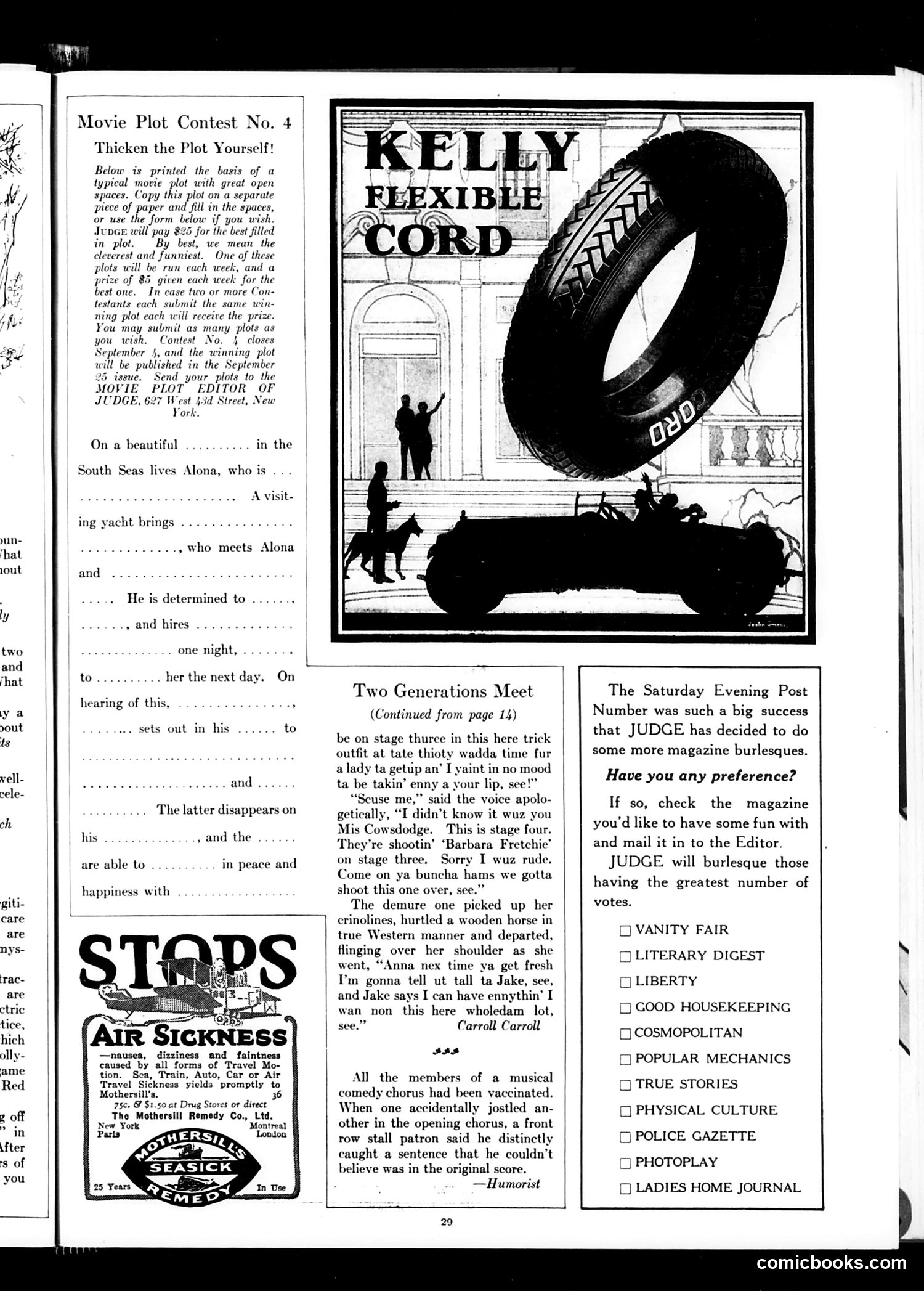
This page contains a **movie plot contest** rather than political satire. Readers submitted creative plot continuations to fill in blanks of a South Seas romance involving a character named Alona—a common pulp fiction trope of the era. Judge offered $25 prizes for the cleverest entries, satirizing Hollywood's formulaic storytelling by inviting readers to complete absurd templates themselves. The page also includes period **advertisements** (Mothersill's seasickness remedy) and a humor section titled "Two Generations Meet," which appears to mock old-fashioned stage actresses encountering modern film production. A separate joke about vaccinated chorus members making double-entendre comments suggests wartime-era humor about public health measures. The **Kelly Flexible Cord** advertisement features a vintage product endorsement unrelated to the editorial content. Finally, a reader poll requests preferences for which magazines Judge should parody next—indicating the publication's success had encouraged further burlesque issues.
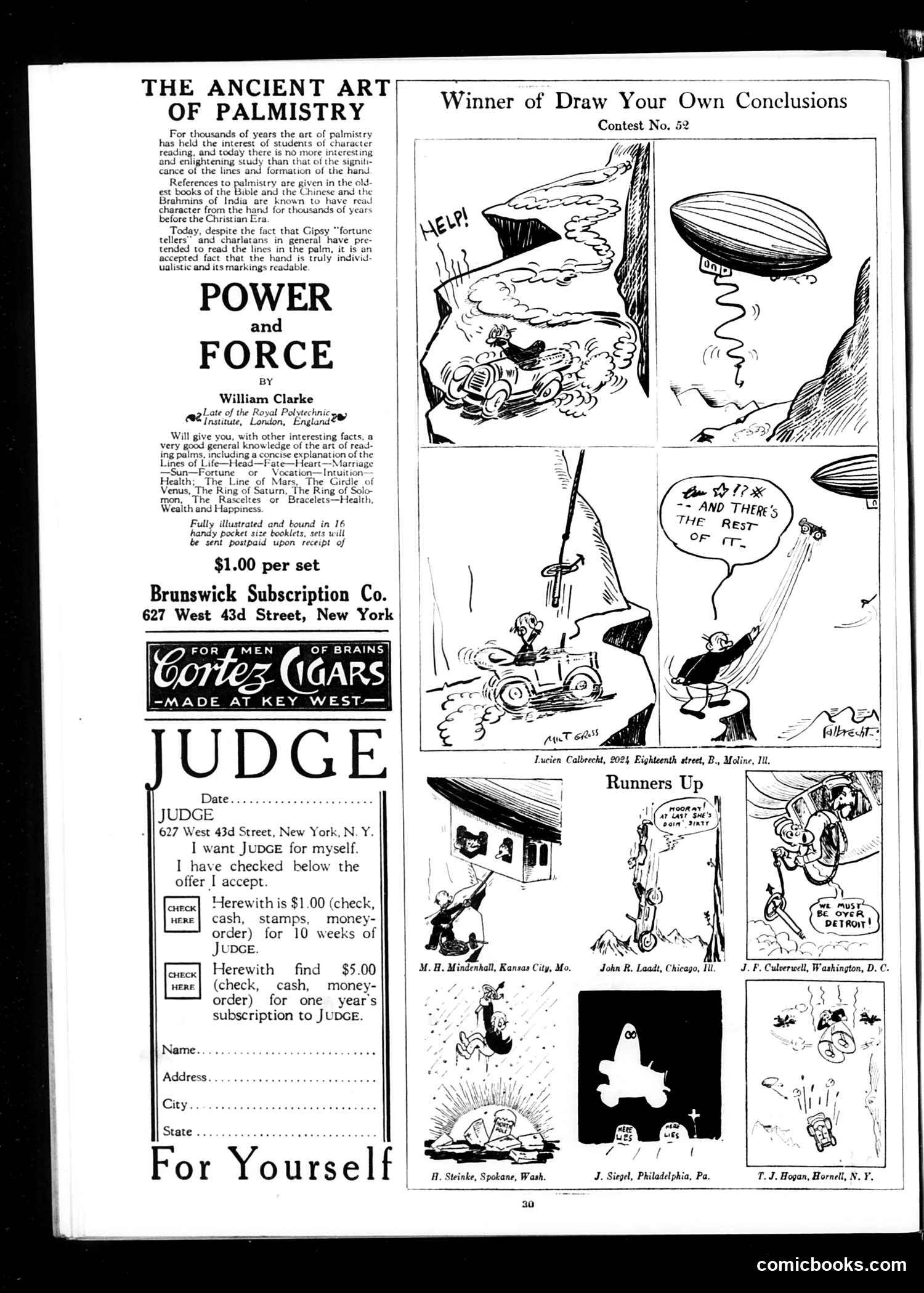
This page showcases **Judge's "Draw Your Own Conclusions" cartoon contest** (No. 52). The winning entry depicts a figure in distress calling "HELP!" while trapped in what appears to be a dangerous mechanical or industrial situation—possibly a printing press or factory machine. The cartoon's humor relies on visual absurdity: the figure cries for help while simultaneously declaring "AND THERE'S THE REST OF IT," suggesting dark comedy about workplace hazards or industrial accidents. The "Runners Up" section displays four additional contest entries from contributors across America, all using similar visual gag formats common to Judge's satirical style. The page also advertises **palmistry books** (character reading via palm analysis) and subscription offers for Judge magazine itself—typical editorial padding of the era mixing editorial content with advertising to drive subscriptions and product sales.
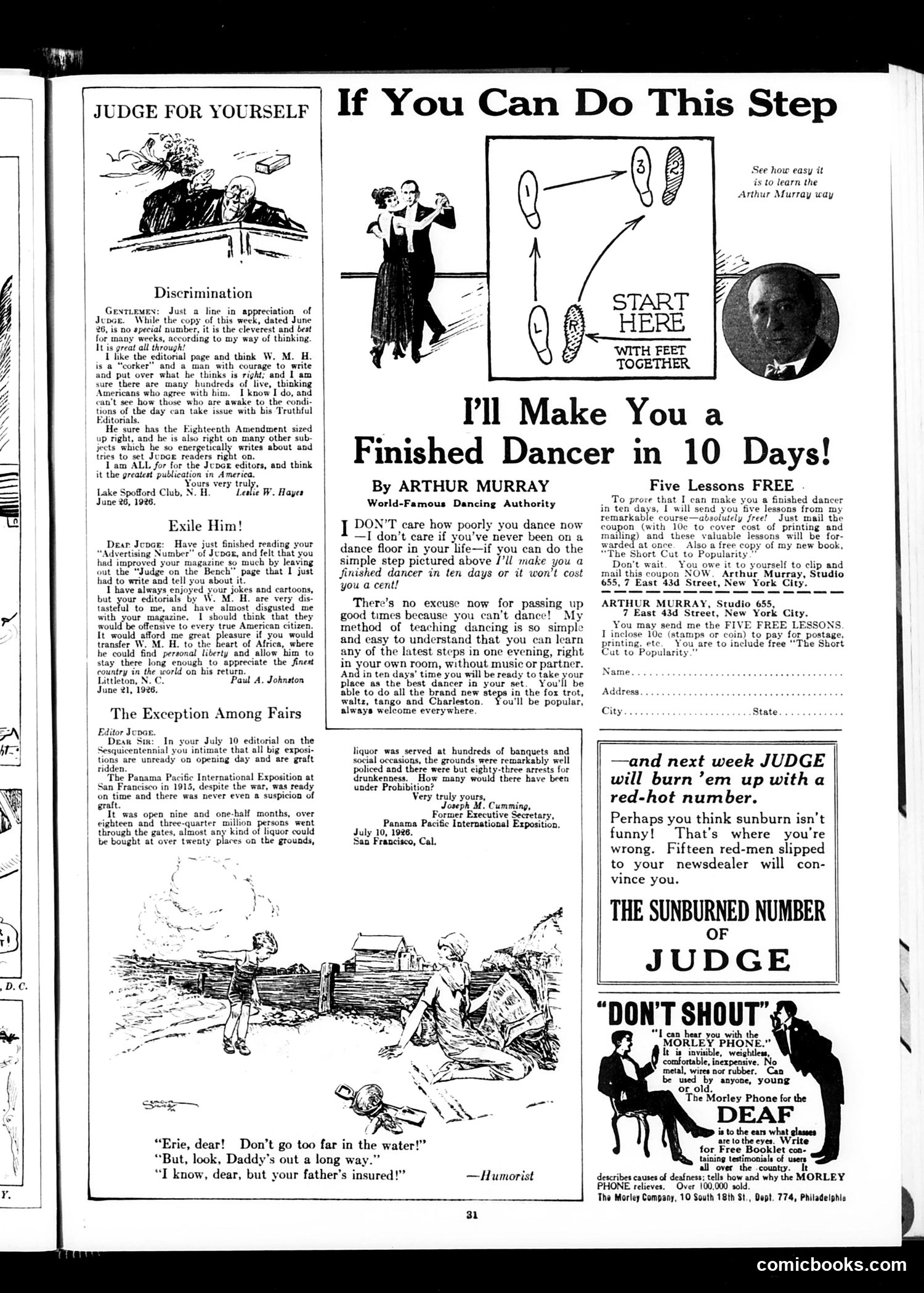
This page from Judge (June 26, 1926) contains mixed editorial content and advertising. **Left side:** Two reader letters appear. "Discrimination" praises Judge's editorial stance and its editor W.M.H., particularly supporting prohibition enforcement and the Eighteenth Amendment. "Exile Him!" criticizes the same editor for offensive content, suggesting he be removed to Africa. These opposing views illustrate contemporary political divisions over Prohibition and editorial standards. **Center/Right:** The dominant feature is an Arthur Murray dancing advertisement promising to make readers "a Finished Dancer in 10 Days" with five free lessons. This reflects the 1920s craze for ballroom dancing (foxtrot, waltz, Charleston, tango) and mail-order self-improvement schemes popular during the era. **Bottom:** A brief editorial note mentions the 1915 Panama-Pacific Exposition, noting alcohol was served at banquets despite Prohibition being in effect—highlighting contradictions in law enforcement. The page demonstrates Judge's mix of political satire and popular commercial culture of the Roaring Twenties.
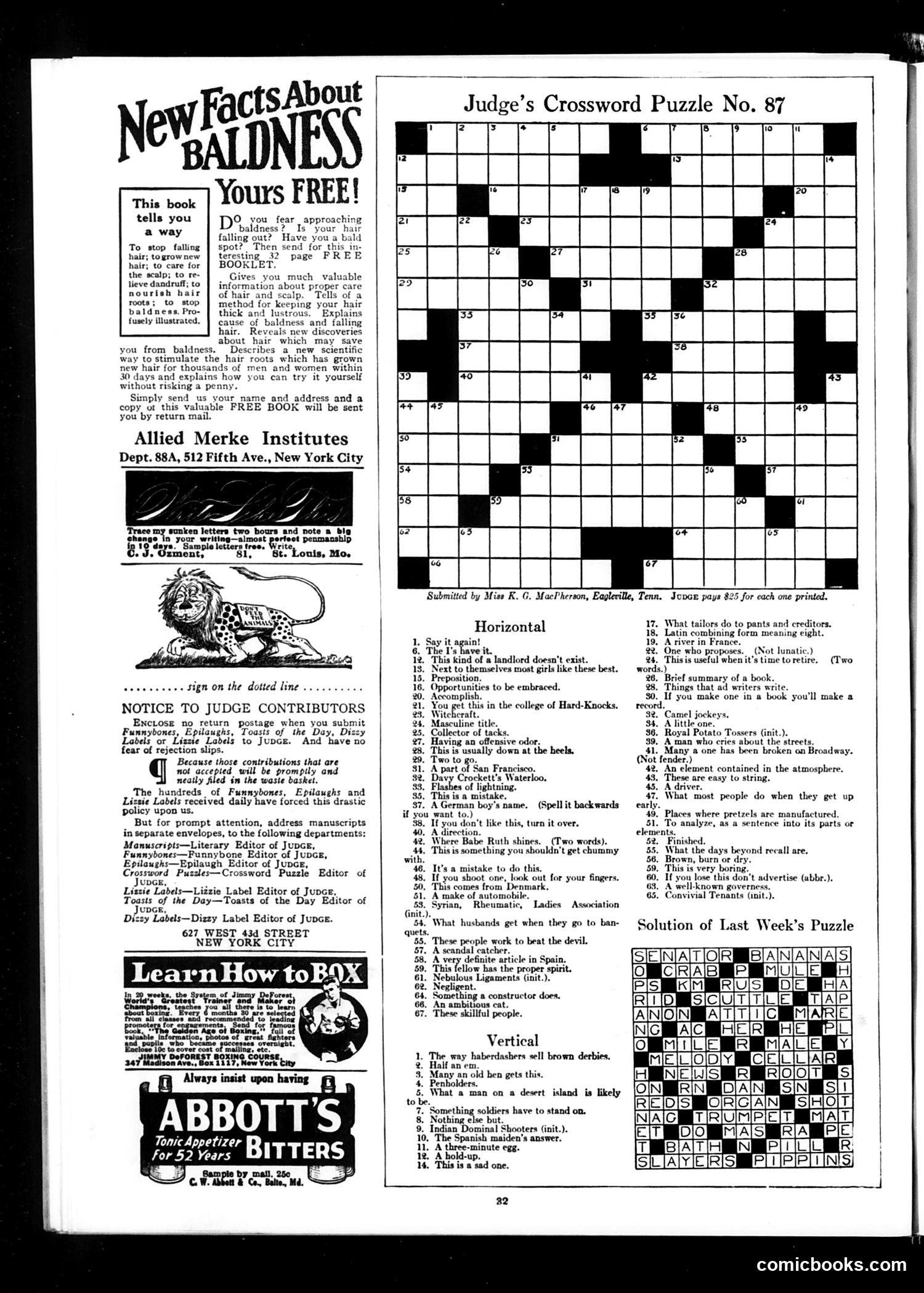
This page is primarily advertisements and a crossword puzzle, not a satirical cartoon. The main content includes: 1. **Allied Merck Institutes advertisement** for a free baldness book, promising to stop hair loss and stimulate hair growth through scientific methods. 2. **Advertisements for Abbott's Bitters** (a tonic) and a "Learn How to Box" guide. 3. **A notice to Judge contributors** humorously stating that rejected submissions will be "promptly and neatly filed in the waste basket" — a meta-joke about the magazine's volume of submissions. 4. **Judge's Crossword Puzzle No. 87** with clues and the previous week's solution. The page reflects 1920s-era advertising culture and magazine content, showing how Judge balanced humor with commercial revenue. The baldness cure pitch is notable as period-typical "cure-all" advertising making dubious health claims.
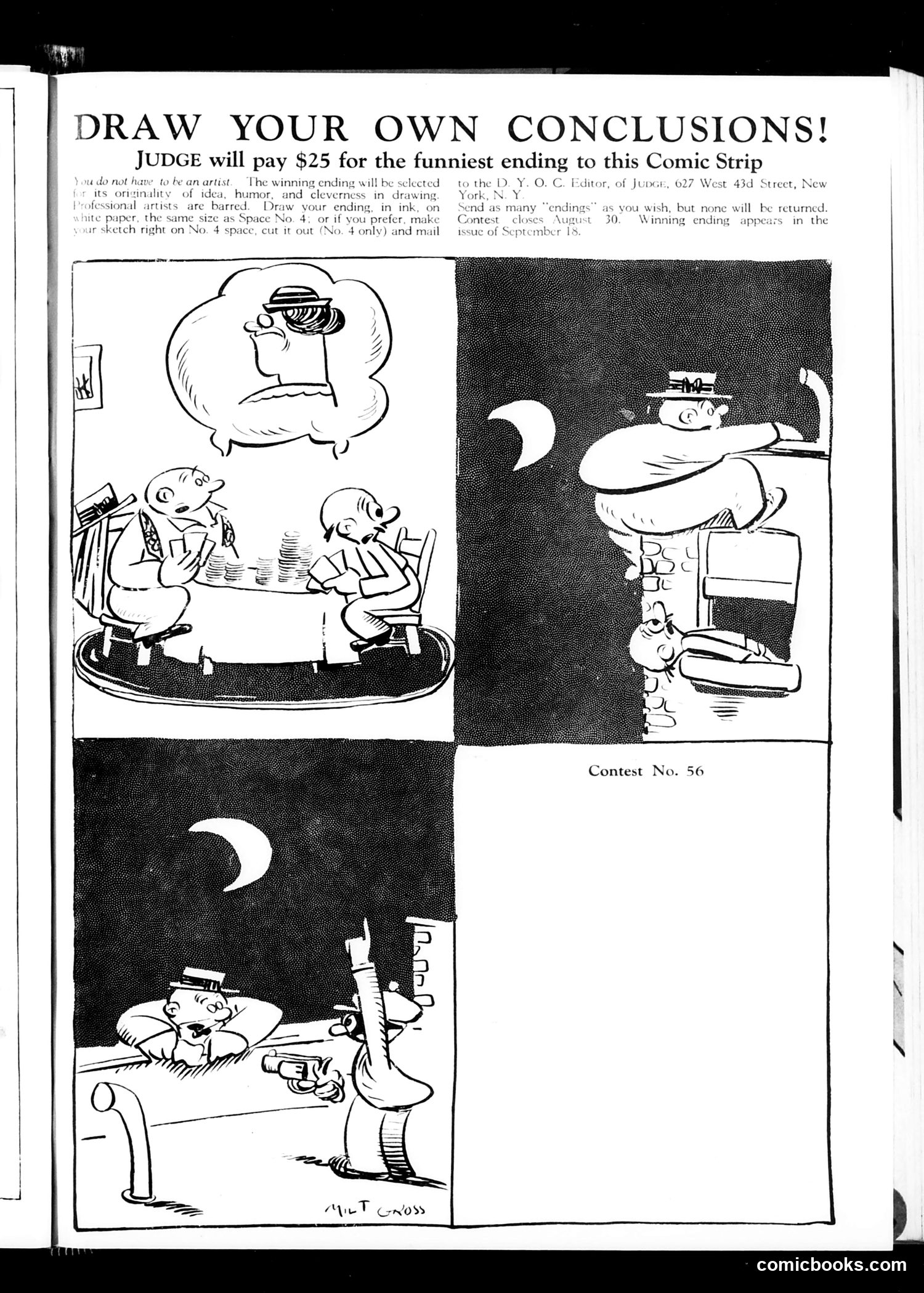
This is a **reader participation contest**, not a political cartoon. Judge magazine invited readers to complete an unfinished comic strip for a $25 prize (significant money in this era). The three panels show absurdist or surreal situations: the first depicts two men at a table with a large thought bubble above; the second shows a figure in bed at night with someone on the roof; the third shows a nighttime scene with figures and what appears to be a gun. The humor lies in the **incongruity and absurdity** of these scenarios—readers were challenged to devise funny, logical, or clever conclusions to these bizarre setups. The contest emphasizes originality of idea over artistic skill, democratizing humor-creation. The cartoonist is credited as "Milt Gross," a known humorist of the period. This reflects Judge's interactive approach to humor and its confidence that ordinary readers could generate entertaining content.
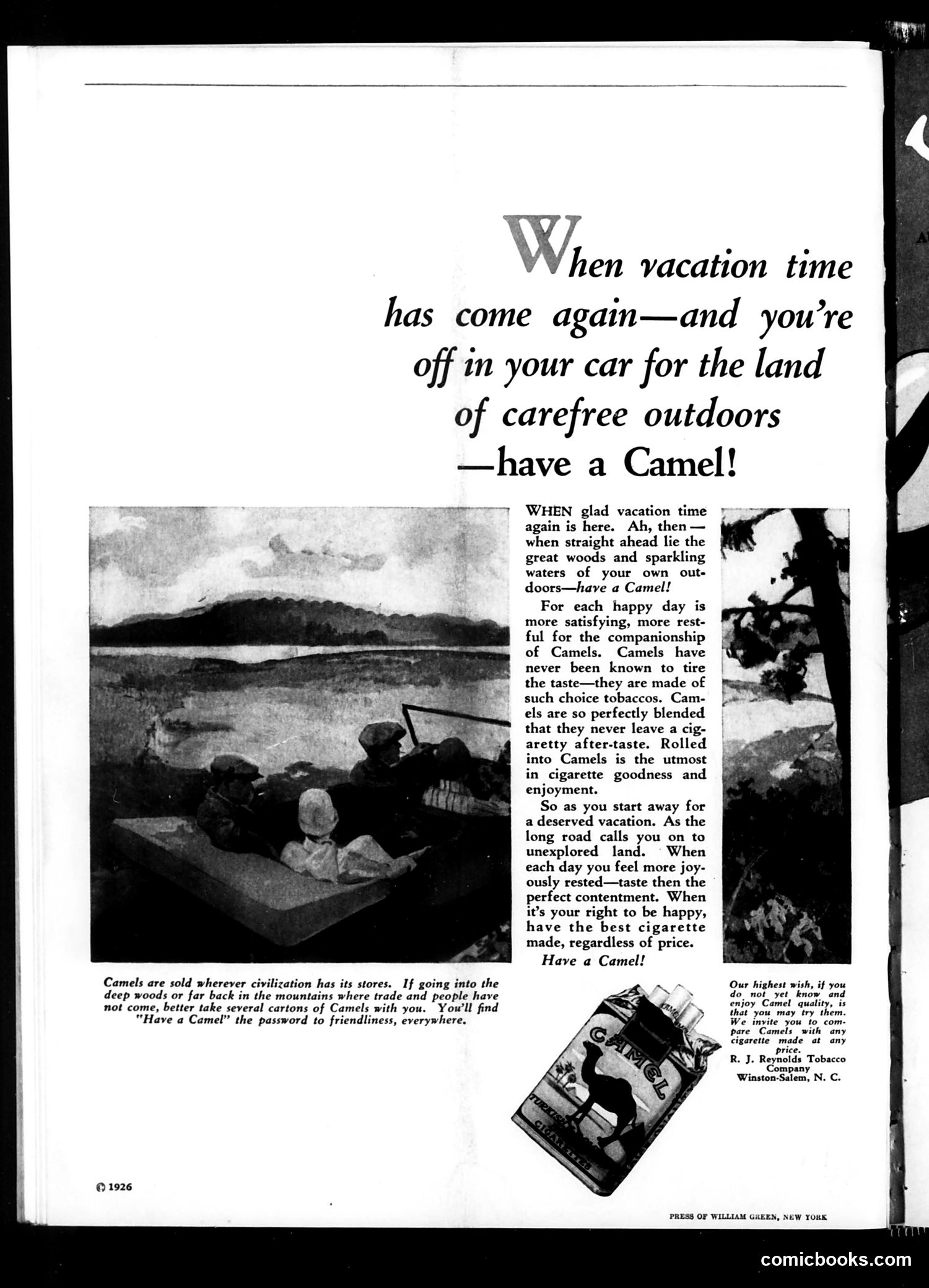
This is a **Camel cigarette advertisement**, not political satire. The page presents a 1926 marketing campaign promoting cigarettes for vacation leisure. The advertisement features an idealized outdoor scene—a couple relaxing by a lake or river with mountains in the background—positioning Camel cigarettes as essential vacation companions. The text emphasizes the cigarette's quality tobaccos and "perfect" blending, claiming they won't leave an unpleasant aftertaste. The ad includes a notable cultural claim: Camels are "the password to friendliness, everywhere," even in remote areas where "trade and people have not come." This reflects early 20th-century advertising's confidence in American consumer products as universal social currency. For modern readers, the page demonstrates how openly cigarettes were marketed before health warnings existed—directly associating smoking with happiness, relaxation, and outdoor enjoyment. The aspirational lifestyle imagery and health/taste claims would be legally prohibited in contemporary advertising.