
Judge, 1926-08-21 · page 8 of 36
Judge — August 21, 1926 — page 8: what you’re looking at
What you’re looking at
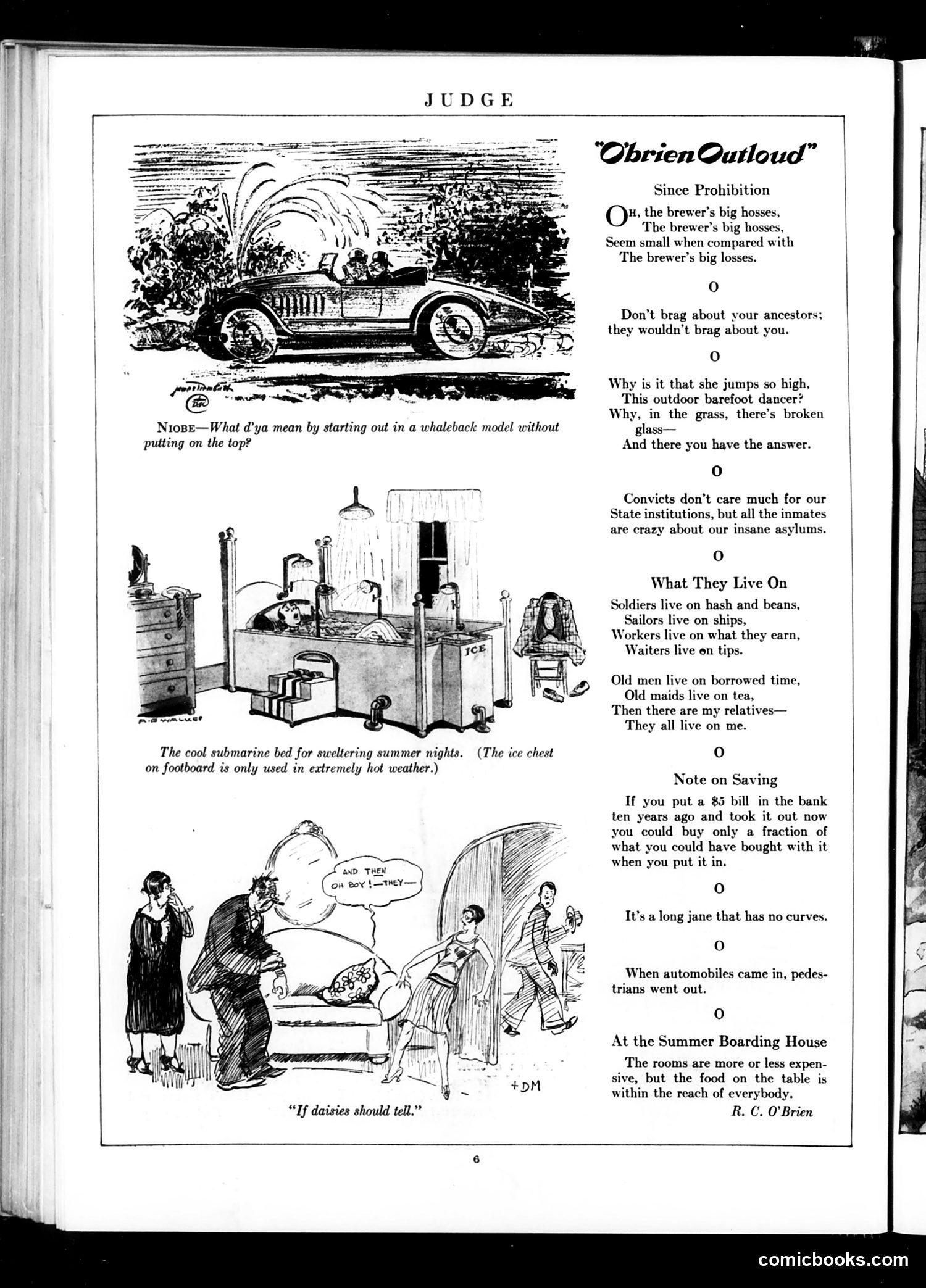
This page from *Judge* contains satirical commentary on 1920s American life, primarily post-Prohibition. **Main Content:** The "O'Brien Outloud" column by R.C. O'Brien offers humorous observations on contemporary issues. Key targets include: - **Prohibition's economic impact**: Breweries suffered massive losses after alcohol was banned (1920) - **Social commentary**: Jokes about class, family obligations, inflation, and changing urban life - **Automobiles**: References the recent car boom replacing pedestrian culture - **Inflation/savings**: Notes how $5 has lost purchasing power over a decade—early commentary on economic decline **Cartoons:** Three illustrated jokes accompany the text, including one showing people discussing summer cooling methods and another about two figures (caption: "If daisies should tell"), likely a mild romantic or domestic humor piece. The overall tone is sardonic observation of post-WWI American culture, economic anxiety, and social change—typical of *Judge*'s satirical approach to contemporary life.
📄 Transcribed text from this page (OCR, searchable)
Machine-transcribed from the original scan — historical spelling and the odd misread are preserved.
putting on the top? The cool submarine bed for sweltering summer on footboard is only used in extremely hot weather.) AND THES On BY! “If daisies should tell.” Niose—What d’ya mean by starting out in a whaleback model without nights. (The ice chest ‘ObrienQutloud” Since Prohibition O« the brewer’s big hosses, The brewer's big hosses, Seem small when compared with The brewer's big losses. fo} Don’t brag about your ancestors; they wouldn’t brag about you. fo} Why is it that she jumps so high, This outdoor barefoot dancer? Why, in the grass, there’s broken glass— And there you have the answer. Oo Convicts don’t care much for our State institutions, but all the inmates are crazy about our insane asylums. fo} What They Live On Soldiers live on hash and beans, Sailors live on ships, Workers live on what they earn, Waiters live on tips. Old men live on borrowed time, Old maids live on tea, Then there are my relatives— They all live on me. fe} Note on Saving If you put a $5 bill in the bank ten years ago and took it out now you could buy only a fraction of what you could have bought with it when you put it in. fo} It’s a long jane that has no curves. fo) When automobiles came in, pedes- trians went out. fe} At the Summer Boarding House The rooms are more or less expen- sive, but the food on the table is within the reach of everybody. R. C. O’Brien comicbooks.com