
Judge, 1926-08-21 · page 29 of 36
Judge — August 21, 1926 — page 29: what you’re looking at
What you’re looking at
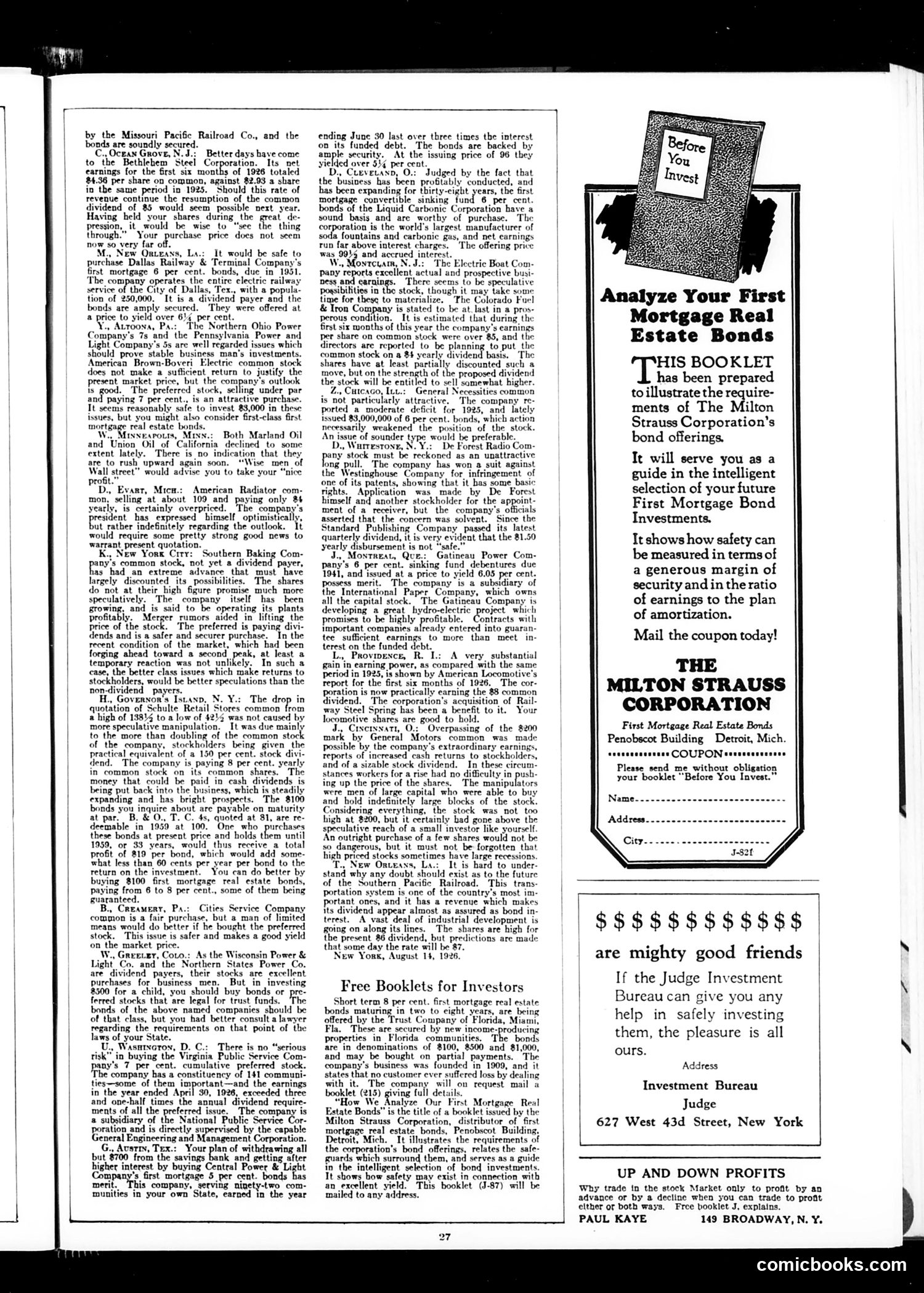
This page from Judge magazine (dated August 14, 1926, per the visible date) is primarily **financial advice content**, not political satire. The main text consists of an "Investment Bureau" column answering readers' questions about stocks and bonds. The right side features an **advertisement for the Milton Strauss Corporation**, promoting a booklet about first mortgage real estate bonds as safe investments—emphasizing "safety" and "margin of security" for investors. The cartoon labeled "Before You Invest" (top right) appears to show a figure cautioning potential investors, though specific details are unclear from the image. **Historical context**: This August 1926 content was published during the prosperous mid-1920s, just three years before the 1929 stock market crash. The financial advice—recommending railroad bonds, utilities, and industrial stocks—reflects pre-Depression confidence in American markets and corporate stability. The page targets middle-class investors seeking guidance on managing their savings and portfolio decisions.
📄 Transcribed text from this page (OCR, searchable)
Machine-transcribed from the original scan — historical spelling and the odd misread are preserved.
by the Missouri Pacific Railroad Co., and the bonds are soundly secured. C., Ocean Grove, N.J.: Better days have come to the Bethlehem Steel Corporation. Its net earnings for the first six months of 1926 totaled $4.36 per share on common, against $2.93 a share in the same period in 1925. Should this rate of revenue continue the resumption of the common dividend of 85 would seem possible next year. Having held your shares during the great. de- pression, it would be wise to “see the thing through.” Your purchase price docs not seem now so very far off. M., New Orteans, La.: It would be safe to purchase Dallas Railway & Terminal Company's first mortgage 6 per cent. bonds, due in 1951. The company operates the entire electric railway service of the City of Dallas, Tes., with « popule- tion of 250,000, “It is a dividend payer andthe bonds are amply secured. They were offered at a price to yield over 614 per cent. Y., Atroona, Pa.: | The Northern Ohio Power Company's 7s and the Pennsylvania Power and Light Company's 5s are well regarded issues which should prove stable business man's investments. American Brown-Boveri Electric common. stock does not make a sufficient return to justify the present market price, but the company’s outlook 1s good. The preferred stock, selling under par and paying 7 per cent., is an attractive purchase. It seems reasonably safe to invest 3,000 in these issues, but you might also consider first-class first mortgage real estate bonds. v Mivweapouts, Mivn.: Both Marland Oil and Union Oil, of California declined to some extent lately. There is no indication that they are to rush upward again soon. ‘Wise men of Wall street” would advise you to take your “nice profit.” D., Evart, Mica.: American Radiator com- mon, selling at about 109 and paying only 8 yearly, is certainly overpriced. ‘The company sident has expressed himself optimistically, ut rather indefinitely regarding the outlook. It would require some pretty strong good news to warrant present quotation. K., New Yor Crrr: Southern Baking Com- iny’s common stock, not yet a dividend payer, as had an extreme advance that must have largely discounted its possibili ‘The shares do not at their high figure promise much more speculatively. The company itself has been growing, and is said to be operating its plants profitably. Merger rumors aided in lifting the price of the stock. The preferred is paying divi- dends and is a safer and securer purchase. In the recent condition of the market, which had been forging ahead toward a second peak, at least a temporary reaction was not unlikely. In such a case, the better class issues which make returns to stockholders, would be better speculations than the non-dividend payers. H., Governor's Istanp, N. Y.: The drop in quotation of Schulte Retail Stores common from a high of 13814 to a low of 42/4 was not caused by more speculative manipulation. It was due mainly to the more than doubling of the common stocl of the company, stockholders being given the practical equivalent of a 150 per cent. stock divi- dend. The company is paying 8 per cent. yearly in common stock on its common shares. The money that could be paid in cash dividends is being put back into the business, which is steadily expanding and has bright prospects. The $100 bonds you inquire about are payable on maturity at par. B. & O., T. C. 4s, quoted at 81, are re- deemable in 1959 at 100. One who purchases these bonds at present price and holds them until 1959, or 33 years, would thus receive a total proft of 819 per bond, which would add some- what less than 60 cents per year per bond to the return on the investment. You can do better by buying $100 first. mortgage real estate bonds, paying from 6 to 8 per cent., some of them being guaranteed. B., Creamery, Pa.: Cities Service Company common is a fair purchase, but a man of limited means would do better if he bought the preferred stock. ‘This issue is safer and makes a good yield on the market price. W., Greeter, Coto.: As the Wisconsin Power & Light Co. and’ the Northern States Power Co. are dividend payers, their stocks are excellent purchases for business men. But in investing 8500 for a child, you should buy bonds or pre- ferred stocks that are legal for trust funds. The bonds of the above named companies should be of that class, but you had better consult a lawyer regarding the requirements on that point of the laws of your State. U,, Wasmtxctos, D. There is no “serious tisk” in buying the Virginia Public Service Com- py’'s 7 per cent. cumulative preferred stock. ‘he company has a constituency of 141 communi- ties—some of them important—and the earnings in the year ended April 30, 1926, exceeded three and one-half times the annual dividend require- ments of all the preferred issue. The company a subsidiary of the National Public Service Cor- poration and is directly supervised by the capable General Engineering and Management Corporation. G., Ausrty, Tex.: Your plan of withdrawing all but $700 from the savings bank and getting after higher interest by buying Central Power & Light Co irst_ mortgage 5 per cent. bonds has it. This company, serving ninety-two com- munities in your own State, earned in the year ending June 30 last over three times the interest on its funded debt. The bonds are backed by suple security. At the issuing price of 96 they yielded over 534 per cent. D., Curveuann, O.: Judged by the fact that the business has been profitably conducted, and has been expanding for thirty-eight years, the first mortgage convertible sinking fund 6 per cent. bonds of the Liquid Carbonic Corporation have a sound basis and are worthy of purchase. The ration is the world’s largest manufacturer of soda fountains and carbonic gas, and net earnings tun far above interest charges. ‘The offering price was 9934 and accrued interest. W., Moyteyarr, : The Electric Boat Com- Pany reports excellent actual and prospective busi- ness and earnings. There seems to be speculative possibilities in the stock, though it may take some time for these to materialize. ‘The Colorado Fuel & Iron Company is stated to be at, last in a pros- erous condition. It is estimated that during the first six months of this year the company’s earnings per share on common stock were over 85, and the directors are reported to be planning to put the common stock on a $4 yearly dividend basis. The shares have at least partially discounted such a move, but on the strength of the proposed dividend the stock will be entitled to sell samewhat higher. _ Z.,Cutcaco, Iut.: General Necessities common is not particularly attractive. The company re- ported a moderate deficit for 1925, and latel issued 83,000,000 of 6 per cent. bonds, which ac necessarily weakened the position of the stock. An issue of sounder type would be preferable. D., Wurrestoxg, N. Y.: De Forest Radio Com- pany stock must be reckoned as an unattractive long pull. The company has won a suit against the Westinghouse Company for infringement of one of its patents, showing that it has some basic rights. Application was made by De Forest himself and snother stockholder for the appoi ment of a receiver, but the company asserted that the concern was solvent. Si Standard Publishing C Passer iti nt that the 81.50 quarterly dividend, yearly disbursement is not “safe. J.,, Montreat, Qve.: Gatineau Power Com- pany's 6 per cent. sinking fund debentures due 1941, and issued at a price to yield 6.05 per cent. possess merit. The company is a subsidiary of the International Paper Company, which owns all the capital stock. The Gatineau Company is developing a great hydro-electric project. which romises to be highly profitable. Contracts with important companies already entered into guaran- tee sufficient earnings to more than meet in- terest on the funded debt. Provivexce, A very. substantial gain in earning power, as compared with the same period in 1925, is shown by American Locomotive's report for the first six months of 1926. The cor- poration is now practically earning the 88 common dividend. ‘The corporation's acquisition of Rail- way Steel Spring has been a benefit to it. Your locomotive shares are good to bold. J., Ciscixsatt, O.: Overpassing of the $200 mark by General Motors common was made possible by the company’s extraordinary earnings, reports of increased cash returns to stockholders, and of a ble stock dividend. In these circum- stances workers for a rise had no difficulty in push- ing up the price of the shares. The manipulators were men of large capital who were able to buy and hold indefinitely large blocks of the stock. Considering everything, the stock was not too high at $200, but it certainly bad gone above the speculative reach of a small investor like yourself. An outright purchase of a few shares would not, be so dangerous, but it must not be forgotten that high priced stocks sometimes have large recessions. T., New Orteass, La.: It is bard to under- stand why any doubt should exist as to the future of the Southern Pacific Railroad. This trans- portation system is one of the country's most im- portant ones, and it has a revenue which makes its dividend appear almost as assured as bond in- terest. A vast deal of industrial development is going on along its lines. ‘The shares are high for the present 86 dividend, but predictions are made that some day the rate will be 87. New York, August 14, 1926, Free Booklets for Investors Short term 8 per cent. first mortgage real estate bonds maturing in two to eight years, are being offered by the Trust Company of Florida, Miami, Fla, These are secured by new income-producing properties in Florida communities. The bonds are in denominations of $100, $500 and 81,000, and may be bought on partial payments. ‘The company's business was founded in 1909, and it states that no customer ever suffered loss by dealing with it. The company will on request mail a booklet (215) giving full details. “How We Analyze Our First Mortgage Real Estate Bonds” is the title of a booklet issued by the Milton Strauss Corporation, distributor of. first I estate bonds, Penobscot Building, It illustrates the requirements of the corporation's bond offerings, relates the safe- guards which surround them, and serves as a guide in the intelligent selection of bond investments. It shows bow safety may exist in connection with an excellent yield. This booklet (J-87) will be mailed to any address. Analyze Your First Mortgage Real Estate Bonds ‘HIS BOOKLET has been prepared to illustrate the require- ments of The Milton Strauss Corporation's bond offerings, Tt will serve you as a guide in the intelligent selection of your future First Mortgage Bond Investments. It shows how safety can be measured in terms of a generous margin of security and in the ratio of earnings to the plan of amortization. Mail the coupon today! THE MILTON STRAUSS CORPORATION First Mortgage Real Estate Bonds Penobscot Building Detroit, Mich. s COUPON #88 Please send me without obligation your booklet “Before You Invest.” Name- Address... City-- $$$S$$SS$S$$S | are mighty good friends | hs) If the Judge Investment | Bureau can give you any help in safely investing them, the pleasure is all | ours. \ Address Investment Bureau Judge 627 West 43d Street, New York UP AND DOWN PROFITS ‘Why trade in the stock Market only to proft by an advance or by a decline when you can trade to profit either of both ways. Free booklet J, explains. PAUL KAYE 149 BROADWAY, N. Y. comicbooks.com