
Judge, 1926-08-21 · page 13 of 36
Judge — August 21, 1926 — page 13: what you’re looking at
What you’re looking at
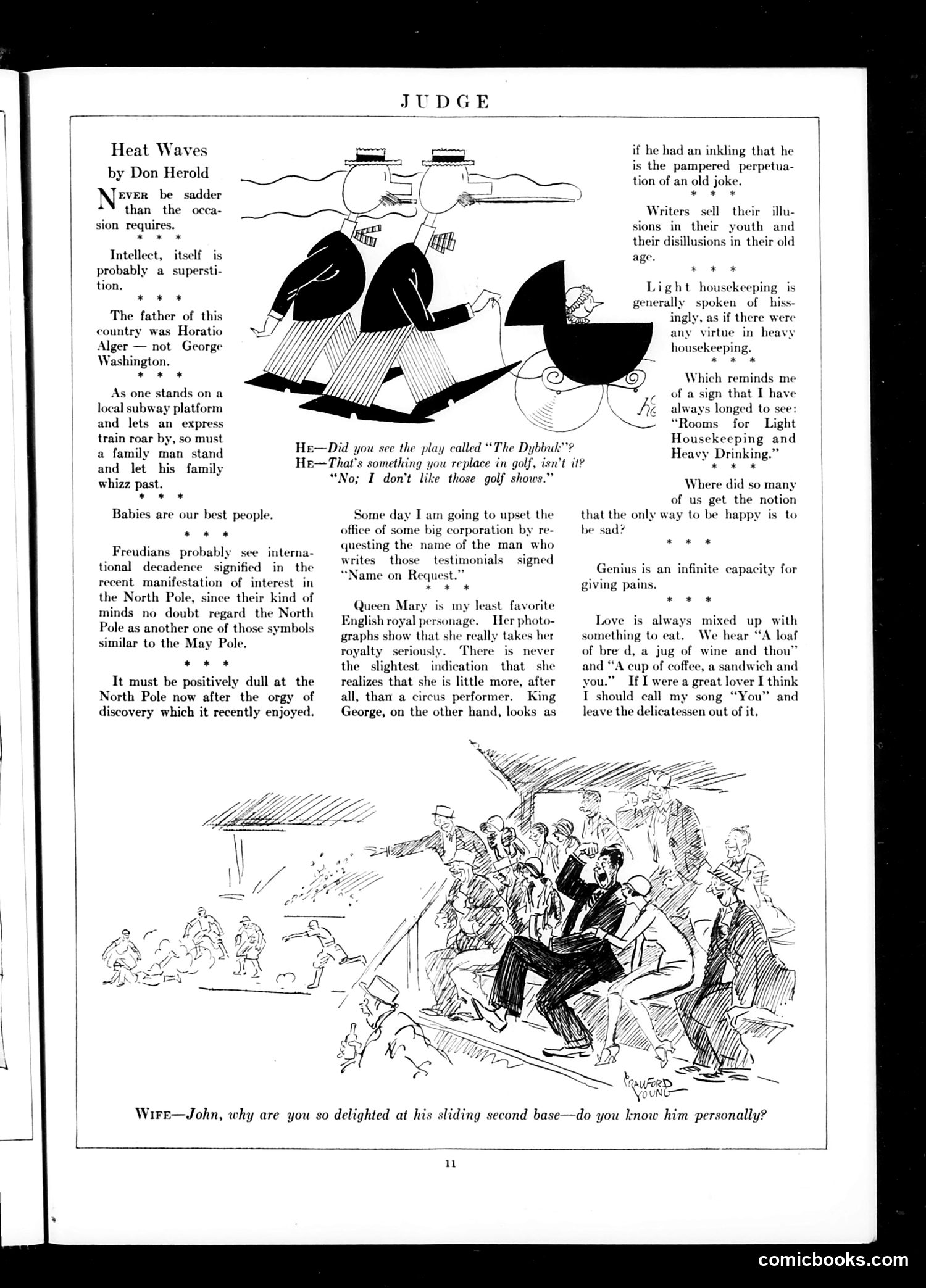
This page features **Don Herold's satirical column** of brief, cynical observations on American life, paired with two cartoons. The top cartoon depicts a couple in a car suffering through extreme heat, humorously illustrating the titular "heat waves." The column's aphorisms mock contemporary American values: Horatio Alger (the rags-to-riches myth) replacing George Washington as the national ideal; the replacement of parental attention with material comfort; and Queen Mary's overly serious royalty versus King George's apparent awareness he's part of an "old joke." The bottom cartoon shows a baseball game with a wife questioning her husband's enthusiasm for a player—likely satirizing how Americans bond over sports despite barely knowing the athletes involved. Throughout, Herold presents cynical but accessible humor: critiques of advertising testimonials, observations about love and food, and jabs at both British royalty and American social pretensions. The tone is **mildly nihilistic**—typical Judge magazine fare mocking modern life's absurdities.
📄 Transcribed text from this page (OCR, searchable)
Machine-transcribed from the original scan — historical spelling and the odd misread are preserved.
Heat Waves by Don Herold EVER be sadder than the occa- sion requires. x * * Intellect, itself is probably a supersti- tion. * * * The father of this country was Horatio Alger — not George Washington. ee * As one stands on a local subway platform and lets an express train roar by, so must a family man stand and let his family whizz past. se * Babies are our best people. +e * Freudians probably see interna- tional decadence signified in the recent manifestation of interest in the North Pole, since their kind of minds no doubt regard the North Pole as another one of those symbols similar to the May Pole. ee * It must be positively dull at the North Pole now after the orgy of discovery which it recently enjoyed. He—Did you see the play called “The Dybbul” He—That’s something you replace in golf, isn’t it? “No; I don’t like those golf shows. Some day I am going to upset the office of some big corporation by re- questing the name of the man who writes those testimonials signed “Name on Request.” se * Queen Mary is my least favorite English royal personage. Her photo- graphs show that she really takes her royalty seriously. There is never the slightest indication that she realizes that she is little more, after all, than a circus performer. King George, on the other hand, looks as if he had an inkling that he | is the pampered perpetua- tion of an old joke. x ee Wri Il their illu- sions in their youth and their disillusions in their old age. Light housekeeping is generally spoken of _ hiss- ingly, as if there were any virtue in heavy housekeeping. ‘ee Which reminds me of a sign that I have always longed to see: “Rooms for Light Housekeeping and Heavy Drinking.” * * * Where did so many of us get the notion that the only way to be happy is to be sad? * * * Genius is an infinite capacity for giving pains. * e * Love is always mixed up with something to eat. We hear “A loaf of bre d, a jug of wine and thou” and “A cup of coffee, a sandwich and you.” If I were a great lover I think I should call my song ‘‘You” and comicbooks.com