
A complete issue · 36 pages · 1926
Judge — July 17, 1926
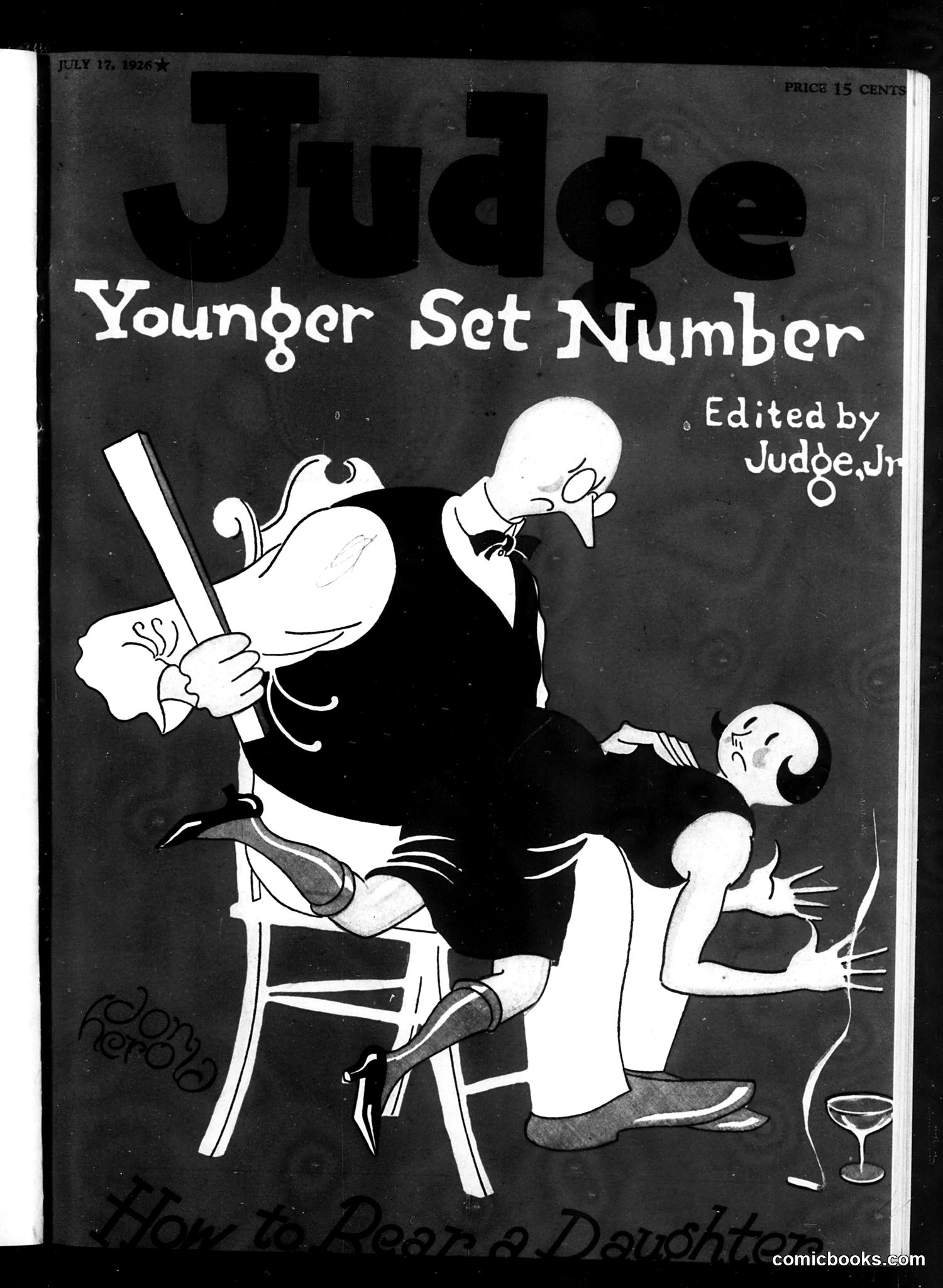
This is the cover of Judge magazine's "Younger Set Number," edited by Judge Jr. The illustration depicts a stern, bald older man in formal attire sitting in a chair while spanking a young woman across his knee. A cocktail glass sits nearby on the floor. The cartoon satirizes the generational conflict of the 1920s Jazz Age. The "younger set" refers to rebellious youth challenging Victorian social norms—particularly women's newfound independence, smoking, drinking, and dating freedoms during Prohibition. The image mockingly presents paternal discipline as the presumed response to youth excess, while the casual cocktail suggests the hypocrisy of moral condemnation during the illegal alcohol era. The humor targets both generational tension and the era's contradictions.
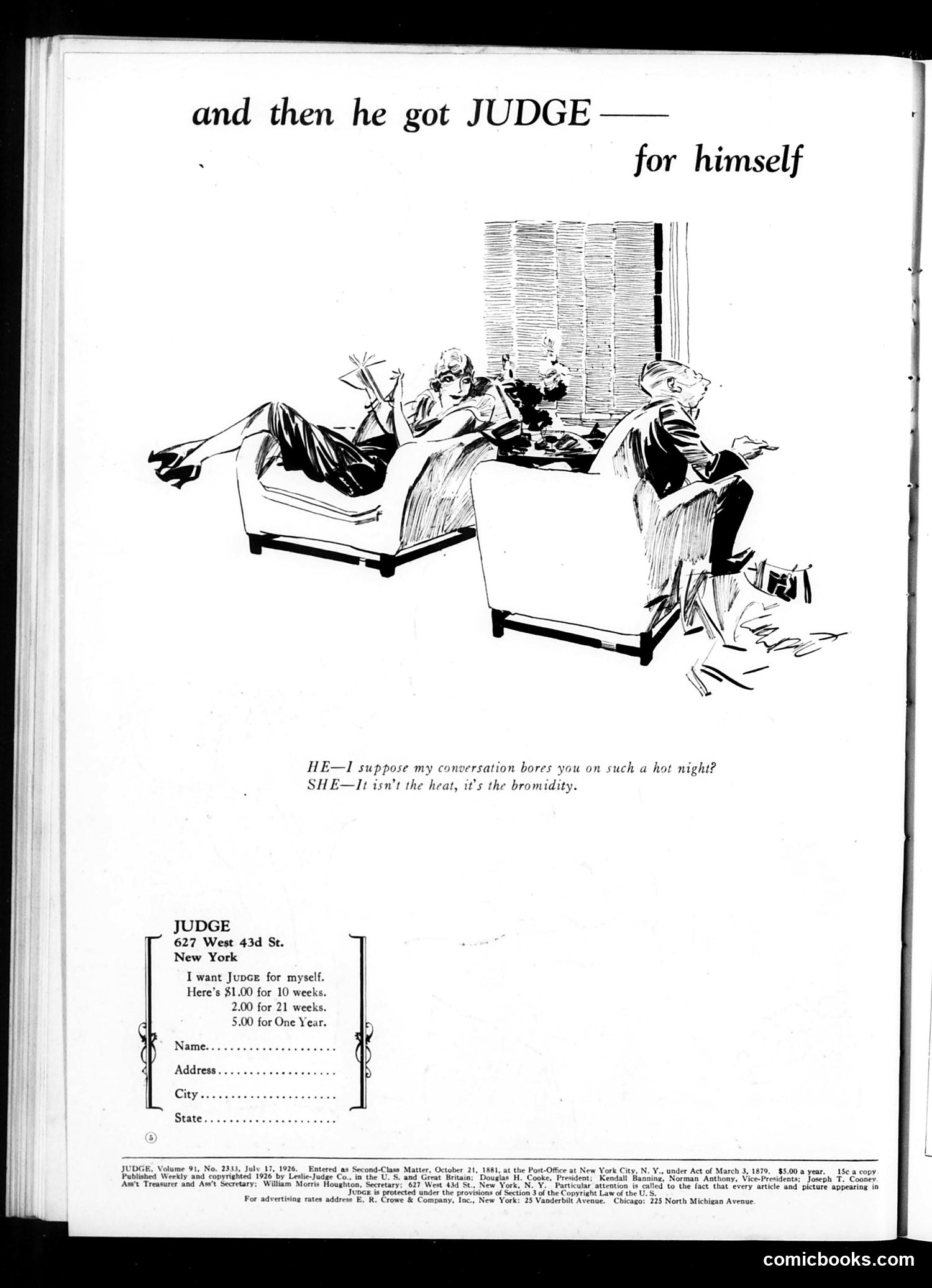
This page is primarily a **subscription advertisement** for Judge magazine itself, disguised as satirical content. The cartoon depicts a couple lounging in hot weather, with the man complaining that the woman's conversation bores him on a hot night. She responds that "it isn't the heat, it's the humidity" — a common period expression about weather discomfort. The joke appears to be meta: the advertisement suggests that Judge magazine provides intellectual companionship superior to casual conversation, offering mental stimulation during tedious summer evenings. The subscription rates ($1.00 for 10 weeks through $5.00 for one year) are listed below. The satire is gentle — targeting boredom and relationship monotony rather than political issues. This reflects Judge's evolution toward lifestyle humor by the 1920s-1930s era.
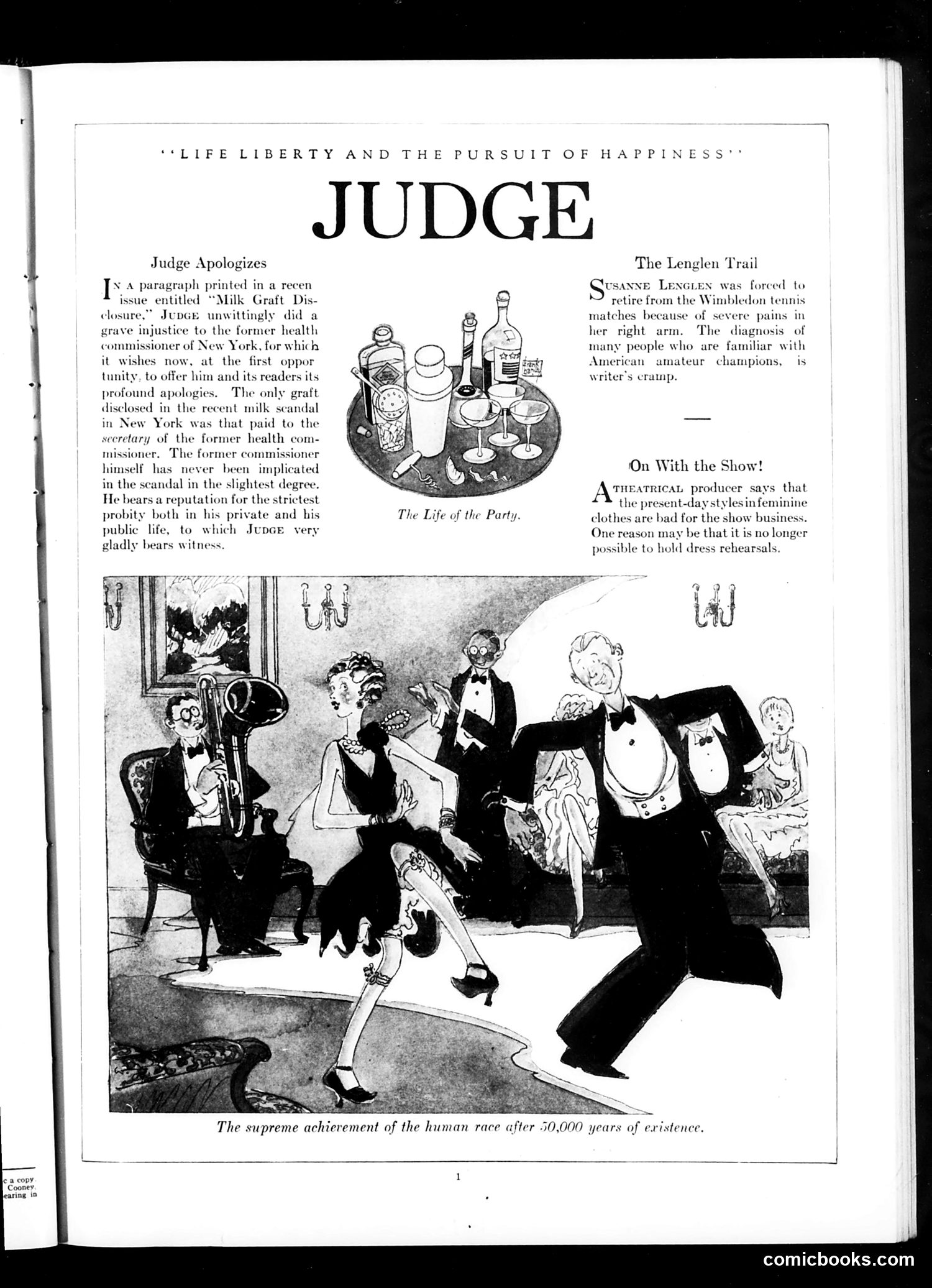
This page contains three separate satirical pieces: 1. **"Judge Apologizes"**: A brief item about a judge who inadvertently committed injustice regarding milk scandals in New York. The piece sarcastically notes his good reputation remains intact despite the error. 2. **"The Lenglen Trail"**: References Suzanne Lenglen, a famous tennis champion forced to retire due to injury—likely a commentary on her physical condition being well-known among sports enthusiasts. 3. **"On With the Show!"**: A theatrical producer's observation that modern feminine fashion makes dress rehearsals impractical. The large illustration below depicts a lively formal party or performance scene with elegantly dressed figures dancing and socializing, captioned "The supreme achievement of the human race after 50,000 years of existence"—a satirical commentary on modern social priorities and entertainment culture.
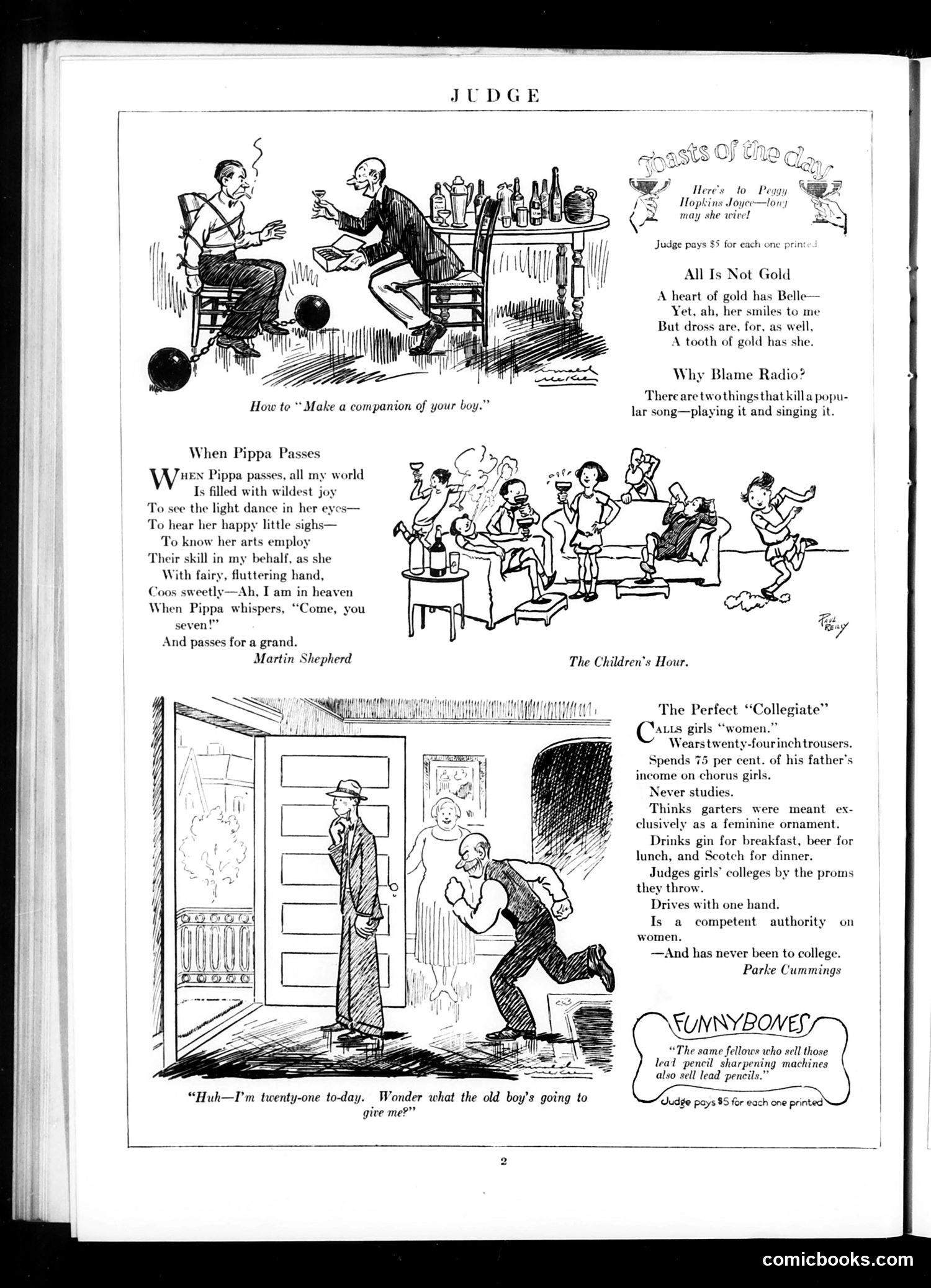
This page contains humor pieces and satirical commentary typical of early 20th-century Judge magazine: **"When Pippa Passes"** - A romantic poem by Martin Shepherd celebrating an unnamed woman named Pippa, expressing admiration for her beauty and charm. **"The Children's Hour"** - An illustration depicting children at play, likely referencing Longfellow's poem of the same name about domestic childhood innocence. **"The Perfect 'Collegiate'"** - A satirical character sketch by Parke Cummings mocking wealthy college men who are idle, frivolous, and unserious. He calls women "women," drinks excessively, never studies, and judges girls' colleges by proms rather than academics. The satire targets privileged male undergraduates of the era. **"Funny Bones"** - A brief joke about pencil-sharpening machines, appearing as filler humor. The page emphasizes social satire of upper-class youth culture.
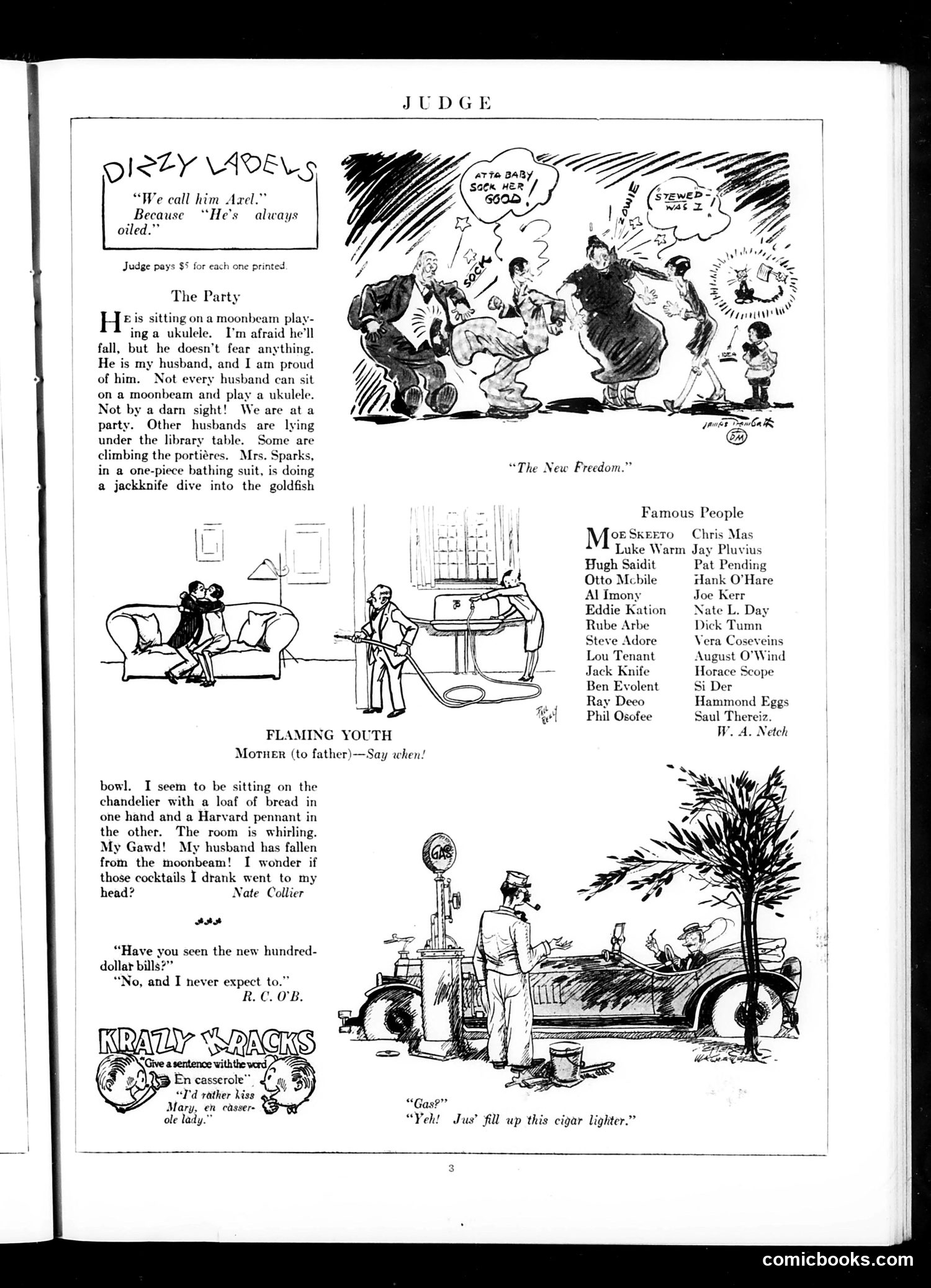
This page contains several satirical humor pieces from Judge magazine, a publication that paid $5 per printed joke. **"The Party"** depicts a chaotic domestic scene where husbands engage in undignified behavior—playing ukulele on moonbeams, climbing curtains, and diving into goldfish bowls—while their wives appear exasperated. The satire mocks the "Flaming Youth" generation's wild behavior and the marital discord it creates. **"Famous People"** is a straightforward list of popular entertainers and performers of the era (names like Chris Mas and Jay Phycius appear to be jokes/puns). **"Gas?"** shows a gas station attendant, likely satirizing either new automobile culture or wartime rationing concerns, though the specific historical context remains unclear from the image alone. The overall tone criticizes young people's recklessness and marital instability during what appears to be the 1920s Jazz Age era.
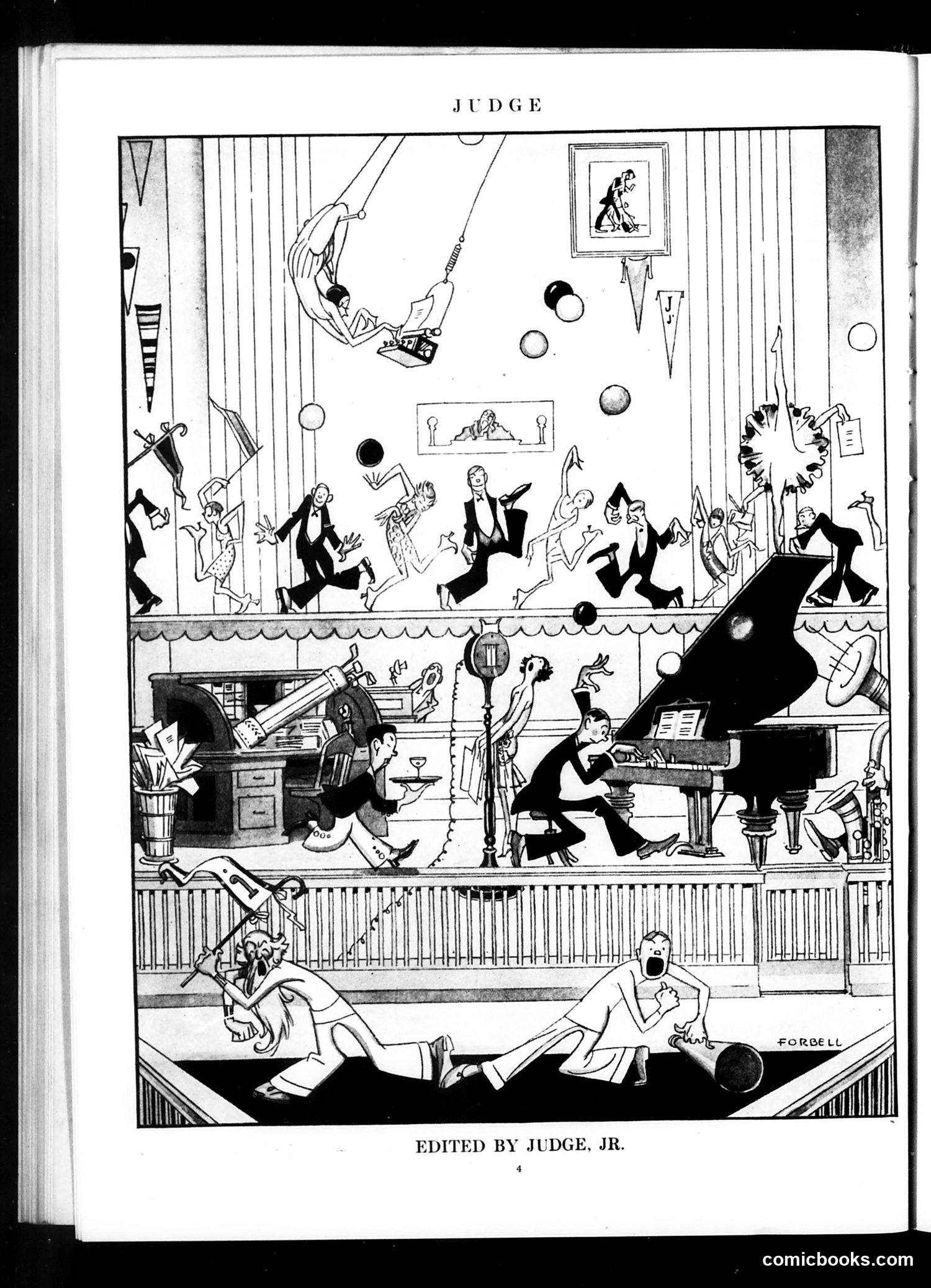
This is a multi-panel satirical illustration titled "Judge" (edited by Judge, Jr.), depicting a courtroom in chaos. The cartoon appears to satirize judicial proceedings or legal incompetence through surreal, comedic imagery. The scene shows three levels: a courtroom with judges and lawyers above, musicians with instruments in the middle section, and two figures wrestling or fighting at the bottom. Various objects—balls, papers, and debris—fly throughout, suggesting complete disorder. The satire likely mocks the legal system's dysfunction, with the intrusion of music and physical chaos symbolizing how justice has become a farce or performance rather than serious proceedings. The specific political or social target remains unclear without additional context about Judge magazine's publication date and contemporary events.
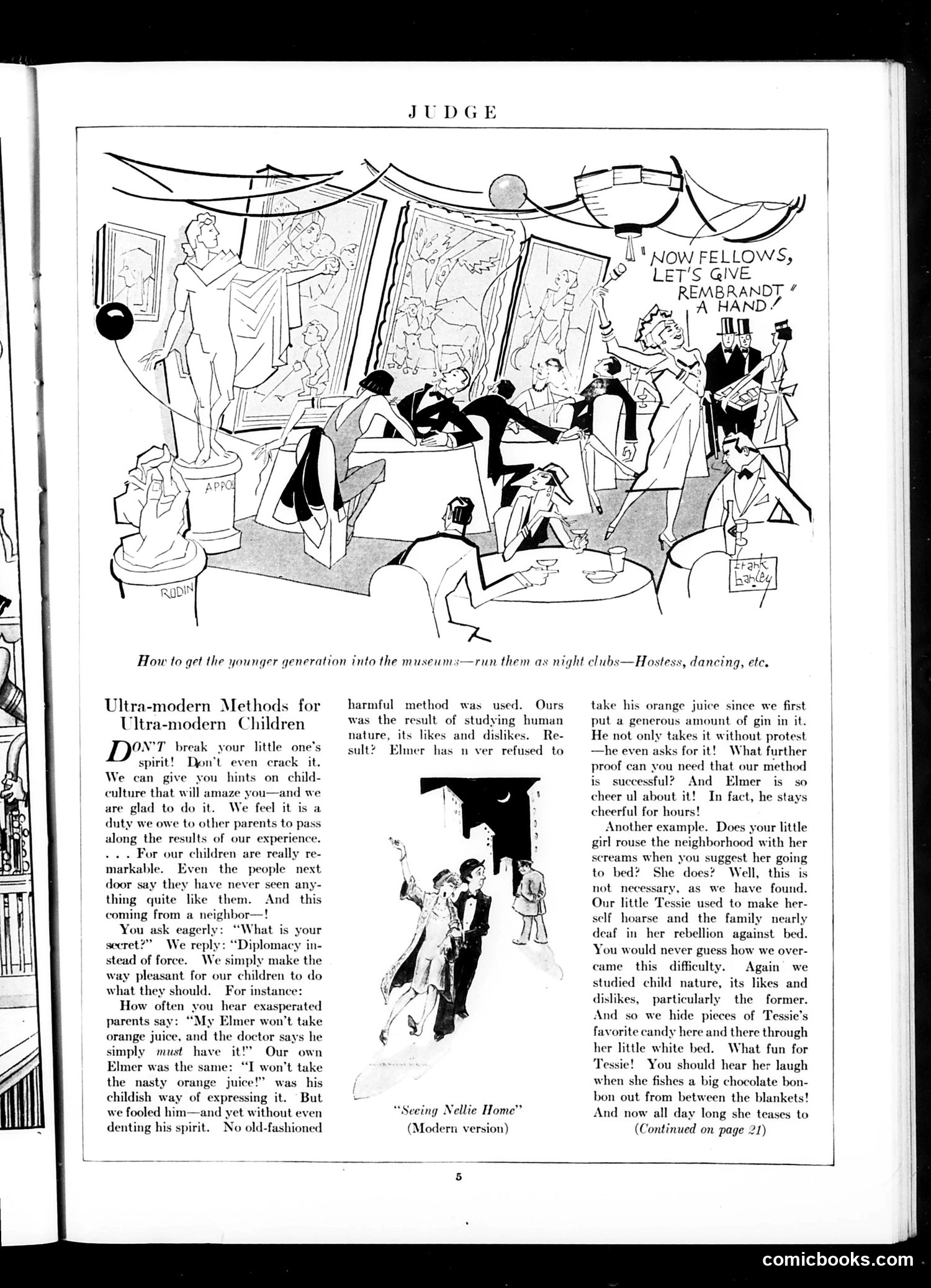
This page satirizes modern parenting methods of the early 20th century. The main cartoon depicts a museum converted into a nightclub—complete with dancing, cocktails, and entertainment—to attract young people to art and culture. The accompanying article, "Ultra-modern Methods for Ultra-modern Children," mocks permissive parenting that avoids discipline. It criticizes parents who indulge children's whims rather than imposing structure. Examples include a boy refusing orange juice (resolved by hiding it in gin) and a girl avoiding bedtime (solved through hiding candy to discover later). The satire targets both trendy parenting philosophies and institutional attempts to make culture "fun" rather than educational. The joke is that coddling children's natural impulses—rather than teaching obedience—produces spoiled, difficult adults.
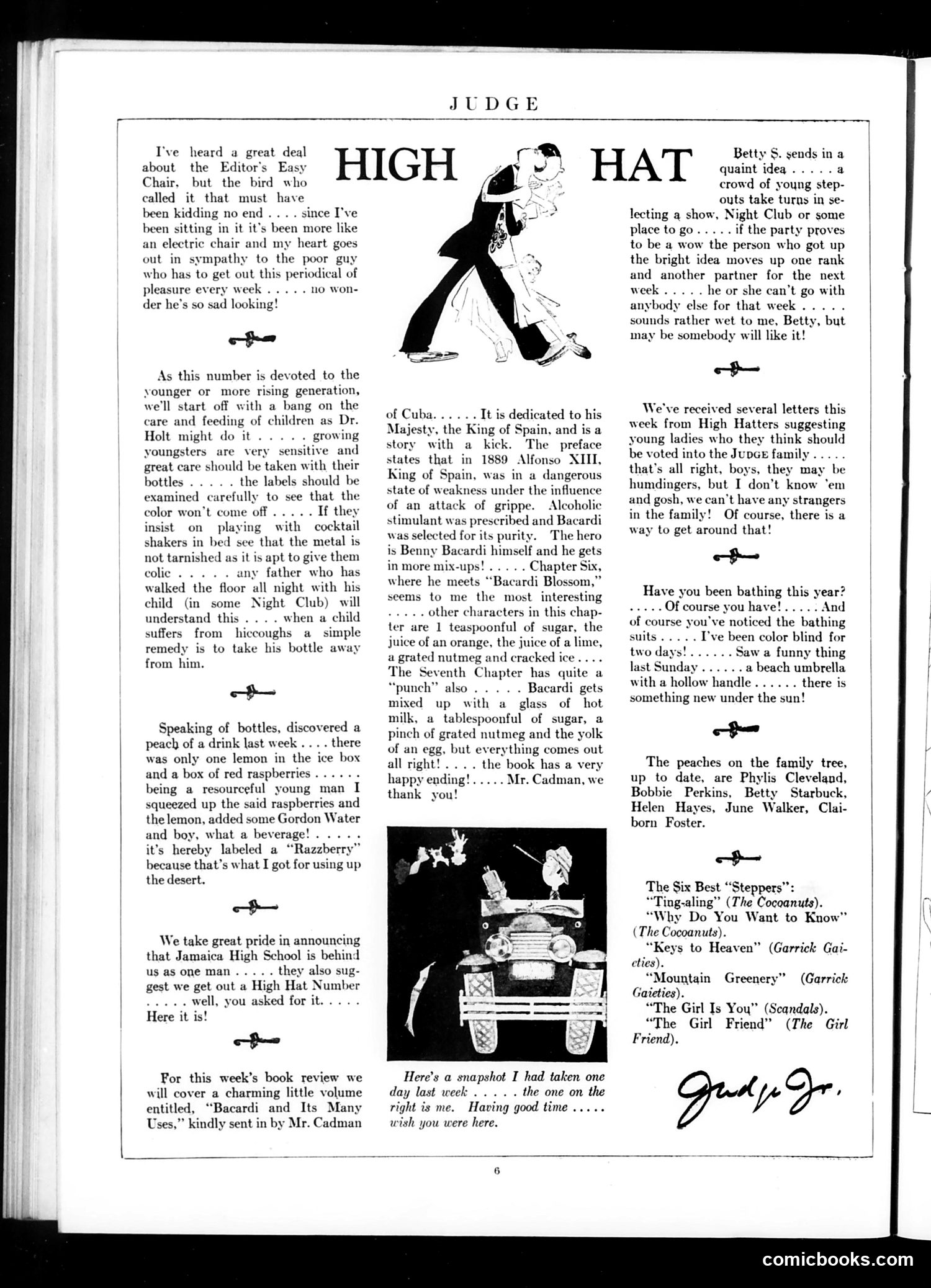
This is a satirical **Editor's Column** page from Judge magazine, likely from the 1920s, devoted to younger readers and social trends. **Main Content:** The "High Hat" column uses humor to critique modern youth culture and parenting. References include: - **Bacardi book satire**: A mock "review" of a drinking guide disguised as a Bacardi history, with chapters listing cocktail ingredients (lemon, orange juice, nutmeg, egg) as if they were characters—poking fun at Prohibition-era drinking culture. - **Parenting critique**: Satirizes sloppy child-care advice, noting hypocritical youth who frequent "Night Clubs" while caring for children. - **"High Hat" society**: Mocks an exclusive social game where young people rank partners based on entertainment choices—targeting adolescent pretension. - **Bathing suit fashion**: Light commentary on new beach fashion and color trends. The overall tone mocks both reckless youth behavior and adults' hand-wringing about the younger generation, using absurdist humor typical of 1920s satirical magazines.
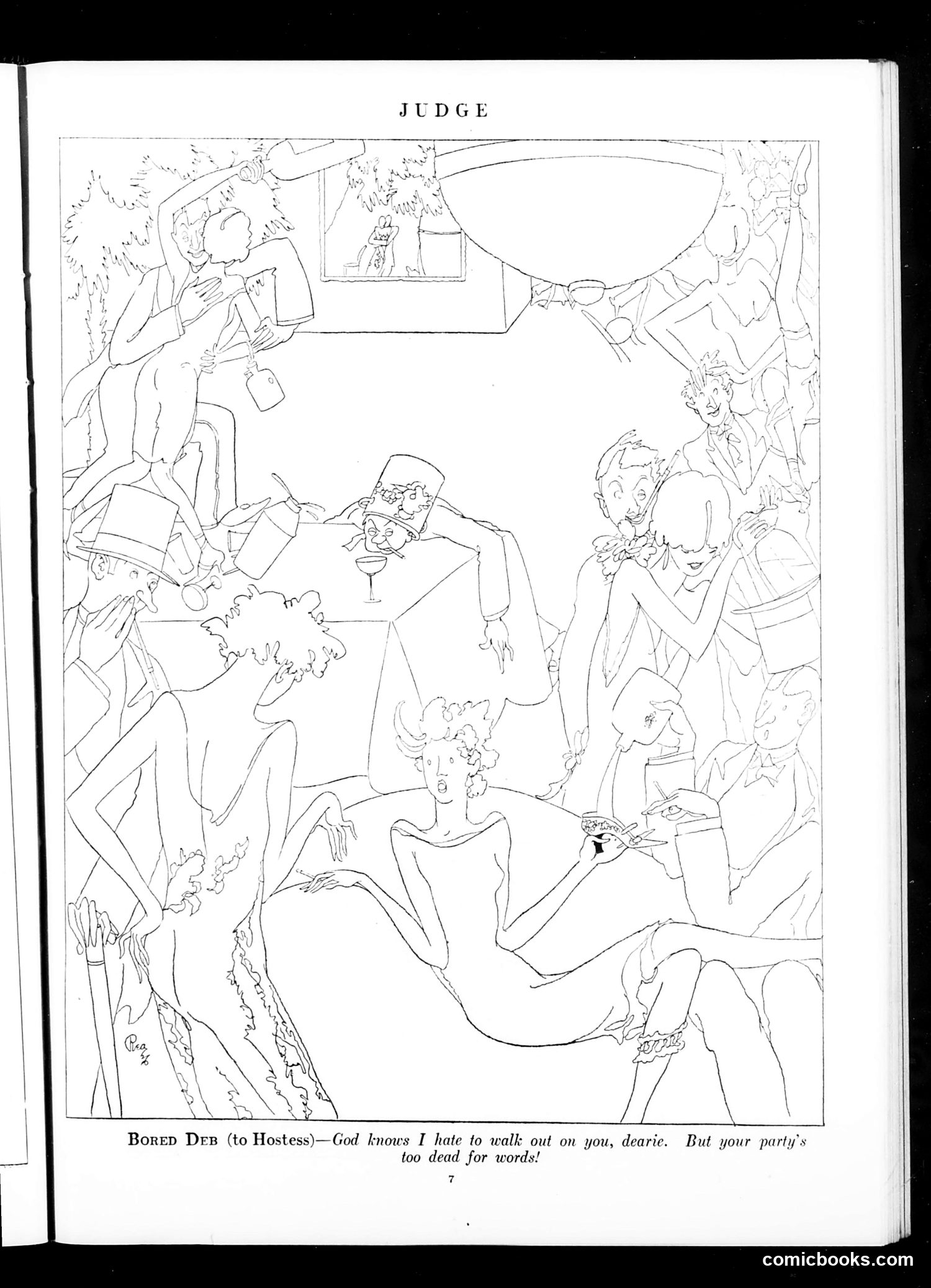
This single-panel cartoon titled "Bored Deb" depicts a social scene at what appears to be a party or gathering. A young woman (the "deb" or debutante) addresses her hostess, expressing her desire to leave while diplomatically claiming the hostess isn't responsible—rather, the party itself is too dull ("too dead for words"). The satire targets upper-class social life, specifically the shallow tedium of debutante society gatherings. The surrounding figures suggest a crowded event that should be lively but feels lifeless. The cartoon mocks both the pretentiousness of such social obligations and the ennui of wealthy young women condemned to attend dreary parties as part of their social duties. The humor relies on the contrast between the ostensibly glamorous debutante world and its actual boring reality.
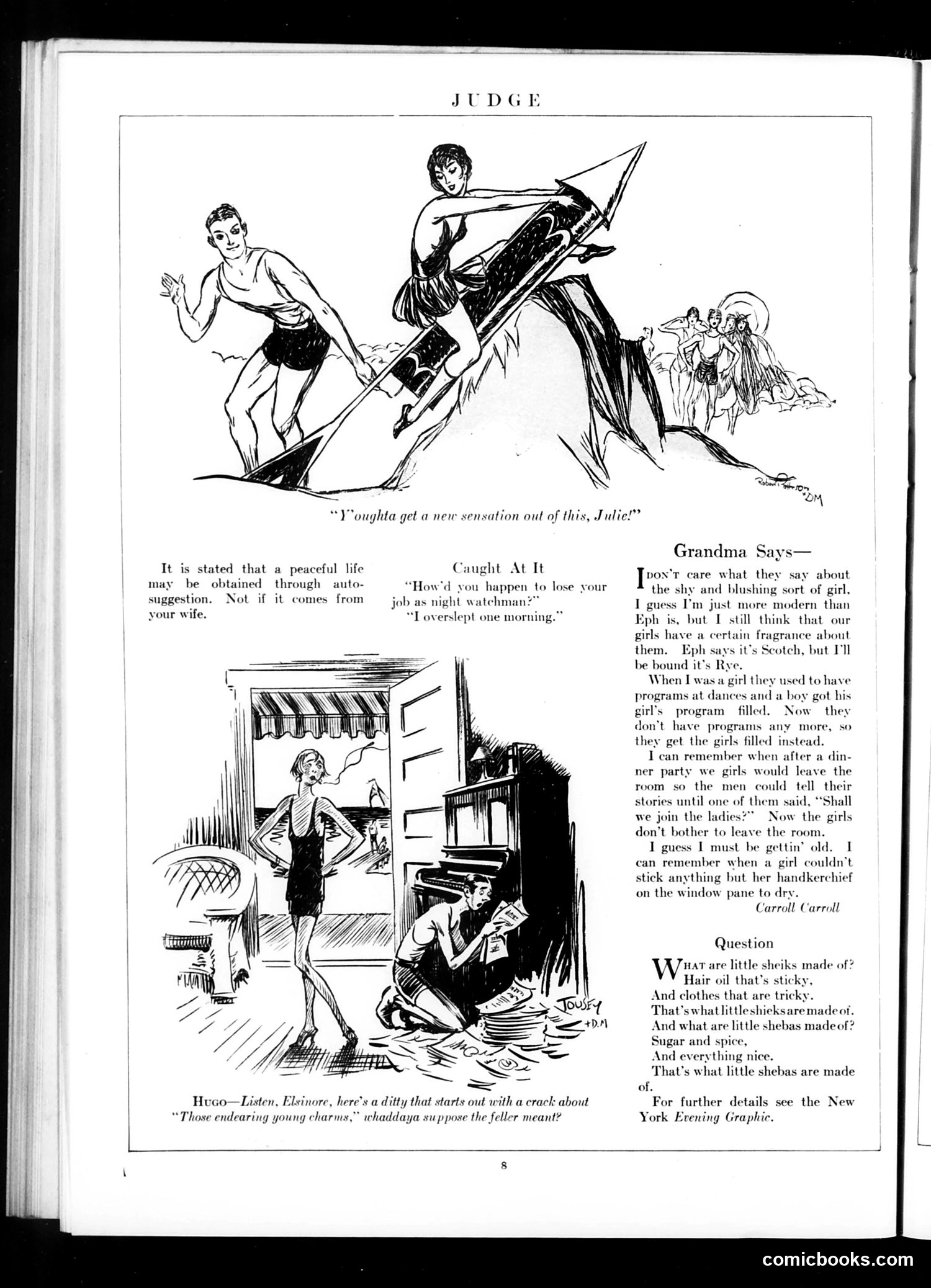
This page contains multiple satirical pieces targeting 1920s social changes and dating customs. **Top cartoon**: A couple engages in reckless behavior (appearing to operate an airplane or vehicle dangerously) while a man watches disapprovingly. The caption satirizes wives who push husbands toward excitement/danger through "auto-suggestion." **Middle cartoon**: Depicts a woman in revealing clothing while a man looks on. The "Caught At It" caption suggests infidelity or impropriety—a common Judge theme mocking modern romance. **"Grandma Says" column**: An elderly woman nostalgically contrasts old social norms with 1920s behavior—girls now get "filled" (drunk) at dances instead of having chaperoned programs; women no longer leave dinner parties to let men tell stories privately. She laments lost propriety. **Poem "Question"**: Mocking contemporary slang terms: "sheiks" (attractive men) and "shebas" (flapper women). The pseudo-nursery rhyme format satirizes how frivolous and commercialized modern youth culture has become. Overall: Judge ridicules Jazz Age permissiveness, dating freedoms, and the decline of Victorian decorum.
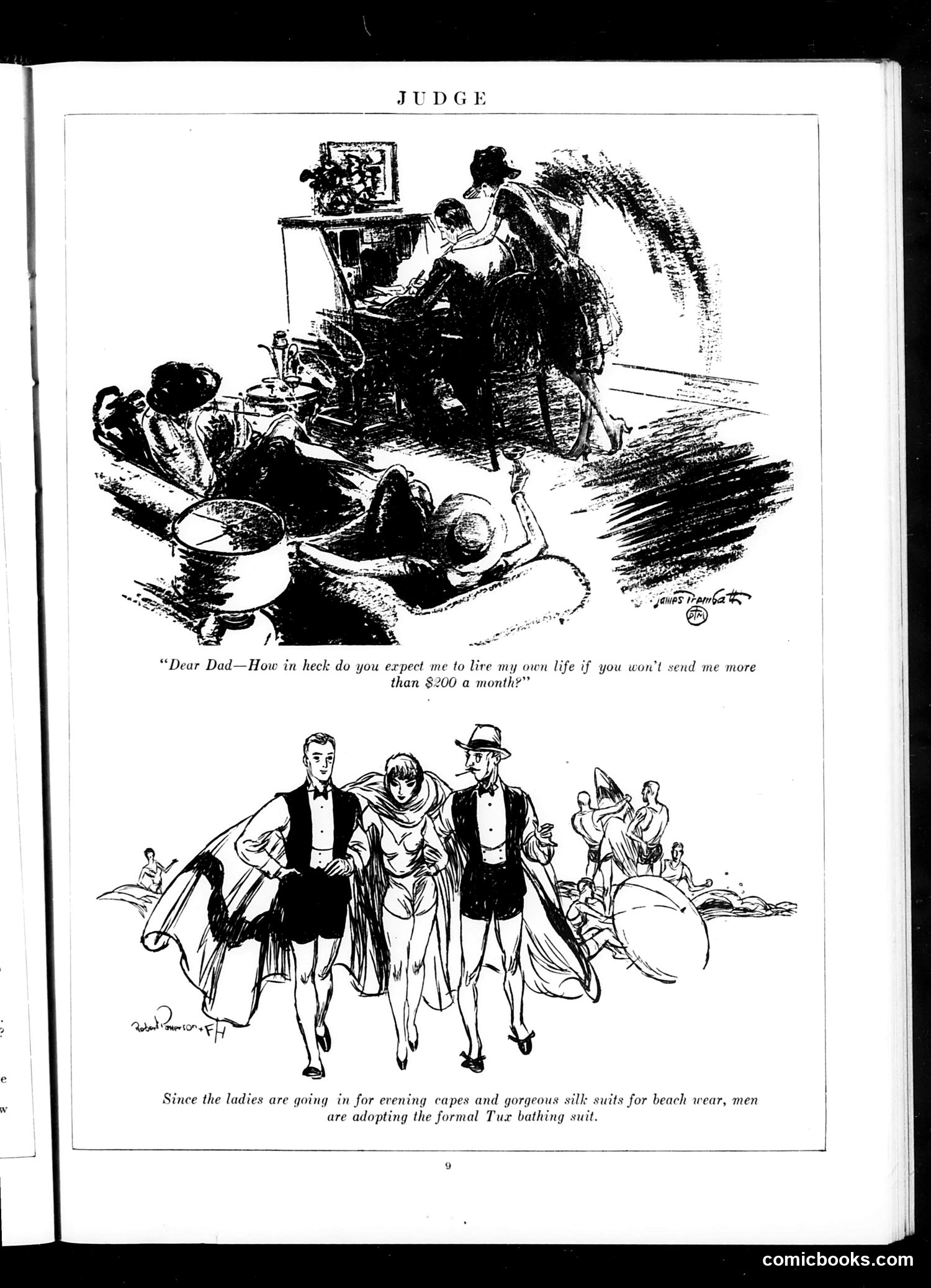
**Top cartoon:** A young person (likely a son or daughter) lounges luxuriously while writing to their father, complaining that $200 monthly allowance is insufficient. The satire mocks entitled youth and parental indulgence during what appears to be the Jazz Age/1920s, when $200 represented substantial income for ordinary workers. **Bottom cartoon:** Mocks fashion trends where women wear elaborate evening capes and silk suits to the beach. The joke suggests men are absurdly responding by wearing formal tuxedo bathing suits—satirizing how ridiculous it is when fashion logic becomes inverted or when formality invades casual settings. Both cartoons critique the era's consumer culture and fashion excess among the wealthy leisure class.
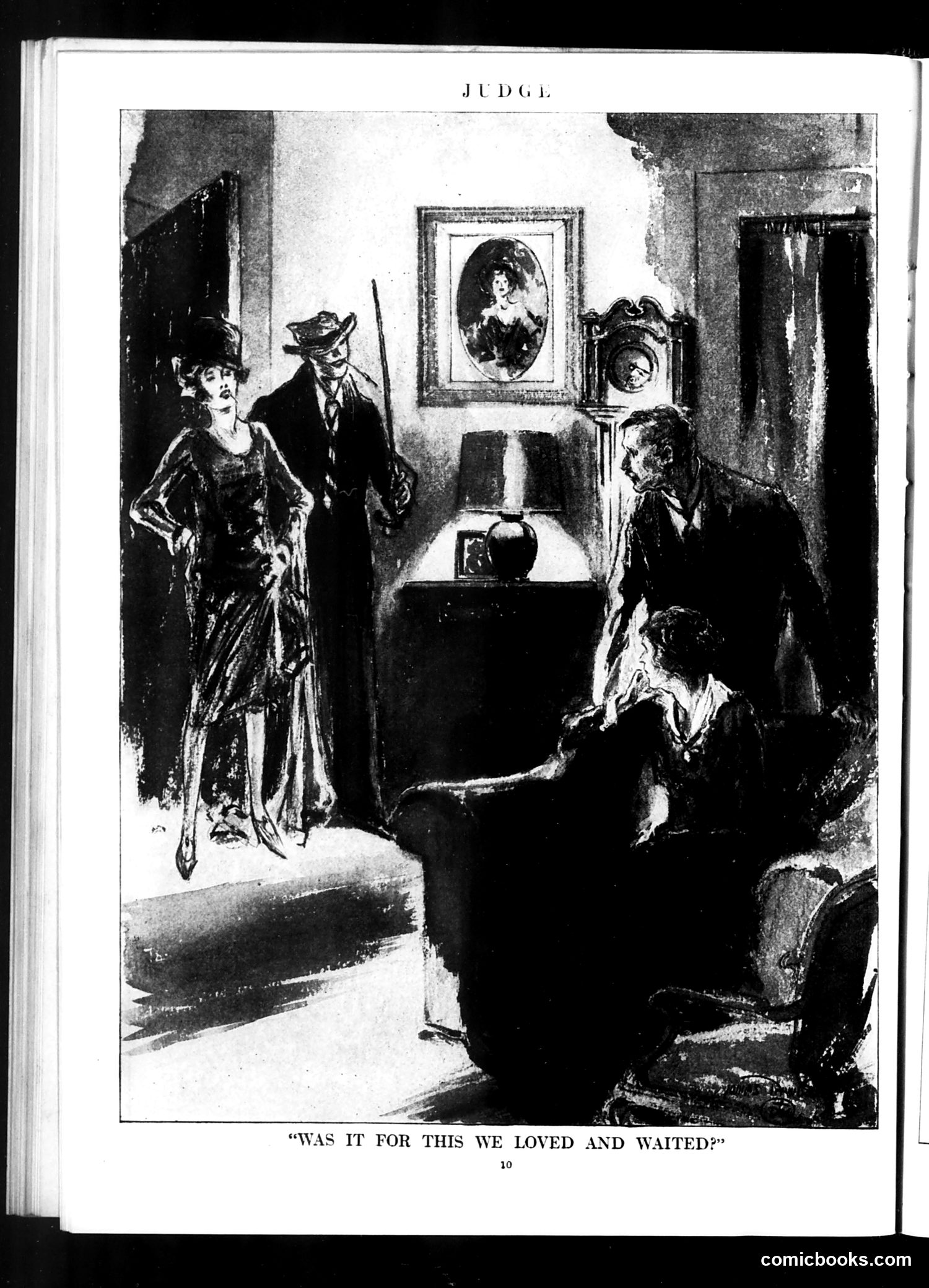
This illustration depicts a domestic drama scene, likely from the early 20th century. A well-dressed couple enters a modest interior while two seated figures—appearing distressed or disappointed—react with the caption "Was It For This We Loved and Waited?" The satire appears to address disappointed expectations in marriage or romantic relationships. The contrast between the standing couple's refined appearance and the seated figures' dejection suggests a commentary on how reality fails to meet romantic ideals. The caption's rhetorical question implies that whatever the seated figures anticipated from their relationship has not materialized. Without additional context, the specific social or political reference remains unclear, though the scene's domestic setting and the figures' class markers suggest commentary on courtship, marriage prospects, or social aspirations of the era.
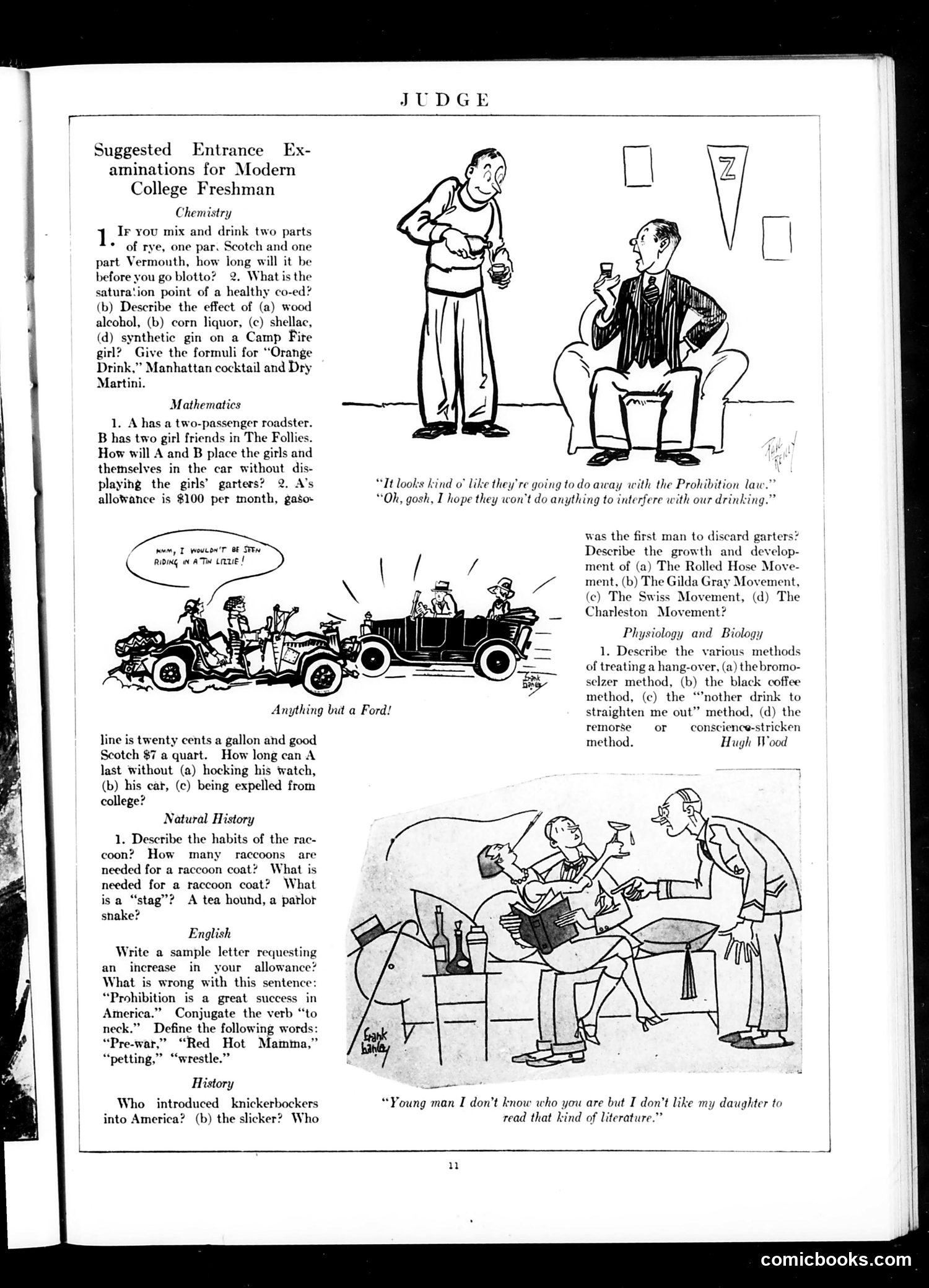
This page satirizes 1920s college life during Prohibition, presenting mock "entrance exams" that expose the era's contradictions. The humor lies in treating illegal or scandalous behavior as legitimate academic subjects. The exams mock students' preoccupation with alcohol (mixing cocktails, calculating hangovers), sexual behavior (garter-displaying math problems, necking definitions), and fashion trends (the Charleston, rolled hose movement). The cartoons reinforce this: one shows two men discussing Prohibition's repeal while hoping it won't "interfere with our drinking"—highlighting the hypocrisy of enforcing laws many ignored. Another depicts a father objecting to his daughter's "literature," suggesting generational anxiety about youth morality. The "Anything but a Ford!" caption reflects class consciousness—expensive automobiles as status symbols among privileged college students. Overall, Judge critiques both youth excess and adult hypocrisy during the Prohibition era, when illegal drinking was widespread despite legal prohibition.
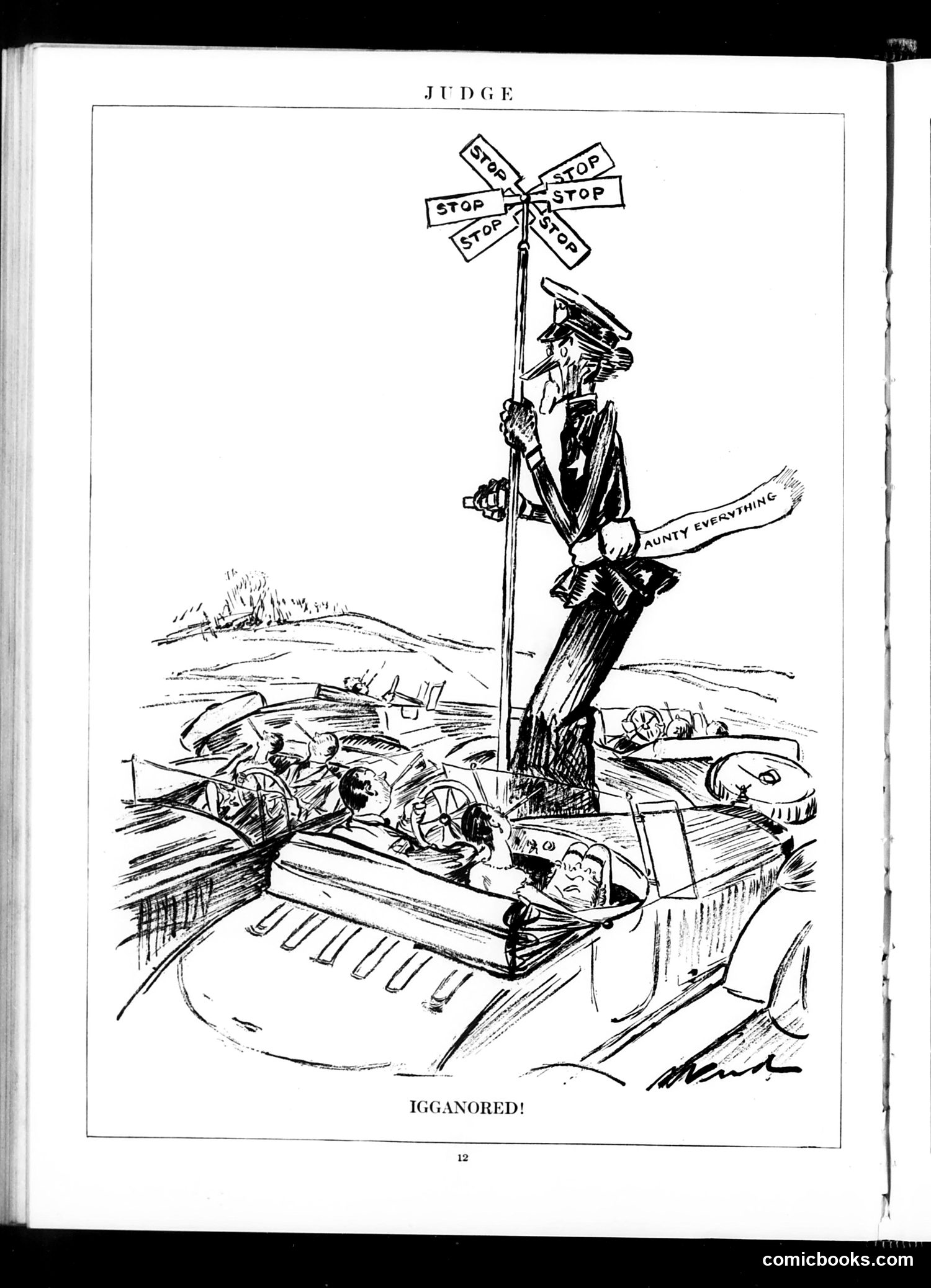
This political cartoon depicts a figure in judicial robes standing atop a pole marked with multiple "STOP" signs, holding a sign reading "AUNTY EVERYTHING." Below, crashed vehicles and debris surround the base, with people appearing to ignore the judicial figure's warnings. The satire appears to criticize the judiciary's inability to enforce traffic safety or legal authority—motorists are literally ignoring the judge's stop signs, resulting in vehicular chaos. The title "Igganored" (ignored) makes this explicit. The cartoon likely critiques judicial ineffectiveness during a period when traffic safety was becoming a public concern, suggesting that judicial authority alone cannot compel public compliance without enforcement mechanisms. The "Aunty Everything" label remains unclear but may reference paternalistic government regulation.
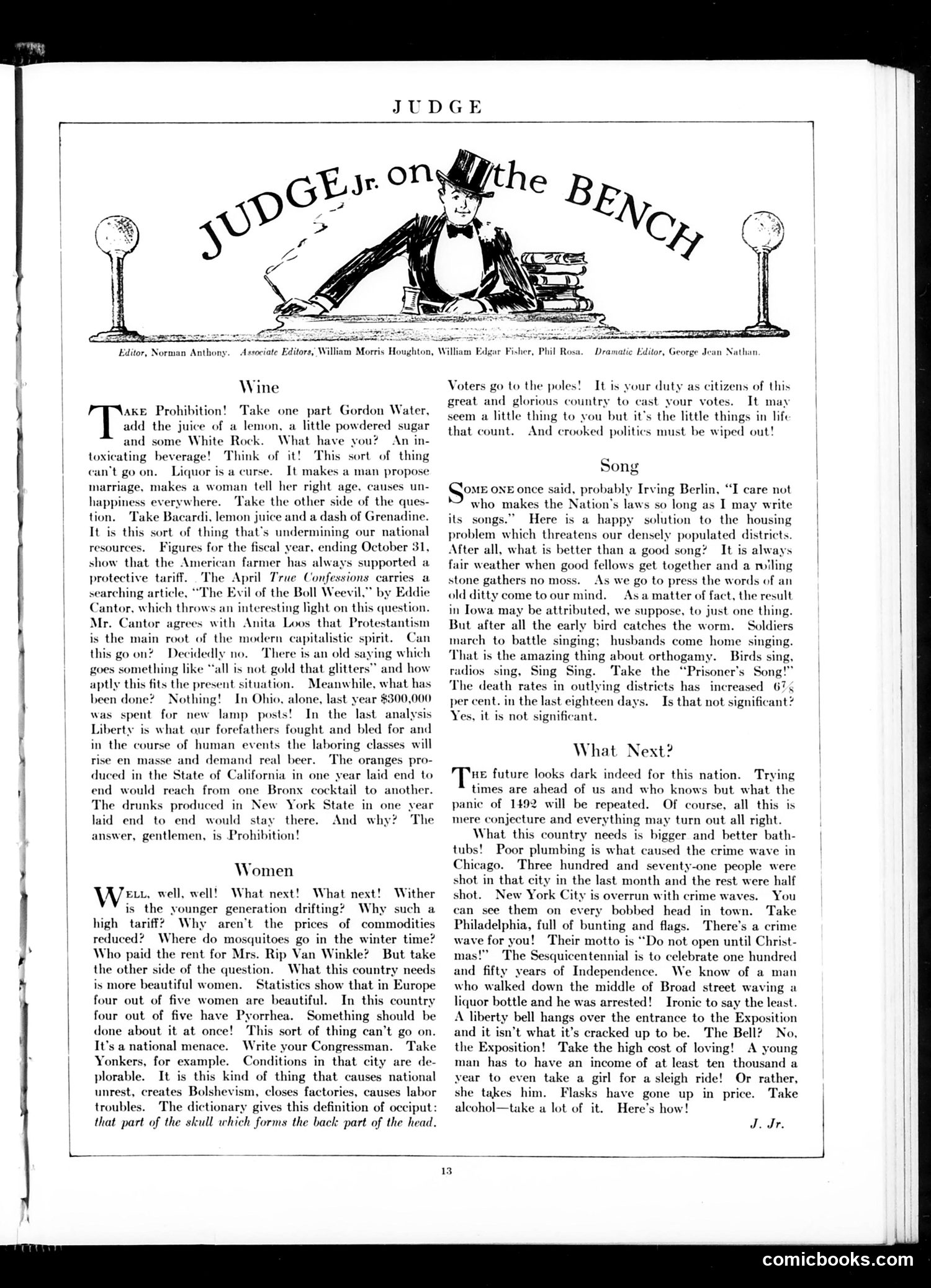
This is a satirical commentary column disguised as absurdist rambling. The page mocks American social and political concerns circa Prohibition era through deliberately nonsensical arguments. The "Wine" section sarcastically defends Prohibition by listing absurd consequences of alcohol (proposals, lying about age), then contradicts itself by listing cocktail recipes, suggesting the law is unenforceable and hypocritical. The "Women" section similarly ridicules contemporary debates about tariffs, female beauty standards, and social decay by non-sequiturs—jumping from women's appearance to Pyorrhea (gum disease) to blaming Yonkers conditions on "Bolshevism." The "Song" and "What Next?" sections continue this scattershot style, sarcastically connecting unrelated problems (housing, crime waves, the Sesquicentennial celebration) to vague moral decay while offering no real solutions. The overall effect mocks how politicians and commentators addressed national problems through disconnected rhetoric and false causation.
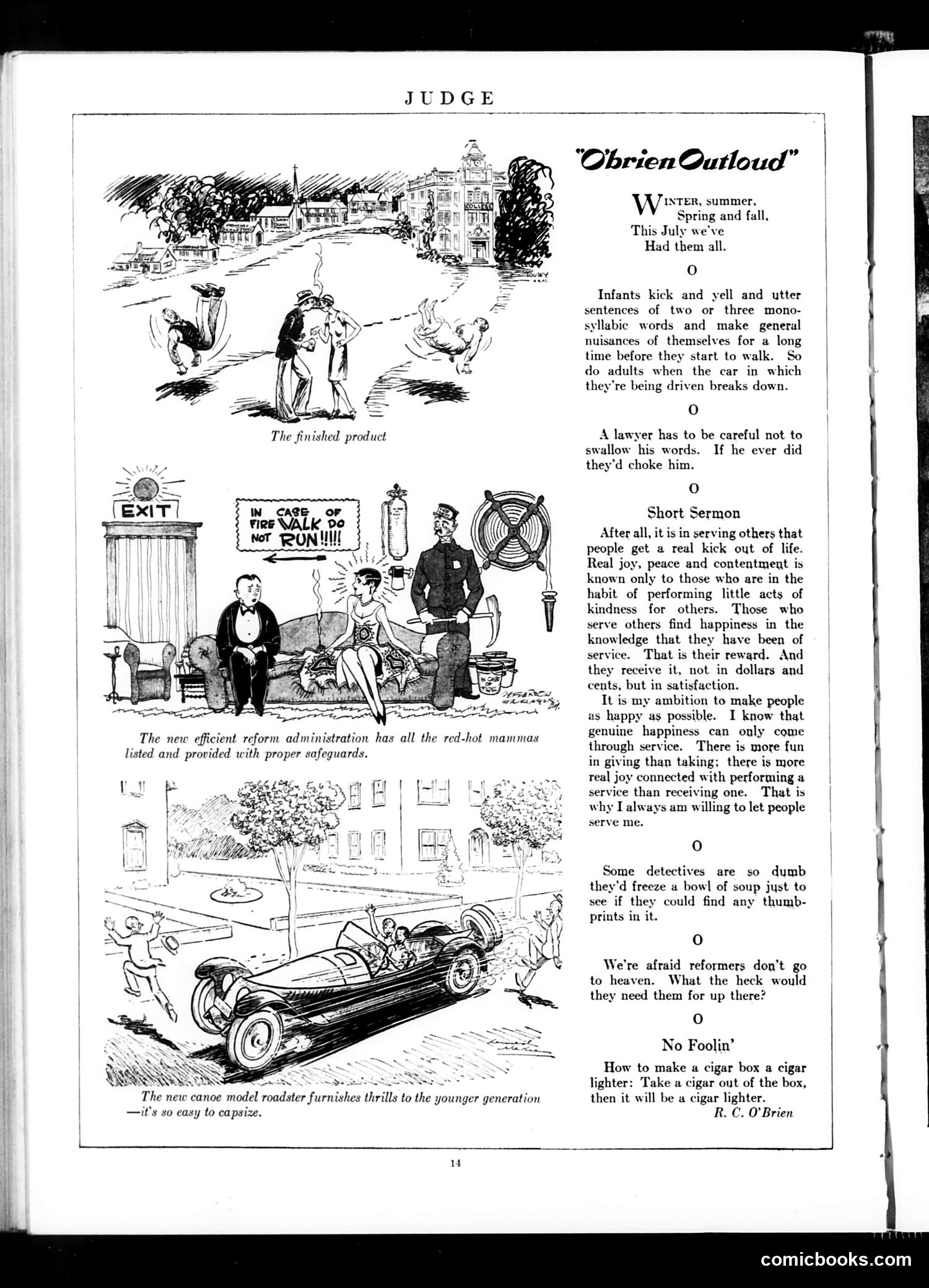
This Judge magazine page combines satirical cartoons with humorous commentary. The top cartoon mocks a "reform administration" by showing it has catalogued "red-hot mammas" (attractive women) with "safeguards"—suggesting reformers are hypocritically regulating vice while being distracted by women themselves. The middle cartoon jokes about a new "canoe model roadster" car that's easy to capsize, satirizing automobile design trends that prioritize novelty over safety for young drivers. The "O'Brien Outloud" column offers brief satirical quips: comparing infants' tantrums to adults complaining when cars break down; mocking lawyers who "swallow their words"; warning that reformers won't reach heaven (since there's nothing to reform there); and a pun about removing a cigar from a box to make it "lighter." The overall theme targets reform movements and modern consumer culture, suggesting reformers are self-righteous while society embraces frivolous, unsafe trends.
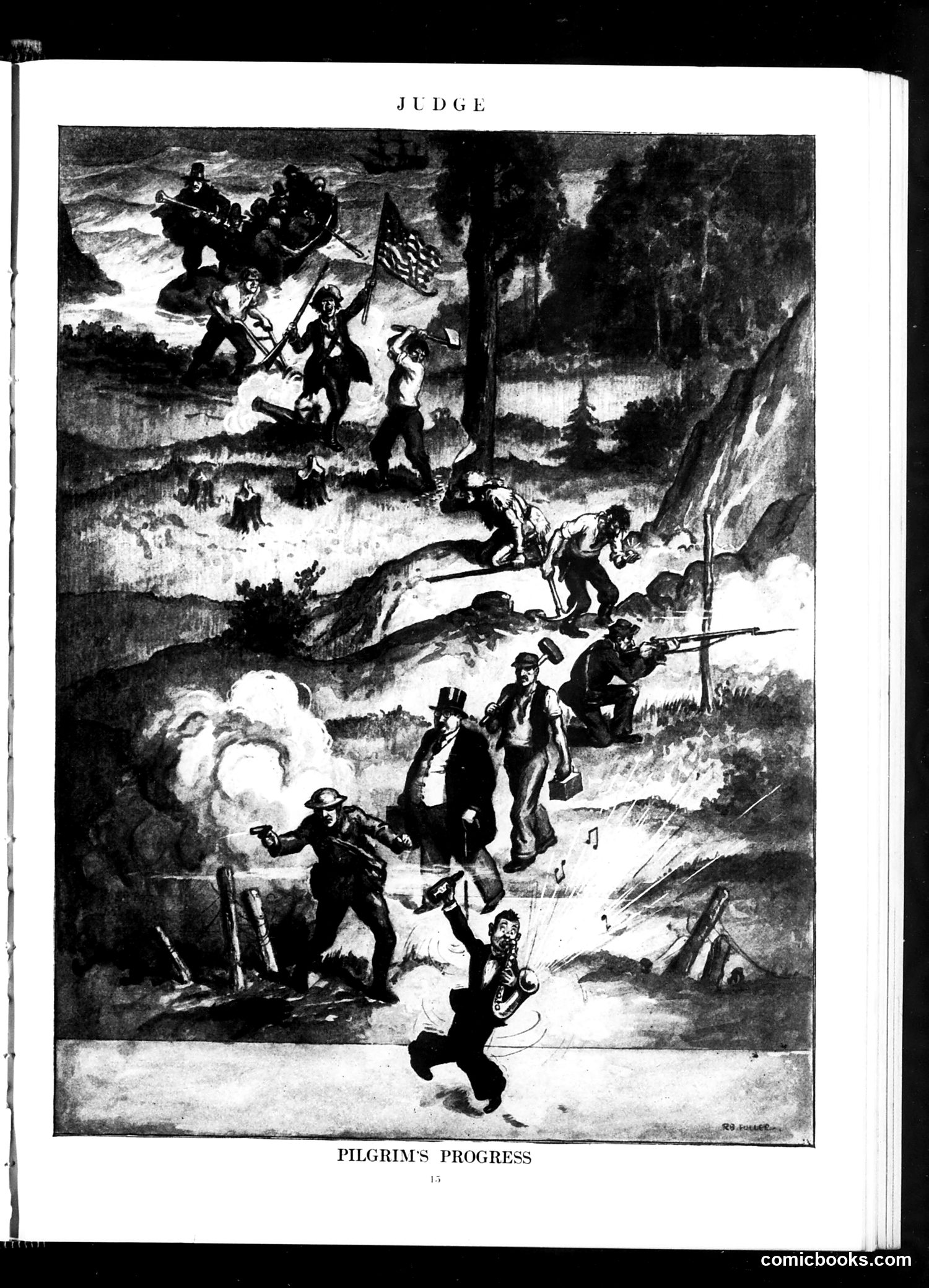
This illustration is titled "Pilgrim's Progress," referencing John Bunyan's famous 1678 allegory about a Christian's spiritual journey through trials and temptations. The satire appears to depict a figure (likely representing an ordinary citizen or reformer) navigating through various obstacles and hostile forces. The composition shows: - A central struggling figure at bottom - Armed figures blocking the path above - Water/difficult terrain representing hardship - What appears to be authorities or antagonistic forces throughout Without clearer visual identification of specific characters or knowledge of the publication date, the exact political reference remains unclear. However, the cartoon likely satirizes some contemporary social struggle—possibly labor disputes, political reform efforts, or religious controversy—by mapping it onto Bunyan's spiritual journey metaphor. The "progress" is clearly arduous and opposed.
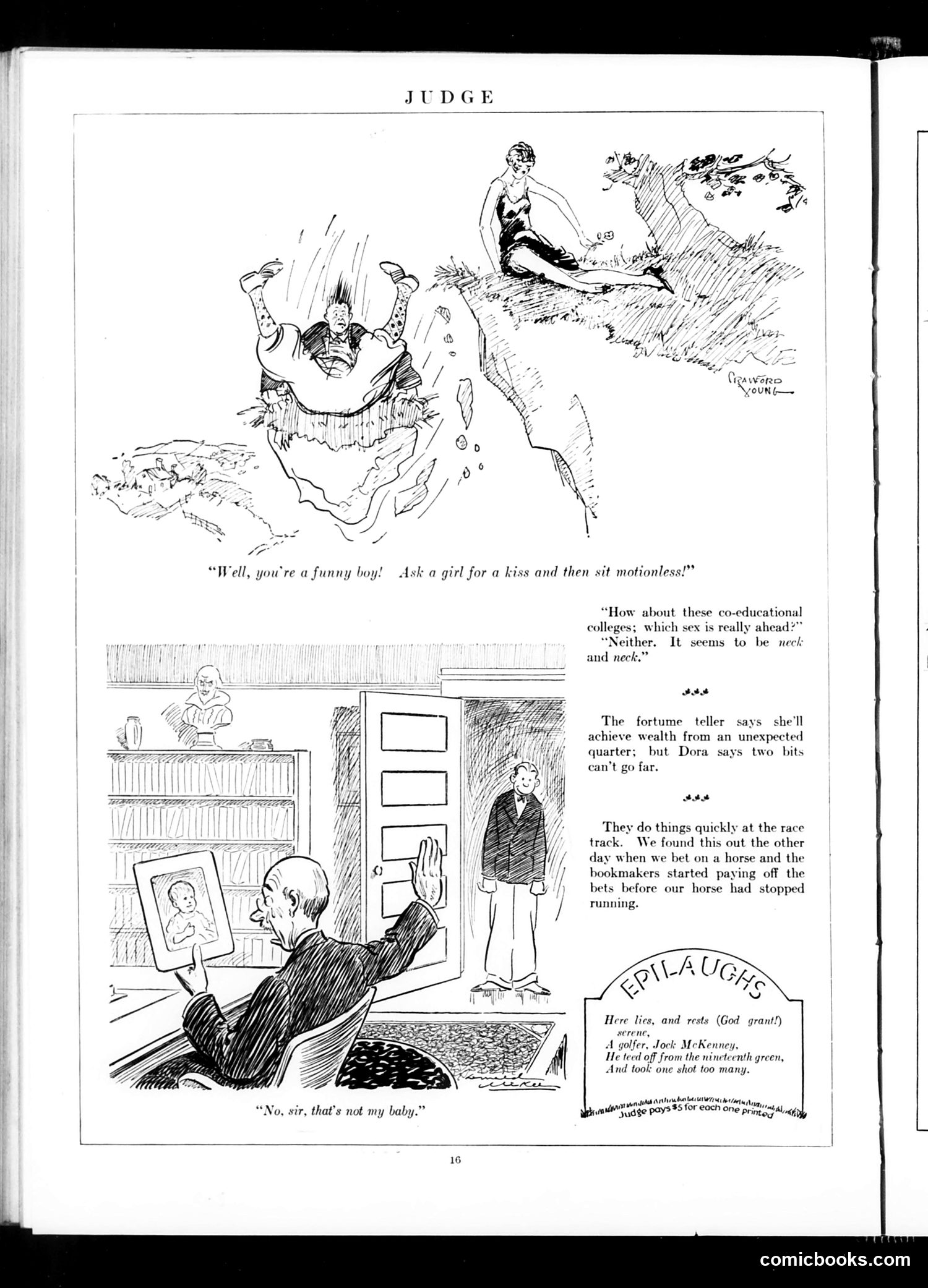
This page contains three unrelated humorous sketches typical of early 20th-century satirical magazines: 1. **Top cartoon**: A young man literally sits motionless after kissing a girl—mocking men who become paralyzed or lose composure around women. 2. **Middle section**: A dialogue joke about co-educational colleges where neither sex has an advantage ("neck and neck"), likely referencing contemporary anxiety about women's education and changing gender dynamics. 3. **Bottom left cartoon**: A man shows a portrait to someone at a door, claiming "that's not my baby"—a domestic humor joke playing on paternity doubts. 4. **Right sidebar**: Includes brief quips about fortune tellers, racetrack betting speed, and an epitaph for golfer "Jock McKenney" who "took one shot too many"—dark humor about golf excess. The page reflects period concerns: courtship awkwardness, women's education, infidelity humor, and leisure activities. The style and content are typical Judge magazine filler material.
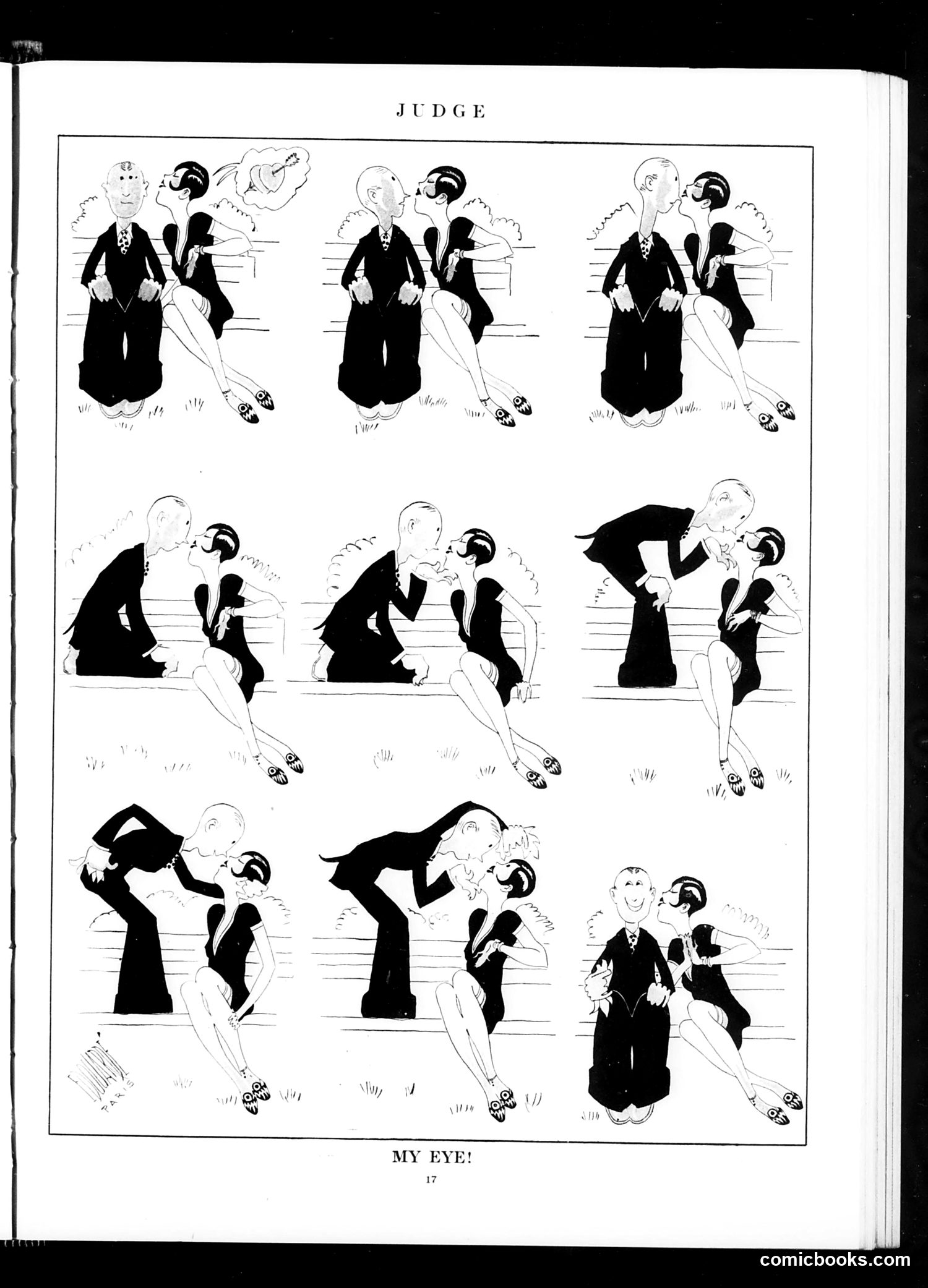
This comic strip titled "My Eye!" depicts a series of interactions between a stern-faced judge (in robes) and a flirtatious woman in increasingly suggestive poses. The progression shows the woman gradually seducing or distracting the judge through physical charm and proximity, culminating in her embracing him. The satire targets judicial impartiality and corruption—suggesting that judges can be swayed from their duties by personal attraction or manipulation. It's a commentary on the vulnerability of authority figures to improper influence, presented here as dark humor. The "My Eye!" caption suggests skepticism about judicial objectivity or fairness. This reflects early 20th-century concerns about whether supposedly impartial legal authority could truly remain untainted by outside pressure or personal weakness.
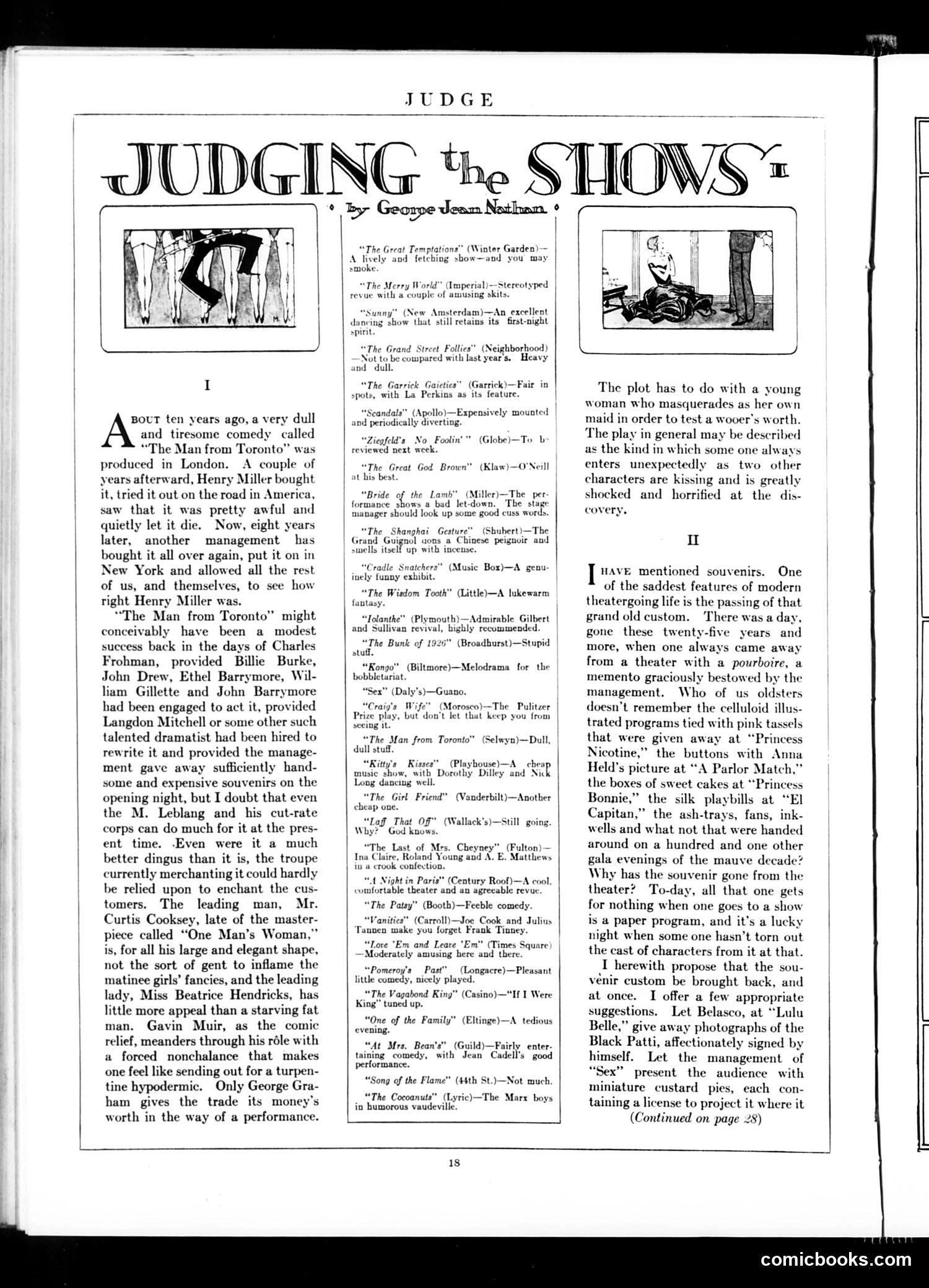
This is a theater review column by George Jean Nathan, a prominent drama critic of the 1920s. The page contains his sharp critiques of current Broadway productions. The main article ridicules "The Man from Toronto," a recycled British comedy that failed repeatedly—first in London, then dismissed by Henry Miller in America years earlier. Nathan sarcastically notes that even star power (he mentions Charles Frohman's era stars like Billie Burke and John Drew) couldn't have saved it. He particularly mocks the current cast: Curtis Cooksey (the leading man) and Beatrice Hendricks (the leading lady) as uninspiring, with only George Graham delivering adequate performance. The right column lists brief reviews of other Broadway shows—some praised ("The Great God Brown"), others dismissed as derivative ("Scandals," "Kongo"). Nathan's tone throughout is caustic, using phrases like "stupid," "dull," and "Guano" to describe mediocre productions. This reflects 1920s theater criticism's expectation of quality on Broadway.
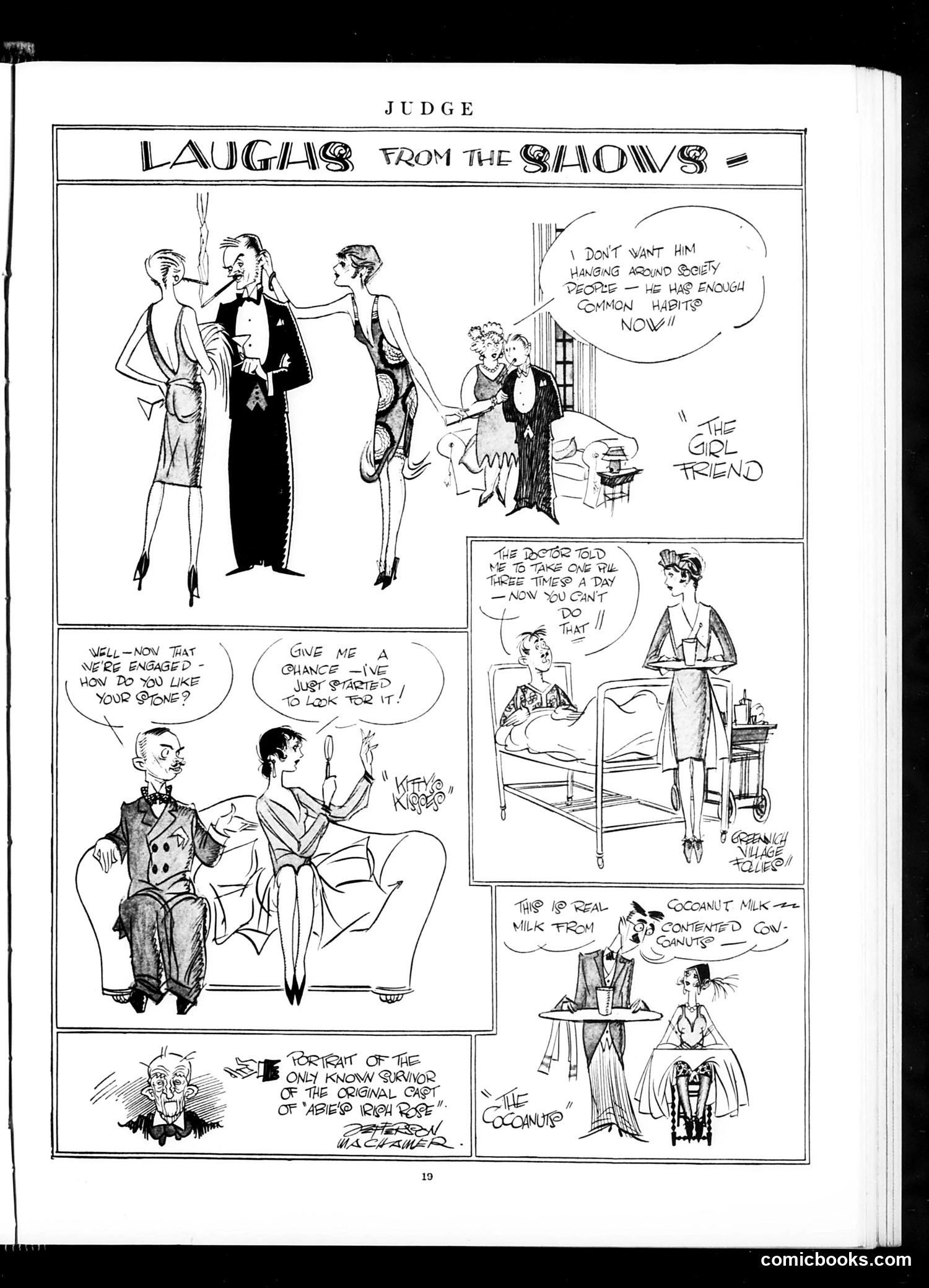
This page from *Judge* comprises several connected comedic sketches satirizing dating and courtship customs of the era (appears to be 1920s-30s based on style). The main narrative follows an engaged couple: a woman introduces her fiancé to society friends, but he has "common habits"—he takes pills three times daily. A doctor advised this regimen, limiting his social acceptability. Subsequent panels show courtship interactions: the man proposing, a couple discussing engagement, a doctor's prescription joke, and a final gag about "coconut milk" made from "contented cows"—likely mocking health fads and dubious patent medicines popular then. The satire targets both overconcern with social propriety and the era's obsession with health tonics and dietary trends. The "The Coconut" credit suggests this references a specific theatrical production or cultural reference now unclear.
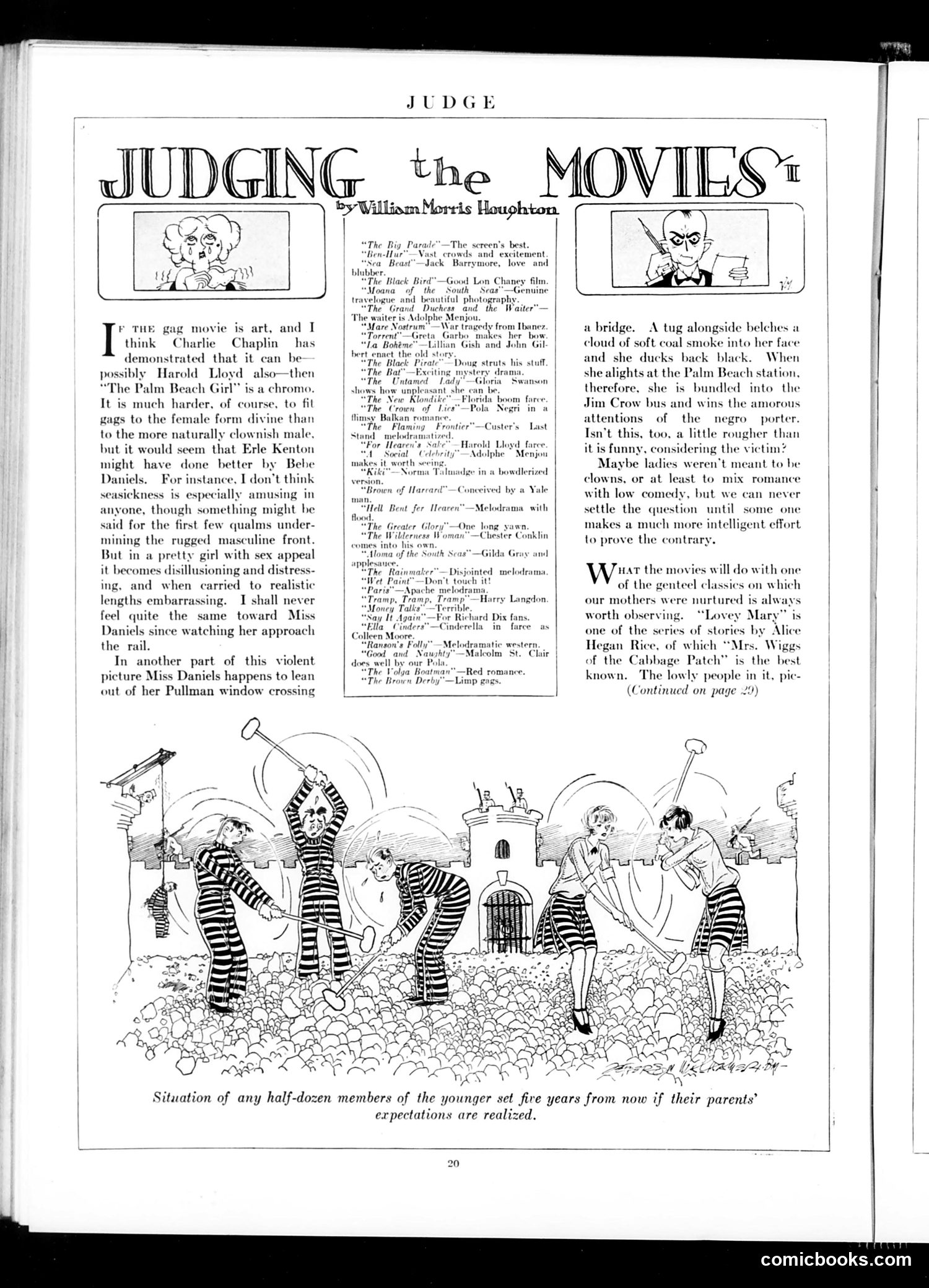
This is a film review column by William Morris Houghton critiquing contemporary movies, with satirical commentary on actress Bebe Daniels' comedic performance in what appears to be "The Palm Beach Girl." **The Main Satire:** Houghton argues that while slapstick works for male comedians like Charlie Chaplin and Harold Lloyd, it fails when applied to pretty actresses like Daniels. He finds her physical comedy "disillusioning and distressing" because it conflicts with romantic appeal—audiences can't reconcile her as both a sex symbol and a clown. **The Bottom Cartoon:** The illustration shows flappers in 1920s striped prison garb (a visual pun on "jailbirds"), captioned as the "situation" young women face if parental expectations about marriage and social behavior aren't met—suggesting anxieties about modern youth and changing gender roles. **Historical Context:** This reflects 1920s debates over women's evolving roles: career, comedy, independence versus traditional femininity.
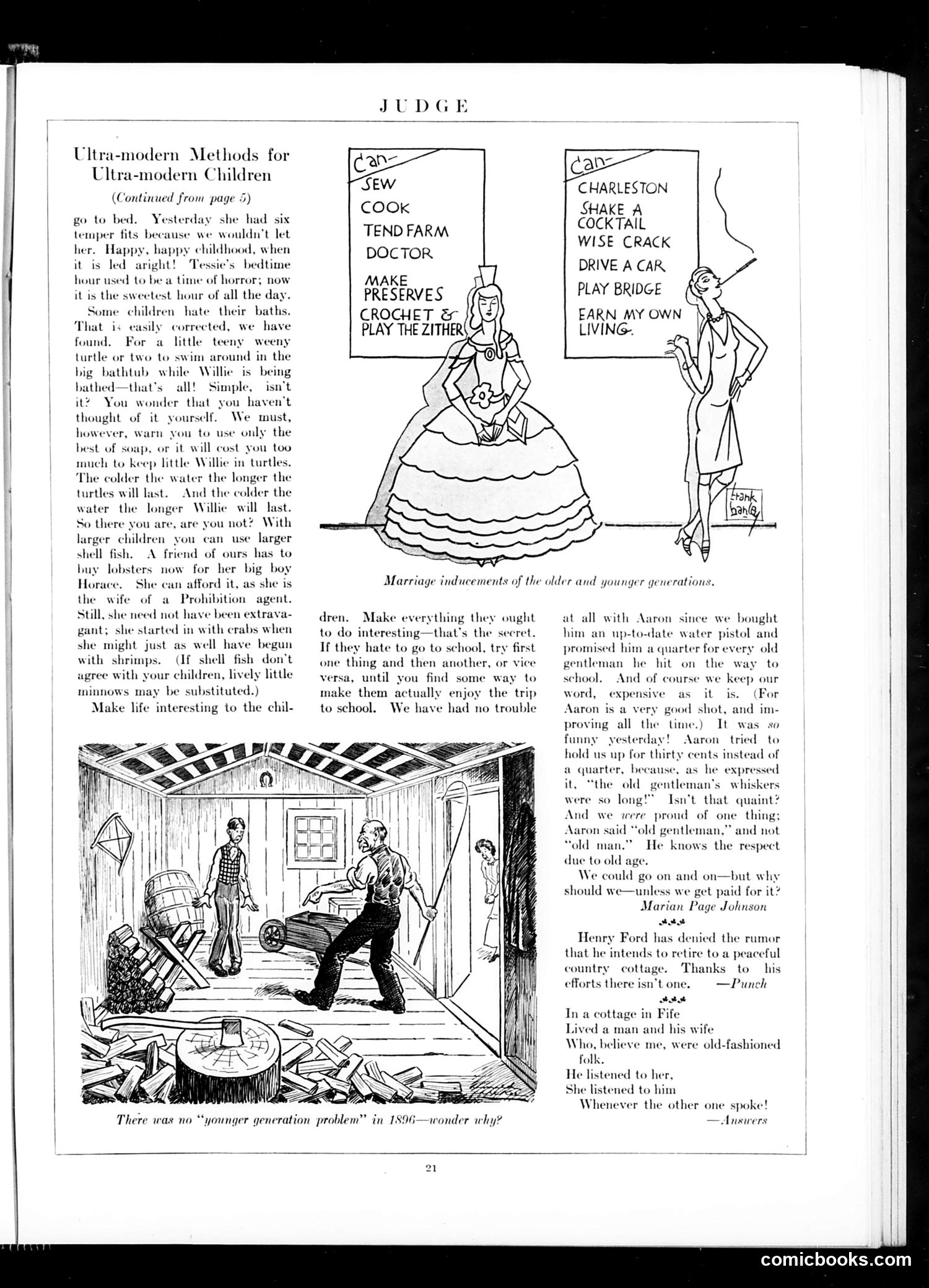
This page satirizes changing gender roles and generational expectations in early 20th-century America. The two cartoon panels labeled "Marriage inducements of the older and younger generations" contrast what women were expected to want: **Left panel (older generation):** Lists traditional domestic duties—cooking, farm work, doctoring, making preserves, needlework. **Right panel (younger generation):** Shows a flapper-style woman listing modern ambitions—driving cars, playing bridge, earning her own living, drinking cocktails, making wisecracks. The satire critiques the "modern woman" of the Jazz Age as rejecting domesticity for independence and frivolity. The article above mocks permissive "ultra-modern" parenting methods (letting children have pet turtles during baths, rewarding them for hitting elderly men with water pistols), treating the era's loosening social standards as absurd. The page overall expresses anxiety about rapid social change—both in child-rearing and women's roles—presenting modernism as ridiculous rather than progressive.
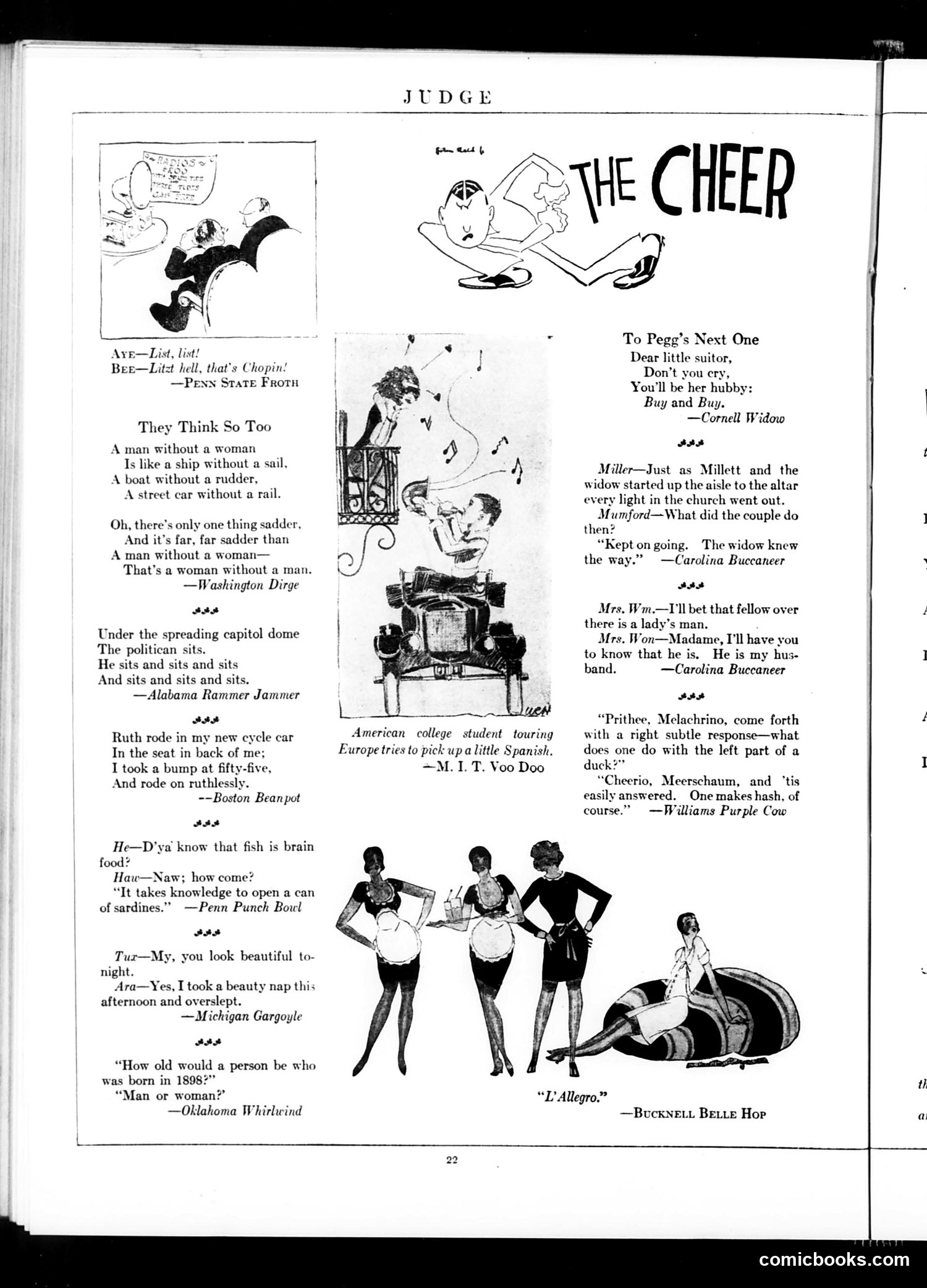
This is a humor anthology page from Judge magazine, featuring jokes and satirical commentary sourced from college humor publications (MIT Voo Doo, Penn Punch Bowl, etc.). **Key content:** The cartoons mock early 1900s social conventions: gender relations, courtship, and modern technology (automobiles, electric lights). Notable jokes include wordplay about sardine cans requiring "knowledge" to open, and a widow conducting her wedding in the dark—implying her experience made the ceremony routine. Another compares men and women as essential pairs, suggesting incompleteness without romance. The "L'Allegro" illustration shows flappers—women in modern, scandalously short skirts—reflecting 1920s anxieties about changing female fashion and independence. The page satirizes collegiate life, romantic mishaps, and gender dynamics typical of American undergraduate humor magazines of this era. No specific political figures are identifiable; the satire targets universal social foibles rather than current events.
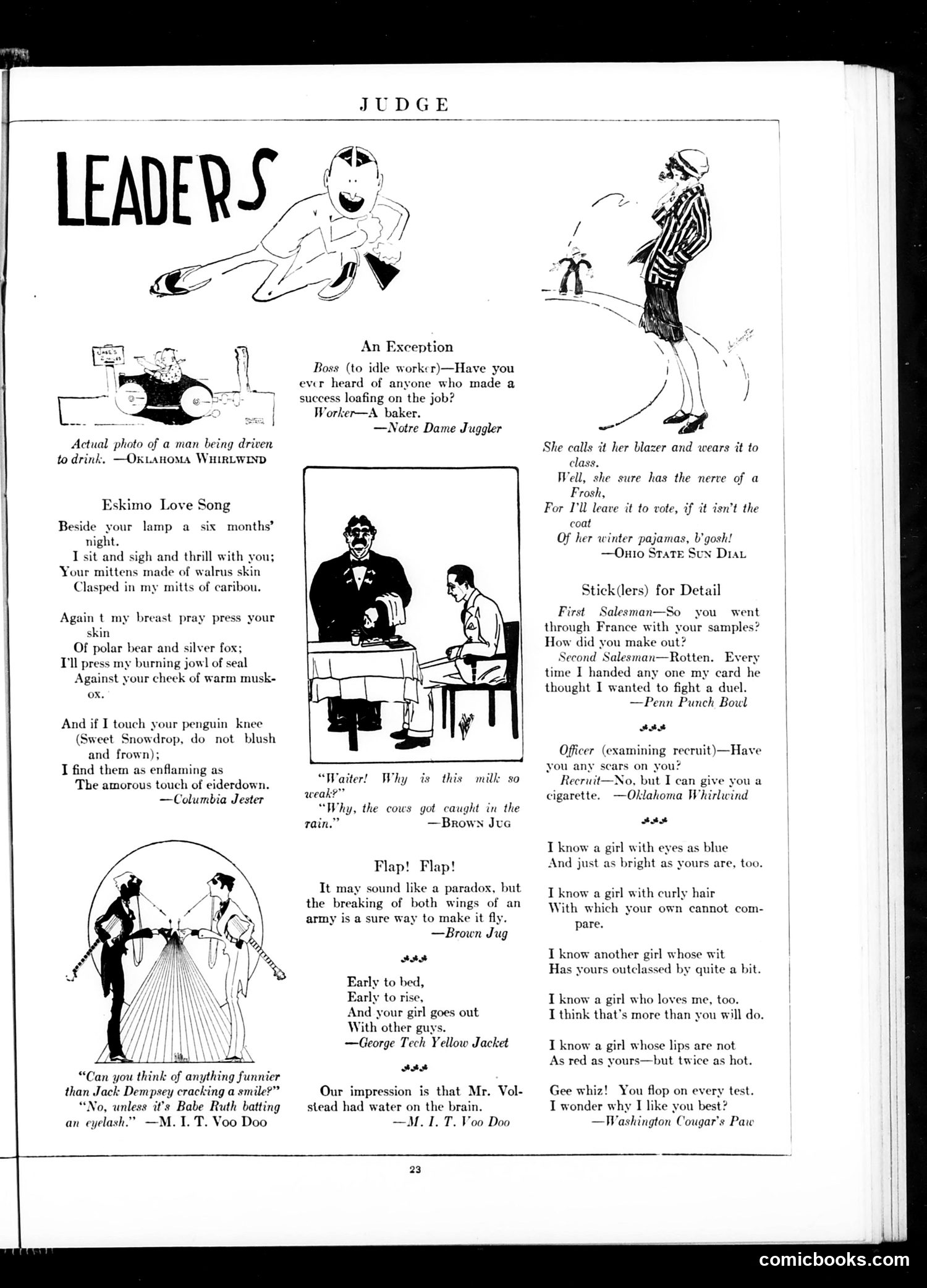
This page from Judge comprises humor pieces and cartoons typical of 1920s college and satirical magazines. The content includes: **"Leaders"** section features crude drawings mocking various figures: a football player, an Eskimo love song (ethnic humor), and a woman in athletic wear called a "Flapper" — the modern, independent young woman of the Jazz Age who scandalized conservatives. **Repeated jokes** target Prohibition (the "Volstead" reference mocks the law enforcing alcohol bans), baseball stars Jack Dempsey and Babe Ruth (contemporary celebrities), and workplace laziness. **College humor dominates**: pieces from Notre Dame, MIT, George Tech, and Penn Punch Bowl mock student life, dating customs, and military recruitment. The overall tone reflects 1920s American culture: irreverent toward authority, obsessed with youth and dating, dismissive of ethnic groups, and celebrating new social freedoms while mocking tradition. Much content would be considered offensive today.
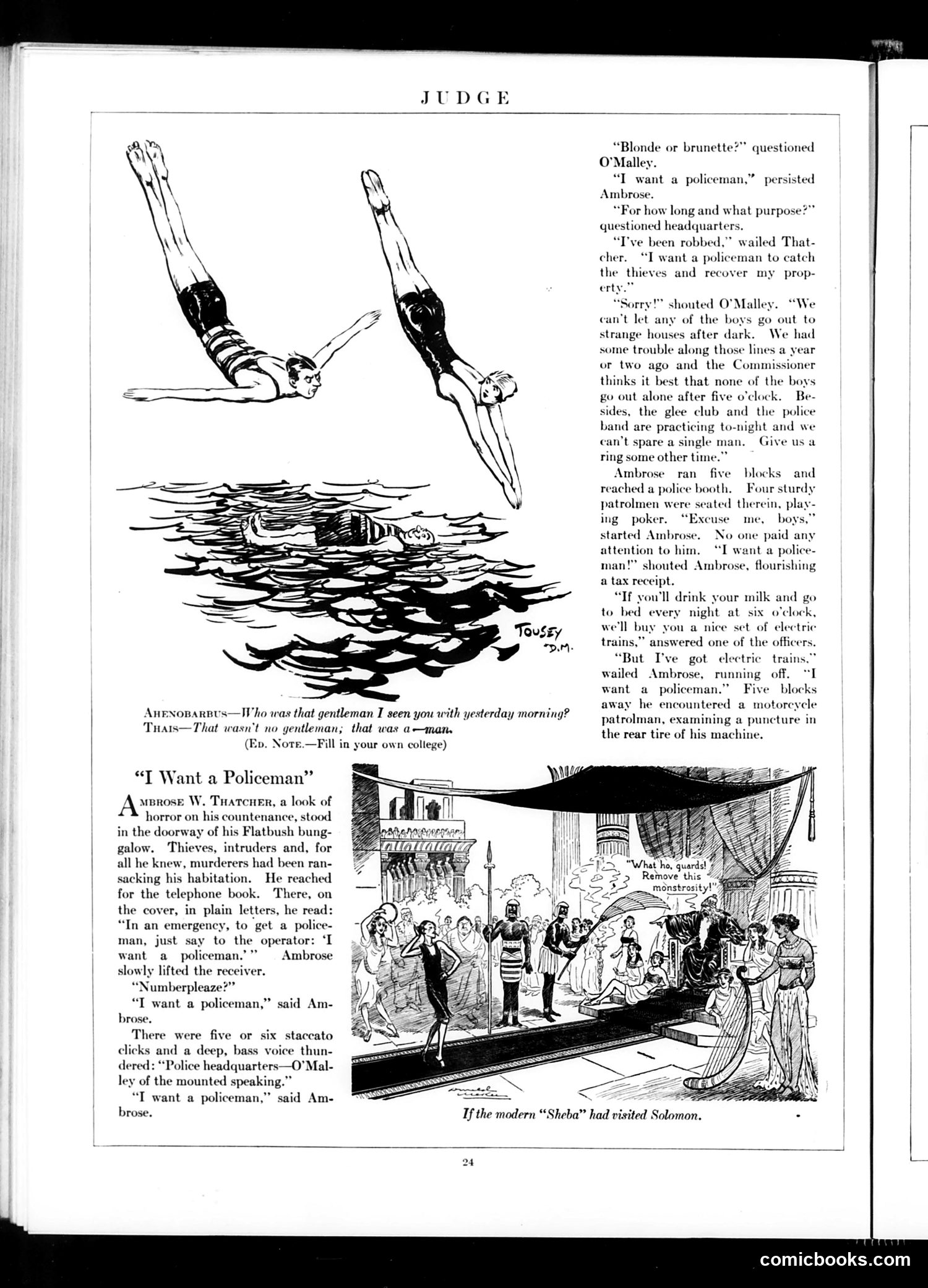
This story satirizes the incompetence and unavailability of early 20th-century police departments. When robbery victim Ambrose Thatcher calls for help, the police operator (O'Malley) refuses to send officers because: they're restricted from going out alone after dark due to past incidents, and the entire force is occupied with social activities (glee club and police band practice). The satire intensifies as Ambrose visits a police booth where officers ignore him while playing poker, then encounters a motorcycle patrolman occupied with a flat tire. The joke critiques how police prioritize their own comfort and recreation over public safety and crime prevention. The tax receipt flourishing suggests bureaucratic absurdity—even documentation can't compel response. The opening exchange about "blonde or brunette" hints at corruption or inappropriate conduct. Overall, Judge ridicules the NYPD's dysfunction and questionable priorities during this era.
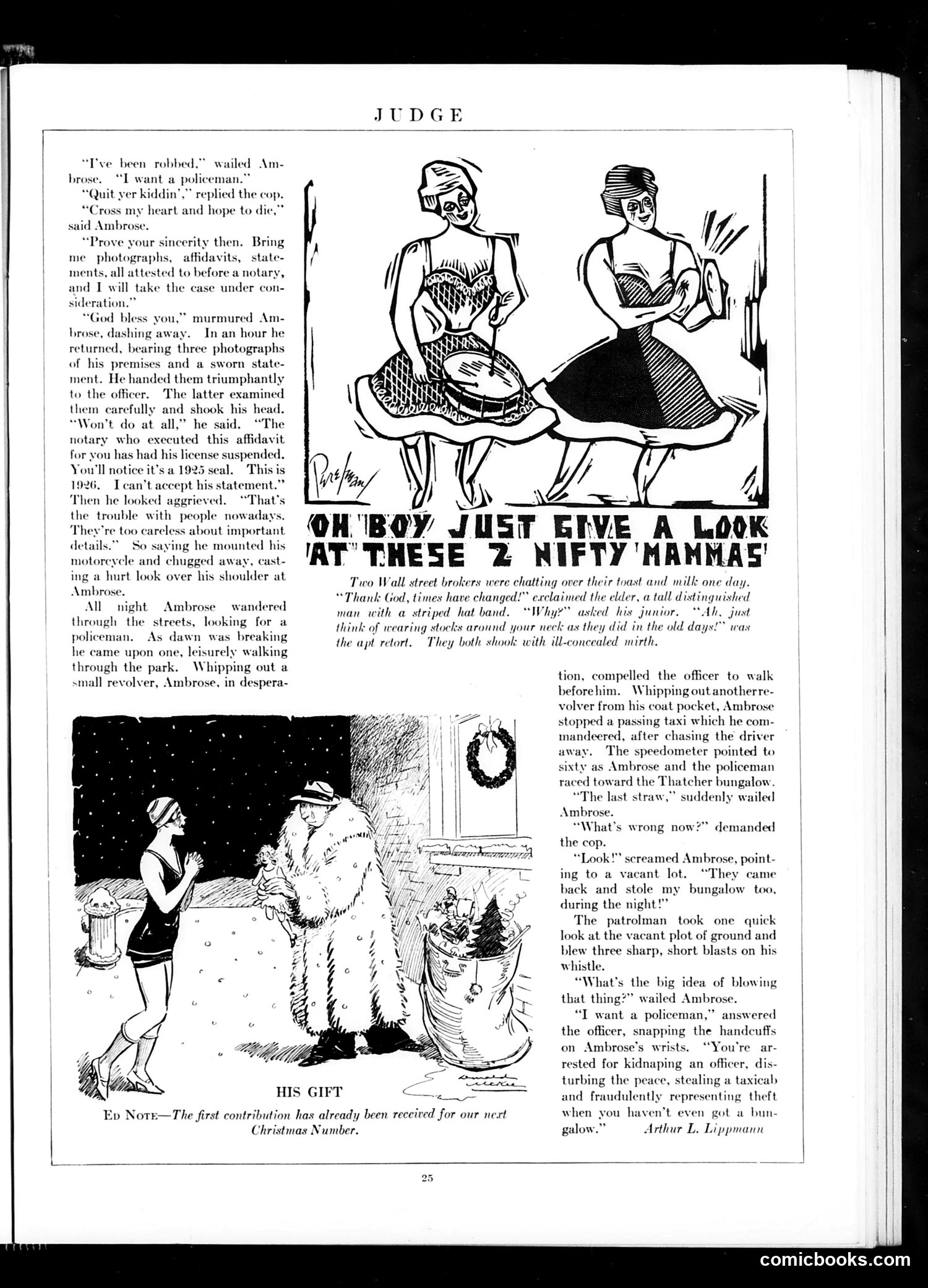
This page contains two satirical pieces mocking 1920s American institutions and attitudes. **"Judge" (main story):** A man named Ambrose reports a robbery to a police officer who demands excessive documentation—photographs, affidavits, notarized statements—before considering the case. This satirizes police bureaucracy and indifference to crime. When Ambrose finally produces everything, the officer still refuses it on technicalities. The absurdist conclusion has Ambrose kidnapping the officer at gunpoint to pursue his stolen bungalow, only to find it's been stolen too. The joke critiques both police incompetence and the lengths citizens must go to receive basic service. **"Wall Street Brokers" cartoon:** Two brokers joke about how "times have changed"—specifically, they're relieved modern fashion no longer requires wearing stocks (as neck restraints) like "in the old days." This puns on "stocks" (both the neckwear and financial instruments), playing on Wall Street's association with finance. It's mild social commentary on changing customs. Both pieces reflect 1926 frustrations with bureaucratic inefficiency and changing social norms.
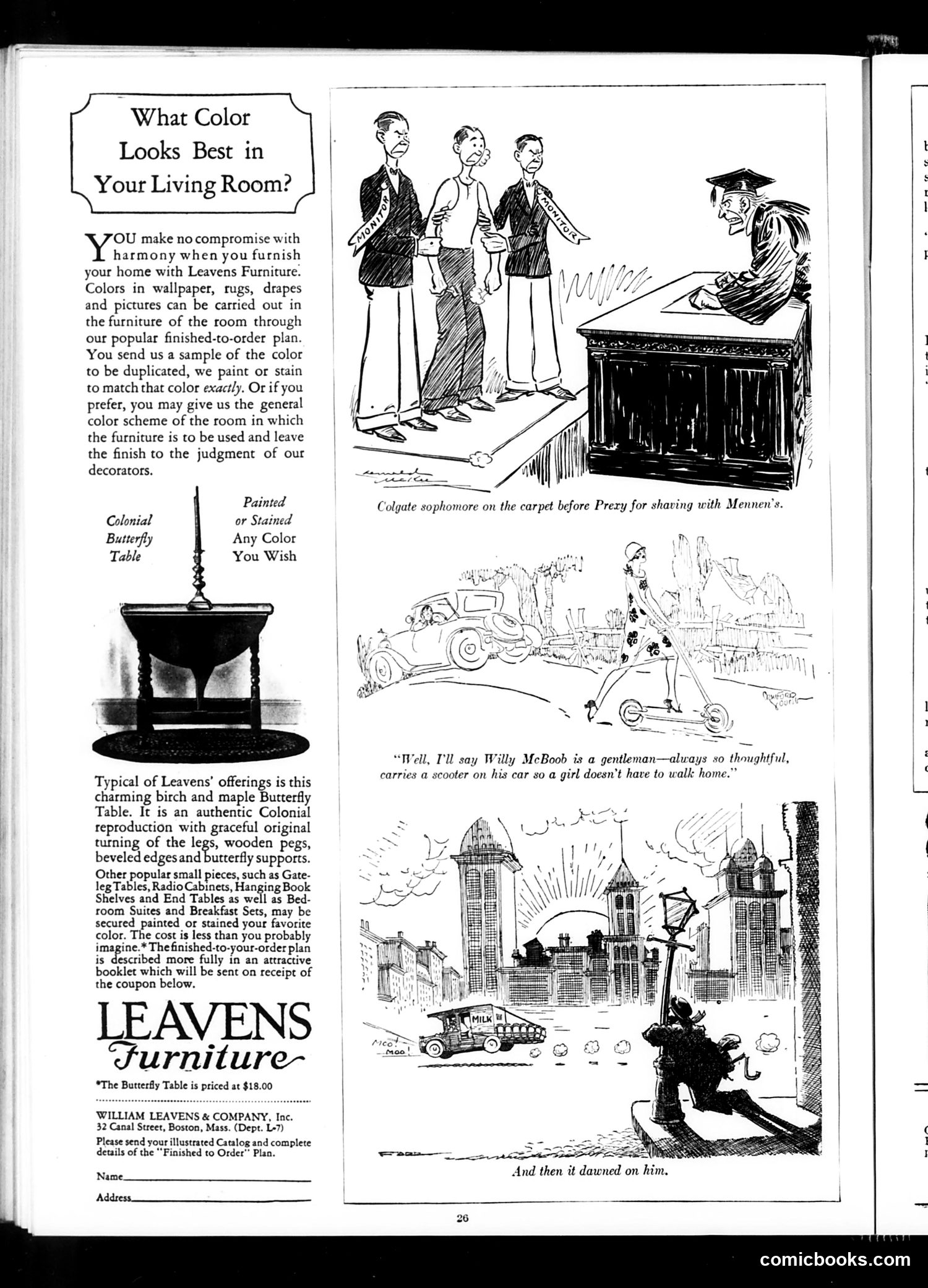
This page is primarily **advertising**, not political satire. The bulk of the content promotes Leavens Furniture's "finished-to-order" customization service, emphasizing their ability to match furniture colors to clients' homes. The cartoons are **humorous vignettes unrelated to the ads**: 1. **Top cartoon**: A college student ("Colgate sophomore") shows three men a carpet sample before presenting it to "Prezy" (the college president), suggesting anxious anticipation of approval. 2. **Bottom cartoons**: Two scenes depicting a character named "Willy McBoob"—apparently a satirical figure representing questionable male behavior. One woman praises his "thoughtfulness" for carrying a scooter on his car so girls needn't walk; the final panel ("And then it dawned on him") implies he's realized the absurdity or selfishness of his actions. These appear to be generic humor fillers typical of Judge magazine, poking fun at youth culture and gender dynamics, rather than targeting specific political figures or events.
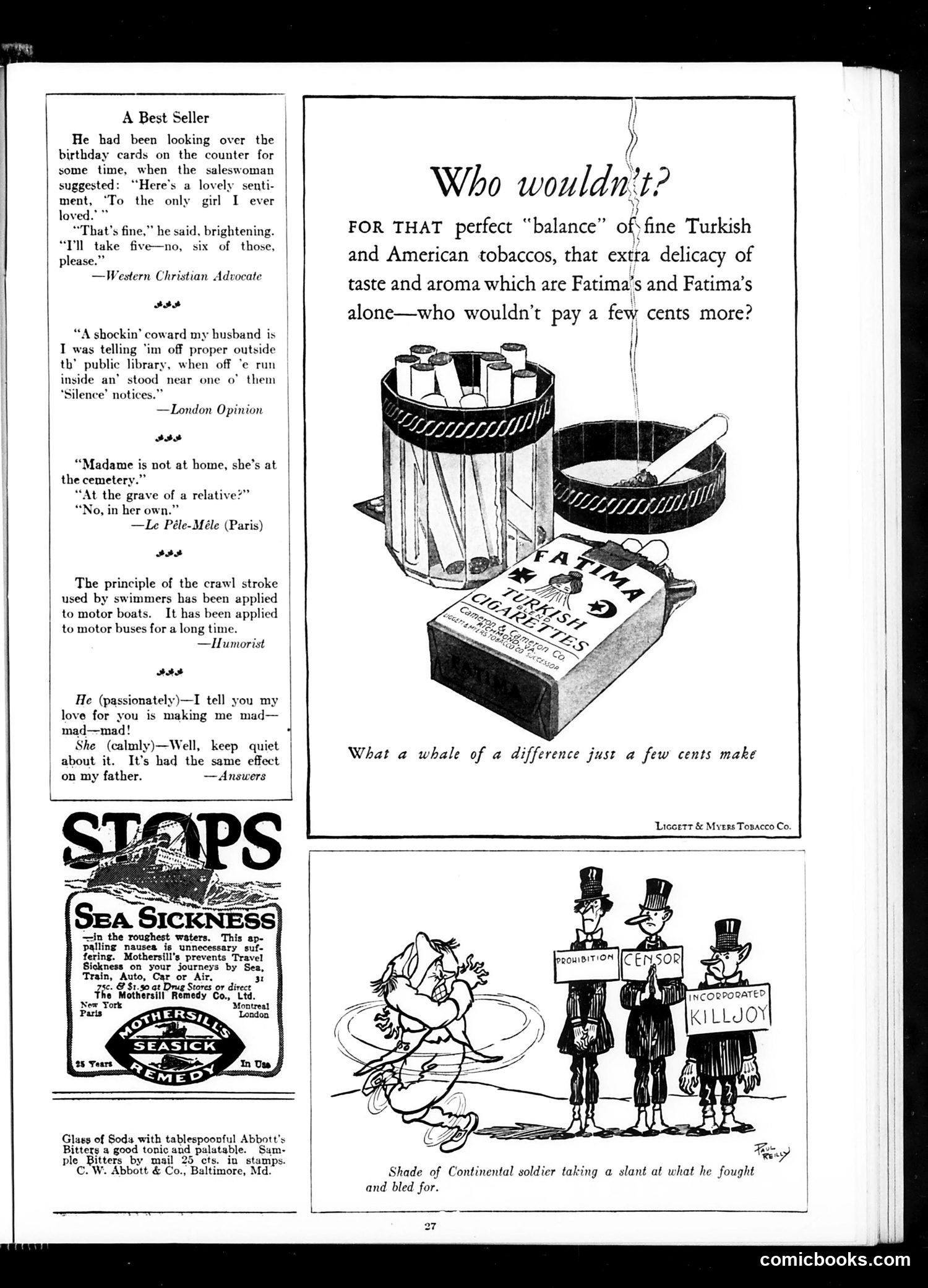
This page contains multiple brief humorous anecdotes and advertisements typical of Judge magazine's format. **The cartoons and jokes** mock various social situations: a man buying duplicate greeting cards (suggesting infidelity), a wife embarrassing her husband at a library, marital discord, and slow transportation. These are lighthearted domestic humor pieces. **The main political cartoon** (bottom) shows a Continental soldier from the American Revolution observing three figures wearing signs labeled "Prohibition," "Censorship," and "Killjoy." The satire criticizes post-WWI American restrictions—Prohibition (alcohol ban) and censorship—as contrary to the freedoms soldiers fought for. The soldier's disapproving gaze suggests these policies betray Revolutionary ideals. **Advertisements** include Fatima cigarettes (emphasizing quality for "a few cents more") and Mothersill's seasickness remedy, typical commercial content of the era. The page reflects 1920s American anxieties about government overreach during Prohibition and wartime censorship measures.
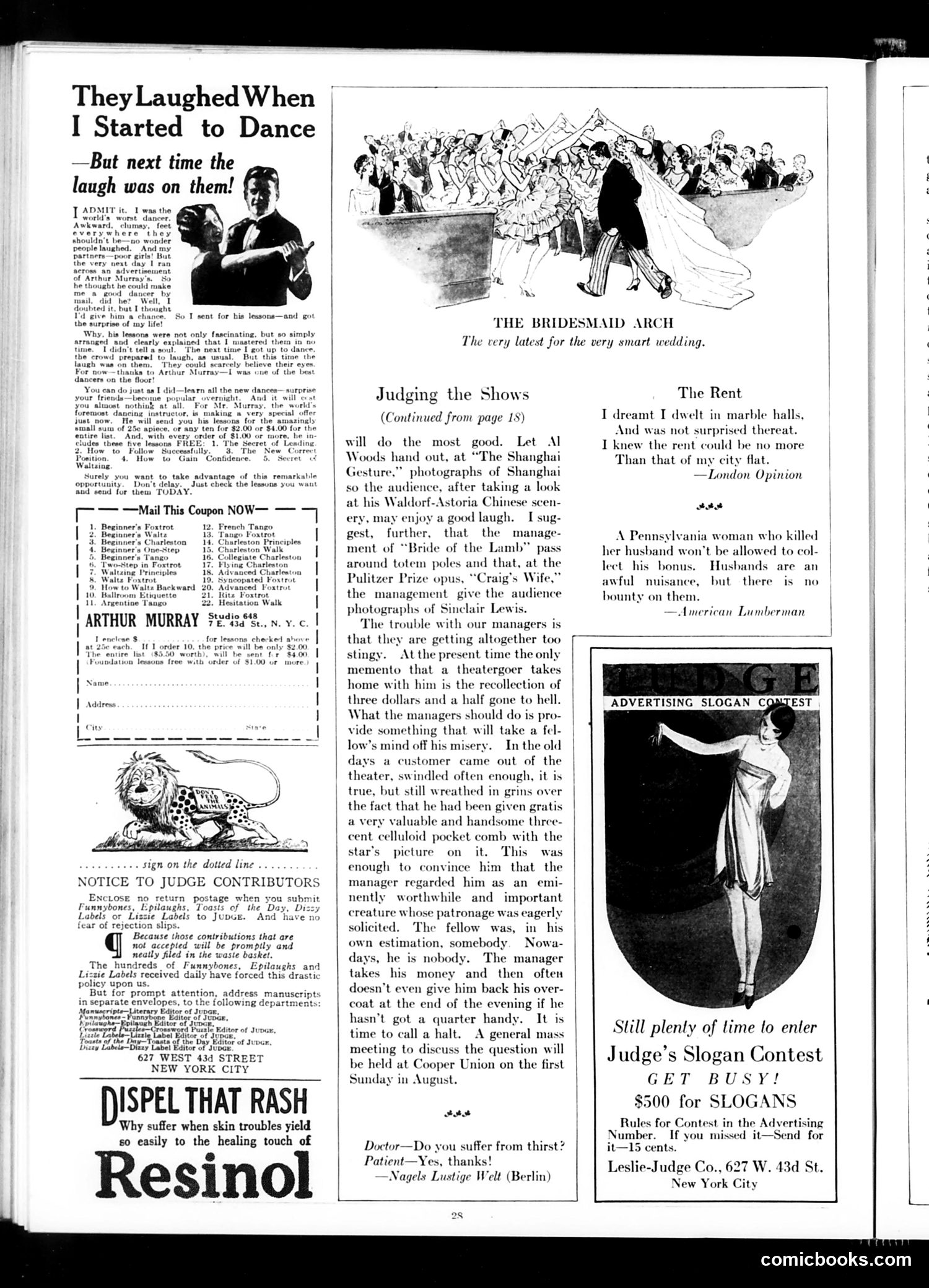
This page from *Judge* magazine (a satirical publication) contains several distinct elements: **Main Advertisement**: A prominently featured testimonial about Arthur Murray dance lessons—a famous dancing instruction service. The narrative follows a man mocked for poor dancing who takes mail-order lessons and becomes skilled. This is genuine advertising, not satire. **"The Bridesmaid Arch"**: A cartoon captioned "The very latest for the very smart wedding"—likely satirizing an actual wedding trend or fashion innovation of the era, though the specific trend referenced is unclear today. **Theater Criticism Column**: A piece critiquing theater managers for being "stingy" and no longer providing souvenir items (like combs with stars' pictures) to patrons—a nostalgic complaint about lost theatrical courtesy. **Miscellaneous Content**: Brief jokes about rent prices and a Pennsylvania woman denied her husband's life insurance bonus. The page is primarily commercial (advertisements and announcements), with light satirical commentary on contemporary social practices rather than hard political satire.
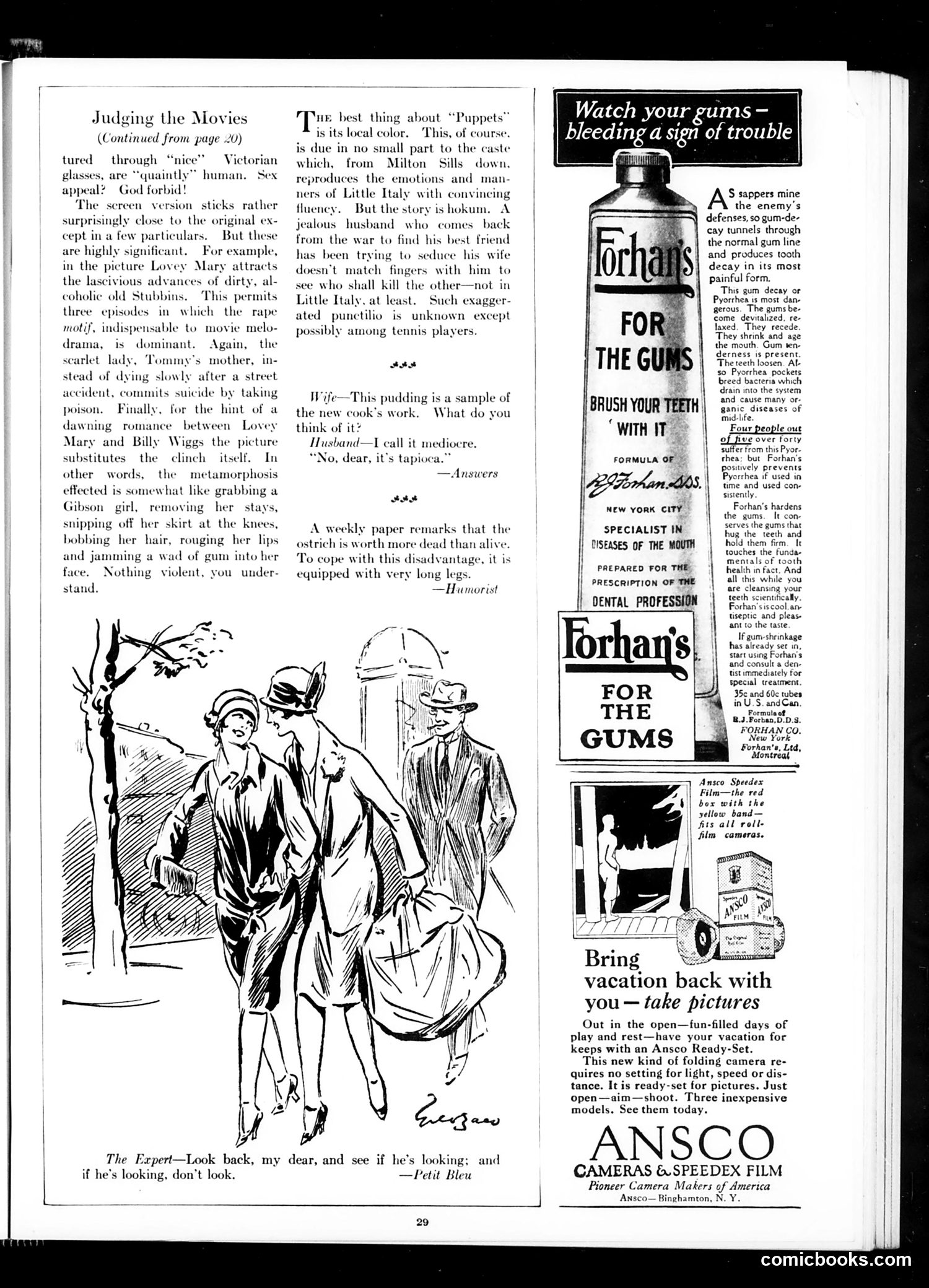
This magazine page contains film criticism and advertisements from the 1920s. **The Movie Reviews** (left side): The text discusses film adaptations, particularly criticizing how "Puppets" and other movies sensationalize stories. The reviewer notes that filmmakers add melodramatic elements like rape scenes and suicide that weren't in original sources, and alter romantic plots. There's also satire about how cinema transforms wholesome characters—a "Gibson girl" metaphor is used to describe stripping away Victorian propriety (removing corsets, shortening skirts, applying makeup). **The Cartoons**: Two illustrated jokes appear: one about a couple's awkward romantic moment, another mocking how an ostrich's long legs seem impractical despite being valuable dead. **The Advertisements** (right side): These promote Forhan's gum treatment (addressing pyorrhea/gum disease) and Ansco cameras—products marketed to leisure activities and personal care typical of the 1920s consumer culture. The page reflects 1920s anxieties about cinema's moral influence and changing social standards around appearance and behavior.
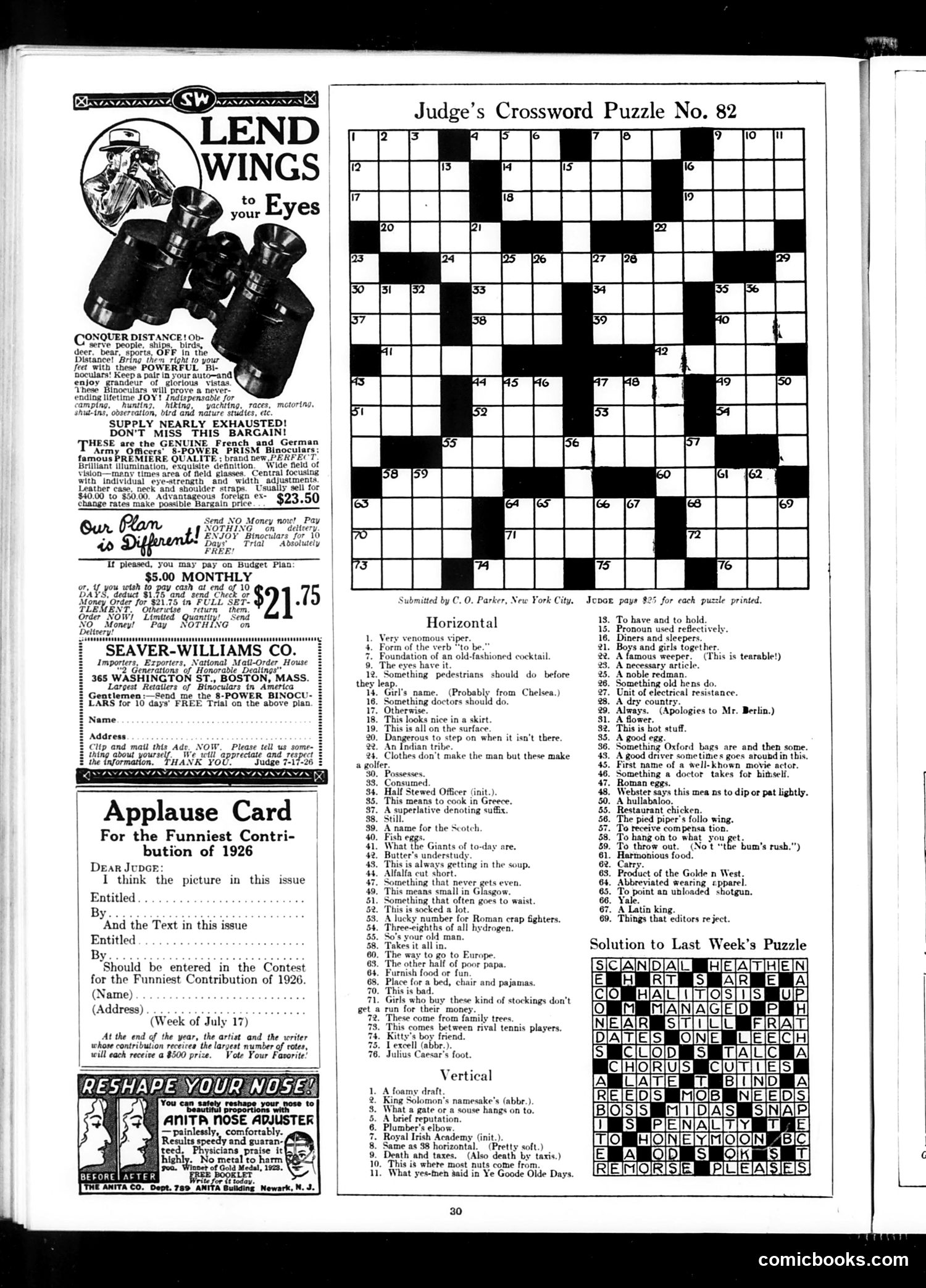
This page is primarily **advertising and puzzle content** rather than political satire. The dominant feature is a crossword puzzle (#82) submitted by C.O. Parker. The advertisements include: - **"Lend Wings to Your Eyes"**: binoculars marketed as surplus military stock from France/Germany, sold through mail-order at discounted prices ($93.50 versus $40-54 retail). This targets post-WWI consumers eager for "bargain" foreign military equipment. - **Anita Nose Adjuster**: a device claiming painless nose reshaping—reflecting 1920s cosmetic self-improvement trends and possibly ethnic appearance anxieties. The **"Applause Card"** invites readers to vote on funniest contributions for a $500 prize, suggesting *Judge* was an interactive humor magazine encouraging reader participation. The crossword clues are standard wordplay with period-specific references (e.g., "Half Stewed Officer," "Butter's understudy"). No significant political commentary is evident on this page.
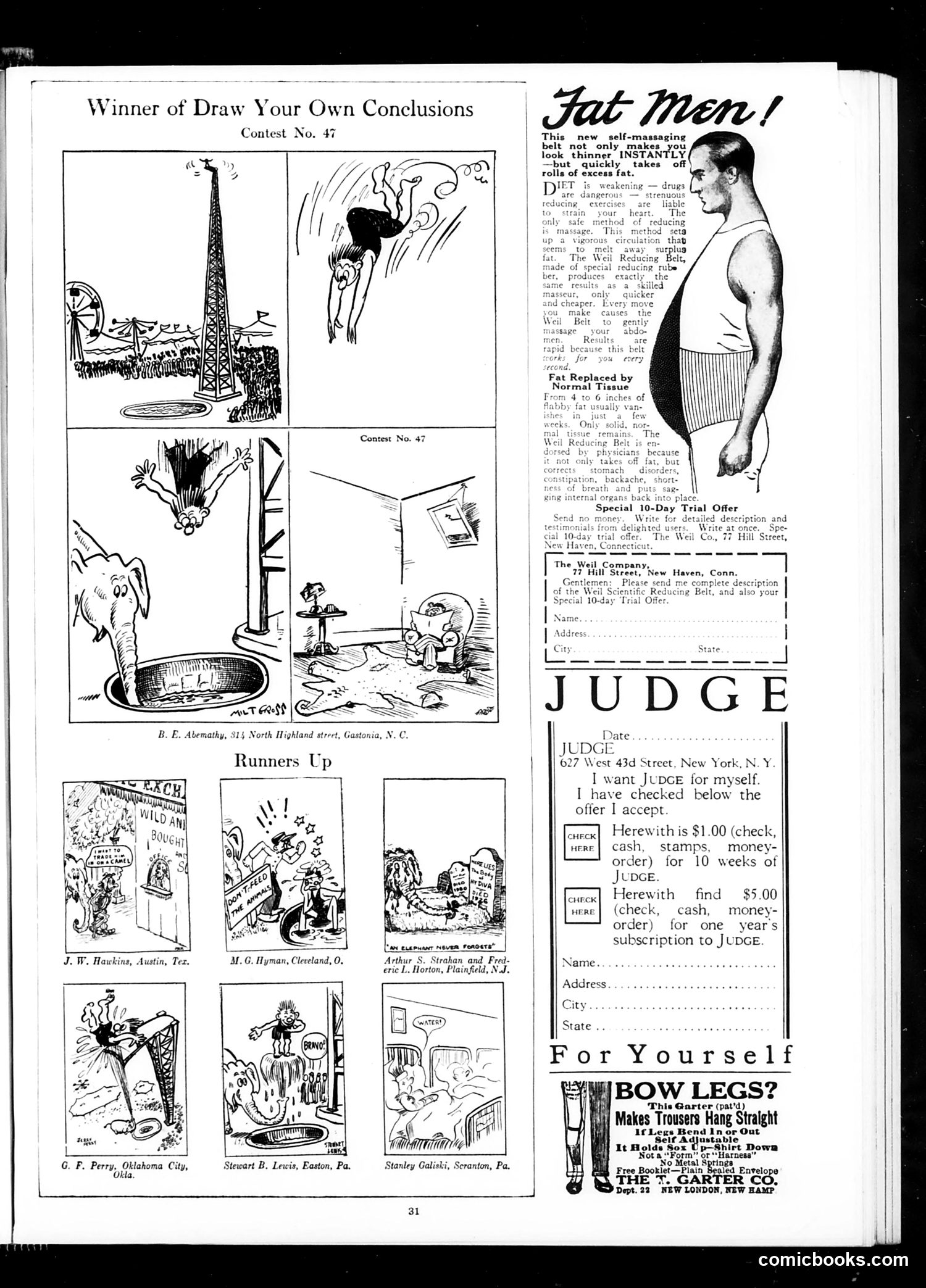
This page primarily showcases a "Draw Your Own Conclusions" cartoon contest, displaying the winning entry by B.E. Abernathy and several runners-up entries. The cartoons themselves appear to be visual gags or satirical illustrations—one depicts an oil derrick with surreal imagery, another shows an acrobat or contortionist, and others feature domestic or social scenarios with exaggerated comic situations. The page is dominated by advertising, particularly for the "Weil Reducing Belt" (a pseudo-scientific weight-loss device), Judge magazine subscriptions, and novelty products like corrective garters for bow legs. These ads reflect early 20th-century commercial quackery targeting physical insecurities. The cartoons' specific satirical points are unclear without more context, though they appear to employ the surreal, absurdist humor characteristic of Judge magazine's style. The page represents typical magazine content mixing reader-submitted humor contests with period advertisements.
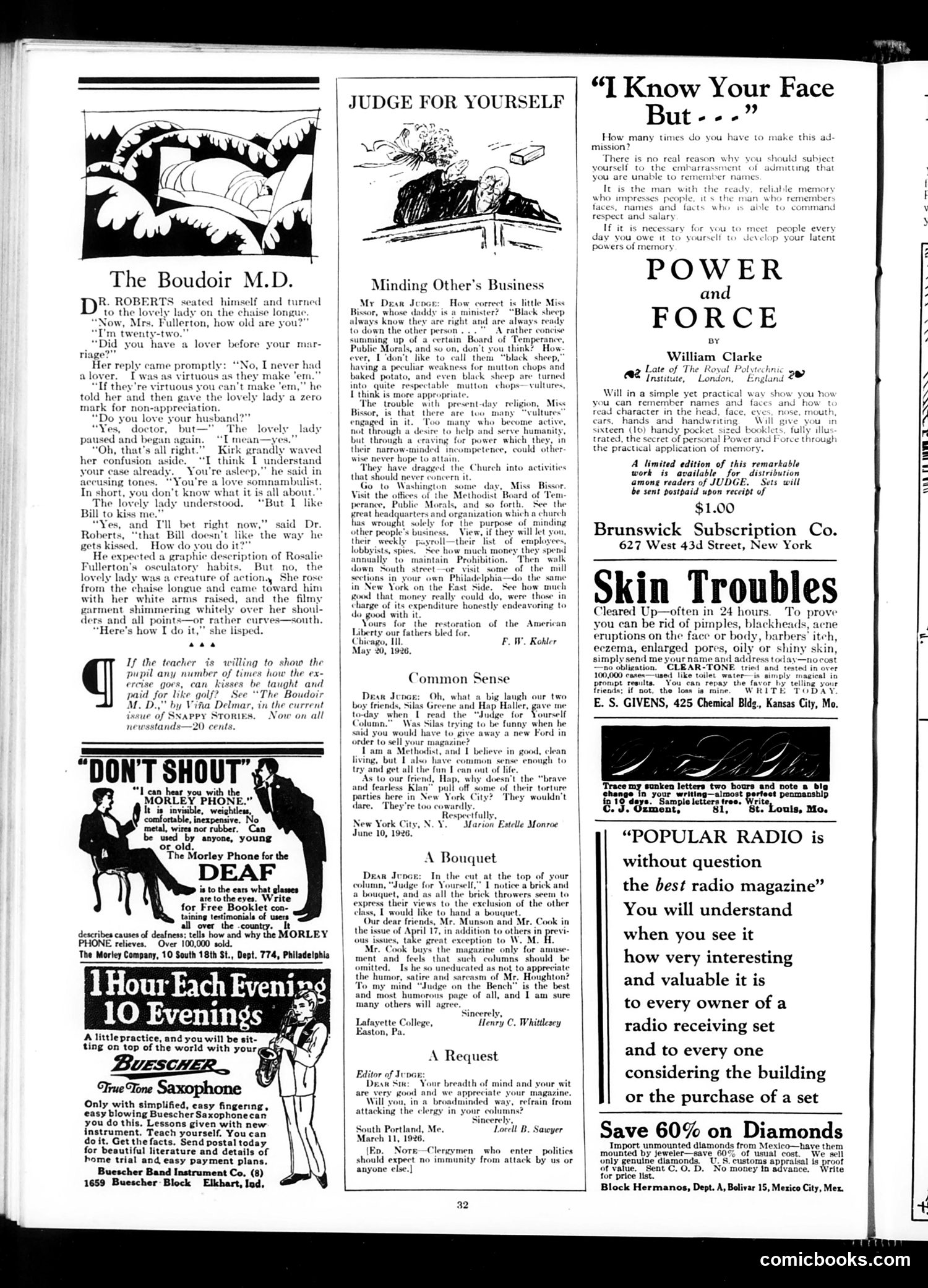
This page from Judge magazine contains **primarily advertisements and reader letters**, not political cartoons with unified satirical messaging. The notable content includes: **"The Boudoir M.D."** — a serialized story (by Vita Delmar) about a doctor and a woman on a chaise longue, promoting the full story in "Snappy Stories" magazine. This appears to be lighthearted romantic fiction typical of 1920s magazines. **Reader Letters** discussing social issues: One criticizes churches and reform organizations for "minding other's business" and spending money on lobbying for Prohibition. Another defends friends against accusations of cowardice. These reflect 1920s debates over Prohibition and government overreach. **Multiple product advertisements** dominate the page: hearing aids ("Morley Phone"), saxophones, skin treatments, diamonds, and radio magazines—typical commercial content of the era. The page lacks coherent political satire. It's essentially a mixed content page of fiction promotion, reader correspondence, and advertising rather than editorial cartooning.
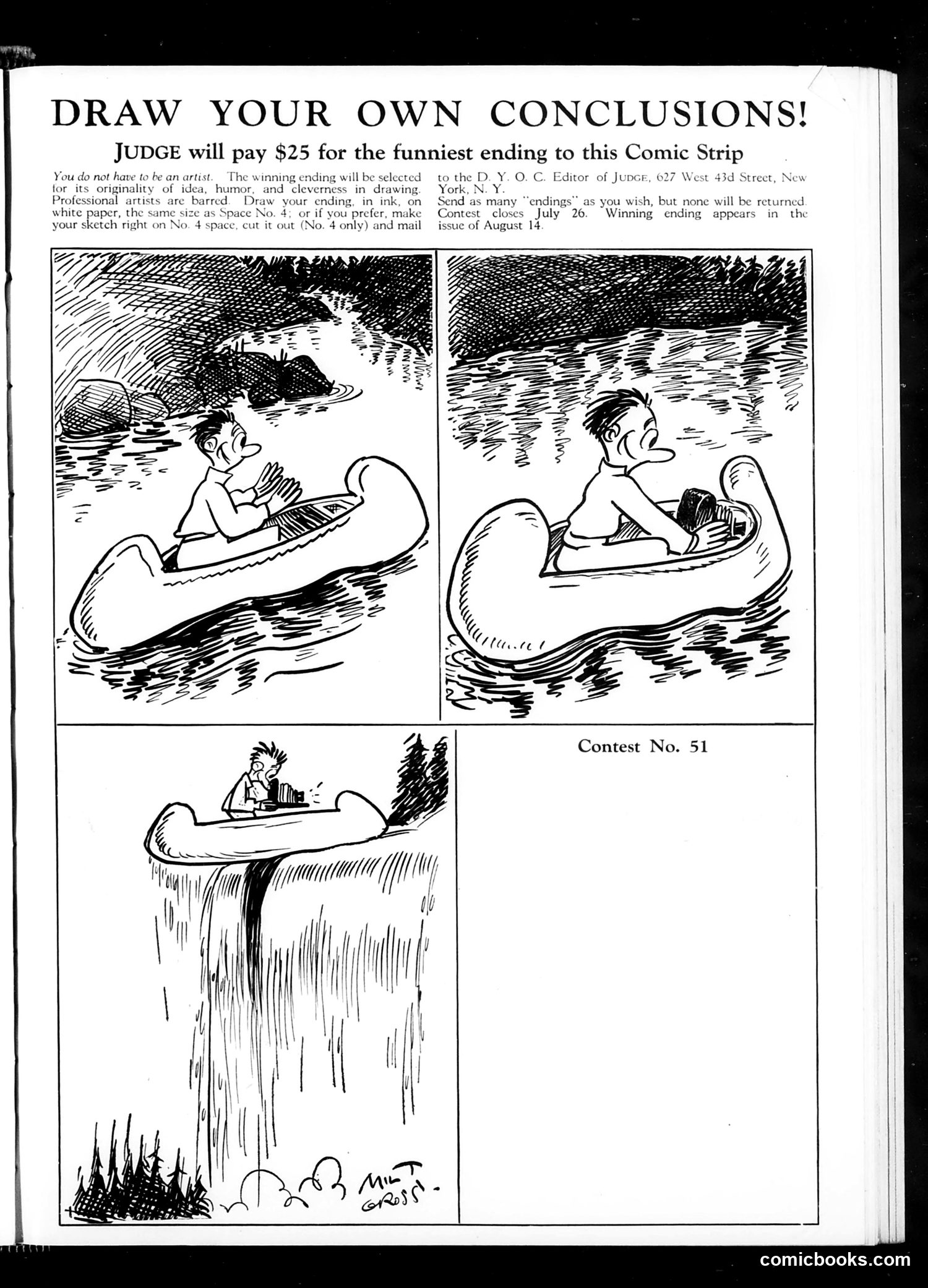
This page presents "Contest No. 51," a reader-participation feature where Judge magazine invites readers to complete an unfinished comic strip for a $25 prize—a significant sum at the time this appears to be from (likely 1910s-1920s, given the style). The three panels show a man in a small boat-like vessel paddling through water. The first two panels appear complete, showing sequential action. The third panel depicts the boat going over what appears to be a waterfall or cliff edge, with the conclusion left blank for readers to imagine. The humor presumably derives from the precarious situation: readers must devise a funny outcome to the man's apparent disaster. The satire is gentle—this is simple visual comedy relying on slapstick misfortune rather than political content. The contest encourages amateur artistic participation, explicitly noting "You do not have to be an artist," democratizing cartooning and generating reader engagement for the magazine.
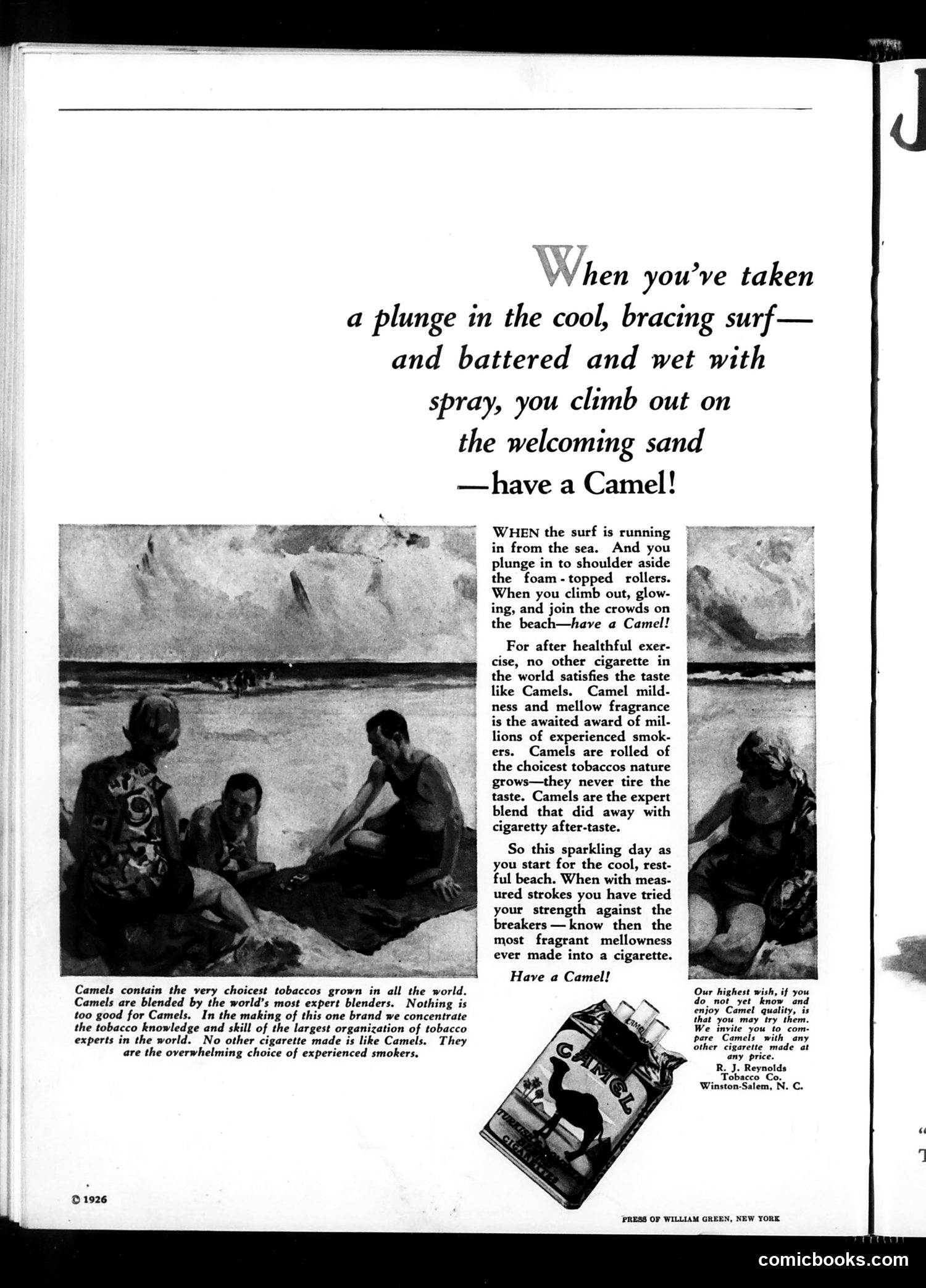
This is not a cartoon or satire, but rather a **straightforward cigarette advertisement** from 1926. The page features photos of beachgoers and promotes Camel cigarettes as the ideal reward after surfing and swimming. The advertisement's appeal is to associate smoking with healthy outdoor recreation and youthful vigor. It emphasizes Camel's "mildness" and claims superiority over competitors through superior tobacco blending. The messaging links cigarette consumption to wellness—positioning smoking as a natural complement to "healthful exercise." From a modern perspective, this reveals how openly tobacco was marketed in the 1920s, even *explicitly connecting smoking to athletic activity*—something now recognized as deeply misleading health marketing. The ad's confidence in tobacco's virtue contrasts sharply with current understanding of smoking's dangers, making it a historical artifact of how differently cigarettes were promoted in the pre-regulation era.