
Judge, 1926-07-17 · page 26 of 36
Judge — July 17, 1926 — page 26: what you’re looking at
What you’re looking at
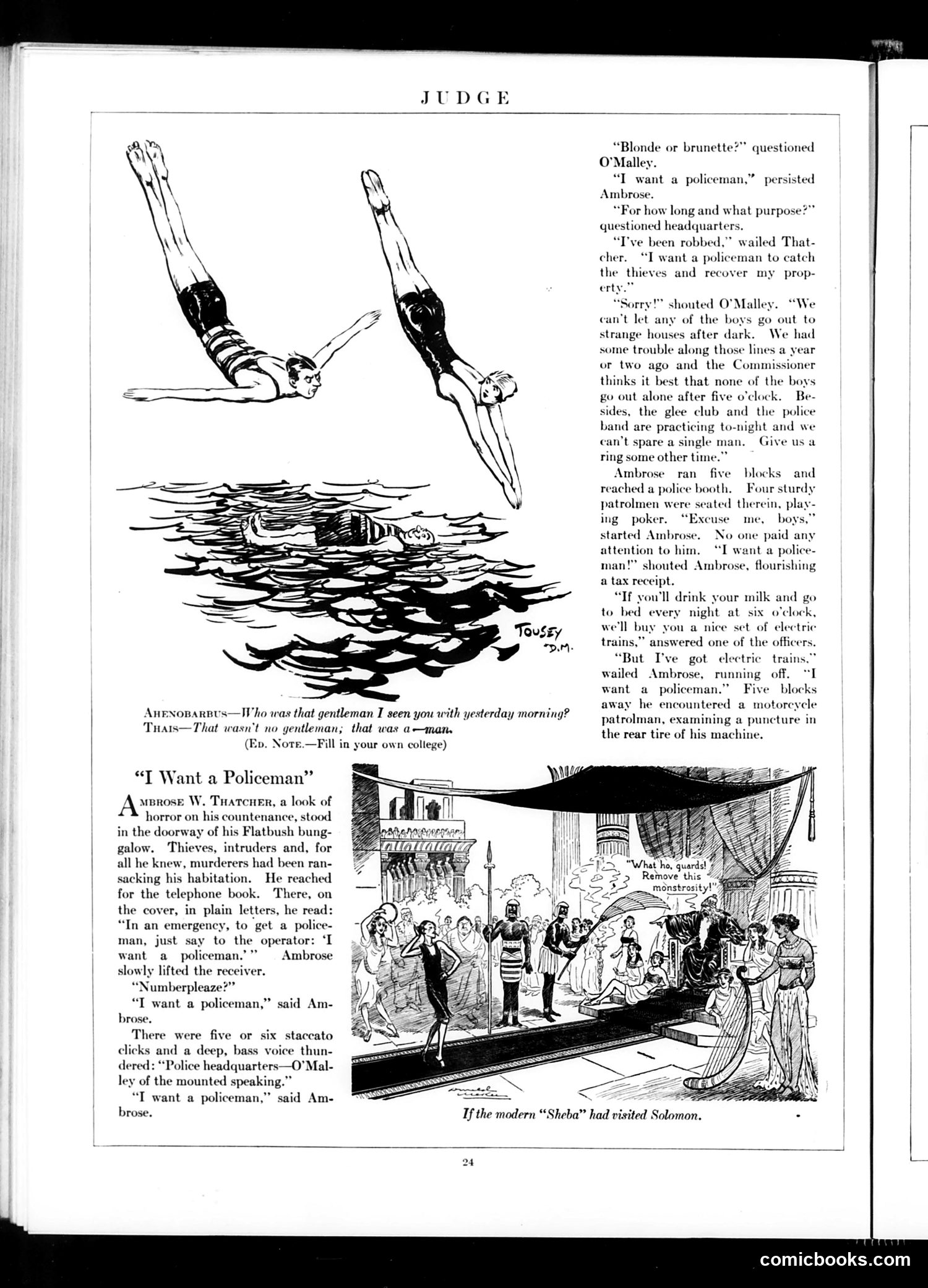
This story satirizes the incompetence and unavailability of early 20th-century police departments. When robbery victim Ambrose Thatcher calls for help, the police operator (O'Malley) refuses to send officers because: they're restricted from going out alone after dark due to past incidents, and the entire force is occupied with social activities (glee club and police band practice). The satire intensifies as Ambrose visits a police booth where officers ignore him while playing poker, then encounters a motorcycle patrolman occupied with a flat tire. The joke critiques how police prioritize their own comfort and recreation over public safety and crime prevention. The tax receipt flourishing suggests bureaucratic absurdity—even documentation can't compel response. The opening exchange about "blonde or brunette" hints at corruption or inappropriate conduct. Overall, Judge ridicules the NYPD's dysfunction and questionable priorities during this era.
📄 Transcribed text from this page (OCR, searchable)
Machine-transcribed from the original scan — historical spelling and the odd misread are preserved.
JUDGE “Blonde or brunette?” questioned O'Malley. “I want a policeman,” persisted Ambrose. “For how long and what purpose?” questioned headquarters. “T've been robbed,” wailed That- cher. “I want a policeman to catch w the thieves and recover my prop- erty.” “Sorry!” shouted O'Malley. “We can't let any of the boys go out to strange houses after dark. We had some trouble along those lines a year or two ago and the Commissioner thinks it best that none of the boys. go out alone after five o'clock. Be- sides, the glee club and the police band are practicing to-night and we can’t spare a single man. Give us a ring some other time.” Ambrose ran five blocks and reached a police booth. Four sturdy patrolmen we ing poker. started Ambrose. No one paid any attention to him. “I wa man!” shouted Ambrose, flourishing a tax receipt. seated therein, 5 xcuse me, boys,” 1 police- “If you'll drink your milk and go to bed every night at six o'clock, we'll buy you a nice set of electric trains,” ai wered one of the officers. “But I've got electric trains.” wailed Ambrose, running off. “I want a policeman.” Five blocks away he encountered a motorcycle patrolman, examining a puncture in the rear tire of his machine. AnENoBARBUS—IWho was that gentleman I seen you with yesterday morning? Tuais—That wasn't no gentleman; that was a—man (Ep. Note.—Fill in your own college) “T Want a Policeman” um A MBROBE W. Tuatcuer, a look of horror on his countenance, stood | in the doorway of his Flatbush bung- | galow. Thieves, intruders and, for | all he knew, murderers had been ran- sacking his habitation. He reached for the telephone book. There, on | the cover, in plain letters, he read: “In an emergency, to “get a pol | man, just say to the operator: ‘I want a policeman.’ ” Ambrose slowly lifted the receiver. “Numberpleaze? “I want a policeman,” said Am- brose. There were five or six staccato clicks and a deep, bass voice thun- dered: “Police headquarters—O’Mal- ley of the mounted speaking.” “T want a policeman,” said brose. Am- comicbooks.com