
Judge, 1926-07-17 · page 20 of 36
Judge — July 17, 1926 — page 20: what you’re looking at
What you’re looking at
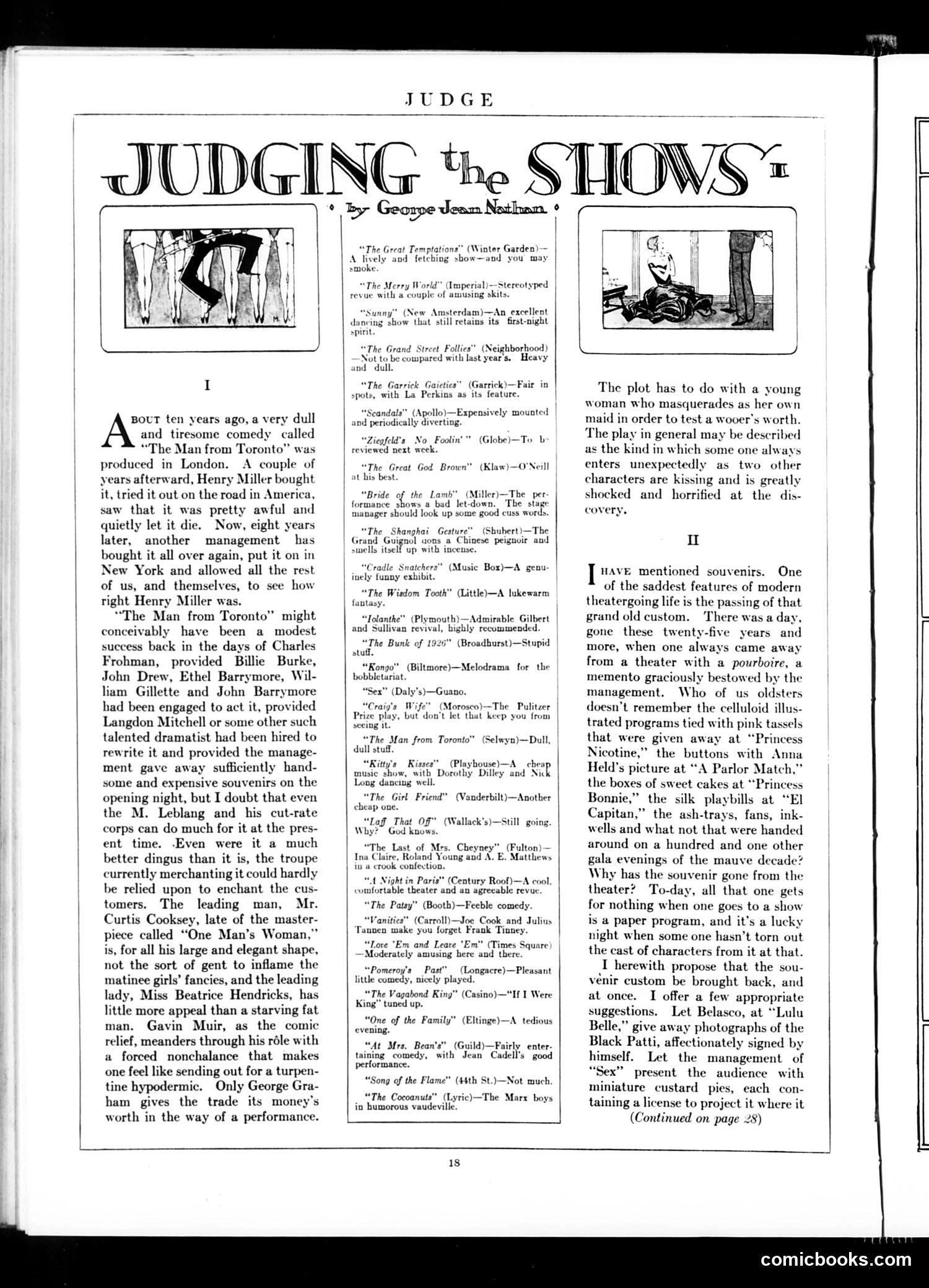
This is a theater review column by George Jean Nathan, a prominent drama critic of the 1920s. The page contains his sharp critiques of current Broadway productions. The main article ridicules "The Man from Toronto," a recycled British comedy that failed repeatedly—first in London, then dismissed by Henry Miller in America years earlier. Nathan sarcastically notes that even star power (he mentions Charles Frohman's era stars like Billie Burke and John Drew) couldn't have saved it. He particularly mocks the current cast: Curtis Cooksey (the leading man) and Beatrice Hendricks (the leading lady) as uninspiring, with only George Graham delivering adequate performance. The right column lists brief reviews of other Broadway shows—some praised ("The Great God Brown"), others dismissed as derivative ("Scandals," "Kongo"). Nathan's tone throughout is caustic, using phrases like "stupid," "dull," and "Guano" to describe mediocre productions. This reflects 1920s theater criticism's expectation of quality on Broadway.
📄 Transcribed text from this page (OCR, searchable)
Machine-transcribed from the original scan — historical spelling and the odd misread are preserved.
JUDGE BOUT ten years ago, a very dull A and tiresome comedy called “The Man from Toronto” was produced in London. A couple of years afterward, Henry Miller bought , tried it out on the road in America, w that it was pretty awful and quietly let it die. Now, eight years later, another management has bought it all over again, put it on in New York and allowed all the rest of us, and themselves, to see how right Henry Miller was. “The Man from Toronto” might conceivably have been a modest success back in the days of Charles Frohman, provided Billie Burke, John Drew, Ethel Barrymore, Wil- liam Gillette and John Barrymore had been engaged to act it, provided Langdon Mitchell or some other such talented dramatist had been hired to rewrite it and provided the manage- ment gave away sufficiently hand- some and expensive souvenirs on the opening night, but I doubt that even the M. Leblang and his cut-rate corps can do much for it at the pres- ent time. -Even were it a much better dingus than it is, the troupe currently merchanting it could hardly be relied upon to enchant the cus- tomers. The leading man, Mr. Curtis Cooksey, late of the master- piece called “One Man’s Woman,” is, for all his large and elegant shape, not the sort of gent to inflame the matinee girls’ fancies, and the leading lady, Miss Beatrice Hendricks, has little more appeal than a starving fat man. Gavin Muir, as the comic relief, meanders through his réle with a forced nonchalance that makes one feel like sending out for a turpen- tine hypodermic. Only George Gra- ham gives the trade its money's worth in the way of a performance. ¢ by Georpe Jeam Nathan. “The Great Temptati A lively and fetching sbow—and you way smoke s"* (Winter Garden) — “The Merry World” (Imperial) —Stereotyped revue with a couple of amusing skit ° | “Sunny” (New Amsterdam)—An excellent | dancing show that still retains its first-night spirit he Grand Street Follies” (Neighborhood) ot to be compared with last year's. Heavy dull. he Garrick Gaietics” (Garrick)—Fair in . with La Perkins as its feature. ‘Scandals (Apollo)—Expensively mounted and periodically diverting. afeld’s No Foolin'” (Globe)—To b ved next week. “The Great God Brown" (Klaw)—O'Neill at his best. “Bride of the Lamb” (Miller)—The per formance shows a bad let-down. The stage manager should look up some good cuss words. “The Shanghai Gesture” (Shubert)—The Grand Guignol aons a Chinese peignoir and swells itself up with incense. (Music Box)—A genu: The Wisdom Tooth” (Little)—A lukewarm fantasy. “folanthe” (Plymouth)—Admirable Gilbert | and Sullivan revival, highly recommended. “The Bunk of 1920" (Broadburst)—Stupid stu “Kongo” (Biltmore)—Melodrama for the bobbletariat. “Sex” (Daly's)—Guano. seeing it. “The Man from Toronto” (Selwyn)—Dull, dull stuf. “Kitty's Kissea” (Playbouse)—A ches musie show, with Dorothy Dilley and Nick Long dancing well. “The Girl Friend” (Vanderbilt)—Another | cheap one. “Laf That Of” (Wallack's)—Still going. Why? God knows. “The Last of Mrs. Cheyney” (Fulton) — Ina Claire, Roland Young and A. E. Matthews in a crook confection. “4 Night in Paris” (Century Roof)—A cool, comfortable theater and an agreeable revue. “The Patsy” (Booth)—Feeble comedy. “Vanities” (Carroll)—Joe Cook and Julius Tannen make you forget Frank Tinney. and Leare "Em" (Times Square’ Moderately amusing here and there. “Pomeroy's Past” (Longacre) —Pleasant little comedy, nicely played. Vagabond King” (Casino)—“If 1 Were tuned up. “One of the Family” (Eltinge)—A tedious evening. “At Mra. Bean's” (Guild)—Fairly enter taining comedy, with Jean Cadell’s good performance. “Song of the Flame” (44th St.)—Not much. “The Cocoanuts” (Lyric)—The Marx boys in humorous vaudeville. The plot has to do with a young woman who masquerades as her own maid in order to test a wooer's worth. The play in general may be described as the kind in which some one always enters unexpected] characters are kissi shocked and_horri covery. as two other g and is greatly ied at the dis I HAVE mentioned souvenirs. One of the saddest features of modern theatergoing life is the passing of that grand old custom. There was a day, gone these twenty-five years and more, when one always came away from a theater with a pourboire, a memento graciously bestowed by the management. Who of us oldsters doesn’t remember the celluloid illus- trated programs tied with pink tassels that were given away at “Princess Nicotine,” the buttons with Anna Held’s picture at “A Parlor Match,” the boxes of sweet cakes at “Princess Bonnie,” the silk playbills at “El Capitan,” the ash-trays, fans, ink- wells and what not that were handed around on a hundred and one other gala evenings of the mauve decade? Why has the souvenir gone from the theater? To-day, all that one gets for nothing when one goes to a show is a paper program, and it’s a lucky night when some one hasn’t torn out the cast of characters from it at that. I herewith propose that the sou- venir custom be brought back, and at once. I offer a few appropriate suggestions. Let Belasco, at “Lulu Belle,” give away photographs of the Black Patti, affectionately signed by himself. Let the management of “Sex” present the audience with miniature custard pies, each con- taining a license to project it where it (Continued on page 28) comicbooks.com eel | |