
Judge, 1926-07-17 · page 27 of 36
Judge — July 17, 1926 — page 27: what you’re looking at
What you’re looking at
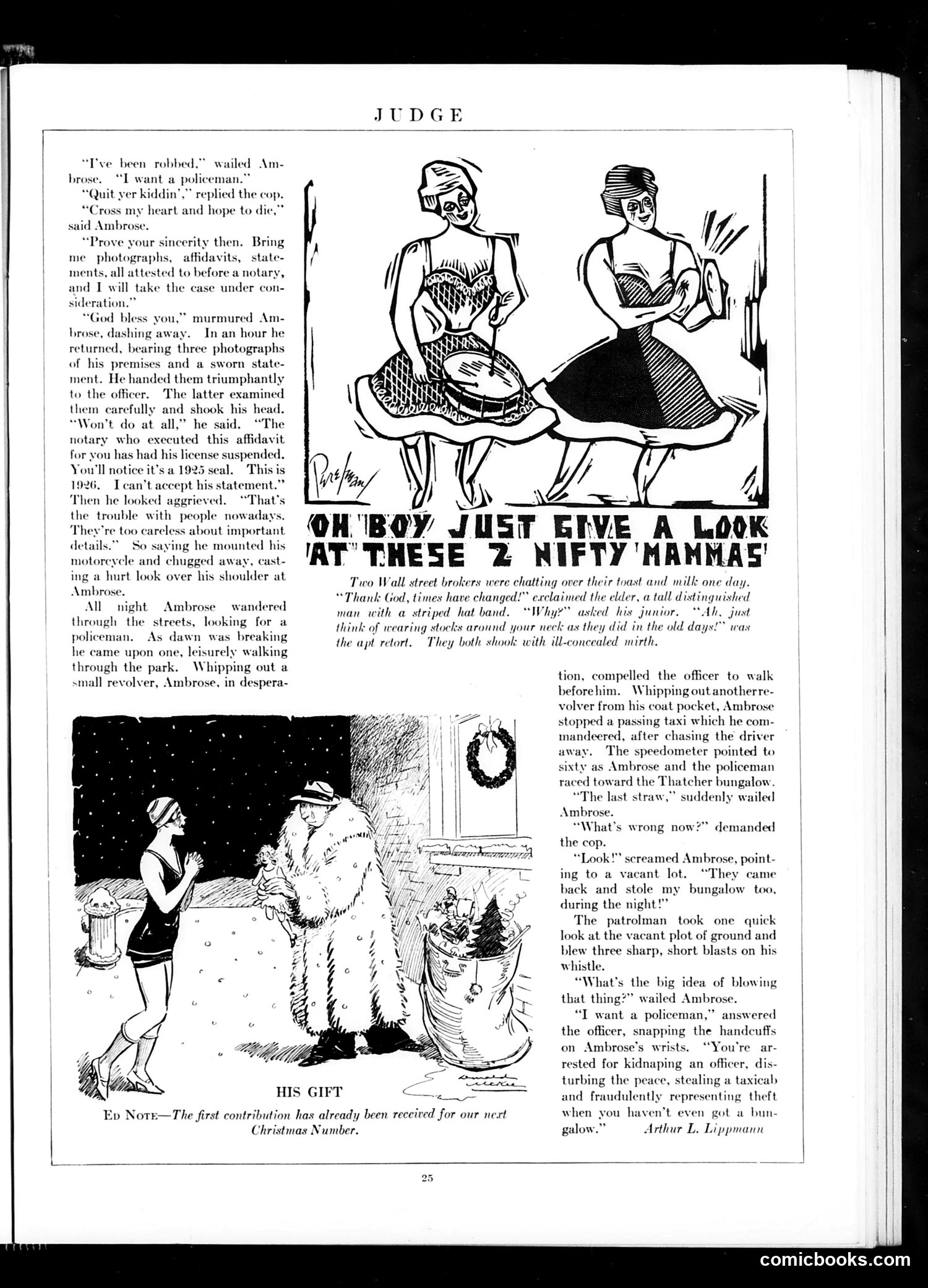
This page contains two satirical pieces mocking 1920s American institutions and attitudes. **"Judge" (main story):** A man named Ambrose reports a robbery to a police officer who demands excessive documentation—photographs, affidavits, notarized statements—before considering the case. This satirizes police bureaucracy and indifference to crime. When Ambrose finally produces everything, the officer still refuses it on technicalities. The absurdist conclusion has Ambrose kidnapping the officer at gunpoint to pursue his stolen bungalow, only to find it's been stolen too. The joke critiques both police incompetence and the lengths citizens must go to receive basic service. **"Wall Street Brokers" cartoon:** Two brokers joke about how "times have changed"—specifically, they're relieved modern fashion no longer requires wearing stocks (as neck restraints) like "in the old days." This puns on "stocks" (both the neckwear and financial instruments), playing on Wall Street's association with finance. It's mild social commentary on changing customs. Both pieces reflect 1926 frustrations with bureaucratic inefficiency and changing social norms.
📄 Transcribed text from this page (OCR, searchable)
Machine-transcribed from the original scan — historical spelling and the odd misread are preserved.
JUDGE “Eve been robbed.” wailed Am- brose. “I want a policeman.” “Quit yer kiddin’,” replied the cop. “Cross my heart and hope to die,” said Ambrose. “Prove your sincerity then. Bring me photographs, affidavits, state- ments, all attested to before a notary, and I will take the case under con- sideration.” “God bless you,” murmured Am- brose, dashing away. In an hour he returned, bearing three photographs of his premises and a sworn state- ment. He handed them triumphantly to the officer. The latter examined them carefully and shook his head. “Won't do at all,” he said. “The notary who executed this affidavit for you You'll notic 1926, Ican’t accept his statement.” Then he looked aggrieved. “That's the trouble with people nowadays Sy cicero: OW BOY JUST ERVE A LOOK nnotonyde and chugeed avast (AT THESE 2 NIFTY 'MANMAS' ing a hurt look over his shoulder at Two Wall street brokers were chatting over their toast and mill: one day. Ambrose. “Thank God, times have changed!” exclaimed the elder, a tall distinguished man with a striped hat band. “Why?” asked his junior. “Ah, just think of wearing stocks around your neck as they did in the old days!” was the apt retort. They both shook with ill-concealed mirth. All night Ambrose — wandered through the streets, looking for a policeman. As dawn was breaking he came upon one, leisurely walking vhrougl ne pars: | vhipping — tion, compelled the officer to walk small revolver, Ambrose, in despera- ‘i aa beforehim. Whipping out anotherre- volver from his coat pocket, Ambrose stopped a passing taxi which he com- mandeered, after chasing the driver The speedometer pointed to sixty as Ambrose and the policeman raced toward the Thatcher bungalow. jast straw,” suddenly wailed “What's wrong now?” demanded the cop. “Look!” screamed Ambrose, point- ing to a vacant lot. “They came back and stole my bungalow too, during the night!” The patrolman took one quick look at the vacant plot of ground and blew three sharp, short blasts on his whistle. “What's the big idea of blowing that thing?” wailed Ambrose. “T want a policeman,” answered the officer, snapping the handcuffs on Ambro: wrists. ‘You're ar- rested for kidnaping an officer, dis- turbing the peace, stealing a taxicab HIS GIFT oe = and fraudulently representing theft Ep Notre—The first contribution has already been received for our nest when you haven't even got a bun- Christmas Number. galow.” Arthur L. Lippmann comicbooks.com