
A complete issue · 36 pages · 1926
Judge — May 29, 1926
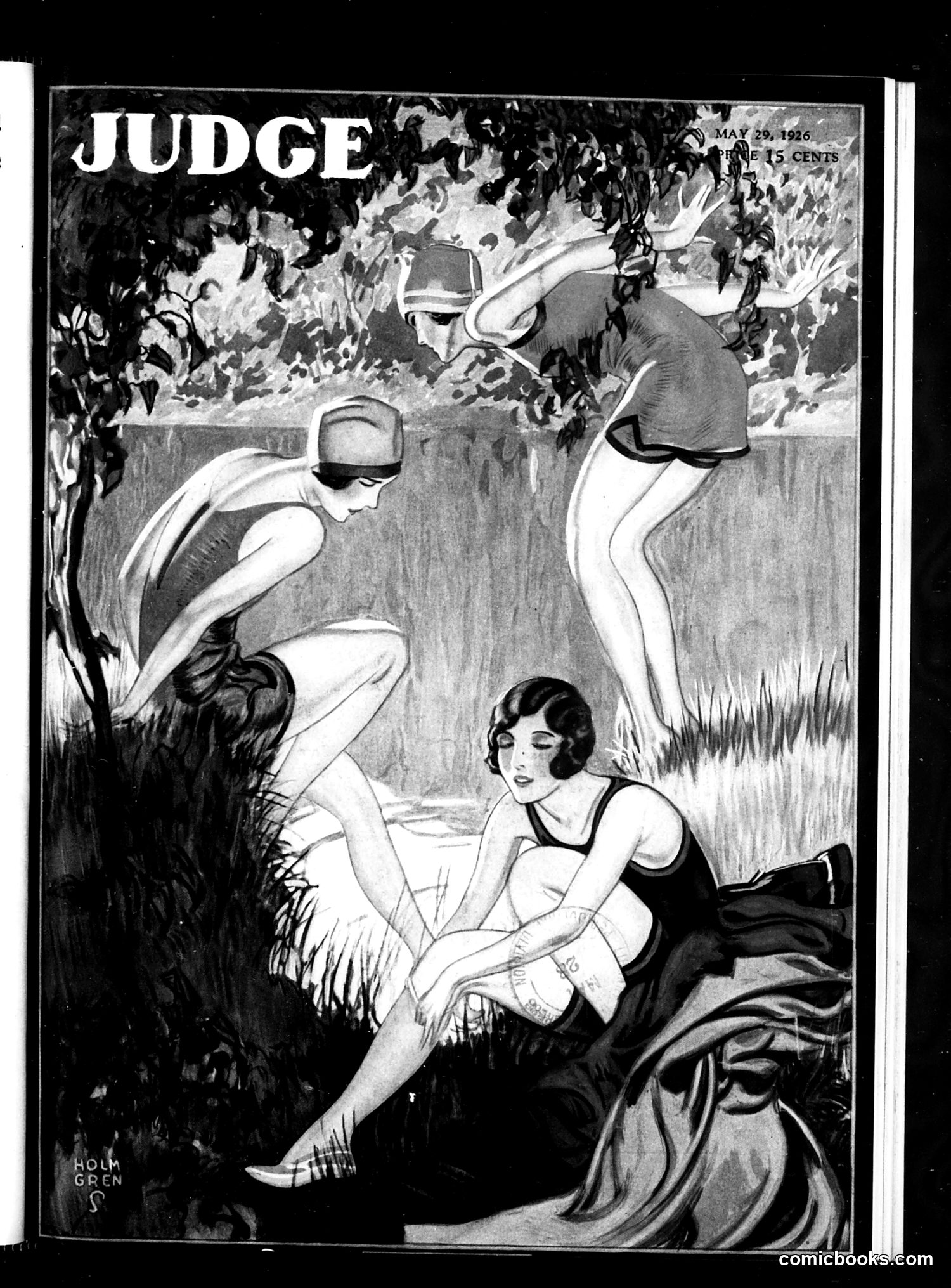
This Judge magazine cover from May 29, 1926 depicts three women in 1920s bathing attire at what appears to be a swimming hole or beach. The illustration, signed by artist Holm Greñ, shows women in various states of undress, with one seated on a dark garment in the foreground. The satire likely targets the "New Woman" of the 1920s—the flapper era—when women's fashion became increasingly revealing and scandalous by contemporary standards. Swimming costumes that exposed legs and arms were considered shocking and morally questionable. The cartoon probably satirizes public anxieties about women's liberation, changing social norms, and the erosion of Victorian modesty during this period of rapid social change. The specific context or caption would clarify the precise satirical intent.
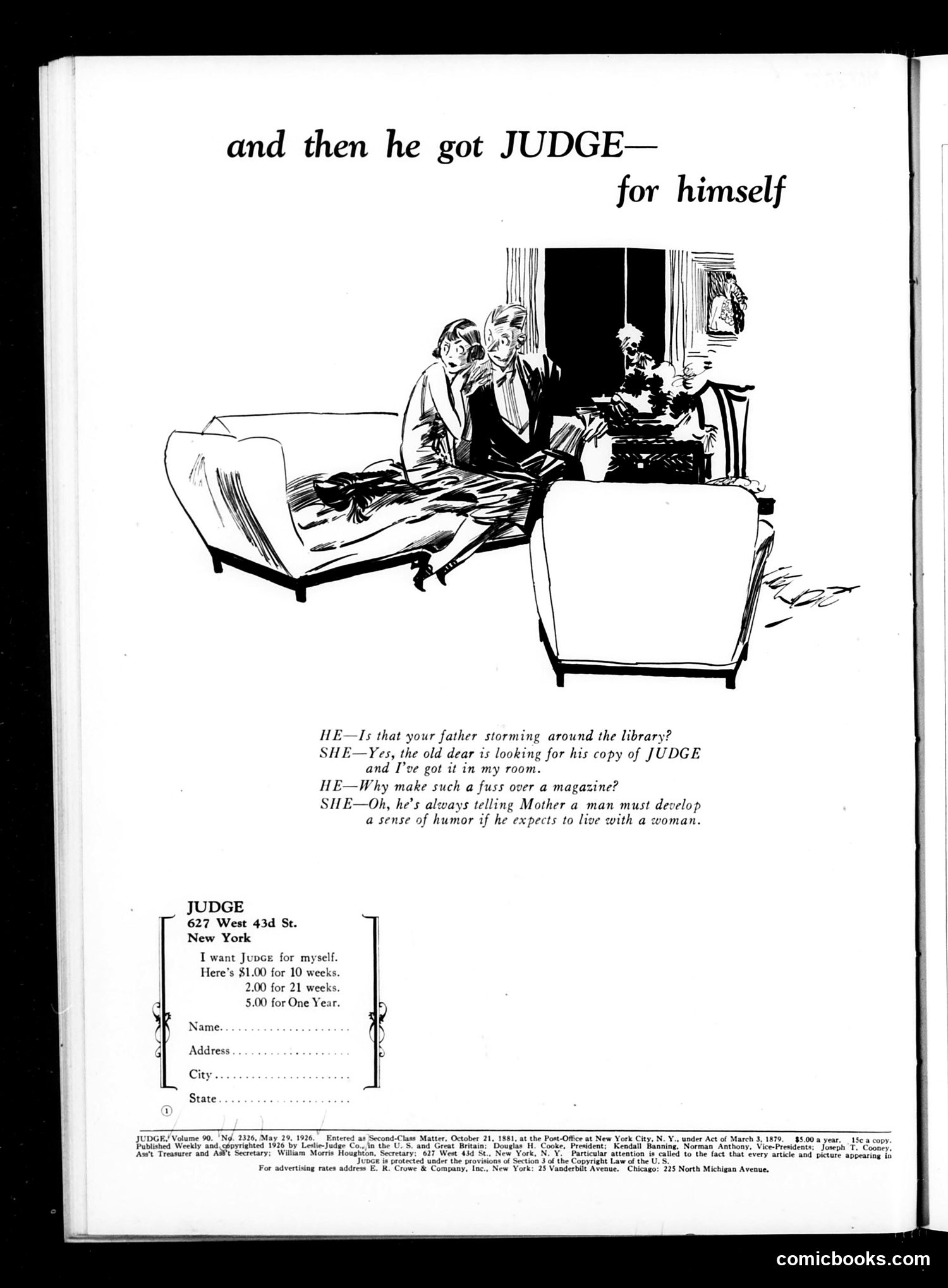
This page is primarily an **advertisement for Judge magazine itself** rather than political commentary. The cartoon depicts a domestic scene where a man searches for his copy of Judge magazine. His wife explains he's "looking for his copy of JUDGE," and she adds that "he's always telling Mother a man must develop a sense of humor if he expects to live with a woman." The joke is a **self-promotional advertisement**: Judge magazine positions itself as essential reading for maintaining marital harmony through humor. The implication is that reading Judge will help men develop the wit and humor necessary for successful relationships with women—a common advertising appeal of the era that assumes humor as a masculine virtue and domestic peace as dependent on male temperament. The subscription form below offers various rates, encouraging readers to subscribe for themselves.
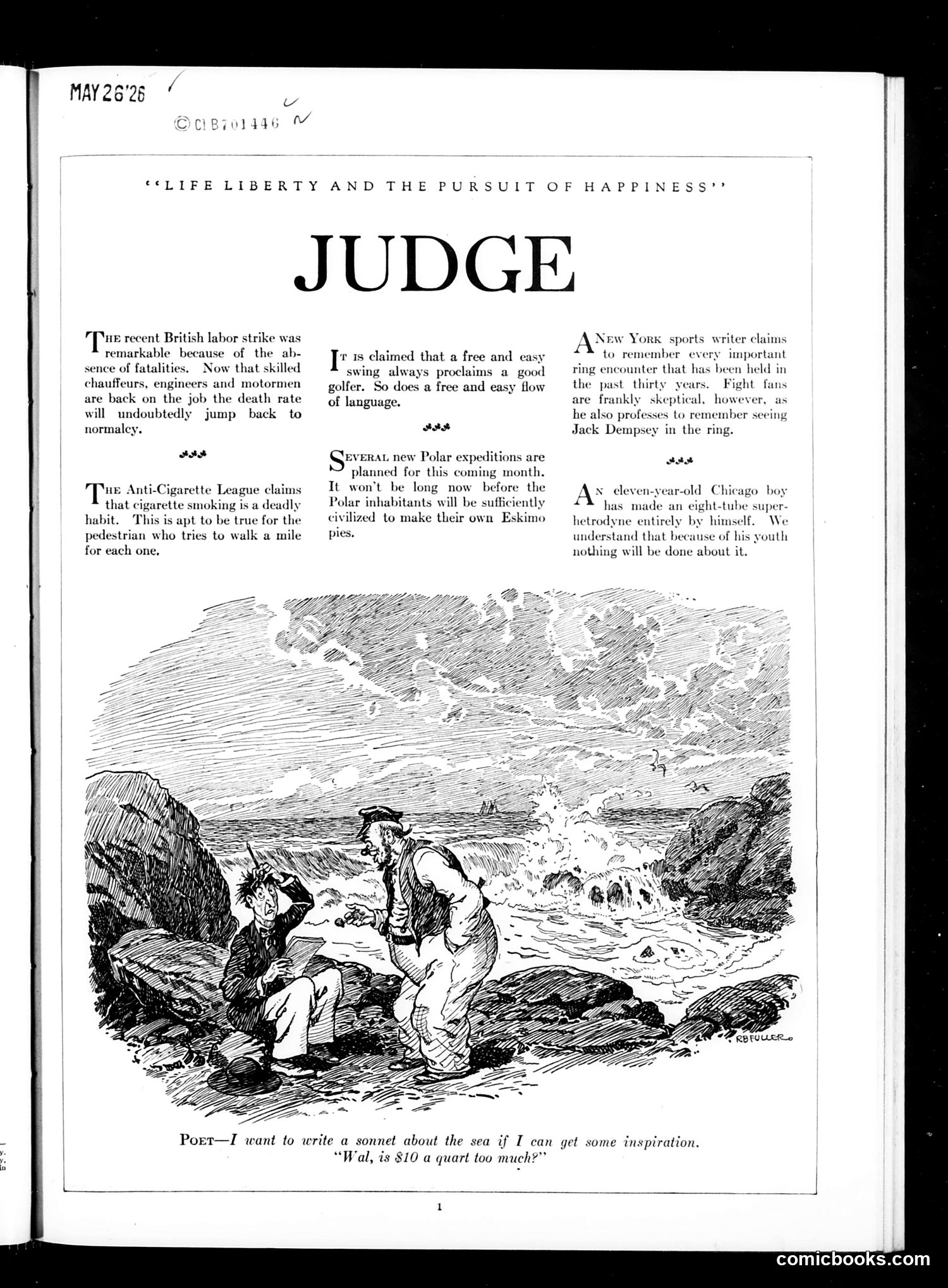
This page contains editorial commentary and a cartoon. The main illustration depicts two figures by the seaside—a poet seeking inspiration to write about the ocean, and another man responding that "$10 a quart" is too expensive, apparently referring to bootleg liquor prices during Prohibition. The cartoon satirizes the absurdity of Prohibition-era economics: even a poet trying to find artistic inspiration at the beach can't escape thinking about the inflated black-market cost of alcohol. It's social commentary on how pervasively Prohibition affected daily life and conversation, making illegal liquor prices a constant preoccupation across all social classes and contexts. The surrounding text discusses unrelated topics (labor strikes, cigarette smoking, polar expeditions, and a child's science project), typical of Judge's format.
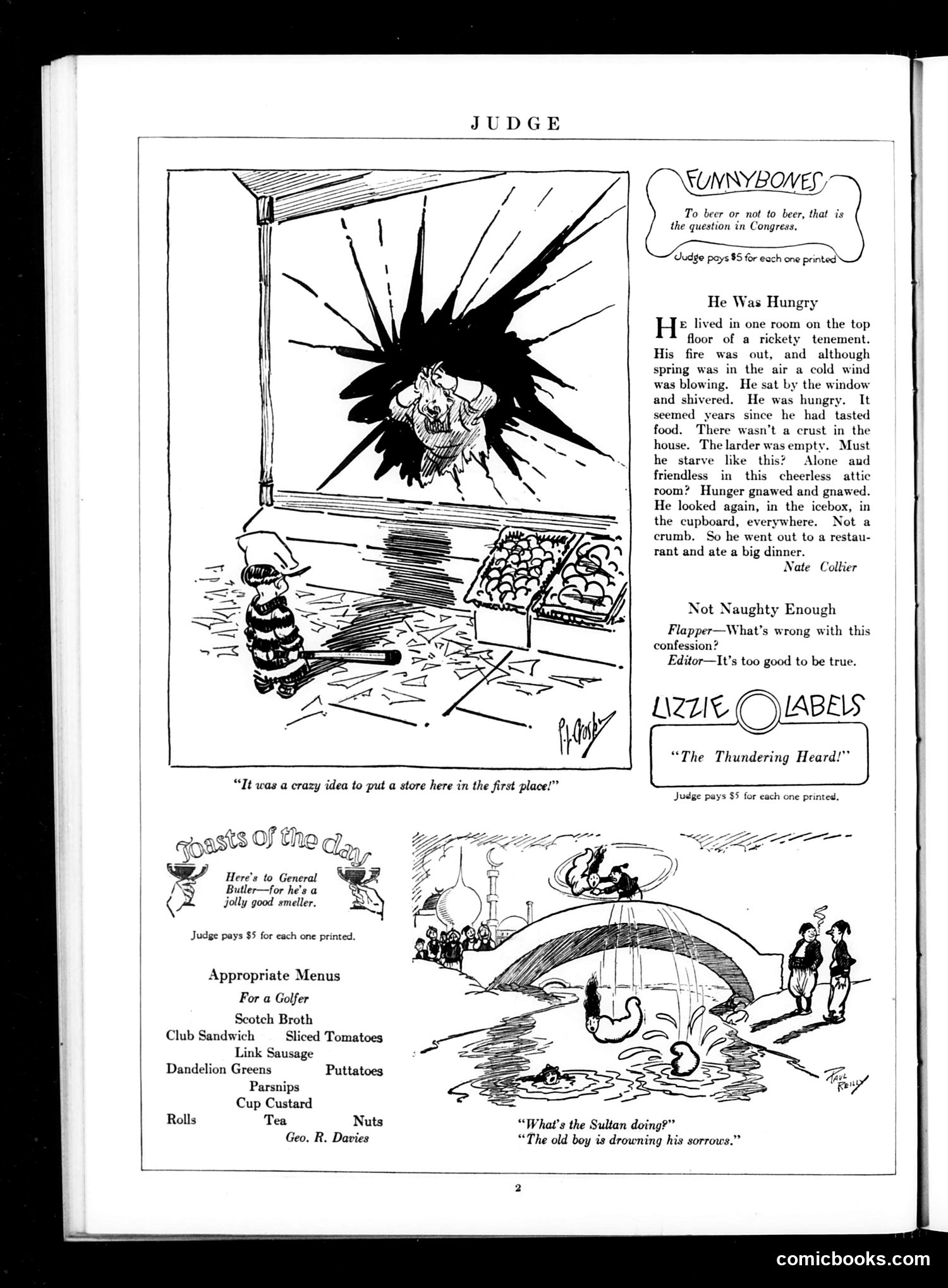
This page contains several satirical pieces: **"It was a crazy idea to put a store here in the first place!"** - A cartoon showing a storefront destroyed by wind/weather, with a small figure amid debris. The satire targets poor business decisions or unfortunate locations. **"He Was Hungry"** by Nate Collier depicts urban poverty—a starving man in a tenement finds no food, so he must eat at a restaurant, reversing expected class dynamics as social commentary. **"The Thundering Heard!"** (Lizzie Labels) appears to be wordplay satire, though unclear without fuller context. **"Roasts of the Day"** and **"Appropriate Menus for a Golfer"** are humorous food-related pieces unrelated to political satire. The bottom cartoon about "the Sultan" likely references Ottoman politics, though specifics are unclear from the image alone.
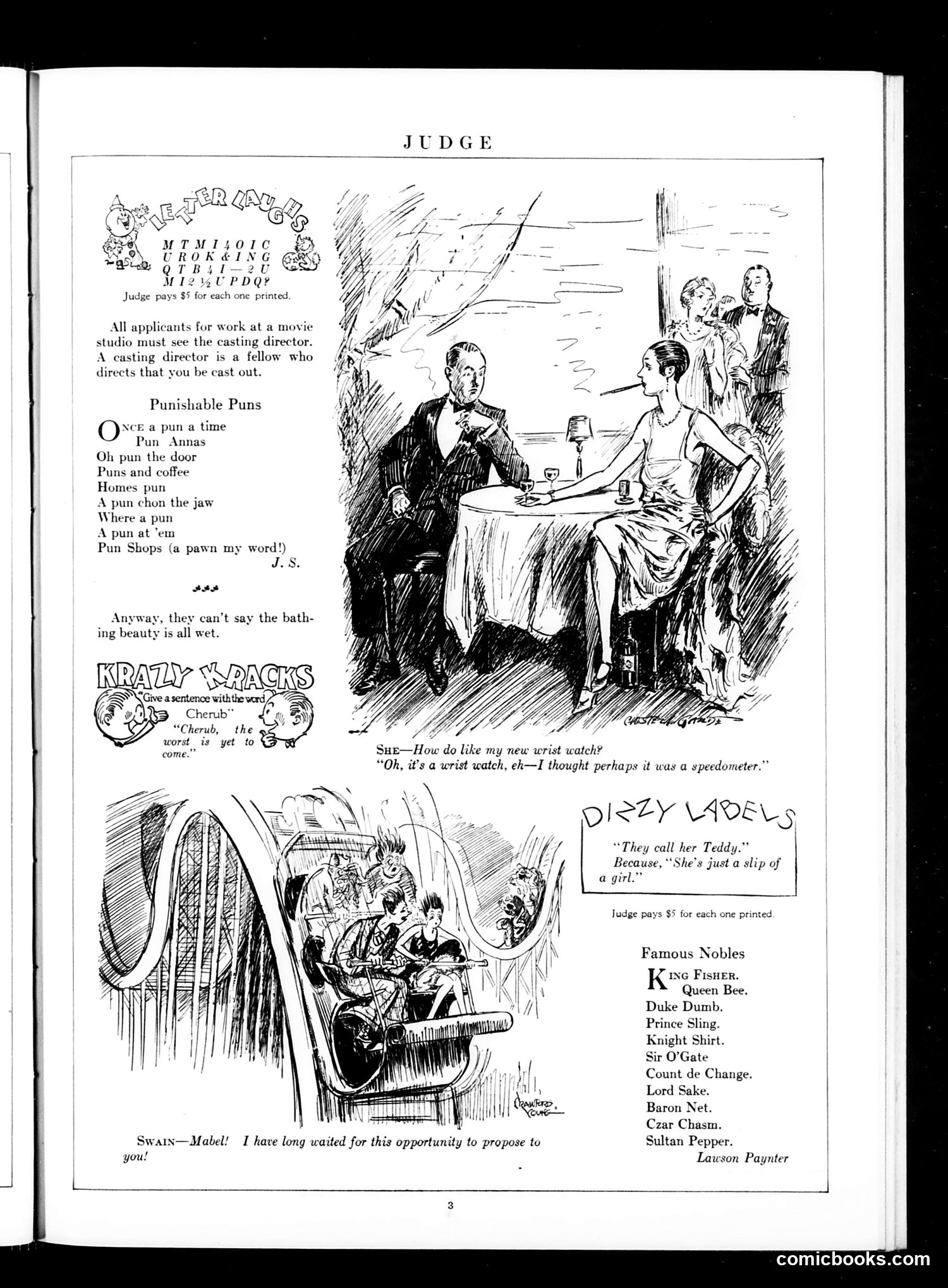
This page contains humor pieces and satirical cartoons typical of Judge magazine's content. **Top cartoon**: A couple at dinner where the woman shows off a "wrist watch," but the man mistakes it for a "speedometer." The joke plays on emerging automotive culture and male obliviousness to women's fashions. **Middle section**: "Punishable Puns" and "Krazy Kracks"—simple wordplay humor common to the era. **Bottom cartoon**: A swan proposing to "Mabel" in a gondola. The caption "I have long waited for this opportunity" is a pun on the swan's literal long neck. **Right side**: Lists "Famous Nobles" with absurdist titles (Queen Bee, Duke Dumb, Knight Shirt), mock-nobility humor mocking pretension. The page is primarily entertainment-focused rather than political commentary.
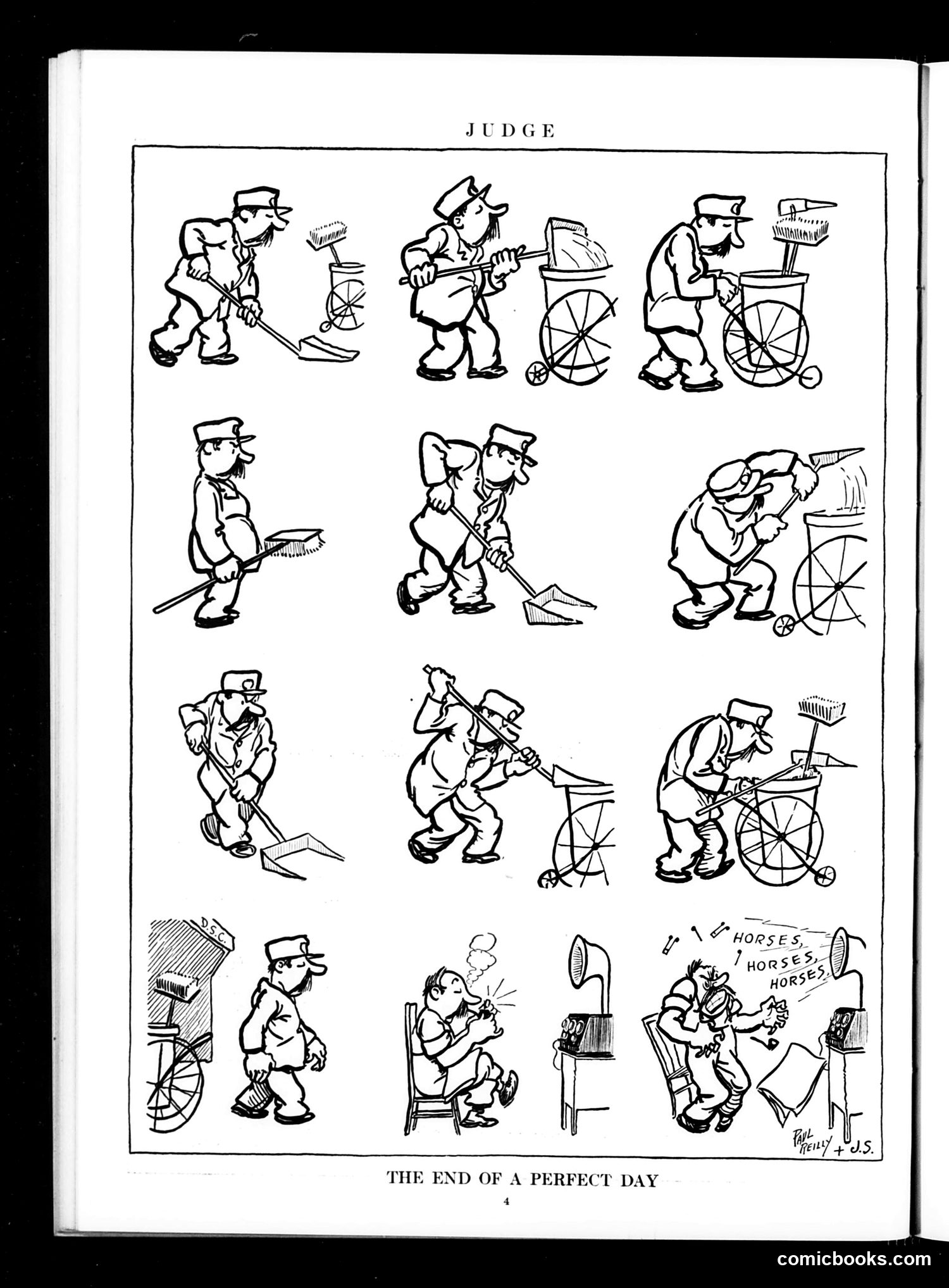
This satirical cartoon depicts a street vendor—likely a hot dog or food cart operator—experiencing an increasingly chaotic day. The sequence shows him progressively losing control of his situation: starting with routine vending, moving through confrontations with customers or authorities (suggested by the shovel-wielding figures), and culminating in complete pandemonium in the final panel where he's frantically gesturing and shouting about "horses." The humor appears to rest on the contrast between the mundane reality of street vending and the vendor's escalating mental breakdown. The "perfect day" title is ironic—what unfolds is the opposite of perfection. The cartoon likely satirizes the frustrations of working-class vendors dealing with urban chaos, authorities, or difficult customers in early 20th-century America.
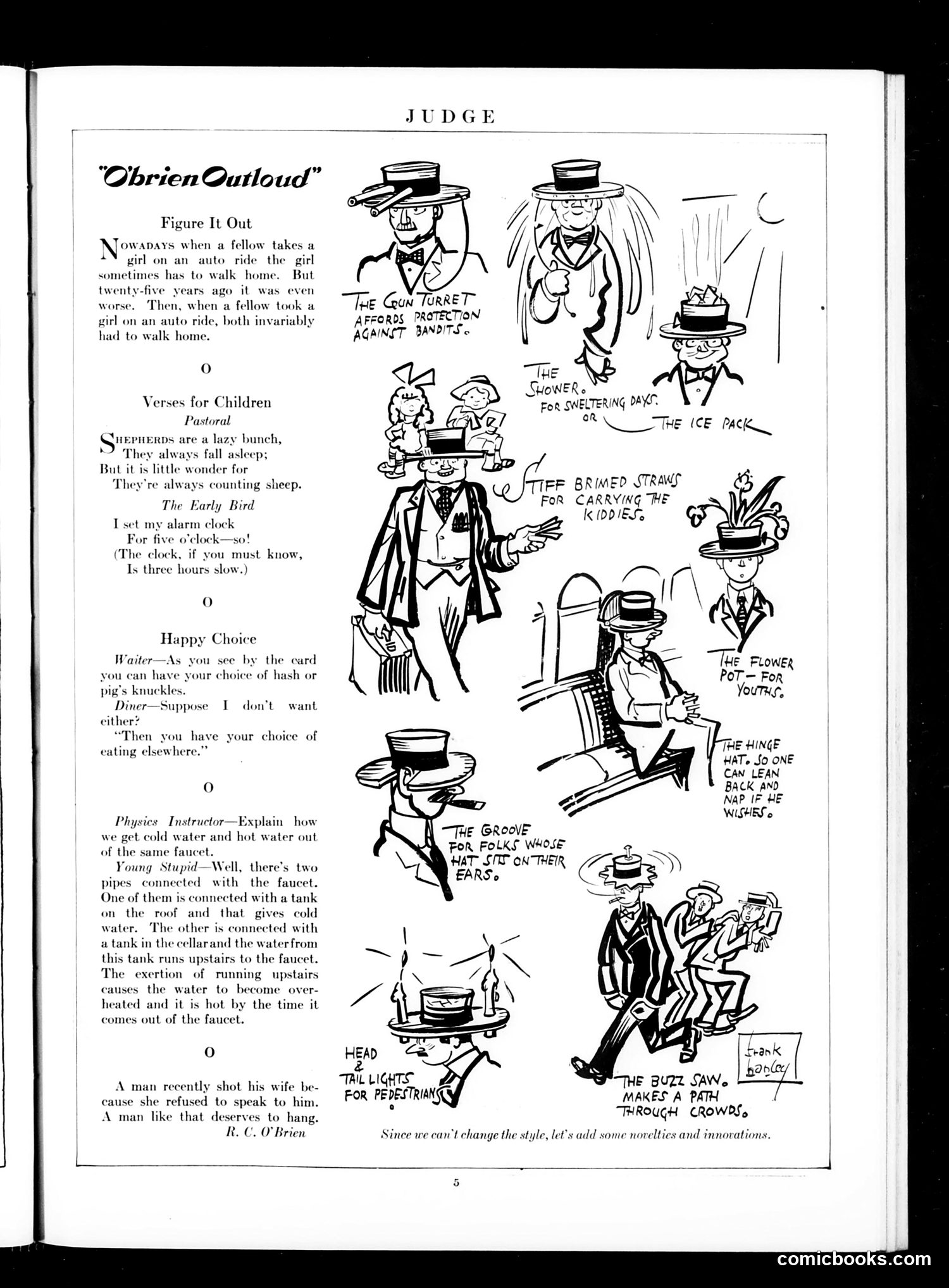
This page features humorous illustrated inventions and fashion novelties from early 20th-century America. The cartoons satirize practical solutions to everyday annoyances: - **"The Gun Turret Afford Protection Against Bandits"** - mocks paranoid auto safety concerns - **"The Shower for Overheating Days"** - ridicules impractical cooling devices - **"Stiff Brimed Straw for Carrying Kiddies"** - satirizes awkward child-carrying contraptions - **"The Flower Pot for Youths"** - jokes about fashionable hat decorations - **"Head Tail Lights for Pedestrians"** - mocks safety inventions for walkers - **"The Buzz Saw Makes a Path Through Crowds"** - exaggerates solutions to crowded streets The page also includes brief comic verses and a dark joke about a domestic shooting. The overall tone gently ridicules contemporary inventions and social manners through absurdist humor typical of Judge's satirical style.
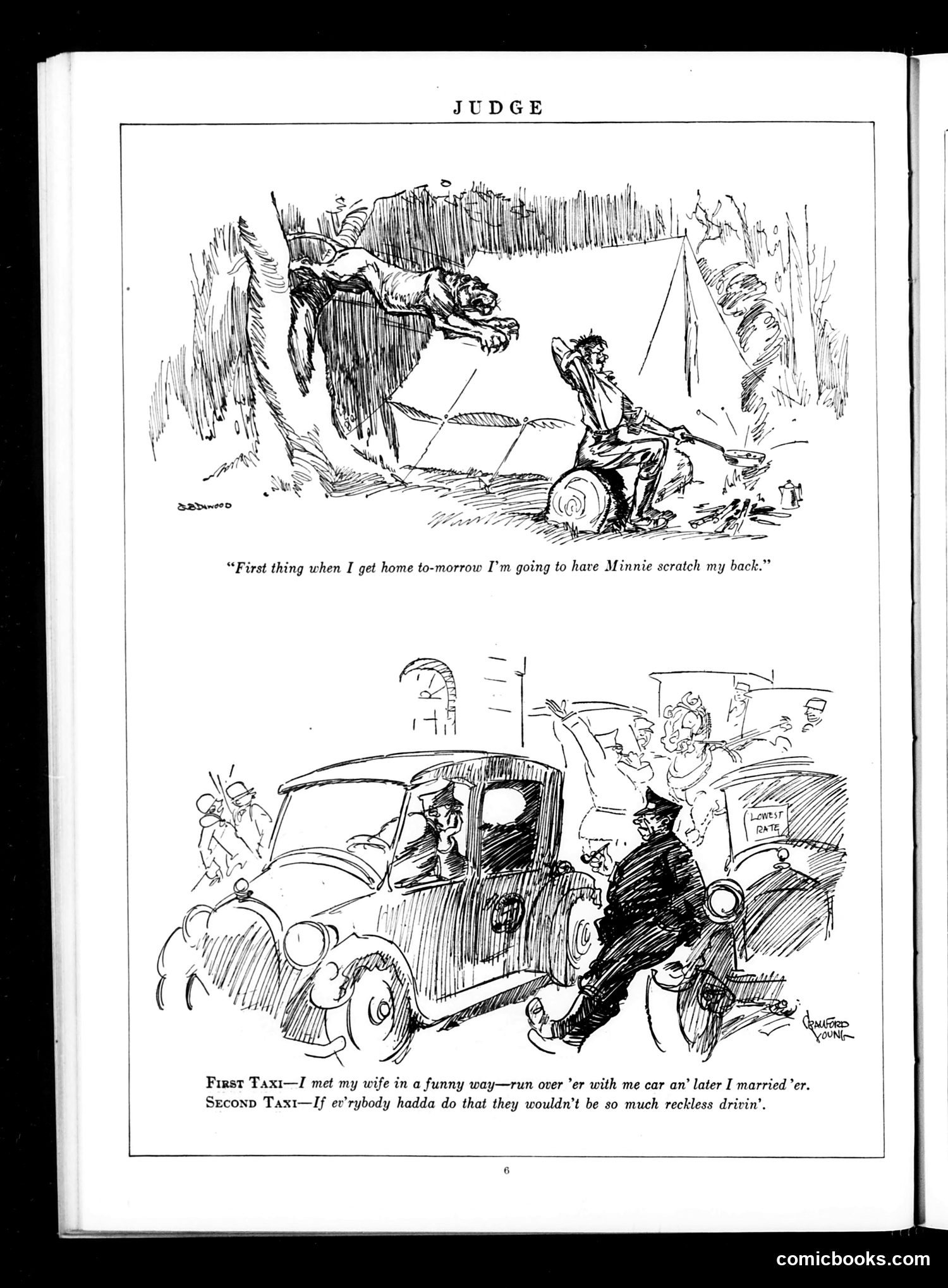
This page contains two unrelated jokes satirizing early 20th-century social attitudes. **Top cartoon**: A man fishing tells his companion he plans to have his wife "Minnie scratch my back"—crude humor treating marriage as servitude, where wives exist to satisfy husbands' demands. **Bottom cartoon**: Two taxi drivers discuss how they met their wives. The first boasts he "run over 'er" or hit her with his car before marrying her. The second responds that if everybody drove recklessly like that, there wouldn't be so much careless driving—dark satire suggesting that reckless behavior (hitting pedestrians) might paradoxically reduce traffic accidents by eliminating careless drivers. Both cartoons reflect period attitudes toward marriage as transactional and normalize dangerous driving through dark humor. The satire critiques masculine attitudes rather than endorsing them.
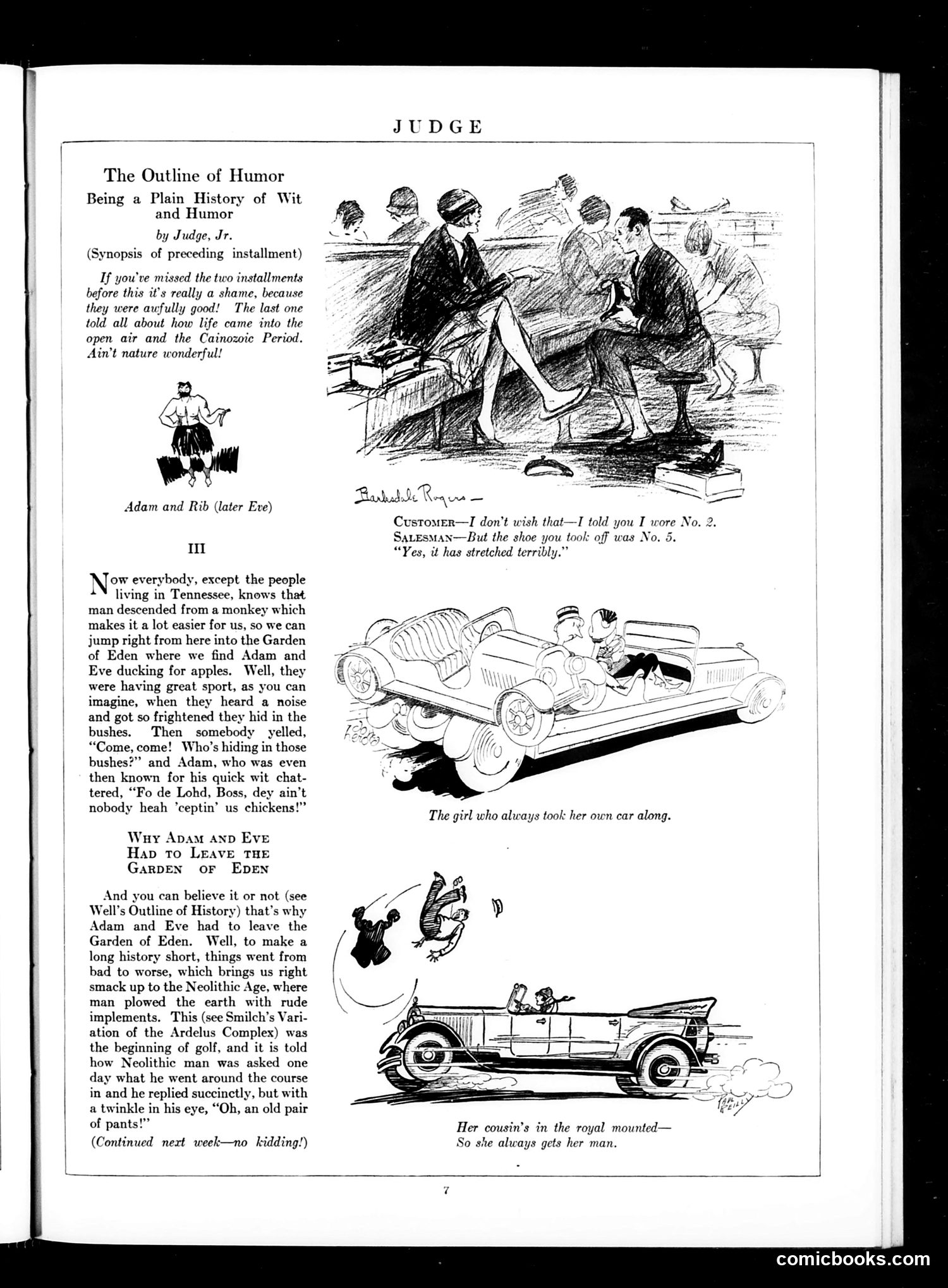
This page from Judge magazine presents humorous pseudo-historical commentary. The main joke involves Adam's response to God's voice in Eden—he adopts a stereotypical African American dialect ("Fo de Lohd, Boss, dey ain't nobody heah 'ceptin' us chickens!")—which the text treats as the *reason* Adam and Eve were expelled. This reflects the crude racial humor common to early 20th-century American comics. The page also includes unrelated comic vignettes: a shoe salesman dispute, a reference to golf's supposed "Neolithic" origins with a pun about "pants," and scenes of women in vehicles. The overall tone mimics popular pseudo-scientific histories (referencing H.G. Wells), treating human evolution and history as material for crude jokes. The humor relies on dated stereotypes and wordplay rather than sophisticated satire.
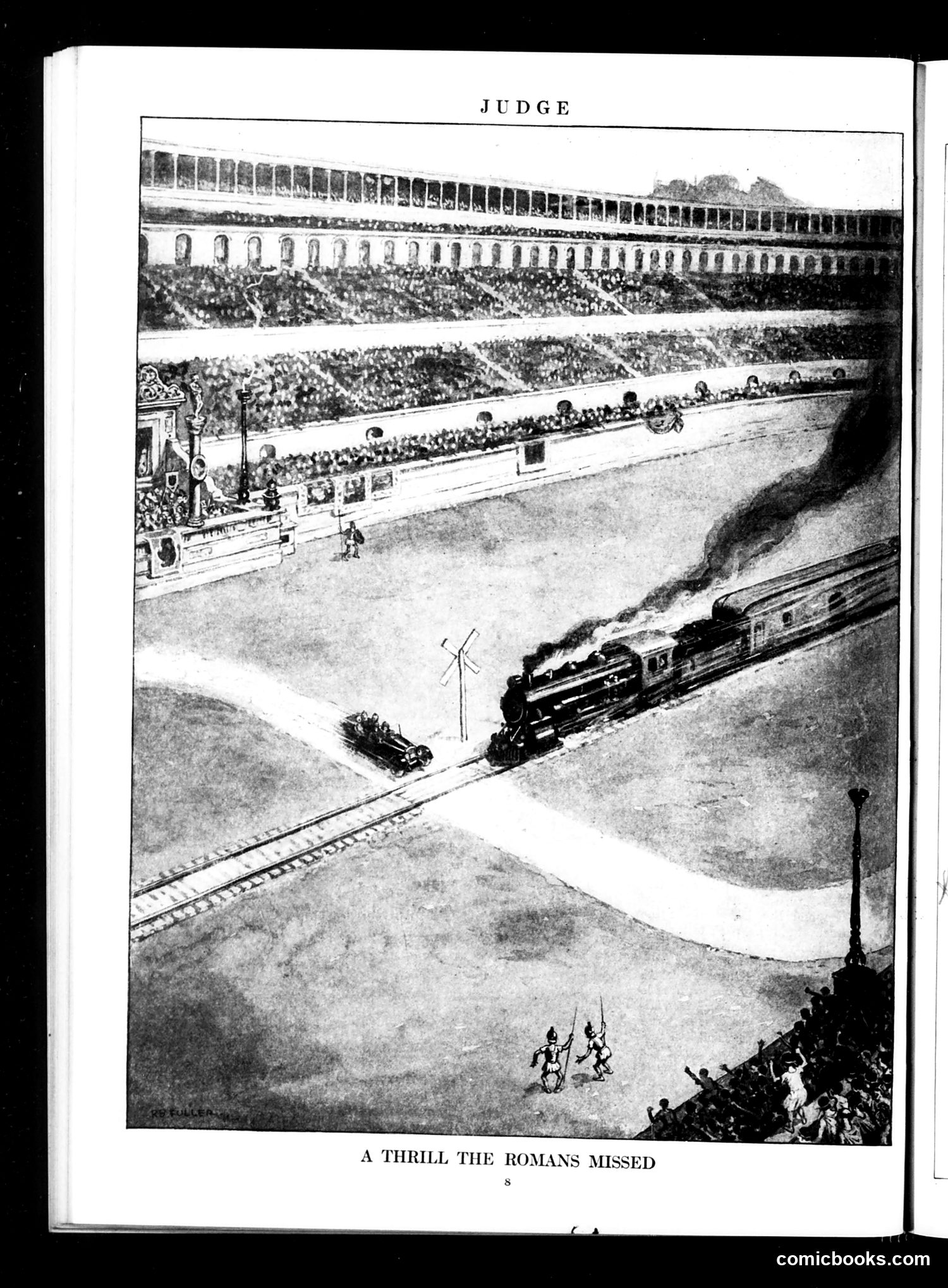
This illustration satirizes modern technology by imagining what ancient Romans would have witnessed had a steam locomotive existed during their era. The image depicts a train racing across an arena floor while crowds fill the tiered seating above—mimicking the famous Roman Colosseum's layout and spectacle. The joke's premise: Romans enjoyed gladiatorial combats and exotic animal shows, yet they "missed" the thrilling sight of a speeding locomotive. This reflects early 20th-century pride in industrial progress and mechanical innovation as entertainment surpassing ancient civilizations' amusements. The cartoon assumes readers find locomotives sufficiently impressive to constitute a superior spectacle to historical Roman entertainment, celebrating industrial-age modernity over antiquity.
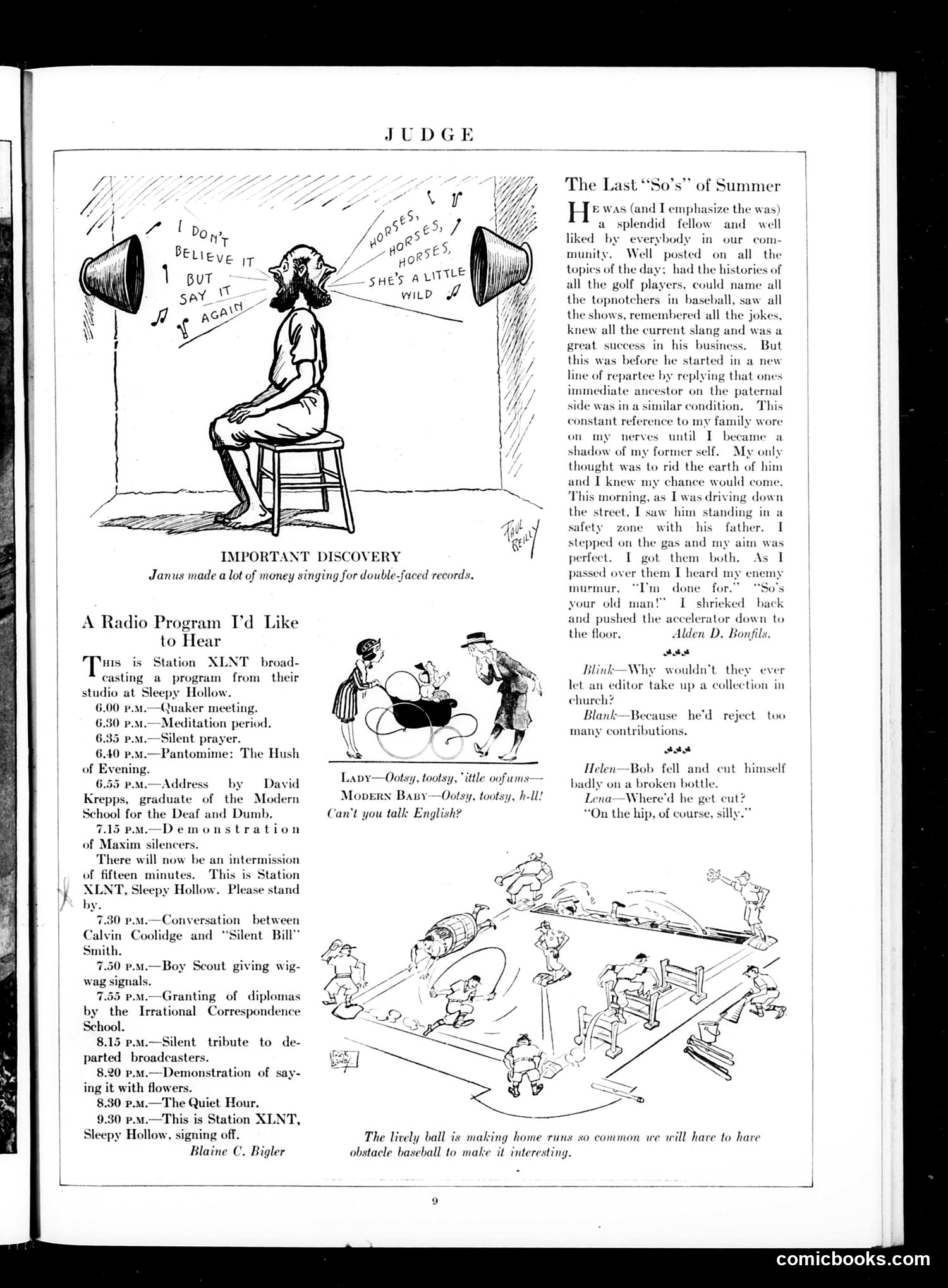
This page contains satirical humor typical of 1920s Judge magazine: **"Important Discovery"** mocks the novelty of "double-faced records"—likely referring to phonograph records with different content on each side, a recent innovation. The Janus reference (the two-faced Roman god) makes the pun explicit. **"A Radio Program I'd Like to Hear"** satirizes the then-novel medium of radio broadcasting by proposing an entire station dedicated to *silence*—featuring silent prayer, pantomime, a speech from a deaf graduate, Calvin Coolidge (famously taciturn), and "Silent Bill" Smith. This mocks both radio's novelty and Coolidge's reputation for being uncommunicative. **The baseball cartoon** jokes about modern ball becoming too lively (home runs too frequent), requiring "obstacle baseball" to remain challenging. **"The Last 'So's' of Summer"** is a darkly comic story about revenge—a man kills his annoying acquaintance and the man's father by hitting them with his car. The page reflects 1920s preoccupations: new technology (radio), changing social customs, and contemporary public figures like Coolidge.
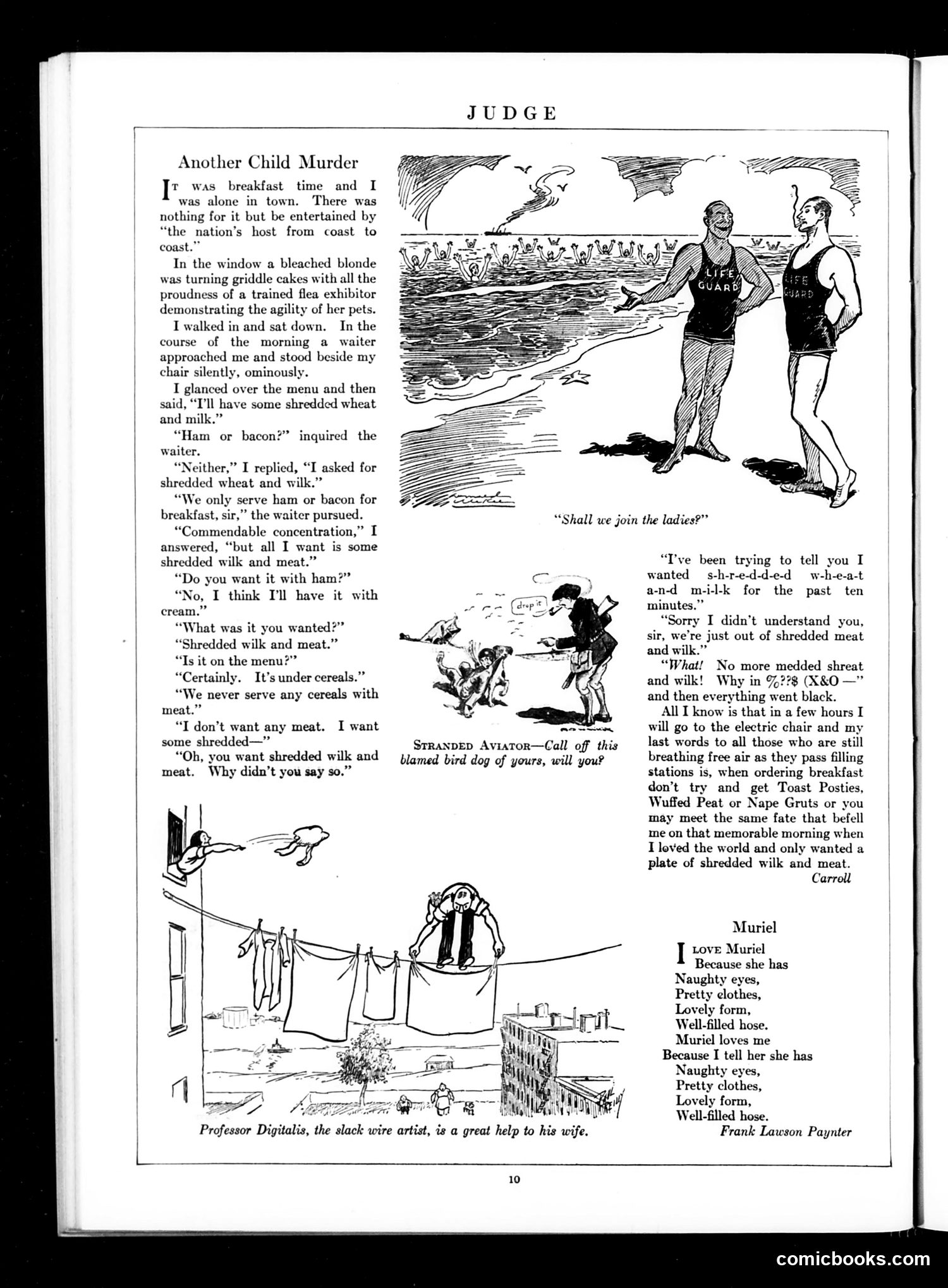
This page satirizes the frustration of dealing with obstinate service workers who refuse to listen. The main story describes a diner patron's absurd conversation with a waiter who repeatedly misunderstands or ignores a simple breakfast order for "shredded wheat and milk," insisting on adding ham or bacon despite corrections. The humor escalates darkly: the miscommunication becomes so maddening that the narrator supposedly murders someone and faces execution—hence "Another Child Murder," a sardonic reference to capital punishment. The satire targets institutional inflexibility and poor customer service, where workers follow rigid protocols rather than accommodate reasonable requests. The accompanying cartoons (a beach scene, a clothesline domestic scene) and poems about "Muriel" are separate humorous content typical of Judge's format. The overall message: bureaucratic obstinacy, even in minor service interactions, can drive people to madness.
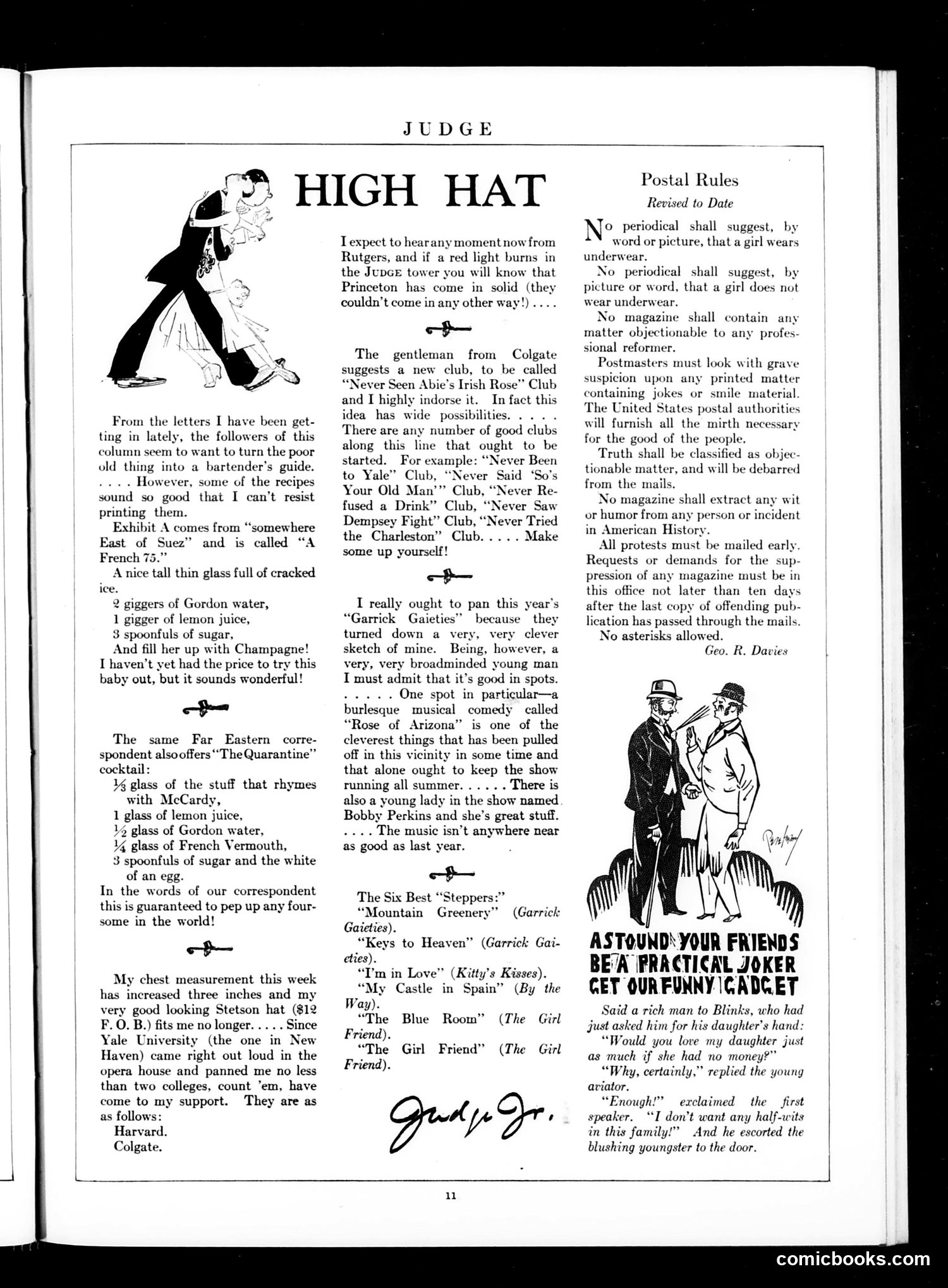
This page is primarily a humorous column called "High Hat" by the magazine's editor, featuring cocktail recipes and social commentary rather than political satire. **Main Content:** The "High Hat" column presents cocktail formulas (the "French 75" and "Quarantine") sent by readers—likely referencing Prohibition-era America, where such recipes circulated covertly. The author jokes about gaining weight and receiving support from Yale, Harvard, and Colgate universities. **The Satire:** The "Postal Rules" section is the page's satirical punch. It mocks actual postal censorship regulations by presenting absurdist rules: prohibiting suggestions about girls' underwear (both wearing and not wearing it), banning jokes, classifying truth as "objectionable," and forbidding humor about American history. This critiques the era's heavy-handed censorship of magazines. **Additional Content:** Reviews of theatrical productions ("Garrick Gaieties") and a small joke at bottom-right about a practical joker's "funny gadget." The overall thrust criticizes government suppression of magazine content during the 1920s.
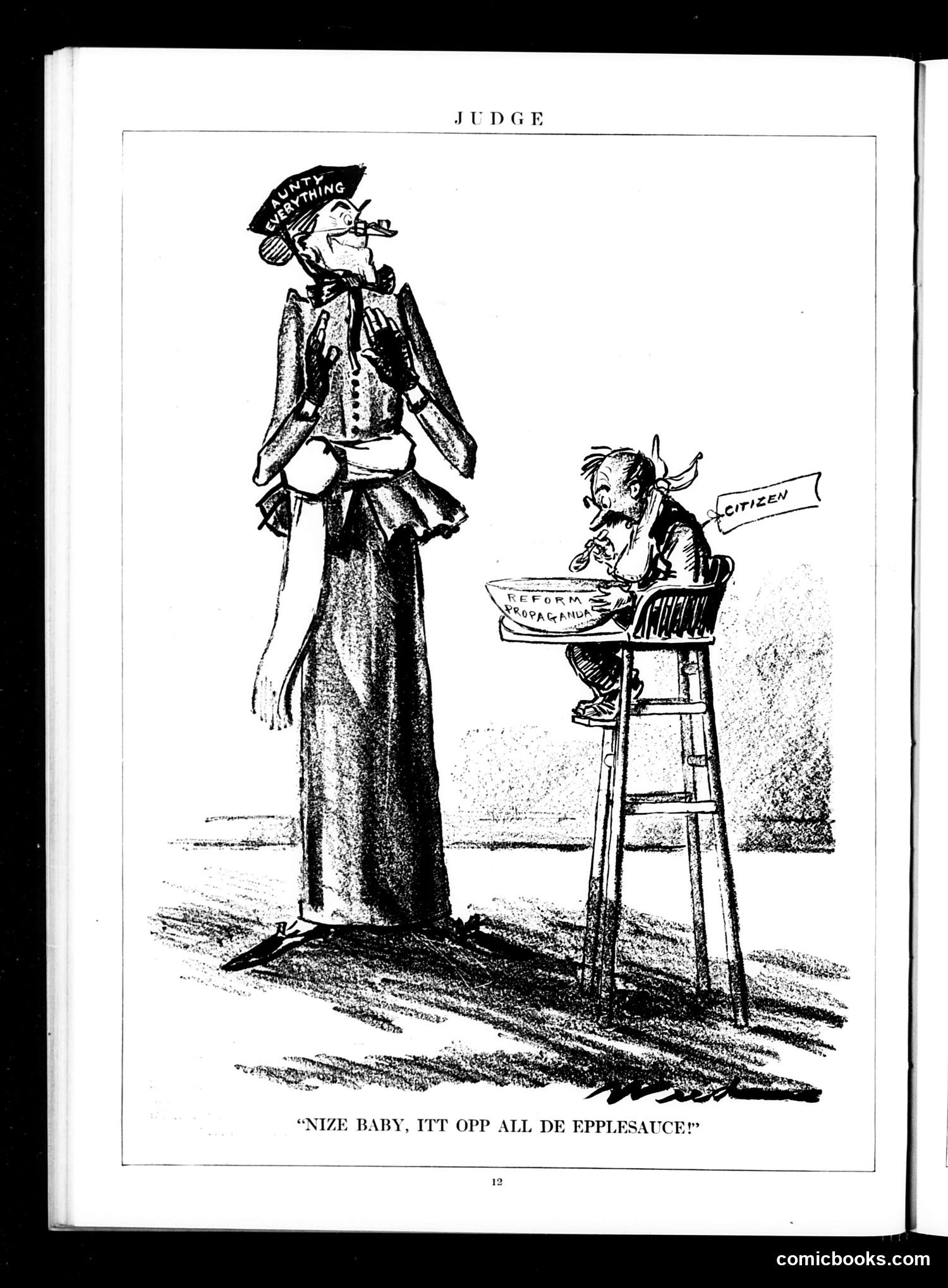
This political cartoon depicts a tall figure labeled "ANYTHING GOES" (appearing to represent judicial permissiveness or lax law enforcement) towering over a smaller character seated on a stool labeled "CITIZEN." The citizen holds papers labeled "REFORM PROPAGANDA" and a flag marked "CITIZEN." The caption uses dialectal speech ("Nize baby," "itt opp," "epplesauce"), likely representing immigrant or working-class vernacular common in early 20th-century American satire. The cartoon critiques how judicial authority dismisses reform efforts—the judge condescendingly tells the citizen to accept or ignore reform proposals. The satire targets the tension between judicial power and citizens' reform movements, suggesting courts were indifferent to public demands for change.
This page contains three editorial essays, not cartoons. The masthead shows a judge at a bench, illustrating the publication's satirical voice on current events. The pieces address: 1. **"About Face"**: Mocks *Collier's* magazine's reversal on Prohibition. Judge celebrates that even die-hard dry advocates now admit alcohol prohibition has failed and call for repeal—a dramatic shift Judge finds amusing. 2. **"The Strike"**: References a British general strike (likely 1926). Judge supports the miners' grievances but expresses relief at settlement. It sarcastically suggests punishing Winston Churchill (then a political figure opposing labor) by sending him down a coal mine. 3. **"The Optimist"**: Quotes Henry Ford dismissing British labor unrest, claiming America's "intelligent" immigrants prevent such trouble. Judge gently disputes this, noting America lacks rigid class divisions that breed European labor militancy—suggesting Ford's confidence, while possibly correct, rests on faulty reasoning rather than superiority.
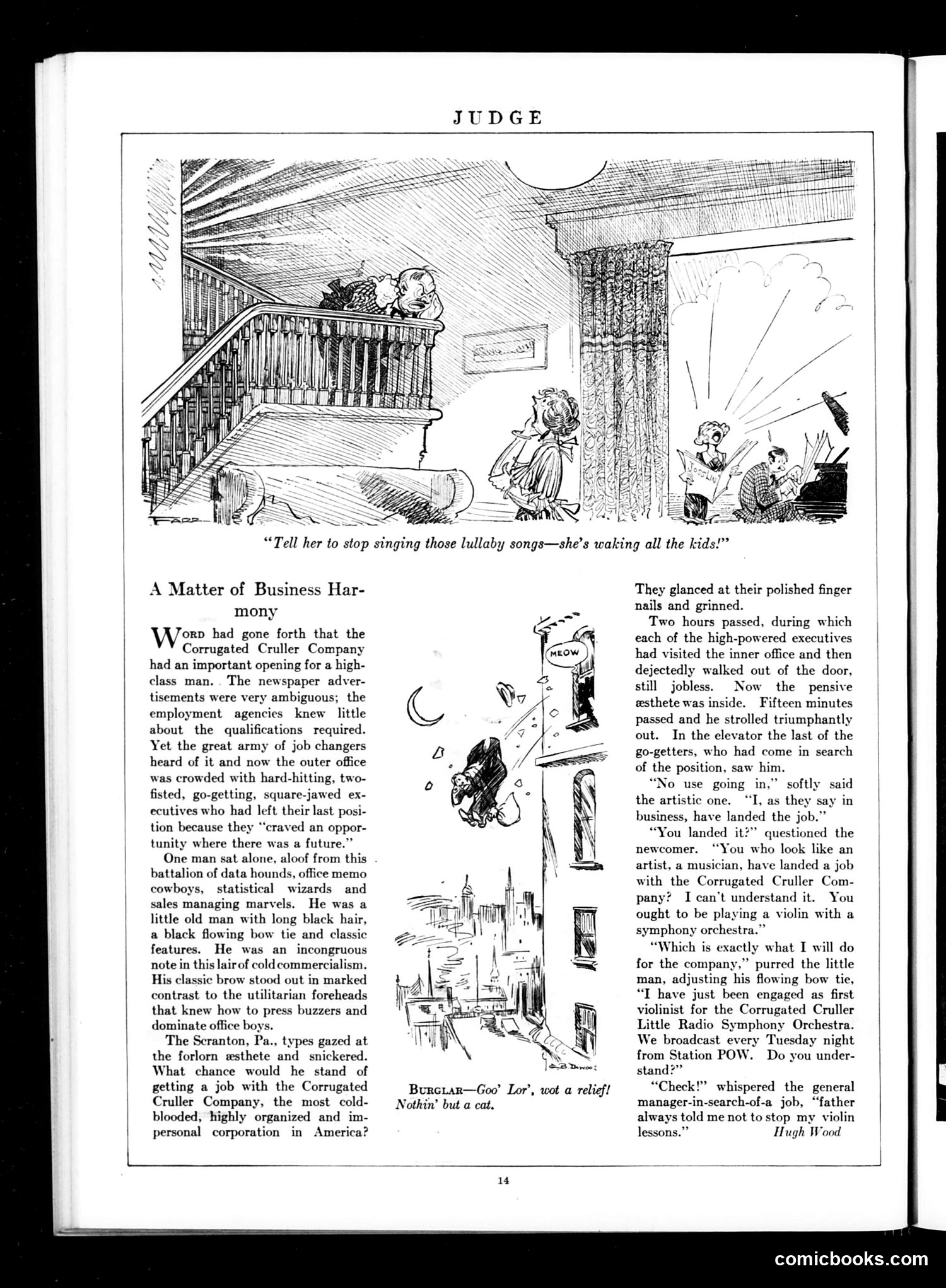
This Judge cartoon satirizes early 20th-century corporate culture and hiring practices. An artistic man with classical features—appearing as a musician or aesthete—sits alone while aggressive, ambitious "go-getter" businessmen crowd the waiting room for a position at the Corrugated Cruller Company (a fictional firm representing soulless corporate America). The joke: all the hard-nosed executives are rejected, but the artistic musician gets hired—not despite his impracticality, but *because* of it. He's hired as a violinist for the company's radio symphony orchestra, a broadcasting venture. The satire mocks how rigid corporate hierarchies miss obvious fits while pursuing stereotypical "business types," and how even supposedly cold, impersonal corporations needed culture and entertainment to seem modern and sophisticated. The "aesthetic one" triumphs precisely by being the opposite of the ruthless businessman archetype—a pointed commentary on what 1920s-30s executives actually valued.
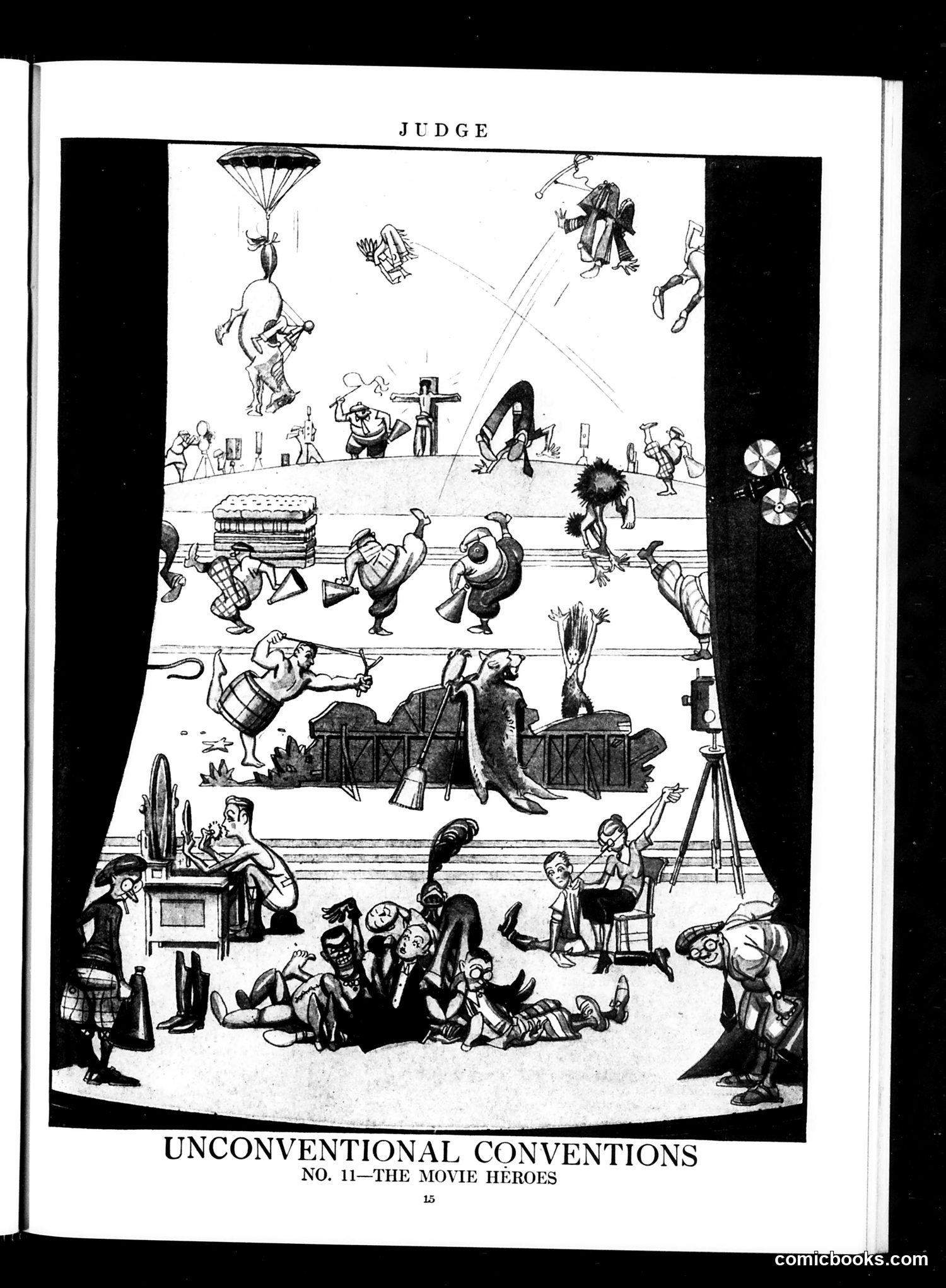
This Judge magazine cartoon satirizes the film industry and movie heroes of its era. The central scene depicts a chaotic "convention" of cinema characters and tropes arranged in theatrical stages. The middle tier shows exaggerated film stereotypes: musicians with instruments, dramatic figures, and what appears to be a wild animal tamer with a beast. The upper level features acrobatic performers and slapstick action—people with parachutes, falling figures, and physical comedy. A cross and religious imagery suggest melodramatic "serious" films. The bottom foreground shows devils and demonic figures alongside what appear to be criminal or villainous characters—common movie antagonists. The satire mocks Hollywood's reliance on formulaic conventions: physical comedy, wild stunts, melodrama, and moral simplicity (good versus evil). By literally depicting these as a "convention," Judge suggests the film industry operates by predictable, tired formulas rather than genuine creativity or sophistication.
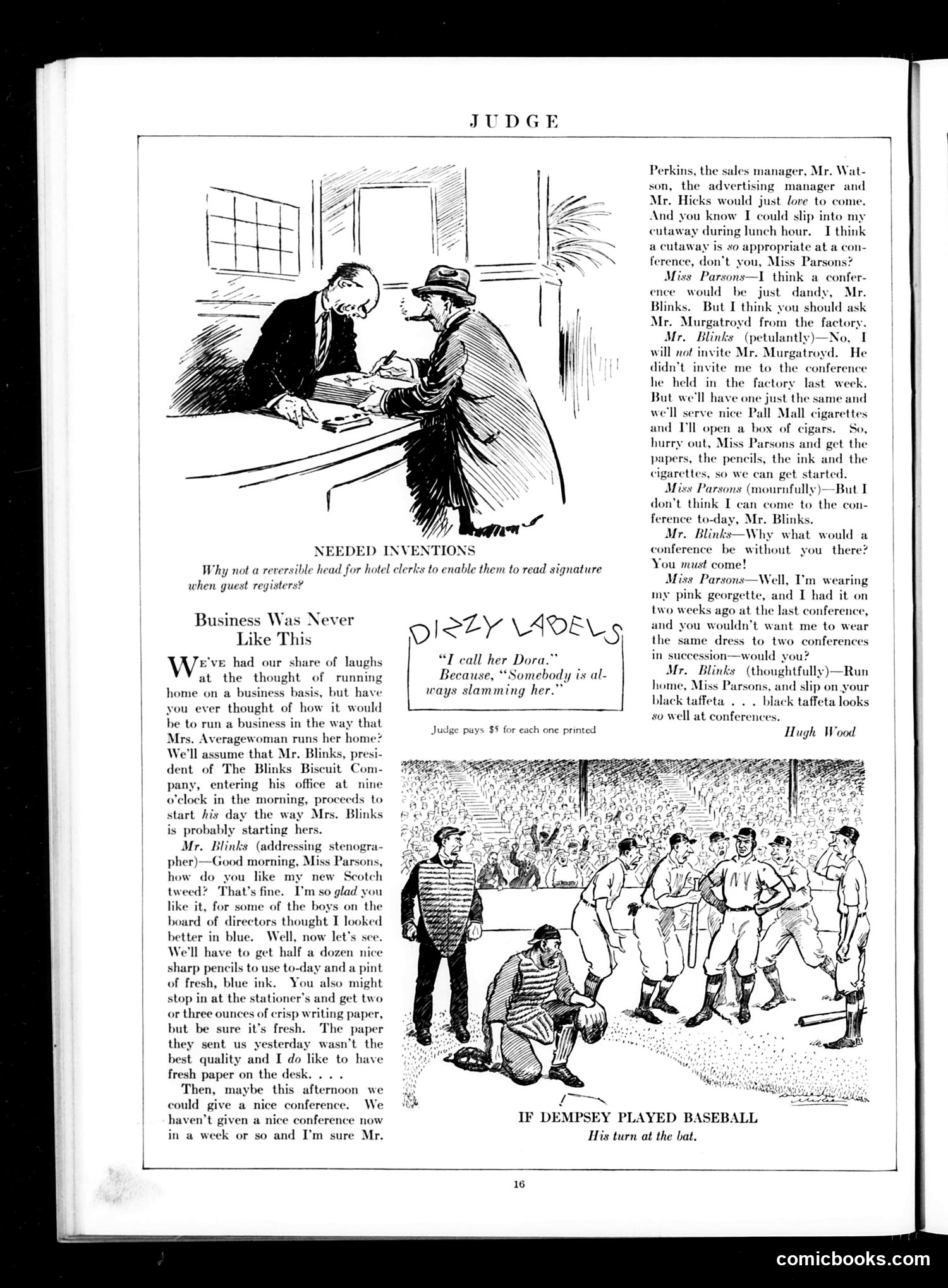
This page satirizes the absurdity of running a business like a household. The central joke: Mr. Blinks, a biscuit company president, conducts his office with the same inefficient, domestic priorities as his wife manages their home. The humor lies in the contrast between business professionalism and domestic frivolity. Instead of focusing on operations, Blinks fusses over choosing new Scotch tweed, acquiring fresh blue ink and crisp writing paper, and selecting cigarette brands—treating a corporation like household management. His stenographer Miss Parsons becomes entangled in his whims, including concern about wearing the same dress twice to conferences (requiring her to rush home and change into "black taffeta"). The sidebar cartoon "If Dempsey Played Baseball" likely references Jack Dempsey, the famous heavyweight boxer, humorously reimagined playing baseball—another incongruous skill juxtaposition joke typical of Judge's era humor. The overall message criticizes inefficient, personality-driven business management divorced from actual operations.
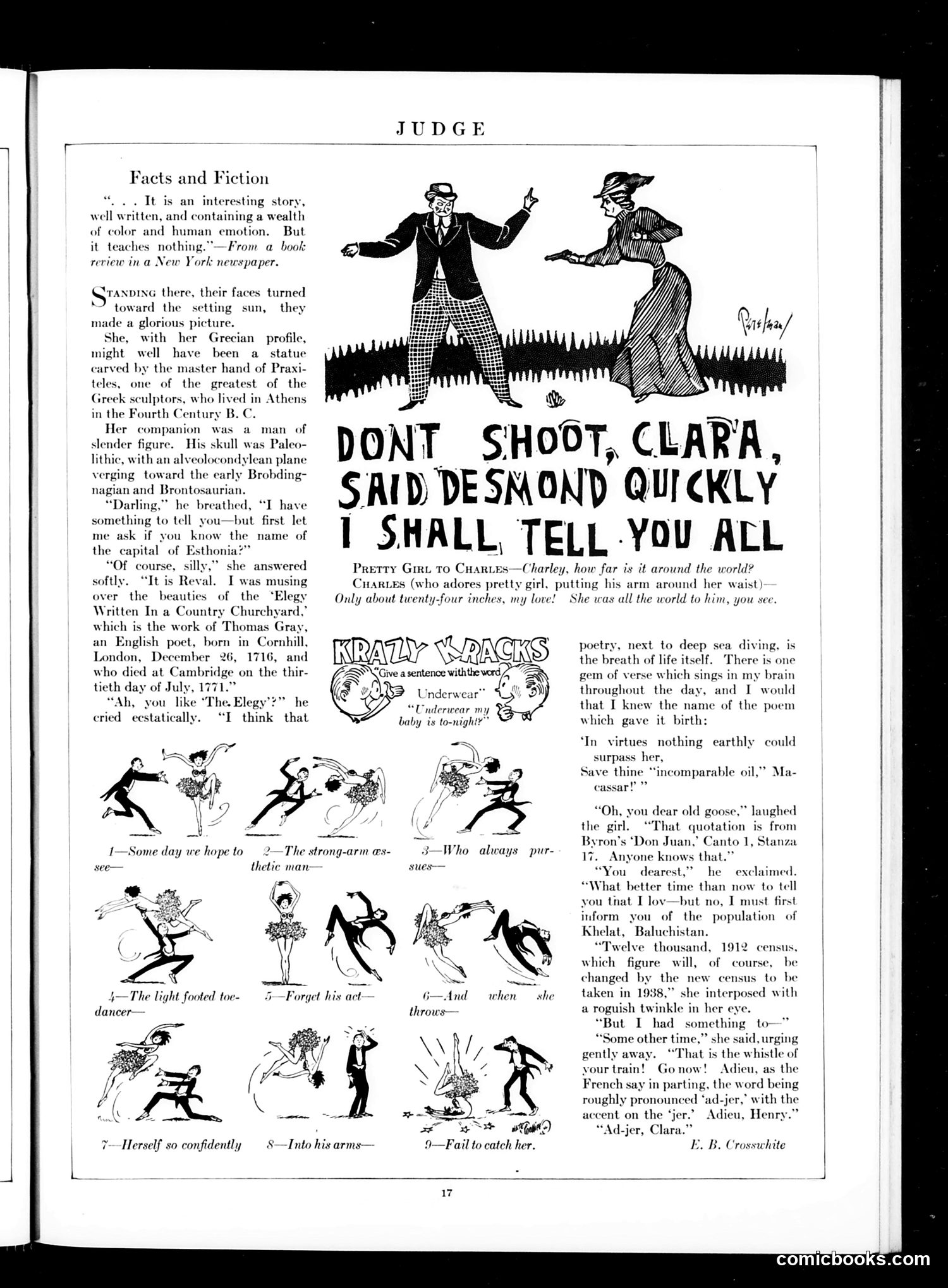
This page satirizes pretentious literary and romantic affectation. The main story mocks couples who interrupt romantic moments with ostentatious displays of knowledge—quoting obscure poetry, reciting historical facts about poets (Thomas Gray's exact birth/death dates), and spouting geographical trivia instead of genuine emotion. The "Facts and Fiction" header frames the joke: the book review excerpt criticizes a novel for being well-written but teaching nothing—the page then demonstrates this complaint through its protagonists, who constantly interrupt tenderness with pedantic information (the capital of "it," Baluchistan's population, Byron citations). The "Krazy Kracks" cartoon and acrobatic illustrations below provide visual comedy—physical slapstick contrasting with the intellectual pretension above. The satire targets early 20th-century middle-class affectation: the assumption that romance must be seasoned with cultural references and trivial facts to seem sophisticated. By overdoing this, the characters actually undermine genuine connection.
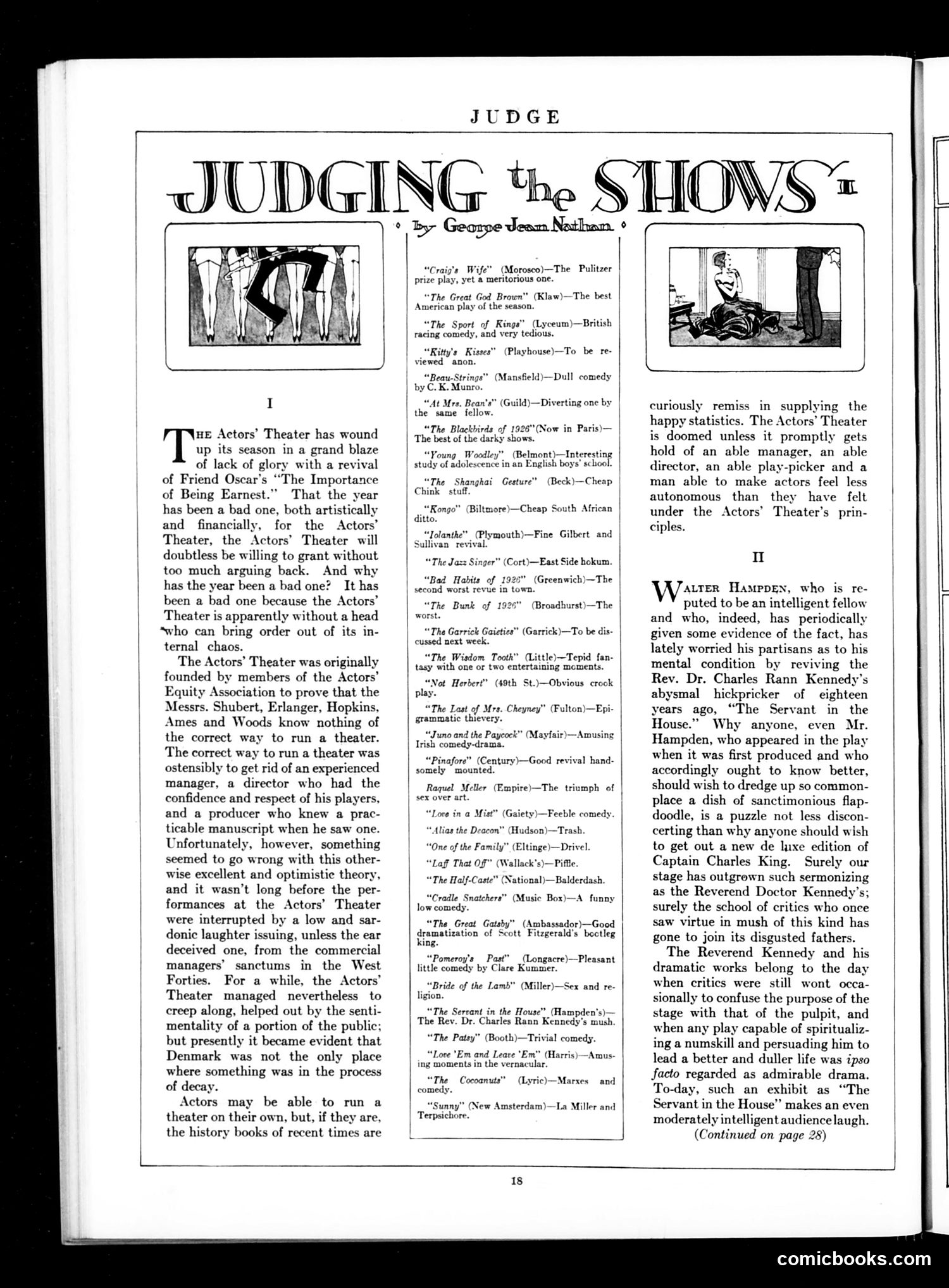
This page is primarily a theater review column by George Jean Nathan, a prominent drama critic. The two small photographs show theatrical scenes, but the main content is Nathan's critical assessment of the Actors' Theater's failed season. **The satire:** Nathan mocks the Actors' Theater—founded by members of Actors' Equity to prove established theater producers (Shubert, Erlanger, Hopkins, et al.) didn't know how to run theaters—for ironically failing precisely because it lacked experienced management. The theater attempted to operate without a professional manager, director, or experienced producer, replacing them with actors. Nathan sardonically notes this "otherwise excellent and optimistic theory" collapsed, and the commercial producers in the "West Forties" were apparently amused by the failure. The second section reviews current Broadway productions with Nathan's characteristically caustic one-liners, dismissing many as "trash," "hokum," and "balderdash." This demonstrates his acerbic critical style typical of Judge magazine's theater commentary.
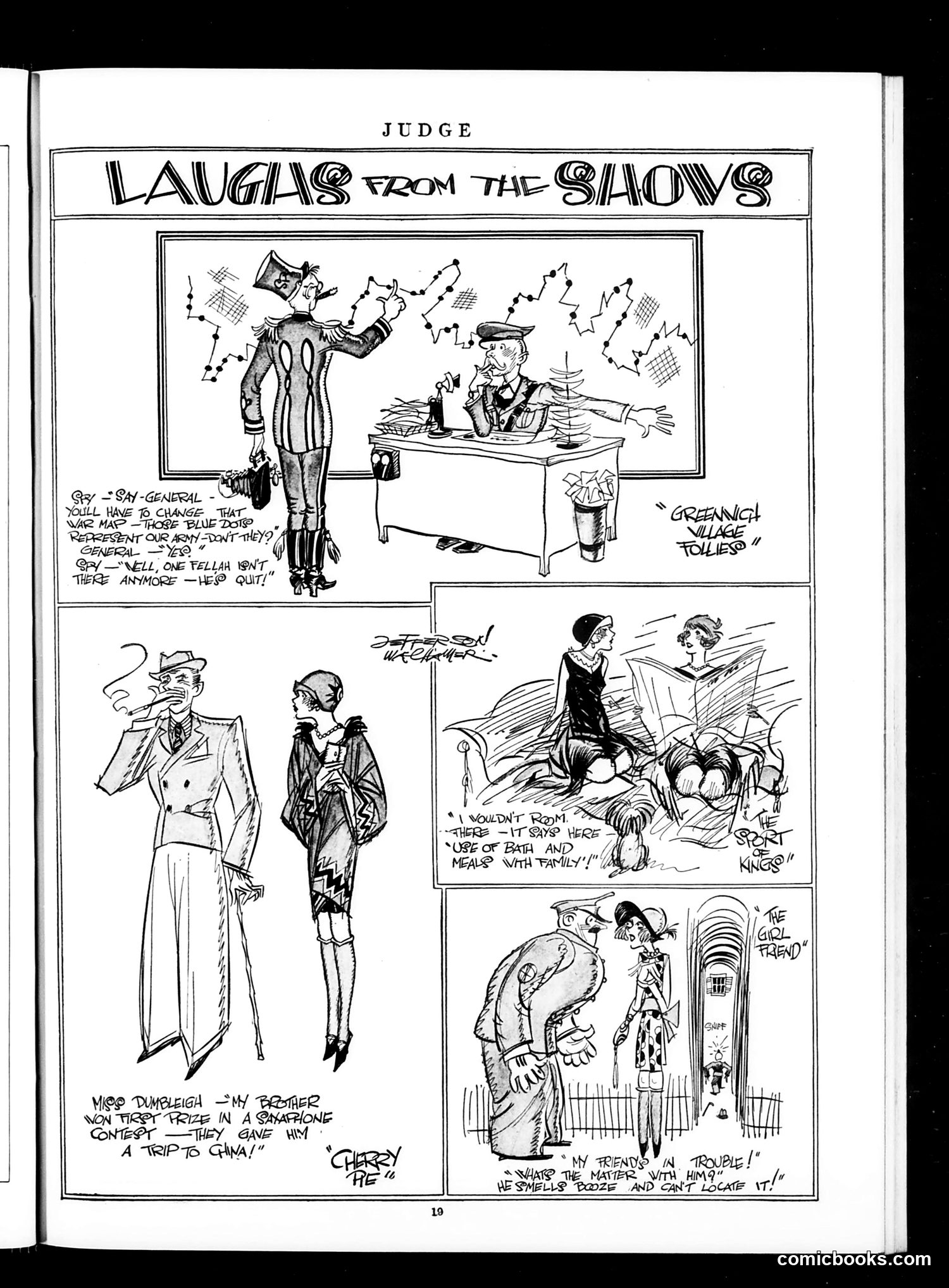
This page satirizes military leadership and domestic complaints during wartime (likely WWI era). The top panel shows a general frustrated that army recruits keep deserting—the officer notes one soldier "quit" entirely, suggesting poor morale or discipline. The lower panels appear to mock civilian grumbling: a woman complains about rationing and bath restrictions; Miss Dumbleigh boasts her brother won a saxophone contest offering a China trip (seemingly trivializing the war); and a man complains his friend is unreliable and smells bad. The satire targets both incompetent military leadership unable to retain soldiers and self-absorbed civilians prioritizing petty personal grievances (comfort, prizes, social embarrassments) over serious wartime needs. The "shadows" in the title likely refers to these hidden, shameful aspects of home-front behavior and military dysfunction.
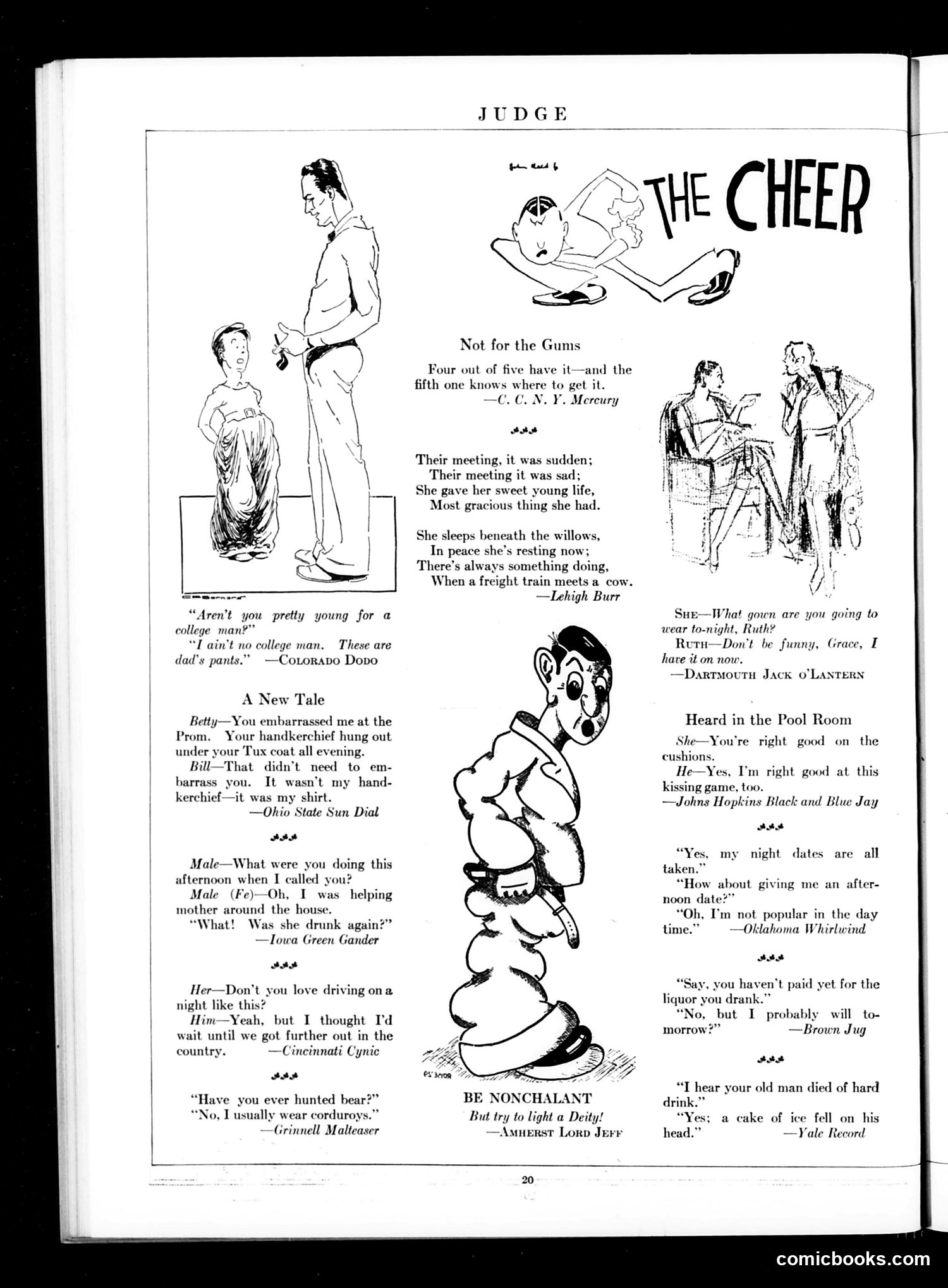
This page from **Judge** (a satirical humor magazine) contains mostly **short jokes and quips** rather than political cartoons. The humor targets college students, dating couples, and social conventions of the era. The jokes mock: - **Youth pretension**: A boy wearing his father's oversized pants to appear older - **Dating awkwardness**: Prom embarrassment, unclear romantic intentions, daytime unpopularity - **Class**: References to wealth (Tuxedos, driving in the country) - **Gender relations**: Stereotypes about women drivers and dating behavior - **Alcohol**: Multiple jokes about drinking and intoxication, suggesting Prohibition-era social anxieties The central cartoon shows a rotund figure labeled "BE NONCHALANT," illustrated as someone trying to appear composed while clearly anxious—satirizing affected sophistication. The magazine credits various college humor publications (Ohio State, Yale, Johns Hopkins), indicating this compiled college-sourced humor. The satire is gentle, targeting generational social behaviors rather than politics.
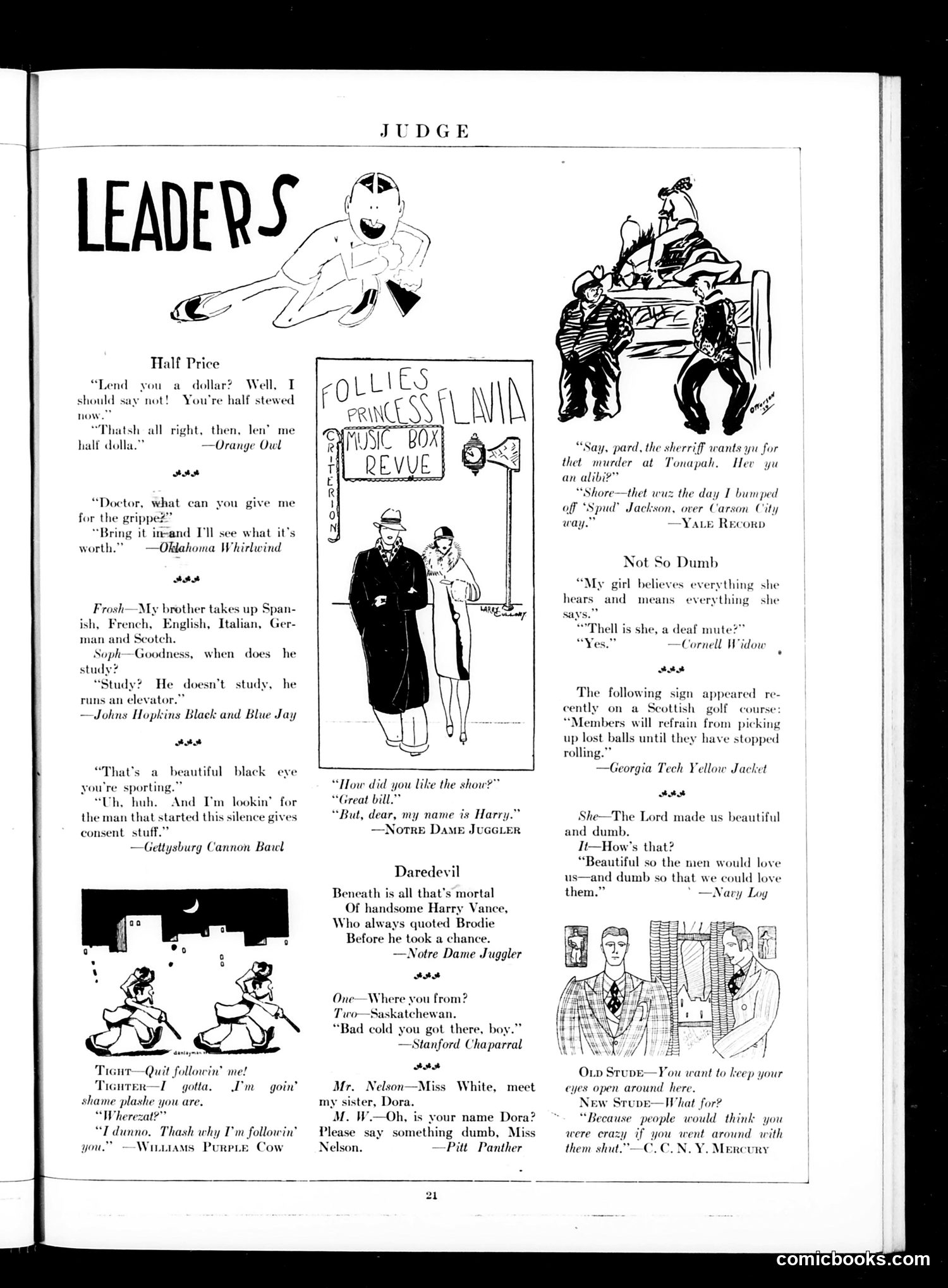
This is a humor page featuring short jokes and cartoons typical of early 20th-century American satirical magazines. The content includes: **Main themes:** - Ethnic/dialect humor (frequent in period comedy): jokes about language learners, a "Frosh" whose brother studies multiple languages while running an elevator, and Saskatchewan references - Gender stereotypes: women portrayed as unintelligent ("believes everything"), a "deaf mute" girlfriend, and a woman who only says "dumb" things - Prohibition-era jokes: a drunk man asking to "lend" money while "half stewed" - Western/frontier humor: sheriffs and murders in Nevada towns - College humor: credited to Yale, Notre Dame, Stanford, etc. **Visual elements:** A "Follies Princess Flavia" music box revue advertisement, illustrations of couples and comic situations. **Notable context:** The pervasive ethnic stereotypes and sexist humor reflect common Judge magazine content of the era—what was considered acceptable comedy in the 1910s-1920s would be offensive today.
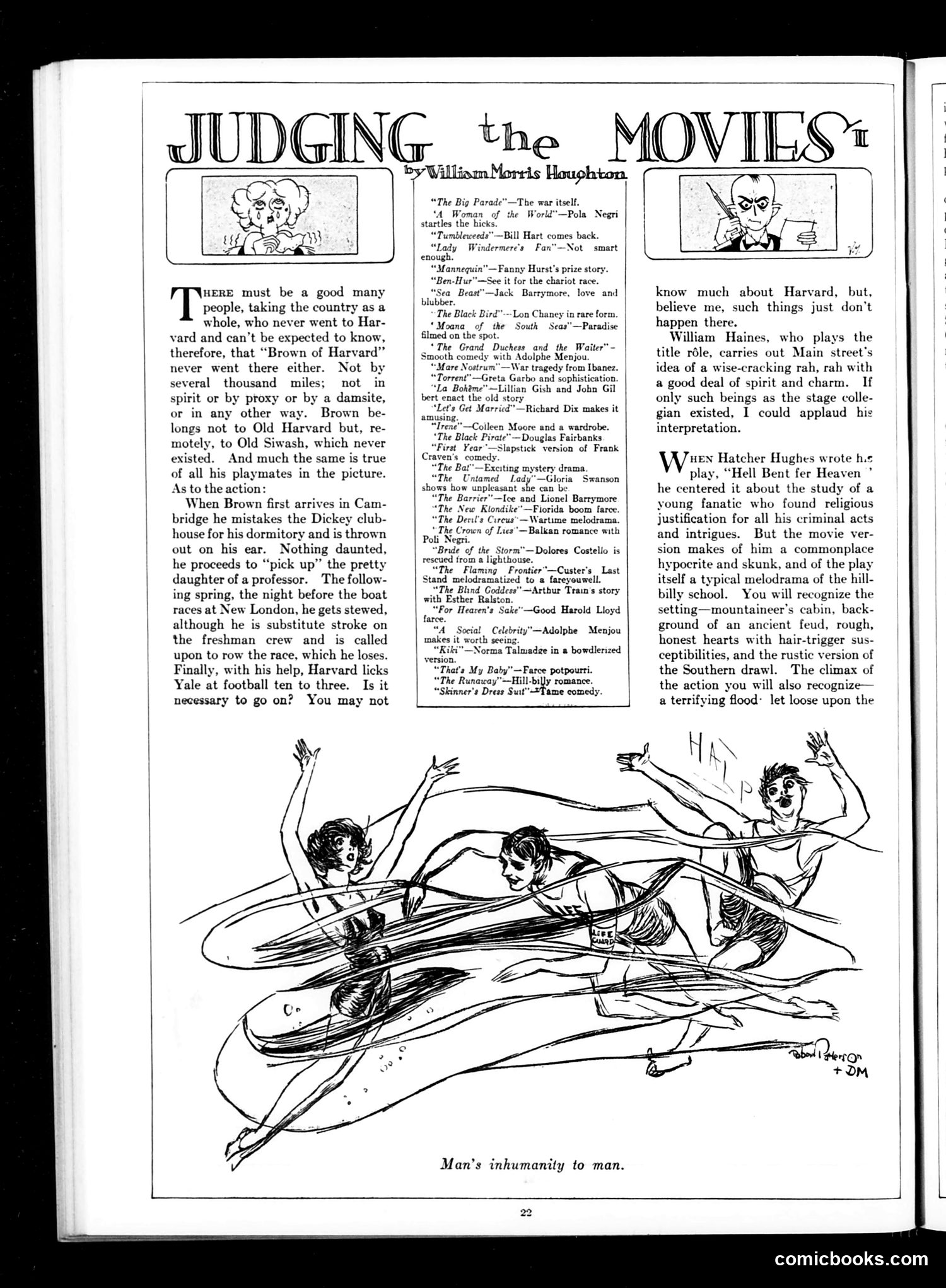
This page contains film reviews by William Morris Houghton from *Judge* magazine, accompanied by a satirical cartoon. The reviews mock various 1920s movies—some titles are identifiable (*The Big Parade*, *Moana of the South Seas*)—with dismissive one-liners ("Not smart enough," "Paradise filmed on the spot"). The main article critiques *"Brown of Harvard,"* a film about a working-class student mistaken for a Harvard man. Houghton argues the movie's portrayal of Harvard life is inaccurate, and actor William Haines's "wise-cracking rah" character bears no resemblance to actual Harvard students. The cartoon below illustrates "Man's inhumanity to man"—three figures seemingly trapped in or struggling through ribbon-like forms, suggesting entanglement or conflict. The page satirizes Hollywood's casual distortion of American institutions and regional stereotypes for entertainment profit.
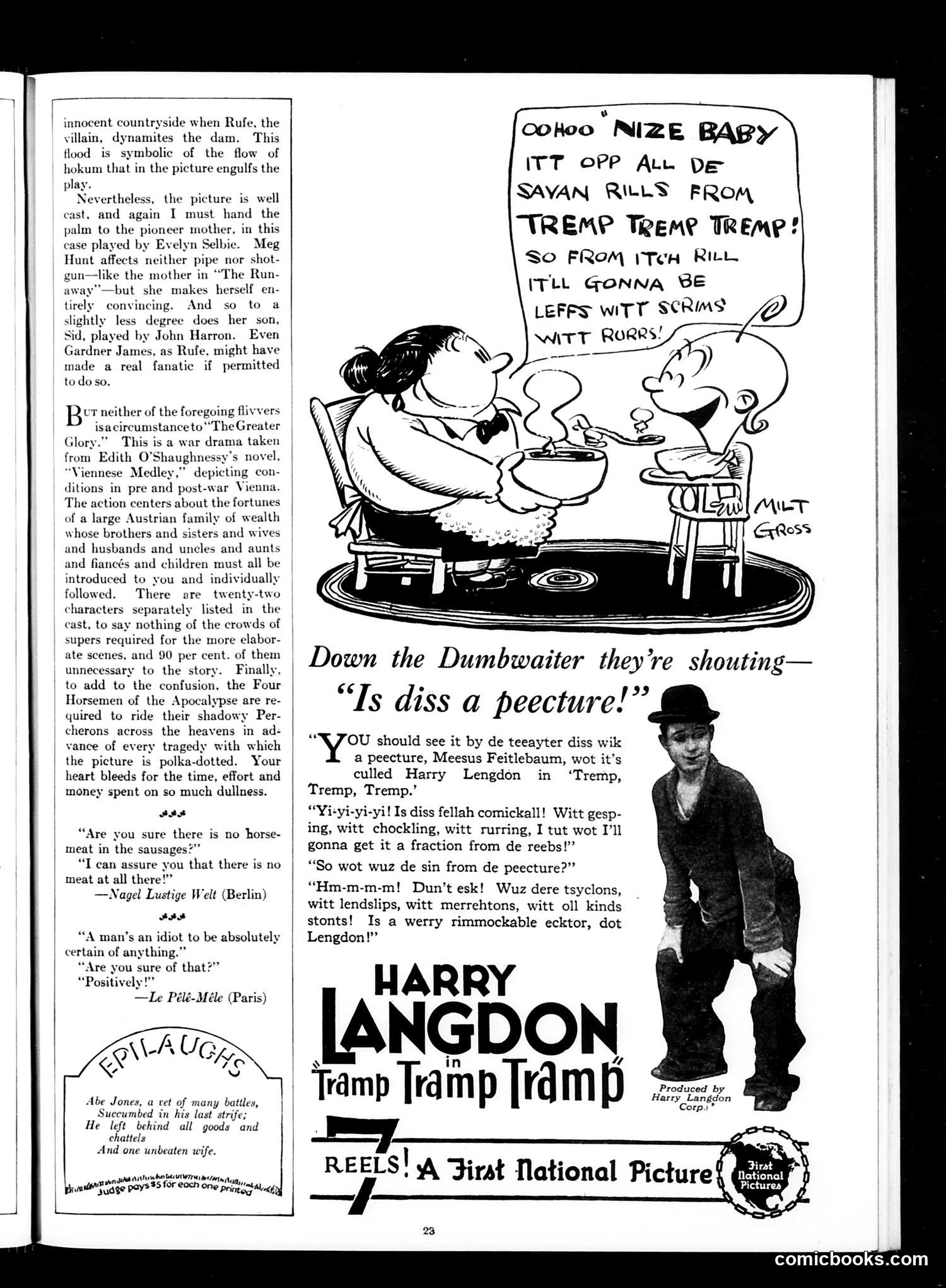
This page features film criticism and advertisements circa the silent film era. The main cartoon depicts Yiddish-speaking immigrants enthusiastically discussing a Harry Langdon comedy called "Tramp Tramp Tramp" in exaggerated dialect ("diss wik a peecture"). The humor relies on ethnic stereotyping—mocking how working-class Jewish immigrants spoke English, their malapropisms, and their enthusiasm for vaudeville-style slapstick comedy. The accompanying text reviews two films: one criticized for hokum plotting, and "The Greater Glory," a post-WWI Vienna drama panned for overcomplicated plot with 22 characters and unnecessary spectacle. The satirical intent targets both cheap filmmaking practices and immigrant audiences, reflecting 1920s attitudes that portrayed working-class ethnic viewers as unsophisticated consumers of lowbrow entertainment. The exaggerated dialect humor was typical of Judge's satirical approach to American social stratification.
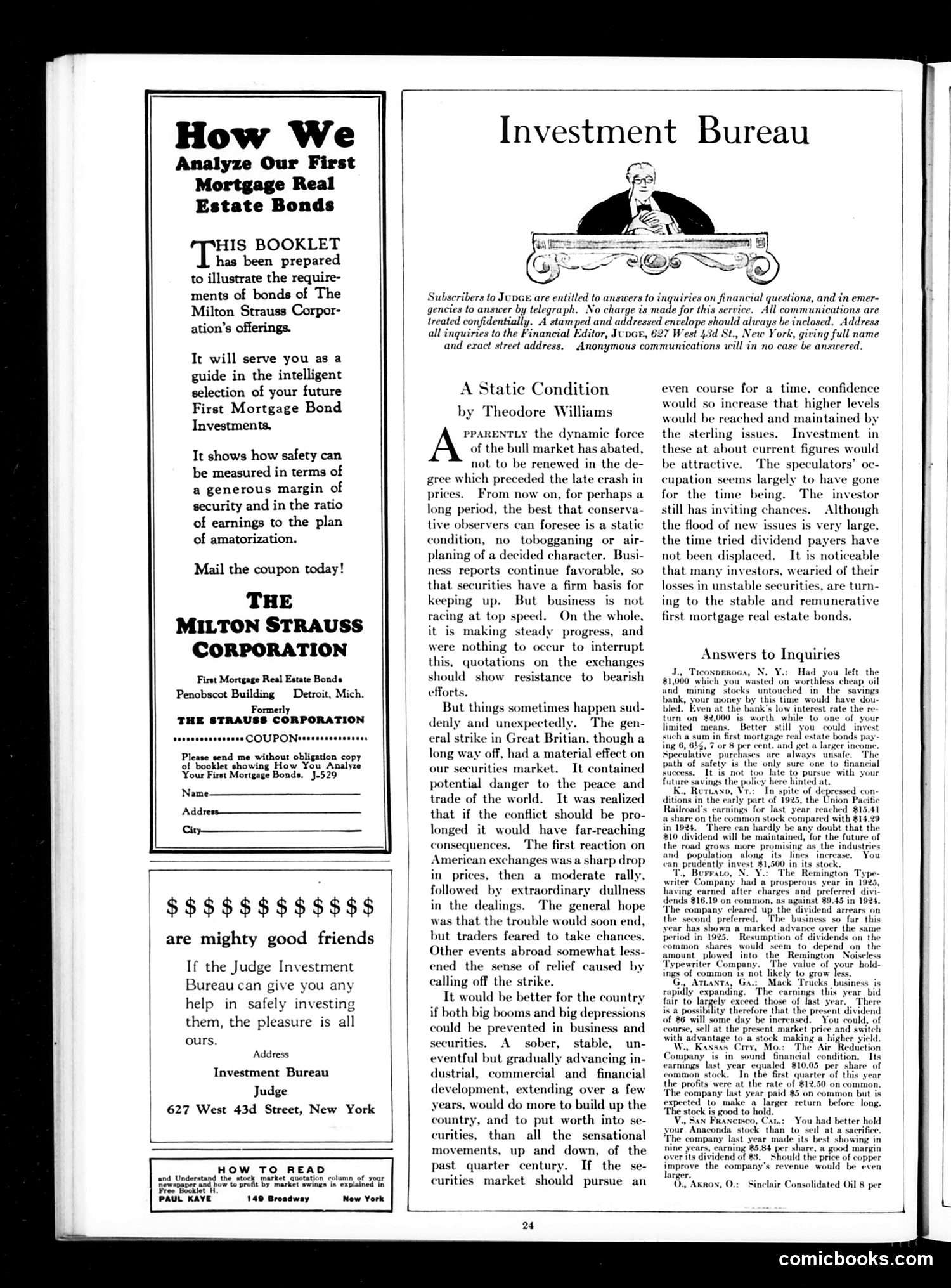
This page is primarily **advertising and financial content**, not satirical commentary. The left side advertises Milton Strauss Corporation's mortgage bonds, targeting investors seeking safety through detailed financial analysis. A coupon invites readers to request their educational booklet. The right side features "Investment Bureau," Judge magazine's **legitimate financial advice column**. The article "A Static Condition" by Theodore Williams analyzes current market conditions post-crash, discussing how the bull market's dynamic force has "abated." Williams argues for steady, gradual industrial development over sensational market swings, noting that a recent British general strike caused American market anxiety. This represents Judge functioning as a **financial publication serving investors**, not purely as satire. The tone is earnest and advisory rather than mocking. The focus reflects 1920s concerns: market stability, bond safety, and the interconnection between international events (British labor unrest) and American securities markets.
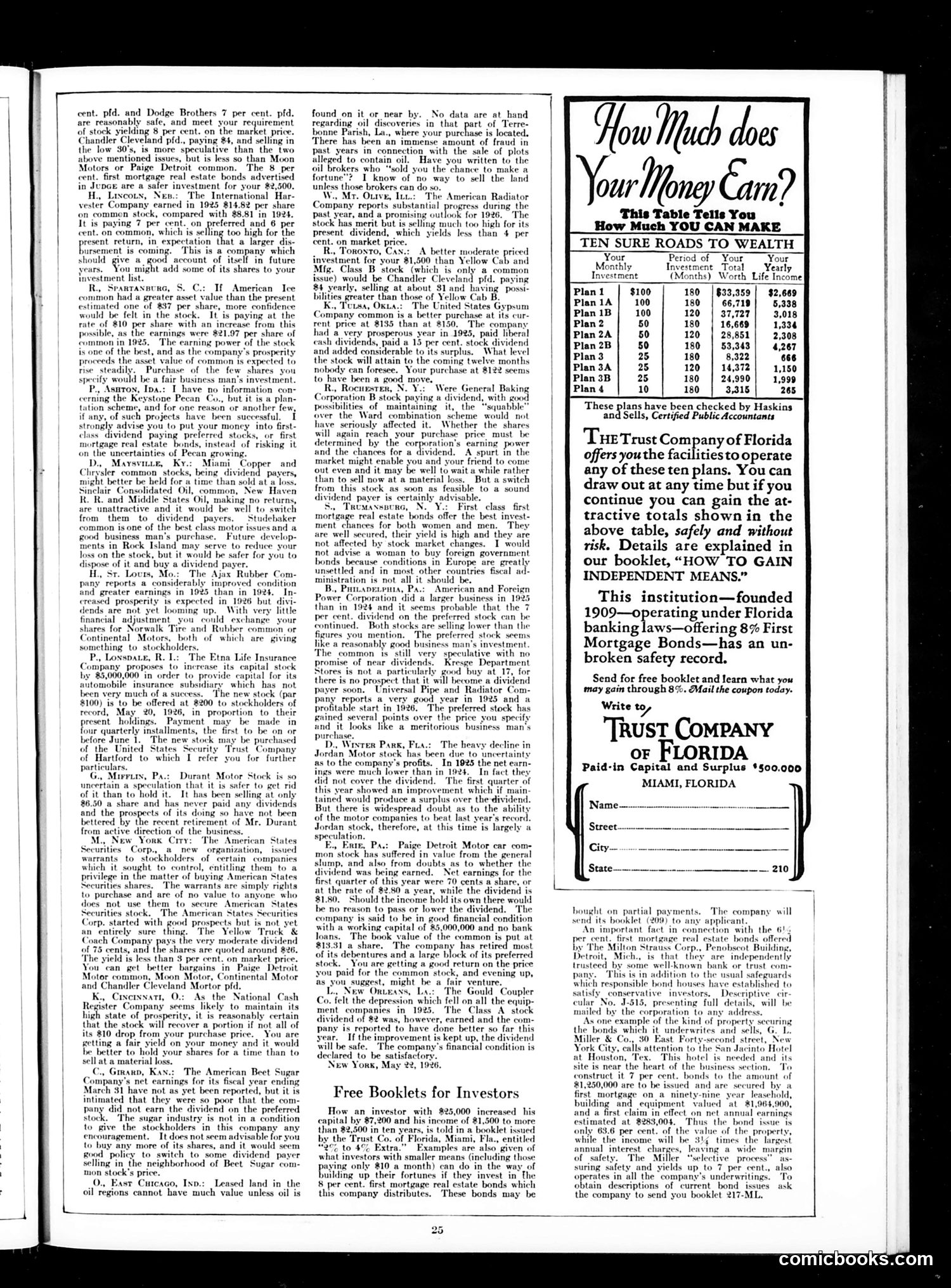
This is primarily **financial advice content**, not political satire. The page features a large advertisement for "The Trust Company of Florida" offering investment plans, surrounded by a "Question and Answer" financial column addressing readers' stock investment concerns. The column discusses various 1920s companies (Dodge Brothers, Chrysler, Rock Island railroad, Durant Motors, etc.), advising readers whether to buy, hold, or sell shares. Topics include dividend yields, stock valuations, and which industrial stocks appear sound investments. The Trust Company ad emphasizes safe, guaranteed returns through their mortgage bond investments—offering plans ranging from $100-$500 initial investment promising returns of $2,669-$33,359 over time. **Context for modern readers**: This reflects the pre-1929 stock market boom when investment advice was ubiquitous in magazines, and companies aggressively marketed securities to ordinary people. The emphasis on "safety" and guaranteed returns seems almost quaint given the 1929 crash that followed.
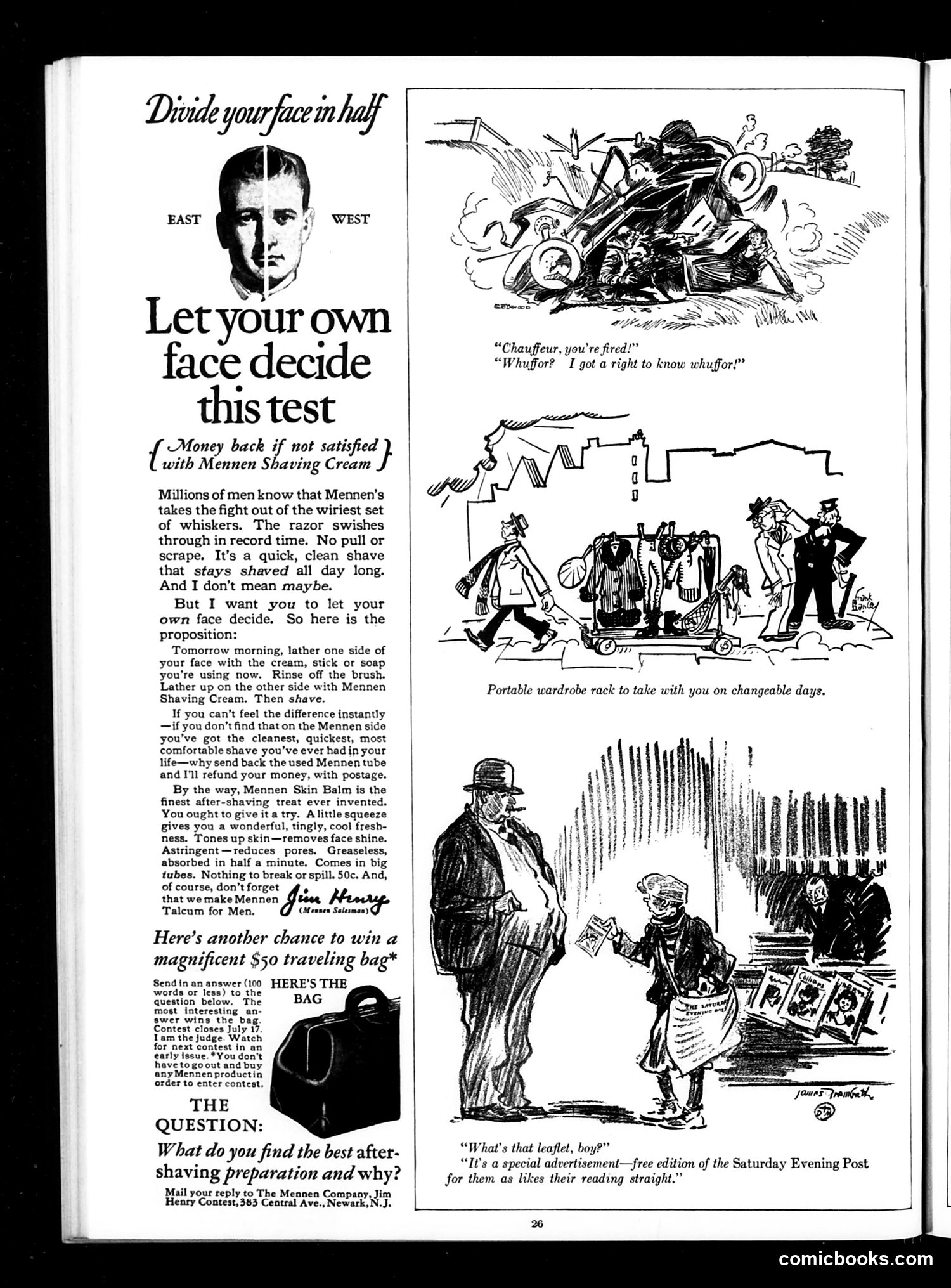
This page is primarily a **Mennen Shaving Cream advertisement** with embedded satirical cartoons. **Main Advertisement (Left):** A split-face comparison challenges readers to test Mennen against competing products, offering a money-back guarantee. The ad emphasizes the product's superiority in providing a smooth, all-day shave without pull or scrape. **The Cartoons (Right):** Three separate satirical sketches mock various subjects: 1. **Top:** A chauffeur is fired from a car accident, demanding to know "why"—satirizing employment disputes and dismissive employers. 2. **Middle:** A "portable wardrobe rack" on wheels for "changeable days"—likely mocking fashion excess or traveling salesmen. 3. **Bottom:** A boy selling "leaflets" (advertisements printed as news) to someone who prefers "straight reading"—**this is the key satire**. It critiques the prevalence of advertising disguised as editorial content in publications like the Saturday Evening Post, lampooning both commercial manipulation and readers who don't distinguish ads from actual news. The irony is sharp: Judge itself is running this satirical critique *within* a full-page advertisement.
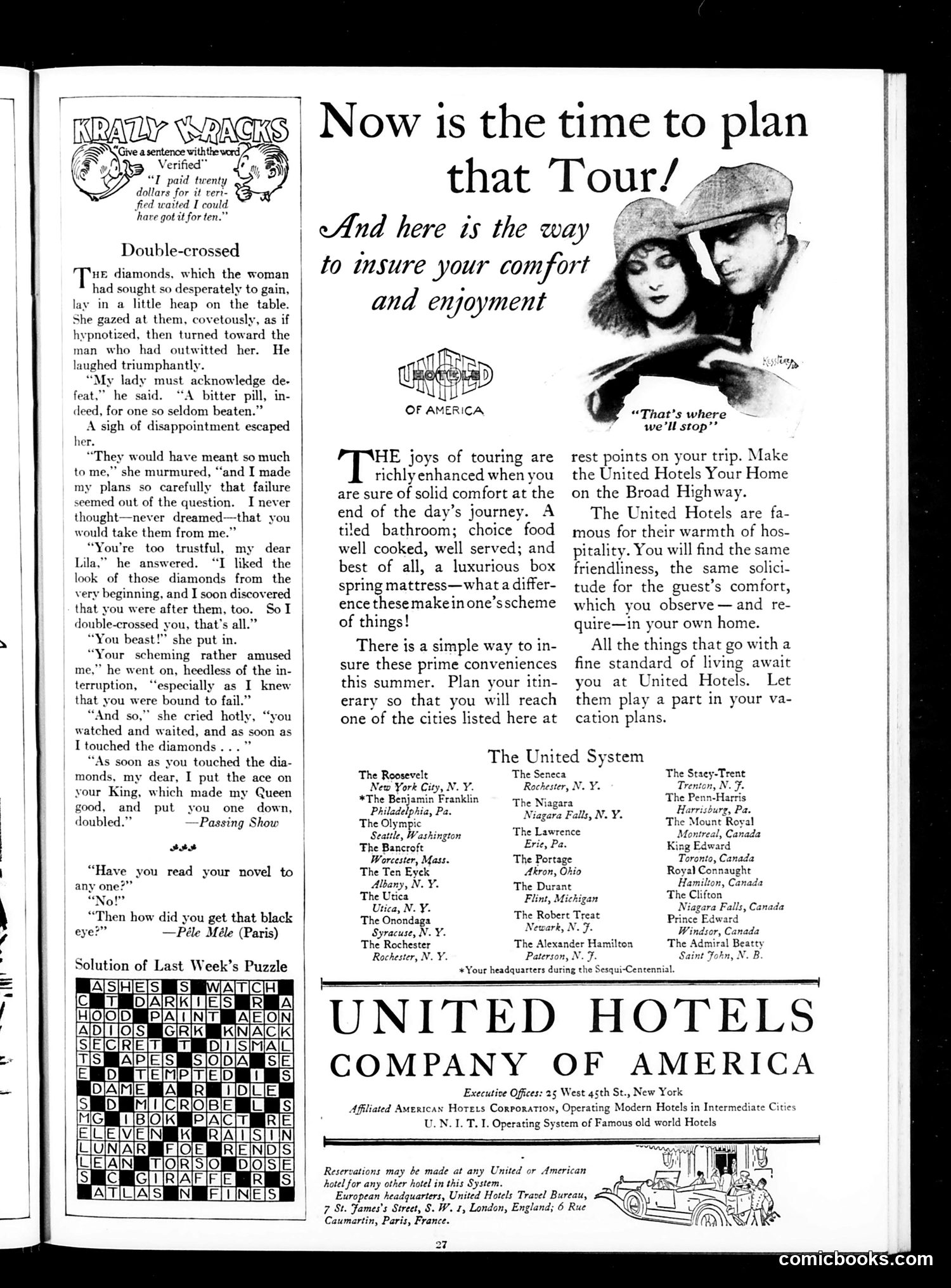
This page contains two distinct elements: **"Double-Crossed" Story:** A short romantic fiction piece depicting a man and woman playing cards or a similar game. The man outwits the woman by pretending ignorance while secretly detecting her own scheme—he "double-crosses" her by turning her own deception against her. The story plays on contemporary themes of romantic gamesmanship and wit, with the woman portrayed as scheming but ultimately outsmarted. **United Hotels Advertisement:** The bulk of the page is a corporate advertisement for the United Hotels Company of America. It pitches their hotel chain as offering comfort and reliability for summer tourists—emphasizing "luxurious" mattresses, good food, and hospitable service. The ad lists numerous hotel locations across the U.S. and Canada, framing travel as a leisure activity requiring reliable accommodations. The "Krazy Kracks" puzzle and brief jokes at the page margins are typical Judge filler content. The advertisement dominates, reflecting how magazines of this era generated revenue through paid content alongside editorial material.
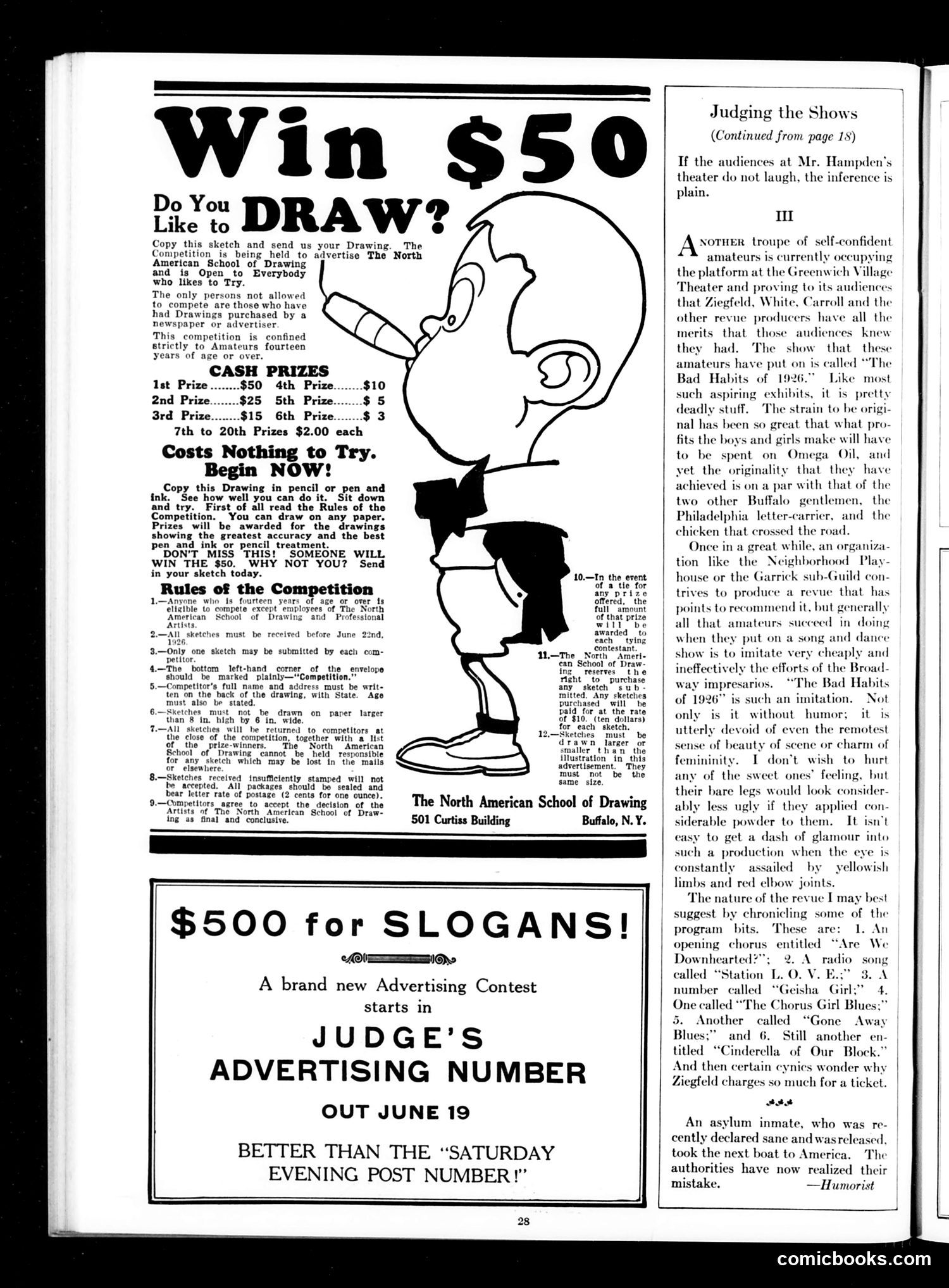
This page combines **advertising and theater criticism** from Judge magazine (a satirical publication). **Main Content:** The dominant feature is a **drawing competition advertisement** for the North American School of Drawing, offering $50 for the best amateur sketch submission. The cartoon mascot—a simple line-drawn figure with exaggerated features—illustrates the contest. **Theater Review Section (Right Column):** The "Judging the Shows" column critiques amateur theatrical productions at Greenwich Village venues, specifically mocking "The Bad Habits of 1926" revue. The reviewer dismisses these amateur shows as cheap imitations of professional productions by Ziegfeld and others, lacking originality, humor, or charm. The criticism extends to the performers themselves—particularly their physical appearance and lack of glamour compared to professional dancers. **Historical Context:** This reflects 1920s cultural snobbery toward amateur theater and the tension between professional Broadway spectacle and amateur productions. The tone is condescending, typical of Judge's satirical approach to lowbrow entertainment and aspiring artists. **Bottom Advertisement:** A separate ad promotes Judge's advertising slogan contest with $500 prize money.
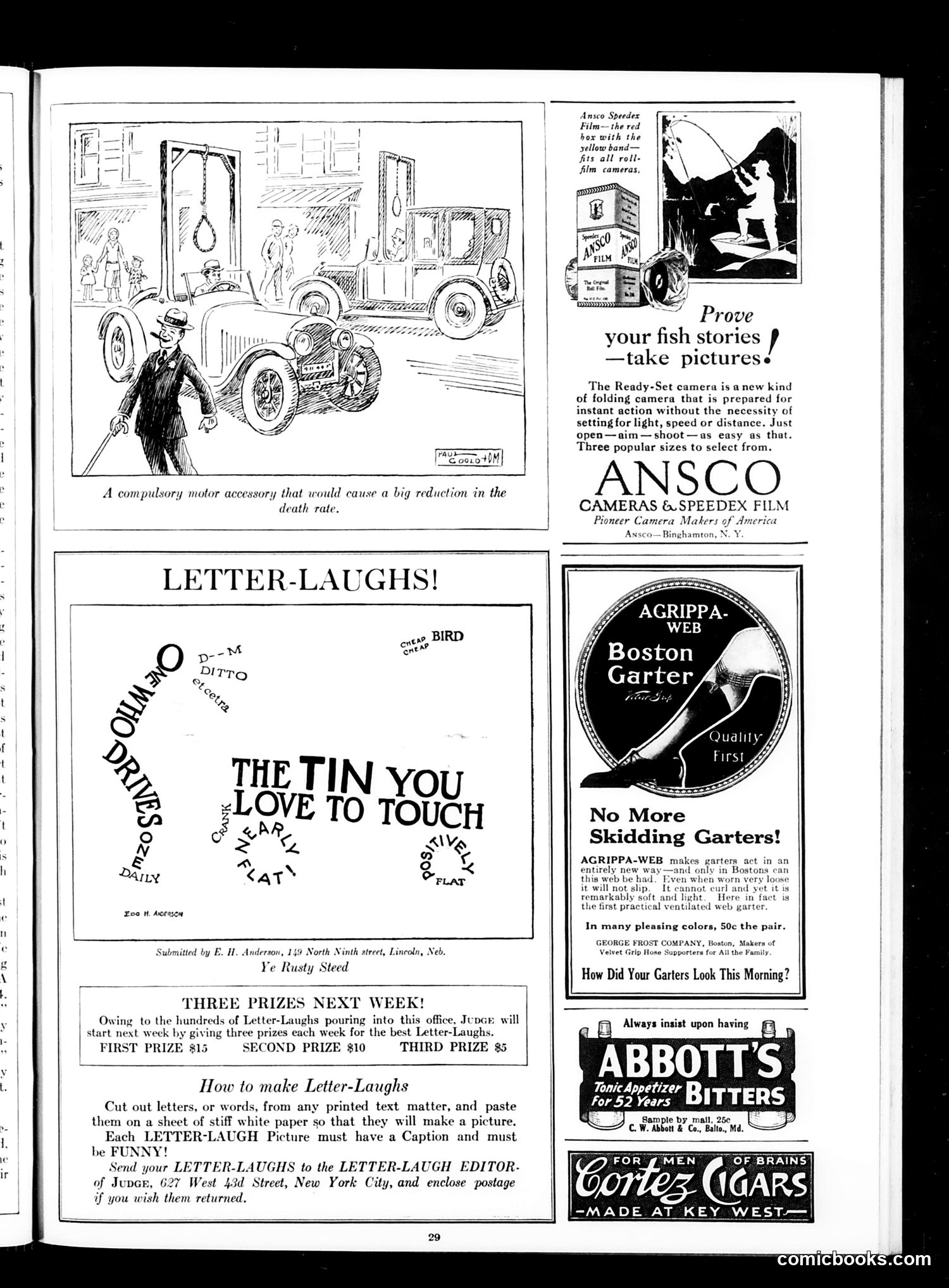
This page primarily contains **advertisements and a reader participation feature** rather than political satire. The main cartoon (top left) depicts a **traffic safety joke**: a man with a gallows labeled "motor accessory" stands among early automobiles. The caption suggests that making this execution device a "compulsory motor accessory" would reduce traffic death rates—a dark humor commentary on automobile fatalities, which were a serious public concern in the early 20th century. Below is the magazine's "Letter-Laughs" section, a reader contest where participants create visual puns by cutting and pasting letters from printed text. The example shown spells "DITTO BIRD" and other words forming a picture about touching tin, with the submitted contributor credited. The remainder consists of period advertisements for **cameras (Ansco), garters, bitters, and cigars**—typical commercial content in such publications. The page illustrates how Judge mixed satirical content with substantial advertising revenue.
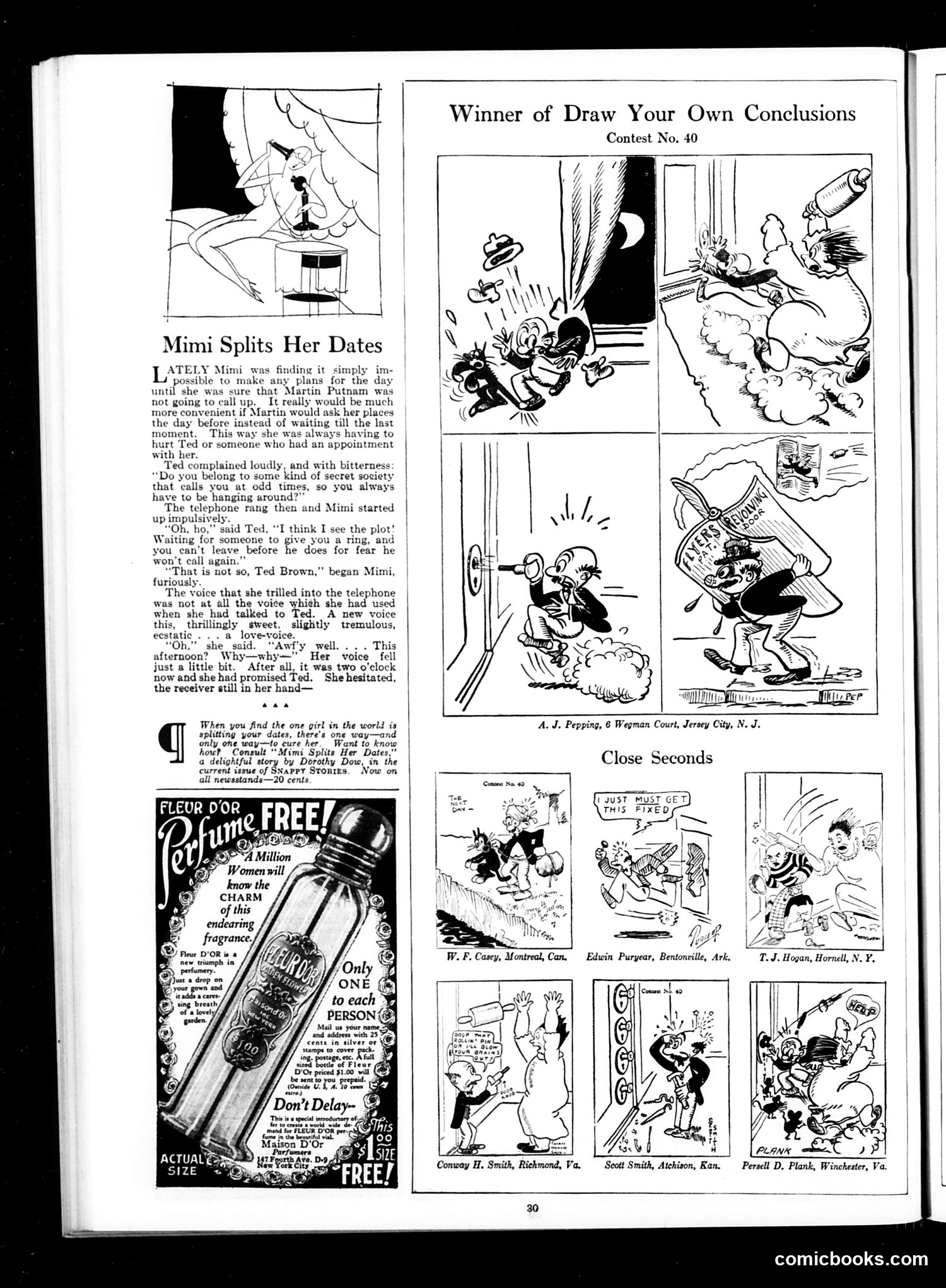
This story satirizes a modern dating problem: a young woman named Mimi juggling multiple suitors by accepting last-minute plans without committing to anyone in advance. Her boyfriend Ted complains that she constantly cancels on him because she waits for other men (particularly Martin Putnam) to call with offers—implying she'll drop Ted if someone more appealing rings. The humor targets female indecision and the era's dating conventions where men initiated plans. The "Draw Your Own Conclusions" contest entries below show readers' humorous interpretations of comic scenarios. The accompanying Fleur d'Or perfume advertisement promises romantic success—a pointed irony given Mimi's romantic chaos. The overall message: women who play the field by keeping multiple options open will lose everyone's respect and commitment.
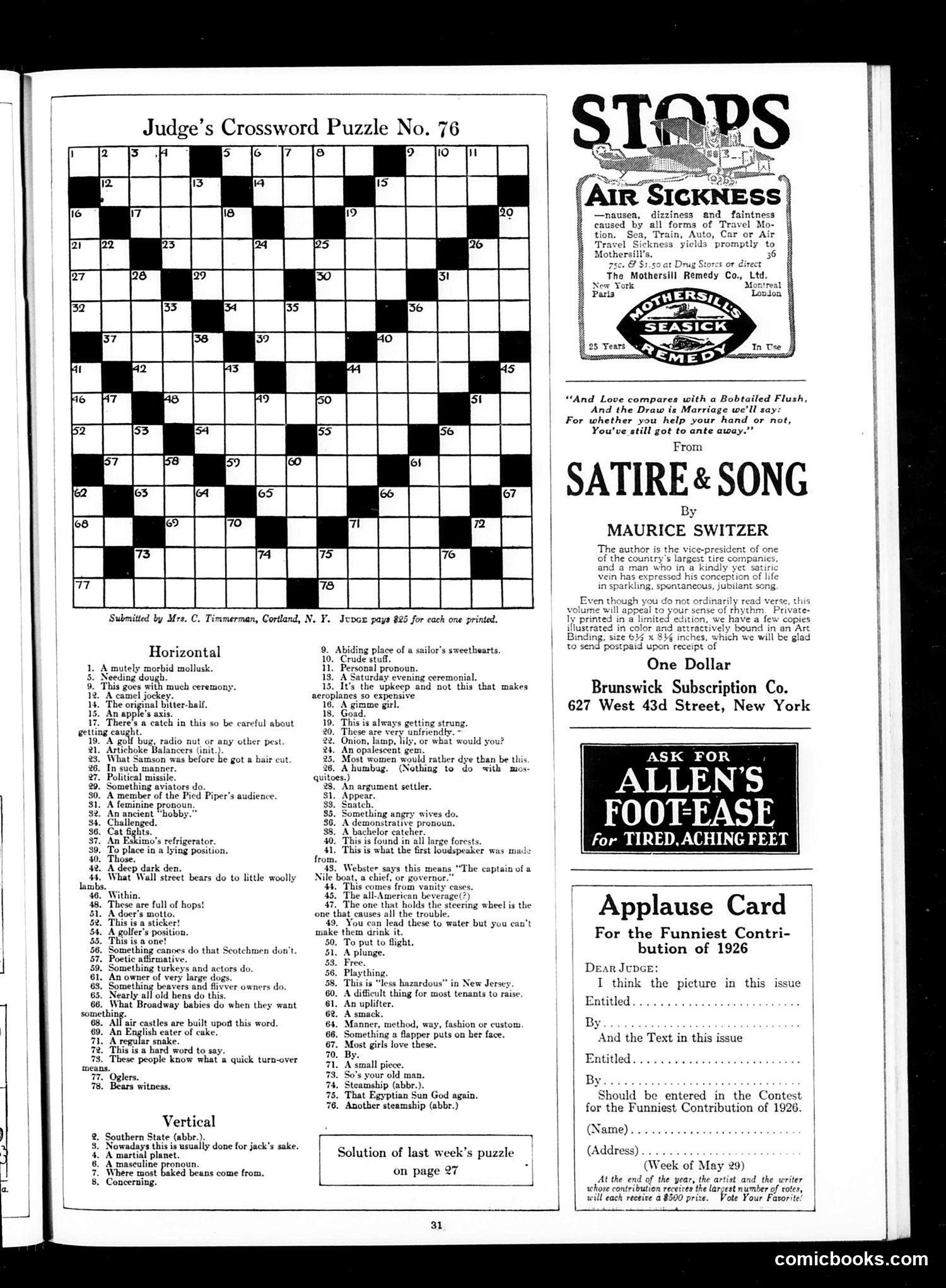
This page is primarily a **crossword puzzle** (#76) with advertising and promotional content—not a political cartoon. The puzzle itself contains typical 1920s satirical clues reflecting contemporary American society: references to "flappers," radio enthusiasts ("radio nut"), golf culture, Broadway entertainment, and automobiles ("flivver owners"). Clue 16 mentions "gimme girl" (a gold-digger), reflecting 1920s social anxieties about modern women. The advertisements are period-typical: **Mothersill's Remedy** for air/motion sickness (relevant as commercial aviation was new); **Allen's Foot-Ease** for tired feet; and **Brunswick Subscription Co.** soliciting book club membership. A sidebar promotes **"Satire & Song"** by Maurice Switzer, described as vice-president of "the country's largest tire company," positioning him as a businessman-turned-poet offering humorous social commentary. The **"Applause Card"** invites readers to submit the funniest contribution for 1926, with prizes for best picture and text contributions. The page reflects 1920s popular culture, consumerism, and commercial entertainment rather than political messaging.
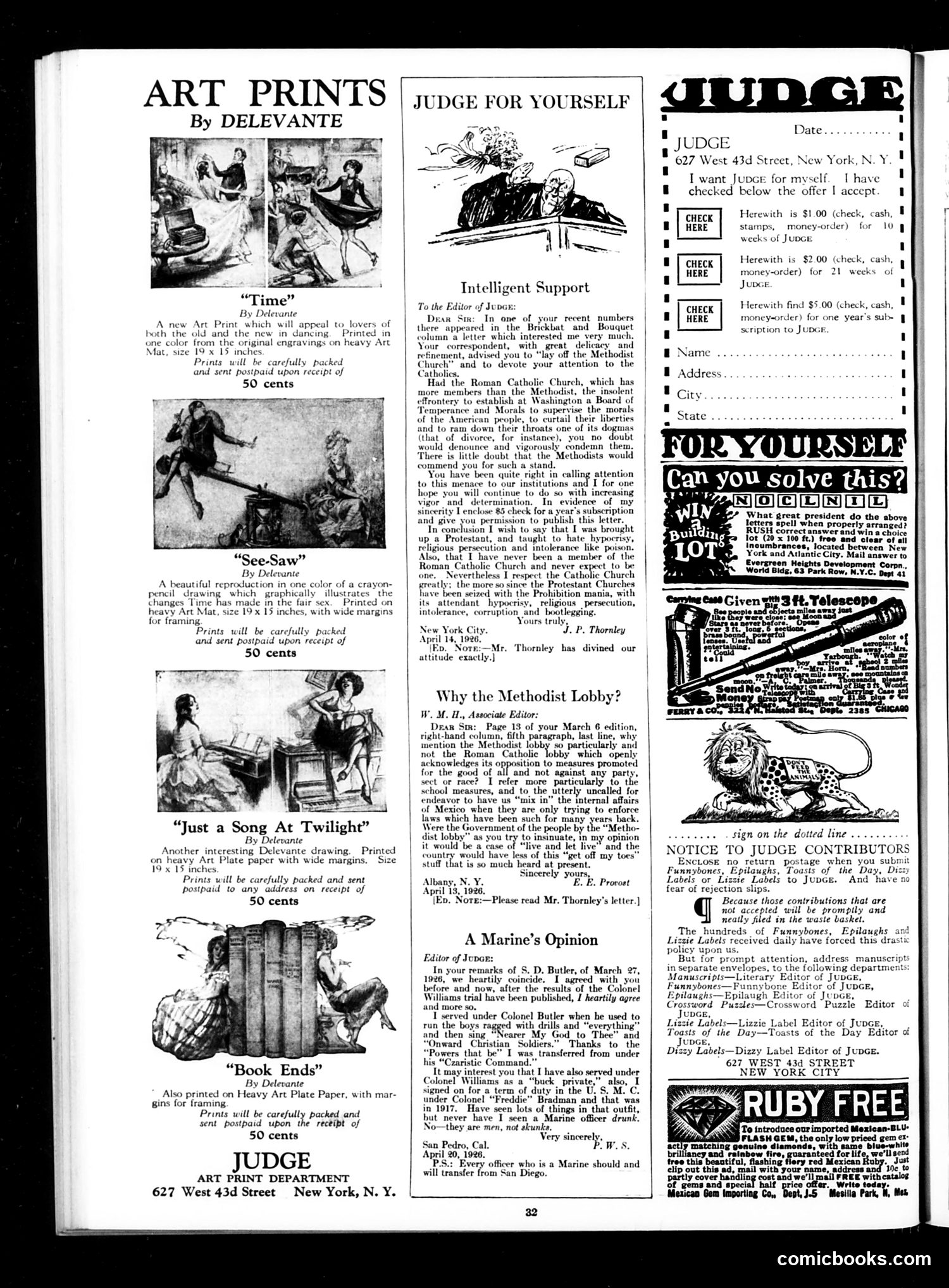
This page is primarily **advertising and reader letters**, not political satire. The top section advertises art prints by Delevante—decorative drawings of women in various poses ("Time," "See-Saw," "Just a Song At Twilight," "Book Ends")—available for 50 cents each. The substantive content comprises three reader letters debating **Protestant versus Catholic institutional influence in America**: 1. **"Intelligent Support"**: A correspondent praises Judge for criticizing Methodist lobbying and moral policing, while claiming to respect Catholicism despite personal Protestantism. 2. **"Why the Methodist Lobby?"**: A reader challenges Judge's selective criticism, asking why they single out Methodist opposition to Prohibition while ignoring Catholic institutional opposition. 3. **"A Marine's Opinion"**: Brief agreement with Judge's earlier remarks about Colonel S.D. Butler and military conduct. The letters reflect **1920s tensions over Prohibition, religious institutional power, and whether Judge's criticism was evenhandedly applied**—suggesting the magazine had taken editorial positions on these controversies that readers debated.
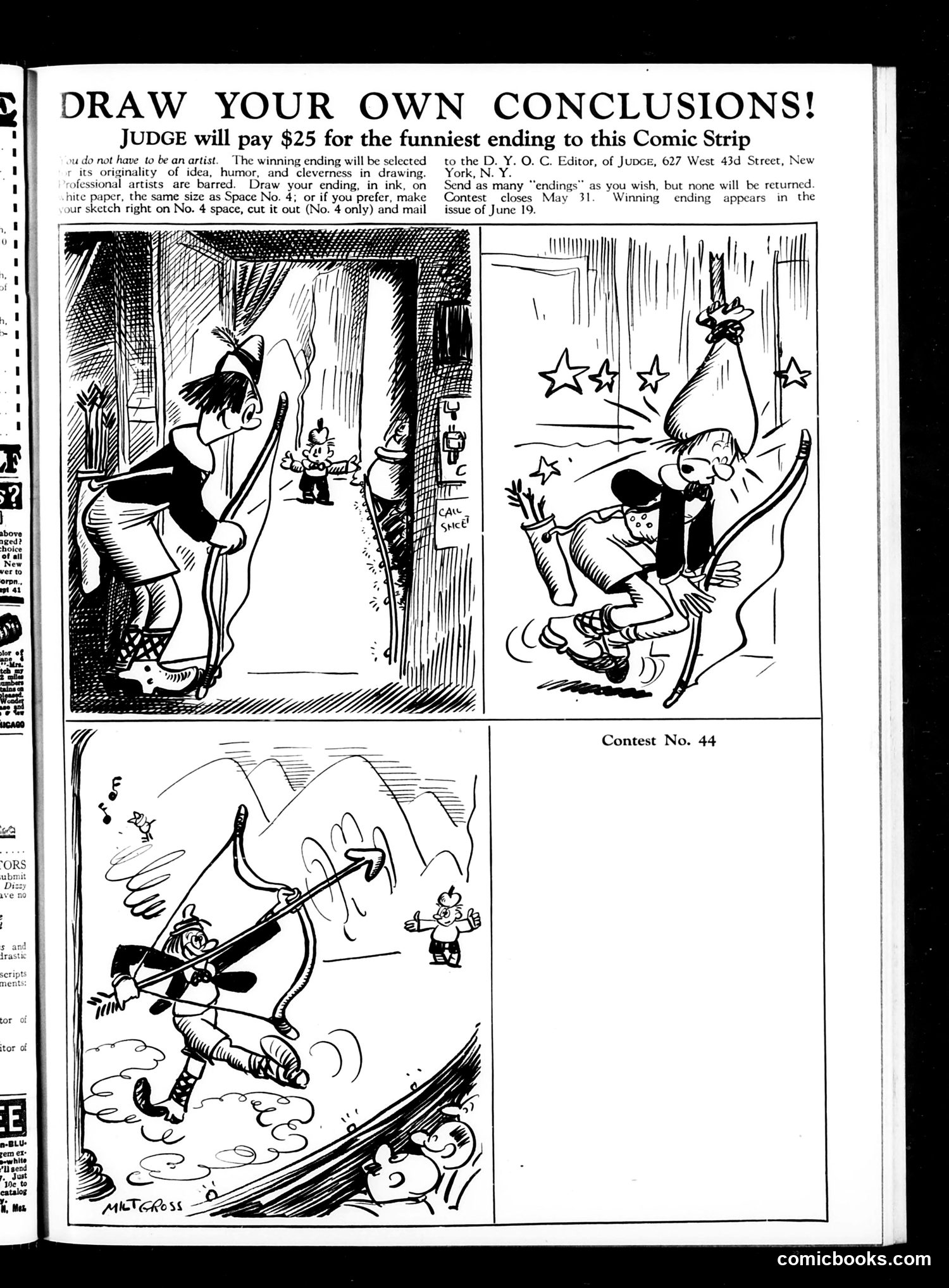
This page presents an interactive comic-strip contest where Judge magazine invites readers to complete three unfinished cartoon scenarios. The magazine offered a $25 prize for the funniest ending submitted. The three panels show: 1. A woman at a doorway with a small figure visible inside 2. A character surrounded by stars, appearing to celebrate or react to something 3. A character with a bow and arrow aiming at what appears to be small figures The contest mechanics are straightforward: readers should draw their own comic endings on white paper (or on the provided space itself) and mail them to Judge's office in New York. No original submissions would be returned. The contest closed May 31, with the winning entry to appear in the June 19 issue. This reflects Judge's interactive approach to humor—outsourcing comedy creation to its readership while crowdsourcing jokes at minimal cost. The specific scenarios being completed are unclear without knowing the original strip's context.
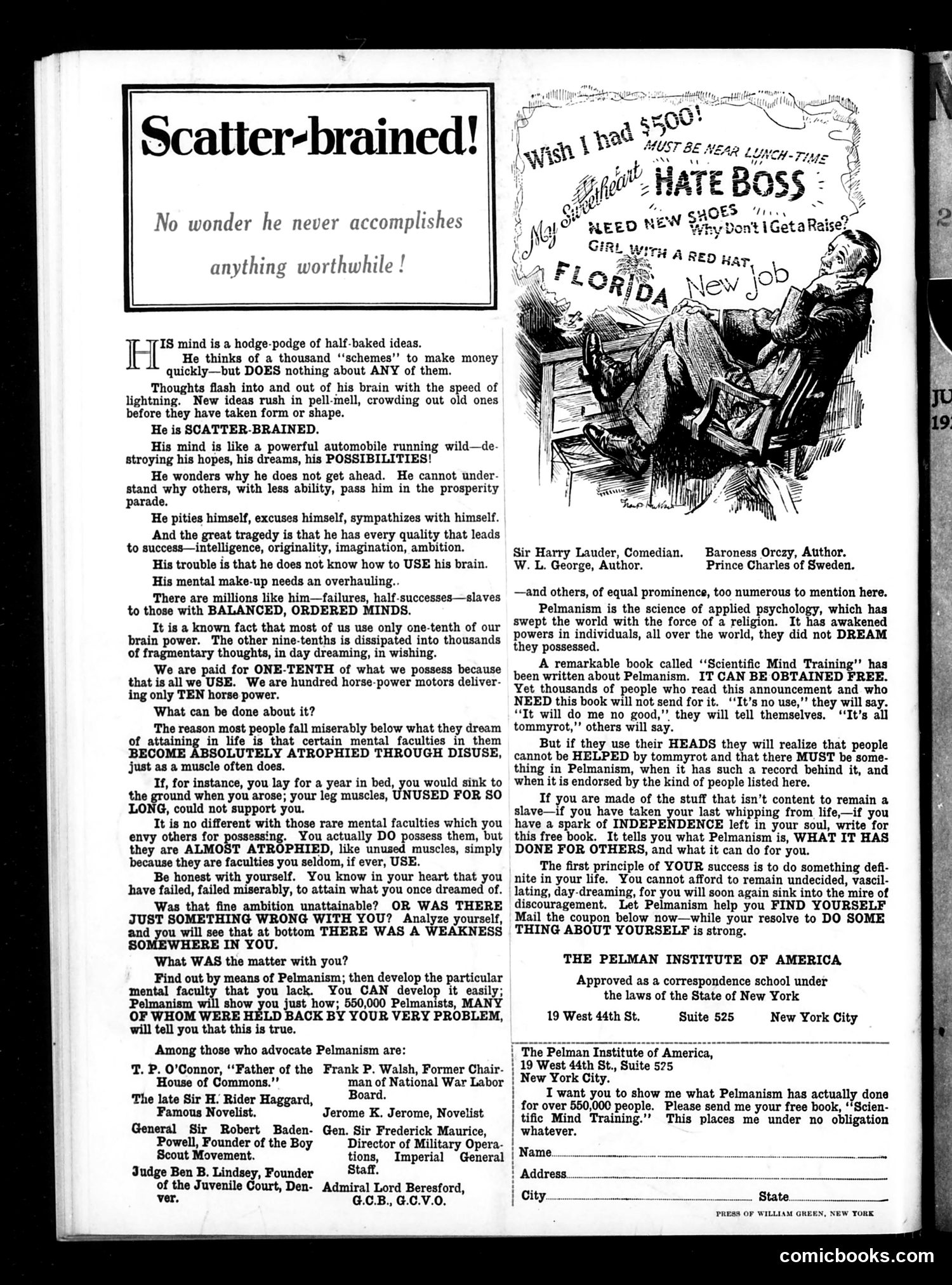
This is primarily a **Pelmanism self-help advertisement** disguised as satirical social commentary. The cartoon shows a man at his desk drowning in scattered thoughts—"HATE BOSS," "Need New Shoes," "FLORIDA," "New Job"—representing mental disorganization. The text mocks people with unfocused minds who squander natural talent through scattered thinking and poor mental discipline. The implicit message: such people deserve their failure. **The pitch:** Pelmanism (a real memory/mind-training system popular in the early 20th century) can cure this weakness. The ad lists celebrities and notable figures (Sir Harry Lauder, Sir Robert Baden-Powell, etc.) as endorsers to establish credibility. This reflects **early-1900s pop psychology trends** emphasizing self-improvement through purchased mental training. The satire works by diagnosing a social "type"—the dreamer with grand ambitions but no follow-through—then offering a commercial solution to personality flaws.